MAY. (continued 2)
Reading edition
The engraving at the head of this article is altered from a lithographic print representing a “Scandiscope.” Perhaps the machine may be better understood from the annexed diagram. It simply consists of a whalebone brush, and wooden cylinders strung on rope, and put into action by the method described beneath the larger engraving.
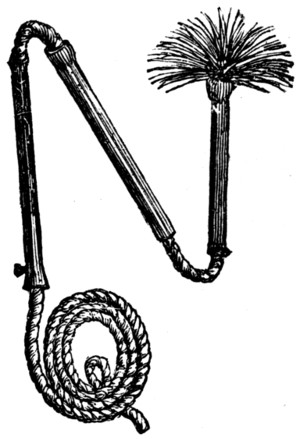
Mr. George Smart obtained two gold medals from the Society of Arts for this invention. The names of the machine chimney-sweepers in different parts of London may be obtained from Mr. Wilt, secretary of the “Society for superseding Climbing Boys,” No. 125, Leadenhall-street; the treasurer of the institution is W. Tooke, esq., F. R. S. Any person may become a member, and acquaint himself with the easy methods by which the machine is adopted to almost any chimney. As the climbing chimney-sweepers are combining to oppose it, all humane individuals will feel it a duty to inquire whether they should continue willing instruments in the hands of the “profession” for the extension of the present cruel practice.
The late Mrs. Montagu gave an annual dinner to the poor climbing boys which ceased with her death.
And is all pity for the poor sweeps fled, Since Montagu is numbered with the dead? She who did once the many sorrows weep, That met the wanderings of the woe-worn sweep! Who, once a year, bade all his griefs depart, On May’s sweet morn would doubly cheer his heart! Washed was his little form, his shirt was clean, On that one day his real face was seen, His shoeless feet, now boasted pumps—and new. The brush and shovel gaily held to view! The table spread, his every sense was charmed, And every savoury smell his bosom warmed; His light heart joyed to see such goodly cheer, And much he longed to taste the mantling beer: His hunger o’er—the scene was little heaven— If riches thus can bless, what blessings might be given! But, she is gone! none left to soothe their grief, Or, once a year, bestow their meed of beef! Now forth he’s dragged to join the beggar’s dance; With heavy heart, he makes a slow advance, Loudly to clamour for that tyrant’s good, Who gives with scanty hand his daily food!
It is the interest of the “United Society of Master Chimney Sweepers” to appear liberal to the wretched beings who are the creatures of their mercy; of the variation and degrees of that mercy, there is evidence before the committee of the house of commons. Sympathy for the oppressed in the breast of their oppressors is reasonably to be suspected. On the minutes of the “Society for superseding Climbing Boys,” there are cases that make humanity shudder; against their recurrence there is no security but the general adoption of machines in chimnies—instead of children.
Mr. Montgomery’s “Chimney Sweeper’s Friend, and Climbing Boys’ Album,” is a volume of affecting appeal, dedicated to the king, “in honour of his majesty’s condescending and exemplary concern for the effectual deliverance of the meanest, the poorest, and weakest of British born subjects, from unnatural, unnecessary, and unjustifiable personal slavery and moral degradation.” It contains a variety of beautiful compositions in prose and verse: one of them is—
The Chimney Sweeper.
Communicated by Mr. Charles Lamb, from a very rare and curious little work, Mr. Blake’s “Songs of Innocence.”
When my mother died I was very young, And my father sold me, while yet my tongue Could scarcely cry, “Weep! weep! weep!” So your chimnies I sweep, and in soot I sleep. There’s little Tom Toddy, who cried when his head, That was curl’d like a lamb’s back, was shaved, so I said, “Hush, Tom, never mind it for when your head’s bare, You know that the soot cannot spoil your white hair.” And so he was quiet, and that very night As Tom was a sleeping, he had such a sight, That thousands of sweepers, Dick, Joe, Ned, and Jack, Were all of them locked up in coffins so black. And by came an angel, who had a bright key, And he opened the coffins, and set them all free; Then down a green plain, leaping, laughing, they run, And wash in a river, and shine in the sun, Then naked and white, all their bags left behind, They rise upon clouds, and sport in the wind; And the angel told Tom, if he’d be a good boy He’d have God for his father, and never want joy. And so Tom awoke, and we rose in the dark, And got with our bags and our brushes to work; Though the morning was cold, Tom was happy and warm, So if all do their duty they need not fear harm.
Dining with Duke Humphrey, May Day Honours to Him.
In old St. Paul’s cathedral “within a proper chappel purposely made for him,” and in a proper tomb, sir John Beauchamp, constable of Dover, and warden of the cinque ports, was buried in the year 1358. “This deceased nobleman,” says Stow, “by ignorant people hath been erroneously mistermed and said to be duke Humfrey, the good duke of Gloucester, who lyeth honourably buried at Saint Albans in Hartfordshire, twenty miles from London; in idle and frivolous opinion of whom, some men, of late times, have made a solemne meeting at his tombe upon Saint Andrewe’s day in the morning (before Christmasse) and concluded on a breakfast or dinner, as assuring themselves to be servants, and to hold diversity of offices under the good duke Humfrey.”
Stow’s continuator says, “Likewise, on May-day, tankard bearers, watermen, and some other of like quality beside, would use to come to the same tombe early in the morning, and, according as the other, deliver serviceable presentation at the same monument, by strewing herbes, and sprinkling faire water on it, as in the duty of servants, and according to their degrees and charges in office: but (as Master Stow hath discreetly advised such as are so merrily disposed, or simply profess themselves to serve duke Humfrey in Pauls) if punishment of losing their dinners daily, there, be not sufficient for them, they should be sent to St. Albans, to answer there for their disobedience, and long absence from their so highly well deserving lord and master, as in their merry disposition they please so to call him.”
There can be no doubt that this mock solemnity on May-day, and the feast of St. Andrew, on pretence of attending a festival in Paul’s, on the invitation of a dead nobleman in another place, gave rise to the saying concerning “dining with duke Humfrey.” It is still used respecting persons who inquire “where shall I dine?” or who have lost, or are afraid of “losing their dinners.”
Printers’ May Festival.
The following particulars of a very curious celebration is remarkable, as being a description of the old mode of festivous enjoyment, “according to order,” and the wearing of garlands by the stewards, with “whifflers” in the procession.[155] It is extracted from Randle Holme’s “Storehouse of Armory, 1688.”
Stationers’ Hall May Feast.
The Printers, Journeymen, with the Founders and Ink-makers have every year a general Feast, which is kept in the Stationers Hall on or about May Day. It is made by 4 Stewards, 2 Masters, and 2 Journeymen; and with the Collection of half a Crown a piece of every Guest, the charges of the whole Feast is defrayed.
About 10 of the Clock in the Morning on the Feast day, the Company invited meet at the place appointed, and from thence go to some Church thereabouts in this following Order. First, 4 Whifflers (as Servitures) by two and two, walking before with white Staves in their Hands, and red and blew Ribbons hung Belt-wise upon their Shoulders: these make way for the Company.
Then walks the Beadle of the Company of Stationers, with the Companies Staff in his Hand, and Ribbons as afore.
Then the Minister, whom the Stewards have engaged to Preach the Sermon, and his Reader or Clerk.
Then the Stewards walk, by two and two, with long white wands in their Hands, and all the rest of the Company follow in like order, till they enter the Church, &c. Service ended, and a Sermon suitable for the occasion finished, they all return to their Hall in the same order, where upon their entrance each Guest delivers his Ticket to a Person appointed, which gives him admittance; where every one Feasts himself with what he likes best, being delighted all the while with Musicks and Songs, &c.
After Dinner the Ceremony of Electing new Stewards for the next Year begins: then the Stewards withdraw into another Room, and put Garlands of Laurel or Box on their Heads, and white wands in their Hands, and are Ushered out of the withdrawing Room thus;—
First, the Companies Beadle with his Staff in his Hand, and Musick sounding before him;
Then one of the Whifflers with a great Bowl of White wine and Sugar in his right Hand, and his Staff in the left: after him follows the eldest Steward.
Then another Whiffler as aforesaid, before the second Steward; in like manner another Whiffler before the third; and another before the fourth Steward.
And thus they walk, with Musick sounding before them, three times round the Hall; and, in the fourth round, the first Steward takes the Bowl from his Whiffler, and Drinks to one (whom before he resolved on) by the Title of Mr. Steward Elect; and taking the Garland off his own Head, puts it on the Steward Elect’s Head, at which all the Company clap their Hands in token of Joy.
Then the present Steward takes out the Steward elect, and Walks with him, hand in hand, (giving him the right Hand,) behind the three other Stewards, another round the Hall; and in the next round as aforesaid, the second Steward drinks to another with the same Ceremony as the first did; and so the third, and so the fourth. And then all walk one round more, hand in hand, about the Hall, that the Company may take Notice of the Stewards Elect: and so ends the Ceremony of the Day.
Old Watch Tower of the City Wall.
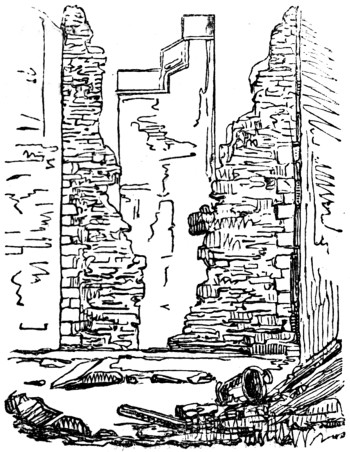
Old Watch Tower of the City Wall.
This is a front view of a watch tower, or one of the barbicans, on the city wall, which was discovered near Ludgate-hill on the first of May, 1792. Below is a section of Ludgate-hill from a plan of London by Hollar, wherein this tower is described.
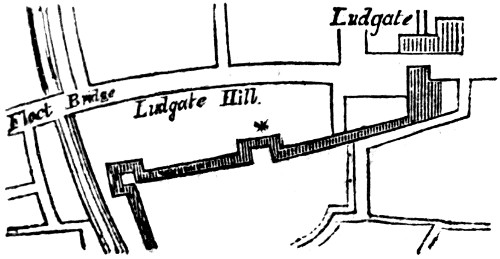
They are both represented in an engraving published by the late Mr. Nathaniel Smith, of Great May’s buildings, from whence the preceding views are copied for the purpose of more especially marking the discovery of the old tower on this festival day.
Opera Arm Chairs.
A rare tract, connected with the history of the opera in England, records a jeu d’esprit, which, together with the tract, are attributed to the author of the “Pursuits of Literature:” it will be seen to relate to the present day from the following extracts from the pamphlet.
THE EDITOR TO THE READER.
May 5, 1800.
Piu non si turbi all’ anima La sua tranquillità: Pensiamo solo a ridere; Sara quel che sara’.
Aria; Gli Zingari in Fiera. A. 2.
The following poetical Composition appeared in the Morning Herald of May 1, 1800; and it is reprinted at the very particular request of several persons, votaries of the Opera, Fashion, Wit, and Poetry, who were desirous that it should be preserved in a less perishable form than that of a Newspaper.
The occasion of the Arm-Chairs being placed in the Pit at the Opera House was this. Before the opening of the Opera House this season, it was generally understood, that His Majesty had graciously signified to Lord Salisbury his concern, that any of the Subscribers should be deprived of their Boxes on the nights when His Majesty honoured the Theatre with his presence. This being communicated to Mr. Taylor, he observed that the Royal objection might easily be obviated, by detaching the last Row from the Pit, on these occasions, for the reception of the Subscribers. This was done accordingly, and a Row of Arm-Chairs, with Locks and Keys to the bottoms of them, were placed there, which on every other night were to be free for general accommodation. But about two months after, the Arm-Chairs were removed, and a long bench was substituted.
On this great event, the Editor has no Intercepted Letters to lay before the public by authority, and therefore he has not applied to Mr. Canning for a Preface, nor for Notes to Mr. Gifford. There is no Egyptian Fast to be solemnized, nor Festival to be celebrated. He can assure them also, that neither the Mustapha Raschid Effendi and Mustapha Ressichi Effendi for the Grand Vizir; nor General Dessaix and Citizen Poussielgue for General Kleber, were Commissioners on signing this Convention. But the Evacuation of the Arm-ed Chairs was effected without bloodshed or loss on either side, by Lord Galloway and Mr. Bell, Commissioners on the part of the Amateurs and Conoscenti, and by Signor Lorenzo da Ponte, Poet to the Opera House, and Mr. Solomon, Leader of the Band, Commissioners on the part of General Taylor and the Dramatic Field Marshal the Marquis of Salisbury. The Arm-ed Chairs were surrendered three days after the signing of the Capitulation, without the intervention of any gallant Knight[156] from Sweden or from Malta.
Thus far is from the preface, and after a few remarks and a “Scena” in Italian, the poem alluded to, and here reprinted verbatim, is introduced in the following manner:—
March 19, 1800.
THE ARGUMENT.
A month or two ago, Lord Galloway came to the Opera, and on the Pit-door near the Orchestra being opened, he perceived, to his confusion and astonishment, that a long Bench was substituted in the place of the Row of Arm-Chairs at the bottom of the Pit, the principal or central of which he had filled for so many nights with discernment and dignity, and to the general satisfaction of every person present. His Lordship conceiving, rather hastily, that this measure was intended as a personal slight to himself, retired disconcerted, without taking his seat; and, as he is a votary of the Muses, penned the following Lamentation, which he sent to Lord Salisbury the next day, and recovered his wonted good humour, cheerfulness, and gayety.
PANDOLFO ATTONITO! OR, LORD GALLOWAY’s POETICAL LAMENTATION ON THE REMOVAL OF THE ARM-CHAIRS FROM THE PIT AT THE OPERA HOUSE!
What!—the proud honours of the chair Must I no more, with Cecil(a), share?— Still be my soul serene Virtù, or virtue’s but a name, Brutus and Galloway exclaim, And sighing quit the scene. Too sure I heard a warning knell, And told my Critic Brother Bell(b) The fall of seats(c) and stocks; Yet fondly sooth’d by Bolla’s airs, Thought Taylor’s bottom, and his chairs Secure with keys and locks.(d) But ah! how Fortune loves to joke! Expell’d am I, who sung and spoke As loud as at the Fair:(e) While yearly, with six thousand pound, The Commons Addington have bound Their Servant to the Chair. My purer taste, my classic eye, Unzon’d Thalia could descry, Who stepp’d beyond her place: How oft I warn’d, in either house, That charms too plain at last would rouse The Mitre and the Mace! I with Pandolfo watch’d the sphere, When Mars on Venus shone so clear, That Saturn(f) felt the shock: Grave Shute and Henry shrunk at Love, And at the loose flesh-colour’d glove, That blush’d at twelve o’clock. I said, some folks would thunder Greek At Hilligsberg’s Morale lubrique, And Parisot’s costume!(g) Where shall Paullinia, tight and round,(h) In vest appropriate now be found, With India’s palm and plume? Old Q—nsb—ry feels his dotard qualm, Terpsichorè can pour no balm O’er half his visual ray; Nor William(i) can console the Sag, Nor Elisée(k) his pain assuage, Nor Yarmouth smooth his way. When Marinari’s(l) magic hand Traced the bold view in fabled land, For Fawns and Wood-nymphs meet Ah, soon, I cried, may Sal’sb’ry think, ’Tis just, that they who dance should drink, And they who sing, should eat.(ll) For this, in arbitrating state, In presence of the wise and great, I sung the Sovereign’s air:(m) Firm was my voice, for Taylor smil’d; Nor deem’d I then, (too well beguil’d,) How slippery was the Chair. Nor G—rd—n’s coarse and brawny Grace, The last new Woman in the Place(n) With more contempt could blast; Not Marlb’rough’s damp on Blandford’s purse To me could prove a heavier curse; My fame, my glory past. Fall’n though I am, I ne’er shall mourn, Like the dark Peer on Storer’s urn,(nn) Reflecting on his seat! In vain that mean mysterious Sire In embers would conceal the fire; While Honour’s pulse can beat. For me shall droop th’ Assyrian Queen,(o) With softest train and tragic mien, The Siddons in her art; E’en Bolla(p) shall forget to please, With sparkling eye and playful ease, And Didelot shall start. Leo enthron’d bade Querno sit; And Gianni’s(q) verse and regal wit The Consul loves to share: Pye has the laurel and the sack, And C—mbe the foolscoat on his back, But Galloway, no Chair. Yet though, reduc’d by Taylor’s pranks, I sit confounded in the ranks, Good Humour’s still my own; Still shall I breathe in rapt’rous trance, “Eternal be the Song, the Dance, The Opera and the Throne!”
NATURALISTS’ CALENDAR.
Mean Temperature 52·75.
May 2.
Demonstrative Proof.
It is noticed in the journals of May, 1817, that in the preceding summer, Mr. J. Welner, a German chemist, retired to his house in the country, there to devote himself, without being disturbed, to the study and examination of poisonous substances for the purpose of producing a complete “Toxicology,” established by undeniable proof. He tried his poisons upon himself, and appeared insensible to the great alterations which such dangerous trials produced upon his health. At the latter end of the month of October, he invented some unknown poisonous mixture; and wished to be assured of its effect. The following is the account which he gives of it in the last page of his manuscript:—“A potion composed of—(here the substances are named, and the doses indicated)—is mortal; and the proof of it is—that I am dying!”
NATURALISTS’ CALENDAR.
Mean Temperature 52·55.
May 3.
Invention of the Cross.
For the origin of this church of England holiday, see vol. i. p. 611.
“A Pie sat on a Pear Tree.”
To the Editor of the Every-Day Book.
May 3, 1826.
Sir,—There is a custom at Yarmouth dinners, which in my opinion would be “more honoured in the breach than the observance.” After the cloth has been removed, and the ladies have retired, some one in the company, who is an adept in the game, sings the following lines,—
“A pie sat on a pear tree, A pie sat on a pear tree, A pie sat on a pear tree, Heigh oh! heigh oh! heigh oh!”
At the conclusion, the person sitting next to the singer continues the strain thus,—
“And once so merrily hopp’d she;”
during which the first singer is obliged to drink a bumper, and should he be unable to empty his glass before the last line is sung, he must begin again until he succeeds.
The difficulty consists in swallowing the liquor fast enough, many getting tipsy before they are able to accomplish it. This of course goes round the party, until the whole are either completely “knocked up,” save a few who from the capacity of their throats are so fortunate as to escape. Your inserting the above in the Every-Day Book will much oblige, Sir, &c.
J. F.
The preceding is from a valued correspondent, on whose veracity full reliance is placed by the editor; he will nevertheless be happy to hear that this usage is on the decline.
NATURALISTS’ CALENDAR.
Mean Temperature 52·67.
May 4.
1826. Holy Thursday, Or Ascension Day.
For this movable feast see vol. i. p. 651, 643.
Tissington Well Dressing.
For the Every-Day Book.
Unless the historians of Derbyshire have been very negligent in their inquiries, the peak differs exceedingly from mountainous tracts in general, where the customs, manners, and language of antiquity are preserved with peculiar care. The language, indeed, has retained its olden character, but of peculiar customs little is known. In Lysons’ “Magna Britannia,” the practices of rush-bearing, of hanging up white gloves and garlands of roses in the churches, at the funerals of young maidens,—of foot-ball plays, now confined to Derby, and this well-dressing of Tissington are the sum total of those notices under the head of “Country Customs.” A correspondent communicated to the Every-Day Book in March, a custom existing near Tideswell; and I have seen it stated in a provincial paper, that a right is claimed in the Peak Forest of marrying after the fashion of Gretna Green, and that such a wedding actually took place not very long ago. Something more of this should be known.
Tissington well-dressing is a festivity, which not only claims a high antiquity, but is one of the few country fêtes which are kept up with any thing like the ancient spirit. It is one which is heartily loved and earnestly anticipated. One which draws the hearts of those who were brought up there, but whom fortune has cast into distant places, homewards with an irresistible charm. I have not had the pleasure of witnessing it, but I have had that of seeing the joy which sparkled in the eyes of the Tissingtonians as they talked of its approach, and of their projected attendance. Long before the time arrives, they have canvassed the neighbourhoods where they reside, for flowers to take with them: and these flowers, in all the instances which have come under my notice have been red daisies, and none else. If, however, John Edwards, in his poem, “The Tour of the Dove,” be correct, others must be used, and those wild flowers:—
“Still Dovedale yield thy flowers to deck the fountains Of Tissington, upon its holyday; The customs long preserved among the mountains Should not be lightly left to pass away. They have their moral; and we often may Learn from them how our wise forefathers wrought, When they upon the public mind would lay Some weighty principle, some maxim brought Home to their hearts, the healthful product of deep thought.”
In a note he adds;—“The custom of decorating wells with flowers, and attending them with religious services and festive rejoicings on Holy Thursday, is not peculiar to Tissington. Many other wells have been committed to the patronage of the saints, and treated with reverence; some on account of the purity, and others for the medicinal virtues of their waters. St. Alkmund’s well at Derby, is an instance of the former class, where the name has been continued long after the superstition which gave it has passed away. In the dark ages of popery, this veneration for holy wells was carried to an idolatrous excess, insomuch, that in the reigns of Edgar and Canute, it was found necessary to issue edicts prohibiting well-worship. But the principle of veneration for waters, if restricted within its proper bounds, is amiable: indeed, it seems to have been implanted in the breast of man in all ages. A fountain is the emblem of purity and benevolence. From the days when the patriarchs journeyed in the wilderness, down to the present period—whether bursting from the arid sands of the African desert, or swelling out its genial waters amid the Greenland snows—its soft melody, its refreshing virtues, and its transparency, have ever been a subject of delight and interest to the human race. Who could have approached the Bethesda of the Jews with a callous heart? Who could have listened to the song of Israel with indifference, when her princes had digged the well, and her nobles and lawgiver stood around it?”
Rhodes, who has traversed almost every part of the peak with indefatigable zeal, gives the following account in his “Peak Scenery.” “An ancient custom still prevails in the village of Tissington, to which indeed it appears to be confined, for I have not met with any thing of a similar description in any other part of Derbyshire. It is denominated well-flowering, and Holy Thursday is devoted to the rites and ceremonies of this elegant custom. This day is regarded as a festival; and all the wells in the place, five in number, are decorated with wreaths and garlands of newly-gathered flowers, disposed in various devices. Sometimes boards are used, which are cut to the figure intended to be represented, and covered with moist clay, into which the stems of the flowers are inserted to preserve their freshness; and they are so arranged as to form a beautiful mosaic work, often tasteful in design, and vivid in colouring: the boards, thus adorned, are so placed in the spring, that the water appears to issue from amongst beds of flowers. On this occasion the villagers put on their best attire, and open their houses to their friends. There is service at the church, where a sermon is preached: afterwards a procession takes place, and the wells are visited in succession: the psalms for the day, the epistle and gospel are read, one at each well, and the whole concludes with a hymn which is sung by the church singers, and accompanied by a band of music. This done, they separate, and the remainder of the day is spent in rural sports and holiday pastimes.
The custom of well-flowering as it exists at Tissington, is said to be a popish relic; but in whatever way it originated, one would regret to see it discontinued. That it is of great antiquity cannot be disputed; it seems to have existed at different periods of time, in countries far remote from each other. In the earliest ages of poetry and romance, wherever fountains and wells were situated, the common people were accustomed to honour them with the title of saints. In our own country innumerable instances occur of wells being so denominated.” “Where a spring rises or a river flows,” says Seneca, “there should we build altars, and offer sacrifices.” At the fountain of Arethusa in Syracuse, of which every reader of poetry and history has often heard, great festivals were celebrated every year. In Roman antiquity the fontinalia were religious feasts, held in honour of the nymphs of wells and fountains; the ceremony consisted in throwing nosegays into fountains, and putting crowns of flowers upon wells. Many authorities might be quoted in support of the antiquity of this elegant custom, which had its origin anterior to the introduction of christianity. It was mingled with the rites and ceremonies of the heathens, who were accustomed to worship streams and fountains, and to suppose that the nymphs, whom they imagined the goddesses of the waters, presided over them. Shaw in his “History of the Province of Morray,” says, that “heathen customs were much practised amongst the people there;” and he cites as an instance, “that they performed pilgrimages to wells, and built chapels to fountains.”
“From this ancient usage, which has been continued through a long succession of ages, and is still in existence at Tissington, arose the practice of sprinkling the Severn and the rivers of Wales with flowers, as alluded to by Dyer in his poem of the Fleece and by Milton in his Comus.—
——————With light fantastic toe the nymphs Thither assembled, thither every swain; And o’er the dimpled stream a thousand flowers, Pale lilies, roses, violets and pinks, Mixed with the green of burnet, mint, and thyme, And trefoil, sprinkled with their sportive arms: Such custom holds along the irriguous vales, From Wreakin’s brow to archy Dolvoryn.
Dyer.
———————The shepherds at their festivals Carol her good deeds loud in rustic lays, And throw sweet garland wreaths into her stream, Of pancies, pinks, and gaudy daffodils.
Milton.”
I hope some of your correspondents will contribute to our information by accounts of well-dressings in other parts of the kingdom.
Shaftesbury “Byzant.”
The town of Shaftesbury from its situation on the top of a high hill, is entirely destitute of springs; except at the foot of the hills in St. James’s parish, where are two wells, in the possession of private persons. At the foot of Castle-hill were formerly some water-works, to supply the town, their reservoir was on the top of the Butter cross; but the inhabitants have from time immemorial been supplied with water brought on horse’s backs, or on people’s heads, from three or four large wells, a quarter of a mile below the town in the hamlet of Motcomb, and parish of Gillingham; on which account there is this particular custom yearly observed by ancient agreement, dated 1662, between the lord of the manor of Gillingham, and the mayor and burgesses of Shaftesbury. The mayor is obliged the Monday before Holy Thursday to dress up a prize besom, or byzant, as they call it, somewhat like a May garland in form, with gold and peacock’s feathers, and carry it to Enmore Green, half a mile below the town, in Motcomb, as an acknowledgment for the water; together with a raw calf’s head, a pair of gloves, a gallon of beer, or ale, and two penny loaves of white wheaten bread, which the steward receives, and carries away to his own use. The ceremony being over, the “byzant” is restored to the mayor, and brought back by one of his officers with great solemnity. This “byzant” is generally so richly adorned with plate and jewels, borrowed from the neighbouring gentry, as to be worth not less than 1500l.[175]
Procession of the Camel.
Holy Thursday was formerly a day of great festivity at Beziers, in France, and was celebrated with a variety of little sports.
“The Procession of the Camel” constituted one part of them. A figure representing that animal, with a man in the inside, was made to perform ridiculous tricks. The municipal officers, attended by the companies of the different trades and manufactures, preceded the camel. It was followed by a cart, over which were branches of trees twined into an arbour, filled with people: the cart was drawn by mules ornamented with bunches of flowers and ribands; a number of people stuck over with flowers and little twigs of trees, who were called the “wild men,” followed the cart and closed the procession. After parading about the town all day, towards evening the whole company repaired to the chapel of the Blue Penitents, where it was met by the chapter of the cathedral, who had previously also gone in procession round the town, and then a large quantity of bread was given away by the chapter among the poor.
Another part of the ceremonies of the day was, that the peasants from the country assembled in the streets with crooks in their hands, and ranging themselves in long files on each side, made mock skirmishes with their crooks, aiming strokes at each other, and parrying them with great dexterity. Each of these skirmishes ended with a dance to the fife and tabourine. The inhabitants threw sugar-plums and dried fruits at each other from their windows, or as they passed in the streets.
The day usually concluded by a favourite dance among the young men and women, called la danse des treilles. Every dancer carried a cerceau, as it is called, that is a half hoop, twined with vine branches; and ranging themselves in long files on each, side of the street, formed different groups. The young men were all dressed in white jackets and trowsers, and the young women in white jackets with short petticoats, and ornaments of flowers and ribands. These sports of Beziers were suspended during the revolution.[176]
NATURALISTS’ CALENDAR.
Mean Temperature 52·77.
May 5.
“A Particular Fact.”
The Indexes, &c. to the Every-Day Book, Vol. I. were published on the 5th of May, 1826.
The new preface to the volume is particularly addressed to the notice of correspondents, and I shall be particularly obliged if every reader of the work will favour it with attentive perusal.
Chronology.
It should be observed of Joseph Baretti, who died on this day in the year 1789, that he was the friend and associate of Johnson, who introduced him to the Thrale family, and whom he assisted in the compilation of his “Dictionary of the English Language.”
Baretti was a native of Turin; he had received a good education, and inherited paternal property, which in his youth he soon gambled away, and resorted to a livelihood by teaching Italian to some English gentlemen at Venice; whence he repaired to England, and distinguished himself as a teacher of Italian. By his employment under Dr. Johnson, he acquired such a knowledge of our language as to be enabled to compile the “Italian and English Dictionary,” which is still in use. He then revisited his native country, and after an absence of six years returned through Spain and Portugal, and in 1768 published “An Account of the Manners and Customs of Italy,” in reply to some querulous strictures on that country in the “Letters from Italy” by surgeon Sharp, which Baretti’s book effectually put down, with no small portion both of humour and argument. Not long afterwards, he was accosted in the Haymarket by a woman, whom he repulsed with a degree of roughness which was resented by her male confederates, and in the scuffle, he struck one of them with a French pocket dessert knife. On this, the man pursued and collared him; when Baretti, still more alarmed, stabbed him repeatedly with the knife, of which wounds he died on the following day. He was immediately taken into custody, and tried for murder at the Old Bailey, when Johnson, Burke, Goldsmith, Garrick, Reynolds, and Beauclerk gave testimony to his good character; and although he did not escape censure for his too ready resort to a knife, he was acquitted. Domesticated in the Thrale family, he accompanied them and Dr. Johnson to Paris, but in a fit of unreasonable disgust, quitted them the next year; and in the latter part of his life was harassed with pecuniary difficulties, which were very little alleviated by his honorary post of foreign secretary to the Royal Academy, and an ill-paid pension of eighty pounds per annum under the North administration. Among other works he published one with the singular title of “Tolondron: Speeches to John Bowles about his edition of Don Quixote, together with some account of Spanish Literature.” This was his last production; his constitution was broken by uneasiness of mind and frequent attacks of the gout, and he died in May, 1789.
Baretti was rough and cynical in appearance, yet a pleasant companion; and of his powers in conversation Johnson thought very highly.
He communicated several of Dr. Johnson’s letters to the “European Magazine,” and intended to publish several more; but on his decease his papers fell into the hands of ignorant executors, who barbarously committed them to the flames.[177]
It is remarkable that with Johnson’s scrupulous attachment to the doctrines and ceremonies of the church of England, he was sincerely attached to Baretti, whose notions on religious matters widely differed from the opinions of “the great lexicographer.” Johnson seems to have been won by his friend’s love of literature and independence of character. Baretti often refused pecuniary aid when it was greatly needed by his circumstances: his morals were pure, and his conduct, except in the unhappy instance which placed his life in jeopardy, was uniformly correct. He died with the reputation of an honest man.
There is an engraving representing Diogenes at noon-day with his lantern in one hand, and in the other a circular picture frame, which is left vacant, that a purchaser of the print may insert the portrait of the man he delights to honour as the most honest. Hence the vacancy is sometimes supplied by the celebrated John Wilkes, the prophetic Richard Brothers, the polite lord Chesterfield, Churchill, the satirist, Sam House, or Joseph Baretti, or any other. “Cornelius May,” of whose existence, however, there is reason to doubt, would scarcely find a head to grace the frame.
“Poetry.”
“The Knaverie of the Worlde, sette forthe in homelie verse, by Cornelius May,” from “The Seven Starrs of Witte,” 1647.
Ah me throughoute the worlde Doth wickednesse abounde! And well I wot on neither hande Can honestie be founde. The wisest man in Athens Aboute the citie ran With a lanthorne in the light of daie To find an honeste man; And when at night he sate him downe To reckon on his gaines, He onely founde—alack poore man! His labour for his paines. And soe thou now shalt finde Alle men of alle degree Striving, as if their onely trade Were that of cheating thee. Thy friend will bid thee welcome, His servantes at thy calle— The dearest friend he has on earthe Till he has wonne thy alle; He will play with thee at dice Till thy golde is in his hande, He will meete thee at the tennis court Till he winne alle thy lande. The brother of thy youth When ye shared booke and bedde Would eat himself the sugar plums And leave thee barley bread: But growing up to manhode His hart is colder grown, Aske in thy neede for barley bread And he’ll give thee a stone. The wife whom thou dost blesse Alack, she is thy curse— A bachelor’s an evil state, But a married man’s is worse. The lawyer at his deske Good lawe will promise thee Untill thy very last groat Is given for his fee. Thy baker, and thy brewer Doe wronge thee night and morne; And thy miller, he doth grinde thee In grinding of thy corne. Thy goldsmith and thy jeweller Are leagu’d in knavish sorte, And the elwande of thy tailor It is an inche too shorte. Thy cooke hath made thy dish From the offals on the shelfe, While fishe and fowle and savourie herbes Are served to himselfe. The valet thou dost trust, Smooth-tongued and placid-faced, Dothe weare thy brilliantes in his cappe And thou wear’st his of paste. Alack! thou canst not finde Of high or lowe degree In cott or courte or cabinett A man of honestie. There is not in the worlde, Northe, southe, or easte, or weste, Who would maintaine a righteous cause Against his intereste. Ah me! it grieves me sore, And I sorrowe nighte and daie, To see how man’s arch enemie Doth leade his soule astraie.
NATURALISTS’ CALENDAR.
Mean Temperature 53·22.
May 6.
Birds.
The bird-catchers are now peering about the fields and thickets in search of different species of song-birds, for the purpose of netting and training them for sale.
Old bird-fanciers treat the younger ones with disdain, as having corrupted the rich melodies of the birds, by battling them against each other, in singing matches, for strength of pipe.
For the Every-Day Book.
Sonnet, Written on hearing my Blackbird, while confined to my Bed by Illness.
Bird of the golden beak, thy pensive song Floats visions of the country to my mind; And sweet sounds heard the pleasant woods among, I hear again, while on my bed reclined. Weaken’d in frame, and harass’d by my kind, I long for fair-green fields and shady groves, Where dark-eyed maids their brows with wild flowers bind, And rosy health with meditation roves. Sing on, my bird—as in thy native tree, Sing on—and I will close my burning eyes, Till in my fav’rite haunts again I be, And sweetest music on my ears arise; And waving woods their shades around me close, And sounds of waters lull me to repose.
April 16, 1826.
S. R. J.
NATURALISTS’ CALENDAR.
Mean Temperature 54·57.
May 7.
The Season. Thunny Fishing.
The Mediterranean produces many sorts of fish unknown to us, the thunny among others. The manner in which these fish are caught is somewhat curious; it is a sort of hunting at sea. The nets are extended in the water so as to close upon the fish when they come within reach of them, and then the boats chase them to that part where they are taken: they have great force in their tails, so that much caution is required in getting them aboard. Vernet among his other sea-pieces has a very good one of this fishery. There are four principal places near Marseilles where it is carried on, called the madragues, which are rented out to the fishers, by the town, at a considerable advantage. When Louis XIII. visited Marseilles in 1662, he was invited to a thunny fishing at the principal madrague of Morgion, and found the diversion so much to his taste, that he often said it was the pleasantest day he had spent in his whole progress through the south.
The thunnies come in such shoals, that in the height of the season, that is, in the months of May and June, from five to six hundred are sometimes taken in a day at one madrague only: they commonly weigh from about ten to twenty or twenty-five pounds each, but they have been known to weigh even as much as fifty pounds. They are very delicious food, but the flesh is so solid that it seems something between fish and meat; it is as firm as sturgeon, but beyond all comparison finer flavoured. They dress this fish in France in a great variety of ways, and always excellent: it makes capital soup, or it is served as a ragout, or plain fried or broiled; pies are made of it, which are so celebrated as to be sent all over France; they will keep good for six weeks or two months. There is also a way of preserving it to keep the whole year round with salt and oil, called thon mariné: this is eaten cold, as we eat pickled salmon, and is delicious. Besides the great season in May and June, they are caught in considerable numbers in the autumn, about November, which is the great season for making the pies. A large quantity of them were sent to Paris against Buonaparte’s coronation. Stragglers of these fish are occasionally taken the whole year round. They are an ugly fish to the eye.
The palamede, though much smaller than the thunny, seems so much of the same nature that some persons have supposed it only the young thunny; but naturalists say that it is a distinct species of fish. It is mentioned by Gibbon in his description of Constantinople, as, at the time of the foundation of that city, the most celebrated among the variety of excellent fish taken in the Propontis.[178]
NATURALISTS’ CALENDAR.
Mean Temperature 54·70.
May 8.
“The Furry.”
For the Every-Day Book.
On the eighth of May, at Helston, in Cornwall, is held what is called “the Furry.” The word is supposed by Mr. Polwhele to have been derived from the old Cornish word fer, a fair or jubilee. The morning is ushered in by the music of drums and kettles, and other accompaniments of a song, a great part of which is inserted in Mr. Polwhele’s history, where this circumstance is noticed. So strict is the observance of this day as a general holiday, that should any person be found at work, he is instantly seized, set astride on a pole, and hurried on men’s shoulders to the river, where he is sentenced to leap over a wide place, which he of course fails in attempting, and leaps into the water. A small contribution towards the good cheer of the day easily compounds for the leap. About nine o’clock the revellers appear before the grammar-school, and demand a holiday for the schoolboys. After which they collect contributions from house to house. They then fade into the country, (fade being an old English word for go,) and, about the middle of the day, return with flowers and oak branches in their hats and caps. From this time they dance hand in hand through the streets, to the sound of the fiddle, playing a particular tune, running into every house they pass without opposition. In the afternoon, a select party of the ladies and gentlemen make a progress through the street, and very late in the evening repair to the ball-room. A stranger visiting the town on the eighth of May, would really think the people mad; so apparently wild and thoughtless is the merriment of the day.
There is no doubt of “the Furry” originating from the “Floralia,” anciently observed by the Romans on the fourth of the calends of May.[179]
“Every pot has two handles.” This means “that one story’s good, till another story’s told;” or, “there is no evil without its advantages.”
If it is generally “good” to anticipate festival days in the Every-Day Book, it is an “evil” to be “behind-hand;” and yet “advantages” have sometimes resulted from it. For instance, the day of “the Furry” at Helston, elapsed before this sheet was sent to press; but a correspondent who was present at the festival on that day in the present year, 1826, sends an account of the manner wherein it is conducted at present; and though the former “story’s good,” his particular description of the last Furry, is a lively picture of the pleasant manner, wherein it continues to be celebrated: thus is illustrated the ancient saying, that “every pot has two handles.”
It would be ill acknowledgment of the annexed letter to abridge it, by omitting its brief notice of the origin of the Furry, already adverted to, and therefore the whole is inserted verbatim.
Helston “Furry, or Flora Day.”
To the Editor of the Every-Day Book.
Sir,—Having for several years past resided in Cornwall, (from whence I have lately returned,) I beg to inform you of one of their gayest days of amusement, which is regularly kept up in the borough of Helston on the eighth day of May.
It originated from the Roman custom of paying an early tribute of respect to the goddess Flora; the garlands of flowers worn on the occasion confirms this opinion. This festival commences at an early hour: the morning is enlivened by the sound of “drum and fife;” and music, harmony, and dance are the sports of “high and low”—“from morn to night.” Some of the oldest townsmen chant some ancient ditties—not very comprehensible, “nor is the melody thereof enchanting.”
The hilarity of the day precludes the possibility of doing business; every consideration but mirth, music, and feasting is set at naught. Should any persons be found at work, they are instantly seized, set astride on a pole, and jolted away on men’s shoulders, amidst thousands of huzzas, &c., and at last sentenced to leap over the river, (which by the by is none of the narrowest,) the result which therefore frequently happens is—they jump into it. The payment of a certain fine towards the expenses of the day saves them from this cooling.
At nine in the morning the mob gathers round the various seminaries, and countless voices demand a holiday for all in them, which is acceded to: a collection from the housekeepers is then commenced towards the general fund. While this is going on, the young folks of both sexes go to the gardens of the neighbourhood, and return at twelve with their heads dressed out with gay flowers, oak branches, &c. On entering the town they are joined by a band of music; they dance through the streets to the “Flora Tune.” In their progress they go through every house and garden they please without distinction; all doors are opened, and, in fact, it is thought much of by the householders to be thus favoured.
The older branch of the population dance in the same manner, for it is to be noticed they have select parties, and at different hours; no two sets dance together, or at the same time. Then follows the gentry, which is really a very pleasing sight on a fine day from the noted respectability of this rich borough. In this set the sons and daughters of some of the first and noblest families of Cornwall join. The appearance of the ladies is enchanting. Added to their personal charms, in ball-room attire, each tastefully adorned with beautiful spring flowers, in herself appears to the gazer’s eye a Flora, and leads us to conceive the whole a scene from fairy land. The next set is, the soldiers and their lasses; then come the tradesmen and their wives; journeymen and their sweethearts; and, “though last not least,” the male and female servants in splendid livery; best bibs and tuckers are in request, and many pretty brunettes are to be found in their Sunday finery, with healthy smiling looks, which on such a day as this are sure to make sad havoc with the hearts of the young men.
In the evening a grand ball is always held at the assembly rooms; to which, this year, were added the performance of the “Honey Moon” at the theatre, by Dawson’s company of comedians, Powell’s celebrated troop of horse at the Circus, and Mr. Ingleby’s sleight of hand at the rooms. The borough was thronged with visiters from all parts of the country. It is a pleasing task to conclude by being able to state, that Aurora rose on the ninth without any account of accident or disappointment being experienced by any of its numerous attendants. I have many other anecdotes of Cornwall, which I shall forward you in case you deem them worthy a place in your Every-Day Book, to which I wish the success it really deserves.
I am, Sir, Your’s truly, Sam Sam’s Son.
London, May 16, 1826.
⁂ This communication was almost past the time; yet, as we set out with a proverb, we may end with “better late than never;” and, “not to ride a free horse to death,” but merely to “drive the nail that will go,” thanks are offered to “Sam Sam’s Son,” with the hope of early receiving his “future agreeable favours.”
NATURALISTS’ CALENDAR.
Mean Temperature 55·07.
May 9.
A Match.
A New York paper of the ninth of May, 1817, announces that in Montgomery county, Mr. Jesse Johnson, being eighteen or nineteen years of age, and four feet one inch high, and weighing about seventy-five pounds, was married to Miss Nancy Fowler, about twenty-six or twenty-seven years of age, six feet two inches high, and weighing about two hundred and fifty pounds. “Sure such a pair were never seen.”
NATURALISTS’ CALENDAR.
Mean Temperature 54·20.
May 10.
Justice.
In May, 1736, Henry Justice, of the Middle Temple, Esq., was tried at the Old Bailey, for stealing books out of Trinity-college library in Cambridge. He attempted to defeat the prosecution by pleading, that in the year 1734, he was admitted fellow-commoner of the said college, whereby he became a member of that corporation, and had a property in the books, and therefore could not be guilty of felony, and read several clauses of their charter and statutes to prove it. But after several hours’ debate, it appeared he was only a boarder or lodger, by the words of the charter granted by Henry VIII. and queen Elizabeth. He was found guilty.
On the tenth of the month, having been put to the bar to receive sentence, he moved, that as the court had a discretionary power, he might be burnt in the hand and not sent abroad; first, for the sake of his family, as it would be an injury to his children and to his clients, with several of whom he had great concerns, which could not be settled in that time; secondly, for the sake of the university, for he had numbers of books belonging to them, some in friends’ hands, and some sent to Holland, and if he was transported he could not make restitution. As to himself, considering his circumstances, he had rather go abroad, having lived in credit till this unhappy mistake, as he called it, and hoped the university would intercede for him. The deputy-recorder commiserated his case, told him how greatly his crime was aggravated by his education and profession, and then sentenced him to be transported to some of his majesty’s plantations in America for seven years.
NATURALISTS’ CALENDAR.
Mean Temperature 53·87.
May 11.
London Gymnastic Society.
The establishment of this institution is of so great importance to the health and manners of the metropolis, that to pass it unregarded would be inexcusable. Much of mental infirmity proceeds from bodily infirmity. Without activity, the entire human being is diseased. A disposition to inactivity generates imbecility of character; diligence ceases, indolence prevails, unnatural feelings generate unnatural desires, and the individual not only neglects positive duties, but becomes sensual and vicious. The “London Gymnastic Society,” therefore, in a national point of view is of the highest regard. A letter, subjoined, will be found to represent some of its exercises and advantages in an agreeable and interesting manner.
Gymnastic Exercises.
To the Editor of the Every-Day Book.
Sir,—On the twenty-second of March, not less than fifteen hundred persons assembled at the Mechanics’ Institute for the purpose of forming a “London Gymnastic Society.” This event is likely to have very important and useful results to the community, and, therefore, within the plan of the Every-Day Book to record. I have no intention to describe what passed on the occasion, any further than by stating that a series of resolutions in support of the proposed object were unanimously adopted; and as great misconception prevails as to the nature of gymnastic exercises, some light on the subject, beyond that conveyed in your first volume, may be interesting.
The grounds on which the use of exercise generally are recommended, are precisely those from which the benefits of this particular class are to be inferred; with this advantage in favour of gymnastics, that they combine the advantages of almost every other species. If it be desirable that the body should be strengthened, the limbs acquire flexibility, the muscles be brought into full play, and the spirits be invigorated, gymnastics must be allowed to be salutary for such are their ordinary effects. Moreover, if it be desirable that a man should become acquainted with his physical capabilities, in order that he may be encouraged to exert them on suitable occasions, within the compass of safety, and be aware when he is in danger of trespassing beyond the proper limit, gymnastics must be beneficial, for they instruct him where that limit lies, and give him entire confidence within it. And so gradual are the steps by which the pupil is led on towards proficiency, now mastering a small difficulty, then advancing to one a little greater, then to another, and another, that at last he accomplishes the evolution which at one time appeared to him of greatest difficulty with more facility than he at first accomplished the first lesson; while all the time he has been acquiring in the process increased capability, strength, confidence, and presence of mind. For the utility of these exercises does not end in the gymnasium; it only begins there. The performances of the evolutions are means by which great ends are attained; the vigour acquired in performing them, being afterwards useful wherever vigour may be required.
In the preliminary exercises, the pupil is taught to accustom himself to extend his arms and legs in various natural positions, in quick succession; sometimes exerting the arms only, the legs resting passive, sometimes the reverse; and sometimes exerting both legs and arms together. These exercises are not so strictly preliminary as to require the pupil to become perfect in them before he engages in others. On the contrary, he may with advantage, at a very early stage, combine them with those of greater difficulty; and also at an advanced stage, find it useful occasionally to recur to them. But let us proceed to the bars.
The bars consist of two pieces of wood placed parallel, in a horizontal position, on supporters, extending breast-high from the ground. The pupil having raised himself erect between the bars (they are something less than two feet apart, and about five feet in length) passes from one end to the other by the help of his hands only, moving one hand forward at a time, as the feet are moved in walking. He next places himself in the centre between the bars, and keeping his legs straight and close together projects them over the right hand bar, and so arrives on the ground. He then does the same on the left side, then on the right side backwards, either with or without previously swinging, then on the left side backwards in the same way. He next resumes his position at the end of the bars; but instead of walking or treading along the bars with his hands, as in the first exercise, he this time lifts both hands together, and passes to the other end by short jumps. He then returns to the centre of the bars, and retaining hold of them, projects his body over the left hand bar, from which position, by slightly springing, he projects himself over that on his right. This evolution he performs also on both sides, and later in his progress backwards also. Then there is the half moon, or semi-circle, which is performed by projecting the legs over one of the bars in front, and then bringing them back, and swinging them over the same bar behind. As the pupil advances, he is enabled to project himself over the bars unassisted by the lower part of his arms; also to rest the lower part of his arms on the bars, and from that position to raise himself erect by the hands only, repeating the evolution several times in succession, to pass from one side of the bar to the other, without touching the ground, and many other evolutions all conducing in one way or another to the strength and elasticity of his frame.
The horizontal poles are placed at various heights from the ground, according to the height of the pupil, and the exercises to be performed on them. Those chiefly used are a few inches above the head. One of the first lessons on the pole is analogous to the first on the parallel bars, the pupil passing from one end of the pole to the other, by the help of his hands only, first by moving one hand at a time as in walking, afterwards by moving both hands together. Grasping the pole with both hands, the pupil is taught to raise himself in various ways above it—to pass over it—to pass from one side of the pole to the other, &c. &c. The exercises on the pole are equal in diversity to those on the bars, perhaps on the whole more arduous, and certainly equally beneficial. I believe the arms and back are particularly strengthened by this diversion of the exercises.
Leaving the pole, let us attend a moment to the masts, the ropes, and the ladders. These are of various heights and dimensions. The pupil first learns to climb the rope and mast by the assistance of his hands and feet, afterwards by his hands only, and by degrees he learns to ascend the latter without the assistance of his feet or legs. The leaping with and without a pole, jumping, running, throwing the javelin, the use of the broad sword, &c., do not require description as they are more or less familiar to every one. I therefore confine myself to naming them, and observing that familiar as some of them are, the regulations under which they are practised tend greatly to increase their utility.[180]
There is still a division of these exercises which I have not mentioned, and which deserves a full description, and that is, the exercises on the horse—a wooden horse—without head or tail—but, as I feel myself quite unable to bear anything like adequate testimony to the merits of this very useful and quiet quadruped, I must reluctantly leave his eulogium to others more competent. It is a subject I cannot well get upon, being but a very indifferent equestrian.
I remain, Sir, &c. A Parallel Barrister.
To all individuals of sedentary occupations, in great towns and cities, gymnastic exercises are of immense benefit. It is difficult to convince, but it is a duty to attempt persuading them, that their usual habits waste the spirits, destroy health, and shorten life. Hundreds of Londoners die every year for want of exercise.
It is not necessary that we should cultivate gymnastics “after the manner of the ancients,” but only so much as may be requisite to maintain the even tenour of existence. The state of society in towns, continually imposes obstructions to health, and offers inducements to the slothful, in the shape of palliatives, which ultimately increase “the miseries of human life.” Exercise is both a prevention and a remedy; but, we must not mistake—diligence is not, therefore, exercise.
Our present pastimes are almost all within doors; the old ones were in the open air. Our ancestors danced “on the green” in the day time; we, if we dance at all, move about in warm rooms at night: and then there are the “late hours;” the “making a toil of a pleasure;” the lying in bed late the next morning; the incapacity to perform duties in consequence of “recreation!” The difference to health is immense—if it be doubted, inquire of physicians. The difference to morals is not less—if reflection be troublesome, read the proceedings in courts of justice, and then reflect. We have much to unlearn.
It is a real amusement to go to a theatre, and see an indolent audience sitting to witness feats of agility.
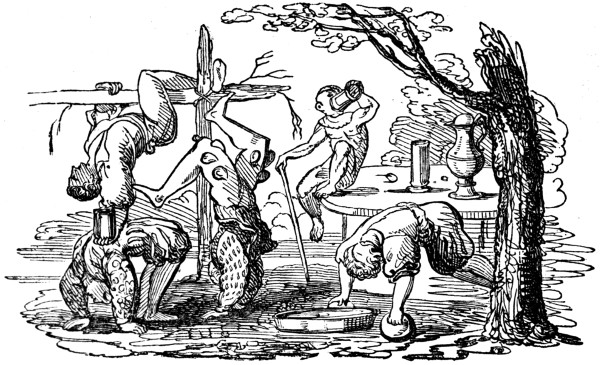
From a rare Engraving, by an unknown Artist.
Here we see that some of the tricks and dexterities of Mazurier and Gouffe were performed centuries ago; and here, too, we have an illustration that the horizontal bars of our correspondent, the “Parallel Barrister,” though novelties now, were known before our grandfathers were grandchildren. The print from whence this is copied, is from sir Mark Sykes’s collection: it is produced here as a curiosity.
NATURALISTS’ CALENDAR.
Mean Temperature 54·74.
May 12.
The Month.
Hail, May! lovely May! how replenished my pails! The young dawn o’erspreads the broad east, streaked with gold! My glad heart beats time to the laugh of the vales, And Colin’s voice rings through the wood from the fold. The wood to the mountain submissively bends, Whose blue misty summit first glows with the sun! See! thence a gay train by the wild rill descends To join the mixed sports:—Hark! the tumult’s begun. Be cloudless, ye skies!—And be Colin but there; Not dew-spangled bents on the wide level dale, Nor morning’s first smile can more lovely appear Than his looks, since my wishes I cannot conceal. Swift down the mad dance, while blest health prompts to move, We’ll court joys to come, and exchange vows of truth: And haply, when age cools the transports of love, Decry, like good folks, the vain follies of youth.
Bloomfield.
NATURALISTS’ CALENDAR.
Mean Temperature 54·22.
May 13.
1826. Oxford Term ends.
Old May Day. Scottish Beltein.
To the Editor of the Every-Day Book.
Sir,—I confess I was not a little astonished a few days ago, on becoming acquainted with a custom evidently heathenish in its origin, which exists in the united kingdom, where, it must be admitted, great advances have been made in morals and religion, as well as in science and general knowledge.
The fact I allude to is in Dr. Jamieson’s “Dictionary of the Scottish Language.” He mentions a festival called Beltane, or Beltein, annually held in Scotland on old May-day. A town in Perthshire is called “Tillee Beltein;” i. e. the eminence (or high place) of the fire of Baal. Near this are two druidical temples of upright stones with a well, adjacent to one of them, still held in great veneration for its sanctity, and on that account visited by vast numbers of superstitious people. In the parish of Callander (same county) upon “Beltein day,” they cut a circular trench in the ground, sufficient to enclose the whole company assembled. “They kindle a fire and dress a repast of eggs and milk in the consistence of a custard; they knead a cake of oatmeal, which is toasted at the embers against a stone.” After the custard is eaten, they divide the cake into as many equal parts as there are persons present, and one part is made perfectly black with charcoal.
The bits of cake are put into a bonnet and are drawn blindfold, and he who draws the black bit is considered as “devoted to be sacrificed to Baal, and is obliged to leap three times through the flame.”
Mr. Pennant in his “Tour in Scotland, 1769,” gives a similar account with varying ceremonies.
“In Ireland,” says Mr. Macpherson, “Beltein is celebrated on the twenty-first of June at the time of the solstice. There they make fires on the tops of the hills, and every member of the family is made to pass through the fire, as they reckon this ceremony to ensure good fortune during the succeeding year. This resembles the rite used by the Romans in Palilia.”—“Beltein (adds Mr. M.) is also observed in Lancashire.”
This “custom” being entirely new to me, and appearing so much to illustrate many passages in the Bible which refer to the idolatry of the ancients, I forward it to you agreeably to your printed invitation.
I am, &c. J. K. S.
Strand Maypole.
To the Editor of the Every-Day Book.
Sir,—In your account of the Maypole which stood in the Strand, you have stated that the said Maypole upon its decay was obtained of the parish by sir I. Newton, and placed at Wanstead for support of his telescope; but in the preface to the ninth edition of Derham’s “Astro-Theology,” published 1750, he says, “And now for a close I shall take this opportunity of publicly owning, with all honour and thankfulness, the generous offer made me by some of my friends, eminent in their stations, as well as skill and abilities in the laws, who would have made me a present of the Maypole in the Strand, (which was to be taken down,) or any other pole I thought convenient for the management of Mr. Huygens’s glass; but as my incapacity of accepting the favour of those noble Mecænates hath been the occasion of that glass being put into better hands, so I assure myself their expectations are abundantly answered by the number and goodness of the observations that have been and will be made therewith.”
As you will perceive by the expression “which was to be taken down,” it must have been standing at the time of publication of his book, and as sir I. Newton died in 1726, the “compilation” from which you extracted your account must be erroneous. The name of the philosopher to whom the glass belonged, you will also perceive to be misspelled. I should not have troubled you with these trifling corrections, but as I am sure your admirable work will pass through many editions, you may not in the future ones refuse to make the alteration.
I am, Sir, Your obedient servant, J. S.
May 17, 1826.
I am obliged to J. S. for his endeavour to rectify what he deems an error; but it rather corroborates than invalidates the fact stated in vol. i. p. 560, on the authority of the work there referred to.
J. S. quotes “the ninth edition of Derham’s ‘Astro-Theology,’ published 1750,” and infers that the Strand Maypole “must have been standing at the time of publishing his book;” and so it was; but it was no more in being when the “ninth edition” of his book was published, than Derham himself was, who died in 1735. The first edition of “his book” was published in 1714, and Derham then wrote of it as then standing, and the citation of J. S. shows that it was then contemplated to present Derham with the Maypole for Huygens’s glass, which from “incapacity” he could not accept, and was therefore the occasion of the glass “being put into better hands.” These “better hands” were sir Isaac Newton’s; the object of the intended present of the Maypole to Derham was for Huygens’s glass; and it is reasonable to believe that as sir Isaac had the glass, so also he had the Maypole to appropriate to the purpose of the glass.
Nevertheless, though I think J. S. has failed in proving my authority to be erroneous, and that he himself is mistaken, I repeat that I am obliged by his intention; and I add, that I shall feel obliged to any one who will take the trouble of pointing out any error. I aim to be accurate, and can truly say that it costs me more time to establish the facts I adduce, than to write and arrange the materials after I have convinced myself of their authority.
The Month.
May Morning.
But who the melodies of morn can tell? The wild brook babbling down the mountain side; The lowing herd; the sheepfold’s simple bell; The pipe of early shepherd dim descried In the lone valley; echoing far and wide The clamorous horn along the cliffs above; The hollow murmur of the ocean tide; And the full choir that wakes the universal grove. The cottage curs at early pilgrim bark; Crown’d with her pail the tripping milk-maid sings; The whistling ploughman stalks afield; and, hark! Down the rough slope the ponderous waggon rings; Through rustling corn the hare astonished springs; Slow tolls the village clock the drowsy hour; The partridge bursts away on whirring wings; Deep mourns the turtle in sequestered bower; The shrill lark carols clear from her aërial tow’r.
Beattie.
May Evening.
Sweet was the sound when oft at evening’s close, By yonder hill the village murmur rose; There, as I passed with careless steps and slow, The mingling notes came softened from below; The swain responsive as the milk-maid sung, The sober herd that lowed to meet their young, The noisy geese that gabbled o’er the pool, The playful children just let loose from school, The watch-dog’s voice that bayed the whispering wind, And the loud laugh that spoke the vacant mind, These all in sweet confusion sought the shade, And filled each pause the nightingale had made.
Goldsmith.
NATURALISTS’ CALENDAR.
Mean Temperature 54·12.
May 14.
1826. Whitsunday.
This is the annual commemoration of the feast of Pentecost. In the catholic times of England it was usual to dramatise the descent of the Holy Ghost in the churches; and hence we have Barnaby Googe’s rhymes:—
On Whitsunday whyte pigeons tame in strings from heauen flie, And one that framed is of wood still hangeth in the skie. Thou seest how they with idols play, and teach the people too; None otherwise then little gyrles with pvppets vse to do.
Naogeorgus.
These celebrations are noticed in vol. i. p. 685.
Whitsunday Accident. St. Anthony’s Church, Cornwall.
In an old tract printed against church ceremonies during “the troubles of England,” there is an account of “fearfull judgements that God hath shewed upon churches,” one whereof is alleged by the puritan author to have been manifested on this day. His account is curious, and the fact being historical, is here related in his own words, viz.
On VVhitsunday last, 1640, in the parish of Anthony in Cornwall, when people were kneeling at the Communion, great claps of thunder were heard, as though divers Cannons had been shot off at once, and extraordinary, and most fearfull flashes of Lightnings, and a terrible and unspeakable strange sound, to the great amazement of the people; and when the Minister was turning towards the Communion Table, to give the Cup, after he had given the Bread, he saw (to his thinking) a flaming fire about his body, and withall, heard a terrible and unspeakable sound, and had no hurt, save that the outside of one of his legs was scalded: presently after, divers balls of fire came into the Church and struck one Ferdinando Reepe on the sole of his left foot, with such a violence, as he thought his foot had been split in pieces, and was for a while deprived of his senses: One John Hodge was stricken in the knees and thighs, and lower parts of his body, so as he thought every part of his body to be unjoynted: One Dorothy Tubbe was stricken so, as she thought her legs and knees were struck off from her body: One Anthony Peeke was fearfully struck in all the lower parts of his body, and thought that he had been shot thorow, and was lift up from kneeling, and set upon the form by which hee kneeled: One Susan Collins was struck in the lower parts of her body, so as it seemed to her, to be struck off from the upper part, and was scalded on the wrist of the right hand: A great fire, far redder then any lightning, came into the Church, and struck one Nicholas Shelton on both sides of his head, as though he had been struck with two flat stones, and did shake his body, as though it would shake it in pieces, whereby he lost his sight and his senses: One Roger Nile was struck on the backbone, on the right side, and on the anckle on the inside of his left leg, so as for a while, he was not able to stand; after the fire, there was heard in the Church, as it were, the hissing of a great shot; and after that a noise, as though divers Cannons had been shot off at once, to make one single and terrible report; the noise did not descend from above, but was heard, and seemed to begin close at the Northside of the Communion Table: After this fire and noise, then followed a loathsome smell of Gunpowder and Brimstone, and a great smoak. The Church had no harm, save that seven or eight holes and rents were made in the wall of the Steeple, some on the inside, and some on the outside; impressions on the stones in divers places, as if they were made by force of shot, discharged out of a great Ordnance, so as in divers places, light might be seen through the walls. In this storm was no body kill’d, save one Dog in the Belfree, and another at the feet of one kneeling to receive the Cup; As soon as this fearfull storm was over, they that were weak, not able to stand, were (through the mercy of God) restored to their strength; and they that were frantick, to their senses; and he that was blind, was restored to his sight; and came all to the Lords Table, and received the VVine, and went all in the afternoon to give God thanks.
NATURALISTS’ CALENDAR.
Mean Temperature 53·47.
May 15.
1826. Whit Monday.
This second season of annual holidays in England, with the humours of Greenwich fair, and the sports in the park, is described in vol. i. p. 687, &c.
It is a universal festival in the humble ranks of life throughout the kingdom.
Hark, how merrily, from distant tower, Ring round the village bells; now on the gale They rise with gradual swell, distinct and loud, Anon they die upon the pensive ear, Melting in faintest music. They bespeak A day of jubilee, and oft they bear, Commixt along the unfrequented shore, The sound of village dance and tabor loud, Startling the musing ear of solitude. Such is the jocund wake of Whitsuntide, When happy superstition, gabbling eld, Holds her unhurtful gambols. All the day The rustic revellers ply the mazy dance On the smooth shaven green, and then at eve Commence the harmless rites and auguries; And many a tale of ancient days goes round. They tell of wizard seer, whose potent spells Could hold in dreadful thrall the labouring moon, Or draw the fixed stars from their eminence, And still the midnight tempest; then, anon, Tell of uncharnelled spectres, seen to glide Along the lone wood’s unfrequented path, Startling the nighted traveller; while the sound Of undistinguished murmurs, heard to come From the dark centre of the deepening glen, Struck on his frozen ear.
H. K. White.
Drop Handkerchief.
To the Editor of the Every-Day Book.
Sir,—The approaching Whitsuntide brings to my remembrance a custom which I believe to be now quite obsolete.
I remember when I was a boy that it was usual in Devonshire, at Easter and Whitsuntide, for young people of both sexes to form a ring at fairs and revels, and play at what was termed “drop handkerchief.” After the ring was formed, which used to be done with little difficulty, a young man would go round it once or twice, examining all the time with curious eye each well formed blooming maiden; the favoured fair was selected by the handkerchief being thrown over her shoulders, and at the same time saluted with a kiss. The young man then took his place in the ring, and the young woman proceeded round it as he had done before, until she dropped the handkerchief behind one of the young men. As soon as this was done she would bound away with the swiftness of a roe, followed by the young man, and if, as was sometimes the case, she proved to be the lightest of foot, considerable merriment was afforded to the bystanders in witnessing the chase through its different windings, dodgings, and circumlocutions, which ended in the lady’s capture, with a kiss for the gentleman’s trouble.
I believe many matches in the humble walks of life may date their origin from this custom; and however the opulent and refined may be disposed to object to a promiscuous assemblage of the sexes, I am doubtful whether they can point out any plan which shall rival in innocence and gaiety those of our forefathers, many of which are gone, and as pseudo-delicacy and refinement are now the order of the day, I fear that they never can return again.
Cannon-street.
R. S.
The editor saw “Drop-handkerchief” in Greenwich-park at Whitsuntide, 1825, and mentioned it as “Kiss in the ring” in vol. i. p. 692.
Whit Monday at Lichfield.
To the Editor of the Every-Day Book.
Sir,—In the pleasant little city of Lichfield (celebrated for the neatness of its streets, and the beauty of its splendid cathedral) the annual fair for the exhibition of shows, &c. is held on Whit Monday, and it is the custom on that day for a procession, accompanied with musicians, flags, &c. to be formed, composed of part of the corporation, with its inferior officers, &c. who are joined by several of the best mechanics of the place, each of whom carries a representation in miniature of his separate workshop and mode of trade, the figures being so formed as to be put in motion by machinery, and worked by a single wheel. These representations are about two feet square, and are fixed at the top of a pole about two yards high, decorated with flowers, &c. The procession walks from the guildhall to a high hill in the vicinity of the city, called Greenhill, (but which is now nearly surrounded by houses,) where a temporary booth has been erected, with a small space of ground enclosed at the front with boards. This booth is also decorated with flowers, and hence the fair has derived the appellation of “The Greenhill Bower.” On arriving at this booth, the gates of the enclosed park are opened and the procession enters. The different little machines are placed around the enclosure, and then put in motion by the separate “operatives,” in the presence of the higher portion of the corporation, who award which of the machines presents the greatest ingenuity, and prizes are distributed accordingly. This takes place about the middle of the day. The machines remain, and are put in motion and exhibited by their owners until the evening. The booth itself is filled with refreshments; and men being stationed at the gates to prevent the entrance of the disorderlies, every well-dressed person is admitted at once, and some cakes, &c. are given gratuitously away; the corporation I believe being at this expense. The various shows are ranged in different parts of the hill, and as none make their appearance there but such as have already graced “Bartholomew,” it will be endless for me to say another word on this part of the subject, as by reference to your notices of September 3, 1825, will more fully and at large appear, and where your reader will find, although enough, yet “not to spare.” I am, &c. J. O. W.
Whitsuntide Hirings.
To the Editor of the Every-Day Book.
May 3, 1826.
Sir,—If you think the annexed worth a place in your invaluable and entertaining work, you will extremely oblige me by inserting it.
I am, Sir, &c. Henry Wm. Dewhurst.
63, Upper Thornhaugh-street, Bedford-square.
Cumberland Hirings.
The “hirings” for farmers’ servants half yearly at Whitsuntide and Martinmass, though not altogether peculiar to the county of Cumberland, are however, I conceive, entitled to notice. Those who come to be hired stand in a body in the market-place, and to distinguish themselves hold a bit of straw or green sprig in their mouths. When the market is over the girls begin to file off and gently pace the streets, with a view of gaining admirers, whilst the young men with similar designs follow them; and having “eyed the lasses,” each picks up a sweetheart, conducts her to a dancing-room, and treats her with punch, wine, and cake. Here they spend their afternoon, and part of their half-year’s wages, in drinking and dancing, unless, as it frequently happens, a girl becomes the subject of contention, when the harmony of the meeting is interrupted, and the candidates for her love settle the dispute by blows. When the diversions of the day are concluded, the servants generally return to their homes for a few holidays before they enter on their new servitude. At fairs, as well as hirings, it is customary for all the young people in the neighbourhood to assemble and dance at the inns and alehouses. In their dances, which are jigs and reels, exertion and agility are more regarded than ease and grace. But little order is observed in these rustic assemblies: disputes frequently arise, and are generally terminated by blows. During these combats the weaker portion of the company, with the minstrels, get on the benches, or cluster in corners, whilst the rest support the combatants; even the lasses will often assist in the battle in support of their relations or lovers, and in the last cases they are desperate. When the affray is over the bruised pugilists retire to wash, and the tattered nymphs to re-adjust their garments. Fresh company arrives, the fiddles strike up, the dancing proceeds as before, and the skirmish which had commenced without malice, is rarely remembered. In their dancing parties the attachments of the country people are generally formed.
Ensham, Oxon. Old Custom.
Till within the last century, an old custom prevailed in the parish of Ensham, Oxfordshire, by which the townspeople were allowed on Whit Monday to cut down and carry away as much timber as could be drawn by men’s hands into the abbey-yard, the churchwardens previously marking out such timber by giving the first chop; so much as they could carry out again, notwithstanding the opposition of the servants of the abbey to prevent it, they were to keep for the reparation of the church. By this service they held their right of commonage at Lammas and Michaelmas; but about the beginning of the last century, this practice was laid aside by mutual consent.[181]
Kidlington, Oxon.
There is a custom at Kidlington, in Oxfordshire, on Monday after Whitson Week, to provide a fat live lamb; and the maids of the town, having their thumbs tied behind them, run after it, and she that with her mouth takes and holds the lamb, is declared Lady of the Lamb; which being dressed, with the skin hanging on, is carried on a long pole before the lady and her companions to the green, attended with music, and a morisco dance of men, and another of women, where the rest of the day is spent in dancing, mirth, and merry glee. The next day the lamb is part baked, boiled, and roast, for the lady’s feast, where she sits majestically at the upper end of the table, and her companions with her, with music and other attendants, which ends the solemnity.[182]
Necton, Norfolk.
For the Every-Day Book.
Various purse clubs, or benefit societies, annual feasts, and other merry-makings, having from time immemorial produced a Whitsuntide holiday amongst the inhabitants of numerous villages in Norfolk, in 1817, colonel, at that time major, Mason, in order to concentrate these festivities, and render Necton, (his place of family residence,) the focus of popular attraction to the neighbouring villagers, established a guild or festival for rural sports, on Whit Monday and Tuesday. Having, during the late war, while with his regiment (the East Norfolk Militia) had an opportunity of observing the various celebrations of Whitsuntide, in different parts of the kingdom, he was thus enabled to constitute Necton guild, a superior holiday festival. Arranged under his immediate patronage, and conducted by his principal tenantry, it soon became, and still continues, the most respectable resort of Whitsuntide festivities in Norfolk.
Previous to the festival, the following printed notice is usually circulated
“Whitsun Holidays
“On the afternoons of Whit Monday and Whit Tuesday next, a guild for rural games, Maypole dances, &c. will be held in the grounds of William Mason, Esq., Necton.
“The guild being entirely distinct from a fair, no stalls, stands, or booths, or other conveniences for the sale of goods, will be suffered to be brought upon the grounds, but by those who have special leave for that purpose, in writing, given on application to John Carr, master beadle.
“The guild will open each day at two P. M., and canteens, (where refreshments of all sorts may be had, and cold dinners supplied,) will close each night by sound of bell at eleven.
“N. B.—As this guild is regularly policed, it is hoped that the hilarity of the festival will continue to be preserved as heretofore, by the order and obliging conduct of all those who come to mix in the entertainment.
“Signed by * * * Mayor. “* * * * Past Mayor.
“God save the King.”
The field selected for the purpose is beautifully and picturesquely situated, opposite the park of Necton-hall. Near the centre is a raised mound of earth fenced round to protect it from the pressure of the crowd, on which is erected a “Maypole,” crowned with a streamer or pennant, and encircled by numerous garlands of flowers and evergreens, suspended longitudinally from the top to the bottom of the pole:—this is called the Maypole-stand. At a convenient distance are placed the stalls, canteens, and booths; the principal of which, tastefully decorated with evergreens, is called “the mayor’s booth,” and is solely appropriated to his friends and the select party of the company; care being taken to prevent improper intrusion.
Necton Guild.
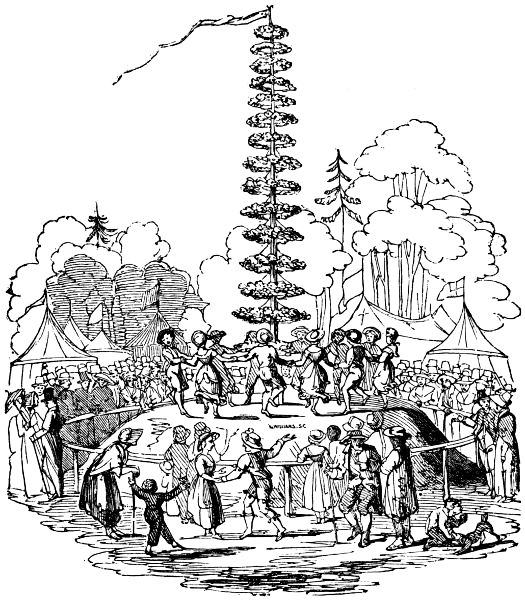
Necton Guild.
From the “mayor’s booth,” early on Whit Monday afternoon, the ceremony of commencing or proclaiming the guild emanates in the following order of procession:—
Constable of Necton in a red scarf, with his staff of office. Beadles or special constables with staves, two and two. Master beadle of the guild, with a halberd. Six boys and girls, Maypole dancers, two and two, hand in hand. Band of Music. Maskers, or morris-dancers, fancifully attired, two and two. Pursuivant with a truncheon, habited in a tabard, on which is depictured an allegorical representation of the arms of Necton. Sword-bearer in grotesque dress, on horseback. Standard bearer on horseback. THE MAYOR OF THE GUILD, On horseback, in full dress suit and purple robes with his chain of office. Standard bearer on horseback. The mayor elect on horseback. Standard bearer on horseback. Principal tenantry on horseback, two and two. Beadles of the guild. Maskers or morris-dancers, fancifully attired, two and two. Six boys and girls, Maypole dancers, two and two, hand in hand. Beadles of the guild. Band of music. Man bearing a standard. Members of Royal Oak Friendly Society, with purple and light blue favours in their hats, two and two. Members of the Necton Old Club Friendly Society with light blue favours in their hats, two and two.
Taking a circuitous route through the field into the park, upon arriving at the principal entrance to the hall, where the colonel and his friends are waiting the approach of the procession, the mayor alights, and thus addresses the patron:—
“Honourable sir,— “The period now arriv’d, In which the tokens of my mayoralty Must be resign’d,—I make it my request, You should appoint as mayor elect, this year, Our worthy friend and colleague, Mr. * * * * But in resigning, beg best thanks to give For the diversion of our last year’s guild;— Hoping the festival will as much this year, By weather and kind friends be happy blest.”
To this the colonel replies, “by thanking the mayor for his past services,—for the good order and regularity observed during the last festival,—and the pleasure it will afford him to make the new appointment.”—They then enter the vestibule, where the mayor resigning his robes and tokens of office, the mayor elect is then invested with them. After returning to the door, the colonel congratulates the new mayor on entering his office, &c. to which his worship thus replies:—
“Honourable sir,— “With pleasure I receive Th’ official tokens of my mayoralty, Which now in place of our late worthy mayor, Alderman * * * * I do most willingly take: Be well assured, as much as in me lies, I will good rule and order strict maintain, That peace and pleasure may together tend To make our guild, two days of even mirth Hoping all here assembled at the hall, Anon will join us in the festive scene, And bidding all most welcome to our guild: I thus respectful beg to take my leave, That I may tend my duties in the field.”—
The procession then returns by the same route and in the same order, with the exception of the new and the past mayors who have changed places. The rustic sports then commence;—the master beadle, ringing a bell, proclaims the sport and the prize, the competitors for which are desired to “come upon the Maypole-stand.”—The sports usually selected, are
Wrestling-matches.
Foot-races.
Jingling-matches.
Jumping in sacks.
Wheel-barrow races, blindfold.
Spinning matches.
Whistling matches.
Grinning ditto, through a horse-collar.
Jumping matches.
&c. &c. &c. &c.
These are occasionally enlivened with Maypole dances, by the boys and girls of the village, selected and dressed for the occasion, and also by the maskers or morris-dancers. When the shades of evening prevent the continuance of these sports, the spacious “mayor’s booth” is then the object of attraction. Well lighted, and the floor boarded for the occasion, country dances commence, which are generally kept up with great spirit and harmony, till the master beadle with his bell announces the time arrived for closing the booths and canteens, “by order of the mayor.” A few minutes, and sometimes (by permission) a little longer, terminates the amusement, which is always concluded, on both evenings, by the whole company joining in the national anthem of “God save the king.”
That “Necton guild” is considered as a superior establishment to a rustic fair, or other merry-making, by the numerous, respectable, and fashionable companies who generally attend from all parts of the neighbourhood. Undisturbed by those scenes of intoxication and disorder, usually prevalent at village fairs, the greatest harmony prevails throughout, and the superior attention and accommodation afforded by the patron and directors of the festival, to all classes of well-behaved and respectable visiters, cannot fail to render “Necton guild,” a popular and attractive resort of Whitsuntide festivities.
I have attempted a sketch of the Maypole stand, &c. from my own knowledge, for I have usually rambled to Necton one or two evenings of each year, since the “guild” was established, and hence I have given you the particulars from actual observation, though I am indebted to a friend, who is a diligent and accurate recorder of customs for the speeches, &c. I must further observe, that the mound of earth I have endeavoured to represent is permanent in the field, and about three feet high, though I have erroneously represented it as higher from lack of eye in drawing, to which indeed I make no pretension. The dancers are the morris-dancers in grotesque dresses; the men with fanciful figured print waistcoat and small clothes, decked with bows; and the women in coloured skirts, trimmed like stage dresses for Spanish girls, with French toques instead of caps.
I find you have removed the publishing office since I wrote last, but I hope you do not mean to withdraw yourself from the work. Should you continue “the soul” of the Every-Day Book “body,” you shall hear from me again, whenever and as soon as I can.
K.
⁂ To obviate the possibility of misapprehension in consequence of the Every-Day Book being published by Messrs. Hunt and Clarke, I take this opportunity of observing, that those gentlemen have no other concern in the work than that of being its publishers, and that it has never ceased from my entire management from the time they undertook that service for me on my own solicitation. No one has any share or interest in it, or any power of influencing its management, and it will continue to be conducted and written by me, as it has been, from the first hour of its commencement. I hope that this is a full and final answer to every inquiry on the subject.
May, 1826.
W. Hone.
Whitsun Ales.
It is pleasant to read the notices of these ancient revels in our topographical histories. One of them gives the following account of a Cornish merriment.
“For the church-ale, two young men of the parish are yerely chosen by their last foregoers to be wardens, who, dividing the task, make collection among the parishioners, of whatsoever provision it pleaseth them voluntarily to bestow. This they employ in brewing, baking, and other acates, against Whitsuntide, upon which holidays the neighbours meet at the church house, and there merily feed on their owne victuals, each contributing some petty portion to the stock, which, by many smalls, groweth to a meetly greatness; for there is entertayned a kind of emulation between these wardens, who, by his graciousness in gathering, and good husbandry in expending, can best advance the churche’s profit. Besides, the neighbour parishes at those times lovingly visit one another, and frankly spend their money together. The afternoons are consumed in such exercises as olde and yonge folk (having leysure) doe accustomably weare out the time withall. When the feast is ended, the wardens yeeld in their accounts to the parishioners; and such money as exceedeth the disbursement is layd up in store, to defray any extraordinary charges arising in the parish, or imposed on them for the good of the countrey or the prince’s service; neither of which commonly gripe so much, but that somewhat stil remayneth to cover the purse’s bottom.”[183]