FEBRUARY.
Reading edition
When, in the zodiac, the Fish wheel round, They loose the floods, and irrigate the ground. Then, husbandmen resume their wonted toil, Yoke their strong steers, and plough the yielding soil: Then prudent gard’ners seize the happy time, To dig and trench, and prune for shoots to climb, Inspect their borders, mark the silent birth Of plants, successive, from the teeming earth, Watch the young nurslings with paternal care, And hope for “growing weather” all the year. Yet February’s suns uncertain shine, For rain and frost alternately combine To stop the plough, with sudden wintry storms— And, often, fearful violence the month deforms.
February 1.
Flowers.
A good garden in a sunny day, at the commencement of this month, has many delightful appearances to a lover of nature, and issues promises of further gratification. It is, however, in ball-rooms and theatres that many of the sex, to whose innocence and beauty the lily is likened, resort for amusement, and see or wear the mimic forms of floral loveliness. Yet this approach to nature, though at an awful distance, is to be hailed as an impulse of her own powerful working in the very heart of fashion; and it has this advantage, that it supplies means of existence to industry, and urges ingenuity to further endeavour. Artificial wants are rapidly supplied by the necessity of providing for real ones; and the wealthy accept drafts upon conditions which indigence prescribes, till it becomes lifted above poverty to independence.
The manufacture of artificial flowers is not wholly unknown in England, but our neighbours, the French, eclipse us in the accuracy and variety of their imitations. Watering-places abound with these wonders of their work-people, and in the metropolis there are depôts, from whence dress-makers and milliners are supplied by wholesale.
The annexed literal copy of a French flower-maker’s card, circulated during the summer of 1822 among the London shopkeepers, is a whimsical specimen of self-sufficiency, and may save some learners of French from an overweening confidence in their acquisition of that language, which, were it displayed in Paris, would be as whimsical in that metropolis as this English is in ours.
M. MARLOTEAU et Cie.
Manufacturers from Paris,
37, MONTMORENCY-STREET,
ToLondon14Broadstreet, Oxfordstreet.
Acquaint the Trade in general, that they have just established in London.
A Warhouse for FRENCH FLOWERS, for each Season, feathar from hat ladies of their own Manufacture elegant fans of the NEWEST TASTE.
And of Manufactures of Paris, complette sets ornaments for balls, snuff boxes scale gold and silver, boxes toilette, ribbons and embroidered, hat et cap, from Ladies of the newest Taste, China, all sorts, etc.
He commit generally the articles from Paris, Manufacturers.
And send in all BRITISH CITY.
Attandance from Nine o’Clock in the Morning till five in the Afternoon.

NATURALISTS’ CALENDAR.
Mean Temperature 39·70.
February 2.
Purification, or Candlemas. 1826.—Holiday at the Public Offices.
This day, the festival of “the Purification of the Blessed Virgin Mary,” is sometimes called Christ’s Presentation, the Holiday of St. Simeon, and The Wives’ Feast. An account of its origin and celebration is in vol. i. p. 199. A beautiful composition in honour of the Virgin is added as a grace to these columns.
Portuguese Hymn. TO THE VIRGIN MARY. By John Leyden.
Star of the wide and pathless sea, Who lov’st on mariners to shine, These votive garments wet to thee, We hang within thy holy shrine. When o’er us flushed the surging brine, Amid the warring waters tost, We called no other name but thine, And hoped, when other hope was lost, Ave Maris Stella! Star of the vast and howling main, When dark and lone is all the sky, And mountain-waves o’er ocean’s plain Erect their stormy heads on high; When virgins for their true loves sigh, And raise their weeping eyes to thee, The star of Ocean heeds their cry, And saves the foundering bark at sea. Ave Maris Stella! Star of the dark and stormy sea, When wrecking tempests round us rave, Thy gentle virgin form we see Bright rising o’er the hoary wave. The howling storms that seem to crave Their victims, sink in music sweet, The surging seas recede to pave The path beneath thy glistening feet, Ave Maris Stella! Star of the desert waters wild, Who pitying hears the seaman’s cry, The God of mercy, as a child, On that chaste bosom loves to lie; While soft the chorus of the sky Their hymns of tender mercy sing, And angel voices name on high The mother of the heavenly king, Ave Maris Stella! Star of the deep! at that blest name The waves sleep silent round the keel, The tempests wild their fury tame That made the deep’s foundations reel: The soft celestial accents steal So soothing through the realms of woe, ***** ***** Ave Maris Stella! Star of the mild and placid seas, Whom rainbow rays of mercy crown, Whose name thy faithful Portuguese O’er all that to the depths go down, With hymns of grateful transport own, When gathering clouds obscure their light, And heaven assumes an awful frown, The star of Ocean glitters bright, Ave Maris Stella! Star of the deep! when angel lyres To hymn thy holy name essay, In vain a mortal harp aspires To mingle in the mighty lay! Mother of God! one living ray Of hope our grateful bosoms fires When storms and tempests pass away, To join the bright immortal quires. Ave Maris Stella!
On Candlemas-day, 1734, there was a grand entertainment for the judges, sergeants, &c. in the Temple-hall. The lord chancellor, the earl of Macclesfield, the bishop of Bangor, together with other distinguished persons, were present, and the prince of Wales attended incog. At night the comedy of “Love for Love” was acted by the company of his Majesty’s revels from the Haymarket theatre, who received a present of 50l. from the societies of the Temple. The judges, according to an ancient custom, danced “round the coal fire,” singing an old French song.[51]
THE COAL AND THE DIAMOND A Fable for Cold Weather.
A coal was hid beneath the grate, (’Tis often modest merit’s fate,) ’Twas small, and so, perhaps, forgotten; Whilst in the room, and near in size, In a fine casket lined with cotton, In pomp and state, a diamond lies. “So, little gentleman in black,” The brilliant spark in anger cried, “I hear, in philosophic clack, Our families are close allied; But know, the splendour of my hue, Excell’d by nothing in existence, Should teach such little folks as you To keep a more respectful distance.” At these reflections on his name, The coal soon redden’d to a flame; Of his own real use aware, He only answer’d with a sneer— “I scorn your taunts, good bishop Blaze, And envy not your charms divine; For know, I boast a double praise, As I can warm as well as shine.”
Elizabeth Woodcock.

Elizabeth Woodcock.
She was in prison, as you see, All in a cave of snow; And she could not relieved be, Though she was frozen so. Ah, well a-day! For she was all froze in with frost, Eight days and nights, poor soul! But when they gave her up for lost, They found her down the hole. Ah, well-a-day!
MS. Ballad.
On Saturday, the 2d of February, 1799, Elizabeth Woodcock, aged forty-two years, went on horseback from Impington to Cambridge; on her return, between six and seven o’clock in the evening, being about half a mile from her own home, her horse started at a sudden light, probably from a meteor, which, at this season of the year, frequently happens. She exclaimed, “Good God! what can this be?” It was a very inclement, stormy night; a bleak wind blew boisterously from the N. E.; the ground was covered by great quantities of snow that had fallen during the day. Many of the deepest ditches were filled up, whilst in the open fields there was but a thin covering; but in roads and lanes, and in narrow and enclosed parts, it had so accumulated as to retard the traveller. The horse ran backwards to the brink of a ditch, and fearing lest the animal should plunge into it, she dismounted, intending to lead the animal home; but he started again, and broke from her. She attempted to regain the bridle; but the horse turned suddenly out of the road, over a common field, and she followed him. Having lost one of her shoes in the snow, and wearied by the exertion she had made, and by a heavy basket on her arm, her pursuit of the horse was greatly impeded; she however persisted, and having overtaken him about a quarter of a mile from whence she alighted, she gained the bridle, and made another attempt to lead him home. But on retracing her steps to a thicket contiguous to the road, she became so much fatigued, and her left foot, which was without a shoe, was so much benumbed, that she was unable to proceed farther. Sitting down upon the ground in this state, and letting go the bridle, “Tinker,” she said, calling the horse by his name, “I am too much tired to go any farther; you must go home without me:” and exclaimed, “Lord have mercy upon me! what will become of me?” The ground on which she sat was upon a level with the common field, close under the thicket on the south-west. She well knew its situation, and its distance from her own house. There was then only a small quantity of snow drifted near her; but it accumulated so rapidly, that when Chesterton bell rang at eight o’clock, she was completely hemmed in by it. The depth of the snow in which she was enveloped was about six feet in a perpendicular direction, and over her head between two and three. She was incapable of any effectual attempt to extricate herself, and, in addition to her fatigue and cold, her clothes were stiffened by the frost; and therefore, resigning herself to the necessity of her situation, she sat awaiting the dawn of the following day. To the best of her recollection, she slept very little during the night. In the morning, observing before her a circular hole in the snow, about two feet in length, and half a foot in diameter, running obliquely upwards, she broke off a branch of a bush which was close to her, and with it thrust her handkerchief through the hole, and hung it, as a signal of distress, upon one of the uppermost twigs that remained uncovered. She bethought herself that the change of the moon was near, and having an almanac in her pocket, took it out, though with great difficulty, and found that there would be a new moon the next day, February the 4th. Her difficulty in getting the almanac from her pocket arose, in a great measure, from the stiffness of her frozen clothes; the trouble, however, was compensated by the consolation which the prospect of so near a change in her favour afforded. Here, however, she remained day after day, and night after night, perfectly distinguishing the alterations of day and night, hearing the bells of her own and the neighbouring villages, particularly that of Chesterton, which was about two miles distant from the spot, and rung in winter time at eight in the evening and four in the morning, Sundays excepted; she was sensible to the sound of carriages upon the road, the bleating of sheep and lambs, and the barking of dogs. One day she overheard a conversation between two gipsies, relative to an ass they had lost. She recollected having pulled out her snuff-box, and taken two pinches of snuff, but felt so little gratification from it, that she never repeated it. Possibly, the cold might have so far blunted her powers of sensation, that the snuff no longer retained its stimulus. Finding her left hand beginning to swell, in consequence of her reclining on that arm, she took two rings, the tokens of her nuptial vows twice pledged, from her finger, and put them, together with a little money from her pocket, into a small box, judging that, should she not be found alive, the rings and money, being thus deposited, were less likely to be overlooked by the discoverers of her breathless corpse. She frequently shouted, in hopes that her vociferations might reach any that chanced to pass, but the snow prevented the transmission of her voice. The gipsies, who approached her nearer than any other persons, were not sensible of any sound, though she particularly endeavoured to attract their attention. A thaw took place on the Friday after the commencement of her misfortunes; she felt uncommonly faint and languid; her clothes were wetted quite through by the melted snow; the aperture before mentioned became considerably enlarged, and she attempted to make an effort to release herself; but her strength was too much impaired; her feet and legs were no longer obedient to her will, and her clothes were become much heavier by the water which they had imbibed. She now, for the first time, began to despair of being discovered alive; and declared, that, all things considered, she could not have survived twenty-four hours longer. This was the morning of her emancipation. The apartment or cave of snow formed around her was sufficiently large to afford her space to move herself about three or four inches in any direction, but not to stand upright, it being only about three feet and a half in height, and about two in the broadest part. Her sufferings had now increased; she sat with one of her hands spread over her face, and fetched very deep sighs; her breath was short and difficult, and symptoms of approaching dissolution became hourly more apparent. On that day, Sunday, the 10th of February, Joseph Muncey, a young farmer, in his way home from Cambridge, about half-past twelve o’clock, passed very near the spot where the woman was. Her handkerchief, hanging upon the twigs, where she had suspended it, caught his eye; he walked up to the place, and saw the opening in the snow, and heard a sound issue from it similar to that of a person breathing hard and with difficulty. He looked in, and saw the woman who had been so long missing. He did not speak to her, but, seeing another young farmer and a shepherd at a little distance, communicated to them the discovery he had made; upon which, though they scarcely credited his report, they went to the spot. The shepherd called out, “Are you there, Elizabeth Woodcock?” She replied, in a faint and feeble accent, “Dear John Stittle, I know your voice; for God’s sake, help me out of this place!” Stittle immediately made his way through the snow till he was able to reach her; she eagerly grasped his hand, and implored him not to leave her. “I have been here a long time,” she observed. “Yes,” answered the man, “ever since Saturday.”—“Ay, Saturday week,” she replied; “I have heard the bells go two Sundays for church.” Her husband was immediately acquainted with the discovery, and proper means were taken for conveying her home. Her husband and some neighbours brought a horse and chaise-cart, with blankets to wrap her in. The snow being somewhat cleared away, she asked for a piece of biscuit and a small quantity of brandy, from taking which she found herself greatly recruited. As a person took her up to put her into the chaise, the stocking of the left leg, adhering to the ground, came off, and she fainted. Nature was greatly exhausted, and the motion, added to the sight of her husband and neighbours, was too much for her strength and spirits. When she recovered, she was laid gently in the carriage, covered well over with the blankets, and conveyed without delay to her own house.
It appears that when the horse came home, her husband and another person set out on the road with a lantern, and went quite to Cambridge, where they only learnt that she left the inn at six that evening. They explored the road afresh that night, and for four succeeding days, and searched the huts of the gipsies, whom they suspected might have robbed and murdered her, till she was unexpectedly discovered in the manner already mentioned.
Mr. Okes, a surgeon, first saw her in the cart, as she was removing home. She spoke to him with a voice tolerably strong, but rather hoarse; her hands and arms were sodden, but not very cold though her legs and feet were. She was put to bed, and weak broth given her occasionally. From the time of her being lost she had eaten only snow, and believed she had not slept till Friday the 8th. The hurry of spirits, occasioned by too many visitors, rendered her feverish; and her feet were found to be completely mortified. The cold had extended its violent effects from the end of the toes to the middle of the instep, including more than an inch above the heels, and all the bottom of the feet, insomuch, that she lost all her toes with the integuments from the bottom of one foot. Her life was saved, but the mutilated state in which she was left, without even a chance of ever being able to attend to the duties of her family, was almost worse than death itself. She lingered until the 13th of July, 1799, when she expired, after a lapse of five months from the period of her discovery.
NATURALISTS’ CALENDAR.
Mean Temperature 40·37.
February 3.
St. Blaise. St. Agatha.
These two Romish festivals are still retained in the church of England calendar.
Of St. Blaise’s festival there is an account in vol. i. p. 207.
WITCHCRAFT.
The necessity for instruction is powerfully exemplified by the following narrative. Some who reflect upon it, and discover that there are other and worse consequences to be apprehended from ignorance than those related below, will consult their own safety, by providing education for the children of labouring people, and influencing their attendance where they may gain the means of distinguishing right from wrong.
In February, 1808, at Great Paxton, in Huntingdonshire, Alice Brown, crossing the ice on the river Ouse, fell into the water, and narrowly escaped drowning, in the sight of her friend, Fanny Amey, a poor epileptic girl, who, in great terror, witnessed the accident. Alice arrived at her father’s house shivering with cold, and, probably from sympathetic affection, was herself seized with epilepsy. The fits returning frequently, she became emaciated, and incapable of labour. In April following, the rev. Isaac Nicholson, curate of the parish, inquiring after her health, was astonished by her brother informing him that her fits and debility were the effect of witchcraft. “She is under an evil tongue,” said the youth. “As sure as you are alive, sir,” continued a stander-by, “she is bewitched, and so are two other young girls that live near her.” The boor related, that at the town he came from in Bedfordshire, a man had been exactly in the same way; but, by a charm, he discovered the witch to be an old woman in the same parish, and that her reign would soon be over; which happened accordingly, for she died in a few days, and the man recovered. “Thomas Brown tried this charm last night for his daughter, but it did not succeed according to our wishes; so they have not at present found out who it is that does all the mischief.”
Mr. Nicholson was greatly shocked at the general opinion of the people that Alice Brown, Fanny Amey, and Mary Fox were certainly bewitched by some person who had bought a familiar or an evil spirit of the devil at the expense of the buyer’s soul, and that various charms had been tried to discover who the buyer was. It was utterly out of his power to remove or diminish the impressions of his parishioners as to the enchantment; and on the following Sunday, a few minutes before he went to church, Ann Izzard, a poor woman about sixty years old, little, but not ill-looking, the mother of eight children, five of whom were living, requested leave to speak to him. In tears and greatly agitated, she told him her neighbours pretended, that, by means of certain charms, they had discovered that she was the witch. She said they abused her children, and by their violent threats frightened her so much that she frequently dropped down to the ground in fainting-fits. She concluded by asserting her innocence in these words: “I am not a witch, and am willing to prove it by being weighed against the church bible.” After the sermon, he addressed his flock on the folly of their opinions, and fatal consequences of brooding over them. It appears, however, that his arguments, explanations, and remonstrances were in vain. On Thursday, the 5th of May, Ann Izzard was at St. Neot’s market, and her son, about sixteen years old, was sent there by his master for a load of corn: his mother and another woman, a shopkeeper in the parish, accompanied him home; but, contrary to the mother’s advice, the woman put a basket of grocery on the sacks of corn One of the horses, in going down hill, became restive, and overturned the cart; and by this accident the grocery was much damaged. Because Ann Izzard had advised her neighbour against putting it in the cart, she charged her with upsetting it by the black art, on purpose to spoil the goods. In an hour, the whole village was in an uproar. “She has just overturned a loaded cart with as much ease as if it had been a spinning-wheel: this is positive proof; it speaks for itself; she is the person that does all the mischief; and if something is not done to put a stop to her baseness, there will be no living in the place.” As it grew dark, on the following Sunday, these brutal creatures assembled together, and at ten o’clock, taking with them the young women supposed to be bewitched, they proceeded to Wright Izzard’s cottage, which stood in a solitary spot at some distance from the body of the village; they broke into the poor man’s house, dragged his wife naked from her bed into the yard, dashed her head against the large stones of the causeway, tore her arms with pins, and beat her on the face, breast, and stomach with the wooden bar of the door. When the mob had dispersed, the abused and helpless woman crawled into her dwelling, put her clothes on, and went to the constable, who said he could not protect her for he had not been sworn in. One Alice Russell, a compassionate widow, unlocked her door to her at the first call, comforted her, bound up her wounds, and put her to bed.
In the evening of the next day she was again dragged forth and her arms torn till they streamed afresh with blood. Alive the following morning, and apparently likely to survive this attack also, her enemies resolved to duck her as soon as the labour of the day was over. On hearing this she fled to Little Paxton, and hastily took refuge in the house of Mr. Nicholson, who effectually secured her from the cruelty of his ignorant flock, and had the mortification to learn that his own neighbours condemned him for “harbouring such a wretch.”
The kindness and affection of the widow Russel were the means of shortening her days. The infatuated populace cried, “The protectors of a witch are just as bad as the witch, and deserve the same treatment.” She neither ate nor slept again from anxiety and fear; but died a martyr to her humanity in twelve days after her home became the asylum, for a few hours, of the unhappy Alice Izzard.
At the Huntingdon assizes in the August following, true bills of indictment were found by the grand jury against nine of these ignorant, infuriated wretches, for assaults on Wright Izzard and Ann Izzard, which were traversed to the following assizes.[52] It does not appear how they were disposed of.
Captain Burt, an officer of engineers, who, about the year 1730, was sent into the north of Scotland on government service, relates the following particulars of an interview between himself and a minister, whom he met at the house of a nobleman.
Witchcraft.
After the minister had said a good deal concerning the wickedness of such a diabolical practice as sorcery; and that I, in my turn, had declared my opinion of it, which you knew many years ago; he undertook to convince me of the reality of it by an example, which is as follows:—
A certain Highland laird had found himself at several times deprived of some part of his wine, and having as often examined his servants about it, and none of them confessing, but all denying it with asseverations, he was induced to conclude they were innocent.
The next thing to consider was, how this could happen. Rats there were none to father the theft. Those, you know, according to your philosophical next-door neighbour, might have drawn out the corks with their teeth, and then put in their tails, which, being long and spongeous, would imbibe a good quantity of liquor. This they might suck out again, and so on, till they had emptied as many bottles as were sufficient for their numbers and the strength of their heads. But to be more serious:—I say there was no suspicion of rats, and it was concluded it could be done by none but witches.
Here the new inquisition was set on foot, and who they were was the question; but how should that be discovered? To go the shortest way to work, the laird made choice of one night, and an hour when he thought it might be watering-time with the hags; and went to his cellar without a light, the better to surprise them. Then, with his naked broadsword in his hand, he suddenly opened the door, and shut it after him, and fell to cutting and slashing all round about him, till, at last, by an opposition to the edge of his sword, he concluded he had at least wounded one of them. But I should have told you, that although the place was very dark, yet he made no doubt, by the glare and flashes of their eyes, that they were cats; but, upon the appearance of a candle, they were all vanished, and only some blood left upon the floor. I cannot forbear to hint in this place at Don Quixote’s battle with the borachios of wine.
There was an old woman, that lived about two miles from the laird’s habitation, reputed to be a witch: her he greatly suspected to be one of the confederacy, and immediately he hasted away to her hut; and, entering, he found her lying upon her bed, and bleeding excessively.
This alone was some confirmation of the justness of his suspicion; but casting his eye under the bed, there lay her leg in its natural form.
I must confess I was amazed at the conclusion of this narration; but ten times more, when, with the most serious air, he assured me that he had seen a certificate of the truth of it, signed by four ministers of that part of the country, and could procure me a sight of it in a few days, if I had the curiosity to see it.
When he had finished his story, I used all the arguments I was master of, to show him the absurdity of supposing that a woman could be transformed into the shape and diminutive substance of a cat; to vanish like a flash of fire; carry her leg home with her, &c.: and I told him, that if a certificate of the truth of it had been signed by every member of the general assembly, it would be impossible for me (however strong my inclinations were to believe) to bring my mind to assent to it.
To the Editor of the Every-Day Book.
Sir,
As a small matter of use and curiosity, I beg to acquaint the readers of the Every-Day Book with the means of determining the gradual increase of a plant.
Take a straight piece of wood, of a convenient height; the upright piece, marked A B in the figure, may be divided into as many parts as you think fit; in the manner of a carpenter’s rule: lay across the top of this another piece of wood, marked G with a small wheel, or pulley, at each end thereof, marked C D; they should be so fixed that a fine thread of silk may easily run through each of them: at the end of this thread, E, tie a small weight, or poise, and tie the other end of the thread, F, to the tip-top of the plant, as represented in the figure.
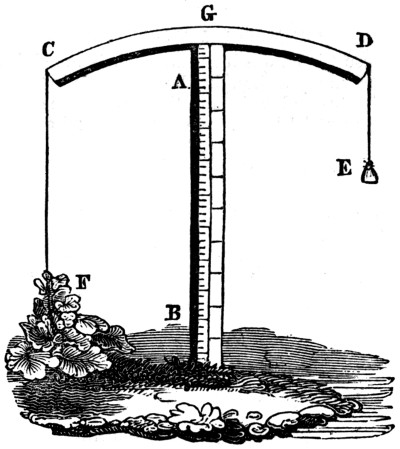
To find the daily increase of this plant, observe to what degree the knot F rises every day, at a particular hour, or to what degree the ball E descends every day.
This little machine may serve several good purposes. By this you will be able to judge how much nourishment a plant receives in the course of each day, and a tolerably just notion may be formed of its quality; for moist plants grow quicker than dry ones, and the hot and moist quicker than the cold and dry.
I am, sir, Your constant reader, S. Thomas.
January 24th, 1826.
To the Editor of the Every-Day Book.
Sir,
Perhaps the following parody of Moore’s beautiful melody, “Those Evening Bells,” on p. 143, may be acceptable to your readers, at a time like the present, when a laugh helps out the spirits against matter-of-fact evils.
I do not think it necessary to avow myself as an “authority” for my little communication; many of your readers will, no doubt, be able to furnish feeling evidence of the truth of the lines. Hoping you, sir, may read them without participating in the lively sensibility that the author felt, I remain,
Your admiring reader, and regular customer, A small Bookseller!
City, Jan. 1826.
“These Christmas Bills!”
A COMMERCIAL MELODY, 1826.
These Christmas bills, these Christmas bills, How many a thought their number kills Of notes and cash, and that sweet time When oft’ I heard my sovereigns chime. Those golden days are past away, And many a bill I used to pay Sticks on the file, and empty tills Contain no cash for Christmas bills. And so ’twill be—though these are paid, More Christmas bills will still be made, And other men will fear these ills, And curse the name of Christmas bills!
COPY OF A LETTER Written to a Domestic at Parting.
The cheerfulness and readiness with which you have always served me, has made me interested in your welfare, and determined me to give you a few words of advice before we part. Read this attentively, and keep it; it may, perhaps, be useful.
Your honesty and principles are, I firmly trust, unshaken. Consider them as the greatest treasure a human being can possess. While this treasure is in your possession you can never be hurt, let what will happen. You will indeed often feel pain and grief, for no human being ever was without his share of them; but you can never be long and completely miserable but by your own fault.
If, therefore, you are ever tempted to do evil, check the first wicked thought that rises in your mind, or else you are ruined. For you may look upon this as a most certain and infallible truth, that if evil thoughts are for a moment encouraged, evil deeds follow: and you need not be told, that whoever has lost his good conscience is miserable, however he may hide it from the world, and whatever wealth and pleasures he may enjoy.
And you may also rely upon this, that the most miserable among the virtuous is infinitely happier than the happiest of the wicked.
The consequence I wish you to draw from all this is, never to do any thing except what you certainly know to be right; for if you doubt about the lawfulness of any thing, it is a sign that it ought not to be done.
NATURALISTS’ CALENDAR.
Mean Temperature 40·32.
February 4.
Chronology.
On the 4th of February, 1800, the rev. William Tasker, remarkable for his learning and eccentricity, died, aged 60, at Iddesleigh, in Devonshire, of which church he was rector near thirty years, though he had not enjoyed the income of the living till within five years before his death, in consequence of merciless and severe persecutions and litigations. “An Ode to the Warlike Genius of Britain, 1778,” 4to., was the first effusion of his poetical talent. His translations of “Select Odes of Pindar and Horace” add to his reputation with the muses, whose smiles he courted by many miscellaneous efforts. He wrote “Arviragus,” a tragedy, and employed the last years of his checkered life on a “History of Physiognomy from Aristotle to Lavater,” wherein he illustrated the Greek philosopher’s knowledge of the subject in a manner similar to that which he pursued in “An Attempt to examine the several Wounds and Deaths of the Heroes in the Iliad and Æneid, trying them by the Test of Anatomy and Physiology.” These erudite dissertations contributed to his credit with the learned, but added nothing to his means of existence. He usually wore a ragged coat, the shirt peeping at the elbows, and shoes of a brownish black, sometimes tied with packthread. Having heard that his spirited “Ode to the Warlike Genius of Britain” had been read by the late king, George III., he presented himself, in his customary habit, on the esplanade at Weymouth, where it excited curiosity; and his majesty asking an attendant who that person was? Mr. Tasker approached, avowed his name, and obtained a gratifying reception. His productions evince critical skill, and a large portion of poetic furor. But he was afflicted and unsuccessful; frequently struggling with penury, and sometimes with oppression. His irritability subjected him to numerous mortifications, and inflicted on him many pangs unknown to minds of less feeling or less delicacy.
Mr. Nichols, in his “Literary Anecdotes,” gives a letter he received from Mr. Tasker, dated from Iddesleigh, in December, 1798, wherein he says, “I continue in very ill health, and confined in my dreary situation at Starvation Hall, forty miles below Exeter, out of the verge of literature, and where even your extensive magazine [‘The Gentleman’s’] has never yet reached.” The works he put forth from his solitude procured him no advancement in the church, and, in the agony of an excruciating complaint, he departed from a world insensible to his merits:—his widow essayed the publication of his works by subscription without effect. Such was the fate of an erudite and deserving parish priest, whose right estimation of honourable independence barred him from stooping to the meanness of flattery; he preserved his self-respect, and died without preferment, and in poverty.
A CHARACTER. The Old Lady.
If the Old Lady is a widow and lives alone, the manners of her condition and time of life are so much the more apparent. She generally dresses in plain silks that make a gentle rustling as she moves about the silence of her room; and she wears a nice cap with a lace border that comes under the chin. In a placket at her side is an old enamelled watch, unless it is locked up in a drawer of her toilet for fear of accidents. Her waist is rather tight and trim than otherwise, as she had a fine one when young; and she is not sorry if you see a pair of her stockings on a table, that you may be aware of the neatness of her leg and foot. Contented with these and other evident indications of a good shape, and letting her young friends understand that she can afford to obscure it a little, she wears pockets, and uses them well too. In the one is her handkerchief, and any heavier matter that is not likely to come out with it, such as the change of a sixpence;—in the other is a miscellaneous assortment, consisting of a pocket-book, a bunch of keys, a needle-case, a spectacle-case, crumbs of biscuit, a nutmeg and grater, a smelling-bottle, and according to the season, an orange or apple, which, after many days, she draws out, warm and glossy, to give to some little child that has well behaved itself. She generally occupies two rooms, in the neatest condition possible. In the chamber is a bed with a white coverlet, built up high and round to look well, and with curtains of a pastoral pattern, consisting alternately of large plants, and shepherds and shepherdesses. On the mantle-piece also are more shepherds and shepherdesses, with dot-eyed sheep at their feet, all in coloured ware, the man perhaps in a pink jacket and knots of ribbons at his knees and shoes, holding his crook lightly in one hand, and with the other at his breast turning his toes out and looking tenderly at the shepherdess:—the woman, holding a crook also, and modestly returning his look, with a gipsy-hat jerked up behind, a very slender waist, with petticoat and hips to counteract, and the petticoat pulled up through the pocket-holes in order to show the trimness of her ancles. But these patterns, of course, are various. The toilet is ancient, carved at the edges, and tied about with a snow-white drapery of muslin. Beside it are various boxes, mostly japan: and the set of drawers are exquisite things for a little girl to rummage, if ever little girl be so bold,—containing ribbons and laces of various kinds,—linen smelling of lavender, of the flowers of which there is always dust in the corners,—a heap of pocket-books for a series of years,—and pieces of dress long gone by, such as head-fronts, stomachers, and flowered satin shoes with enormous heels. The stock of letters are always under especial lock and key. So much for the bed-room. In the sitting-room, is rather a spare assortment of shining old mahogany furniture, or carved arm-chairs equally old, with chintz draperies down to the ground,—a folding or other screen with Chinese figures, their round, little-eyed, meek faces perking side-wise;—a stuffed bird perhaps in a glass case (a living one is too much for her;)—a portrait of her husband over the mantle-piece, in a coat with frog-buttons, and a delicate frilled hand lightly inserted in the waistcoat:—and opposite him, on the wall, is a piece of embroidered literature, framed and glazed, containing some moral distich or maxim worked in angular capital letters, with two trees or parrots below in their proper colours, the whole concluding with an A B C and numerals, and the name of the fair industrious, expressing it to be “her work, Jan. 14, 1762.” The rest of the furniture consists of a looking-glass with carved edges, perhaps a settee, a hassock for the feet, a mat for the little dog, and a small set of shelves, in which are the Spectator and Guardian, the Turkish Spy, a Bible and Prayer-book, Young’s Night-Thoughts, with a piece of lace in it to flatten, Mrs. Rowe’s Devout Exercises of the Heart, Mrs. Glasse’s Cookery, and perhaps Sir Charles Grandison, and Clarissa. John Buncle is in the closet among the pickles and preserves. The clock is on the landing-place between the two room-doors, where it ticks audibly but quietly; and the landing-place, as well as the stairs, is carpeted to a nicety. The house is most in character, and properly coeval, if it is in a retired suburb, and strongly built, with wainscot rather than paper inside, and lockers in the windows. Before the windows also should be some quivering poplars. Here the Old Lady receives a few quiet visitors to tea and perhaps an early game at cards; or you may sometimes see her going out on the same kind of visit herself, with a light umbrella turning up into a stick and crooked ivory handle, and her little dog equally famous for his love to her and captious antipathy to strangers. Her grandchildren dislike him on holidays; and the boldest sometimes ventures to give him a sly kick under the table. When she returns at night, she appears, if the weather happens to be doubtful, in a calash; and her servant, in pattens, follows half behind and half at her side, with a lantern.
Her opinions are not many, nor new. She thinks the clergyman a nice man. The duke of Wellington, in her opinion, is a very great man; but she has a secret preference for the marquis of Granby. She thinks the young women of the present day too forward, and the men not respectful enough: but hopes her grand-children will be better; though she differs with her daughter in several points respecting their management. She sets little value on the new accomplishments: is a great though delicate connoisseur in butcher’s meat and all sorts of house-wifery: and if you mention waltzes, expatiates on the grace and fine breeding of the minuet. She longs to have seen one danced by sir Charles Grandison, whom she almost considers as a real person. She likes a walk of a summer’s evening, but avoids the new streets, canals, &c. and sometimes goes through the church-yard where her other children and her husband lie buried, serious, but not melancholy. She has had three great æras in her life,—her marriage,—her having been at court to see the king, queen, and royal family,—and a compliment on her figure she once received in passing from Mr. Wilkes, whom she describes as a sad loose man, but engaging. His plainness she thinks much exaggerated. If any thing takes her at a distance from home, it is still the court; but she seldom stirs even for that. The last time but one that she went was to see the duke of Wirtemberg: and she has lately been, most probably for the last time of all, to see the princess Charlotte and prince Leopold. From this beatific vision, she returned with the same admiration as ever for the fine comely appearance of the duke of York and the rest of the family, and great delight at having had a near view of the princess, whom she speaks of with smiling pomp and lifted mittens, clasping them as passionately as she can together, and calling her, in a sort of transport of mixed loyalty and self-love, a fine royal young creature, and daughter of England.—Indicator.
The Season.
Sudden storms of short duration, the last blusters of expiring winter, frequently occur during the early part of the present month. These gales and gusts are mostly noticed by mariners, who expect them, and therefore keep a good “look out for squalls.” The observations of seamen upon the clouds, and of husbandmen on the natural appearances of the weather generally, would form an exceedingly curious and useful compendium of meteorological facts.
Stilling the Sea with Oil.
Dr. Franklin suggests the pouring of oil on the sea to still the waves in a storm, but, before he lived, Martin wrote an “Account of the Western Islands of Scotland,” wherein he says, “The steward of Kilda, who lives in Pabbay, is accustomed in time of a storm to tie a bundle of puddings, made of the fat of sea-fowl, to the end of his cable, and lets it fall into the sea behind the rudder; this, he says, hinders the waves from breaking, and calms the sea; but the scent of the grease attracts the whales, which put the vessel in danger.”
NATURALISTS’ CALENDAR.
Mean Temperature 38·34.
February 5.
Browne Willis, Esq. LL.D.
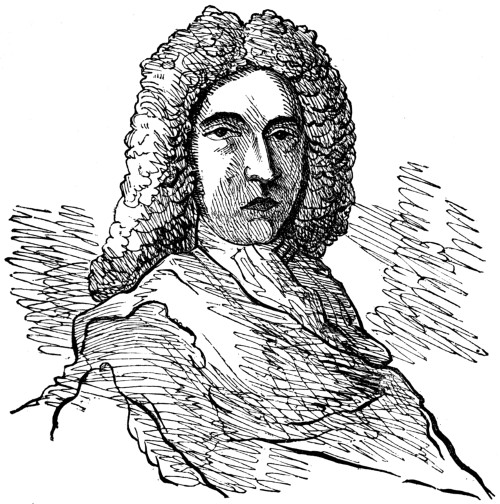
Browne Willis, Esq. LL.D.
A Doctor in Antiquity was he, And Tyson lined his head, as now you see. Kind, good “collector!” why “collect” that storm? No rude attempt is made to mar his form; No alteration ’s aim’d at here—for, though The artist’s touch has help’d to make it show, The meagre contour only is supplied— Is it improved?—compare, and then decide. Had Tyson, “from the life,” Browne Willis sketch’d, And left him, like old Jacob Butler,[53] etch’d, This essay had not been, to better trace The only likeness of an honour’d face.
*
The present engraving, however unwinning its aspect as to drawing, is, in other respects, an improvement of the late Mr. Michael Tyson’s etching from a picture painted by Dahl. There is no other portrait of “the great original” published.
On the 5th of February, 1760, Dr. Browne Willis died at Whaddon hall, in the county of Bucks, aged 78; he was born at St. Mary Blandford, in the county of Dorset, on the 14th of September, 1682. He was unexcelled in eagerness of inquiry concerning our national antiquities, and his life was devoted to their study and arrangement. Some interesting particulars concerning the published labours and domestic habits of this distinguished individual, will be given in a subsequent sheet, with one of his letters, not before printed, accompanied by a fac-simile of his handwriting.
NATURALISTS’ CALENDAR.
Mean Temperature 39·20.
February 6.
Collop Monday. See vol. i. p. 241.
The Season and Smoking.
At this time, Dr. Forster says that people should guard against colds, and, above all, against the contagion of typhus and other fevers, which are apt to prevail in the early spring. “Smoking tobacco,” he observes, “is a very salutary practice in general, as well as being a preventive against infection in particular. The German pipes are the best, and get better as they are used, particularly those made of merschaum, called Ecume de Mer. Next to these, the Turkey pipes, with long tubes, are to be recommended; but these are fitter for summer smoking, under the shade of trees, than for the fireside. The best tobacco is the Turkey, the Persian, and what is called Dutch canaster. Smoking is a custom which should be recommended in the close cottages of the poor, and in great populous towns liable to contagion.”
The Rule of Health.
Rise early, and, take exercise in plenty, But always take it with your stomach empty. After your meals sit still and rest awhile, And with your pipe a careless hour beguile. To rise at light or five, breakfast at nine, Lounge till eleven, and at five to dine, To drink and smoke till seven, the time of tea, And then to dance or walk two hours away Till ten o’clock,—good hour to go to nest, Till the next cock shall wake you from your rest.
On the virtues of tobacco its users enhance with mighty eloquence, and puff it bravely.
In praise of Tobacco.
Much food doth gluttony procure to feed men fat like swine, But he’s a frugal man indeed who on a leaf can dine. He needs no napkin for his hands, his finger ends to wipe, Who has his kitchen in a box, his roast-meat in a pipe.
NATURALISTS’ CALENDAR.
Mean Temperature 39·47.
February 7.
1826.—SHROVE TUESDAY.
Several of the customs and sports of this day are related in vol i. p. 242-261. It is the last meat day permitted by the papacy before Lent, which commences to-morrow, and therefore in former times, full advantage was taken of the expiring opportunity to feast and make merry. Selden observes, “that what the church debars us one day, she gives us leave to eat another—first, there is a carnival, and then a Lent.” This period is also recorded in the homely rhymes of Barnaby Googe.
Shrove-tide.
Now when at length the pleasant time of Shrove-tide comes in place, And cruell fasting dayes at hand approach with solemne grace. Then olde and yong are both as mad, as ghestes of Bacchus’ feast, And foure dayes long they tipple square, and feede and never reast. Downe goes the hogges in every place, and puddings every wheare Do swarme: the dice are shakte and tost, and cardes apace they teare: In every house are showtes and cryes, and mirth, and revell route, And daintie tables spred, and all be set with ghestes aboute: With sundrie playes and Christmasse games, and feare and shame away, The tongue is set at libertie, and hath no kinde of stay.
Naogeorgus.
The Great Seal in Danger.
February 7, 1677, about one in the morning, the lord chancellor Finch’s mace was stolen out of his house in Queen-street; the seal laid under his pillow, so the thief missed it. The famous thief that did it was Thomas Sadler, he was soon after taken, and hanged for it at Tyburn on the 16th of March.[54]
NATURALISTS’ CALENDAR.
Mean Temperature 37·37.
February 8.
1826.—Ash Wednesday,
The First Day of Lent.
To the particulars concerning this day, and the ashes, (in vol. i. p. 261,) is to be added, that the ashes, made of the branches of brushwood, properly cleansed, sifted, and consecrated, were worn four times a year, as at the beginning of Lent; and that on this day the people were excluded from church, husbands and wives parted bed, and the penitents wore sackcloth and ashes.[55]
According to the Benedictine rule, on Ash Wednesday, after sext, the monks were to return to the cloister to converse; but, at the ringing of a bell, be instantly silent. They were to unshoe themselves, wash their hands, and go to church, and make one common prayer. Then was to follow a religious service; after which the priest, having consecrated the ashes, and sprinkled holy water on them, was to throw them on the heads of the monks, saying, “Remember that you are but dust, and to dust must return.” Then “the procession” was to follow.[56]
In former times, on the evening of Ash Wednesday, boys used to run about with firebrands and torches.[57]
Lent Assizes and Sessions.
These follow, in due course, after Hilary Term, which is within a week of its expiration. The importance of assize and sessions business is frequently interrupted by cases not more serious than
The Trial Of Farmer Carter’s Dog PORTER For Murder.
Edward Long, esq., late judge of the admiralty court of Jamaica, wrote and published this “Trial,”[58] which is now scarce, and here somewhat abridged from the original without other alteration.
He commences his report thus:—
County of SEX- GOTHAM, ss.
}
At a High Court of Oyer and Terminer and Gaol-Delivery, holden this — day of —— 1771, at Gotham-Hall.
Present:
The Worshipful J. Bottle, Esq.
} President.
A. Noodle, Mat o’ the Mill, Osmyn Ponser,
} Esqs., Just-asses and Associates.
Game-act Plaintiff versus Porter Defendant.
The Court being met, the indictment was read, which we omit, for sake of brevity.
Court. Prisoner, hold up your paw at the bar.
First Counsel. He is sullen, and refuses.
Court. Is he so? Why then let the constable hold it up, nolens volens.
[Which was done, according to order.]
Court. What is the prisoner’s name?
Constable. P-P-Po-rt-er, an’t please your worship.
Court. What does the fellow say?
Constable. Porter! an’t please you; Porter!
Mat. He says Porter. It’s the name of a liquor the London kennel[59] much delight in.
Ponser. Ay, ’tis so; and I remember another namesake of his. I was hand in glove with him, I’ll tell you a droll story about him—
Court. Hush, brother. Culprit, how will you be tried?
Counsel for the Prosecution. Please your worship, he won’t say a word. Stat mutus—as mute as a fish.
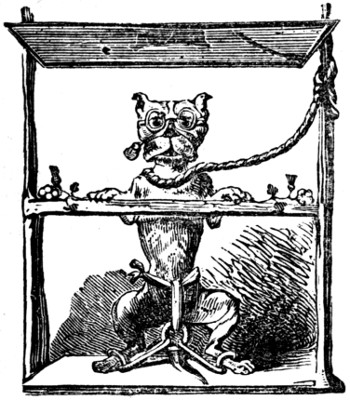
Court. How?—what?—won’t the dog speak? Won’t he do what the court bids him? What’s to be done? Is the dignity of this court to be trifled with in such a manner?
Counsel for Pros. Please your worships—it is provided by the statute in these cases, that when a culprit is stubborn, and refuses to plead, he is to be made to plead whether he will or no.
Court. Ay? How’s that, pray?
Counsel for Pros. Why, the statute says—that he must first of all be thumb-screwed—
Court. Very good.
Counsel for Pros. If that will not do, he must be laid flat on his back, and squeezed, like a cheese in a press, with heavy weights.
Court. Very well. And what then?
Counsel for Pros. What then? Why, when all the breath is squeezed out of his body, if he should still continue dumb, which sometimes has been the case, he generally dies for want of breath.
Court. Very likely.
Counsel for Pros. And thereby saves the court a great deal of trouble; and the nation, the expense of a halter.
Court. Well, then, since the land stands thus—constable, twist a cord about the culprit’s—
Counsel for Pros. Fore-paws.
Constable. Four paws? Why he has but two.
Court. Fore-paws, or fore-feet, blockhead! and strain it as tight as you can, ’till you make him open his mouth.
[The constable attempted to enforce the order, but in drawing a little too hard, received a severe bite.]
Constable. ’Sblood and suet! He has snapped off a piece of my nose.
Court. Mr. Constable, you are within the statute of swearing, and owe the court one shilling.
Constable. Zounds and death! your worships! I could not help it for the blood o’ me.
Court. Now you owe us two shillings.
Constable. That’s a d——d bad plaster, your worships, for a sore nose!
Court. That being but half an oath, the whole fine amounts to two shillings and sixpence, or a half-crown bowl. So, without going further, if you are afraid of his teeth, apply this pair of nut-crackers to his tail.
Constable. I shall, your worships.
[He had better success with the tail, as will now appear.]
Prisoner. Bow, wow, wow, ow, wow!
Court. Hold! Enough. That will do.
It was now held that though the prisoner expressed himself in a strange language, yet, as he could speak no other, and as the law can not only make dogs to speak, but explain their meaning too, so the law understood and inferred that the prisoner pleaded not guilty, and put himself upon his trial. Issue therefore being joined, the Counsel for the Prosecution proceeded to address the Court; but was stopped by the other side.
Prisoner’s Counsel. I take leave to demur to the jurisdiction of the court. If he is to have a trial per pares, you must either suppose their worships to be his equals, that is to say, not his betters, which would be a great indignity, or else you must have a venire for a jury of twelve dogs. I think you are fairly caught in this dilemma.
Counsel for Pros. By no means. It is easily cured. We’ll send the constable with a Mandamus to his Grace’s kennel.
Pris. Counsel. They are fox hounds. Not the same species; therefore not his equals. I do not object to the harriers, nor to a tales de circumstantibus.
Counsel for Pros. That’s artful, brother, but it won’t take. I smoke your intention of garbling a jury. You know the harriers will be partial, and acquit your client at any rate. Neither will we have any thing to do with your tales.
Mat. No—no—you say right. I hate your tales and tale-bearers. They are a rascally pack altogether.
Counsel for Pros. Besides, the statute gives your worships ample jurisdiction in this case; and if it did not give it, your worships know how to take it, because the law says, boni est judicis ampliare jurisdictionem.
Pris. Counsel. Then—I demur for irregularity. The prisoner is a dog, and cannot be triable as a man—ergo, not within the intent of the statute.
Counsel for Pros. That’s a poor subterfuge. If the statute respects a man, (a fortiori) it will affect a dog.
Ponser. You are certainly right. For when I was in the Turkish dominions, I saw an Hebrew Jew put to death for killing a dog, although dog was the aggressor.
Counsel for Pros. A case in point, please your worship. And a very curious and learned one it is. And the plain induction from it is this, that the Jew (who I take for granted was a man) being put to death for killing dog, it follows that said dog was as respectable a person, and of equal rank in society with the said Jew; and therefore—ergo—and moreover—That, said dog, so slain, was, to all and every purpose of legal inference and intendment, neither more nor less than—a man.
Court. We are all clearly of that opinion.
Counsel for Pros. Please your worships of the honourable bench. On Saturday the day of February inst. on or about the hour of five in the afternoon, the deceased Mr. Hare was travelling quietly about his business, in a certain highway or road leading towards Muckingham; and then, and there, the prisoner at the bar being in the same road, in and upon the body of the deceased, with force and arms, a violent assault did make; and further, not having the fear of your worships before his eyes, but being moved and seduced by the instigation of a devilish fit of hunger, he the said prisoner did him the said deceased, in the peace of our lord of the manor then and there being, feloniously, wickedly, wantonly, and of malice aforethought, tear, wound, pull, haul, touzle, masticate, macerate, lacerate, and dislocate, and otherwise evilly intreat; of all and singular which tearings, woundings, pullings, haulings, touzleings, mastications, and so forth, maliciously inflicted in manner and form aforesaid, the said Hare did languish, and languishing did die, in Mr. Just-ass Ponser’s horsepond, to wit, and that is to say, contrary to the statute in that case made and provided, and against the peace of our said lord, his manor and dignity.
This, please your worships, is the purport of the indictment; to this indictment the prisoner has pleaded not guilty, and now stands upon his trial before this honourable bench.
Your worships will therefore allow me, before I come to call our evidence, to expatiate a little upon the heinous sin, wherewith the prisoner at the bar is charged. Hem!—To murder,—Ehem—To murder, may it please your worships, in Latin, is—is—Murderare;—or in the true and original sense of the word, Murder-ha-re. H—, as your worships well know, being not as yet raised to the dignity of a letter by any act of parliament, it follows that it plainly is no other than Murder-a-re, according to modern refined pronunciation. The very root and etymology of the word does therefore comprehend in itself a thousand volumes in folio, to show the nefarious and abominable guilt of the prisoner, in the commission and perpetration of this horrid fact. And it must appear as clear as sunshine to your worships, that the word Murderare, which denotes the prisoner’s crime, was expressly and originally applied to that crime, and to that only, as being the most superlative of all possible crimes in the world. I do not deny that, since it first came out of the mint, it has, through corruption, been affixed to offences of a less criminal nature, such as killing a man, a woman, or a child. But the sense of the earliest ages having stamped hare-murder, or murder-ha-re, (as the old books have it,) with such extraordinary atrociousness, I am sure that Just-asses of your worships’ acknowledged and well-known wisdom, piety, erudition, and humanity, will not, at this time of the day, be persuaded to hold it less detestable and sinful. Having said thus much on the nature of the prisoner’s guilt, I mean not to aggravate the charge, because I shall always feel due compassion for my fellow-creatures, however wickedly they may demean themselves.—I shall next proceed, with your worships’ leave, to call our witnesses.—Call Lawrence Lurcher and Toby Tunnel.
Pris. Counsel. I must object to swearing these witnesses.—I can prove, they were both of them drunk, and non compos, during the whole evening, when this fact is supposed to have been committed.
Bottle. That will do you no service. I am very often drunk myself, and never more in my senses than at such times.
Court. We all agree in this point with brother Bottle.
[Objection overruled and witnesses sworn.]
Lurcher. As I, and Toby Tunnel here, was a going hoam to squire Ponser’s, along the road, one evening after dark, we sees the prisoner at the bar, or somebody like him, lay hold of the deceased, or somebody like him, by the back, an’t please your worships. So, says I, Toby, says I, that looks for all the world like one of ’squire Ponser’s hares. So the deceased cried out pitifully for help, and jumped over a hedge, and the prisoner after him, growling and swearing bitterly all the way. So, says I, Toby, let’s run after ’um. So I scrambled up the hedge; but Toby laid hold of my leg, to help himself up; so both of us tumbled through a thick furze bush into the ditch. So, next morning, as we was a going by the squire’s, we sees the deceased in his worship’s horse-pond.
Pris. Counsel. Are you sure he was dead?
Lurcher. Ay, as dead as my great grandmother.
Pris. Counsel. What did you do with the body?
Ponser. That’s not a fair question. It ought not to be answered.
Lurcher. I bean’t ashamed nor afeard to tell, not I. We carried it to his worship, squire Ponser; and his worship had him roasted, with a pudding in his belly, for dinner, that seame day.
Council for Pros. That is nothing to the purpose. Have you any more questions for the witness?
Pris. Counsel. Yes, I have. Pray friend, how do you know the body you found was the very same you saw on the evening before?
Lurcher. I can’t tell; but I’m ready to take my bible oath on’t.
Pris. Counsel. That is a princely argument, and I shall ask you nothing farther.
Mrs. Margery Dripping, cook to his worship squire Ponser, deposed to the condition of the deceased.
DEFENCE
Prisoner’s Counsel. Please your worships, I am counsel for the prisoner, who, in obedience to your worships’ commands, has pleaded not guilty; and I hope to prove that his plea is a good plea; and that he must be acquitted by the justice of his cause. In the first place, the witnesses have failed in proving the prisoner’s identity. Next, they have not proved the identity of the deceased. Thirdly, they do not prove who gave the wounds. Fourthly, nor to whom they were given. Fifthly, nor whether the party died of the wounds, if they were given, as supposed, to this identical hare. For, I insist upon it, that, because a hare was found in the squire’s horse-pond, non sequitur, that he was killed, and thrown in by the defendant. Or, if they had proved that defendant had maliciously, and animo furioso, pursued the deceased into the horse-pond, it does not prove the defendant guilty of his death, because he might owe his death to the water; and therefore, in that case, the pond would be guilty; and if guilty, triable; and if triable, punishable for the same, and not my client. And I must say, (under favour,) that his worship would likewise be particeps criminis, for not having filled it up, to prevent such accidents. One evidence, who never saw the prisoner till now, nor the deceased till after the fact supposed to have happened, declares, he is sure the prisoner killed the deceased. And why? Because he is ready to take his bible oath on’t. This is, to be sure, a very logical conviction.
Court. It is a very legal one, and that’s better.
Pris. Counsel. I submit to your wisdoms. But I must conclude with observing, that admitting a part of the evidence to be true, viz. that the prisoner did meet the deceased on the highway, and held some conference with him; I say, that supposing this, for argument sake; I do insist, that Mr. Hare, the deceased, was not following a lawful, honest business, at that late hour; but was wickedly and mischievously bent upon a felonious design, of trespassing on farmer Carter’s ground, and stealing, consuming, and carrying off, his corn and his turnips. I further insist that the defendant, knowing this his felonious and evil machination, and being resolved to defend the property of his good friend and patron from such depredations, did endeavour to divert him from it. Which not being able to effect by fair means, he then was obliged to try his utmost, as a good subject and trusty friend, to seize and apprehend his person, and bring him, per habeas corpus, before your worships, to be dealt with according to law. But the deceased being too nimble for him, escaped out of his clutches, and tumbling, accidentally, in the dark, into his worship’s horse-pond, was there drowned. This is, I do not doubt, a true history of the whole affair; and proves that, in the strictest construction of law, it can only be a case of per infortunium—unless your worships should rather incline to deem it felo de se.
Noodle. A fall in the sea! No such thing: it was only a horse-pond, that’s clear from the evidence.
Pris. Counsel. Howsoever your worships may think fit to judge of it, I do humbly conceive, upon the whole matter, that the defendant is not guilty; and I hope your worships, in your wisdoms, will concur with me in opinion, and acquit him.
The Counsel for the Prosecution replied in a long speech. He contended that Mr. Hare, the deceased, was a peaceable, quiet, sober, and inoffensive sort of a person, beloved by king, lords, and commons, and never was known to entertain any idea of robbery, felony, or depredation, but was innocently taking the air, one afternoon, for the benefit of his health, when he was suddenly accosted, upon his majesty’s highway, by the prisoner, who immediately, and bloody-mindedly, without saying a syllable, made at him, with so much fury in his countenance, that the deceased was put in bodily fear; and being a lover of peace, crossed the other side of the way: the prisoner followed him close, and pressed him so hard, that he was obliged to fly over hedge and ditch with the prisoner at his heels. It was at this very juncture they were observed by the two witnesses first examined. The learned counsel further affirmed from circumstances, which he contended amounted to presumptive evidence, that, after various turnings and windings, in his endeavour to escape, his foot slipped, and the prisoner seized him and inflicted divers wounds; but that the deceased finding means to get away, took to the pond, in order to swim across; when the prisoner, running round the pond incessantly, prevented his escape: so that, faint and languishing under his wounds and loss of blood, the hapless victim there breathed his last, in manner and form as the indictment sets forth. He also alleged that, as Mr. Hare lived within his worship’s territory, where there are several more of the same family, he could not, therefore, be going to farmer Carter’s; for that would have been absurd, when he might have got corn and turnips enough on his worship’s own ground. Can there, said the learned gentleman, be a stronger, a weightier, a surer, a—a—a—?
Court. We understand you. It is as clear as crystal.
[Their worships in consultation.]
Court. Has the prisoner’s counsel any thing further to offer in his behalf?
Pris. Counsel. Call farmer Carter.
Pray, farmer Carter, inform the court what you know of the prisoner’s life, character, and behaviour.
Carter. I have known the prisoner these several years. He has lived in my house great part of the time. He was always sober—
Court. Never the honester for that. Well, go on.
Carter. Sober, honest, sincere, trusty, and careful. He was one of the best and most faithful friends I ever knew. He has many a time deterred thieves from breaking into my house at night, and murdering me and my family. He never hated nor hurt any body but rogues and night-walkers. He performed a million of good offices for me, for no other recompense than his victuals and lodging; and seemed always happy and contented with what I could afford him, however scanty the provision. He has driven away many a fox that came to steal my geese and turkies; and, for taking care of a flock of sheep, there is not his equal in the county. In short, whenever he dies I shall lose my best friend, my best servant, and most vigilant protector. I am positive that he is as innocent as a babe of the crime charged upon him; for he was with me that whole evening, and supped and slept at home. He was indeed my constant companion, and we were seldom or never asunder. If your worships please, I’ll be bail for him from five pounds to five hundred.
Court. That cannot be: it is not a bailable offence. Have you any thing else to say, Mr. Positive?
Carter. Say? I think I’ve said enough, if it signified any thing.
Bottle. Drag him away out of hearing.
Carter. I will have justice! You, all of ye, deserve hanging more than your prisoner, and you all know it too.
Court. Away with him, constable.—Scum of the earth! Base-born peasant!
[Carter is hauled out of the court, after a stout resistance.]
Court. A sturdy beggar! We must find out some means of wiring that fellow!
The Counsel for the Prosecution prayed sentence of death upon the culprit at the bar.
Court. How says the statute? Are we competent for this?
Counsel for Pros. The statute is, I confess, silent. But silence gives consent. Besides, this is a case of the first impression, and unprovided for by law. It is your duty, therefore, as good and wise magistrates of the Hundreds of Gotham, to supply this defect of the law, and to suppose that the law, where it says nothing, may be meant to say, whatever your worships shall be pleased to make it.
Bottle. It is now incumbent upon me to declare the opinion of this high and right worshipful court here assembled.
Shall the reptile of a dunghill, a paltry muckworm, a pitch-fork fellow, presume for to go for to keep a dog?—and not only a dog, but a dog that murders hares? Are these divine creatures, that are religiously consecrated to the mouths alone of squires and nobles, to become the food of garlic-eating rogues? It is a food, that nature and policy forbid to be contaminated by their profane teeth. It is by far too dainty for their robustious constitutions. How are our clayey lands to be turned up and harrowed, and our harvests to be got in, if our labourers, who should strengthen themselves with beef and ale, should come to be fed with hare, partridge, and pheasant? Shall we suffer our giants to be nourished with mince-meat and pap? Shall we give our horses chocolate and muffins? No, gentlemen. The brains of labourers, tradesmen, and mechanics, (if they have any,) should ever be sodden and stupified with the grosser aliments of bacon and dumpling. What is it, but the spirit of poaching, that has set all the lower class, the canaille, a hunting after hare’s-flesh? You see the effects of it gentlemen; they are all run mad with politics, resist their rulers, despise their magistrates, and abuse us in every corner of the kingdom. If you had begun hanging of poachers ten years ago, d’ye think you would have had one left in the whole kingdom by this time? No, I’ll answer for it; and your hares would have multiplied, till they had been as plenty as blackberries, and not left a stalk of corn upon the ground. This, gentlemen, is the very thing we ought to struggle for; that these insolent clowns may come to find, that the only use they are good for, is to furnish provision for these animals. In short, gentlemen, although it is not totally clear from the evidence, that the prisoner is guilty; nevertheless, hanged he must and ought to be, in terrorem to all other offenders.
Therefore let the culprit stand up, and hearken to the judgment of the court.
Constable. Please your worship, he’s up.
Bottle. Porter! Thou hast been found guilty of a most daring, horrible, and atrocious crime. Thou hast, without being qualified as the law directs, and without licence or deputation from the lord of the manor, been guilty of shedding innocent blood. In so doing, thou hast broken the peace of the realm, set at naught the laws and statutes of thy country, and (what is more than all these) offended against these respectable personages, who have been sitting in judgment upon thee. For all this enormity of guilt, thy life doth justly become forfeit, to atone for such manifold injuries done to our most excellent constitution. We did intend, in Christian charity, to have given some moments for thy due repentance, but, as the hour is late, and dinner ready, now hear thy doom.
Thou must be led from the bar to the end of the room, where thou art to be hanged by the neck to yonder beam, coram nobis, till you are dead, dead, dead! Hangman, do your duty.
Constable. Please your worships, all is ready.
Ponser. Hoist away, then, hoist away.
[Porter is tucked up.]
Mat. Come, it seems to be pretty well over with him now. The constable has given him a jerk, and done his business.
Bottle. He’s an excellent fellow.
Ponser. The best informer in the whole county.
Bottle. And must be well encouraged.
Ponser. He shall never want a licence, whilst I live.
Noodle. Come, shall we go to dinner?
Bottle. Ay—he’ll never course hares again in this world. Gentlemen, the court is adjourned.
[Exeunt omnes.
EPITAPH,
Composed by Sam. Snivel, the parish clerk, proposed to be put, at Farmer Carter’s expense, on the unfortunate malefactor’s tombstone:
Here lie the remains of honest PORTER; who, after an innocent and well-spent life, was dragged hither, and tried, for a crime he never committed, upon laws to which he was unamenable, before men who were no judges, found guilty without evidence, and hanged without mercy: to give to future ages an example, that the spirit of Turkish despotism, tyranny, and oppression, after glutting itself with the conquest of liberty in British men, has stooped at length to wreak its bloody vengeance on British dogs! Anno Dom. 1771. Requiescat in pace!
S. S.
This humorous “Trial” was written in consequence of “a real event which actually took place, in 1771, near Chichester.” The persons who composed the court are designated by fictitious names; but to a copy of the pamphlet, in the possession of the editor of the Every-day Book, there is a manuscript-key to their identity. The affair is long past, and they are therefore added in italics.
’SQUIRES. J. Bottle—Butler. A. Noodle—Aldridge. Mat o’ the Mill—Challen. O. Ponser—Bridger.
It appears that “the actors in the tragedy were well known by their nicknames, given in Mr. Long’s pamphlet.”
Edward Long, esq. was called to the bar in 1757, and sailed immediately for Jamaica, where he, at first, filled the post of private secretary to his brother-in-law, sir Henry Moore, bart., then lieutenant-governor of the island. He was afterwards appointed judge of the vice-admiralty court, and left the island in 1769. The remainder of his long life was spent in England, and devoted to literature. Mr. Long’s first production was the facetious report of the case of “Farmer Carter’s Dog Porter.” He wrote ably on negro slavery, the sugar trade, and the state of the colonies; but his most distinguished work is “The History of Jamaica,” in three quarto volumes, which contains a large mass of valuable information, much just reasoning, and many spirited delineations of colonial scenery and manners, and is almost as rare as the curious and amusing tract that has contributed to the preceding pages. He was born on the 23d of August, 1734, at Rosilian, in the parish of St. Blaize, Cornwall, and died, on the 13th of March, 1813, at the house of his son-in-law, Henry Howard Molyneux, esq. M.P. of Arundel Park, Sussex, aged 79. Further particulars of his life, writings, and family, are in Mr. Nichols’s “Literary Anecdotes,” and the “Gentleman’s Magazine,” vol. lxxiii., from whence this brief notice is extracted.
NATURALISTS’ CALENDAR.
Mean Temperature 37·27.
February 9.
St. Apollonia.
She is called, by Butler, “the admirable Apollonia, whom old age and the state of virginity rendered equally venerable.” He relates, that in a persecution of the Christians, stirred up by “a certain poet of Alexandria,” she was seized, and all her teeth were beaten out, with threats that she should be cast into the fire, “if she did not utter certain impious words;” whereupon, of her own accord, she leaped into the flames. From this legend, St. Apollonia is become the patron saint of persons afflicted by tooth-ach.
In the “Horæ B. Virginis” is the following prayer:—
“O Saint Apollonia, by thy passion, obtain for us the remission of all the sins, which, with teeth and mouth, we have committed through gluttony and speech; that we may be delivered from pain and gnashing of teeth here and hereafter; and loving cleanness of heart, by the grace of our lips we may have the king of angels our friend. Amen.”
If her teeth and jaws in Romish churches be good evidence, St. Apollonia superabounded in these faculties; the number of the former is surprising to all who disbelieve that relics of the saints multiply of themselves. A church at Bononia possesses her lower jaw, “which is solemnly worshipped by the legate;” St. Alban’s church at Cologne also has her lower jaw—each equally genuine and of equal virtue.
Chronology.
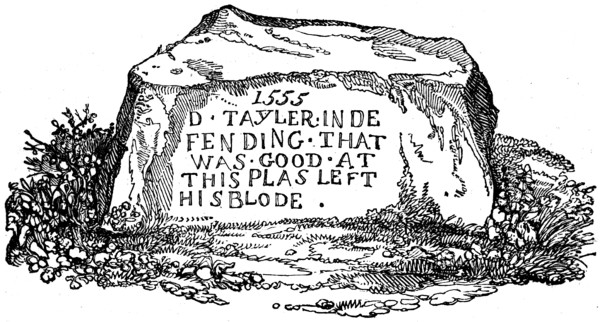
1555. On the 9th of February in this year, Dr. Rowland Taylor, vicar of Hadleigh in Suffolk, one of the first towns in England that entertained the Reformation, suffered death there for resisting the establishment of papal worship in his church. The engraving beneath is a correct representation of an old stone commemorative of the event, as it appeared in 1825, when the drawing was made from it, by a gentleman who obligingly transmits it for the present purpose.
The Martyr’s Stone at Hadleigh in Suffolk.
The Martyr’s Stone at Hadleigh in Suffolk.
Besides the rude inscription on this old stone, as it is represented in the engraving, there is another on a neat monument erected by the side of the original in 1818. The lines are as follows: they were supplied by the Rev. Dr. Hay Drummond, rector of Hadleigh.
Mark this rude Stone, where Taylor dauntless stood, Where Zeal infuriate drank the Martyr’s blood: Hadleigh! that day, how many a tearful eye Saw the lov’d Pastor dragg’d a Victim by; Still scattering gifts and blessings as he past “To the blind pair” his farewell alms were cast; His clinging flock e’en here around him pray’d “As thou hast aided us, be God thine aid;” Nor taunts, nor bribes of mitred rank, nor stake, Nor blows, nor flames, his heart of firmness shake; Serene—his folded hands, his upward eyes, Like Holy Stephen’s, seek the opening skies; There, fix’d in rapture, his prophetic sight Views Truth dawn clear, on England’s bigot night; Triumphant Saint! he bow’d, and kiss’d the rod, And soar’d on Seraph-wing to meet his God.
Rowland Taylor was “a doctor in both the civil and canon lawes, and a right perfect divine.” On induction to his benefice, he resided with his flock, “as a good shepherd abiding and dwelling among his sheep,” and “not only was his word a preaching unto them, but all his life and conversation was an example of unfained christian life, and true holinesse: he was void of all pride, humble and meeke as any child, so that none were so poore, but they might boldly, as unto their father, resort unto him; neither was his lowlinesse childish or fearfull; but, as occasion, time, and place required, he would be stout in rebuking the sinfull and evil doers, so that none was so rich, but he would tell him plainly his fault, with such earnest and grave rebukes as became a good curate and pastor.” He continued in well-doing at Hadleigh during the reign of king Edward VI. till the days of queen Mary, when one Foster, a lawyer, and one John Clerk, of Hadley, “hired one Averth, parson of Aldam, a right popish priest, to come to Hadley, and there to give the onset to begin again the popish masse: to this purpose they builded up, with all haste possible, the altar, intending to bring in their masse again about the Palme Munday.” The altar was thrown down in the night, but on the following day it was replaced, and the Aldam priest entered the church, attended by Foster and Clerk, and guarded by men with swords and bucklers. Dr. Taylor, who was in his study, and ignorant of this irruption, hearing the church bells ring, repaired thither, and found the priest, surrounded by his armed force, ready to begin mass, against whom he was unable to prevail, and was himself thrust, “with strong hand, out of the church.” Two days afterwards, he was summoned by Gardiner, bishop of Winchester, to come before him at London, and answer complaints. His friends counselled him to fly, but Taylor determined to meet his enemies, “and, to their beards, resist their false doings.” He took his departure amidst their weeping, “leaving his cure with a godly old priest named sir Richard Yeoman, who afterwards, for God’s truth, was burnt at Norwich.” On his appearance, bishop Gardiner, who was also lord chancellor, reviled him, “calling him knave, traitor, heretike, with many other villainous reproaches.” Taylor listened patiently: at last he said, “My lord, I am neither traitor nor heretike, but a true subject, and a faithfull christian man; and am come, according to your commandment, to know what is the cause that your lordship hath sent for me?” The bishop charged upon him that he was married. “Yea,” quoth Taylor, “that I thank God I am, and have had nine children, and all in lawful matrimony; and blessed be God that ordained matrimony.” Then the bishop charged him with having resisted the priest of Aldam in saying mass at Hadleigh. Taylor also admitted this, and, after stout dispute, was committed to the king’s bench, where he spent his time in praying, reading the scriptures, writing, preaching, and exhorting the prisoners to repentance and amendment of life. There he found “master Bradford,” whom he comforted by his courage. While imprisoned, he was cited to appear “in the Arches at Bow church,” and was carried thither, and “deprived of his benefice because he was married.” On the 20th of January, 1555, Taylor was again taken before Gardiner and other bishops. He gives a long account of his disputations with them on that and like occasions. They urged him, and others with him, to recant: the prisoners refused, and “then the bishops read sentence of death upon them.”
After condemnation, Dr. Taylor was “bestowed in the Clinke till it was toward night, and then he was removed to the counter by the Poultry.” On the 4th of February, Bonner, bishop of London, came to the counter to degrade him; first wishing him to return to the church of Rome, and promising him to sue for his pardon. Whereunto Taylor answered, “I woulde you and your fellowes would turne to Christ; as for me I will not turn to Antichrist.” “Well,” quoth the bishop, “I am come to degrade you, wherefore put on these vestures.” “No,” quoth doctor Taylor, “I will not.” “Wilt thou not?” said the bishop. “I shall make thee, ere I goe.” Quoth doctor Taylor, “You shall not, by the grace of God.” Then Bonner caused another to put them on his back; and when thus arrayed, Taylor, walking up and down, said, “How say you, my lord, am I not a goodly fool? How say you, my masters; if I were in Cheap, should I not have boys enough to laugh at these apish toys, and toying trumpery?” The bishop proceeded, with certain ceremonies, to his purpose, till at the last, when, according to the form, he should have struck Taylor on the breast with his crosier, the bishop’s chaplain said, “My lord, strike him not, for he will sore strike again.” Taylor favoured the chaplain’s suspicion. “The cause,” said he, “is Christ’s; and I were no good christian if I would not fight in my master’s quarrel.” It appears that “the bishop laid his curse upon him, but struck him not;” and after all was over, when he got up stairs, “he told master Bradford (for both lay in one chamber) that he had made the bishop of London afraid; for, saith he, laughingly, his chaplain gave him counsell not to strike with his crosier-staff, for that I would strike again; and by my troth, said he, rubbing his hands, I made him believe I would doe so indeed.”
Thus was Taylor still cheerful from rectitude. In the afternoon his wife, his son, and John Hull his servant, were permitted to sup with him. After supper, walking up and down, he impressively exhorted them, with grave advice, to good conduct and reliance on Providence. “Then they, with weeping tears, prayed together, and kissed one the other; and he gave to his wife a book of the church service, set out by king Edward, which in the time of his imprisonment he daily used; and unto his sonne Thomas he gave a latine booke, containing the notable sayings of the old martyrs, gathered out of Ecclesiastica Historia; and in the end of that booke he wrote his testament and last vale.” In this “vale,” dated the 5th of February, he says to his family, “I goe before, and you shall follow after, to our long home. I goe to the rest of my children. I have bequeathed you to the onely Omnipotent.” In the same paper he tells his “dear friends of Hadley, to remain in the light opened so plainely and simply, truly, throughly, and generally in all England,” for standing in which he was to die in flames.
In the morning at two o’clock, the sheriff of London with his officers brought him, without light, from the counter to Aldgate. His wife, suspecting that he would be carried away thus privately, had watched, from the time they had parted, within the porch of St. Botolph’s church, having her daughter Mary with her, and a little orphan girl named Elizabeth, whom the honest martyr had reared from three years old to her then age of thirteen: and when the sheriff and his company came nigh to where they stood, the child Elizabeth cried, “O my dear father! Mother, mother, here is my father led away.” The darkness being so great that the one could not see the other, his wife cried, “Rowland, Rowland, where art thou?” Taylor answered, “Dear wife! I am here,” and he stayed; and the sheriff’s men would have forced him, but the sheriff said, “Stay a little, my masters, I pray you, and let him speak to his wife.” Then he took his daughter Mary in his arms, and he, and his wife, and the orphan girl kneeled and prayed; and the sheriff, and many who were present, wept; and he arose and kissed his wife, and shook her by the hand, and said, “Farewell, my dear wife, be of good comfort, for I am quiet in my conscience; God shall stir up a father for my children.” He had three others, besides his daughter Mary and the young Elizabeth. He then kissed Mary, and then Elizabeth, and he bade them, also, farewell and enjoined them to stand steadfast in their faith. His weeping wife said, “God be with thee, dear Rowland, I will, with God’s grace, meet thee at Hadleigh.” Then he was led on to the Woolsack inn, at Aldgate, where he was put in a chamber, under the custody of four yeomen of the guard and the sheriff’s men. Here his wife again desired to see him, but was restrained by the sheriff, who otherwise treated her with kindness, and offered her his own house to abide in; but she preferred to go to her mother’s, whither two officers conducted her, charging her mother to keep her within till their return.
Meantime so soon as Taylor entered the chamber he prayed; and he remained at the inn until the sheriff of Essex was ready to receive him. At eleven o’clock the inn gates were shut, and then he was put on horseback within the gates. When they arrived outside, Taylor saw his son Thomas standing against the rails, in the care of his man John Hull; and he said, “Come hither, my son Thomas.” John Hull lifted the child up, and set him on the horse before his father; and Taylor put off his hat, and spoke a sentence or two to the people in behalf of matrimony, and then he lifted up his eyes and prayed for his son, and laid his hat on the child’s head, and blessed him. This done he delivered the child to John Hull, whom he took by the hand, and he said to him, “Farewell, John Hull, the faithfullest servant that ever man had.” Having so said, he rode forth with the sheriff of Essex and the yeomen of the guard to go to his martyrdom in Suffolk.
When they came near to Brentwood, one Arthur Taysie, who had been servant to Taylor, supposing him free, took him by the hand and said, “Master Doctor, I am glad to see you again at liberty;” but the sheriff drove him back. At Brentwood, a close hood was put over Taylor’s face, with holes for his eyes to look out at, and a slit for his mouth to breathe through. These hoods were used at that place to be put on the martyrs that they should not be known, and that they should not speak to any one, on the road to the burning-places.
Yet as they went, Taylor was so cheerful, and talked to the sheriff and his guards in such wise, that they were amazed at his constancy. At Chelmsford they met the sheriff of Suffolk, who was there to carry him into his county. At that time he supped with the two sheriffs. The sheriff of Essex laboured during supper to persuade him to return to queen Mary’s religion, telling him that all present would use their suit to the queen for his pardon, nor doubted they could obtain it. The sheriff reminded him, that he had been beloved for his virtues, and honoured for his learning; that, in the course of nature, he was likely to live many years; and that he might even be higher esteemed than ever; wherefore he prayed him to be advised: “This counsel I give you,” said the sheriff, “of a good heart and good will towards you;” and, thereupon he drank to him; and the yeomen of the guard said, “In like manner, upon that condition, master Doctor, we all drink to you.” When they had so done, and the cup came to Taylor, he staid awhile, as studying what he might say, and then answered thus: “Master sheriff, and my masters all, I heartily thank you for your good will. I have hearkened to your words and marked well your counsels; and to be plain with you, I do perceive that I have been deceived myself, and am likely to deceive a great many of their expectation.” At these words they were exceedingly glad. “Would ye know my meaning plainly?” he said. “Yea, good master Doctor,” answered the sheriff, “tell it us plainly.” “Then,” said Taylor, “I will tell you:” and he said, that, as his body was of considerable bulk, and as he thought, if he had died in his bed, it would have been buried in Hadleigh church-yard, so he had deceived himself; and, as there were a great many worms there abiding, which would have mealed handsomely upon him, so they, as well as himself, were deceived; “for” said he, “it must be burnt to ashes, and they will thereby lose their feeding.” The sheriff and his company were thereupon astonished at him, as being a man without fear of death, and making a jest of the flames. During their progress, many gentlemen and magistrates were admitted to see him, and entreated him, in like manner, but he remained immovable.
Thus they drew near to Hadleigh: and when they rode over Hadleigh bridge, a poor man with his five small children awaited their coming. When they saw Taylor, they all fell down on their knees and held up their hands, and cried aloud, “God help and succour thee, as thou hast many a time succoured me and my poor children.” The streets of Hadleigh were crowded on each side by men and women, of the town and country, sorely weeping, and with piteous voices loudly bewailing the loss of their pastor, praying that he might be strengthened and comforted in his extremity, and exclaiming, “What shall become of this wicked world!” Taylor said, “I have preached to you God’s word and truth, and am come to seal it with my blood.” When he came to the almshouses, he put some money, that had been bestowed on him during his imprisonment, into a glove, and this he is said to have given to the poor almsmen as they stood at their doors, to see their wonted benefactor pass. At the last of the almshouses he inquired, “Is the blind man, and blind woman, that dwelt here, alive?” He was answered, “Yes; they are there, within.” Then he threw glove and all in at the window, and so rode forth towards the field of his death.
Coming where a great multitude were assembled, he asked, “What place is this, and what meaneth it that so much people are gathered hither?” It was answered, “This is Aldham common, the place where you must suffer.” He said, “Thanked be God, I am even at home.” Then he alighted from his horse, and with both his hands rent the hood from his head. His hair was unseemly, for Bonner, when he degraded him, had caused it to be clipped in manner of a fool’s. At the sight of his ancient and reverend face, and his long white beard, the people burst into tears, and prayed for him aloud. He would have spoken to them, but whenever he attempted, one or other of the yeomen of the guard thrust a tipstaff into his mouth.
Then he desired licence to speak, of the sheriff; but the sheriff refused him, and bade him remember his promise to the council: “Well,” quoth Taylor, “promise must be kept.” What the promise was is unknown. Seating himself on the ground he called to one in the crowd, “Soyce, I pray thee come and pull off my boots, and take them for thy labour; thou hast long looked for them, now take them.” Then he arose, and putting off his underclothes, them also he bestowed. This done, he cried with a loud voice, “Good people! I have taught you nothing but God’s holy word, and those lessons that I have taken out of God’s blessed book, the Holy Bible; and I am come hither this day to seal it with my blood.” One Holmes, a yeoman of the guard, who had used him cruelly all the way, then struck him a violent blow on the head “with a waster,” and said, “Is that the keeping of thy promise, thou heretick?” Whereupon Taylor knelt on the earth and prayed, and a poor, but faithful woman, stepped from among the people to pray with him: the guards would fain have thrust her away, they threatened to tread her down with their horses, but she was undismayed, and would not remove, but remained and prayed with him. Having finished his devotions he went to the stake, and kissed it, and placed himself in a pitch-barrel which had been set for him to stand in; and he stood with his back upright against the stake, and he folded his hands together, and he lifted his eyes towards heaven, and he prayed continually. Then they bound him with chains, and the sheriff called one Richard Donningham, a butcher, and commanded him to set up the faggots, but he said, “I am lame, sir, and not able to lift a faggot.” The sheriff threatened to send him to prison, but the man refused to obey his command notwithstanding. Then the sheriff appointed to this labour one Mullcine of Carsey, “a man for his virtues fit to be a hangman.” Soyce, a very drunkard, a man named Warwick, and one Robert King, “a deviser of interludes.” These four set up the faggots, and prepared for making ready the fire, and Warwick cast a faggot at the martyr, which lit upon his head and wounded his face, so that the blood ran down. Taylor said, “O, friend! I have harm enough, what needed that?” Then, while he repeated the psalm Miserere, in English, sir John Shelton struck him on the mouth: “You knave,” said he, “speak Latin; or I will make thee.” At last they set the faggots on fire, and Taylor, holding up both his hands, called on God, crying, “Merciful Father of Heaven! for Jesus Christ our saviour’s sake, receive my soul into thy hands!” He stood, during his burning, without crying or moving, till Soyce struck him on the head with a halberd, and the brains falling out, the corpse fell down into the fire.[60]