September.
Reading edition
Next him September marched eke on foot; Yet was he heavy laden with the spoyle Of harvest’s riches, which he made his boot, And him enriched with bounty of the soyle; In his one hand, as fit for harvest’s toyle, He held a knife-hook; and in th’ other hand A paire of weights, with which he did assoyle Both more and lesse, where it in doubt did stand, And equal gave to each as justice duly scanned.
This is the ninth month of the year: anciently it was the seventh, as its name imports, which is compounded of septem, seven, and imber, a shower of rain, from the rainy season usually commencing at this period of the year.
Our Saxon ancestors called this month “Gerst-monat, for that barley which that moneth commonly yeelded was antiently called gerst, the name of barley being given unto it by reason of the drinke therewith made, called beere, and from beerlegh it come to be berlegh, and from berleg to barley. So in like manner beereheym, to wit, the overdecking or covering of beere, came to be called berham, and afterwards barme, having since gotten I wot not how many names besids.—This excellent and healthsome liquor, beere, antiently also called ael, as of the Danes it yet is (beere and ale being in effect all one,) was first of the Germans invented, and brought in use.”[268]
Mr. Leigh Hunt notices, that Spenser takes advantage of the exuberance of harvest, and the sign of the zodiac, libra, in this month, to read another lesson on justice. “This is the month,” Mr. Hunt continues, “of the migration of birds, of the finished harvest, of nut-gathering, of cyder and perry-making, and, towards the conclusion, of the change of colour in trees. The swallows and many other soft-billed birds that feed on insects, disappear for the warmer climates, leaving only a few stragglers behind, probably from weakness or sickness, who hide themselves in caverns and other sheltered places, and occasionally appear upon warm days. The remainder of harvest is got in; and no sooner is this done, than the husbandman ploughs up his land again, and prepares it for the winter grain. The oaks and beeches shed their nuts, which in the forest that still remain, particularly the New Forest in Hampshire, furnish a luxurious repast for the swine, who feast of an evening in as pompous a manner as any alderman, to the sound of the herdsman’s horn. But the acorn must not be undervalued because it is food for swine, nor thought only robustly of, because it furnishes our ships with timber. It is also one of the most beautiful objects of its species, protruding its glossy green nut from its rough and sober-coloured cup, and dropping it in a most elegant manner beside the sunny and jagged leaf. We have seen a few of them, with their stems in water, make a handsome ornament to a mantle-piece, in this season of departing flowers.—The few additional flowers this month are cornflowers, Guernsey-lilies, starwort, and saffron, a species of crocus, which is cultivated in separate grounds. The stamens of this flower are pulled, and dried into flat square cakes for medicinal purposes. It was formerly much esteemed in cookery. The clown in the Winter’s Tale, reckoning up what he is to buy for the sheepshearing feast, mentions ‘saffron to colour the warden-pies.’ The fresh trees and shrubs in flower are bramble, chaste-tree, laurustinus, ivy, wild honeysuckle, spirea, and arbutus, or strawberry-tree, a favourite of Virgil, which, like the garden of Alcinous, in Homer, produces flower and fruit at once. Hardy annuals, intended to flower in the spring, should now be sown; annuals of curious sorts, from which seed is to be raised, should be sheltered till ripened; and auriculas in pots, which were shifted last month, moderately watered. The stone-curlew clamours at the beginning of this month, wood-owls hoot, the ring-ouzel reappears, the saffron butterfly is seen, hares congregate; and, at the end of it, the woodlark, thrush, and blackbird, are heard.”
Mr. Hunt further observes that, September, though its mornings and evenings are apt to be chill and foggy, and therefore not wholesome to those who either do not, or cannot, guard against them, is generally a serene and pleasant month, partaking of the warmth of summer and the vigour of autumn. But its noblest feature is a certain festive abundance for the supply of all the creation. There is grain for men, birds, and horses, hay for the cattle, loads of fruit on the trees, and swarms of fish in the ocean. If the soft-billed birds which feed on insects miss their usual supply, they find it in the southern countries, and leave one’s sympathy to be pleased with an idea, that repasts apparently more harmless are alone offered to the creation upon our temperate soil. The feast, as the philosophic poet says on a higher occasion—
The feast is such as earth, the general mother, Pours from her fairest bosom, when she smiles In the embrace of Autumn. To each other As some fond parent fondly reconciles Her warring children, she their wrath beguiles With their own sustenance; they, relenting, weep. Such is this festival, which from their isles, And continents, and winds, and oceans deep, All shapes may throng to share, that fly, or walk, or creep.
Shelley.
September 1.
St. Giles, Abbot, 7th Cent. Twelve Brothers, Martyrs, A. D. 258. St. Lupus, or Leu, Abp. A. D. 623. St. Firminus II., Bp. of Amiens, A. D. 347.
St. Giles.
This saint is in the church of England calendar. He was born at Athens, and came into France in 715, having first disposed of his patrimony to charitable uses. After living two years with Cæsarius, bishop of Arles, he commenced hermit, and so continued till he was made abbot of an abbey at Nismes, which the king built for his sake. He died in 750.[269]
St. Giles is the patron of beggars. Going to church in his youth, he gave his coat to a sick beggar who asked alms of him, the mendicant was clothed, and the garment miraculously cured his disorder. He was also the patron of cripples. After he had retired to a cave in a solitary desert, the French king was hunting near his thicket, and Giles was wounded by an arrow from a huntsman’s bow while at prayers; whereupon being found unmoved from his position, the king fell at his feet, craved his pardon, and gave orders for the cure of his wound, but this the saint would not permit, because he desired to suffer pain and increase his merits thereby, and so he remained a cripple, and received reverence from the king whom he counselled to build a monastery; and the king did so, and Giles became abbot thereof, “and led the life of an angel incarnate,” and converted the king.[270] It is related of him that he raised the dead son of a prince to life, and made a lame man walk: our church of St. Giles, Cripplegate, is dedicated to him. It is further told, that at Rome he cast two doors of cypress into the Tiber, and recommended them to heavenly guidance, and on his return to France found them at the gates of his monastery, and set them up as the doors of his own church. These are some only of the marvels gravely told of him, “many wytnisse that they herde the company of aungelles berynge the soule of hym into heven.”[271]
FLORAL DIRECTORY.
Great Sedum. Sedum Telephium. Dedicated to St. Giles.
September 2.
St. Stephen, king of Hungary, A. D. 1038. St. Justus, Abp. of Lyons, A. D. 390. St. William, Bp. of Roschild, A. D. 1067. B. Margaret, 13th Cent.
London Burnt, 1666.
The “Great Fire” of London is denoted as above in our almanacs on this day. It broke out at Pudding-lane and ended at Pie-corner. The monument on Fish-street-hill to commemorate the calamity, bears the following inscription on the north side:—
“In the year of Christ, 1666, the 2d day of September, eastward from hence, at the distance of 202 feet, the height of this column, a terrible fire broke out about midnight; which, driven on by a strong wind, not only wasted the adjacent parts, but also very remote places, with incredible noise and fury. It consumed eighty-nine churches, the city gates, Guildhall, many public structures, hospitals, schools, libraries, a vast number of stately edifices, 13,200 dwelling-houses, and 430 streets, of the twenty-six wards it utterly destroyed fifteen, and left eight others shattered and half burnt. The ruins of the city were 436 acres, from the Tower by the Thames side to the Temple church, and from the north-east along the City-wall to Holborn-bridge. To the estates and fortunes of the citizens it was merciless, but to their lives very favourable, that it might in all things resemble the conflagration of the world. The destruction was sudden; for in a small space of time the city was seen most flourishing, and reduced to nothing. Three days after, when this fatal fire had baffled all human counsels and endeavours, in the opinion of all, it stopped, as it were, by a command from heaven, and was on every side extinguished. But papistical malice, which perpetrated such mischiefs, is not yet restrained.”
A line, beginning on the west side, contains the following words; on James II. coming to the crown, they were erased, but restored under William III.:—
“This pillar was set up in perpetual remembrance of the most dreadful burning of this protestant city, begun and carried on by the treachery and malice of the popish faction, in the beginning of September, in the year of our Lord, 1666, in order to the carrying on their horrid plot for extirpating the protestant religion, and old English liberty, and introducing popery and slavery.”
The south side is thus inscribed:—“Charles the Second, son of Charles the Martyr, king of Great Britain, France and Ireland, defender of the faith, a most gracious prince, commiserating the deplorable state of things, whilst the ruins were yet smoaking, provided for the comfort of his citizens, and the ornament of his city; remitted their taxes, and referred the petitions of the magistrates and inhabitants to the parliament; who immediately passed an act, that public works should be restored to greater beauty, with public money, to be raised by an imposition on coals; that churches, and the cathedral of St. Paul’s, should be rebuilt from their foundations, with all magnificence; that the bridges, gates, and prisons should be new made, the sewers cleansed, the streets made straight and regular, such as were steep levelled, and those too narrow made wider, markets and shambles removed to separate places. They also enacted, that every house should be built with party walls, and all in front raised of an equal height, and those walls all of square stone or brick; and that no man should delay building beyond the space of seven years.”
An estimate of the value of property consumed by the fire amounted to ten millions six hundred and eighty-nine thousand pounds, wherein was included the value of St. Paul’s cathedral, which was set down at nearly one-fifth of the total. The occasion of the conflagration was the subject of parliamentary investigation. It is imputed to the Roman Catholics, but a dispassionate consideration of all the circumstances by impartial men tends to acquit them of the crime, and most persons at this time believe that—
———“London’s column pointing to the skies, Like a tall bully, rears its head and lies.”
Thomas Vincent, a non-conformist minister, who was ejected from the living of St. Mary Magdalen, in Milk-street, and during the great plague remained in the city, and preached regularly to the great comfort of the inhabitants under the affliction of the raging pestilence, was an eye-witness of the subsequent conflagration. He wrote “God’s terrible Judgments in the City by Plague and Fire,” and has left a circumstantial relation in that work of the progress made by the flames, and their effects on the people.
Vincent’s Narrative.
It was the 2d of September, 1666, that the anger of the Lord was kindled against London, and the fire began: it began in a baker’s house, in Pudding-lane, by Fish-street-hill; and now the Lord is making London like a fiery oven in the time of his anger, and in his wrath doth devour and swallow up our habitations. It was in the depth and dead of the night, when most doors and fences were locked up in the city, that the fire doth break forth and appear abroad; and, like a mighty giant refreshed with wine, doth awake and arm itself, quickly gathers strength, when it had made havoc of some houses; rusheth down the hill towards the bridge; crosseth Thames-street, invadeth Magnus church, at the bridge foot; and, though that church were so great, yet it was not a sufficient barricado against this conqueror; but, having scaled and taken this fort, it shooteth flames with so much the greater advantage into all places round about; and a great building of houses upon the bridge is quickly thrown to the ground: then the conqueror, being stayed in his course at the bridge, marcheth back to the city again, and runs along with great noise and violence through Thames-street, westward; where, having such combustible matter in its teeth, and such a fierce wind upon its back, it prevails with little resistance, unto the astonishment of the beholders.
Fire! fire! fire! doth resound the streets; many citizens start out of their sleep, look out of their windows; some dress themselves and run to the place. The lord mayor of the city comes with his officers; a confusion there is; counsel is taken away; and London, so famous for wisdom and dexterity, can now find neither brains nor hands to prevent its ruin. The hand of God was in it; the decree was come forth; London must now fall, and who could prevent it? No wonder, when so many pillars are removed, if the building tumbles; the prayers, tears, and faith, which sometimes London hath had, might have quenched the violence of the fire; might have opened heaven for rain, and driven back the wind: but now the fire gets mastery, and burns dreadfully.
That night most of the Londoners had taken their last sleep in their houses; they little thought it would be so when they went into their beds; they did not in the least suspect, when the doors of their ears were unlocked, and the casement of their eyes were opened in the morning, to hear of such an enemy invading the city, and that they should see him, with such fury, enter the doors of their houses, break into every room, and look out of their casements with such a threatening countenance.
That which made the ruin the more dismal, was, that it was begun on the Lord’s-day morning: never was there the like sabbath in London; some churches were in flames that day; and God seems to come down, and to preach himself in them, as he did in Mount Sinai, when the mount burned with fire; such warm preaching those churches never had; such lightning dreadful sermons never were before delivered in London. In other churches ministers were preaching their farewell sermons, and people were hearing with quaking and astonishment: instead of a holy rest which christians have taken on this day, there is a tumultuous hurrying about the streets towards the place that burned, and more tumultuous hurrying upon the spirits of those that sat still, and had only the notice of the ear of the quick and strange spreading of the fire.
Now the train-bands are up in arms watching at every quarter for outlandish-men, because of the general fear and jealousies, and rumours, that fire-balls were thrown into houses by several of them to help on and provoke the too furious flames. Now goods are hastily removed from the lower parts of the city; and the body of the people begin to retire, and draw upwards, as the people did from the tabernacles of Korah, Dathan, and Abiram, when the earth did cleave asunder and swallow them up: or rather as Lot drew out from his house in Sodom before it was consumed by fire from heaven. Yet some hopes were retained on the Lord’s-day that the fire would be extinguished, especially by them who lived in the remote parts; they could scarcely imagine that the fire a mile off should be able to reach their houses.
But the evening draws on, and now the fire is more visible and dreadful: instead of the black curtains of the night, which used to be spread over the city, now the curtains are yellow; the smoke that arose from the burning parts seemed like so much flame in the night, which being blown upon the other parts by the wind, the whole city, at some distance, seemed to be on fire. Now hopes begin to sink, and a general consternation seizeth upon the spirits of people; little sleep is taken in London this night; the amazement which the eye and ear doth effect upon the spirit, doth either dry up or drive away the vapour which used to bind up the senses. Some are at work to quench the fire with water; others endeavour to stop its course, by pulling down of houses; but all to no purpose: if it be a little allayed, or beaten down, or put to a stand in some places, it is but a very little while; it quickly recruits, and recovers its force; it leaps and mounts, and makes the more furious onset, drives back its opposers, snatcheth their weapons out of their hands, seizeth upon the water-houses and engines, burns them, spoils them, and makes them unfit for service.
On the Lord’s-day night the fire had run as far as Garlick-hithe, in Thames-street, and had crept up into Cannon-street, and levelled it with the ground; and still is making forward by the water-side, and upward to the brow of the hill, on which the city was built.
On Monday, (the 3d) Gracechurch-street is all in flames, with Lombard-street, on the left hand, and part of Fenchurch-street, on the right, the fire working (though not so fast) against the wind that way: before it were pleasant and stately houses, behind it ruinous and desolate heaps. The burning then was in fashion of a bow, a dreadful bow it was, such as mine eyes never before had seen; a bow which had God’s arrow in it, with a flaming point: it was a shining bow; not like that in the cloud, which brings water with it; and withal signified God’s covenant not to destroy the world any more with water: but it was a bow which had fire in it, which signified God’s anger, and his intention to destroy London with fire.
Now the flames break in upon Cornhill, that large and spacious street, and quickly cross the way by the train of wood that lay in the streets untaken away, which had been pulled down from houses to prevent its spreading: and so they lick the whole street as they go: they mount up to the top of the highest houses; they descend down to the bottom of the lowest vaults and cellars; and march along on both sides of the way, with such a roaring noise, as never was heard in the city of London; no stately building so great as to resist their fury: the Royal Exchange itself, the glory of the merchants, is now invaded with much violence; and when once the fire was entered, how quickly did it run round the galleries, filling them with flames; then came down stairs, compasseth the walks, giving forth flaming volleys, and filleth the court with sheets of fire: by-and-by down fall all the kings upon their faces, and the greatest part of the stone-building after them, (the founder’s statue only remaining,) with such a noise as was dreadful and astonishing.
Then, then the city did shake indeed; and the inhabitants did tremble, and flew away in great amazement from their houses, lest the flames should devour them; rattle, rattle, rattle, was the noise which the fire struck upon the ear round about, as if there had been a thousand iron chariots beating upon the stones: and if you opened your eye to the opening of the streets, where the fire was come, you might see, in some places, whole streets at once in flames, that issued forth as if they had been so many great forges, from the opposite windows, which folding together, were united into one great flame throughout the whole street; and then you might see the houses tumble, tumble, tumble, from one end of the street to the other, with a great crash, leaving the foundations open to the view of the heavens.
Now fearfulness and terror doth surprise the citizens of London; confusion and astonishment doth fall upon them at this unheard-of, unthought-of, judgment. It would have grieved the heart of an unconcerned person to see the rueful looks, the pale cheeks, the tears trickling down from the eyes, (where the greatness of sorrow and amazement could give leave for such a vent,) the smiting of the breast, the wringing of the hands; to hear the sighs and groans, the doleful and weeping speeches of the distressed citizens, when they were bringing forth their wives, (some from their child-bed,) and their little ones (some from their sickbed,) out of their houses, and sending them into the country, or somewhere into the fields with their goods. Now the hopes of London are gone, their heart is sunk; now there is a general remove in the city, and that in a greater hurry than before the plague, their goods being in greater danger by the fire than their persons were by the sickness. Scarcely are some returned, but they must remove again, and, not as before, now without any more hopes of ever returning and living in those houses any more.
Now carts, and drays, and coaches, and horses, as many as could have entrance into the city, were loaden, and any money is given for help; 5l. 10l. 20l. 30l. for a cart, to bear forth into the fields some choice things, which were ready to be consumed; and some of the carmen had the conscience to accept of the highest price, which the citizens did then offer in their extremity; I am mistaken if such money do not burn worse than the fire out of which it was raked. Now casks of wine, and oil, and other commodities, are tumbled along, and the owners shove as much of their goods as they can towards the gate: every one now becomes a porter to himself, and scarcely a back either of man or woman, that hath strength, but had a burden on it in the streets: it was very sad to see such throngs of poor citizens coming in and going forth from the unburnt parts, heavy laden with some pieces of their goods, but more heavy laden with weighty grief and sorry of heart, so that it is wonderful they did not quite sink under these burdens.
Monday night was a dreadful night: when the wings of the night had shadowed the light of the heavenly bodies, there was no darkness of night in London, for the fire shines now round about with a fearful blaze, which yieldeth such light in the streets, as it had been the sun at noon-day. Now the fire having wrought backward strangely against the wind, to Billingsgate, &c., along Thames-street, eastward, runs up the hill to Tower-street, and having marched on from Gracechurch-street, making further progress in Fenchurch-street, and having spread its wing beyond Queenhithe, in Thames-street, westward, mounts up from the water-side, through Dowgate, and Old Fish-street, into Watling-street: but the great fury of the fire was in the broader streets; in the midst of the night it was come down Cornhill, and laid it in the dust, and runs along by the Stocks, and there meets with another fire, which came down Threadneedle-street; a little further with another, which came up from Wallbrook; a little further with another, which comes up from Bucklersbury; and, all these four, joining together, break into one great flame at the corner of Cheapside, with such a dazzling light, and burning heat, and roaring noise, by the fall of so many houses together, that was very amazing; and though it were something stopt in its swift course at Mercers’-chapel, yet with great force in a while it conquers the place, and burns through it; and then, with great rage, proceedeth forward in Cheapside.
On Tuesday (the 4th) was the fire burning up the very bowels of London; Cheapside is all in a light, (fire in a few hours time,) many fires meeting there, as in the centre; from Soper-lane, Bow-lane, Bread-street, Friday-street, and Old Change, the fire comes up almost together, and breaks furiously into the Broad-street, and most of that side of the way was together in flames, a dreadful spectacle; and then, partly by the fire which came down by Mercers’-chapel, partly by the fall of the houses cross the way, the other side is quickly kindled, and doth not stand long after it. Now the fire gets into Blackfriars, and so continues its course by the water, and makes up towards Paul’s church, on that side, and Cheapside fire besets the great building on this side, and the church, though all of stone outward, though naked of houses about it, and though so high above all buildings in the city, yet, within a while, doth yield to the violent assaults of the conquering flames, and strangely takes fire at the top: now the lead melts and runs down, as if it had been snow before the sun; and the great beams and massy stones with a great noise fall on the pavement, and break through into Faith church underneath; now great flakes of stone scale and peel off strangely from the side of the walls; the conqueror having got this high fort, darts its flames round about. Now Paternoster-row, Newgate-market, the Old Bailey, and Ludgate-hill, have submitted themselves to the devouring fire, which with wonderful speed rusheth down the hill into Fleet-street. Now Cheapside fire marcheth along Ironmonger-lane, Old Jewry, Lawrence-lane, Milk-street, Wood-street, Gutter-lane, Foster-lane. Now it runs along Lothbury, Cateaton-street, &c. From Newgate-market, it assaults Christchurch, and conquers that great building, and burns through Martin’s-lane towards Aldersgate, and all about so furiously, as if it would not leave a house standing upon the ground.
Now horrible flakes of fire mount up the sky, and the yellow smoke of London ascendeth up towards heaven, like the smoke of a great furnace; a smoke so great, as darkened the sun at noonday: (if at any time the sun peeped forth, it looked red like blood:) the cloud of smoke was so great, that travellers did ride at noonday, some miles together, in the shadow thereof, though there were no other cloud beside to be seen in the sky.
And if Monday night was dreadful, Tuesday night was more dreadful, when far the greatest part of the city was consumed: many thousands who on Saturday had houses convenient in the city, both for themselves, and to entertain others, now have not where to lay their head; and the fields are the only receptacle which they can find for themselves and their goods; most of the late inhabitants of London lie all night in the open air, with no other canopy over them but that of the heavens: the fire is still making towards them, and threateneth the suburbs; it was amazing to see how it had spread itself several times in compass; and, amongst other things that night, the sight of Guildhall was a fearful spectacle, which stood the whole body of it together in view, for several hours together, after the fire had taken it, without flames, (I suppose because the timber was such solid oak,) in a bright shining coal, as if it had been a palace of gold, or a great building of burnished brass.
On Wednesday morning, (the 5th) when people expected that the suburbs would be burnt, as well as the city, and with speed were preparing their flight, as well as they could, with their luggage into the countries, and neighbouring villages, then the Lord hath pity on poor London; his bowels began to relent; his heart is turned within him, and he stays his rough wind in the day of the east wind; his fury begins to be allayed; he hath a remnant of people in London, and there shall a remnant of houses escape: the wind now is husht; the commission of the fire is withdrawing, and it burns so gently, even where it meets with no opposition, that it was not hard to be quenched, in many places, with a few hands: now the citizens begin to gather a little heart, and encouragement in their endeavours to quench the fire. A check it had at Leadenhall by that great building; a stop it had in Bishopsgate-street, Fenchurch-street, Lime-street, Mark-lane, and towards the Tower; one means, under God, was the blowing up of houses with gunpowder. Now it is stayed in Lothbury, Broad-street, Coleman-street; towards the gates it burnt, but not with any great violence; at the Temple also it is stayed, and in Holborn, where it had got no great footing; and when once the fire was got under, it was kept under, and on Thursday the flames were extinguished.
But on Wednesday night, when the people, late of London, now of the fields, hoped to get a little rest on the ground, where they had spread their beds, a more dreadful fear falls upon them than they had before, through a rumour that the French were coming armed against them to cut their throats, and spoil them of what they had saved out of the fire: they were now naked and weak, and in ill condition to defend themselves, and the hearts, especially of the females, do quake and tremble, and are ready to die within them; yet many citizens, having lost their houses, and almost all that they had, are fired with rage and fury: and they begin to stir up themselves like lions, or like bears bereaved of their whelps, and now “Arm! Arm!” doth resound the fields and suburbs with a dreadful voice. We may guess at the distress and perplexity of the people this night, which was something alleviated when the falseness of the alarm was perceived.
The ruins of the city were 396 acres; [viz. 333 acres within the walls, and 63 in the liberties of the city,] of the six and twenty wards, it utterly destroyed fifteen, and left eight others shattered, and half burnt; and it consumed 400 streets, 13,200 dwelling-houses, eighty-nine churches, [besides chapels,] four of the city gates, Guildhall, many public structures, hospitals, schools, libraries, and a vast number of stately edifices.
The preceding relation by Thomas Vincent, with the philosophic Evelyn’s, will acquaint the reader with as much as can here be told of the most direful visitations the metropolis ever suffered. Evelyn’s account is in his “Diary,” or “Memoirs” of himself, a manuscript which is known to have been preserved from probable destruction by Mr. Upcott.
John Evelyn’s Narrative.
Sept. 2, 1666. This fatal night, about ten, began that deplorable fire near Fish-streete in London.
Sept. 3. The fire continuing, after dinner I took coach with my wife and sonn, and went to the Bankside in Southwark, where we beheld that dismal spectacle, the whole citty in dreadful flames neare the water side; all the houses from the bridge, all Thames-street, and upwards towards Cheapeside downe to the Three Cranes, were now consum’d.
The fire having continu’d all this night (if I may call that night which was as light as day for ten miles round about, after a dreadful manner,) when conspiring with a fierce eastern wind in a very drie season: I went on foote to the same place, and saw the whole south part of the citty burning from Cheapeside to the Thames, and all along Cornehill, (for it kindl’d back against the wind as well as forward,) Tower-streete, Fenchurch-streete, Gracious-streete, and so along to Bainard’s-castle, and was now taking hold of St. Paule’s church, to which the scaffolds contributed exceedingly. The conflagration was so universal, and the people so astonish’d, that from the beginning, I know not by what despondency or fate, they hardly stirr’d to quench it, so that there was nothing heard or seene but crying out and lamentation, running about like distracted creatures, without at all attempting to save even their goods, such a strange consternation there was upon them, so as it burned both in breadth and length, the churches, publiq halls, exchange, hospitals, monuments, and ornaments, leaping after a prodigious manner from house to house and streete to streete, at greate distances one from the other, for the heate with a long set of faire and warme weather, had even ignited the air, and prepar’d the materials to conceive the fire which devour’d after an incredible manner, houses, furniture, and every thing. Here we saw the Thames cover’d with goods floating, all the barges and boates laden with what some had time and courage to save, as, on the other, the carts, &c. carrying out to the fields, which for many miles were strew’d with moveables of all sorts, and tents erecting to shelter both people and what goods they could get away. Oh, the miserable and calamitous spectacle! such as haply the world had not seene the like since the foundation of it, nor to be outdone till the universal conflagration. All the skie was of a fiery aspect, like the top of a burning oven, the light seene above forty miles round about for many nights. God grant my eyes may never behold the like, now seeing above 10,000 houses all in one flame; the noise and cracking and thunder of the impetuous flames, the shrieking of women and children, the hurry of people, the fall of towers, houses, and churches, was like an hideous storme, and the aire all about so hot and inflam’d that at last one was not able to approach it, so that they were forc’d to stand still and let the flames burn on, which they did for neere two miles in length and one in breadth. The clouds of smoke were dismall, and reach’d upon computation neer fifty miles in length. Thus I left it this afternoone burning, a resemblance of Sodom, or the last day. London was, but is no more!
Sept. 4. The burning still rages, and it was now gotten as far as the Inner Temple, all Fleete-streete, the Old Bailey, Ludgate-hill, Warwick-lane, Newgate, Paul’s Chain, Watling-streete, now flaming, and most of it reduc’d to ashes; the stones of Paules flew like granados, the melting lead running downe the streetes in a streame, and the very pavements glowing with fiery rednesse, so as no horse nor man was able to tread on them, and the demolition had stopp’d all the passages, so that no help could be applied. The eastern wind still more impetuously drove the flames forward. Nothing but the Almighty power of God was able to stop them, for vaine was the help of man.
Sept. 5. It crossed towards Whitehall; Oh, the confusion there was then at that court! it pleased his majesty to command me among the rest to looke after the quenching of Fetter-lane end, to preserve if possible that part of Holborn, while the rest of the gentlemen tooke their several posts (for now they began to bestir themselves, and not till now, who hitherto had stood as men intoxicated, with their hands acrosse), and began to consider that nothing was likely to put a stop but the blowing up of so many houses as might make a wider gap than any had yet ben made by the ordinary method of pulling them down with engines; this some stout seamen propos’d early enough to have sav’d neare the whole citty, but this some tenacious and avaritious men, aldermen, &c. would not permit, because their houses must have been of the first. It was therefore now commanded to be practic’d, and my concern being particularly for the hospital of St. Bartholomew neere Smithfield, where I had many wounded and sick men, made me the more diligent to promote it, nor was my care for the Savoy lesse. It now pleas’d God by abating the wind, and by the industry of the people, infusing a new spirit into them, that the fury of it began sensibly to abate about noone, so as it came no farther than the Temple westward, nor than the entrance of Smithfield north; but continu’d all this day and night so impetuous towards Cripplegate and the Tower, as made us all despaire: it also broke out againe in the Temple, but the courage of the multitude persisting, and many houses being blown up, such gaps and desolations were soone made, as with the former three days’ consumption, the back fire did not so vehemently urge upon the rest as formerly. There was yet no standing neere the burning and glowing ruines by neere a furlong’s space.
The poore inhabitants were dispers’d about St. George’s Fields, and Moorefields, as far as Highgate, and severall miles in circle, some under tents, some under miserable huts and hovells, many without a rag or any necessary utensills, bed or board, who from delicatenesse, riches, and easy accommodations in stately and well furnish’d houses, were now reduc’d to extreamest misery and poverty.
In this calamitous condition I return’d with a sad heart to my house, blessing and adoring the mercy of God to me and mine, who in the midst of all this ruine was like Lot, in my little Zoar, Safe and sound.
Sept. 7. I went this morning on foote from Whitehall as far as London Bridge, thro’ the late Fleete-streete, Ludgate-hill, by St. Paules, Cheapeside, Exchange, Bishopsgate, Aldersgate, and out to Moorefields, thence thro’ Cornehille, &c. with extraordinary difficulty, clambering over heaps of yet smoking rubbish, and frequently mistaking where I was. The ground under my feete was so hot, that it even burnt the soles of my shoes. In the mean time his majesty got to the Tower by water to demolish the houses about the graff, which being built intirely about it, had they taken fire and attack’d the White Tower where the magazine of powder lay, would undoubtedly not only have beaten downe and destroy’d all the bridge, but sunke and torne the vessells in the river, and render’d the demolition beyond all expression for several miles about the countrey.
At my return I was infinitely concern’d to find that goodly church St. Paules now a sad ruine, and that beautifull portico (for structure comparable to any in Europe, as not long before repair’d by the king,) now rent in pieces, flakes of vast stone split asunder, and nothing remaining intire but the inscription in the architrave, shewing by whom it was built, which had not one letter of it defac’d. It was astonishing to see what immense stones the heat had in a manner calcin’d, so that all the ornaments, columns, freezes, and projectures of massie Portland stone flew off, even to the very roofe, where a sheet of lead covering a great space was totally mealted; the ruines of the vaulted roofe falling broke into St. Faith’s, which being fill’d with the magazines of bookes belonging to the stationers, and carried thither for safety, they were all consum’d, burning for a weeke following. It is also observable that the lead over the altar at the east end was untouch’d, and among the divers monuments, the body of one bishop remain’d intire. Thus lay in ashes that most venerable church, one of the most antient pieces of early piety in the christian world, besides neere one hundred more. The lead, yron worke, bells, plate, &c. mealted; the exquisitely wrought Mercers’-chapell, the sumptuous Exchange, the august fabriq of Christ church, all the rest of the companies halls, sumptuous buildings, arches, all in dust; the fountaines dried up and ruin’d whilst the very waters remain’d boiling; the vorrago’s of subterranean cellars, wells, and dungeons, formerly warehouses, still burning in stench and dark clouds of smoke, so that in five or six miles traversing about I did not see one load of timber unconsum’d, nor many stones but what were calcin’d white as snow. The people who now walk’d about the ruines appear’d like men in a dismal desart, or rather in some great citty laid waste by a cruel enemy; to which was added the stench that came from some poore creatures bodies, beds, &c. Sir Tho. Gresham’s statue, tho’ fallen from its nich in the Royal Exchange, remain’d intire, when all those of the kings since the conquest were broken to pieces, also the standard in Cornehill, and Q. Elizabeth’s effigies, with some armes on Ludgate, continued with but little detriment, whilst the vast yron chaines of the cittie streetes, hinges, bars and gates of prisons, were many of them mealted and reduced to cinders by the vehement heate. I was not able to passe through any of the narrow streetes, but kept the widest, the ground and aire, smoake and fiery vapour, continu’d so intense that my haire was almost sing’d, and my feete unsufferably surheated. The bie lanes and narrower streetes were quite fill’d up with rubbish, nor could one have knowne where he was, but by the ruines of some church or hall, that had some remarkable tower or pinnacle remaining. I then went towards Islington and Highgate, where one might have seene 200,000 people of all ranks and degrees dispers’d and lying along by their heapes of what they could save from the fire, deploring their losse, and tho’ ready to perish for hunger and destitution, yet not asking one penny for relief, which to me appear’d a stranger sight than any I had yet beheld. His majesty and council indeede tooke all imaginable care for their reliefe by proclamation for the country to come in and refresh them with provisions. In the midst of all this calamity and confusion, there was, I know not how, an alarme begun, that the French and Dutch, with whom we were now in hostility, were not onely landed, but even entering the citty. There was in truth some days before greate suspicion of those two nations joyning; and now, that they had been the occasion of firing the towne. This report did so terrifie, that on a suddaine there was such an uproare and tumult that they ran from their goods, and, taking what weapons they could come at, they could not be stopp’d from falling on some of those nations whom they casually met, without sense or reason. The clamour and peril grew so excessive, that it made the whole court amaz’d, and they did with infinite paines and greate difficulty reduce and appease the people, sending troopes of soldiers and guards to cause them to retire into the fields againe, where they were watch’d all this night. I left them pretty quiet, and came home sufficiently weary and broken. Their spirits thus a little calmed, and the affright abated, they now began to repaire into the suburbs about the citty, where such as had friends or opportunity got shelter.
The essential particulars of Evelyn’s narrative being ended, it may be observed that a discontinued periodical miscellany notices at the end of “Littleton’s Dictionary,” an inscription for the monument (on Fish-street-hill), wherein this very learned scholar proposes a name for it, in a word which extends through seven degrees of longitude. It is designed to commemorate the names of the seven lord mayors of London, under whose respective mayoralties the monument was begun, continued, and completed:—
Quam non unâ aliqua ac simplici voce, uti istam quondam Duilianam; Sed, ut vero eam Nomine indigites, Vocabulo constructiliter Heptastego. Fordo—Watermanno—Hansono—Hookero Vinero—Sheldono—Davisianam Appellites oportebit.
Well might Adam Littleton call this an heptastic vocable, rather than a word.[272]
FLORAL DIRECTORY.
Golden Rod. Solidago virgaurea. Dedicated to St. Margaret.
September 3.
St. Simeon Stylites, the younger, A. D. 592. St. Remaclus, Bp. of Maestricht, A. D. 664. St. Mansuet, first Bp. of Toul, in Lorrain, A. D. 375. St. Macrisius, first Bp. of Connor, in Ireland, A. D. 513.
Proclamation of Bartholomew Fair.
This is the only Fair now held within the city of London, and, as introductory to an account of this annual scene, it is necessary to notice that it has been the custom from time immemorial for one of the four attorneys of the lord mayor’s court, who may happen to be what is termed the attorney in waiting, (and which duty in respect of proclaiming the Fair for the last seven years has devolved upon Mr. Carter,) to accompany the lord mayor in his state carriage from the Mansion-house to Smithfield, on the day whereon the Fair is proclaimed, which is on the 3d of September, unless Sunday should fall on that day. The proclamation is read at the gate leading into Cloth-fair by the lord mayor’s attorney, and repeated after him by a sheriff’s officer, in the presence of the lord mayor and sheriffs, and also of the aldermen, (if they attend, but who, though summoned for that purpose, seldom appear.) The procession afterwards proceeds round Smithfield, and returns to the Mansion-house, where, in the afternoon, the gentlemen of his lordship’s household dine together at the sword-bearer’s table, and thus the ceremony is concluded. It was also the custom of the procession to stop at Newgate to drink to the governor’s health, but this practice was discontinued in the second mayoralty of Mr. Alderman Wood.
The following is a copy of the proclamation from the parchment-roll now used:—
“Form of the Proclamation of Bartholomew Fair made at the Great Gate going into the Cloth Fair, Smithfield.
“Oyez, 3 times.
“The Right Honourable [John Garratt] Lord Mayor of the City of London, and his right Worshipful Brethren the Aldermen of the said City, streightly charge and command, on the behalf of our Sovereign Lord the King, That all manner of Persons of whatsoever Estate, Degree, or Condition they be, having recourse to this Fair, keep the Peace of our said Sovereign Lord the King.
“That no manner of Persons shall make any Congregation, Conventicles, or Affrays, by the which the same peace may be broken or disturbed, upon pain of Imprisonment, and Fine, to be made after the discretion of the Lord Mayor and Aldermen.
“Also, that all manner of Sellers of Wine, Ale, or Beer, sell by measures ensealed, as by Gallon, Pottle, Quart and Pint, upon pain that will fall thereof.
“And, that no person sell any Bread, but it be good and wholesome for Man’s Body, upon pain that will fall thereof.
“And, that no manner of Cook, Pye-baker, nor Huckster, sell, nor put to sale, any manner of Victual, except it be good and wholesome for Man’s Body, upon pain that will fall thereof.
“And, that no manner of Person buy nor sell, but with true weights and measures, sealed according to the Statute, in that behalf made, upon pain that will fall thereof.
“And, that no manner of person or persons take upon him, or them, within this Fair, to make any manner of arrest, attachment, summons, or execution; except it be done by the Officers of this City, thereunto assigned, upon pain that will fall thereof.
“And, that no person or persons whatsoever, within the limits and bounds of this Fair, presume to break the Lord’s day in selling, shewing, or offering to Sale, or in buying, or in offering to buy, any Commodities whatsoever; or in sitting tippling, or drinking in any Tavern, Inn, Alehouse, Tipling House or Cook house; or in doing any other thing that may tend to the breach thereof, upon the pain and penalties contained in several Acts of Parliament, which will be severely inflicted upon the Breakers thereof.
“And, finally, that what person soever find themselves aggrieved, injured, or wronged, by any manner of Person in this Fair, that they come with their Plaints before the Stewards in this Fair assigned to hear and determine Pleas, and they will minister to all parties, Justice, according to the Laws of this Land, and the Customs of this City.
God save the King.
“It is ordered that this Fair do finally close on [Wednesday] next.
“N. B. This Fair continues 3 days, exclusive of the day of Proclamation.”
FLORAL DIRECTORY.
Fleabane. Inula dysenterica. Dedicated to St. Simeon Stylites Jun.
September 4.
Sts. Marcellus and Valerian, A. D. 179. Translation of St. Cuthbert. St. Ida, Widow, 9th Cent. St. Rosalia, A. D. 1160. St. Rosa of Viterbo, A. D. 1252. St. Ultan, Irish Bp. A. D. 655.
Bartholomew Fair.
This day in the year, 1825, being Sunday, Bartholomew Fair was wholly suspended. Yet many thousands of persons walking for recreation, repaired to Smithfield and viewed its appearance. The city officers most strictly enforced observance of the day: one keeper of a gingerbread-stall who plied for custom, and refractorily persisted, was taken into custody, and held in prison, till he could be carried before a magistrate on the following day, when he was fined for his offence.
FLORAL DIRECTORY.
Sapwort. Saponaria officinalis. Dedicated to St. Rosalia.
September 5.
St. Laurence Justinian, first Patriarch of Venice, A. D. 1455. St. Bertin, Abbot, A. D. 709. St. Alto, Abbot, 8th Cent.
Bartholomew Fair.
1825. On this day, Monday the 5th, the Fair was resumed, when the editor of the Every-Day Book accurately surveyed it throughout. From his notes made on the spot he reports the following particulars of what he there observed.
VISIT TO Bartholomew Fair.
At ten o’clock this morning I entered Smithfield from Giltspur-street. [Mem. This way towards Smithfield was anciently called Gilt Spurre, or Knight-Riders Street, because of the knights, who in quality of their honour wore gilt spurs, and who, with others, rode that way to the tournaments, justings, and other feats of arms used in Smithfield.[273]]
On this day there were small uncovered stalls, from the Skinner-street corner of Giltspur-street, beginning with the beginning of the churchyard, along the whole length of the churchyard. On the opposite side of Giltspur-street there were like stalls, uncovered, from Newgate-street corner, in front of the Compter-prison, in Giltspur-street. At these stalls were sold oysters, fruit, inferior kinds of cheap toys, common gingerbread, small wicker-baskets, and other articles of trifling value. They seemed to be mere casual standings, taken up by petty dealers, and chapmen in small ware, who lacked means to purchase room, and furnish out a tempting display. Their stalls were set out from the channel into the roadway. One man occupied upwards of twenty feet of the road lengthwise, with discontinued wood-cut pamphlets, formerly published weekly at twopence, which he spread out on the ground, and sold at a halfpenny each in great quantities; he also had large folio bible prints, at a halfpenny each, and prints from magazines at four a penny. The fronts of these standings were towards the passengers in the carriage-way. They terminated, as before observed, with the northern ends of St. Sepulchre’s churchyard on one side, and the Compter on the other. Then, with occasional distances of three or four feet for footways, from the road to the pavement, began lines of covered stalls, with their open fronts opposite the fronts of the house, and close to the curb stone, and their enclosed backs in the road. On the St. Sepulchre’s side, they extended to Cock-lane, from Cock-lane to the house of Mr. Blacket, clothier and mercer, at the Smithfield corner of Giltspur-street; then, turning the corner of his house into Smithfield, they continued to Hosier-lane, and from thence all along the west side of Smithfield to the Cow-lane corner, where, on that side, they terminated at that corner, in a line with the opposite corner leading to St. John-street, where the line was resumed, and ran thitherward to Smithfield-bars, and there on the west side ended. Crossing over to the east side, and returning south, these covered stalls commenced opposite to their termination on the west, and ran towards Smithfield, turning into which they ran westerly towards the pig-market, and from thence to Long-lane; from Long-lane, they ran along the east side of Smithfield to the great gate of Cloth-fair, and so from Duke-street, went on the south side, to the great front gate of Bartholomew-hospital, and from thence to the carriage entrance of the hospital, from whence they were continued along Giltspur-street to the Compter, where they joined the uncovered stalls before described. These covered stalls, thus surrounding Smithfield, belonged to dealers in gingerbread, toys, hardware, garters, pocket-books, trinkets, and articles of all prices, from a halfpenny to a half sovereign. The gingerbread stalls varied in size, and were conspicuously fine, from the dutch gold on their different shaped ware. The largest stalls were the toy-sellers’; some of these had a frontage of five and twenty feet, and many of eighteen. The usual frontage of the stalls was eight, ten, and twelve feet; they were six feet six inches, or seven feet, high in front, and from four feet six inches, to five feet, in height at the back, and all formed of canvass, tightly stretched across light poles and railing; the canvass roofings declined pent-house-ways to the backs, which were enclosed by canvass to the ground. The fronts, as before mentioned, were entirely open to the thronging passengers, for whom a clear way was preserved on the pavements between the fronts of the stalls and the fronts of the houses, all of which necessarily had their shutters up and their doors closed.
The shows of all kinds had their fronts towards the area of Smithfield, and their backs close against the backs of the stalls, without any passage between them in any part. There not being any shows or booths, save as thus described, the area of Smithfield was entirely open. Thus, any one standing in the carriage-way might see all the shows at one view. They surrounded and bounded Smithfield entirely, except on the north side, which small part alone was without shows, for they were limited to the other three sides; namely, Cloth-fair side, Bartholomew-hospital side, and Hosier-lane side. Against the pens in the centre, there were not any shows, but the space between the pens and the shows quite free for spectators, and persons making their way to the exhibitions. Yet, although no coach, cart, or vehicle of any kind, was permitted to pass, this immense unobstructed carriage-way was so thronged, as to be wholly impassable. Officers were stationed at the entrance of Giltspur-street, Hosier-lane, and Duke-street, to prevent carriages and horsemen from entering. The only ways by which they were allowed ingress to Smithfield at all, were through Cow-lane, Chick-lane, Smithfield-bars, and Long-lane; and then they were to go on, and pass without stopping, through one or other of these entrances, and without turning into the body of the Fair, wherein were the shows. Thus the extent of carriage-way was bounded from Cow-lane to Long-lane, in a right line, nor were carriages or horses suffered to stand or linger, but the riders or drivers were compelled to go about their business, if business they had, or to alight for their pleasure, and enter the Fair, if they came thither in search of pleasure. So was order so far preserved; and the city officers, to whom was committed the power of enforcing it, exercised their duty rigorously, and properly; because, to their credit, they swerved not from their instructions, and did not give just cause of offence to any whom the regulations displeased.
The sheep-pens occupying the area of Smithfield, heretofore the great public cookery at Fair times, was this day resorted to by boys and others in expectation of steaming abundance; nor were they disappointed. The pens immediately contiguous to the passage through them from Bartholomew-hospital-gate towards Smithfield-bars, were not, as of old, decked out and denominated, as they were within recollection, with boughs and inscriptions tempting hungry errand boys, sweeps, scavengers, dustmen, drovers, and bullock-hankers to the “princely pleasures” within the “Brighton Pavilion,” the “Royal Eating Room,” “Fair Rosamond’s Bower,” the “New London Tavern,” and the “Imperial Hotel:” these names were not:—nor were there any denominations; but there was sound, and smell, and sight, from sausages almost as large as thumbs, fried in miniature dripping-pans by old women, over fires in saucepans; and there were oysters, which were called “fine and fat,” because their shells were as large as tea saucers. Cloths were spread on tables or planks, with plates, knives and forks, pepper and salt, and, above all, those alluring condiments to persons of the rank described, mustard and vinegar. Here they came in crowds; each selecting his table-d’-hote, dined handsomely for threepence, and sumptuously for fourpence. The purveyors seemed aware of the growing demand for cleanliness of appearance, and whatever might be the quality of the viands, they were served up in a more decent way than many of the consumers were evidently accustomed to. Some of them seemed appalled by being in “good company,” and handled their knives and forks in a manner which bespoke the embarrassment of “dining in public” with such implements.
My object in going to Bartholomew Fair was to observe its present state, and record it as I witnessed it in the Every-Day Book. I therefore first took a perambulatory view of the exterior, from Giltspur-street, and keeping to the left, went completely round Smithfield, on the pavement, till I returned to the same spot; from thence I ventured “to take the road” in the same direction, examined the promising show-cloths and inscriptions on each show, and shall now describe or mention every show in the Fair. It may be more interesting to read some years hence than now. Feeling that our ancestors have slenderly acquainted us with what was done here in their time, and presuming that our posterity may cultivate the “wisdom of looking backward” in some degree, as we do with the higher wisdom of “looking forward,” I write as regards Bartholomew Fair, rather to amuse the future, than to inform the present, generation.
Show I.
This was the first show, and stood at the corner of Hosier-lane. The inscription outside, painted in black letters, a little more than an inch in height, on a piece of white linen, was as follows:—
“Murder of Mr. Weare, and Probert’s cottage.—The Execution of William Probert.
“A View to be seen here of the Visit of Queen Sheba to King Soloman on the Throne.—Daniel in the Den of Lions.—St. Paul’s Conversion.—The Tower of Babel.—The Greenland Whale-Fishery.—The Battle of Waterloo.—A View of the City of Dublin.—Coronation of George IV.”
This was what is commonly, but erroneously called a puppet-show; it consisted of scenes rudely painted, successively let down by strings pulled by the showman; and was viewed through eye-glasses of magnifying power, the spectators standing on the ground. A green curtain from a projecting rod was drawn round them while viewing. “Only a penny—only a penny,” cried the showman; I paid my penny, and saw the first and the meanest show in the Fair.
Show II.
“Only a penny—only a penny, walk up—pray walk up.” So called out a man with a loud voice, on an elevated stage, while a long drum and hurdy-gurdy played away; I complied with the invitation, and went in to see what the show-cloths described, “Miss Hipson, the Middlesex Wonder; the Largest Child in the Kingdom, when young the Handsomest Child in the World.—The Persian Giant.—The Fair Circassian with Silver Hair.—The Female Dwarf, Two Feet, Eleven Inches high.—Two Wild Indians from the Malay Islands in the East,” and other wonders. One of these “Wild Indians” had figured outside the show, in the posture represented in the engraving; in that position he was sketched by an artist who accompanied me into the show, and who there drew the “little lady” and the “gigantic child,” Miss Hipson.
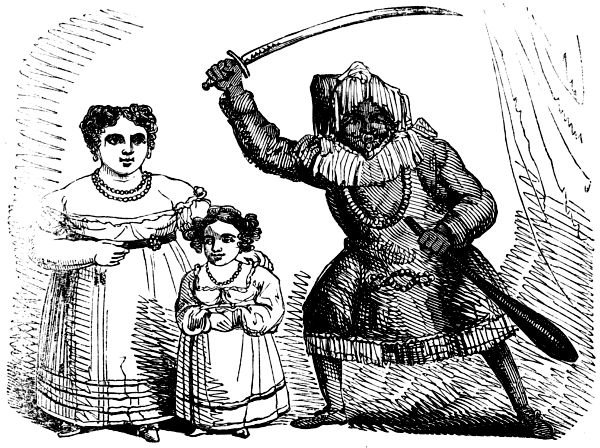
Miss Hipson; the female Dwarf; and the Malay.
When a company had collected, they were shown from the floor of a caravan on wheels, one side whereof was taken out, and replaced by a curtain, which was either drawn to, or thrown back as occasion required. After the audience had dispersed, I was permitted by the proprietor of the show, Nicholas Maughan, of Ipswich, Suffolk, to go “behind the curtain,” where the artist completed his sketches, while I entered into conversation with the persons exhibited. Miss Hipson, only twelve years of age, is remarkably gigantic, or rather corpulent, for her age, pretty, well-behaved, and well-informed; she weighed sixteen stone a few months before, and has since increased in size; she has ten brothers and sisters, nowise remarkable in appearance: her father, who is dead, was a bargeman at Brentford. The name of the “little lady” is Lydia Walpole, she was born at Addiscombe, near Yarmouth, and is sociable, agreeable, and intelligent. The fair Circassian is of pleasing countenance and manners. The Persian giant is a good-natured, tall, stately negro. The two Malays could not speak English, except, however, three words, “drop o’ rum,” which they repeated with great glee. One of them, with long hair reaching below the waist, exhibited the posture of drawing a bow; Mr. Maughan described them as being passionate, and showed me a severe wound on his finger which the little one, in the engraving, had given him by biting, while he endeavoured to part him and his countryman, during a quarrel a few days ago. A “female giant” was one of the attractions to this exhibition, but she could not be shown for illness: Miss Hipson described her to be a very good young woman.
There was an appearance of ease and good condition, with content of mind, in the persons composing this show, which induced me to put several questions to them, and I gathered that I was not mistaken in my conjecture. They described themselves as being very comfortable, and that they were taken great care of, and well treated by the proprietor, Mr. Maughan, and his partner in the show. The “little lady” had a thorough good character from Miss Hipson as an affectionate creature; and it seems the females obtained exercise by rising early, and being carried into the country in a post-chaise, where they walked and thus maintained their health. This was to me the most pleasing show in the Fair.
Show III.
The inscription outside was,
Ball’s Theatre.
Here I saw a man who balanced chairs on his chin, and holding a knife in his mouth, balanced a sword on the edge of the knife; he then put a pewter plate on the hilt of the sword horizontally, and so balanced the sword with the plate on the edge of the knife as before, the plate having previously received a rotary motion, which it communicated to the sword and was preserved during the balancing. He then balanced the sword and plate in like manner, with a crown-piece placed edgewise between the point of the sword and the knife, and afterwards with two crown-pieces, and then with a key. These feats were accompanied by the grimaces of a clown, and succeeded by children tumbling, and a female who danced a hornpipe. A learned horse found out a lady in the company who wished to be married; a gentleman who preferred a quart of beer to going to church to hear a good sermon; a lady who liked to lie abed in the morning; and made other discoveries which he was requested to undertake by his master in language not only “offensive to ears polite,” but to common decency. The admission to this show was a penny.
Show IV.
Atkin’s Menagerie.
This inscription was in lamps on one of the largest shows in the fair. The display of show-cloths representing some of the animals exhibited within, reached about forty feet in heighth, and extended probably the same width. The admission was sixpence. As a curiosity, and because it is a singularly descriptive list, the printed bill of the show is subjoined.
“MORE WONDERS IN ATKINS’S ROYAL MENAGERIE.
“Under the Patronage of HIS MAJESTY.
G.R.
G.R.
“Wonderful Phenomenon in Nature! The singular and hitherto deemed impossible occurrence of a LION and TIGRESS cohabiting and producing young, has actually taken place in this menagerie, at Windsor. The tigress, on Wednesday, the 27th of October last, produced three fine cubs; one of them strongly resembles the tigress; the other two are of a lighter colour, but striped. Mr. Atkins had the honour (through the kind intervention of the marquis of Conyngham,) of exhibiting the lion-tigers to his majesty, on the first of November, 1824, at the Royal Lodge, Windsor Great Park, when his majesty was pleased to observe, they were the greatest curiosity of the beast creation he ever witnessed.
“The royal striped Bengal Tigress has again whelped three fine cubs, (April 22,) two males and one female: the males are white, but striped; the female resembles the tigress, and singular to observe, she fondles them with all the care of an attentive mother. The sire of the young cubs is the noble male lion. This remarkable instance of subdued temper and association of animals to permit the keeper to enter their den, and introduce their young to the spectators, is the greatest phenomenon in natural philosophy.
“That truly singular and wonderful animal, the AUROCHOS. Words can only convey but a very confused idea of this animal’s shape, for there are few so remarkably formed. Its head is furnished with two large horns, growing from the forehead, in a form peculiar to no other animal; from the nostrils to the forehead, is a stiff tuft of hair, and underneath the jaw to the neck is a similar brush of hair, and between the fore legs is hair growing about a foot and a half long. The mane is like that of a horse, white, tinged with black, with a beautiful long flowing white tail; the eye remarkably keen, and as large as the eye of the elephant: colour of the animal, dark chesnut; the appearance of the head, in some degree similar to the buffalo, and in some part formed like the goat, the hoof being divided; such is the general outline of this quadruped, which seems to partake of several species. This beautiful animal was brought over by captain White, from the south of Africa, and landed in England, September 20, 1823, and is the same animal so frequently mistaken by travellers for the unicorn: further to describe its peculiarities would occupy too much space in a handbill. The only one in England.
“That colossal animal, the wonderful performing
Elephant,
Upwards of ten feet high!!—Five tons weight!! His consumption of hay, corn, straw, carrots, water, &c., exceeds 800lbs. daily. The elephant, the human race excepted, is the most respectable of animals. In size, he surpasses all other terrestrial creatures, and by far exceeds any other travelling animal in England. He has ivory tusks, four feet long, one standing out on each side of his trunk. His trunk serves him instead of hands and arms, with which he can lift up and seize the smallest as well as the largest objects. He alone drags machines which six horses cannot move. To his prodigious strength, he adds courage, prudence, and an exact obedience. He remembers favours as long as injuries: in short, the sagacity and knowledge of this extraordinary animal are beyond any thing human imagination can possibly suggest. He will lie down and get up at the word of command, notwithstanding the many fabulous tales of their having no joints in their legs. He will take a sixpence from the floor, and place it in a box he has in the caravan; bolt and unbolt a door; take his keeper’s hat off, and replace it; and by the command of his keeper will perform so many wonderful tricks, that he will not only astonish and entertain the audience, but justly prove himself the half-reasoning beast. He is the only elephant now travelling.
“A full grown LION and LIONESS, with four cubs, produced December 12, 1824, at Cheltenham.
“Male Bengal Tiger. Next to the lion, the tiger is the most tremendous of the carnivorous class; and whilst he possesses all the bad qualities of the former, seems to be a stranger to the good ones: to pride, to strength, to courage, the lion adds greatness, and sometimes, perhaps, clemency; while the tiger, without provocation, is fierce—without necessity, is cruel. Instead of instinct, he hath nothing but a uniform rage, a blind fury, so blind, indeed, so undistinguishing, that he frequently devours his own progeny; and if the tigress offers to defend them, he tears in pieces the dam herself.
“The Onagra, a native of the Levant, the eastern parts of Asia, and the northern parts of Africa. This race differs from the zebra by the size of the body, (which is larger,) slenderness of the legs, and lustre of the hair. The only one now alive in England.
“Two Zebras, one full grown, the other in its infant state, in which it seems as if the works of art had been combined with those of nature in this wonderful production. In symmetry of shape, and beauty of colour, it is the most elegant of all quadrupeds ever presented; uniting the graceful figure of a horse, with the fleetness of a stag: beautifully striped with regular lines, black and white.
“A Nepaul Bison, only twenty-four inches high.
“Panther, or spotted tiger of Buenos Ayres, the only one travelling.
“A pair of rattle-tail Porcupines.
“Striped untameable Hyæna, or tiger wolf.
“An elegant Leopard, the handsomest marked animal ever seen.
“Spotted Laughing Hyæna, the same kind of animal described never to be tamed; but singular to observe, it is perfectly tame, and its attachment to a dog in the same den is very remarkable.
“The spotted Cavy.
“Pair of Jackalls.
“Pair of interesting Sledge Dogs, brought over by captain Parry from one of the northern expeditions: they are used by the Esquimaux to draw the sledges on the ice, which they accomplish with great velocity.
“A pair of Rackoons, from North America.
“The Oggouta, from Java.
“A pair of Jennetts, or wild cats.
“The Coatimondi, or ant-eater.
“A pair of those extraordinary and rare birds, PELICANS of the wilderness. The only two alive in the three kingdoms.—These birds have been represented on all crests and coats of arms, to cut their breasts open with the points of their bills, and feed their young with their own blood, and are justly allowed by all authors to be the greatest curiosity of the feathered tribe.
“Ardea Dubia, or adjutant of Bengal, gigantic emew, or Linnæus’s southern ostrich. The peculiar characteristics that distinguish this bird from the rest of the feathered tribe;—it comes from Brazil, in the new continent; it stands from eight to nine feet high when full grown; it is too large to fly, but is capable of out-running the fleetest horses of Arabia; what is still more singular, every quill produces two feathers. The only one travelling.
“A pair of rapacious Condor-Minors, from the interior of South America, the largest birds of flight in the world when full grown; it is the same kind of bird the Indians have asserted to carry off a deer or young calf in their talons, and two of them are sufficient to destroy a buffalo, and the wings are as much as eighteen feet across.
“The great Horned Owl of Bohemia. Several species of gold and silver pheasants, of the most splendid plumage, from China and Peru. Yellow-crested cockatoo. Scarlet and buff macaws.—Admittance to see the whole menagerie, 1s.—Children, 6d.—Open from ten in the forenoon till feeding-time, half-past-nine, 2s.”
Here ends Atkins’s bill; which was plentifully stuck against the outside, and the people “tumbled up” in crowds, to the sound of clarionets, trombones, and a long drum, played by eight performers in scarlet beef-eater coats, with wild-skin caps, who sat fronting the crowd, while a stentorian showman called out “don’t be deceived; the great performing elephant—the only lion and tigress in one den that are to be seen in the Fair, or the proprietor will forfeit a thousand guineas! Walk in! walk in!” I paid my sixpence, and certainly the idea of the exhibition raised by the invitation and the programme, was in no respect overcharged. The “menagerie” was thoroughly clean, and the condition of the assembled animals, told that they were well taken care of. The elephant, with his head through the bars of his cage, whisked his proboscis diligently in search of eatables from the spectators, who supplied him with fruit or biscuits, or handed him halfpence, which he uniformly conveyed by his trunk to a retailer of gingerbread, and got the money’s-worth in return. Then he unbolted the door to let in his keeper, and bolted it after him; took up a sixpence with his trunk, lifted the lid of a little box fixed against the wall and deposited it within it, and some time afterwards relifted the lid, and taking out the sixpence with a single motion, returned it to the keeper; he knelt down when told, fired off a blunderbuss, took off the keeper’s hat, and afterwards replaced it on his head with as fitting propriety as the man’s own hand could have done; in short, he was perfectly docile, and performed various feats that justified the reputation of his species for high understanding. The keeper showed every animal in an intelligent manner, and answered the questions of the company readily and with civility. His conduct was rewarded by a good parcel of halfpence, when his hat went round with a hope, that “the ladies and gentlemen would not forget the keeper before he showed the lion and the tigress.” The latter was a beautiful young animal, with two playful cubs about the size of bull-dogs, but without the least fierceness. When the man entered the den, they frolicked and climbed about him like kittens; he took them up in his arms, bolted them in a back apartment, and after playing with the tigress a little, threw back a partition which separated her den from the lion’s, and then took the lion by the beard. This was a noble animal; he was couching, and being inclined to take his rest, only answered the keeper’s command to rise, by extending his whole length, and playfully putting up one of his magnificent paws, as a cat does when in a good humour. The man then took a short whip, and after a smart lash or two upon his back, the lion rose with a yawn, and fixed his eye on his keeper with a look that seemed to say—“Well, I suppose I must humour you.” The man then sat down at the back of the den, with his back against the partition, and after some ordering and coaxing, the tigress sat on his right hand, and the lion on his left, and, all three being thus seated, he threw his arms round their necks, played with their noses, and laid their heads in his lap. He arose and the animals with him; the lion stood in a fine majestic position, but the tigress reared, and putting one foot over his shoulder, and patting him with the other, as if she had been frolicking with one of her cubs, he was obliged to check her playfulness. Then by coaxing, and pushing him about, he caused the lion to sit down, and while in that position opened the animal’s ponderous jaws with his hands, and thrust his face down into the lion’s throat, wherein he shouted, and there held his head nearly a minute. After this he held up a common hoop for the tigress to leap through, and she did it frequently. The lion seemed more difficult to move to this sport. He did not appear to be excited by command or entreaty; at last, however, he went through the hoop, and having been once roused, repeated the action several times; the hoop was scarcely two feet in diameter. The exhibition of these two animals concluded by the lion lying down on his side, when the keeper stretched himself to his whole length upon him, and then calling to the tigress she jumped upon the man, extended herself with her paws upon his shoulders, placed her face sideways upon his, and the whole three lay quiescent till the keeper suddenly slipped himself off the lion’s side, with the tigress on him, and the trio gambolled and rolled about on the floor of the den, like playful children on the floor of a nursery.
Of the beasts there is not room to say more, than that their number was surprising, considering that they formed a better selected collection, and showed in higher condition from cleanliness and good feeding, than any assemblage I ever saw. Their variety and beauty, with the usual accessory of monkeys, made a splendid picture. The birds were equally admirable, especially the pelicans, and the emew. This sixpenny “show” would have furnished a dozen sixpenny “shows,” at least, to a “Bartlemy Fair” twenty years ago.
Show V.
This was a mare with seven feet, in a small temporary stable in the passage-way from the road to the foot-pavement, opposite the George Inn, and adjoining to the next show: the admission to this “sight” was threepence. The following is a copy of the printed bill:—
“To Sportsmen and Naturalists.—Now exhibiting, one of the greatest living natural curiosities in the world; namely, a thorough-bred chesnut MARE, with seven legs! four years of age, perfectly sound, free from blemish, and shod on six of her feet. She is very fleet in her paces, being descended from that famous horse Julius Cæsar, out of a thorough-bred race mare descended from Eclipse, and is remarkably docile and temperate. She is the property of Mr. T. Checketts, of Belgrave-hall, Leicestershire, and will be exhibited for a few days as above.”
This mare was well worth seeing. Each of her hind legs, besides its natural and well-formed foot, had another growing out from the fetlock joint: one of these additions was nearly the size of the natural foot; the third and least grew from the same joint of the fore-leg. Mr. Andrews, the proprietor, said, that they grew slowly, and that the new hoofs were, at first, very soft, and exuded during the process of growth. This individual, besides his notoriety from the possession of this extraordinary mare, attained further distinction by having prosecuted to conviction, at the Warwick assizes, in August, 1825, a person named Andrews, for swindling. He complained bitterly of the serious expense he had incurred in bringing the depredator to justice; his own costs, he said, amounted to the sum of one hundred and seventy pounds.
Show VI.
Richardson’s Theatre.
The outside of this show was in height upwards of thirty feet, and occupied one hundred feet in width. The platform on the outside was very elevated; the back of it was lined with green baize, and festooned with deeply-fringed crimson curtains, except at two places where the money-takers sat, which were wide and roomy projections, fitted up like gothic shrine-work, with columns and pinnacles. There were fifteen hundred variegated illumination-lamps disposed over various parts of this platform, some of them depending from the top in the shape of chandeliers and lustres, and others in wreaths and festoons. A band of ten performers in scarlet dresses, similar to those worn by beef-eaters, continually played on clarionets, violins, trombones, and the long drum; while the performers paraded in their gayest “properties” before the gazing multitude. Audiences rapidly ascended on each performance being over, and paying their money to the receivers in their gothic seats, had tickets in return; which, being taken at the doors, admitted them to descend into the “theatre.” The following “bill of the play” was obtained at the doors upon being requested:—
⁂ Change of Performance each Day.
RICHARDSON’S THEATRE.
This Day will be performed, an entire New Melo-Drama, called the WANDERING OUTLAW, Or, the Hour of Retribution.
Gustavus, Elector of Saxony, Mr. Wright. Orsina, Baron of Holstein, Mr. Cooper. Ulric and Albert, Vassals to Orsina, Messrs. Grove and Moore. St. Clair, the Wandering Outlaw, Mr. Smith. Rinalda, the Accusing Spirit, Mr. Darling. Monks, Vassals, Hunters, &c. Rosabella, Wife to the Outlaw, Mrs. Smith. Nuns and Ladies.
The Piece concludes with the Death of Orsina, and the Appearance of the ACCUSING SPIRIT.
The Entertainments to conclude with a New Comic Harlequinade, with New Scenery, Tricks, Dresses, and Decorations, called,
HARLEQUIN FAUSTUS!
OR, THE DEVIL WILL HAVE HIS OWN. Luciferno, Mr. Thomas.
Dæmon Amozor, afterwards Pantaloon, Mr. Wilkinson.—Dæmon Ziokos, afterwards Clown, Mr. Hayward.—Violencello Player, Mr. Hartem.—Baker, Mr. Thompson.—Landlord, Mr. Wilkins.—Fisherman, Mr. Rae.—Doctor Faustus, afterwards Harlequin, Mr. Salter.
Adelada, afterwards Columbine, Miss Wilmot. Attendant Dæmons, Sprites, Fairies, Ballad Singers, Flower Girls, &c. &c.
The Pantomime will finish with A SPLENDID PANORAMA, Painted by the First Artists.
BOXES, 2s. PIT, 1s. GALLERY, 6d.
The theatre was about one hundred feet long, and thirty feet wide, hung all round with green baize, and crimson festoons. “Ginger beer, apples, nuts, and a bill of the play,” were cried; the charge for a bill to a person not provided with one was “a penny.” The seats were rows of planks, rising gradually from the ground at the end, and facing the stage, without any distinction of “boxes, pit, or gallery.” The stage was elevated, and there was a painted proscenium like that in a regular theatre, with a green curtain, and the king’s arms above, and an orchestra lined with crimson cloth, and five violin-players in military dresses. Between the orchestra and the bottom row of seats, was a large space, which, after the seats were filled, and greatly to the discomfiture of the lower seat-holders, was nearly occupied by spectators. There were at least a thousand persons present.
The curtain drew up and presented the “Wandering Outlaw,” with a forest scene and a cottage; the next scene was a castle; the third was another scene in the forest. The second act commenced with a scene of an old church and a market-place. The second scene was a prison, and a ghost appeared to the tune of the “evening hymn.” The third scene was the castle that formed the second scene in the first act, and the performance was here enlivened by a murder. The fourth scene was rocks, with a cascade, and there was a procession to an unexecuted execution; for a ghost appeared, and saved the “Wandering Outlaw” from a fierce-looking headsman, and the piece ended. Then a plump little woman sung, “He loves and he rides away,” and the curtain drew up to “Harlequin Faustus,” wherein, after columbine and a clown, the most flaming character was the devil, with a red face and hands, in a red Spanish mantle and vest, red “continuations,” stockings and shoes ditto to follow, a red Spanish hat and plume above, and a red “brass bugle horn.” As soon as the fate of “Faustus” was concluded, the sound of a gong announced the happy event, and these performances were, in a quarter of an hour, repeated to another equally intelligent and brilliant audience.
Show VII.
ONLY A PENNY. There never was such times, indeed!
Nero The largest Lion in the Fair for a Hundred Guineas!
These inscriptions, with figured show-cloths, were in front of a really good exhibition of a fine lion, with leopards, and various other “beasts of the forest.” They were mostly docile and in good condition. One of the leopards was carried by his keeper a pick-a-back. Such a show for “only a penny” was astonishing.
Show VIII.
“SAMWELL’S COMPANY.”
Another penny show: “The Wonderful Children on the Tight Rope, and Dancing Horse. Only a Penny!” I paid my penny to the money-taker, a slender “fine lady,” with three feathers in a “jewelled turban,” and a dress of blue and white muslin and silver; and withinside I saw the “fat, contented, easy” proprietor, who was arrayed in corresponding magnificence. If he loved leanness, it was in his “better half,” for himself had none of it. Obesity had disqualified him for activity, and therefore in his immensely tight and large satin jacket, he was, as much as possible, the active commander of his active performers. He superintended the dancing of a young female on the tight rope. Then he announced, “A little boy will dance a hornpipe on the rope,” and he ordered his “band” inside to play; this was obeyed without difficulty, for it merely consisted of one man, who blew a hornpipe tune on a Pan’s-pipe; while it went on, the “little boy” danced on the tight rope; so far it was a hornpipe dance and no farther. “The little boy will stand on his head on the rope,” said the manager, and the little boy stood on his head accordingly. Then another female danced on the slack-wire; and after her came a horse, not a “dancing horse,” but a “learned” horse, quite as learned as the horse at Ball’s theatre, in Show III. There was enough for “a penny.”
Show IX.
“CLARKE FROM ASTLEY’S.”
This was a large show, with the back against the side of “Samwell’s Company,” and its front in a line with Hosier-lane, and therefore looking towards Smithfield-bars. Large placards were pasted at the side, with these words, “Clarke’s from Astley’s, Lighted with Real Gas, In and Outside.” The admission to this show was sixpence. The platform outside was at least ten feet high, and spacious above, and here there was plenty of light. The interior was very large, and lighted by only a single hoop, about two feet six inches in diameter, with little jets of gas about an inch and a half apart. A large circle or ride was formed on the ground. The entertainment commenced by a man dancing on the tight-rope. The rope was removed, and a light bay horse was mounted by a female in trowsers, with a pink gown fully frilled, flounced, and ribboned, with the shoulders in large puffs. While the horse circled the ring at full speed, she danced upon him, and skipped with a hoop like a skipping-rope; she performed other dexterous feats, and concluded by dancing on the saddle with a flag in each hand, while the horse flew round the ring with great velocity. These and the subsequent performances were enlivened by tunes from a clarionet and horn, and jokes from a clown, who, when she had concluded, said to an attendant, “Now, John, take the horse off, and whatever you do, rub him well down with a cabbage.” Then a man rode and danced on another horse, a very fine animal, and leaped from him three times over garters, placed at a considerable height and width apart, alighting on the horse’s back while he was going round. This rider was remarkably dexterous. In conclusion, the clown got up and rode with many antic tricks, till, on the sudden, an apparently drunken fellow rushed from the audience into the ring, and began to pull the clown from the horse. The manager interfered, and the people cried—“Turn him out;” but the man persisted, and the clown getting off, offered to help him up, and threw him over the horse’s back to the ground. At length the intruder was seated, with his face to the tail, though he gradually assumed a proper position; and riding as a man thoroughly intoxicated would ride, fell off; he then threw off his hat and great coat, and threw off his waistcoat, and then an under-waistcoat, and a third, and a fourth, and more than a dozen waistcoats. Upon taking off the last, his trowsers fell down and he appeared in his shirt; whereupon he crouched, and drawing his shirt off in a twinkling, appeared in a handsome fancy dress, leaped into the saddle of the horse, rode standing with great grace, received great applause, made his bow, and so the performance concluded.
This show was the last in the line on the west side of Smithfield.
Show X.
The line of shows on the east of Smithfield, commencing at Long-lane, began with “The Indian Woman—Chinese Lady and Dwarf,” &c. A clown outside cried, “Be assured they’re alive—only one penny each.” The crowd was great, and the shows to be seen were many, I therefore did not go in.
Show XI.
On the outside was inscribed, “To be seen alive! The Prodigies of Nature!—The Wild Indian Woman and Child, with her Nurse from her own country.—The Silver-haired Lady and Dwarf. Only a Penny.”—The showmaster made a speech: “Ladies and gentlemen, before I show you the wonderful prodigies of nature, let me introduce you to the wonderful works of art;” and then he drew a curtain, where some wax-work figures stood. “This,” said he, “ladies and gentlemen, is the famous old Mother Shipton; and here is the unfortunate Jane Shore, the beautiful mistress of king Edward the Second; next to her is his majesty king George the Fourth of most glorious memory; and this is queen Elizabeth in all her glory; then here you have the princess Amelia, the daughter of his late majesty, who is dead; this is Mary, queen of Scots, who had her head cut off; and this is O’Bryen, the famous Irish giant; this man, here, is Thornton, who was tried for the murder of Mary Ashford; and this is the exact resemblance of Othello, the moor of Venice, who was a jealous husband, and depend upon it every man who is jealous of his wife, will be as black as that negro. Now, ladies and gentlemen, the two next are a wonderful couple, John and Margaret Scott, natives of Dunkeld, in Scotland; they lived about ninety years ago; John Scott was a hundred and five years old when he died, and Margaret lived to be a hundred and twelve; and what is more remarkable, there is not a soul living can say he ever heard them quarrel.” Here he closed the curtain, and while undrawing another, continued thus: “Having shown you the dead, I have now to exhibit to you two of the most extraordinary wonders of the living; this,” said he, “is the widow of a New Zealand Chief, and this is the little old woman of Bagdad; she is thirty inches high, twenty-two years of age, and a native of Boston, in Lincolnshire.” Each of these living subjects was quite as wonderful as the waxen ones: the exhibition, which lasted about five minutes, was ended by courteous thanks for the “approbation of the ladies and gentlemen present,” and an evident desire to hurry them off, lest they might be more curious than his own curiosities.
Show XII.
“Only a penny” was the price of admission to “The Black Wild Indian Woman.—The White Indian Youth—and the Welsh Dwarf.—All Alive!” There was this further announcement on the outside, “The Young American will Perform after the Manner of the French Jugglers at Vauxhall Gardens, with Balls, Rings, Daggers,” &c. When the “Welsh dwarf” came on he was represented to be Mr. William Phillips, of Denbigh, fifteen years of age. The “white Indian youth” was an Esquimaux, and the exhibitor assured the visitors upon his veracity, that “the black wild Indian woman” was “a court lady of the island of Madagascar.” The exhibitor himself was “the young American,” an intelligent and clever youth in a loose striped jacket or frock tied round the middle. He commenced his performances by throwing up three balls, which he kept constantly in the air, as he afterwards did four, and then five, with great dexterity, using his hands, shoulders, and elbows, apparently with equal ease. He afterwards threw up three rings, each about four inches in diameter, and then four, which he kept in motion with similar success. To end his performance he produced three knives, which, by throwing up and down, he contrived to preserve in the air altogether. These feats forcibly reminded me of the Anglo-Saxon Glee-man, who “threw three balls and three knives alternately in the air, and caught them, one by one, as they fell; returning them again in regular rotation.”[274] The young American’s dress and knives were very similar to the Glee-man’s, as Strutt has figured them from a MS. in the Cotton collection. This youth’s was one of the best exhibitions in the Fair, perhaps the very best. The admission it will be remembered was “only a penny.”
Show XIII.
The inscriptions and paintings on the outside of this show were, “The White Negro, who was rescued from her Black Parents by the bravery of a British Officer—the only White Negro Girl Alive.—The Great Giantess and Dwarf.—Six Curiosities Alive!—only a Penny to see them All Alive!” While waiting a few minutes till the place filled, I had leisure to observe that one side of the place was covered by a criminal attempt to represent a tread-mill, in oil colours, and the operators at work upon it, superintended by gaolers, &c. On the other side were live monkies in cages; an old bear in a jacket, and sundry other animals. Underneath the wheels of the machine, other living creatures were moving about, and these turned out to be the poor neglected children of the showman and his wife. The miserable condition of these infants, who were puddling in the mud, while their parents outside were turning a bit of music, and squalling and bawling with all their might, “walk in—only a penny,” to get spectators of the objects that were as yet concealed on their “proud eminence,” the caravan, by a thin curtain, raised a gloom in the mind. I was in a reverie concerning these beings when the curtain was withdrawn, and there stood confessed to sight, she whom the showman called “the tall lady,” and “the white negro, the greatest curiosity ever seen—the first that has been exhibited since the reign of George the Second—look at her head and hair, ladies and gentlemen, and feel it; there’s no deception, it’s like ropes of wool.” There certainly was not any deception. The girl herself, who had the flat nose, thick lips, and peculiarly shaped scull of the negro, stooped to have her head examined, and being close to her I felt it. Her hair, if it could be called hair, was of a dirtyish flaxen hue; it hung in ropes, of a clothy texture, the thickness of a quill, and from four to six inches in length. Her skin was the colour of an European’s. Afterwards stepped forth a little personage about three feet high, in a military dress, with top boots, who strutted his tiny legs, and held his head aloft with not less importance than the proudest general officer could assume upon his promotion to the rank of field-martial. Mr. Samuel Williams, whose versatile and able pencil has frequently enriched this work, visited the Fair after me, and was equally struck by his appearance. He favours me with the subjoined engraving of this