APRIL. (continued 2)
Reading edition
1765. Dr. Edward Young, author of the “Night Thoughts,” died.
1782. Admiral Rodney defeated the French fleet under count de Grasse, in the West Indies.
1814. A general illumination in London, on three successive nights, for the termination of the war with France.
FLORAL DIRECTORY.
Great Saxifrage. Saxifraga crassifolia. Dedicated to St. Zeno.
An Epitaph. (Written on a chimney-board.)
Here lie entombed THE ASHES of a BRIGHT AND SHINING GENIUS, who in his youth it is confessed discovered some sparks of a light and volatile nature, but was in maturity of a steady and a grateful disposition and diffusive benevolence. Though naturally of a warm temper, and easily stirred up, yet was he a shining example of fervent and unreserved benignity. For though he might have been the most dangerous and dreadful of enemies, yet was he the best and warmest of friends. Nor did he ever look cool even on his worst foes, though his friends too often, and shamefully indeed, turned their backs upon him. Oh! undeserving and licentious times, when such illustrious examples are wantonly made light of! Such resplendent virtue basely blown upon! Though rather a promoter of a cheerful glass in others, and somewhat given to smoking, yet was he himself never seen in liquor, which was his utter abhorrence. Raking, which ruins most constitutions, was far from spoiling his, though it often threw him into inflammatory disorders. His days, which were short, were ended by a gentle decay, his strength wasted, and his substance spent. A temporal period was put to his finite existence, which was more immediately effected by his being seized with a severe cold, and no help administered, in some of the warm days of the fatal month of May. His loss and cheerful influence are often and feelingly regretted by his sincere admirers, who erected this monument in memory of his endearing virtue, till that grateful and appointed day, when the dormant powers of his more illustrious nature shall be again called forth: When, inflamed with ardour, and with resplendence crowned, he shall again rise with songs of joy and triumph o’er the grave.
April 13.
Oxford and Cambridge Terms begin.
St. Hermenegild, Martyr, A. D. 586. St. Guinoch, about 838. St. Caradoc, A. D. 1124.
Chronology.
1517. Cairo taken by the sultan Selim, who thus became sole master of Egypt.
1748. The rev. Christopher Pitt, translator of Virgil, died at Blandford in Dorsetshire, where he was born in 1699.
1814. Charles Burney, Mus.D. F.R.S. &c. author of the “History of Music,” and other works, which stamp his literary ability, and his scientific character as a musician, died at Chelsea, aged 88.
CAMBRIDGE EXAMINATION.
A good-humoured jeu d’esprit, intended to produce nothing but corresponding good humour in the persons whose names are mentioned, appeared in The Times on the 25th of January, 1816. This being the first day of Cambridge Term, the “freshmen” who have seen recent imitations may be much amused by perusal of the original witticism.
Parody of a Cambridge Examination. Utopia University. UNDECEMBER 9657.
1. Give a comparative sketch of the principal English theatres, with the dates of their erection, and the names of the most eminent candle-snuffers at each. What were the stage-boxes? What were the offices of prompter—ballet-master—and scene-shifter? In what part of the theatre was the one-shilling gallery? Distinguish accurately between operas and puppet-shows.
2. Where was Downing-street? Who was prime-minister when Cribb defeated Molineux—and where did the battle take place? Explain the terms milling—fibbing—cross buttock—neck and crop—bang up—and—prime.
3. Give the dates of all the parliaments from their first institution to the period of the hard frost on the Thames. In what month of what year was Mr. Abbot elected Speaker? Why was he called “the little man in the wig?” When the Speaker was out of the chair, where was the mace put?
4. Enumerate the principal houses of call in and about London, marking those of the Taylors, Bricklayers, and Shoemakers, and stating from what Brewery each house was supplied with Brown Stout. Who was the tutelary Saint of the Shoemakers? At what time was his feast celebrated? Who was Saint Swithin? Do you remember any remarkable English proverb respecting him?
5. Give a ground plan of Gilead-house. Mention the leading topics of the Guide to Health, with some account of the Anti-Impetigines—Daffy’s Elixir—Blaine’s Distemper Powders—Ching’s Worm Lozenges—and Hooper’s Female Pills.
6. Give characters of Wat Tyler, Jack Cade, and sir Francis Burdett. Did the latter return from the Tower by water or land? On what occasion did Mr. Lethbridge’s “hair stand on ind”? Correct the solecism, and give the reason of your alteration.
7. Enumerate the roads on which double toll was taken on the Sundays. Did this custom extend to Christmas-day and Good Friday? Who was toll-taker at Tyburn, when Mrs. Brownrigg was executed?
8. Distinguish accurately between Sculls and Oars—Boat, and Punt—Jack-ass, and Donkey—Gauger, Exciseman, and Supervisor—Pantaloons, Trowsers, Gaiters, and Over-alls.—At what place of education were any of these forbidden? Which? and Why?
9. Express the following words in the Lancashire, Derbyshire, London, and Exmoor dialects—Bacon—Poker—You—I—Doctor—and Turnpike-gate.
10. Mention the principal Coach Inns in London, with a correct list of the Coaches which set out from the Bolt-in-Tun. Where were the chief stands of Hackney Coaches?—and what was the No. of that in which the Princess Charlotte drove to Connaught-house? To what stand do you suppose this removed after it set her down?
11. Give a succinct account, with dates, of the following persons—Belcher—Mr. Waithman—Major Cartwright—Martin Van Butchell—and Edmund Henry Barker.
12. Draw a Map of the Thames with the surrounding country, marking particularly Wapping, Blackwall, Richmond, and the Isle of Dogs. Distinguish between Newcastle-on-Tyne, and Newcastle-under-Line—Gloucester and Double Gloucester—and the two Richmonds. What celebrated teacher flourished at one of them?—and who were his most eminent disciples?
13. What were the various sorts of paper in use amongst the English? To what purpose was whited-brown chiefly applied? What was size? Distinguish between this and college Sizings, and state the ordinary expense of papering a room.
14. “For every one knows little Matt’s an M.P.” Frag. Com. Inc. ap. Morn. Chron. vol. 59, p. 1624.
What reasons can you assign for the general knowledge of this fact? Detail at length, the ceremony of chairing a Member. What were the Hustings? Who paid for them? Explain the abbreviations—Matt. M.P.—Tom—Dick—F.R.S.—L.L.D.—and A.S.S.
15. What was the distinguishing title of the Mayors of London? Did any other city share the honour? Give a list of the Mayors of London from Sir Richard Whittington to Sir William Curtis, with an account of the Cat of the first, and the Weight of the last. What is meant by Lord Mayor’s day? Describe the Apothecaries’ Barge, and give some account of Marrow-bones and Cleavers.
16. When was Spyring and Marsden’s Lemon Acid invented? Distinguish between this and Essential Salt of Lemons. Enumerate the principal Patentees, especially those of Liquid Blacking.
17. Scan the following lines—
But for shaving and tooth-drawing, Bleeding, cabbaging and sawing, Dicky Gossip, Dicky Gossip is the man!
What is known of the character and history of Dicky Gossip?
FLORAL DIRECTORY.
Green Narcisse. Narcissus Viridiflorus. Dedicated to St. Hermenigild.
April 14.
Sts. Tiburtius, Valerian, and Maximus, A. D. 229. Sts. Carpus, Bishop, Papylus, and Agathodorus, A. D. 251. Sts. Antony, John, and Eustachius, A. D. 1342. St. Benezet, or Little Bennet, A. D. 1184. B. Lidwina, or Lydwid, A. D. 1433.
Chronology.
1471. The battle of Barnet was fought in the wars between the houses of York and Lancaster, and the earl of Warwick, called “the king-maker,” was slain on the field.
1685. Thomas Otway, the dramatic poet, died, at a public-house in the Minories, of want, by swallowing bread too eagerly which he had received in charity.
1759. George Frederick Handel, the illustrious musician, died. He was born at Halle, in Saxony, in 1684.
1793. Tobago, in the West Indies, taken by the English.
1809. Beilby Porteus, bishop of London, died at Fulham, aged 78.
FLORAL DIRECTORY.
Borage. Borago Officinalis. Dedicated to St. Lidwina.
THE SEASON.
The Floral appearances of the year are accurately described by Dr. Forster in his “Perennial Calendar.” He says, “In order to ascertain the varieties in the seasons, as indicated by the flowering of plants, we ought to become accurately acquainted with their natural periods, and the average time of flowering which belongs to each species. I have of late made an artificial division of the seasons of different plants into six distinct periods, to each of which respectively a certain number of species belong. Dividing then the reign of the goddess of blooms into six principal portions, we shall begin with the first in the order of phenomena. The Primaveral Flora may be said to commence with the first breaking of the frost before February; it comprehends the snowdrop, the crocus, the coltsfoot, all the tribe of daffodils, narcissi, jonquils, and hyacinths, the primrose, cyclamen, heartsease, violet, cowslip, crown imperial, and many others. The Equinox being also past, and the leaves beginning to bud forth amidst a display of blossoms on the trees, another period may be said to begin, and May ushers in the Vernal Flora, with tulips, peonies, ranunculi, monkey poppy, goatsbeards, and others: at this time, the fields are bespangled with the golden yellow of the crowfoot, or blue with the harebells. The whole bosom of earth seems spread with a beautiful carpet, to soften the path of Flora, at this delicious season. By and bye, towards the middle of June, the approach of the Solstice is marked by another set of flowers; and the scarlet lychnis, the various poppies, the lilies and roses, may be said to constitute the Solstitial Flora. As the year declines, the Aestival Flora, corresponding to the Vernal, paints the garish eyes of the dog-days with sunflowers, China asters, tropoeoli, African marigolds, and other plants which love heat. The Autumnal Flora, answering to the Primaveral, then introduces Michaelmas daisies, starworts, and other late blowing plants, with their companions, fungi and mushrooms, till at length bleak winter shows only a few hellebores, aconites, and mosses, belonging to the Hibernal Flora of this dreary season. Thus, in this our temperate climate, have we a round of botanical amusements all the year, and the botanist can never want for sources of recreation. How different must be the order of phenomena about the poles of the earth, where summer and winter are synonymous with day and night, of which Kirke White has given us a very fine description:—
On the North Pole.
Where the North Pole, in moody solitude, Spreads her huge tracts and frozen wastes around, There ice rock piled aloft, in order rude, Form a gigantic hall; where never sound Startled dull Silence’ ear, save when, profound The smoke frost muttered: there drear Cold for aye Thrones him,—and fixed on his primæval mound, Ruin, the giant, sits; while stern Dismay Stalks like some woe-struck man along the desert way. In that drear spot, grim Desolation’s lair, No sweet remain of life encheers the sight; The dancing heart’s blood in an instant there Would freeze to marble, Mingling day and night, (Sweet interchange which makes our labours light,) Are there unknown; while in the summer skies, The sun rolls ceaseless round his heavenly height, Nor ever sets till from the scene he flies, And leaves the long bleak night of half the year to rise.”
April 15.
St. Peter Gonzales, or Telm, or Elm, A. D. 1246. Sts. Basilissa and Anastasia, 1st Cent. St. Paternus, Bishop, or Patier, Pair, or Foix, 6th Cent. St. Munde, Abbot, A. D. 962. St. Ruadhan, A. D. 584.
NATURAL HISTORY.
Average day of arrival of Spring Birds from a Twenty years’ Journal.
April 3. Smallest Willow Wren. Ficaria pinetorum arrives.
April 10. Common Willow Wren. Ficaria Salicum arrives.
April 14. Called First Cuckoo Day in Sussex. The Cuckoo, cuculus canorus, sometimes heard.
April 15. Called Swallow Day. The Chimney Swallow, Hirundo rustica, arrives.
April 19. The Sand Swallow. Hirundo riparia arrives.
April 20. The Martin. Hirundo terbica sometimes seen.
April 21. The Cuckoo, commonly heard.
April 30. The Martin, commonly seen.
The other vernal birds arrive between the 15th and 30th of the month.[90]
FLORAL DIRECTORY.
Green Stitchwort. Stellaria holostea. Dedicated to St. Peter Gonzales.
An April Day.
Original.
Dear Emma, on that infant brow, Say, why does disappointment low’r? Ah! what a silly girl art thou, To weep to see a summer show’r! O, dry that unavailing tear, The promis’d visit you shall pay; The sky will soon again be clear, For ’tis, my love, an April day. And see, the sun’s returning light Away the transient clouds hath driv’n, The rainbow’s arch with colours bright Spreads o’er the blue expanse of heav’n; The storm is hush’d, the winds are still, A balmy fragrance fills the air; Nor sound is heard, save some clear rill Meandering thro’ the vallies fair. Those vernal show’rs that from on high Descend, make earth more fresh and green; Those clouds that darken all the air Disperse, and leave it more serene And those soft tears that for awhile Down sorrow’s faded cheek may roll, Shall sparkle thro’ a radiant smile, And speak the sunshine of the soul! While yet thy mind is young and pure, This sacred truth, this precept learn— That He who bids thee all endure, Bids sorrow fly, and hope return. His chast’ning hand will never break The heart that trusts in Him alone; He never, never will forsake The meanest suppliant at his throne. The world, that with unfeeling pride Sees vice to virtue oft preferr’d, From thee, alas! may turn aside— O, shun the fawning, flatt’ring herd! And while th’ Eternal gives thee health With joy thy daily course to run, Let wretches hoard their useless wealth, And Heav’n’s mysterious will be done. With fair Religion, woo content, ’Twill bid tempestuous passions cease; And know, my child, the life that’s spent In pray’r and praise, must end in peace. The dream of Life is quickly past, A little while we linger here; And tho’ the Morn be overcast, The Ev’ning may be bright and clear. Islington.
D. G.
An Evening in Spring.
Now the noon, Wearied with sultry toil, declines and falls Into the mellow eve:—the west puts on Her gorgeous beauties—palaces and halls And towers, all carved of the unstable cloud Welcome the calmy waning monarch—he Sinks gently ’midst that glorious canopy Down on his couch of rest—even like a proud King of the earth—the ocean.
Bowring.
April 16.
Eighteen Martyrs of Saragossa, and St. Encratis, or Engratia, A. D. 304. St. Turibius, Bp. 420. St. Fructuosus, Abp. A. D. 665. St. Druon, or Drugo, A. D. 1186. St. Joachim of Sienna, A. D. 1305. St. Mans, or Magnus, A. D. 1104.
“The Venerable Benedict Joseph Labre, Who died in the odour of sanctity, On the 16th of April, 1783.”
If such a creature as the venerable B. J. Labre can be called a man, he was one of the silliest that ever lived to creep and whine, and one of the dirtiest that ever “died in the odour of sanctity;” and yet, for the edification of the English, his life is translated from the French “by the rev. M. James Barnard, ex-president of the English college at Lisbon and Vicar General of the London district.”
From this volume it appears that Labre was born at Boulogne, on the 26th of March, 1748. When a child he would not play as other children did, but made little oratories, and “chastised his body.” Having thus early put forth “buds of self-denial and self-contempt,” he was taught Latin, educated superior to his station, did penance, made his first general confession, and found his chief delight at the feet of altars. At sixteen years old, instead of eating his food he gave it away out of the window, read pious books as he walked, turned the house of his uncle, a priest, into “a kind of monastery,” observed religious poverty, monkish silence, and austere penance, and, by way of humility, performed abject offices for the people of the parish, fetched provender for their animals, took care of their cattle, and cleaned the stalls. The aversion which he entertained against the world, induced him to enter into a convent of Carthusians; there he discovered that he disliked profound retirement, and imagined he should not be able to save his soul unless he embraced an order more austere. Upon this he returned home, added extraordinary mortifications to his fasts and prayers, instead of sleeping on his bed lay on the floor, and told his mother he wished to go and live upon roots as the anchorets did. All this he might have done in the Carthusian convent, but his brain seems to have been a little cracked, for he resolved to go into another Carthusian convent, the prior of which would not admit him till he had studied ‘philosophy’ for a year, and learned the Gregorian chant. Church music was very agreeable to him—but it was not so with regard to logic; “notwithstanding all his efforts, he was never able to conquer his repugnance to this branch of study;” yet he somehow or other scrambled through an examination; got admitted into the convent; “thought its rules far too mild for such a sinner as he looked upon himself to be;” and after a six weeks’ trial, left it in search of admission into the order of La Trappe, as the most rigid of any that he knew. The Trappists would not have him; this refusal he looked upon as a heavenly favour, because the monastery of Sept-Fonts surpassed La Trappe in severe austerities and discipline, and there he became a “novice” till the life he fancied, did not agree with him. “Having a long time before quitted his father’s house he could not think of returning to it again;” and at two and twenty years of age he knew not what to do. His biographer says, that “little fit for the cloister, and still less fit for the world, he was destitute of the means of getting a livelihood; and being now persuaded of what were the designs of God concerning him, he resolved to follow the conduct, the light, and inspirations of the holy spirit, and to submit himself to all the sufferings and afflictions which might await him.” If in this condition some one had compelled him to eat a good dinner every day, made him go to bed at a proper hour and take proper rest, and then set him on horseback and trotted him through the fresh air and sun-shine every forenoon, he might have been restored; or if his parents, as in duty they ought, had bound him apprentice at a proper age to a good trade, he might have been an useful member of society. These thoughts, however, never appear to have entered Labre’s head, and in the dilemma represented “his love of humility, poverty, and a penitential life, presented to his zealous mind the practice of that kind of piety which he afterwards put in execution.” His first step to this was writing a farewell letter to his parents, on the 31st of August, 1770, “and from that time they never received any account of him till after his death.” His next steps were pilgrimages. First he went to Loretto “from tender devotion to the Blessed Virgin, whom he looked on as his mother;” next to Assissium the birthplace of St. Francis, where he, “according to custom, got a small blessed cord which he constantly wore;” then he went to Rome where he sojourned for eight or nine months and wept “in the presence of the tomb of the holy apostles;” afterwards “he visited the tomb of St. Romuald at Fabrieno, where the inhabitants immediately began to look upon him as a saint;” from thence he returned to Loretto; he then journeyed to Naples, and had the pleasure of seeing the blood of St. Januarius which would not liquify when the French entered Naples, till the French general threatened the priests who performed the miracle that the city would suffer, if the saint remained obstinate; “and in short,” says the rev. Vicar General of the London district, “there was hardly any famous place of devotion in Europe which was not visited by this servant of God;”—the Vicar General’s sentence had concluded better with the words “this slave of superstition.” To follow Labre’s other goings to and fro would be tedious, suffice it to say that at one of his Loretto trips some people offered him an abode, in order to save him the trouble of going every night to a barn at a great distance; but as they had prepared a room for him with a bed in it he thought this lodging was too sumptuous; and he therefore retired into a hole “cut out of the rock under the street.” Labre at last favoured the city of Rome by his fixed residence, and sanctified the amphitheatre of Flavian by making his home in a hole of the ancient ruins.
In this “hole of sufficient depth to hold and shelter him in a tolerable degree from the weather,” he deposited himself every night for several years. He employed the whole of every day, “sometimes in one church and sometimes in another, praying most commonly upon his knees, and at other times standing, and always keeping his body as still as if he were a statue.” Labre’s daily exercise in fasting and lifelessness reduced him to a helpless state, that a beggar had compassion on him, and gave him a recommendation to an hospital, where “by taking medicines proper for his disorder, and more substantial food, he soon grew well;” but relapsing into his “constant, uniform, and hidden life,” he became worse. This opportunity of exhibiting Labre’s virtues is not neglected by his biographer, who minutely informs us of several particulars. 1st. He was so careful to observe the law of silence, that in the course of a whole month, scarcely any one could hear him speak so much as a few words. 2dly. He lived in the midst of Rome, as if he had lived in the midst of a desert. 3dly. He led a life of the greatest self-denial, destitute of every thing, disengaged from every earthly affection, unnoticed by all mankind, desiring no other riches than poverty, no other pleasures than mortification, no other distinction than that of being the object of universal contempt. 4thly. He indulged in rigorous poverty, exposed to the vicissitudes and inclemencies of the weather, without shelter against the cold of winter or the heat of summer, wearing old clothes, or rather rags, eating very coarse food, and for three years living in the “hole in the wall.” 5thly. To his privations of all worldly goods, he joined an almost continual abstinence, frequent fasts, nightly vigils, lively and insupportable pains from particular mortifications, and two painful tumours which covered both his knees, from resting the whole weight of his body on them when he prayed. 6thly. “He looked upon himself as one of the greatest of sinners;” and this was the reason why “he chose to lead a life of reproach and contempt,” why he herded “among the multitude of poor beggars,” “why he chose to cover himself with rags and tatters instead of garments, why he chose to place a barrier of disgust between himself and mankind,” why “he abandoned himself to the bites of disagreeable insects,” and why he coveted to be covered with filthy blotches.
Labre’s biographer, who was also his confessor, says that his “appearance was disagreeable and forbidding; his legs were half naked, his clothes were tied round the waist with an old cord, his head was uncombed, he was badly clothed and wrapped up in an old and ragged coat, and in his outward appearance he seemed to be the most miserable beggar that I had ever seen.” His biographer further says, “I never heard his confession but in a confessional, on purpose that there might be some kind of separation between us.” The holy father’s lively reason for this precaution, any history of insects with the word “pediculus” will describe accurately.
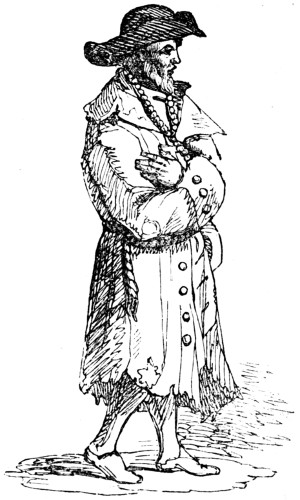
Thus Labre lived and died; and here it might be supposed would end his memoirs. But, no. In whatever odour he lived, as he “died in the odour of sanctity,” an enthusiasm seized some persons to touch Labre dead, who, when living, was touchless. Labre being deceased, was competent to work miracles; accordingly he stretched out his left hand, and laid hold on the board of one of the benches. On Easter-day being a holiday, he worked more miracles, and wonders more wonderful than ever were wondered in our days, as may be seen at large, in the aforesaid volume, entitled—“The Life of the venerable Benedict Joseph Labre, who died at Rome, in the odour of sanctity.” The portrait, from which the engraving on this page is taken, was published immediately after his death by Mr. Coghlan, Catholic bookseller, Duke-street, Grosvenor-square, from a drawing in his possession.
Miracle at Somers Town.
The authenticity of the following extraordinary fact can be verified. Mr. H——, a middle-aged gentleman, long afflicted by various disorders, and especially by the gout, had so far recovered from a severe attack of the latter complaint, that he was enabled to stand, yet with so little advantage, that he could not walk more than fifty yards, and it took him nearly an hour to perform that distance. While thus enfeebled by suffering, and safely creeping in great difficulty, on a sunny day, along a level footpath by the side of a field near Somers Town, he was alarmed by loud cries, intermingled with the screams of many voices behind him. From his infirmity, he could only turn very slowly round, and then, to his astonishment, he saw, within a yard of his coat-tail, the horns of a mad bullock; when, to the equal astonishment of its pursuers, this unhappy gentleman instantly leaped the fence, and overcome by terror, continued to run with amazing celerity nearly the whole distance of the field, while the animal kept its own course along the road. The gentleman, who had thus miraculously recovered the use of his legs, retained his power of speed until he reached his own house, where he related the miraculous circumstance; nor did his quickly-restored faculty of walking abate, until it ceased with his life several years afterwards. This “miraculous cure” can be attested by his surviving relatives.
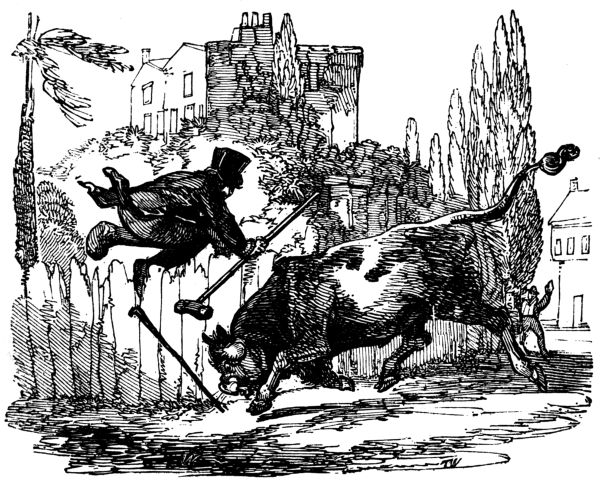
Somers Town Miracle.
THE KALEIDOSCOPE.
In April, 1818, London was surprised by the sudden appearance of an optical instrument for creating and exhibiting beautiful forms, which derives its name from καλος beautiful, ειδος a form, and σκοπεω to see. The novelty was so enchanting, that opticians could not manufacture kaleidoscopes fast enough, to meet the universal desire for seeing the delightful and ever-varying combinations, presented by each turn of the magical cylinder.
The kaleidoscope was invented by Dr. Brewster, to whom, had its exclusive formation been ensured, it must have produced a handsome fortune in the course of a single year. Unhappily, that gentleman was deprived of his just reward by fraudful anticipation.[91] He says, “I thought it advisable to secure the exclusive property of it by a patent; but in consequence of one of the patent instruments having been exhibited to one of the London opticians, the remarkable properties of the kaleidoscope became known before any number of them could be prepared for sale. The sensation excited in London by this premature exhibition of its effects is incapable of description, and can be conceived only by those who witnessed it. It may be sufficient to remark, that, according to the computation of those who were best able to form an opinion on the subject, no fewer than two hundred thousand instruments have been sold in London and Paris during three months.”
The Kaleidoscope.
Mystic trifle, whose perfection Lies in multiplied reflection, Let us from thy sparkling store Draw a few reflections more: In thy magic circle rise All things men so dearly prize, Stars, and crowns, and glitt’ring things, Such as grace the courts of kings; Beauteous figures ever twining,— Gems with brilliant lustre shining; Turn the tube;—how quick they pass— Crowns and stars prove broken glass! Trifle! let us from thy store Draw a few reflections more; Who could from thy outward case Half thy hidden beauties trace? Who from such exterior show Guess the gems within that glow? Emblem of the mind divine Cased within its mortal shrine! Once again—the miser views Thy sparkling gems—thy golden hues— And, ignorant of thy beauty’s cause, His own conclusions sordid draws; Imagines thee a casket fair Of gorgeous jewels rich and rare;— Impatient his insatiate soul To be the owner of the whole, He breaks thee ope, and views within Some bits of glass—a tube of tin! Such are riches, valued true— Such the illusions men pursue!
W. H. M.
FLORAL DIRECTORY.
Yellow Tulip. Tulipa Sylvestris. Dedicated to St. Joachim of Sienna.
April 17.
St. Anicetus, Pope, 2d. Cent. St. Stephen, Abbot, A. D. 1134. St. Simeon, Bishop, and other Martyrs, A. D. 341.
Hock, OR HOKE DAY OR TIDE.
Antiquaries are exceedingly puzzled respecting the derivation of this annual festival, which commenced the fifteenth day after Easter, and was therefore a movable feast dependent upon Easter.[92] Though Matthew Paris, who is the oldest authority for the word Hoke-day, says it is “quindena paschæ,” yet Mr. Douce assigns convincing reasons for taking it as the second Tuesday after Easter. At Hock-tide, which seems to have included Monday and Tuesday, collections of Hock-money were made in various parishes by the churchwardens, until the Reformation.[93] Tuesday was the principal day. Hock Monday was for the men, and Hock Tuesday for the women. On both days the men and women alternately, with great merriment, intercepted the public roads with ropes, and pulled passengers to them, from whom they exacted money to be laid out for pious uses; Monday probably having been originally kept as only the vigil or introduction to the festival of Hock-day. Mr. Brand unaccountably, because inconsistently with his previous representations respecting the antiquity of the custom of heaving at Easter, derives that custom from the men and women Hocking each other, and collecting money at Hock-tide.
It is a tradition that this festival was instituted to commemorate the massacre of the Danes in England, under Etheldred, in the year 1002; a supposition however wholly unsupportable, because that event happened on the feast of St. Brice, in the month of November. Another and more reasonable opinion is, that the institution celebrated the final extinction of the Danish power by the death of Hardicanute, on the sixth day before the ides of June, 1042.[94] Yet, in relation to the former event, “certain good-hearted men of Coventry” petitioned, “that they might renew their old storial show” of the Hock-tide play before queen Elizabeth, when she was on a visit to the earl of Leicester, at his castle of Kenilworth, in July, 1575. According to “Laneham’s Letter,” this “storial show” set forth how the Danes were for quietness borne, and allowed to remain in peace withal, until on the said St. Brice’s night they were “all despatched and the realm rid;” and because the matter did show “in action and rhymes” how valiantly our English women, for love of their country, behaved, the “men of Coventry” thought it might move some mirth in her majesty. “The thing,” said they, “is grounded in story, and for pastime (was) wont to be played in our city yearly without ill example of manners, papistry, or any superstition:” and they knew no cause why it was then of late laid down, “unless it was by the zeal of certain of their preachers; men very commendable for their behaviour and learning, and sweet in their sermons, but somewhat too sour in preaching away their pastime.” By license, therefore, they got up their Hock-tide play at Kenilworth, wherein “capt. Cox,” a person here indescribable without hindrance to most readers, “came marching on valiantly before, clean trussed and garnished above the knee, all fresh in a velvet cap, flourishing with his ton-sword, and another fence-master with him, making room for the rest. Then proudly came the Danish knights on horseback, and then the English, each with their alder-pole martially in their hand.” The meeting at first waxing warm, then kindled with courage on both sides into a hot skirmish, and from that into a blazing battle with spear and shield; so that, by outrageous races and fierce encounters, horse and man sometimes tumbled to the dust. Then they fell to with sword and target, and did clang and bang, till, the fight so ceasing, afterwards followed the foot of both hosts, one after the other marching, wheeling, forming in squadrons, triangles, and circles, and so winding out again; and then got they so grisly together, that inflamed on each side, twice the Danes had the better, but at the last were quelled, and so being wholly vanquished, many were led captive in triumph by our English women. This matter of good pastime was wrought under the window of her highness, who beholding in the chamber delectable dancing, and therewith great thronging of the people, saw but little of the Coventry play; wherefore her majesty commanded it on the Tuesday following, to have it full out, and being then accordingly presented, her highness laughed right well. Then too, played the “good-hearted men of Coventry” the merrier, and so much the more, because her majesty had given them two bucks, and five marks in money; and they prayed for her highness long happily to reign, and oft to come thither, that oft they might see her; and rejoicing upon their ample reward, and triumphing upon their good acceptance, vaunted their play was never so dignified, nor ever any players before so beatified.[95]
FLORAL DIRECTORY.
Fravi’s Cowl. Arum Arisarum. Dedicated to St. Stephen of Citeaux.
April 18.
St. Apollonius, A. D. 186. St. Galdin, Abp. 1176. St. Laserian, or Molaisre, Bp. of Leighlin, A. D. 638.
Chronology.
1689. The infamous judge Jefferies died in the Tower, whither he had been committed by the lords of the council, after he had been taken in the disguise of a common sailor for the purpose of leaving England. He was born at Acton, near Wrexham, in Denbighshire, and being raised to the bench, polluted its sanctity by perversions of the law. His habits and language were vulgar and disgusting. John Evelyn says, “I went this day to a wedding of one Mrs. Castle, to whom I had some obligation: and it was to her fifth husband, a lieutenant-colonel of the city. She was the daughter of one Bruton, a broom-man, by his wife, who sold kitchen-stuff in Kent-street, whom God so blessed, that the father became very rich, and was a very honest man; and this daughter was a jolly, friendly woman. There were at the wedding the lord mayor, the sheriff, several aldermen, and persons of quality; above all sir George Jefferies, newly made lord chief justice of England, who, with Mr. justice Withings, danced with the bride, and were exceeding merry! These great men spent the rest of the afternoon, till eleven at night, in drinking healths, taking tobacco, and talking much beneath the gravity of judges that had but a day or two before condemned Mr. Algernon Sidney, who was executed the 7th of Dec. 1683, on Tower-hill, on the single witness of that monster of a man, lord Howard of Escrick, and some sheets of paper taken in Mr. Sidney’s study, pretended to be written by him, but not fully proved.” James II. found Jefferies a fit instrument for his arbitrary purposes. After the defeat of the duke of Monmouth in the west, he employed the most sanguinary miscreants, and Jefferies among the rest, to wreak his vengeance on the deluded people. Bishop Burnet says, that Jefferies’s behaviour was brutally disgusting, beyond any thing that was ever heard of in a civilized nation; “he was perpetually either drunk or in a rage, liker a fury than the zeal of a judge.” He required the prisoners to plead guilty, on pretence of showing them favour; but he afterwards showed them no mercy, hanging many immediately. He hanged in several places about six hundred persons. The king had a daily account of Jefferies’ proceedings, which he took pleasure to relate in the drawing-room to foreign ministers, and at his table he called it Jefferies’s campaign. Upon Jefferies’ return, he created him a peer of England, by the title of earl of Flint. During these “bloody assizes,” the lady Lisle, a noble woman of exemplary character, whose husband had been murdered by the Stuart party, was tried for entertaining two gentlemen of the duke of Monmouth’s army; and though the jury twice brought her in not guilty, Jefferies sent them out again and again, until, upon his threatening to attaint them of treason, they pronounced her guilty. Jefferies, before he tried this lady, got the king to promise that he would not pardon her, and the only favour she obtained was the change of her sentence from burning to beheading. Mrs. Gaunt, a widow, near Wapping, who was a Baptist, and spent her time in acts of charity, was tried on a charge of having hid one Burton, who, hearing that the king had said that he would sooner pardon rebels than those who harboured them, accused his benefactress of having saved his life. She was burned at the stake. The excellent William Penn, the Quaker, saw her die, and related the manner of her death to Burnet. She laid the straw about her for her burning speedily, and behaved herself so heroically, that all melted into tears. Six men were hanged at Tyburn, on the like charge, without trial. At length, the bloody and barbarous executions were so numerous, that they spread horror throughout the nation. England was an acaldema: the country, for sixty miles together, from Bristol to Exeter, had a new and terrible sort of sign-posts or gibbets, bearing the heads and limbs of its butchered inhabitants. Every soul was sunk in anguish and terror, sighing by day and by night for deliverance, but shut out of all hope, till the arrival of the prince of Orange, on whom the two houses of parliament bestowed the crown. Jefferies had attained under James II. to the high office of lord chancellor.
1794. Died Charles Pratt, earl Camden, born in 1713. As chief justice of the common pleas, he was distinguished for having discharged the celebrated John Wilkes from the tower. By that decision, general warrants were pronounced illegal; and for so great a service to his country, lord Camden received the approbation of his fellow citizens; they conferred on him the freedom of their cities, and placed his picture in their corporation-halls. He was equally distinguished for opposing the opinion of prerogative lawyers in matters of libel. At his death he was lord president of the council. Firm of purpose, and mild in manners, he was a wise and amiable man. It is pleasantly related of him, that while chief justice, being upon a visit to lord Dacre, at Alveley, in Essex, he walked out with a gentleman, a very absent man, to a hill, at no great distance from the house, upon the top of which stood the stocks of the village. The chief justice sat down upon them; and after a while, having a mind to know what the punishment was, he asked his companion to open them and put him in. This being done, his friend took a book from his pocket, sauntered on, and so completely forgot the judge and his situation, that he returned to lord Dacre’s. In the mean time, the chief justice being tired of the stocks, tried in vain to release himself. Seeing a countryman pass by, he endeavoured to move him to let him out, but obtained nothing by his motion. “No, no, old gentleman,” said the countryman, “you was not set there for nothing;” and left him, until he was released by a servant of the house despatched in quest of him. Some time after he presided at a trial in which a charge was brought against a magistrate for false imprisonment, and for setting in the stocks. The counsel for the magistrate, in his reply, made light of the whole charge, and more especially setting in the stocks, which he said every body knew was no punishment at all. The chief justice rose, and leaning over the bench, said, in a half-whisper, “Brother, have you ever been in the stocks?” “Really, my lord, never.”—“Then I have,” said the judge, “and I assure you, brother, it is no such trifle as you represent.”
1802. Dr. Erasmus Darwin died. He was born at Newark in Nottinghamshire, in 1732, and attained to eminence as a physician and a botanist. His decease was sudden. Riding in his carriage, he found himself mortally seized, pulled the check-string, and desired his servant to help him to a cottage by the road-side. On entering, they found a woman within, whom the doctor addressed thus, “Did you ever see a man die?”—“No, sir.”—“Then now you may.” The terrified woman ran out at the door, and in a few minutes Darwin was no more. He strenuously opposed the use of ardent spirits, from conviction that they induced dreadful maladies, especially gout, dropsy, and insanity; hence his patients were never freed from his importunities, and the few who had courage to persevere benefited by his advice.
THE MAID SERVANT.
Holidays being looked forward to with unmixed delight by all whose opportunities of enjoying them are dependent upon others, a sketch of character at such a season may amuse those whose inclination is not sufficiently strong to study the original, and just enough to feel pleasure in looking at the picture. The outline and finishing of that which is here exhibited prove it the production of a master hand.
“The maid servant must be considered as young, or else she has married the butcher, the butler, or her cousin, or has otherwise settled into a character distinct from her original one, so as to become what is properly called the domestic. The maid servant, in her apparel, is either slovenly or fine by turns, and dirty always; or she is at all times snug and neat, and dressed according to her station. In the latter case, her ordinary dress is black stockings, a stuff gown, a cap, and neck-handkerchief pinned corner-wise behind. If you want a pin, she just feels about her, and has always one to give you. On Sundays and holidays, and perhaps of afternoons, she changes her black stockings for white, puts on a gown of a better texture and fine pattern, sets her cap and her curls jauntily, and lays aside the neck-handkerchief for a high body, which, by the way, is not half so pretty. There is something very warm and latent in the handkerchief,—something easy, vital, and genial. A woman in a high-bodied gown, made to fit her like a case, is by no means more modest, and is much less tempting. She looks like a figure at the head of a ship. We could almost see her chucked out of doors into a cart with as little remorse as a couple of sugar-loaves. The tucker is much better, as well as the handkerchief; and is to the other, what the young lady is to the servant. The one always reminds us of the Sparkler in the ‘Guardian;’ the other of Fanny in ‘Joseph Andrews.’ But to return:—The general furniture of her ordinary room, the kitchen, is not so much her own as her master’s and mistress’s, and need not be described; but in a drawer of the dresser of the table, in company with a duster and a pair of snuffers, may be found some of her property, such as a brass thimble, a pair of scissars, a thread-case, a piece of wax candle much wrinkled with the thread, an odd volume of ‘Pamela,’ and perhaps a sixpenny play, such as ‘George Barnwell,’ or Mrs. Behn’s ‘Oroonoko.’ There is a piece of looking-glass also in the window. The rest of her furniture is in the garret, where you may find a good looking-glass on the table; and in the window a Bible, a comb, and a piece of soap. Here stands also, under stout lock and key, the mighty mystery—the box,—containing among other things her clothes, two or three song-books, consisting of nineteen for the penny; sundry tragedies at a half-penny the sheet: the ‘Whole Nature of Dreams laid open,’ together with the ‘Fortune-teller,’ and the ‘Account of the Ghost of Mrs. Veal;’ ‘the story of the beautiful Zoa who was cast away on a desert island, showing how,’ &c.: some half-crowns in a purse, including pieces of country money, with the good countess of Coventry on one of them riding naked on the horse; a silver penny wrapped up in cotton by itself; a crooked sixpence, given her before she came to town, and the giver of which has either forgotten her or been forgotten by her, she is not sure which; two little enamel boxes, with looking-glass in the lids, one of them a fairing, the other ‘a trifle from Margate;’ and lastly, various letters, square and ragged, and directed in all sorts of spelling, chiefly with little letters for capitals. One of them, written by a girl who went to a day school with her, is directed ‘miss.’—In her manners, the maid servant sometimes imitates her young mistress; she puts her hair in papers, cultivates a shape, and occasionally contrives to be out of spirits. But her own character and condition overcome all sophistications of this sort; her shape, fortified by the mop and scrubbing-brush, will make its way; and exercise keeps her healthy and cheerful. From the same cause her temper is good; though she gets into little heats when a stranger is over saucy, or when she is told not to go so heavily down stairs, or when some unthinking person goes up her wet stairs with dirty shoes—or when she is called away often from dinner; neither does she much like to be seen scrubbing the street-door-steps of a morning; and sometimes she catches herself saying, ‘drat that butcher,’ but immediately adds, ‘God forgive me.’ The tradesmen indeed, with their compliments and arch looks, seldom give her cause to complain. The milkman bespeaks her good humour for the day with—‘Come, pretty maids.’ Then follow the butcher, the baker, the oilman, &c. all with their several smirks and little loiterings; and when she goes to the shops herself, it is for her the grocer pulls down his string from its roller with more than ordinary whirl, and tosses, as it were, his parcel into a tie,—for her, the cheesemonger weighs his butter with half a glance, cherishes it round about with his patties, and dabs the little piece on it to make up, with a graceful jerk. Thus pass the mornings between working, and singing, and giggling, and grumbling, and being flattered. If she takes any pleasure unconnected with her office before the afternoon, it is when she runs up the area-steps, or to the door to hear and purchase a new song, or to see a troop of soldiers go by; or when she happens to thrust her head out of a chamber window at the same time with a servant at the next house, when a dialogue infallibly ensues, stimulated by the imaginary obstacles between. If the maid-servant is wise, the best part of her work is done by dinner time; and nothing else is necessary to give perfect zest to the meal. She tells us what she thinks of it, when she calls it ‘a bit o’ dinner.’ There is the same sort of eloquence in her other phrase, ‘a cup o’ tea;’ but the old ones, and the washerwomen, beat her at that. After tea in great houses, she goes with the other servants to hot cockles, or What-are-my-thoughts like, and tells Mr. John to ‘have done then;’ or if there is a ball given that night, they throw open all the doors, and make use of the music up stairs to dance by. In smaller houses, she receives the visit of her aforesaid cousin; and sits down alone, or with a fellow maid servant, to work; talks of her young master, or mistress, Mr. Ivins (Evans): or else she calls to mind her own friends in the country, where she thinks the cows and ‘all that’ beautiful, now she is away. Meanwhile, if she is lazy, she snuffs the candle with her scissars; or if she has eaten more heartily than usual, she sighs double the usual number of times, and thinks that tender hearts were born to be unhappy. Such being the maid-servant’s life in doors, she scorns, when abroad, to be any thing but a creature of sheer enjoyment. The maid-servant, the sailor, and the school-boy, are the three beings that enjoy a holiday beyond all the rest of the world: and all for the same reason,—because their inexperience, peculiarity of life, and habit of being with persons or circumstances or thoughts above them, give them all, in their way, a cast of the romantic. The most active of money-getters is a vegetable compared with them. The maid-servant when she first goes to Vauxhall, thinks she is in heaven. A theatre is all pleasure to her, whatever is going forward, whether the play, or the music, or the waiting which makes others impatient, or the munching of apples and gingerbread nuts, which she and her party commence almost as soon as they have seated themselves. She prefers tragedy to comedy, because it is grander, and less like what she meets with in general; and because she thinks it more in earnest also, especially in the love scenes. Her favourite play is ‘Alexander the Great, or the Rival Queens,’ Another great delight is in going a shopping. She loves to look at the patterns in the window, and the fine things labelled with those corpulent numerals of ‘only 7s.’—‘only 6s. 6d.’ She has also, unless born and bred in London, been to see my lord mayor, the fine people coming out of court, and the ‘beasties’ in the tower; and at all events she has been to Astley’s and the Circus, from which she comes away equally smitten with the rider, and sore with laughing at the clown. But it is difficult to say what pleasure she enjoys most. One of the completest of all is the fair, where she walks through an endless round of noise, and toys, and gallant apprentices, and wonders. Here she is invited in by courteous, well dressed people as if she were the mistress. Here also is the conjuror’s booth, where the operator himself, a most stately and genteel person all in white, calls her ‘ma’am;’ and says to John by her side, in spite of his laced hat, ‘Be good enough, sir, to hand the card to the lady.’ Ah! may her cousin turn out as true as he says he is; or may she get home soon enough, and smiling enough, to be as happy again next time.”
FLORAL DIRECTORY.
Musk Narcisse. Narcissus moschatus. Dedicated to St. Apollonius.
April 19.
St. Leo IX. Pope, A. D. 1054. St. Elphege, A. D. 1012. St. Ursmar, Bp. A. D. 713.
St. Elphege.
This saint’s name in the church of England calendar is Alphege. He was brought up at the monastery of Deerhurst, in Gloucestershire; afterwards he built himself a lonely cell in the abbey of Bath, where he became abbot, and corrected the “little junketings” and other irregularities of the monks. St. Dunstan being warned in a vision, drew him from thence, and gave him episcopal ordination. In 1006, he became bishop of Winchester, and was afterwards translated to the see of Canterbury. On the storming of that city by the Danes, he endeavoured to allay their fury, but they burnt his cathedral, decimated his monks, and carrying Alphege prisoner to Canterbury, there slew him on this day in 1012.[96]
It is storied, that when St. Alphege was imprisoned at Greenwich, the devil appeared to him in likeness of an angel, and tempted him to follow him into a dark valley, over which he wearily walked through hedges and ditches, till at last being in a most foul mire the devil vanished, and a real angel appeared and told St. Alphege to go back to prison and be a martyr, which he did. Then after his death, an old rotten stake was driven into his body, and those who drave it said, that if on the morrow the stake was green and bore leaves they would believe; whereupon the stake flourished and the drivers thereof repented as they said they would, and the body being buried at St. Paul’s church, in London, worked miracles.[97]
In commemoration of this saint was put up in Greenwich church the following inscription: “This church was erected and dedicated to the glory of God, and the memory of Saint Alphege, archbishop of Canterbury, here slain by the Danes.”
Chronology.
1739. Died, Dr. Nicholas Saunderson, Lucasian professor of mathematics. He was born in 1659, at Thurlston, in Yorkshire, lost his sight from the small pox when twelve months old, and became so proficient in the science of certainties, that his eminence has rarely been equalled.
1775. The American war commenced at Lexington.
1791. Dr. Richard Price died. He was born in Glamorganshire in 1732. Revered for the purity of his private character, he is celebrated for his religious, moral, mathematical, and political works throughout Europe.
1824. Lord Byron died. A letter taken from a newspaper several years ago,[98] relative to the residence of this distinguished character in the island of Mitylene, seems to have escaped editorial inquiry, and is therefore subjoined. If authentic, it is, in some degree, an interesting memorial.
Mr. Editor,
In sailing through the Grecian Archipelago, on board one of his majesty’s vessels, in the year 1812, we put into the harbour of Mitylene, in the island of that name. The beauty of this place, and the certain supply of cattle and vegetables always to be had there, induce many British vessels to visit it, both men of war and merchantmen; and though it lies rather out of the track for ships bound to Smyrna, its bounties amply repay for the deviation of a voyage. We landed, as usual, at the bottom of the bay, and whilst the men were employed in watering, and the purser bargaining for cattle with the natives, the clergyman and myself took a ramble to a cave, called Homer’s School, and other places, where we had been before. On the brow of Mount Ida (a small monticole so named) we met with and engaged a young Greek as our guide, who told us he had come from Scio with an English lord, who left the island four days previous to our arrival, in his felucca. “He engaged me as a pilot,” said the Greek, “and would have taken me with him, but I did not choose to quit Mitylene, where I am likely to get married. He was an odd, but a very good man. The cottage over the hill, facing the river, belongs to him, and he has left an old man in charge of it; he gave Dominick, the wine trader, six hundred zechines for it, (about 250l. English currency,) and has resided there about fourteen months, though not constantly; for he sails in his felucca very often to the different islands.”
This account excited our curiosity very much, and we lost no time in hastening to the house where our countryman had resided. We were kindly received by an old man, who conducted us over the mansion. It consisted of four apartments on the ground floor: an entrance hall, a drawing-room, a sitting parlour, and a bed room, with a spacious closet annexed. They were all simply decorated: plain green-stained walls, marble tables on either side, a large myrtle in the centre, and a small fountain beneath, which could be made to play through the branches by moving a spring fixed in the side of a small bronze Venus in a leaning posture; a large couch or sopha completed the furniture. In the hall stood half a dozen English cane chairs, and an empty bookcase: there were no mirrors, nor a single painting. The bed-chamber had merely a large mattrass spread on the floor, with two stuffed cotton quilts and a pillow—the common bed throughout Greece. In the sitting room we observed a marble recess, formerly, the old man told us, filled with books and papers, which were then in a large seaman’s chest in the closet: it was open, but we did not think ourselves justified in examining the contents. On the tablet of the recess lay Voltaire’s, Shakspeare’s, Boileau’s, and Rousseau’s works, complete; Volney’s “Ruins of Empires;” Zimmerman, in the German language; Klopstock’s “Messiah;” Kotzebue’s novels; Schiller’s play of the “Robbers;” Milton’s “Paradise Lost,” an Italian edition, printed at Parma in 1810; several small pamphlets from the Greek press at Constantinople, much torn. Most of these books were filled with marginal notes, written with a pencil, in Italian and Latin. The “Messiah” was literally scribbled all over, and marked with slips of paper, on which also were remarks.
The old man said, “the lord had been reading these books the evening before he sailed, and forgot to place them with the others; but,” said he, “there they must lie until his return; for he is so particular, that were I to move one thing without orders, he would frown upon me for a week together: he is otherwise very good. I once did him a service, and I have the produce of this farm for the trouble of taking care of it, except twenty zechines, which I pay to an aged Armenian, who resides in a small cottage in the wood, and whom the lord brought here from Adrianople; I don’t know for what reason.”
The appearance of the house externally was pleasing. The portico in front was fifty paces long and fourteen broad, and the fluted marble pillars with black plinths and fret-work cornices, (as it is now customary in Grecian architecture,) were considerably higher than the roof. The roof, surrounded by a light stone balustrade, was covered by a fine Turkey carpet, beneath an awning of strong coarse linen. Most of the house-tops are thus furnished, as upon them the Greeks pass their evenings in smoking, drinking light wines, such as “lachryma Christi,” eating fruit, and enjoying the evening breeze.
On the left hand, as we entered the house, a small streamlet glided away; grapes, oranges, and limes were clustering together on its borders, and under the shade of two large myrtle bushes, a marble seat, with an ornamental wooden back, was placed, on which, we were told, the lord passed many of his evenings and nights, till twelve o’clock, reading, writing, and talking to himself. “I suppose,” said the old man, “praying; for he was very devout, and always attended our church twice a week, besides Sundays.”
The view from this seat was what may be termed “a bird’s eye view.” A line of rich vineyards led the eye to Mount Calcla, covered with olive and myrtle-trees in bloom, and on the summit of which an ancient Greek temple appeared in majestic decay. A small stream issuing from the ruins, descended in broken cascades, until it was lost in the woods near the mountain’s base. The sea, smooth as glass, and an horizon unshaded by a single cloud, terminates the view in front; and a little on the left, through a vista of lofty chesnut and palm-trees, several small islands were distinctly observed, studding the light blue wave with spots of emerald green. I seldom enjoyed a view more than I did this; but our inquiries were fruitless as to the name of the person who had resided in this romantic solitude; none knew his name but Dominick, his banker, who had gone to Candia. “The Armenian,” said our conductor, “could tell, but I am sure he will not.”—“And cannot you tell, old friend?” said I.—“If I can,” said he, “I dare not.” We had not time to visit the Armenian, but on our return to the town we learnt several particulars of the isolated lord. He had portioned eight young girls when he was last upon the island, and even danced with them at the nuptial feast. He gave a cow to one man, horses to others, and cotton and silk to the girls who live by weaving these articles. He also bought a new boat for a fisherman who had lost his own in a gale, and he often gave Greek Testaments to the poor children. In short, he appeared to us, from all we collected, to have been a very eccentric and benevolent character. One circumstance we learnt which our old friend at the cottage thought proper not to disclose. He had a most beautiful daughter, with whom the lord was often seen walking on the sea-shore, and he had bought her a pianoforte, and taught her himself the use of it.
Such was the information with which we departed from the peaceful isle of Mitylene; our imaginations all on the rack, guessing who this rambler in Greece could be. He had money, it was evident: he had philanthropy of disposition, and all those eccentricities which mark peculiar genius. Arrived at Palermo, all our doubts were dispelled. Falling in with Mr. Foster, the architect, a pupil of Wyatt’s, who had been travelling in Egypt and Greece, “The individual,” said he, “about whom you are so anxious, is lord Byron; I met him in my travels on the island of Tenedos, and I also visited him at Mitylene.”—We had never then heard of his lordship’s fame, as we had been some years from home; but “Childe Harold” being put into our hands, we recognised the recluse of Calcla in every page. Deeply did we regret not having been more curious in our researches at the cottage, but we consoled ourselves with the idea of returning to Mitylene on some future day; but to me that day will never return.
* * * *John Mitford.
The names of Byron and Moore are associated for their attainments; they were kindred in their friendship. The last lines, written by lord Byron, on his native soil, were addressed to Mr. Moore:
My boat is on the shore, And my bark is on the sea; But ere I go, Tom Moore, Here’s a double health to thee. Here’s a sigh for those I love, And a smile for those I hate, And, whatever sky’s above, Here’s a heart for any fate. Though the ocean roars around me, It still shall bear me on; Though a desert should surround me It hath springs that may be won. Were it the last drop in the well, As I gasped on the brink, Ere my fainting spirits fell, ’Tis to thee that I would drink. In that water, as this wine, The libation I would pour Should be—Peace to thee and thine, And a health to thee, Tom Moore.
Forbearing to estimate him whom the low and the lofty alike assume to measure, a passage from his own pen may fitly conclude this notice:—
Beautiful! How beautiful is all this visible world! How glorious in its action and itself; But we, who name ourselves its sovereigns, we, Half dust, half deity, alike unfit To sink or soar, with our mix’d essence make A conflict of its elements, and breathe The breath of degradation and of pride, Contending with low wants and lofty will Till our mortality predominates, And men are—what they name not to themselves, And trust not to each other.
Byron.
FLORAL DIRECTORY.
Ursine Garlick. Allium Ursinum. Dedicated to St. Leo IX., Pope.
April 20.
St. Agnes, of Monte Pulciano, A. D. 1317. St. Serf, or Servanus, Bp. 5th Cent. St. James of Sclavonia, or Illyricum, A. D. 1485.
Easter Term, 1825, begins.
On this day the sun enters Taurus ♉ or the bull, at 9 h. 50 m. A. M., at which period black cattle produce their offspring, and hence probably the sign is represented by the male animal. The Greeks affirmed it to be the bull into which Jupiter metamorphosed himself, when he visited Europa, but this sign was figured and worshipped throughout the East as the god Apis, or a symbol of the sun, before the Greek zodiac existed.
SEASONABLE DESIRES.
With the incoming of spring there is an outgoing from town, or a wish to do so. We all love what nature proffers to our enjoyment. Now—the humble tenant of the lofty attic in the metropolis, cultivates a few flowers in garden pots, within the ridge of the parapet that bounds the eye from all things but sky and clouds; and when he can, walks with his wife in search of fields where grass grows and cattle feed. Now—the better conditioned take a trip a few miles beyond the suburbs, and all manifest hopes or wishes for prolonged enjoyment of the country in the approaching summer. Now—ready furnished cottages and lodgings, which have been “to let” throughout the winter in the villages near the metropolis, find admirers, and some of them find occupiers. Now—the good wife reminds her good man—“My dear it’s very hard, after so many years not to be able to afford a little comfort at last—we can’t, you know, live in this way for ever. What a charming day this is. Let us see and get a little place just a little way from town against the fine weather comes; the walk there and back will do you good; it will do us all good; and the expense won’t be miss’d in the long run.” Now the thoughtful and thrifty, and the unthoughtful and the unthrifty, of certain and uncertain income, begin to plan or scheme where to go “after parliament’s up,” or in what neighbourhood, or on what site, to hire or build a house suitable to their real or imaginary wants. Now, in other words, “all the world” in London is thinking how or where “to go out of town by and bye.”
I who a country life admire, And ne’er of rural prospects tire, Salute my friend who loves the town, And hates to see a country clown. Tho’ we almost congenial be, In this howe’er we disagree; You’re fond of bustle, din, and smoke, And things that always me provoke, Whilst I clear rivulets extol, That o’er their pebbly channels roll, Rude mossy rocks that nodding stand; Rich corn that’s waving o’er the land, Thick shady groves where zephyrs play And cool the sultry heat of day; I’m fond of every rustic sport, And hate—detest a venal court. Whene’er I quit the noisy town, And to my rural spot get down, I find myself quite at my ease, And can do whatsoe’er I please; Sometimes I study, sometimes ride, Or stroll along the river’s side, Or saunter through some fertile mead, Where lowing herds in plenty feed; Or rest upon a bank of flowers, And pass, ’midst innocence, my hours.
FLORAL DIRECTORY.
Spring Snowflake. Leucojum vernum. Dedicated to St. Agnes of Monte Pulciano.
April 21.
St. Anselm. St. Anastasius, the Sinaite, A. D. 678. St. Anastasius I., Patriarch, A. D. 598. St. Anastasius, the younger, A. D. 610. St. Beuno, or Beunor, Abbot of Clynnog, A. D. 616. St. Eingan, or Eneon, A. D. 590. St. Malrubius, A. D. 721.
St. Anselm.
Was born at Aoust in Piedmont, and was made archbishop of Canterbury, by William Rufus, in 1093. Butler gives a circumstantial account of his life and writings, from whence it appears that Anselm was a learned and skilful theologian, and conducted his affairs with great circumspection and obedience to the papal see under William I. and II., and Henry I.; and that he died on the 21st of April, 1109, aged seventy-six: he says, “We have authentic accounts of many admirable miracles wrought by this saint.”
Chronology.
753. B. C. Romulus commenced the foundations of Rome; on this day his brother Remus was slain by Romulus or his workmen, for having ridiculed the slenderness of the walls. Thus raised in blood they became the sanctuary of refugees and criminals, and to increase the population neighbouring females were forcibly dragged within its boundaries.
323. B. C. Alexander the Great, son of Philip of Macedon died. When a boy he tamed Bucephalus, a horse which none of the courtiers could manage, and Philip wept that the kingdom of Macedonia would be too small for such a son. He was under Aristotle for five years; after the assassination of his father, he slew his murderers, succeeded him in the sovereignty, conquered Thrace and Illyricum, destroyed Thebes, became chief commander of all the forces of Greece, conquered Darius and all Minor Asia, subdued Egypt, Media, Syria, and Persia, visited the temple of Jupiter Ammon, bribed the priests to salute him as the son of that god, exacted divine honours from his army, spread his conquests over India, invaded Scythia, visited the Indian ocean, and laden with the spoils of India, returned to Babylon, where he died of drunkenness, in the thirty-second year of his age. After his death, all his family and infant children were put to death, his generals quarrelled for the empire, and bloody wars distributed the prize in shares to the sanguinary winners.
1142. Peter Abelard, a learned doctor of the church died, aged sixty-three. He was the celebrated lover of the no less celebrated Heloise, the niece of a canon, who placed her under Abelard to be taught philosophy, of whom she learned the art of love; and preferring an infamous reputation to the bonds of wedlock, caused her tutor’s ruin.
FLORAL DIRECTORY.
Cyprus Narcisse. Narcissus Orientalis albus. Dedicated to St. Anselm.
April 22.
Sts. Sotor and Caius, Popes, 2d Cent. St Caius, Pope, A. D. 296. Sts. Azades, Tharba, &c., Martyrs in Persia, A. D. 341. Sts. Epipodius and Alexander, 2d Cent. St. Theodorus, of Siceon, Bishop, A. D. 613. St. Opportuna, Abbess, A. D. 770. St. Leonides, A. D. 202. St. Rufus, or Rufin, of Glendaloch.
ROOKS.—An Anecdote.
Amongst the deliramenta of the learned, which have amused mankind, the following instance merits a conspicuous rank. Some years ago, there were several large elm trees in the college garden, behind the ecclesiastical court, Doctors Commons, in which a number of rooks had taken up their abode, forming in appearance a sort of convocation of aërial ecclesiastics. A young gentleman, who lodged in an attic, and was their close neighbour, frequently entertained himself with thinning this covey of black game, by means of a cross-bow. On the opposite side lived a curious old civilian, who, observing from his study, that the rooks often dropt senseless from their perch, or as it may be said, without using a figure, hopp’d the twig, making no sign, nor any sign being made to his vision to account for the phenomenon, set his wits to work to consider the cause. It was probably during a profitless time of peace, and the doctor having plenty of leisure, weighed the matter over and over, till he was at length fully satisfied that he had made a great ornithological discovery, that its promulgation would give wings to his Fame, and that he was fated by means of these rooks to say,
“Volito vivus per ora virum.”
His goose-quill and foolscap were quickly in requisition, and he actually wrote a treatise, stating circumstantially what he himself had seen, and in conclusion, giving it as the settled conviction of his mind, that rooks were subject to the falling sickness![99]
SPARROWS.
Country churchwardens and overseers are encouraged by farmers to offer rewards for the destruction of these merry twitterers, under the notion that they are fell destroyers of their grain. Mr. Bewick has taken some interest in their behalf, by stating a plain fact. He says:
“Most of the smaller birds are supported, especially when young, by a provision of caterpillars, small worms and insects; on these they feed, and thus they contribute to preserve the vegetable world from destruction. This is contrary to the commonly received opinion, that birds, particularly SPARROWS, do much mischief in destroying the labours of the gardener and husbandman. It has been observed, ‘that a SINGLE PAIR OF SPARROWS, during the time they are feeding their young, will destroy about FOUR THOUSAND CATERPILLARS WEEKLY!’ They likewise feed their young with butterflies and other winged insects, each of which, if not destroyed in this manner, would be productive of several hundreds of caterpillars. Let us not condemn a whole species of animals, because, in some instances, we have found them troublesome or inconvenient. Of this we are sufficiently sensible; but the uses to which they are subservient, in the grand economical distribution of nature, we cannot so easily ascertain. We have already observed that, in the destruction of caterpillars, sparrows are eminently serviceable to vegetation, and in this respect alone, there is reason to suppose, sufficiently re-pay the destruction they make in the produce of the garden or the field. The great table of nature is spread alike to all, and is amply stored with every thing necessary for the support of the various families of the earth: it is owing to the superior intelligence and industry of man, that he is enabled to appropriate so large a portion of the best gifts of providence for his own subsistence and comfort; let him not then think it waste, that, in some instances, creatures inferior to him in rank are permitted to partake with him, nor let him grudge them their scanty pittance; but, considering them only as the tasters of his full meal, let him endeavour to imitate their cheerfulness, and lift up his heart in grateful effusions to Him, ‘who filleth all things with plenteousness.’”
FLORAL DIRECTORY.
Wood Crowfoot. Rununculus Auricomus. Dedicated to St. Rufus.
April 23.
St. George. St. Adalbert, Bp. A. D. 997. St. Gerard, Bp. A. D. 994. St. Ibar, or Ivor, Bp. in Ireland, about 500.
St. George the Martyr, Patron of England.
Who was St. George? Butler says that the Greeks long distinguished him by the title of “The Great Martyr;” that, among other churches, five or six were formerly dedicated to him at Constantinople; that he “seems” to have been the founder of the church of St. George over “his tomb” in Palestine; that one of his churches in Constantinople gave to the Hellespont the name of “the Arm of St. George;” that he is honoured as principal patron of saints by several eastern nations, particularly “the Georgians;” that the Byzantine historians relate battles gained, and miracles won, by his intercession; that he was celebrated in France in the sixth century; that his office is found in the sacramentary of the (credulous) pope Gregory the Great; that certain of his (presumed) relics were placed in a church at Paris, on its consecration to St. Vincent; that “he is said to have been a great soldier;” that he was chosen by our ancestors the tutelar saint of England, under the first Norman kings; that the council at Oxford in 1222, commanded his feast to be kept a holiday of the lesser rank; that under his name and ensign our Edward III. instituted the most noble order of knighthood in Europe; that this institution was fifty years before that of St. Michael by Louis XI. of France, eighty years before the order of the Golden Fleece by Philip the Good, duke of Burgundy, one hundred and ninety years before that of St. Andrew by James I. of Scotland, and one hundred and forty years before the order of St. George by the emperor Frederick IV.; and that “the extraordinary devotion of all Christendom to this saint is an authentic proof how glorious his triumph and name have always been in the church.” Still who was St. George?
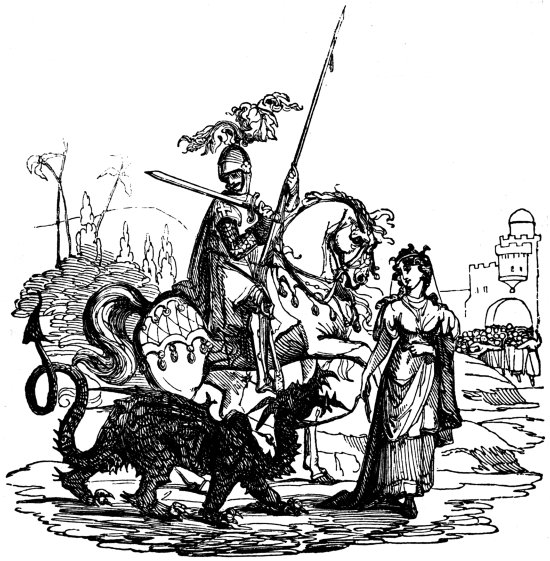
St. George and the Dragon.
It is related of St. George,[100] that he arrived at a city of Lybia called Sylene. Near this city was a stagnant lake or pond like a sea, wherein dwelt a dragon, who was so fierce and venomous, that he terrified and poisoned the whole country. The people therefore assembled to slay him; but when they saw him, his appearance was so horrible, that they fled. Then the dragon pursued them even to the city itself, and the inhabitants were nearly destroyed by his very breath, and suffered so much, that they were obliged to give him two sheep every day to keep him from doing them harm. At length the number of sheep became so small, that they could only give him one sheep every day, and they were obliged to give him a man instead of the other: at last, because all the men might not be eaten up, a law was made that they should draw lots to give him the youth and infants of all ranks, and so the dragon was fed with young gentlefolks and poor people’s children, till the lot fell upon the king’s daughter. Then the king was very sorry, and begged the people to take his gold and silver instead of his daughter, which the people would not accept, because it was according to his own law; and the king wept very much, and begged of the people to give the princess eight days before she should be given to the dragon to be devoured, and the people consented. And when the eight days were gone, the king caused his daughter to be richly dressed as if she were going to her bridal, and having kissed her, he gave her his blessing, and the people led her to where the dragon was. St. George had just come; when he saw the princess, and demanding why she was there, she answered, “Go your way, fair young man, that you perish not also.” Then again St. George demanded the reason of her being there, and why she wept, and endeavoured to comfort her; and when she saw he would not be satisfied, she told him. Upon this St. George promised to deliver her; but she could not believe he had power to do her so great a service, and therefore again begged him to go away. And while they were talking the dragon appeared, and began to run towards them; but St. George being on horseback, drew his sword and signed himself with the cross, and rode violently, and smiting the dragon with his spear, wounded him so sorely that he threw him down. Then St. George called to the princess, to bind her girdle about the dragon’s neck, and not to be afraid; and when she had done so, “the dragon folowed as it had been a meke beest and debonayre;” and she led him into the city, which when the people saw, they fled for fear to the mountains and vallies, till, being encouraged by St. George, they returned, and he promised to slay the dragon if they would believe and be baptized. Then the king was baptized, with upwards of 15,000 men, besides women and children, and St. George slew the dragon, and cut off his head; and the people took four carts and drew the body with oxen out of the city; and the king built a church, and dedicated it to our Lady and St. George—“This blyssyd & holy martyr saynt George, is patron of this realme of englond, & the crye of men of warre. In the worshyp of whom is founded the noble ordre of the gartre, & also a noble college in the castel of wyndsore by kynges of englonde, in whiche college is the hert of saint George, which Sygysmond the emperour of almayne[101] brought, & gave it for a grete & precyous relyke to kynge Henry the fyfth; & also the sayd Sygismond was a broder of the said garter, & also there is a pece of his heed.”
Butler informs us, that St. George, was born in Cappadocia; that he went with his mother into Palestine, of which country she was a native, where she had a considerable estate, “which fell to her son George,” who was a soldier, and became “a tribune or colonel in the army,” wherein he was further promoted by the emperor Dioclesian, to whom he resigned his commissions and posts when that emperor waged war against the christian religion, and who threw him into prison for remonstrating against bloody edicts, and caused him to be beheaded. This is all that Butler relates of him, and this on the authority of what he calls “the account given to us by Metaphrastes.” According also to Butler, St. George became the patron of the military because he had been military himself, and his apparition encouraged “the christian army in the holy war before the battle of Antioch,” which proved fortunate under Godfrey of Bouillon; and also because his apparition inspirited Richard I. in his expedition against the Saracens. “St. George,” says Butler, “is usually painted on horseback, and tilting at a dragon under his feet; but this is no more than an emblematical figure, purporting that, by his faith and christian fortitude, he conquered the devil, called the dragon in the Apocalypse.” This is very easily said, but not so easily proved, nor has Butler in any way attempted to prove it. To this assertion may be opposed the fact, that St. Michael is also represented killing a dragon; and the present writer presumes to think, that unless there be any valid objection to mounting an angel on horseback, the well-known legend of this archangel supplies the clue to the pictorial representation of St. George; or, in plain words, that St. George and the dragon are neither more nor less than St. Michael contending with the devil. Concerning this device, however, more cannot be observed without excluding curious particulars.
There are many old ballads in honour of the patron saint of England and his feat. The ballad of “St. George and the Dragon,” which is not the oldest, begins with the first and ends with the last of the following verses, and places him above sir Bevis of Hampton, and other heroes of mighty doings in our old romances.
Why should we boast of Arthur and his Knights, Knowing how many Men have performed Fights? Or why should we speak of Sir Lancelot de Lake, Of Sir Tristram du Leon, that fought for Ladies Sake? Read in old stories, and there you shall see, How St. George, St. George, he made the Dragon flee. St. George he was for England, St. Dennis was for France; Sing Honi soit qui mal y pense. ***** Mark Anthony, I’ll warrant ye, play’d Feats with Ægypt’s Queen; Sir Eglemore, that valiant Knight, the like was never seen; Grim Gorgon’s Might was known in Fight; old Bevis most Men frighted; The Mirmidons and Prester Johns; why were not these Men knighted? Brave Spinola took in Breda, Nassau did it recover; But St. George, St. George, turn’d the Dragon over and over. St. George he was for England, St. Dennis was for France; Sing, Honi soit qui mal y pense.[102]
This latter verse is a modern interpolation. Percy gives a purer version of the old ballad.[103]
In the romance of the “Seven Champions of Christendom,” St. George’s performances exceed that of the other champions; the ballad, bearing the same title, distinguishes him in like manner, and it is there sung, that in his fight with the dragon,
When many hardy Strokes he’d dealt, And could not pierce his Hide, He run his Sword up to the Hilt, In at the Dragon’s Side; By which he did his Life destroy, Which cheer’d the drooping King; This caus’d an universal Joy, Sweet Peals of Bells did ring.[104]
Saint George was the ancient English war-cry.[105] Shakspeare so uses it in his “Richard III.;” he makes Richmond conclude his address to his soldiery, with
Sound, drums and trumpets, bold and cheerfully, God and Saint George, Richmond and victory.
So also Richard, after he receives the news of Stanley’s defection, exclaims,
Advance our standards, set upon our foes! Our ancient word of courage, fair Saint George, Inspire us with the spleen of fiery dragons! Upon them!
In the 10th year of king Henry VII. the Irish were prohibited from using their favourite battle-cry of Aboo, or Aber. Every native of that country was enjoined against using that word, or “other words like or otherwise contrary to the king’s laws, his crown and dignity and peace, but to call on St. George, or the name of his Sovereign Lord, the King of England, for the time being,” &c.[106] There is also this injunction to the English in an old art of war: “Item that all souldiers entering into battaile, assault, skirmish, or other faction of armes, shall have for their common cry and word, St. George forward, or, Upon them St. George, whereby the soldier is much comforted, and the enemie dismaied by calling to minde the ancient valour of England, which with that name has so often been victorious.”[107] So much for the present concerning St. George.
His majesty, king George IV., who was born on the 12th of August, changed the annual celebration of his birth-day, to St. George’s-day.
The mail-coaches, according to annual custom on the king’s birth-day, go in procession from Millbank to Lombard-street. At about twelve o’clock, the horses belonging to the different mails, with new harness, and the postmen and postboys on horseback, arrayed in their new scarlet coats and jackets, proceed from Lombard-street to Millbank, and there dine. At this place the coaches are fresh painted; from thence the procession being arranged begins to move about five o’clock in the afternoon, headed by the general postmen on horseback. The mails follow them, filled with the wives and children, friends and relations, of the coachmen and guards; while the postboys sounding their bugles and cracking their whips, bring up the rear. From the commencement of the procession, the bells of the different churches ring out merrily, and continue their rejoicing peals till it arrives at the General Post-office in Lombard-street, from whence they sparkle abroad to all parts of the kingdom. Great crowds assemble to witness the cavalcade as it passes through the principal streets of the metropolis, viz. Parliament-street, the Strand, Fleet-street, Ludgate-hill, St. Paul’s church-yard, and Cheapside. The clean and cheerful appearance of the coachmen and guards, each with a large bouquet of flowers in his bright scarlet coat, the beauty of the cattle, and the general excellence of the equipment, present a most agreeable spectacle to every eye and mind, that can be gratified by seeing and reflecting on the advantages derived to trade and social intercourse by this magnificent establishment.
On the same day the Society of Antiquaries, by their charter of incorporation, meet at their apartments in Somerset-place, to elect a president, council, and other officers for the year ensuing, and dine together, according to annual custom.
Chronology.
1616. Miguel Cervantes de Saavedra, the celebrated Spanish author, died. Cervantes was born in 1549; he is best known in England by his “Don Quixote,” which has rendered him popular throughout Europe.
1616. On the same day with Cervantes in Spain, Shakspeare died in England. It was the anniversary of his birth-day, whereon he had completed the fifty-second year of his age. Who is qualified to praise him, whose supereminent genius all men acknowledge and reverence? To his greatness he added a quality it is seldom allied with. “No man had ever fewer enemies alive or dead; and this is the more remarkable as he was himself prone to parody, and must therefore have mortified many of his contemporaries.”[108]
Goodness and he fill up one monument.
Shakspeare’s Jest Book.
Under this title a book was reprinted in 1815, from one lately discovered bearing the title of
¶ A. C. Mery Talys.
Referring to the preface of the reprint for its value in support of the opinion corroborated by other reprints, that Shakspeare was destitute of the learning attributed to him by some writers, an extract (with the spelling modernized) is taken from it as a specimen of the wit, and morals which amused our ancestors.
Of the woman that followed her fourth husband’s bier and wept.
A woman there was which had four husbands. It fortuned also that her fourth husband died and was brought to church upon the bier, whom this woman followed, and made great moan, and waxed very sorry, insomuch that her neighbours thought she would swoon and die for sorrow; wherefore one of her gossips came to her and spake to her in her ear, and bade her for God’s sake comfort herself and refrain that lamentation, or else it would hurt her, and peradventure put her in jeopardy of her life. To whom this woman answered and said “I wys good gossip I have great cause to mourn if ye knew all, for I have buried three husbands beside this man, but I was never in the case that I am now, for there was not one of them but when that I followed the corse to church, yet I was sure of another husband, before the corse came out of my house; and now I am sure of no other husband, and therefore ye may be sure I have great cause to be sad and heavy.”
By this tale ye may see, that the old proverb is true, that it is as great a pity to see a woman weep, as a goose to go barefoot.
If the moral deduced by the story-teller from the tale just related is satirical on the sex, it should be remembered, that he wrote at a period when jokes were homely, and less felt than in our refined times. To talk now of “no joke like a true joke” is scarcely passable, unless the application be in itself true, and then it is no longer a joke.
WIND.
A resident on the banks of the Thames at Kingston observes, that when the swan flies any distance against the wind, however serene and fine the weather may appear, a wind, amounting almost to a hurricane, is always certain to ensue within twenty-four hours afterwards, and generally within twelve. If they fly with the wind, which rarely occurs, it seems to be merely for their amusement, or for reaching some certain spot in a quicker way than floating down the tide, and in this case no change takes place. The gale is usually unaccompanied by wet, though sometimes a heavy shower will be brought up with it.[109]
RAIN.
According to our old works on husbandry, we have many prognostics of rain from the motions of animals. One of them observes thus: “In a herd of cows, as they are on their march towards their pastures in a morning, if the bull lead the van, and keep back his company that they go not before him, it is a prognostic of rainy or tempestuous weather; but if he be careless and let them go at random, the contrary. Or if they eat more than ordinary, or lick their hoofs all about, rain follows forthwith. If they run to and fro, flinging and kicking, and extending their tails, tempests usually follow.”[110]
The same writer says that, “If the swallow fly low, and near the waters, it presageth rain: the coming of the swallow is a true presage of the spring.” It has been already remarked, that the 15th of April, from the usual appearance of this remarkable bird about that time, is called “swallow-day.”
The Swallow.
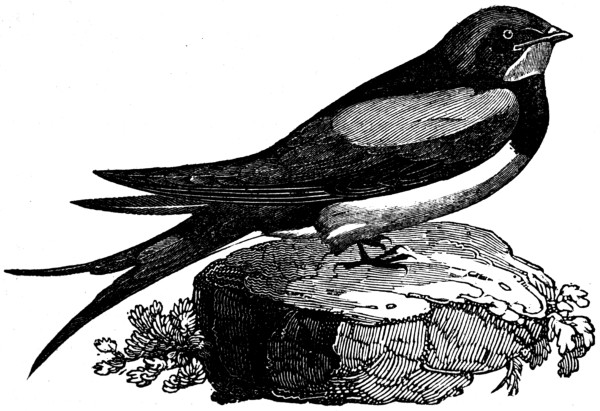
The Swallow.
The preceding engraving is copied from one which illustrates a scientific and agreeable investigation concerning the harbinger of spring, by Dr. Forster; from which dissertation the following interesting particulars are also derived.[111]
The swallow makes its first appearance in Great Britain, early in spring; remains with us during summer, and disappears in autumn. The four species which inhabit this island, are also found during summer, in almost every other region in Europe and Asia, where their manners and habits are nearly the same as in this country. In the more southern parts of the Continent, they appear somewhat earlier than in England. The distinguishing marks of the swallow tribe are—a small bill; a wide mouth; a head rather large in proportion to the bulk of the body, and somewhat flattish; a neck scarcely visible; a short, broad, and cloven tongue; a tail mostly forked; short legs; very long wings; a rapid and continued flight.
The house or Chimney Swallow, hirundo rustica, (figured above) is the most common, as well as the best known. Its length is about six inches, its breadth from tip to tip of the wings, when extended, about twelve inches; the upper parts of its body and wings are black; the under parts whitish ash-colour; the head black; the forehead and chin marked with a red spot; the tail very much forked. It generally arrives earlier than the rest of its genus, and mostly before the middle of April. It builds its nest in chimnies, at the distance of about a foot from the top, or under the roofs of barns and outhouses, has commonly two broods in the year, and usually disappears in the latter end of September, or beginning of October. Like all birds of the swallow tribe, it is perpetually on the wing, and lives upon insects, which it catches flying. It has been calculated from the velocity of this bird on the wing, and its flight in the air for fourteen or fifteen hours together, in search of food, that it flies from two to three hundred miles in that time. As previously observed by an early writer, before rain it may often be seen skimming round the edge of a lake or river, and not unfrequently dipping the tips of its wings, or under part of its body into the water, as it passes over its surface. Dr. Forster cites Aratus and Virgil in corroboration, that ancient authors had observed the same fact. He describes the Martin, or Martlett, hirundo urbica, as being rather less than the swallow, and as easily distinguishable from it, by the bright white colour of all the under parts of the body. This species usually makes its first appearance early in May, though sometimes sooner, and leaves us towards the latter end of October. It builds under the eaves of houses, in crags of rocks and precipices near the sea, has oftentimes three broods in the year, and constructs its curious nest like that of the swallow, with mud and straw, lined with feathers on the inside. He says that the Swift, hirundo apus, is the largest of the genus, being seven inches in length, and nearly eighteen in breadth, when its wings are extended, and that it is of a sooty black colour, with a whitish spot on its breast. It arrives towards the middle of May, and departs about the middle of August. It builds in holes of rocks, in ruined towers, and under the tiling of houses; and has only one brood in the year. He observes of the Bank or Sand Martin, hirundo riparia, that it is the smallest of the genus, is of a dusky brown colour above, and whitish beneath; and that it builds its nest in holes, which it bores in banks of sand, and is said to have only one brood in the year.