DECEMBER. (continued 2)
Reading edition
“He neither shall be clothed in purple nor in pall, But all in fair linen, as were babies all: He neither shall be rock’d in silver nor in gold, But in a wooden cradle, that rocks on the mould.”
Not to multiply instances at present, let it suffice that in a MS. at the British Museum[417] there is “A song on the holly and the ivy,” beginning,
“Nay, my nay, hyt shal not be I wys, Let holy hafe the maystry, as the maner ys: “Holy stond in the hall, fayre to behold, Ivy stond without the dore, she ys ful sore acold. “Nay my nay,” &c. “Holy, & hys mery men, they dawnsyn and they syng, Ivy and hur maydyns, they wepyn & they wryng. “Nay my nay,” &c.
The popularity of carol-singing occasioned the publication of a duodecimo volume in 1642, intituled, “Psalmes or Songs of Sion, turned into the language, and set to the tunes of a strange land. By W(illiam) S(latyer), intended for Christmas carols, and fitted to divers of the most noted and common but solemne tunes, every where in this land familiarly used and knowne.” Upon the copy of this book in the British Museum, a former possessor has written the names of some of the tunes to which the author designed them to be sung: for instance, Psalm 6, to the tune of Jane Shore; Psalm 19, to Bar. Forster’s Dreame; Psalm 43, to Crimson Velvet; Psalm 47, to Garden Greene; Psalm 84, to The fairest Nymph of the Valleys; &c.
In a carol, still sung, called “Dives and Lazarus,” there is this amusing account:
“As it fell it out, upon a day, Rich Dives sicken’d and died, There came two serpents out of hell, His soul therein to guide. “Rise up, rise up, brother Dives, And come along with me, For you’ve a place provided in hell, To sit upon a serpent’s knee.”
However whimsical this may appear to the reader, he can scarcely conceive its ludicrous effect, when the “serpent’s knee” is solemnly drawn out to its utmost length by a Warwickshire chanter, and as solemnly listened to by the well-disposed crowd, who seem, without difficulty, to believe that Dives sits on a serpent’s knee. The idea of sitting on this knee was, perhaps, conveyed to the poet’s mind by old wood-cut representations of Lazarus seated in Abraham’s lap. More anciently, Abraham was frequently drawn holding him up by the sides, to be seen by Dives in hell. In an old book now before me, they are so represented, with the addition of a devil blowing the fire under Dives with a pair of bellows.
Carols begin to be spoken of as not belonging to this century, and few, perhaps, are aware of the number of these compositions now printed. The editor of the Every-Day Book has upwards of ninety, all at this time, published annually.
This collection he has had little opportunity of increasing, except when in the country he has heard an old woman singing an old carol, and brought back the carol in his pocket with less chance of its escape, than the tune in his head.
Mr. Southey, describing the fight “upon the plain of Patay,” tells of one who fell, as having
“In his lord’s castle dwelt, for many a year, A well-beloved servant: he could sing Carols for Shrove-tide, or for Candlemas, Songs for the wassel, and when the boar’s head Crown’d with gay garlands, and with rosemary, Smoak’d on the Christmas board.”
Joan of Arc, b. x. l. 466.
These ditties, which now exclusively enliven the industrious servant-maid, and the humble labourer, gladdened the festivity of royalty in ancient times. Henry VII., in the third year of his reign, kept his Christmas at Greenwich: on the twelfth night, after high mass, the king went to the hall, and kept his estate at the table; in the middle sat the dean, and those of the king’s chapel, who, immediately after the king’s first course, “sang a carall.”[418]—Granger innocently observes, that “they that fill the highest and the lowest classes of human life, seem in many respects to be more nearly allied than even themselves imagine. A skilful anatomist would find little or no difference in dissecting the body of a king, and that of the meanest of his subjects; and a judicious philosopher would discover a surprising conformity in discussing the nature and qualities of their minds.”[419]
The earliest collection of Christmas carols supposed to have been published, is only known from the last leaf of a volume printed by Wynkn de Worde, in the year 1521. This precious scrap was picked up by Tom Hearne; Dr. Rawlinson purchased it at his decease in a volume of tracts, and bequeathed it to the Bodleian library. There are two carols upon it: one, “a caroll of huntynge,” is reprinted in the last edition of Juliana Berners’ “Boke of St. Alban’s;” the other, “a caroll, bringing in the bore’s head,” is in Mr. Dibdin’s “Ames,” with a copy of it as it is now sung in Queen’s-college, Oxford, every Christmas-day. Dr. Bliss, of Oxford, also printed on a sheet for private distribution, a few copies of this and Ant. à Wood’s version of it, with notices concerning the custom, from the hand-writings of Wood and Dr. Rawlinson, in the Bodleian library. Ritson, in his ill-tempered “Observations on Warton’s History of English Poetry,” (1782, 4to. p. 37,) has a Christmas carol upon bringing up the boar’s head, from an ancient MS. in his possession, wholly different from Dr. Bliss’s. The “Bibliographical Miscellanies,” (Oxford, 1813, 4to.) contains seven carols from a collection in one volume in the possession of Dr. Cotton, of Christchurch-college, Oxford, “imprynted at London, in the Powltry, by Richard Kele, dwellyng at the longe shop vnder saynt Myldrede’s Chyrche,” probably “between 1546 and 1552.” I had an opportunity of perusing this exceedingly curious volume, which is supposed to be unique, and has since passed into the hands of Mr. Freeling. There are carols among the Godly and Spiritual Songs and Balates, in “Scottish Poems of the sixteenth century,” (1801, 8vo.); and one by Dunbar, from the Bannatyne MS. in “Ancient Scottish Poems.” Others are in Mr. Ellis’s edition of Brand’s “Popular Antiquities,” with several useful notices. Warton’s “History of English Poetry” contains much concerning old carols. Mr. Douce, in his “Illustrations of Shakspeare,” gives a specimen of the carol sung by the shepherds, on the birth of Christ, in one of the Coventry plays. There is a sheet of carols headed thus: “Christus Natus Est: Christ is born;” with a wood-cut, 10 inches high, by 81⁄2 inches wide, representing the stable at Bethlehem; Christ in the crib, watched by the virgin and Joseph; shepherds kneeling; angels attending; a man playing on the bagpipes; a woman with a basket of fruit on her head; a sheep bleating, and an ox lowing on the ground; a raven croaking, and a crow cawing on the hay-rack; a cock crowing above them; and angels singing in the sky. The animals have labels from their mouths, bearing Latin inscriptions. Down the side of the wood-cut is the following account and explanation: “A religious man, inventing the conceits of both birds and beasts, drawn in the picture of our Saviour’s birth, doth thus express them: the cock croweth, Christus natus est, Christ is born. The raven asked, Quando? When? The crow replied, Hac nocte, This night. The ox cryeth out, Ubi? Ubi? Where? where? The sheep bleated out, Bethlehem, Bethlehem. A voice from heaven sounded, Gloria in Excelsis, Glory be on high.—London: printed and sold by J. Bradford, in Little Britain, the corner house over against the Pump, 1701. Price One Penny.” This carol is in the possession of Mr. Upcott.
The custom of singing carols at Christmas prevails in Ireland to the present time. In Scotland, where no church feasts have been kept since the days of John Knox, the custom is unknown. In Wales it is still preserved to a greater extent, perhaps, than in England; at a former period, the Welsh had carols adapted to most of the ecclesiastical festivals, and the four seasons of the year, but in our times they are limited to that of Christmas. After the turn of midnight at Christmas-eve, service is performed in the churches, followed by the singing of carols to the harp. Whilst the Christmas holidays continue, they are sung in like manner in the houses, and there are carols especially adapted to be sung at the doors of the houses by visiters before they enter. Lffyr Carolan, or the book of carols, contains sixty-six for Christmas, and five summer carols; Blodeugerdd Cymrii, or the “Anthology of Wales,” contains forty-eight Christmas carols, nine summer carols, three May carols, one winter carol, one nightingale carol, and a carol to Cupid. The following verse of a carol for Christmas is literally translated from the first mentioned volume. The poem was written by Hugh Morris, a celebrated song-writer during the commonwealth, and until the early part of the reign of William III:—
“To a saint let us not pray, to a pope let us not kneel; On Jesu let us depend, and let us discreetly watch To preserve our souls from Satan with his snares; Let us not in morning invoke any one else.”
With the succeeding translation of a Welsh wassail song, the observer of manners will, perhaps, be pleased. In Welsh, the lines of each couplet, repeated inversely, still keep the same sense.
A Carol for the Eve of St. Mary’s Day.
This is the season when, agreeably to custom, That it was an honour to send wassail By the old people who were happy In their time, and loved pleasure; And we are now purposing To be like them, every one merry: Merry and foolish, youths are wont to be, Being reproached for squandering abroad. I know that every mirth will end Too soon of itself; Before it is ended, here comes The wassail of Mary, for the sake of the time: N ——— [420] place the maid immediately In the chair before us; And let every body in the house be content that we May drink wassail to virginity, To remember the time, in faithfulness, When fair Mary was at the sacrifice, After the birth to her of a son, Who delivered every one, through his good will From their sins, without doubt. Should there be an inquiry who made the carol, He is a man whose trust is fully on God, That he shall go to heaven to the effulgent Mary, Towards filling the orders where she also is.
Thomas Evans.
In the rage for “collecting” almost every thing, it is surprising that “collectors” have almost overlooked carols as a class of popular poetry. To me they have been objects of interest from circumstances which occasionally determine the direction of pursuit. The wood-cuts round the annual sheets, and the melody of “God rest you merry gentlemen,” delighted my childhood; and I still listen with pleasure to the shivering carolist’s evening chant towards the clean kitchen window decked with holly, the flaring fire showing the whitened hearth, and reflecting gleams of light from the surfaces of the dresser utensils.
Davies Gilbert, Esq. F.R.S. F.A.S. &c. has published “Ancient Christmas carols, with the tunes to which they were formerly sung in the west of England.” Mr. Gilbert says, that “on Christmas-day these carols took the place of psalms in all the churches, especially at afternoon service, the whole congregation joining: and at the end it was usual for the parish clerk, to declare in a loud voice, his wishes for a merry Christmas and a happy new year.”
In “Poor Robin’s Almanac,” for 1695, there is a Christmas carol, which is there called, “A Christmas Song,” beginning thus:—
Now thrice welcome, Christmas, Which brings us good cheer, Minced-pies and plumb-porridge, Good ale and strong beer; With pig, goose, and capon, The best that may be, So well doth the weather And our stomachs agree. Observe how the chimneys Do smoak all about, The cooks are providing For dinner, no doubt; But those on whose tables No victuals appear, O, may they keep Lent All the rest of the year! With holly and ivy So green and so gay; We deck up our houses As fresh as the day. With bays and rosemary And laurel compleat, And every one now Is a king in conceit.
So much only concerning carols for the present. But more shall be said hereon in the year 1826, if the editor of the Every-Day Book live, and retain his faculties to that time. He now, however, earnestly requests of every one of its readers in every part of England, to collect every carol that may be singing at Christmas time in the year 1825, and convey these carols to him at their earliest convenience, with accounts of manners and customs peculiar to their neighbourhood, which are not already noticed in this work. He urges and solicits this most earnestly and anxiously, and prays his readers not to forget that he is a serious and needy suitor. They see the nature of the work, and he hopes that any thing and every thing that they think pleasant or remarkable, they will find some means of communicating to him without delay. The most agreeable presents he can receive at any season, will be contributions and hints that may enable him to blend useful information with easy and cheerful amusement.
CUSTOMS ON Christmas Eve.
Mr. Coleridge writing his “Friend,” from Ratzeburg, in the north of Germany, mentions a practice on Christmas-eve very similar to some on December the 6th, St. Nicholas’-day. Mr. Coleridge says, “There is a Christmas custom here which pleased and interested me. The children make little presents to their parents, and to each other, and the parents to their children. For three or four months before Christmas the girls are all busy, and the boys save up their pocket-money to buy these presents. What the present is to be is cautiously kept secret; and the girls have a world of contrivances to conceal it—such as working when they are out on visits, and the others are not with them—getting up in the morning before day-light, &c. Then, on the evening before Christmas-day, one of the parlours is lighted up by the children, into which the parents must not go; a great yew bough is fastened on the table at a little distance from the wall, a multitude of little tapers are fixed in the bough, but not so as to burn it till they are nearly consumed, and coloured paper, &c. hangs and flutters from the twigs. Under this bough the children lay out in great order the presents they mean for their parents, still concealing in their pockets what they intend for each other. Then the parents are introduced, and each presents his little gift; they then bring out the remainder one by one, from their pockets, and present them with kisses and embraces. Where I witnessed this scene, there were eight or nine children, and the eldest daughter and the mother wept aloud for joy and tenderness; and the tears ran down the face of the father, and he clasped all his children so tight to his breast, it seemed as if he did it to stifle the sob that was rising within it. I was very much affected. The shadow of the bough and its appendages on the wall, and arching over on the ceiling, made a pretty picture; and then the raptures of the very little ones, when at last the twigs and their needles began to take fire and snap—O it was a delight to them!—On the next day, (Christmas-day) in the great parlour, the parents lay out on the table the presents for the children; a scene of more sober joy succeeds; as on this day, after an old custom, the mother says privately to each of her daughters, and the father to his sons, that which he has observed most praiseworthy and that which was most faulty in their conduct. Formerly, and still in all the smaller towns and villages throughout North Germany, these presents were sent by all the parents to some one fellow, who, in high buskins, a white robe, a mask, and an enormous flax wig, personates Knecht Rupert, i. e. the servant Rupert. On Christmas-night he goes round to every house, and says, that Jesus Christ, his master, sent him thither. The parents and elder children receive him with great pomp and reverence, while the little ones are most terribly frightened. He then inquires for the children, and, according to the character which he hears from the parents, he gives them the intended present, as if they came out of heaven from Jesus Christ. Or, if they should have been bad children, he gives the parents a rod, and, in the name of his master, recommends them to use it frequently. About seven or eight years old the children are let into the secret, and it is curious how faithfully they keep it.”
A correspondent to the “Gentleman’s Magazine,” says, that when he was a school-boy, it was a practice on Christmas-eve to roast apples on a string till they dropt into a large bowl of spiced ale, which is the whole composition of lamb’s wool. Brand thinks, that this popular beverage obtained its name from the softness of the composition, and he quotes from Shakspeare’s “Midsummer-Night’s Dream,”
————“Sometimes lurk I in a gossip’s bowl, In very likeness of a roasted crab; And, when she drinks, against her lips I bob, And on her wither’d dew-lap pour the ale.”
It was formerly a custom in England on Christmas-eve to wassail, or wish health to the apple-tree. Herrick enjoins to—
“Wassaile the trees, that they may beare You many a plum, and many a peare; For more or lesse fruits they will bring, And you do give them wassailing.”
In 1790, it was related to Mr. Brand, by sir Thomas Acland, at Werington, that in his neighbourhood on Christmas-eve it was then customary for the country people to sing a wassail or drinking-song, and throw the toast from the wassail-bowl to the apple-trees in order to have a fruitful year.
“Pray remember,” says T. N. of Cambridge, to the editor of the Every-Day Book, “that it is a Christmas custom from time immemorial to send and receive presents and congratulations from one friend to another; and, could the number of baskets that enter London at this season be ascertained, it would be astonishing; exclusive of those for sale, the number and weight of turkeys only, would surpass belief. From a historical account of Norwich it appears, that between Saturday morning and the night of Sunday, December 22, 1793, one thousand seven hundred turkeys, weighing 9 tons, 2 cwt. 2 lbs. value 680l. were sent from Norwich to London; and two days after half as many more.”
“Now,” says Stevenson, in his Twelve Months, 1661, “capons and hens, besides turkeys, geese, ducks, with beef and mutton, must all die; for in twelve days a multitude of people will not be fed with a little. Now plums and spice, sugar and honey, square it among pies and broth. Now a journeyman cares not a rush for his master, though he begs his plum-porridge all the twelve days. Now or never must the music be in tune, for the youth must dance and sing to get them a heat, while the aged sit by the fire. The country-maid leaves half her market, and must be sent again if she forgets a pack of cards on Christmas-eve. Great is the contention of holly and ivy, whether master or dame wears the breeches; and if the cook do not lack wit, he will sweetly lick his fingers.”
Mr. Leigh Hunt’s Indicator presents this Christmas picture to our contemplation—full of life and beauty:—
Holiday Children.
One of the most pleasing sights at this festive season is the group of boys and girls returned from school. Go where you will, a cluster of their joyous chubby faces present themselves to our notice. In the streets, at the panorama, or playhouse, our elbows are constantly assailed by some eager urchin whose eyes just peep beneath to get a nearer view.
I am more delighted in watching the vivacious workings of their ingenuous countenances at these Christmas shows, than at the sights themselves.
From the first joyous huzzas, and loud blown horns which announce their arrival, to the faint attempts at similar mirth on their return, I am interested in these youngsters.
Observe the line of chaises with their swarm-like loads hurrying to tender and exulting parents, the sickly to be cherished, the strong to be amused; in a few mornings you shall see them, new clothes, warm gloves, gathering around their mother at every toy-shop, claiming the promised bat, hoop, top, or marbles; mark her kind smile at their ecstacies; her prudent shake of the head at their multitudinous demands; her gradual yielding as they coaxingly drag her in; her patience with their whims and clamour while they turn and toss over the play-things, as now a sword, and now a hoop is their choice, and like their elders the possession of one bauble does but make them sigh for another.
View the fond father, his pet little girl by the hand, his boys walking before on whom his proud eye rests, while ambitious views float o’er his mind for them, and make him but half attentive to their repeated inquiries; while at the Museum or Picture-gallery, his explanations are interrupted by the rapture of discovering that his children are already well acquainted with the different subjects exhibited.
Stretching half over the boxes at the theatre, adorned by maternal love, see their enraptured faces now turned to the galleries wondering at their height and at the number of regular placed heads contained in them, now directed towards the green cloud which is so lingeringly kept between them and their promised bliss. The half-peeled orange laid aside when the play begins; their anxiety for that which they understand; their honest laughter which runs through the house like a merry peal of sweet bells; the fear of the little girl lest they should discover the person hid behind the screen; the exultation of the boy when the hero conquers.
But, oh, the rapture when the pantomime commences! Ready to leap out of the box, they joy in the mischief of the clown, laugh at the thwacks he gets for his meddling, and feel no small portion of contempt for his ignorance in not knowing that hot water will scald and gunpowder explode; while with head aside to give fresh energy to the strokes, they ring their little palms against each other in testimony of exuberant delight.
Who can behold them without reflecting on the many passions that now lie dormant in their bosoms, to be in a few years agitating themselves and the world. Here the coquet begins to appear in the attention paid to a lace frock or kid gloves for the first time displayed, or the domestic tyrant in the selfish boy, who snatches the largest cake, or thrusts his younger brother and sister from the best place.
At no season of the year are their holidays so replete with pleasures; the expected Christmas-box from grand-papa and grand-mamma; plum-pudding and snap-dragon, with blindman’s-buff and forfeits; perhaps to witness a juvenile play rehearsed and ranted; galantée-show and drawing for twelfth-cake; besides Christmas gambols in abundance, new and old.
Even the poor charity-boy at this season feels a transient glow of cheerfulness, as with pale blue face, frost-nipped hands and ungreatcoated, from door to door, he timidly displays the unblotted scutcheon of his graphic talents, and feels that the pence bestowed are his own, and that for once in his life he may taste the often desired tart, or spin a top which no one can snatch from him in capricious tyranny.
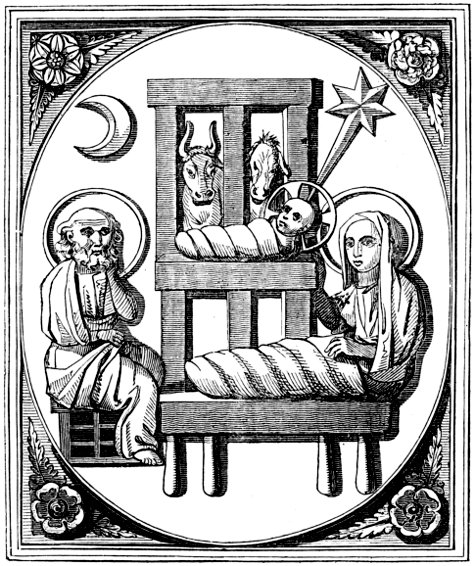
Ancient Representation of the Nativity.
THE OX AND THE ASS.
According to Mr. Brand, “a superstitious notion prevails in the western parts of Devonshire, that at twelve o’clock at night on Christmas-eve, the oxen in their stalls are always found on their knees, as in an attitude of devotion; and that (which is still more singular) since the alteration of the style, they continue to do this only on the eve of old Christmas-day. An honest countryman, living on the edge of St. Stephen’s Down, near Launceston, Cornwall, informed me, October 28, 1790, that he once, with some others, made a trial of the truth of the above, and watching several oxen in their stalls at the above time, at twelve o’clock at night, they observed the two oldest oxen only fall upon their knees, and, as he expressed it in the idiom of the country, make ‘a cruel moan like christian creatures.’ I could not but with great difficulty keep my countenance: he saw, and seemed angry that I gave so little credit to his tale, and, walking off in a pettish humour, seemed to ‘marvel at my unbelief.’ There is an old print of the Nativity, in which the oxen in the stable, near the virgin and the child, are represented upon their knees, as in a suppliant posture. This graphic representation has probably given rise to the above superstitious notion on this head.” Mr. Brand refers to “an old print,” as if he had only observed one with this representation; whereas, they abound, and to the present day the ox and the ass are in the wood-cuts of the nativity on our common Christmas carols. Sannazarius, a Latin poet of the fifteenth century, in his poem De Partu Virginis, which he was several years in composing, and twenty years in revising, and which chiefly contributed to the celebrity of his name among the Italians, represents that the virgin wrapped up the new-born infant, and put him into her bosom; that the cattle cherished him with their breath, an ox fell on his knees, and an ass did the same. He declares them both happy, promises they shall be honoured at all the altars in Rome, and apostrophizes the virgin on occasion of the respect the ox and ass have shown her. To a quarto edition of this Latin poem, with an Italian translation by Gori, printed at Florence in 1740, there is a print inscribed “Sacrum monumentum in antiquo vitro Romæ in Museo Victorio,” from whence the preceding engraving is presented, as a curious illustration of the obviously ancient mode of delineating the subject.
In the edition just mentioned of Sannazarius’s exceedingly curious poem, which is described in the editor’s often cited volume on “Ancient Mysteries,” there are other engravings of the nativity with the ox and the ass, from sculptures on ancient sarcophagi at Rome. This introduction of the ox and the ass warming the infant in the crib with their breath, is a fanciful construction by catholic writers on Isaiah i. 3; “The ox knoweth his owner, and the ass his master’s crib.”
Sannazarius was a distinguished statesman in the kingdom of Naples. His superb tomb in the church of St. Mark is decorated with two figures originally executed for and meant to represent Apollo and Minerva; but as it appeared indecorous to admit heathen divinities into a christian church, and the figures were thought too excellent to be removed, the person who shows the church is instructed to call them David and Judith: “You mistake,” said a sly rogue who was one of a party surveying the curiosities, “the figures are St. George, and the queen of Egypt’s daughter.” The demonstrator made a low bow, and thanked him.[421]
FLORAL DIRECTORY.
Frankincense. Pinus Tæda. Dedicated to Sts. Thrasilla and Emiliana.
December 25.
The Nativity of Christ, or Christmas-day. St. Anastasia, A. D. 304. Another St. Anastasia. St. Eugenia, A. D. 257.
Christmas-day.
The festival of the nativity was anciently kept by different churches in April, May, and in this month. It is now kept on this day by every established church of christian denomination; and is a holiday all over England, observed by the suspension of all public and private business, and the congregating of friends and relations for “comfort and joy.”
Our countryman, Barnaby Googe, from the Latin of Naogeorgus, gives us some lines descriptive of the old festival:—
Then comes the day wherein the Lorde did bring his birth to passe; Whereas at midnight up they rise, and every man to Masse. This time so holy counted is, that divers earnestly Do thinke the waters all to wine are chaunged sodainly; In that same houre that Christ himselfe was borne, and came to light, And unto water streight againe transformde and altred quight. There are beside that mindfully the money still do watch, That first to aultar commes, which then they privily do snatch. The priestes, least other should it have, takes oft the same away, Whereby they thinke throughout the yeare to have good lucke in play, And not to lose: then straight at game till day-light do they strive, To make some present proofe how well their hallowde pence wil thrive. Three Masses every priest doth sing, upon that solemne day, With offrings unto every one, that so the more may play. This done, a woodden child in clowtes is on the aultar set, About the which both boyes and gyrles do daunce and trymly jet, And Carrols sing in prayse of Christ, and, for to helpe them heare, The organs aunswere every verse with sweete and solemne cheare. The priestes doe rore aloude; and round about the parentes stande To see the sport, and with their voyce do helpe them and their hande.
The commemorations in our own times vary from the account in these versifyings. An accurate observer, with a hand powerful to seize, and a hand skilled in preserving manners, offers us a beautiful sketch of Christmas-tide in the “New Monthly Magazine,” of December 1, 1825. Foremost in his picture is the most estimable, because the most useful and ornamental character in society,—a good parish priest.
“Our pastor was told one day, in argument, that the interests of christianity were opposed to universal enlightenment. I shall not easily forget his answer. ‘The interests of christianity,’ said he, ‘are the same as the interests of society. It has no other meaning. Christianity is that very enlightenment you speak of. Let any man find out that thing, whatever it be, which is to perform the very greatest good to society, even to its own apparent detriment, and I say that is christianity, or I know not the spirit of its founder. What?’ continued he, ‘shall we take christianity for an arithmetical puzzle, or a contradiction in terms, or the bitterness of a bad argument, or the interests, real or supposed, of any particular set of men? God forbid. I wish to speak with reverence (this conclusion struck me very much)—I wish to speak with reverence of whatever has taken place in the order of Providence. I wish to think the best of the very evils that have happened; that a good has been got out of them; perhaps that they were even necessary to the good. But when once we have attained better means, and the others are dreaded by the benevolent, and scorned by the wise, then is the time come for throwing open the doors to all kindliness and to all knowledge, and the end of christianity is attained in the reign of beneficence.’
“In this spirit our pastor preaches to us always, but most particularly on Christmas-day; when he takes occasion to enlarge on the character and views of the divine person who is supposed then to have been born, and sends us home more than usually rejoicing. On the north side of the church at M. are a great many holly-trees. It is from these that our dining and bed-rooms are furnished with boughs. Families take it by turns to entertain their friends. They meet early; the beef and pudding are noble; the mince-pies—peculiar; the nuts half play-things and half-eatables; the oranges as cold and acid as they ought to be, furnishing us with a superfluity which we can afford to laugh at; the cakes indestructible; the wassail bowls generous, old English, huge, demanding ladles, threatening overflow as they come in, solid with roasted apples when set down. Towards bed-time you hear of elder-wine, and not seldom of punch. At the manor-house it is pretty much the same as elsewhere. Girls, although they be ladies, are kissed under the misletoe. If any family among us happen to have hit upon an exquisite brewing, they send some of it round about, the squire’s house included; and he does the same by the rest. Riddles, hot-cockles, forfeits, music, dances sudden and not to be suppressed, prevail among great and small; and from two o’clock in the day to midnight, M. looks like a deserted place out of doors, but is full of life and merriment within. Playing at knights and ladies last year, a jade of a charming creature must needs send me out for a piece of ice to put in her wine. It was evening and a hard frost. I shall never forget the cold, cutting, dreary, dead look of every thing out of doors, with a wind through the wiry trees, and the snow on the ground, contrasted with the sudden return to warmth, light, and joviality.
“I remember we had a discussion that time, as to what was the great point and crowning glory of Christmas. Many were for mince-pie; some for the beef and plum-pudding; more for the wassail-bowl; a maiden lady timidly said, the misletoe; but we agreed at last, that although all these were prodigious, and some of them exclusively belonging to the season, the fire was the great indispensable. Upon which we all turned our faces towards it, and began warming our already scorched hands. A great blazing fire, too big, is the visible heart and soul of Christmas. You may do without beef and plum-pudding; even the absence of mince-pie may be tolerated; there must be a bowl, poetically speaking, but it need not be absolutely wassail. The bowl may give place to the bottle. But a huge, heaped-up, over heaped-up, all-attracting fire, with a semicircle of faces about it, is not to be denied us. It is the lar and genius of the meeting; the proof positive of the season; the representative of all our warm emotions and bright thoughts; the glorious eye of the room; the inciter to mirth, yet the retainer of order; the amalgamater of the age and sex; the universal relish. Tastes may differ even on a mince-pie; but who gainsays a fire? The absence of other luxuries still leaves you in possession of that; but
‘Who can hold a fire in his hand With thinking on the frostiest twelfth-cake?’
“Let me have a dinner of some sort, no matter what, and then give me my fire, and my friends, the humblest glass of wine, and a few penn’orths of chesnuts, and I will still make out my Christmas. What! Have we not Burgundy in our blood? Have we not joke, laughter, repartee, bright eyes, comedies of other people, and comedies of our own; songs, memories, hopes? [An organ strikes up in the street at this word, as if to answer me in the affirmative. Right, thou old spirit of harmony, wandering about in that ark of thine, and touching the public ear with sweetness and an abstraction! Let the multitude bustle on, but not unarrested by thee and by others, and not unreminded of the happiness of renewing a wise childhood.] As to our old friends the chesnuts, if any body wants an excuse to his dignity for roasting them, let him take the authority of Milton. ‘Who now,’ says he, lamenting the loss of his friend Deodati,—‘who now will help to soothe my cares for me, and make the long night seem short with his conversation; while the roasting pear hisses tenderly on the fire, and the nuts burst away with a noise,—
‘And out of doors a washing storm o’erwhelms Nature pitch-dark, and rides the thundering elms?’”
Christmas in France.
From a newspaper of 1823, (the name unfortunately not noted at the time, and not immediately ascertainable), it appears that Christmas in France is another thing from Christmas in England.
“The habits and customs of the Parisians vary much from those of our own metropolis at all times, but at no time more than at this festive season. An Englishman in Paris, who had been for some time without referring to his almanac, would not know Christmas-day from another by the appearance of the capital. It is, indeed, set down as a jour de fete in the calendar, but all the ordinary business of life is transacted; the streets are, as usual, crowded with waggons and coaches; the shops, with few exceptions, are open, although on other fête days the order for closing them is rigorously enforced, and if not attended to, a fine levied; and at the churches nothing extraordinary is going forward. All this is surprising in a catholic country, which professes to pay such attention to the outward rites of religion.
“On Christmas-eve indeed, there is some bustle for a midnight mass, to which immense numbers flock, as the priests, on this occasion, get up a showy spectacle which rivals the theatres. The altars are dressed with flowers, and the churches decorated profusely; but there is little in all this to please men who have been accustomed to the John Bull mode of spending the evening. The good English habit of meeting together to forgive offences and injuries, and to cement reconciliations, is here unknown. The French listen to the church music, and to the singing of their choirs, which is generally excellent, but they know nothing of the origin of the day and of the duties which it imposes. The English residents in Paris, however, do not forget our mode of celebrating this day. Acts of charity from the rich to the needy, religious attendance at church, and a full observance of hospitable rites, are there witnessed. Paris furnishes all the requisites for a good pudding, and the turkeys are excellent, though the beef is not to be displayed as prize production.
“On Christmas-day all the English cooks in Paris are in full business. The queen of cooks, however, is Harriet Dunn, of the Boulevard.—As sir Astley Cooper among the cutters of limbs, and d’Egville among the cutters of capers, so is Harriet Dunn among the professors of one of the most necessary, and in its results, most gratifying professions of existence; her services are secured beforehand by special retainers; and happy is the peer who can point to his pudding, and declare that it is of the true “Dunn” composition. Her fame has even extended to the provinces. For some time previous to Christmas-day, she forwards puddings in cases to all parts of the country, ready cooked and fit for the table, after the necessary warming. All this is, of course, for the English. No prejudice can be stronger than that of the French against plum-pudding—a Frenchman will dress like an Englishman, swear like an Englishman, and get drunk like an Englishman; but if you would offend him for ever, compel him to eat plum-pudding. A few of the leading restaurateurs, wishing to appear extraordinary, have plomb-pooding upon their cartes, but in no instance is it ever ordered by a Frenchman. Every body has heard the story of St. Louis—Henri Quatre, or whoever else it might be, who, wishing to regale the English ambassador on Christmas-day with a plum-pudding, procured an excellent recipe for making one, which he gave to his cook, with strict injunctions that it should be prepared with due attention to all the particulars. The weight of the ingredients, the size of the copper, the quantity of water, the duration of time, every thing was attended to except one trifle—the king forgot the cloth, and the pudding was served up like so much soup, in immense tureens, to the surprise of the ambassador, who was, however, too well bred to express his astonishment. Louis XVIII., either to show his contempt of the prejudices of his countrymen, or to keep up a custom which suits his palate, has always an enormous pudding on Christmas-day, the remains of which, when it leaves the table, he requires to be eaten by the servants, bon gré, mauvais gré; but in this instance even the commands of sovereignty are disregarded, except by the numerous English in his service, consisting of several valets, grooms, coachmen, &c., besides a great number of ladies’ maids, in the service of the duchesses of Angouleme and Berri, who very frequently partake of the dainties of the king’s table.”
The following verses from the original in old Norman French, are said to be the first drinking song composed in England. They seem to be an abridged version of the Christmas carol in Anglo-Norman French, translated by Mr Douce:—
Lordlings, from a distant home, To seek old Christmas are we come, Who loves our minstrelsy— And here, unless report mis-say, The greybeard dwells; and on this day Keeps yearly wassel, ever gay With festive mirth and glee. Lordlings, list, for we tell you true, Christmas loves the jolly crew, That cloudy care defy: His liberal board is deftly spread, With manchet loaves and wastel bread, His guests with fish and flesh are led, Nor lack the stately pye. Lordlings, it is our host’s command, And Christmas joins him hand in hand, To drain the brimming bowl; And I’ll be foremost to obey— Then pledge me, sirs, and drink away For Christmas revels here to-day And sways without controul. Now wassel to you all! and merry may you be, And foul that wight befall, who drinks not health to me.
There were anciently great doings in the halls of the inns of court at Christmas time. At the Inner-Temple early in the morning, the gentlemen of the inn went to church, and after the service they did then “presently repair into the hall to breakfast with brawn, mustard, and malmsey.” At the first course at dinner, was “served in, a fair and large Bore’s head upon a silver platter with minstralsye.”[422]
The Boar’s Head.
With our forefathers a soused boar’s head was borne to the principal table in the hall with great state and solemnity, as the first dish on Christmas-day.
In the book of “Christmasse Carolles” printed by Wynkyn de Worde in 1521, are the words sung at this “chefe servyce,” or on bringing in this the boar’s head, with great ceremony, as the first dish: it is in the next column.
A Carol bryngyng in the Boar’s Head
Caput Apri defero Reddens laudes Domino. The bore’s head in hande bring I, With garlandes gay and rosemary, I pray you all synge merely, Qui estis in convivio. The bore’s head, I understande, Is the chefe servyce in this lande Loke wherever it be fande Servite cum Cantico. Be gladde, lords, both more and lasse, For this hath ordayned our stewarde To chere you all this Christmasse, The bore’s head with mustard.
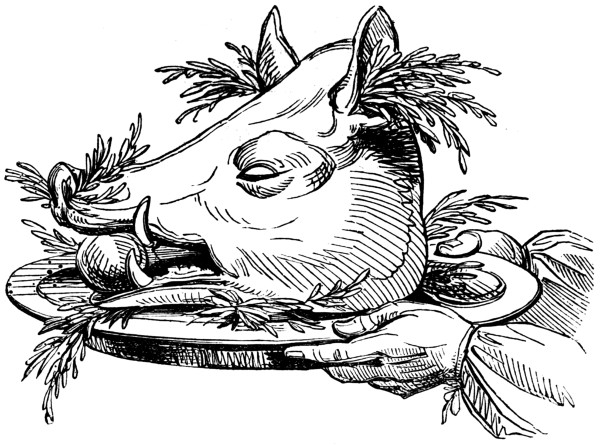
The Boar’s Head at Christmas.
“With garlandes gay and rosemary.”
Warton says, “This carol, yet with many innovations, is retained at Queen’s-college, in Oxford.” It is still sung in that college, somewhat altered, “to the common chant of the prose version of the psalms in cathedrals;” so, however, the rev. Mr. Dibdin says, as mentioned before.
Mr. Brand thinks it probable that Chaucer alluded to the custom of bearing the boar’s head, in the following passage of the “Franklein’s Tale:”—
“Janus sitteth by the fire with double berd, And he drinketh of his bugle-horne the wine, Before him standeth the brawne of the tusked swine.”
In “The Wonderful Yeare, 1603,” Dekker speaks of persons apprehensive of catching the plague, and says, “they went (most bitterly) miching and muffled up and down, with rue and wormwood stuft into their eares and nosthrils, looking like so many bores heads stuck with branches of rosemary, to be served in for brawne at Christmas.”
Holinshed says, that in 1170, upon the young prince’s coronation, king Henry II. “served his son at the table as sewer, bringing up the bore’s head, with trumpets before it, according to the manner.”[423]
An engraving from a clever drawing by Rowlandson, in the possession of the editor of the Every-Day Book, may gracefully close this article.
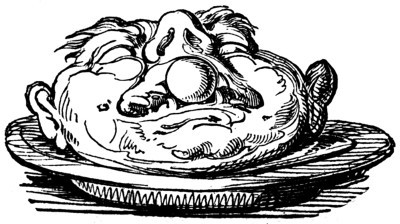
A Boor’s Head.
“Civil as an orange.”
Shakspeare.
There are some just observations on the old mode of passing this season, in “The World,” a periodical paper of literary pleasantries. “Our ancestors considered Christmas in the double light of a holy commemoration, and a cheerful festival, and accordingly distinguished it by devotion, by vacation from business, by merriment, and hospitality. They seemed eagerly bent to make themselves, and every one about them happy; with what punctual zeal did they wish one another a merry Christmas! and what an omission would it have been thought, to have concluded a letter without the compliments of the season! The great hall resounded with the tumultuous joys of servants and tenants, and the gambols they played served as amusement to the lord of the manor, and his family, who, by encouraging every art conducive to mirth and entertainment, endeavoured to soften the rigour of the season, and mitigate the influence of winter.”
The country squire of three hundred a year, an independent gentleman in the reign of queen Anne, is described as having “never played at cards but at Christmas, when the family pack was produced from the mantle-piece.” “His chief drink the year round was generally ale, except at this season, the 5th of November, or some other gala days, when he would make a bowl of strong brandy punch, garnished with a toast and nutmeg. In the corner of his hall, by the fire-side, stood a large wooden two-armed chair, with a cushion, and within the chimney corner were a couple of seats. Here, at Christmas, he entertained his tenants, assembled round a glowing fire, made of the roots of trees, and other great logs, and told and heard the traditionary tales of the village, respecting ghosts and witches, till fear made them afraid to move. In the meantime the jorum of ale was in continual circulation.”[424]
It is remarked, in the “Literary Pocket Book,” that now, Christmas-day only, or at most a day or two, are kept by people in general; the rest are school holidays; “But, formerly, there was nothing but a run of merry days from Christmas-eve to Candlemas, and the first twelve in particular were full of triumph and hospitality. We have seen but too well the cause of this degeneracy. What has saddened our summer-time has saddened our winter. What has taken us from our fields and May-flowers, and suffered them to smile and die alone, as if they were made for nothing else, has contradicted our flowing cups at Christmas. The middle classes make it a sorry business of a pudding or so extra, and a game at cards. The rich invite their friends to their country houses, but do little there but gossip and gamble; and the poor are either left out entirely, or presented with a few clothes and eatables that make up a wretched substitute for the long and hospitable intercourse of old. All this is so much the worse, inasmuch as christianity had a special eye to those feelings which should remind us of the equal rights of all; and the greatest beauty in it is not merely its charity, which we contrive to swallow up in faith, but its being alive to the sentiment of charity, which is still more opposed to these proud distances and formal dolings out.—The same spirit that vindicated the pouring of rich ointment on his feet, (because it was a homage paid to sentiment in his person,) knew how to bless the gift of a cup of water. Every face which you contribute to set sparkling at Christmas is a reflection of that goodness of nature which generosity helps to uncloud, as the windows reflect the lustre of the sunny heavens. Every holly bough and lump of berries with which you adorn your houses is a piece of natural piety as well as beauty, and will enable you to relish the green world of which you show yourselves not forgetful. Every wassail bowl which you set flowing without drunkenness, every harmless pleasure, every innocent mirth however mirthful, every forgetfulness even of serious things, when they are only swallowed up in the kindness and joy with which it is the end of wisdom to produce, is
‘Wisest, virtuousest, discreetest, best;’
and Milton’s Eve, who suggested those epithets to her husband, would have thought so too, if we are to judge by the poet’s account of her hospitality.”
ANCIENT CHRISTMAS.
And well our christian sires of old Loved, when the year its course had roll’d And brought blithe Christmas back again, With all its hospitable train. Domestic and religious rite Gave honour to the holy night: On Christmas-eve the bells were rung; On Christmas-eve the mass was sung; That only night, in all the year, Saw the stoled priest the chalice rear. The damsel donn’d her kirtle sheen; The hall was dress’d with holly green; Forth to the wood did merry men go, To gather in the misletoe. Then open wide the baron’s hall, To vassal, tenant, serf, and all; Power laid his rod of rule aside, And ceremony doff’d his pride. The heir, with roses in his shoes, That night might village partner choose: The lord, underogating, share The vulgar game of “post and pair.” All hailed, with uncontrouled delight, And general voice, the happy night, That to the cottage, as the crown, Brought tidings of salvation down. The fire, with well-dried logs supply’d, Went, roaring, up the chimney wide; The huge hall table’s oaken face, Scrubb’d till it shone, the day to grace, Bore then upon its massive board No mark to part the squire and lord. Then was brought in the lusty brawn, By old blue-coated serving man; Then the grim boar’s-head frown’d on high, Crested with bays and rosemary. Well can the green-garb’d ranger tell, How, when, and where the monster fell, What dogs before his death he tore, And all the baiting of the boar; While round the merry wassel bowl, Garnish’d with ribbons, blithe did trowl. There the huge sirloin reek’d; hard by Plum-porridge stood, and Christmas pie; Nor fail’d old Scotland to produce, At such high tide her savoury goose. Then came the merry maskers in, And carols roar’d with blithsome din; If unmelodious was the song, It was a hearty note and strong. Who lists may in their mumming see Traces of ancient mystery; White shirts supply the masquerade, And smutted cheeks the visor made; But, oh! what masquers, richly dight, Can boast of bosoms half so light! England was merry England when Old Christmas brought his sports again. ’Twas Christmas broach’d the mightiest ale; ’Twas Christmas told the merriest tale; A Christmas gambol oft would cheer A poor man’s heart through half the year.
Sir Walter Scott.
WAITS.
The musicians who play by night in the streets at Christmas are called waits. It has been presumed, that waits in very ancient times meant watchmen; they were minstrels at first attached to the king’s court, who sounded the watch every night, and paraded the streets during winter to prevent depredations.
In London, the waits are remains of the musicians attached to the corporation of the city under that denomination. They cheer the hours of the long nights before Christmas with instrumental music. To denote that they were “the lord mayor’s music,” they anciently wore a cognizance, or badge on the arm, similar to that represented in the engraving below, from a picture by A. Bloemart.
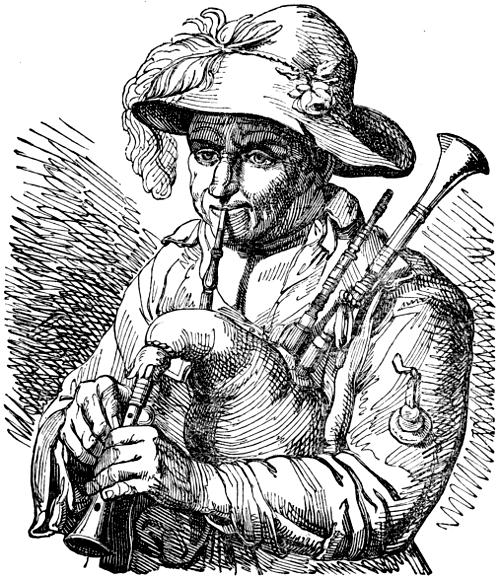
The Piper.
He blows his bagpipe soft or strong, Or high or low, to hymn or song, Or shrill lament, or solemn groan, Or dance, or reel, or sad o-hone! Or ballad gay, or well-a-day— To all he gives due melody.
Preparatory to Christmas, the bellman of every parish in London rings his bell at dead midnight, that his “worthy masters and mistresses” may listen, and be assured by his vocal intonation that he is reciting “a copy of verses” in praise of their several virtues, especially their liberality; and, when the festival is over, he calls with his bell, and hopes he shall be “remembered.”
At the good town of Bungay, in Suffolk, the “watch” of the year 1823 circulated the following, headed by a representation of a moiety of their dual body:—
A COPY OF CHRISTMAS VERSES,
PRESENTED TO THE
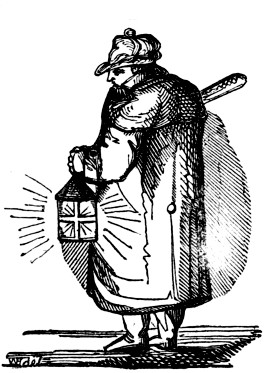
INHABITANTS OF BUNGAY,
BY THEIR HUMBLE SERVANTS,
THE LATE WATCHMEN
John Pye and John Tye.
YOUR pardon, Gentles, while we thus implore, In strains not less awakening than of yore, Those smiles we deem our best reward to catch, And for the which we’ve long been on the Watch; Well pleas’d if we that recompence obtain, Which we have ta’en so many steps to gain. Think of the perils in our calling past, The chilling coldness of the midnight blast, The beating rain, the swiftly-driving snow, The various ills that we must undergo, Who roam, the glow-worms of the human race, The living Jack-a-lanthorns of the place. ’Tis said by some, perchance, to mock our toil, That we are prone to “waste the midnight oil!” And that, a task thus idle to pursue, Would be an idle waste of money too! How hard, that we the dark designs should rue Of those who’d fain make light of all we do! But such the fate which oft doth merit greet, And which now drives us fairly off our beat! Thus it appears from this our dismal plight, That some love darkness, rather than the light. Henceforth let riot and disorder reign, With all the ills that follow in their train; Let Toms and Jerrys unmolested brawl, (No Charlies have they now to floor withal,) And “rogues and vagabonds” infest the Town, For cheaper ’tis to save than crack a crown! To brighter scenes we now direct our view— And first, fair Ladies, let us turn to you. May each New Year new joys, new pleasures bring, And Life for you be one delightful spring! No summer’s sun annoy with fev’rish rays, No winter chill the evening of your days! To you, kind Sirs, we next our tribute pay: May smiles and sunshine greet you on your way! If married, calm and peaceful be your lives; If single, may you forthwith get you wives! Thus, whether Male or Female, Old or Young, Or Wed or Single, be this burden sung: Long may you live to hear, and we to call, A Happy Christmas and New Year to all!
J. and R. Childs, Printers, Bungay.
Previous to Christmas 1825, a trio of foreign minstrels appeared in London, ushering the season with melody from instruments seldom performed on in the streets. These were Genoese with their guitars. Musicians of this order are common in Naples and all over Italy; at the carnival time they are fully employed, and at other periods are hired to assist in those serenades whereof English ladies hear nothing, unless they travel, save by the reports of those who publish accounts of their adventures. The three now spoken of took up their abode in London, at the King’s-head public-house, in Leather-lane, from whence ever and anon, to wit, daily, they sallied forth to “discourse most excellent music.” They are represented in the engraving below, from a sketch hastily taken by a gentleman who was of a dinner party, by whom they were called into the house of a street in the suburbs.
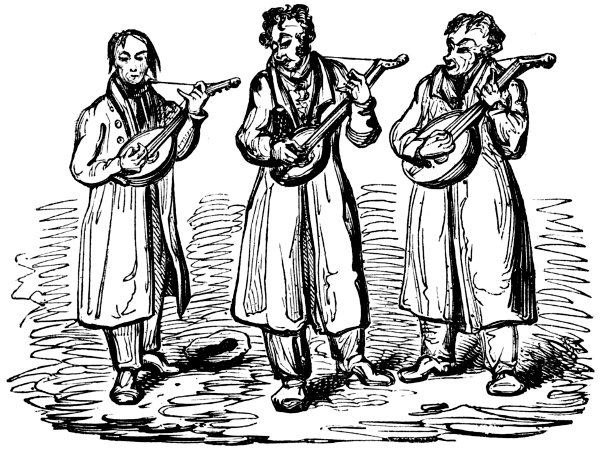
Italian Minstrels in London, AT CHRISTMAS, 1825.
Ranged in a row, with guitars slung Before them thus, they played and sung: Their instruments and choral voice Did each glad guest still more rejoice; And each guest wish’d again to hear Their wild guitars and voices clear.
There was much of character in the men themselves. One was tall, and had that kind of face which distinguishes the Italian character; his complexion a clear pale cream colour, with dark eyes, black hair, and a manner peculiarly solemn: the second was likewise tall, and of more cheerful feature; but the third was a short thick-set man, with an Oxberry countenance of rich waggery, heightened by large whiskers: this was the humorist. With a bit of cherry-tree held between the finger and thumb, they rapidly twirled the wires in accompaniment of various airs, which they sung with unusual feeling and skill. They were acquainted with every foreign tune that was called for. That Italian minstrels of this class should venture here for the purpose of perambulating our streets, is evidence that the refinement in our popular manners is known in the “land of song,” and they will bear testimony to it from the fact that their performances are chiefly in the public-houses of the metropolis, from whence thirty years ago such aspirants to entertain John Bull would have been expelled with expressions of abhorrence.
To the accounts of Christmas keeping in old times, old George Wither adds amusing particulars in rhime.
Christmas.
So now is come our joyfulst feast; Let every man be jolly; Each room with ivy leaves is drest, And every post with holly. Though some churls at our mirth repine, Round your foreheads garlands twine; Drown sorrow in a cup of wine, And let us all be merry. Now all our neighbours’ chimnies smoke, And Christmas blocks are burning; Their ovens they with baked meat choke, And all their spits are turning. Without the door let sorrow lye; And if for cold it hap to die, We’ll bury’t in a Christmas pie, And evermore be merry. Now every lad is wond’rous trim, And no man minds his labour; Our lasses have provided them A bagpipe and a tabor; Young men and maids, and girls and boys, Give life to one another’s joys; And you anon shall by their noise Perceive that they are merry. Rank misers now do sparing shun; Their hall of music soundeth; And dogs thence with whole shoulders run, So all things there aboundeth. The country folks, themselves advance, With crowdy-muttons out of France; And Jack shall pipe and Jyll shall dance, And all the town be merry. Ned Squash hath fetcht his bands from pawn, And all his best apparel; Brisk Nell hath bought a ruff of lawn With dropping of the barrel. And those that hardly all the year Had bread to eat, or rags to wear, Will have both clothes and dainty fare, And all the day be merry. Now poor men to the justices With capons make their errants; And if they hap to fail of these, They plague them with their warrants: But now they feed them with good cheer, And what they want, they take in beer, For Christmas comes but once a year, And then they shall be merry. Good farmers in the country nurse The poor, that else were undone; Some landlords spend their money worse, On lust and pride at London. There the roysters they do play, Drab and dice their lands away, Which may be ours another day, And therefore let’s be merry. The client now his suit forbears, The prisoner’s heart is eased; The debtor drinks away his cares, And for the time is pleased. Though others’ purses be more fat, Why should we pine, or grieve at that? Hang sorrow! care will kill a cat, And therefore let’s be merry. Hark! now the wags abroad do call, Each other forth to rambling; Anon you’ll see them in the hall, For nuts and apples scrambling. Hark! how the roofs with laughter sound, Anon they’ll think the house goes round, For they the cellar’s depth have found, And there they will be merry. The wenches with their wassel bowls About the streets are singing; The boys are come to catch the owls, The wild mare in it bringing. Our kitchen boy hath broke his box, And to the dealing of the ox, Our honest neighbours come by flocks, And here they will be merry. Now kings and queens poor sheepcotes have And mute with every body; The honest now may play the knave, And wise men play the noddy. Some youths will now a mumming go, Some others play at Rowland-bo, And twenty other game boys mo, Because they will be merry. Then, wherefore, in these merry daies, Should we, I pray, be duller? No, let us sing some roundelayes, To make our mirth the fuller. And, while we thus inspired sing, Let all the streets with echoes ring; Woods and hills, and every thing, Bear witness we are merry.
From Mr. Grant’s “Popular Superstitions of the Highlands,” we gather the following account:—
Highland Christmas.
As soon as the brightening glow of the eastern sky warns the anxious housemaid of the approach of Christmas-day, she rises full of anxiety at the prospect of her morning labours. The meal, which was steeped in the sowans-bowie a fortnight ago, to make the Prechdachdan sour, or sour scones, is the first object of her attention. The gridiron is put on the fire, and the sour scones are soon followed by hard cakes, soft cakes, buttered cakes, brandered bannocks, and pannich perm. The baking being once over, the sowans pot succeeds the gridiron, full of new sowans, which are to be given to the family, agreeably to custom, this day in their beds. The sowans are boiled into the consistence of molasses, when the Lagan-le-vrich, or yeast-bread, to distinguish it from boiled sowans, is ready. It is then poured into as many bickers as there are individuals to partake of it, and presently served to the whole, old and young. It would suit well the pen of a Burns, or the pencil of a Hogarth, to paint the scene which follows. The ambrosial food is despatched in aspiring draughts by the family, who soon give evident proofs of the enlivening effects of the Lagan-le-vrich. As soon as each despatches his bicker, he jumps out of bed—the elder branches to examine the ominous signs of the day,[425] and the younger to enter on its amusements. Flocking to the swing, a favourite amusement on this occasion, the youngest of the family get the first “shouder,” and the next oldest to him in regular succession. In order to add the more to the spirit of the exercise, it is a common practice with the person in the swing, and the person appointed to swing him, to enter into a very warm and humorous altercation. As the swinged person approaches the swinger, he exclaims, Ei mi tu chal, “I’ll eat your kail.” To this the swinger replies, with a violent shove, Cha ni u mu chal, “You shan’t eat my kail.” These threats and repulses are sometimes carried to such a height, as to break down or capsize the threatener, which generally puts an end to the quarrel.
As the day advances, those minor amusements are terminated at the report of the gun, or the rattle of the ball-clubs—the gun inviting the marksman to the “Kiavamuchd,” or prize-shooting, and the latter to “Luchd-vouil,” or the ball combatants—both the principal sports of the day. Tired at length of the active amusements of the field, they exchange them for the substantial entertainments of the table. Groaning under the “sonsy haggis,”[426] and many other savoury dainties, unseen for twelve months before, the relish communicated to the company, by the appearance of the festive board, is more easily conceived than described. The dinner once despatched, the flowing bowl succeeds, and the sparkling glass flies to and fro like a weaver’s shuttle. As it continues its rounds, the spirits of the company become the more jovial and happy. Animated by its cheering influence, even old decrepitude no longer feels his habitual pains—the fire of youth is in his eye, as he details to the company the exploits which distinguished him in the days of “auld langsyne;” while the young, with hearts inflamed with “love and glory,” long to mingle in the more lively scenes of mirth, to display their prowess and agility. Leaving the patriarchs to finish those professions of friendship for each other, in which they are so devoutly engaged, the younger part of the company will shape their course to the ball-room, or the card-table, as their individual inclinations suggest; and the remainder of the evening is spent with the greatest pleasure of which human nature is susceptible.
Evergreens at Christmas.
When Rosemary and Bays, the poet’s crown, Are bawl’d in frequent cries through all the town; Then judge the festival of Christmass near, Christmass, the joyous period of the year! Now with bright Holly all the temples strow, With Lawrel green, and sacred Misletoe. From ev’ry hedge is pluck’d by eager hands The Holly branch with prickly leaves replete, And fraught with berries of a crimson hue; Which, torn asunder from its parent trunk, Is straightway taken to the neighb’ring towns, Where windows, mantels, candlesticks, and shelves, Quarts, pints, decanters, pipkins, basins, jugs, And other articles of household ware, The verdant garb confess.
R. J. Thorn.
The old and pleasant custom of decking our houses and churches at Christmas with evergreens is derived from ancient heathen practices. Councils of the church forbad christians to deck their houses with bay leaves and green boughs at the same time with the pagans; but this was after the church had permitted such doings in order to accommodate its ceremonies to those of the old mythology. Where druidism had existed, “the houses were decked with evergreens in December, that the sylvan spirits might repair to them, and remain unnipped with frost and cold winds, until a milder season had renewed the foliage of their darling abodes.”[427]
Polydore Vergil says that, “Trimmyng of the Temples, with hangynges, floures, boughes, and garlondes, was taken of the heathen people, whiche decked their idols and houses with suche array.” In old church calendars Christmas-eve is marked “Templa exornantur.” Churches are decked.
The holly and the ivy still maintain some mastery at this season. At the two universities, the windows of the college chapels are decked with laurel. The old Christmas carol in MS. at the British Museum, quoted at p. 1598, continues in the following words:—
Ivy hath a lybe; she laghtit with the cold, So mot they all hafe that wyth Ivy hold. Nay, Ivy! Nay, hyt, &c. Holy hat berys as red as any Rose, The foster the hunters, kepe hem from the doo. Nay, Ivy! Nay, hyt, &c. Ivy hath berys as black as any slo; Ther com the oule and ete hym as she goo. Nay, Ivy! Nay, hyt, &c. Holy hath byrdys, aful fayre flok, The Nyghtyngale, the Poppyngy, the gayntyl Lavyrok. Nay, Ivy! Nay, hyt, &c. Good Ivy! what byrdys ast thou! Non but the howlet that kreye ‘How! How!’ Nay, Ivy! Nay, hyt shall not, &c.
Mr. Brand infers from this, “that holly was used only to deck the inside of houses at Christmas: while ivy was used not only as a vintner’s sign, but also among the evergreens at funerals.” He also cites from the old tract, “Round about our Coal-fire, or Christmas Entertainments,” that formerly “the rooms were embowered with holly, ivy, cyprus, bays, laurel, and misletoe, and a burning Christmas log in the chimney;” but he remarks, that “in this account the cyprus is quite a new article. Indeed I should as soon have expected to have seen the yew as the cypress used on this joyful occasion.”
Mr. Brand is of opinion that “although Gay mentions the misletoe among those evergreens that were put up in churches, it never entered those sacred edifices but by mistake, or ignorance of the sextons; for it was the heathenish and profane plant, as having been of such distinction in the pagan rites of druidism, and it therefore had its place assigned it in kitchens, where it was hung up in great state with its white berries, and whatever female chanced to stand under it, the young man present either had a right or claimed one of saluting her, and of plucking off a berry at each kiss.” He adds “I have made many diligent inquiries after the truth of this. I learnt at Bath that it never came into churches there. An old sexton at Teddington, in Middlesex, informed me that some misletoe was once put up in the church there, but was by the clergyman immediately ordered to be taken away.” He quotes from the “Medallic History of Carausius,” by Stukeley, who speaking of the winter solstice, our Christmas, says: “This was the most respectable festival of our druids called yule-tide; when misletoe, which they called all-heal, was carried in their hands and laid on their altars, as an emblem of the salutiferous advent of Messiah. The misletoe they cut off the trees with their upright hatchets of brass, called celts, put upon the ends of their staffs, which they carried in their hands. Innumerable are these instruments found all over the British Isles. The custom is still preserved in the north, and was lately at York. On the eve of Christmas-day they carry misletoe to the high altar of the cathedral and proclaim a public and universal liberty, pardon, and freedom to all sorts of inferior and even wicked people at the gates of the city towards the four quarters of heaven.” This is only a century ago.
In an “Inquiry into the ancient Greek Game, supposed to have been invented by Palamedes,” Mr. Christie speaks of the respect the northern nations entertained for the mistletoe, and of the Celts and Goths being distinct in the instance of their equally venerating the misletoe about the time of the year when the sun approached the winter solstice. He adds, “we find by the allusion of Virgil, who compared the golden bough in infernis, to the misletoe, that the use of this plant was not unknown in the religious ceremonies of the ancients, particularly the Greeks, of whose poets he was the acknowledged imitator.”
The cutting of the misletoe was a ceremony of great solemnity with our ancient ancestors. The people went in procession. The bards walked first singing canticles and hymns, a herald preceded three druids with implements for the purpose. Then followed the prince of the druids accompanied by all the people. He mounted the oak, and cutting the misletoe with a golden sickle, presented it to the other druids, who received it with great respect, and on the first day of the year distributed it among the people as a sacred and holy plant, crying, “The misletoe for the new year.” Mr. Archdeacon Nares mentions, “the custom longest preserved was the hanging up of a bush of misletoe in the kitchen or servant’s hall, with the charm attached to it, that the maid, who was not kissed under it at Christmas, would not be married in that year.” This natural superstition still prevails.
Christmas Doughs, Pies, and Porridge.
The season offers its
————— customary treat, A mixture strange of suet, currants, meat, Where various tastes combine.
Oxford Sausage.
Yule-dough, or dow, a kind of baby, or little image of paste, was formerly baked at Christmas, and presented by bakers to their customers, “in the same manner as the chandlers gave Christmas candles.” They are called yule cakes in the county of Durham. Anciently, “at Rome, on the vigil of the nativity, sweetmeats were presented to the fathers in the Vatican, and all kinds of little images (no doubt of paste) were to be found at the confectioners’ shops.” Mr. Brand, who mentions these usages, thinks, “there is the greatest probability that we have had from hence both our yule-doughs, plum-porridge, and mince-pies, the latter of which are still in common use at this season. The yule-dough has perhaps been intended for an image of the child Jesus, with the Virgin Mary:” he adds, “it is now, if I mistake not, pretty generally laid aside, or at most retained only by children.”
It is inquired by a writer in the “Gentleman’s Magazine,” 1783, “may not the minced pye, a compound of the choicest productions of the east, have in view the offerings made by the wise men, who came from afar to worship, bringing spices,” &c. These were also called shrid-pies.
Christmasse Day.
No matter for plomb-porridge, or shrid-pie Or a whole oxe offered in sacrifice To Comus, not to Christ, &c.
Sheppard’s Epigrams, 1651.
Mr. Brand, from a tract in his library printed about the time of queen Elizabeth or James I. observes, that they were likewise called “minched pies.”
According to Selden’s “Table Talk,” the coffin shape of our Christmas pies, is in imitation of the cratch, or manger wherein the infant Jesus was laid. The ingredients and shape of the Christmas pie is mentioned in a satire of 1656, against the puritans:—
Christ-mass? give me my beads: the word implies A plot, by its ingredients, beef and pyes. The cloyster’d steaks with salt and pepper lye Like Nunnes with patches in a monastrie. Prophaneness in a conclave? Nay, much more, Idolatrie in crust!———— ———— and bak’d by hanches, then Serv’d up in coffins to unholy men; Defil’d, with superstition, like the Gentiles Of old, that worship’d onions, roots, and lentiles!
R. Fletcher.
There is a further account in Misson’s “Travels in England.” He says, “Every family against Christmass makes a famous pye, which they call Christmas pye. It is a great nostrum; the composition of this pasty is a most learned mixture of neat’s-tongues, chicken, eggs, sugar, raisins, lemon and orange peel, various kinds of spicery,” &c. The most notably familiar poet of our seasonable customs interests himself for its safety:—
Come guard this night the Christmas-pie That the thiefe, though ne’r so slie, With his flesh hooks don’t come nie To catch it; From him, who all alone sits there, Having his eyes still in his eare, And a deale of nightly feare To watch it.
Herrick.
Mr. Brand observes, of his own knowledge, that “in the north of England, a goose is always the chief ingredient in the composition of a Christmas pye;” and to illustrate the usage, “further north,” he quotes, that the Scottish poet Allan Ramsay, in his “Elegy on lucky Wood,” tells us, that among other baits by which the good ale-wife drew customers to her house, she never failed to tempt them at Yule (Christmas,) with
“A bra’ Goose Pye.”
Further, from “Round about our Coal-fire,” we likewise find that “An English gentleman at the opening of the great day, i. e. on Christmass day in the morning, had all his tenants and neighbours enter his hall by day-break. The strong beer was broached, and the black jacks went plentifully about with toast, sugar, nutmegg, and good Cheshire cheese. The hackin (the great sausage) must be boiled by day-break, or else two young men must take the maiden (i. e.) the cook, by the arms and run her round the market-place till she is ashamed of her laziness.
“In Christmas holidays, the tables were all spread from the first to the last; the sirloins of beef, the minced pies, the plumb porridge, the capons, turkeys, geese, and plum-puddings, were all brought upon the board: every one eat heartily, and was welcome, which gave rise to the proverb, ‘merry in the hall when beards wag all.’”
Misson adds of our predecessors in his time, that besides the “famous pye” at Christmas, “they also make a sort of soup with plums which is not at all inferior to the pye, which is in their language called plum-porridge.”
Lastly, Mr. Brand makes this important note from personal regard. “Memorandum. I dined at the chaplain’s table at St. James’s on Christmas-day, 1801, and partook of the first thing served and eaten on that festival at that table, i. e. a tureen full of rich luscious plum-porridge. I do not know that the custom is any where else retained.”
Thus has been brought together so much as, for the present, seems sufficient to describe the ancient and present estimation and mode of keeping Christmas.
FLORAL DIRECTORY.
Holly. Ilex bacciflora. Dedicated to the Nativity of Jesus Christ.
It ought not, however, to be forgotten, that a scene of awful grandeur, hitherto misrepresented on the stage by the meanest of “his majesty’s servants,” opens the tragedy of Hamlet, wherein our everlasting bard refers to ancient and still existing tradition, that at the time of cock-crowing, the midnight spirits forsake these lower regions, and go to their proper places; and that the cocks crow throughout the live-long nights of Christmas—a circumstance observable at no other time of the year. Horatio, the friend of Hamlet, discourses at midnight with Francisco, a sentry on the platform before the Danish palace, and Bernardo and Marcellus, two officers of the guard, respecting the ghost of the deceased monarch of Denmark, which had appeared to the military on watch.
Mar. Horatio says, ’tis but our fantasy, And will not let belief take hold of him, Touching this dreaded sight, twice seen of us; Therefore I have entreated him, along With us, to watch the minutes of this night; That, if again this apparition come, He may approve our eyes, and speak to it. Hor. Tush! tush! ’twill not appear. Ber. Sit down awhile; And let us once again assail your ears, That are so fortified against our story, What we two nights have seen. ———— Last night of all, When yon same star, that’s westward from the pole, Had made his course to illume that part of heaven Where now it burns, Marcellus and myself, The bell then beating one,——— Mar. Peace, break thee off; look, where it comes again!
The ghost enters. Horatio is harrowed with fear and wonder. His companions urge him to address it; and somewhat recovered from astonishment, he urges “the majesty of bury’d Denmark” to speak. It is offended, and stalks away.
Mar. Thus, twice before, and just at this dead hour, With martial stalk he hath gone by our watch.
Horatio discourses with his companions on the disturbed state of the kingdom, and the appearance they have just witnessed; whereof he says, “a mote it is, to trouble the mind’s eye.” He is interrupted by its re-entry, and invokes it, but the apparition remains speechless; the “cock crows,” and the ghost is about to disappear, when Horatio says,
———Stay, and speak.—Stop it, Marcellus. Mar. Shall I strike at it with my partizan? Hor. Do, if it will not stand. Ber. ’Tis here! Hor. ’Tis here! Mar. ’Tis gone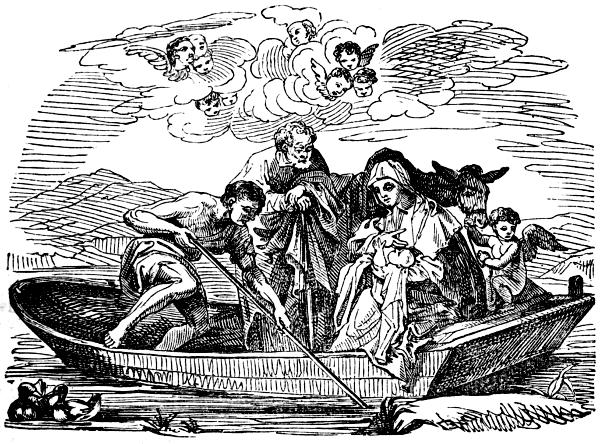
The Flight of the Holy Family.
From Herod’s cruel order they, By angel’s order, fled away, And painters add, an angel, too, Attended them the journey through.
The old artists often painted the flight of the holy family from Herod’s cruel purpose:—“Behold the angel of the lord appeared to Joseph in a dream, saying, Arise, and take the young child and his mother, and flee into Egypt, and be thou there until I bring thee word: for Herod will seek the young child to destroy him. When he arose he took the young child and his mother by night, and departed into Egypt, and was there until the death of Herod.”[437] In some pictures an angel is painted accompanying them on the way, although on no scriptural authority. In a painting by “Lucca Giordano” they are represented in a boat with the ass, whereon the virgin had rode, held by an angel, who is thus degraded to the condition of a stable boy; while cherubs company them in the sky: the picture being curious, an engraving from it is placed in this article.
Lucca Giordano.
The artist of the picture mentioned was born at Naples, about 1629: he studied under Spagnoletto, and afterwards under Pietra da Cortona. He is likewise called Luca fa Presto, from a phrase used by his father. Though his son painted with amazing facility, from designs of the great masters, while he pursued his studies, and the old man sold them for high prices, yet he was accustomed to hurry his son at his meals as well as his work, and say, “Luca fa presto!” Luca, make haste: hence, Luca’s companions nicknamed him Fa Presto. His knowledge of the style of artists belonging to different schools was amazing, and though his attainments in judgment and execution were of high order, he seems to have preferred the copying of other compositions to painting designs by himself. Hence, there are more pictures by Luca fa Presto than some connoisseurs would willingly acknowledge. They pervade every collection under the reputation of being by Titian, Guido, Tintorette, and other painters of greater celebrity than Giordano. He etched his own thoughts freely and gracefully, and died loaded with honours from crowned heads, and immensely rich, in 1704.
FLORAL DIRECTORY.
Bloody Heath. Erica cruenta. Dedicated to the Holy Innocents.
December 29.
St. Thomas, Abp. of Canterbury, A. D. 1170. St. Marcellus, Abbot of the Acæmetes, A. D. 485. St. Evroul, Abbot, A. D. 596.