JUNE. (continued 3)
Reading edition
Pulpits.
Without descanting at this time on the manifold construction of the pulpit, it may be allowable, perhaps, to observe, that the ambo, or first pulpit, was an elevation consisting of two flights of stairs; on the higher was read the gospel, on the lower the epistle. The pulpit of the present day is that fixture in the church, or place of worship, occupied by the minister while he delivers his sermon. Thus much is observed for the present, in consequence of the mention of the Oxford pulpit; and for the purpose of introducing the representation of a remarkably beautiful structure of this kind, from a fine engraving by Fessard in 1710.
This pulpit is larger than the pulpit of the church of England, and the other Protestant pulpits in our own country. It is a pulpit of the Romish church with a bishop preaching to a congregation of high rank. It is customary for a Roman Catholic prelate to have the ensigns of his prelacy displayed in the pulpit, and hence they are so exhibited in Fessard’s print. This, however, is by no means so large as other pulpits in Romish churches, which are of increased magnitude for the purpose of congregating the clergy, when their occupations at the altar have ceased, before the eye of the congregation; and hence it is common for many of them to sit robed, by the side of the preacher, during the sermon.
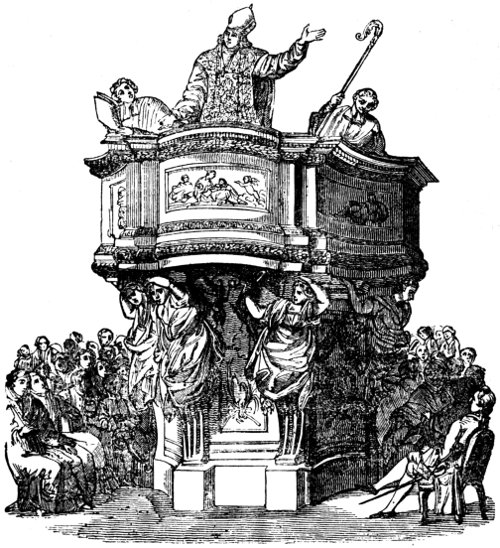
French Pulpit FROM A FINE ENGRAVING.
An English lady visiting France, who had been mightily impressed by the rites of the Roman Catholic religion, revived there since the restoration of the Bourbons, was induced to attend the Protestant worship, at the chapel of the British ambassador. She says “the splendour of the Romish service, the superb dresses, the chanting, accompanied by beautiful music, the lights, and the other ceremonies, completely overpowered my mind; at last on the Sunday before I left Paris I went to our ambassador’s chapel, just to say that I had been. There was none of the pomp I had been so lately delighted with; the prevailing character of the worship was simplicity; the minister who delivered the sermon was only sufficiently elevated to be seen by the auditors; he preached to a silent and attentive congregation, whose senses had not been previously affected; his discourse was earnest, persuasive, and convincing. I began to perceive the difference between appeals to the feelings and to the understanding, and I came home a better Protestant and I hope a better Christian than when I left England.”
Quarter-day.
For the Every-Day Book.
This is quarter-day!—what a variety of thought and feeling it calls up in the minds of thousands in this great metropolis. How many changes of abode, voluntary and involuntary, for the better and for the worse, are now destined to take place! There is the charm of novelty at least; and when the mind is disposed to be pleased, as it is when the will leads, it inclines to extract gratification from the anticipation of advantages, rather than to be disturbed by any latent doubts which time may or may not realize.
Perhaps the removal is to a house of decidedly superior class to the present; and if this step is the consequence of augmented resources, it is the first indication to the world of the happy circumstance. Here, then, is an additional ground of pleasure, not very heroic indeed, but perfectly natural. Experience may have shown us that mere progression in life is not always connected with progression in happiness; and therefore, though we may smile at the simplicity which connects them in idea, yet our recollection of times past, when we ourselves indulged the delusion, precludes us from expressing feelings that we have acquired by experience. The pleasure, if from a shallow source, is at least a present benefit, and a sort of counterpoise to vexations from imaginary causes. It does not seem agreeable to contemplate retrogression; to behold a family descending from their wonted sphere, and becoming the inmates of a humbler dwelling; yet, they who have had the resolution, I may almost say the magnanimity, voluntarily to descend, may reasonably be expected again to rise. They have given proof of the possession of one quality indispensable in such an attempt—that mental decision, by which they have achieved a task, difficult, painful, and to many, impracticable. They have shown, too, their ability to form a correct estimate of the value of the world’s opinion, so far as it is influenced by external appearances, and boldly disregarding its terrors, have wisely resolved to let go that which could not be much longer held. By this determination, besides rescuing themselves from a variety of perpetually recurring embarrassments and annoyances, they have suppressed half the sneers which the malicious had in store for them, had their decline reached its expected crisis, while they have secured the approbation and kind wishes of all the good and considerate. The consciousness of this consoles them for what is past, contents them with the present, and animates their hopes for the future.
Now, let us shift the scene a little, and look at quarter-day under another aspect. On this day some may quit, some may remain; all must pay—that can! Alas, that there should be some unable! I pass over the rich, whether landlord or tenant; the effects of quarter-day to them are sufficiently obvious: they feel little or no sensation on its approach or arrival, and when it is over, they feel no alteration in their accustomed necessaries and luxuries. Not so with the poor man; I mean the man who, in whatever station, feels his growing inability to meet the demands periodically and continually making on him. What a day quarter-day is to him! He sees its approach from a distance, tries to be prepared, counts his expected means of being so, finds them short of even his not very sanguine expectations, counts again, but can make no more of them; and while day after day elapses, sees his little stock diminishing. What shall he do? He perhaps knows his landlord to be inexorable; how then shall he satisfy him? Shall he borrow? Alas, of whom? Where dwell the practicers of this precept—“From him that would borrow of thee turn thou not away?” Most of the professors of the religion which enjoins this precept, construe it differently. What shall he do? something must be soon decided on. He sits down to consider. He looks about his neatly-furnished house or apartments, to see what out of his humble possessions, he can convert into money. The faithful wife of his bosom becomes of his council. There is nothing they have, which they did not purchase for some particular, and as they then thought, necessary purpose; how, then, can they spare any thing? they ruminate; they repeat the names of the various articles, they fix on nothing—there is nothing they can part with. They are about so to decide; but their recollection that external resources are now all dried up, obliges them to resume their task, and resolutely determine to do without something, however painful may be the sacrifice. Could we hear the reasons which persons thus situated assign, why this or that article should by no means be parted with, we should be enabled, in some degree, to appreciate their conflicts, and the heart-aches which precede and accompany them. In such inventories much jewellery, diamond rings, or valuable trinkets, are not to be expected. The few that there may be, are probably tokens of affection, either from some deceased relative or dear friend; or not less likely from the husband to the wife, given at their union—“when life and hope were new”—when their minds were so full of felicity, that no room was left for doubts as to its permanence; when every future scene appeared to their glowing imaginations dressed in beauty; when every scheme projected, appeared already crowned with success; when the possibility of contingencies frustrating judicious endeavours, either did not present itself to the mind, or presenting itself, was dismissed as an unwelcome guest, “not having on the wedding garment.” At such a time were those tokens presented, and they are now produced. They serve to recall moments of bliss unalloyed by cares, since become familiar. They were once valued as pledges of affection, and now, when that affection endures in full force and tenderness, they wish that those pledges had no other value than affection confers on them, that so there might be no temptation to sacrifice them to a cruel necessity. Let us, however, suppose some of them selected for disposal, and the money raised to meet the portentous day. Our troubled fellow-creatures breathe again, all dread is for the present banished; joy, temporary, but oh! how sweet after such bitterness, is diffused through their hearts, and gratitude to Providence for tranquillity, even by such means restored, is a pervading feeling. It is, perhaps, prudent at this juncture to leave them, rather than follow on to the end of the next quarter. It may be that, by superior prudence or some unexpected supply, a repetition of the same evil, or the occurrence of a greater is avoided; yet, we all know that evils of the kind in question, are too frequently followed by worse. If a family, owing to the operation of some common cause, such as a rise in the price of provisions, or a partial diminution of income from the depression of business, become embarrassed and with difficulty enabled to pay their rent; the addition of a fit of sickness, the unexpected failure of a debtor, or any other contingency of the sort, (assistance from without not being afforded,) prevents them altogether. The case is then desperate. The power which the law thus permits a landlord to exercise, is one of fearful magnitude, and is certainly admirably calculated to discover the stuff he is made of. Yet, strange as it seems, this power is often enforced in all its rigour, and the merciless enforcers lose not, apparently, a jot of reputation, nor forfeit the esteem of their intimates: so much does familiarity with an oppressive action deaden the perception of its real nature, and so apt are we to forget that owing to the imperfection of human institutions, an action may be legal and cruel at the same time! The common phrase, “So and so have had their goods seized for rent,” often uttered with indifference and heard without emotion, is a phrase pregnant with meaning of the direst import. It means that they—wife, children, and all—who last night sat in a decent room, surrounded by their own furniture, have now not a chair of their own to sit on; that they, who last night could retire to a comfortable bed, after the fatigues and anxieties of the day, have tonight not a bed to lie on—or none but what the doubtful ability or humanity of strangers or relations may supply: it means that sighs and tears are produced, where once smiles and tranquillity existed; or, perhaps, that long cherished hopes of surmounting difficulties, have by one blow been utterly destroyed,—that the stock of expedients long becoming threadbare, is at last quite worn out, and all past efforts rendered of no avail, though some for a time seemed likely to be available. It means that the hollowness of professed friends has been made manifest; that the busy tongue of detraction has found employment; that malice is rejoicing; envy is at a feast; and that the viands are the afflictions of the desolate. Landlord! ponder on these consequences ere you distrain for rent, and let your heart, rather than the law, be the guide of your conduct. The additional money you may receive by distraining may, indeed, add something to the luxuries of your table, but it can hardly fail to diminish your relish. You may, perhaps, by adopting the harsh proceeding, add down to your pillow, but trust not that your sleep will be tranquil or your dreams pleasant. Above all remember the benediction—“Blessed are the merciful, for they shall obtain mercy;” and inspired with the sentiment, and reflecting on the fluctuations which are every day occurring, the poor and humble raised, and the wealthy and apparently secure brought down, you will need no other incitement to fulfil the golden rule of your religion—“Do unto others as ye would they should do unto you.”
Sigma.
Concerning the Feast of St. John the Baptist, an author, to whom we are obliged for recollections of preceding customs, gives us information that should be carefully perused in the old versified version:—
Then doth the joyfull feast of John the Baptist take his turne, When bonfiers great, with loftie flame, in every towne doe burne; And yong men round about with maides, doe daunce in every streete, With garlands wrought of Motherwort, or else with Vervain sweete, And many other flowres faire, with Violets in their handes, Whereas they all do fondly thinke, that whosoever standes, And thorow the flowres beholds the flame, his eyes shall feel no paine. When thus till night they daunced have, they through the fire amaine, With striving mindes doe runne, and all their hearbes they cast therein, And then with wordes devout and prayers they solemnely begin, Desiring God that all their ills may there consumed bee; Whereby they thinke through all that yeare from agues to be free. Some others get a rotten Wheele, all worne and cast aside, Which covered round about with strawe and tow, they closely hide: And caryed to some mountaines top, being all with fire light, They hurle it downe with violence, when darke appears the night: Resembling much the sunne, that from the Heavens down should fal, A strange and monstrous sight it seemes, and fearefull to them all: But they suppose their mischiefes all are likewise throwne to hell, And that from harmes and daungers now, in safetie here they dwell.[186]
A very ancient “Homily” relates other particulars and superstitions relating to the bonfires on this day:—
“In worshyp of Saint Johan the people waked at home, and made three maner of fyres: one was clene bones, and noo woode, and that is called a bone fyre; another is clene woode, and no bones, and that is called a wood fyre, for people to sit and wake thereby; the thirde is made of wode and bones, and it is callyd Saynt Johannys fyre. The first fyre, as a great clerke, Johan Belleth, telleth, he was in a certayne countrey, so in the countrey there was so soo greate hete, the which causid that dragons to go togyther in tokenynge, that Johan dyed in brennynge love and charyte to God and man, and they that dye in charyte shall have part of all good prayers, and they that do not, shall never be saved. Then as these dragons flewe in th’ ayre they shed down to that water froth of ther kynde, and so envenymed the waters, and caused moche people for to take theyr deth thereby, and many dyverse sykenesse. Wyse clerkes knoweth well that dragons hate nothyng more than the stenche of brennynge bones, and therefore they gaderyd as many as they mighte fynde, and brent them; and so with the stenche thereof they drove away the dragons, and so they were brought out of greete dysease. The seconde fyre was made of woode, for that wyll brenne lyght, and wyll be seen farre. For it is the chefe of fyre to be seen farre, and betokennynge that Saynt Johan was a lanterne of lyght to the people. Also the people made blases of fyre for that they shulde be seene farre, and specyally in the nyght, in token of St. Johan’s having been seen from far in the spirit by Jeremiah. The third fyre of bones betokenneth Johan’s martyrdome, for hys bones were brente.”—Brand calls this “a pleasant absurdity;” the justice of the denomination can hardly be disputed.
Gebelin observes of these fires, that “they were kindled about midnight on the very moment of the summer solstice, by the greatest part as well of the ancient as of modern nations; and that this fire-lighting was a religious ceremony of the most remote antiquity, which was observed for the prosperity of states and people, and to dispel every kind of evil.” He then proceeds to remark, that “the origin of this fire, which is still retained by so many nations, though enveloped in the mist of antiquity, is very simple: it was a feu de joie, kindled the very moment the year began; for the first of all years, and the most ancient that we know of, began at this month of June. Thence the very name of this month, junior, the youngest, which is renewed; while that of the preceding one is May, major, the ancient. Thus the one was the month of young people, while the other belonged to old men. These feux de joie were accompanied at the same time with vows and sacrifices for the prosperity of the people and the fruits of the earth. They danced also round this fire; for what feast is there without a dance? and the most active leaped over it. Each on departing took away a fire-brand, great or small, and the remains were scattered to the wind, which, at the same time that it dispersed the ashes, was thought to expel every evil. When, after a long train of years, the year ceased to commence at this solstice, still the custom of making these fires at this time was continued by force of habit, and of those superstitious ideas that are annexed to it.” So far remarks Gebelin concerning the universality of the practice.
Bourne, a chronicler of old customs, says, “that men and women were accustomed to gather together in the evening by the sea side, or in some certain houses, and there adorn a girl, who was her parent’s first begotten child, after the manner of a bride. Then they feasted, and leaped after the manner of bacchanals, and danced and shouted as they were wont to do on their holidays; after this they poured into a narrow-necked vessel some of the sea water, and put also into it certain things belonging to each of them; then, as if the devil gifted the girl with the faculty of telling future things, they would inquire with a loud voice about the good or evil fortune that should attend them: upon this the girl would take out of the vessel the first thing that came to hand, and show it, and give it to the owner, who, upon receiving it, was so foolish as to imagine himself wiser as to the good or evil fortune that should attend him.” “In Cornwall, particularly,” says Borlase, “the people went with lighted torches, tarred and pitched at the end, and made their perambulations round their fires.” They went “from village to village, carrying their torches before them, and this is certainly the remains of the Druid superstition.”
And so in Ireland, according to sir Henry Piers, in Vallancey, “on the eves of St. John the baptist and St. Peter, they always have in every town a bonfire late in the evenings, and carry about bundles of reeds fast tied and fired; these being dry, will last long, and flame better than a torch, and be a pleasing divertive prospect to the distant beholder; a stranger would go near to imagine the whole country was on fire.” Brand cites further, from “The Survey of the South of Ireland,” that—“It is not strange that many Druid remains should still exist; but it is a little extraordinary that some of their customs should still be practised. They annually renew the sacrifices that used to be offered to Apollo, without knowing it. On Midsummer’s eve, every eminence, near which is a habitation, blazes with bonfires; and round these they carry numerous torches, shouting and dancing, which affords a beautiful sight. Though historians had not given us the mythology of the pagan Irish, and though they had not told us expressly that they worshipped Beal, or Bealin, and that this Beal was the sun, and their chief god, it might, nevertheless, be investigated from this custom, which the lapse of so many centuries has not been able to wear away.” Brand goes on to quote from the “Gentleman’s Magazine,” for February 1795, “The Irish have ever been worshippers of fire and of Baal, and are so to this day. This is owing to the Roman Catholics, who have artfully yielded to the superstitions of the natives, in order to gain and keep up an establishment, grafting christianity upon pagan rites. The chief festival in honour of the sun and fire is upon the 21st of June, when the sun arrives at the summer solstice, or rather begins its retrograde motion. I was so fortunate in the summer of 1782, as to have my curiosity gratified by a sight of this ceremony to a very great extent of country. At the house where I was entertained, it was told me that we should see at midnight the most singular sight in Ireland, which was the lighting of fires in honour of the sun. Accordingly, exactly at midnight, the fires began to appear: and taking the advantage of going up to the leads of the house, which had a widely extended view, I saw on a radius of thirty miles, all around, the fires burning on every eminence which the country afforded. I had a farther satisfaction in learning, from undoubted authority, that the people danced round the fires, and at the close went through these fires, and made their sons and daughters, together with their cattle, pass the fire; and the whole was conducted with religious solemnity.”
Mr. Brand notices, that Mr. Douce has a curious French print, entitled “L’este le Feu de la St. Jean;” Mariette ex. In the centre is the fire made of wood piled up very regularly, and having a tree stuck in the midst of it. Young men and women are represented dancing round it hand in hand. Herbs are stuck in their hats and caps, and garlands of the same surround their waists, or are slung across their shoulders. A boy is represented carrying a large bough of a tree. Several spectators are looking on. The following lines are at the bottom:—
“Que de Feux brulans dans les airs! Qu’ils font une douce harmonie! Redoublons cette mélodie Par nos dances, par nos concerts!”
This “curious French print,” furnished the engraving at page 823, or to speak more correctly, it was executed from one in the possession of the editor of the Every-Day Book.
To enliven the subject a little, we may recur to recent or existing usages at this period of the year. It may be stated then on the authority of Mr. Brand’s collections, that the Eton scholars formerly had bonfires on St. John’s day; that bonfires are still made on Midsummer eve in several villages of Gloucester, and also in the northern parts of England and in Wales; to which Mr. Brand adds, that there was one formerly at Whiteborough, a tumulus on St. Stephen’s down near Launceston, in Cornwall. A large summer pole was fixed in the centre, round which the fuel was heaped up. It had a large bush on the top of it. Round this were parties of wrestlers contending for small prizes. An honest countryman, who had often been present at these merriments, informed Mr. Brand, that at one of them an evil spirit had appeared in the shape of a black dog, since which none could wrestle, even in jest, without receiving hurt: in consequence of which the wrestling was, in a great measure, laid aside. The rustics there believe that giants are buried in these tumuli, and nothing would tempt them to be so sacrilegious as to disturb their bones.
In Northumberland, it is customary on this day to dress out stools with a cushion of flowers. A layer of clay is placed on the stool, and therein is stuck, with great regularity, an arrangement of all kinds of flowers, so close as to form a beautiful cushion. These are exhibited at the doors of houses in the villages, and at the ends of streets and cross-lanes of larger towns, where the attendants beg money from passengers, to enable them to have an evening feast and dancing.[187]
One of the “Cheap Repository Tracts,” entitled, “Tawney Rachel, or the Fortune-Teller,” said to have been written by Miss Hannah More, relates, among other superstitious practices of Sally Evans, that “she would never go to bed on Midsummer eve, without sticking up in her room the well-known plant called Midsummer Men, as the bending of the leaves to the right, or to the left, would never fail to tell her whether her lover was true or false.” The Midsummer Men were the orpyne plants, which Mr. Brand says is thus elegantly alluded to in the “Cottage Girl,” a poem “written on Midsummer eve, 1786:”—
“The rustic maid invokes her swain; And hails, to pensive damsels dear, This eve, though direst of the year. * * * * * “Oft on the shrub she casts her eye, That spoke her true-love’s secret sigh; Or else, alas! too plainly told Her true-love’s faithless heart was cold.”
In the “Connoisseur,” there is mention of divinations on Midsummer eve. “I and my two sisters tried the dumb-cake together: you must know, two must make it, two bake it, two break it, and the third put it under each of their pillows, (but you must not speak a word all the time), and then you will dream of the man you are to have. This we did: and to be sure I did nothing all night but dream of Mr. Blossom. The same night, exactly at twelve o’clock, I sowed hemp-seed in our back-yard, and said to myself,—‘Hemp-seed I sow, hemp-seed I hoe, and he that is my true-love come after me and mow.’ Will you believe me? I looked back, and saw him behind me, as plain as eyes could see him. After that, I took a clean shift and wetted it, and turned it wrong-side out, and hung it to the fire upon the back of a chair; and very likely my sweetheart would have come and turned it right again, (for I heard his step) but I was frightened, and could not help speaking, which broke the charm. I likewise stuck up two Midsummer Men, one for myself and one for him. Now if his had died away, we should never have come together, but I assure you his blowed and turned to mine. Our maid Betty tells me, that if I go backwards, without speaking a word, into the garden upon Midsummer eve, and gather a rose, and keep it in a clean sheet of paper, without looking at it till Christmas-day, it will be as fresh as in June; and if I then stick it in my bosom, he that is to be my husband will come and take it out. My own sister Hetty, who died just before Christmas, stood in the church porch last Midsummer eve, to see all that were to die that year in our parish; and she saw her own apparition.”
Gay, in one of his pastorals, says—
At eve last Midsummer no sleep I sought, But to the field a bag of hemp-seed brought: I scattered round the seed on every side, And three times, in a trembling accent cried:— “This hemp-seed with my virgin hand I sow, Who shall my true love be, the crop shall mow.” I straight looked back, and, if my eyes speak truth, With his keen scythe behind me came the youth.
It is also a popular superstition that any unmarried woman fasting on Midsummer eve, and at midnight laying a clean cloth, with bread, cheese, and ale, and sitting down as if going to eat, the street-door being left open, the person whom she is afterwards to marry will come into the room and drink to her by bowing; and after filling the glass will leave it on the table, and, making another bow, retire.[188]
So also the ignorant believe that any person fasting on Midsummer eve, and sitting in the church porch, will, at midnight, see the spirits of the persons of that parish who will die that year, come and knock at the church door, in the order and succession in which they will die.
In the “Cottage Girl,” before referred to, the gathering the rose on Midsummer eve and wearing it, is noticed as one of the modes by which a lass seeks to divine the sincerity of her suitor’s vows:—
The moss-rose that, at fall of dew, (Ere Eve its duskier curtain drew,) Was freshly gather’d from its stem, She values as the ruby gem; And, guarded from the piercing air, With all an anxious lover’s care, She bids it, for her shepherd’s sake, Await the new-year’s frolic wake— When, faded, in its alter’d hue She reads—the rustic is untrue! But, if it leaves the crimson paint, Her sick’ning hopes no longer faint. The rose upon her bosom worn, She meets him at the peep of morn; And lo! her lips with kisses prest, He plucks it from her panting breast.
In “Time’s Telescope,” there is cited the following literal version of a beautiful ballad which has been sung for many centuries by the maidens, on the banks of the Guadalquivir in Spain, when they go forth to gather flowers on the morning of the festival of St John the baptist:—
Spanish Ballad.
Come forth, come forth, my maidens, ’tis the day of good St. John, It is the Baptist’s morning that breaks the hills upon; And let us all go forth together, while the blessed day is new, To dress with flowers the snow-white wether, ere the sun has dried the dew. Come forth, come forth, &c. Come forth, come forth, my maidens, the hedgerows all are green, And the little birds are singing the opening leaves between; And let us all go forth together, to gather trefoil by the stream, Ere the face of Guadalquivir glows beneath the strengthening beam. Come, forth, come forth, &c. Come forth, come forth, my maidens, and slumber not away The blessed, blessed morning of John the Baptist’s day; There’s trefoil on the meadow, and lilies on the lee, And hawthorn blossoms on the bush, which you must pluck with me. Come forth, come forth, &c. Come forth, come forth, my maidens, the air is calm and cool, And the violet blue far down ye’ll view, reflected in the pool; The violets and the roses, and the jasmines all together, We’ll bind in garlands on the brow of the strong and lovely wether. Come forth, come forth, &c. Come forth, come forth, my maidens, we’ll gather myrtle boughs, And we all shall learn, from the dews of the fern, if our lads will keep their vows If the wether be still, as we dance on the hill, and the dew hangs sweet on the flowers, Then we’ll kiss off the dew, for our lovers are true, and the Baptist’s blessing is ours. Come forth, come forth, &c. Come forth, come forth, my maidens, ’tis the day of good St. John, It is the Baptist’s morning that breaks the hills upon; And let us all go forth together, while the blessed day is new, To dress with flowers the snow-white wether, ere the sun has dried the dew. Come forth, come forth, &c.
There are too many obvious traces of the fact to doubt its truth, that the making of bonfires, and the leaping through them, are vestiges of the ancient worship of the heathen god Bal; and therefore, it is, with propriety, that the editor of “Times’s Telescope,” adduces a recent occurrence from Hitchin’s “History of Cornwall,” as a probable remnant of pagan superstition in that county. He presumes that the vulgar notion which gave rise to it, was derived from the druidical sacrifices of beasts. “An ignorant old farmer in Cornwall, having met with some severe losses in his cattle, about the year 1800, was much afflicted with his misfortunes. To stop the growing evil, he applied to the farriers in his neighbourhood, but unfortunately he applied in vain. The malady still continuing, and all remedies failing, he thought it necessary to have recourse to some extraordinary measure. Accordingly, on consulting with some of his neighbours, equally ignorant with himself, and evidently not less barbarous, they recalled to their recollections a tale, which tradition had handed down from remote antiquity, that the calamity would not cease until he had actually burned alive the finest calf which he had upon his farm; but that, when this sacrifice was made, the murrain would afflict his cattle no more. The old farmer, influenced by this counsel, resolved immediately on reducing it to practice; that, by making the detestable experiment, he might secure an advantage, which the whisperers of tradition, and the advice of his neighbours, had conspired to assure him would follow. He accordingly called several of his friends together, on an appointed day, and having lighted a large fire, brought forth his best calf; and, without ceremony or remorse, pushed it into the flames. The innocent victim, on feeling the intolerable heat, endeavoured to escape; but this was in vain. The barbarians that surrounded the fire were armed with pitchforks, or pikes, as in Cornwall they are generally called; and, as the burning victim endeavoured to escape from death, with these instruments of cruelty the wretches pushed back the tortured animal into the flames. In this state, amidst the wounds of pitchforks, the shouts of unfeeling ignorance and cruelty, and the corrosion of flames, the dying victim poured out its expiring groan, and was consumed to ashes. It is scarcely possible to reflect on this instance of superstitious barbarity, without tracing a kind of resemblance between it, and the ancient sacrifices of the Druids. This calf was sacrificed to fortune, or good luck, to avert impending calamity, and to ensure future prosperity, and was selected by the farmer as the finest among his herd.” Every intelligent native of Cornwall will perceive, that this extract from the history of his county, is here made for the purpose of shaming the brutally ignorant, if it be possible, into humanity.
To conclude the present notices rather pleasantly, a little poem is subjoined, which shows that the superstition respecting the St. John’s wort is not confined to England; it is a version of some lines transcribed from a German almanac:—
The St. John’s Wort.
The young maid stole through the cottage door, And blushed as she sought the plant of pow’r;— “Thou silver glow-worm, O lend me thy light, I must gather the mystic St. John’s-wort to-night. The wonderful herb, whose leaf will decide If the coming year shall make me a bride.” And the glow-worm came With its silvery flame, And sparkled and shone Thro’ the night of St. John, And soon has the young maid her love-knot tied. With noiseless tread To her chamber she sped, Where the spectral moon her white beams shed:— “Bloom here—bloom here, thou plant of pow’r, To deck the young bride in her bridal hour!” But it drooped its head that plant of power, And died the mute death of the voiceless flower And a withered wreath on the ground it lay, More meet for a burial than bridal day. And when a year was past away, All pale on her bier the young maid lay And the glow-worm came With its silvery flame, And sparkled and shone Thro’ the night of St. John, And they closed the cold grave o’er the maid’s cold clay.
It would be easy, and perhaps more agreeable to the editor than to his readers, to accumulate many other notices concerning the usages on this day; let it suffice, however, that we know enough to be assured, that knowledge is engendering good sense, and that the superstitions of our ancestors will in no long time have passed away for ever. Be it the business of their posterity to hasten their decay.
FLORAL DIRECTORY.
St. John’s Wort. Hypericum Pulchrum. Nativity of St. John.
June 25.
St. Prosper, A. D. 463. St. Maximus, Bp. A. D. 465. St. William of Monte-Vergine, A. D. 1142. St. Adelbert, A. D. 740. St. Moloc, Bp. 7th Cent. Sts. Agoard and Aglibert, A. D. 400.
Chronology.
1314. The battle of Bannockburn which secured the independence of Scotland, and fixed Robert Bruce on the throne of that kingdom, was fought on this day between the Scots under that chieftain, and the English under Edward II.
Franking of Newspapers.
By a recent regulation it is not necessary to put the name of a member of either house of parliament on the cover; the address of the party to whom it is sent, with the ends of the paper left open as usual, will be sufficient to ensure its delivery. This is a praiseworthy accommodation to common sense. The old fiction was almost universally known to be one, and yet it is only a few years ago, that a member of parliament received a humble letter of apology, coupled with a request from one of his constituents, that he might be allowed to use the name of his representative in directing a newspaper. To the ingenuous, pretences seem realities.
FLORAL DIRECTORY.
Sweet Williams. Dianthus barbatus. Dedicated to St. William.
June 26.
St. John and Paul, Martyrs about A. D. 362. St. Maxentius, Abbot, A. D. 515. St. Vigilius, Bp. A. D. 400, or 405. St. Babolen. St. Anthelm, Bp. of Bellay, A. D. 1178. Raingarda, Widow, A. D. 1135.
Chronology.
On the 26th of June, 1541, Francis Pizarro, the conqueror of Peru, was assassinated. He was born at Truxillo, in Spain; his birth was illegitimate, and in his youth he was a keeper of hogs. Becoming a soldier, he went to America, and settled at Punama, where he projected the prosecution of discoveries to the eastward of that settlement. By means of an expedition, which he solicited, and was intrusted to command from the court of Spain, he entered Peru when the empire was divided by a civil war between Huascar the legitimate monarch, and Atahualpa his half brother. Pretending succour to Atahualpa, he was permitted to penetrate twelve days’ journey into the country, and received as an ally by Atahualpa, whose confidence he rewarded by suddenly attacking him, and making him prisoner. The exaction of an immense ransom for this king’s release; the shameful breach of faith, by which he was held in captivity after his ransom was paid; his brutal murder under the infamous mockery of a trial; the horrible frauds by which he was inveigled to die in the profession of the christian faith, without being able to comprehend its tenets; and the superaddition of other acts of perfidy and cruelty, will render the name of Pizarro infamous so long as it exists.
His assassination was effected by the friends of Almagro, his original associate, with whom he had quarelled, and whom he caused to be executed when he got him into his power.
Copenhagen-house
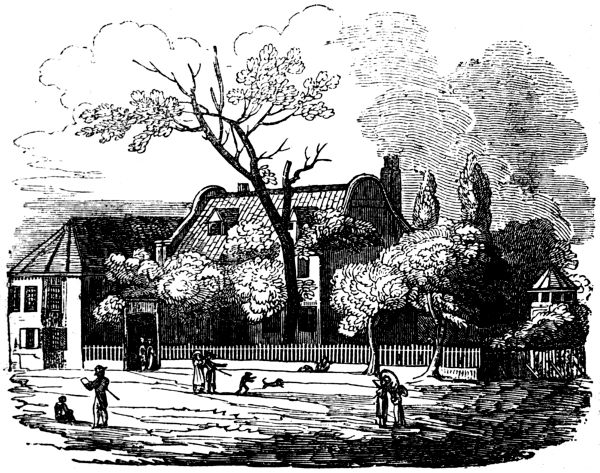
Copenhagen-house
In olden times, so high a rise Was, perhaps, a Tor or beacon ground And lit, or ’larm’d, the country round, For pleasure, or against surprise
There is a cobler’s stall in London that I go out of my way to look at whenever I pass its vicinity, because it was the seat of an honest old man who patched my shoes and my mind, when I was a boy. I involuntarily reverence the spot; and if I find myself in Red Lion-square, I, with a like affection, look between the iron railings of its enclosure, because, at the same age, from my mother’s window, I watched the taking down of the obelisk, stone by stone, that stood in the centre, and impatiently awaited the discovery of the body of Oliver Cromwell, which, according to local legend, was certainly buried there in secrecy by night. It is true that Oliver’s bones were not found; but then “every body” believed that “the workmen did not dig deep enough.” Among these believers was my friend, the cobbler, who, though no metaphysician, was given to ruminate on “causation.” He imputed the nonpersistence of the diggers to “private reasons of state,” which his awfully mysterious look imported he had fathomed, but dared not reveal. From ignorance of wisdom, I venerated the wisdom of ignorance; and though I now know better, I respect the old man’s memory. He allowed me, though a child, to sit on the frame of his little pushed-back window; and I obtained so much of his good-will and confidence, that he lent me a folio of fragments from Caxton’s “Polychronicon,” and Pynson’s “Shepherd’s Kalendar,” which he kept in the drawer of his seat, with “St. Hugh’s bones,” the instruments of his “gentle craft.” This black-letter lore, with its wood-cuts, created in me a desire to be acquainted with our old authors, and a love for engravings, which I have indulged without satiety. It is impossible that I should be without fond recollections of the spots wherein I received these early impressions.
From still earlier impressions, I have like recollection of the meadows on the Highgate side of Copenhagen-house. I often rambled in them in summer-time, when I was a boy, to frolic in the new-mown hay, or explore the wonders of the hedges, and listen to the songs of the birds. Certain indistinct apprehensions of danger arose in me from the rude noises of the visitors at Copenhagen-house itself, and I scarcely ventured near enough to observe more than that it had drinking-benches outside, and boisterous company within. I first entered the place in the present month of June, 1825, and the few particulars I could collect concerning it, as an old place of public entertainment, may be acceptable to many who recollect its former notoriety. Speculators are building up to it, and if they continue with their present speed, it will in a few years be hidden by their operations.
Copenhagen-house stands alone in the fields north of the metropolis, between Maiden-lane, the old road to Highgate on the west, and the very ancient north road, or bridle-way, called Hagbush-lane, on the east; on this latter side it is nearly in a line with Cornwall-place, Holloway. Its name is said to have been derived from a Danish prince, or a Danish ambassador, having resided in it during a great plague in London; another representation is, that in the beginning of the seventeenth century, it was opened under its present name by a Dane, as a place of resort for his countrymen. “Coopen-Hagen” is the name given to it in the map in Camden’s “Britannia,” published in 1695.[189] It is situated in the parish of Islington, in the manor of St. John of Jerusalem, in the rental of which manor, dated the 25th of February, 1624, its name does not occur;[190] it is therefore probable from thence, and from the appearance of the oldest part of the present edifice, that it was not then built.
It is certain that Copenhagen-house has been licensed for the sale of beer, and wine, and spirits, upwards of a century; and for such refreshments, and as a tea-house, with a garden and grounds for skittles and Dutch pins, it has been greatly resorted to by Londoners. No house of the kind commands so extensive and uninterrupted a view of the metropolis and the immense western suburb, with the heights of Hampstead and Highgate, and the rich intervening meadows. Those nearest to London are now rapidly destroying for their brick-earth, and being covered with houses; though from Copenhagen-street, which is built on the green lane from White Conduit-house, there is a way to the footpath leading to Copenhagen-house, from the row of handsome cottages called Barnesbury-park.
The latter buildings are in the manor of Berners, or Bernersbury, otherwise Barnesbury; the name being derived from the Berners’ family,[191] of whom the most distinguished individual was John Bourchier, the last lord Berners, and “the fifth writer in order of time among the nobility.” He was author of “a comedy usually acted in the great church of Calais after vespers,” of which town he held the command by appointment of king Henry VIII.;[192] he also translated several works, and particularly “Froissart’s Cronycles, oute of Frenche into our maternale Englysshe tongue.”
West of Barnesbury-park, and close to the footpath from thence to Copenhagen-house, are the supposed remains of a Roman encampment. It is a square of about one hundred and twenty feet, surrounded by a ditch, with a high embankment or breast work to the west. This is presumed to have been a position occupied by Suetonius, the Roman general, when he destroyed eighty thousand of the Britons under Boadicea, in a memorable engagement presumed to have been fought from this place in the fields of Pentonville, and terminating in the plain at Battle-bridge, from whence that place is said to have been so named.
From Battle-bridge up Maiden-lane, and from Barnesbury-park, there are still footways to Copenhagen-house, which, from standing alone on an eminence, is visible from every open spot for many miles round. To the original edifice is attached a building at the west end, with a large parlour below for drinking and smoking, and beyond it is a billiard-room; above is a large tea-room. The engraving represents its present appearance, from a drawing made for that purpose.
About the year 1770, this house was kept by a person named Harrington; at his decease the business was continued by his widow, wherein she was assisted for several years by a young woman who came from Shropshire. This female assistant afterwards married a person named Tomes, and kept the Adam and Eve at Islington; she is now a widow; and from her information the editor of the Every-Day Book gathers, that at the time of the London riots in the year 1780, a body of the rioters passed Copenhagen-house on their way to attack the seat of lord Mansfield, at Caen-wood: happily, they did not sack Copenhagen; but Mrs. Harrington and her maid were so alarmed, that they despatched a man to justice Hyde, who sent a party of soldiers to garrison this important place, where they remained till the riots were quelled. From this spot the view of the nightly conflagrations in the metropolis must have been terrific. Mrs. Tomes says, she saw nine large fires at one time. On new-year’s day previous to this, the house was broken into after the family had retired to rest. The burglars forced the kitchen window, and mistaking the salt-box in the chimney corner for a man’s head, fired a ball through it. They then ran up stairs with a dark-lantern, tied the man and the woman servant, burst the lower pannel of Mrs. Harrington’s room-door, while she secreted fifty pounds between her bed and the mattress, and three of them rushed to her bedside, armed with a cutlass, crowbar, and pistol, while a fourth remained on the watch outside. They demanded her money; and as she denied that she had any, they wrenched her drawers open with the crowbar, refusing to use the keys she offered to them. In these they found about ten pounds belonging to her daughter, a little child, whom they threatened to murder unless she ceased crying, while they packed up all the plate, linen, and clothes, which they carried off. They then went to the cellar, set all the ale-barrels running, broke the necks off the wine-bottles, spilt the other liquors, and slashed a round of beef with their cutlasses. From this wanton spoil they reserved sufficient to carouse with in the kitchen, where they ate, drank, and sung, till they resolved to “pinch the old woman, and make her find more money.” On this, they all ran up stairs again, where she still lay in bed, and by their threats and violence soon obtained from her a disclosure of the hidden fifty pounds. This rather appeared to enrage than pacify them, and they seriously proposed cutting her throat for the deception; but that crime was not perpetrated, and they departed with their plunder. Rewards were offered, by government and the parish of Islington, for the apprehension of the felons: in May following, one of them, named Clarkson, was discovered, and hopes of mercy tendered to him if he would discover his accomplices. This man was a watch-maker in Clerkenwell, the other three were tradesmen; his information led to their discovery; they were tried and executed, and Clarkson was pardoned; though, some time afterwards, he, also, suffered death, for obtaining a box of plate from the White-horse, in Fetter-lane, upon pretence that it had been sent thither by mistake.
The robbery at Copenhagen-house, was so far fortunate to Mrs. Harrington, that she obtained a subscription considerably more in amount than the value of the money and property she had lost. Mr. Leader, the coachmaker, in Long-acre, who was her landlord, remitted to her a year’s rent of the premises, which at that time was 30l. The notoriety of the robbery increased the visitors to the house, and Mr. Leader built the additional rooms to the old house, instead of a wooden room, to accommodate the new influx of custom; and soon afterwards the house was celebrated for fives-playing. This last addition was almost accidental. “I made the first fives-ball,” says Mrs. Tomes, “that was ever thrown up against Copenhagen-house. One Hickman, a butcher at Highgate, a countryman of mine, ‘used’ the house, and seeing me ‘country,’ we talked about our country sports, and amongst the rest fives; I told him we’d have a game some day: I laid down the stone in the ground myself, and, against he came again, made a ball. I struck the ball the first blow and he gave it the second, and so we played; and as there was company they liked the sport, and it got talked of. This was the beginning of the fives-play, which has since become so famous at Copenhagen-house.”
A word or two on ball-play.
Fives was our old hand-tennis, and is a very ancient game.
In the fourteenth century there was a game at ball, where a line, called the cord, was traced upon the wall, below which the stroke was faulty. Some of the players were on foot; others had the two hands tied together, or played in a hollow cask.[193]
Hand-ball was before the days of Homer. He introduces the princess Corcyra, daughter of Alcinous, king of Phœacia, amusing herself, with her maidens, at hand-ball:—
“O’er the green mead the sporting virgins play; Their shining veils unbound, along the skies, Tost and re-tost, the ball incessant flies.”[194]
It is related of St. Cuthbert, who lived in the seventh century, that “whan he was viii yere old, as he played at the ball with other chyldren, sodeynly there stode amonge them a fayre yonge chylde,” who admonished Cuthbert against “vayne playes,” and seeing Cuthbert take no heed, he fell down, wept sore and wrung his hands; “and than Cuthbert and the other chyldren lefte their playe and comforted hym; and than sodeynly he vanyshed away; and than he knewe veryly that it was an angel; and, fro than forth on, he lefte all such vayne playes, and never used them more.”[195]
Ball-play was formerly played at Easter in churches, and statutes passed to regulate the size of the ball. The ceremony was as follows: the ball being received, the dean, or his representative, began an antiphone, or chant, suited to Easter-day; then taking the ball in his left hand, he commenced a dance to the tune, others of the clergy dancing round, hand in hand. At intervals the ball was handed or tossed by the dean to each of the choristers, the organ playing according to the dance and sport: at the conclusion of the anthem and dance, they went and took refreshment. It was the privilege of the lord, or his locum tenens, to throw the ball, and even the archbishop did it.[196]
The French palm-play consisted in receiving the ball and driving it back again with the palm of the hand. Anciently they played with the naked hand, then with a glove, which, in some instances, was lined; afterwards they bound cords and tendons round their hands, to make the ball rebound more forcibly; and hence, says St. Foix, the racket derived its origin.
In the reign of Charles V., palm-play, which, Strutt says, may properly enough be denominated hand-tennis, or fives, was exceedingly fashionable in France, being played by the nobility for large sums of money; and when they had lost all that they had about them, they would sometimes pledge a part of their wearing apparel rather than give up the game. The duke of Bourbon having lost sixty francs at palm-play with M. William de Lyon, and M. Guy de la Trimouille, and not having money enough to pay them, gave his girdle as a pledge for the remainder.
A damsel, named Margot, who resided at Paris in 1424, played at hand-tennis with the palm, and also with the back of her hand, better than any man; and what is most surprising, says St. Foix, at that time the game was played with the naked hand, or at least with a double glove.
Hand-tennis still continues to be played, though under a different name, and probably a different modification of the game: it is now called fives, which denomination, perhaps, it might receive from having five competitors in it, as the succeeding passage shews: When queen Elizabeth was entertained at Elvetham, in Hampshire, by the earl of Hertford, “after dinner about three o’clock, ten of his lordship’s servants, all Somersetshire men, in a square greene court before her majesties windowe, did hang up lines, squaring out the forme of a tennis court, and making a cross line in the middle; in this square they, being stripped out of their dublets, played five to five with hand-ball at bord and cord as they tearme it, to the great liking of her highness.”[197]
Fives-playing at Copenhagen-house, is recorded in a memoir of Cavanagh, the famous fives-player, by Mr. Hazlitt. It first appeared in the Examiner of February 17, 1819, and is subjoined, with the omission of a passage or two, not essentially connected with the subject.
DEATH OF JOHN CAVANAGH.
——“And is old Double dead? See, see, he drew a good bow; and dead! he shot a fine shoot. John of Gaunt loved him well, and betted much money on his head. Dead! he would have clapt in the clout at twelve score, and carried you a forehand shaft a fourteen and fourteen and a half, that it would have done a man’s heart good to see.”
Died at his house in Burbage-street, St. Giles’s, John Cavanagh, the famous hand fives-player. When a person dies, who does any one thing better than any one else in the world, which so many others are trying to do well, it leaves a gap in society. It is not likely that any one will now see the game of fives played in its perfection for many years to come—for Cavanagh is dead, and has not left his peer behind him.
It may be said that there are things of more importance than striking a ball against a wall—there are things indeed that make more noise and do as little good, such as making war and peace, making speeches and answering them, making verses and blotting them, making money and throwing it away. But the game of fives is what no one despises who has ever played at it. It is the finest exercise for the body, and the best relaxation for the mind.
The Roman poet said that “Care mounted behind the horseman, and stuck to his skirts.” But this remark would not have applied to the fives-player. He who takes to playing at fives is twice young. He feels neither the past nor future “in the instant.” Debts, taxes, “domestic treason, foreign levy, nothing can touch him further.” He has no other wish, no other thought, from the moment the game begins, but that of striking the ball, of placing it, of making it! This Cavanagh was sure to do. Whenever he touched the ball, there was an end of the chase. His eye was certain, his hand fatal, his presence of mind complete. He could do what he pleased, and he always knew exactly what to do. He saw the whole game, and played it; took instant advantage of his adversary’s weakness, and recovered balls, as if by a miracle and from sudden thought, that every one gave for lost. He had equal power and skill, quickness and judgment. He could either outwit his antagonist by finesse, or beat him by main strength. Sometimes, when he seemed preparing to send the ball with the full swing of his arm, he would, by a slight turn of his wrist, drop it within an inch of the line. In general, the ball came from his hand, as if from a racket, in a strait horizontal line; so that it was in vain to attempt to overtake or stop it. As it was said of a great orator, that he never was at a loss for a word, and for the properest word, so Cavanagh always could tell the degree of force necessary to be given to a ball, and the precise direction in which it should be sent. He did his work with the greatest ease; never took more pains than was necessary, and while others were fagging themselves to death, was as cool and collected as if he had just entered the court.
His style of play was as remarkable as his power of execution. He had no affectation, no trifling. He did not throw away the game to show off an attitude, or try an experiment. He was a fine, sensible, manly player, who did what he could, but that was more than any one else could even affect to do. He was the best up-hill player in the world; even when his adversary was fourteen, he would play on the same or better, and as he never flung away the game through carelessness and conceit, he never gave it up through laziness or want of heart. The only peculiarity of his play was that he never volleyed, but let the balls hop; but if they rose an inch from the ground, he never missed having them. There was not only no body equal, but nobody second to him. It is supposed that he could give any other player half the game, or beat them with his left hand. His service was tremendous. He once played Woodward and Meredith together (two of the best players in England) in the Fives-court, St. Martin’s-street, and made seven and twenty aces following by services alone—a thing unheard of. He another time played Peru, who was considered a first-rate fives-player, a match of the best out of five games, and in the three first games, which of course decided the match, Peru got only one ace.
Cavanagh was an Irishman by birth, and a house-painter by profession. He had once laid aside his working-dress, and walked up, in his smartest clothes, to the Rosemary Branch to have an afternoon’s pleasure. A person accosted him, and asked him if he would have a game. So they agreed to play for half-a-crown a game, and a bottle of cider. The first game began—it was seven, eight, ten, thirteen, fourteen, all. Cavanagh won it. The next was the same. They played on and each game was hardly contested. “There,” said the unconscious fives-player, “there was a stroke that Cavanagh could not take: I never played better in my life, and yet I can’t win a game. I don’t know how it is.” However, they played on, Cavanagh winning every game, and the bye-standers drinking the cider and laughing all the time. In the twelfth game, when Cavanagh was only four, and the stranger thirteen, a person came in, and said, “What are you here, Cavanagh!” The words were no sooner pronounced than the astonished player let the ball drop from his hand, and saying, “What! have I been breaking my heart all this time to beat Cavanagh?” refused to make another effort. “And yet, I give you my word,” said Cavanagh, telling the story with some triumph, “I played all the while with my clenched fist.”
He used frequently to play matches at Copenhagen-house for wagers and dinners. The wall against which they play is the same that supports the kitchen-chimney, and when the wall resounded louder than usual, the cooks exclaimed, “Those are the Irishman’s balls,” and the joints trembled on the spit!
Goldsmith consoled himself that there were places where he too was admired: and Cavanagh was the admiration of all the fives-courts where he ever played. Mr. Powell, when he played matches in the court in St. Martin’s-street, used to fill his gallery at half-a-crown a head, with amateurs and admirers of talent in whatever department it is shown. He could not have shown himself in any ground in England, but he would have been immediately surrounded with inquisitive gazers, trying to find out in what part of his frame his unrivalled skill lay.
He was a young fellow of sense, humour, and courage. He once had a quarrel with a waterman at Hungerford-stairs, and they say, “served him out” in great style. In a word, there are hundreds at this day, who cannot mention his name without admiration, as the best fives-player that perhaps ever lived (the greatest excellence of which they have any notion)—and the noisy shout of the ring happily stood him instead of the unheard voice of posterity.
The only person who seems to have excelled as much in another way as Cavanagh did in his, was the late John Davies, the racket-player. It was remarked of him that he did not seem to follow the ball, but the ball seemed to follow him. Give him a foot of wall, and he was sure to make the ball. The four best racket-players of that day were Jack Spines, Jem Harding, Armitage, and Church. Davies could give any one of these two hands a time, that is, half the game, and each of these at their best, could give the best player now in London the same odds. Such are the gradations in all exertions of human skill and art. He once played four capital players together, and beat them. He was also a first-rate tennis-player, and an excellent fives-player. In the Fleet or King’s Bench, he would have stood against Powell, who was reckoned the best open-ground player of his time. This last-mentioned player is at present the keeper of the Fives-court, and we might recommend to him for a motto over his door,—“Who enters here, forgets himself, his country, and his friends.” And the best of it is, that by the calculation of the odds, none of the three are worth remembering!
Cavanagh died from the bursting of a blood-vessel, which prevented him from playing for the last two or three years. This, he was often heard to say, he thought hard upon him. He was fast recovering, however, when he was suddenly carried off to the regret of all who knew him.
Jack Cavanagh was a zealous Catholic, and could not be persuaded to eat meat on a Friday, the day on which he died. We have paid this willing tribute to his memory.
“Let no rude hand deface it, And his forlorn ‘Hic Jacet.’”
Fives-play from the year 1780 was a chief diversion at Copenhagen-house, particularly while Mrs. Harrington remained the landlady. She was careless of all customers, except they came in shoals to drink tea in the gardens and long room up stairs, or to play at fives, skittles, and Dutch pins, and swill and smoke. The house was afterwards kept by a person named Orchard, during whose time the London Corresponding Society, in 1795, held meetings in the adjacent fields.[198] In 1812, it was proposed by a company of projectors to bring sea-water through iron pipes “from the coast of Essex to Copenhagen fields,” and construct baths, which, according to the proposals, would yield twelve and a half per cent. on a capital of 200,000l.; but the subscription was not filled up, though the names of several eminent physicians sanctioned the undertaking, and the project failed.[199]
After Orchard’s tenancy, Copenhagen-house was kept by one Tooth, who encouraged brutal sports for the sake of the liquors he sold. On a Sunday morning the fives-ground was filled by bull-dogs and ruffians, who lounged and drank to intoxication; so many as fifty or sixty bull-dogs have been seen tied up to the benches at once, while their masters boozed and made match after match, and went out and fought their dogs before the house, amid the uproar of idlers attracted to the “bad eminence” by its infamy. This scene lasted throughout every Sunday forenoon, and then the mob dispersed, and the vicinity was annoyed by the yells of the dogs and their drunken masters on their return home. There was also a common field, east of the house, wherein bulls were baited; this was called the bull-field. These excesses, although committed at a distance from other habitations, occasioned so much disturbance, that the magistrates, after repeated warnings to Tooth, refused him a license in 1816, and granted it to Mr. Bath, the present landlord, who abated the nuisance by refusing to draw beer or afford refreshment to any one who had a bull-dog at his heels. The bull-field has since been possessed and occupied by a great cow-keeping landlord in the neighbourhood, though by what title he holds it is not known, certainly not by admission to it as waste of the manor. This field is close to the mud cottage hereafter mentioned in Hagbush-lane, an ancient way to Highgate-hill.
Near the spot at which Hagbush-lane comes out into the Holloway-road to Highgate, the great lord Bacon met with the cause of his death, in a way not generally known. He was taking an airing in his coach, on a winter-day, with Dr. Witherborne, a Scotchman, physician to James I., and the snow laying on the ground. It occurred to lord Bacon that flesh might be preserved in snow as well as in salt; resolving to try the experiment, they alighted from the carriage, and going into a poor woman’s cottage at the foot of Highgate-hill, they bought a hen; his lordship helped to stuff the body with snow, which so chilled him that he fell ill, and could not return to his lodgings; he therefore went to the earl of Arundel’s house at Highgate, where a bed was warmed for him with a pan of coals; but the bed not having been lain in for about a year before was damp, and so increased his disorder that in two or three days he died.
It is not to defame so great a man, the greatest of modern times, but merely to illustrate his well-known attachment to particular favourites, that a paper is here for the first time printed. It is a bill of fees to counsel, upon an order made in the court of chancery by lord Bacon, as keeper of the great seal, during the first year he held it. From this it appears that counsel had been retained to argue a demurrer, on the first day of Michaelmas term, 1617; and that the hearing stood over till the following Tuesday, before which day “one of my lord-keeper’s favourites” was retained as other counsel, and, “being one of my lord-keeper’s favourites,” had a double fee for his services. The mention of so extraordinary a fact in a common bill of costs may perhaps justify its rather out-of-the-way introduction in this place. The paper from whence it is here printed, the editor of the Every-Day Book has selected from among other old unpublished manuscripts in his possession, connected with the affairs of sir Philip Hoby, who was ambassador to the emperor of Germany from Henry VIII., and held other offices during that reign.
(COPY.)
Termino Micalis, 1617.
To Mr. Bagger of the Iner-Temple, Councellor, the firste day of the Tearme, for attending at the Chancery barr, to mayntain or. demurrer against Sr. Tho. Hoby, by my Lo: Keeper’s order, that daye to attend the Corte, wch. herd noe motions that daye, but deferd it of until Tusday following xxii. s.
Uppon Tusdaye following wee had yonge Mr. Tho: Finch, and Mr. Bagger, of our Councell, to attend there to mayntaine the same demurrer, and the cause be cancelled; Upon (which) my Lo: Keeper ordered, that he refferred the cause to be heard before Sr. Charles Cesér King, one of the docters of the Chancery, to make a reporte unto his Lo: of the Cause, that his Lo: might better consider, whether the demurrer should stand good, or noe:—Mr. Tho: Finch his fee, being one of my Lo: favourites, had 44s.
Mr. Bager his Fee 22s.
At Copenhagen-house, the eye and the stomach may be satisfied together. A walk to it through the fresh air creates an appetite, and the sight must be allowed some time to take in the surrounding prospect. A seat for an hour or two at the upstairs tea-room windows on a fine day is a luxury. As the clouds intercept the sun’s rays, and as the winds disperse or congregate the London atmosphere, the appearance of the objects it hovers over continually varies. Masses of building in that direction daily stretch out further and further across the fields, so that the metropolis may be imagined a moving billow coming up the heights to drown the country. Behind the house the
“Hedge-row elms, o’er hillocks green,”
is exquisitely beautiful, and the fine amphitheatre of wood, from Primrose-hill to Highgate-archway and Hornsey, seems built up to meet the skies. A stroll towards either of these places from Copenhagen-house, is pleasant beyond imagination. Many residents in London to whom walking would be eminently serviceable, cannot “take a walk” without a motive; to such is recommended the “delightful task” of endeavouring to trace Hagbush-lane.
Crossing the meadow west of Copenhagen-house, to the north-east corner, there is a mud built cottage in the widest part of Hagbush-lane, as it runs due north from the angle formed by its eastern direction. It stands on the site of one still more rude, at which until destroyed, labouring men and humble wayfarers, attracted by the sequestered and rural beauties of the lane, stopped to recreate. It was just such a scene as Morland would have coveted to sketch, and therefore Mr. Fussell with “an eye for the picturesque,” and with a taste akin to Morland’s, made a drawing of it while it was standing, and placed it on the wood whereon it is engraven, to adorn the next page.
Cottage formerly in Hagbush-lane.
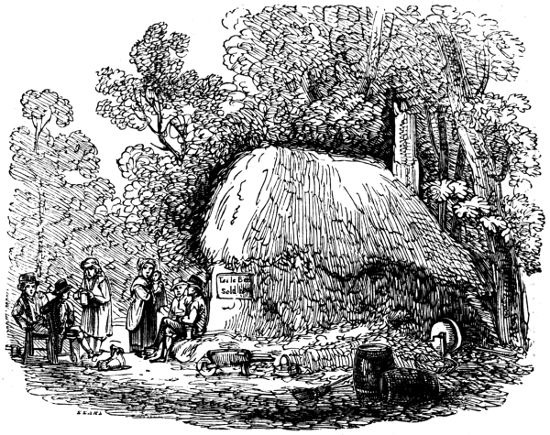
Cottage formerly in Hagbush-lane. “Why this cottage, sir, not three miles from London, is as secluded as if it were in the weald of Kent.”
This cottage stands no longer: its history is in the “simple annals of the poor.” About seven years ago, an aged and almost decayed labouring man, a native of Cheshunt, in Hertfordshire, with his wife and child, lay out every night upon the road side of Hagbush-lane, under what of bough and branch they could creep for shelter, till “winter’s cold” came on, and then he erected this “mud edifice.” He had worked for some great land-holders and owners in Islington, and still jobbed about. Like them, he was, to this extent of building, a speculator; and to eke out his insufficient means, he profited, in his humble abode, by the sale of small beer to stragglers and rustic wayfarers. His cottage stood between the lands of two rich men; not upon the land of either, but partly on the disused road, and partly on the waste of the manor. Deeming him by no means a respectable neighbour for their cattle, they “warned him off;” he, not choosing to be houseless, nor conceiving that their domains could be injured by his little enclosure between the banks of the road, refused to accept this notice, and he remained. For this offence, one of them caused his labourers to level the miserable dwelling to the earth, and the “houseless child of want,” was compelled by this wanton act to apply for his family and himself to be taken into the workhouse. His application was refused, but he received advice to build again, with information that his disturber was not justified in disturbing him. In vain he pleaded incompetent power to resist; the workhouse was shut against him, and he began to build another hut. He had proceeded so far as to keep off the weather in one direction, when wealth again made war upon poverty, and while away from his wife and child, his scarcely half raised hut was pulled down during a heavy rain, and his wife and child left in the lane shelterless. A second application for a home in the workhouse was rejected, with still stronger assurances that he had been illegally disturbed, and with renewed advice to build again. The old man has built for the third time; and on the site of the cottage represented in the engraving, erected another, wherein he dwells, and sells his small beer to people who choose to sit and drink it on the turf seat against the wall of his cottage; it is chiefly in request, however, among the brickmakers in the neighbourhood, and the labourers on the new road, cutting across Hagbush-lane from Holloway to the Kentish-town road, which will ultimately connect the Regent’s-park and the western suburb, with the eastern extremity of this immensely growing metropolis. Though immediately contiguous to Mr. Bath, the landlord of “Copenhagen-house,” he has no way assisted in obstructing this poor creature’s endeavour to get a morsel of bread. For the present he remains unmolested in his almost sequestered nook, and the place and himself are worth seeing, for they are perhaps the nearest specimens to London, of the old country labourer and his dwelling.
From the many intelligent persons a stroller may meet among the thirty thousand inhabitants of Islington, on his way along Hagbush-lane, he will perhaps not find one to answer a question that will occur to him during his walk. “Why is this place called Hagbush-lane?” Before giving satisfaction here to the inquirer, he is informed that, if a Londoner, Hagbush-lane is, or ought to be, to him, the most interesting way that he can find to walk in; and presuming him to be influenced by the feelings and motives that actuate his fellow-citizens to the improvement and adornment of their city, by the making of a new north road, he is informed that Hagbush-lane, though now wholly disused, and in many parts destroyed, was the old, or rather the oldest north road, or ancient bridle-way to and from London, and the northern parts of the kingdom.
Now for its name—Hagbush-lane. Hag is the old Saxon word hæg, which became corrupted into hawgh, and afterwards into haw, and is the name for the berry of the hawthorn; also the Saxon word haga signified a hedge or any enclosure. Hag afterwards signified a bramble, and hence, for instance, the blackberry-bush, or any other bramble, would be properly denominated a hag. Hagbush-lane, therefore, may be taken to signify either Hawthornbush-lane, Bramble-lane, or Hedgebush-lane; more probably the latter. Within recent recollection, Whitcomb-street, near Charing-cross, was called Hedge-lane.
Supposing the reader to proceed from the old man’s mud-cottage in a northerly direction, he will find that the widest part of Hagbush-lane reaches, from that spot, to the road now cutting from Holloway. Crossing immediately over the road, he comes again into the lane, which he will there find so narrow as only to admit convenient passage to a man on horseback. This was the general width of the road throughout, and the usual width of all the English roads made in ancient times. They did not travel in carriages, or carry their goods in carts, as we do, but rode on horseback, and conveyed their wares or merchandise in pack-saddles or packages on horses’ backs. They likewise conveyed their money in the same way. In an objection raised in the reign of Elizabeth to a clause in the Hue and Cry bill, then passing through parliament, it was urged, regarding some travellers who had been robbed in open day within the hundred of Beyntesh, in the county of Berks, that “they were clothiers, and yet travailed not withe the great trope of clothiers; they also carried their money openlye in wallets upon their saddles.”[200] The customary width of their roads was either four feet or eight feet. Some parts of Hagbush-lane are much lower than the meadows on each side; and this defect is common to parts of every ancient way, as might be exemplified, were it necessary, with reasons founded on their ignorance of every essential connected with the formation, and perhaps the use, of a road.
It is not intended to point out the tortuous directions of Hagbush-lane; for the chief object of this notice is to excite the reader to one of the pleasantest walks he can imagine, and to tax his ingenuity to the discovery of the route the road takes. This, the ancient north road, comes into the present north road, in Upper Holloway, at the foot of Highgate-hill, and went in that direction to Hornsey. From the mud-cottage towards London, it proceeded between Paradise-house, the residence of Mr. Greig, the engraver, and the Adam and Eve public-house, in the Holloway back-road, and by circuitous windings approached London, at the distance of a few feet on the eastern side of the City Arms public-house, in the City-road, and continued towards Old-street, St. Luke’s. It no where communicated with the back-road, leading from Battle-bridge to the top of Highgate-hill, called Maiden-lane.
Hagbush-lane is well known to every botanizing perambulator on the west side of London. The wild onion, clowns-wound-wort, wake-robin, and abundance of other simples, lovely in their form, and of high medicinal repute in our old herbals and receipt-books, take root, and seed and flower here in great variety. How long beneath the tall elms and pollard oaks, and the luxuriant beauties on the banks, the infirm may be suffered to seek health, and the healthy to recreate, who shall say? Spoilers are abroad.
Through Hagbush-lane every man has a right to ride and walk; in Hagbush-lane no one man has even a shadow of right to an inch as private property. It is a public road, and public property. The trees, as well as the road, are public property; and the very form of the road is public property. Yet bargains and sales have been made, and are said to be now making, under which the trees are cut down and sold, and the public road thrown, bit by bit, into private fields as pasture. Under no conveyance or admission to land by any proprietor, whether freeholder or lord of a manor, can any person legally dispossess the public of a single foot of Hagbush-lane, or obstruct the passage of any individual through it. All the people of London, and indeed all the people of England, have a right in this road as a common highway. Hitherto, among the inhabitants of Islington, many of whom are opulent, and all of whom are the local guardians of the public rights in this road, not one has been found with sufficient public virtue, or rather with enough of common manly spirit, to compel the restoration of public plunder, and in his own defence, and on the behalf of the public, arrest the highway robber.
Building, or what may more properly be termed the tumbling up of tumbledown houses, to the north of London, is so rapidly increasing, that in a year or two there will scarcely be a green spot for the resort of the inhabitants. Against covering of private ground in this way, there is no resistance; but against its evil consequences to health, some remedy should be provided by the setting apart of open spaces for the exercise of walking in the fresh air. The preservation of Hagbush-lane therefore is, in this point of view, an object of public importance. Where it has not been thrown into private fields, from whence, however, it is recoverable, it is one of the loveliest of our green lanes; and though persons from the country smile at Londoners when they talk of being “rural” at the distance of a few miles from town, a countryman would find it difficult to name any lane in his own county, more sequestered or of greater beauty.
LINES
WRITTEN IN HAGBUSH-LANE.
A scene like this, Would woo the care-worn wise To moralize, And courting lovers court to tell their bliss. Had I a cottage here I’d be content; for where I have my books I have old friends, Whose cheering looks Make me amends. For coldnesses in men: and so, With them departed long ago, And with wild-flowers and trees And with the living breeze, And with the “still small voice” Within, I would rejoice, And converse hold, while breath Held me, and then—come Death!
*
FLORAL DIRECTORY.
Blue Sowthistle. Sonchus Cœruleus. Dedicated to B. Raingarda.
June 27.
St. Ladislas I., king of Hungary, A. D. 1095. St. John, of Moutier, 6th Cent.
THE SEASON.
Mr. Howard, in his work on the weather, is of opinion, that farmers and others, who are particularly interested in being acquainted with the variations in the weather, derive considerable aid from the use of the barometer. He says, “in fact, much less of valuable fodder is spoiled by wet now than in the days of our forefathers. But there is yet room for improvement in the knowledge of our farmers on the subject of the atmosphere. It must be a subject of great satisfaction and confidence to the husbandman, to know, at the beginning of a summer, by the certain evidence of meteorological results on record, that the season, in the ordinary course of things, may be expected to be a dry and warm one; or to find, in a certain period of it, that the average quantity of rain to be expected for the month has already fallen. On the other hand, when there is reason, from the same source of information, to expect much rain, the man who has courage to begin his operations under an unfavourable sky, but with good ground to conclude, from the state of his instruments and his collateral knowledge, that a fair interval is approaching, may often be profiting by his observations; while his cautious neighbour, who waited for the weather to ‘settle,’ may find that he has let the opportunity go by. This superiority, however, is attainable by a very moderate share of application to the subject; and by the keeping of a plain diary of the barometer and raingauge with the hygrometer and the vane under his daily notice.”
FLORAL DIRECTORY.
Perforated St. John’s Wort. Hypericum perforatum. Dedicated to St. John.
June 28.
St. Irenæus, Bp. of Lyons, A. D. 202. St. Leo II., Pope A. D. 683. Sts. Plutarch and others, Martyrs, about A. D. 202. Sts. Potamiana and Basilides, Martyrs.
Chronology.
1797. George Keate, F.R.S., died, aged sixty-seven. He was born at Trowbridge in Wilts, educated at Kingston school, called to the bar, abandoned the profession of the law, amused himself with his pen, and wrote several works. His chief production is the account of “Capt. Wilson’s Voyage to the Pelew Islands;” his “Sketches from Nature,” written in the manner of Sterne, are pleasing and popular.
FLORAL DIRECTORY.
Blue Cornflower. Centaurea Cyanus. Dedicated to St. Irenæus.
NOW, A hot day.
Now the rosy- (and lazy-) fingered Aurora, issuing from her saffron house, calls up the moist vapours to surround her, and goes veiled with them as long as she can; till Phœbus, coming forth in his power, looks every thing out of the sky, and holds sharp uninterrupted empire from his throne of beams. Now the mower begins to make his sweeping cuts more slowly, and resorts oftener to the beer. Now the carter sleeps a-top of his load of hay, or plods with double slouch of shoulder, looking out with eyes winking under his shading hat, and with a hitch upward of one side of his mouth. Now the little girl at her grandmother’s cottage-door watches the coaches that go by, with her hand held up over her sunny forehead. Now labourers look well, resting in their white shirts at the doors of rural alehouses. Now an elm is fine there, with a seat under it; and horses drink out of the trough, stretching their yearning necks with loosened collars; and the traveller calls for his glass of ale, having been without one for more than ten minutes; and his horse stands wincing at the flies, giving sharp shivers of his skin, and moving to and fro his ineffectual docked tail; and now Miss Betty Wilson, the host’s daughter, comes streaming forth in a flowered gown and earrings, carrying with four of her beautiful fingers the foaming glass, for which, after the traveller has drank it, she receives with an indifferent eye, looking another way, the lawful two-pence: that is to say, unless the traveller, nodding his ruddy face, pays some gallant compliment to her before he drinks, such as “I’d rather kiss you, my dear, than the tumbler,”—or “I’ll wait for you, my love, if you’ll marry me;” upon which, if the man is good-looking and the lady in good-humour, she smiles and bites her lips, and says “Ah—men can talk fast enough;” upon which the old stage-coachman, who is buckling something near her, before he sets off, says in a hoarse voice, “So can women too for that matter,” and John Boots grins through his ragged red locks, and doats on the repartee all the day after. Now grasshoppers “fry,” as Dryden says. Now cattle stand in water, and ducks are envied. Now boots and shoes, and trees by the road side, are thick with dust; and dogs rolling in it, after issuing out of the water, into which they have been thrown to fetch sticks, come scattering horror among the legs of the spectators. Now a fellow who finds he has three miles further to go in a pair of tight shoes, is in a pretty situation. Now rooms with the sun upon them become intolerable; and the apothecary’s apprentice, with a bitterness beyond aloes, thinks of the pond he used to bathe in at school. Now men with powdered heads (especially if thick) envy those that are unpowdered, and stop to wipe them up hill, with countenances that seem to expostulate with destiny. Now boys assemble round the village pump with a ladle to it, and delight to make a forbidden splash and get wet through the shoes. Now also they make suckers of leather, and bathe all day long in rivers and ponds, and follow the fish into their cool corners, and say millions of “my eyes!” at “tittlebats.” Now the bee, as he hums along, seems to be talking heavily of the heat. Now doors and brick-walls are burning to the hand; and a walled lane, with dust and broken bottles in it, near a brick-field, is a thing not to be thought of. Now a green lane, on the contrary, thick-set with hedge-row elms, and having the noise of a brook “rumbling in pebble-stone,” is one of the pleasantest things in the world. Now youths and damsels walk through hay-fields by chance; and the latter say, “ha’ done then, William;” and the overseer in the next field calls out to “let thic thear hay thear bide;” and the girls persist, merely to plague “such a frumpish old fellow.”
Now, in town, gossips talk more than ever to one another, in rooms, in doorways, and out of windows, always beginning the conversation with saying that the heat is overpowering. Now blinds are let down, and doors thrown open, and flannel waistcoats left off, and cold meat preferred to hot, and wonder expressed why tea continues so refreshing, and people delight to sliver lettuces into bowls, and apprentices water doorways with tin-canisters that lay several atoms of dust. Now the water-cart, jumbling along the middle of the streets, and jolting the showers out of its box of water, really does something. Now boys delight to have a waterpipe let out, and set it bubbling away in a tall and frothy volume. Now fruiterers’ shops and dairies look pleasant, and ices are the only things to those who can get them. Now ladies loiter in baths; and people make presents of flowers; and wine is put into ice; and the after-dinner lounger recreates his head with applications of perfumed water out of long-necked bottles. Now the lounger, who cannot resist riding his new horse, feels his boots burn him. Now buckskins are not the lawn of Cos. Now jockies, walking in great coats to lose flesh, curse inwardly. Now five fat people in a stage coach, hate the sixth fat one who is coming in, and think he has no right to be so large. Now clerks in offices do nothing, but drink soda-water and spruce-beer, and read the newspaper. Now the old clothes-man drops his solitary cry more deeply into the areas on the hot and forsaken side of the street; and bakers look vicious; and cooks are aggravated: and the steam of a tavern kitchen catches hold of one like the breath of Tartarus. Now delicate skins are beset with gnats; and boys make their sleeping companion start up, with playing a burning-glass on his hand; and blacksmiths are super-carbonated; and coblers in their stalls almost feel a wish to be transplanted; and butter is too easy to spread; and the dragoons wonder whether the Romans liked their helmets; and old ladies, with their lappets unpinned, walk along in a state of dilapidation; and the servant-maids are afraid they look vulgarly hot; and the author, who has a plate of strawberries brought him, finds that he has come to the end of his writing.—Indicator.
In the “Miscellanies,” published by the Spalding Society of Antiquaries there is a poem of high feeling and strong expression against “man’s cruelty to man:”—
Why should mans high aspiring mind Burn in him, with so proud a breath; When all his haughty views can find In this world, yields to death; The fair, the brave, the vain, the wise, The rich, the poor, and great, and small, Are each, but worms anatomys, To strew, his quiet hall. Power, may make many earthly gods, Where gold, and bribery’s guilt, prevails; But death’s, unwelcome honest odds, Kicks oer, the unequal scales. The flatter’d great, may clamours raise Of Power,—and, their own weakness hide, But death, shall find unlooked for ways To end the Farce of pride.— An arrow, hurtel’d ere so high From e’en a giant’s sinewy strength, In time’s untraced eternity, Goes, but a pigmy length— Nay, whirring from the tortured string, With all its pomp, of hurried flight, Tis, by the Skylarks little wing, Outmeasured, in its height. Just so, mans boasted strength, and power, Shall fade, before deaths lightest stroke; Laid lower, than the meanest flower— Whose pride, oertopt the oak. And he, who like a blighting blast, Dispeopled worlds, with wars alarms, Shall be himself destroyed at last, By poor, despised worms. Tyrants in vain, their powers secure. And awe slaves’ murmurs, with a frown; But unawed death, at last is sure, To sap the Babels down— A stone thrown upward, to the skye, Will quickly meet, the ground agen: So men-gods, of earths vanity, Shall drop at last, to men; And power, and pomp, their all resign Blood purchased Thrones, and banquet Halls. Fate, waits to sack ambitions shrine As bare, as prison walls, Where, the poor suffering wretch bows down, To laws, a lawless power hath past;— And pride, and power, and King, and Clown, Shall be death’s slaves at last. Time, the prime minister of death, There’s nought, can bribe his honest will He, stops the richest Tyrants breath, And lays, his mischief still: Each wicked scheme for power, all stops, With grandeurs false, and mock display, As Eve’s shades, from high mountain tops. Fade with the rest, away. Death levels all things, in his march, Nought, can resist his mighty strength; The Pallace proud,—triumphal arch, Shall mete, their shadows length: The rich, the poor, one common bed, Shall find, in the unhonoured grave, Where weeds shall crown alike, the head, Of Tyrant, and of Slave.
Marvel.
June 29.
Holiday at the Public Offices, except Excise, Stamp, and Custom.
St. Peter, the Apostle. St. Hemma, A. D. 1045.
St. Peter.
From this apostle the Romish church assumes to derive her authority, and appoints this his anniversary, which she splendidly celebrates. The illuminations at Rome on this day would astonish the apostle were he alive. From the account of a recent traveller, they appear to be more brilliant than an Englishman can well imagine; he witnessed them, and describes them in these words:—
“At Ave Maria we drove to the piazza of St. Peter’s. The lighting of the lanternoni, or large paper lanterns, each of which looks like a globe of ethereal fire, had been going on for an hour, and, by the time we arrived there, was nearly completed. As we passed the Ponte San Angelo, the appearance of this magnificent church, glowing in its own brightness—the millions of lights reflected in the calm waters of the Tiber, and mingling with the last golden glow of evening, so as to make the whole building seem covered with burnished gold, had a most striking and magical effect.
“Our progress was slow, being much impeded by the long line of carriages before us; but at length we arrived at the piazza of St. Peter’s, and took our station on the right of its farther extremity, so as to lose the deformity of the dark, dingy Vatican palace. The gathering shades of night rendered the illumination every moment more brilliant. The whole of this immense church—its columns, capitals, cornices, and pediments—the beautiful swell of the lofty dome, towering into heaven, the ribs converging into one point at top, surmounted by the lantern of the church, and crowned by the cross,—all were designed in lines of fire; and the vast sweep of the circling colonnades, in every rib, line, mould, cornice, and column, were resplendent in the same beautiful light.
“While we were gazing upon it, suddenly a bell chimed. On the cross of fire at the top waved a brilliant light, as if wielded by some celestial hand, and instantly ten thousand globes and stars of vivid fire seemed to roll spontaneously along the building, as if by magic; and self-kindled, it blazed in a moment into one dazzling flood of glory. Fancy herself, in her most sportive mood, could scarcely have conceived so wonderful a spectacle as the instantaneous illumination of this magnificent fabric: the agents by whom it was effected were unseen, and it seemed the work of enchantment. In the first instance, the illuminations had appeared to be complete, and one could not dream that thousands and tens of thousands of lamps were still to be illumined. Their vivid blaze harmonized beautifully with the softer, milder light of the lanternoni; while the brilliant glow of the whole illumination shed a rosy light upon the fountains, whose silver fall, and ever-playing showers, accorded well with the magic of the scene.