JUNE.
Reading edition
And after her came jolly June, array’d All in green leaves, as he a player were; Yet in his time he wrought as well as play’d, That by his plough-irons mote right well appeare. Upon a crab he rode, that him did bare With crooked crawling steps an uncouth pase, And backward-yode, as bargemen wont to fare Bending their force contrary to their face; Like that ungracious crew which faines demurest grace.
Spenser.
This is the sixth month of the year. According to an old author “unto June the Saxons gave the name of Weyd-monat, because their beasts did then weyd in the meddowes, that is to say, goe to feed there, and hereof a medow is also in the Tutonicke called a weyd, and of weyd we yet retaine our word wade, which we understand of going through watrie places, such as medowes are wont to be.”[159] Another author likewise says, that “weyd is probably derived from weyden (German), to go about as if to pasture;” he further says, they called it Woedmonath, and that woed means “weed”; and that they called it also by the following names: Medemonath, Midsumormonath, and Braeckmonath; thought to be so named from the breaking up of the soil from bræcan (Saxon), to break: they also named it Lida erra; the word Lida, or litha, signifying in Icelandic, “to move, or pass over,” may imply the sun’s passing its greatest height, and Lida erra consequently mean the first month of the sun’s descent. Lida, it is added, has been deemed to signify smooth-air.[160]
Mr. Leigh Hunt observes, in his “Months,” that “the name of June, and indeed that of May, gave rise to various etymologies; but the most probable one derives it from Juno, in honour of whom a festival was celebrated at the beginning of the month.” He says, “it is now complete summer:—
‘Summer is ycomen in, Loud sing cuckoo; Groweth seed, And bloweth mead, And springeth the weed new.’
“Thus sings the oldest English song extant, in a measure which is its own music.—The temperature of the air, however, is still mild, and in our climate sometimes too chilly; but when the season is fine, this is, perhaps, the most delightful month of the year. The hopes of spring are realized, yet the enjoyment is but commenced: we have all summer before us; the cuckoo’s two notes are now at what may be called their ripest,—deep and loud; so is the hum of the bee; little clouds lie in lumps of silver about the sky, and sometimes fall to complete the growth of the herbage; yet we may now lie down on the grass, or the flowering banks, to read or write; the grasshoppers click about us in the warming verdure; and the fields and hedges are in full blossom with the clover, the still more exquisite bean, the pea, the blue and yellow nightshade, the fox-glove, the mallow, white briony, wild honeysuckle, and the flower of the hip or wild rose, which blushes through all the gradations of delicate red and white. The leaves of the hip, especially the young ones, are as beautiful as those of any garden rose. Towards evening, the bat and the owl venture forth, flitting through the glimmering quiet; and at night, the moon looks silveriest, the sky at once darkest and clearest; and when the nightingale, as well as the other birds have done singing, you may hear the undried brooks of the spring running and panting through their leafy channels. ‘It ceased,’ says the poet, speaking of a sound of heavenly voices about a ship,—
It ceased; yet still the sails made on A pleasant noise till noon, A noise like of a hidden brook, In the leafy month of June, That to the sleeping woods all night Singeth a quiet tune.
Coleridge.
“There is a greater accession of flowers in this month than in any other. In addition to those of the last, the garden sparkles with marygolds, golden-road, larkspur, sun-flowers, amarynths, (which Milton intermingles with sun-beams for his angel’s hair,) lupins, carnations, Chinese pinks, holyhocks, ladies’ slipper, annual stocks, campanulas, or little bells, martagons, periwinkles, wall-flower, snap-dragon, orchis, nasturtium, apocynum, chrysanthemum, cornflower, gladiolus, and convolvulus. The reader who is fond of poetry, and of the Greek fables, and does not happen to be acquainted with professor Martyn’s notes upon Virgil, should here be informed, that the species of red lily, called the martagon or Turk’s-cap, has been proved by that writer, at least to our satisfaction, to be the real ancient hyacinth, into which the youth of that name was turned by Apollo. The hyacinth, commonly so called, has nothing to show for its being the ancient one, which should be of a blood colour, and was said to be inscribed with the Greek exclamation of sorrow AI, AI. Now, we were struck with the sort of literal black marks with which the Turk’s-cap is speckled, and on reading the professor’s notes, and turning to the flower again, we could plainly see, that with some allowance, quite pardonable in a superstition, the marks might now and then fall together, so as to indicate those characters. It is a most beautiful, glowing flower; and shoots gracefully forth in a vase or glass from among white lilies, and the double narcissus:—
Νυν υακινθε, λαλει τα σα γσαμματα, και πλεον Αι Αι Λαμβανε σοις πεταλοισι.
Moschus.
‘Now tell your story, Hyacinth; and show Ai Ai the more amidst your sanguine woe.’
“The rural business of this month is made up of two employments, as beautiful to look at as they are useful,—sheep-shearing and hay-making. Something like a holiday is still made of the former, and in the south-west of England, the custom, we believe, is still kept up, of throwing flowers into the streams, an evident relic of paganism; but, altogether, the holiday is but a gleam of the same merry period in the cheap and rural time of our ancestors.”
June 1.
St Justin, Martyr, A. D. 167. St. Pamphilus, A. D. 309. St. Caprais, Abbot, A. D. 430. St. Peter, of Pisa, A. D. 1435. St. Wistan, Prince of Mercia, A. D. 849.
St. Nicomede.
This saint is in the English almanacs of this day; for what reason is unknown. He was an ancient martyr in no way distinguished from others who perished during the persecution under Domitian.
Chronology.
1794. Lord Howe’s memorable victory by sea over the French fleet.
1814. A newspaper of this day notices that the Tuesday preceding was observed at Burton, in Dorsetshire, as a great festival, in consequence of the arrival at that place of a vat of Hambro’ yarn, from London, being the first that had come into the town for many years. The inhabitants met the waggon, took out the horse, decorated the vat with ribands, and various emblems of peace, plenty, trade and commerce, and drew the same through the village, preceded by a flag and band of music, amidst the acclamations of thousands, many of whom were regaled with bread, cheese, and strong beer: one loaf (among others) baked for the occasion, claimed the admiration of every one present; its length being six feet three inches, breadth twenty-one inches, depth fourteen inches, and its weight considerably above 100 lbs. To explain the occasion of this rejoicing, it is necessary to state that Burton, as a manufacturing place, had suffered under the privation which was felt more or less throughout the British dominions, by Buonaparte declaring them to be in a state of blockade. By this decree, from the continent of Europe being within his power, he was enabled to injure and derange the industry and commerce of our artisans and merchants to an extent that was not contemplated. They have happily been liberated by an unlooked-for, and wonderful, combination of circumstances; nor so long as good faith and wise dispositions prevail, can they be prevented from arriving to a height of prosperity unparalleled in our annals.
FLORAL DIRECTORY.
Yellow Rose. Rosa lutea. Dedicated to St. Justin.
June 2.
Sts. Pothinus, Bp. Sanctus, Attalus, Blandina, &c., of Lyons, A. D. 177. Sts. Marcellinus and Peter, A. D. 304. St. Erasmus, or Ermo, or Elmo, A. D. 303.
Corpus Christi Day, and the performance of Mysteries.
This grand festival of the Romish church is held on the Thursday next after Trinity Sunday, in which order it also stands in the church of England calendar, and in the English almanacs. It celebrates the doctrine of transubstantiation. In all Roman catholic countries it is observed with music, lights, flowers strewed in the street, rich tapestries hung upon the walls, and with other demonstrations of rejoicing:[161] this is the usage still. Anciently in this country, as well as abroad, it was the custom to perform plays on this day, representing scripture subjects. From an author before cited, the following verses relating to these manners are extracted:—
“Then doth ensue the solemne feast of Corpus Christi Day, Who then can shewe their wicked use, and fond and foolish play? The hallowed bread, with worship great, in silver pix they beare About the church, or in the citie passing here and theare. His armes that beares the same two of the welthiest men do holde, And over him a canopey of silke and cloth of golde. Christe’s passion here derided is, with sundrie maskes and playes, Faire Ursley, with hir maydens all, doth passe amid the wayes: And, valiant George, with speare thou killest the dreadfull dragon here, The Devil’s house is drawne about, wherein there doth appere A wondrous sort of damned sprites, with foule and fearefull looke, Great Christopher doth wade and passe with Christ amid the brooke: Sebastian full of feathred shaftes, the dint of dart doth feele, There walketh Kathren, with hir sworde in hand, and cruel wheele: The Challis and the singing Cake with Barbara is led, And sundrie other pageants playde, in worship of this bred. * * * * * * * * * * * The common ways with bowes are strawde, and every streete beside, And to the walles and windowes all are boughes and braunches tide. The monkes in every place do roame, the nonnes abrode are sent, The priestes and schoolmen lowd do rore, some use the instrument. The straunger passing through the streete, upon his knees doe fall: And earnestly upon this bread, as on his God, doth call. For why, they counte it for their Lorde, and that he doth not take The form of flesh, but nature now of breade that we do bake. A number great of armed men here all this while do stande, To looke that no disorder be, nor any filching hande: For all the church-goodes out are brought, which certainly would bee A bootie good, if every man might have his libertie.”[162]
The Religious Plays performed on Corpus Christi Day, in the times of superstition, were such as were represented at other periods, though with less ceremony. From a volume on the subject, by the editor of the Every-Day-book, he relates so much as may set forth their origin and the nature of the performances.
Origin of Religious Plays.
A Jewish play, of which fragments are still preserved in Greek iambics, is the first drama known to have been written on a scripture subject. It is taken from Exodus: a performer, in the character of Moses, delivers the prologue in a speech of sixty lines, and his rod is turned into a serpent on the stage. The play is supposed to have been written at the close of the second century, by one Ezekiel, a Jew, as a political spectacle to animate his dispersed brethren with the hopes of a future deliverance from their captivity.
The emperor Julian made a law that no Christian should be taught in the heathen schools, or make use of that learning; but there were two men living at that time, who exerted their talents to supply the deficiency of instruction and entertainment that the Christians experienced from Julian’s edict: these were Apollinarius, bishop of Laodicea, and his father, a priest of the same city; they were both scholars, well skilled in oratory and the rules of composition, and of high literary renown. Apollinarius, the elder, a profound philologer, translated the five books of Moses into heroic verse, and in the same manner composed the history of the Israelites to the time of Saul, into a poem of twenty-four books, in imitation of Homer. He also wrote religious odes, and turned particular histories and portions of the Old and New Testament into comedies and tragedies, after the manner of Menander, Euripides, and Pindar. His son the bishop, an eloquent rhetorician, and already an antagonist of Julian’s, anxious that the Christians might not be ignorant of any species of Greek composition, formed the writings of the evangelists, and the works of the apostles, into dialogues, in the manner of Plato.
About the same time, Gregory Nazianzen, patriarch and archbishop of Constantinople, one of the fathers of the church, and master to the celebrated Jerome, composed plays from the Old and New Testament, which he substituted for the plays of Sophocles and Euripides at Constantinople, where the old Greek stage had flourished until that time. The ancient Greek tragedy was a religious spectacle; and the sacred dramas of Gregory Nazianzen were formed on the same model; he transformed the choruses into Christian hymns. One only of the archbishop’s plays is extant: it is a tragedy called “Christ’s Passion;” the prologue calls it an imitation of Euripides; the play is preserved in Gregory Nazianzen’s works. The remainder of his dramas have not survived those inimitable compositions over which they triumphed for a time.
It is not known whether the religious dramas of the Apollinarii perished so early as some of their other writings, that were ordered to be destroyed for, a crime common in all ages, heresy; but this is certain, that the learning they endeavoured to supply gradually disappeared before the progress of Constantine’s establishment. Suddenly acquiring power, and finally assuming infallibility, observing pagan feasts as religious festivals, consecrating heathen rites into christian solemnities, and transforming the non-observances of primitive simplicity into precedents for gorgeous ceremony, the church blazed with a scorching splendour that withered up the heart of man. Every accession to the dominion of its ecclesiastics over his property and intellect induced self-relaxation and sloth; to the boldness that seized a liberal supply for spiritual support, succeeded the craft that extended it to a boundless revenue for effeminate indulgence. The miraculous powers of the church wonderfully multiplied; but implicit belief in miracles was equivocal, unless the act of faith was accompanied by liberal contributions at the altar. The purchase of pardons for sin, and the worship of the relics exhibited in sumptuous shrines, were effectual ways of warring with the powers of darkness, and the coffers overflowed with contributions. These active hostilities against Satan occasioned him to ascend upon earth, and, to terrify the devout, he often appeared to them in the natural ugliness of his own proper person. When put to flight, by masses and holy water, he took lodgings incog. in the bodies of careless people, nor would he leave a tenement he occupied, till he was forcibly turned out of possession by a priest acquainted with the forms of ejectment. Dislike to clean linen was a peculiar mark of piety, and dirty hermits emitted the odour of sanctity. Though their holinesses were so violently hated by the devil, that he took the trouble to assault and tempt them in the holes of the earth and trunks of old trees where they inhabited, yet it was rewarded with visits to their chosen abodes from all the orders of heaven; and by long familiarity with the powers of the other world, these “tender-nosed saints could detect the presence of invisible angels.” They who turn their backs upon the concerns of life were especial favourites above. A nun reported that Christ opened her side with his corporal hands, took out her heart, and then carefully placing his own in the chasm, left it there and closed the wound, at the same time doing her the honour to wear her shift. Nor did the faithful, who believed the former relation, doubt for an instant that the Virgin descended from heaven to visit the cells of monasteries, and milk her breasts into the mouths of monks. Doubts were effectually removed by burning doubters. All who were privileged to shave the top of the head in a circle, as a token of emancipation from worldly superfluities, were partners in the profitable trade of granting licenses for unmolested existence at the price of unconditional admission. Ecclesiastical policy accomplished its purpose: the human mind was in a delirium; the hierarchy at the summit of its ascendancy.
From the complete establishment of the church until within a short time before the reformation, darkness overspread the world, and the great mass of the clergy themselves were in a state of deplorable ignorance. During this period, in order to wean the people from the ancient spectacles, particularly the Bacchanalian and calendary solemnities, religious shows were instituted partaking of the same spirit of licentiousness.
To these shows the clergy added the acting of mysteries, or representing the miraculous acts of saints circumstances from apocryphal story, and subjects from the Old and New Testament. There are different opinions as to the religious class by whom they were introduced into Europe, though it seems reasonable to suppose that they were adopted by the Italians in the depth of the dark ages from the spiritual dramas of the Apollinarii, father and son, and Gregory Nazianzen; but, however that may be, there is no room for surprise that all writers concur in attributing the performance of mysteries, or religious plays, to the clergy of the catholic church.
As mysteries arose with Gregory Nazianzen, it is not likely that his example as a father of the church should be lost sight of as soon as he had succeeded in destroying the performance of the ancient Greek plays; yet English writers do not appear to have traced sacred representations in a dramatic form until many centuries after Gregory Nazianzen’s death.
The first dramatic representation in Italy was a spiritual comedy, performed at Padua in 1243; and there was a company instituted at Rome in 1264, whose chief employment was to represent the sufferings of Christ in Passion week. The rev. Mr. Croft, and the hon. Topham Beauclerc, collected a great number of these Italian plays or mysteries; and at the sale of their libraries, Dr. Burney purchased many of the most ancient, which he speaks of as being evidently much earlier than the discovery of printing, from the gross manner in which the subjects are treated, the coarseness of the dialogue, and the ridiculous situation into which most sacred persons and things are thrown.
In 1313, Philip the Fair gave the most sumptuous entertainment at Paris ever remembered in that city. Edward II. and his queen Isabella, crossed over from England with a large retinue of nobility, and partook of the magnificent festivities. The pomp and profusion of the banquettings, the variety of the amusements, and the splendour of the costume were unsurpassed. On each of the eight days the princes and nobles changed their dresses three times; while the people were sometimes entertained with representations of the Glory of the blessed, at other times with the Torments of the damned, and various other spectacles. In 1402, by an edict of Charles VI. dated Dec. 4, the mystery of the conception, passion, and resurrection of Christ, was performed at St. Maur, about five miles from Paris. At the council at Constance, in the year 1417, the English fathers played the mystery of the massacre of the Holy Innocents. The mystery of the passion was performed on the entrance of the kings of France and England at Paris, on December 1. 1420, in the street Kalende, before the palace, upon a raised scaffolding of one hundred paces in length.
In the Royal Library of Paris, No. 4350, is Le Mystere de la passion Jesus Christ; Paris, printed by Antoine Verard, 1490, folio. This is a fine copy on vellum with every page richly illuminated, and containing a MS. note in French, purporting to be an extract from an old chronicle, entitled, “Histoire de Metz veritable,” whence it appears that its performance was attended by many foreign lords and ladies whose names are specified, and that there were lanthorns placed in the windows during the whole time of the plays: but the most curious part of the MS. note is, that, “in the year 1437, on the 3rd of July was represented the game or play, de la Passion, N. S. in the plain of Vexmiel, when the park was arranged in a very noble manner, for there were nine ranges of seats in height rising by degrees; all around and behind were great and long seats for the lords and ladies. On the stage was represented the mouth of hell, it is described as having been very well done, for that it opened and shut when the devils required to enter and come out, and had two large eyes of steel.”
On the 27th of May, 1509, was performed at Romans, in Dauphiny, before the Cordelier’s church, the Mystery of the Three Dons. In this religious play, which lasted three days, there are emissaries who undertake very long journeys, and must come back before the play can be ended. The scene, besmeared with the blood of the three martyrs, the Dons, is sometimes at Rome, sometimes at Vienna, soon after at Lyons, and at other times in the Alps. The stage constantly represents hell and paradise; and Europe, Asia, and Africa, are cantoned in three towers. Some metaphysical beings are most curiously personified. Dame Silence, for instance, speaks the prologue; Human Succour, Divine Grace, and Divine Comfort, are the supporters of the heroes and heroines of the piece, while hell exhibits monsters and devils, to frighten the audience. They are constantly abusing Proserpine, who is introduced with all the trappings of Tartarean pomp into this performance, where there are no less than ninety-two dramatis personæ, among whom are the Virgin and God the Father.
The story of Le Mystere du Chevalier qui donne sa Femme au Diable, played by ten persons in 1505, is of a dissipated knight reduced by his profligacy to distress and wickedness. In his misfortunes the devil appears, and proposes to make him richer than ever, if he will assign his wife, that the devil may have her in seven years. After some discussion the knight consents, his promise is written out, and he signs it with his blood. The seducer then stipulates that his victim shall deny his God; the knight stoutly resists for a time, but in the end the devil gains his point, and emboldened by success ventures to propose that the knight shall deny the Virgin Mary. This, however, being a still greater sin, he refuses to commit it with the utmost indignity and vehemence, and the devil walks off baffled. At the end of seven years, the promise being due, the devil presents it to the knight, who, considering it a debt of honour, prepares to discharge it immediately. He orders his wife to follow him to a certain spot, but on their way she perceives a church, which after obtaining her husband’s permission she enters, for the purpose of offering her devotion; while thus engaged, the Virgin Mary recollecting the knight’s unsullied allegiance to her, assumes the semblance of his wife, and in that character joins him. The moment that they both appear before the devil, he perceives who he has to deal with, and upbraids the unconscious knight for attempting to deceive him. The knight protests his ignorance and astonishment, which the Virgin corroborates, by telling the devil that it was her own plan, for the rescue of two souls from his power, and she orders him to give up the knight’s promise. He of course obeys so high an authority, and runs off in great terror. The Virgin exhorts the knight to better conduct in future, restores his wife to him, and the piece concludes.
In the reign of Francis I., 1541, the performance of a grand mystery of the Acts of the Apostles, was proclaimed with great solemnity, and acted at Paris for many successive days, before the nobility, clergy, and a large assemblage in the Hotel de Flandres. These plays written in French rhyme, by the brothers Greban, were printed in 2 vols, folio, black letter, under letters patent of the king to William Alabat, a merchant of Bourges. The dramatis personæ, were a multitude of celestial, terrestial, and infernal personages, amounting altogether to four hundred and eighty-five characters. Though the scenes of these plays were chiefly scriptural, yet many were from apocryphal story, and the whole exhibition was a strange mixture of sacred and profane history.
Bayle calls the work entitled the Mystere des Actes Apostres, “a very rare and uncommon work.” He obtained the loan of a copy from sir Hans Sloane in England, and largely describes the volume. It is, however, more curious than rare. From the public instruments prefixed to the work, and the circumstances related by Bayle, it is evident that there was much importance attached to these plays; but it cannot so well be conceived from perusing them, as from the remarkable ceremonial of the public proclamation for their performance, concerning which he says nothing, probably from the extreme rarity of the tract, he had not seen it. It ordained, that the proclamation of this play should be made by sound of trumpets, with the city officers and serjeants attending, and directed that the performance should take place “in the hall of the Passion, the accustomed place for rehearsals and repetitions of the Mysteries played in the said city of Paris; which place, being well hung with rich tapestry chairs and forms, is for the reception of all persons of honest and virtuous report, and of all qualities therein assisting, as well as a great number of citizens and merchants, and other persons, as well as clergy and laity, in the presence of the commissaries and officers of justice appointed and deputed to hear the speeches of each personage; and these are to make report, according to the merit of their well doing, as in such case required, concerning which have a gracious reception; and from day to day, every day, so to continue to do, until the perfection of the said Mystery.” It is not necessary to trace these plays abroad; they continue to be represented there to the present hour. At Berlin, 1804 and 5, the grand sacred comedy of “David,” in five acts, with battles and choruses, was performed by the comedians in the National Theatre. Throughout March, April, and May, 1810, the same play was represented at Vienna; and while the Congress was held there in 1815, it was again performed with the utmost possible splendour. The back of the stage, extending into the open air, gradually ascended to a distance sufficient to admit carriages and horses, and to allow the evolutions of at least five hundred Austrian soldiers, infantry and cavalry, who, habited in the characters of Jews and Philistines, carried muskets and carbines, defiled and deployed, charged with the bayonet, let off their fire-arms, and played artillery, to represent the battles described in the Book of Kings. The emperor Alexander of Russia, the king of Prussia, and other monarchs, with their ministers, and the representatives of different courts, at the Congress, attended these plays, which were exhibited at the great theatre (An der Wien) to crowded audiences, at the usual prices of admission.
The first trace of theatrical representation in this country is recorded by Matthew Paris, who wrote about 1240, and relates, that Geoffrey, a learned Norman, master of the school of the abbey of Dunstable, composed the play of St. Catharine, which was acted by his scholars. Geoffrey’s performance took place in the year 1110, and he borrowed copes from the sacrist of the neighbouring abbey of St. Albans, to dress his characters. Fitzstephen writing in 1174, says that, “London, for its theatrical exhibitions, has religious plays, either the representations of miracles wrought by holy confessors, or the sufferings of martyrs.” Besides those of Coventry, there are MSS. of the Chester mysteries, ascribed to Ranulph Higden, compiler of the Polychronicon, and a Benedictine monk of that city, where they were performed at the expense of the incorporated trades, with a thousand days of pardon from the pope, and forty days of pardon from the bishop of Chester to all who attended the representation, which is supposed to have been first had in the year 1328.
It is related in the Museum MS., of these Chester plays, that the author, “was thrice at Rome before he could obtain leave of the pope to have them in the English tongue.” The subjects of these plays being “from the Old and New Testament,” seem to supply the reasons for the difficulty in obtaining the pope’s consent. Scripture in English had been scrupulously withheld from the people, and the pope probably anticipated, that if they were made acquainted with a portion of it, the remainder would be demanded; while the author of the plays, better acquainted than the pope with the more immediate difficulty of altogether repressing the curiosity that had been excited towards it, conceived, perhaps, that the growing desire might be delayed, by distorted and confusing representations of certain portions. Perhaps such corruptions and absurdities, as are in these plays, seconded by the eloquence of their author, abated the papal fears concerning the appearance of these scriptural interludes in English, and finally obtained the sanction for their performance.
It may be supposed, that the Chester plays, written in an early and dark age, would contain a great mass of apocryphal interpolation, and that the Coventry plays, written much later, would contain less; yet the contrary is the fact. Among the Chester mysteries, the “Descent into Hell” is the only one not founded on scripture, and that even has a colourable authority by implication; while among the Coventry mysteries, which were produced ninety years afterwards, there are, besides the “Descent,” no less than eight founded on apocryphal Testament story. This remarkable difference of feature, may probably be accounted for. From the fourth century, when Gregory Nazianzen, and the Apollonarii, turned portions of the bible into tragedies and comedies, the clergy of the continent must have done much in the same way, and with much of apocryphal engraftment; and though “religious plays” prevailed in England, yet scriptural subjects were new to the people, and the Chester mystery-maker of 1328, found these so numerous, as to render recourse to the New Testament Apocrypha unnecessary. But the Coventry mastery-maker of 1416, was under circumstances that would suggest powerful motives to the cunning of a monkish mind for apocryphal adoption. He was likely to conceive that a false glare might obscure the dawnings of the human mind. The rising day of the Reformation had been foretold by the appearance of its “morning star,” in the person of the intrepid Wycliffe, who exercised the right of private judgment in England, a century and a half before Luther taught it as a principle in Germany. It was a period of fearful foreboding to the church. In 1404, Henry IV. held a parliament at Coventry, which, from its desire to compel the clergy to contribute largely to the exigencies of the state, was called the Laymen’s Parliament. The country was in imminent danger; an abundant supply of money was immediately necessary; the church property and income were enormous; the parliament knew that this profusion of ecclesiastical wealth could only have been acquired from the industry of the laity; and they represented that the clergy had been of little service to the king, while the laity had served in his wars with their persons, and by contributions for the same purpose had impoverished their estates. The archbishop of Canterbury said, that if the clergy did not fight in person their tenants fought for them, that their contributions had been in proportion to their property, and that the church had offered prayers and masses day and night for God’s blessing on the king and the army. The speaker, sir John Cheyne, answered, that the prayers of the church were a very slender supply. To this the archbishop replied, that it might easily be seen what would become of the kingdom when such devout addresses were so slighted. The persistence of the archbishop saved the church at that time from the impending storm; but the priests saw that their exactions and their worship were only tolerated. Wycliffe had then been dead about twenty years. After a life wonderfully preserved from the unsparing cruelty of ecclesiastical power, by the protection of Edward III., his memory was affectionately revered, and, as printing had not been discovered, his writings were scarce, and earnestly sought. The good seed of dissent had germinated, and the appearance of dissenters at intervals, was a specimen of the harvest that had not yet come. Nothing more fearfully alarmed the establishment than Wycliffe’s translation of the New Testament into English. All arts were used to suppress it, and to enliven the slumbering attachment of the people to the “good old customs” of the church. There is abundant evidence of studious endeavours to both these ends in the Coventry mysteries. The priests industriously reported, that Wycliffe’s Testament was a false one; that he had distorted the language, and concealed facts. There was no printing press to multiply copies of his book; biblical criticism was scarcely known but by being denounced; the ecclesiastics anathematized scriptural inquiry as damnable heresy from their confessionals and pulpits; and as “the churches served as theatres for holy farces,” the Franciscan friars of Coventry, shortly after the meeting of the Laymen’s Parliament in that city, craftily engrafting stories from the pseudo-gospels upon narratives in the New Testament, composed and performed the plays called the Coventry mysteries. These fraudful productions were calculated to postpone the period of illumination, and to stigmatize, by implication, the labours of Wycliffe. Yet, if the simulation succeeded for a while with the vulgar, it reinvigorated the honest and the persevering; and as the sun breaks forth after a season of cold and darkness, so truth, finally emerging from the gulph of the papal hierarchy, animated the torpid intellect, and cheered the “long abused sight.”
But to return. In 1538, Ralph Radcliffe, a scholar and a lover of graceful erudition, wrote plays in Latin and English, which were exhibited by his pupils. Among his comedies, were “Dives and Lazarus,” the “Delivering of Susannah,” “Job’s sufferings,” the “Burning of John Huss,” &c. The scholars of St. Paul’s school in London, were, till a comparatively late period, in great celebrity for their theatrical talent, which it appears was in full exercise upon the mysteries so early as the reign of Richard II.; for in that year, 1378, they presented a petition to his majesty, praying him “to prohibit some unexpert people from presenting the history of the Old and New Testament, to the great prejudice of the said clergy, who have been at great expense in order to represent it publicly at Christmas.”
But the more eminent performers of mysteries in London, were the society of parish clerks. On the 18th, 19th, and 20th of July, 1390, they played interludes at the Skinner’s-well, as the usual place of their performance, before king Richard II., his queen, and their court; and at the same place, in 1490, they played the “Creation of the World,” and subjects of the like kind, for eight successive days, to splendid audiences of the nobility and gentry from all parts of England. The parish-clerks’ ancient performances are memorialized in raised letters of iron, upon a pump on the east side of Rag-street, now called Ray-street, beyond the Sessions-house, Clerkenwell.
The pump of the Skinner’s-well is let into a low dead wall. On its north side is an earthenware shop; and on the south a humble tenement occupied by a bird-seller, whose cages with their chirping tenants, hang over and around the inscription. The passing admirer of linnets and redpoles, now and then stops awhile to listen to the melody, and refresh his eye with a few green clover turfs, that stand on a low table for sale by the side of the door; while the monument, denoting the histrionic fame of the place, and alluding to the miraculous powers of the water for healing incurable diseases, which formerly attracted multitudes to the spot, remains unobserved beneath its living attractions. The present simplicity of the scene powerfully contrasts with the recollection of its former splendour. The choral chant of the Benedictine nuns accompanying the peal of the deep-toned organ through their cloisters, and the frankincense curling its perfume from priestly censers at the altar, are succeeded by the stunning sounds of numerous quickly-plied hammers, and the smith’s bellows flashing the fires of Mr. Bond’s iron-foundry, erected upon the unrecognised site of the convent. This religious house stood about half-way down the declivity of the hill, which commencing near the church on Clerkenwell-green, terminates at the river Fleet. The prospect then, was uninterrupted by houses, and the people upon the rising grounds could have had an uninterrupted view of the performances at the well. About pistol-shot from thence, on the N. N. E. part of the hill, there was a Bear garden; and scarcely so far from the well, at the bottom of the hill westward, and a little to the north, in the hollow of Air-street, lies Hockley-in the-Hole, where different rude sports, which probably arose with the discontinuance of the parish clerks’ acting, were carried on, within the recollection of persons still living, to the great annoyance of this suburb.
The religious guild, or fraternity of Corpus Christi at York, was obliged annually to perform a Corpus Christi play. Drake says, that this ceremony must have been in its time one of the most extraordinary entertainments the city could exhibit. It was acted in that city till the twenty-sixth year of queen Elizabeth, 1584.
Corpus Christi day, at Newcastle-upon-Tyne, was celebrated with similar exhibitions by the incorporated trades. The earliest mention of the performance of mysteries there, is in the ordinary of the coopers for 1426. In 1437, the barbers played the “Baptizing of Christ.” In 1568, the “Offering of Abraham and Isaac” was exhibited by the slaters. About 1578, the Corpus Christi plays were on the decline, and never acted but by a special command of the magistrates of Newcastle. They are spoken of as the general plays of the town of Newcastle, and when thought necessary by the mayor to be set forth and played, the millers were to perform the “Deliverance of Israel;” the house-carpenters, the “Burial of Christ;” the masons, the “Burial of our lady Saint Mary the Virgin.” Between the first and last mentioned periods, there are many minutes in the trades’ books of the acting in different years.
In the reign of Henry VII., 1487, that king, in his castle of Winchester, was entertained on a Sunday, while at dinner, with the performance of Christ’s “Descent into Hell,” by the choir boys of Hyde abbey and St. Swithin’s priory, two large monasteries there; and in the same reign, 1489, there were shows and ceremonies, and (religious) plays, exhibited in the palace at Westminster.
On the feast of St. Margaret, in 1511, the miracle play of the “Holy Martyr St. George,” was acted on a stage in an open field at Bassingborne, in Cambridgeshire, at which were a minstrel and three waits hired from Cambridge, with a property-man and a painter.
It appears from the Earl of Northumberland’s Household-book, (1512,) that the children of his chapel performed mysteries during the twelve days of Christmas, and at Easter, under the direction of his master of the revels. Bishop Percy cites several particulars of the regulated sums payable to “parsones” and others for these performances. The exhibiting scripture dramas on the great festivals entered into the regular establishment, and formed part of the domestic regulations of our ancient nobility; and what is more remarkable, it was as much the business of the chaplain in those days to compose plays for the family, as it is now for him to make sermons.
At London, in the year 1556, the “Passion of Christ” was performed at the Grey Friars, before the lord mayor, the privy-council, and many great estates of the realm. In 1577, the same play was performed at the same place, on the day that war was proclaimed in London against France; and in that year, the holiday of St. Olave, the patron of the church in Silver-street, dedicated to that saint, being celebrated with great solemnity, at eight o’clock at night, a play of the “miraculous Life of St. Olave,” was performed for four hours, and concluded with many religious plays. The acting of religious plays experienced interruption during the reign of Elizabeth, and occasionally at other periods. Malone thinks that the last mystery represented in England, was that of “Christ’s Passion,” in the reign of king James I. Prynne relates that it was performed at Ely-house, in Holborn, when Gondomar, the Spanish ambassador, lay there, on Good Friday, at night, and that thousands were present.
Concerning the Coventry mysteries, Dugdale relates, in his “History of Warwickshire,” published in 1656, that, “Before the suppression of the monasteries, this city was very famous for the pageants that were played therein, upon Corpus Christi day (one of their ancient faires,) which occasioning very great confluence of people thither from far and near, was of no small benefit thereto: which pageants being acted with mighty state and reverence by the Grey Friars, had theatres for the several scenes, very large and high, placed upon wheels, and drawn to all the eminent parts of the city, for the better advantage of spectators, and contained the story of the Old and New Testament, composed in the Old Englishe rithme, as appeareth by an ancient MS. (in Bibl. Cotton. Vesp. D. VIII.) intituled, Ludus Corporis Christi, or Ludus Coventriæ. ‘I have been told,’ says Dugdale, ‘by some old people, who in their younger years were eye-witnesses of these pageants so acted, that the yearly confluence of people to see that shew was extraordinary great, and yielded no small advantage to this city.’ The celebrity of the performances may be inferred from the rank of the audiences; for, at the festival of Corpus Christi, in 1483, Richard III. visited Coventry to see the plays, and at the same season in 1492, they were attended by Henry VII. and his queen, by whom they were highly commended.”
The mysteries were acted at Chester, by the trading companies of the city. “Every company had his pagiante, or parte, which pagiantes were a highe scafolde with two rowmes, a higher and a lower upon four wheeles. In the lower they apparelled themselves, in the higher rowme they played, being all open on the tope, that all behoulders might hear and see them. The places where they played them was in every streete. They begane first at the Abay gates, and when the pagiante was played, it was wheeled to the High-cross before the mayor, and so to every streete; and so every streete had a pagiante playing before them, till all the pagiantes for the daye appointed were played, and when one pagiante was neer ended, worde was broughte from streete to streete, that soe the mighte come in place thereof, excedinge orderlye, and all the streetes had their pagiante afore them, all at one time, playing together, to se which playes was great resorte, and also scafoldes, and stages made in the streetes, in those places where they determined to playe their pagiantes.”
In Cornwall they had interludes in the Cornish language from scripture history. These were called the Gnary Miracle plays, and were sometimes performed in the open fields, at the bottom of earthen amphitheatres, the people standing around on the inclined plane, which was usually forty or fifty feet diameter. Two MSS. in the Bodleian Library contains the Cornish plays of the “Deluge,” the “Passion,” and the “Resurrection.”
According to Strutt, when mysteries were the only plays, the stage consisted of three platforms, one above another. On the uppermost sat God the Father, surrounded by his angels; on the second, the glorified saints, and on the last and lowest, men who had not yet passed from this life. On one side of the lowest platform was the resemblance of a dark pitchy cavern, from whence issued the appearance of fire and flames; and when it was necessary, the audience was treated with hideous yellings and noises in imitation of the howlings and cries of wretched souls tormented by relentless demons. From this yawning cave the devils themselves constantly ascended to delight, and to instruct the spectators.[163]
Cat Worship on Corpus Christi Day.
In the middle ages, animals formed as prominent a part in the worship of the time as they had done in the old religion of Egypt. The cat was a very important personage in religious festivals. At Aix, in Provence, on the festival of Corpus Christi, the finest Tom cat of the country, wrapt in swaddling clothes like a child, was exhibited in a magnificent shrine to public admiration. Every knee was bent, every hand strewed flowers or poured incense, and Grimalkin was treated in all respects as the god of the day. But on the festival of St. John, poor Tom’s fate was reversed. A number of the tabby tribe were put into a wicker basket and thrown alive into the midst of an immense fire, kindled in the public square by the bishop and his clergy. Hymns and anthems were sung, and processions were made by the priests and people in honour of the sacrifice.[164]
FLORAL DIRECTORY.
Pimpernal. Anagallis arvensis. Dedicated to St. Erasmus.
June 3.
St. Cecilius, A. D. 211. St. Clotildis, or Clotilda, Queen of France, A. D. 545. St. Coemgen, or Keivin, A. D. 618. St. Lifard, Abbot, about the middle of the 6th Cent. St. Genesis, in French, Genes, Bp. about A. D. 662.
Chronology.
1817, June 3, Paris.—Yesterday the ladies of the market of St. Germain, having invited the rector of St. Sulpice to bless their new market-place, that pastor accompanied by the clergy of the parish, repaired there at five o’clock, and sung the hymn, Veni Creator. A procession took place inside the edifice, and the market was formally blessed. The whole concluded with Domine, Salvum fac Regem. The market was to open the next morning.—Moniteur.
Hornsey-wood House.
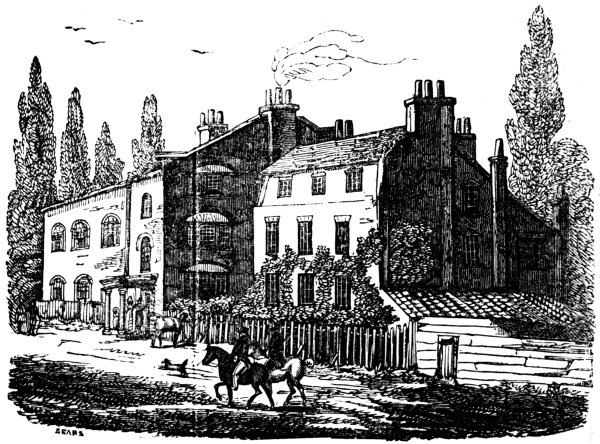
Hornsey-wood House.
A house of entertainment—in a place So rural, that it almost doth deface The lovely scene: for like a beauty-spot, Upon a charming cheek that needs it not, So Hornsey Tavern seems to me. And yet, Tho’ nature be forgotten, to forget The artificial wants of the forgetters, Is setting up oneself to be their betters. This is unwise; for they are passing wise, Who have no eyes for scenery, and despise Persons like me, who sometimes have sensations Through too much sight, and fall in contemplations, Which, as cold waters cramp and drown a swimmer, Chill and o’erwhelm me. Pleasant is that glimmer, Whereby trees seem but wood:—The men who know No qualities but forms and uses, go Through life for happy people:—they are so.
*
Hornsey-wood house is beyond the Sluice-house, from whence anglers and other visitors pass to it through an upland meadow, along a straight gravel-path, angle-wise. It is a good, “plain, brown brick,” respectable, modern, London looking building. Within the entrance to the left, is a light and spacious room of ample accommodation, and of which more care has been taken, than of its fine leather-folding screen in ruins—an unseemly sight for him, who respects old requisites for their former beauty and convenience. This once partook of both, but disuse hath abused and “time hath written strange defeatures” on its face, which in its early days was handsome. It still bears some remains of a spirited painting, spread all over its leaves, to represent the amusements and humours of a fair in the low countries. At the top of a pole, which may have been the village May-pole, is a monkey with a cat on his back; then there is a sturdy bear-ward, in scarlet, with a wooden leg, exhibiting his bruin; an old woman telling fortunes to the rustics; a showman’s drummer on a stage before a booth, beating up for spectators to the performance within, which the show-cloth represents to be a dancer on the tight-rope; a well set-out stall of toys, with a woman displaying their attractions; besides other really interesting “bits” of a crowded scene, depicted by no mean hand, especially a group coming from a church in the distance, apparently a wedding procession, the females well-looking and well dressed, bearing ribbons or scarfs below their waists in festoons. The destruction of this really interesting screen by worse than careless keeping, is to be lamented. This ruin of art is within a ruin of nature. Hornsey-tavern and its grounds have displaced a romantic portion of the wood, the remains of which, however, skirt a large and pleasant piece of water, formed at a considerable expense.
Lake of Hornsey-wood House.
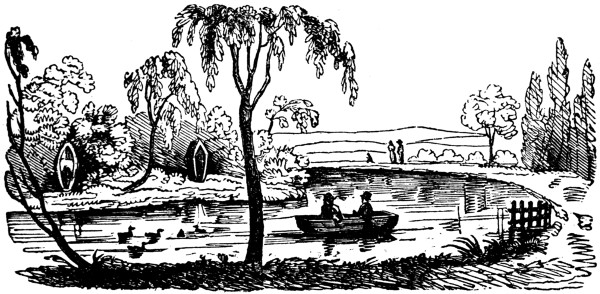
Lake of Hornsey-wood House.
To this water, which is well stored with fish, anglers resort with better prospect of success than to the New River; the walk around it, and the prospect, are very agreeable.
The old Hornsey-wood house well became its situation; it was embowered, and seemed a part of the wood. Two sisters, Mrs. Lloyd and Mrs. Collier, kept the house; they were ancient women; large in size, and usually sat before their door, on a seat fixed between two venerable oaks, wherein swarms of bees hived themselves. Here the venerable and cheerful dames tasted many a refreshing cup, with their good-natured customers, and told tales of by-gone days, till, in very old age, one of them passed to her grave, and the other followed in a few months. Each died regretted by the frequenters of the rural dwelling, which was soon afterwards pulled down, and the old oaks felled, to make room for the present roomy and more fashionable building. To those who were acquainted with it in its former rusticity, when it was an unassuming “calm retreat,” it is indeed an altered spot. To produce the alteration, a sum of ten thousand pounds was expended by the present proprietor, and Hornsey-wood tavern is now a well-frequented house. The pleasantness of its situation is a great attraction in fine weather.
Chronology.
1802. On the 3d of June, madame Mara, the celebrated singer, took leave of the English public. The Dictionary of Musicians, in recording the performance, observes, that never certainly was such a transcendent exercise of ability as a duet composed to display the mutual accomplishments of madame Mara and Mrs. Billington, which they sung with mutual excitement to the highest pitch of scientific expression.
Madame Mara was born at Cassel, in Germany, in 1750. Her paternal name was Schmelling. Her early years were devoted to the study of the violin, which, as a child, she played in England, but quitted that instrument, and became a singer, by the advice of the English ladies, who disliked a “female fiddler.” To this, perhaps, we owe the delight experienced from the various excellencies of the most sublime singer the world ever saw. Her first efforts were in songs of agility, yet her intonation was fixed by the incessant practice of plain notes. To confirm the true foundation of all good singing, by the purest enunciation, and the most precise intonation of the scale, was the study of her life, and the part of her voicing upon which she most valued herself. The late Dr. Arnold saw Mara dance, by way of experiment, and assume the most violent gesticulations, while going up and down the scale; yet such was her power of chest, that the tone was as undisturbed and free as if she had stood in the customary quiet position of the orchestra. The Italians say, that “of the hundred requisites to make a singer, he who has a fine voice has ninety-nine.” Mara had certainly the ninety-nine in one. Her voice was in compass from G to E in altissimo, and all its notes were alike even and strong; but she had the hundredth also in a supereminent degree, in the grandest and most sublime conception. At the early age of twenty-four, when she was at Berlin, in the immaturity of her judgment and her voice, the best critics admitted her to have exceeded Cuzzoni, Faustina, and indeed all those who preceded her. Our age has since seen Billington and Catalani, yet in majesty and truth of expression (a term comprehending the most exalted gifts and requisites of vocal science,) Mara retains her superiority. From her we deduce all that has been learned concerning the great style of singing. The memory of her performance of Handel’s sublime work, ‘I know that my Redeemer liveth,’ is immortalized, together with the air itself. Often as we have since heard it, we have never witnessed even an approach to the simple majesty of Mara: it is to this air alone that she owes her highest preeminence; and they who, not having heard her, would picture to themselves a just portraiture of her performance, must image a singer who is fully equal to the truest expression of the inspired words, and the scarcely less inspired music of the loftiest of all possible compositions. She was the child of sensibility: every thing she did was directed to the heart; her tone, in itself pure, sweet, rich, and powerful, took all its various colourings from the passion of the words; and she was not less true to nature and feeling in ‘The Soldier tir’d,’ and in the more exquisite, ‘Hope told a flattering tale,’ than in ‘I know that my Redeemer liveth.’ Her tone, perhaps, was neither so sweet nor so clear as Billington’s, nor so rich and powerful as Catalani’s, but it was the most touching language of the soul. It was on the mastery of the feelings of her audience that Mara set her claims to fame. She left surprise to others, and was wisely content with an apparently, but not really humbler, style; and she thus chose the part of genuine greatness.” Her elocution must be taken rather as universal than as national; for although she passed some time in England when a child, and retained some knowledge of the language, her pronunciation was continually marred by a foreign accent, and those mutilations of our words which are inseparable from the constant use of foreign languages, during a long residence abroad. Notwithstanding this drawback, the impression she made, even upon uneducated persons, always extremely alive to the ridiculous effects of mispronunciation, and upon the unskilled in music, was irresistible. The fire, dignity, and tenderness of her vocal appeal could never be misunderstood; it spoke the language of all nations, for it spoke to the feelings of the human heart. Mrs. Billington, with a modesty becoming her great acquirements, voluntarily declared, that she considered Mara’s execution to be superior to her own in genuine effect, though not in extent, compass, rapidity, and complication. Mara’s divisions always seemed to convey a meaning; they were vocal, not instrumental; they had light and shade, and variety of tone; they relaxed from or increased upon the time, according to the sentiment of which they always appeared to partake: these attributes were always remarkable in her open, true, and liquid shake, which was certainly full of expression. Neither in ornaments, learned and graceful as they were, nor in her cadences, did she ever lose sight of the appropriate characteristics of the sense of melody. She was, by turns, majestic, tender, pathetic, and elegant, but in the one or the other not a note was breathed in vain. She justly held every species of ornamental execution, to be subordinate to the grand end of uniting the effects of sound sense, in their operations upon the feelings of her hearers. True to this spirit, if any one commended the agility of a singer, Mara would ask, “Can she sing six plain notes?” In majesty and simplicity, in grace, tenderness, and pathos, in the loftiest attributes of art, in the elements of the great style, she far transcended all her competitors in the list of fame. She gave to Handel’s compositions their natural grandeur and effect, which is, in our minds, the very highest degree of praise that we can bestow. Handel is heavy, say the musical fashion-mongers of the day. Milton would be heavy beyond endurance, from the mouth of a reader of talents even above mediocrity. The fact is, that to wield such arms, demands the strength of giants. Mara possessed this heaven-gifted strength. It was in the performance of Handel that her finer mind fixed its expression, and called to its aid all the powers of her voice, and all the acquisitions of her science. From the time of her retirement from England, Mara chiefly resided in Russia; yet as the conflagration of Moscow destroyed great part of her property, towards the close of the year 1819, or the beginning of 1820, she returned to London, and determined on presenting herself once more to the judgment of the English public, who had reverenced her name so highly and so long. She, consequently, had a concert at the Opera-house, but her powers were so diminished that it proved unsuccessful.
Justice to the channel which supplies these particulars concerning madame Mara requires it to be observed, that they are almost verbatim from a book of great merit and extensive usefulness, The Dictionary of Musicians. Its information obviously results from extensive research concerning the deceased, and personal acquaintance with many of the living individuals whose memoirs it contains. The work has experienced the fate of originality and excellence—it has been pillaged without acknowledgment; and the discovery of an error or two, which the pillagers themselves were too ignorant to detect, have enabled them to abuse it. Although written by scientific hands, it is exempt from the meanness of envy, and honestly renders honour to whom honour is due. It is a book full of facts, with interspersions of anecdote so eloquently related, that it is one of the pleasantest works a lover of literature can take up, and is therefore not only a valuable accession to our biographical collections, but to our stores of amusement.
FLORAL DIRECTORY.
Rosa de meaux. Rosa provincialis. Dedicated to St. Cecilius.
June 4.
St. Quirinus, Bp. A. D. 304. St. Optatus, Bp. 4th Cent. St. Walter, Abbot, 13th Cent. St. Petroc, or Perreuse, Abbot, 6th Cent. St. Breaca, or Breague. St. Burian. St. Nenooc, or Nennoca, A. D. 467.
Chronology.
1738. King George III. born: he began his reign, October 25, 1760, and died, January 29, 1820.
FLORAL DIRECTORY.
Indian Pink. Dianthus Chinensis. Dedicated to St. Quirinus.
June 5.
St. Boniface, 8th Cent. St. Dorotheus, of Tyre St. Dorotheus, Abbot, 4th Cent. St. Illidius, Bp. 4th Cent.
St. Boniface.
This saint is in the church of England calendar. His name was Winfred. He was born at Crediton in Devonshire, educated in a Benedictine monastery at Exeter, sent to Friesland as a missionary, became archbishop of Mentz and primate of Germany and Belgium, and obtained the appellation of apostle of the Germans. His conversions were extensive, but many of them were effected by pious frauds; he was murdered in East Friesland by the peasantry, while holding a confirmation, in 755.
Chronology.
1814. From a newspaper of June the 5th in that year it appears, that on the preceding Sunday morning, while the sexton of All Saints’ church, at Stamford, was engaged in ringing the bells, two youths, named King and Richards, through mere emulation, ascended the steeple by means of the crotchets, or projecting stones on the outside of that beautiful and lofty spire. The projecting stones on which they stepped in the ascent are twenty-six in number, three feet asunder, and the summit of the spire 152 feet from the ground. In ten or twelve minutes the feat was performed, and the adventurers had safely descended; one of them (Richards) having hung his waistcoat on the weathercock as a memento.
FLORAL DIRECTORY.
Three-leaved Rose. Rosa Sinica. Dedicated to St. Boniface.
June 6.
St. Norbert, A. D. 1134. St. Philip the Deacon, A. D. 58. St. Gudwall, Bp. 6th Cent. St. Claude, Abp. A. D. 696 or 703.
Chronology.
1762. George lord Anson, the circumnavigator of the world, died, at Moor-park, near Rickmansworth, Herts; he was born at Shuckborough, in Staffordshire, in 1700.
Abduction.
This offence was by no means uncommon in England some years ago. In the London Chronicle for 1762, there is an extract from a letter, dated “Sunday, Highgate, June 6,” from whence it appears, that on that morning, between twelve and one, a postchaise, in which was a lady, was driven through that place very furiously by two postillions, and attended by three persons who had the appearance of gentlemen, from which she cried out, “Murder! save me! Oh, save me!” Her voice subsided from weakness into faint efforts of the same cries of distress; but as there was at that time no possibility of relief, they hastily drove towards Finchley Common. “From another quarter,” says the London Chronicle, “we have undoubted intelligence of the same carriage being seen, and the same outcries heard, as it passed through Islington, with the additional circumstance of the two postillions being in their shirts. Is this outrage to be suffered in England?”
FLORAL DIRECTORY.
Common Pink. Dianthus deltoides. Dedicated to St. Norbert.
June 7.
St. Paul, Bp. of Constantinople, A. D. 350, or 351. St. Robert, Abbot, A. D. 1159. St. Colman, Bp. of Dromore, A. D. 610. St. Godeschalc, Prince of the Western Vandals, and his companions. St. Meriadec, Bp. A. D. 1302.
Chronology.
1779. William Warburton, bishop of Gloucester, died. He was born at Newark-upon-Trent, in 1698, followed the profession of an attorney, relinquished it for the church, and became an eminently able and learned prelate. His writings are distinguished by genius, but deformed by a haughty and vindictive spirit.
FLORAL DIRECTORY.
Red Centaury. Chironia centaureum. Dedicated to St. Paul.
June 8.
St. Medard, Bp. 6th Cent. St. Gildard, or Godard, Bp. A. D. 511. St. Maximinus, 1st Cent. St. William, Abp. of York, A. D. 1154. St. Clou, or Clodulphus, Bp. A. D. 696. St. Syra, 7th Cent.
Thimble and Pea.
On the 8th of June, 1825, a publican in the neighbourhood of Whitechapel was charged at the Public Office, Bow-street, by Mr. John Francis Panchaud, a foreigner, with having, in conjunction with several other persons, defrauded him of a 10l. note, at Ascot Heath race-course, on the Thursday preceding. The alleged fraud, or robbery, was effected by means of an unfair game known among the frequenters of races and fairs by the name of “the thimble rig,” of which J. Smith, the officer, this day gave the following description to Mr. Minshull, in order that the worthy magistrate might perfectly understand the case:—A gang of seven or eight, or more, set up a table, but they all appear strangers to each other, and unconnected with the game, except one who conducts it, and who appears to be the sole proprietor. This master of the ceremonies has three thimbles, and is provided with a number of peas, or pepper-corns. He puts one under each thimble, or perhaps only under one or two, as the case may be. He then offers a bet as to which thimble a pepper-corn is or is not under, and offers at first such a wager as is eagerly taken by those round the table, and he loses. He pays the losings freely, and the other members of this joint-stock company affect to laugh at him, as what they call a “good flat.” Having thus drawn the attention, and probably excited the cupidity of a stranger, who appears to have money, they suffer him to win a stake or two, and get him to increase his bets. When he seems thoroughly in the humour, the master of the table lifts a thimble, under which is a pepper-corn, and turning his head aside to speak to some one, he suffers the corn to roll off; and, seeming to be unconscious of this, he replaces the thimble, and offers bets to any amount that there is a corn underneath that particular thimble. The stranger having seen the corn roll off “with his own eyes,” as the phrase is, chuckles to himself, and eagerly takes the bet; the thimble is removed, and behold!—there is a pepper-corn under it still, the fellow having dexterously slipped another under it when the first rolled off the table. “So that the plain fact is, sir,” continued Smith, “that the stranger, fancying he is taking in the master of the table, cheerfully stakes his money with a dead certainty, as he supposes, of winning, and he finds that he has been taken in himself.” Smith said, he had known instances of gentlemen getting from their carriages, and in a few moments ridding themselves of 20l. or 30l., or perhaps more, and going off wondering at their folly, and looking uncommon silly.
It appeared that Mr. Panchaud went up to one of these tables, at which the defendant and many others were playing, and after winning two or three times, the trick above described was commenced. The conductor of the game offered a bet of 5l., and Mr. Panchaud having seen the pepper-corn roll off, took the wager, and put down a 10l. note. In a moment after there was a general hustling, the table was upset, and the whole party speedily disappeared, together with the 10l. note. When the bet was offered, the defendant, who stood next to him, jogged his elbow, and said eagerly, “Bet him, bet him; you must win, the ball is under our feet.” Mr. Panchaud had no doubt, from his whole manner, that the defendant was concerned with the others in the trick. The case stood over for further investigation. It is only mentioned here for the purpose of showing a species of slight of hand continued in our own times to defraud the unwary.
FLORAL DIRECTORY.
Moneywort. Lysimachia nummularia. Dedicated to St. Medard.
Passion Flower
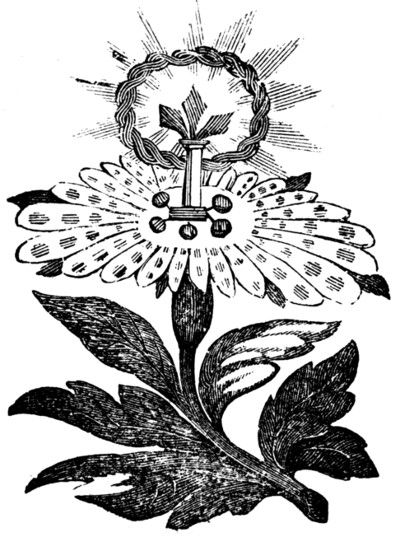
Passion Flower
This flower, says the elegant author of the Flora Domestica, derives its name from an idea, that all the instruments of Christ’s passion are represented in it.
The above engraving from an ancient print, shows the curious distortion of the flower in those parts whereon the imagination has indulged. The original print bears an inscription to this effect; that nature itself grieves at the crucifixion, as is denoted by the flower representing the five wounds, and the column or pillar of scourging, besides the three nails, the crown of thorns, &c.
Most of the passion-flowers are natives of the hottest parts of America. The rose coloured passion-flower is a native of Virginia, and is the species which was first known in Europe. It has since been, in a great measure, superseded by the blue passion-flower, which is hardy enough to flower in the open air, and makes an elegant tapestry for an unsightly wall. The leaves of this, in the autumn, are of the most brilliant crimson; and, when the sun is shining upon them, seem to transport one to the gardens of Pluto.[165]
June 9.
Sts. Primus and Felicianus, A. D. 286. St. Columba, or Columkille, A. D. 597. St. Pelagia, A. D. 311. St. Vincent, 3d Cent. St. Richard, Bp. of Andria, 5th Cent.
Chronology.
1760. Nicholas Lewes, count Zinzendorf, a native of Saxony, and founder of the religious society called Moravians, died at Chelsea.
FLORAL DIRECTORY.
Barberry. Barberis vulgaris. Dedicated to St. Columba.
June 10.
St. Margaret, Queen of Scotland, A. D. 1093. St. Getulius and companions, 2d Cent. St. Landry, or Landericus, Bp. A. D. 650. B. Henry of Treviso, A. D. 1315.
Chronology.
1735. Thomas Hearne, the learned antiquary, died at Oxford: he was born at White Waltham, in Berkshire, in 1680.
FLORAL DIRECTORY.
Yellow Fleur-de-lis. Iris Pseudacorus. Dedicated to St. Margaret.
June 11.
St. Barnabas, Apostle, 1st Cent. St. Tochumra, of Tochumrach in Ireland. Another St. Tochumra, diocese of Kilmore.
St. Barnabas the Apostle.
He was of the tribe of Levi, and coadjutor with the apostle Paul for several years. Though denominated an apostle, it seems agreed that he was not entitled to that character; if he were, his extant epistle would have equal claim with the writings of the other apostles to a place among the books in the New Testament. He is said to have been martyred, but of this there is not sufficient evidence.
St. Barnabas’ Day.
This was a high festival in England formerly.
Besides the holy thorn, there grew in the abbey churchyard of Glastonbury, on the north side of St. Joseph’s chapel, a miraculous walnut-tree, which never budded forth before the feast of St. Barnabas, viz. the eleventh of June, and on that very day shot forth leaves, and flourished like its usual species. This tree is gone, and in the place thereof stands a very fine walnut-tree of the common sort. It is strange to say how much this tree was sought after by the credulous; and, though not an uncommon walnut, queen Anne, king James, and many of the nobility of the realm, even when the times of monkish superstition had ceased, gave large sums of money for small cuttings from the original.[166]
Midsummer, or nightless days, now begin and continue until the 2d of July.[167] There is still this saying among country people,—
“Barnaby Bright, Barnaby Bright, The longest day and the shortest night.”
FLORAL DIRECTORY.
Midsummer Daisy. Chrysanthemum Leucanthemum. Dedicated to St. Barnabas.
June 12.
St. John, Hermit, A. D. 1479. St. Basilides, Quirinus, or Cyrinus, Nabor, and Nazarius. St. Eskill, Bp. St. Onuphrius, Hermit. St. Ternan, Bp. of the Picts.
Chronology.
1734. The duke of Berwick, illegitimate son of James II., by Arabella Churchill, sister to the great duke of Marlborough, was killed by a cannon ball, at the siege of Phillipsburgh, in Germany, in the 64th year of his age. He was only excelled in the art of war by the duke of Marlborough himself.
FLORAL DIRECTORY.
White Dog Rose. Rosa arvensis. Dedicated to St. John.
June 13.
St. Antony of Padua, A. D. 1231. St. Damhanade.
Chronology.
1625. Henrietta Maria, youngest daughter to Henry IV. of France, landed at Dover, and was married to Charles I., at Canterbury, on the same day; her portraits represent her to have been beautiful. She was certainly a woman of ability, but faithless to her unfortunate consort, after whose death on the scaffold she lived in France, and privately married her favourite, the lord Jermyn, a descendant of whom, with that name, is (in 1825,) a grocer in Chiswell-street, and a member of the society of friends. Henrietta Maria, though a Bourbon, was so little regarded in the court of the Bourbons, and reduced to so great extremity, that she was without fuel for her fire-place during the depth of winter, in the palace assigned to her by the French monarch.
FLORAL DIRECTORY.
Garden Ranunculus. Ranunculus Asiaticus. Dedicated to St. Antony.
June 14.
St. Basil, Abp. A. D. 379. Sts. Rufinus and Valerius, 3d Age. St. Methodius, Patriarch of Constantinople, A. D. 846. St. Docmael, 6th Cent. St. Nennus, or Nehemias, Abbot, A. D. 654. St. Psalmodius, A. D. 630.
Chronology.
1645. The battle of Naseby, between the royalists under Charles I., and the parliament troops under Fairfax, was decided this day by the entire rout of the king’s army, and the seizure of all his artillery and ammunition. Among the spoil was the king’s cabinet with his letters, which the parliament afterwards published. Hume says, “they give an advantageous idea both of the king’s genius and morals.” Yet it is a fact, which every person who reads the correspondence must inevitably arrive at, that the king purposed deception, when he professed good faith, and that, as true genius never exists with fraud, these letters do not entitle him to reputation for common honesty, or real ability.
FLORAL DIRECTORY.
Sweet Basil. Oscimum Basilicum. Dedicated to St. Basil.
June 15.
Sts. Vitus, or Guy, Crescentia, and Modestus, 4th Cent. St. Landelin, Abbot, A. D. 686. B. Bernard, of Menthon, A. D. 1008. St. Vauge, Hermit, A. D. 585. B. Gregory Lewis Barbadigo, Cardinal Bp. A. D. 1697.
St. Vitus.
This saint was a Sicilian martyr, under Dioclesian. Why the disease called St. Vitus’s dance was so denominated, is not known. Dr. Forster describes it as an affection of the limbs, resulting from nervous irritation, closely connected with a disordered state of the stomach and bowels, and other organs of the abdomen. In papal times, fowls were offered on the festival of this saint, to avert the disease. It is a vulgar belief, that rain on St. Vitus’s day, as on St. Swithin’s day, indicates rain for a certain number of days following.
It is related, that after St. Vitus and his companions were martyred, their heads were enclosed in a church wall, and forgotten, so that no one knew where they were, until the church was repaired, when the heads were found, and the church bells began to sound of themselves, which causing inquiry, a writing was found, authenticating the heads; they consequently received due honour, and worked miracles in due form.
FLORAL DIRECTORY.
Sensitive Plant. Mimosa sensit. Dedicated to St. Vitus.
CEREMONY OF LAYING THE First Stone of the New London-bridge, ON WEDNESDAY, THE 15th OF JUNE, 1825.
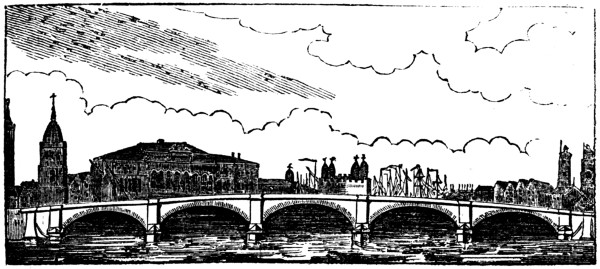
New London-bridge.
London, like famous old Briareus, With fifty heads and twice told fifty arms, Laid one strong arm across yon noble flood, For free communication with each shore; Hence, though the thews and sinews sink and shrink, And we so manifold and strong have grown, That a renewal of the limb for purposes Of national and private weal be requisite, It is to be regarded as a friend That oft hath served us in our utmost need, With all its strength. Be ye then merciful, Good citizens, to this our ancient “sib,” Operate on it tenderly, and keep Some fragments of it, as memorials Of its former worth: for our posterity Will to their ancestors do reverence, As we, ourselves, do reverence to ours.—
*
The present engraving is from the design at the head of the admission tickets, and is exactly of the same form and dimensions; the tickets themselves were large cards of about the size that the present leaf will present when bound in the volume, and cut round the edges.
COPY OF THE TICKET.
Admit the Bearer to witness The Ceremony of laying THE FIRST STONE of the New London-bridge, on Wednesday, the 15th day of June, 1825.
(Signed) Heny Woodthorpe, Jun.
Clerk of the Committee.
Seal of the City Arms.
N.B. The access is from the present bridge, and the time of admission will be between the hours of twelve and two.
No 281.
It has been truly observed of the design for the new bridge, that it is striking for its contrast with the present gothic edifice, whose place it is so soon to supply. It consists but of five elliptical arches, which embrace the whole span of the river, with the exception of a double pier on either side, and between each arch a single pier of corresponding design: the whole is more remarkable for its simplicity than its magnificence; so much, indeed, does the former quality appear to have been consulted, that it has not a single balustrade from beginning to end.
New London-bridge is the symbol of an honourable British merchant: it unites plainness with strength and capacity, and will be found to be more expansive and ornamental, the more its uses and purposes are considered.
The following are to be the dimensions of the new bridge:—
Centre arch—span, 150 feet; rise, 32 feet; piers, 24 feet.
Arches next the centre arch—span, 140 feet; rise, 30 feet; piers 22 feet.
Abutment arches—span, 130 feet; rise, 25 feet; abutment, 74 feet.
Total width, from water-side to water-side, 690 feet.
Length of the bridge, including the abutments, 950 feet; without the abutments, 782 feet.
Width of the bridge, from outside to outside of the parapets, 55 feet; carriage-way, 33 feet 4 inches.
“Go and set London-bridge on fire,” said Jack Cade, at least so Shakspeare makes him say, to “the rest” of the insurgents, who, in the reign of Henry VI., came out of Kent, took the city itself, and there raised a standard of revolt against the royal authority. “Sooner said than done, master Cade,” may have been the answer; and now, when we are about to erect a new one, let us “remember the bridge that has carried safe over.” Though its feet were manifold as a centipede’s, and though, in gliding between its legs, as it
“doth bestride the Thames,”
some have, ever and anon, passed to the bottom, and craft of men, and craft with goods, so perished, yet the health and wealth of ourselves, and those from whom we sprung, have been increased by safe and uninterrupted intercourse above.
By admission to the entire ceremony of laying the first stone of the new London-bridge, the editor of the Every-Day Book is enabled to give an authentic account of the proceedings from his own close observation; and therefore, collating the narratives in every public journal of the following day, by his own notes, he relates the ceremonial he witnessed, from a chosen situation within the coffer-dam.
At an early hour of the morning the vicinity of the new and old bridges presented an appearance of activity, bustle, and preparation; and every spot that could command even a bird’s-eye view of the scene, was eagerly and early occupied by persons desirous of becoming spectators of the intended spectacle, which, it was confidently expected, would be extremely magnificent and striking; these anticipations were in no way disappointed.
So early as twelve o’clock, the avenues leading to the old bridge were filled with individuals, anxious to behold the approaching ceremony, and shortly afterwards the various houses, which form the streets through which the procession was to pass, had their windows graced with numerous parties of well-dressed people. St. Magnus’ on the bridge, St. Saviour’s church in the Borough, Fishmongers’-hall, and the different warehouses in the vicinity, had their roofs covered with spectators; platforms were erected in every nook from whence a sight could be obtained, and several individuals took their seats on the Monument, to catch a bird’s-eye view of the whole proceedings. The buildings, public or private, that at all overlooked the scene, were literally roofed and walled with human figures, clinging to them in all sorts of possible and improbable attitudes. Happy were they who could purchase seats, at from half a crown to fifteen shillings each, for so the charge varied, according to the degree of accommodation afforded. As the day advanced, the multitude increased in the street; the windows of the shops were closed, or otherwise secured, and those of the upper floors became occupied with such of the youth and beauty of the city as has not already repaired to the river: and delightfully occupied they were: and were the sun down, as it was not, it had scarcely been missed—for there—
“From every casement came the light, Of women’s eyes, so soft and bright, Peeping between the trelliced bars, A nearer, dearer heaven of stars!”
The wharfs on the banks of the river, between London-bridge and Southwark-bridge, were occupied by an immense multitude. Southwark-bridge itself was clustered over like a bee-hive; and the river from thence to London-bridge presented the appearance of an immense dock covered with vessels of various descriptions; or, perhaps, it more closely resembled a vast country fair, so completely was the water concealed by multitudes of boats and barges, and the latter again hidden by thousands of spectators, and canvass awnings, which, with the gay holiday company within, made them not unlike booths and tents, and contributed to strengthen the fanciful similitude. The tops of the houses had many of them also their flags and awnings; and, from the appearance of them and the river, one might almost suppose the dry and level ground altogether deserted, for this aquatic fete, worthy of Venice at her best of times. All the vessels in the pool hoisted their flags top-mast-high, in honour of the occasion, and many of them sent out their boats manned, to increase the bustle and interest of the scene.
At eleven o’clock London-bridge was wholly closed, and at the same hour Southwark-bridge was thrown open, free of toll. At each end of London-bridge barriers were formed, and no persons were allowed to pass, unless provided with tickets, and these only were used for the purpose of arriving at the coffer-dam. There was a feeling of awful solemnity at the appearance of this, the greatest thoroughfare of the metropolis, now completely vacated of all its foot-passengers and noisy vehicles.
At one o’clock the lord mayor and sheriffs arrived at Guildhall, the persons engaged in the procession having met at a much earlier hour.
The lady mayoress and a select party went to the coffer-dam in the lord mayor’s private state carriage, and arrived at the bridge about half-past two o’clock.
The Royal Artillery Company arrived in the court-yard of the Guildhall at two o’clock.
The carriages of the members of parliament and other gentlemen, forming part of the procession, mustered in Queen-street and the Old Jewry.
At twelve o’clock, the barrier at the foot of the bridge on the city side of the river was thrown open, and the company, who were provided with tickets for the coffer-dam, were admitted within it, and kept arriving till two o’clock in quick succession. At that time the barriers were again closed, and no person was admitted till the arrival of the chief procession. By one o’clock, however, most of the seats within the coffer-dam were occupied, with the exception of those reserved for the persons connected with the procession.
The tickets of admission issued by the committee, consisting of members of the court of common council, were in great request. By their number being judiciously limited, and by other arrangements, there was ample accommodation for all the company. At the bottom of each ticket, there was a notice to signify that the hours of admission were between twelve and two, and not a few of the fortunate holders were extremely punctual in attending at the first mentioned hour, for the purpose of securing the best places. They were admitted at either end of the bridge, and passed on till they came to an opening that had been made in the balustrade, leading to the platform that surrounded the area of the proposed ceremony. This was the coffer-dam formed in the bed of the river, for the building of the first pier, at the Southwark side. The greatest care had been taken to render the dam water-tight, and during the whole of the day, from twelve till six, it was scarcely found necessary to work the steam-engine a single stroke. On passing the aperture in the balustrade, already mentioned, the company immediately arrived on a most extensive platform, from which two staircases divided—the one for the pink tickets, which introduced the possessor to the lowest stage of the works, and the other for the white ones, of less privilege, and which were therefore more numerous. The interior of the works was highly creditable to the committee. Not only were the timbers, whether horizontal or upright, of immense thickness, but they were so securely and judiciously bolted and pinned together, that the liability of any danger or accident was entirely done away with. The very awning which covered the whole coffer-dam, to ensure protection from the sun or rain, had there been any, was raised on a little forest of scaffolding poles, which, any where but by the side of the huge blocks of timber introduced immediately beneath, would have appeared of an unusual stability. In fact, the whole was arranged as securely and as comfortably as though it had been intended to serve the time of all the lord mayors for the next century to come, while on the outside, in the river, every necessary precaution was taken to keep off boats, by stationing officers there for that purpose. With the exception of the lower floor, which, as already mentioned, was only attainable by the possession of pink tickets, and a small portion of the floor next above it, the whole was thrown open without reservation, and the visitors took possession of the unoccupied places they liked best.
The entire coffer-dam was ornamented with as much taste and beauty as the purposes for which it was intended would possibly admit. The entrance to the platform from the bridge, was fitted up with crimson drapery, tastefully festooned. The coffer-dam itself was divided into four tiers of galleries, along which several rows of benches, covered with scarlet cloth, were arranged for the benefit of the spectators. It was covered with canvass to keep out the rays of the sun, and from the transverse beams erected to support it, which were decked with rosettes of different colours, were suspended flags and ensigns of various descriptions brought from Woolwich yard; which by the constant motion in which they were kept, created a current of air, which was very refreshing. The floor of the dam, which is 45 feet below the high water mark, was covered, like the galleries, with scarlet cloth, except in that part of it where the first stone was to be laid. The floor is 95 feet in length, and 36 in breadth; is formed of beech planks, four inches in thickness, and rests upon a mass of piles, which are shod at the top with iron, and are crossed by immense beams of solid timber. By two o’clock all the galleries were completely filled with well-dressed company, and an eager impatience for the arrival of the procession was visible in every countenance. The bands of the Horse Guards, red and blue, and also that of the Artillery Company, played different tunes, to render the interval of expectation as little tedious as possible; but, in spite of all their endeavours, a feeling of listlessness appeared to pervade the spectators.—In the mean time the arrangements at Guildhall being completed, the procession moved from the court-yard, in the following order:—
A body of the Artillery Company.
Band of Music.
Marshalmen.
Mr. Cope, the City Marshal, mounted, and in the full uniform of his Office.
The private carriage of — Saunders, Esq., the Water Bailiff, containing the Water-Bailiff, and Nelson, his Assistant.
Carriage containing the Barge-masters.
City Watermen bearing Colours.
A party of City Watermen without Colours.
Carriage containing Messrs. Lewis and Gillman, the Bridge-masters, and the Clerk of the Bridge-house Estate.
Another party of the City Watermen.
Carriage containing Messrs. Jolliffe and Sir E. Banks, the Contractors for the Building of the New Bridge.
Model of the New Bridge.
Carriages containing Members of the Royal Society.
Carriage containing John Holmes, Esq., the Bailiff of Southwark.
Carriage containing the Under-Sheriffs.
Carriages containing Thomas Shelton, Esq., Clerk of the Peace for the City of London; W. L. Newman, Esq., the City Solicitor; Timothy Tyrrell, Esq., the Remembrancer; Samuel Collingridge, Esq., and P. W. Crowther, Esq., the Secondaries; J. Boudon, Esq., Clerk of the Chamber; W. Bolland, Esq., and George Bernard, Esq., the Common Pleaders; Henry Woodthorpe, Esq., the Town Clerk; Thomas Denman, Esq., the Common Sergeant; R. Clarke, Esq., the Chamberlain.
These Carriages were followed by those of several Members of Parliament.
Carriages of Members of the Privy Council.
Band of Music and Colours, supported by City Watermen.
Members of the Goldsmiths’ (the Lord Mayor’s) Company.[783, 784]
Marshalmen.
Lord Mayor’s Servants in their State Liveries.
Mr. Brown, the City Marshal, mounted on horseback, and in the full uniform of his Office.
The Lord Mayor’s State Carriage, drawn by six bay horses, beautifully caparisoned, in which were his Lordship and the Duke of York.
The Sheriffs, in their State Carriages.
Carriages of several Aldermen who have passed the Chair.
Another body of the Royal Artillery Company.
The procession moved up Cornhill and down Gracechurch-street, to London-bridge. While awaiting the arrival of the procession, wishes were wafted from many a fair lip, that the lord of the day, as well as of the city, would make his appearance. Small-talk had been exhausted, and the merits of each particular timber canvassed for the hundredth time, when, at about a quarter to three, the lady mayoress made her appearance, and renovated the hopes of the company. They argued that his lordship as a family man, would not be long absent from his lady. The clock tolled three, and no lord mayor had made his appearance. At this critical juncture a small gun made its report; but, except the noise and smoke, it produced nothing. More than an hour elapsed before the eventful moment arrived; a flourish of trumpets in the distance gave hope to many hearts, and finally two six-pounders of the Artillery Company, discharged from the wharf at Old Swan Stairs, at about a quarter-past four o’clock, announced the arrival of the cavalcade. Every one stood up, and in a very few minutes the city watermen, bearing their colours flying, made their appearance at the head of the coffer-dam, and would, if they could, have done the same thing at the bottom of it; but owing to the unaccommodating narrowness of the staircase, they found it inconvenient to convey their flags by the same route that they intended to convey themselves. Necessity, however, has long been celebrated as the mother of invention, and a plan was hit upon to wind the flags over this timber and under that, till after a very serpentine proceeding, they arrived in safety at the bottom. After this had been accomplished, there was a sort of pause, and every body seemed to be thinking of what would come next, when some one in authority hinted, that as the descent of the flags had been performed so dexterously, or for some other reason that did not express itself, they might as easily be conveyed back, so that the company, whose patience, by the bye, was exemplary, were gratified by the ceremony of those poles returning, till the arrival of the expected personages, satisfied every desire. A sweeping train of aldermen were seen winding in their scarlet robes through the mazes of the pink-ticketted staircase, and in a very few minutes a great portion of these dignified elders of the city made their appearance on the floor below, the band above having previously struck up the “Hunter’s Chorus” from Der Freischütz. Next in order entered a strong body of the common-councilmen, who had gone to meet the procession on its arrival at the barriers. Independently of those that made their appearance on the lower platform, glimpses of their purple robes with fur-trimmings, were to be caught on every stage of the scaffolding, where many of them had been stationed throughout the day. After these entered the recorder, the common sergeant, the city solicitor, the city clerk, the city chamberlain, and a thousand other city officers, “all gracious in the city’s eyes.” These were followed by the duke of York and the lord mayor, advancing together, the duke being on his lordship’s right hand. His royal highness was dressed in a plain blue coat with star, and wore at his knee the garter. They were received with great cheering, and proceeded immediately up the floor of the platform, till they arrived opposite the place where the first stone was suspended by a tackle, ready to be swung into the place that it is destined to occupy for centuries. Opposite the stone, an elbowed seat had been introduced into the line of bench, so as to afford a marked place for the chief magistrate, without breaking in upon the direct course of the seats. His lordship, who was in his full robes, offered the chair to his royal highness, which was positively declined on his part. The lord mayor therefore seated himself, and was supported on the right by his royal highness, and on the left by Mr. Alderman Wood. The lady mayoress, with her daughters in elegant dresses, sat near his lordship, accompanied by two fine-looking intelligent boys, her sons; near them were the two lovely daughters of lord Suffolk, and many other fashionable and elegantly dressed ladies. In the train which arrived with the lord mayor and his royal highness were the earl of Darnley, lord J. Stewart, the right hon. C. W. Wynn, M. P., sir G. Warrender, M. P., sir I. Coffin, M. P., sir G. Cockburn, M.P., sir R. Wilson, M.P., Mr. T. Wilson, M.P., Mr. W. Williams, M.P., Mr. Davies Gilbert, M.P., Mr. W. Smith, M.P., Mr. Holme Sumner, M.P., with several other persons of distinction, and the common sergeant, the city pleaders, and other city officers.
The lord mayor took his station by the side of the stone, attended by four gentlemen of the committee, bearing, one, the glasscut bottle to contain the coins of the present reign, another, an English inscription incrusted in glass, another, the mallet, and another, the level.
The sub-chairman of the committee, bearing the golden trowel, took his station on the side of the stone opposite the lord mayor.
The engineer, John Rennie, esq., took his place on another side of the stone, and exhibited to the lord mayor the plans and drawings of the bridge.
The members of the committee of management, presented to the lord mayor the cut glass bottle which was intended to contain the several coins.
The ceremony commenced by the children belonging to the wards’ schools, Candlewick, Bridge, and Dowgate, singing “God save the King.” They were stationed in the highest eastern gallery for that purpose; the effect produced by their voices, stealing through the windings caused by the intervening timbers to the depth below, was very striking and peculiar.
The chamberlain delivered to his lordship the several pieces of coin: his lordship put them into the bottle, and deposited the bottle in the place whereon the foundation stone was to be laid.
The members of the committee, bearing the English inscription incrusted on glasses, presented it to the lord mayor. His lordship deposited it in the subjacent stone.
Mr. Jones, sub-chairman of the Bridge Committee, who attended in purple gowns and with staves, presented the lord mayor, on behalf of the committee, with an elegant silver-gilt trowel, embossed with the combined arms of the “Bridge House Estate and the City of London,” and bearing on the reverse an inscription of the date, and design of its presentation to the right hon. the lord mayor, who was born in the ward, and is a member of the guild wherein the new bridge is situated. This trowel was designed by Mr. John Green, of Ludgate-hill, and executed by Messrs. Green, Ward, and Green, in which firm he is partner. Mr. Jones, on presenting it to the lord mayor, thus addressed his lordship: “My lord, I have the honour to inform you, that the committee of management has appointed your lordship, in your character of lord mayor of London, to lay the first stone of the new London-bridge, and that they have directed me to present to your lordship this trowel as a means of assistance to your lordship in accomplishing that object.”