MAY. (continued 2)
Reading edition
“Golden lads and lasses must, As chimney-sweepers, come to dust—
“James White is extinct, and with him these suppers have long ceased. He carried away with him half the fun of the world when he died—of my world at least. His old clients look for him among the pens; and, missing him, reproach the altered feast of St. Bartholomew, and the glory of Smithfield departed for ever.”
A philanthropist, who rejoices over every attempt to cheer helplessness, will not quarrel with the late annual treat of “Jem White.” Our kindnesses wear different fashions, and Elia’s report of the festival is a feast for a feeling and merry heart. Mrs. Montague’s entertainment to the London chimney-sweepers was held every May-day, at her house, in Portman-square; she gave them roast-beef and plumb-pudding, and a shilling each, and they danced after their dinner. But Mrs. Montague and Jem White are dead; and now the poor fellows, though the legislature has interfered for their protection, want “a next friend” to cheer them once a year, and acquaint the sufferers that they have sympathizers. An extract from a letter to the editor of the Every-Day Book, dated April 16, 1825, from Sheffield, in Yorkshire, is a reproach to us of the metropolis:—“In the ‘Chimney-sweepers’ Friend, and Climbing-boys’ Album,’ by Mr. James Montgomery, the poet, and editor of the ‘Sheffield Iris,’ is a literal representation of an annual dinner which that gentleman, and a few of us, give to the lads employed as climbing-boys in Sheffield. This we have done for about eighteen years in succession. From twenty-four to twenty-six attend; and their appearance, behaviour, and acquirements, (I may say,) do credit to their masters. They are a much better generation to look upon than they were when we first took them by the hand. On last Easter Monday, out of the twenty-four present, there were only two who did not attend Sunday-schools; which, in whatever estimation these institutions may be held, shows that once, at least, every week, these poor children looked like other people’s children, and associated with them; being clean washed, decently dressed, and employed in reading, or in learning to read: many of them could write. Something of the kind is projected at Leeds. A benevolent lady, at Derby, has this year raised friends, and a fund, for an annual dinner to the climbing-boys there on Easter Monday.” Mr. Montgomery’s “Chimney-sweepers’ Friend” is a series of representations calculated to assist “the immediate relief of the sufferers, and the gradual abolition of this home slave-trade in little children.” His applications to distinguished characters for literary contributions to his work were successful. “May I,” he said, “entreat your aid to this humble cause? Were you to see all the climbing-boys in the kingdom (and climbing-girls, too, for we have known parents who have employed their own daughters in this hideous way,) assembled in one place, you would meet a spectacle of deformed, degraded, and depraved humanity, in its very age of innocence, (pardon the phrase,) which would so affect your heart that we should be sure of your hand.” Not one being of humanity can read the statements in Mr. Montgomery’s volume with a dry eye—not one but before he has half perused it will resolve never to let a climbing-boy enter his chimney again. Fathers and mothers of England, read the book! The “Examiner,” some time ago, related an anecdote much to the purpose, from a pamphlet by Mr. J. W. Orderson, late of Barbadoes; it is a fine specimen of pure feeling. “About fourteen years ago,” says Mr. Orderson, “a Mrs. P. arrived at Bristol, from the West Indies, and brought with her a female Negro servant, mother of two or three children left in that country. A few days after their arrival, and they had gone into private lodgings, a sweep-boy was sent for by the landlady to sweep the kitchen chimney. This woman being seated in the kitchen when little Soot entered, was struck with amazement at the spectacle he presented; and with great vehemence, clapping her hands together, exclaimed, ‘Wha dis me see! La, la, dat buckara piccaninny! So help me, nyung Misse,’ (addressing herself to the housemaid then present,) ‘sooner dan see one o’mine piccaninnies tan so, I drown he in de sea.’ The progress of the poor child in sweeping the chimney closely engrossed her attention, and when she saw him return from his sooty incarceration, she addressed him with a feeling that did honour to her maternal tenderness, saying, ‘Child! come yaw, child,’ (and without waiting any reply, and putting a sixpence into his hand;) ‘Who you mammy? You hab daddy, too? Wha dem be, da la you go no chimney for?’ and moistening her finger at her lips, began to rub the poor child’s cheek, to ascertain, what yet appeared doubtful to her, whether he was really a buccara, (white.) I saw this woman some time after in the West Indies; and it was a congratulation to her ever after, that her ‘children were not born to be sweeps.’”
MAY-DAY IN IRELAND.
It appears from a volume of “Fairy Legends and Traditions of the South of Ireland,”[129] that there are romantic remains of antiquity connected with the celebration of May-day in that country of imagination. “Mummers in Ireland,” says the author, “are clearly a family of the same race with those festive bands, termed Morrice-dancers, in England. They appear at all seasons in Ireland, but May-day is their favourite and proper festival. They consist of a number, varying according to circumstances, of the girls and young men of the village or neighbourhood, usually selected for their good looks, or their proficiency,—the females in the dance, the youths in hurling and other athletic exercises. They march in procession, two abreast, and in three divisions; the young men in the van and the rear, dressed in white or other gay-coloured jackets or vests, and decorated with ribbons on their hats and sleeves; the young women are dressed also in light-coloured garments, and two of them bear each a holly bush, in which are hung several new hurling balls, the May-day present of the girls to the youths of the village. The bush is decorated with a profusion of long ribbons or paper cut in imitation, which adds greatly to the gay and joyous, yet strictly rural, appearance of the whole. The procession is always preceded by music; sometimes of the bagpipe, but more commonly of a military fife, with the addition of a drum or tamboureen. A clown is, of course, in attendance: he wears a frightful mask, and bears a long pole, with shreds of cloth nailed to the end of it, like a mop, which ever and anon he dips in a pool of water, or puddle, and besprinkles such of the crowd as press upon his companions, much to the delight of the younger spectators, who greet his exploits with loud and repeated shouts and laughter. The Mummers, during the day, parade the neighbouring villages, or go from one gentleman’s seat to another, dancing before the mansion-house, and receiving money. The evening, of course, terminates with drinking. May-eve is considered a time of peculiar danger. The ‘good people,’ are supposed then to possess the power and the inclination to do all sorts of mischief without the slightest restraint. The ‘evil eye’ is then also deemed to have more than its usual vigilance and malignity; and the nurse who would walk in the open air with a child in her arms, would be reprobated as a monster. Youth and loveliness are thought to be especially exposed to peril. It is therefore a natural consequence, that not one woman in a thousand appears abroad: but it must not be understood that the want of beauty affords any protection. The grizzled locks of age do not always save the cheek from a blast; neither is the brawny hand of the roughest ploughman exempt from a similar visitation. The blast is a large round tumour, which is thought to rise suddenly upon the part affected, from the baneful breath cast on it by one of the ‘good people’ in a moment of vindictive or capricious malice. May-day is called la na Beal tina, and May-eve neen na Beal tina,—that is, day and eve of Beal’s fire, from its having been in heathen times, consecrated to the god Beal, or Belus; whence also the month of May is termed in Irish ‘Mi na Beal-tine.’ The ceremony practised on May-eve, of making the cows leap over lighted straw, or faggots, has been generally traced to the worship of that deity. It is now vulgarly used in order to save the milk from being pilfered by ‘the good people.’—Another custom prevalent on May-eve is the painful and mischievous one of stinging with nettles. In the south of Ireland it is the common practice for school-boys, on that day, to consider themselves privileged to run wildly about with a bunch of nettles, striking at the face and hands of their companions, or of such other persons as they think they may venture to assault with impunity.”
A popular superstition related in the last quoted work, is, that at early dawn on May-morning, “the princely O’Donoghue gallops his white charger over the waters of Killarney.” The foundation of this is,
The Legend of O’Donoghue.
In an age so distant that the precise period is unknown, a chieftain named O’Donoghue ruled over the country which surrounds the romantic Lough Lean, now called the lake of Killarney. Wisdom, beneficence, and justice distinguished his reign, and the prosperity and happiness of his subjects were their natural results. He is said to have been as renowned for his warlike exploits as for his pacific virtues; and as a proof that his domestic administration was not the less rigorous because it was mild, a rocky island is pointed out to strangers, called ‘O’Donoghue’s Prison’ in which this prince once confined his own son for some act of disorder and disobedience.
“His end—for it cannot correctly be called his death—was singular and mysterious. At one of those splendid feasts for which his court was celebrated, surrounded by the most distinguished of his subjects, he was engaged in a prophetic relation of the events which were to happen in ages yet to come. His auditors listened, now wrapt in wonder, now fired with indignation, burning with shame, or melted into sorrow, as he faithfully detailed the heroism, the injuries, the crimes, and the miseries of their descendants. In the midst of his predictions, he rose slowly from his seat, advanced with a solemn, measured, and majestic tread to the shore of the lake, and walked forward composedly upon its unyielding surface. When he had nearly reached the centre, he paused for a moment, then turning slowly round, looked towards his friends, and waving his arms to them with the cheerful air of one taking a short farewell, disappeared from their view.
“The memory of the good O’Donoghue has been cherished by successive generations, with affectionate reverence; and it is believed, that at sunrise, on every May-day morning, the anniversary of his departure, he revisits his ancient domains: a favoured few only are, in general, permitted to see him, and this distinction is always an omen of good fortune to the beholders: when it is granted to many, it is a sure token of an abundant harvest,—a blessing, the want of which, during this prince’s reign, was never felt by his people.
“Some years have elapsed since the last appearance of O’Donoghue. The April of that year had been remarkably wild and stormy; but on May-morning the fury of the elements had altogether subsided. The air was hushed and still; and the sky, which was reflected in the serene lake, resembled a beautiful but deceitful countenance, whose smiles, after the most tempestuous emotions, tempt the stranger to believe that it belongs to a soul which no passion has ever ruffled.
“The first beams of the rising sun were just gilding the lofty summit of Glenaa, when the waters near the eastern shore of the lake became suddenly and violently agitated, though all the rest of its surface lay smooth and still as a tomb of polished marble. The next moment a foaming wave darted forward, and like a proud high-crested war-horse, exulting in his strength, rushed across the lake towards Toomies mountain. Behind this wave appeared a stately warrior, fully armed, mounted upon a milk-white steed: his snowy plume waved gracefully from a helmet of polished steel, and at his back fluttered a light-blue scarf. The horse, apparently exulting in his noble burthen, sprung after the wave along the water, which bore him up like firm earth, while showers of spray, that glittered brightly in the morning sun were dashed up at every bound.
“The warrior was O’Donoghue: he was followed by numberless youths and maidens, who moved light and unconstrained over the watery plain, as the moonlight fairies glide through the fields of air; they were linked together by garlands of delicious spring flowers, and they timed their movements to strains of enchanting melody. When O’Donoghue had nearly reached the western side of the lake, he suddenly turned his steed, and directed his course along the wood-fringed shore of Glenaa, preceded by the huge wave that curled and foamed up as high as the horse’s neck, whose fiery nostrils snorted above it. The long train of attendants followed, with playful deviations, the track of their leader, and moved on with unabated fleetness to their celestial music, till gradually, as they entered the narrow strait between Glenaa and Dinis, they became involved in the mists which still partially floated over the lakes, and faded from the view of the wondering beholders: but the sound of their music still fell upon the ear, and echo catching up the harmonious strains, fondly repeated and prolonged them in soft and softer tones, till the last faint repetition died away, and the hearers awoke as from a dream of bliss.”
Such is the story of O’Donoghue, in the words of the author of “Irish Legends,” an elegant work of amusing and recondite lore regarding the land of his fathers.
MAY-DAY IN ITALY.
Misson, who travelled in Italy in the beginning of the last century, speaks of May there in these terms. “The present season of the year inspires all the world with joy and good humour; and this month is every where particularly remarkable for sports and festivals: but I never saw a more diverting object than troops of young girls, who regaled us with dances and songs on all this road; though perhaps the rarity of the sex might, in some measure, contribute to heighten the pleasure we took in seeing these merry creatures. Five or six of the prettiest and best attired girls of the village meet together, and go from house to house singing, and wishing every where a ‘merry May.’ All their songs consist of a great number of wishes, which are commonly very pleasant; for they wish you may at once enjoy all the pleasures of youth, and of the blooming season: that you may be still possessed with an equal love, morning and evening: that you may live a hundred and two years: that every thing you may eat may be turned to sugar and oil: that your clothes and lace may never wear old: that nature may smile eternally, and that the goodness of its fruits may surpass the beauty of its flowers, &c. And then come their spiritual wishes: that the lady of Loretto may pour down her favours upon you: that the soul of St. Anthony of Padua may be your guardian angel: that St. Katharine of Sienna may intercede for you. And, for the burthen of the song, after every stanza, ‘Allegro Magio, Allegro Magio:’ ‘a merry, merry, merry May.’” To this picture of gladness might be added scenes from other countries, which testify the general rejoicing under the genial influence of the month.
All gentle hearts confess the quick’ning spring, For May invig’rates every living thing. Hark how the merry minstrels of the grove Devote the day to melody and love; Their little breasts with emulation swell, And sweetly strive in singing to excel. In the thick forests feed the cooing dove; The starling whistles various notes of love; Up spring the airy larks, shrill voic’d and loud, And breathe their matins from a morning cloud, To greet glad nature, and the god of day, And flow’ry Venus, blooming queen of May Thus sing the sweet musicians on the spray: Welcome thou lord of light, and lamp of day; Welcome to tender herbs and myrtle bowers, Welcome to plants and odour-breathing flowers, Welcome to every root upon the plain, Welcome to gardens, and the golden grain: Welcome to birds that build upon the breere, Welcome great lord and ruler of the year: Welcome thou source of universal good, Of buds to boughs, and beauty to the wood: Welcome bright Phœbus, whose prolific power In every meadow spreads out every flower; Where’er thy beams in wild effulgence play, Kind nature smiles and all the world is gay.
Gawin Douglas, by Fawkes.
REMARKABLE CORRESPONDENT.
Although public notice has been given that anonymous correspondents will only be answered on the wrappers to the parts of this work, and that those who attach their real names will be noticed privately, yet it is necessary to remark on one who is without a local habitation, and is out of the reach of the two-penny and general post. This is the communication alluded to:—
To the Editor of the Every-Day Book.
Sir,
I am the youngest of Three hundred and sixty-six brethren—there are no fewer of us—who have the honour, in the words of the good old Song, to call the Sun our Dad. You have done the rest of our family the favour of bestowing an especial compliment upon each member of it individually—I mean, as far as you have gone; for it will take you some time before you can make your bow all round—and I have no reason to think that it is your intention to neglect any of us but poor Me. Some you have hung round with flowers; others you have made fine with martyrs’ palms and saintly garlands. The most insignificant of us you have sent away pleased with some fitting apologue, or pertinent story. What have I done, that you dismiss me without mark or attribute? What though I make my public appearance seldomer than the rest of my brethren? I thought that angels’ visits had been accounted the more precious for their very rarity. Reserve was always looked upon as dignified. I am seen but once, for four times that my brethren obtrude themselves; making their presence cheap and contemptible, in comparison with the state which I keep.
Am I not a Day (when I do come) to all purposes as much as any of them? Decompose me, anatomise me; you will find that I am constituted like the rest. Divide me into twenty-four, and you shall find that I cut up into as many goodly hours (or main limbs) as the rest. I too have my arteries and pulses, which are the minutes and the seconds.
It is hard to be dis-familied thus, like Cinderella in her rags and ashes, while her sisters flaunted it about in cherry-coloured ribbons and favors. My brethren forsooth are to be dubbed; one, Saint Day; another, Pope Day; a third, Bishop Day; the least of them is Squire Day, or Mr. Day, while I am—plain Day. Our house, Sir, is a very ancient one, and the least of us is too proud to put up with an indignity. What though I am but a younger brother in some sense—for the youngest of my brethren is by some thousand years my senior—yet I bid fair to inherit as long as any of them, while I have the Calendar to show; which, you must understand, is our Title Deeds.
Not content with slurring me over with a bare and naked acknowledgement of my occasional visitation in prose, you have done your best to deprive me of my verse-honours. In column 310 of your Book, you quote an antique scroll, leaving out the last couplet, as if on purpose to affront me. “Thirty days hath September”—so you transcribe very faithfully for four lines, and most invidiously suppress the exceptive clause:—
Except in Leap Year, that’s the time When February’s days hath twenty and—
I need not set down the rhyme which should follow; I dare say you know it very well, though you were pleased to leave it out. These indignities demand reparation. While you have time, it will be well for you to make the amende honorable. Ransack your stores, learned Sir, I pray of you, for some attribute, biographical, anecdotical, or floral, to invest me with. Did nobody die, or nobody flourish—was nobody born—upon any of my periodical visits to this globe? does the world stand still as often as I vouchsafe to appear? Am I a blank in the Almanac? alms for oblivion? If you do not find a flower at least to grace me with (a Forget Me Not would cheer me in my present obscurity), I shall prove the worst Day to you you ever saw in your life; and your Work, instead of the Title it now vaunts, must be content (every fourth year at least) to go by the lame appellation of
The Every-Day—but—one—Book. Yours, as you treat me, Twenty Ninth of February.
To this correspondent it may be demurred and given in proof, that neither in February, nor at any other time in the year 1825, had he, or could he, have had existence; and that whenever he is seen, he is only an impertinence and an interpolation upon his betters. To his “floral Honours” he is welcome; in the year 992, he slew St. Oswald, archbishop of York in the midst of his monks, to whom the greater perriwinkle, Vinca Major, is dedicated. For this honour our correspondent should have waited till his turn arrived for distinction. His ignorant impatience of notoriety is a mark of weakness, and indeed it is only in compassion to his infirmity that he has been condescended to; his brothers have seen more of the world, and he should have been satisfied by having been allowed to be in their company at stated times, and like all little ones, he ought to have kept respectful silence. Besides, he forgets his origin; he is illegitimate; and as a burthen to “the family,” and an upstart, it has been long in contemplation to disown him, and then what will become of him? If he has done any good in the world he may have some claim upon it, but whenever he appears, he seems to throw things into confusion. His desire to alter the title of this work excites a smile—however, when he calls upon the editor he shall have justice, and be compelled to own that it is calumny to call this the Every-day—but—one—Book.
May 2.
St. Athanasius, Patriarch of Alexandria, A. D. 373.
St. Athanasius.
This learned doctor of the church, was patriarch of Alexandria; he is celebrated for his opposition to the Arians, and from his name having been affixed to the creed which contains his doctrines. He died in 373. Alban Butler says, the creed was compiled in Latin in the fifth century.
Chronology.
1519. Leonardo da Vinci, the painter, died.
Richmond.
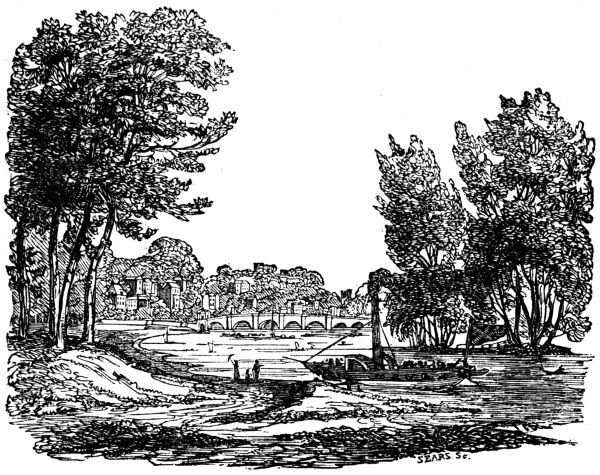
Richmond.
In the beginning of May, a steam-boat for conveying passengers ascends the Thames in the morning from Queenhithe to Richmond, and returns the same day; and so she proceeds to and fro until the autumn. Before she unmoors she takes in little more than half her living freight, the remainder is obtained during the passage. Her band on deck plays a lively tune, and “off she goes” towards Blackfriars’-bridge. From thence, leisurely walkers, and holiday-wishing people, on their way to business, look from between the balustrades on the enviable steamer; they see her lower her chimney to pass beneath the arch, and ten to one, if they cross the road to watch her coming forth on the other side, they receive a puff from the re-elevating mast; this fuliginous rebuke is inspiring.
A Legal Lament.
Ye Richmond Navigators bold all on the liquid plain, When from the bridge we envied you, with pleasure mix’d with pain, Why could you be so cruel as to ridicule our woes, By in our anxious faces turning up your steamer’s nose? ’Twas strange, ’twas passing strange, ’twas pitiful, ’twas wonderous Pitiful, as Shakspeare says, by you then being under us, To be insulted as we were, when you your chimney rose And thought yourselves at liberty to cloud our hopes and clothes. The same sweet poet says, you know, “each dog will have his day,” And hence for Richmond we, in turn, may yet get under weigh. So thus we are consoled in mind, and as to being slighted, For that same wrong, we’ll right ourselves, and get you all indicted.
*
The steam-boat is a good half hour in clearing the port of London, and arriving at Westminster; this delay in expedition is occasioned by “laying to” for “put offs” of single persons and parties, in Thames wherries. If the day be fine, the passage is very pleasant. The citizen sees various places wherein he has enjoyed himself,—he can point out the opening to Fountain-court, wherein is the “coal-hole,” the resort of his brother “wolves,” a club of modern origin, renowned for its support of Mr. Kean; on the left bank, he shows the site of “Cuper’s-gardens,” to which he was taken when a boy by his father’s foreman, and where the halfpenny-hatch stood; or he has a story to tell of the “Fox-under-the-hill,” near the Strand, where Dutch Sam mustered the fighting Jews, and Perry’s firemen, who nightly assisted John Kemble’s “What d’ye want,” during the “O. P. row,” at Covent-garden theatre. Then he directs his attention to the Mitre, at Stangate, kept by “independent Bent,” a house celebrated for authors who “flourish” there, for “actors of all work,” and artists of less prudence than powers. He will tell you of the capital porter-shops that were in Palace-yard before the old coffee-houses were pulled down, and he directs you to the high chimney of Hodges’s distillery, in Church-street, Lambeth. He stands erect, and looks at Cumberland-gardens as though they were his freehold—for there has he been in all his glory; and at the Red-house, at Battersea, he would absolutely go ashore, if his wife and daughters had not gone so far in geography as to know that Richmond is above Battersea-bridge. Here he repeats after Mathews, that Battersea-steeple, being of copper, was coveted by the emperor of Russia for an extinguisher; that the horizontal windmill was a case for it; and that his imperial majesty intended to take them to Russia, but left them behind from forgetfulness. Others see other things. The grounds from which the walls of Brandenburgh-house were rased to the foundation, after the decease of fallen majesty—the house wherein Sharp, the engraver, lived after his removal from Acton, and died—the tomb of Hogarth, in Chiswick church-yard—“Brentford town of mud,” so immortalized by one of our poets, from whence runs Boston-lane, wherein dwelt the good and amiable Granger, who biographized every Englishman of whom there was a portrait—and numerous spots remarkable for their connection with some congenial sentiment or person.
The Aits, or Osier Islands, are picturesque interspersions on the Thames. Its banks are studded with neat cottages, or elegant villas crown the gentle heights; the lawns come sweeping down like carpets of green velvet, to the edge of its soft-flowing waters, and the grace of the scenery improves till we are borne into the full bosom of its beauty—the village of Richmond, or as it was anciently called, Sheen. On coming within sight of this, the most delightful scene in our sea-girt isle, the band on board the steam-boat plays “the lass of Richmond-hill,” while the vessel glides on the translucent water, till she curves to the bridge-foot, and the passengers disembark. Ascending the stone stairs to the street, a short walk through the village brings us to the top of the far-famed hill, from whence there is a sudden sight of one of the loveliest views in the world. Here, unless an overflowing purse can command the preference of the “Star and Garter,” we enter the pleasant and comfortable “Roebuck” inn, which has nothing to recommend it but civil treatment and domestic conveniences. The westward room on the second floor is quiet, and one of the pleasantest in the house. The walls of this peaceful apartment have no ornament, unless so can be called a mezzotinto engraving by Watson, after Reynolds, of Jeffery, lord Amherst, in armour, with a countenance remarkably similar to the rev. Rowland Hill’s in his younger days. The advantage of this room is the delightful view from its windows. Hither come ye whose hearts are saddened, or whose nerves are shattered by the strife of life, or the disturbances of the world; inhale the pure air, and gaze awhile on a prospect more redolent of beauty than Claude or Poussin ever painted or saw. Whatever there be of soothing charm in scenery, is here exuberant. Description must not be attempted, for poets have made it their theme and failed.
To the over-wearied inhabitants of the metropolis, the trip to Richmond is covetable. The lively French, the philosophic German, the elegant Italian, the lofty Spaniard, and the Cossack of the Don, pronounce the prospect from the hill the most enchanting in Europe. There was no itinerary of Richmond until Dr. John Evans, during a visit in 1824, hastily threw some memoranda into a neat little volume, illustrated by a few etchings, under the title of “Richmond and its Vicinity,” which he purposes to improve.
In honour of the female character, and in illustration of the first of May, should be added, that upon the coin of Dort, or Dordrecht, in Holland, is a cow, under which is sitting a milk-maid. The same representation is in relievo on the pyramid of an elegant fountain in that beautiful town. Its origin is from the following historical fact:—When the United Provinces were struggling for their liberty two beautiful daughters of a rich farmer, on their way to the town, with milk, observed, not far from their path, several Spanish soldiers concealed behind some hedges. The patriotic maidens pretending not to have seen any thing, pursued their journey, and as soon as they arrived in the city, insisted upon an admission to the burgo-master, who had not yet left his bed; they were admitted, and related what they had discovered. He assembled the council, measures were immediately taken, the sluices were opened, and a number of the enemy lost their lives in the water. The magistrates in a body honoured the farmer with a visit, where they thanked his daughters for the act of patriotism, which saved the town; they afterwards indemnified him fully for the loss he sustained from the inundation; and the most distinguished young citizens, vied with each other, who should be honoured with the hands of those virtuous milk-maids.
It should also be noticed, in connection with Mr. Montgomery’s volume in behalf of the chimney-sweepers, that a Mr. J. C. Hudson has addressed “A Letter to the Mistresses of Families, on the Cruelty of employing Children in the odious, dangerous, and often fatal Task of sweeping Chimnies.” To Mr. Hudson’s pamphlet, which is published at sixpence, there are two cuts, from designs by Mr. George Cruikshank.
It is observed by Dr. Forster, in the “Perennial Calendar,” that “the melody of birds is perhaps at no time of the year greater and more constant than it is at this present period. The nightingale, the minstrel of the eve; and the lark, the herald of the morn; together with the numerous birds whose music fills the groves all day, contribute, in no small degree, to the pleasure derived from the country in this month. Nor is the lowing of distant cattle in the evening, the hooting of the owl, and many other rustic sounds, deficient in power to please by association of ideas. Shakspeare has a beautiful comparison of the lark and nightingale in ‘Romeo and Juliet:’—
Scene. Juliet’s Chamber.
Jul. Wilt thou be gone? it is not yet near day: It was the nightingale, and not the lark, That pierced the fearful hollow of thine ear; Nightly she sings on yon Pomegranate tree: Believe me, love, it was the Nightingale. Rom. It was the lark, the herald of the morn, No nightingale: look, love, what envious streaks Do lace the severing clouds in yonder east: Night’s candles are burnt out, and jocund day Stands tiptoe on the misty mountain tops. I must be gone and live, or stay and die. Jul. Yon light is not daylight, I know it, I: It is some meteor that the sun exhales, To be to thee this night a torchbearer, And light thee on thy way to Mantua: Therefore stay yet, thou need’st not to be gone. Rom. Let me be ta’en, let me be put to death; I am content, so thou wilt have it so. I’ll say, yon grey is not the morning’s eye; ’Tis but the pale reflex of Cynthia’s brow: Nor that is not the lark, whose notes do beat The vaulty heaven so high above our heads. I have more care to stay than will to go.”
TULIPS.
Dr. Forster notices, that “beds of tulips begin now to flower, and about London, Haerlem, Amsterdam, and other cities of England and Holland, are seen in perfection in the gardens of florists, who have a variety of very whimsical names for the different varieties. The early, or Van Thol tulip, is now out of blow, as is the variety called the Clarimond, beds of which appear very beautiful in April. The sort now flowering is the tulipa Gesneriana, of which the names Bizarre, Golden Eagle, &c. are only expressive of varieties. For the amusement of the reader, we quote from the ‘Tatler’ the following account of an accident that once befell a gentleman in a tulip-garden:—‘I chanced to rise very early one particular morning this summer, and took a walk into the country, to divert myself among the fields and meadows, while the green was new, and the flowers in their bloom. As at this season of the year every lane is a beautiful walk, and every hedge full of nosegays, I lost myself with a great deal of pleasure among several thickets and bushes that were filled with a great variety of birds, and an agreeable confusion of notes, which formed the pleasantest scene in the world to one who had passed a whole winter in noise and smoke. The freshness of the dews that lay upon every thing about me, with the cool breath of the morning, which inspired the birds with so many delightful instincts, created in me the same kind of animal pleasure, and made my heart overflow with such secret emotions of joy and satisfaction as are not to be described or accounted for. On this occasion, I could not but reflect upon a beautiful simile in Milton:—
As one who long in populous city pent, Where houses thick and sewers annoy the air, Forth issuing on a summer’s morn, to breathe Among the pleasant villages, and farms Adjoined, from each thing met conceives delight: The smell of grain, or tedded grass, or kine, Or dairy, each rural sight, each rural sound.
“‘Those who are conversant in the writings of polite authors, receive an additional entertainment from the country, as it revives in their memories those charming descriptions, with which such authors do frequently abound. I was thinking of the foregoing beautiful simile in Milton, and, applying it to myself, when I observed to the windward of me a black cloud falling to the earth in long trails of rain, which made me betake myself for shelter to a house which I saw at a little distance from the place where I was walking. As I sat in the porch, I heard the voices of two or three persons, who seemed very earnest in discourse. My curiosity was raised when I heard the names of Alexander the Great and Artaxerxes; and as their talk seemed to run on ancient heroes, I concluded there could not be any secret in it; for which reason I thought I might very fairly listen to what they said. After several parallels between great men, which appeared to me altogether groundless and chimerical, I was surprised to hear one say, that he valued the Black Prince more than the duke of Vendosme. How the duke of Vendosme should become a rival of the Black Prince, I could not conceive: and was more startled when I heard a second affirm with great vehemence, that if the emperor of Germany was not going off, he should like him better than either of them. He added, that though the season was so changeable, the duke of Marlborough was in blooming beauty. I was wondering to myself from whence they had received this odd intelligence; especially when I heard them mention the names of several other great generals, as the prince of Hesse, and the king of Sweden, who, they said, were both running away. To which they added, what I entirely agreed with them in, that the crown of France was very weak, but that the marshal Villars still kept his colours. At last one of them told the company, if they would go along with him he would show them a Chimney-sweeper and a Painted Lady in the same bed, which he was sure would very much please them. The shower which had driven them as well as myself into the house, was now over; and as they were passing by me into the garden, I asked them to let me be one of their company. The gentleman of the house told me, if I delighted in flowers, it would be worth my while; for that he believed he could show me such a bowl of tulips as was not to be matched in the whole country. I accepted the offer, and immediately found that they had been talking in terms of gardening, and that the kings and generals they had mentioned were only so many tulips, to which the gardeners, according to their usual custom, had given such high titles and appellations of honour. I was very much pleased and astonished at the glorious show of these gay vegetables, that arose in great profusion on all the banks about us. Sometimes I considered them with the eye of an ordinary spectator, as so many beautiful objects varnished over with a natural gloss, and stained with such a variety of colours as are not to be equalled in any artificial dyes or tinctures. Sometimes I considered every leaf as an elaborate piece of tissue, in which the threads and fibres were woven together into different configurations, which gave a different colouring to the light as it glanced on the several parts of the surface. Sometimes I considered the whole bed of tulips, according to the notion of the greatest mathematician and philosopher that ever lived, (sir Isaac Newton,) as a multitude of optic instruments, designed for the separating light into all those various colours of which it is composed. I was awakened out of these my philosophical speculations, by observing the company often seemed to laugh at me. I accidentally praised a tulip as one of the finest I ever saw, upon which they told me it was a common Fool’s Coat. Upon that I praised a second, which it seems was but another kind of Fool’s Coat. I had the same fate with two or three more; for which reason I desired the owner of the garden to let me know which were the finest of the flowers, for that I was so unskilful in the art, that I thought the most beautiful were the most valuable, and that those which had the gayest colours were the most beautiful. The gentleman smiled at my ignorance: he seemed a very plain honest man, and a person of good sense, had not his head been touched with that distemper which Hippocrates calls the Τυλιππομανια, Tulippomania, insomuch, that he would talk very rationally on any subject in the world but a tulip. He told me, that he valued the bed of flowers, which lay before us, and was not above twenty yards in length and two in breadth, more than he would the best hundred acres of land in England; and added, that it would have been worth twice the money it is, if a foolish cookmaid of his had not almost ruined him the last winter, by mistaking a handful of tulip roots for a heap of onions, and by that means, says he, made me a dish of porridge, that cost me above a thousand pounds sterling. He then showed me what he thought the finest of his tulips, which I found received all their value from their rarity and oddness, and put me in mind of your great fortunes, which are not always the greatest beauties. I have often looked upon it as a piece of happiness, that I have never fallen into any of these fantastical tastes, nor esteemed any thing the more for its being uncommon and hard to be met with. For this reason, I look upon the whole country in spring time as a spacious garden, and make as many visits to a spot of daisies, or a bank of violets, as a florist does to his borders or parterres. There is not a bush in blossom within a mile of me which I am not acquainted with, nor scarce a daffodil or cowslip that withers away in my neighbourhood without my missing it. I walked home in this temper of mind through several fields and meadows with an unspeakable pleasure, not without reflecting on the bounty of Providence, which has made the most pleasing and the most beautiful objects the most ordinary and most common.’”
FLORAL DIRECTORY.
Charlock. Rhaphanus Rhafaristrum. Dedicated to St. Athanasius.
May 3.
The Invention, or Discovery of the Holy Cross, A. D. 326. St. Alexander, Pope, A. D. 119.
INVENTION OF THE CROSS.
This festival of the Romish church is also in the church of England calendar; Mr. Audley says, “the word invention sometimes signifies the finding a thing that was hidden;” thence the name of this festival, which celebrates the alleged finding of the cross of Christ by St. Helena, who is said to have found three crosses on Mount Calvary, but the true one could not be distinguished, till a sick woman being placed on each, was healed by one, which was therefore pronounced the veritable cross. Mr. Audley quotes, that “the custody of the cross was committed to the bishop of Jerusalem. Every Easter Sunday it was exposed to view, and pilgrims from all countries were indulged with little pieces of it enchased in gold or gems. What was most astonishing, the sacred wood was never lessened, although it was perpetually diminished, for it possessed a secret power of vegetation.” It appears from Ribadeneira, that St. Paulinus says, “the cross being a piece of wood without sense or feeling, yet seemeth to have in it a living and everlasting virtue; and from that time to this it permitteth itself to be parted and divided to comply with innumerable persons, and yet suffereth no loss or detriment, but remains as entire as if it had never been cut, so that it can be severed, parted, and divided, for those among whom it is to be distributed, and still remains whole and entire for all that come to reverence and adore it.” There is no other way left to the Romish church to account for the superabundance of the wood of the cross.
Robert Parker wrote a remarkably learned book, in folio, entitled—“A Scholasticall Discourse against symbolizing with Antichrist in ceremonies: especially in the signe of the Crosse, 1607.” This erudite work subjected Parker to a persecution under James I., from which he fled to Doesburg, where he died in 1630.
CROSS OF THE SOUTH.
This constellation is in about 185 degrees of longitude; its south-polar distance being only about 39 degrees, it cannot be seen in the northern parts of Europe.[130] Humboldt who observed the cross of the south, thus eloquently describes it:—“The lower regions of the air were loaded with vapours for some days. We saw distinctly, for the first time, the cross of the south, only in the night of the 4th and 5th of July, in the sixteenth degree of latitude. It was strongly inclined, and appeared, from time to time, between the clouds, the centre of which, furrowed by uncondensed lightnings, reflected a silver light. The pleasure felt on discovering the southern cross was warmly shared by such of the crew as had lived in the colonies. In the solitude of the seas, we hail a star as a friend from whom we have been long separated. Among the Portuguese and the Spaniards, peculiar motives seem to increase this feeling; a religious sentiment attaches them to a constellation, the form of which recalls the sign of the faith planted by their ancestors in the deserts of the new world. The two great stars which mark the summit and the foot of the cross, having nearly the same right ascension, it follows, that the constellation is almost vertical at the moment when it passes the meridian. This circumstance is known to every nation that lives beyond the tropics, or in the southern hemisphere. It is known at what hour of the night, in different seasons, the southern cross is erect, or inclined. It is a timepiece that advances very regularly nearly four minutes a day; and no other group of stars exhibits, to the naked eye, an observation of time so easily made. How often have we heard our guides exclaim, in the savannas of Venezuela, or in the desert extending from Lima to Truxillo, ‘Midnight is past, the cross begins to bend!’ How often these words reminded us of that affecting scene, where Paul and Virginia, seated near the source of the river of Lataniers, conversed together for the last time; and when the old man, at the sight of the southern cross, warns them that it is time to separate!”
FLORAL DIRECTORY.
Poetic Narcissus. Narcissus poeticus. Invention of the Cross.
May 4.
St. Monica. St. Godard, Bp. A. D. 1038.
ST. MONICA, A. D. 387.
She was mother of St. Augustine, whom she sent to study at Carthage, where, in 373, he became a Manichee, and remained so, to his mother’s affliction, until 386; she was a woman of piety, and he revered her memory. Her supposed remains were translated with the customary ceremonies of the church of Rome, but their identity has been doubted.[131]
Chronology.
1471. Battle of Tewkesbury, Gloucestershire, gained by Edward IV. over the Lancasterians.
1677. Dr. Isaac Barrow died, aged 47. He was an eminent mathematician, a learned divine, and a high cavalier. Educated at the Charter-house, he was disinclined to study; his recreation was in sports that led to fighting among the boys, yet he afterwards subdued his inclination to quarrels, and distinguished himself as a scholar. He became professor of mathematics at Cambridge, master of Trinity-college, served the office of vice-chancellor, and was buried in Westminster Abbey. Charles II. used to say of him, that he exhausted every subject whereon he treated; yet he did nothing for him. After the Restoration, Barrow wrote a Latin distich, thus translated:—
O, how my breast did ever burn, To see my lawful king return! Yet, whilst his happy fate I bless, No one has felt his influence less.
Barrow was a great smoker to help his thinking. He was a great wit: he met Rochester at court, who said to him, “doctor, I am yours to my shoe-tie;” Barrow bowed obsequiously with, “my lord, I am yours to the ground;” Rochester returned this by, “doctor, I am yours to the centre;” Barrow rejoined, “my lord, I am yours to the antipodes;” Rochester, not to be foiled by “a musty old piece of divinity,” as he was accustomed to call him, exclaimed, “doctor, I am yours to the lowest pit of hell;” whereupon Barrow turned from him with, “there, my lord, I leave you.”
1736. Eustace Budgell drowned himself, at the age of 52, from vexation, that a bequest to him of 2,000l. in the will of Dr. Tindal, was set aside. He wrote in the “Spectator,” “Tatler,” and “Guardian;” was a member of the Irish parliament, and lost his property in the South-sea bubble.
1758. George Bickham, the eminent writing-engraver, died, aged 74; and was buried at St. Luke’s, Old-street.
1795. John James Barthelemy, the celebrated author of “The Travels of Anacharsis the younger in Greece,” died, aged 79. He was a man of deep learning and simplicity of character; unhappily he became involved in the troubles of the French revolution, and endured great hardships from the turbulence of men opposed to his views of social happiness.
BIRDS.
A distinguished naturalist obligingly communicates the subjoined table and prefatory remark.
For the Every-Day Book.
A notion prevails that birds do great injury in gardens and fields, and hence rewards are frequently offered to induce boys and others to kill them in spring. The notion and the practice are erroneous. A gentleman of long experience in horticulture, has ascertained that birds, in general, do more good by destroying vermin than they do harm by the little fruit and grain they consume; an entire district in Germany was once nearly deprived of its corn harvest, by an order to kill all the rooks having been generally obeyed.
SPRING BIRDS.
Table of the average terms of their arrival, deduced from a Journal of Natural History, kept during nearly sixty years.
The Least Willow Wren arrives about March 31
Stone Curlew March 27
Chimney Swallow April 15
Redstart April 16
Blackcap April 17
Nightingale April 14
Martlet April 20
Sand Martin April 25
Yellow Willow Wren April 15
Lesser Reed Sparrow April 23
Cuckoo April 21
Great Green Willow Wren April 21
Grasshopper Lark April 16
Spotted Flycatcher April 20
Pied Flycatcher April 15
Black Martin May 9
Fern Owl May 20
Swift May 14
FLORAL DIRECTORY.
Stock Gilly Flower. Mathiola incana. Dedicated to St. Monica.
May 5.
St. Pius V., Pope, A. D. 1572. St. Hilary, Abp. of Arles, A. D. 449. St. Angelus, A. D. 1225. St. Mauront, Abbot, A. D. 706. St. Avertin, A. D. 1189.
Chronology.
1760. The right honourable Laurence, earl Ferrers, viscount Tamworth, was hanged at Tyburn, for the murder of John Johnson, his steward.
1785. Thomas Davies, died. He is well recollected from frequent creditable mention made of him in Boswell’s “Life of Johnson;” Davies was an actor, afterwards a bookseller, turned strolling player, returned to the bookselling business in Russel-street, Covent-garden, became bankrupt, was relieved in his misfortunes by Dr. Johnson, wrote the “Life of Garrick,” “Dramatic Miscellanies,” and other pieces; and acquired before his death the honourable appellation of “honest Tom Davies.” He was intrusted by the rev. James Granger with the publication of his “Biographical History of England.”
1789. Joseph Baretti, author of the “Italian Dictionary,” &c. died, aged 73.
1821. Napoleon died at St. Helena, in the sixth year of his confinement. What he was all men pretend to know, and historians will tell.
THE SEASON.
“Here they are! blowing, growing, all alive!” This was an old London cry by little flower gardeners, who brought the products of their grounds to the metropolis, and wheeled them through the streets in a barrow, “blowing, growing, all alive!” to tempt purchasers in the humble streets and alleys of working neighbourhoods. Acts of Parliament have put down the flower-pots, which were accustomed to “topple on the walkers’ heads,” from the windows of houses, wherein flower-fanciers dwelt.
Flower Garden.
Fairhanded Spring unbosoms every grace, Throws out the snowdrop and the crocus first, The daisy, primrose, violet darkly blue. And polyanthus of unnumbered dyes; The yellow wallflower, stained with iron brown, The lavish stock that scents the garden round. From the soft wing of vernal breezes shed Anemonies, auriculas, enriched With shining meal o’er all their velvet leaves, And full ranunculus of glowing red. Then comes the tulip race, where beauty plays Her idle freaks, from family diffused To family, as flies the father dust, The varied colours run; and while they break On the charmed eye, the exulting florist marks, With secret pride, the wonders of his hand. No gradual bloom is wanting, from the bud, First born of Spring, to Summer’s musky tribes— Nor hyacinths of purest virgin white, Low bent and blushing inwards—nor jonquils Of potent fragrance—nor Narcissus fair, As o’er the fabled mountain hanging still— Nor broad carnations, nor gay spotted pinks, Nor showered from every bush the damask rose.
Thomson.
FLORAL DIRECTORY.
Apple Tree. Pyrus Malus. Dedicated to St. Angelus and St. Pius.
May 6.
St. John before the Latin Gate. St. John Damascen, A. D. 780. St. Eadbert, Bp. of Lindisfarne, A. D. 687.
ST. JOHN PORT LATIN.
This was St. John the Evangelist, though his name stands with Ante Port. Lat. annexed to it in the church of England calendar. The description is founded on a Roman Catholic legend that St. John the Evangelist in his old age was accused of atheism to Domitian, who sent him to Rome, and there, before the gate called Porta Latina, caused him to be put into a cauldron of boiling oil, from whence he suffered no pain, and came forth without harm. This miracle is fabled to have occurred before the exile of St. John to the desert isle of Patmos, in the Archipelago, where he is supposed to have written the Apocalypse, or book of “Revelations.”
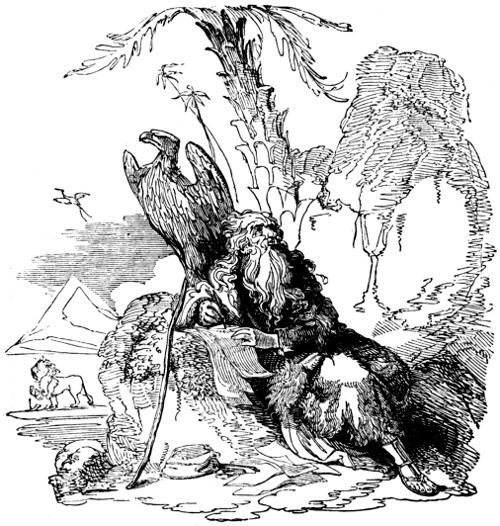
St. John in the Isle of Patmos.
There is no evidence that St. John suffered martyrdom; on the contrary, he is said to have returned to Ephesus in the reign of Nerva, who succeeded Domitian in the imperial dignity. Painters usually represent him in Patmos with an eagle by his side; though, as St. John Port Latin, there are many engravings of him in the legendary oil cauldron. Other representations of him put a chalice in his hand, with a serpent issuing from it, founded on another legend, that being constrained to drink poison, he swallowed it without sustaining injury.
There is a further legend, that while St. Edward the Confessor was dedicating a church to St. John, a pilgrim demanded alms of him in the saint’s name, whereupon the king gave him the ring from his finger. This pilgrim was St. John, who discovered himself to two English pilgrims in the Holy Land, bidding them bear the ring to the king in his name, and require him to make ready to depart this world; after this they went to sleep. On awakening they found themselves among flocks of sheep and shepherds in a strange place, which turned out to be Barham Downs in Kent, wherefore they thanked God and St. John for their good speed, and coming to St. Edward on Christmas-day, delivered to him the ring with the warning; these the king received in a suitable manner, “And on the vigyll of the Epyphanye, next after, he dyed and departed holyly out of this worlde, and is buryed in the Abbey of Westmester by London, where as is yet unto this daye that same rynge.” Again it is said, that Isidore affirms of St. John, that he transformed branches of trees into fine gold, and sea-gravel into precious stones, with other like incredibilities.[132]
Chronology.
1677. Samuel Bochart, a learned French Protestant divine and orientalist, died at Caen, aged 68 years.
1802. Died at Guernsey, aged 40, of water in his chest, serjeant Samuel M‘Donald, of the 93d regiment, commonly known by the name of Big Sam. He served during the American war with his countrymen, the Sutherland Fencibles, and afterwards as fugelman in the Royals, till 1791, when he was taken into the household of his royal highness the prince of Wales, as lodge-porter at Carlton-house, and remained in that capacity till 1793; he was then appointed a serjeant in the late Sutherland Fencibles, and continued to act in that corps, and the 93d regiment, formed from it, till his death.—He was six feet ten inches in height, four feet round the chest, and well proportioned. He continued active till his 35th year, when he began to decline. His strength was prodigious, but he was never known to exert it improperly. Several considerable offers were made to engage him as a public exhibition, all of which he refused, and always disliked being stared at.
SPRING BLIGHT.
The greatest misfortune that the cultivator of a garden apprehends at this season, is blight, of which, according to Dr. Forster, there are three kinds. “The first occurs in the early spring, about the time of the blossoming of the peach, and is nothing more than a dry frosty wind, usually from the north or north-east, and principally affects the blossoms, causing them to fall off prematurely. The two other kinds of blight occur in this month, affecting principally the apple and pear trees, and sometimes the corn. One of these consists in the appearance of an immense multitude of aphides, a kind of small insect of a brown, or black, or green colour, attacking the leaves of plants, and entirely incrusting the young stems. These pests are always found to make their appearance after a north-east wind, and it has been supposed by many that they are actually conveyed hither by the wind. Thomson, too, positively ascribes them to the north wind:—
For oft engendered by the hazy north, Myriads on myriads, insect armies warp Keen in the poisoned breeze; and wasteful eat, Through buds and bark, into the blackened core Their eager way.
“In our opinion, an east wind more often brings blights. Many circumstances, indeed, favour the opinion that blights are animalculæ; as the suddenness with which they appear, being generally in the course of a single night, and those trees that are sheltered from the wind being uninfected: indeed, it frequently happens that a single branch that chances to be screened, will escape unhurt, while the rest of the tree is quite covered with these minute destroyers. A third reason may be derived from the inactivity of these insects: they generally remain almost immovable on the branch or leaf where they are first seen, and are for the most part, unprovided with wings; yet the places where they are commonly found are those parts of a tree which are farthest from the ground, and the most exposed to the wind. The last kind of blight is generally preceded by a south or south-west wind, unaccompanied by insects; the effects of which are visible in the burnt appearance of all leaves and shoots which are exposed to that quarter. Oaks and other large trees suffer from this blight.”[133]
To Blossoms.
Fair pledges of a fruitful tree, Why do ye fall so fast? Your date is not so past, But you may stay yet here awhile To blush and gently smile, And go at last! What, were ye born to be An hour or half’s delight? And so to bid good night? ’Tis pity Nature brought ye forth Merely to show your worth, And lose you quite! But your lovely leaves, where we May read how soon things have Their end, though ne’er so brave: And after they have shown their pride, Like you, awhile they glide Into the grave!
Herrick.
FLORAL DIRECTORY.
Lucken Gowans. Trollius Europæus. Dedicated to St. John Damascen.
May 7.
St. Stanislas, Bp. of Cracow, A. D. 1079. St. Benedict II., Pope, A. D. 686. St. John of Beverley.
ST. JOHN OF BEVERLEY, A. D. 721,
Was born at Harpham, a village in the north of England. In the reign of king Alfred, he was made bishop of Hexham; he gave venerable Bede the orders of deacon and priest; and built the monastery of Beverley, then a forest, now a market-town, twenty-seven miles from York, where he died, in 721.[134] Bede assigns several miracles to him in his lifetime. William of Malmesbury relates, that the inhabitants of Beverley acknowledge the sanctity of their patron, because the fiercest bulls being dragged with the strongest ropes, by the lustiest men, into his church-yard, lose their fury, become gentle as lambs, and being left to their freedom, innocently sport themselves, instead of goring and trampling with their horns and feet all that come near them.[135] It is related by another author that in 1312, on the feast of St. Bernard, wonderful oil miraculously issued from his sepulchre, which was a sovereign remedy against many diseases. Also, that king Ethelstan laid his knife on the saint’s altar, in pledge, that if by his interference he obtained a victory over the Scots, he would enrich his church; by the merits of the saint he conquered, and desiring to have a sign as a perpetual testimony of prerogative over the Scots, he struck his sword into a rock near Dunbar-castle, which for many ages retained a mark of a yard in length from the blow, and this was referred to by king Edward I. before pope Boniface, in proof of his right over Scotland. Ethelstan, in consequence of his victory, granted right of sanctuary to the church of Beverley, with other privileges.[136]
SEASONABLE STORY.
If the north-east wind blow on this day, or on any other day in May, or in any other summer month, the nervous reader will experience the uneasiness which is sure to afflict him from that baleful quarter. The sun may shine, and the birds may sing, and flowers may give forth their odours, yet pernicious influences prevail against the natural harmony and spirit of the season. To one, therefore, so afflicted, the story of Daniel O’Rourke, from the “Fairy Legends,” may be diverting.
DANIEL O’ROURKE.
People may have heard of the renowned adventures of Daniel O’Rourke, but how few are there who know that the cause of all his perils, above and below, was neither more nor less than his having slept under the walls of the Phooka’s tower. I knew the man well: he lived at the bottom of Hungry Hill, just at the right hand side of the road as you go towards Bantry. An old man was he at the time that he told me the story, with gray hair, and a red nose; and it was on the 25th of June, 1813, that I heard it from his own lips, as he sat smoking his pipe under the old poplar tree, on as fine an evening as ever shone from the sky. I was going to visit the caves in Dursey Island, having spent the morning at Glengariff.
“I am often axed to tell it, sir,” said he, “so that this is not the first time. The master’s son, you see, had come from beyond foreign parts in France and Spain, as young gentlemen used to go, before Buonaparte or any such was heard of; and sure enough there was a dinner given to all the people on the ground, gentle and simple, high and low, rich and poor. The ould gentlemen were the gentlemen, after all, saving your honour’s presence. They’d swear at a body a little, to be sure, and, may be, give one a cut of a whip now and then, but we were no losers by it in the end;—and they were so easy and civil, and kept such rattling houses, and thousands of welcomes;—and there was no grinding for rent, and few agents; and there was hardly a tenant on the estate that did not taste of his landlord’s bounty often and often in the year;—but now it’s another thing: no matter for that, sir, for I’d better be telling you my story.
“Well, we had every thing of the best, and plenty of it; and we ate, and we drank, and we danced, and the young master by the same token danced with Peggy Barry, from the Bohereen—a lovely young couple they were, though they are both low enough now. To make a long story short, I got, as a body may say, the same thing as tipsy almost, for I can’t remember ever at all, no ways, how it was that I left the place: only I did leave it, that’s certain. Well, I thought, for all that, in myself. I’d just step to Molly Cronahan’s, the fairy woman, to speak a word about the bracket heifer what was bewitched; and so as I was crossing the stepping-stones of the ford of Ballyashenogh, and was looking up at the stars and blessing myself—for why? it was Lady-day—I missed my foot, and souse I fell into the water. ‘Death alive!’ thought I, ‘I’ll be drowned now?’ However, I began swimming, swimming, swimming away for the dear life, till at last I got ashore, somehow or other, but never the one of me can tell how, upon a dissolute island.
“I wandered and wandered about there, without knowing where I wandered, until at last I got into a big bog. The moon was shining as bright as day, or your fair lady’s eyes, sir, (with your pardon for mentioning her,) and I looked east and west, and north and south, and every way, and nothing did I see but bog, bog, bog;—I could never find out how I got into it; and my heart grew cold with fear, for sure and certain I was that it would be my berrin place. So I sat down upon a stone which, as good luck would have it, was close by me, and I began to scratch my head, and sing the Ullagone—when all of a sudden the moon grew black, and I looked up, and saw something for all the world as if it was moving down between me and it, and I could not tell what it was. Down it came with a pounce, and looked at me full in the face; and what was it but an eagle? as fine a one as ever flew from the kingdom of Kerry. So he looked at me in the face, and says he to me, ‘Daniel O’Rourke,’ says he, ‘how do you do?’ ‘Very well, I thank you, sir,’ says I: ‘I hope you’re well;’ wondering out of my senses all the time how an eagle came to speak like a Christian. ‘What brings you here, Dan?’ says he. ‘Nothing at all, sir,’ says I; ‘only I wish I was safe home again.’ ‘Is it out of the island you want to go, Dan?’ says he. ‘’Tis, sir,’ says I: so I up and told him how I had taken a drop too much, and fell into the water; how I swam to the island; and how I got into the bog, and did not know my way out of it. ‘Dan,’ says he, after a minute’s thought, ‘though it was very improper for you to get drunk on Lady-day, yet as you are a decent, sober man, who ’tends mass well, and never flings stones at me or mine, nor cries out after us in the fields—my life for yours,’ says he; ‘so get up on my back, and grip me well for fear you’d fall off, and I’ll fly you out of the bog.’ ‘I am afraid,’ says I, ‘your honour’s making game of me; for who ever heard of riding a horseback on an eagle before?’ ‘’Pon the honour of a gentleman,’ says he, putting his right foot on his breast, ‘I am quite in earnest; and so now either take my offer or starve in the bog—besides, I see that your weight is sinking the stone.’
“It was true enough as he said, for I found the stone every minute going from under me. I had no choice; so thinks I to myself, faint heart never won fair lady, and this is fair persuadance:—‘I thank your honour,’ says I, ‘for the loan of your civility; and I’ll take your kind offer.’ I therefore mounted upon the back of the eagle, and held him tight enough by the throat, and up he flew in the air like a lark. Little I knew the trick he was going to serve me. Up—up—up—God knows how far up he flew. ‘Why, then,’ said I to him—thinking he did not know the right road home—very civilly, because why?—I was in his power entirely;—‘sir,’ says I, ‘please your honour’s glory, and with humble submission to your better judgment, if you’d fly down a bit, you’re now just over my cabin, and I could be put down there, and many thanks to your worship.’
“‘Arrah, Dan,’ said he, ‘do you think me a fool? Look down in the next field, and don’t you see two men and a gun? By my word it would be no joke to be shot this way, to oblige a drunken blackguard that I picked up off of a could stone in a bog.’ ‘Bother you,’ said I to myself, but I did not speak out, for where was the use? Well, sir, up he kept, flying, flying, and I asking him every minute to fly down, and all to no use. ‘Where in the world are you going, sir?’ says I to him. ‘Hold your tongue, Dan,’ says he: ‘mind your own business, and don’t be interfering with the business of other people.’ ‘Faith, this is my business, I think,’ says I. ‘Be quiet, Dan,’ says he: so I said no more.
“At last where should we come to, but to the moon itself. Now you can’t see it from this, but there is, or there was in my time a reaping-hook sticking out of the side of the moon, this way (drawing the figure on the ground with the end of his stick.)
“‘Dan,’ said the eagle, ‘I’m tired with this long fly; I had no notion ’twas so far.’ ‘And my lord, sir,’ said I, ‘who in the world axed you to fly so far—was it I? did not I beg, and pray, and beseech you to stop half an hour ago?’ ‘There’s no use talking, Dan,’ said he; ‘I’m tired bad enough, so you must get off, and sit down on the moon until I rest myself.’ ‘Is it sit down on the moon?’ said I; ‘is it upon that little round thing, then? why, then, sure I’d fall off in a minute, and be kilt and spilt, and smashed all to bits: you are a vile deceiver—so you are.’ ‘Not at all, Dan,’ said he: ‘you can catch fast hold of the reaping-hook that’s sticking out of the side of the moon, and t’will keep you up.’ ‘I won’t, then,’ said I. ‘May be not,’ said he, quite quiet. ‘If you don’t, my man, I shall just give you a shake, and one slap of my wing, and send you down to the ground, where every bone in your body will be smashed as small as a drop of dew on a cabbage-leaf in the morning.’ ‘Why, then, I’m in a fine way,’ said I to myself, ‘ever to have come along with the likes of you;’ and so giving him a hearty curse in Irish, for fear he’d know what I said, I got off of his back with a heavy heart, took a hold of the reaping-hook, and sat down upon the moon, and a mighty cold seat it was, I can tell you that.
“When he had me there fairly landed, he turned about to me, and said, ‘Good morning to you, Daniel O’Rourke,’ said he: ‘I think I’ve nicked you fairly now. You robbed my nest last year,’ (’twas true enough for him, but how he found it out is hard to say,) ‘and in return you are freely welcome to cool your heels dangling upon the moon like a cockthrow.’
“‘Is that all, and is this the way you leave me, you brute, you?’ says I. ‘You ugly unnatural baste, and is this the way you serve me at last? Bad luck to yourself, with your hook’d nose, and to all your breed, you blackguard.’ ’Twas all to no manner of use: he spread out his great big wings, burst out a laughing, and flew away like lightning. I bawled after him to stop; but I might have called and bawled for ever, without his minding me. Away he went, and I never saw him from that day to this—sorrow fly away with him! You may be sure I was in a disconsolate condition, and kept roaring out for the bare grief, when all at once a door opened right in the middle of the moon, creaking on its hinges as if it had not been opened for a month before. I suppose they never thought of greasing ’em, and out there walks—who do you think but the man in the moon? I knew him by his bush.
“‘Good morrow to you, Daniel O’Rourke,’ said he: ‘How do you do?’ ‘Very well, thank your honour,’ said I. ‘I hope your honour’s well.’ ‘What brought you here, Dan?’ said he. So I told him how I was a little overtaken in liquor at the master’s, and how I was cast on a dissolute island, and how I lost my way in the bog, and how the thief of an eagle promised to fly me out of it, and how instead of that he had fled me up to the moon.
“‘Dan,’ said the man in the moon, taking a pinch of snuff when I was done, ‘you must not stay here.’ ‘Indeed, sir,’ says I, ‘’tis much against my will I’m here at all; but how am I to go back?’ ‘That’s your business,’ said he, ‘Dan: mine is to tell you that here you must not stay, so be off in less than no time.’ ‘I’m doing no harm,’ says I, ‘only holding on hard by the reaping-hook, lest I fall off.’ ‘That’s what you must not do, Dan,’ says he. ‘Pray, sir,’ says I, ‘may I ask how many you are in family, that you would not give a poor traveller lodging: I’m sure ’tis not so often you’re troubled with strangers coming to see you, for ’tis a long way.’ ‘I’m by myself, Dan,’ says he; ‘but you’d better let go the reaping-hook.’ ‘Faith, and with your leave,’ says I, ‘I’ll not let go the grip.’ ‘You had better, Dan,’ says he again. ‘Why, then, my little fellow,’ says I, taking the whole weight of him with my eye from head to foot, ‘there are two words to that bargain; and I’ll not budge, but you may if you like.’ ‘We’ll see how that is to be,’ says he; and back he went, giving the door such a great bang after him (for it was plain he was huffed), that I thought the moon and all would fall down with it.
“Well, I was preparing myself to try strength with him, when back again he comes, with the kitchen cleaver in his hand, and without saying a word, he gave two bangs to the handle of the reaping-hook that was keeping me up, and whap! it came in two. ‘Good morning to you, Dan,’ says the spiteful little old blackguard, when he saw me cleanly falling down with a bit of the handle in my hand; ‘I thank you for your visit, and fair weather after you, Daniel.’ I had not time to make any answer to him, for I was tumbling over and over, and rolling and rolling at the rate of a fox-hunt. ‘God help me,’ says I, ‘but this is a pretty pickle for a decent man to be seen in at this time of night: I am now sold fairly.’ The word was not out of my mouth, when whiz! what should fly by close to my ear but a flock of wild geese; and the ould gander, who was their general, turning about his head, cried out to me, ‘Is that you Dan?’ I was not a bit daunted now at what he said, for I was by this time used to all kinds of bedevilment, and, besides, I knew him of ould. ‘Good morrow, to you,’ says he, ‘Daniel O’Rourke: how are you in health this morning?’ ‘Very well, sir,’ says I, ‘I thank you kindly,’ drawing my breath, for I was mightily in want of some. ‘I hope your honour’s the same.’ ‘I think ’tis falling you are, Daniel,’ says he. ‘You may say that, sir,’ says I. ‘And where are you going all the way so fast?’ said the gander. So I told him how I had taken the drop, and how I came on the island, and how I lost my way in the bog, and how the thief of an eagle flew me up to the moon, and how the man in the moon turned me out. ‘Dan,’ said he, ‘I’ll save you: put out your hand and catch me by the leg, and I’ll fly you home.’ ‘Sweet is your hand in a pitcher of honey, my jewel,’ says I, though all the time I thought in myself that I don’t much trust you; but there was no help, so I caught the gander by the leg, and away I and the other geese flew after him as fast as hops.
“We flew, and we flew, and we flew, until we came right over the wide ocean. I knew it well, for I saw Cape Clear to my right hand, sticking up out of the water. ‘Ah! my lord,’ said I to the goose, for I thought it best to keep a civil tongue in my head any way, ‘fly to land if you please.’ ‘It is impossible, you see, Dan,’ said he, ‘for a while, because you see we are going to Arabia.’ ‘To Arabia,’ said I; ‘that’s surely some place in foreign parts, far away. Oh! Mr. Goose: why then, to be sure, I’m a man to be pitied among you.’ ‘Whist, whist, you fool,’ said he, ‘hold your tongue; I tell you Arabia is a very decent sort of place, as like West Carbery as one egg is like another, only there is a little more sand there.’
“Just as we were talking, a ship hove in sight, scudding so beautiful before the wind: ‘Ah! then, sir,’ said I, ‘will you drop me on the ship, if you please?’ ‘We are not fair over it,’ said he. ‘We are,’ said I. ‘We are not,’ said he: ‘If I dropped you now, you would go splash into the sea.’ ‘I would not,’ says I; ‘I know better than that, for it is just clean under us, so let me drop now at once.’
“‘If you must, you must,’ said he. ‘There, take your own way;’ and he opened his claw, and faith he was right—sure enough I came down plump into the very bottom of the salt sea! Down to the very bottom I went, and I gave myself up then for ever, when a whale walked up to me, scratching himself after his night’s sleep, and looked me full in the face, and never the word did he say, but lifting up his tail, he splashed me all over again with the cold salt water, till there wasn’t a dry stitch upon my whole carcass; and I heard somebody saying—’twas a voice I knew, too—‘Get up, you drunken brute, off of that:’ and with that I woke up, and there was Judy with a tub full of water, which she was splashing me all over;—for, rest her soul! though she was a good wife, she never could bear to see me in drink, and had a bitter hand of her own.
“‘Get up,’ said she again: ‘and of all places in the parish, would no place sarve your turn to lie down upon but under the ould walls of Carrigaphooka? an uneasy resting I am sure you had of it.’ And sure enough I had; for I was fairly bothered out of my senses with eagles, and men of the moons, and flying ganders, and whales, driving me through bogs, and up to the moon, and down to the bottom of the great ocean. If I was in drink ten times over, long would it be before I’d lie down in the same spot again, I know that.”
FLORAL DIRECTORY.
Asiatic Globeflower. Trollius Asiaticus. Dedicated to St. John of Beverley.
May 8.
The Apparition of St. Michael the Archangel. St. Peter, Abp. of Tarentaise, or Monstiers, A. D. 1174. St. Victor, A. D. 303. St. Wiro, Bp. 7th Cent. St. Odrian, Bp. of Waterford. St. Gybrian, or Gobrian, 8th Cent.
ST. MICHAEL, THE ARCHANGEL.
It is not clear what particular apparition of St. Michael is celebrated in the Roman Catholic church on this day; their books mention several of his apparitions. They rank him as field-marshal and commander-in-chief of the armies of heaven, as prince of the angels opposed to Lucifer, and, especially, as principal guardian of human souls against the infernal powers.[137] In heraldry, as head of the order of archangels, his ensign is a banner hanging on a cross, and he is armed as Victory, with a dart in one hand, and a cross on his forehead, or the top of the head; archangels are distinguished from angels by that sign. Usually, however, he is painted in coat-armour, in a glory, with a dart, throwing Lucifer headlong into a flame of fire issuing out of a base proper; this is also termed the battle between Michael and the devil, with his casting out of heaven into the lake of fire and brimstone. “There remained,” says a distinguishing herald, “still in heaven, after the fall of Lucifer, the bright star, and his company, more angels than there ever was, is, and shall be men born in the earth, which God ranked into nine orders or chorus, called the nine quoires of holy angels.”[138]
St. Michael is further represented in catholic books as engaged with weighing souls in a pair of scales. A very curious spiritualizing romance, originally in French, printed in English by Caxton, in the reign of Edward V., exemplifies the office of St. Michael in this capacity; the work is entitled—“The Pilgremage of the Sowle.” The author expresses himself under “the similitude of a dream,” which, he says, befell him on a St. Laurence’ night sleeping in his bed. He thought himself travelling towards the city of Jerusalem, when death struck his body and soul asunder; whereupon Satan in a foul and horrible form came towards the soul, which being in great terror, its warden, or guardian angel, desired Satan to flee away and not meddle with it. Satan refuses, alleging that God had permitted that no soul which had done wrong should, on its passage, escape from being “snarlyd in his trappe;” and he said, that the guardian angel well knew that he, the said guardian, could never withdraw the soul from evil, or induce it to follow his good counsel; and that even if he had, the soul would not have thanked him for it; Satan, therefore, knew not why the angel should interfere, and begged he would let him alone to do with the soul what he had a right to do, and could not be prevented from doing. The parley continued, until they agreed to carry the soul before Michael, the provost of heaven, and abide his award on Satan’s claim.
The soul was then lifted between them both into the transparent air, wherein the spirits of the newly dead were passing thickly on every side, to and fro, as motes flitting in the sun-beam. They tarried not until they arrived at a marvellous place of bright fire, shining with a brilliant light, surrounded by a great multitude of souls attending there for a like purpose. The guardian angel entered, leaving Satan without, and also the soul, who could hear the voice of his warden speaking in his behalf, and acquainting Michael that he had brought from earth a pilgrim, who was without, and with him Satan his accuser, abiding judgment.
Then Satan began to cry out and said, “Of right he is mine, and that I shall prove; wherefore deliver him to me by judgment, for I abide naught else.” This caused proclamation to be made by sound of trumpet in these words:—“All ye that are without, awaiting your judgment, present yourselves before the provost to receive your doom; but first ye that have longest waited, and especially those that have no great matter and are not much troubled; for the plain and light causes shall first be determined, and then other matters that need greater tarrying.”
This proclamation greatly disturbed the souls without. Satan and his evil spirits were most especially angry, and holding a consultation, he spoke as follows: “It appears we are of little consequence, and hence our wicked neighbours do us injustice. These wardens hinder us from our purposes, and we are without favour. There is no caitiff pilgrim but hath had a warden assigned him from his birth, to attend him and defend him at all times from our hands, and especially from the time that he washed in the ‘salt lye,’ ordained by grace de Dieu, who hath ever been our enemy; and then they are taken, as soon as these wardens come, before the provost, and have audience at their own pleasure; while we are kept here without, as mere ribalds. Let us cry out a rowe [haro], and out upon them all! they have done us wrong; and we will speak so loud that in spite of them they shall hear us.” Then Satan and his spirits cried out all at once, “Michael! provost, lieutenant, and commissary of the high judge! do us right, without exception or favour of any party. You know very well that in every upright court the prosecutor is admitted to make his accusation and propose his petition; but you first admit the defendant to make his excusation. This manner of judging is suspicious; for were these pilgrims innocent yet, if reason were to be heard, and right were to prevail, the accusers would have the first hearing to say what they would, and then the defendants after them, to excuse themselves if they could: we, then, being the prosecutors, hear us first, and then the defendants.”
After Satan’s complaint, the soul heard within the curtain, “a longe parlament;” and, at the last, there was another proclamation ordered by sound of trumpet, as follows:—“All ye that are accustomed to come to our judgments, to hear and to see, as assessors, that right be performed, come forth immediately and take your seats; ye well knowing your own assigned places. Ye also that are without, waiting the sitting of the court, present yourselves forthwith to the judgment thereof, in order as ye shall be called; so that no one hinder another, or interrupt another’s discourse. Ye pilgrims, approach the entrance of this curtain, awaiting without; and your wardens, because they are our equals, belonging to our company, are to appear, as of right they ought, within our presence.”
After this proclamation was observed, the guardian angel said,—“Provost Michael! I here present to you this pilgrim, committed to my care in the world below: he has kept his faith to the last, and ought to be received into the heavenly Jerusalem, whereto his body hath long been travelling.”—Satan answered—“Michael! attend to my word and I shall tell you another tale.” The soul being befriended throughout by St. Michael, finally escapes the dreadful doom of eternal punishment.
On St. Michael’s contention with the devil about the body of Moses, more may be seen in the volume on “Ancient Mysteries,” from which the present notice is extracted, or in “Bishop Marsh’s translation of Michaeli’s Introduction to the New Testament.”
The managers of an institution for the encouragement of British talent, less versed in biblical criticism than in art, lately offered a prize to the painter who should best represent this strange subject.
FLORAL DIRECTORY.
Lily of the Valley. Convallaria majalis. Dedicated to St. Selena.
Canonbury Tower.
Canonbury Tower.
People methinks are better, but the scenes Wherein my youth delighted are no more. I wander out in search of them, and find A sad deformity in all I see. Strong recollections of my former pleasures, And knowledge that they never can return, Are causes of my sombre mindedness: I pray you then bear with my discontent.
*
A walk out of London is, to me, an event; I have an every-day desire to bring it about, but weeks elapse before the time arrives whereon I can sally forth. In my boyhood, I had only to obtain parental permission, and stroll in fields now no more,—to scenes now deformed, or that I have been wholly robbed of, by “the spirit of improvement.” Five and thirty years have altered every thing—myself with the rest. I am obliged to “ask leave to go out,” of time and circumstance; or to wait till the only enemy I cannot openly face has ceased from before me—the north-east wind—or to brave that foe and get the worst of it. I did so yesterday. “This is the time,” I said, to an artist, “when we Londoners begin to get our walks; we will go to a place or two that I knew many years ago, and see how they look now; and first to Canonbury-house.”
Having crossed the back Islington-road, we found ourselves in the rear of the Pied Bull. Ah! I know this spot well: this stagnant pool was a “famous” carp pond among boys. How dreary the place seems! the yard and pens were formerly filled with sheep and cattle for Smithfield market; graziers and drovers were busied about them; a high barred gate was constantly closed; now all is thrown open and neglected, and not a living thing to be seen. We went round to the front, the house was shut up, and nobody answered to the knocking. It had been the residence of the gallant sir Walter Raleigh, who threw down his court mantle for queen Elizabeth to walk on, that she might not damp her feet; he, whose achievements in Virginia secured immense revenue to his country; whose individual enterprise in South America carried terror to the recreant heart of Spain; who lost years of his life within the walls of the Tower, where he wrote the “History of the World,” and better than all, its inimitable preface; and who finally lost his life on a scaffold for his courage and services. By a door in the rear we got into “the best parlour;” this was on the ground-floor; it had been Raleigh’s dining-room. Here the arms of sir John Miller are painted on glass in the end window; and we found Mr. John Cleghorn sketching them. This gentleman, who lives in the neighbourhood, and whose talents as a draftsman and engraver are well known, was obligingly communicative; and we condoled on the decaying memorials of past greatness. On the ceiling of this room are stuccoed the five senses; Feeling in an oval centre, and the other four in the scroll-work around. The chimney-piece of carved oak, painted white, represents Charity, supported by Faith on her right, and Hope on her left. Taking leave of Mr. Cleghorn, we hastily passed through the other apartments, and gave a last farewell look at sir Walter’s house; yet we bade not adieu to it till my accompanying friend expressed a wish, that as sir Walter, according to tradition, had there smoked the first pipe of tobacco drawn in Islington, so he might have been able to smoke the last whiff within the walls that would in a few weeks be levelled to the ground.
We got to Canonbury. Geoffrey Crayon’s “Poor Devil Author” sojourned here:—
“Chance threw me,” he says, “in the way of Canonbury Castle. It is an ancient brick tower, hard by ‘merry Islington;’ the remains of a hunting-seat of queen Elizabeth, where she took the pleasure of the country when the neighbourhood was all woodland. What gave it particular interest in my eyes was the circumstance that it had been the residence of a poet. It was here Goldsmith resided when he wrote his ‘Deserted Village.’ I was shown the very apartment. It was a relic of the original style of the castle, with pannelled wainscots and Gothic windows. I was pleased with its air of antiquity, and with its having been the residence of poor Goldy. ‘Goldsmith was a pretty poet,’ said I to myself, ‘a very pretty poet, though rather of the old school. He did not think and feel so strongly as is the fashion now-a-days; but had he lived in these times of hot hearts and hot heads, he would no doubt have written quite differently.’ In a few days I was quietly established in my new quarters; my books all arranged; my writing-desk placed by a window looking out into the fields, and I felt as snug as Robinson Crusoe when he had finished his bower. For several days I enjoyed all the novelty of change and the charms which grace new lodgings before one has found out their defects. I rambled about the fields where I fancied Goldsmith had rambled. I explored merry Islington; ate my solitary dinner at the Black Bull, which, according to tradition, was a country seat of sir Walter Raleigh, and would sit and sip my wine, and muse on old times, in a quaint old room where many a council had been held. All this did very well for a few days; I was stimulated by novelty; inspired by the associations awakened in my mind by these curious haunts; and began to think I felt the spirit of composition stirring with me. But Sunday came, and with it the whole city world, swarming about Canonbury Castle. I could not open my window but I was stunned with shouts and noises from the cricket ground; the late quiet road beneath my window was alive with the tread of feet and clack of tongues; and, to complete my misery, I found that my quiet retreat was absolutely a ‘show house,’ the tower and its contents being shown to strangers at sixpence a head. There was a perpetual tramping up stairs of citizens and their families to look about the country from the top of the tower, and to take a peep at the city through the telescope, to try if they could discern their own chimneys. And then, in the midst of a vein of thought, or a moment of inspiration, I was interrupted, and all my ideas put to flight, by my intolerable landlady’s tapping at the door, and asking me if I would ‘just please to let a lady and gentleman come in, to take a look at Mr. Goldsmith’s room.’ If you know any thing what an author’s study is, and what an author is himself, you must know that there was no standing this. I put a positive interdict on my room’s being exhibited; but then it was shown when I was absent, and my papers put in confusion; and on returning home one day I absolutely found a cursed tradesman and his daughters gaping over my manuscripts, and my landlady in a panic at my appearance. I tried to make out a little longer, by taking the key in my pocket; but it would not do. I overheard mine hostess one day telling some of her customers on the stairs that the room was occupied by an author, who was always in a tantrum if interrupted; and I immediately perceived, by a slight noise at the door, that they were peeping at me through the key-hole. By the head of Apollo, but this was quite too much! With all my eagerness for fame, and my ambition of the stare of the million, I had no idea of being exhibited by retail, at sixpence a head, and that through a key-hole. So I bade adieu to Canonbury Castle, merry Islington, and the haunts of poor Goldsmith, without having advanced a single line in my labours.”