MAY. (continued 3)
Reading edition
Now for this and some other descriptions, I have a quarrel with the aforesaid Geoffrey Crayon, gent. What right has a transatlantic settler to feelings in England? He located in America, but it seems he did not locate his feelings there; if not, why not? What right has he of New York to sit “solitary” in Raleigh’s house at Islington, and “muse” on our “old times;” himself clearly a pied animal, mistaking the pied bull for a “black” bull. There is “black” blood between us. By what authority has he a claim to a domicile at Canonbury? Under what international law laid down by Vattel or Martens, or other jurist, ancient or modern, can his pretension to feel and muse at sir Walter’s or queen Elizabeth’s tower, be admitted? He comes here and describes as if he were a real Englishman; and claims copyright in our courts for his feelings and descriptions, while he himself is a copyist; a downwright copyist of my feelings, who am an Englishman, and a forestaller of my descriptions—bating the “black” bull. He has left me nothing to do.
My friend, the artist, obligingly passed the door of Canonbury tower to take a sketch of its north-east side; not that the tower has not been taken before, but it has not been given exactly in that position. We love every look of an old friend, and this look we get after crossing the bridge of the New River, coming from the “Thatched house” to “Canonbury tavern.” A year or so ago, the short walk from the lower Islington-road to this bridge was the prettiest “bit” on the river nearest to London. Here the curve of the stream formed the “horse-shoe.” In by-gone days only three or four hundred, from the back of Church-street southerly, and from the back of the upper street westerly, to Canonbury, were open green pastures with uninterrupted views easterly, bounded only by the horizon. Then the gardens to the houses in Canonbury-place, terminated by the edge of the river, were covetable retirements; and ladies, lovely as the marble bust of Mrs. Thomas Gent, by Behnes, in the Royal Academy Exhibition, walked in these gardens, “not unseen,” yet not obtruded on. Now, how changed!
My ringing at the tower-gate was answered by Mr. Symes, who for thirty-nine years past has been resident in the mansion, and is bailiff of the manor of Islington, under lord Northampton. Once more, to “many a time and oft” aforetime, I ranged the old rooms, and took perhaps a last look from its roof. The eye shrunk from the wide havoc below. Where new buildings had not covered the sward, it was embowelling for bricks, and kilns emitted flickering fire and sulphurous stench. Surely the dominion of the brick-and-mortar king will have no end; and cages for commercial spirits will be instead of every green herb. In this high tower some of our literary men frequently shut themselves up, “far from the busy haunts of men.” Mr. Symes says that his mother-in-law, Mrs. Evans, who had lived there three and thirty years, and was wife to the former bailiff, often told him that her aunt, Mrs. Tapps, a seventy years’ inhabitant of the tower, was accustomed to talk much about Goldsmith and his apartment. It was the old oak room on the first floor. Mrs. Tapps affirmed that he there wrote his “Deserted Village,” and slept in a large press bedstead, placed in the eastern corner. From this room two small ones for sleeping in have since been separated, by the removal of the pannelled oak wainscotting from the north-east wall, and the cutting of two doors through it, with a partition between them; and since Goldsmith was here, the window on the south side has been broken through. Hither have I come almost every year, and frequently in many years, and seen the changing occupancy of these apartments. Goldsmith’s room I almost suspect to have been tenanted by Geoffrey Crayon; about seven years ago I saw books on one of the tables, with writing materials, and denotements of more than a “Poor Devil Author.” This apartment, and other apartments in the tower, are often to be let comfortably furnished, “with other conveniences.” It is worth while to take a room or two, were it only to hear Mr. Symes’s pleasant conversation about residences and residentiaries, manorial rights and boundaries, and “things as they used to be” in his father’s time, who was bailiff before him, and “in Mrs. Evans’s time,” or “Mrs. Tapps’s time.” The grand tenantry of the tower has been in and through him and them during a hundred and forty-two years.
Canonbury tower is sixty feet high, and seventy feet square. It is part of an old mansion which appears to have been erected, or, if erected before, much altered about the reign of Elizabeth. The more ancient edifice was erected by the priors of the canons of St. Bartholomew, Smithfield, and hence was called Canonbury, to whom it appertained until it was surrendered with the priory to Henry VIII.; and when the religious houses were dissolved, Henry gave the manor to Thomas lord Cromwell; it afterwards passed through other hands till it was possessed by sir John Spencer, an alderman and lord mayor of London, known by the name of “rich Spencer.” While he resided at Canonbury, a Dunkirk pirate came over in a shallop to Barking creek, and hid himself with some armed men in Islington fields, near to the path sir John usually took from his house in Crosby-place to this mansion, with the hope of making him prisoner; but as he remained in town that night, they were glad to make off, for fear of detection, and returned to France disappointed of their prey, and of the large ransom they calculated on for the release of his person. His sole daughter and heiress, Elizabeth, was carried off in a baker’s basket from Canonbury-house by William, the second lord Compton, lord president of Wales. He inherited Canonbury, with the rest of sir John Spencer’s wealth at his death, and was afterwards created earl of Northampton; in this family the manor still remains. The present earl’s rent-roll will be enormously increased, by the extinction of comfort to the inhabitants of Islington and its vicinity, through the covering up of the open fields and verdant spots on his estates.
As a custom it is noticeable, that many metropolitans visit this antique edifice in summer, for the sake of the panoramic view from the roof. To those who inquire concerning the origin or peculiarities of its erection or history, Mr. Symes obligingly tenders the loan of “Nelson’s History of Islington,” wherein is ample information on these points. In my visit, yesterday, I gathered one or two particulars from this gentleman not befitting me to conceal, inasmuch as I hold and maintain that the world would not be the worse for being acquainted with what every one knows; and that it is every one’s duty to contribute as much as he can to the amusement and instruction of others. Be it known then, that Mr. Symes says he possesses the ancient key of the gate belonging to the prior’s park. “It formerly hung there,” said he, pointing with his finger as we stood in the kitchen, “withinside that clock-case, but by some accident it has fallen to the bottom, and I cannot get at it.” The clock-case is let into the solid wall flush with the surface, and the door to the weights opening only a small way down from the dial plate, they descend full two-thirds the length of their lines within a “fixed abode.” Adown this space Mr. Symes has looked, and let down inches of candle without being able to see, and raked with long sticks without being able to feel, the key; and yet he thinks it there, in spite of the negative proof, and of a suggestion I uncharitably urged, that some antiquary, with confused notions as to the “rights of things,” might have removed the key from the nail in the twinkling of Mr. Symes’s eye, and finally deposited it among his own “collections.” A very large old arm chair, with handsome carved claws, and modern verdant baize on the seat and back, which also stands in the kitchen, attracted my attention. “It was here,” said Mr. Symes, “before Mrs. Tapps’s time; the old tapestry bottom was quite worn out, and the tapestry back so ragged, that I cut them away, and had them replaced as you see; but I have kept the back, because it represents Queen Elizabeth hunting in the woods that were hereabout in her time—I’ll fetch it.” On my hanging this tapestry against the clock-case, it was easy to make out a lady gallantly seated on horseback, with a sort of turbaned headdress, and about to throw a spear from her right hand; a huntsman on foot, with a pole in one hand, and leading a brace of dogs with the other, runs at the side of the horse’s head; and another man on foot, with a gun on his shoulder, follows the horse; the costume, however, is not so early as the time of Elizabeth; certainly not before the reign of Charles I.
This edifice is well worth seeing, and Mr. Symes’s plain civility is good entertainment. Readers have only to ring at the bell above the brass plate with the word “Tower” on it, and ask, “Is Mr. Tower at home?” as I do, and they will be immediately introduced; at the conclusion of the visit the tender of sixpence each, by way of “quit-rent,” will be accepted. Those who have been before and not lately, will view “improvement” rapidly devastating the forms of nature around this once delightful spot; others who have not visited it at all may be amazed at the extensive prospects; and none who see the “goings on” and “ponder well,” will be able to foretell whether Mr. Symes or the tower will enjoy benefit of survivorship.
To Canonbury Tower.
As some old, stout, and lonely holyhock, Within a desolate neglected garden, Doth long survive beneath the gradual choke Of weeds, that come and work the general spoil; So, Canonbury, thou dost stand awhile: Yet fall at last thou must; for thy rich warden Is fast “improving;” all thy pleasant fields Have fled, and brick-kilns, bricks, and houses rise At his command; the air no longer yields A fragrance—scarcely health; the very skies Grow dim and townlike; a cold, creeping gloom Steals into thee, and saddens every room: And so realities come unto me, Clouding the chambers of my mind, and making me—like thee.
May 18, 1825.
*
Rogation Sunday.
This is the fifth Sunday after Easter. “Rogation” is supplication, from the Latin rogare, to beseech.
Rogation Sunday obtained its name from the succeeding Monday, Tuesday, and Wednesday, which are called Rogation-days, and were ordained by Mammertus, archbishop of Vienne, in Dauphiné; about the year 469 he caused the litanies, or supplications, to be said upon them, for deliverance from earthquakes, fires, wild beasts, and other public calamities, which are alleged to have happened in his city; hence the whole week is called Rogation-week, to denote the continual praying.[139]
Shepherd, in his “Elucidation of the Book of Common Prayer,” mistaking Vienne for Vienna the capital of Germany, says: “The example of Mammertus was followed by many churches in the West, and the institution of the Rogation-days, soon passed from the diocese of Vienna into France, and from France into England.”
Rogation-week is also called grass-week, from the appetite being restricted to salads and greens; cross-week, from the cross being more than ordinarily used; procession-week, from the public processions during the period; and gang-week, from the ganging, or going about in these processions.[140]
The rogations and processions, or singing of litanies along the streets during this week, were practised in England till the Reformation. In 1554, the priests of queen Mary’s chapel made public processions. “All the three days there went her chapel about the fields: the first day to St. Giles’s, and there sung mass: the next day, being Tuesday, to St. Martin’s in the Fields; and there a sermon was preached, and mass sung; and the company drank there: the third day to Westminster; where a sermon was made, and then mass and good cheer made; and after, about the park, and so to St. James’s court. The same Rogation-week went out of the Tower, on procession, priests and clerks, and the lieutenant with all his waiters; and the axe of the Tower borne in procession: the waits attended. There joined in this procession the inhabitants of St. Katharine’s, Radcliff, Limehouse, Poplar, Stratford, Bow, Shoreditch, and all those that belonged to the Tower, with their halberts. They went about the fields of St. Katharine’s, and the liberties.”[141] On the following Thursday, “Being Holy Thursday, at the court of St. James’s, the queen went in procession within St. James’s, with heralds and serjeants of arms, and four bishops mitred; and bishop Bonner, beside his mitre, wore a pair of slippers of silver and gilt, and a pair of rich gloves with ouches of silver upon them, very rich.”[142]
The effect of processions in the churches, must have been very striking. A person sometimes inquires the use of a large portion of unappropriated room in some of our old ecclesiastical edifices; he is especially astonished at the enormous unoccupied space in a cathedral, and asks, “what is it for?”—the answer is, at this time, nothing. But if the Stuarts had succeeded in reestablishing the catholic religion, then this large and now wholly useless portion of the structure, would have been devoted to the old practices. In that event, we should have had cross-carrying, canopy-carrying, censing, chanting, flower-strewing, and all the other accessories and essentials of the grand pageantry, which distinguishes catholic from protestant worship. The utmost stretch of episcopal ceremonial in England, can scarcely extend to the use of an eighth part of any of our old cathedrals, each of which, in every essential particular as a building, is papal.
May 9.
St. Gregory Nazianzen, A. D. 389, or 391. St. Hermas, 1st Cent. St. Nicholas Bp. A. D. 1391.
May Morning.
The sun is up, and ’tis a morn of May Round old Ravenna’s clear-shown towers and bay, A morn, the loveliest which the year has seen Last of the spring, yet fresh with all its green; For a warm eve, and gentle rains at night, Have left a sparkling welcome for the light, And there’s a crystal clearness all about; The leaves are sharp, the distant hills look out A balmy briskness comes upon the breeze; The smoke goes dancing from the cottage trees; And when you listen, you may hear a coil Of bubbling springs about the grassy soil; And all the scene, in short—sky, earth, and sea Breathes like a bright-eyed face, that laughs out openly.
Leigh Hunt.
A benevolent lover of nature,[143]—and who that loves nature is not benevolent—observes, in a notice of this day, that “the Swift, which arrives in England about this time, in the morning and in the evening comes out in quest of food, and utters, while rapidly flying, its peculiar scream, whence it is called Squeaker. In a warm summer morning these birds may be seen flying round in small companies, and all squeaking together: in the evening they come forth again; but there are times in the middle of the day when few or none of these birds are seen. We have already observed,” continues Dr. Forster, “that the scenery of a May morning is particularly beautiful; a serene sky, a refreshing fragrance arising from the face of the earth, and the melody of the birds, all combine to render it inexpressibly delightful, to exhilarate the spirits, and call forth a song of grateful adoration.
How fresh the breeze that wafts the rich perfume, And swells the melody of waking birds! The hum of bees beneath the verdant grove, And woodman’s song, and low of distant herds!
And yet there are some to whom these scenes give no delight, and who hurry away from all the varieties of rural beauty, to lose their hours and divert their thoughts by a tavern dinner, or the prattle or the politics of the day. Such was, by his own confession, Mr. Boswell, the biographer of Johnson; and, according to this ‘honest chronicler’s’ report, the doctor himself was alike insensible to the charms of nature. “We walked in the evening,” says Boswell, “in Greenwich-park. Johnson asked me, I suppose by way of trying my disposition, ‘Is not this very fine?’ Having no exquisite relish of the beauties of nature, and being more delighted with the ‘busy hum of men,’ I answered, ‘Yes, sir; but not equal to Fleet-street.’ Johnson said, ‘You are right, sir.’ I am aware that many of my readers may censure my want of taste. Let me, however, shelter myself under the authority of a very fashionable baronet in the brilliant world, who, on his attention being called to the fragrance of a May evening in the country, ‘This may be very well; but, for my part, I prefer the smell of a flambeau at the playhouse!’”
Green fields, and shady groves, and crystal springs And larks, and nightingales, are odious things. But smoke and dust, and noise and crowds, delight; And to be pressed to death, transports her quite: Where silvery rivulets play through flowery meads, And woodbines give their sweets, and limes their shades Black kennels’ absent odours she regrets, And stops her nose at beds of violets; Nor likes to leave her bed at early dawn, To meet the sun upon the upland lawn.
FLORAL DIRECTORY.
Solomon’s Seal. Convallaria multiflora. Dedicated to St. Gregory of Nazianzen.
May 10.
St. Antoninus, or Little Antony, Abp. A. D. 1459. Sts. Gordian, A. D. 362, and Epimachus, A. D. 250. St. Isidore, Patron of Madrid, A. D. 1170. St. Comgall, Irish abbot, A. D. 601. St. Cataldus, Bp. of Tarentum.
FLORAL DIRECTORY.
Slender-leaved Piony. Pæonia Tenuifolia. Dedicated to St. Comgall.
THE DOTTEREL. (For the Every-Day Book.)
In May and June this bird is to be found on Gogmagog-hills and the moors adjacent. It is caught with nets, by people using a whistle made to imitate its note; the bird is so simple and fond of imitation, it suffers itself to be approached, and the net dropped over it. There is a tradition current here, that king James I. was very fond of seeing dotterels taken; and when he came to Newmarket, used to accompany the birdcatchers to the Gogmagog-hills and moors, for that purpose. It is said, a needy clergyman residing in the parish of Sawston, who was very expert in dotterel-catching, attended the king; his majesty was pleased with his skill, and promised him a living: the clergyman waited some years, till, concluding that the king “had remembered to forget his promise,” he went to London and appeared at court, where too he was unnoticed and forgotten; at length, approaching the king, and making the same signs as he was wont to do when catching dotterels with the king near Cambridge, his majesty exclaimed, “Why, here is my reverend dotterel-catcher,” and instantly gave him the long-delayed living:—
The boggy moor a fruitful field appears, Since the inclosure of those latter years; Though oft a victim to the fowler’s snare, The dotterel keeps her wonted vigils there! Ah! simple bird to imitate false man, Who does by stratagem thy life trepan! So by the world is man oft led astray, Nor strives to shun the siren’s ’witching lay; But knows, alas! like thee, when ’tis too late, The want of caution, and repents his fate. In sad reality—too often seen, Does folly end in sorrow’s tragic scene.
Cambridge, May 18, 1825.
T. N.
May 11.
St. Mammertus, Abp. of Vienne, A. D. 477. St. Maieul, or Majolus, Abbot A. D. 994.
BEES AND BIRDS.
A Warwickshire correspondent says, that in that county “the first swarm of bees is simply called a swarm, the second from the same hive is called a cast, and the third from the same hive a spindle. It is a saying in this county, that
“A swarm of bees in May Is worth a load of hay; A swarm of bees in June Is worth a silver spune (spoon;) A swarm of bees in July Is not worth a fly.
“In Warwickshire, also, there is a different version of verses about the swallow, &c.
“The robin and the wren Are God Almighty’s cock and hen; The martin and the swallow Are God Almighty’s bow and arrow.”
Chronology.
King James I. and his queen arrived in Scotland on Old May-day, 1590, it being then according to the old style the first day of May, in order to be at the queen’s coronation. The entry and coronation were conducted with great ceremony; the pageant on the latter occasion is an example of splendid dramatic effect, which in this country no longer prevails on such occasions. According to the account printed at London, in black letter, A. D. 1590, these are the particulars:—
“The King arrived at Lyeth the first day of May, anno 1590, with the Queene his wife and his traine in thirteene shippes, accompanied with Peter Munck, Admirall of Denmarke, one of the Regentes of the King, Steven Brave, a Danish Lorde, and sundry other the Lordes of the same countrey, where at theyr arrivall they were welcommed by the Duke of Lenox, the Earle Bothwell, and sundry other the Scottish Nobility. At their landing, one M. James Elpheston, a Senator of the Colledge of Justice, with a Latine oration welcommed them into the countrey, which done, the King went on to the church of Lyeth, where they had a sermon preached by Maister Patrick Gallowey, in English, importing a thanksgiving for their safe arrivall, and so they departed to their lodging, where they expected the comming in of the rest of the nobility, together with such preparation as was to bee provided in Edinborough and the Abbey of the Holy Rood House.
“This performed, and the nobility joyning to the township of Edinborough, they receaved the King and Queene from the town of Lyeth, the King riding before, and the Queene behind him in her chariot, with her maides of honor on ech side of her Majesties one. Her chariot was drawne with eight horses, capparisoned in velvet, imbrodred with silver and gold, very rich, her highnesse maister of her householde, and other Danish ladies on the one side, and the Lorde Hamilton on the other, together with the rest of the nobility, and after her chariot followed the Lorde Chancelours wife, the Lady Bothwell, and other the ladies, with the burgesses of the towne and others round about her, as of Edinborough, of Lyeth, of Fishrow, of Middleborow, of Preston, of Dalkith, &c. all the inhabitants being in armour, and giving a volle of shotte to the King and Queene in their passage, in joy of their safe arrivall. In this manner they passed to the Abbey of Holy Roode House, where they remained until the seaventeenth of May, upon which day the Queene was crowned in the said Abbey Church, after the sermon was ended by Maister Robert Bruce and M. David Linsey, with great triumphes. The coronation ended, she was conveide to her chamber, being led by the Lord Chancelour, on the one side and the Embassador of Englande on the other, sixe ladies bearing uppe her traine, having going before her twelve heraultes in their coates of armes, and sundrye trumpets still sounding. The Earle of Angus bare the sworde of honor, the L. Hamilton the scepter, and the Duke of Lenox the crowne. Thus was that day spent in joy and mirth. Uppon Tuesday the nineteenth of May, her Majesty made her entry into Edinborough in her chariot, with the Lordes and Nobility giving their attendance, among the which ther were sixe and thirty Danes on horsebacke with foote clothes, every of them being accompanied with some Scottish Lorde or Knight, and all the ladies following the chariot. At her comming to the South side of the yardes of the Canogit, along the parke wall, being in sight of the Castle, they gave her thence a great volle of shotte, with their banners and auncientes displaied upon the walles. Thence shee came to the West port, under the which her highnesse staied, and had an oration to welcome her to the towne, uttered in Latine by one maister John Russell, who was thereto appointed by the towneshippe, whose sonne also being placed uppon the toppe of the portehead, and was let downe by a devise made in a globe, which being come somewhat over her Majesties heade, opened at the toppe into foure quarters, where the childe appearing in the resemblance of an angell delivered her the keyes of the towne in silver, which done, the quarters closed, and the globe was taken uppe agayne, so as the childe was no more seene there. Shee had also a canapie of purple velvet, embrodered with gold, carried over her by sixe ancient townes-men. There were also three score young men of the towne lyke Moores, and clothed in cloth of silver, with chaines about their neckes, and bracelets about their armes, set with diamonds and other precious stones, verie gorgeous to the eie, who went before the chariot betwixt the horsemen and it, everie one with a white staffe in his hande to keepe off the throng of people, where also rid the Provost and Baileefes of the towne with foote clothes to keepe the people in good order, with most of the inhabitants in their best araie to doe the like. In this order her Grace passed on the Bow street, where was erected a table, whereupon stood a globe of the whole worlde, with a boy sitting therby, who represented the person of a King, and made her an oration, which done, she went up the Bowe, wher were cast forth a number of banketing dishes as they came by, and comming to the butter trone, there were placed nine maidens bravely arraied in cloth of silver and gold, representing the nine Muses, who sung verie sweete musicke, where a brave youth played upon the organs, which accorded excellentlie with the singing of their psalmes, whereat her Majestie staied awhile, and thence passed downe through the high gate of Edinborough, which was all decked with tapistry from the top to the bottom: at her Graces comming to the Tolboth, there stood on high the four vertues, as first, Justice with the ballance in one hand, and the sword of justice in the other; then Temperance, having in the one hand a cup of wine, and in the other hand a cup of water; Prudence, holding in her hand a serpent and a dove, declaring that men ought to bee as wise as the serpent to prevent mischief, but as simple as a dove eyther in wrath or malice. The last is Fortitude, who held a broken piller in her hand, representing the strength of a kingdome.
“Thus shee passed on to the crosse, uppon the toppe whereof shee had a psalm sung in verie good musicke before her comming to the churche, whiche done, her Majestie came forth of her chariot, and was conveied unto S. Giles Church, where she heard a sermon preached by M. Robert Bruce. That ended, with praiers for her highnesse, shee was conveied againe to her chariot. Against her comming forth, there stood upon the top of the crosse a table covered, whereupon stood cups of gold and silver full of wine, with the goddess of Corne and Wine sitting thereat, and the corne on heapes by her, who in Latine cried that there should be plentie thereof in her time, and on the side of the crosse sate the God Bacchus upon a punchion of wine, drinking and casting it by cups full upon the people, besides other of the townsmen that cast apples and nuts among them, and the crosse itself ranne claret wine upon the caulsway for the royaltie of that daie. Thence her Grace rode downe the gate to the sault trone, whereupon sate all the Kings heretofore of Scotland, one of them lying along at their feete, as if he had bene sick, whom certain souldiers seemed to awake at her Majesties comming; whereupon he arose and made her an oration in Latine. Which ended, she passed down to the neather bow, which was beautified with the marage of a King and his Queene, with all their nobilitie about them, among whom at her highness presence there arose a youth who applied the same to the marriage of the King and herselfe, and so blessed that marriage. Which done, there was let downe unto her from the top of the porte in a silke string a box covered with purple velvet, whereupon was embrodered an A. for Anna (her Majesties name) set with diamonds and precious stones, esteemed at twentie thousand crownes, which the townshippe gave for a present to her highness; and then, after singing of some psalmes with very good musicke, her Grace departed to the Abbey for that night.”
1778. William Pitt, the great earl of Chatham, died in the House of Lords, aged 70 years.
1782. Richard Wilson, the eminent English landscape painter, died, neglected, at the age of 68 years; for in his lifetime his labours were unappreciated. He was accustomed to say, that posterity would do him justice; and now his pictures produce astonishing sums.
FLORAL DIRECTORY.
Lancashire Asphodel. Asphodelus Luteus. Dedicated to St. Mammertus.
May 12.
Holy Thursday, holiday at the Public Offices, except Excise, Stamp, and Custom.
Sts. Nereus and Achilleus. St. Flavia Domitilla. St. Pancras, A. D. 304. St. Epiphanius, Abp. A. D. 403. St. Germanus, Patriarch of Constantinople, A. D. 733. St. Rictrudes, Abbess, A. D. 688.
Holy Thursday, Or Ascension Day.
The anniversary of Christ’s Ascension as kept by the Romish church, is set forth in the “Popish Kingdome,” thus:
Then comes the day when Christ ascended to his father’s seate Which day they also celebrate, with store of drinke and meate, Then every man some birde must eate, I know not to what ende, And after dinner all to church they come, and their attende The blocke that on the aultar still, till then was seene to stande, Is drawne vp hie aboue the roofe, by ropes, and force of hande: The Priestes about it rounde do stand, and chaunt it to the skie, For all these mens religion great, in singing most doth lie. Then out of hande the dreadfull shape of Sathan downe they throw, Oft times, with fire burning bright, and dasht a sunder tho,[144] The boyes with greedie eyes do watch, and on him straight they fall, And beate him sore with rods, and breake him into peeces small. This done, they wafers downe doe cast, and singing Cakes the while, With papers round amongst them put, the children to beguile. With laughter great are all things done: and from the beames they let Great streames of water downe to fall, on whom they meane to wet. And thus this solemne holiday, and hye renowned feast, And all their whole deuotion here, is ended with a ieast.[145]
It is sufficient for the present to observe of Holy Thursday, that with us on this day it is a common custom of established usage, for the minister of each parish, with the parochial officers and other inhabitants of the parish, followed by the boys of the parish school, headed by their master, to go in procession to the different parish boundaries; which boundaries the boys strike with peeled willow wands that they bear in their hands, and this is called “beating the bounds.” More, concerning this and other practices connected with the day, is purposely deferred till the subject be properly set forth hereafter.
Rule of Health for May.
The month of May is called a “trying” month, to persons long ailing with critical complaints. It is common to say, “Ah, he’ll never get up May-hill!” or, “If he can climb over May-hill he’ll do.” “As a rule of health for May,” says Dr. Forster, “we may advise early rising in particular, as being essentially conducive to that blessing. Every thing now invites the sluggard to leave his bed and go abroad. Milton has given such a lively description of morning scenes as must rouse every lover of the country from his couch:—
Lines from l’Allegro
To hear the lark begin his flight, And singing, startle the dull night, From his watch-tower in the skies, Till the dappled dawn doth rise; Then to come, in spite of sorrow, And at my window bid good morrow, Through the sweet-brier, or the vine, Or the twisted eglantine: While the cock, with lively din, Scatters the rear of darkness thin; And to the stack, or the barn-door, Stoutly struts his dames before. Oft listening now the hounds and horn Cheerly rouse the slumbering morn, From the side of some hoar hill, Through the high wood echoing shrill: Some time walking, not unseen, By hedge-row elms, on hillocks green, Right against the eastern gate Where the great sun begins his state, Robed in flames, and amber light, The clouds in thousand liveries dight; While the ploughman, near at hand, Whistles o’er the furrow’d land, And the milkmaid singeth blithe, And the mower whets his sithe, And every shepherd tells his tale Under the hawthorn in the dale. Straight mine eye hath caught new pleasures, Whilst the landscape round it measures; Russet lawns, and fallows gray, Where the nibbling flocks do stray; Mountains, on whose barren breast, The labouring clouds do often rest; Meadows trim with daisies pide, Shallow brooks, and rivers wide: Towers and battlements it sees Bosomed high in tufted trees, Where perhaps some beauty lies, The cynosure of neighbouring eyes.
MANNERS IN IRELAND.
Not as a picture of general manners, but as sketches of particular characters in certain parts of Ireland, the following anecdotes are extracted from one of the “Letters from the Irish Highlands,” dated in May, 1823.
“In the same spirit, the pleasures of the table are but too often shared by the gentlemen of the country with those who are very much their inferiors, both in birth and fortune. The lowest and most degrading debauchery must be the natural consequence, and here I must not forget an anecdote which will at once illustrate this, and also make you acquainted with a childish superstition, with which it is a frequent practice of all ranks to combat this pernicious vice, encouraged by their indolent manner of life, and by the former facility of procuring smuggled liquors. A gentleman, whose rental at one time amounted to 10,000l. per annum, and who was in the constant habits of intoxication, took an oath to drink nothing after the cloth was removed; but, unable to comply with the spirit, he soon contented himself with adhering to the letter of this rash vow, and, keeping the cloth on table after dinner was over, could drink all night without fear of infringing it. He then swore not to drink in his dining-parlour, but again as easily evaded his engagement, by adjourning to the next apartment; in the next apartment, however, on some fresh qualms of conscience, the vow was renewed; and so, in each room successively, until he fairly swore himself out of the house. He then took refuge in the summer-house of his garden, and there used to dine and drink daily; till, rashly renewing his vow here also, he was reduced to find a new subterfuge by taking lodgings in a neighbouring town.
“This story reminds me of a circumstance which has taken place within these few days, and in which the chief actor was one of the remaining branches of a numerous family, among the second-rate gentry, who are here distinguished by the title of buckeens. Originally supported in a state of comparative ease and indulgence, partly by their share in the contraband trade, partly by their close connection and alliance with the principal families in the country, their incomes have gradually sunk with the change of circumstances, which has, in a great measure, dissolved this ancient bond of fellowship, as well as destroyed their more illegitimate sources of revenue. Many of these, without seeking employment for themselves, or education for their children, still cling to customs which have now passed away; and, when reduced almost to a state of mendicity, continue their former boast of being ‘gentlemen.’
“A puncheon of spirits lately came ashore, and fell to the share of the individual above mentioned. It was too large to be got in at the door of his house; he therefore pulled part of the wall down; still, however, it stuck half way. His small stock of patience could last no longer; he tapped the end that was within, and he and his wife, with their servant, soon became completely intoxicated. His neighbours, aware of this, tapped the cask at the other end, and the next day, when this worthy personage would have taken his morning, he found the cask completely emptied!”
Conduct, or rather misconduct, such as this, is very natural in a country wherein social feelings are cultivated; wherein capital is not employed; and wherein the knowledge of principles among the influential classes of the community, is not sufficiently extended to unite in cooperation by way of example and instruction. Industry is essential to happiness, and the unemployed will be either playful or vicious. We say of children, “Give them something to do, or they will be in mischief;” this is equally true of men.
Francis Grose, Esq. F.S.A. etc.
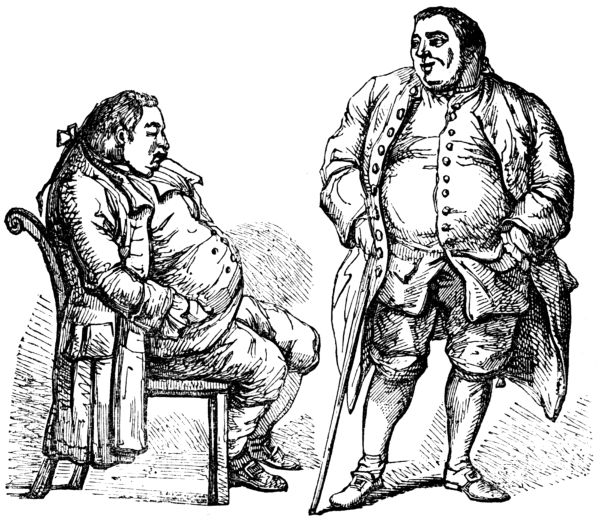
Francis Grose, Esq. F.S.A. etc.
This gentleman died on the 12th of May, 1791; he was son of Francis Grose, esq. jeweller at Richmond, who fitted up the coronation crown of George II. He was a captain in the Surrey militia, an eminent antiquary, and a right worthy man. His “Antiquities of England and Wales, Scotland and Ireland,” are more generally known perhaps than other topographical works of more profound inquiry. They were commenced in numbers, and published by “Master Samuel Hooper,” so he called his bookseller, to whom he was a steady and affectionate friend, though he says, in one of his letters, “he never did any one thing I desired him.” His “Classical Dictionary of the Vulgar Tongue,” Mr. Nichols says, “it would have been for his credit to have suppressed.” The truth of this observation is palpable to every one who is not sophisticated by the wretchedly mischievous line, that
“Vice, to be hated, needs but to be seen.”
A more mischievous sentiment was never promulgated. Capt. Grose’s “Olio” is a pleasant medley of whimsicalities. He was an excellent companion, a humorist, and caricaturist; he wrote “Rules for drawing Caricatures,” and drew and etched many, wherein he took considerable liberties with his friends. Yet he seems to have disliked a personal representation of himself sleeping in a chair, which Mr. Nichols pronounces “an excellent” likeness; a copy of which we have given in the preceding page. Adjoining it is another of him, a whole length, standing, from an engraving by Bartolozzi, after a drawing by Dance. The sleeping portrait is attributed to the rev. James Douglas, one of his brother antiquaries, who dedicated the print to their “devoted brethren” of the society. Beneath it were inscribed the following lines:
“Now Grose, like bright Phœbus, has sunk into rest, Society droops for the loss of his jest; Antiquarian debates, unseason’d with mirth, To Genius and Learning will never give birth. Then wake, Brother Member, our friend from his sleep, Lest Apollo should frown, and Bacchus should weep.”
He was remarkably corpulent, as the engravings show. In a letter to the rev. James Granger, he says, “I am, and ever have been, the idlest fellow living, even before I had acquired the load of adventitious matter which at present stuffs my doublet.” On the margin of this letter Mr. Granger wrote, “As for the matter that stuffs your doublet, I hope it is all good stuff; if you should double it, I shall call it morbid matter and tremble for you. But I consider it as the effect of good digestion, pure blood, and laughing spirits, coagulated into a wholesome mass by as much sedentariness (I hate this long word) as is consistent with the activity of your disposition.” In truth, Grose was far from an idle man; he had great mental activity, and his antiquarian knowledge and labours were great. He was fond however of what are termed the pleasures of the table; and is represented in a fine mezzotinto, drawn and engraved by his friend Nathaniel Hone, with Theodosius Forrest, the barrister, and Hone himself, dressed in the character of monks, over a bowl, which Grose is actively preparing for their carousal. He died of apoplexy in Mr. Hone’s house in Dublin, at the age of fifty-two. In reference to his principal works, the following epitaph, quoted by Mr. Nichols in his “Anecdotes,” was proposed for him in the “St. James’s Chronicle:”—
Here lies Francis Grose. On Thursday, May 12, 1791, Death put an end to His views and prospects.
FLORAL DIRECTORY.
German Fleur de lis. Iris Germanica. Dedicated to St. Germanus.
May 13.
St. John the Silent, Bp. A. D. 558. St. Peter Regalati, A. D. 1456. St. Servatus, Bp. of Tongres, A. D. 384.
FLORAL DIRECTORY.
Common Comfrey. Symphetum officinale. Dedicated to St. John the Silent.
May 14.
St. Boniface, A. D. 307. St. Pachomius, Abbot, A. D. 348. St. Pontius, A. D. 258. St. Carthagh, or Mochudu, Bp. of Lismore, A. D. 637 or 638.
FLORAL DIRECTORY.
Common Piony. Pæonia officinalis. Coralline Piony. Pæonia corallina. Dedicated to St. Pontius.
May 15.
St. Peter, Andrew, and Companions, Martyrs, A. D. 250. St. Dympna, 7th Cent. St. Genebrard or Genebern.
For the Every-Day Book.
A “SEASONABLE STORY.”
’Tis hard, you’ll tell me, but ’tis true— Thanks to that heathen dog, Mahomet— In Turkey if you want to woo— But, by the bye, you’d best keep from it— The object of your love must hide Her face from every idle gazer— A wholesome check on female pride I think; and what’s your notion, pray sir? “Where beechen boughs their shade diffuse” ’Twas once my lot to hear a ditty, Fill’d with such stuff as lovers use To melt the maiden heart with pity, Recited by a Turk: ’twas queer I thought that one like him, who never Had seen his mistress, should appear In “puff” and “eulogy” so clever. “Two swains were smoking,” tales, you know, Of love begin and end in vapour— “Beside a purling stream, when lo! By came a maiden, slim and taper. Her eyes were like two stars at night”— No matter how I came to know it— The one beholds her with delight. And all at once becomes a poet. “Why sits thy soul within those eyes?” The other asks, “resume your smoking,” The lover hears him with surprise And answers, “Set aside all joking, The pipe has now no charms for me; My heart is, as a fig, transported To the thick foliage of some tree, And there a bright-eyed bird has caught it.” Now hear a moral! Love’s a sly And roguish fellow: look about ye Watch all he does with careful eye, Or else ’tis ten to one he’ll flout ye. Give him an inch he’ll take an ell; And, if he once make conquest o’er ye, Then sense, wit, reason, will, farewell!— Thus ends this seasonable story.
Δ
FLORAL DIRECTORY.
Welsh Poppy. Papaver Cambricum. Dedicated to St. Dympna.
May 16.
St. John Nepomucen, A. D. 1383. St. Simon Stock, A. D. 1265. St. Ubaldus, A. D. 1160. St. Honoratus, Bp. A. D. 660. St. Abdjesus, or Hebedjesus, Bp. St. Abdas, Bp. St. Brendan the Elder, Abbot of Clonfert, A. D. 578.
Last day of Easter Term, 1825; it commenced 20th of April.
A PASTORAL RECESS.
From the “Diana” of George of Montemayor, 1598, there is an extract in the Literary Pocket Book sweetly descriptive of a placid scene in nature. It begins with—“When the joyous companie arrived thus far, they saw how a little brooke, covered almost all over with sweet and smelling herbs, ran gently thorow a greene meadow amongst a ranke of divers trees that were nourished and maintained by the cleere water; under the shadowes of which, as they were now determined to rest themselves, Syrenus said, ‘Let us see from whence this little spring doth issue forth. It may be the place is more fresh and cool thereabouts: if not, or if we cannot finde out the fountaine from whence it flowes, we will return here.’ It liked his company well, and so they desired him to lead the way. Everie place and part of all the brooke upwards invited them to pleasant rest; but, when, at length, after much perplexitie, resulting from the very abundance and luxurie of their choice, they were about to lay themselves downe, they sawe that with greater quantitie of waters and fresher shades of green trees the brooke ran up higher, forsaking its right course towards the left hande, where our companie discovered a great thicket and spring of divers trees, in which they saw a very narrow entrance, and somewhat long, whose sides were not of walls fabricated by artificiall hand but made of trees by nature, the mistresse of all things. For there were seene the deadly Cypresse, the triumphant laurell, the hard oke, the low sallow, the invincible palme, the blacke and ruggie elme, the olive, the prickie chestenut, and the high pine-apple, one amongst another, whose bodies were bound about with greene ivie and the fruitfull vine, and beset with sweet jesmines and many other redolent flowers, that grew very thicke together in that place. Amongst the which many little birds (inhabitants of that wood) went leaping from bough to bough, making the place more pleasant with their sweet and silver notes. The trees were in such order set together that they denied not the golden sunbeames to have an entrance, to paint the greene ground with divers colours (which reverberated from the flowers) that were never steadie in one place, by reason that the moveable leaves did disquiet them. This narrow way did leade to a little greene, covered all over with fine grasse, and not touched with the hungrie mouthes of devouring flockes. At the side of it was the fountaine of the brooke, having a care that the place should not drie up, sending forth on every side her flowing waters.”
The season is coming on wherein the heart will court retreat to such a scene of natural beauty.
FLORAL DIRECTORY.
Great Star of Bethlehem. Ornithogalum Umbrellatum. Dedicated to St. John Nepomucen.
May 17.
St. Paschal Babylon, A. D. 1592. St. Possidius, Bp. of Calama, in Numidia, A. D. 430. St. Maden, or Madern. St. Maw. St. Cathan, 6th or 7th Cent. St. Silave, or Silan, Bp. A. D. 1100.
Chronology.
1817. Died at Heckington, aged sixty-five, Mr. Samuel Jessup, an opulent grazier, of pill-taking memory. He lived in a very eccentric way, as a bachelor, without known relatives; and at his decease possessed of a good fortune, notwithstanding a most inordinate craving for physic, by which he was distinguished for the last thirty years of his life, as appeared on a trial for the amount of an apothecary’s bill, at the assizes at Lincoln, a short time before Mr. Jessup’s death, wherein he was defendant. The evidence on the trial affords the following materials for the epitaph of the deceased, which will not be transcended by the memorabilia of the life of any man:—In twenty-one years (from 1791 to 1816) the deceased took 226,934 pills, supplied by a respectable apothecary at Bottesford; which is at the rate of 10,806 pills a year, or twenty-nine pills each day; but as the patient began with a more moderate appetite, and increased it as he proceeded, in the last five years preceding 1816, he took the pills at the rate of seventy-eight a day, and in the year 1814 he swallowed not less than 51,590. Notwithstanding this, and the addition of 40,000 bottles of mixture, and juleps and electuaries, extending altogether to fifty-five closely written columns of an apothecary’s bill, the deceased lived to attain the advanced age of sixty-five years.
FLORAL DIRECTORY.
Early Red Poppy. Papaver Argemone. Dedicated to St. Paschal Babylon.
May 18.
St. Eric, King of Sweden, A. D. 1151. St. Theodotus, Vintner, and Seven Virgins, Martyrs, A. D. 303. St. Venantius, A. D. 250. St. Potamon, Bp. of Heraclea, in Egypt, A. D. 341.
Chronology.
1808. Sir John Carter, knt. died at Portsmouth, his native town, aged sixty-seven. He was an alderman, and nine times mayor of the borough; and a magistrate of the county, for which he also served the office of sheriff in 1784. His name is here introduced to commemorate an essential service that he rendered to his country, by his mild and judicious conduct during the mutiny at Spithead, in the spring of 1797. The sailors having lost three of their body in consequence of the resistance made to their going on board the London, then bearing the flag of admiral Colpoys, wished to bury them in Kingston churchyard, and to carry them in procession through the town of Portsmouth. This request was most positively refused them by the governor. They then applied to sir John Carter to grant their request, who endeavoured to convince the governor of the propriety and necessity of complying with it, declaring that he would be answerable for the peace of the town, and the orderly conduct of the sailors. The governor would not be prevailed on, and prepared for resistance; and resistance on both sides would most probably have been resorted to, had not the calmness, perseverance, and forbearance of sir John Carter at length compromised the affair, by obtaining permission for the sailors to pass through the garrison of Portsmouth in procession, and the bodies to be landed at the Common Hard in Portsea, where the procession was to join them.
So great was sir John Carter’s influence over the sailors, that they most scrupulously adhered to the terms he prescribed to them in their procession to the grave. Two of their comrades having become “a little groggy” after they came on shore, they were carefully locked up in a room by themselves, lest they should become quarrelsome, or be unable to conduct themselves with propriety. It was a most interesting spectacle. Sir John accompanied them himself through the garrison, to prevent any insult being offered to them. At the Common Hard he was joined by Mr. Godwin, the friend and associate of his youth, and also a most worthy magistrate of this borough. They attended the procession till it had passed the fortifications at Portsea: every thing was conducted with the greatest decorum. When the sailors returned, and were sent off to their respective ships, two or three of the managing delegates came to sir John, to inform him that the men were all gone on board, and to thank him for his great goodness to them. Sir John seized the opportunity of inquiring after their admiral, as these delegates belonged to the London. “Do you know him, your honour?” “Yes; I have a great respect for him, and I hope you will not do him any harm.” “No, by G—d, your honour, he shall not be hurt.” It was at that time imagined admiral Colpoys would be hung at the yard-arm, and he had prepared for this event by arranging his affairs and making his will. In this will he had left to the widows of the three men who were so unfortunately killed an annuity of 20l. each. The next morning, however, the admiral was privately, unexpectedly, and safely brought on shore, though pursued by a boat from the Mars, as soon as they suspected what was transacting. The delegates brought him to sir John Carter, and delivered him to his care: they then desired to have a receipt for him, as a proof to their comrades that they had safely delivered him into the hands of the civil power; and this receipt he gave. The admiral himself, in his first appearance at court afterwards, acknowledged to the king that he owed his life to sir John Carter, and assured his majesty that his principles were misinterpreted and his conduct misrepresented, and that he had not a more faithful and worthy subject in his dominions. Notwithstanding this, the duke of Portland, then secretary of state for the home department, received a very strong letter against him, which letter his grace sent to sir John, assuring him at the same time that the government placed the utmost confidence in his honour, integrity, and patriotism, and concluded by proposing to offer a large reward for the discovery of the writer: this, with a dignified consciousness of the purity of his conduct, sir John declined; though, from some well-founded conjectures, the discovery might possibly have been easily made. This inestimable consciousness enabled him to meet with the greatest composure every effort of party rage to sully his reputation and destroy his influence. So pure were his principles, that when in the year 1806 he was offered a baronetage by Mr. Fox, he declined it on the ground that he believed the offer to have been made for his undeviating attachment to Mr. Fox’s politics; and that, to accept it, would be a manifest departure from his principles. In every public and domestic relationship he was uniformly mild, impartial, and upright; nor was he ever deterred by persona, difficulties or inconveniences from a faithful, and even minute attendance on his widely extended duties. The poor in him ever found a friend, and the unfortunate a protector. The peace, comfort, and happiness of others, and not his own interest, were the unwearied objects of his pursuit. Never was there a character in which there was less of self than in his.
MANURES.
Rambling in cultivated spots renders one almost forgetful of cultivating friends. On the subject of “manure,” the editor of the Every-Day Book has no competent knowledge; he has not settled in his own mind whether he should decide for “long straw or short straw,” and as regards himself would willingly dispose of the important question by “drawing cuts;” all he can at present do for his country readers, is to tell them what lord Bacon affirms; his lordship says that “muck should be spread.” This would make a capital text or vignette for a dissertation; but there is no space here to dissertate, and if Messrs. Taylor and Hessey’s London Magazine, for May, had not suggested the subject, it would scarcely have occurred. There the reviewer of “Gaieties and Gravities” has extracted some points from that work, which are almost equal to the quantity of useful information derivable from more solid books—here they are:—
Gaieties.
“Residing upon the eastern coast, and farming a considerable extent of country, I have made repeated and careful experiments with this manure; and as the mode of burial in many parts of the Continent divides the different classes into appropriated portions of the churchyard, I have been enabled, by a little bribery to sextons and charnel-house men, to obtain specimens of every rank and character, and to ascertain with precision their separate qualities and results for the purposes of the farmer, botanist, or common nurseryman. These it is my purpose to communicate to the reader, who may depend upon the caution with which the different tests were applied, as well as upon the fidelity with which they are reported.
“A few cartloads of citizens’ bones gave me a luxuriant growth of London pride, plums, Sibthorpia or base money-wort, mud-wort, bladder-wort, and mushrooms; but for laburnum or golden chain, I was obliged to select a lord mayor. Hospital bones supplied me with cyclamen in any quantity, which I intermixed with a few seeds from the Cyclades Islands, and the scurvy-grass came up spontaneously; while manure from different fields of battle proved extremely favourable to the hæmanthus or blood-flower, the trumpet-flower and laurel, as well as to widow-wail and cypress. A few sample skulls from the poet’s corner of a German abbey furnished poet’s cassia, grass of Parnassus, and bays, in about equal quantities, with wormwood, crab, thistle, stinging-nettle, prickly holly, teasel, and loose-strife. Courtiers and ministers, when converted into manure, secured an ample return of jack-in-a-box, service-apples, climbers, supple-jacks, parasite plants, and that species of sun-flower which invariably turns to the rising luminary. Nabobs form a capital compost for hepatica, liver-wort, spleen-wort, hips, and pine; and from those who had three or four stars at the India-house, I raised some particularly fine China asters. A good show of adonis, narcissus, jessamine, cockscomb, dandelion, money-flower, and buckthorn, may be obtained from dandies, although they are apt to encumber the ground with tickweed; while a good drilling with dandisettes is essential to those beds in which you wish to raise Venus’s looking-glass, Venus’s catchfly, columbines, and love-apples. A single dressing of jockies will ensure you a quick return of horse-mint, veronica or speedwell, and colt’s-foot; and a very slight layer of critics suffices for a good thick spread of scorpion senna, viper’s bugloss, serpent’s tongue, poison-nut, nightshade, and hellebore. If you are fond of raising stocks, manure your bed with jobbers; wine-merchants form the most congenial stimulant for sloes, fortune-hunters for the marygold and goldenrod, and drunkards for Canary wines, mad-wort and horehound. Failing in repeated attempts to raise the chaste tree from the bones of nuns, which gave me nothing but liquorice-root, I applied those of a dairy-maid, and not only succeeded perfectly in my object, but obtained a good crop of butter-wort, milk-wort, and heart’s-ease. I was equally unsuccessful in raising any sage, honesty, or everlasting from monks; but they yielded a plentiful bed of monk’s hood, or jesuit’s bark, medlars, and cardinal flowers. My importation of shoemakers was unfortunately too scanty to try their effect upon a large scale, but I contrived to procure from them two or three ladies’ slippers. As school-boys are raised by birch, it may be hardly necessary to mention, that when reduced to manure, they return the compliment; but it may be useful to make known as widely as possible, that dancing-masters supply the best hops and capers, besides quickening the growth of the citharexylum or fiddle-wood. For your mimosas or sensitive plants there is nothing better than a layer of novel-readers, and you may use up the first bad author that you can disinter for all the poppies you may require. Coffee-house waiters will keep you supplied in cummin; chronologists furnish the best dates, post-office men serve well for rearing scarlet-runners, poulterers for hen-bane, tailors for cabbage, and physicians for truffles, or any thing that requires to be quickly buried. I could have raised a few bachelors’ buttons from the bones of that class; but as nobody cares a button for bachelors, I did not think it worth while. As a general remark it may be noticed, that young people produce the passion-flower in abundance, while those of a more advanced age may be beneficially used for the elder-tree, the sloe, and snapdragon; and with respect to different nations, my experiments are only sufficiently advanced to enable me to state that Frenchmen are favourable to garlic, and that Poles are very good for hops. Of mint I have never been able to raise much; but as to thyme, I have so large a supply, as the reader will easily perceive, that I am enabled to throw it away; and as he may not possibly be in a similar predicament, I shall refer him for the rest of my experiments to the records of the Horticultural Society.”
It is noticed by Dr. Forster, that about this time the purple goatsbeard tragopogon porrifolius and the yellow goatsbeard tragopogon pratensis begin to blow; and that of all the indices in the HOROLOGIUM FLORÆ the above plants are the most regular: they open their flowers at sunrise, and shut them so regularly at mid-day, that they have been called by the whimsical name of go to bed at noon. They are as regular as a clock, and are mentioned as such in the following verses:—
RETIRED LEISURE’S DELIGHT.
To sit and smoke between two rows of Limes, Along the wall of some neat old Dutch town, In noontide heat, and hear the jingling chimes From Stadhouse Steeple; then to lay one down Upon a Primrose bank, where Violet flowers Smell sweetly, and the meads in bloomy prime, ’Till Flora’s clock, the Goat’s Beard, mark the hours, And closing says, Arise, ’tis dinner time; Then dine on Pyes and Cauliflower heads, And roam away the afternoon in Tulip Beds.
To give an idea of the general face of nature at this period, Dr. Forster composed the subjoined
Catalogue of Plants which compose the VERNAL FLORA in the Garden.
Common Peony Paeonia officinalis in full blow.
Slenderleaved Peony P. tenuifolia going off.
Crimson Peony P. peregrina.
Dwarf Peony P. humilis.
Tulip Tulipa Gesneriana in infinite varieties.
Monkey Poppy Papaver Orientale.
Welch Poppy P. Cambricum.
Pale Poppy P. nudicaule.
European Globeflower Trollius Europaeus.
Asiatic Globeflower Trollius Asiaticus.
Bachelor’s Buttons Ranunculus aeris plenus.
Biflowered Narcissus N. biflorus.
Poetic Narcissus N. poeticus.
German Fleur de Lis Iris Germanica, two varieties.
Lurid Iris Iris lurida.
Wallflower Chieranthus cheiri, numerously, both single and double sorts.
Stock Gilliflower Chiranthus fruticulosus beginning. Of this plant there are red, white, and purple varieties; also double Stocks.
Yellow Asphodel Asphodelus luteus.
Columbine Aquilegia vulgaris begins to flower, and has several varieties in gardens.
Great Star of Bethlehem Ornithogalum umbellatum.
Peruvian Squill Scilla Peruviana.
Yellow Azalea Azalea Pontica.
Scarlet Azalea Azalea nudiflora.
Purple Goatsbeard Tragopogon porrifolius.
Yellow Goatsbeard Tragopogon pratensis.
Motherwort Hesperis matronalis begins to blow.
Great Leopard’s Bane Doronicum pardalianches.
Lesser Leopard’s Bane Doronicum plantagineum.
Ramshorns or Male Orchis O. mascula still blows.
Female Orchis Orchis morio still flowers.
In the Fields.
The Harebell Scylla nutans makes the ground blue in some places.
Bulbous Crowfoot Ranunculus bulbosus.
Creeping Crowfoot R. repens now common.
Upright Meadow Crowfoot R. acris the latest of all.
Rough Crowfoot R. hirsutus not so common as the above. The fields are quite yellow with the above genus.
Meadow Lychnis Lychnis Flos Cuculi.
Campion Lychnis Lychnis dioica under hedges in our chalky soils.
Germander Speedwell Veronica chamaedris on banks, covering them with its lively blue, comparable only to the Borage, or the Cynoglossum Omphalodes, still blowing and luxuriant in gardens.
Mousear Scorpion Grass Myosotus Scorpioides.
Our Lady’s Smock Cardamine pratensis.
Bitter Lady’s Smock Cardamine amara.
Hedge Geranium Geranium Robertianum; also several other wild Geraniums.
Kidlock Sinapis arvensis.
Charlock Raphanus Raphanistrum.
Stichwort Stellaria Holostea.
Yellow Water Lily Nuphar luteum in ponds and rivers.
White Water Lily Nymphea alba in the same.
We might add numerous others, which will be found noticed on the days when they usually first flower. Besides these, many of the plants of the Primaveral Flora still remain in blow, as violets, hearteases, hepaticas, narcissi, some hyacinths, marsh marigolds, wood anemonies, garden anemonies, &c. &c. The cuckoo pint, or lord and lady Arum, is now in prime.
The nations among whom a taste for flowers was first discovered to prevail in modern times, were China, Persia, and Turkey. The vegetable treasures of the eastern world were assembled at Constantinople, whence they passed into Italy, Germany, and Holland, and from the latter into England; and since botany has assumed the character of a science, we have laid the whole world under contribution for trees, and shrubs, and flowers, which we have not only made our own, but generally improved in vigour and beauty. The passion for flowers preceded that of ornamental gardening. The Dutch system of straight walks, enclosed by high clipped hedges of yew or holly, at length prevailed; and tulips and hyacinths bloomed under the sheltered windings of the “Walls of Troy,” most ingeniously traced in box and yew. A taste for gardening, which, however formal, is found at length to be preferable to the absurd winding paths, and the close imitation of wild nature by art, which modern garden-makers have pretended to of late years. The learned baron Maseres used to say, “Such a garden was to be had every where wild in summer, and in a garden formality was preferable.”
Proverbs relating to May.
A cold May and a windy Makes a fat barn and a findy.
A hot May makes a fat churchyard.
Proverbs relating to the Weather and Seasons generally. Collected by Dr. Forster.
Drought never bred dearth in England.
Whoso hath but a mouth, shall ne’er in England suffer drought.
When the sand doth feed the clay, England woe and welladay; But when the clay doth feed the sand, Then it is well with Angle land.
After a famine in the stall, Comes a famine in the hall.
When the cuckoo comes to the bare thorn, Sell your cow, and buy your corn; But when she comes to the full bit, Sell your corn, and buy your sheep.
If the cock moult before the hen, We shall have weather thick and thin; But if the hen moult before the cock, We shall have weather hard as a block.
As the days lengthen, so the cold strengthen.
If there be a rainbow in the eve, it will rain and leave, But if there be a rainbow in the morrow, it will neither lend nor borrow.
A rainbow in the morning Is the shepherd’s warning; But a rainbow at night Is the shepherd’s delight.
No tempest, good July, Lest corn come off blue by.
When the wind’s in the east, It’s neither good for man nor beast. When the wind’s in the south, It’s in the rain’s mouth.
When the wind’s in the south, It blows the bait into the fishes’ mouth.
No weather is ill, If the wind be still.
When the sloe-tree is as white as a sheet, Sow your barley, whether it be dry or wet.
A green winter makes a fat churchyard.
Hail brings frost in the tail.
A snow year, a rich year.
Winter’s thunder’s summer’s wonder.
FLORAL DIRECTORY.
Mouse Ear. Hieracium Pilosella. Dedicated to St. Eric.
May 19.
St. Peter Celestine, Pope, A. D. 1296. St. Pudentiana. St. Dunstan; Abp. of Canterbury, A. D. 988.
St. Dunstan.
He was born at Glastonbury, of which monastery he became abbot, and died archbishop of Canterbury in 988.[146]
The legend of St. Dunstan relates many miracles of him, the most popular of which is to this effect; that St. Dunstan, as the fact really was, became expert in goldsmith’s work; it then gives as a story, that while he was busied in making a chalice, the devil annoyed him by his personal appearance, and tempted him; whereupon St. Dunstan suddenly seized the fiend by the nose with a pair of iron tongs, burning hot, and so held him while he roared and cried till the night was far spent.
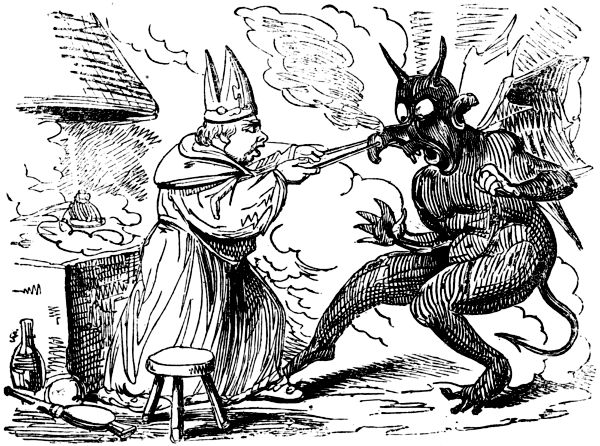
St. Dunstan and the Devil.
There is an engraved portrait of St. Dunstan thus detaining the devil in bondage, with these lines, or lines to that effect beneath; they are quoted from memory:—
St. Dunstan, as the story goes, Once pull’d the devil by the nose With red-hot tongs, which made him roar, That he was heard three miles or more.
On lord mayor’s day, in 1687, the pageants of sir John Shorter, knt. as lord mayor, were very splendid. He was of the company of goldsmiths, who, at their own expense, provided one of the pageants representing this miracle of St. Dunstan. It must have been of amazing size, for it was a “Hieroglyphic of the Company,” consisting of a spacious laboratory or workhouse, containing several conveniences and distinct apartments, for the different operators and artificers, with forges, anvils, hammers, and all instruments proper for the mystery of the goldsmiths. In the middle of the frontispiece, on a rich golden chair of state, sat ST. DUNSTAN, the ancient patron and tutelar guardian of the company. He was attired, to express his prelatical dignity and canonization, in a robe of fine lawn, with a cope over it of shining cloth of gold reaching to the ground. He wore a golden mitre beset with precious stones, and bore in his left hand a golden crosier, and in his right a pair of goldsmith’s tongs. Behind him were Orpheus and Amphion playing on melodious instruments; standing more forward were the cham of Tartary, and the grand sultan, who, being “conquered by the christian harmony, seemed to sue for reconcilement.” At the steps of the prelatical throne were a goldsmith’s forge and furnace, with fire, crucibles, and gold, and a workman blowing the bellows. On each side was a large press of gold and silver plate. Towards the front were shops of artificers and jewellers all at work, with anvils, hammers, and instruments for enamelling, beating out gold and silver plate; on a step below St. Dunstan, sat an assay-master, with his trial-balance and implements. There were two apartments for the processes of disgrossing, flatting, and drawing gold and silver wire, and the fining, melting, smelting, refining, and separating of gold and silver, both by fire and water. Another apartment contained a forge, with miners in canvass breeches, red waistcoats and red caps, bearing spades, pickaxes, twibbles, and crows for sinking shafts and making adits. The lord mayor, having approached and viewed the curiosity of the pageant, was addressed in
A SPEECH BY ST. DUNSTAN.
Waked with this musick from my silent urn, Your patron DUNSTAN comes t’ attend your turn. Amphion and old Orpheus playing by, To keep our forge in tuneful harmony. These pontifical ornaments I wear, Are types of rule and order all the year. In these white robes none can a fault descry, Since all have liberty as well as I: Nor need you fear the shipwreck of your cause, Your loss of charter or the penal laws, Indulgence granted by your bounteous prince, Makes for that loss too great a recompence. This charm the Lernæan Hydra will reclaim; Your patron shall the tameless rabble tame. Of the proud CHAM I scorn to be afear’d; I’ll take the angry SULTAN by the beard. Nay, should the DEVIL intrude amongst your foes[Enter Devil Devil. What then? St. Dunstan. —————Snap, thus, I have him by the nose!
The most prominent feature in the devil’s face being held by St. Dunstan’s tongs, after the prelate had duly spurned the submission of the cham of Tartary and the grand sultan, a silversmith with three other workmen proceeding to the great anvil, commenced working a plate of massy metal, singing and keeping time upon the anvil.[147]
Chronology.
1536. Anne Boleyn, queen of Henry VIII., fell a victim to his brutal passions by the hands of the executioner.
1692. The great sea battle off la Hogue.
FLORAL DIRECTORY.
Monk’s hood. Aconitum Napellus. Dedicated to St. Dunstan.
May 20.
St. Bernardin of Sienna, A. D. 1444. St. Ethelbert, King of the East Angles, A. D. 793. St. Yvo, Bp. of Chartres, A. D. 1115.
ON BEING CONFINED TO SCHOOL ONE PLEASANT MORNING IN SPRING.
The morning sun’s enchanting rays Now call forth every songster’s praise; Now the lark, with upward flight, Gaily ushers in the light; While wildly warbling from each tree, The birds sing songs to Liberty. But for me no songster sings, For me no joyous lark up-springs; For I, confined in gloomy school, Must own the pedant’s iron rule, And, far from sylvan shades and bowers, In durance vile, must pass the hours; There con the scholiast’s dreary lines, Where no bright ray of genius shines, And close to rugged learning cling, While laughs around the jocund spring. How gladly would my soul forego All that arithmeticians know, Or stiff grammarians quaintly teach, Or all that industry can reach, To taste each morn of all the joys That with the laughing sun arise; And unconstrain’d to rove along The bushy brakes and glens among; And woo the muse’s gentle power, In unfrequented rural bower! But, ah! such heaven-approaching joys Will never greet my longing eyes; Still will they cheat in vision fine, Yet never but in fancy shine. Oh, that I were the little wren That shrilly chirps from yonder glen Oh, far away I then would rove, To some secluded bushy grove; There hop and sing with careless glee, Hop and sing at liberty; And till death should stop my lays, Far from men would spend my days.
In the “Perennial Calendar,” Dr. Forster with great taste introduces a beautiful series of quotations adapted to the season from different poets:—
Lucretius on Spring and the Seasons, translated by Good.
Spring comes, and Venus with fell foot advanced; Then light-winged Zephyr, harbinger beloved; Maternal Flora, strewing ere she treads, For every footstep flowers of choicest hue, And the glad æther loading with perfumes Then Heat succeeds, the parched Etesian breeze, And dust-discoloured Ceres; Autumn then Follows, and tipsy Bacchus, arm in arm, And storms and tempests; Eurus roars amain, And the red south brews thunders; till, at length, Cold shuts the scene, and Winter’s train prevails, Snows, hoary Sleet, and Frost, with chattering teeth.
Milton makes the most heavenly clime to consist of an eternal spring:
The birds that quire apply; airs, vernal airs, Breathing the smell of field and grove, attune The trembling leaves, while universal Pan, Knit with the graces, and the hours in dance, Led on the eternal spring.
From Atherstone’s Last Days of Herculaneum.
Soft tints of sweet May morn, when day’s bright god Looks smiling from behind delicious mists; Throwing his slant rays on the glistening grass, Where ’gainst the rich deep green the Cowslip hangs His elegant bells of purest gold:—the pale Sweet perfumed primrose lifts its face to heaven, Like the full, artless gaze of infancy:— The little ray-crowned daisy peeps beneath, When the tall neighbour grass, heavy with dew, Bows down its head beneath the freshening breeze; Where oft in long dark lines the waving trees Throw their soft shadows on the sunny fields; Where, in the music-breathing hedge, the thorn And pearly white May blossom, full of sweets, Hang out the virgin flag of spring, entwined With dripping honey-suckles, whose sweet breath Sinks to the heart—recalling, with a sigh, Dim recollected feelings of the days Of youth and early love.
From Spring, by Kleist
Who thus, O tulip! thy gay-painted breast In all the colours of the sun has drest? Well could I call thee, in thy gaudy pride, The queen of flowers; but blooming by thy side Her thousand leaves that beams of love adorn, Her throne surrounded by protecting thorn, And smell eternal, form a juster claim, Which gives the heaven-born rose the lofty name, Who having slept throughout the wintry storm, Now through the opening buds displays her smiling form. Between the leaves the silver whitethorn shows Its dewy blossoms, pure as mountain snows. Here the blue hyacinth’s nectareous cell To my charmed senses gives its cooling smell. In lowly beds the purple violets bloom, And liberal shower around their rich perfume. See, how the peacock stalks yon beds beside, Where rayed in sparkling dust and velvet pride, Like brilliant stars, arranged in splendid row, The proud auriculas their lustre show: The jealous bird now shows his swelling breast, His many-coloured neck, and lofty crest; Then all at once his dazzling tail displays, On whose broad circle thousand rainbows blaze. The wanton butterflies, with fickle wing, Flutter round every flower that decks the spring Then on their painted pinions eager haste, The luscious cherry’s blood to taste.
Prognostics of Weather and Horologe of Flora. FOR SPRING AND SUMMER.
From the “Perennial Calendar.”
Chickweed.—When the flower expands boldly and fully, no rain will happen for four hours or upwards: if it continues in that open state, no rain will disturb the summer’s day: when it half conceals its miniature flower, the day is generally showery; but if it entirely shuts up, or veils the white flower with its green mantle, let the traveller put on his great coat, and the ploughman, with his beasts of drought, expect rest from their labour.
Siberian sowthistle.—If the flowers of this plant keep open all night, rain will certainly fall the next day.
Trefoil.—The different species of trefoil always contract their leaves at the approach of a storm: hence these plants have been termed the husbandman’s barometer.
African marygold.—If this plant opens not its flowers in the morning about seven o’clock, you may be sure it will rain that day, unless it thunders.
The convolvulus also, and the pimpernel anagalis arvensis, fold up their leaves on the approach of rain: the last in particular is termed the poor man’s weather-glass.
White thorns and dog-rose bushes.—Wet summers are generally attended with an uncommon quantity of seed on these shrubs; whence their unusual fruitfulness is a sign of a severe winter.
Besides the above, there are several plants, especially those with compound yellow flowers, which nod, and during the whole day turn their flowers towards the sun: viz. to the east in the morning, to the south at noon, and to the west towards evening; this is very observable in the sowthistle sonchus arvensis: and it is a well-known fact, that a great part of the plants in a serene sky expand their flowers, and as it were with cheerful looks behold the light of the sun; but before rain they shut them up, as the tulip.
The flowers of the alpine whitlow grass draba alpina, the bastard feverfew parthenium, and the wintergreen trientalis, hang down in the night as if the plants were asleep, lest rain or the moist air should injure the fertilizing dust.
One species of woodsorrel shuts up or doubles its leaves before storms and tempests, but in a serene sky expands or unfolds them, so that the husbandman can pretty clearly foretell tempests from it. It is also well known that the mountain ebony bauhinia, sensitive plants, and cassia, observe the same rule.
Besides affording prognostics, many plants also fold themselves up at particular hours, with such regularity, as to have acquired particular names from this property. The following are among the more remarkable plants of this description:—
Goatsbeard.—The flowers of both species of tragopogon open in the morning at the approach of the sun, and without regard to the state of the weather regularly shut about noon. Hence it is generally known in the country by the name of go to bed at noon.
The princesses’ leaf, or four o’clock flower, in the Malay Islands, is an elegant shrub so called by the natives, because their ladies are fond of the grateful odour of its white leaves. It takes its generic name from its quality of opening its flowers at four in the evening, and not closing them in the morning till the same hour returns, when they again expand in the evening at the same hour. Many people transplant them from the woods into their gardens, and use them as a dial or a clock, especially in cloudy weather.
The evening primrose is well known from its remarkable properties of regularly shutting with a loud popping noise, about sunset in the evening, and opening at sunrise in the morning. After six o’clock, these flowers regularly report the approach of night.
The tamarind tree parkinsonia, the nipplewort lapsana communis, the water lily nymphaea, the marygolds calendulae, the bastard sensitive plant aeschynomene, and several others of the diadelphia class, in serene weather, expand their leaves in the daytime, and contract them during the night. According to some botanists, the tamarind-tree enfolds within its leaves the flowers or fruit every night, in order to guard them from cold or rain.
The flower of the garden lettuce, which is in a vertical plane, opens at seven o’clock, and shuts at ten.
A species of serpentine aloe, without prickles, whose large and beautiful flowers exhale a strong odour of the vanilla during the time of its expansion, which is very short, is cultivated in the imperial garden at Paris. It does not blow till towards the month of July, and about five o’clock in the evening, at which time it gradually opens its petals, expands them, droops, and dies. By ten o’clock the same night, it is totally withered, to the great astonishment of the spectators, who flock in crowds to see it.
The cerea, a native of Jamaica and Vera Cruz, expands an exquisitely beautiful coral flower, and emits a highly fragrant odour, for a few hours in the night, and then closes to open no more. The flower is nearly a foot in diameter; the inside of the calyx, of a splendid yellow; and the numerous petals are of a pure white. It begins to open about seven or eight o’clock in the evening, and closes before sunrise in the morning.
The flower of the dandelion possesses very peculiar means of sheltering itself from the heat of the sun, as it closes entirely whenever the heat becomes excessive. It has been observed to open, in summer, at half an hour after five in the morning, and to collect its petals towards the centre about nine o’clock.
Linnæus has enumerated forty-six flowers, which possess this kind of sensibility: he divides them into three classes.—1. Meteoric flowers, which less accurately observe the hour of folding, but are expanded sooner or later according to the cloudiness, moisture, or pressure of the atmosphere. 2. Tropical flowers, that open in the morning and close before evening every day, but the hour of their expanding becomes earlier or later as the length of the day increases or decreases. 3. Equinoctial flowers, which open at a certain and exact hour of the day, and for the most part close at another determinate hour.
On Flora’s Horologe, by Charlotte Smith.
In every copse and sheltered dell, Unveiled to the observant eye, Are faithful monitors, who tell How pass the hours and seasons by. The green-robed children of the Spring Will mark the periods as they pass, Mingle with leaves Time’s feathered wing, And bind with flowers his silent glass. Mark where transparent waters glide, Soft flowing o’er their tranquil bed; There, cradled on the dimpling tide, Nymphæa rests her lovely head. But conscious of the earliest beam, She rises from her humid nest, And sees reflected in the stream The virgin whiteness of her breast. Till the bright Daystar to the west Declines, in Ocean’s surge to lave: Then, folded in her modest vest, She slumbers on the rocking wave. See Hieracium’s various tribe, Of plumy seed and radiate flowers, The course of Time their blooms describe, And wake or sleep appointed hours. Broad o’er its imbricated cup The Goatsbeard spreads its golden rays But shuts its cautious petals up, Retreating from the noontide blaze. Pale as a pensive cloistered nun, The Bethlem Star her face unveils, When o’er the mountain peers the Sun, But shades it from the vesper gales. Among the loose and arid sands The humble Arenaria creeps; Slowly the Purple Star expands, But soon within its calyx sleeps. And those small bells so lightly rayed With young Aurora’s rosy hue, Are to the noontide Sun displayed, But shut their plaits against the dew. On upland slopes the shepherds mark The hour, when, as the dial true, Cichorium to the towering Lark Lifts her soft eyes serenely blue. And thou, “Wee crimson tipped flower,” Gatherest thy fringed mantle round Thy bosom, at the closing hour, When nightdrops bathe the turfy ground, Unlike Silene, who declines The garish noontide’s blazing light; But when the evening crescent shines, Gives all her sweetness to the night. Thus in each flower and simple bell, That in our path betrodden lie, Are sweet remembrancers who tell How fast their winged moments fly.
Dr. Forster remarks that towards the close of this month, the cat’s ear hypochœris radicata is in flower every where; its first appearance is about the 18th day. This plant, as well as the rough dandelion, continues to flower till after Midsummer. The lilac, the barberry tree, the maple, and other trees and shrubs, are also in flower. The meadow grasses are full grown and flowering. The flowers of the garden rose, in early and warm years, begin to open.
On a Young Rosebud in May, from the German of Goëthe.
A Rose, that bloomed the roadside by, Caught a young vagrant’s wanton eye: The child was gay, the morn was clear, The child would see the rosebud near: She saw the blooming flow’r. My little Rose, my Rosebud dear! My Rose that blooms the roadside near! The child exclaimed, “My hands shall dare, Thee, Rose, from off thy stem to tear:” The Rose replied, “If I have need, My thorns shall make thy fingers bleed— Thy rash design give o’er.” My little Rose, my Rosebud dear! My Rose that blooms the roadside near! Regardless of its thorny spray, The child would tear the Rose away; The Rose bewailed with sob and sigh, But all in vain, no help was nigh To quell the urchin’s pow’r. My little Rose, my Rosebud dear! My Rose that bloomed the roadside near!
New Monthly Magazine.
From Dr. Aikin’s “Natural History of the Year,” the ensuing passages regarding the season will be found agreeable and useful.
On hedge-banks the wild germander of a fine azure blue is conspicuous, and the whole surface of meadows is often covered by the yellow crowfoot. These flowers, also called buttercups, are erroneously supposed to communicate to the butter at this season its rich yellow tinge, as the cows will not touch it on account of its acrid biting quality; this is strikingly visible in pastures, where, though all the grass is cropped to the very roots, the numerous tufts of this weed spring up, flower, and shed their seeds in perfect security, and the most absolute freedom from molestation by the cattle; they are indeed cut down and made into hay together with the rest of the rubbish that usually occupies a large proportion of every meadow; and in this state are eaten by cattle, partly because they are incapable of separating them, and partly because, by dying, their acrimony is considerably subdued; but there can be no doubt of their place being much better supplied by any sort of real grass. In the present age of agricultural improvement the subject of grass lands among others has been a good deal attended to, but much yet remains to be done, and the tracts of the ingenious Stillingfleet, and of Mr. Curtis, on this important division of rural economy, are well deserving the notice of every liberal farmer. The excellence of a meadow consists in its producing as much herbage as possible, and that this herbage should be agreeable and nutritious to the animals which are fed with its crop. Every plant of crowfoot therefore ought, if practicable, to be extirpated, for, so far from being grateful and nourishing to any kind of cattle, it is notorious, that in its fresh state nothing will touch it. The same may be said of the hemlock, kex, and other umbelliferous plants which are common in most fields, and which have entirely overrun others; for these when fresh are not only noxious to the animals that are fed upon hay, but from their rank and straggling manner of growth occupy a very large proportion of the ground. Many other plants that are commonly found in meadows may upon the same principles be objected to; and though the present generation of farmers has done much, yet still more remains for their successors to perform.
The gardens now yield an agreeable though immature product in the young gooseberries and currants, which are highly acceptable to our tables, now almost exhausted of their store of preserved fruits.
Early in the month the latest species of the summer birds of passage arrive, generally in the following order: fern-owl or goat-sucker, fly-catcher, and sedge-bird.
This is also the principal time in which birds hatch and rear their young. The assiduity and patience of the female during the task of sitting are admirable, as well as the conjugal affection of the male, who sings to his mate, and often supplies her place; and nothing can exceed the parental tenderness of both when the young are brought to light.
Several species of insects are this month added to those which have already been enumerated; the chief of which are the great white cabbage butterfly, capilio brassicæ; the may-chaffer, the favourite food of the fern-owl; the horse-fly, or forest-fly, so great a plague to horses and cattle; and several kinds of moths and butterflies.
Towards the end of May the bee-hives send forth their earlier swarms. These colonies consist of the young progeny, and some old ones, now grown too numerous to remain in their present habitation, and sufficiently strong and vigorous to provide for themselves. One queen bee is necessary to form each colony, and wherever she flies they follow. Nature directs them to march in a body in quest of a new settlement, which, if left to their choice, would generally be some hollow trunk of a tree. But man, who converts the labours and instincts of so many animals to his own use, provides them with a dwelling, and repays himself with their honey. The early swarms are generally the most valuable, as they have time enough to lay in a plentiful store of honey for their subsistence through the winter.
About the same time the glow-worm shines. Of this species of insect the females are without wings and luminous, the males are furnished with wings, but are not luminous; it is probable, therefore, that this light may serve to direct the male to the haunts of the female, as Hero of Sestos is said to have displayed a torch from the top of a high tower to guide her venturous lover Leander in his dangerous passage across the Hellespont:—
You (i.e. the Sylphs) Warm on her mossy couch the radiant worm, Guard from cold dews her love-illumined form, From leaf to leaf conduct the virgin light, Star of the earth, and diamond of the night.
Darwin.
These little animals are found to extinguish their lamps between eleven and twelve at night.
Old May-day is the usual time for turning out cattle into the pastures, though frequently then very bare of grass. The milk soon becomes more copious, and of finer quality, from the juices of the young grass; and it is in this month that the making of cheese is usually begun in the dairies. Cheshire, Wiltshire, and the low parts of Gloucestershire, are the tracts in England most celebrated for the best cheese.
Many trees and shrubs flower in May, such as the oak, beech, maple, sycamore, barberry, laburnum, horse-chestnut, lilac, mountain ash, and Guelder rose; of the more humble plants the most remarkable are the lily of the valley, and woodroof in woods, the male orchis in meadows, and the lychnis, or cuckoo flower, on hedge-banks.
This month is not a very busy season for the farmer. Some sowing remains to be done in late years; and in forward ones, the weeds, which spring up abundantly in fields and gardens, require to be kept under. The husbandman now looks forward with anxious hope to the reward of his industry:—
Be gracious, Heaven! for now laborious man Has done his part. Ye fost’ring breezes, blow! Ye soft’ning dews, ye tender show’rs descend; And temper all, thou world-receiving sun, Into the perfect year!
Thomson.
FLORAL DIRECTORY.
The Horse-chestnut. Æschylus Hippocastanum. Dedicated to St. Barnardine of Sienna.
May 21.
Holiday at the Public Offices.
St. Felix of Cantalicio, A. D. 1587. St. Godrick, Hermit, A. D. 1170. St. Hospitius, A. D. 681.
FLORAL DIRECTORY.
Ragged Robin. Lychnis flos cuculi. Dedicated to St. Felix.
May 22.
St. Yvo, A. D. 1303. St. Basiliscus, Bp. A. D. 312. Sts. Castus and Æmilius, A. D. 250. St. Bobo, A. D. 985. St. Conall, Abbot.
When first the soul of Love is sent abroad, Warm through the vital air, and on the heart Harmonious seizes, the gay troops begin, In gallant thought, to plume the painted wing, And try again the long-forgotten strain, At first faint warbled. But no sooner grows The soft infusion prevalent and wide, Than all alive at once their joy o’erflows In music unconfined. Up springs the Lark, Shrill voiced and loud, the messenger of morn; Ere yet the shadows fly, he mounted sings Amid the dawning clouds, and from their haunt Calls up the tuneful nations. Every copse Deep tangled, tree irregular, and bush Bending with dewy moisture o’er the heads Of the coy quoristers that lodge within, Are prodigal of harmony. The Thrush And Woodlark, o’er the kind contending throng Superior heard, run through the sweetest length Of notes, when listening Philomela deigns To let them joy, and purposes, in thought Elate, to make her night excel their day. The Blackbird whistles from the thorny brake, The mellow Bullfinch answers from the grove. Nor are the Linnets, o’er the flowering furze Pour’d out profusely, silent. Joined to these Innumerous songsters, in the freshening shade Of newsprung leaves, their modulations mix, Mellifluous. The Jay, the Rook, the Daw, And each harsh pipe, discordant heard alone, Aid the full concert, while the Stockdove breathes A melancholy murmur through the whole. Around our heads the whitewinged Plover wheels Her sounding flight, and then directly on, In long excursion, skims the level lawns, To tempt him from her nest. The Wild Duck hence: O’er the rough moss and o’er the trackless waste The Heath Hen flutters, pious fraud, to lead The hot pursuing Spaniel far astray!
Thomson.
FLORAL DIRECTORY.
Yellow Star of Bethlehem. Tragopogon pratensis. Dedicated to St. Yvo.
May 23.
St. Julia, 5th Cent. St. Desiderius, Bp. of Langres, 7th Cent. St. Desiderius, Bp. of Vienne, A. D. 612.
Whitsuntide.
Mr. Fosbroke remarks that this feast was celebrated in Spain with representations of the gift of the Holy Ghost, and of thunder from engines, which did much damage. Wafers, or cakes, preceded by water, oak-leaves, or burning torches, were thrown down from the church roof; small birds, with cakes tied to their legs, and pigeons were let loose; sometimes there were tame white ones tied with strings, or one of wood suspended. A long censer was also swung up and down. In an old Computus, anno 1509, of St. Patrick’s, Dublin, we have ivs. viid. paid to those playing with the great and little angel and the dragon; iiis. paid for little cords employed about the Holy Ghost; ivs. vid. for making the angel (thurificantis) censing, and iis. iid. for cords of it—all on the feast of Pentecost. On the day before Whitsuntide, in some places, men and boys rolled themselves, after drinking, &c. in the mud in the streets. The Irish kept the feast with milk food, as among the Hebrews; and a breakfast composed of cake, bread, and a liquor made by hot water poured on wheaten bran. The Whitson Ales were derived from the Agapai, or love-feasts of the early Christians, and were so denominated from the churchwardens buying, and laying in from presents also, a large quantity of malt, which they brewed into beer, and sold out in the church or elsewhere. The profits, as well as those from sundry games, there being no poor rates, were given to the poor, for whom this was one mode of provision, according to the christian rule that all festivities should be rendered innocent by alms. Aubrey thus describes a Whitson Ale. “In every parish was a church-house, to which belonged spits, crocks, and other utensils for dressing provisions. Here the housekeepers met. The young people were there too, and had dancing, bowling, shooting at butts, &c. the ancients sitting gravely by, and looking on.” It seems too that a tree was erected by the church door, where a banner was placed, and maidens stood gathering contributions. An arbour, called Robin Hood’s Bower, was also put up in the church-yard. The modern Whitson Ale consists of a lord and lady of the ale, a steward, sword-bearer, purse-bearer, mace-bearer, train-bearer, or page, fool, and pipe and tabor man, with a company of young men and women, who dance in a barn.