JANUARY. (continued 2)
Reading edition
TWELFTH-DAY.
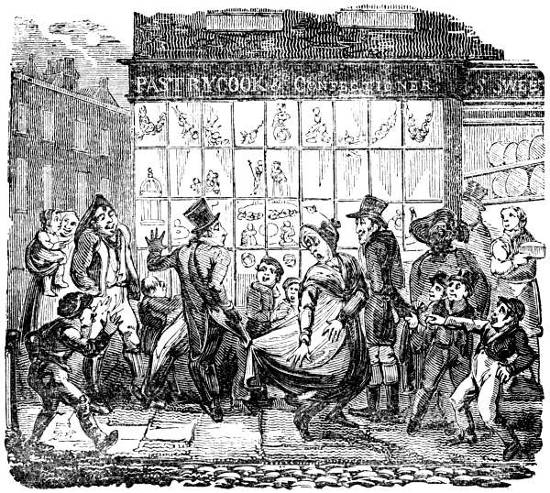
TWELFTH-DAY.
Such are the scenes, that, at the front and side Of the Twelfth-cake-shops, scatter wild dismay; As up the slipp’ry curb, or pavement wide, We seek the pastrycooks, to keep Twelfth-day; While ladies stand aghast, in speechless trance, Look round—dare not go back—and yet dare not advance.
In London, with every pastrycook in the city, and at the west end of the town, it is “high change” on Twelfth-day. From the taking down of the shutters in the morning, he, and his men, with additional assistants, male and female, are fully occupied by attending to the dressing out of the window, executing orders of the day before, receiving fresh ones, or supplying the wants of chance customers. Before dusk the important arrangement of the window is completed. Then the gas is turned on, with supernumerary argand-lamps and manifold wax-lights, to illuminate countless cakes of all prices and dimensions, that stand in rows and piles on the counters and sideboards, and in the windows. The richest in flavour and heaviest in weight and price are placed on large and massy salvers; one, enormously superior to the rest in size, is the chief object of curiosity; and all are decorated with all imaginable images of things animate and inanimate. Stars, castles, kings, cottages, dragons, trees, fish, palaces, cats, dogs, churches, lions, milkmaids, knights, serpents, and innumerable other forms in snow-white confectionary, painted with variegated colours, glitter by “excess of light” from mirrors against the walls festooned with artificial “wonders of Flora.” This “paradise of dainty devices,” is crowded by successive and successful desirers of the seasonable delicacies, while alternate tapping of hammers and peals of laughter, from the throng surrounding the house, excite smiles from the inmates.
The cause of these sounds may be inferred from something like this passing outside.
Constable. Make way, make way! Clear the way! You boys stand aside!
Countryman. What is all this; Is any body ill in the shop?
1st Boy. Nobody, sir; it’s only Twelfth day!
2d Boy. This is a pastrycook’s, sir; look at the window! There they stand! What cakes!
3d Boy. What pretty ones these are!
4th Boy. Only see that!
5th Boy. Why it’s as large as the hind-wheel of a coach, and how thick!
6th Boy. Ah! it’s too big to come out at the door, unless they roll it out.
7th Boy. What elegant figures, and what lots of sweetmeats!
8th Boy. See the flowers; they look almost like real ones.
Countryman. What a crowd inside!
9th Boy. How the people of the house are packing up all the good things!
Countryman. What a beautiful lady that is behind the counter!
10th Boy. Which?
Countryman. Why the young one!
10th Boy. What her? oh, she’s the pastrycook’s daughter, and the other’s her mother.
Countryman. No, no; not her; I mean her, there.
10th Boy. Oh, her; she’s the shopwoman; all the pastrycooks always try to get handsome ladies to serve in the shop!
11th Boy. I say, I say! halloo! here’s a piece of work! Look at this gentleman—next to me—his coat-tail’s nailed to the window! Look, look!
Countryman. Aye, what?
All the boys. Ah! ah! ah! Huzza.
Countryman. Who nailed my coat-tail? Constable!
12th Boy. That’s the boy that’s got the hammer!
2d Boy. What, me? why that’s the boy—there; and there’s another boy hammering! and there’s a man with a hammer!
1st Boy. Who pinned that woman to the gentleman? Why there’s a dozen pinned together.
Countryman. Constable! constable!
2nd Boy. Here comes the constable. Hark at him!
Const. Clear away from the doors! Let the customers go in! Make way! Let the cakes come out! Go back, boy!
13th Boy. If you please, Mr. Constable, I’m going to buy a cake!
Const. Go forward, then!
Man with cakes. By your leave! by your leave.
Const. Clear the way!
All the Boys. Huzza! huzza! More people pinned—and plenty nailed up!——
To explain, to those who may be ignorant of the practice. On Twelfth-night in London, boys assemble round the inviting shops of the pastrycooks, and dexterously nail the coat-tails of spectators, who venture near enough, to the bottoms of the window frames; or pin them together strongly by their clothes. Sometimes eight or ten persons find themselves thus connected. The dexterity and force of the nail driving is so quick and sure, that a single blow seldom fails of doing the business effectually. Withdrawal of the nail without a proper instrument is out of the question; and, consequently, the person nailed must either leave part of his coat, as a cognizance of his attachment, or quit the spot with a hole in it. At every nailing and pinning shouts of laughter arise from the perpetrators and the spectators. Yet it often happens to one who turns and smiles at the duress of another, that he also finds himself nailed. Efforts at extrication increase mirth, nor is the presence of a constable, who is usually employed to attend and preserve free “ingress, egress, and regress,” sufficiently awful to deter the offenders.
Scarcely a shop in London that offers a halfpenny plain bun to the purchase of a hungry boy, is without Twelfth-cakes and finery in the windows on Twelfth-day, The gingerbread-bakers—there are not many, compared with their number when the writer was a consumer of their manufactured goods,—even the reduced gingerbread-bakers periwig a few plum-buns with sugar-frost to-day, and coaxingly interpolate them among their new made sixes, bath-cakes, parliament, and ladies’ fingers. Their staple-ware has leaves of untarnished dutch-gilt stuck on; their upright cylinder-shaped show-glasses, containing peppermint-drops, elecampane, sugar-sticks, hard-bake, brandy-balls, and bulls’-eyes, are carefully polished; their lolly-pops are fresh encased, and look as white as the stems of tobacco-pipes; and their candlesticks are ornamented with fillets and bosses of writing paper; or, if the candles rise from the bottom of inverted glass cones, they shine more sparkling for the thorough cleaning of their receivers in the morning.
How to eat Twelfth-cake requires no recipe; but how to provide it, and draw the characters, on the authority of Rachel Revel’s “Winter Evening Pastimes,” may be acceptable. First, buy your cake. Then, before your visitors arrive, buy your characters, each of which should have a pleasant verse beneath. Next look at your invitation list, and count the number of ladies you expect; and afterwards the number of gentlemen. Then, take as many female characters as you have invited ladies; fold them up, exactly of the same size, and number each on the back; taking care to make the king No. 1, and the queen No. 2. Then prepare and number the gentlemen’s characters. Cause tea and coffee to be handed to your visitors as they drop in. When all are assembled and tea over, put as many ladies’ characters in a reticule as there are ladies present; next put the gentlemen’s characters in a hat. Then call on a gentleman to carry the reticule to the ladies as they sit, from which each lady is to draw one ticket, and to preserve it unopened. Select a lady to bear the hat to the gentlemen for the same purpose. There will be one ticket left in the reticule, and another in the hat, which the lady and gentleman who carried each is to interchange, as having fallen to each. Next, arrange your visitors according to their numbers; the king No. 1, the queen No. 2, and so on. The king is then to recite the verse on his ticket; then the queen the verse on hers; and so the characters are to proceed in numerical order. This done, let the cake and refreshments go round, and hey! for merriment!
They come! they come! each blue-eyed sport, The Twelfth-night king and all his court— ’Tis Mirth fresh crown’d with mistletoe! Music with her merry fiddles, Joy “on light fantastic toe,” Wit with all his jests and riddles, Singing and dancing as they go. And Love, young Love, among the rest, A welcome—nor unbidden guest.
Twelfth-day is now only commemorated by the custom of choosing king and queen. “I went,” says a correspondent in the Universal Magazine for 1774, “to a friend’s house in the country to partake of some of those innocent pleasures that constitute a merry Christmas. I did not return till I had been present at drawing king and queen, and eaten a slice of the Twelfth-cake, made by the fair hands of my good friend’s consort. After tea yesterday, a noble cake was produced, and two bowls, containing the fortunate chances for the different sexes. Our host filled up the tickets; the whole company, except the king and queen, were to be ministers of state, maids of honour, or ladies of the bed-chamber. Our kind host and hostess, whether by design or accident, became king and queen. According to Twelfth-day law, each party is to support their character till midnight.” The maintenance of character is essential to the drawing. Within the personal observation of the writer of these sheets, character has never been preserved. It must be admitted, however, that the Twelfth-night characters sold by the pastrycooks, are either commonplace or gross—when genteel they are inane; when humorous, they are vulgar.
Young folks anticipate Twelfth-night as a full source of innocent glee to their light little hearts. Where, and what is he who would negative hopes of happiness for a few short hours in the day-spring of life? A gentle spirit in the London Magazine beautifully sketches a scene of juvenile enjoyment this evening: “I love to see an acre of cake spread out—the sweet frost covering the rich earth below—studded all over with glittering flowers, like ice-plants, and red and green knots of sweetmeat, and hollow yellow crusted crowns, and kings and queens, and their paraphernalia. I delight to see a score of happy children sitting huddled all round the dainty fare, eyeing the cake and each other, with faces sunny enough to thaw the white snow. I like to see the gazing silence which is kept so religiously while the large knife goes its round, and the glistening eyes which feed beforehand on the huge slices, dark with citron and plums, and heavy as gold. And then, when the “Characters” are drawn, is it nothing to watch the peeping delight which escapes from their little eyes? One is proud, as king; another stately, as queen; then there are two whispering grotesque secrets which they cannot contain (those are sir Gregory Goose and sir Tunbelly Clumsy.) The boys laugh out at their own misfortunes; but the little girls (almost ashamed of their prizes) sit blushing and silent. It is not until the lady of the house goes round, that some of the more extravagant fictions are revealed. And then, what a roar of mirth! Ha, ha! The ceiling shakes, and the air is torn. They bound from their seats like kids, and insist on seeing Miss Thompson’s card. Ah! what merry spite is proclaimed—what ostentatious pity! The little girl is almost in tears; but the large lump of allotted cake is placed seasonably in her hands, and the glass of sweet wine ‘all round’ drowns the shrill urchin laughter, and a gentler delight prevails.” Does not this make a charming picture?
There is some difficulty in collecting accounts of the manner wherein Twelfth-night is celebrated in the country. In “Time’s Telescope,” an useful and entertaining annual volume, there is a short reference to the usage in Cumberland, and other northern parts of England. It seems that on Twelfth-night, which finishes their Christmas holidays, the rustics meet in a large room. They begin dancing at seven o’clock, and finish at twelve, when they sit down to lobscouse, and ponsondie; the former is made of beef, potatoes, and onions fried together; and in ponsondie we recognise the wassail or waes-hael of ale, boiled with sugar and nutmeg, into which are put roasted apples,—the anciently admired lambs’-wool. The feast is paid for by subscription: two women are chosen, who with two wooden bowls placed one within the other, so as to leave an opening and a space between them, go round to the female part of the society in succession, and what one puts into the uppermost bowl the attendant collectress slips into the bowl beneath it. All are expected to contribute something, but not more than a shilling, and they are best esteemed who give most. The men choose two from themselves, and follow the same custom, except that as the gentlemen are not supposed to be altogether so fair in their dealings as the ladies, one of the collectors is furnished with pen, ink, and paper, to set down the subscriptions as soon as received.
If a satirical prophecy in “Vox Graculi,” 4to. 1623, may be relied on as authority, it bears testimony to the popularity of Twelfth-night at that period. On the 6th of January the author declares, that “this day, about the houres of 5, 6, 7, 8, 9, and 10, yea, in some places till midnight well nigh, will be such a massacre of spice-bread, that, ere the next day at noon, a two-penny browne loafe will set twenty poore folkes teeth on edge. Which hungry humour will hold so violent, that a number of good fellowes will not refuse to give a statute-marchant of all the lands and goods they enjoy, for half-a-crown’s worth of two-penny pasties.” He further affirms, that there will be “on this night much masking in the Strand, Cheapside, Holbourne, or Fleet-street.”
“The twelve days of Christmas,” as the extent of its holidays, were proverbial; but among labourers, in some parts, the Christmas festivities did not end till Candlemas. Old Tusser, in his “Five Hundred Points of good Husbandry,” would have the merriments end in six days; he begins January with this advice to the countryman:
When Christmas is ended, bid feasting adue, Goe play the good husband, thy stock to renue: Be mindful of rearing, in hope of a gaine, Dame Profit shall give thee reward for thy paine.
This was the recommendation of prudence tempered by kindness; a desire for diligence in the husbandman, with an allowance of reasonable pastime to sweeten his labour.
From Naogeorgus, in “The Popish Kingdome,” a poem before quoted, and which will be frequently referred to for its lore regarding our ancient customs, it is to be gathered, that the king of Twelfth-night, after the manner of royalty, appointed his officers. He himself attained his dignity thus:
Then also every householder, to his abilitie, Doth make a mightie cake, that may suffice his companie: Herein a pennie doth he put, before it come to fire, This he divides according as his householde doth require, And every peece distributeth, as round about they stand, Which in their names unto the poore is given out of hand. But who so chaunceth on the peece wherein the money lies, Is counted king amongst them all, and is with showtes and cries Exalted to the heavens up.
Mr. Fosbroke notices, that “the cake was full of plums, with a bean in it for the king, and a pea for the queen, so as to determine them by the slices. Sometimes a penny was put in the cake, and the person who obtained it, becoming king, crossed all the beams and rafters of the house against devils. A chafing-dish with burning frankincense was also lit, and the odour snuffed up by the whole family, to keep off disease for the year. After this, the master and mistress went round the house with the pan, a taper, and a loaf, against witchcraft.”
So far Mr. Fosbroke abridges Naogeorgus’s account, which goes on to say, that
— in these dayes beside, They judge what weather all the yeare shall happen and betide: Ascribing to each day a month, and at this present time, The youth in every place doe flocke, and all apparel’d fine, With pypars through the streetes they runne, and singe at every dore. ***** There cities are, where boyes and gyrles, together still do runne, About the streete with like, as soone as night beginnes to come, And bring abrode their wassel bowles, who well rewarded bee, With cakes and cheese, and great good cheare, and money plenteouslee.
Queen Elizabeth’s Progresses by Mr. Nichols, contain an entertainment to her at Sudley, wherein were Melibæus, the King of the Bean, and Nisa, the queen of the Pea.
“Mel. Cut the cake: who hath the beane, shall be King; and where the peaze is, she shall be Queene.
“Nis. I have the peaze, and must be Queene.
“Mel. I have the beane, and King; I must commande.”
Pinkerton’s “Ancient Scotish Poems,” contain a letter from sir Thomas Randolph, queen Elizabeth’s chamberlain of the Exchequer, to Dudley lord Leicester, dated from Edinburgh on the 15th January, 1563, wherein he mentions, that Lady Flemyng was “Queen of the Beene” on Twelfth-day in that year: and in Ben Jonson’s Masque of Christmas, Baby-cake, one of the characters, is attended by “an Usher, bearing a great cake with a bean, and a pease.” Herrick, the poet of our festivals, has several allusions to the celebration of this day by our ancestors: the poem here subjoined, recognises its customs with strict adherence to truth, and in pleasant strains of joyousness.
Twelfe-night, or King and Queene.
Now, now the mirth comes With the cake full of plums, Where beane’s the king of the sport here, Beside, we must know, The pea also Must revell, as queene in the court here. Begin then to chuse, This night as ye use, Who shall for the present delight here, Be a king by the lot, And who shall not Be Twelfe-day queene for the night here. Which knowne, let us make Joy-sops with the cake; And let not a man then be seen here, Who unurg’d will not drinke, To the base from the brink, A health to the king and the queene here. Next crowne the bowle ful. With gentle lambs-wooll; Adde sugar, nutmeg, and ginger, With store of ale, too; And thus ye must doe To make the wassaile a swinger. Give them to the king And queene wassailing; And though with ale ye be whet here; Yet part ye from hence, As free from offence, As when ye innocent met here.
A citation by Brand represents the ancient Twelfth-night-cake to have been composed of flour, honey, ginger, and pepper. The maker thrust in, at random, a small coin as she was kneading it. When baked, it was divided into as many parts as there were persons in the family, and each had his share. Portions of it were also assigned to Christ, the Virgin, and the three Magi, and were given in alms.
On Twelfth-day the people of Germany and the students of its academies chose a king with great ceremony and sumptuous feastings.
In France, the Twelfth-cake is plain, with a bean; the drawer of the slice containing the bean is king or queen. All drink to her or his majesty, who reigns, and receives homage from all, during the evening. There is no other drawing, and consequently the sovereign is the only distinguished character. In Normandy they place a child under the table, which is so covered with a cloth that he cannot see; and when the cake is divided, one of the company taking up the first piece, cries out, “Fabe Domini pour qui?” The child answers, “Pour le bon Dieu:” and in this manner the pieces are allotted to the company. If the bean be found in the piece for the “bon Dieu,” the king is chosen by drawing long or short straws. Whoever gets the bean chooses the king or queen, according as it happens to be a man or woman. According to Brand, under the old order of things, the Epiphany was kept at the French court by one of the courtiers being chosen king, and the other nobles attended an entertainment on the occasion; but, in 1792, during the revolution, La Fête de Rois was abolished; Twelfth-day was ordered to be called La Fête de Sans-Culottes; the old feast was declared anti-civic; and any priest keeping it was deemed a royalist. The Literary Pocket Book affirms, that at La Fête de Rois the French monarch and his nobles waited on the Twelfth-night king, and that the custom was not revived on the return of the Bourbons, but that instead of it the royal family washed the feet of some people and gave them alms.
There is a difference of opinion as to the origin of Twelfth-day. Brand says, “that though its customs vary in different countries, yet they concur in the same end, that is, to do honour to the Eastern Magi.” He afterwards observes, “that the practice of choosing ‘king,’ on Twelfth-day, is similar to a custom that existed among the ancient Greeks and Romans, who, on the festival days of Saturn, about this season of the year, drew lots for kingdoms and like kings exercised their temporary authority.” Indeed, it appears, that the question is almost at rest. Mr. Fosbroke affirms that “the king of Saturnalia was elected by beans, and that from thence came our king and queen on this day.” The coincidence of the election by beans having been common to both customs, leaves scarcely the possibility of doubt that ours is a continuation of the heathen practice under another name. Yet “some of the observances on this day are the remains of Druidical, and other superstitious ceremonies.” On these points, if Mr. Fosbroke’s Dictionary of Antiquities be consulted by the curious inquirer, he will there find the authorities, and be in other respects gratified.
The Epiphany is called Twelfth-day, because it falls on the twelfth day after Christmas-day. Epiphany signifies manifestation, and is applied to this day because it is the day whereon Christ was manifested to the Gentiles. Bourne in his Vulgar Antiquities, which is the substructure of Brand’s Popular Antiquities, remarks that this is the greatest of the twelve holidays, and is therefore more jovially observed, by the visiting of friends and Christmas gambols, than any other.
Finally, on observances of this festival not connected with the Twelfth-night king and queen. It is a custom in many parishes in Gloucestershire on this day to light up twelve small fires and one large one; this is mentioned by Brand: and Mr. Fosbroke relates, that in some countries twelve fires of straw are made in the fields “to burn the old witch,” and that the people sing, drink, and dance around it, and practise other ceremonies in continuance. He takes “the old witch” to be the Druidical God of Death. It is stated by sir Henry Piers, in genl. Vallancey’s “Collectanea,” that, at Westmeath, “on Twelve-eve in Christmas, they used to set up as high as they can a sieve of oats, and in it a dozen of candles set round, and in the centre one larger, all lighted; this in memory of our saviour and his apostles, lights of the world.” Sir Henry’s inference may reasonably be doubted; the custom is probably of higher antiquity than he seems to have suspected.
A very singular merriment in the Isle of Man is mentioned by Waldron, in his history of that place. He says, that “during the whole twelve days of Christmas, there is not a barn unoccupied, and that every parish hires fiddlers at the public charge. On Twelfth-day, the fiddler lays his head in some one of the girls’ laps, and a third person asks, who such a maid, or such a maid shall marry, naming the girls then present one after another; to which he answers according to his own whim, or agreeable to the intimacies he has taken notice of during this time of merriment. But whatever he says is as absolutely depended on as an oracle; and if he happens to couple two people who have an aversion to each other, tears and vexation succeed the mirth. This they call cutting off the fiddler’s head; for, after this, he is dead for the whole year.”
It appears from the Gentleman’s Magazine, that on Twelfth-day 1731, the king and the prince at the chapel royal, St. James’s, made their offerings at the altar, of gold, frankincense, and myrrh, according to custom, and that at night their majesties, &c. played at hazard for the benefit of the groom-porter. These offerings which clearly originate from the Roman church, and are not analogous to any ceremony of the church of England, continue to be annually made; with this difference, however, that the king is represented by proxy in the person of some distinguished officer of the household. In other respects the proceedings are conducted with the usual state.
THE SEASON.
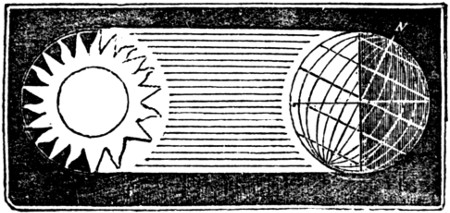
Midwinter is over. According to astronomical reckoning, we have just passed that point in the earth’s orbit, where the north pole is turned most from the sun. This position is represented in the diagram above, by the direction of the terminator, or boundary line of light and darkness, which is seen to divide the globe into two equal parts; the north pole, which is the upper pole in the figure, and all parts within 321⁄2 degrees, being enveloped in constant darkness. We now trace the sun among the stars of the constellation Capricorn or sea-goat, and it is winter in the whole northern hemisphere. At the beginning of January the earth is at its least distance from the sun, which is proved by measuring the apparent magnitude of that luminary by means of an instrument called a micrometer, his disc being now about 32 minutes of a degree; whereas at the opposite season, or at the beginning of July, near our Midsummer, his apparent diameter is only about 31 minutes. The coldness of winter therefore does not depend on the distance of the earth from the sun, but on the very oblique or slanting direction of his rays; less heat falling on any given part of the earth, than when the rays fall more direct. From the slanting direction of his rays they pass through a more dense region of the atmosphere, and are somewhat intercepted; while another cause of the cold is the shortness of our days and the length of our nights; the sun continuing only about seven hours and a half above the horizon, while he is absent for about sixteen hours and a half.
This position of the earth relatively to the sun is exemplified in the Popular Lectures on Astronomy, now delivering at the Assembly-room, Paul’s Head, Cateaton-street, by Mr. John Wallis, on Tuesday and Thursday evenings. His explanations of this noble science are familiarly and beautifully illustrated, by an original and splendid apparatus devised and constructed by his own hands. It consists of extensive mechanism and numerous brilliant transparencies. Mr. Wallis’s lectures on Tuesday and Thursday next, the 18th and 20th of January, 1825, are under the patronage of the Lord Mayor. Here is a sure mode of acquiring astronomical knowledge, accompanied by the delightful gratification of witnessing a display of the heavens more bewitching than the mind can conceive. Ladies, and young persons especially, have a delightful opportunity of being agreeably entertained by the novelty and beauty of the exhibition and the eloquent descriptions of the enlightened lecturer.
The holly with its red berries, and the “fond ivy,” still stick about our houses to maintain the recollection of the seasonable festivities. Let us hope that we may congratulate each other on having, while we kept them, kept ourselves within compass. Merriment without discretion is an abuse for which nature is sure to punish us. She may suffer our violence for a while in silence; but she is certain to resume her rights at the expense of our health, and put us to heavy charges to maintain existence.
January 7.
St. Lucian. St. Cedd. St. Kentigerna. St. Aldric. St. Thillo. St. Canut.
St. Lucian.
This saint is in the calendar of the church of England on the following day, 8th of January. He was a learned Syrian. According to Butler, he corrected the Hebrew version of the Scriptures for the inhabitants of Palestine, during some years was separated from the Romish church, afterwards conformed to it, and died after nine years imprisonment, either by famine or the sword, on this day, in the year 312. It further appears from Butler, that the Arians affirmed of St. Lucian, that to him Arius was indebted for his distinguishing doctrine, which Butler however denies.
ST. DISTAFF’S DAY, OR ROCK-DAY.
The day after Twelfth-day was so called because it was celebrated in honour of the rock, which is a distaff held in the hand, from whence wool is spun by twirling a ball below. It seems that the burning of the flax and tow belonging to the women, was the men’s diversion in the evening of the first day of labour after the twelve days of Christmas, and that the women repaid the interruption to their industry by sluicing the mischief-makers. Herrick tells us of the custom in his Hesperides:—
St. Distaff’s day, or the morrow after Twelfth-day.
Partly work, and partly play, Ye must on S. Distaff’s day: From the plough soone free your teame, Then come home and fother them. If the maides a spinning goe, Burne the flax, and fire the tow; *** Bring in pailes of water then, Let the maides bewash the men: Give S. Distaffe all the right, Then bid Christmas sport good-night. And next morrow, every one To his owne vocation.
In elder times, when boisterous diversions were better suited to the simplicity of rustic life than to the comparative refinement of our own, this contest between fire and water must have afforded great amusement.
Chronology.
1772. “An authentic, candid, and circumstancial narrative of the astonishing transactions at Stockwell, in the county of Surry, on Monday and Tuesday, the 6th and 7th days of January, 1772, containing a series of the most surprising and unaccountable events that ever happened; which continued from first to last upwards of twenty hours, and at different places. Published with the consent and approbation of the family, and other parties concerned, to authenticate which, the original Copy is signed by them.”
This is the title of an octavo tract published in “London, printed for J. Marks, bookseller, in St. Martin’s-lane, 1772.” It describes Mrs. Golding, an elderly lady, at Stockwell, in whose house the transactions happened, as a woman of unblemished honour and character; her niece, Mrs. Pain, as the wife of a farmer at Brixton-causeway, the mother of several children, and well known and respected in the parish; Mary Martin as an elderly woman, servant to Mr. and Mrs. Pain, with whom she had lived two years, having previously lived four years with Mrs. Golding, from whom she went into Mrs. Pain’s service; and Richard Fowler and Sarah, his wife, as an honest, industrious, and sober couple, who lived about opposite to Mr. Pain, at the Brick-pound. These were the subscribing witnesses to many of the surprising transactions, which were likewise witnessed by some others. Another person who bore a principal part in these scenes was Ann Robinson, aged about twenty years, who had lived servant with Mrs. Golding but one week and three days. The “astonishing transactions” in Mrs. Golding’s house were these:
On Twelfth-day 1772, about ten o’clock in the forenoon, as Mrs. Golding was in her parlour, she heard the china and glasses in the back kitchen tumble down and break; her maid came to her and told her the stone plates were falling from the shelf; Mrs. Golding went into the kitchen and saw them broke. Presently after, a row of plates from the next shelf fell down likewise, while she was there, and nobody near them; this astonished her much, and while she was thinking about it, other things in different places began to tumble about, some of them breaking, attended with violent noises all over the house; a clock tumbled down and the case broke; a lantern that hung on the staircase was thrown down and the glass broke to pieces; an earthen pan of salted beef broke to pieces and the beef fell about; all this increased her surprise, and brought several persons about her, among whom was Mr. Rowlidge, a carpenter, who gave it as his opinion that the foundation was giving way and that the house was tumbling down, occasioned by the too great weight of an additional room erected above: “so ready,” says the narrative, “are we to discover natural causes for every thing!”
Mrs. Golding ran into Mr. Gresham’s house, next door to her, where she fainted, and in the interim, Mr. Rowlidge, and other persons, were removing Mrs. Golding’s effects from her house, for fear of the consequences prognosticated. At this time all was quiet; Mrs. Golding’s maid remaining in her house, was gone up stairs, and when called upon several times to come down, for fear of the dangerous situation she was thought to be in, she answered very coolly, and after some time came down deliberately, without any seeming fearful apprehensions.
Mrs. Pain was sent for from Brixton-causeway, and desired to come directly, as her aunt was supposed to be dead;—this was the message to her. When Mrs. Pain came, Mrs. Golding was come to herself, but very faint from terror.
Among the persons who were present, was Mr. Gardner, a surgeon, of Clapham, whom Mrs. Pain desired to bleed her aunt, which he did; Mrs. Pain asked him if the blood should be thrown away; he desired it might not, as he would examine it when cold. These minute particulars would not be taken notice of, but as a chain to what follows. For the next circumstance is of a more astonishing nature than any thing that had preceded it; the blood that was just congealed, sprung out of the basin upon the floor, and presently after the basin broke to pieces; this china basin was the only thing broke belonging to Mr. Gresham; a bottle of rum that stood by it broke at the same time.
Among the things that were removed to Mr. Gresham’s was a tray full of china, &c., a japan bread-basket, some mahogany waiters, with some bottles of liquors, jars of pickles, &c. and a pier glass, which was taken down by Mr. Saville, (a neighbour of Mrs. Golding’s;) he gave it to one Robert Hames, who laid it on the grass-plat at Mr. Gresham’s; but before he could put it out of his hands, some parts of the frame on each side flew off; it raining at that time, Mrs. Golding desired it might be brought into the parlour, where it was put under a side-board, and a dressing-glass along with it; it had not been there long before the glasses and china which stood on the side-board, began to tumble about and fall down, and broke both the glasses to pieces. Mr. Saville and others being asked to drink a glass of wine or rum, both the bottles broke in pieces before they were uncorked.
Mrs. Golding’s surprise and fear increasing, she did not know what to do or where to go; wherever she and her maid were, these strange, destructive circumstances followed her, and how to help or free herself from them, was not in her power or any other person’s present: her mind was one confused chaos, lost to herself and every thing about her, drove from her own home, and afraid there would be none other to receive her, she at last left Mr. Gresham’s, and went to Mr. Mayling’s, a gentleman at the next door, here she staid about three quarters of an hour, during which time nothing happened. Her maid staid at Mr. Gresham’s, to help put up what few things remained unbroken of her mistress’s, in a back apartment, when a jar of pickles that stood upon a table, turned upside down, then a jar of raspberry jam broke to pieces.
Mrs. Pain, not choosing her aunt should stay too long at Mr. Mayling’s, for fear of being troublesome, persuaded her to go to her house at Rush Common, near Brixton-causeway, where she would endeavour to make her as happy as she could, hoping by this time all was over, as nothing had happened at that gentleman’s house while she was there. This was about two o’clock in the afternoon.
Mr. and Miss Gresham were at Mr. Pain’s house, when Mrs. Pain, Mrs. Golding, and her maid went there. It being about dinner time they all dined together; in the interim Mrs. Golding’s servant was sent to her house to see how things remained. When she returned, she told them nothing had happened since they left it. Sometime after Mr. and Miss Gresham went home, every thing remaining quiet at Mr. Pain’s: but about eight o’clock in the evening a fresh scene began; the first thing that happened was, a whole row of pewter dishes, except one, fell from off a shelf to the middle of the floor, rolled about a little while, then settled, and as soon as they were quiet, turned upside down; they were then put on the dresser, and went through the same a second time: next fell a whole row of pewter plates from off the second shelf over the dresser to the ground, and being taken up and put on the dresser one in another, they were thrown down again. Two eggs were upon one of the pewter shelves, one of them flew off, crossed the kitchen, struck a cat on the head, and then broke to pieces.
Next Mary Martin, Mrs. Pain’s servant, went to stir the kitchen fire, she got to the right hand side of it, being a large chimney as is usual in farm houses, a pestle and mortar that stood nearer the left hand end of the chimney shelf, jumped about six feet on the floor. Then went candlesticks and other brasses: scarce any thing remaining in its place. After this the glasses and china were put down on the floor for fear of undergoing the same fate.
A glass tumbler that was put on the floor jumped about two feet and then broke. Another that stood by it jumped about at the same time, but did not break till some hours after, when it jumped again and then broke. A china bowl that stood in the parlour jumped from the floor, to behind a table that stood there. This was most astonishing, as the distance from where it stood was between seven and eight feet, but was not broke. It was put back by Richard Fowler, to its place, where it remained some time, and then flew to pieces.
The next thing that followed was a mustard-pot, that jumped out of a closet and was broke. A single cup that stood upon the table (almost the only thing remaining) jumped up, flew across the kitchen, ringing like a bell, and then was dashed to pieces against the dresser. A tumbler with rum and water in it, that stood upon a waiter upon a table in the parlour, jumped about ten feet and was broke. The table then fell down, and along with it a silver tankard belonging to Mrs. Golding, the waiter in which had stood the tumbler, and a candlestick. A case bottle then flew to pieces.
The next circumstance was, a ham, that hung on one side of the kitchen chimney, raised itself from the hook and fell down to the ground. Some time after, another ham, that hung on the other side of the chimney, likewise underwent the same fate. Then a flitch of bacon, which hung up in the same chimney, fell down.
All the family were eye-witnesses to these circumstances as well as other persons, some of whom were so alarmed and shocked, that they could not bear to stay.
At all the times of action, Mrs. Golding’s servant was walking backwards and forwards, either in the kitchen or parlour, or wherever some of the family happened to be. Nor could they get her to sit down five minutes together, except at one time for about half an hour towards the morning, when the family were at prayers in the parlour; then all was quiet; but, in the midst of the greatest confusion, she was as much composed as at any other time, and with uncommon coolness of temper advised her mistress not to be alarmed or uneasy, as she said these things could not be helped.
“This advice,” it is observed in the narrative, surprised and startled her mistress, almost as much as the circumstances that occasioned it. “For how can we suppose,” says the narrator, “that a girl of about twenty years old, (an age when female timidity is too often assisted by superstition,) could remain in the midst of such calamitous circumstances, (except they proceeded from causes best known to herself,) and not be struck with the same terror as every other person was who was present. These reflections led Mr. Pain, and at the end of the transactions, likewise Mrs. Golding, to think that she was not altogether so unconcerned as she appeared to be.”
About ten o’clock at night, they sent over the way to Richard Fowler, to desire he would come and stay with them. He came and continued till one in the morning, when he was so terrified, that he could remain no longer.
As Mrs. Golding could not be persuaded to go to bed, Mrs. Pain, at one o’clock, made an excuse to go up stairs to her youngest child, under pretence of getting it to sleep; but she really acknowledged it was through fear, as she declared she could not sit up to see such strange things going on, as every thing one after another was broken, till there was not above two or three cups and saucers remaining out of a considerable quantity of china, &c., which was destroyed to the amount of some pounds.
About five o’clock on Tuesday morning, the 7th, Mrs. Golding went up to her niece, and desired her to get up, as the noises and destruction were so great she could continue in the house no longer. Mrs. Golding and her maid went over the way to Richard Fowler’s: when Mrs. Golding’s maid had seen her safe to Richard Fowler’s, she came back to Mrs. Pain, to help her to dress the children in the barn, where she had carried them for fear of the house falling. At this time all was quiet: they then went to Fowler’s, and then began the same scene as had happened at the other places. All was quiet here as well as elsewhere, till the maid returned.
When they got to Mr. Fowler’s, he began to light a fire in his back room. When done, he put the candle and candlestick upon a table in the fore room. This apartment Mrs. Golding and her maid had passed through. Another candlestick with a tin lamp in it that stood by it, were both dashed together, and fell to the ground. At last the basket of coals tumbled over, and the coals rolling about the room, the maid desired Richard Fowler not to let her mistress remain there, as she said, wherever she was, the same things would follow. In consequence of this advice, and fearing greater losses to himself, he desired Mrs. Golding would quit his house; but first begged her to consider within herself, for her own and the public sake, whether or not she had not been guilty of some atrocious crime, for which Providence was determined to pursue her on this side the grave. Mrs. Golding told him she would not stay in his house, or any other person’s, as her conscience was quite clear, and she could as well wait the will of Providence in her own house as in any other place whatever; upon which she and her maid went home, and Mrs. Pain went with them.
After they had got to Mrs. Golding’s, a pail of water, that stood on the floor, boiled like a pot; a box of candles fell from a shelf in the kitchen to the floor, and they rolled out, but none were broken, and the table in the parlour fell over.
Mr. Pain then desired Mrs. Golding to send her maid for his wife to come to them, and when she was gone all was quiet; upon her return she was immediately discharged, and no disturbances happened afterwards; this was between six and seven o’clock on Tuesday morning. At Mrs. Golding’s were broken the quantity of three pails full of glass, china, &c. Mrs. Pain’s filled two pails.
The accounts here related are in the words of the “narrative,” which bears the attestation of the witnesses before mentioned. The affair is still remembered by many persons: it is usually denominated the “Stockwell Ghost,” and deemed inexplicable. It must be recollected, however, that the mysterious movements were never made but when Ann Robinson, Mrs. Golding’s maid-servant, was present, and that they wholly ceased when she was dismissed. Though these two circumstances tend to prove that this girl was the cause of the disturbances, scarcely any one who lived at that time listened patiently to the presumption, or without attributing the whole to witchcraft. One lady, whom the editor of the Every-Day Book conversed with several times on the subject, firmly believed in the witchcraft, because she had been eye-witness to the animation of the inanimate crockery and furniture, which she said could not have been effected by human means—it was impossible. He derived, however, a solution of these “impossibilities” from the late Mr. J. B———, at his residence in Southampton-street, Camberwell, towards the close of the year 1817. Mr. B——— said, all London was in an uproar about the “Stockwell Ghost” for a long time, and it would have made more noise than the “Cock-lane Ghost,” if it had lasted longer; but attention to it gradually died away, and most people believed it was supernatural. Mr. B———, in continuation, observed, that some years after it happened, he became acquainted with this very Ann Robinson, without knowing for a long time that she had been the servant-maid to Mrs. Golding. He learned it by accident, and told her what he had heard. She admitted it was true, and in due season, he says, he got all the story out. She had fixed long horse hairs to some of the crockery, and put wires under others; on pulling these, the “movables” of course fell. Mrs. Golding was terribly frightened, and so were all who saw any thing tumble. Ann Robinson herself, dexterously threw many of the things down, which the persons present, when they turned round and saw them in motion or broken, attributed to unseen agency. These spectators were all too much alarmed by their own dread of infernal power to examine any thing. They kept at an awful distance, and sometimes would not look at the utensils, lest they might face fresh horrors; of these tempting opportunities she availed herself. She put the eggs in motion, and after one only fell down, threw the other at the cat. Their terrors at the time, and their subsequent conversations magnified many of the circumstances beyond the facts. She took advantage of absences to loosen the hams and bacon, and attach them by the skins; in short, she effected all the mischief. She caused the water in the pail to appear as if it boiled, by slipping in a paper of chemical powders as she passed, and afterwards it bubbled. “Indeed,” said Mr. B———, “there was a love story connected with the case, and when I have time, I will write out the whole, as I got it by degrees from the woman herself. When she saw the effect of her first feats, she was tempted to exercise the dexterity beyond her original purpose for mere amusement. She was astonished at the astonishment she caused, and so went on from one thing to another; and being quick in her motions and shrewd, she puzzled all the simple old people, and nearly frightened them to death.” Mr. B——— chuckled mightily over his recollections; he was fond of a practical joke, and enjoyed the tricks of Ann Robinson with all his heart. By his acuteness, curiosity, and love of drollery, he drew from her the entire confession; and “as the matter was all over years ago, and no more harm could be done,” said Mr. B., “I never talked about it much, for her sake; but of this I can assure you, that the only magic in the thing was, her dexterity and the people’s simplicity.” Mr. B. promised to put down the whole on paper; but he was ailing and infirm, and accident prevented the writer from caring much for a “full, true, and particular account,” which he could have had at any time, till Mr. Brayfield’s death rendered it unattainable.
THE SEASON.
Mr. Arthur Aikin, in his “Calendar of Nature,” presents us with a variety of acceptable information concerning the operations of nature throughout the year. “The plants at this season,” he says, “are provided by nature with a sort of winter-quarters, which secure them from the effects of cold. Those called herbaceous, which die down to the root every autumn, are now safely concealed under-ground, preparing their new shoots to burst forth when the earth is softened in spring. Shrubs and trees, which are exposed to the open air, have all their soft and tender parts closely wrapt up in buds, which by their firmness resist all the power of frost; the larger kinds of buds, and those which are almost ready to expand, are further guarded by a covering of resin or gum, such as the horse-chestnut, the sycamore, and the lime. Their external covering, however, and the closeness of their internal texture, are of themselves by no means adequate to resist the intense cold of a winter’s night: a bud detached from its stem, enclosed in glass, and thus protected from all access of external air, if suspended from a tree during a sharp frost, will be entirely penetrated, and its parts deranged by the cold, while the buds on the same tree will not have sustained the slightest injury; we must therefore attribute to the living principle in vegetables, as well as animals, the power of resisting cold to a very considerable degree: in animals, we know, this power is generated from the decomposition of air by means of the lungs, and disengagement of heat; how vegetables acquire this property remains for future observations to discover. If one of these buds be carefully opened, it is found to consist of young leaves rolled together, within which are even all the blossoms in miniature that are afterwards to adorn the spring.”
During the mild weather of winter, slugs are in constant motion preying on plants and green wheat. Their covering of slime prevent the escape of animal heat, and hence they are enabled to ravage when their brethren of the shell, who are more sensible of cold, lie dormant. Earthworms likewise appear about this time; but let the man of nice order, with a little garden, discriminate between the destroyer, and the innocent and useful inhabitant. One summer evening, the worms from beneath a small grass plat, lay half out of their holes, or were dragging “their slow length” upon the surface. They were all carefully taken up, and preserved as a breakfast for the ducks. In the following year, the grass-plat, which had flourished annually with its worms, vegetated unwillingly. They were the under-gardeners that loosened the sub-soil, and let the warm air through their entrances to nourish the roots of the herbage.
“Their calm desires that asked but little room,”
were unheeded, and their usefulness was unknown, until their absence was felt.
Plough Monday
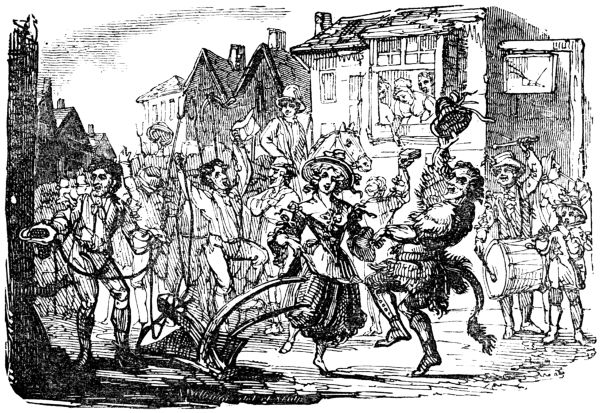
Plough Monday
The first Monday after Twelfth-day is called Plough Monday, and appears to have received that name because it was the first day after Christmas that husbandmen resumed the plough. In some parts of the country, and especially in the north, they draw the plough in procession to the doors of the villagers and townspeople. Long ropes are attached to it, and thirty or forty men, stripped to their clean white shirts, but protected from the weather by waistcoats beneath, drag it along. Their arms and shoulders are decorated with gay-coloured ribbons, tied in large knots and bows, and their hats are smartened in the same way. They are usually accompanied by an old woman, or a boy dressed up to represent one; she is gaily bedizened, and called the Bessy. Sometimes the sport is assisted by a humorous countryman to represent a fool. He is covered with ribbons, and attired in skins, with a depending tail, and carries a box to collect money from the spectators. They are attended by music, and Morris-dancers when they can be got; but there is always a sportive dance with a few lasses in all their finery, and a superabundance of ribbons. When this merriment is well managed, it is very pleasing. The money collected is spent at night in conviviality. It must not be supposed, however, that in these times, the twelve days of Christmas are devoted to pastime, although the custom remains. Formerly, indeed, little was done in the field at this season, and according to “Tusser Redivivus,” during the Christmas holidays, gentlemen feasted the farmers, and every farmer feasted his servants and taskmen. Then Plough Monday reminded them of their business, and on the morning of that day, the men and maids strove who should show their readiness to commence the labours of the year, by rising the earliest. If the ploughman could get his whip, his plough-staff, hatchet, or any field implement, by the fireside, before the maid could get her kettle on, she lost her Shrove-tide cock to the men. Thus did our forefathers strive to allure youth to their duty, and provided them innocent mirth as well as labour. On Plough Monday night the farmer gave them a good supper and strong ale. In some places, where the ploughman went to work on Plough Monday, if, on his return at night, he came with his whip to the kitchen-hatch, and cried “Cock in pot,” before the maid could cry “Cock on the dunghill,” he gained a cock for Shrove Tuesday.
Blomefield’s History of Norfolk tends to clear the origin of the annual processions on Plough Monday. Anciently, a light called the Plough-light, was maintained by old and young persons who were husbandmen, before images in some churches, and on Plough Monday they had a feast, and went about with a plough and dancers to get money to support the Plough-light. The Reformation put out these lights; but the practice of going about with the plough begging for money remains, and the “money for light” increases the income of the village alehouse. Let the sons of toil make glad their hearts with “Barley-wine;” let them also remember to “be merry and wise.” Their old acquaintance, “Sir John Barleycorn,” has had heavy complaints against him. There is “The Arraigning and Indicting of Sir John Barleycorn, knt. printed for Timothy Tosspot.” This whimsical little tract describes him as of “noble blood, well beloved in England, a great support to the crown, and a maintainer of both rich and poor.” It formally places him upon his trial, at the sign of the Three Loggerheads, before “Oliver and Old Nick his holy father,” as judges. The witnesses for the prosecution were cited under the hands and seals of the said judges, sitting “at the sign of the Three merry Companions in Bedlam; that is to say, Poor Robin, Merry Tom, and Jack Lackwit.” At the trial, the prisoner, sir John Barleycorn, pleaded not guilty.
Lawyer Noisy.—May it please your lordship, and gentlemen of the jury, I am counsel for the king against the prisoner at the bar, who stands indicted of many heinous and wicked crimes, in that the said prisoner, with malice propense and several wicked ways, has conspired and brought about the death of several of his majesty’s loving subjects, to the great loss of several poor families, who by this means have been brought to ruin and beggary, which, before the wicked designs and contrivances of the prisoner, lived in a flourishing and reputable way, but now are reduced to low circumstances and great misery, to the great loss of their own families and the nation in general. We shall call our evidence; and if we make the facts appear, I do not doubt but you will find him guilty, and your lordships will award such punishment as the nature of his crimes deserve.
Vulcan, the Blacksmith.—My lords, sir John has been a great enemy to me, and many of my friends. Many a time, when I have been busy at my work, not thinking any harm to any man, having a fire-spark in my throat, I, going over to the sign of the Cup and Can for one pennyworth of ale, there I found sir John, and thinking no hurt to any man, civilly sat me down to spend my twopence; but in the end, sir John began to pick a quarrel with me. Then I started up, thinking to go away; but sir John had got me by the top of the head, that I had no power to help myself, and so by his strength and power he threw me down, broke my head, my face, and almost all my bones, that I was not able to work for three days; nay, more than this, he picked my purse, and left me never a penny, so that I had not wherewithal to support my family, and my head ached to such a degree, that I was not able to work for three or four days; and this set my wife a scolding, so that I not only lost the good opinion my neighbours had of me, but likewise raised such a storm in my family, that I was forced to call in the parson of the parish to quiet the raging of my wife’s temper.
Will, the Weaver.—I am but a poor man, and have a wife and a charge of children: yet this knowing sir John will never let me alone; he is always enticing me from my work, and will not be quiet till he hath got me to the alehouse; and then he quarrels with me, and abuses me most basely; and sometimes he binds me hand and foot, and throws me in the ditch, and there stays with me all night, and next morning leaves me but one penny in my pocket. About a week ago, we had not been together above an hour, before he began to give me cross words: at our first meeting, he seemed to have a pleasant countenance, and often smiled in my face, and would make me sing a merry catch or two; but in a little time, he grew very churlish, and kicked up my heels, set my head where my heels should be, and put my shoulder out, so that I have not been able to use my shuttle ever since, which has been a great detriment to my family, and great misery to myself.
Stitch, the Tailor, deposed to the same effect.
Mr. Wheatly.—The inconveniencies I have received from the prisoner are without number, and the trouble he occasions in the neighbourhood is not to be expressed. I am sure I have been oftentimes very highly esteemed both with lords, knights, and squires, and none could please them so well as James Wheatly, the baker; but now the case is altered; sir John Barleycorn is the man that is highly esteemed in every place. I am now but poor James Wheatly, and he is sir John Barleycorn at every word; and that word hath undone many an honest man in England; for I can prove it to be true, that he has caused many an honest man to waste and consume all that he hath.
The prisoner, sir John Barleycorn, being called on for his defence, urged, that to his accusers he was a friend, until they abused him; and said, if any one is to be blamed, it is my brother Malt. My brother is now in court, and if your lordships please, may be examined to all those facts which are now laid to my charge.
Court.—Call Mr. Malt.
Malt appears.
Court.—Mr. Malt, you have (as you have been in court) heard the indictment that is laid against your brother, sir John Barleycorn, who says, if any one ought to be accused, it should be you; but as sir John and you are so nearly related to each other, and have lived so long together, the court is of opinion he cannot be acquitted, unless you can likewise prove yourself innocent of the crimes which are laid to his charge.
Malt.—My lords, I thank you for the liberty you now indulge me with, and think it a great happiness, since I am so strongly accused, that I have such learned judges to determine these complaints. As for my part, I will put the matter to the bench. First, I pray you consider with yourselves, all tradesmen would live; and although Master Malt does make sometimes a cup of good liquor, and many men come to taste it, yet the fault is neither in me nor my brother John, but in such as those who make this complaint against us, as I shall make it appear to you all.
In the first place, which of you all can say but Master Malt can make a cup of good liquor, with the help of a good brewer; and when it is made, it will be sold. I pray which of you all can live without it? But when such as these, who complain of us, find it to be good, then they have such a greedy mind, that they think they never have enough, and this overcharge brings on the inconveniences complained of, makes them quarrelsome with one another, and abusive to their very friends, so that we are forced to lay them down to sleep. From hence it appears it is from their own greedy desires all these troubles arise, and not from wicked designs of our own.
Court.—Truly, we cannot see that you are in the fault. Sir John Barleycorn, we will show you so much favour, that if you can bring any person of reputation to speak to your character, the court is disposed to acquit you. Bring in your evidence, and let us hear what they can say in your behalf.
Thomas, the Ploughman.—May I be allowed to speak my thoughts freely, since I shall offer nothing but the truth.
Court.—Yes, thou mayest be bold to speak the truth, and no more, for that is the cause we sit here for; therefore speak boldly, that we may understand thee.
Ploughman.—Gentlemen, sir John is of an ancient house, and is come of a noble race; there is neither lord, knight, nor squire, but they love his company, and he theirs; as long as they don’t abuse him, he will abuse no man, but doth a great deal of good. In the first place, few ploughmen can live without him; for if it were not for him, we should not pay our landlords their rent; and then what would such men as you do for money and clothes? Nay, your gay ladies would care but little for you, if you had not your rents coming in to maintain them; and we could never pay, but that sir John Barleycorn feeds us with money; and yet would you seek to take away his life! For shame, let your malice cease, and pardon his life, or else we are all undone.
Bunch, the Brewer.—Gentlemen, I beseech you, hear me. My name is Bunch, a brewer; and I believe few of you can live without a cup of good liquor, no more than I can without the help of sir John Barleycorn. As for my own part, I maintain a great charge, and keep a great many men at work; I pay taxes forty pounds a year to his majesty, God bless him, and all this is maintained by the help of sir John; then how can any man for shame seek to take away his life.
Mistress Hostess.—To give evidence in behalf of sir John Barleycorn, gives me pleasure, since I have an opportunity of doing justice to so honourable a person. Through him the administration receives large supplies; he likewise greatly supports the labourer, and enlivens the conversation. What pleasure could there be at a sheep-clipping without his company, or what joy at a feast without his assistance? I know him to be an honest man, and he never abused any man, if they abused not him. If you put him to death, all England is undone, for there is not another in the land can do as he can do, and hath done; for he can make a cripple go, the coward fight, and a soldier neither feel hunger nor cold. I beseech you, gentlemen, let him live, or else we are all undone; the nation likewise will be distressed, the labourer impoverished, and the husbandman ruined.
Court.—Gentlemen of the jury, you have now heard what has been offered against sir John Barleycorn, and the evidence that has been produced in his defence. If you are of opinion he is guilty of those wicked crimes laid to his charge, and has with malice propense conspired and brought about the death of several of his majesty’s loving subjects, you are then to find him guilty; but if, on the contrary, you are of opinion that he had no real intention of wickedness, and was not the immediate, but only the accidental, cause of these evils laid to his charge, then, according to the statute law of this kingdom, you ought to acquit him.
Verdict, Not Guilty.
From this facetious little narrative may be learned the folly of excess, and the injustice of charging a cheering beverage, with the evil consequences of a man taking a cup more of it than will do him good.
January 8.
St. Lucian—Holiday at the Exchequer.
St. Appollinaris. St. Severinus. St. Pega. St. Vulsin. St. Gudula. St. Nathalan.
St. Lucian.
The St. Lucian of the Romish church on this day was from Rome, and preached in Gaul, where he suffered death about 290, according to Butler, who affirms that he is the St. Lucian in the English Protestant calendar. There is reason to suppose, however, that the St. Lucian of the church of England was the saint of that name mentioned yesterday.
St. Gudula
Is the patroness of Brussels, and is said to have died about 712. She suffered the misfortune of having her candle blown out, and possessed the miraculous power of praying it a-light again, at least, so says Butler; “whence,” he affirms, “she is usually represented in pictures with a lantern.” He particularizes no other miracle she performed. Surius however relates, that as she was praying in a church without shoes, the priest compassionately put his gloves under her feet; but she threw them away, and they miraculously hung in the air for the space of an hour—whether in compliment to the saint or the priest does not appear.
Chronology.
1821. A newspaper of January 8, mentions an extraordinary feat by Mr. Huddy, the postmaster of Lismore, in the 97th year of his age. He travelled, for a wager, from that town to Fermoy in a Dungarvon oyster-tub, drawn by a pig, a badger, two cats, a goose, and a hedgehog; with a large red nightcap on his head, a pig-driver’s whip in one hand, and in the other a common cow’s-horn, which he blew to encourage his team, and give notice of this new mode of posting.
Let us turn away for a moment from the credulity and eccentricity of man’s feebleness and folly, to the contemplation of “the firstling of the year” from the bosom of our common mother. The Snow-drop is described in the “Flora Domestica” as “the earliest flower of all our wild flowers, and will even show her head above the snow, as if to prove her rivalry in whiteness;” as if
—Flora’s breath, by some transforming power, Had chang’d an icicle into a flower.
Mrs. Barbauld.
One of its greatest charms is its “coming in a wintry season, when few others visit us: we look upon it as a friend in adversity; sure to come when most needed.”
Like pendent flakes of vegetating snow, The early herald of the infant year, Ere yet the adventurous crocus dares to blow, Beneath the orchard-boughs, thy buds appear. While still the cold north-east ungenial lowers, And scarce the hazel in the leafless copse, Or sallows, show their downy powder’d flowers, The grass is spangled with thy silver drops.
Charlotte Smith.
January 9.
St. Peter of Sebaste. St. Julian and Basilissa. St. Marciana. St. Brithwald. St. Felan. St. Adrian. St. Vaneng.
Of the seven Romish saints of this day scarcely an anecdote is worth mentioning.
Chronology.
1766. On the 9th of January died Dr. Thomas Birch, a valuable contributor to history and biography. He was born on the 23d of November, 1705, of Quaker parents. His father was a coffee-mill maker, and designed Thomas for the same trade; but the son “took to reading,” and being put to school, obtained successive usherships; removing each time into a better school, that he might improve his studies; and stealing hours from sleep to increase his knowledge. He succeeded in qualifying himself for the church of England, without going to the university; obtained orders from bishop Hoadley in 1731, and several preferments from the lord chancellor Hardwicke and earl Hardwicke; became a member of the Royal Society before he was thirty years of age, and of the Antiquarian Society about the same time; was created a doctor of divinity, and made a trustee of the British Museum; and at his death, left his books and MSS. to the national library there. Enumeration of his many useful labours would occupy several of these pages. His industry was amazing. His correspondence was extensive; his communications to the Royal Society were various and numerous, and his personal application may be inferred from there being among his MSS. no less than twenty-four quarto volumes of Anthony Bacon’s papers transcribed by his own hand. He edited Thurloes’ State Papers in 7 vols. folio; wrote the Lives of Illustrious Persons of Great Britain, and a History of the Royal Society; published miscellaneous pieces of Lord Bacon, before unprinted, and produced a large number of other works. The first undertaking wherein he engaged, with other learned men, was the “General Dictionary, Historical and Critical,”—a most useful labour, containing the whole of Bayle’s Dictionary newly translated, and several thousand additional lives. He was enabled to complete his great undertakings by being a very early riser, and by usually executing the business of the morning before most persons had commenced it.
WINTER. From “Poetic Vigils,” by Bernard Barton
The flowret’s bloom is faded, Its glossy leaf grown sere; The landscape round is shaded By Winter’s frown austere. The dew, once sparkling lightly On grass of freshest green, In heavier drops unsightly On matted weeds is seen. No songs of joy, to gladden, From leafy woods emerge; But winds, in tones that sadden, Breathe Nature’s mournful dirge. All sights and sounds appealing, Through merely outward sense, To joyful thought and feeling, Seem now departed hence. But not with such is banished The bliss that life can lend; Nor with such things hath vanished Its truest, noblest end. The toys that charm, and leave us, Are fancy’s fleeting elves; All that should glad, or grieve us, Exists within ourselves. Enjoyment’s gentle essence Is virtue’s godlike dower; Its most triumphant presence Illumes the darkest hour.
January 10.
St. William. St. Agatho, Pope. St. Martian.
St. William.
This saint, who died in 1207, was archbishop of Bourges, always wore a hair shirt, never ate flesh meat, when he found himself dying caused his body to be laid on ashes in his hair shirt, worked miracles after his death, and had his relics venerated till 1562, when the Hugonots burnt them without their manifesting miracles at that important crisis. A bone of his arm is still at Chaalis, and one of his ribs at Paris; so says Butler, who does not state that either of these remains worked miracles since the French revolution.
1820. The journals of January relate some particulars of a gentleman remarkable for the cultivation of an useful quality to an extraordinary extent. He drew from actual memory, in twenty-two hours, at two sittings, in the presence of two well-known gentlemen, a correct plan of the parish of St. James, Westminster, with parts of the parishes of St. Mary-le-bone, St. Ann, and St. Martin; which plan contained every square, street, lane, court, alley, market, church, chapel, and all public buildings, with all stable and other yards, also every public-house in the parish, and the corners of all streets, with every minutiæ, as pumps, posts, trees, houses that project and inject, bow-windows, Carlton-house, St. James’s palace, and the interior of the markets, without scale or reference to any plan, book, or paper whatever. He did the same with respect to the parish of St. Andrew, Holborn, in the presence of four gentlemen, from eight to twelve, one evening at a tavern; and he also undertook to draw the plan of St. Giles-in-the-fields, St. Paul’s, Covent-garden, St. Mary-le-strand, St. Clement’s, and three-fourths of Mary-le-bone, or St. George’s. The plans before alluded to were drawn in the presence of John Willock, Esq. Golden-square; Mr. Robinson, of Surrey-road; William Montague, Esq. of Guildhall; Mr. Allen, vestry clerk of St. Ann’s; John Dawson, Esq. of Burlington-street; N. Walker, Holborn; and two other gentlemen. He can tell the corner of any great and leading thoroughfare-street from Hyde Park-corner, or Oxford-street, to St. Paul’s; or from the New-road to Westminster abbey; and the trade or profession carried on at such corner house. He can tell every public shop of business in Piccadilly, which consists of two hundred and forty-one houses, allowing him only twenty-four mistakes; he accomplished this in the presence of four gentlemen, after five o’clock, and proved it before seven in the same evening. A house being named in any public street, he will name the trade of the shop, either on the right or left hand of the same, and whether the door of such house so named is in the centre, or on the right or left. He can take an inventory, from memory only, of a gentleman’s house, from the attic to the groundfloor, and afterwards write it out. He did this at lord Nelson’s, at Merton, and likewise at the duke of Kent’s, in the presence of two noblemen. He is known by the appellation of “Memory-corner Thompson.” The plan of his house, called Priory Frognall, Hampstead, he designed, and built it externally and internally, without any working-drawing, but carried it up by the eye only. Yet, though his memory is so accurate in the retention of objects submitted to the eye, he has little power of recollecting what he hears. The dialogue of a comedy heard once, or even twice, would, after an interval of a few days, be entirely new to him.
January 11.
St. Theodosius. St. Hyginus. St. Egwin. St. Salvius.
St. Theodosius
This saint visited St. Simeon Stylites on his pillar and had his fortune told. He ate coarse pulse and wild herbs, never tasted bread for thirty years, founded a monastery for an unlimited number of monks, dug one grave large enough to hold the whole community, when he received strangers, and had not food enough, he prayed for its miraculous increase and had it multiplied accordingly, prophesied while he was dying, died in 529, and had his hair shirt begged by a count, who won a victory with it. He was buried according to Butler, who relates these particulars, in the cave wherein the three kings of Cologne were said to have lodged on their way to Bethlehem.
FISH IN WINTER
In hard frosts holes must be broken in the ice that forms upon fish ponds, or the fish will die. It is pleasing to watch the finny tenants rising half torpid beneath a new-formed hole for the benefit of the air. Ice holes should be kept open during the frost: one hole to a pond is sufficient.
At Logan or Port Nessock in Wigtownshire, North Britain, a large saltwater pond was formed for Cod in 1800. It is a basin of 30 feet in depth, and 160 feet in circumference, hewn out from the solid rock, and communicating with the sea by one of those fissures which are common to bold and precipitous coasts. Attached to it is a neat Gothic cottage for the accommodation of the fisherman, and the rock is surmounted all round by a substantial stone wall at least 300 feet in circumference. In every state of the wind or tide, winter and summer, when not a single boat dare venture to sea, Colonel M‘Dowal can command a supply of the finest fish, and study at his leisure the instincts and habits of the “finny nations,” with at least all the accuracy of those sage naturalists, who rarely travel farther than Exeter ’Change. From the inner or back door of the lodge, a winding stair-way conducts to the usual halting place—a large flat stone projecting into the water, and commanding a view of every part of the aquatic prison. When the tide is out, this stone is left completely dry, and here a stranger perceives with surprise, a hundred mouths simultaneously opened to greet his arrival.
The moment the fisherman crosses his threshold, the pond is agitated by the action of some hundred fins, and otherwise thrown into a state of anarchy and confusion. Darting from this, that, and the other corner, the whole population move as it were to a common centre, elevate their snouts, lash their tails, and jostle one another with such violence, that on a first view they actually seem to be menacing an attack on the poor fisherman, in place of the creel full of limpets he carries. Many of the fish are so tame, that they will feed greedily from the hand, and bite your fingers into the bargain, if you are foolish enough to allow them; while others again are so shy, that the fisherman discourses of their different tempers, as a thing quite as palpable as the gills they breathe, or the fins they move by. One gigantic cod, which seems to answer to the name of “Tom,” and may well be described as the patriarch of the pond, forcibly arrests attention. This unfortunate, who passed his youth in the open sea, was taken prisoner at the age of five, and has since sojourned at Port Nessock, for the long period of twelve years, during all which time he has gradually increased in bulk and weight. He is now wholly blind from age or disease, and he has no chance whatever in the general scramble. The fisherman, however, is very kind to him, and it is affecting as well as curious, to see the huge animal raise himself in the water; and then resting his head on the flat stone, allow it to be gently patted or stroked, gaping all the while to implore that food which he has no other means of obtaining. In this pond, cod appears to be the prevailing species; there are also blochin or glassin, haddocks, flounders, and various other kinds. Salmon, which at spawning time visit the highest rivers, could not of course obey their instincts here, and accordingly there is only one specimen of this favourite fish in the pond at present. As the fisherman remarked, “he is far soupler than any o’ the rest,” and by virtue of this one quality, chases, bites, and otherwise annoys a whole battalion of gigantic cod, that have only, one would think, to open their mouths and swallow him. To supply them with food is an important part of the fisherman’s duty; and with this view, he must ply the net, and heave the line, during two or three days of every week. He has also to renew the stock, when the pond appears to be getting thin, from the contributions levied on it by the cook.
A letter from Cairo, in a journal of January 1824, contains a whimsical exemplification of Turkish manners in the provinces, and the absurdity of attempting to honour distant authorities, by the distinctions of civil society. A diploma of honorary member of the Society of Frankfort was presented to the Pacha, at the divan (or council.) The Pacha, who can neither read nor write, thought it was a firman (despatch) from the Porte. He was much surprised and alarmed; but the interpreter explained to him that it was written in the Nemptchee (German) language, contained the thanks of the ulemas (scholars) of a German city named Frankfort, for his kindness to two Nemptchee travelling in Egypt.
But the most difficult part was yet to come; it was to explain to him that he had been appointed a member of their society; and the Turkish language having no word for this purely European idea, the interpreter, after many hesitations and circumlocutions, at last succeeded in explaining, “that as a mark of respect and gratitude, the society had made him one of their partners.” At these words the eyes of the Pacha flashed with anger, and with a voice of thunder he roared that he would never again be the partner of any firm; that his partnership with Messrs. Briggs and Co. in the Indian trade, cost him nearly 500,000 hard piasters; that the association for the manufactory of sugar and rum paid him nothing at all; and, in short, that he was completely tired of his connections with Frank merchants, who were indebted to him 23,000,000 of piasters, which he considered as completely lost. In his rage, he even threatened to have the interpreter drowned in the Nile, for having presumed to make offer of a mercantile connection, against his positive orders.
The poor interpreter was confounded, and unable to utter a word in his defence. At this critical moment, however, Messrs. Fernandez, Pambonc, and others who have access to the Pacha, interposed; and it was some time before they could reduce his Highness to reason; his passion had thrown him into an hysterical hiccup. When his Highness was a little recovered, Mr. Fernandez endeavoured to explain to him that there was no question about business: that the ulemas of Frankfort were possessed of no stock but books, and had no capital. “So much the worse,” replied the Pacha; “then they are sahhaftehi, (booksellers,) who carry on their business without money, like the Franks at Cairo and Alexandria.” “Oh, no, they are no sahhaftehi, but ulemas, kiatibs, (authors,) physicians, philoussoufs, &c., who are only engaged in science.” “Well,” said he, “and what am I then to do in their society; I, a Pacha of three horse tails?” “Nothing at all, your Highness, like perhaps most of the members of their society, but by receiving you into their society, these gentlemen intended to show you their respect and gratitude.” “That is a strange custom, indeed,” cried the Pacha, “to show respect to a person by telling or writing to him in funny letters—you are worthy of being one of us.” “But this is the custom,” added Divan Effendi (his Secretary.) “Your Happiness knows that the friends (Franks) have many customs different from ours, and often such as are very ridiculous. For instance, if they wish to salute a person, they bare their heads, and scrape with their right foot backwards; instead of sitting down comfortably on a sofa to rest themselves, they sit on little wooden chairs, as if they were about to be shaved: they eat the pillao with spoons, and the meat with pincers; but what seems most laughable is, that they humbly kiss the hands of their women, who, instead of the yashmak, (veil,) carry straw baskets on their heads; and that they mix sugar and milk with their coffee.” This last sally set the whole assembly (his Highness excepted) in a roar of laughter. Among those who stood near the fountain in the middle of the hall, several exclaimed with respect to the coffee with sugar and milk, Kiafirler! (Ah, ye infidels!)
In the end the Pacha was pacified, and “All’s well that ends well;” but it had been better, it seems, if, according to the customs of the east, the society of Frankfort had sent the Pacha the unquestionable civility of a present, that he could have applied to some use.
ST. BRIDE’S CHURCH.
On the 11th of January, 1825, a sketch of this church was taken from a second-floor window in the house No. 115, Fleet-street, which stands on the opposite side of the way to that whereon the opening was made by the late fire; and the subjoined engraving from the sketch is designed to perpetuate the appearance through that opening. Till then, it had been concealed from the view of passengers through Fleet-street by the houses destroyed, and the conflagration has been rightly deemed a favourable opportunity for endeavouring to secure a space of sufficient extent to render the church a public ornament to the city. To at least one person, professionally unskilled, the spire of St. Bride’s appears more chaste and effective than the spire of Bow. In 1805, it was 234 feet high, which is thirty-two feet higher than the Monument, but having been struck by lightning in that year, it was lowered to its present standard.
St. Bride’s Church, London, as it appeared Jan. 11, 1825. From the opening in Fleet-street made by the Fire of Sunday, November 14, 1824.
St. Bride’s church was built by sir Christopher Wren, and completed in 1680. It has been repeatedly beautified: its last internal decorations were effected in 1824. In it are interred Thomas Flatman the poet, Samuel Richardson the novelist, and William Bingley, a bookseller, remarkable for his determined and successful resistance to interrogatories by the court of King’s Bench—a practice which that resistance abated for ever: his latter years were employed, or rather were supported, by the kindness of the venerable and venerated John Nichols, Esq. F. S. A. whose family tablet of brass is also in this church. As an ecclesiastical edifice, St. Bride’s is confessedly one of the most elegant in the metropolis: an unobstructed view of it is indispensable therefore to the national character. Appeals which will enable the committee to purchase the interests of individuals on the requisite site are now in progress, and can scarcely be unheeded by those whom wealth, taste, and liberality dispose to assist in works of public improvement. The engraved sketch does not claim to be more than such a representation as may give a distant reader some grounds for determining whether a vigorous effort to save a building of that appearance from enclosure a second time ought not now to be made. The proceedings for that purpose are in this month, and are entitled to a place in this sheet.
Card-playing.
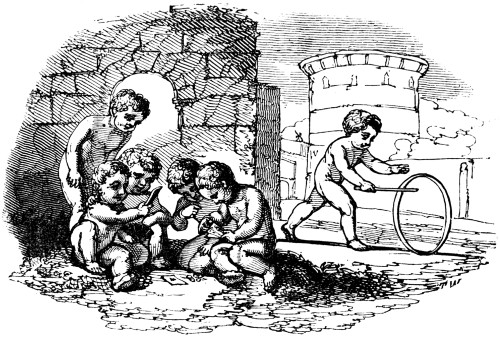
Card-playing.
This diversion, resorted to at visitings during the twelve days of Christmas, as of ancient custom, continues without abatement during the prolongation of friendly meetings at this season. Persons who are opposed to this recreation from religious scruples, do not seem to distinguish between its use and its abuse. Mr. Archdeacon Butler refers to the “harmless mirth and innocent amusements of society,” in his sermon on “Christian Liberty,” before the duke of Gloucester, and the university of Cambridge, on his royal highness’s installation as chancellor, June 30, 1811. The archdeacon quotes, as a note on that point in his sermon, a remarkable passage from Jeremy Taylor, who says, “that cards, &c. are of themselves lawful, I do not know any reason to doubt. He can never be suspected, in any criminal sense, to tempt the Divine Providence, who by contingent things recreates his labour. As for the evil appendages, they are all separable from these games, and they may be separated by these advices, &c.” On the citation, which is here abridged, the archdeacon remarks, “Such are the sentiments of one of the most truly pious and most profoundly learned prelates that ever adorned any age or country; nor do I think that the most rigid of our disciplinarians can produce the authority of a wiser or a better man than bishop Jeremy Taylor.” Certainly not; and therefore an objector to this pastime will do well to read the reasoning of the whole passage as it stands at the end of the archdeacon’s printed sermon: if he desire further, let him peruse Jeremy Taylor’s “advices.”
Cards are not here introduced with a view of seducing parents to rear their sons as gamblers and blacklegs, or their daughters to
“a life of scandal, an old age of cards;”
but to impress upon them the importance of “not morosely refusing to participate in” what the archdeacon refers to, as of the “harmless mirth and innocent amusements of society.” Persons who are wholly debarred from such amusements in their infancy, frequently abuse a pleasure they have been wholly restrained from, by excessive indulgence in it on the first opportunity. This is human nature: let the string be suddenly withdrawn from the overstrained bow, and the relaxation of the bow is violent.
Look at a juvenile card-party—not at that which the reader sees represented in the engraving, which is somewhat varied from a design by Stella, who grouped boys almost as finely as Fiamingo modelled their forms—but imagine a juvenile party closely seated round a large table, with a Pope Joan board in the middle; each well supplied with mother-o’-pearl fish and counters, in little Chinese ornamented red and gold trays; their faces and the candles lighting up the room; their bright eyes sparkling after the cards, watching the turn-up, or peeping into the pool to see how rich it is; their growing anxiety to the rounds, till the lucky card decides the richest stake; then the shout out of “Rose has got it!” “It’s Rose’s!” “Here, Rose, here they are—take ’em all; here’s a lot!” Emma, and John, and Alfred, and William’s hands thrust forth to help her to the prize; Sarah and Fanny, the elders of the party, laughing at their eagerness; the more sage Matilda checking it, and counting how many fish Rose has won; Rose, amazed at her sudden wealth, talks the least; little Samuel, who is too young to play, but has been allowed a place, with some of the “pretty fish” before him, claps his hands and halloos, and throws his playthings to increase Rose’s treasure; and baby Ellen sits in “mother’s” lap, mute from surprise at the “uproar wild,” till a loud crow, and the quick motion of her legs, proclaim her delight at the general joy, which she suddenly suspends in astonishment at the many fingers pointed towards her, with “Look at baby! look at baby!” and gets smothered with kisses, from which “mother” vainly endeavours to protect her. And so they go on, till called by Matilda to a new game, and “mother” bids them to “go and sit down, and be good children, and not make so much noise:” whereupon they disperse to their chairs; two or three of the least help up Samuel, who is least of all, and “mother” desires them to “take care, and mind he does not fall.” Matilda then gives him his pretty fish “to keep him quiet;” begins to dress the board for a new game; and once more they are “as merry as grigs.”
In contrast to the jocund pleasure of children at a round game, take the picture of “old Sarah Battle,” the whist-player. “A clear fire, a clean hearth, and the rigour of the game,” was her celebrated wish. “She was none of your lukewarm gamesters, your half-and-half players, who have no objection to take a hand, if you want one to make up a rubber; who affirm that they have no pleasure in winning; that they like to win one game, and lose another; that they can wile away an hour very agreeably at a card-table, but are indifferent whether they play or no; and will desire an adversary, who has slipt a wrong card, to take it up and play another. Of such it may be said that they do not play at cards, but only play at playing at them. Sarah Battle was none of that breed; she detested them from her heart and soul; and would not, save upon a striking emergency, willingly seat herself at the same table with them. She loved a thorough-paced partner, a determined enemy. She took and gave no concessions; she hated favours; she never made a revoke, nor ever passed it over in her adversary, without exacting the utmost forfeiture. She sat bolt upright, and neither showed you her cards, nor desired to see yours. All people have their blind side—their superstitions; and I have heard her declare, under the rose, that Hearts was her favourite suit. I never in my life (and I knew Sarah Battle many of the best years of it) saw her take out her snuffbox when it was her turn to play, or snuff a candle in the middle of a game, or ring for a servant till it was fairly over. She never introduced, or connived at, miscellaneous conversation during its process: as, she emphatically observed, cards were cards. A grave simplicity was what she chiefly admired in her favourite game. There was nothing silly in it, like the nob in cribbage—nothing superfluous. To confess a truth, she was never greatly taken with cribbage. It was an essentially vulgar game, I have heard her say,—disputing with her uncle, who was very partial to it. She could never heartily bring her mouth to pronounce ‘go,’ or ‘that’s a go.’ She called it an ungrammatical game. The pegging teased her. I once knew her to forfeit a rubber, because she would not take advantage of the turn-up knave, which would have given it her, but which she must have claimed by the disgraceful tenure of declaring ‘two for his heels.’ Sarah Battle was a gentlewoman born.” These, omitting a few delicate touches, are her features by the hand of Elia. “No inducement,” he says, “could ever prevail upon her to play at her favourite game for nothing.” And then he adds, “With great deference to the old lady’s judgment on these matters, I think I have experienced some moments in my life when playing at cards for nothing has even been agreeable. When I am in sickness, or not in the best spirits, I sometimes call for the cards, and play a game at piquet for love with my cousin Bridget—Bridget Elia.” Cousin Bridget and the gentle Elia seem beings of that age wherein lived Pamela, whom, with “old Sarah Battle,” we may imagine entering their room, and sitting down with them to a square game. Yet Bridget and Elia live in our own times: she, full of kindness to all, and of soothings to Elia especially;—he, no less kind and consoling to Bridget, in all simplicity holding converse with the world, and, ever and anon, giving us scenes that Metzu and De Foe would admire, and portraits that Denner and Hogarth would rise from their graves to paint.