September. (continued 4)
Reading edition
After being twenty-two years at Covent-garden, Garrick engaged him, in the winter of 1774, to perform at Drury-lane, where he remained till the close of his professional labours in 1788. Though Mr. Smith, for a considerable period, played the first parts in tragedy, nature seemed not to have qualified him for this branch of the histrionic art. His person was tall and well formed, but his features wanted flexibility, for the expression of the stronger and finer emotions of tragedy, and his voice had a monotony and harshness, which took much from the effect of his finer performances. The parts in this line in which he acquired most popularity were Richard the Third, Hotspur, and Hastings.
But, now, I must speak of those powers in which Mr. Smith was unrivalled. His personation of Charles Surface, in the “School for Scandal,” (of which he was the original representative,) has always been spoken of as his masterpiece, and, indeed, the highest praise and admiration were always awarded him for originality, boldness of conception, truth, freedom, ease, and gracefulness of action and manner. A sigh of tender regret to the recollection of so great a worthy has been uttered by the pleasant Elia, in his “Essay upon Old Actors,” to which I refer every lover of the drama,—there he will discover what our favourites in the old school of acting were,—and what our modern professors ought now to be!
Mr. Smith’s Kitely has been extolled as superior to that of Garrick. Archer and Oakly are two other parts, in which he acquired high reputation.
On the 9th of March, 1788, after performing Macbeth, he delivered an epilogue, in which he announced his intention to quit the stage at the close of the season, thinking it time to “resign the sprightly Charles to abler hands and younger heads.” On the ninth of June following, he took his leave, after the performance of Charles Surface, in a short, but neat and elegant address: expressing his gratitude for the candour, indulgence, and generosity he had experienced, and his hope that the “patronage and protection the public had vouchsafed him on the stage, would be followed by some small esteem, when he was off.” He performed but once afterwards, which was in the same part, in 1798, for the benefit of his old friend King. Mr. Smith was first married to the sister of the earl of Sandwich, the widow of Kelland Courtnay, Esq.; she died in 1762. Soon afterwards he married Miss Newson, of Leiston, in Suffolk. Lord Chedworth bequeathed him a legacy of 200l. He died at Bury St. Edmunds, on the 13th of September, 1819, in the 89th year of his age.[316]
In my humble walk of life, when a boy at the free grammar-school of Bury St. Edmunds, I had, with my young “classical” companions, frequent opportunities of meeting this aged veteran of the drama. His appearance was always agreeable to us. He encouraged our playful gambols, and was well-pleased in giving us something to be pleased with. In his eightieth year he looked “most briskly juvenal.” His person was then debonair, and his fine, brown, intelligent eye reflected all the mind could realize of the volition of Charles Surface. His dress was in perfect keeping with the vivacious disposition of the man. He always wore, when perambulating, a white hat, edged with green—blue coat—figured waistcoat—fustian-coloured breeches, and gaiters to correspond. Thus apparelled, he was, when the weather was favourable, to be met with in some one of the beautifully rural walks in the neighbourhood of the town, tripping on at a sharp, brisk pace, and twisting his thin gold-headed cane in his right hand. His politeness was proverbial; and the same ease and gracefulness of carriage—dignity of manner—and suavity of address—were features as conspicuous off, as when on, the stage. It was a lucky moment for us to meet him near our “tart” and “turn-over” shop. He would anticipate our raspberry cravings, and remind us that he “was once a school-boy,” and that the fagging system was only to be tolerated in the hopeful expectation of a plentiful reward in “sweets” and “sugar-candy.” He was one whom Shakspeare has painted—
“That liv’d, that lov’d, that lik’d, that look’d with cheer.”
Should this trifling sketch fall into the hands of any of my respected fellows, who were with me during my labours at the above-named school, I am confident they will contemplate this great man’s memory with that regard which his rich pleasantries, and our personal knowledge of him, are calculated to inspire. He was an honourable man; and it was his honourable conduct which alone conducted him to an honourable distinction in the evening of his days. Unlike the many of his profession, whose talents blaze forth for a while, and then depart like a sunbeam, he retired into the quiet of domestic life—sought peace and solace—and found them. In a word, “Gentleman Smith” was a respecter of virtue:—and he developed its precepts to the world in the incidents of his own life.
I am, dear Sir,
Yours very truly,
S. R.
FLORAL DIRECTORY.
Officinal Crocus. Crocus Sativus. Dedicated to St. Eulogius.
September 14.
The Exaltation of the Holy Cross, A. D. 629. St. Catharine of Genoa, A. D. 1510. St. Cormac, Bp. of Cashel, and king of Munster, A. D. 908.
Holy Cross, or Holy Rood.
Holy Cross is in our almanacs and the church of England calendar on this day, whereon is celebrated a Romish catholic festival in honour of the holy cross, or, as our ancestors called it, the holy rood. From this denomination Holyrood-house, Edinburgh, derives its name.
The rood was a carved or sculptured groupe consisting of a crucifix, or image of Christ on the cross, with, commonly, the virgin Mary on one side, and John on the other; though for these were sometimes substituted the four evangelists, and frequently rows of saints were added on each side.[317]
The rood was always placed in a gallery across the nave, at the entrance of the chancel or choir of the church, and this gallery was called the rood-loft, signifying the rood-gallery; the old meaning of the word loft being a high, or the highest, floor, or a room higher than another room. In the rood-loft the musicians were stationed, near the rood, to play during mass.
The holy roods or crosses being taken down at the time of the reformation, the rood-loft or gallery became the organ-loft or singing gallery, as we see it in our churches at present: the ancient rood-loft was usually supported by a cross-beam, richly carved with foliage, sometimes superbly gilt, with a screen of open tabernacle-work beneath.[318]
When the roods, and other images in churches were taken down throughout England, texts of scripture were written on the walls of the churches instead. The first rood taken down in London was the rood belonging to St. Paul’s cathedral, and then all the other roods were removed from the churches of the metropolis.[319]
The holy rood, at Boxley, in Kent, was called the Rood of Grace; its image, on the cross, miraculously moved its eyes, lips, and head, upon the approach of its marvelling votaries. The Boxley Rood was brought to London, and Hilsey, bishop of Rochester, within whose diocese it had performed wonders under the papacy, took it to pieces at St. Paul’s cross, and showed the people the springs and wheels by which, at the will of the priests, it had been secretly put in motion.[320] The open detection and destruction of this gross imposture, reconciled many, who had been deceived, to the reformation.
The festival of Holy Cross, or as it is more elaborately termed by the Catholics, the Exaltation of the Holy Cross, is in commemoration of the alleged miraculous appearance of the cross to Constantine in the sky at mid-day. It was instituted by the Romish church on occasion of the recovery of a large piece of the pretended real cross which Cosroes, king of Persia, took from Jerusalem when he plundered it. The emperor Heraclius defeated him in battle, retook the relic, and carried it back in triumph to Jerusalem.
According to Rigordus, a historian of the thirteenth century, the capture of this wood by Cosroes, though it was recaptured by Heraclius, was a loss to the human race they never recovered. We are taught by him to believe that the mouths of our ancestors “used to be supplied with thirty, or in some instances, no doubt according to their faith, with thirty-two teeth, but that since the cross was stolen by the infidels, no mortal has been allowed more than twenty-three!”[321]
Nutting appears to have been customary on this day. Brand cites from the old play of “Grim, the Collier of Croydon:”—
“This day, they say, is called Holy-rood day, And all the youth are now a nutting gone.”
It appears, from a curious manuscript relating to Eton school, that in the month of September, “on a certain day,” most probably the fourteenth, the scholars there were to have a play-day, in order to go out and gather nuts, a portion of which, when they returned, they were to make presents of to the different masters; but before leave was granted for their excursion, they were required to write verses on the fruitfulness of autumn, and the deadly cold of the coming winter.[322]
“Tuesday, Sept. 14, 1731, being Holyrood day, the king’s huntsmen hunted their free buck in Richmond New park, with bloodhounds, according to custom.”[323]
FLORAL DIRECTORY.
Passion Flower. Passiflora cærulea. Dedicated to the Exaltation of the Cross.
September 15.
St. Nicetas, 4th Cent. St. Nicomedes, A. D. 90. St. John, the Dwarf, 5th Cent. St. Aicard, or Achart, Abbot, A. D. 687. St. Aper, or Evre, Bp. A. D. 486.
The weather on an average is, at least, six times out of seven fine on this day.[324]
It yet is not day; The morning hath not lost her virgin blush, Nor step, but mine, soiled the earth’s tinsel robe. —— How full of heaven this solitude appears, This healthful comfort of the happy swain; Who from his hard but peaceful bed roused up, In ’s morning exercise saluted is By a full quire of feathered choristers, Wedding their notes to the inamoured air. Here Nature, in her unaffected dresse, Plaited with vallies, and imbost with hills, Enchast with silver streams, and fringed with woods, Sits lovely in her native russet.
Chamberlayne.
FLORAL DIRECTORY.
Byzantine Saffron. Colchicum Byzanticum. Dedicated to St. Nicetas.
September 16.
St. Cornelius, Pope, A. D. 252. St. Cyprian, Abp. of Carthage, A. D. 258. St. Euphemia, A. D. 307. Sts. Lucia and Geminianus. Sts. Ninian, or Ninyas, Bp. A. D. 432. St. Editha, A. D. 984.
Jemmy Gordon.
This eccentric individual, who is recorded on the 23d of May, died in the workhouse of St. Leonard’s, at Cambridge, on the 16th of September, 1825. He had for many years been in the receipt of an annuity of five and twenty pounds bequeathed to him by Mr. Gordon, a deceased relative. Several confinements in the town gaol left Gordon at liberty to write memoirs of himself, which are in the possession of Mr. W. Mason, picture-dealer of Cambridge. He may amuse and essentially benefit society if he publish the manuscripts, accompanied by details drawn from personal recollections of the deceased biographer, with reflections on the misapplication of talent and the consequences of self-indulgence. It is an opportunity whereon to “point a moral, and adorn a tale.”
FLORAL DIRECTORY.
Sea Starwort. Aster Tripolum. Dedicated to St. Editha.
September 17.
St. Lambert, Bp. A. D. 709. St. Columba, A. D. 853. St. Hildegardis, Abbess, A. D. 1179. St. Rouin, or Rodingus, or Chrodingus, A. D. 680. Sts. Socrates and Stephen, Martyrs under Dioclesian.
Lambert.
He is a saint in the Romish calendar; his name “Lambert” stands unsainted in the church of England calendar and almanacs: sometimes he is called Landebert. He was bishop of Maestricht from which see he was expelled in 673, and retired to the monastery of Stavelo, where he continued seven years, submitting to the rules of the novices. He was afterwards restored to his bishopric, and discharged its functions with zeal and success. But during the disorders which prevailed in the government of France, he was murdered on the 17th of September, 703, and in 1240, his festival was ordained to be kept on this day.[325]
THEATRICALS.
This is about the season when the summer theatres close, and the winter theatres open. Most of the productions written, and represented of late years, seem symptomatic of decay in dramatic and histrionic talent. The false taste of some of the vocal performers, is laughed at in a light piece called “Der Freischütz Travestie: by Septimus Globus, Esq.” One of its versifications is in a “SCENE—UNSEEN.” According to the author,—
A SONG—SINGS ITSELF.
TUNE.—Galloping Dreary Dun.
Fine singers we have, both woman and man, Gallop O! fly away! jump! They all bravura, as fast as they can, They mock Catalani, Up long laney, Bawling, Squalling, Galloping all away! drag and tail,—die away—plump! They come on the stage, so fine and so gay, Gallop O! fly away! jump! They mount in the air, and they ride away, They mock Catalani, &c. They canter one off, all into the dark, Gallop O! fly away! jump! The Jack-bottom sings, instead of the lark, They mock Catalani, &c. They let off a trill, and it asks the way, Gallop O! fly away! jump! They quiver and shake—oh! I bid you good day, They mock Catalani, &c. Such singing I guess, does nobody good, Gallop O! fly away! jump! Notes wander about, like the babes in the wood, They mock Catalani, &c. I sing by myself, but pray take a peep, Gallop O! fly away! jump! You’ll soon find singers, to sing you to sleep, They mock Catalani, &c. [Exit Song.
From the same piece there may be another “seasonable” extract, for we are at that period of the year when the chase, which was once a necessary pursuit, is indulged as an amusement. In Von Weber’s “Der Freischütz,” the casting of the fifth bullet by Caspar is accompanied by “a wild chase in the clouds;” the writer who travestied that opera, as it was represented at the Lyceum theatre, represents this operation to be thus accompanied:—
Neighing and barking ‘old clothes!’—Skylarking—A wild chase in the clouds; an ‘Etherial Race—inhabitants of air,’ consisting of skeleton dogs muzzled, skeleton horses, and skeleton horsemen, with overalls and preservers, and Mr. Green from the city, are in pursuit of a skeleton stag ‘to Bachelor’s-hall,’ with grave music accompanying the following—
SONG AND CHORUS. BY SKELETON HUNTSMEN.
“Bright Chanticleer proclaims the dawn.”
The moon’s eclipse proclaims our hunt, The graves release their dead, The common man lifts up the wood, The lord springs from the lead; The lady-corpses hurry on, To join the ghostly crowds, And off we go, with a ho! so—ho! A—hunting in the clouds. With a hey, ho, chivey! Hark forward, hark forward, tantivy! &c. No hill, no dale, no glen, no mire, No dew, no night, no storm, No earth, no water, air, nor fire, Can do wild huntsmen harm. We laugh at what the living dread, And throw aside our shrouds, And off we go, with a ho! so—ho! A—hunting in the clouds. With a hey, ho, chivey! Hark forward, hark forward, tantivy, &c. Oft, when by body-snatchers stol’n, And surgeons for us wait, Some honest watchmen take the rogues To be examined straight, We slip away from surgeons, and From police-office crowds, And off we go, with a ho! so—ho! A—hunting in the clouds. With a hey, ho, chivey! Hark forward, hark forward, tantivy! &c.
FLORAL DIRECTORY.
Narrow-leaved Mallow. Malva augustiflora. Dedicated to St. Lambert.
September 18.
St. Thomas, Abp. of Valentia, A. D. 1555. St. Methodius, Bp. of Tyre, A. D. 311. St. Ferreol, A. D. 304. St. Joseph, of Cupertino, A. D. 1663.
St. Ferreol.
He was “a tribune or colonel,” Butler says, at Vienne in France, and imprisoned on suspicion of being a christian, which he verified by refusing to sacrifice according to the religion of the country, whereupon being scourged and laid in a dungeon, on the third day his chains fell off his hands and legs, and he swam over the Rhone. It appears that the miraculous chain-falling was ineffectual, for he was discovered and beheaded near the river.
The anniversary of this saint and martyr is celebrated at Marseilles with great pomp. The houses are decorated with streamers to the very tops; and the public way is crossed by cords, on which are suspended numberless flags of various colours. The ships are always ornamented with flags and streamers. The procession passes under several arches, hung with boughs, before it stops at the altars or resting-places, which are covered with flowers: every thing concurs to give to this solemnity an air of cheerfulness. The eye dwells with pleasure on the garlands of beautiful flowers, the green boughs, and the emblem of the divinity contained in the flags of the procession. The attendants are extremely numerous; every gardener carries his wax taper, ornamented with the most rare and beautiful flowers; he has also the vegetables and fruits with which heaven had blessed his labour, and sometimes he bears some nests of birds.
The butchers also make a part of this procession, clothed in long tunics, and with a hat à la Henri IV. armed with a hatchet or cleaver; they lead a fat ox dressed with garlands and ribands, and with gilt horns, like the ox at the carnival: his back is covered with a carpet, on which sits a pretty child, dressed as St. John the Baptist. During the whole week which precedes the festival, the butchers lead about this animal: they first take him to the police, where they pay a duty, and then their collection begins, which is very productive: every one wishes to have the animal in his house; and it is a prevailing superstition among the people, that they shall have good luck throughout the year if this beast leave any trace of his visit, however dirty it may be. The ox is killed on the day after the festival. The child generally lives but a short time: exhausted by the fatigue which he has suffered, and by the caresses which he has received, and sickened by the sweetmeats with which he has been crammed, he languishes, and often falls a victim.
A number of young girls, clothed in white, their heads covered with veils, adorned with flowers, and girded with ribands of a uniform colour are next in the procession. Children, habited in different manners, recall the ancient “mysteries.” Several young women are dressed as nuns; these are St. Ursula, St. Rosalia, St. Agnes, St. Teresa, &c. The handsomest are clothed as Magdalens; with their hair dishevelled on their lovely faces, they look with an air of contrition on a crucifix which they hold in the hand: others appear in the habit of the Sœurs de la Charité, whose whole time is devoted to the service of the sick. Young boys fill other parts, such as angels, abbots, monks; among whom may be distinguished St. Francis, St. Bruno, St. Anthony, &c. In the midst of the shepherds marches the little St. John, but half covered with a sheep’s skin, like the picture of his precursor; he leads a lamb decked with ribands, a symbol of the saviour who offered himself for us, and died for the remission of our sins. The streets are strewed with flowers; numerous choristers carry baskets full of roses and yellow broom, which they throw, on a given signal, before the host or holy sacrament: they strew some of these on the ladies who sit in rows to see the procession; these also have baskets of flowers on their knees, which they offer to the host; they amuse themselves with covering the young virgins and little saints with the flowers. The sweet scents of the roses, the cassia, the jessamine, the orange, and the tuberose, mingled with the odour of the incense, almost overpower the senses. The procession proceeds to the port, and it is there that the ceremony presents a sublime character: the people fill the quays; all the decks are manned with seamen, dressed in their best blue jackets, their heads uncovered, and their red caps in their hands. All bend the knee to the God of the Universe: the seamen stretch out their hands towards the prelate, who, placed under a canopy, gives the benediction: the most profound silence reigns among this immense crowd. The benediction received, every one rises instantaneously; the bells begin to ring, the music plays, and the whole train takes the road to the temple from which they came.[326]
FLORAL DIRECTORY.
Pendulous Starwort. Aster pendulus. Dedicated to St. Thomas, of Villanova.
September 19.
St. Januarius, Bp. of Benevento, A. D. 305. St. Theodore, Abp. of Canterbury, A. D. 690. Sts. Peleus, Pa-Termuthes, and Companions. St. Lucy A. D. 1090. St. Eustochius, Bp. A. D. 461. St. Sequanus, or Seine, Abbot, A. D. 580.
STOURBRIDGE FAIR
This place, near Cambridge, is also called Sturbridge, Sturbitch, and Stirbitch. A Cambridge newspaper speaks of Stirbitch fair being proclaimed on the 19th of September, 1825, for a fortnight, and of Stirbitch horse-fair commencing on the 26th of the month. The corruption of this proper name, stamps the persons who use it in its vulgar acceptation as being ignorant as the ignorant; the better instructed should cease from shamefully acquiescing in the long continued disturbance of this appellation.
Stephen Batman, in his “Doome warning,” published in 1582, relates that “Fishers toke a disfigured divell, in a certain stoure, (which is a mighty gathering togither of waters, from some narrow lake of the sea,) a horrible monster with a goats heade, and eyes shyning lyke fyre, whereuppon they were all afrayde and ranne awaye; and that ghoste plunged himselfe under the ise, and running uppe and downe in the stowre made a terrible noyse and sound.” We get in Stirbitch a most “disfigured divell” from Stourbridge. The good people derive their “good name” from their river.
Stourbridge fair originated in a grant from king John to the hospital of lepers at that place. By a charter in the 30th year of Henry VIII., the fair was granted to the magistrates and corporation of Cambridge. The vicechancellor of the university has the same power in it that he has in the town of Cambridge.
By an order of privy council of the 3rd of October, 1547, the mayor and under-sheriff of the county were required, not only to acknowledge before the vicechancellor, heads of colleges and proctors, that they had interfered with the privileges of the university in Stourbridge fair, but also, “that the mayor, in the common hall, shall openly, among his brethren, acknowledge his wilfull proceeding.” The breach consisted in John Fletcher, the mayor, having refused to receive into the tolbooth certain persons of “naughty and corrupt behaviour,” who were “prisoners, taken by the proctors of the university, in the last Sturbridge fair;” wherefore he was called before the lords and others of the council, and his fault therein “so plainly and justly opened” that he could not deny it, but did “sincerely and willingly confess his said fault.”[327]
In 1613, Stourbridge fair acquired such celebrity, that hackney-coaches attended it from London. Subsequently not less than sixty coaches plied at this fair, which was the largest in England. Vast quantities of butter and cheese found there a ready market; it stocked the people of Norfolk, Suffolk, Essex, and other counties with clothes, and all other necessaries; and shopkeepers supplied themselves from thence with the commodities wherein they dealt.[328]
Jacob Butler, Esq. who died on the 28th of May, 1765, stoutly maintained the charter of Stourbridge fair: he was of Bene’t-college, Cambridge, and a barrister-at-law. In stature he was six feet four inches high, of determined character, and deemed “a great eccentric” because, among other reasons, he usually invited the giants and dwarfs, who came for exhibition, to dine with him. He was so rigid in seeing the charter literally complied with, that if the ground was not cleared by one o’clock on the day appointed, and he found any of the booths standing, he had them pulled down, and the materials taken away. On one occasion when the wares were not removed by the time mentioned in the charter, he drove his carriage among the crockery and destroyed a great quantity.
The rev. John Butler, LL.D. rector of Wallington, in Hertfordshire, father of Mr. Butler, who was his eldest son, endeavoured in the year 1705, to get Stourbridge fair rated to the poor. This occasioned a partial and oppressive assessment on himself that involved him in great difficulties. Dr. Butler died in 1714, and Jacob Butler succeeded to his difficulties and estates in the parish of Barnwell. As a trustee under an act for the turnpike road from Cambridge to London, Mr. Butler was impeached of abuses in common with his co-trustees. Being obnoxious, he was singled out to make good the abuse, and summoned to the county sessions, where he appeared in his barrister’s gown, was convicted and fined ten pounds, which he refused to pay, and was committed. He excepted to the jurisdiction, wherein he was supported by the opinion of sir Joseph Yorke, then attorney-general, and to save an estreat applied to the under-sheriff, who refused his application, and afterwards went to the clerk of the peace at Newmarket, from whom he met the like treatment; this forced him to the quarter-sessions, where he obtained his discharge, after telling the chairman he felt it hard to be compelled to the trouble and expense of teaching him and his brethren law. He appears to have been a lawyer of that school, which admitted no law but the old common law of the land, and statute law. In 1754, “to stem the venality and corruption of the times, he offered himself a candidate to represent the county in parliament, unsupported by the influence of the great, the largess of the wealthy, or any interest, but that which his single character could establish in the esteem of all honest men and lovers of their country. But when he found the struggles for freedom faint and ineffectual, and his spirits too weak to resist the efforts of his enemies, he contented himself with the testimony of those few friends who dare to be free, and of his own unbiassed conscience, which, upon this, as well as every other occasion, voted in his favour; and upon these accounts he was justly entitled to the name of the old Briton.” He bore this appellation to the day of his death. The loss of a favourite dog is supposed to have accelerated his end; upon its being announced to him, he said, “I shall not live long now my dog is dead.” He shortly afterwards became ill, and, lingering about two months, died.
His coffin, which was made from a large oak by his express order, some months before his death, became an object of public curiosity; it was of sufficient dimensions to contain several persons, and wine was copiously quaffed therein by many of those who went to see it. To a person, who was one of the legatees, the singular trust was delegated of driving him to the grave, on the carriage of a waggon, divested of the body: seated in the front, he was to drive his two favourite horses, Brag and Dragon, to Barnwell church, and should they refuse to receive his body there, he was to return and bury him in the middle of the grass-plat in his own garden. Part only of his request was complied with, for the body being put into a leaden coffin, and the leaden one into a shell, was conveyed in a hearse, and the coffin made before his death was put upon the carriage of his waggon, and driven before the hearse by the gentleman above mentioned when arrived at the church door, it was taken from the carriage by four men, who received half-a-guinea each; it was then put into the vault, and the corpse being taken from the hearse was carried to the vault, there put into the coffin, and then screwed down.
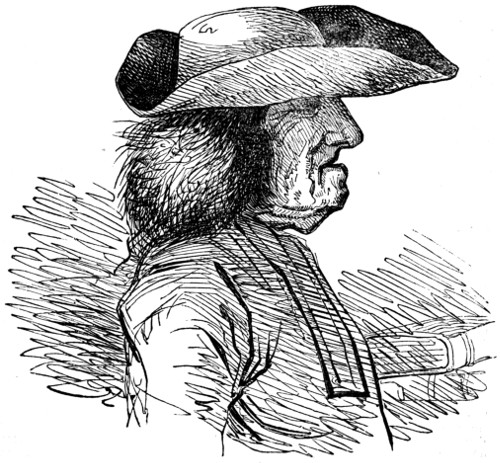
Jacob Butler, Esq.
The late rev. Michael Tyson of Bene’t-college, “a good antiquary and a gentleman artist,” amused himself with etching a few portraits; among them “were some of the old masters of his college, and some of the noted characters in and about Cambridge, as Jacob Butler of Barnwell, who called himself the old Briton,” which Mr. Nichols says “may be called his best, both in design and execution; for it expresses the very man himself.” A gentleman of the university has obligingly communicated to this work a fine impression of Mr. Tyson’s head of “the old Briton,” from whence the present portrait is engraven.
Origin of Stourbridge Fair.
Mr. George Dyer, in a supplement to his recently published “Privileges of the University of Cambridge,” being a sequel to his “History of the University,” cites thus from Fuller:—
“Stourbridge fair is so called from Stour, a little rivulet (on both sides whereof it is kept,) on the east of Cambridge, whereof this original is reported. A clothier of Kendal, a town characterized to be Lanificii gloria et industria præcellens, casually wetting his cloath in water in his passage to London, exposed it there to sale, on cheap termes, as the worse for wetting, and yet it seems saved by the bargain. Next year he returned again with some other of his townsmen, proffering drier and dearer cloath to be sold. So that within a few years hither came a confluence of buyers, sellers, and lookers-on, which are the three principles of a fair. In memoria thereof, Kendal men challenge some privilege in that place, annually choosing one of the town to be chief, before whom an antic sword was carried with some mirthful solemnities, disused of late, since these sad times, which put men’s minds into more serious employments.” This was about 1417.
The “History of Stourbridge Fair,” &c. a pamphlet published at Cambridge in 1806, supplies the particulars before the reader, respecting Jacob Butler and the fair, except in a few instances derived from authorities acknowledged in the notes. From thence also is as follows:—
Stourbridge fair was annually set out on St. Bartholomew’s day, by the aldermen and the rest of the corporation of Cambridge, who all rode there in grand procession, with music playing before them; and, when the ceremony was finished, used to ride races about the place; then returning to Cambridge, cakes and ale were given to the boys who attended them, at the Town-hall; but, we believe, this old custom is now laid aside. On the 7th of September they rode in the same manner to proclaim it; which being done, the fair then began, and continued three weeks, though the greatest part was over in a fortnight.
This fair, which was allowed, some years ago, to be the largest in Europe, is kept in a corn-field about half a mile square, the river Cam running on the north side, and the rivulet called the Stour, (from which, and the bridge which crosses it, the fair received its name,) on the east side; it is about two miles from Cambridge market-place, and where, during the time of the fair, coaches, &c. attend to convey persons to the fair. The chief diversions at the fair were drolls, rope-dancing, sometimes a music-booth, and plays performed; and though there is an act of parliament which prohibits the acting of plays within ten miles of Cambridge, the Norwich company have permission to perform there every night during the fair.
If the corn was not cleared off the field by the 24th of August, the builders were at liberty to tread it down to build their booths; and on the other hand, if the booths and materials were not cleared away by Michaelmas-day at noon, the ploughmen might enter the same with their horses, ploughs, and carts, and destroy whatever they found remaining on the ground after that time. The filth, straw, dung, &c. left by the fair-keepers, making the farmers amends for their trampling and hardening the ground. The shops, or booths, were built in rows like streets, having each their name; as Garlick-row, Booksellers’-row, Cook-row, &c. and every commodity had its proper place; as the cheese-fair, hop-fair, wool-fair, &c. In these streets, or rows, as well as in several others, were all kinds of tradesmen, who sell by wholesale or retail, as goldsmiths, toy-men, braziers, turners, milliners, haberdashers, hatters, mercers, drapers, pewterers, china warehouses, and, in short, most trades that could be found in London, from whence many of them came; there were also taverns, coffee-houses, and eating-houses in great plenty, all kept in booths, except six or seven brick-houses, in any of which (except the coffee-house booth,) you might be accommodated with hot or cold roast goose, roast or boiled pork, &c.
Crossing the road, at the south end of Garlick-row, on the left hand, was a square formed of the largest booths, called the Duddery, the area of which was from two hundred and forty to three hundred feet, chiefly taken up with woollen drapers, wholesale tailors, sellers of second-hand clothes, &c. where the dealers had a room before their booths to take down and open their packs, and bring in waggons to load and unload the same. In the centre of the square there formerly stood a high pole with a vane at the top. On two Sundays, during the principal time of the fair, morning and afternoon, divine service was performed, and a sermon preached by the minister of Barnwell, from a pulpit placed in this square, who was very well paid for the same, by a contribution made among the fair-keepers.
In this duddery only, it is said, that 100,000l. worth of woollen manufacture has been sold in less than a week, exclusive of the trade carried on here by the wholesale tailors from London, and other parts of England, who transacted their business wholly with their pocket-books, and meeting with their chapmen here from all parts of the country, make up their accounts, receive money, and take further orders. These, it is said, exceed the sale of goods actually brought to the fair, and delivered in kind; it was frequently known that the London wholesale-men have carried back orders from their dealers for 10,000l. worth of goods, and some a great deal more. Once, in this duddery, there was a booth consisting of six apartments, which contained goods worth 20,000l. belonging solely to a dealer in Norwich stuffs.
The trade for wool, hops, and leather, was prodigious; the quantity of wool only, which was sold at one fair, was said to amount to between 50 and 60,000l., and of hops to nearly the same sum.
The 14th of September was the horse-fair day, which was always the busiest day during the time of the fair, and the number of people, who came from all parts of the county on this day, was very great. Colchester oysters and fresh herrings were in great request, particularly by those who lived in the inland parts of the kingdom.
The fair was like a well-governed city, and less disorder or confusion were to be seen here than in any other place, where there was so great a concourse of people assembled. Here was a court of justice, open from morning till night, where the mayor, or his deputy, always attended to determine all controversies in matters arising from the business of the fair, and for keeping the peace; for which purpose he had eight servants to attend him, called red-coats, who were employed as constables, and if any dispute arose between buyer and seller, &c. upon calling out red-coat there was one of them immediately at hand; and if the dispute was not quickly decided, the offenders were taken to the said court, and the case determined in a summary way, (as was practised in those called pie-powder courts in other fairs,) and from which there was no appeal.
The greatest inconvenience attending the tradesmen at this fair, was the manner in which they were obliged to lodge in the night; their bed (if it may be so called,) was laid upon two or three boards nailed to four posts about a foot from the ground, and four boards fixed round it to keep them from falling out; in the day-time it was obliged to be removed from the booth, and laid in the open air, exposed to the weather; at night it was again taken in, and made up in the best manner they were able, and they laid almost neck and heels together, it being not more than five feet long. Very heavy rains, which fall about this season, would sometimes force through the hair-cloths, which were almost the only covering to the booths, and oblige them to get up again; and high winds have been known to blow down many of the booths, particularly in the year 1741.
CRUELTY TO ANIMALS.
Legislative discussion and interference have raised a feeling of kindness towards the brute creation which slumbered and slept in our forefathers. Formerly, the costermonger was accustomed to make wounds for the express purpose of producing torture. He prepared to drive an ass, that had not been driven, with his knife. On each side of the back bone, at the lower end, just above the tail, he made an incision of two or three inches in length through the skin, and beat into these incisions with his stick till they became open wounds, and so remained, while the ass lived to be driven to and from market, or through the streets of the metropolis. A costermonger, now, would shrink from this, which was a common practice between the years 1790 and 1800. The present itinerant venders of apples, and other fruit, abstain from wanton barbarity, while coachmen and carmen are punished for it under Mr. Martin’s act. This gentleman’s humanity, though sometimes eccentric, is ever active; and, when judiciously exercised, is approved by natural feelings, and supported by public opinion.
A correspondent has pleasantly thrown together some amusing citations respecting the ass. It is a rule with the editor of the Every-Day Book not to alter communications, or he would have turned one expression, in the course of the subjoined paper, which seems to bear somewhat ludicrously upon the interference of the member for Galway, in behalf of that class of animals which have endured more persecution than any in existence, except, perhaps, our fellow human-beings, the Jews.
THE ASS.
(For Hone’s Every-Day Book.)
Poorly as the world may think of the intellectual abilities of asses, there have been some very clever fellows among them. There have been periods when, far from his name being synonymous with stupidity, and his person made the subject of the derision, the contempt, and, what is worse, the scourge of the vulgar—(for that is “the unkindest cut of all”)—he was “respected and beloved by all who had the pleasure of his acquaintance!” Leo Africanus asserts, that asses may be taught to dance to music, and it is surprising to see the accurate manner in which they will keep time. In this, at least, they must be far superior to us, poor human beings, if they can keep time, for “time stays for no man,” as the proverb says. Though their vocal powers do not equal those of a Bra-ham, yet we have had an undoubted proof of the sensitiveness of their ear to the sweets of harmony; Gay also tells us—
“The ass learnt metaphors and tropes, But most on music fixed his hopes.”—
And merry Peter Pindar thus apostrophises his asinine namesake:—
“What tho’ I’ve heard some voices sweeter; Yet exquisite thy hearing, gentle Peter! Whether a judge of music, I don’t know— If so— Thou hast th’ advantage got of many a score That enter at the open door.”——
What an unfounded calumny then must it have been on the part of the Romans, to declare these “Roussins d’Arcadie” (as La Fontaine calls them) so deficient in their aural faculties, that “to talk to a deaf ass” was proverbial for “to labour in vain!”—Perhaps it was under the same delusion that, as Goldsmith says,—
“John Trott was desired by two witty peers, To tell them the reason why asses had ears.”
John owns his ignorance of the subject, and facetiously exclaims—
“Howe’er, from this time, I shall ne’er see your graces, As I hope to be saved! without thinking on asses!”
Which joke, by the bye, the author of “Waverley” has deigned to make free with, and thrust into the mouth of a thick-headed fellow, in the fourth volume of the “Crusaders.”
Gesner says he saw one leap through a hoop, and, at the word of command, lie down just as if he were dead.
Mahomet had an excellent creature, half ass and half mule: for if we may take his word for it, the beast carried him from Mecca to Jerusalem in the twinkling of an eye in one step!—“It is only the first step which is difficult,” says the French proverb, and here it is undoubtedly right.
Sterne gives us a most affecting account of one which had the misfortune to die. “The ass,” the old owner told him, “he was assured loved him. They had been separated three days, during which time the ass had sought him as much as he had sought the ass: and they had scarce either eat or drank till they met.” This certainly could not have assisted much to improve the health of the donkey. I cannot better conclude my evidence of his shrewdness and capacity than with an anecdote which many authors combine in declaring:—
“De la peau du lion l’âne s’étant vêtu Etoit craint partout à la ronde: Et bien qu’animal sans vertu Il faisoit trembler tout le monde. Un petit bout d’oreille, echappé par malheur, Decouvrit la fourbe et l’erreur. Martin fit alors son office,” &c.
La Fontaine.
It is curious to see the same taste and the same peculiarities attached to the same family. As long as the ass was thought to be a lion, he was suffered to go on,—but when he is discovered to be an ass, forth steps Mr. Martin—then the task is his!
Now for the estimation in which they were held.
Shakspeare makes the fairy queen, the lovely Titania, fall in love with a gentleman who sported an ass’s head:—
“Methought I was enamour’d of an ass,”
said the lady waking—and she thought right, if love be
“All made of fantasy, All adoration, duty, and observance.”
At Rouen, they idolized a donkey in the most ludicrous manner, by dressing him up very gaily in the church, dancing round him, and singing, “eh! eh! eh! father ass! eh! eh! eh! father ass!” which, however flattering to him, was really no compliment to themselves.
The ass on which Silenus rode, when he did good service to Jove, and the other divinities, was transported up into the celestial regions. Apion affirms, that when Antiochus spoiled the temple at Jerusalem a golden ass’s head was found, which the Jews used to worship.—To this Josephus replies with just indignation, and argues how could they adore the image of that, which, “when it does not perform what we impose upon it, we beat with a great many stripes!” Poor beasts! they must be getting used to hard usage by this time! The wild ass was a very favourite creature for hunting, as we learn from Martial (13 Lib. 100 Ep.); and Virgil sings—
“Sæpè etiam cursu timidos agitabis onagros.”
Its flesh was esteemed a dainty. Xenophon, in the first book of the “Anabasis,” compares it to venison; and Bingley says, it is eaten to this day by the Tartars: but what is more curious, Mæcenas, who was a sensible man in other respects, preferred, according to Pliny, the meat of the foal of the tame donkey! “de gustibus non disputandum” indeed! With its milk Poppœa composed a sort of paste with which she bedaubed her face, for the purpose of making it fair: as we are told by Pliny (Lib. 11. 41) and Juvenal (Sat. 2. 107): and in their unadulterated milk she used frequently to bathe for the same purpose (Dio. 62. 28.):
“Propter quod secum comites educit asellas Exul Hyperboreum si dimittatur ad axem.”
Juv. 6. 468.
And in both respects she was imitated by many of the Roman ladies. Of its efficacy to persons of delicate habits there can be no doubt, and Dr. Wolcott only called it in question (when recommended by Dr. Geach,) for the purpose of making the following excellent epigram:—
“And, doctor, do you really think That ass’s milk I ought to drink? ’Twould quite remove my cough, you say, And drive my old complaints away.— It cured yourself—I grant it true— But then—’twas mother’s milk to you?”
And lastly, even when dead, his utility is not ended; for, as we read in Plutarch (Vita Cleomenis) the philosopher affirmed, that “from the dead bodies of asses, beetles were produced!”
Tim Tims.
FLORAL DIRECTORY.
Devil’s Bit Scabious. Scabiosa Succisa. Dedicated to St. Lucy.
September 20.
Sts. Eustachius and Companions. St. Agapetus, Pope, A. D. 536.
Chronology.
On the 20th of September, 1753, the foundation stone of the new exchange at Edinburgh was laid by George Drummond, Esq. grand master of the society of freemasons in Scotland. The procession was very grand and regular: each lodge of masons, of which there were twelve or thirteen, walked in procession by themselves, all uncovered, amounting to six hundred and seventy-two, most of whom were operative masons. The military paid proper honours to the company, and escorted the procession. The grand master, supported by a former grand master and the present substitute, was joined in the procession by the lord provost, magistrates, and council, in their robes, with the city sword, mace, &c. carried before them, accompanied with the directors of the scheme, &c. The foundation stone, bearing the Latin inscription, lay all that day on the pavement, to be viewed by the populace.
The freemasons, having caused a magnificent triumphal arch in the true Augustine style to be erected at the entry of the place where the stone was laid, they passed through it, and the magistrates went to a theatre erected for them, covered with tapestry, and decked with flowers, on the west of the place where the stone was to be laid; and directly opposite, to the east, another theatre was erected for the grand master and officers of the grand lodge, and being seated in a chair placed for him, the grand master soon after laid the stone; and put into it, in holes made for that purpose, two medals, one of them being inscribed—
“In the Lord is all our trust.”
The grand master having applied the square the plumb, the level, the mallet, &c. to the stone, in order to fix the same in its proper position, gave it three knocks with the mallet, which were followed by three huzzas from the brethren: then the mason’s anthem, which was played by the music when the stone was first slung in the tackle, was again repeated, the brethren, &c. joining in the chorus, which being ended, a cornucopia, with two silver vessels, were handed to the grand master, filled with corn, wine, and oil; he, according to an ancient ceremony, poured them on the stone, saying,
“May the bountiful hand of heaven supply this city with abundance of corn, wine, oil, and all other necessaries of life.”
This being also succeeded by three huzzas, the anthem was again played; and when finished, the grand master repeated these words:
“May the grand architect of the universe, as we have now laid the foundation stone, of his kind providence enable us to carry on and finish what we have now begun; and may he be a guard to this place, and the city in general, and preserve it from decay and ruin to the latest posterity.”
Having closed the ceremony with a short prayer for the sovereign, the senate of the city, the fraternity of masons, and all the people, and the anthem having been again played, the grand master addressed himself to the lord provost and magistrates, &c. in a polite and learned manner, applauding their noble design, and praying that heaven would crown their endeavours, &c. with the desired success. He also made a speech to the undertakers, admonishing them to observe the instructions of the directors, &c. and to do their duty as artificers, for their own honour, credit, &c. Several medals struck on the occasion, were distributed by the grand master to the magistrates, &c.[329]
FLORAL DIRECTORY.
Common Meadow Saffron. Colchicum autumnale. Dedicated to St. Eustachius.
September 21.
St. Matthew, Apostle and Evangelist. St. Maura, A. D. 850. St. Lo, or Laudus, Bp. of Coutances, A. D. 568.
St. Matthew.
This is a festival in the church of England calendar, and in the almanacs.
Mr. Audley notices of Matthew, that he was also called Levi; that he was the son of Alpheus, a publican, or tax-gatherer, under the Romans; and that he is said to have preached the gospel in Ethiopia, and to have died a martyr there. Mr. A. inclines to think that he died a natural death. He says, it is generally, if not universally, agreed by the ancients, that Matthew wrote his gospel in Hebrew, but that several moderns think it was written in Greek, and that Matthew has more quotations from the Old Testament than any of the evangelists.
On this day the lord mayor, aldermen, sheriffs, and governors of the several royal hospitals in London, attend divine service, and hear a sermon preached at Christ church, Newgate-street; they then repair to the great hall in Christ’s hospital, where two orations are delivered, one in Latin, and the other in English, by the two senior scholars of the grammar-school; and afterwards partake of an elegant dinner.
FLORAL DIRECTORY.
Cilcated Passion Flower. Passiflora cilcata. Dedicated to St. Matthew.
September 22.
St. Maurice, and his Companions, 4th Cent. St. Emmeran, Bp. of Poitiers, A. D. 653.
“Now soften’d suns a mellow lustre shed, The laden orchards glow with tempting red; On hazel boughs the clusters hang embrown’d, And with the sportsman’s war the new-shorn fields resound.”
FLORAL DIRECTORY.
Tree Boletus. Boletus arborens. Dedicated to St. Maurice.
September 23.
St. Linus, Pope. St. Thecla, 1st Cent. St. Adamnan, Abbot, A. D. 705.
On the 23d of September, 1751, a man ran, driving a coach-wheel, from the Bishop’s-head in the Old Bailey, to the eleventh mile stone at Barnet, and back again, in three hours and fifty-one minutes, having four hours to do it in, for a wager of 50l.[330]
FLORAL DIRECTORY.
White Starwort. Aster dumotus. Dedicated to St. Thecla.
September 24.
St. Gerard, Bp. of Chonad, A. D. 1046. St. Germer, or Geremar, Abbot, A. D. 658. St. Rusticus, or St. Rotiri, Bp. of Auvergne, 5th Cent. St. Chuniald, or Conald.
FLORAL DIRECTORY.
Dung Fungus. Agaricus fimetarius. Dedicated to St. Gerard.
September 25.
S. Ceolfrid, Abbot, A. D. 716. St. Barr, or Finbarr, first Bp. of Cork, 6th Cent. St. Firmin, Bp. of Amiens, 3d Cent. St. Aunaire, Bp. of Auxerre, A. D. 605.
Gymnastics.
A late distinguished senator said in parliament, “man is born to labour as the sparks fly upwards.” This observation is founded on a thorough knowledge of the destiny from which none can escape. The idle are always unhappy, nor can even mental vigour be preserved without bodily exercise. Neither he who has attained to inordinate wealth, nor he who has reached the greatest heights of human intellect is exempt from the decree, that every man must “work for his living.” If the “gentleman” does not work to maintain his family, he must work to maintain his life; hence he walks, rides, hunts, shoots, and travels, and occupies his limbs as well as his mind; hence noblemen amuse themselves at the turning lathe, and the workman’s bench, or become mail coachmen, or “cutter-lads:” and hence sovereigns sometimes “play at being workmen,” or, what is worse, at the “game” of war.
Without exercise the body becomes enfeebled, and the mind loses its tension. Corporeal inactivity cannot be persisted in even with the aid of medicine, without symptoms of an asthenic state. From this deliquium the patient must be relieved in spite of his perverseness, or he becomes a maniac or a corpse. Partial remedies render him “a nervous man;” his only effectual relief is bodily exercise.
Exercise in the open air is indispensable, and many who walk in the wide and rapidly extending wilderness of the metropolis have sufficient; but, to some, the exercise of walking is not enough for carrying on the business of life; while others, whose avocations are sedentary, scarcely come under the denomination of sesquipedalians. These resort to stretching out the arms, kicking, hopping, what they call “jumping,” running up and down a pair of stairs, sparring, or playing with the dumb bells: these substitutes may assist, but, alone, they are inadequate to the preservation of health.
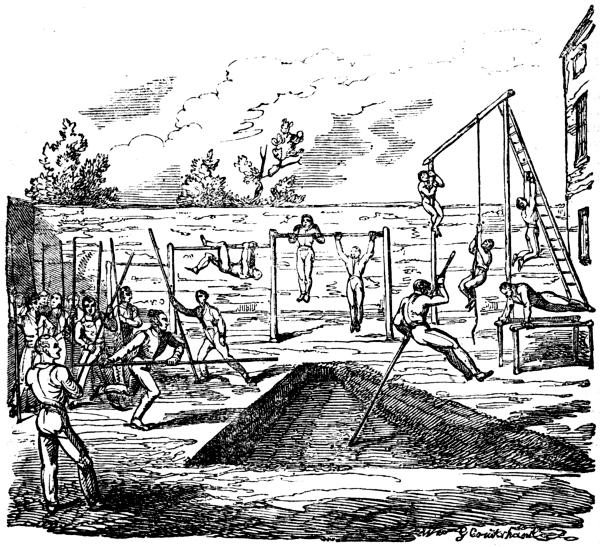
Some years ago a work on gymnastics, by Salzmann, was translated from the German into English. Its precepts were unaided by example; it produced a sensation, people talked about it at the time, and agreed that the bodily exercises it prescribed were good, but nobody took them, and gymnastics, though frequently thought upon, have not until lately been practised. In the first sheet of the Every-Day Book public attention was called to this subject, and since them Mr. Voelker, a native of Germany, has opened a gymnasium at No. 1, Union-place, in the New-road, near the Regent’s-park; and another at Mr. Fontaine’s riding-school, Worship-street, Finsbury-square. The editor of this work has visited Mr. Voelker’s gymnasium in the New-road; and with a view to public benefit, and because they will operate a new feature in manners, he promulgates the information that such institutions are established.
Mr. Voelker’s prospectus of his establishment is judicious. He contends that while education has been exclusively directed to the developement of the mental faculties, the bodily powers have been entirely neglected. “The intimate connection between mind and body has not been sufficiently considered; for who does not know, from his own experience, that the mind uniformly participates in the condition of the body; that it is cheerful, when the body is strong and healthy; and depressed, when the body is languid and unhealthy?”
Mr. Voelker refers to Xenophon, and to the great promoters of education in modern times, namely, Locke, Rousseau, Campe, Basedow, Pestalozzi, and Fellenberg, as authorities for the use of gymnastics; but he says it was reserved for professor Jahn to be the restorer of this long-lost art. In 1810, he established a gymnasium at Berlin; and the number of his pupils, consisting of boys, youth, and men, soon increased to several thousands. His ardent zeal and indefatigable exertion, and his powerful and persuasive appeals to his pupils, had such an effect, that all vied with each other in endeavouring to render their bodies strong and active. But the rising of the German people, in 1813, suddenly changed the cheerful game into a serious combat. Professor Jahn, and such of his pupils as were capable of bearing arms, (many of these being but fourteen years of age,) joined the volunteers of Lutzen. But few lived to revisit the place, where they had prepared themselves for enduring the hardships of war. Most of these young heroes covered the fields of battle with their corpses from the gates of Berlin to the capital of their enemies. The exercises, however, were resumed at Berlin, and had spread through several other towns, when the campaign of 1815 caused a new, but short interruption.
“As a pupil of Jahn’s,” says Mr. Voelker, “I also had the honour of serving among the volunteers. The campaign being finished, I returned to my studies: and when I thought myself sufficiently qualified for the duties of a teacher, I commenced them in 1818. At first I established gymnastic exercises at the academy of Eisenach, and in the university of Tubingen. In these establishments, as in all others where similar exercises had been introduced by professor Jahn or his pupils, a new vigour was imparted to the scholars. Boys, youths, and men, soon found more pleasure in exercises which strengthened the powers of their body, than in pleasures which render it effeminate and weak. By the consciousness of increased vigour, the mind, too, was powerfully excited, and strove for equal perfection; and each of the pupils had always before his eyes, as the object of his exertions, mens sana in corpore sano. Even men indolent by nature were irresistibly carried away by the zeal of their comrades. Weakly and sick persons, too, recovered their health; and these exercises were, perhaps, the only effectual remedy that could have been found for their complaints. The judgment of physicians, in all places where these exercises were introduced, concurred in their favourable effect upon health; and parents and teachers uniformly testified, that by them their sons and pupils, like all other young men who cultivated them, had become more open and free, and more graceful in their deportment. Fortune led me to the celebrated establishment of M. Von Fellenberg; and this great philosopher, and at the same time practical educator, gave the high authority of his approbation to the gymnastic science. It would not become me to state how I have laboured in the academy of that gentleman; but the recommendations with which he and others have favoured me, and also the testimonials, for which I am indebted to them, sufficiently prove that I do not set too high a value upon the utility of this branch of education. After I had established this system of education there, I accepted an invitation as professor at the Canton school at Chur, which I received from the government of the Canton. My exertions there had the same result as in other establishments, as is fully shown by the testimonials of the government. The thanks which I received from so many of my pupils, the testimonials from the directors of those establishments in which I have taught, my own consciousness of not having worked in vain, and the invitations of some friends, emboldened me to come forward in England, also, with gymnastics, on the plan of professor Jahn, and animate me with the confidence that here, too, my endeavours will not be fruitless.”
The subscription to professor Voelker’s gymnasium in the New-road and at Worship-street is, for one month, 1l.; for three months, 2l. 10s.; for six months, 4l.; for a twelvemonth, six guineas: or an association of twenty gentlemen may pay each 2l. for three, and 3l. for six months. Pupils from boarding-schools pay each 2l. for three, and 3l. for six months; but a number together pay each 1l. 10s. for three, 2l. 10s. for six, and 4l. for twelve months. Pupils not taking lessons with the other pupils, pay a guinea for every lesson. Twelve lessons may be had when convenient for 1l. 10s.
The Exercises.
I. The preliminary exercises serve principally to strengthen the arms and legs, and to increase their activity, to give the body a graceful carriage, to accustom it to labour, and thus prepare it for the other exercises.
II. Running for a length of time, and with celerity. If the pupil follows the prescribed rules, and is not deterred by a little fatigue in the first six lessons, he will soon be able to run three English miles in from twenty to twenty-five minutes. Some of Mr. V.’s pupils have been able to run for two hours incessantly, and without being much out of breath.
III. Leaping in distance and height, with and without a pole. Every pupil will soon convince himself to what degree the strength of the arms, the energy of the muscles of the feet, and good carriage of the body, are increased by leaping, particularly with a pole. Almost every one learns in a short time to leap his own height, and some of the pupils have been able to leap ten or eleven feet high. It is equally easy to learn to leap horizontally over a space three times the length of the body; even four times that length has been attained.
IV. Climbing up masts, ropes, and ladders. Every pupil will soon learn to climb up a mast, rope, or ladder of twenty-four feet high; and after six months’ exercise, even of thirty-four or thirty-six feet. The use of this exercise is very great in strengthening the arms.
V. The exercises on the pole and parallel bars, serve in particular to expand the chest, to strengthen the muscles of the breast and small of the back, and to make the latter flexible. In a short time, every pupil will be enabled to perform exercises of which he could not have thought himself capable, provided that he do not deviate from the prescribed course and rules.
VI. Vaulting, which is considered one of the principal exercises for the increase of strength, activity, good carriage of the body, and courage, which employs and improves the powers of almost all parts of the body, and has hitherto always been taught as an art by itself, is brought to some perfection in three months.
VII. Fencing with the broad sword, throwing lances, wrestling, and many other exercises.
All these exercises so differ from one another, that generally those parts of the body which are employed in one, rest in another. Every lesson occupies from one hour and a half to two hours, its length depending on the degree of labour required for the exercises practised in it.
In the New-road, lessons are given on Monday, Wednesday, Thursday, and Saturday, from six to eight o’clock, A. M., or on Tuesday, Wednesday, and Friday, from six to eight o’clock, P. M. Young pupils are instructed every day from eight to nine o’clock, A. M.
At Worship-street, the lessons are given on Mondays, Thursdays, and Saturdays, from seven to nine o’clock in the evening.
The drawing for this article was made by Mr. George Cruikshank, after his personal observation of Mr. Voelker’s gymnasium in the New-road: it was engraved by Mr. H. White.
To the Editor of the Every-Day Book.
Sir,
You, who have so long and so ably instructed us in the amusements of our ancestors, will not, I hope, neglect to give publicity to a new species of amusement which is not only pleasant in itself, but absolutely necessary in this overgrown metropolis. I allude to the gymnastic exercises which have lately been introduced from Germany into this country. They are as yet but little known, and some portion of that prejudice exists against them which invariably attends a new discovery: fortunately, however, it is in the power of the Editor of the Every-Day Book to combat the former by a simple notice, while the latter will be much shaken if it be known that these exercises are approved by him.
An inhabitant of London need only look out of his own window to see practical illustrations of the necessity of these exercises. How often do we see a young man with an intelligent but very pale countenance, whose legs have hardly strength to support the weight of his bent and emaciated body. He once probably was a strong and active boy, but he came to London, shut himself up in an office, took no exercise because he was not obliged to take any; grew nervous and bilious; took a great deal of medical advice and physic; took every thing in fact but the true remedy, exercise; and may probably still linger out a few years of wretched existence, when death will be welcomed as his best friend. This, though an extreme case, is a very common one, and the unfortunate beings who approximate to it in a considerable degree are still more numerous. Many of the miseries and diseases of young and old, male and female, in this city, may be traced eventually to want of exercise. Give us pure air, and we can exist with comparatively little exercise; but bad air and no exercise at all, are poisons of a very active description.
These exercises are so contrived that they exert equally every part of the body without straining or tiring any; and I speak from my own experience, when I say that after two hours’ practice in professor Voelker’s gymnasium, opposite Mary-le-bone church in the new Paddington-road, I am not more fatigued than when I entered it, and feel an agreeable glow of body, and flow of spirits, which walking or riding does not create. I, as well as some other pupils, have two or three miles to walk to the gymnasium; we have the option of going morning or evening, and we do not find the walk and two hours of the exercises before breakfast, fatigue us or incapacitate us in the slightest degree from going through our customary avocations. I should also add that in bodily strength I am under, rather than above, par.
Voelker’s Gymnastics.
It is not easy to describe these exercises to those who have not seen them. They consist: First, Of preliminary exercises of the hands and legs, which give force and agility to those members, and prepare the body for the other exercises. Secondly, Horizontal parallel bars, from three to five feet high, according to the size of the pupil, on which he raises his body by the arms, and swings his legs over in a variety of directions: this exercise opens the chest, and gives great strength to the muscles of the arms and body. Thirdly, The horizontal round pole supported by posts from five to eight feet high, according to the height of the performer. An endless variety of exercises may be performed on this pole, such as raising the body by the arms, going from one end to the other by the hands alone, vaulting, swinging the body over in all directions, &c. &c. Fourthly, The horse, a large wooden block shaped like the body of a horse—the pupils jump upon and over this much-enduring animal in many ways. Fifthly, Leaping in height and distance with and without poles. Sixthly, Climbing masts, ropes, and ladders of various heighths. Seventhly, Throwing lances, running with celerity and for a length of time, hopping, &c. &c. &c. It is, moreover, in our option to take whatever portion of the exercises we may find most agreeable.
The improvement which the gentlemen who practise these exercises experience in health (not to mention strength, agility, and grace,) is very considerable, and altogether wonderful in several who have entered in a feeble and sickly state. This, one would think, would be sufficient to prove that the exercises are not attended with danger, even were I not to mention that I have not seen a single accident. Neither is their utility necessarily confined to boyhood, as several gentlemen upwards of forty can clearly testify; nor does the pleasure of practising them depart with the novelty, but always increases with proficiency and time.
The expense the professor has already incurred in providing implements and adequate accommodation has been very considerable, and his terms are so moderate that a small number of pupils cannot possibly remunerate him; it is therefore to be hoped, no less for his sake than for our own, that he should meet with encouragement in this city.
With respect to the professor himself he has every quality that can recommend him to his pupils. The grace with which he performs the exercises is only equalled by his attention and care, and his mild and unassuming manners have won the hearts of all who know him. His pupils feel grateful not only for the benefits they have themselves received, but for the advantage that is likely to accrue to the country from the introduction of these wholesome, athletic amusements.
I am, &c.
G*.
FLORAL DIRECTORY.
Great Boletus. Boletus Bovinus. Dedicated to St. Ceolfrid.
September 26.
Sts. Cyprian and Justina, A. D. 304. St. Eusebius, Pope, A. D. 310. St. Colman Elo, Abbot, A. D. 610. St. Nilus, the younger, Abbot, A. D. 1005.
Old Holy-rood.
This day is so marked in the church of England calendar and in the almanacs. Respecting the rood enough, perhaps, was said to gratify the reader’s curiosity on holy-rood day.
St. Cyprian.
Is also in the calendar and almanacs on this day. He was a native of Carthage in the third century, and as a father is highly esteemed for the piety of his writings and the purity of the Latin tongue wherein they were written.
FLORAL DIRECTORY.
Gigantic Golden Rod. Solidago gigantea. Dedicated to St. Justina.
September 27.
Sts. Cosmas and Damian, A. D. 303. Sts. Elzear and Delphina, A. D. 1323, and 1369.
Sts. Cosmas and Damian.
These saints are said to have been beheaded under Dioclesian.
In a church dedicated to these saints at Isernia, near Naples, while sir William Hamilton was ambassador from Great Britain to that court, votive offerings were presented of so remarkable a nature, as to occasion him to acquaint sir Joseph Banks with the particulars. They were the grossest relics of the ancient pagan worship. The late Mr. Richard Payne Knight wrote a remarkable “Dissertation” on the subject for the use of the Dilettanti.
FLORAL DIRECTORY.
Manyflowered Starwort. Aster multiflorus. Dedicated to St. Delphina.
September 28.
St. Wenceslas, duke of Bohemia, A. D. 938. St. Lioba, Abbess, A. D. 779. St. Eustochium, A. D. 419. St. Exuperius, Bp. of Toulouse, A. D. 409.
FLORAL DIRECTORY.
Evergreen Golden Rod. Solidago sempervirens. Dedicated to St. Eustochium, V.
September 29.
The Dedication of St. Michael’s Church, or The Festival of St. Michael and all the holy Angels. St. Theodota, A. D. 642.
St. Michael.
This saint is in our almanacs and in the calendar of the church of England. The day is a great festival in the Romish church. The rev. Edward Barnard, of Brantinghamthorpe, in “The Protestant Beadsman,” an elegantly written “series of biographical notices and hymns, commemorating the saints and martyrs whose holidays are kept by the church of England,” says, “The rank of archangel is given in scripture to none but Michael, who is represented as the guardian and protector both of the Jewish church, and the glorious church of Christ, in which the former merged. On this account he is celebrated by name, while the rest of the holy angels are praised collectively. St. Michael is mentioned in scripture five times, and always in a military view; thrice by Daniel, as fighting for the Jewish church against Persia; once by St. John, as fighting at the head of his angelic troops against the dragon and his host; and once by St. Jude, as fighting personally with the devil, about the body of Moses; for the very ashes of God’s servants have angelic protection. It has been thought by many, that there is no other archangel but Michael. An author of great name, who has not given his reasons or authority, inclines to this opinion; and adds, that he succeeded Lucifer in this high dignity. Others imagine, and not without strong probability, that Michael is the Son of God himself. The interpretation of his name, and the expression (used by St. John) of ‘his angels,’ strengthen this supposition; for to whom can the angels belong but to God, or Christ? The title, by which Gabriel spoke of him, when he required his assistance, (‘Michael your prince’) is likewise brought forward, by bishop Horsley, in confirmation of this opinion. Besides, the Jews always claimed to be under the immediate spiritual protection and personal government of God, who calls them his peculiar people. How then can Michael preside over them? This festival will not loose any dignity by the adoption of such an interpretation, but will demand a more conscientious observance from those, who celebrate in it, not only the host of friendly angels, but, likewise (under the title of Michael) Jesus Christ the common Lord both of angels and men.” A well-informed expositor of the “Common Prayer-book,” Wheatley, says that the feast of St. Michael and all angels is observed, that the people may know what benefits are derived from the ministry of angels.
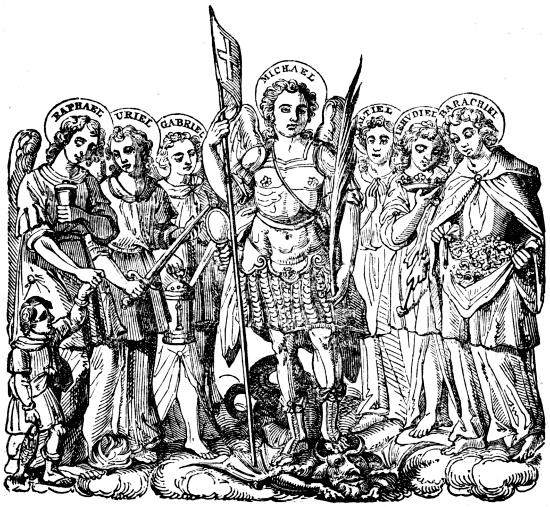
The accompanying engraving is from an ancient print emanating from the “contemplations” of catholic churchmen, among whom there is diversity of opinion concerning the number of archangels. Their inquiries have been directed to the subject, because it is an article of the catholic faith that angels, as well as saints, intercede for men, and that their intercession may be moved by prayers to them. In conformity with this persuasion patron-saints and angels are sometimes drawn for, by putting certain favourite names together, and selecting one, to whom, as the patron-saint or angel, the invocations of the individual are from that time especially addressed.
In the great army of angels the archangels are deemed commanders. The angels themselves are said to be divided into as many legions as there are archangels; whether these are seven or nine does not appear to be determined; but Michael, as in the present engraving, is always represented as the head or chief archangel, he is here accompanied by six only.
Dr. Laurence, regius professor of Hebrew at Oxford, and now archbishop of Cashel, recently printed at the Clarendon press, the long lost “Book of Enoch.” This celebrated apocryphal writing of ancient times calls “Michael one of the holy angels, who, presiding over human virtue, commands the nations.” It says, that Raphael “presides over the spirits of men;” that Uriel “presides over clamour and terror;” and Gabriel, “over paradise and over the cherubims.”
Our old heraldic friend, Randle Holme, says, Michael is the head of the “order of archangels;” his design is a banner hanging on a cross, and he is armed, as representing victory with a dart in one hand, and a cross on his forehead. He styles Raphael as leader of the “order of powers,” with a thunderbolt and a flaming sword to withsta “order of seraphims;” his ensign is a flaming heart and a cross-staff. Gabriel he makes governor of the “order of angels,” and his ensign a book and a staff. Of the other three archangels in the print, it would be difficult to collect an account immediately.
St. Michael and other Archangels.
Our forefathers were told by the predecessor of Alban Butler, that Michael bore the banner of the celestial host, chased the angel Lucifer and his followers from heaven, and enclosed them in dark air unto the day of judgment, not in the upper region, because there it is clear and delightful, nor upon the earth, because there they could not torment mankind, but between heaven and earth, that when they look up they may see the joy they have lost, and when they look downward, may see men mount to heaven from whence they fell. The relation says, they flee about us as flies; they are innumerable, and like flies they fill the air without number; and philosophers and doctors are of opinion, that the air is as full of devils and wicked spirits “as the sonne bemes ben full of small motes which is small dust or poudre.”[331]
Bishop Hall, in his “Triumphs of Rome,” mentions a red velvet buckler to have been preserved in a castle in Normandy which Michael wore in his combat with the dragon.
Bishop Patrick who wrote subsequently, in 1674, says “I hope that the precious piece of St. Michael’s red cloth is forthcoming—his dagger and his shield were to be seen at the beginning of this age, though one of their historians says, that five years before he came thither, in 1607 the bishop of Avranches had forbidden his shield to be any more showed: but who knows but some of the succeeding bishops may have been better natured, and not have denied this gratification to the desires of their gaping devotees.”
Bishop Patrick cites a Roman catholic litany, wherein after addresses to God, the Trinity, and the virgin Mary, there are invocations to St. Michael, St. Gabriel, and St. Raphael, together with all the orders of angels, to “pray for us.” He also instances that in the old Roman missal, and in the Sarum missal, there is a proper mass to Raphael the archangel, as the protector of pilgrims and travellers, and a skilful worker with medicine. Likewise an office for the continual intercession of St. Gabriel, and all the heavenly militia. In these catholic services St. Michael is invoked as a “most glorious and warlike prince,” “chief officer of paradise,” “captain of God’s hosts,” “the receiver of souls,” “the vanquisher of evil spirits,” and “the admirable general.” After mentioning several miracles attributed by the Romanists to St. Michael, the bishop says, “You see from this legend, that when people are mad with superstition, any story of a cock and a bull will serve their turn to found a festival upon, and to give occasion for the further veneration of a saint or an angel, though the circumstances are never so improbable.” He relates as an instance, that in a Romish church-book, Michael is said to have appeared to a bishop, whom he required to go to a hill-top, where if he found a bull tied, he was to found a church, and dedicate it to God and St. Michael. The bishop found the bull, and proceeded to found the church, but a rock on each side hindered the work, wherefore St. Michael appeared to a man, and bade him go and put away the rock, and dread nothing; so the man went, and “sette to his shoulders,” and bade the rock go away in the name of God and St. Michael; and so the rocks departed to the distance necessary to the work. “This removing the rock,” says bishop Patrick, “is a pretty stretcher!”
Michaelmas.
It is noticed by Mr. Brand in his “Popular Antiquities,” which cites most of the circumstances presently referred to, that—“It has long been and still continues the custom at this time of the year, or thereabouts, to elect the governors of towns and cities, the civil guardians of the peace of men, perhaps, as Bourne supposes, because the feast of angels naturally enough brings to our minds the old opinion of tutelar spirits, who have, or are thought to have, the particular charge of certain bodies of men, or districts of country, as also that every man has his guardian angel, who attends him from the cradle to the grave, from the moment of his coming in, to his going out of life.”
Mr. Nichols notices in the “Gentleman’s Magazine,” that on Monday, October 1st, 1804,—“The lord mayor and alderman proceeded from Guildhall, and the two sheriffs with their respective companies from Stationers’-hall, and having embarked on the Thames, his lordship in the city barge, and the sheriffs in the stationers’ barge, went in aquatic state to Palace-yard. They proceeded to the court of Exchequer: where, after the usual salutations to the bench (the cursitor baron, Francis Maseres, Esq. presiding) the recorder presented the two sheriffs; the several writs were then read, and the sheriffs and the senior under-sheriff took the usual oath. The ceremony, on this occasion, in the court of Exchequer, which vulgar error supposed to be an unmeaning farce, is solemn and impressive; nor have the new sheriffs the least connection either with chopping of sticks, or counting of hobnails. The tenants of a manor in Shropshire are directed to come forth to do their suit and service; on which the senior alderman below the chair steps forward, and chops a single stick, in token of its having been customary for the tenants of that manor to supply their lord with fuel. The owners of a forge in the parish of St. Clement (which formerly belonged to the city, and stood in the high road from the Temple to Westminster, but now no longer exists,) are then called forth to do their suit and service; when an officer of the court, in the presence of the senior alderman, produces six horse-shoes and sixty-one hobnails, which he counts over in form before the cursitor baron; who, on this particular occasion, is the immediate representative of the sovereign.
“The whole of the numerous company then again embarked in their barges, and returned to Blackfriars-bridge, where the state carriages were in waiting. Thence they proceeded to Stationers’-hall, where a most elegant entertainment was given by Mr. Sheriff Domville.”
To the Editor of the Every-Day Book.
Sir,
I have no doubt but many thousands of my fellow-citizens were unaware of the existence and very recent destruction of the baronial establishment of their chief magistrate; and that, therefore, by recording a few particulars you will endeavour to mark the era, when, perhaps, the last of these gentlemanly households, once to be found in every knightly and noble family, was destroyed in England. It is perhaps an unavoidable consequence of change of manners; but to those who delight in contemplating those of their ancestors, to witness the wreck of what appears almost consecrated by ancient usage, affords any thing but a pleasurable sensation. In former days those of rank considered it a degradation to have menials officiate about their persons, and therefore created officers in their households, which were looked upon as initiatory schools to every thing gallant or polite, and were consequently eagerly filled by noble youths and aspiring cadets. In imitation of those with whom for a brief period he ranked, the lord mayor of London had an establishment arranged for him, consisting of the following officers:
Four Squires.
1st. The sword-bearer, whose duty it was to advise his lordship of the necessary etiquette to be observed on stated occasions. To some it may appear very unimportant whether the lord mayor has on a violet or a scarlet gown; whether the mace is always carried before him or not, and strictly speaking it is so; but while old customs are harmless, and tend to preserve dignity and good order, why should they not be observed? This place used to be purchased, but when the late Mr. Cotterel died, who gave I believe upwards of 7000l. for it, and could have parted with it for 9000l. but was prevented by the corporation, it was made a gift place, and given to Mr. Smith of the chamberlain’s office, who now holds it subject to an annual election. This has placed the office on a very different, less independent, and less respectable footing, than it used to be. The predecessor of Mr. Cotterel, Heron Powney, Esq., who enjoyed the office thirty-three years, exercised great authority throughout the house, and used, with great form, to attend the lord mayor every morning to instruct him in any necessary ceremonial; and on all public occasions, assisted by two yeomen of the water side, robed his lordship: this is now performed by servants. There are four swords—the black, used on Good Friday, 30th of January, fire of London, and all fast days, when his lordship ought to go to St. Paul’s: on these days he wears his livery gown. The common sword, to go to the sessions, courts of aldermen, common council, &c.; the Sunday sword; and the pearl sword, which used to be carried on very rare occasions only, but is now exhibited at every turn. This gentleman, in the olden times, had apartments at the Old Bailey, and derived emolument from granting admission to two galleries during the sessions. He wears a black silk damask gown, and a cap of maintenance, and chain upon state days. He sits at the head of the table which goes by his name, at which the gentlemen of the household dined when they were in waiting; but now they only dine together fourteen days in the year, on public occasions. The lord mayors were latterly allowed 1500l. per annum for the maintenance of this table, which supplied that in the servants’ hall; but the latter have long been on board wages, to the great loss of many an exhausted pauper.
The second squire was Mr. Common Hunt: his principal office is indicated by his title; but he was likewise master of the ceremonies. He was in waiting every Monday and Wednesday, and every third Sunday while the house was in waiting. The last who held this office was Mr. Charles Cotterel, brother to the late sword-bearer, at whose death in 1807 it was abolished, and the duty of master of the ceremonies has since been performed by Mr. Goldham, one of the serjeants of the chamber. The common hunt’s house used to be at the Dog-house-bar in the City-road.
The third squire is Mr. Common Crier, whose duty it is to attend his lordship with the mace to the courts of aldermen and common council, common halls, and courts of hustings: he is in waiting every Tuesday and Thursday; and whenever the lord mayor wears his scarlet robes, attends him with the mace. His dress is a damask gown and counsellor’s wig: he had apartments at Aldersgate. Formerly this place was purchased, but not within the memory of man.
The fourth squire is the water-bailiff, who is empowered by the lord mayor to act as sub-conservator of the Thames and Medway. He is in waiting every Friday and Saturday, every third Sunday, and all public days. Dress, damask gown. Had apartments at Cripplegate. This is now likewise a gift place.
The four attornies used to attend his lordship in turn, weekly, to advise him in his magisterial capacity; but this part of their duty has now become obsolete, and has devolved to Mr. Hobler.
To the lord mayor’s household also properly belong three serjeant carvers, three serjeants of the chamber, one serjeant of the channel, one yeoman of the chamber, two marshals, four yeomen of the water-side, one yeoman of the channel, one under water-bailiff, six young men.
The members of the household, with the exception of the four squires, attornies, and marshals, had the privilege of alienating their places on payment of 50l. to the corporation; but if they died without paying this fine, their places lapsed to the city, and the value of them was consequently lost to their family. But let the one who sold hold what situation he might in this little republic, the purchaser was admitted to only the lowest rank, that of junior young man, that all below the one who sold might rise a step.
The gentlemen were in waiting on fixed days; sometimes the whole number, at others only a part, and at these times were entitled to a dinner, and on any extra occasion when the sword was carried: there was a bill of fare for each day. At table, the marshals were the lowest above the salt. This was formerly made of pewter, but in the year , a carver presented the table with one of silver, nearly similar in form. The pewter one was used in the servants’ hall until it was rendered useless by the introduction of board wages. Except the squires, attornies, and marshals, the household now all wear black gowns, in form like those of the livery, made of prince’s stuff faced with velvet, though formerly they were curious enough. Divided as if by a herald into two parts, dexter and sinister, one side was formed of the colours distinguishing the lord mayor’s livery, and the other those of the two sheriffs.
On Plough Sunday his lordship goes to church to qualify, when two of the yeomen of the water-side attend, that they may depose to this fact at the next sessions. On the Monday his lordship keeps wassail with his household, and with his lady presides at the head of their table. This used indeed to be a gala day; but elegance now takes place of profusion and hilarity. Formerly they could scarcely see their opposite neighbour for the piles of sweetmeats; but these have disappeared to make way for the city plate and artificial flowers. The lady mayoress is generally accompanied by two or three ladies, to obviate the unpleasantness of finding herself the only female among so many strangers: the chaplain on that day takes the lower end of the table. The yeoman of the cellar is stationed behind his lordship, and at the conclusion of the dinner produces two silver cups filled with negus, and giving them to his lord and lady, proclaims with a loud voice, “Mr. Sword-bearer, squires, and gentlemen all! my lord mayor and lady mayoress drink to you in a loving cup, and bid you all heartily welcome!” After drinking, they pass the cups down each side of the table, for all to partake and drink their healths. When the ladies retire the chaplain leads her ladyship, and after a few songs his lordship follows. Then a mighty silver bowl of punch was introduced, and a collection amounting to nearly 25l. used to be made for the servants. They were all introduced, from the stately housekeeper to the kitchen girl, in merry procession to accept the largess, taste the punch, and perhaps the cook or a pretty housemaid did not escape without a kiss. This was not the only day on which the servants partook of the bounty of the gentlemen. Every Saturday there was a collection of three shillings and sixpence from the sword-bearer and the other squire, and one shilling and sixpence from the other individuals. This was termed cellarage, and was divided between the yeoman of the cellar and the butler. But these golden days are over. Since the days of the Fitzaleyns and Whittingtons, it has been found expedient to make the lord mayors an allowance to enable them, or rather assist them, to maintain the hospitality and splendour of their station; but such is the perverseness of human nature, that as this has from time to time been increased, the gorgeousness of the display seems to have decreased. The following are the receipts and expenses of Mr. Wilkes during his mayoralty:
Receipts.
£. s. d.
Payments from the chamberlain’s office 2372 8 4
Cocket office 702 5 6 1⁄2
Gauger 250 0 0
Annual present of plate from the Jews 50 0 0
Lessees of Smithfield-market 10 0 0
Licenses 4 10 0
From the bridge-house towards the feast 50 0 0
Alienation of a young man’s place 40 0 0
Sale of a young man’s place 1000 0 0
Presentation of the sheriffs 13 6 8
For keeping the mansion-house in order 100 0 0
Six freedoms to the lord mayor 150 0 0
In lieu of buckets 6 0 0
Licensing the sessions paper 130 0 0
From Mr. Roberts, comptroller, for the importation fee 10 10 0
£4889 0 6 1⁄2
Expenses.
£. s. d.
Lord mayor’s table, including public dinners 2050 0 0
Sword-bearer’s table 1500 0 0
Lord mayor’s-day 520 0 0
Easter Monday 1200 0 0
Rout 190 0 0
Old Bailey 730 0 0
Horses, coaches, &c. 420 0 0
Servants’ wages, liveries, &c. 570 0 0
Lamps, wax, and other candles 295 0 0
Linen 160 0 0
Coals and firing 280 0 0
China and glass 110 0 0
Stationery wares, newspapers, &c. 60 0 0
Winter and summer for the sword-bearer and household 36 13 0
Glazier, upholsterer, &c. 46 0 0
Music, &c. 35 0 0
Ribands, &c. 24 0 0
£8226 13 0
N. B. Benefactions on public occasions, charities, &c. cloths, fees to the water-bailiff, are not included.
Expenses 8226 13 0
Receipts 4889 0 6 1⁄2
Balance £3337 12 5 1⁄2
The rout was first discontinued by sir Brooke Watson, because it was always customary to have it in passion week. The allowance has since had an increase of 3000l. This liberality on the part of the corporation, instead of exciting a corresponding feeling on the part of their magistrates, seems rather to have raised in them a spirit of cupidity, and of late years, on many occasions, the office seems to have been undertaken on a kind of speculation for saving money. Though allowed 1500l. a year for the sword-bearer’s table, every chicken and bottle of wine began to be grudged; and after repeated appeals by the household to the court of common council, on account of the shabby reductions successively made, and which were considered as unjust, as they had purchased their places with the usual privileges, the corporation concluded a treaty with them a short time ago, by which a specified sum of money was secured to each individual, either on giving up his place, or at his death to be paid to his family. They have of course given up the right of alienating their places, and thus perpetuating the system. The corporation have thus gained an extensive increase of patronage; though the number of officers is to be reduced as the places fall in. But some of the aldermen below the chair were rather disagreeably surprised at the result; for the common council very justly deducted the 1500l. at which the expense of the table was generally calculated, from his lordship’s allowance.
I am, &c.
C. R. H.
The lord mayor’s household, scarcely known in its constitution by the citizens whom the lord mayor selects for his visitors, is well set forth by the preceding letter of a valuable correspondent. It concerns all who are interested in the maintenance of civic splendour, and especially those who are authorized to regulate it. Such papers, and indeed any thing regarding the customs of London, will always be acceptable to the readers of this work, who have not until now been indulged with information by those who have the power to give it. The Every-Day Book is a collection of ancient and present usages and manners, wherein such contributions are properly respected, and by the Editor they are always thankfully received.
On Michaelmas-day the sheriffs of London, previously chosen, are solemnly sworn into office, and the lord mayor is elected for the year ensuing.
Pennant speaking of the mercers’ company, which by no means implied originally a dealer in silks, (for mercery included all sorts of small wares, toys, and haberdashery,) says, “This company is the first of the twelve, or such who are honoured with the privilege of the lord mayor’s being elected out of one of them.” If the lord mayor did not belong to either of the twelve, it was the practice for him to be translated to one of the favoured companies. The custom was discontinued in the mayoralty of sir Brook Watson, in 1796, and has not been revived.
E. I. C.
The “Gentleman’s Magazine” notices a singular custom at Kidderminster—“On the election of a bailiff the inhabitants assemble in the principal streets to throw cabbage stalks at each other. The town-house bell gives signal for the affray. This is called lawless hour. This done, (for it lasts an hour,) the bailiff elect and corporation, in their robes, preceded by drums and fifes, (for they have no waits,) visit the old and new bailiff, constables, &c. &c. attended by the mob. In the mean time the most respectable families in the neighbourhood are invited, to meet and fling apples at them on their entrance. I have known forty pots of apples expended at one house.”