NOVEMBER. (continued 2)
Reading edition
Letter from the Ærial.
When this sheet was going to press a letter was received; which, being properly authenticated, is here subjoined, with the words in italics as marked in the original.
To the Editor of the Every-Day Book.
Sir,
November 16, 1825.
I conceive that nothing but my “death,” or at least “the beautiful leg,” will atone to the world for my little indiscretions. If you expect me to appeal to the public, I answer, that I have been without father and mother eleven years nearly, though now only twenty-five years old, and measuring five feet two inches and a half, and in the hands of guardians, though not wanting money, four of whom it took to put me in the watchhouse, and I answer that I would rather be hanged if “the most liberal nation of the earth” wishes it.
You have observed that the company shrieked with laughter and amazement. Now I say I was the only one who shrieked with laughter, as I should at another hoax on the public. You might have spared me the trouble of answering you, if you had not introduced a most immutable picture of my conduct. You have represented me as the individual courting excessive censure or praise; but I must here be puppy enough to talk of general opinion, and say, that notwithstanding the pretended christian burial of me by the newspapers, it still appears by each and every of them that in the end the magistrate had no just cause to hate me. Besides acquiring experience from disappointment, and Mr. Chantry who sent for me, I had a dream which clearly convinced me I should not part with the cast.
I have no occasion to mention the author of the following quotation:—
“Let Hercules himself do what he may, The cat will mew, the dog will have his day.”
I am, Sir, Your most obedient servant, Joseph Leeming.
No. 61, Berwick Street, Soho.
Having inserted this letter here the matter ends, for nothing remains to be said.
It being within the purpose of the Every-Day Book to observe on the phenomena of the times, Mr. Leeming, as “the Ærial,” was included, but not until he had been previously in print from the character he assumed. His present letter speaks for itself. He admits “little” indiscretions: among these “little” ones a large one was, what he terms, his “hoax” on the public; but his visits to the artists are of another character. There exists no feeling towards him, on the part of the editor of this work, but a kind one; and he advises him, for his own sake, to “study to be quiet.”
Happy the man whose wish and care, A few paternal acres bound; Content to breathe his native air, In his own ground. Whose herds with milk, whose fields with bread, Whose flocks supply him with attire; Whose trees in summer yield him shade, In winter fire. Blest, who can unconcern’dly find Hours, days, and years, slide soft away In health of body, peace of mind, Quiet by day. Sound sleep by night, study and ease Together mix’d; sweet recreation! And innocence which most does please With meditation. Thus let me live, unseen, unknown, Thus unlamented let me die; Steal from the world, and not a stone Tell where I lie.
Pope.
FLORAL DIRECTORY.
Glaucus Aletris. Veltheimia glauca. Dedicated to St. John Lateran.
November 10.
St. Andrew Avellino, A. D. 1608. Sts. Trypho and Respicius, A. D. 250. St. Nympha, 5th Cent. St. Justus, Abp. of Canterbury, A. D. 627. St. Milles, Bp., and Sts. Abrosimus and Sina, A. D. 341.
Day after Lord Mayor’s Day. London on the 10th of November.
Thin attendance on ’Change to-day—dull eyes—languid countenance—a little nervous this morning—fresh demand for soda-water and ginger-beer—much breakfasting at the coffee-houses about twelve—scrags of mutton in great request—confounded head-ache—shall be home early to-morrow, my dear—let me have a little broth—deuce take the lord mayor; I’ll never go again.[384]—
FLORAL DIRECTORY.
Scotch Fir. Pinus Silvestris. Dedicated to St. Nympha.
November 11.
St. Martin, Bp. A. D. 397. St. Mennas, A. D. 304.
St. Martin.
He is in the church of England calendar and the almanacs. By Romish writers he is called “the Great St. Martin, the glory of Gaul.” They say that he was born in Lower Hungary, about 316, and becoming a soldier, a beggar requested alms, when having no money he drew his sword, and cutting his cloak into two pieces, gave half to the beggar, and wrapped himself up in the other; whereupon Christ appeared to him the next night, in the half he had given away, asked him if he knew it, and said to angels that surrounded him, “Martin has given me this garment.” This occasioned him to leave the army and enter the church, and he was made an exorcist by St. Hilary. Turning hermit, he lived on roots and wild herbs, and unawares ate a quantity of hellebore sufficient to kill an unprivileged person. After this, one of his disciples fell ill of a fever, and died suddenly without baptism; “whereupon,” says Alban Butler, “feeling in himself a divine impulse to work a miracle,” he stretched himself upon the body, and prayed till the deceased came to life. She said her soul had been before the divine tribunal, and been sentenced to a dark dungeon;—but that on two angels representing St. Martin was praying for her coming back, she was ordered to be restored to the body and raised to life. “Another time the saint restored to life, in the same manner, a slave who had hanged himself.” In 371, he was chosen bishop of Tours, and is said to have lived in a narrow hole in the side of a rock. Near to it was a chapel with an altar, over a tomb, but St. Martin would not visit it, because, although the person buried was represented to have been a martyr, he was not assured that the relics were genuine. He went, however, one day with some of his clergy, and prayed for information, whereupon on his left hand, “he saw near him a pale ghost of a fierce aspect, whom he commanded to speak; the ghost told his name, and it appeared that he had been a robber who was executed for his crimes, whom the people honoured as a martyr; none but St. Martin saw him, the rest only heard his voice; he thereupon caused the altar to be removed.” After the rectification of this trifling mistake, he went on raising the dead, casting out devils, and receiving revelations; but as he grew older “it cost him more difficulty, and longer prayers, to cast out devils than formerly.” He died in 397, and his shrine worked the usual miracles. This account of St. Martin is abstracted from the rev. Alban Butler’s life of him.
Martinmas.
A custom anciently prevailed, though generally confined at present to country villages, of killing cows, oxen, swine, &c. at this season, which were cured for the winter, when fresh provisions were seldom or never to be had.
When Easter comes, who knows not than That veale and bacon is the man? And Martilmass Beefe doth beare good tacke, When countrey folke do dainties lacke.
Tusser.
Martlemas beef was beef dried in the chimney, as bacon, and is so called, because it was usual to kill the beef for this provision about the feast of St. Martin.[385] There is mention of
—dried flitches of some smoked beeve, Hang’d on a writhen wythe since Martin’s Eve.
Hall.
Mr. Brand relates, that rustic families in Northumberland clubbed at Martinmas to buy a cow or other animal; the union for this purchase is called a “mart.” After the animal was killed, they filled the entrails with a kind of pudding meat, consisting of blood, suet, groats, &c. which being formed into little sausage links, were boiled and sent about as presents. These are called “black-puddings” from their colour. There is also noticed a kind of entertainment in Germany, called the “feast of sausages,” which was wont to be celebrated with great joy and festivity. The day is a great festival on the continent: new wines then begin to be tasted, and the hours are spent in carousing. An old author says, that the great doings on this occasion almost throughout Europe in his time, are derived from an ancient Athenian festival, observed in honour of Bacchus, upon the eleventh, twelfth, and thirteenth days of the month Anthesterion, corresponding with our November. Another says, that the eleventh month had a name from the ceremony of “tapping their barrels on it;” when it was customary to make merry. It is likewise imagined by Dr. Stukeley, in his “Itinerary” concerning Martinsal-hill, thus: “I take the name of this hill to come from the merriments among the northern people, called Martinalia, or drinking healths to the memory of St. Martin, practised by our Saxon and Danish ancestors. I doubt not but upon St. Martin’s day, or Martinmass, all the young people in the neighbourhood assembled here, as they do now upon the adjacent St. Ann’s-hill, upon St. Ann’s day.” He adds, that “St. Martin’s day, in the Norway clogs, (or wooden almanacs) is marked with a goose: for on that day they always feasted with a roasted goose: they say, St. Martin, being elected to a bishoprick, hid himself, (noluit episcopari) but was discovered by that animal. We have transferred the ceremony to Michaelmas.”[386]
Dr. Forster, so often cited, observes, that a medal has lately been struck in France in commemoration of this laudable custom; on one side of which is embossed a goose, and on the reverse occurs the word Martinalia. Relative to the custom of goose-eating, it is further noticed in the “Perennial Calendar,” that the festival of St. Martin occurs when geese are in high season. “It is always celebrated with a voracity the more eager, as it happens on the eve of the petit carême, when fowls can no longer be presented on the tables of a religious age. A German monk, Martin Schoock, has made it a case of conscience whether, even on the eve of the little Lent, it be allowable to eat goose: ‘An liceat Martinalibus anserem comedere?’ After having dived into the weedy pool of the casuist’s arguments, the delighted devotee emerges with the permission to roast his goose; and thus the goose came to be a standing dish on Martinmas as well as Michaelmas day.”
In some of the old church calendars the celebration of this day is called “The Martinalia, a genial feast; wines are tasted of and drawn from the lees; Bacchus is the figure of Martin.”[387]
“Time’s Telescope,” for 1814, cites some extracts from a little ballad, entitled “Martilmasse Day:”—
It is the day of Martilmasse, Cuppes of ale should freelie passe; What though Wynter has begunne To push downe the Summer sunne, To our fire we can betake, And enjoye the crackling brake, Never heedinge Wynter’s face On the day of Martilmasse. Some do the citie now frequent, Where costlie shows and merriment Do weare the vaporish eveninge out With interlude and revellinge rout; Such as did pleasure Englande’s queene When here her Royal Grace was seen Yet will they not this day let passe, The merrie day of Martilmasse. When the dailie sportes be done, Round the market crosse they runne, Prentis laddes and gallant blades Dancing with their gamesome maids, Till the Beadel, stout and sowre, Shakes his bell, and calls the houre; Then farewell ladde and farewell lasse To the merry night of Martilmasse. Martilmasse shall come againe, Spite of wind, and snow, and raine; But many a strange thing must be done, Many a cause be lost and won, Many a tool must leave his pelfe, Many a worldlinge cheat himselfe, And many a marvel come to passe, Before return of Martilmasse.
FLORAL DIRECTORY.
Weymouth Pine. Pinus Strobus. Dedicated to St. Martin.
November 12.
St. Martin, Pope, A. D. 655. St. Nilus, A. D. 390. St. Livin, A. D. 633. St. Lebwin, Patron of Daventer, 8th Cent.
Birth-day of Admiral Vernon.
The anniversary of this famous old admiral’s nativity was formerly kept with great enthusiasm. It was distinguished in 1740 in a very extraordinary manner, by the ringing of bells, and public dinners in many places, &c. In the evening there were the greatest rejoicings, bonfires, and illuminations in London and other cities, that had been known for many years. Don Blass was burnt in some places, and at Chancery-lane-end was a pageant, whereon was represented admiral Vernon, and a Spaniard on his knees offering him a sword; a view of Porto Bello, &c.; over the admiral was wrote, “Venit, vidit, vicit;” and under him, “Vernon semper viret.”[388]
FLORAL DIRECTORY.
Grape Aloe. Velthennia Uvaria. Dedicated to St. Nilus.
November 13.
St. Homobonus, A. D. 1197. St. Didacus, A. D. 1463. St. Stanislas Kostka, A. D. 1568. St. Mitrius. St. Brice, A. D. 444. St. Constant, of Logherne, A. D. 777. St. Chillen, or Killian, of Ireland.
St. Brice.
This saint is in the church of England calendar and the almanacs, for what reason is unknown. He was born at Tours, became a monk under St. Martin, and succeeded him in the see of that city.
St. John’s, Clerkenwell.
The church of St. John, Clerkenwell, having been closed for reparation since the first Sunday in July, was opened for divine service on the 13th of November, 1825, by the Rev. W. E. L. Faulkner, M. A. rector of the parish. The exterior of the present edifice is altogether unseemly. It is frequently called St. John’s chapel, and has more the air of a meeting for dissenting worship, than a structure of the establishment; if it had not a sort of steeple with a bell, it might be mistaken for a theatre; but the interior is in every respect befitting its ecclesiastical use. It has spacious galleries, is well pewed below, and thoroughly lighted, with a very commodious vestry. In these respects it is creditable to the inhabitants who have now so judiciously fitted it up, that it will not require more than usual cleaning for many years. Still it is to be regretted, that a structure, essentially gothic, should have been accommodated to modern architecture. The deviation seems to have taken place on its appropriation to the use of the parish of St. John, about a century preceding the reparation it has now undergone.
St. John’s parish is distinct from the parish of St. James, although, as regards their poor, they are under one management; and the parish of St. James has, in other respects, an ascendancy, which formerly was the cause of open dissention. This difference originated on the setting out of the parish, the boundaries whereof are described by an entry in the vestry-book, which states in what way the church became parochial. Before referring to it, a glance may be taken of the annexed engraving. It is from an original drawing of a south view of the church in the year 1508, and preserved in the Cotton collection. It is especially curious, because it shows the old square tower, on the site whereof the present church stands, with the great bell tower above, which is rapturously described by Stowe, as will be mentioned presently. The building with two windows between three buttresses, surmounted by pinnacles, was anciently the library.
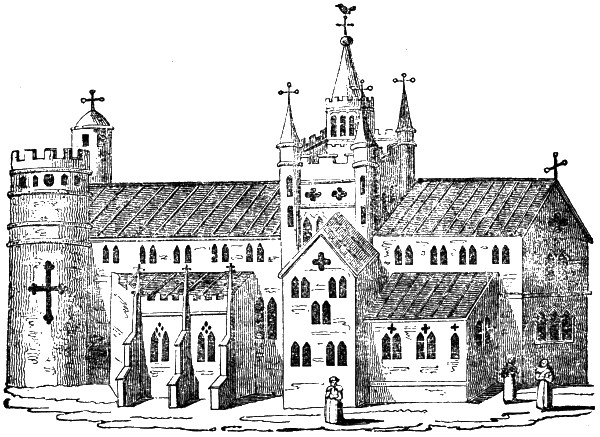
Church of St. John, Clerkenwell, in 1508.
ENTRY IN THE VESTRY BOOK. The History of the Parish of St. John, Clerkenwell.
On friday the twenty seventh Day of December in the year of our Lord Christ one thousand seven hundred twenty and three, and in the tenth Year of the Reign of George by the Grace of God, king of Great Britain, &c. being St. John’s Day, this Church was consecrated and dedicated to the Service of Almighty God by the Right Reverend Father in God Edmund [Gibson] by Divine Permission Lord Bishop of London, by the Name of the Church of St. John Clerkenwell in the County of Middlesex.
This Church is what was the Choir of the antient Church of the Knights Hospitallers, or the Knights of St. John of Jerusalem in England, which Order began at Jerusalem about the Year of our Lord Christ 1099, taking its rise and name from an Hospital built for the reception of Christian Strangers and Pilgrims, who came to perform their Devotion at the Place of our Lord’s Sepulchre, and from a Church adjoining dedicated to St. John Baptist.
In the 11th Century the Christians in the Holy Land were very much harassed by the Turks, till some Merchants from Amalfi in Italy visited the parts about Syria and Egypt, and so far recommended themselves to the Inhabitants by the many rare and pretious commodities they brought thither, that the Calif of Egypt gave them a part of Jerusalem to live in, where they built a Cloister and transplanted thither from Italy an Abbot with some Benedictine Monks, who entertained all Christian Pilgrims and travellers: soon after a Cloister was erected for Women, and these being too small, the Hospital or Alms-House just mentioned was founded for the reception of both sick and well, under the direction of an Overseer maintained chiefly by Alms from Amalfi and other parts of Italy: shortly after, the Church was built, and dedicated to St. John Baptist; tradition informing, that his Father Zachary had often travelled that way, from whence those of this Foundation took the Name of Joannitæ, and continued an Order of Hospitalers or Alms-men some few Years.
In the year 1099, when the Christian Princes, under the command of Godfrey of Bologne, Duke of Lorrain besieged Jerusalem, Gerard the then overseer, with the rest of the Hospitalers by a sudden and unexpected Sally upon the rear of the Turks, contributed greatly to the overthrow of the infidels, and the recovery of the Holy-Land. Godfrey made public acknowledgments of this signal piece of Service, and being created King of Jerusalem gave the Hospitalers large presents, and put the defence of many Towns into their hands. From this time their Order commenced that of Knighthood, Gerard being their first Grand Master. The Order was confirmed by Pope Honorius the second, and by the then Patriarch of Jerusalem. The members of it were called indifferently the Knights Hospitallers of St. John of Jerusalem. It was their Vow and Profession to exercise hospitality, to resist the Barbarians that should offer any injury to Pilgrims on the High Ways, and to maintain the Christian religion by force of Arms in their Country. They soon greatly increased in Fame and Riches and spread into many nations: the services they did to Christian Princes procured them every where great respect, Wealth and Privileges, insomuch that tho’ at first they professed voluntary poverty, they were afterwards at once in Possession of 19000 Manors in Christendom.
This Order flourished with great pomp and splendour in this Nation: their Prior was reckoned the first Baron in England; their Establishment here was very early, for about a Year after their first Institution at Jerusalem, viz. An. Dom. 1100, Jordan Briset Baron, and Muriel his wife, founded a Priory in this place for the Knights of this Order, and built a Church, which was dedicated to the Honour of St. John Baptist, in the Year 1185, being then consecrated by Heraclius Patriarch of Jerusalem. Both Church and House were burnt in 1381, by the Essex Rebels, but were afterwards rebuilt and continued in the possession of the Knights Hospitallers till the 32nd Year of Henry the 8th (which was years after the general Dissolution of Religious Houses in this Kingdom,) when by a particular Act of Parliament the Priory was suppressed, and the House, Church, and all the Lands of the Knights Hospitallers were vested in the Crown, with all Privileges, &c. thereto belonging, other than the right of Sanctuary, which Right is by this Act discharged, but with an express saving of the Privileges common to Churches and Church Yards applied and used to God’s service. In this Act of Parliament the Hospital, House, Church, &c. are mentioned, not as a part of, or within the Parish of St. James, Clerkenwell, but as situate and being near to the City of London, in the County of Middlesex, and so the same are mentioned in the grant from the Crown and subsequent writings.
The Hospital or Priory Church, and House of St. John were preserved from Spoil and down-pulling so long as Henry the 8th lived; but in the third Year of King Edward the 6th the Body and side Isles with the great Bell tower, (a most curious piece of workmanship, graven, gilt, and enamelled,) were pulled down; but the Choir, (which remained,) was closed up in the reign of Queen Mary, who restored the Order and incorporated a Priory and several Brethren, and granted to them this Church, House, and many Lands; but the Order being again dissolved by Queen Elizabeth, the Church and Priory remained in the Crown till the 9th day of May, in the 5th year of King James the first, when by Letters Patent of that date the King granted the same to Ralph Freeman and his heirs, in free and common Soccage by the name of the City or House of the late Hospital of St. John of Jerusalem in England, in the County of Middlesex, and all the City, Circuit, and Precinct of the same House, having therein one great Mansion House, one great Chapel, &c., containing by estimation 5 acres. From Freeman the said Church or Chapel, and part of the great house and gardens, came in the 10th Year of King James the first Ld. Wm. Cecil Lord Burghley, Son and Heir apparent of Thomas Earl of Exeter, by whose daughter the Lady Diana, it passed in marriage in the 5th Year of King Charles the 1st to Thomas, Lord Bruce, afterwards Earl of Elgin, whose son Robert was created Earl of Ailesbury, in which Family this Church or Chapel, (from thence called Ailesbury Chapel,) continued till the Year 1706, and being then sold by them, was afterwards, viz. in the Year 1721, purchased by Mr. Simon Michell, with intent to accommodate the Inhabitants of a new Street by him then partly built, called Red Lion Street, and the neighbouring inhabitants with a convenient place for Divine Worship. He afterwards enlarged the said Chapel, or what was used as such, being the middle Isle only by restoring thereto the North isle, (which had been made part of a dwelling-house,) and also the South Isle, (the upper part of which had been converted into a Library, and the lower part separated by a wall from what was left to the Chapel,) and having likewise entirely new built the west front, and new roofed the whole, and furnished the Chapel with convenient Galleries and pews; he proposed it thus rebuilt and beautified to the Commissioners appointed in pursuance of Acts of Parliament for building 50 New Churches in and about London, as proper to be by them converted into a Parochial Church for such an adjoining District, as they should think fit to appoint for a Parish to the same.
This proposal being accepted and an agreement made by the Commissioners with Mr. Simon Michell, he and Mr. Hutton (his trustee) by bargain and sale enrolled in Chancery, bearing date the 29th day of August 1723, conveyed the Chapel, and the ground extending from the East end thereof to St. John’s Street, (on the front part whereof next to St. John’s Street, stood 2 houses,) to the said Commissioners, who by Deed bearing date the 11th day of December 1723 and afterwards enrolled in Chancery, did, pursuant to their Power, granted by the said Acts of Parliament, declare and appoint the Chapel to be from and for ever after the Enrollment of that Deed and the consecration of the Chapel, a Parish Church by such Name as should be given thereto in the act of Consecration; and by the same Deed the said Commissioners did pursuant to the said Acts of Parliament set out and appoint a Parish for the said Church, and ascertained the Bonds and Limits of such new parish to be as followeth:—
The entry in the vestry-book, hitherto given verbatim, proceeds to set out the parish bounds in words, and a copy of the act of consecration.
It is interesting to go a little farther into the history of this ancient church.
While Henry VIII. reigned, “the rebels of Essex and Kent,” in 1381, set fire to the house, causing it to burn for the space of seven days together, and not suffering any to quench it: afterwards the church, and houses thereto appertaining, were new built, and the church finished by Thomas Docwray, lord prior there about the year 1504, as appears by the inscription over the gate-house, mentioned by Stow as remaining in his time, and which still remains. The church was employed as a storehouse for the king’s “toyles and tents for hunting and for the wars,” &c. Stow, who says this, speaking of its destruction in the third year of king Edward VI., adds, that the church for the most part, to wit, the body and side isles with the great bell tower was undermined and blown up with gunpowder, and the stone thereof employed in building the lord protector’s (Somerset) house in the Strand. The great bell tower he calls “a most curious piece of workmanship, graven, gilt, and inameled to the great beautifying of the city, and passing all other that I have sceene.” He adds that the part of the quire which remained, with some side chapels, was closed up at the west end by cardinal Pole, in the reign of queen Mary, and the other was repaired, and sir Thomas Tresham Knight, made the lord prior there with the restitution of some lands. At the suppression, the priory was valued “to dispend in lands, 3385l. 19s. 8d. yearly; sir William Weston being then lord prior, died on the 7th of May, 1540.” The king granted “great yeerely pensions” to the knights; and to the lord prior, during his life, 1000l. “but he never received a penny.” He died of a broken heart on Ascension-day in the same year, the very day the house was suppressed. An account of the exhumation of his body on the 27th of April, 1788, on taking down the old church of St. James, Clerkenwell, with interesting particulars respecting him, may be seen in the “Gentleman’s Magazine” for that year. Mr. Bartholomew of Red Lion-street, Clerkenwell, a lover, and as far as he is permitted by the other inhabitants, a preserver of the antiquities of his parish of St. John, is in possession of a portion of prior Weston’s cere-cloth.
The only vestiges of the antiquity and extent of this church are in Jerusalem-court, which runs from St. John’s-square into St. John’s-street, and is bounded on the left by houses or dwellings constructed within the remaining part of the south wall: they are now, (in November, 1825,) undergoing reparation by new facing, but portions of the old church buttresses remain, though they are much mutilated, and their shafts buried to the extent of many feet below the pavement. There is not a single inscription or monument of any age remaining. The only remarkable stone in the churchyard is a memoritur of the late “Mrs. Sarah Newman of No. 63, Cow-cross-street, St. Sepulchre,” who died a few years ago, and is rendered “remarkable” by an amplification of the ever-recurring epitaph, “Affliction sore” &c. She is made to say—
Pain was my portion, Physic was my food, Groans was my devotion, Drugs did me no good; Christ was my physician, Knew what way was best, To ease me of my pain, He took my soul to rest.
A mural inscription in the church, represents “Simon Michell Esq. a member of the Middle Temple and Lincoln’s Inn, descended from a family of that name in Somersetshire. He died August 30, 1750, aged 74.” He was a barrister, and member of parliament for Boston. Red Lion-street, built by him, is the best class of houses erected in his time in Clerkenwell, which, among the “lower orders,” is called “Jack Adams’s parish,” for a reason that, if it can be authentically communicated, will be hereafter inserted.
The old gateway of St. John’s priory remains in the state wherein it is seen monthly on the title-page of the “Gentleman’s Magazine.” The east turret and the great rooms over the gateway, are used as a tavern called “The old St. John of Jerusalem,” occupied and kept by Mr. William Flint, who formerly carried on the business of a printer in the Old Bailey. The lower part of the west turret is the watchhouse of St. John’s parish. On entering the gateway from the south, the fixed iron shaft of the top hinge, whereon the ancient gate swung, is about level with the elbow of a person of ordinary stature: from this, the height to which the ground has been raised above the old level may be imagined. The gateway itself has been lately repaired at the parish expense, chiefly at the instance of Mr. Bartholomew, who took great pains to ascertain and properly colour the arms of Prior Docwray on the crown of the arch, and the remaining ornaments, some of which had been hidden in the watchhouse. An ancient door in the watchhouse bricked up, and boarded over by the wainscotting, retains an old carved oak-facing at the top; through Mr. Bartholomew’s persistance it was not destroyed, and he has caused a small flap with hinges to be inserted in the wainscot for the purpose of disclosing this carving, from time to time, to curious inquirers. He is one of the few inhabitants of Clerkenwell, who take an interest in maintaining the reputation of this suburb for its former grandeur.
The rental of St. John’s parish in the year 1782, was 12,658l. In 1825, it amounted to 21,724l., not so much from additional building, as from increase in the value of property.
St. John’s-gate will be always remembered in connection with the “Gentleman’s Magazine,” which was first printed there by Edmund Cave.
FLORAL DIRECTORY.
Bay. Laurus poetica. Dedicated to St. Homobonus.
November 14.
St. Lawrence, Abp. of Dublin, A. D. 1180. St. Dubricius, A. D. 522.
Stamford Bull Running.
This annual custom in the county of Lincoln is fixed for the 13th of November; which, in 1825, being Sunday, it was postponed to the next day, Monday the 14th. A correspondent’s communication sets forth ample and curious particulars of the usage.
To the Editor of the Every-Day Book.
Sir,
As your very respectable and highly entertaining publication, the Every-Day Book, is a receptacle for local usages and customs, doubtless the Stamford bull-running, which takes place annually on the 13th of November, will be acceptable. It is conducted with a most determined spirit, and unlike most other customs, seems to increase in notoriety yearly.
Butcher says, “the bull-running is a sport of no pleasure, except to such as take a pleasure in beastliness and mischief. It is performed just the day six weeks before Christmas. The butchers of the town at their own charge, against the time, purchase a wild bull; this bull over night is had into some stable or barn belonging to the alderman; the next morning proclamation is made by the common bellman of the town, round about the same, that each one shut up his shop-doors and gates, and none, under pain of imprisonment, do any violence to strangers; for the preventing whereof (the town being a great thoroughfare, and then being in term time,) a guard is appointed for the passing of travellers through the same, without hurt. None [to] have any iron upon their bull-clubs, or other staff which they pursue the bull with: which proclamation made, and the gates all shut up, the bull is turned out of the alderman’s house, and then, hivie, skivy, tag-rag, men, women, and children, of all sorts and sizes, with all the dogs in the town, promiscuously running after him with their bull-clubs, spattering dirt in each other’s faces, that one would think them to be so many furies started out of hell for the punishment of Cerberus, as when Theseus and Perillus conquered the place, as Ovid describes it—
“‘A ragged troop of boys and girls, Do pellow him with stones, With clubs, with whips, and many nips, They part his skin from bones.’
“And (which is the greater shame) I have seen both Senatores majorum gentium et matrone de euodem gradu, following this bulling business.
“I can say no more of it, but only to set forth the antiquity thereof, (as the tradition goes,) William, earl of Warren, in the time of king John, standing upon his castle-wall under the same, saw two bulls fighting for one cow. A butcher of the town, the owner of one of the bulls, with a great mastiff dog, accidentally coming by set his dog upon his own bull, who forced the same bull up into the town, which no sooner was come within the same, but all the butcher’s dogs, great and small, followed in pursuit of the bull, which by this time made stark mad with the noise of the people, and the fierceness of the dogs, ran over man, woman, and child, that stood in his way. This caused all the butchers and others in the town to rise up as it were in a tumult, making such a hideous noise that the sound thereof came into the castle into the ears of earl Warren, who presently mounted on horseback, and rid into the town to see the business; which then appearing (to his humour) very delightful, he gave all the meadows in which the bulls were at first found fighting, (which we now call the castle meadows,) perpetually as a common to the butchers of the town, to keep their cattle in till the time of slaughter, upon this condition, that upon the day on which this sport first began, the butchers of the town should from time to time yearly for ever, find a mad bull for the continuance of that sport.”
Mr. Lowe speaks more favourably of the “bull-running” than Butcher. He calls it “a good old custom,” and says, “there is nothing similar to it in his majesty’s dominions, nor I believe in the dominions of any other potentate on the globe: no, it stands without a rival.” “If,” says Lowe, “the doctrine of transmigration be true, nothing can be more certain than that the soul of earl Warren animated the body of Mr. Robert Ridlington, once a tanner, alderman, and mayor, of this corporation, who to perpetuate this gallant diversion as much as in him lay, left half-a-crown to be paid annually to each of the five parishes (of Stamford,) for the trouble of stopping the gates and avenues of the town, which is received on St. Thomas’s-day. I therefore hold it incumbent on me to record this spirited bequest, and to let this par nobile fratrum go hand in hand to posterity, for which legacy every bullard in gratitude ought to drink on that day to the joint memory of both. Since this account may chance to fall into the hands of some who are strangers to the town, I would have such know that when this gala-day falls either on a market-day or on a Sunday, that neither the market nor even the sabbath is put off on its account; but, on the contrary, it is itself postponed till the morrow, which must be acknowledged to be an instance of great forbearance!”
So much for the accounts of Butcher and Lowe. I shall now proceed to state the manner in which the sport is conducted in the present day.
The bull being duly procured, is shut up the night previous to the appointed morn, in a place provided for the purpose, and, long ere dawn of day, no peaceable person lying on his bed, can enjoy the pleasing and renovating stupor which, if unmolested by the cry of “bull for ever,” the leaden key of Somnus would afford him. At eleven o’clock, Taurus is loosed from his prison-house generally into a street stopped at each end, which he parades in majesty sublime. At this dangerous juncture every post, pump, and the like is in requisition, and those who are fortunate enough to get sheltered behind one sit in conscious security,
“grinning with a ghastly smile”
at those who less fortunate than themselves must, for protection, have recourse to flight. The carts and waggons which form the stoppage at the ends of the street, are crowded with individuals, as well as the roofs of houses; in short, every place tenable is occupied. Some years back it was customary to irritate the bull by goading him with pointed sticks, but this is now wholly done away with, it being declared unnecessarily cruel, and different means are resorted to to enrage him. Frequently, a hogshead with both ends knocked out is brought, wherein a man places himself, and by rolling it to the bull, provokes him to toss it. He tosses, but tosses in vain; its inmate is trained too well to the sport to be easily dislodged; so that by this and other means equally harmless and teazing, he is rendered sufficiently infuriated to afford “prime sport.” The street is then unstopped, when, all agog, men, boys, and bull, tumble one over the other to get free.
Bridging the bull is next thought of; this, if he be much enraged, is the most dangerous part of the ceremony; it consists in driving him upon the bridge, which is a great height from the water, and crowds of people press to him on three sides.
“Shouts rend the air and onward goes the throng, Arms locked in arms, and man drives man along,”
Regardless of the danger to which the van is exposed, they press closer and closer; at length, in spite of his amazing powers he yields to the combined strength of his numerous opponents, and is tumbled into the water. On again rising to the surface, his first care generally is to land, which, in most cases, he effects in the meadows; these are very swampy, full of rivers, and spacious. November being a month invariably attended with rain, the stay-laced sportful dandy, alas! too frequently finds that the slippery ground is no respecter of persons, and in spite of all his efforts to maintain his equilibrium, in submissive, prostrate attitude, he embraces his mother earth.
The sport is attended regularly by a patroness,—
“A bold virago stout and tall, Like Joan of France, or English Mall,”
clad in blue, with a rare display of ribbons, and other insignia of her high office, who by close of day generally imbibes so much of the inspiring spirit of sir John Barleycorn, as to make her fully verify the words of Hamlet, viz.—
“Frailty, thy name is woman.”
Thus the amusement continues, until night puts a stop to the proceedings; the baited animal is then slaughtered, and his carcass sold at a reduced price to the lower classes, who to “top the day,” regale themselves with a supper of bull beef.
So ends this jovial sport, which, as Mr. Lowe says, “stands without a rival.” In conclusion, it only remains for me to state, that I have been more than once present at this “bull-running,” and am far from forming the idea that it is so cruel as some represent it to be; fatigue is the greatest pain the bull is subjected to; and, on the other hand, the men who so courageously cope with him are in imminent danger of loss of life, or broken limbs, whilst they possess not the most distant idea of doing any thing more injurious to the animal than irritating him.
I am, Sir, &c. Joseph Jibb.
Sleaford, October 17, 1825.
FLORAL DIRECTORY.
Portugal Laurel. Cerasus Lusitanica. Dedicated to St. Lawrence.
November 15.
St. Gertrude, Abbess, A. D. 1292. St. Leopold, Marquis of Austria, A. D. 1136. St. Eugenius, A. D. 275. St. Malo, or Maclou, A. D. 565.
St. Machutus.
This saint is in the church of England calendar and almanacs. He is the “St. Malo, or Maclou,” of Alban Butler; according to whom he was born in England, and sent to Ireland for his education, where he was offered a bishopric but declined it. Going to Brittany he became disciple to a recluse named Aron, near Aleth, of which city he was the first bishop, and died November 15, 565. St. Malo derives its name from him. The ground whereon he stands in the church of England calendar is unknown.
FLORAL DIRECTORY.
Sweet Coltsfoot. Tussilago fragrans. Dedicated to St. Gertrude.
November 16.
St. Edmund, Abp. of Canterbury, A. D. 1242. St. Eucherius, Bp. of Lyons, A. D. 460.
Stourbridge Fair.
A correspondent in the subjoined note mentions a singular character, which should be taken into the particulars concerning this fair related at page 1300.
(For the Every-Day Book.)
Mr. Editor,
In addition to your account of Stourbridge fair I send you the following, related to me by an individual of great veracity, who attended the fairs in 1766 and 1767.
Exclusive of the servants in red coats there was also another person dressed in similar clothing, with a string over his shoulders, from whence were suspended quantities of spigots and fossetts, and also round each arm many more were fastened. He was called “Lord of the Tap,” and his duty consisted in visiting all the booths in which ale was sold, to determine whether it was fit and proper beverage, for the persons attending the fairs.
In the account published at Cambridge in 1806, as given in your excellent miscellany, no notice is taken of this personage, and it may therefore be presumed the office had been discontinued.
J. N.
November 16, 1825.
FLORAL DIRECTORY.
African Hemp. Sansciviera Guineam. Dedicated to St. Edmund.
November 17.
St. Gregory Thaumaturgus, Bp. A. D. 270. St. Dionysius, Abp. of Alexandria, A. D. 265. St. Gregory, Bp. of Tours, A. D. 596. St. Hugh, Bp. of Lincoln, A. D. 1200. St. Anian, or Agnan, Bp. A. D. 453.
Queen Elizabeth’s Accession.
This day was formerly noted in the almanacs as the anniversary of queen Elizabeth’s accession to the throne, in the year 1558. In 1679, while the bill for excluding the duke of York, afterwards James II., from the throne of England, was in agitation, there was a remarkable cavalcade in London on this day. The following account of it was drawn up at the time:—
“The bells generally about the town began to ring at three o’clock in the morning. At the approach of evening, all things being in readiness, the solemn procession began, setting forth from Moor-gate, and so passed first to Aldgate, and from thence through Leadenhall-street, by the Royal Exchange, through Cheapside, and so to Temple-bar, in the ensuing order, viz.
“1. Six whifflers, to clear the way, in pioneers’ caps, and red waistcoats.
“2. A bellman ringing, and with a loud but dolesome voice, crying out all the way, ‘remember justice Godfrey.’
“3. A dead body, representing justice Godfrey, in a decent black habit, carried before a jesuit in black, on horseback, in like manner as he was carried by the assassins to Primrose-hill.
“4. A priest, in a surplice, with a cope embroidered with dead bones, skeletons, sculls, and the like, giving pardons very plentifully to all those that should murder protestants, and proclaiming it meritorious.
“5. A priest in black, alone, with a great silver cross.
“6. Four carmelites, in white and black habits.
“7. Four grey-fryars, in the proper habits of their order.
“8. Six jesuits, with bloody daggers.
“9. A concert of wind music.
“10. Four bishops, in purple, and lawn sleeves, with a golden cross on their breast, and crosier staves in their hands.
“11. Four other bishops, in pontificalibus, with surplices and rich embroidered copes, and golden mitres on their heads.
“12. Six cardinals, in scarlet robes and caps.
“13. The pope’s doctor, (sir George Wakeman, the queen’s physician,) with jesuit’s powder in one hand, and an urinal in the other.
“14. Two priests in surplices, with two golden crosses.
“Lastly, the pope, in a lofty glorious pageant, representing a chair of state, covered with scarlet, richly embroidered and fringed, and bedecked with golden balls and crosses. At his feet a cushion of slate, and two boys in surplices, with white silk banners, and bloody crucifixes and daggers, with an incense pot before them, censing his holiness, who was arrayed in a splendid scarlet gown, lined through with ermine, and richly daubed with gold and silver lace; on his head a triple crown of gold, and a glorious collar of gold and precious stones, St. Peter’s keys, a number of beads, agnus deis, and other catholic trumpery. At his back, his holiness’s privy councillor, (the degraded seraphim, anglice, the devil,) frequently caressing, hugging, and whispering him, and ofttimes instructing him aloud, ‘to destroy his majesty, to forge a protestant plot, and to fire the city again;’ to which purpose he held an infernal torch in his hand.
“The whole procession was attended with 150 flambeaux and lights, by order; but so many more came in voluntarily that there was some thousands.
“Never were the balconies, windows, and houses more numerously lined, or the streets closer thronged with multitudes of people, all expressing their abhorrence of popery, with continual shouts and exclamations, so that it is modestly computed that, in the whole progress, there could not be fewer than 200,000 spectators.
“Thus, with a slow and solemn state they proceeded to Temple-bar; where, with innumerable swarms, the houses seemed to be converted into heaps of men, and women, and children; for whose diversion there were provided great variety of excellent fireworks.
“Temple-bar being, since its rebuilding, adorned with four stately statues, viz. those of queen Elizabeth and king James on the inward, or eastern side, fronting the city, and those of king Charles I. and king Charles II. on the outside, facing towards Westminster; and the statue of queen Elizabeth, in regard to the day, having on a crown of gilded laurel, and in her hand a golden shield, with this motto inscribed,—‘The Protestant Religion and Magna Charta,’ and flambeauxs placed before it; the pope being brought up near thereunto, the following song (alluding to the posture of those statues) was sung in parts, between one representing the English cardinal, (Howard,) and others acting the people.
Cardinal. “From York to London town we came, To talk of popish ire, To reconcile you all to Rome, And prevent Smithfield fire People. “Cease, cease, thou Norfolk cardinal, See yonder stands queen Bess, Who sav’d our souls from popish thrall, O! queen Bess, queen Bess, queen Bess. “Your popish plot and Smithfield threat We do not fear at all; For lo! beneath queen Bess’s feet You fall, you fall, you fall! “’Tis true, our king’s on t’other side, Looking tow’rds Whitehall, But could we bring him round about, He’d counterplot you all. “Then down with James and set up Charles On good queen Bess’s side, That all true commons, lords, and earls, May wish him a fruitful bride. “Now God preserve great Charles our king And eke all honest men; And traitors all to justice bring, Amen, amen, amen.
“Then having entertained the thronging spectators for some time with the ingenious fireworks, a vast bonfire being prepared just over against the Inner Temple Gate, his holiness, after some compliments and reluctances, was decently toppled from all his grandeur into the impartial flames; the crafty devil leaving his infallibilityship in the lurch, and laughing as heartily at his deserved ignominious end as subtle jesuits do at the ruin of bigotted lay-catholics whom themselves have drawn in; or as credulous Coleman’s abettors did, when, with pretences of a reprieve at the last gasp, they made him vomit up his soul with a lie, and sealed up his dangerous chops with a flatter. This justice was attended with a prodigious shout, that might be heard far beyond Somerset-house, (where the queen resided,) and it was believed the echo, by continual reverberations, before it ceased, reached Scotland, [the duke was then there,] France, and even Rome itself, damping them withal with a dreadful astonishment.”
These particulars, from a tract in lord Somers’s collection, are related in the “Gentleman’s Magazine” for 1740; and the writer adds, that “the place of prompter-general, Mr. North insinuates, was filled by lord Shaftesbury.”
FLORAL DIRECTORY.
Tree Stramony. Datura arborea. Dedicated to St. Gregory.
November 18.
The Dedication of the Churches of Sts. Peter, and Paul, at Rome. Sts. Alphæus, and Zachæus; also Romanus, and Barulas. St. Odo, Abbot of Cluni, A. D. 942. St. Hilda, or Hild, Abbess, A. D. 680.
The “Mirror of the Months,” a pleasing volume published in the autumn of 1825, and devoted to the service of the year, points to the appearance of nature at this time:—“The last storm of autumn, or the first of winter, (call it which you will) has strewed the bosom of the all-receiving earth with the few leaves that were still clinging, though dead, to the already sapless branches; and now all stand bare once more, spreading out their innumerable ramifications against the cold grey sky, as if sketched there for a study by the pencil of your only successful drawing-mistress—nature.
“Of all the numerous changes that are perpetually taking place in the general appearance of rural scenery during the year, there is none so striking as this which is attendant on the falling of the leaves; and there is none in which the unpleasing effects so greatly predominate over the pleasing ones. To say truth, a grove denuded of its late gorgeous attire, and instead of bowing majestically before the winds, standing erect and motionless while they are blowing through it, is ‘a sorry sight,’ and one upon which we will not dwell. But even this sad consequence of the coming on of winter (sad in most of its mere visible effects,) is not entirely without redeeming accompaniments; for in most cases it lays open to our view objects that we are glad to see again, if it be but in virtue of their association with past years; and in many cases it opens vistas into sweet distances that we had almost forgotten, and brings into view objects that we may have been sighing for the sight of all the summer long. Suppose, for example, that the summer view from the windows of a favourite sleeping-room is bounded by a screen of shrubs, shelving upwards from the turf, and terminating in a little copse of limes, beeches, and sycamores; the prettiest boundary that can greet the morning glance when the shutters are opened, and the sun slants gaily in at them, as if glad to be again admitted. How pleasant is it, when (as now) the winds of winter have stripped the branches that thus bound our view in, to spy beyond them, as if through network, the sky-pointing spire of the distant village church, rising from behind the old yew-tree that darkens its portal; and the trim parsonage beside it, its ivy-grown windows glittering perhaps in the early sun! Oh, none but those who will see the good that is in every thing, know how very few evils there are without some of it attendant on them, and yet how much of good there is unmixed with any evil.
“But though the least pleasant sight connected with the coming on of winter in this month is to see the leaves that have so gladdened the groves all the summer long, falling every where around us, withered and dead,—that sight is accompanied by another which is too often overlooked. Though most of the leaves fall in winter, and the stems and branches which they beautified stand bare, many of them remain all the year round, and look brighter and fresher now than they did in spring, in virtue of the contrasts that are every where about them. Indeed the cultivation of evergreens has become so general with us of late years, that the home enclosures about our country dwellings, from the proudest down to even the poorest, are seldom to be seen without a plentiful supply, which we now, in this month, first begin to observe, and acknowledge the value of. It must be a poor plot of garden-ground indeed that does not now boast its clumps of winter-blowing laurestinus; its trim holly bushes, bright with their scarlet berries; or its tall spruce firs, shooting up their pyramid of feathery branches beside the low ivy-grown porch. Of this last-named profuse ornamentor of whatever is permitted to afford it support, (the ivy) we now too every where perceive the beautifully picturesque effects: though there is one effect of it also perceived about this time, which I cannot persuade myself to be reconciled to: I mean where the trunk of a tall tree is bound about with ivy almost to its top, which during the summer has scarcely been distinguished as a separate growth, but which now, when the other leaves are fallen, and the outspread branches stand bare, offers to the eye, not a contrast, but a contradiction. But let us not dwell on any thing in disfavour of ivy, which is one of the prime boasts of the village scenery of our island, and which even at this season of the year offers pictures to the eye that cannot be paralleled elsewhere. Perhaps as a single object of sight, there is nothing which gives so much innocent pleasure to so many persons as an English village church, when the ivy has held undisputed possession of it for many years, and has hung its fantastic banners all around it. There is a charm about an object of this kind, which it is as difficult to resist as to explain.”
FLORAL DIRECTORY.
Curly Passion-flower. Passiflora serrata. Dedicated to the Churches of Sts. Peter and Paul.
November 19.
St. Elizabeth, of Hungary, A. D. 1231. St. Pontian, Pope, A. D. 230. St. Barlaam.
FLORAL DIRECTORY.
Apple-fruited Passion-flower. Passiflora maliformis. Dedicated to St. Elizabeth.
November 20.
St. Edmund, King and Martyr, A. D. 870. St. Humbert, Bp. of the East Angles, A. D. 855. St. Felix, of Valois, A. D. 1212. St. Bernward, Bp., A. D. 1021. St. Masentia, 7th Cent.
St. Edmund, King and Martyr.
This English king and saint is in the church of England calendar and almanacs. St. Edmund was king of East Anglia, which took its name from a people called the Angles, who landed on the eastern coast of Britain, under twelve chiefs, the survivor of whom, Uffa, assumed the title of king of the East Angles. This kingdom contained Norfolk and Suffolk, with part of Cambridgeshire. The chief towns were Norwich, Thetford, Ely, and Cambridge. In 867, the Danes landed in East Anglia, and after ravaging different parts of the island, and continuing some time in Northumberland, returned into East Anglia, committing, in their route, the most horrid barbarities. Edmund the king opposed them; but his army was defeated at Thetford, and the king being taken prisoner, fell a miserable victim to their barbarity, for they tied him to a tree, as a butt, or mark, and then shot him to death with arrows. The place where Edmund was interred had the name of St. Edmund’s Bury, but is now generally called Bury. Canute the Great built a stately church over his grave, and greatly enlarged the town.
FLORAL DIRECTORY.
Red Stapelia. Stapelia rufa. Dedicated to St. Edmund, King.
November 21.
The Presentation of the Blessed Virgin Mary. St. Columban, Abbot, A. D. 615. St. Gelasius, Pope, A. D. 496.
Ghost of an Arm Chair.
A lady assured the editor of the “Perennial Calendar,” of the truth of the following story. She had ordered an armed chair which stood in her room to be sent to a sick friend, and thought it had been sent conformably to her orders. Waking, however, in the night, and looking by the light of the night-lamp at the furniture in her room, she cast her eyes on the place where the said chair used to stand, and saw it, as she thought, in its place. She at first expressed herself to her husband as being vexed that the chair had not been sent; but, as he protested that it was actually gone, she got out of bed to convince herself, and distinctly saw the chair, even on a nearer approach to it. What now became very remarkable was, that the spotted chair-cover which was over it, assumed an unusual clearness, and the pattern assumed the appearance of being studded with bright stars. She got close to it, and putting her hand out to touch it, found her fingers go through the spectrum unresisted. Astonished, she now viewed it as an illusion, and presently saw it vanish, by becoming fainter till it disappeared. Dr. Forster considers this apparition as affording a clue to one mode by which spectra are introduced, namely, by local association. The lady had anticipated seeing the chair in its place, from its always being associated with the rest of the furniture; and this anticipation of an image of perception was the basis of a corresponding image of spectral illusion.
FLORAL DIRECTORY.
Largeflowered Wood Sorrel. Oxalis grandiflora. Dedicated to the Presentation of the V. Mary.
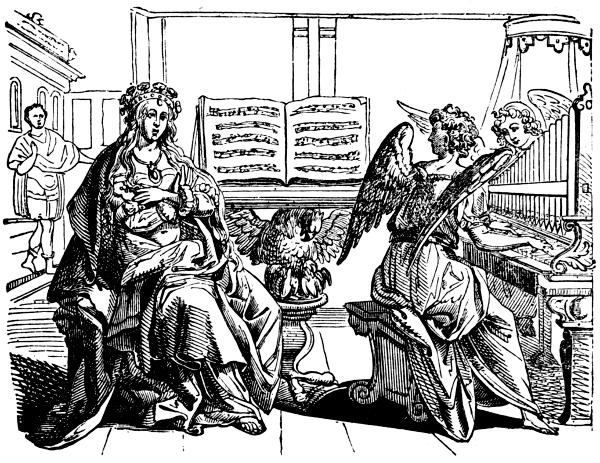
St. Cecilia.
———Divine Cecilia came, Inventress of the vocal frame; The sweet enthusiast, from her sacred store, Enlarg’d the former narrow bounds, And added length to solemn sounds, With nature’s mother-wit, and arts unknown before. Let old Timotheus yield the prize, Or both divide the crown; He rais’d a mortal to the skies, She drew an angel down.
Dryden.
November 22.
St. Cecily, A. D. 230. St. Theodorus, A. D. 821. Sts. Philemon, and Appia.
St. Cecilia.
This saint is in the church of England Calendar, and in the almanacs. Her having existed has been doubted, but she is a saint of the Romish church, and Butler gives her life, wherein he calls her “the patroness of church music.” He says, that she was married to a nobleman named Valerian, whom, with her brother Tibertius, she converted, and with them she was martyred. Various legends, and many pictures and prints, represent her as engaged in music, or listening to it from celestial performers. Hence the ode for St. Cecilia’s day by Dryden, who was a catholic, concludes by saying,
“She drew an angel down.”
Formerly, concerts on her festival-day were fashionable, and Pope honoured her in numbers, though “the numbers came” not to him, as to Dryden. The preceding engraving is from a design by M. de Vos, engraved by J. Sadler. Her husband is represented, allured by the harmony, entering a room, wherein she sits. According to catholic story, he found a young man playing on the organ, Cecilia described him to Valerian as an angel, and from that time she received “angels’ visits.”
FLORAL DIRECTORY.
Trumpet-flowered Wood Sorrel. Oxalis ubiflora. Dedicated to St. Cecilia.
November 23.
St. Clement, Pope, A. D. 100. St. Amphilochius, Bp. of Iconium, A. D. 394. St. Tron, A. D. 693. St. Daniel, Bp. A. D. 545.
St. Clement.
This saint is in the church of England calendar and the almanacs.
Clement was a follower and coadjutor of the apostle Paul, who, writing to the Philippians, (iv. 3.) requires them to be mindful of the flock and their teachers, and distinguishes Clement by name—“help those women which laboured with me in the gospel, and with Clement also, and with other my fellow-labourers.” The Romish writers contend for the direct papal succession from the apostles, and call Clement a pope; but in the uninterrupted succession they claim for the pontiffs of their hierarchy, they fail in establishing as indisputable whether he was the first, second, or third pope; the name itself was not devised until centuries afterwards. Some of them say he was martyred, others contend that he died a natural death. The advocates for his martyrdom assign him an anchor as a symbol of distinction, because they allege that he was thrown into the sea with an anchor about his neck. It is further alleged that two of his disciples desirous of recovering his remains, assembled a multitude and prayed for the discovery, and, as usual, there was a miracle. “Immediately the sea retired for the space of three miles, or a league, in such sort that they could go into it for all that space as upon the dry land; and they found in it a chapel, or little church, made by the hands of angels; and within the church a chest of stone, in which was the body of St. Clement, and by it the anchor with which he had been cast into the sea. This miracle did not happen only that year in which the holy pope died, but it happened also every year, and the sea retired itself three miles, as was said, leaving the way dry for seven days, namely, the day of his martyrdom, and the other six following days.”[389] Though “travellers see strange sights,” no modern tourist has related this annual miracle, which is still performed by the sea in the neighbourhood of Rome, on the days aforesaid, as duly and truly as the annual liquefaction of the blood of St. Januarius at Naples—“or, if not, why not?”
Protestants, in London, are reminded of St. Clement’s apocryphal death by his anchor being the weathercock that “turns and turns,” to every wind, on the steeple of the parish church of St. Clement Danes in the Strand. It denotes the efflux of time as a minute-hand upon the clock; it denotes the limits of the parish as a mark upon the boundary stones; it graces the beadles’ staves; and on the breasts of the charity children is, in the eyes of the parishioners, “a badge of honour.”
It appears from a state proclamation, dated July 22, 1540, that children were accustomed to be decked, and go about on St. Clement’s day in procession. From an ancient custom of going about on the night of this festival to beg drink to make merry with, a pot was formerly marked against the 23d of November upon the old clog-almanacs.[390]
St. Clement is the patron of blacksmiths. His quality in this respect is not noticed by Brand, or other observers of our ancient customs, nor do they mention any observances by that trade in commemoration of his festival. But the following communications will show the estimation wherein he is held among the “cunning workmen in iron.”
To the Editor of the Every-Day Book.
Chancery-lane, Nov. 19, 1825.
Sir,
As secretary of the “Benevolent Institution of Smiths,” I take the liberty of jogging your memory. I hope you will not forget our St. Clement, (Nov. 23,) in your interesting Every-Day Book. When I was a child, an old man went about in the trade, reciting the following ode on smithery, which, I believe, is very old. If you think it worthy a place in your work, it will much oblige me and our trade; for it is now quite forgot, with many good customs of hospitality of the olden days which are no more. I hope you will cull your flowers of antiquity, and collect all you can for our trade; there is a story of St. Dunstan, the smith, with his tongs, pinching the devil by the nose, &c.
An Ode on Smithery, 1610.
“By reading of old authors we do find The smiths have been a trade time out of mind; And it’s believed they may be bold to say, There’s not the like to them now at this day. For was it not for smiths what could we do, We soon should loose our lives and money too; The miser would be stript of all his store, And lose the golden god he doth adore: No tradesman could be safe, or take his rest But thieves and rogues would nightly him molest; It’s by our cunning art, and ancient skill, That we are saved from those who would work ill. The smith at night, and soon as he doth rise, Doth always cleanse and wash his face and eyes; Kindles his fire, and the bellows blows, Tucks up his shirt sleeves, and to work he goes: Then makes the hammer and the anvil ring, And thus he lives as merry as a king. A working smith all other trades excels, In useful labour wheresoe’er he dwells; Toss up your caps ye sons of Vulcan then, For there are none of all the sons of men, That can with the brave working smiths compare, Their work is hard, and jolly lads they are. What though a smith looks sometimes very black, And sometimes gets but one shirt to his back And that is out at elbows, and so thin That you through twenty holes may see his skin; Yet when he’s drest and clean, you all will say, That smiths are men not made of common clay. They serve the living, and they serve the dead, They serve the mitre, and the crowned head; They all are men of honour and renown, Honest, and just, and loyal to the crown. The many worthy deeds that they have done, Have spread their fame beyond the rising sun So if we have offended rich or poor, We will be good boys, and do so no more.”
I hope you will polish up for insertion. I will call for the old copy at your office: I should have sent it sooner, but could not find it, and the trouble it has cost me has made it valuable.
I remain, &c.
J. Johnson.
7, Hill-street, Southwark.
The editor has given the “ode” without Mr. Johnson’s alterations and additions, because its original state is better suited to convey a notion of his predecessors’ manners; for the same reason, his suggestion to “polish up” has been declined. The homeliness of those who preceded him is not discreditable to him, or any of the brethren of his trade. They are daily increasing in respectability, and ought to be a thriving branch. Compared with those who lived before them, they have extraordinary means of becoming acquainted with the principles of their varied manufacture, by becoming members of the Mechanics’ Institution. Many blacksmiths have already joined that society. A diligent and good hand who knows more than his fellows, will be the best workman, and get the most money; and frugality abroad, and economy at home, will secure his independence. Attendance at the Mechanics’ Institution will teach these things: and St. Clement cannot be better honoured than by observing them.
St. Clement, at Woolwich.
R. R. obligingly communicates with his name, the following account of an annual ceremony on the evening of St. Clement’s day, by the blacksmiths’ apprentices of the dockyard there.
(For the Every-Day Book.)
One of the senior apprentices being chosen to serve as old Clem, (so called by them,) is attired in a great coat, having his head covered with an oakham wig, face masked, and a long white beard flowing therefrom; thus attired, he seats himself in a large wooden chair, chiefly covered with a sort of stuff called buntin, with a crown and anchor, made of wood, on the top, and around it, four transparencies, representing “the blacksmiths’ arms,” “anchor smiths at work,” “Britannia with her anchor,” and “Mount Etna.” He has before him a wooden anvil, and in his hands a pair of tongs and wooden hammer which, in general, he makes good use of whilst reciting his speech. A mate, also masked, attends him with a wooden sledge-hammer; he is also surrounded by a number of other attendants, some of whom carry torches, banners, flags, &c.; others battle-axes, tomahawkes, and other accoutrements of war. This procession, headed by a drum and fife, and six men with old Clem mounted on their shoulders, proceed round the town, stopping and refreshing at nearly every public house, (which, by the by, are pretty numerous,) not forgetting to call on the blacksmiths and officers of the dockyard: there the money-box is pretty freely handed, after old Clem and his mate have recited their speeches, which commence by the mate calling for order, with
“Gentlemen all, attention give, And wish St. Clem, long, long to live.”
Old Clem then recites the following speech:—
“I am the real St. Clement, the first founder of brass, iron, and steel, from the ore. I have been to Mount Etna, where the god Vulcan first built his forge, and forged the armour and thunderbolts for the god Jupiter. I have been through the deserts of Arabia; through Asia, Africa, and America; through the city of Pongrove; through the town of Tipmingo; and all the northern parts of Scotland. I arrived in London on the twenty-third of November, and came down to his majesty’s dockyard, at Woolwich, to see how all the gentlemen Vulcans came on there. I found them all hard at work, and wish to leave them well on the twenty-fourth.”
The mate then subjoins:—
“Come all you Vulcans stout and strong, Unto St. Clem we do belong, I know this house is well prepared With plenty of money and good strong beer, And we must drink before we part, All for to cheer each merry heart. Come all you Vulcans, strong and stout, Unto St. Clem I pray turn out; For now St. Clem’s going round the town, His coach and six goes merrily round. Huzza,—a,—a.”
After having gone round the town and collected a pretty decent sum, they retire to some public house, where they enjoy as good a supper as the money collected will allow.
R. R.
FLORAL DIRECTORY.
Convex Wood Sorrel. Oxalis convexula. Dedicated to St. Clement.
November 24.
St. John of the Cross, A. D. 1591. St. Chrysogonus. Sts. Flora and Mary, A. D. 851. St. Cianan, or Kenan, Bp. of Duleek, in Ireland, A. D. 489.
London in November.
In the already cited “Mirror of the Months,” there is a feeling account of certain days in the metropolis, at this season, which every one who has sojourned in “that overgrown place” will immediately recognize to be “quite correct.”
“Now the atmosphere of London begins to thicken over head, and assume its natural appearance, preparatory to its becoming, about Christmas time, that ‘palpable obscure,’ which is one of its proudest boasts; and which, among its other merits, may reckon that of engendering those far-famed fogs, of which every body has heard, but to which no one has ever done justice. A London fog, in November, is a thing for which I have a sort of natural affection—to say nothing of an acquired one—the result of a hackney-coach adventure, in which the fair part of the fare threw herself into my arms for protection, amidst the pleasing horrors of an overthrow.
“As an affair of mere breath, there is something tangible in a London fog. In the evanescent air of Italy, a man might as well not breathe at all, for any thing he knows of the matter. But in a well-mixed metropolitan fog, there is something substantial and satisfying. You can feel what you breathe, and see it too. It is like breathing water,—as we may suppose the fishes to do. And then the taste of it, when dashed with a due seasoning of seacoal smoke, is far from insipid. It is also meat and drink at the same time: something between egg-flip and omelétte soufflée, but much more digestible than either. Not that I would recommend it medicinally, especially to persons of queasy stomachs, delicate nerves, and afflicted with bile. But for persons of a good robust habit of body, and not dainty withal, (which such, by the by, never are,) there is nothing better in its way. And it wraps you all round like a cloak, too—a patent water-proof one, which no rain ever penetrated. No—I maintain that a real London fog is a thing not to be sneezed at—if you help it. Mem. As many spurious imitations of the above are abroad,—such as Scotch mists, and the like,—which are no less deleterious than disagreeable,—please to ask for the ‘true London particular,’—as manufactured by Thames, Coalgas, Smoke, Steam, & Co. No others are genuine.”
Water-proof Boots and Shoes.
Take one pound of drying (boiled linseed) oil, two ounces of yellow wax, two ounces of spirits of turpentine, and one of Burgundy pitch, melted carefully over a slow fire. With this composition new shoes and boots are to be rubbed in the sun, or at a distance from the fire, with a small bit of sponge, as often as they become dry, until they are fully saturated; the leather then is impervious to wet, the shoes and boots last much longer, acquire softness and pliability, and thus prepared, are the most effectual preservatives against cold.
A Notable Woman.
On the 24th of November, 1735, a butcher near Rumford, in Essex, was rode up to by a woman well mounted on a side saddle, who, to his astonishment, presented a pistol, and demanded his money. In amazement he asked her what she meant, and received his answer from a genteel looking man, who coming to him on horseback, said he was a brute to deny the lady’s request, and enforced this conviction by telling him that if he did not gratify her desire immediately he would shoot him through the head. The butcher could not resist an invitation to be gallant, when supported by such arguments, and he placed six guineas and his watch in her hands.[391]
FLORAL DIRECTORY.
Starry Stapelia. Stapelia radiata. Dedicated to St. John of the Cross.
November 25.
St. Catharine, 3d Cent. St. Erasmus, or Elme.
St. Catharine.
This saint is in the church of England calendar, and the almanacs. It is doubtful whether she ever existed; yet in mass-books and breviaries, we find her prayed to and honoured by hymns, with stories of her miracles so wonderfully apocryphal that even cardinal Baronius blushes for the threadbare legends. In Alban Butler’s memoirs of this saint, it may be discovered by a scrutinizing eye, that while her popularity seems to force him to relate particulars concerning her, he leaves himself room to disavow them; but this is hardly fair, for the great body of readers of his “Lives of the Saints,” are too confiding to criticise hidden meanings. “From this martyr’s uncommon erudition,” he says, “and the extraordinary spirit of piety by which she sanctified her learning, and the use she made of it, she is chosen, in the schools, the patroness and model of christian philosophers.” According to his authorities she was beheaded under the emperor Maxentius, or Maximinus II. He adds, “She is said first to have been put upon an engine made of four wheels joined together, and stuck with sharp pointed spikes, that when the wheels were moved her body might be torn to pieces.” The acts add, that at the first stirring of the terrible engine, the cords with which the martyr was tied, were broke asunder by the invisible power of an angel, and, the engine falling to pieces by the wheels being separated from one another, she was delivered from that death. Hence, the name of “St. Catharine’s wheel.”
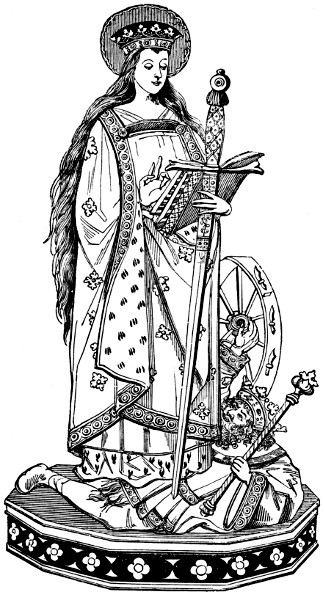
St. Catharine and the Emperor Maxentius. From a stained glass Window in West Wickham Church, Kent, 1825.
The Catharine-wheel, a sign in the Borough, and at other inns and public houses, and the Catharine-wheel in fireworks, testify this saint’s notoriety in England. Besides pictures and engravings representing her pretended marriage with Christ, others, which are more numerous, represent her with her wheel. She was, in common with other papal saints, also painted in churches, and there is still a very fine, though somewhat mutilated, painting of her, on the glass window in the chancel of the church of West Wickham, a village delightfully situated in Kent, between Bromley and Croydon. The editor of the Every-Day Book went thither, and took a tracing from the window itself, and now presents an engraving from that tracing, under the expectation that, as an ornament, it may be acceptable to all, and, as perpetuating a relic of antiquity, be still more acceptable to a few. The figure under St. Catharine’s feet is the tyrant Maxentius. In this church there are other fine and perfect remains of the beautifully painted glass which anciently adorned it. A coach leaves the Ship, at Charing-cross, every afternoon for the Swan, at West Wickham, which is kept by Mr. Crittel, who can give a visiter a good bed, good cheer, and good information, and if need be, put a good horse into a good stable. A short and pleasant walk of a mile to the church the next morning will be gratifying in many ways. The village is one of the most retired and agreeable spots in the vicinity of the metropolis. It is not yet deformed by building speculations.
St. Catharine’s Day.
Old Barnaby Googe, from Naogeorgus, says—
“What should I tell what sophisters on Cathrins day devise? Or else the superstitious toyes that maisters exercise.”
Anciently women and girls in Ireland kept a fast every Wednesday and Saturday throughout the year, and some of them also on St. Catharine’s day; nor would they omit it though it happened on their birthday, or they were ever so ill. The reason given for it was that the girls might get good husbands, and the women better ones, either by the death, desertion, or reformation of their living ones.[392]
St. Catharine was esteemed the saint and patroness of spinsters, and her holiday observed by young women meeting on this day, and making merry together, which they call “Cathar’ning.”[393] Something of this still remains in remote parts of England.
Our correspondent R. R. (in November, 1825,) says, “On the 25th of November, St. Catharine’s day, a man dressed in woman’s clothes, with a large wheel by his side, to represent St. Catharine, was brought out of the royal arsenal at Woolwich, (by the workmen of that place,) about six o’clock in the evening, seated in a large wooden chair, and carried by men round the town, with attendants, &c. similar to St. Clement’s. They stopped at different houses, where they used to recite a speech; but this ceremony has been discontinued these last eight or nine years.”
Much might be said and contemplated in addition to the notice already taken of the demolition of the church of St. Catharine’s, near the Tower. Its destruction has commenced, is proceeding, and will be completed in a short time. The surrender of this edifice will, in the end, become a precedent for a spoliation imagined by very few on the day when he utters this foreboding.
25th of November, 1825.
FLORAL DIRECTORY.
Sweet Butter-bur. Tussilago fragrans. Dedicated to St. Catharine.
November 26.
St. Peter, Martyr, Bp. of Alexandria, A. D. 311. St. Nicon, surnamed Metanoite, A. D. 998. St. Sylvester Gozzolini, A. D. 1267. St. Conrad, Bp. of Constance, A. D. 976.
A New Moon Custom, and “more last words” respecting Captain Starkey.
To the Editor of the Every-Day Book.
Sir,
I do not remember to have seen in your book, “where every-day we turn the leaf to read,” any notice of a custom, which is not only very prevalent, but which is, also, most harmless in its nature and endearing in its tendency—promotes in its practice goodwill and good humour—and, not unfrequently, with those who view the “future i’ th’ instant,” love itself. Among the many new moon customs, such as looking through a new silk handkerchief to ascertain the number of your lovers, feeling for money in your pocket, to see if you will have a lucky month, &c.; I know of none so pleasant, or, to my thinking, so rational, as that of claiming the FIRST KISS FOR A PAIR OF NEW GLOVES! The person, in a company, male or female, who first gets a glimpse of the new moon, immediately kisses some member of the company, and pronounces with a triumphant chuckle, “Aha! Jane, (or as the name may be,) there’s a pair of gloves for me!” By this means a pleasant interruption is often given to a tedious tale, or uninteresting debate, and a new subject starts, in which all may join with greater or less avidity. How happy is some modest youth, should the blushing and ingenuous girl, whom he has secretly “singled from the world,” have laid him under the penalty of a pair of new gloves, by that soft phrase and that first delicious kiss—how fruitful are his sweet anticipations of that golden time—
“When life is all one dream of love and flowers.”
How joyful is an amiable sister, if, by this species of initiation, she has been enabled to re-conciliate the vagrant affections of some estranged brother: and even where love and sisterly feelings are out of the question, viewed as an interchange of common (common!) friendship, between the sexes, how felicitous is it in effect and operation! Should you, Mr. Editor, be of opinion with me, respecting this no longer “tyrant custom,” you may, possibly, by printing this letter be productive of much good humour, and a pair of new gloves.
I am, Your constant and approving reader, W. G. T.
Newcastle-on-Tyne.
P. S. I cannot write the name of the town where I reside, without feeling a strong inducement to say one word of him, who has been so pleasantly immortalized by yourself, and the inimitable being who wrote so affectingly of “Rosamund Gray,” and the “Old Familiar Faces”—I mean poor Starkey. I was born, and have lived all my life (not a long one), in the town where he terminated his humble career, and gave another name to the neglected and unpitied list of those, who seem chiefly to have entered the world for the purpose of swelling
“The short and simple annals of the poor,”
and my earliest recollections are haunted by his meagre care-worn form;—many a time have I shrunk from the shaking of his stick, and the imperious “dem your bluds,” which he bestowed with uncommon celerity on the defenceless heads of his young and unthinking sources of annoyance, as they assailed him from the corners which he was accustomed to pass. But the captain was a humble man, and these “moods of the mind” were seldom indulged in, save when he was returning, brim-full of brief and intemperate importance, from the Black Horse, in Pilgrim-street, the tap-room of which was the scene of many a learned disputation with the “unwashed artificers” of the evening, and in which the captain was always proportionably brilliant to the number of gills he had drank. On these occasions, in his efforts to silence the sons of toil, he did not scruple to use his Latin—and, in such instances, appeal was impossible, and victory sure. Among several anecdotes, I am in possession of two, which you, his most celebrious biographer, may not think unworthy of recording. On one evening, when he was returning from a carousal, furnished by the generosity of friends, or his own indiscretion—for the captain despised to-morrow as much as any man, and was fully convinced of the propriety of the apophthegm, “sufficient unto the day is its own evil”—he found the gate of the Freemen’s Hospital, where he resided, closed, and no one in a better condition for exclaiming with Dr. Beattie,
“Ah! who can tell how hard it is to climb!”
than himself. What was to be done? To fly over was impossible—and he was much too deep in the scale of intoxication to dream of scaling the wall. A party of young bucks, “ripe for fun,” fresh from their sacrifices at the shrine of “the reeling goddess with the zoneless waist,” came up the street; to these, hat in hand, did the captain prefer his petition to be assisted over, and they, with a thoughtlessness hardly to be excused by their condition, took him up, and threw him completely on to the grass plot on the other side. The veteran scrambled to his legs, and, for the wall was not very high on the inside, returned them thanks in his best manner for their timely assistance, utterly forgetful that it might have proved most disastrous both to himself and them. The second, and with which I must conclude a postscript which has already far outgrown the letter, was less harmless and equally illustrative of the man. He had gone, with another eleemosynary worthy, on some gratulatory occasion, to the hall of one of the members for the town, and the butler who was well aware of the object of his guests, treated them handsomely in his refectory to cold beef and good ale. He was accidentally called away, and the two friends were left alone. Alas! for the temptations which continually beset us! The “expedition of” the captain’s “violent love outran the pauser, reason:” he suggested, and both adopted, the expedient of secreting a slice or two of the member’s beef, to make more substantial the repast of the evening. Starkey’s share was deposited in his hat. The man in office returned, pressed his visiters afresh, “and still the circling cup was drained,” until the home-brewed had made considerable innovations, and the travellers thought it fitting to depart. The captain’s habitual politeness was an overmatch for his cunning: whilst he was yet at the door, casting his “last lingering looks behind,” he must needs take off his hat to give more effect to the fervour of his farewell—when—“out upon ’t”—the beef fell as flat on his oration, as did the hat of corporal Trim on the floor in the scene of his eloquence. Starkey was dumb-founded, his associate was in agonies, and the butler was convulsed with the most “side-splitting” laughter. The captain, like other great men, has not fallen “unsung.” Hearken to Gilchrist, one of the “bards of the Tyne,” who thus sings in his apotheosis of Benjamin Starkey:—
“His game is up, his pipe is out, an’ fairly laid his craw, His fame ’ill blaw about just like coal dust at Shiney-Raw. He surely was a joker rare—what times there’d been for a’ the nation, Had he but lived to be a mayor, the glory o’ wor corporation! “Whack, &c.”
W. G. T.
FLORAL DIRECTORY.
Linear Wood Sorrel. Oxalis linearis. Dedicated to St. Conrad.
November 27.
St. Maximus, Bp. of Riez, A. D. 460. St. James, surnamed Intercisus, A. D. 421. St. Maharsapor, A. D. 421. St. Virgil, Bp. of Saltzburg, A. D. 784. St. Secundin, or Seachnal, Bp. of Dunsaghlin, in Meath, A. D. 447.
ANNIVERSARY OF The Great Storm IN ENGLAND.
In Little Wild-street chapel, Lincoln’s Inn Fields, a sermon is annually preached on this day in commemoration of the “Great Storm” in 1703.
This fearful tempest was preceded by a strong west wind, which set in about the middle of the month; and every day, and almost every hour, increased in force until the 24th, when it blew furiously, occasioned much alarm, and some damage was sustained. On the 25th, and through the night following, it continued with unusual violence. On the morning of Friday, the 26th, it raged so fearfully that only few people had courage to venture abroad. Towards evening it rose still higher; the night setting in with excessive darkness added general horror to the scene, and prevented any from seeking security abroad from their homes, had that been possible. The extraordinary power of the wind created a noise, hoarse and dreadful, like thunder, which carried terror to every ear, and appalled every heart. There were also appearances in the heavens that resembled lightning. “The air,” says a writer at the time, “was full of meteors and fiery vapours; yet,” he adds, “I am of opinion, that there was really no lightning, in the common acceptation of the term; for the clouds, that flew with such violence through the air, were not to my observation such as are usually freighted with thunder and lightning; the hurries nature was then in do not consist with the system of thunder.” Some imagined the tempest was accompanied with an earthquake. “Horror and confusion seized upon all, whether on shore or at sea; no pen can describe it, no tongue can express it, no thought can conceive it, unless theirs who were in the extremity of it; and who being touched with a due sense of the sparing mercy of their Maker, retain the deep impressions of his goodness upon their minds though the danger be past. To venture abroad was to rush into instant death, and to stay within afforded no other prospect than that of being buried under the ruins of a falling habitation. Some in their distraction did the former, and met death in the streets; others the latter, and in their own houses received their final doom.” One hundred and twenty-three persons were killed by the falling of dwellings; amongst these were the bishop of Bath and Wells (Dr. Richard Kidder) and his lady, by the fall of part of the episcopal palace of Wells; and lady Penelope Nicholas, sister to the bishop of London, at Horsley, in Sussex. Those who perished in the waters, in the floods of the Severn and the Thames, on the coast of Holland, and in ships blown away and never heard of afterwards, are computed to have amounted to eight thousand.
All ranks and degrees were affected by this amazing tempest, for every family that had any thing to lose lost something: land, houses, churches, corn, trees, rivers, all were disturbed or damaged by its fury; small buildings were for the most part wholly swept away, “as chaff before the wind.” Above eight hundred dwelling-houses were laid in ruins. Few of those that resisted escaped from being unroofed, which is clear from the prodigious increase in the price of tiles, which rose from twenty-one shillings to six pounds the thousand. About two thousand stacks of chimnies were blown down in and about London. When the day broke the houses were mostly stripped, and appeared like so many skeletons. The consternation was so great that trade and business were suspended, for the first occupation of the mind was so to repair the houses that families might be preserved from the inclemency of the weather in the rigorous season. The streets were covered with brickbats, broken tiles, signs, bulks, and penthouses.
The lead which covered one hundred churches, and many public buildings, was rolled up, and hurled in prodigious quantities to distances almost incredible; spires and turrets of many others were thrown down. Innumerable stacks of corn and hay were blown away, or so torn and scattered as to receive great damage.
Multitudes of cattle were lost. In one level in Gloucestershire, on the banks of the Severn, fifteen thousand sheep were drowned. Innumerable trees were torn up by the roots; one writer says, that he himself numbered seventeen thousand in part of the county of Kent alone, and that, tired with counting, he left off reckoning.
The damage in the city of London, only, was computed at near two millions sterling. At Bristol, it was about two hundred thousand pounds. In the whole, it was supposed that the loss was greater than that produced by the great fire of London, 1666, which was estimated at four millions.
The greater part of the navy was at sea, and if the storm had not been at its height at full flood, and in a spring-tide, the loss might have been nearly fatal to the nation. It was so considerable, that fifteen or sixteen men of war were cast away, and more than two thousand seamen perished. Few merchantmen were lost; for most of those that were driven to sea were safe. Rear-admiral Beaumont with a squadron then lying in the Downs, perished with his own and several other ships on the Goodwin Sands.
The ships lost by the storm were estimated at three hundred. In the river Thames, only four ships remained between London-bridge and Limehouse, the rest being driven below, and lying there miserably beating against one another. Five hundred wherries, three hundred ship-boats, and one hundred lighters and barges were entirely lost; and a much greater number received considerable damage. The wind blew from the western seas, which preventing many ships from putting to sea, and driving others into harbour, occasioned great numbers to escape destruction.
The Eddystone lighthouse near Plymouth was precipitated in the surrounding ocean, and with it Mr. Winstanley, the ingenious architect, by whom it was contrived, and the people who were with him.—“Having been frequently told that the edifice was too slight to withstand the fury of the winds and waves, he was accustomed to reply contemptuously, that he only wished to be in it when a storm should happen. Unfortunately his desire was gratified. Signals of distress were made, but in so tremendous a sea no vessel could live, or would venture to put off for their relief.”[394]
The amazing strength and rapidity of the wind, are evidenced by the following well authenticated circumstances. Near Shaftesbury a stone of near four hundred pounds weight, which had lain for some years fixed in the ground, fenced by a bank with a low stone wall upon it, was lifted up by the wind, and carried into a hollow way, distant at least seven yards from the place. This is mentioned in a sermon preached by Dr. Samuel Stennett, in 1788. Dr. Andrew Gifford in a sermon preached at Little Wylde-street, on the 27th of November, 1734, says that “in a country town, a large stable was at once removed off its foundation and instantly carried quite across the highway, over the heads of five horses and the man that was then feeding them, without hurting any one of them, or removing the rack and manger, both of which remained for a considerable time to the admiration of every beholder.” Dr. Gifford in the same sermon, gives an account of “several remarkable deliverances.” One of the most remarkable instances of this kind occurred at a house in the Strand, in which were no less than fourteen persons: “Four of them fell with a great part of the house, &c. three stories, and several two; and though buried in the ruins, were taken out unhurt: of these, three were children; one that lay by itself, in a little bed near its nurse; another in a cradle; and the third was found hanging (as it were wrap’d up) in some curtains that hitch’d by the way; neither of whom received the least damage. In another place, as a minister was crossing a court near his house, a stone from the top of a chimney upwards of one hundred and forty pounds weight, fell close to his heels, and cut between his footsteps four inches deep into the ground. Soon after, upon drawing in his arm, which he had held out on some occasion, another stone of near the same weight and size, brush’d by his elbow, and fell close to his foot, which must necessarily, in the eye of reason, have killed him, had it fallen while it was extended.” In the Poultry, where two boys were lying in a garret, a huge stack of chimnies fell in, which making its way through that and all the other floors to the cellar, it was followed by the bed with the boys asleep in it, who first awaked in that gloomy place of confusion without the least hurt.