JULY.
Reading edition
Then came hot July, boiling like to fire, That all his garments he had cast away. Upon a lyon raging yet with ire He boldly rode, and made him to obey: (It was the beast that whilom did forray The Nemæan forest, till the Amphitrionide Him slew, and with his hide did him array:) Behind his backe a sithe, and by his side Under his belt he bore a sickle circling wide.
July is the seventh month of the year. According to ancient reckoning it was the fifth, and called Quintilis, until Mark Antony denominated it July, in compliment to Caius Cæsar, the Roman dictator, whose surname was Julius, who improved the calendar, and was born in this month.
July was called by the Saxons hen-monath, which probably expressed the meaning of the German word hain, signifying wood or trees; and hence hen-monath might mean foliage month. They likewise called it heymonath, or haymonth; “because,” says Verstegan, “therein they usually mowed and made their hay harvest;” and they also denominated it Lida-aftera, meaning the second “Lida,” or second month after the sun’s descent.[205]
The beautiful representation preceding Spenser’s personification of July, on the preceding page, was designed and engraved by Mr. Samuel Williams, of whom it should in justice be said, that his talents have enriched the Every-Day Book with most of its best illustrations.
Now comes July, and with his fervid noon Unsinews labour. The swinkt mower sleeps; The weary maid rakes feebly; the warm swain Pitches his load reluctant; the faint steer, Lashing his sides, draws sulkily along The slow encumbered wain in midday heat.
Mr. Leigh Hunt in his Months, after remarking that “July is so called after Julius Cæsar, who contrived to divide his names between months and dynasties, and among his better deeds of ambition reformed the calendar,” proceeds to notice, that—“The heat is greatest in this month on account of its previous duration. The reason why it is less so in August is, that the days are then much shorter, and the influence of the sun has been gradually diminishing. The farmer is still occupied in getting the productions of the earth into his garners; but those who can avoid labour enjoy as much rest and shade as possible. There is a sense of heat and quiet all over nature. The birds are silent. The little brooks are dried up. The earth is chapped with parching. The shadows of the trees are particularly grateful, heavy, and still. The oaks, which are freshest because latest in leaf, form noble clumpy canopies, looking, as you lie under them, of a strong and emulous green against the blue sky. The traveller delights to cut across the country through the fields and the leafy lanes, where nevertheless the flints sparkle with heat. The cattle get into the shade, or stand in the water. The active and air-cutting swallows, now beginning to assemble for migration, seek their prey about the shady places, where the insects, though of differently compounded natures, ‘fleshless and bloodless,’ seem to get for coolness, as they do at other times for warmth. The sound of insects is also the only audible thing now, increasing rather than lessening the sense of quiet by its gentle contrast. The bee now and then sweeps across the ear with his gravest tone. The gnats
Their murmuring small trumpets sounden wide;
Spenser.
and here and there the little musician of the grass touches forth his tricksy note.
The poetry of earth is never dead; When all the birds are faint with the hot sun, And hide in cooling trees, a voice will run From hedge to hedge about the new-mown mead: That is the grasshopper’s.
Keats.
“Besides some of the flowers of last month, there are now candy-tufts, catchfly, columbines, egg-plant, French marygolds, lavateras, London-pride, marvel of Peru, veronicas, tuberoses, which seem born of the white rose and lily; and scarlet-beans, which though we are apt to think little of them because they furnish us with a good vegetable, are quick and beautiful growers, and in a few weeks will hang a walk or trellis with an exuberant tapestry of scarlet and green.
“The additional trees and shrubs in flower are bramble, button-wood, iteas, cistuses, climbers, and broom. Pimpernel, cockle, and fumitory, are now to be found in corn-fields, the blue-bell in wastes or by the road-sides; and the luxuriant hop is flowering.
“The fruits begin to abound and are more noticed, in proportion to the necessity for them occasioned by the summer heat. The strawberries are in their greatest quantity and perfection; and currants, gooseberries, and raspberries, have a world of juice for us, prepared, as it were, in so many crowds of little bottles, in which the sunshine has turned the dews of April into wine. The strawberry lurks about under a beautiful leaf. Currants are also extremely beautiful. A handsome bunch looks like pearls or rubies, and an imitation of it would make a most graceful ear-ring. We have seen it, when held lightly by fair fingers, present as lovely a drop, and piece of contrast, as any holding hand in a picture of Titian.
“Bulbous rooted flowers, that have almost done with their leaves, should now be taken up, and deposited in shallow wooden boxes. Mignionette should be transplanted into small pots, carnations be well attended to and supported, and auriculas kept clean from dead leaves and weeds, and in dry weather frequently watered.
“It is now the weather for bathing, a refreshment too little taken in this country, either in summer or winter. We say in winter, because with very little care in placing it near a cistern, and having a leathern pipe for it, a bath may be easily filled once or twice a week with warm water; and it is a vulgar error that the warm bath relaxes. An excess, either warm or cold, will relax; and so will any other excess: but the sole effect of the warm bath moderately taken is, that it throws off the bad humours of the body by opening and clearing the pores. As to summer bathing, a father may soon teach his children to swim, and thus perhaps might be the means of saving their lives some day or other, as well as health. Ladies also, though they cannot bathe in the open air as they do in some of the West Indian islands and other countries, by means of natural basins among the rocks, might oftener make a substitute for it at home in tepid baths. The most beautiful aspects under which Venus has been painted or sculptured, have been connected with bathing: and indeed there is perhaps no one thing that so equally contributes to the three graces of health, beauty, and good temper;—to health, in putting the body into its best state; to beauty, in clearing and tinting the skin; and to good temper, in rescuing the spirits from the irritability occasioned by those formidable personages ‘the nerves,’ which nothing else allays in so quick and entire a manner. See a lovely passage on the subject of bathing in sir Philip Sydney’s ‘Arcadia,’ where ‘Philoclea, blushing, and withall smiling, making shamefastnesse pleasant, and pleasure shamefast, tenderly moved her feet, unwonted to feel the naked ground, until the touch of the cold water made a pretty kind of shrugging come over her body, like the twinkling of the fairest among the fixed stars.’”
July 1.
St. Rumbold, Bp. A. D. 775. Sts. Julius and Aaron. St. Theobald, or Thibault, 11th Cent. St. Gal I. Bp. 5th Cent. St. Calais, or Carilephus, A. D. 542. St. Leonorus, or Lunaire, Bp. St. Simeon Salus, 6th Cent. St. Thieri, A. D. 533. St. Cybar, A. D. 581.
Chronology.
1690. The battle of the Boyne, fought on this day, decided the fate of James II. and the Stuart tyranny, and established William III. on the throne of the people.
FLORAL DIRECTORY.
Agrimony. Agrimonia Eupatoria. Dedicated to St. Aaron.
July 2.
Visitation of the B. Virgin. Sts. Processus and Martinian, 1st Cent. St. Otho, Bp. 12th Cent. St. Monegoude, A. D. 570. St. Oudoceus, Bp. of Landaff, 6th Cent.
FLORAL DIRECTORY.
White Lily. Lilium candidum. Dedicated to the Virgin Mary.
A Morning’s Walk in July.
But when mild morn, in saffron stole, First issues from her eastern goal, Let not my due feet fail to climb Some breezy summit’s brow sublime, Whence Nature’s universal face Illumined smiles with newborn grace, The misty streams that wind below With silver sparkling lustre glow, The groves and castled cliffs appear Invested all in radiance clear; O! every village charm beneath. The smoke that mounts in azure wreath O beauteous rural interchange! The simple spire and elmy grange; Content, indulging blissful hours, Whistles o’er the fragrant flowers: And cattle rous’d to pasture new, Shake jocund from their sides the dew.[206]
July 3.
St. Phocas, a Gardener, A. D. 303. St. Guthagon. St. Gunthiern, a Welsh Prince, 6th Cent. St. Bertram, 6th Cent.
The Bleeding Image.
On the 3d of July is annually celebrated, in Paris, in the church of St. Leu and St. Giles, a solemn office, in commemoration of a miracle wrought by the blessed virgin, in la Rue aux Ours, or the street for the bears; the history of which is as follows:—In the year 1518, a soldier coming out of a tavern in this Bear-street, where he had been gambling, and losing his money and clothes, was blaspheming the name of God; and as he passed by the image of the holy virgin, standing very quietly and inoffensively at the corner of the street, he struck it, or her, furiously with a knife he had in his hand; on which God permitted, as the modern and modest tellers of this tale say, the image to bleed abundantly. The ministers of justice were informed, and the wretch was seized, conducted to the spot where he had committed the sacrilege, tied to a post, and scourged, from six o’clock in the morning till night, till his eyes dropped out; his tongue was bored with a hot iron, and his body was cast into the fire. The blessed image was transported to Rome. This was the origin of a ceremony still remembered, and which once was very curious. The zeal of the inhabitants of Bear-street was conspicuous, and their devotion to the blessed virgin not less so. At first they only made the figure of the soldier, as we in England do of Guy Faux, and threw it into the fire; by degrees the feast became more solemn, and the soldier, who had been rudely fashioned out of faggots, was at last a composition of fireworks, which, after being carried in procession through the streets of Paris, took a flight into the air, to the great joy and edification of the Parisians, particularly of Bear-street. At last, however, the magistrates wisely recollected that the streets being narrow, and the buildings numerous in that part of the city, a fire might happen, and it would then be still more miraculous if the holy image should travel from Rome to Paris to extinguish the flames: not to mention that the holy image might not at that precise moment be so plentifully supplied as on a similar occasion our friend Gulliver was. In 1744, therefore, they forbad any future fire-work soldiers, and the poor distressed inhabitants of Bear-street, were once more reduced to their man of wood, whom they continue to burn with great affection every 3d of July, after having walked him about Paris three days. This figure is now made of osier, clothed, and armed with a knife, and of so horrid an appearance, it would undoubtedly frighten women and children who did not know the story of the sacrilegious soldier; as it is, they believe they see him breathe blasphemy. Messieurs, the associated gentlemen of Bear-street, give the money formerly spent in fireworks, to make a procession to the proxy of the blessed image which now stands where the bleeding one did, and to say a solemn mass to the blessed virgin, for the souls of the defunct gentlemen, associates of Bear-street. The mummery existed under Napoleon, as appears by the preceding particulars, dated Paris, July 12, 1807, and may be seen in the Sunday Advertiser, of the 19th of that month.
On the 3d of July, 1810, a small loaf fastened by a string, was suspended from the equestrian statue at Charing-cross, to which was attached a placard, stating that it was purchased from a baker, and was extremely deficient in weight, and was one of a numerous batch. The notice concluded by simply observing, “Does this not deserve the aid of parliament?” This exhibition attracted a great crowd of people, until the whole of the loaf was nearly washed away by subsequent heavy rain.
The Dog-days.

“The Dog-star rages.”
Sirius, or the Dog-star, is represented as in the above engraving, on a garnet gem, in lord Besborough’s collection, etched by Worlidge. The late Mr. William Butler, in his Chronological Exercises, says, that on this day “commence, according to the almanacs, the Canicular, or Dog-days, which are a certain number of days preceding and following the heliacal rising of Canicula, or the Dog-star, in the morning. Their beginning is usually fixed in the calendars on the 3d of July, and their termination on the 11th of August; but this is a palpable mistake, since the heliacal rising of this star does not now take place, at least in our latitude, till near the latter end of August; and in five or six thousand years more, Canicula may chance to be charged with bringing frost and snow, as it will then, owing to the precession of the equinoxes, rise in November and December.”
Dr. Hutton remarks, that some authors say, from Hippocrates and Pliny, that the day this star first rises in the morning, the sea boils, wine turns sour, dogs begin to grow mad, the bile increases and irritates, and all animals grow languid; also, “the diseases it usually occasions in men are burning fevers, hysterics, and phrensies. The Romans sacrificed a brown dog every year to Canicula, at his first rising to appease his rage.”
A Cambridge contributor to the Every-Day Book affirms, that, in the year 1824, an edict was issued there for all persons keeping dogs either to muzzle or tie them up, and many a dog was tied up by the neck as a sacrifice; whether to the Mayor or Canicular, this deponent saith not; but the act and deed gave rise to the following
JEU D’ESPRIT.
Good mister Mayor All dogs declare The beam of justice falters! To miss the puppies—sure she’s blind, For dogs they are alone consign’d To muzzles or to halters!
Cambridge,
T. N.
Mr. Brady observes, in his “Clavis Calendaria,” “That the weather in July and August is generally more sultry than at any other period of the year, and that some particular diseases are consequently at that time more to be dreaded, both to man and beast, is past dispute. The exaggerated effects of the rising of Sirius are now, however, known to be groundless; and the superior heat usually felt during the Dog-days has been more philosophically accounted for. The sun, at this period of the year, not only darts his rays almost perpendicularly upon us, and of course with greater power; but has also continued to exert his influence through the spring and summer seasons, whereby the atmosphere and earth have received a warmth, proportioned to the continuity of its action; and moisture, in itself naturally cold, has been dissipated. Even in the course of a day, which has been aptly typified as a short year, the greatest effect of the sun is generally felt at about two o’clock, although it has then passed the meridian, because by having so much longer exerted its powers, its consequent effects are more than commensurate for the diminution of heat in its rays. The cold of winter in like manner augments about the time the days begin to increase, and continues to do so, for a considerable time after, because, at that season, the earth has become wet and chilled, from the effects of the preceding gradual decrease of power in the sun, although, at that time, when the cold is usually most severe, that orb is ascensive, and returning from the winter solstice: and our Saxon ancestors were experimentally so well aware of this latter circumstance, that in the delineation on their calendars, to illustrate the characters of the months they represented February, as a man in the act of striking his arms across his body to warm himself: while there is also yet in common use a very old saying, grounded upon the like conviction, that ‘when the days lengthen, the frost is sure to strengthen.’
“The early Egyptians, whose hieroglyphical characters, aptly adapted by them to the peculiarity of their climate and circumstances, were the principal or perhaps sole origin of all the heathenish superstitions of other nations, were taught by long observation and experience, that as soon as a particular star became visible, the Nile would overflow its banks; and they accordingly upon its very first appearance retreated to their terraces, where they remained until the inundation had subsided. This star, therefore, was called by them Sihor, i. e. the Nile; as Σείριος is in Greek, and Sirius in Latin; and from the warning it afforded them, they typified it as a dog, or in most cases as a man with a dog’s head; that faithful animal having been, even in those times, distinguished for his peculiar qualities of watching over the affairs of man, and affording warning of approaching danger. The names assigned to this star by the Egyptians was Thaaut, or Tayout, the dog; and in later times Sothis, Thotes, or Thot, each bearing the like signification; but it was left for the subsequent ignorance of those other nations who adopted that character for Sihor, now Sirius, without considering the true origin of its appellation, falsely to assign to it, the increasing heat of the season, and its consequent effects upon animated nature. The idea, however, of any such effects, either as to heat, or to disorders, from the influence of the canicular star, is now wholly exploded, from the reasons already assigned, and because ‘that star not only varies in its rising every year, as the latitude varies, but that it rises later and later every year in all latitudes;’ so that when it rises in winter, which, by the way, cannot be for five or six thousand years, it might, with equal propriety, be charged with increasing the frost: and besides, it is to be observed, that although Sirius is the nearest to the earth of any of the fixed stars, it is computed to be at the enormous distance of 2,200,000,000,000 miles from our globe; a space too prodigious to admit of its rays affording any sensible heat: and which could not be passed by a cannon-ball, flying with its calculated velocity of 480 miles in one hour, in less than 523,211 years! Upon the whole, therefore, it evidently appears, that the origin of the name of this star was not only wholly disregarded, but that common and undigested opinion made its conjunction with the sun, the cause of heat, &c. instead of having regarded it as a sign of the period when such effects might naturally be expected.”
Mad Dogs.
There is no cure for the bite of a mad dog; and as at this time dogs go mad, it is proper to observe, that immediate burning out of the bitten part by caustic, or the cutting of it out by the surgeon’s knife, is the only remedy. If either burning or cutting be omitted, the bitten person, unless opiumed to death, or smothered between featherbeds, will in a few days or weeks die in unspeakable agony. The latter means are said to have been sometimes resorted to as a merciful method of extinguishing life. It is an appalling fact, that there is no cure for hydrophobia.
Preventive is better than cure, and in this case it is easy. Dogs, however useful in some situations, are wholly useless in towns. Exterminate them.
Against this a cry will go forth from all dog-owners: they will condemn the measure as proceeding from a barbarian; but they are the barbarians who keep animals subject to a disease fatal to human life. Such persons, so far from being entitled to a voice against its execution, merit abhorrence and contempt for daring to propose that every man, woman, and child among their friends and neighbours, should run the risk of a cruel death for the gratification of selfishness. Every honest man in every town who keeps a dog, should destroy it, and use his influence with others to destroy theirs. No means of preventing hydrophobia exists but the destruction of dogs.
Oh! but dogs are useful; they guard our houses at night; they go in carts and guard our goods by day; they catch our rats; and, then, they are such faithful creatures! All this, though very true, does not urge one reason against their destruction as a preventive from their communicating a fatal and wholly incurable disease. Instead of house-dogs at night, get additional watchmen, or secure watchmen more vigilant than those you have, by paying a proper price for the important services required of them, which in most places are not half requited. Instead of cart-dogs, employ boys, of whom there are scores half-starving, who would willingly take charge of carts at little more than the expense of dog-keep. If rats must be caught, cats can catch them, or they may be poisoned. Instead of cultivating the fidelity of dogs, let dog-keepers cultivate a little fidelity in themselves towards their neighbours, and do as they would be done unto, by destroying their dogs.
Oh, but would you deprive the “poor” man of his dog? Yes. The poorer he is, the less occasion he has for a dog, and the less ability he has to maintain a dog. Few poor men in towns keep dogs but for the purpose of sport of some kind; making matches to fight them, drawing badgers with them, baiting bulls with them, or otherwise brutally misemploying them.
An act of parliament, inflicting heavy penalties for keeping dogs in towns, and empowering constables, beadles, street-keepers, and others, with rewards for carrying it into effect on every dog they meet, would put an end to hydrophobia.
It is a common practice to kill dogs at this season in some parts of the continent, and so did our ancestors. Ben Jonson, in his “Bartholomew Fair,” speaks of “the dog-killer in this month of August.” A dog-destroyer in every parish would be an important public officer. Remember! there is no cure for the bite of a mad dog.
To the Bellflower.
With drooping bells of clearest blue Thou didst attract my childish view, Almost resembling The azure butterflies that flew Where on the heath thy blossoms grew So lightly trembling. Where feathery fern and golden broom Increase the sandrock cavern’s gloom I’ve seen thee tangled, ’Mid tufts of purple heather bloom By vain Arachne’s treacherous loom With dewdrops spangled. ’Mid ruins tumbling to decay, Thy flowers their heavenly hues display, Still freshly springing, Where pride and pomp have passed away On mossy tomb and turret gray, Like friendship clinging. When glowworm lamps illume the scene And silvery daisies dot the green, Thy flowers revealing, Perchance to soothe the fairy queen, With faint sweet tones on night serene Soft bells are pealing. But most I love thine azure braid, When softer flowers are all decayed, And thou appearest Stealing beneath the hedgerow shade, Like joys that linger as they fade, Whose last are dearest. Thou art the flower of memory; The pensive soul recalls in thee The year’s past pleasures; And, led by kindred thought, will flee, Till, back to careless infancy, The path she measures. Beneath autumnal breezes bleak, So faintly fair, so sadly meek, I’ve seen thee bending, Pale as the pale blue veins that streak Consumption’s thin, transparent cheek, With death hues blending. Thou shalt be sorrow’s love and mine The violet and the eglantine With Spring are banished. In Summer pinks and roses shine, But I of thee my wreath will twine, When these are vanished.
May you like it.
FLORAL DIRECTORY.
Tried Mallow. Malva Sylvestris. Dedicated to St. Phocas.
July 4.
St. Ulric, or Udalric. St. Odo, Abp. of Canterbury, 10th Cent. St. Sisoes, or Sisoy, A. D. 429. St. Bertha, 8th Cent. St. Finbar, of Crimlen. St. Bolcan, disciple of St. Patrick.
St. Ulric.
He was son of count Hucbald, one of the first dukes of higher Germany. He became bishop of Augsburg, and rebuilt the celebrated cathedral there, in 962, dedicating it to St. Afra, patroness of that city, and died eighty years old, in 973, on ashes laid in the form of a cross upon a floor. Customs peculiar to this day are related in these verses:—
St. Huldryche.
Wheresoeuer Huldryche hath his place, the people there brings in Both carpes, and pykes, and mullets fat, his fauour here to win. Amid the church there sitteth one, and to the aultar nie, That selleth fish, and so good cheepe, that euery man may buie: Nor any thing he loseth here, bestowing thus his paine, For when it hath beene offred once, ’tis brought him all againe, That twise or thrise he selles the same vngodlinesse such gaine Doth still bring in, and plentiously the kitchin doth maintaine. Whence comes this same religion newe? what kind of God is this Same Huldryche here, that so desires, and so delightes in fish?[207]
FLORAL DIRECTORY.
Copper Day Lily. Hemerocallis fulva. Dedicated to St. Ulric.
The London Barrow-woman
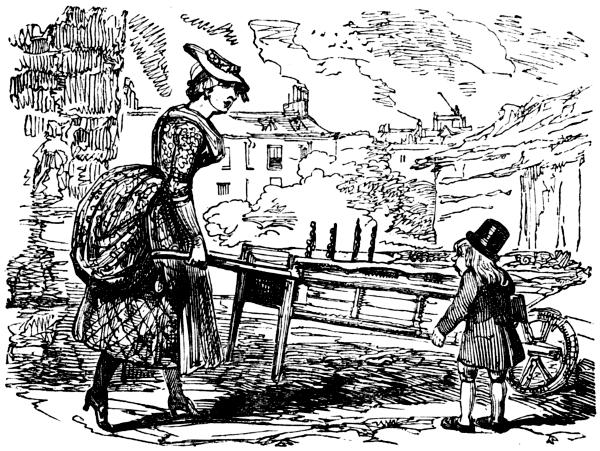
The London Barrow-woman
See! cherries here, ere cherries yet abound, With thread so white in tempting posies ty’d, Scatt’ring like blooming maid their glances round With pamper’d look draw little eyes aside, And must be bought.
Shenstone.
This is cherry season, but it is not to me as cherry seasons were. I like a great deal that is, but I have an affection for what was. By-gone days seem to have been more fair than these; and I cannot help trying to
“catch the manners dying as they fall.”
I have lived through the extremity of one age, into the beginning of another, and I believe a better; yet the former has been too much detracted: every thing new is not, therefore, good; nor was every thing old, bad. When I was a boy, I speak of just after the French revolution broke out, my admiration and taste were pure and natural, and one of my favourites at all times, and in cherry-time especially, was the London barrow-woman. There are no barrow-women now. They are quite “gone out,” or, rather, they have been “put down,” and by many they are not even missed. Look around; there is not one to be seen.
In those days there were women on the earth; finely grown, every way well-proportioned, handsome, and in stature like Mrs. Siddons. I speak of London women. Let not the ladies of the metropolis conceive offence, if I maintain that some of their mothers, and more among their grandmothers, were taller and more robust than they. That they are otherwise may not be in their eyes a misfortune; should they, however, think it so “their schools are more in fault than they.” Be that as it may, I am merely stating a fact. They have declined in personal elevation, as they have increased in moral elevation.
At that time lived the London barrow-woman:—
Her hair loose curl’d, the rest tuck’d up between Her neatly frill’d mob-cap, was scarcely seen; A black chip-hat, peculiarly her own, With ribbon puff’d around the small flat crown Pinn’d to her head-dress, gave her blooming face A jaunty openness and winning grace.
*
On her legs were “women’s blacks,” or, in dry sunny weather, as at this season, stockings of white cotton, with black high-heeled shoes, and a pair of bright sparkling buckles; tight lacing distended her hips, which were further enlarged by her flowered cotton or chintz gown being drawn through the pocket-holes to balloon out behind, and display a quilted glazed petticoat of black or pink stuff, terminating about four inches above the ancles; she wore on her bosom, which was not so confined as to injure its fullness, a light gauze or muslin kerchief. This was her full dress, as she rolled through the street, and cried—
“Round and sound, Two-pence a pound, Cherries! rare ripe cherries!”
“Green and ripe gooseberries! amber-berries! ripe amber-berries!” “Currants! rare ripe currants!” ending, as she began, with cherries:—
“Cherries a ha’penny a stick! Come and pick! come and pick Cherries! big as plums! Who comes? who comes?”
Each side of her well-laden barrow was dressed nearly halfway along with a row of sticks having cherries tied on them. To assist in retailing her other fruit, there lay before her a “full alehouse measure” of clean pewter, and a pair of shining brass scales, with thick turn-over rims, and leaden weights, for the “real black-hearts” that dyed the white cloth they lay on with purple stains. If she had an infant, she was sometimes met with it, at a particular spot, for her to suckle. She was then a study for a painter. Her hearty caresses of her child, while she hastily sat down on the arm of her barrow, and bared her bountiful bosom to give it nourishment; the frolic with which she tickled it; the tenderness with which she looked into its young, up-turned eyes, while the bland fluid overflowed its laughing mouth; her smothering kisses upon its crowing lips after its nurture; and her loud affectionate “God bless it!” when it was carried away, were indescribably beautiful.
As the seasons changed, so her wares varied. With the “rolling year,” she rolled round to us its successive fruits; but cherry-time was the meridian of her glory. Her clear and confident cry was then listened for, in the distance, with as much anxiety to hear it, as the proclamation of a herald, in the full authority of office, was awaited in ancient times. “What can keep the barrow-woman so long?—Surely she has not gone another way!—Hush! there she is; I hear her!” These were tokens of her importance in the neighbourhood she circled; and good housewives and servant girls came to the doors, with basins and dishes, to await her approach, and make their purchases of fruit for their pies and puddings. As she slowly trundled her barrow along the pavement, what doating looks were cast upon its delicacies by boys with ever-ready appetites! How he who had nothing to lay out envied him who a halfpenny entitled to a perplexing choice amidst the tempting variety! If currants were fixed on, the question was mooted, “Which are best—red or white?” If cherries—“white hearts, or blacks?” If gooseberries—“red or yellow?” Sometimes the decision as to the comparative merits of colour was negatived by a sudden impulsive preference for “the other sort,” or “something else;” and not seldom, after these deliberations, and being “served,” arose doubts and regrets, and an application to be allowed to change “these” for “them,” and perhaps the last choice was, in the end, the least satisfactory. Indecisiveness is not peculiar to childhood; “men are but children of a larger growth,” and their “conduct of the understanding” is nearly the same.
Mr. George Cruikshank, whose pencil is distinguished by power of decision in every character he sketches, and whose close observation of passing manners is unrivalled by any artist of the day, has sketched the barrow-woman for the Every-Day Book, from his own recollection of her, aided somewhat by my own. It is engraved on wood by Mr. Henry White, and placed at the head of this article.
Before barrow-women quite “went out,” the poor things were sadly used. If they stopped to rest, or pitched their seat of custom where customers were likely to pass, street-keepers, authorized by orders unauthorized by law, drove them off, or beadles overthrew their fruit into the road. At last, an act of parliament made it penal to roll a wheel or keep a stand for the sale of any articles upon the pavement; and barrow-women and fruit-stalls were “put down.”
Fruit Stalls.
These daily purveyors to the refreshment of passengers in hot weather are not wholly extinct; a few, very few, still exist by mere sufferance—no more. Upon recollection of their number, and the grateful abundance heaped upon them, I could almost exclaim, in the words of the old Scotch-woman’s epitaph—
“Such desolation in my time has been I have an end of all perfection seen!”
Ah! what a goodly sight was Holborn-hill in “my time.” Then there was a comely row of fruit-stalls, skirting the edge of the pavement from opposite the steps of St. Andrew’s church to the corner of Shoe-lane. The fruit stood on tables covered with white cloths, and placed end to end, in one long line. In autumn, it was a lovely sight. The pears and apples were neatly piled in “ha’p’orths,” for there were then no pennyworths; “a pen’orth” would have been more than sufficient for moderate eating at one time. First, of the pears, came the “ripe Kat’er’nes;” these were succeeded by “fine Windsors,” and “real bergamys.” Apples “came in” with “green codlins;” then followed “golden rennets,” “golden pippins,” and “ripe nonpareils.” These were the common street-fruits. Such “golden pippins” as were then sold, three and four for a halfpenny, are now worth pence a piece, and the true “golden rennet” can only be heard of at great fruiterers. The decrease in the growth of this delightful apple is one of the “signs of the times!”
The finest apples in Covent-garden market come from Kent. Growers in that county, by leaving only a few branches upon the tree, produce the most delicious kinds, of a surprisingly large size. For these they demand and obtain very high prices; but instead of London in general being supplied, as it was formerly, with the best apples, little else is seen except swine-feed, or French, or American apples. The importations of this fruit are very large, and under the almost total disappearance of some of our finest sorts, very thankful we are to get inferior ones of foreign growth. Really good English apples are scarcely within the purchase of persons of moderate means.
“Women’s Blacks.”
This is the name of the common black worsted stockings, formerly an article of extensive consumption; they are now little made, because little worn. One of the greatest wholesale dealers in “women’s blacks,” in a manufacturing town, was celebrated for the largeness of his stock; his means enabled him to purchase all that were offered to him for sale, and it was his favourite article. He was an old-fashioned man, and while the servant-maids were leaving them off, he was unconscious of the change, because he could not believe it; he insisted it was impossible that household work could be done in “white cottons.” Offers of quantities were made to him at reduced prices, which he bought; his immense capital became locked up in his favourite “women’s blacks;” whenever their price in the market lowered, he could not make his mind up to be quite low enough; his warehouses were filled with them; when he determined to sell, the demand had wholly ceased; he could effect no sales; and, becoming bankrupt, he literally died of a broken heart—from an excessive and unrequited attachment to “women’s blacks.”
July 5.
St. Peter, of Luxemburg, Card. A. D. 1387. St. Modwena, 9th Cent. St. Edana, of Elphim and Tuam.
There is a beautiful mention of flowers, at this season, in some lines from the Italian of Louis Gonzago.
With an Indian Perfume-box to Maria de Mancini, 1648.
Oh! the Florence rose is freshe and faire, And rich the young carnations blowe, Wreathing in beauties’ ebonne haire, Or sighing on her breaste of snowe, But onlie violette shall twine Thy ebonne tresses, ladye mine. Oh! dazzling shines the noon-daye sunne, So kinglye in his golden carre, But sweeter ’tis when day is done, To watche the evening’s dewye starre, In silence lighting fielde and grove, How like mye heart, how like mye love! Then, ladye, lowlye at thy feete I lay this gift of memorie, All strange and rude, but treasures sweete Within its gloomy bosome lie. Trifles, Marie! may telle the tale, When wisdom, witte, and courage faile.
Pulci.
FLORAL DIRECTORY.
Double Yellow Rose. Rosa Sulphurea. Dedicated to St. Edana.
July 6.
St. Palladius, A. D. 450. St. Julian, Anchorite, 4th Cent. St. Sexburgh, 7th Cent. St. Goar, A. D. 575. St. Moninna, A. D. 518.
FLORAL DIRECTORY.
Garden Hawks’-eyes. Crepis barbara. Dedicated to St. Julian.
July 7.
St. Pantænus, 3d Cent. St. Willibald, Bp. 8th Cent. St. Hedda, A. D. 705. St. Edelburga. St. Felix, Bp. of Nantes, A. D. 584. St. Benedict XI. Pope, A. D. 1304.
Chronology.
1816. Richard Brinsley Sheridan, the poet, dramatist, orator, and statesman, died. He was the third son of Mr. Thomas Sheridan, celebrated as an actor, eminent as a lecturer on elocution, and entitled to the gratitude of the public for his judicious and indefatigable exertions to improve the system of education in this country. His father, the rev. Dr. Thomas Sheridan, was a distinguished divine, the ablest school-master of his time, and the intimate friend of the dean of St. Patrick. Mr. Thomas Sheridan died at Margate, on the 14th of August, 1788. Mrs. Frances Sheridan, the mother of Richard Brinsley, was the author of “Sidney Biddulph,” a novel, which has the merit of combining the purest morality with the most powerful interest. She also wrote “Nourjahad,” an oriental tale, and the comedies of the “Discovery,” the “Dupe,” and “A Trip to Bath.” She died at Blois, in France, the 17th of September, 1766.
Richard Brinsley Sheridan was born in Dorset-street, Dublin, in the month of October, 1751. He was placed, in his seventh year, under the tuition of Mr. Samuel Whyte, of Dublin, the friend of their father. He was placed at Harrow school, after the christmas of 1762. His literary advancement at this seminary appears to have been at first retarded; and it was reserved for the late Dr. Parr, who was at that time one of the sub-preceptors, to discover and call into activity the faculties of young Sheridan’s mind. His memory was found to be uncommonly retentive, and his judgment correct; so that when his mind was quickened by competition, his genius gradually expanded. But to be admired seemed his only object, and when that end was attained, he relaxed in his application, and sunk into his former indolence. His last year at Harrow was spent more in reflecting on the acquirements he had made, and the eventful scenes of a busy life, which were opening to his view, than in enlarging the circle of his classical and literary attainments. His father deemed it unnecessary to send him to the university; and he was, a short time after his departure from Harrow, entered as a student of the Middle Temple.
Mr. Sheridan, when about twenty, was peculiarly fond of the society of men of taste and learning, and soon gave proofs that he was inferior to none of his companions in wit and argument. At this age he had recourse to his literary talents for pecuniary supplies, and directed his attention to the drama; but disgusted with some sketches of comic character which he drew, he actually destroyed them, and in a moment of despair renounced every hope of excellence as a dramatic writer. His views with respect to the cultivation and exertion of his genius in literary pursuits, or to the study of the profession to which he had been destined by his father, were all lost in a passion that mastered his reason. He at once saw and loved Miss Linley, a lady no less admirable for the elegant accomplishments of her sex and the affecting simplicity of her conversation, than for the charms of her person and the fascinating powers of her voice. She was the principal performer in the oratorios at Drury-lane theatre. The strains which she poured forth were the happiest combinations of nature and art; but nature predominated over art. Her accents were so melodious and captivating, and their passage to the heart so sudden and irresistable, that “list’ning Envy would have dropped her snakes, and stern-ey’d Fury’s self have melted” at the sounds.
Her father, Mr. Linley, the late ingenious composer, was not at first propitious to Mr. Sheridan’s passion, and he had many rivals to overcome in his attempts to gain the lady’s affections. His perseverance, however, increased with the difficulties that presented themselves, and his courage and resolution were displayed in vindicating Miss Linley’s reputation from a calumnious report, which had been basely thrown out against it.
Mr. Mathews, a gentleman then well known in the fashionable circles at Bath, had caused a paragraph to be inserted in a public paper at that place, and had set out for London. He was closely pursued by Mr. Sheridan. They met and fought a duel with swords at a tavern in Henrietta-street, Covent-garden, the house at the north-west corner, opposite Bedford-court. Mr. Sheridan’s second on the occasion was his brother, Charles Francis, a late secretary at war in Ireland. Great courage and skill were displayed on both sides; but Mr. Sheridan having succeeded in disarming his adversary, compelled him to sign a formal retraction of the paragraph which had been published. The conqueror instantly returned to Bath; and thinking that, as the insult had been publicly given, the apology should have equal notoriety, he caused it to be published in the same paper. Mr. Mathews soon heard of this circumstance, and, irritated at his defeat, as well as the use which his antagonist had made of his apology, repaired to Bath, and called upon Mr. Sheridan for satisfaction. The parties met on Kingsdown. The victory was desperately contested, and, after a discharge of pistols, they fought with swords. They were both wounded, and closing with each other fell on the ground, where the fight was continued until they were separated. They received several cuts and contusions in this arduous struggle for life and honour, and a part of his opponent’s weapon was left in Mr. Sheridan’s ear. Miss Linley rewarded Mr. Sheridan for the dangers he had braved in her defence, by accompanying him on a matrimonial excursion to the continent. The ceremony was again performed on their return to England, with the consent of her parents; from the period of her marriage, Mrs. Sheridan never appeared as a public performer.
Mr. Sheridan, when encumbered with the cares of a family, felt the necessity of immediate exertion to provide for the pressing calls inseparable from a domestic establishment, which, if not splendid, was marked with all the appearance of genteel life.
On finishing his play of the “Rivals,” he presented it to the manager of Covent-garden theatre, and it was represented on the 17th of January, 1775. In consequence of some slight disapprobation, it was laid aside for a time, after the first night’s performance. Mr. Sheridan having made some judicious alterations, both in the progress of the plot and in the language, it was shortly after brought forward again, and received in the most favourable manner. His next production was the farce of “St. Patrick’s Day, or The Scheming Lieutenant.” This was followed by the comic opera of the “Duenna,” a composition in every respect superior to the general class of English operas then in fashion. It surpassed even the “Beggar’s Opera” in attraction and popularity, and was performed seventy-five nights during the season, while Gay’s singular production ran only sixty-five.
Mr. Garrick having resolved to retire from the management of Drury-lane theatre, his share of the patent was sold to Mr. Sheridan, who, in 1776, paid 30,000l. for it. He immediately brought out the “Trip to Scarborough,” altered from Vanburgh’s comedy of the “Relapse.” It was performed on the 24th of February, 1777. His next production was the comedy of the “School for Scandal,” which raised his fame to undisputed preeminence over contemporary dramatic writers, and conferred, in the opinion of foreign literati, a lustre on the British comedy which it did not previously possess. It was first performed on the 8th of May, 1777.
Early in the following season, he produced the musical piece of “The Camp.” His “Critic,” written upon the model of the duke of Buckingham’s “Rehearsal,” came out on the 30th of October, 1787.
On the death of Mr. Garrick, in 1779, Mr. Sheridan wrote the monody to the memory of Mr. Garrick, recited at Drury-lane theatre by Mrs. Yates.
Notwithstanding the profits which he derived from his pieces, and the share he had in the theatre, which was very considerable, as he had obtained Mr. Lacy’s interest in the patent, a property equally valuable with that of Mr. Garrick, and of course worth, on the lowest calculation, 30,000l., his pecuniary embarrassments had considerably increased. His domestic establishment was not only very expensive, but conducted without any kind of economy. The persuasions of Mr. Fox, whose friendship he had carefully cultivated, operated, with a firm conviction of his own abilities, in determining him to obtain a seat in the house of commons, and a general election taking place in 1780, Mr. Sheridan was returned for Stafford; and though he contented himself at the commencement of the session with giving a silent vote against the minister, he was indefatigable without doors in seconding the views of the whigs under Mr. Fox, against the measures of the ministry. He had a considerable share in the “Englishman,” a paper opposed to the administration of lord North; and when the Rockingham party came into power, in 1782, his exertions were rewarded with the appointment of under secretary to Mr. Fox, then secretary of state for the foreign department.
The death of the marquis of Rockingham, and the unexpected elevation of the earl of Shelburne to the important office of first lord of the treasury, completely defeated the views of himself and friends and the ever-memorable coalition having been formed between Mr. Fox and lord North, Mr. Sheridan was once more called upon to commence literary hostilities against the new administration. The periodical work of the “Jesuit” soon appeared, and several very distinguished members of the party contributed to that production.
At length the coalition having gained a decisive victory over the new administration, formed by the Shelburne party, Mr. Sheridan was once more brought into place, in April, 1783, as secretary of the treasury. Under Mr. Pitt, an entire change took place in men and measures, and on the trial of an ex officio information against the “Jesuit,” Mr. Wilkie, who had the courage to conceal the names of the gentlemen by whom he had been employed, was sentenced to an imprisonment of twelve months.
Mr. Sheridan’s speech in defence of Mr. Fox’s celebrated East-India Bill was so masterly, as to induce the public opinion to select him from the second class of parliamentary speakers. He was viewed as a formidable opponent by Mr. Pitt, and looked up to with admiration, as a principal leader of the opposition.
He was rapidly approaching to perfection as an orator, when the impeachment of Mr. Hastings supplied him with an opportunity of displaying powers which were then unrivalled. He was one of the managers of the prosecution, and his speech delivered in the house of commons, in April, 1787, on the eighth article as stated in the order laid down by Mr. Burke, relative to “money corruptly and illegally taken,” was allowed to equal the most argumentative and impassioned orations that had ever been addressed to the judgment and feelings of the British parliament. He fixed the uninterrupted attention of the house for upwards of five hours, confirmed the minds of those who wavered, and produced co-operation from a quarter which it was supposed would have been hostile to any further proceeding. In the long examination of Mr. Middleton, he gave decided proofs of a strong and discriminating mind; but when, in June, 1788, he summed up the evidence on the charge, respecting the confinement and imprisonment of the princesses of Oude, and the seizure of their treasures, his superiority over his colleagues was established by universal consent. To form a just opinion of this memorable oration, which occupied the attention of the court and excited the admiration of the public for several hours, it would be necessary to have heard Mr. Sheridan himself. It is difficult to select any part of it as the subject of peculiar encomium. The address with which he arranged his materials; the art and force with which he anticipated objections; the unexampled ingenuity with which he commented on the evidence, and the natural boldness of his imagery, are equally entitled to panegyric. He combined the three kinds of eloquence. He was clear and unadorned—diffuse and pathetic—animated and vehement. There was nothing superfluous—no affected turn—no glittering point—no false sublimity. Compassion and indignation were alternately excited, and the wonderful effects related of the eloquence of Greece and Rome were almost revived.
During the indisposition of his late majesty, Mr. Sheridan took a leading part in the attempts which were made to declare the prince of Wales regent, without such restrictions as parliament should think fit to impose. He contended, that the immediate nomination of the heir-apparent ought to take place, as a matter of constitutional right.
He was ever the zealous supporter of parliamentary reform, and the uniform friend of the liberty of the press and of religious toleration; but he rose superior to the selfish drudgery of a mere partizan, and his conduct, during the crisis of the naval mutiny, received the thanks of the minister.
Mrs. Sheridan died in June, 1792, and he had a son by that lady, Mr. Thomas Sheridan, who inherited much of his father’s talents, but fell a victim to indulgence. In 1795, Mr. Sheridan married his second wife, Miss Ogle, youngest daughter of the rev. Dr. Newton Ogle, dean of Winchester. The issue of this second marriage was also a son.
His conduct as manager and principal proprietor of the first theatre in the kingdom, and his punctuality in the discharge of the duties contracted by him in that situation, have rarely been the subject of praise; but in the legal discussion of the claims of the proprietors of Drury-lane theatre, in the court of chancery, so far from any imputation being thrown out against his conduct, it was generally commended; and the chancellor himself (lord Eldon) spoke in the handsomest terms of Mr. Sheridan’s integrity, though certainly he thought his prudence was, in some instances, liable to be questioned.
On the formation of the Fox and Grenville administration, after the death of Mr. Pitt, Mr. Sheridan was appointed treasurer of the navy, and returned member for Westminster, after a strong opposition on the part of Mr. Paul. But in the latter years of his life he had not sat in parliament; where, during the period after his last return, he attended irregularly, and spoke seldom. One of the wittiest of his closing efforts in the house, was a speech, in answer to Mr. Yorke, respecting a discussion on the “Nightly Watch,” which had arisen out of the murder of the families of Marr and Williamson, at Wapping.
Mr. Sheridan was one of that circle denominated the prince’s friends. So long as his mind remained unaffected by the pressure of personal distress and embarrassment, and whilst he could contribute to the hilarity of the table by his wit, as he had formerly contributed to forward the interests of the prince by his earnest and unremitted endeavours, he appears to have been a welcome visitor at Carlton-house—but this was all. Nor the brilliancy of genius, nor the master of talent, nor time, nor intellect employed and exhausted in the service of the prince, obtained for this great man the means of a peaceful existence, on his cession from public life. In June, 1816, his constitution was completely broken up, and his speedy dissolution seemed inevitable.
He died at noon, on Sunday, the 7th of July, 1816. For several weeks prior to his death he lay under arrest, and it was only by the firmness and humanity of the two eminent physicians who attended him, Dr. Baillie and Dr. Bain, that an obdurate attorney was prevented from executing a threat to remove him from his house to a death-bed in gaol. He enjoyed, however, to the last moment, the sweetest consolation that the heart can feel in the affectionate tenderness, sympathy, and attention of his amiable wife and son. Mrs. Sheridan, though herself labouring under severe illness watched over him with the most anxious solicitude through the whole of that protracted suffering, which has parted them for ever.
To these particulars of this extraordinary individual, which are extracted from a memoir of him that appeared in The Times newspaper, must be added a passage or two from a celebrated “Estimate of his Character and Talents” in the same journal.
“Mr. Sheridan in his happiest days never effected any thing by steady application. He was capable of intense, but not of regular study. When public duty or private difficulty urged him, he endured the burden as if asleep under its pressure. At length, when the pain could be no longer borne, he roused himself with one mighty effort, and burst like a lion through the toils. There are reasons for believing that his constitutional indolence began its operation upon his habits at an early age. His very first dramatic scenes were written by snatches, with considerable intervals between them. Convivial pleasures had lively charms for one whose wit was the soul of the table; and the sparkling glass—the medium of social intercourse—had no small share of his affection. These were joys to be indulged without effort: as such they were too well calculated to absorb the time of Mr. Sheridan, and sooner or later to make large encroachments on his character. His attendance in parliament became every year more languid—the vis inertiæ more incurable—the plunges by which his genius had now and then extricated him in former times less frequent and more feeble. We never witnessed a contrast much more melancholy than between the brilliant and commanding talent displayed by Mr. Sheridan throughout the first regency discussions, and the low scale of nerve, activity, and capacity, to which he seemed reduced when that subject was more recently agitated in parliament. But indolence and intemperance must banish reflection, if not corrected by it; since no man could support the torture of perpetual self-reproach. Aggravated, we fear, by some such causes, the naturally careless temper of Mr. Sheridan became ruinous to all his better hopes and prospects. Without a direct appetite for spending money, he thought not of checking its expenditure. The economy of time was as much disregarded as that of money. All the arrangements, punctualities, and minor obligations of life were forgotten, and the household of Mr. Sheridan was always in a state of nature. His domestic feelings were originally kind, and his manners gentle: but the same bad habits seduced him from the house of commons, and from home; and equally injured him as an agent of the public good, and as a dispenser of private happiness. It is painful, it is mortifying, but it is our sacred duty, to pursue this history to the end. Pecuniary embarrassments often lead men to shifts and expedients—these exhausted, to others of a less doubtful colour. Blunted sensibility—renewed excesses—loss of cast in society—follow each other in melancholy succession, until solitude and darkness close the scene.
“It has been made a reproach by some persons, in lamenting Mr. Sheridan’s cruel destiny, that ‘his friends’ had not done more for him. We freely and conscientiously declare it as our opinion, that had Mr. Sheridan enjoyed ten receiverships of Cornwall instead of one, he would not have died in affluence. He never would have attained to comfort or independence in his fortune. A vain man may become rich, because his vanity may thirst for only a single mode of gratification; an ambitious man, a bon vivant, a sportsman, may severally control their expenses; but a man who is inveterately thoughtless of consequences, and callous to reproof—who knows not when he squanders money, because he feels not those obligations which constitute or direct its uses—such a man it is impossible to rescue from destruction. We go further—we profess not to conjecture to what individuals the above reproach of forgotten friendships has been applied. If against persons of illustrious rank, there never was a more unfounded accusation. Mr. Sheridan, throughout his whole life, stood as high as he ought to have done in the quarters alluded to. He received the most substantial proofs of kind and anxious attachment from these personages; and it is to his credit that he was not insensible to their regard. If the mistaken advocates of Mr. Sheridan were so much his enemies as to wish he had been raised to some elevated office, are they not aware that even one month’s active attendance out of twelve he was at times utterly incapable of giving? But what friends are blamed for neglecting Mr. Sheridan? What friendships did he ever form? We more than doubt whether he could fairly claim the rights of friendship with any leader of the whig administration. We know that he has publicly asserted Mr. Fox to be his friend, and that he has dwelt with much eloquence on the sweets and enjoyments of that connection; but it has never been our fortune to find out that Mr. Fox had, on any public or private occasion, bound himself by reciprocal pledges. Evidence against the admission of such ties on his part may be drawn from the well-known anecdotes of what occurred within a few days of that statesman’s death. The fact is, that a life of conviviality and intemperance seldom favours the cultivation of those better tastes and affections which are necessary to the existence of intimate friendship. That Mr. Sheridan had as many admirers as acquaintances, there is no room to doubt; but they admired only his astonishing powers; there never was a second opinion or feeling as to the unfortunate use which he made of them.
“Never were such gifts as those which Providence showered upon Mr. Sheridan so abused—never were talents so miserably perverted. The term ‘greatness’ has been most ridiculously, and, in a moral sense, most perniciously applied to the character of one who, to speak charitably of him, was the weakest of men. Had he employed his matchless endowments with but ordinary judgment, nothing in England, hardly any thing in Europe, could have eclipsed his name, or obstructed his progress.”
May they who read, and he who writes, reflect, and profit by reflection, on
The talents lost—the moments run To waste—the sins of act, of thought, Ten thousand deeds of folly done, And countless virtues cherish’d not.
Bowring.
FLORAL DIRECTORY.
Nasturtium. Tropocolum majus. Dedicated to St. Felix.
To the Summer Zephyr.
Zephyr, stay thy vagrant flight, And tell me where you’re going.— Is it to sip off the dew-drop bright That hangs on the breast of the lily white In yonder pasture growing; Or to revel ’mid roses and mignionette sweet; Or wing’st thou away some fair lady to meet?— If so, then, hie thee away, bland boy; Thou canst not engage in a sweeter employ. “From kissing the blue of yon bright summer sky, To the vine-cover’d cottage, delighted, I fly, Where Lucy the gay is shining; To sport in the beams of her lovely eye, While her temples with roses she’s twining. Then do not detain me; I sigh to be there, To fan her young bosom—to play ’mid her hair!”
July 8.
St. Elizabeth, Queen of Portugal, A. D. 1336. St. Procopius, A. D. 303. Sts. Kilian, Colman, and Totnam, A. D. 688. St. Withburge, 10th Cent. B. Theobald, 13th Cent. St. Grimbald, A. D. 903.
New Churches.
Every one must have been struck by the great number of new churches erected within the suburbs of the metropolis, and the novel forms of their steeples; yet few have been aware of the difficulties encountered by architects in their endeavours to accommodate large congregations in edifices for public worship. Sir Christopher Wren experienced the inconvenience when the fifty churches were erected in queen Anne’s time. He says, “The Romanists, indeed, may build large churches; it is enough if they hear the murmur of the mass, and see the elevation of the host, but ours are to be fitted for auditories. I can hardly think it practicable to make a single room so capacious with pews and galleries, as to hold above two thousand persons, and both to hear distinctly, and see the preacher. I endeavoured to effect this, in building the parish church of St. James’s, Westminster, which I presume is the most capacious, with these qualifications, that hath yet been built; and yet, at a solemn time, when the church was much crowded, I could not discern from a gallery that two thousand were present. A moderate voice may be heard fifty feet distant before the preacher, thirty feet on each side, and twenty behind the pulpit; and not this, unless the pronunciation be distinct and equal, without losing the voice at the last word of the sentence, which is commonly emphatical, and, if obscured, spoils the whole sense. A French is heard further than an English preacher, because he raises his voice, and does not sink his last words. I mention this as an insufferable fault in the pronunciation of some of our otherwise excellent preachers; which schoolmasters might correct in the young, as a vicious pronunciation, and not as the Roman orator spoke; for the principal verb is in Latin usually the last word; and if that be lost, what becomes of the sentence?”
FLORAL DIRECTORY.
Evening Primrose. Oenothera biennis. Dedicated to St. Elizabeth.
July 9.
St. Ephrem of Edessa, A. D. 378. The Martyrs of Gorcum, A. D. 1572. St. Everildis.
Health.
In hot weather walk slowly, and as much as possible in the shade.
When fatigued recline on a sofa, and avoid all drafts.
Eat sparingly of meat, and indeed of every thing.
Especially shun unripe fruits, and be moderate with cherries.
Strawberries may be safely indulged in; with a little cream and bread they make a delightful supper, an hour or two before retiring to rest.
If the frame be weakened by excessive heat, a table spoonfull of the best brandy, thrown into a tumbler of spring water, becomes a cooling restorative; otherwise spirits should not be touched.
Spring water, with a toast in it, is the best drink.
FLORAL DIRECTORY.
Marsh Sowthistle. Sonchus palustris. Dedicated to St. Everildis.
Captain Starkey.
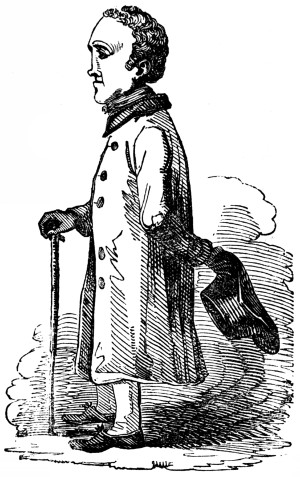
Captain Starkey. Died, July 9, 1822.
Reader! see the famous Captain Starkey, in his own coat wrapt in; Mark his mark’d nose, and mark his eye, His lengthen’d chin, his forehead high, His little stick, his humble hat, The modest tie of his cravat; Mark how easy sit his hose, Mark the shoes that hold his toes; So he look’d when Ranson sketch’d him While alive—but Death has fetch’d him.
*
Auto-biography is agreeable in the writing, and sometimes profitable in the publication, to persons whose names would otherwise die and be buried with them. Of this numerous class was captain Starkey, who to his “immortal memory” wrote and published his own “Memoirs.”[208]
The preface to a fine uncut copy of captain Starkey’s very rare “Memoirs,” penes me, commences thus:—“The writers of biographical accounts have always prepared articles, which at once, when held forth to the public, were highly entertaining, useful, and satisfactory.” This particular representation, so directly opposed to general experience, is decisively original. Its expression bespeaks an independence of character, rendered further conspicuous by an amiable humility. “I am afraid,” says the captain, “I shall fall infinitely short in commanding your attention; none, on this side of time, are perfect, and it is in the nature of things impossible it should be otherwise.” He trusts, “if truth has any force,” that “patience and candour” will hear him out. Of captain Starkey then—it may be said, that “he knew the truth, and knowing dared maintain it.”
The captain declares, he was born of honest and poor parents, natives of Newcastle upon Tyne, at the Lying-in Hospital, Brownlow-street, Long-acre, London, on the 19th of December, 1757. “My infantile years,” he observes, “were attended with much indisposition.” The nature of his “indisposition” does not appear; but it is reasonable to presume, that as the “infantile years” of all of “living born,” at that time, were passed in “much indisposition,” the captain suffered no more than fell to him in the common lot. It was then the practice to afflict a child as soon as it breathed the air, by forcing spoonfulls of “unctuousities” down its throat, “oil of sweet almonds and syrup of blue violets.” A strong cotton swathe of about six inches in width, and from ten to twenty feet in length, was tightly rolled round the body, beginning under the arm pits and ending at the hips, so as to stiffly encase the entire trunk. After the child was dressed, if its constraint would allow it to suck, it was suckled; but whether suckled or not, the effect of the swathing was soon visible; its eyes rolled in agony, it was pronounced convulsed, and a dose of “Dalby’s Carminative” was administered as “the finest thing in the world for convulsions.” With “pap” made of bread and water, and milk loaded with brown sugar, it was fed from a “pap-boat,” an earthen vessel in the form of a butter-boat. If “these contents” were not quickly “received in full,” the infant was declared “not very well,” but if by crying, kicking of the legs, stiffening of the back, and eructation from the stomach, it resisted further overloading, then it was affirmed that it was “troubled with wind,” and was drenched with “Daffy’s Elixir,” as “the finest thing in the world for wind.” As soon as the “wind” had “a little broken off, poor thing!” it was suckled again, and fed again; being so suckled and fed, and fed and suckled, it was wonderful if it could sleep soundly, and therefore, after it was undressed at night, it had a dose of “Godfrey’s Cordial,” as “the finest thing in the world for composing to rest.” If it was not “composed” out of the world before morning, it awoke to undergo the manifold process of being again over-swathed, over-fed, “Dalby’d, Daffy’d, and Godfrey’d” for that day; and so, day by day, it was put in bonds, “carminativ’d, elixir’d, and cordial’d,” till in a few weeks or months it died, or escaped, as by miracle, to be weaned and made to walk. It was not to be put on its legs “too soon,” and therefore, while the work of repletion was going on, it was not to feel that it had legs, but was kept in arms, or rather kept lolling on the arm, till ten or twelve months old. By this means its body, being unduly distended, was too heavy to be sustained by its weak and comparatively diminutive sized limbs; and then a “go-cart” was provided. The go-cart was a sort of circular frame-work, running upon wheels, with a door to open for admission of the child; wherein, being bolted, and the upper part being only so large as to admit its body from below the arms, the child rested by the arm pits, and kicking its legs on the floor, set the machine rolling on its wheels. This being the customary mode of “bringing children up” at the time of captain Starkey’s birth, and until about the year 1790, few were without a general disorder and weakness of the frame, called “the rickets.” These afflicted ones were sometimes hump-backed, and usually bow-shinned, or knock-kneed, for life, though to remedy the latter defects in some degree, the legs were fastened by straps to jointed irons. From the whole length portrait at the head of this article, which is copied from an etching by Mr. Thomas Ranson, prefixed to captain Starkey’s “Memoirs,” it is reasonably to be conjectured that the captain in his childhood had been ricketty and had worn irons. Mr. Ranson has draped the figure in a long coat. Had this been done to conceal the inward inclination of the captain’s knees, it would have been creditable to Mr. Ranson’s delicacy; for there is a sentiment connected with the meeting of the knees, in the owner’s mind, which he who knows human nature and has human feelings, knows how to respect; and no one either as a man or an artist is better acquainted with the “humanities” than Mr. Ranson. But that gentleman drew the captain from the life, and the captain’s coat is from the coat he actually wore when he stood for his picture. There is a remarkable dereliction of the nose from the eyebrows. It was a practice with the race of nurses who existed when the captain’s nose came into the world, to pinch up that feature of our infant ancestors from an hour old, till “the month was up.” This was from a persuasion that nature, on that part of the face, required to be assisted. A few only of these ancient females remain, and it does not accord with the experience of one of the most experienced among them, that they ever depressed that sensible feature; she is fully of opinion, that for the protrusion at the end of the captain’s, he was indebted to his nurse “during the month;” and she says that, “it’s this, that makes him look so sensible.”
According to captain Starkey’s narrative, when “learning to walk alone,” he unfortunately fell, “and so hurt his left arm, that it turned to a white swelling as large as a child’s head.” The captain says, “my poor parents immediately applied to two gentlemen of the faculty, at the west end of the town, named Bloomfield and Hawkins, physicians and surgeons to his then reigning majesty, king George the Second, of these kingdoms, who declared that, they could not do any more than cut it off; unto which my tender parents would not consent.” A French surgeon restored to him the use of his arm, and gave him advice “not to employ it in any arduous employment.” “I, therefore,” says the captain, “as my mother kept a preparatory school, was learned by her to read and spell.” At seven years old he was “put to a master to learn to write, cipher, and the classics.” After this, desiring to be acquainted with other languages, he was sent to another master, and “improved,” to the pleasure of himself and friends, but was “not so successful” as he could wish; for which he says, “I am, as I ought to be, thankful to divine providence.” With him he stayed, improving and not succeeding till he was fourteen, “at which age,” says the captain, “I was bound apprentice to Mr. William Bird, an eminent writer and teacher of languages and mathematics, in Fetter-lane, Holborn.” After his apprenticeship the captain, in the year 1780, went with his father, during an election, to Newcastle-upon-Tyne, his parents’ native town. Returning to London, he, in 1784, went electioneering again to Newcastle, having left a small school in London to the care of a substitute, who managed to reduce twenty-five scholars to ten, “although he was paid a weekly allowance.” Being “filled with trouble by the loss,” he was assisted to a school in Sunderland; “but,” the captain remarks, “as the greatest success did not attend me in that, I had the happiness and honour of receiving a better employment in the aforesaid town of Sunderland, from that ever to be remembered gentleman, William Gooch, esq., comptroller of the customs, who died in the year 1791, and did not die unmindful of me: for he left me in his will the sum of 10l., with which, had I been prudent enough, and left his employ immediately after his interment, I might have done well; but foolishly relying on the continuance of my place, continued doing the duties for nine months without receiving any remuneration; and at last was obliged to leave, it not being the pleasure of the then collector, C. Hill, esq., that I should continue any longer in office.” Great as the sensation must have been at Sunderland on this important change “in office,” the fact is entirely omitted in the journals of the period, and might at this time have been wholly forgotten if the captain had not been his own chronicler. On his forced “retirement” he returned to Newcastle, willing to take “office” there, but there being no opening he resolved once more to try his fortune in London. For that purpose he crossed the Tyne-bridge, with two shillings in his pocket, and arriving at Chester-le-street, obtained a subscription of two guineas, by which, “with helps and hopes,” and “walking some stages,” and getting “casts by coaches,” he arrived in the metropolis, where he obtained a recommendation back, to the then mayor of Newcastle. Thither he again repaired, and presented his letter to the mayor, who promised him a place in the Freemen’s Hospital, and gave it him on the first vacancy. “In which situation,” says captain Starkey, “I have now been twenty-six years enjoying the invaluable blessing of health and good friends.” So ends his “Memoir written by himself.”
To what end captain Starkey wrote his history, or how he came by his rank, he does not say; but in the “Local Records, or Historical Register of Remarkable Events in Durham, Northumberland, Newcastle, and Berwick,” a volume compiled and published by Mr. John Sykes, of Newcastle, there is a notice which throws some light on the matter. “Mr. Starkey, who was uncommonly polite, had a peculiarly smooth method of obtaining the loan of a halfpenny, for which he was always ready to give his promissory note, which his creditors held as curiosities.” Halfpenny debentures were tedious instruments for small “loans,” and Starkey may have compiled his “Memoirs,” without affixing a price, for the purpose of saying, “what you please,” and thereby raising “supplies” by sixpence and a shilling at a time. It is to be observed to his credit, that had he made his book more entertaining, it would have had far less claim upon an honest reader. It is the adventureless history of a man who did no harm in the world, and thought he had a right to live, because he was a living being. Mr. Ranson’s portrait represents him as he was. His stick, instead of a staff of support, appears symbolical of the assistance he required towards existence. He holds his hat behind, as if to intimate that his head is not entitled to be covered in “a gentleman’s presence.” He seems to have been a poor powerless creature, sensible of incompetency to do; anxious not to suffer; and with just enough of worldly cunning, to derive to himself a little of the superabundance enjoyed by men, who obtain for greater cunning the name of cleverness.
QUATRAINS TO THE EDITOR OF THE EVERY-DAY BOOK. [From the London Magazine.]
I like you, and your book, ingenuous Hone! In whose capacious, all-embracing leaves The very marrow of tradition’s shown; And all that history—much that fiction—weaves. By every sort of taste your work is graced. Vast stores of modern anecdote we find, With good old story quaintly interlaced— The theme as various as the reader’s mind. Rome’s lie-fraught legends you so truly paint— Yet kindly—that the half-turn’d Catholic Scarcely forbears to smile at his own saint, And cannot curse the candid Heretic. Rags, relics, witches, ghosts, fiends, crowd your page; Our father’s mummeries we well-pleased behold; And, proudly conscious of a purer age, Forgive some fopperies in the times of old. Verse-honouring Phœbus, Father of bright Days, Must needs bestow on you both good and many, Who, building trophies to his children’s praise, Run their rich Zodiac through, not missing any. Dan Phœbus loves your book—trust me, friend Hone— The title only errs, he bids me say: For while such art—wit—reading—there are shown, He swears, ’tis not a work of every day.
C. Lamb
QUATORZAINS TO THE AUTHOR OF “QUATRAINS.”
In feeling, like a stricken deer, I’ve been Self-put out from the herd, friend Lamb; for I Imagined all the sympathies between Mankind and me had ceased, till your full cry Of kindness reach’d and roused me, as I lay “Musing—on divers things foreknown:” it bid Me know, in you, a friend; with a fine gay Sincerity, before all men it chid, Or rather, by not chiding, seem’d to chide Me, for long absence from you; re-invited Me, with a herald’s trump, and so defied Me to remain immured; and it requited Me, for others’ harsh misdeeming—which I trust is Now, or will be, known by them, to be injustice. I am “ingenuous:” it is all I can Pretend to; it is all I wish to be; Yet, through obliquity of sight in man, From constant gaze on tortuosity, Few people understand me: still, I am Warmly affection’d to each human being; Loving the right, for right’s sake; and, friend Lamb, Trying to see things as they are; hence, seeing Some “good in ev’ry thing” however bad, Evil in many things that look most fair, And pondering on all: this may be mad- ness, but it is my method; and I dare Deductions from a strange diversity Of things, not taught within a University. No schools of science open’d to my youth; No learned halls, no academic bowers; No one had I to point my way to truth, Instruct my ign’rance, or direct my powers: Yet I, though all unlearned, p’rhaps may aid The march of knowledge in our “purer age,” And, without seeming, may perchance persuade The young to think,—to virtue some engage: So have I hoped, and with this end in view, My little Every-Day Book I design’d; Praise of the work, and of its author too, From you, friend Lamb, is more than good and kind: To such high meed I did not dare aspire As public honour, from the hand of Allworthy Elia. As to the message from your friend above:— Do me the favour to present my best Respects to old “Dan Phœbus,” for the “love” He bears the Every-Day Book: for the rest, That is, the handsome mode he has selected Of making me fine compliments by you, ’tis So flatt’ring to me, and so much respected By me, that, if you please, and it should suit his Highness, I must rely upon you, for Obtaining his command, to introduce me To him yourself, when quite convenient; or I trust, at any rate, you’ll not refuse me A line, to signify, that I’m the person known To him, through you, friend Lamb, as
Your Friend
William Hone
July 10.
The Seven Brothers, Martyrs, and St. Felicitas, their Mother. 2nd Cent. Sts. Rufina and Secunda, V. A. D. 257.
Spider Barometers.
If the weather is likely to become rainy, windy, or in other respects disagreeable, spiders fix the terminating filaments, on which the whole web is suspended, unusually short. If the terminating filaments are made uncommonly long, the weather will be serene, and continue so, at least for ten or twelve days. If spiders be totally indolent, rain generally succeeds; though their activity during rain is certain proof that it will be only of short duration, and followed by fair and constant weather. Spiders usually make some alterations in their webs every twenty-four hours; if these changes take place between the hours of six and seven in the evening, they indicate a clear and pleasant night.
FLORAL DIRECTORY.
Speckled Snapdragon. Antirrhinum triphyllum. Dedicated to Sts. Rufina and Secunda.
July 11.
St. James, Bp. of Nisibis, A. D. 350. St. Hidulphus, Bp. A. D. 707, or 713. St. Pius I., Pope, A. D. 157. St. Drostan, A. D. 809.
Sun-set.
Soft o’er the mountain’s purple brow, Meek twilight draws her shadowy grey; From tufted woods, and valleys low, Light’s magic colours steal away. Yet still, amid the spreading gloom, Resplendent glow the western waves That roll o’er Neptune’s coral caves A zone of light on evening’s dome. On this lone summit let me rest, And view the forms to fancy dear, ’Till on the ocean’s darkened breast, The stars of evening tremble clear; Or the moon’s pale orb appear, Throwing her light of radiance wide, Far o’er the lightly curling tide. No sounds o’er silence now prevail, Save of the murm’ring brook below, Or sailor’s song borne on the gale, Or oar at distance striking slow. So sweet, so tranquil, may my evening ray, Set to this world—and rise in future day.
FLORAL DIRECTORY.
Yellow Lupin. Lupinus flævus. Dedicated to St. James.
July 12.
St. John Gualbert, Abbot, A. D. 1073. Sts. Nabor and Felix, Martyrs, A. D. 304.
In the “Poems” of Mr. Gent, there are some lines of tranquillizing tendency.
To Mary.
Oh! is there not in infant smiles A witching power, a cheering ray, A charm that every care beguiles, And bids the weary soul be gay? There surely is—for thou hast been Child of my heart, my peaceful dove, Gladd’ning life’s sad and checquered scene, An emblem of the peace above. Now all is calm and dark and still, And bright the beam the moonlight throws On ocean wave, and gentle rill, And on thy slumb’ring cheek of rose. And may no care disturb that breast, Nor sorrow dim that brow serene; And may thy latest years be blest As thy sweet infancy has been.
FLORAL DIRECTORY.
Great Snapdragon. Antirrhinum purpureum. Dedicated to St. John Gualbert.
July 13.
St. Eugenius, Bp. A. D. 505. St. Anacletus, Pope, A. D. 107. St. Turiaf, Bp. A. D. 749.
How soothing is a calm stroll on a summer’s evening after sun-set, while the breeze of health is floating gently over the verdure, the moon ascending, and the evening star glistening like a diamond.
Diana’s bright crescent, like a silver bow, New strung in Heaven, lifts high its beamy horns Impatient for the night, and seems to push Her brother down the sky; fair Venus shines Ev’n in the eye of day; with sweetest beam, Propitious shines, and shakes a trembling flood Of softened radiance from her dewy locks. The shadows spread apace; while meek-ey’d eve, Her cheeks yet warm with blushes, slow retires Thro’ the Hesperian garden of the west, And shuts the gates of day.
FLORAL DIRECTORY.
Blue Lupin. Lupinus cœruleus. Dedicated to St. Eugenius.
July 14.
St. Bonaventure, Card. Bp. A. D. 1274. St. Camillus de Lellis, A. D. 1614. St. Idus, Bp. in Leinster.
WARMTH.
The heat of the season, unless patiently endured, has a tendency to inflame the mind, and render it irritable. On some infants its effects are visible in their restlessness and peevishness. Parents, and those who have the care of childhood, must now watch themselves as well as their offspring.
A father’s voice in threat’ning tone The storm of rage revealing, His flashing eye and angry frown, Would rouse a kindred feeling. But where’s the child his sigh can hear, When grief his heart is rending? And who unmov’d can see the tear, A parent’s cheek descending. Oh, yes! a child may brave the heat, A father’s rage confessing, But, ah! how sweet his smile to meet, And, oh! how dear his blessing! Then let me shun with shrinking fear, The thought of not conceding, I could not bear affection’s tear, When parent’s lips were pleading.
The Cross Bill. (Loxia curvi rostra.)
In July, 1821, at West Felton, in Shropshire, this rare and beautiful bird was seen, in a flight of about eighteen or twenty, alighting on the tops of pine trees and larch; the cone of which it opens with adroit neatness, holding it in one claw, like a parrot, and picking out the seeds. They were of various colours, brown, green, yellow, and crimson, and some entirely of the most lovely rose colour; hanging and climbing in fanciful attitudes, and much resembling a group of small paroquets. Their unusual note, somewhat like the quick chirp of linnets, but much louder, first attracted attention. The observer had repeated opportunities of viewing them to the greatest advantage, by means of a small telescope. They also eat excrescent knobs, or the insects formed therein by the cynips, at the ends of the young spruce branches. These birds are natives of Germany and the Pyrenees, and are very rarely seen in England. It was remarked, that the same mandible of the bill crossed on the right side in some birds, and on the left in others.[209]
FLORAL DIRECTORY.
Red Lupin. Lupinus perennis. Dedicated to St. Bonaventure.
Destruction of the Bastile.
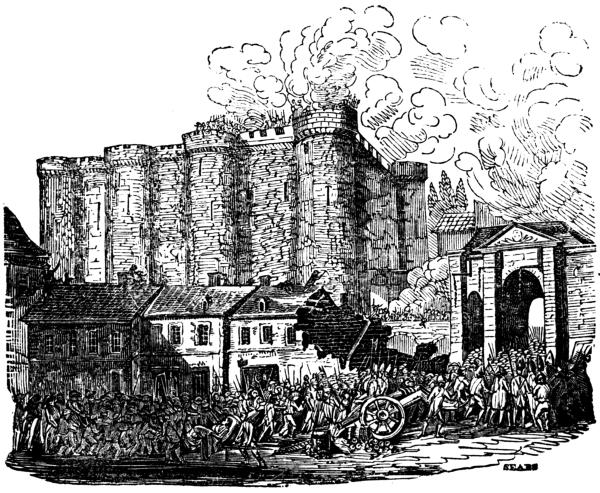
Destruction of the Bastile.
———— Sir, ’tis the Bastile, Full of such dark, deep, damp, chill dungeons of horror and silence. Young men shut therein oft grew gray-haired in a twelvemonth; Old men lost their senses, forgetting they had not been born there; Thumb-screws, weapons of torture, were found, most shocking to think of! Fetters still lock’d on the limbs of unburied skeletons starved there, Curses engraved with a nail in the stone walls.
Hexameters, in Annual Anthology, vol. ii.
The Bastile of Paris, the great state prison of France, was stormed and destroyed by the populace on the 14th of July, 1789. This extraordinary event took place during the sitting of the national assembly convened by Louis XVI. under great exigency. The French government at that time afforded no security to life or property. Persons offensive to the state were arrested under arbitrary warrants, called Lettres de Cachet, consigned to the dungeons of the Bastile, remained there without trial, often for life, and sometimes perished from neglect, or the cruelties incident to imprisonment in the fortress.
Louis XVI. was surrounded by advisers, who insisted on the maintenance of the royal prerogative, in opposition to the growing and loudly expressed desires of the most intelligent men in France, for an administration of public affairs, and the formation of a government, on principles of acknowledged right and justice. The king refused to yield; and, to crush the popular power, and overawe the national assembly in its deliberations, troops were ordered to approach Paris. At this juncture the assembly addressed the king, praying the removal of the troops; he refused, the troops prepared to enter Paris, the people flew to arms, the Bastile was taken, and fatal ills prevailed in the cabinet, till popular fury arrived at a height uncontrollable by public virtue, and the king himself perished on the scaffold, with several of his family.
In recording the destruction of the Bastile on this day, it is necessary to remark, that on the morning of the day before, (the 13th of July,) the populace marched in a body to the Hotel des Invalides, with intent to seize the arms deposited there. The governor, M. de Sombreuil, sensible that resistance was vain, opened the gates, and suffered them to carry away the arms and the cannon. At the same time, the curate of the parish church of St. Etienne du Mont, having put himself at the head of his parishioners, invited his neighbours to arm themselves in their own defence, and in support of good order.
By the interception of couriers, the grand plan of hostility against the city was universally known and understood. It was ascertained that marshall Broglio had accepted the command of the troops; that he had made dispositions for the blockade of Paris; and that considerable convoys of artillery had arrived for that purpose. These facts occasioned violent agitation, and eager search for arms, wherever they could be found. Every one flew to the post of danger; and, without reflection, commenced perilous attacks, seemingly reserved only for military science and cool reflection, to achieve with success.
On the 14th, there was a sudden exclamation among the people, Let us storm the Bastile! If they had only said, let us attack the Bastile, the immense walls that surrounded the edifice, the broad and deep ditches that prevented approach to its walls, and the batteries of cannon placed on them, would have at least cooled their resolution. But insensible of the danger and hazard of the assault, all at once, and with one voice, a numerous body of men, among whom were many of the national guards, exclaimed, Let us storm the Bastile! and that instant they proceeded towards it, with such arms as they happened to be provided with, and presented themselves before this tremendous fortress, by the great street of St. Anthony. M. de Launay, the governor, perceiving this insurrection, caused a flag of truce to be hung out. Upon this appearance, a detachment of the patriotic guards, with five or six hundred citizens, introduced themselves into the outer court, and the governor, advancing to the draw-bridge, inquired of the people what they wanted. They answered, ammunition and arms. He promised to furnish them, when any persons presented themselves on the part of the Hotel de Ville; meaning by that, from Des Flesselles, Prevot des Marchands. The people, little satisfied with this answer, replied by menaces, threats, and great appearance of violence. De Launay then caused the draw-bridge to be raised, and ordered a discharge of artillery on the persons who by this means he had cut off from the main body, and enclosed within the court. Several soldiers, and a greater number of the citizens, fell, and the cannon fired on the city threw the neighbourhood into the greatest disorder. The besiegers, burning to retaliate the loss of their comrades, applied to the districts for reinforcements, sent for the artillery they had just taken from the invalids, and obtained five pieces of cannon, with six gunners, who offered their services, and brought ammunition for the attack. Two serjeants of the patriotic corps, M. Warguier and Labarthe, at the head of a party of their comrades, supported by a troop of citizens, headed by M. Hulin, whom they had unanimously chosen for their commander, traversed on the side of the Celestins, all the passages near the arsenal, and with three pieces of artillery which they brought into the court des Saltpetres, contiguous to the Bastile, immediately commenced a brisk fire, the besiegers endeavouring to outdo each other in courage and intrepidity. M. Hely, an officer of the regiment of infantry (de la Reine,) caused several waggons loaded with straw to be unloaded and set on fire, and by means of the smoke that issued from them, the besieged were prevented from seeing the operations of the besiegers. The governor, knowing that he could not hold out against an incessant fire on the fortress, and seeing that the chains of the first draw-bridge were carried away by the shot from the besiegers’ cannon, again hung out a white flag, as a token of peace. The besiegers, determined to revenge the massacre of their comrades by the perfidy of De Launay, were deaf to all entreaties, and would look at nothing that would lessen their resentment. In vain the governor made a second attempt to pacify the assailants. Through the crevices of the inward draw-bridge, he affixed a writing, which a person went in quest of, at the hazard of his life. The paper was to this purport: “We have twenty thousand weight of gunpowder, and we will blow up the garrison and all its environs, if you do not accept of our capitulation.” The besiegers despising the menace, redoubled their firing, and continued their operations with additional vigour. Numberless spectators of all ages, of all conditions, and many English, were present at this wonderful enterprise; and it is recorded, that a British female, unrestrained by the delicacy of her sex, accepted a lighted match on its being offered to her, and fired one of the cannon against the fortress.
Three pieces of artillery being brought forward to beat down the draw-bridge, the governor demolished the little bridge of passage on the left hand, at the entrance of the fortress; but three persons, named Hely, Hulin, and Maillard, leaped on the bridge, and demanding that the inmost gate should be instantly opened, the besieged obeyed, and the besiegers pushed forward to make good their entrance. The garrison still persisted in a vain resistance. The people massacred all who came in their way, and the victorious standard was soon hoisted from the highest tower. In the mean time, the principal draw-bridge having been let down, a great crowd rushed in at once, and every one looked out for the governor. Arné, a grenadier, singled him out, seized, and disarmed him, and delivered him up to M. Hulin and Hely. The people tore from his coat the badge of honour; numerous hands were lifted against him; and De Launay threw himself into the arms of M. Templement, and conjured him to protect him from the rage of the populace.
The deputy governor, major, and the captain of the gunners, were now united in one group. The horrid dungeons of the fortress were thrown open, never more to be closed; unhappy victims, with hoary locks and emaciated bodies, were astonished at beholding the light, on their release, and shouts of joy and victory resounded through the remotest cells of the Bastile.
The victors formed a kind of march, and while some uttered acclamations of triumph, others vented their passions in threats of revenge against the vanquished. The city militia mixing with the patriotic guards, crowns of laurel, garlands, and ribands, were offered to them by the spectators. The conquerors, proceeding to the Hotel de Ville, were scarcely arrived at the square before that edifice, La Place de Greve, when the multitude called aloud for sudden vengeance on the objects of their resentment. The governor and the other officers were impetuously torn from the hands of their conquerors, and De Launay, with several other victims, perished beneath the weapons of an infuriated populace.
Thus fell the Bastile, after a siege of only three hours. Tumultuous joy prevailed throughout Paris, and the city was illuminated in the evening. By the most experienced military engineers under Louis XIV., it had been deemed impregnable.
The Bastile consisted of eight strong towers. It was surrounded with a fossé one hundred and twenty yards wide, and on the summit of the towers there was a platform, connected by terraces, whereon prisoners were sometimes permitted to walk, attended by a guard. Thirteen pieces of cannon mounted on this platform were fired on days of public rejoicing. There were five sorts of chambers in the Bastile. The dungeons under these towers exhaled noxious vapours and stench, and were frequented by rats, lizards, toads, and other loathsome reptiles. In the angle of each dungeon, was a camp-bedstead, of planks resting on bars of iron fixed in the wall. These cells were dark and hideous, without windows or apertures, to admit either fresh air or light. They were secured by double doors of seven inches thick, the interior one covered with iron-plates, and fastened by strong bolts and heavy locks. The most horrible receptacles were the dungeons, wherein the iron cages were fixed. These cages, the disgrace of human nature, were eight feet high, by six feet wide, and formed of strong beams, strengthened further by iron plates. As this building is amply described in several works, further particulars of it may here cease.