MAY. (continued 4)
Reading edition
ODE, WRITTEN ON WHIT-MONDAY
Hark! how the merry bells ring jocund round, And now they die upon the veering breeze; Anon they thunder loud Full on the musing ear. Wafted in varying cadence, by the shore Of the still twinkling river, they bespeak A day of jubilee, An ancient holiday. And, lo! the rural revels are begun, And gaily echoing to the laughing sky, On the smooth-shaven green Resounds the voice of Mirth— Alas! regardless of the tongue of Fate, That tells them ’tis but as an hour since they, Who now are in their graves, Kept up the Whitsun dance; And that another hour, and they must fall Like those who went before, and sleep as still Beneath the silent sod, A cold and cheerless sleep. Yet why should thoughts like these intrude to scare The vagrant Happiness, when she will deign To smile upon us here, A transient visitor? Mortals! be gladsome while ye have the power, And laugh and seize the glittering lapse of joy; In time the bell will toll That warns ye to your graves. I to the woodland solitude will bend My lonesome way—where Mirth’s obstreperous shout Shall not intrude to break The meditative hour; There will I ponder on the state of man, Joyless and sad of heart, and consecrate This day of jubilee To sad Reflection’s shrine; And I will cast my fond eye far beyond This world of care, to where the steeple loud Shall rock above the sod, Where I shall sleep in peace.
H. K. White.
Whitsuntide at Greenwich.
I have had another holiday—a Whitsuntide holiday at Greenwich: it is true that I did not take a run down the hill, but I saw many do it who appeared to me happier and healthier for the exercise, and the fragrant breezes from the fine May trees of the park.
I began Whit-Monday by breakfasting on Blackheath hill. It was my good fortune to gain a sight of the beautiful grounds belonging to the noblest mansion on the heath, the residence of the princess Sophia of Gloucester. It is not a “show house,” nor is her royal highness a woman of show. “She is a noble lady,” said a worthy inhabitant of the neighbourhood, “she is always doing as much good as she can, and more, perhaps, than she ought; her heart is larger than her purse.” I found myself in this retreat I scarcely know how, and imagined that a place like this might make good dispositions better, and intelligent minds wiser. Some of its scenes seemed, to my imagination, lovely as were the spots in “the blissful seats of Eden.” Delightful green swards with majestic trees lead on to private walks; and gladdening shrubberies terminate in broad borders of fine flowers, or in sloping paths, whereon fairies might dance in silence by the sleeping moonlight, or to the chant of nightingales that come hither, to an amphitheatre of copses surrounding a “rose mount,” as to their proper choir, and pour their melody, unheard by earthly beings,
—————— save by the ear Of her alone who wanders here, or sits Intrelissed and enchanted as the Fair Fabled by him of yore in Comus’ song, Or rather like a saint in a fair shrine Carved by Cellini’s hand.
It may not be good taste, in declaring the truth, to state “the whole truth,” but it is a fact, that I descended from the heights of royalty to “Sot’s hole.” There, for “corporal refection,” and from desire to see a place which derives its name from the great lord Chesterfield, I took a biscuit and a glass of ginger-beer. His lordship resided in the mansion I had just left, and his servants were accustomed to “use” this alehouse too frequently. On one occasion he said to his butler, “Fetch the fellows from that sot’s hole:” from that time, though the house has another name and sign, it is better known by the name or sign of “Sot’s hole.” Ascending the rise to the nearest park-gate, I soon got to the observatory in the park. It was barely noon. The holiday folks had not yet arrived; the old pensioners, who ply there to ferry the eye up and down and across the river with their telescopes, were ready with their craft. Yielding to the importunity of one, to be freed from the invitations of the rest, I took my stand, and in less than ten minutes was conveyed to Barking church, Epping Forest, the men in chains, the London Docks, St. Paul’s Cathedral, and Westminster Abbey. From the seat around the tree I watched the early comers; as each party arrived the pensioners hailed them with good success. In every instance, save one, the sight first demanded was the “men in chains:” these are the bodies of pirates, suspended on gibbets by the river side, to warn sailors against crimes on the high seas. An able-bodied sailor, with a new hat on his Saracen-looking head, carrying a handkerchief full of apples in his left hand, with a bottle neck sticking out of the neck of his jacket for a nosegay, dragged his female companion up the hill with all the might of his right arm and shoulder; and the moment he was at the top, assented to the proposal of a telescope-keeper for his “good lady” to have a view of the “men in chains.” She wanted to “see something else first.” “Don’t be a fool,” said Jack, “see them first; it’s the best sight.” No; not she: all Jack’s arguments were unavailing. “Well! what is it you’d like better, you fool you?” “Why I wants to see our house in the court, with the flower-pots, and if I don’t see that, I won’t see nothing—what’s the men in chains to that? Give us an apple.” She took one out of the bundle, and beginning to eat it, gave instructions for the direction of the instrument towards Limehouse church, while Jack drew forth the bottle and refreshed himself. Long she looked, and squabbled, and almost gave up the hope of finding “our house;” but on a sudden she screamed out, “Here Jack! here it is, pots and all! and there’s our bed-post; I left the window up o’ purpose as I might see it!” Jack himself took an observation. “D’ye see it, Jack?” “Yes.” “D’ye see the pots?” “Yes.” “And the bed-post?” “Ay; and here Sal, here, here’s the cat looking out o’ the window.” “Come away, let’s look again;” and then she looked, and squalled “Lord! what a sweet place it is!” and then she assented to seeing the “men in chains,” giving Jack the first look, and they looked “all down the river,” and saw “Tom’s ship,” and wished Tom was with them. The breakings forth of nature and kind-heartedness, and especially the love of “home, sweet home,” in Jack’s “good lady,” drew forth Jack’s delight, and he kissed her till the apples rolled out of the bundle, and then he pulled her down the hill. From the moment they came up they looked at nobody, nor saw any thing but themselves, and what they paid for looking at through the telescope. They were themselves a sight: and though the woman was far from
whatever fair High fancy forms or lavish hearts could wish,
yet she was all that to Jack; and all that she seemed to love or care for, were “our house,” and the “flower-pots,” and the “bed-post,” and “Jack.”
At the entrances in all the streets of Greenwich, notices from the magistrates were posted, that they were determined to put down the fair; and accordingly not a show was to be seen in the place wherein the fair had of late been held. Booths were fitting up for dancing and refreshment at night, but neither Richardson’s, nor any other itinerant company of performers, was there. There were gingerbread stalls, but no learned pig, no dwarf, no giant, no fire-eater, no exhibition of any kind. There was a large round-about of wooden horses for boys, and a few swings, none of them half filled. The landlord of “the Struggler” could not struggle his stand into notice. In vain he chalked up “Hagger’s entire, two-pence a bottle:” this was ginger-beer; if it was not brisker than the demand for it, it was made “poor indeed;” he had little aid, but unsold “Lemmun aid, one penny a glass.” Yet the public-houses in Greenwich were filling fast, and the fiddles squeaked from several first-floor windows. It was now nearly two o’clock, and the stage-coaches from London, thoroughly filled inside and out, drove rapidly in: these, and the flocking down of foot passengers, gave sign of great visitation. One object I cannot pass by, for it forcibly contrasted in me mind with the joyous disposition of the day. It was a poor blackbird in a cage, from the first-floor window of a house in Melville-place. The cage was high and square; its bars were of a dark brown bamboo; the top and bottom were of the same dolorous colour; between the bars were strong iron wires; the bird himself sat dull and mute; I passed the house several times; not a single note did he give forth. A few hours before I had heard his fellows in the thickets whistling in full throat; and here was he, in endless thrall, without a bit of green to cheer him, or even the decent jailery of a light wicker cage. I looked at him, and thought of the Lollards at Lambeth, of Thomas Delaune in Newgate, of Prynne in the Gatehouse, and Laud in the Tower:—all these were offenders; yet wherein had this poor bird offended that he should be like them, and be forced to keep Whitsuntide in prison? I wished him a holiday, and would have given him one to the end of his life, had I known how.
After dining and taking tea at the “Yorkshire Grey,” I returned to the park, through the Greenwich gate, near the hospital. The scene here was very lively. Great numbers were seated on the grass, some refreshing themselves, others were lookers at the large company of walkers. Surrounded by a goodly number was a man who stood to exhibit the wonders of a single-folded sheet of writing paper to the sight of all except himself; he was blind. By a motion of his hand he changed it into various forms. “Here,” said he, “is a garden-chair for your seat—this is a flight of stairs to your chamber—here is a flower-stand for your mantle-piece;” and so he went on; presenting, in rapid succession, the well-shaped representation of more than thirty forms of different utensils or conveniences: at the conclusion, he was well rewarded for his ingenuity. Further on was a larger group; from the centre whereof came forth sounds unlike those heard by him who wrote—
“Orpheus play’d so well, he moved old Nick, But thou mov’st nothing but thy fiddlestick.”
This player so “imitated Orpheus,” that he moved the very bowels, uneasiness seemed to seize on all who heard his discords. He was seated on the grass, in the garb of a sailor. At his right hand lay a square board, whereon was painted “a tale of woe,” in letters that disdained the printer’s art; at the top, a little box, with a glass cover, discovered that it was “plus” of what himself was “minus;” its inscription described its contents—“These bones was taken out of my leg.” I could not withstand his claim to support. He was effecting the destruction of “Sweet Poll of Plymouth,” for which I gave him a trifle more than his “fair” audience usually bestowed, perhaps. He instantly begged I would name my “favourite;” I desired to be acquainted with his; he said he could not “deny nothing to so noble a benefactor,” and he immediately began to murder “Black-eyed Susan.” If the man at the wall of the Fishmongers’ almshouses were dead, he would be the worst player in England.
There were several parties playing at “Kiss in the ring,” an innocent merriment in the country; here it was certainly not merriment. On the hill the runners were abundant, and the far greater number were, in appearance and manners, devoid of that vulgarity and grossness from whence it might be inferred that the sport was any way improper; nor did I observe, during a stay of several hours, the least indication of its being otherwise than a cheerful amusement. One of the prettiest sights was a game at “Thread my needle,” played by about a dozen lasses, with a grace and glee that reminded me of Angelica’s nymphs. I indulged a hope that the hilarity of rural pastimes might yet be preserved. There was no drinking in the park. It lost its visitants fast while the sun was going down. Many were arrested in their progress to the gate by the sight of the boys belonging to the college, who were at their evening play within their own grounds, and who, before they retired for the night, sung “God save the King,” and “Rule Britannia,” in full chorus, with fine effect.
The fair, or at least such part of it as was suffered to be continued, was held in the open space on the right hand of the street leading from Greenwich to the Creek bridge. “The Crown and Anchor” booth was the great attraction, as indeed well it might. It was a tent, three hundred and twenty-three feet long, and sixty feet wide. Seventy feet of this, at the entrance, was occupied by seats for persons who chose to take refreshment, and by a large space from whence the viands were delivered. The remaining two hundred and fifty feet formed the “Assembly room,” wherein were boarded floors for four rows of dancers throughout this extensive length; on each side were seats and tables. The price of admission to the assembly was one shilling. The check ticket was a card, whereon was printed,
VAUXHALL. CROWN AND ANCHOR, WHIT MONDAY.
This room was thoroughly lighted up by depending branches from the roofs handsomely formed; and by stars and festoons, and the letters G. R. and other devices, bearing illumination lamps. It was more completely filled with dancers and spectators, than were convenient to either. Neither the company nor the scene can be well described. The orchestra, elevated across the middle of the tent, consisting of two harps, three violins, a bass viol, two clarionets, and a flute, played airs from “Der Freischütz,” and other popular tunes. Save the crowd, there was no confusion; save in the quality of the dancers and dancing, there was no observable difference between this and other large assemblies; except, indeed, that there was no master of the ceremonies, nor any difficulty in obtaining or declining partners. It was neither a dancing school, nor a school of morals; but the moralist might draw conclusions which would here, and at this time, be out of place. There were at least 2,000 persons in this booth at one time. In the fair were about twenty other dancing booths; yet none of them comparable in extent to the “Crown and Anchor.” In one only was a price demanded for admission; the tickets to the “Albion Assembly” were sixpence. Most of these booths had names; for instance, “The Royal Standard;” “The Lads of the Village,” “The Black Boy and Cat Tavern,” “The Moon-rakers,” &c. At eleven o’clock, stages from Greenwich to London were in full request. One of them obtained 4s. each for inside, and 2s. 6d. for outside passengers; the average price was 3s. inside, and 2s. outside; and though the footpaths were crowded with passengers, yet all the inns in Greenwich and on the road were thoroughly filled. Certainly, the greater part of the visitors were mere spectators of the scene.
*
NIGHT
The late Henry Kirke White, in a fragment of a poem on “Time,” beautifully imagines the slumbers of the sorrowful. Reader, bear with its melancholy tone. A summer’s day is not less lovely for a passing cloud.
Behold the world Rests, and her tired inhabitants have paused From trouble and turmoil. The widow now Has ceased to weep, and her twin-orphans lie Lock’d in each arm, partakers of her rest. The man of sorrow has forgot his woes; The outcast that his head is shelterless, His griefs unshared. The mother tends no more Her daughter’s dying slumbers, but surprised With heaviness, and sunk upon her couch, Dreams of her bridals. Even the hectic lull’d On Death’s lean arm to rest, in visions wrapt, Crowning with Hope’s bland wreath his shuddering nurse, Poor victim! smiles.—Silence and deep repose Reign o’er the nations; and the warning voice Of Nature utters audibly within The general moral;—tells us that repose, Deathlike as this, but of far longer span, Is coming on us—that the weary crowds, Who now enjoy a temporary calm, Shall soon taste lasting quiet, wrapt around With grave-clothes; and their aching restless heads Mouldering in holes and corners unobserved Till the last trump shall break their sullen sleep.
The Sluice-house.
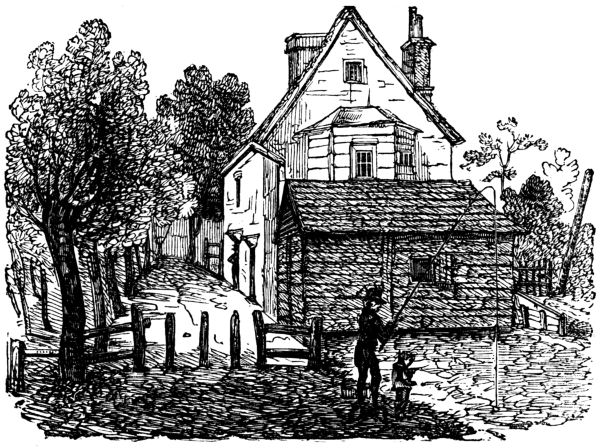
The Sluice-house.
Ye who with rod and line aspire to catch Leviathans that swim within the stream Of this fam’d River, now no longer New, Yet still so call’d, come hither to the Sluice-house. Here, largest gudgeons live, and fattest roach Resort, and even barbel have been found. Here too doth sometimes prey the rav’ning shark Of streams like this, that is to say, a jack. If fortune aid ye, ye perchance shall find Upon an average within one day, At least a fish, or two; if ye do not, This will I promise ye, that ye shall have Most glorious nibbles: come then, haste ye here, And with ye bring large stock of baits and patience.
From Canonbury tower onward by the New River, is a pleasant summer afternoon’s walk. Highbury barn, or, as it is now called, Highbury tavern, is the first place of note beyond Canonbury. It was anciently a barn belonging to the ecclesiastics of Clerkenwell; though it is at present only known to the inhabitants of that suburb, by its capacity for filling them with good things in return for the money they spend there. The “barn” itself is the assembly-room, whereon the old roof still remains. This house has stood in the way of all passengers to the Sluice-house, and turned many from their firm-set purpose of fishing in the waters near it. Every man who carries a rod and line is not an Isaac Walton, whom neither blandishment nor obstacle could swerve from his mighty end, when he went forth to kill fish.
He was the great progenitor of all That war upon the tenants of the stream, He neither stumbled, stopt, nor had a fall When he essay’d to war on dace, bleak, bream, Stone-loach or pike, or other fish, I deem.
The Sluice-house is a small wooden building, distant about half a mile beyond Highbury, just before the river angles off towards Newington. With London anglers it has always been a house of celebrity, because it is the nearest spot wherein they have hope of tolerable sport. Within it is now placed a machine for forcing water into the pipes that supply the inhabitants of Holloway, and other parts adjacent. Just beyond is the Eel-pie house, which many who angle thereabouts mistake for the Sluice-house. To instruct the uninformed, and to gratify the eye of some who remember the spot they frequented in their youth, the preceding view, taken in May 1825, has been engraved. If the artist had been also a portrait painter, it would have been well to have secured a sketch of the present keeper of the Sluice-house; his manly mien, and mild expressive face, are worthy of the pencil: if there be truth in physiognomy, he is an honest, good-hearted man. His dame, who tenders Barcelona nuts and oranges at the Sluice-house door for sale, with fishing-lines from two-pence to six-pence, and rods at a penny each, is somewhat stricken in years, and wholly innocent of the metropolis and its manners. She seems of the times—
“When our fathers pluck’d the blackberry And sipp’d the silver tide.”
An etching of the eccentric individual, from whence the present engraving is taken, was transmitted by a respectable “Cantab,” for insertion in the Every-Day Book, with the few particulars ensuing:—
James Gordon was once a respectable solicitor in Cambridge, till “love and liquor”
“Robb’d him of that which once enriched him, And made him poor indeed!”
He is well known to many resident and non-resident sons of alma mater, as a déclamateur, and for ready wit and repartee, which few can equal. One or two instances may somewhat depict
Jemmy Gordon.
Jemmy Gordon.

Gordon meeting a gentleman in the streets of Cambridge who had recently received the honour of knighthood, Jemmy approached him, and looking him full in the face, exclaimed,
“The king, by merely laying sword on, Could make a knight of Jemmy Gordon.”
At a late assize at Cambridge, a man named Pilgrim was convicted of horse-stealing, and sentenced to transportation. Gordon seeing the prosecutor in the street, loudly vociferated to him, “You, sir, have done what the pope of Rome cannot do; you have put a stop to Pilgrim’s Progress!”
Gordon was met one day by a person of rather indifferent character, who pitied Jemmy’s forlorn condition, (he being without shoes and stockings,) and said, “Gordon, if you will call at my house, I will give you a pair of shoes.” Jemmy, assuming a contemptuous air, replied, “No, sir! excuse me, I would not stand in your shoes for all the world!”
Some months ago, Jemmy had the misfortune to fall from a hay-loft, wherein he had retired for the night, and broke his thigh; since then he has reposed in a workhouse. No man’s life is more calculated
“To adorn a moral, and to point a tale.”
N.
These brief memoranda suffice to memorialize a peculiar individual. James Gordon at one time possessed “fame, wealth, and honours:” now—his “fame” is a hapless notoriety; all the “wealth” that remains to him is a form that might have been less careworn had he been less careless; his honour is “air—thin air,” “his gibes, his jests, his flashes of merriment, that were wont to set the table in a roar,” no longer enliven the plenteous banquet:—
“Deserted in his utmost need By men his former bounty fed,”
the bitter morsel for his life’s support is parish dole. “The gayest of the gay” is forgotten in his age—in the darkness of life; when reflection on what was, cannot better what is. Brilliant circles of acquaintance sparkle with frivolity, but friendship has no place within them. The prudence of sensuality is selfishness.
The Cambridge communication concerning James Gordon is accompanied by an amusing list of names derived from “men and things.”
Personages and their Callings at Cambridge in 1825.
A King is a brewer
A Bishop a tailor
A Baron a horse-dealer
A Knight a turf-dealer
A Proctor a tailor
A Marshall a cheesemonger
An Earl a laundress
A Butler a picture-frame maker
A Page a bookbinder
A Pope an old woman
An Abbott a bonnet-maker
A Monk a waterman
A Nun a horse-dealer
A Moor a poulterer
A Savage a carpenter
A Scott an Englishman
A Rose a fishmonger
A Lilly a brewer
A Crab a butcher
A Salmon a linendraper
A Leech a fruiterer
A Pike a milkman
A Sole a shoemaker
A Wood a grocer
A Field a confectioner
A Tunnell a baker
A Marsh a carrier
A Brook a turf-dealer
A Greenwood a baker
A Lee an innkeeper
A Bush a carpenter
A Grove a shoemaker
A Lane a carpenter
A Green a builder
A Hill a butcher
A Haycock a publican
A Barne a grocer
A Shed a butler
A Hutt a shoeblack
A Hovel a draper
A Hatt a bookseller
A Capp a gardener
A Spencer a butcher
A Bullock a baker
A Fox a brazier
A Lamb a sadler
A Lion a grocer
A Mole a town-crier
A Roe an engraver
A Buck a college gyp.
A Hogg a gentleman
A Bond a grocer
A Binder a fruiterer
A Cock a shoemaker
A Hawk a paperhanger
A Drake a dissenting minister
A Swan a shoemaker
A Bird an innkeeper
A Peacock a lawyer
A Rook a tailor
A Wren a bricklayer’s labourer
A Falcon a gentleman
A Crow a builder
A Pearl a cook
A Stone a glazier
A Cross a boatwright
A Barefoot an innkeeper
A Leg a mantua-maker
White a shoemaker
Green a carpenter
Brown a fishmonger
Grey a painter
Pink a publican
Tall a printer
Short a tailor
Long a shopkeeper
Christmas[701, 702] an ironmonger
Summer a carpenter
Sad a barber
Grief a glazier
Peace a carpenter
Bacon a tobacconist.
A Hard-man A Wise-man A Good-man A Black-man A Chap-man A Free-man A New-man A Bow-man
A Spear-man A Hill-man A Wood-man A Pack-man A Pit-man A Red-man A True-man.
FLORAL DIRECTORY.
Lilac. Syringa vulgaris. Dedicated to St. Julia.
May 24.
St. Vincent of Lerins, A. D. 450. Sts. Donatian and Rogatian, A. D. 287. St. John de Prado.
FLORAL DIRECTORY.
Monkey Poppy. Papaver Orientale. Dedicated to St. Vincent.
May 25.
St. Mary Magdalen of Pazzi, A. D. 1607. St. Urban, Pope, A. D. 223. St. Adhelm, or Aldhelm. St. Gregory VII., Pope, A. D. 1085. Sts. Maximus, or Mauxe, and Venerand, Martyrs in Normandy, 6th Cent. St. Dumhade, Abbot, A. D. 717.
St. Aldhelm.
He founded the abbey of Malmesbury, and was the first Englishman who cultivated Latin and English or Saxon poesy. Among his other mortifications, he was accustomed to recite the psalter at night, plunged up to the shoulders in a pond of water. He was the first bishop of Sherborne, a see which was afterwards removed to Salisbury, and died in 709.[148]
He turned a sunbeam into a clothes-peg; at least, so say his biographers: this was at Rome. Saying mass there in the church of St. John de Lateran, he put off his vestment; the servant neglecting to take it, he hung it on a sunbeam, whereon it remained, “to the wonderful admiration of the beholders.”[149]
FLORAL DIRECTORY.
Common Avens. Geum Urbanum. Dedicated to St. Urban.
May 26.
St. Philip Neri, A. D. 1595. St. Augustine, Abp. of Canterbury, A. D. 604. St. Eleutherius, Pope, A. D. 192. St. Quadratus, Bp. A. D. 125. St. Oduvald, Abbot, A. D. 698.
St. Philip Neri.
He was born at Florence in 1515, became recluse when a child, dedicated himself to poverty, and became miraculously fervent. “The divine love,” says Alban Butler, “so much dilated the breast of our saint, that the gristle which joined the fourth and fifth ribs on the left side was broken, which accident allowed the heart and the larger vessels more play; in which condition he lived fifty years.” According to the same authority, his body was sometimes raised from the ground during his devotions some yards high. Butler relates the same of St. Dunstan, St. Edmund, and many other saints, and says that “Calmet, an author still living, assures us that he knows a religious man who, in devout prayer, is sometimes involuntarily raised in the air, and remains hanging in it without any support; also that he is personally acquainted with a devout nun to whom the same had often happened.” Butler thinks it probable that they themselves would not determine whether they were raised by angels, or by what other supernatural operation. He says, that Neri could detect hidden sins by the smell of the sinners. He died in 1595: the body of such a saint of course worked miracles.
St. Philip Neri founded the congregation or religious order of the Oratory, in 1551. The rules of this religious order savour of no small severity. By the “Institutions of the Oratory,” (printed at Oxford, 1687, 8vo. pp. 49.) they are required to mix corporal punishments with their religious harmony:—“From the first of November to the feast of the resurrection, their contemplation of celestial things shall be heightened by a concert of music; and it is also enjoined, that at certain seasons of frequent occurrence, they all whip themselves in the Oratory. After half an hour’s mental prayer, the officers distribute whips made of small cords full of knots, put forth the children, if there be any, and carefully shutting the doors and windows, extinguish the other lights, except only a small candle so placed in a dark lanthorn upon the altar, that the crucifix may appear clear and visible, but not reflecting any light, thus making all the room dark: then the priest, in a loud and doleful voice, pronounceth the verse Jube Domine benedicere, and going through an appointed service, comes Apprehendite disciplinam, &c.; at which words, taking their whips, they scourge their naked bodies during the recital of the 50th Psalm, Miserere, and the 129th, De profundis, with several prayers; at the conclusion of which, upon a sign given, they end their whipping, and put on their clothes in the dark and in silence.”
Oratorios.
The Oratorio commenced with the fathers of the Oratory. In order to draw youth to church, they had hymns, psalms, and spiritual songs, or cantatas, sung either in chorus or by a single favourite voice. These pieces were divided into two parts, the one performed before the sermon, and the other after it. Sacred stories, or events from scripture, written in verse, and by way of dialogue, were set to music, and the first part being performed, the sermon succeeded, which the people were induced to stay and hear, that they might be present at the performance of the second part. The subjects in early times were the good Samaritan, the Prodigal Son, Tobit with the angel, his father, and his wife, and similar histories, which by the excellence of the composition, the band of instruments, and the performance, brought the Oratory into great repute; hence this species of musical drama obtained the general appellation of Oratorio.
St. Augustine.
This was the monk sent to England by St. Gregory the Great, to convert the English; by favour of Ethelbert, he became archbishop of Canterbury. Christianity, however, had long preceded Augustine’s arrival, for the queen of Ethelbert, previous to his coming, was accustomed to pay her devotions in the church of St. Martin just without Canterbury. This most ancient edifice still exists. Not noticing more at present concerning his historical character, it is to be observed that, according to his biographers, he worked many miracles, whereof may be observed this:—
St. Augustine came to a certain town, inhabited by wicked people, who “refused hys doctryne and prechyng uterly, and drof hym out of the towne, castyng on hym the tayles of thornback, or lyke fysshes; wherefore he besought Almyghty God to shewe hys jugement on them; and God sent to them a shamefull token; for the chyldren that were born after in the place, had tayles, as it is sayd, tyll they had repented them. It is said comynly that this fyll at Strode in Kente; but blyssed be Gode, at thys daye is no such deformyte.”[150] It is said, however, that they were the natives of a village in Dorsetshire who were thus tail-pieced.[151]
Another notable miracle is thus related. When St. Augustine came to Compton, in Oxfordshire, the curate complained, that though he had often warned the lord of the place to pay his tythes, yet they were withheld, “and therefore I,” said the curate, “have cursed hym, and I fynde him the more obstynate.” Then St. Augustine demanded why he did not pay his tythes to God and the church; whereto the knight answered, that as he tilled the ground, he ought to have the tenth sheaf as well as the ninth. Augustine, finding that he could not bend this lord to his purpose, then departed and went to mass; but before he began, he charged all those that were accursed to go out of the church. Then a dead body arose, and went out of the church into the churchyard with a white cloth on his head, and stood there till mass was done; whereupon St. Augustine went to him, and demanded what he was; and the dead body said, “I was formerly lord of this town, and because I would not pay my tithes to my curate, he cursed me, and then I died and went to hell.” Then Augustine bade the dead lord bring him to where the curate was buried, which accordingly he did, and Augustine commanded the dead curate to arise, who thereupon accordingly arose and stood before all the people. Then Augustine demanded of the dead curate if he knew the dead lord, who answered, “Would to God I had never known him, for he was a withholder of his tythes, and, more over, an evil-doer.” Then Augustine delivered to the said curate a rod, and then the dead lord kneeling, received penance thereby; which done, Augustine commanded the dead lord to go again to his grave, there to abide until the day of judgment; and forthwith the said lord entered his grave, and fell to ashes. Then Augustine asked the curate, how long he had been dead; and he said, a hundred and fifty years. And Augustine offered to pray for him, that he might remain on earth to confirm men in their belief; but the curate refused, because he was in the place of rest. Then said Augustine, “Go in peace, and pray for me and for holy church;” and immediately the curate returned to his grave. At this sight, the lord who had not paid the curate his tythes was sore afraid, and came quaking to St. Augustine, and to his curate, and prayed forgiveness of his trespass, and promised ever after to pay his tythes.
Chronology.
On the 26th of May, 1555, was a gay May-game at St. Martin’s-in-the-fields, with giants and hobby-horses, drums and guns, morrice-dances, and other minstrels.[152]
FLORAL DIRECTORY.
Rhododendron. Rhododendrum Ponticum. Dedicated to St. Augustine. Yellow Azalea. Azalea pontica. Dedicated to St. Philip Neri.
May 27.
St. John, Pope, A. D. 526. St. Bede, A. D. 735. St. Julius, about A. D. 302.
St. John, Pope.
This pontiff was imprisoned by Theodoric, king of the Goths, in Italy, and died in confinement. This sovereign had previously put to death the philosopher Boëtius, who, according to Ribadeneira, after he was beheaded, was scoffingly asked by one of the executioners, “who hath put thee to death?” whereupon Boëtius answered, “wicked men,” and immediately taking up his head in his own hands, walked away with it to the adjoining church.
St. Bede.
The life of “Venerable Bede” in Butler, is one of the best memoirs in his biography of the saints. He was an Englishman, in priest’s orders. It is said of him that he was a prodigy of learning in an unlearned age; that he surpassed Gregory the Great in eloquence and copiousness of style, and that Europe scarcely produced a greater scholar. He was a teacher of youth, and, at one time had six hundred pupils, yet he exercised his clerical functions with punctuality, and wrote an incredible number of works in theology, science, and the polite arts. It is true he fell into the prevailing credulity of the early age wherein he flourished, but he enlightened it by his erudition, and improved it by his unfeigned piety and unwearied zeal.
Not to ridicule so great a man, but as an instance of the desire to attribute wonderful miracles to distinguished characters, the following silly anecdote concerning Bede is extracted from the “Golden Legend.” He was blind, and desiring to be led forth to preach, his servant carried him to a heap of stones, to which, the good father, believing himself preaching to a sensible congregation, delivered a noble discourse, whereunto, when he had finished his sermon, the stones answered and said “Amen!”
Methinks that to some vacant hermitage My feet would rather turn—to some dry nook Scooped out of living rock, and near a brook Hurled down a mountain cove from stage to stage, Yet tempering, for my sight, its bustling rage In the soft heaven of a translucent pool; Thence creeping under forest arches cool, Fit haunt of shapes whose glorious equipage Perchance would throng my dreams. A beechen bowl, A Maple dish, my furniture should be; Crisp yellow leaves my bed; the hooting Owl My nightwatch: nor should e’er the crested fowl From thorp or vill his matins sound for me, Tired of the world and all its industry. But what if one, through grove or flowery mead, Indulging thus at will the creeping feet Of a voluptuous indolence, should meet The hovering shade of venerable Bede, The saint, the scholar, from a circle freed Of toil stupendous, in a hallowed seat Of learning, where he heard the billows beat On a wild coast—rough monitors to feed Perpetual industry—sublime recluse! The recreant soul, that dares to shun the debt Imposed on human kind, must first forget Thy diligence, thy unrelaxing use Of a long life, and, in the hour of death, The last dear service of thy passing breath!
Wordsworth.
THE SEASON.
Every thing of good or evil, incident to any period of the year, is to be regarded seasonable; the present time of the year, therefore, must not be quarrelled with, if it be not always agreeable to us. Many days of this month, in 1825, have been most oppressive to the spirits, and injurious to the mental faculties, of persons who are unhappily susceptible of changes in the weather, and especially the winds. These have been borne with some philosophy, by the individual now holding the pen; but, alas! the effects are too apparent, he apprehends, to many who have read what he has been scarcely able to throw together. He hopes that these defaults will be placed to their proper account, and that cloudless skies and genial breezes will enable him to do better.
May, 1825.
All hail to thee, hail to thee, god of the morning! How joyous thy steeds from the ocean have sprung! The clouds and the waves smile to see thee returning, And young zephyrs laugh as they gambol along. No more with the tempest the river is swelling, No angry clouds frown, and no sky darkly lowers; The bee winds his horn, and the gay news is telling, That spring is arrived with her sunshine and flowers. From her home in the grass see the white primrose peeping, While diamond dew-drops around her are spread, She smiles through her tears, like an infant, whose weeping To laughter is changed when its sorrows are fled. In the pride of its beauty the young year is shining, And nature with blossoms is wreathing the trees, The white and the green, in rich clusters entwining, Are sprinkling their sweets on the wings of each breeze. Then hail to thee, hail to thee, god of the morning! Triumphant ride on in thy chariot of light; The earth, with thy bounties her forehead adorning, Comes forth, like a bride, from the chamber of night.
E. C.
FLORAL DIRECTORY.
Buttercups. Ranunculus acris. Dedicated to St. John, Pope. Yellow Bachelor’s Buttons. Ranunculus acris plenus. Dedicated to St. Bede.
May 28.
St. Germanus, Bp. of Paris, A. D. 576. St. Caraunus, also Caranus and Caro, (in French, Cheron.)
Chronology.
1546. Cardinal Beaton was on this day assassinated in Scotland. He was primate of that kingdom, over which he exercised almost sovereign sway. Just before his death he got into his power George Wishart, a gentleman by birth, who preached against Romish superstitions, and caused him to be condemned to the stake for heresy. The cardinal refused the sacrament to his victim, on the ground that it was not reasonable to allow a spiritual benefit to an obstinate heretic, condemned by the church. Wishart was tied to a tree in the castle-yard of St. Andrew’s, with bags of gunpowder fastened about his body. The cardinal and prelates were seated on rich cushions with tapestry hangings before them, from whence they viewed the execution of their sentence. The gunpowder having exploded without ending Wishart’s bodily sufferings, the inflexible reformer exclaimed from the fire, “This flame hath scorched my body, yet hath it not daunted my spirit: but he who from yonder high place beholdeth me with such pride, shall within a few days lie in the same as ignominiously as now he is seen proudly to rest himself.” After these words, the cord that went about his neck was drawn by one of the executioners to stop his breath, the fire was increased, his body was consumed to ashes, and the cardinal caused proclamation to be made that none should pray for the heretic under pain of the heaviest ecclesiastical censures. If the church, said the priests, had found such a protector in former times, she had maintained her authority; but the cardinal’s cruelty struck the people with horror, and John Lesly, brother to the earl of Rothes, with Normand Lesly, the earl of Rothes’ son, (who was disgusted on account of some private quarrel,) and other persons of birth and quality, openly vowed to avenge Wishart’s death. Early in the morning they entered the cardinal’s palace at St. Andrews, which he had strongly fortified; though they were not above sixteen persons, they thrust out a hundred tradesmen and fifty servants, whom they seized separately, before any suspicion arose of their intentions; and having shut the gates, they proceeded very deliberately to execute their purpose on the cardinal. Beaton alarmed with the noise which he heard in the castle, barricadoed the door of his chamber: but finding that they had brought fire in order to force their way, and having obtained, as is believed, a promise of life, he opened the door; and reminding them that he was a priest, he conjured them to spare him. Two of them rushed upon him with drawn swords, but a third, James Melvil, stopped their career, and bade them reflect that this work was the work and judgment of God, and ought to be executed with becoming deliberation and gravity. Then turning the point of his sword towards Beaton, he called to him, “Repent thee, thou wicked cardinal, of all thy sins and iniquities, especially of the murder of Wishart, that instrument of God for the conversion of these lands: it is his death which now cries vengeance upon thee: we are sent by God to inflict the deserved punishment. For here, before the Almighty, I protest, that it is neither hatred of thy person, nor love of thy riches, nor fear of thy power, which moves me to seek thy death: but only because thou hast been, and still remainest, an obstinate enemy to Christ Jesus, and his holy gospel.” Having spoken these words, without giving Beaton time to finish that repentance to which he exhorted him, he thrust him through the body, and the cardinal fell dead at his feet. Upon a rumour that the castle was taken, a great tumult arose in the city; and several partisans of the cardinal armed themselves with intent to scale the walls. When they were told of his death, they desisted, and the people insisting upon a sight of the cardinal’s body, his corpse was exposed to their view from the very same place wherein he sat to behold the execution of George Wishart.
The sanguinary spirit of these times has disappeared, and we look upon what remains to us of the individuals who suffered, or acted under its influence, as memorials of such crimes and criminals as we in a milder age dare not imagine our country can be again afflicted with. The sight of cardinal Beaton’s house in the Cowgate, at Edinburgh, may have induced useful reflections on past intolerance, and increased charitable dispositions in some whose persuasions widely differ. If this be so, a representation of it in this sheet may not be less agreeable to the moralist than to the lover of antiquities. The drawing from whence the engraving on the next page is taken, was made on the spot in 1824.
FLORAL DIRECTORY.
Lurid Fleur-de-lis. Iris Lurida. Dedicated to St. Germain.
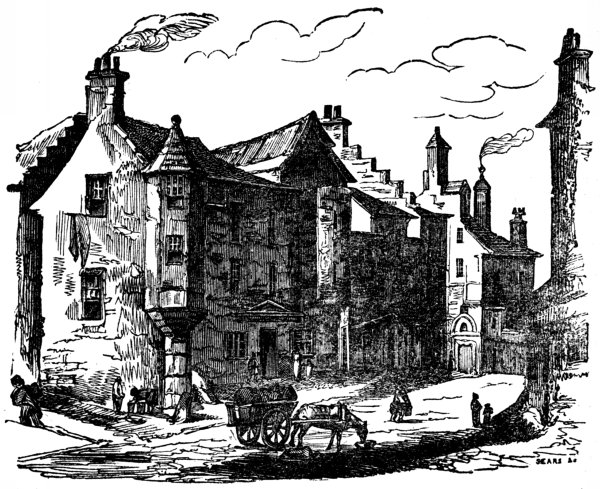
Cardinal Beaton’s house at Edinburgh.
May 29.
St. Maximinus, Bp. of Friers, A. D. 349. St. Cyril. St. Conon and his son, of Iconia in Asia, about A. D. 275. Sts. Sisinnius, Martyrius, and Alexander, A. D. 397.
Restoration Day.
This day is so called from its being the anniversary of the day whereon king Charles II. entered London, in 1660, and re-established royalty, which had been suspended from the death of his father. It is usual with the vulgar people to wear oak-leaves in their hats on this day, and dress their horses’ heads with them. This is in commemoration of the shelter afforded to Charles by an oak while making his escape from England, after his defeat at Worcester, by Cromwell. The battle was fought on the 3d of September, 1651; Cromwell having utterly routed his army, Charles left Worcester at six o’clock in the afternoon, and without halting, travelled about twenty-six miles, in company with fifty or sixty of his friends, from whom he separated, without communicating his intentions to any of them, and went to Boscobel, a lone house in the borders of Staffordshire, inhabited by one Penderell, a farmer, to whom he intrusted himself. This man, assisted by his four brothers, clothed the king in a garb like their own, led him into the neighbouring wood, put a bill into his hand, and pretended to employ themselves in cutting faggots. Some nights he lay upon straw in the house, and fed on such homely fare as it afforded. For better concealment, he mounted upon an oak, where he sheltered himself among the leaves and branches for twenty-four hours. He saw several soldiers pass by. All of them were intent in search of the king; and some expressed, in his hearing, their earnest wishes of seizing him. This tree was afterwards denominated the Royal Oak; and for many years was regarded by the neighbourhood with great veneration. Charles could neither stay, nor stir, without imminent danger. At length he and lord Wilmot, who was concealed in the neighbourhood, put themselves into the hands of colonel Lane, a zealous royalist, who lived at Bentley, not many miles distant. The king’s feet were so hurt by walking in heavy boots or countrymen’s shoes, which did not fit him, that he was obliged to mount on horseback; and he travelled in this situation to Bentley, attended by the Penderells. Lane formed a scheme for his journey to Bristol, where, it was hoped, he would find a ship, in which he might transport himself. He had a near kinswoman, Mrs. Norton, who lived within three miles of that city, and he obtained a pass (for, during those times of confusion, this precaution was requisite) for his sister Jane Lane and a servant to travel towards Bristol, under pretence of visiting and attending her relation. The king rode before the lady, and personated the servant. When they arrived at Norton’s, Mrs. Lane pretended that she had brought along as her servant a poor lad, a neighbouring farmer’s son, who was ill of an ague; and she begged a private room for him where he might be quiet. Though Charles kept himself retired in this chamber, the butler, one Pope, soon knew him: Charles was alarmed, but made the butler promise that he would keep the secret from every mortal, even from his master; and he was faithful to his engagement. No ship, it was found, would, for a month, set sail from Bristol, either for France or Spain; and the king was obliged to go to colonel Windham of Dorsetshire, a partisan of the royal family. During his journey he often passed through the hands of catholics; the Priest’s Hole, as they called it, the place where they were obliged to conceal their persecuted priests, was sometimes employed to shelter him. He continued several days in Windham’s house; and all his friends in Britain, and in every part of Europe, remained in the most anxious suspense with regard to his fortunes: no one could conjecture whether he were dead or alive; and the report of his death being generally believed, relaxed the vigilant search of his enemies. Trials were made to procure a vessel for his escape; but he still met with disappointments. Having left Windham’s house, he was obliged again to return to it. He passed through many other adventures; assumed different disguises; in every step was exposed to imminent perils; and received daily proofs of uncorrupted fidelity and attachment. The sagacity of a smith, who remarked that his horse’s shoes had been made in the north, and not in the west, as he pretended, once detected him; and he narrowly escaped. At Shoreham, in Sussex, a vessel was at last found, in which he embarked. He had been known to so many, that if he had not set sail in that critical moment it had been impossible for him to escape. After one and forty days’ concealment, he arrived safely at Fescamp in Normandy. No less than forty men and women had at different times been privy to his concealment and escape.[153]
Charles II. himself wrote a narrative of his remarkable “Escape.” From this it appears that while journeying with the Penderells, “he wore a very greasy old grey steeple-crowned hat, with the brims turned up, without lining or hatband: a green cloth coat, threadbare, even to the threads being worn white, and breeches of the same, with long knees down to the garter; with an old leathern doublet, a pair of white flannel stockings next to his legs, which the king said were his boot stockings, their tops being cut off to prevent their being discovered, and upon them a pair of old green yarn stockings, all worn and darned at the knees, with their feet cut off; his shoes were old, all slashed for the ease of his feet, and full of gravel; he had an old coarse shirt, patched both at the neck and hands; he had no gloves, but a long thorn stick, not very strong, but crooked three or four several ways, in his hand; his hair cut short up to his ears, and hands coloured; his majesty refusing to have any gloves, when father Hodlestone offered him some, as also to change his stick.”
Charles’s narrative is very minute in many particulars; especially as regards his getting on shipboard, and his passage across the channel.
“We went,” he says, “towards Shoreham, four miles off a place called Brightelmstone, taking the master of the ship with us, on horseback, behind one of our company, and came to the vessel’s side, which was not above sixty tons. But it being low water, and the vessel lying dry, I and my lord Wilmot got up with a ladder into her, and went and lay down in the little cabin, till the tide came to fetch us off.
“But I was no sooner got into the ship, and lain down upon the bed, but the master came in to me, fell down upon his knees, and kissed my hand; telling me, that he knew me very well, and would venture life, and all that he had in the world, to set me down safe in France.
“So, about seven o’clock in the morning, it being high-water, we went out of the port; but the master being bound for Pool, loaden with sea-coal, because he would not have it seen from Shoreham that he did not go his intended voyage, but stood all the day, with a very easy sail, towards the Isle of Wight (only my lord Wilmot and myself, of my company, on board.) And as we were sailing, the master came to me, and desired me that I would persuade his men to use their endeavours with me to get him to set us on shore in France, the better to cover him from any suspicion thereof. Upon which, I went to the men, which were four and a boy, and told them, truly, that we were two merchants that had some misfortunes, and were a little in debt; that we had some money owing us at Rouen, in France, and were afraid of being arrested in England; that if they would persuade the master (the wind being very fair) to give us a trip over to Dieppe, or one of those ports near Rouen, they would oblige us very much, and with that I gave them twenty shillings to drink. Upon which, they undertook to second me, if I would propose it to the master. So I went to the master, and told him our condition, and that if he would give us a trip over to France, we would give him some consideration for it. Upon which he counterfeited difficulties, saying, that it would hinder his voyage. But his men, as they had promised me, joining their persuasions to ours, and, at last, he yielded to set us over.
“So, about five o’clock in the afternoon, as we were in sight of the Isle of Wight, we stood directly over to the coast of France, the wind being then full north; and the next morning, a little before day, we saw the coast. But the tide failing us, and the wind coming about to the south-west, we were forced to come to an anchor within two miles of the shore, till the tide of flood was done.
“We found ourselves just before an harbour in France, called Fescamp; and just as the tide of ebb was made, espied a vessel to leeward of us, which, by her nimble working, I suspected to be an Ostend privateer. Upon which, I went to my lord Wilmot, and telling him my opinion of that ship, proposed to him our going ashore in the little cock-boat, for fear they should prove so, as not knowing, but finding us going into a port of France, (there being then a war betwixt France and Spain,) they might plunder us, and possibly carry us away and set us ashore in England; the master also himself had the same opinion of her being an Ostender, and came to me to tell me so, which thought I made it my business to dissuade him from, for fear it should tempt him to set sail again with us for the coast of England: yet so sensible I was of it, that I and my lord Wilmot went both on shore in the cock-boat; and going up into the town of Fescamp, staid there all day to provide horses for Rouen. But the vessel which had so affrighted us, proved afterwards only a French hoy.
“The next day we got to Rouen, to an inn, one of the best in the town, in the fish-market, where they made difficulty to receive us, taking us, by our clothes, to be some thieves, or persons that had been doing some very ill thing, until Mr. Sandburne, a merchant, for whom I sent, came and answered for us.
“One particular more there is observable in relation to this our passage into France; that the vessel that brought us over had no sooner landed me, and I given her master a pass, for fear of meeting with any of our Jersey frigates, but the wind turned so happily for her, as to carry her directly for Pool, without its being known that she had ever been upon the coast of France.
“We staid at Rouen one day, to provide ourselves better clothes, and give notice to the queen, my mother, (who was then at Paris,) of my being safely landed. After which, setting out in a hired coach, I was met by my mother, with coaches, short of Paris; and by her conducted thither, where I safely arrived.”
An antiquary, a century ago, mentions the “Royal Oak” as standing in his time. “A bow-shoot from Boscobel-house, just by a horse-track passing through the wood, stood the royal oak, into which the king and his companion, colonel Carlos, climbed by means of the hen-roost ladder, when they judged it no longer safe to stay in the house; the family reaching them victuals with the nut-hook. The tree is now inclosed in with a brick wall, the inside whereof is covered with laurel, of which we may say, as Ovid did of that before the Augustan palace, ‘mediamque tubere quercum.’ Close by its side grows a young thriving plant from one of its acorns. Over the door of the inclosure, I took this inscription in marble:—‘Felicissimam arborem quam in asylum potentissimi Regis Caroli II. Deus O. M. per quem reges regnant hic crescere voluit, tam in perpetuam rei tantæ memoriam, quam specimen fermæ in reges fidei, muro cinctam posteris commendant Basilius et Jana Fitzherbert.
“‘Quercus amica Jovi.’”[154]
A letter from an obliging correspondent, whose initials are affixed, claims a place here, in order to correct a literal inaccuracy, and for the facts subsequently mentioned.
To the Editor of the Every-day Book.
Sir,
As the “Royal Oak day” will form a prominent subject in your interesting work, I beg to call your attention to the fact, that colonel William Carlos was the companion of his majesty, in his concealment in the tree in Boscobel wood, and to hope that you will point out the right mode of spelling his name; Lord Clarendon, and others who copy from him, always call him colonel Careless, which is a vile misnomer. When a man does an action worthy of record, it is highly grievous to have his name spelt wrong:
“Thrice happy he whose name has been well spelt In the despatch. I knew a man whose loss Was printed Grove, altho’ his name was Grose.”
Lord Byron.
A coat of arms and a grant of ballastage dues were made to the colonel; but the latter interfering with the rights of the Trinity-house, was given up. A son of the colonel is buried at Fulham church. The book of “Boscobel,” first printed in 1660, contains accurate particulars of the event I refer to: this little work you have no doubt seen. I have seen a print of W. Pendrill, in an oval, encircled within the foliage of an oak tree, (as we may still see king Charles’s head on some alehouse signs,) with a copy of verses, in which the name of the colonel is correctly spelt.
I am, Sir, &c.
April 16, 1825.
E. J. C.
The “Royal Oak” at Boscobel perished many years ago, but another tree has been raised in its stead to mark the spot.
Another correspondent, “Amicus,” who writes to the editor under his real name, favours the readers of this work with an account of a usage still preserved, on “Royal Oak day,” in the west of England.
To the Editor of the Every-day Book.
Sir,
At Tiverton Devon, on the 29th of May, it is customary for a number of young men, dressed in the style of the 17th century, and armed with swords, to parade the streets, and gather contributions from the inhabitants. At the head of the procession walks a man called “Oliver,” dressed in black, with his face and hands smeared over with soot and grease, and his body bound by a strong cord, the end of which is held by one of the men to prevent his running too far. After these come another troop, dressed in the same style, each man bearing a large branch of oak: four others, carrying a kind of throne made of oaken boughs on which a child is seated, bring up the rear. A great deal of merriment is excited among the boys, at the pranks of master “Oliver,” who capers about in a most ludicrous manner. Some of them amuse themselves by casting dirt, whilst others, more mischievously inclined, throw stones at him; but woe betide the young urchin who is caught; his face assumes a most awful appearance from the soot and grease with which “Oliver” begrimes it, whilst his companions, who have been lucky enough to escape his clutches, testify their pleasure by loud shouts and acclamations. In the evening the whole party have a feast, the expenses of which are defrayed by the collection made in the morning.
I am, sir, yours, most obediently,
Amicus.
It has been customary on this day to dress the statue of Charles II. in the centre of the Royal Exchange with oaken boughs. As the removal of this statue has been contemplated, it may interest merchants and persons connected with the corporation, to be informed of the means adopted for placing it there. A correspondent, H. C. G., has enabled the editor to do this, by favouring him with the original precept issued by the court of aldermen on the occasion.
SMITH, MAYOR.
“Martis Vndecimo Die Novembr’, 1684, Annoque Regni Regis Caroli Secundi, Angl’, &c. Tricessimo Sexto.
“Whereas the statue of King Charles the First (of Blessed Memory) is already Set up on the Royal Exchange, And the Company of Grocers have undertaken to Set up the Statue of His present Majesty, And the Company of Clothworkers that of King James, And the Companies of Mercers and Fishmongers the Statues of Queen Mary and Queen Elizabeth, And the Company of Drapers that of Edward the Sixth, This Court doth Recommend it to the several Companies of this City hereafter named, (viz. The Companies of Goldsmiths, Skinners, Merchant-Taylors, Haberdashers, Salters, Ironmongers, Vintners, Dyers, Brewers, Leathersellers, Pewterers, Barber-Chirurgeons, Cutlers, Bakers, Waxchandlers, Tallowchandlers, Armourers, Girdlers, Butchers, Sadlers,) to raise Money by Contributions, or otherwise, for Setting up the Statues of the rest of the Kings of England (each Company One) beginning at the Conqueror, as the Same were There Set up before the Great Fire. And for the better Order in Their proceeding herein, the Master and Wardens, or some Members of the said respective Companies, are desired within some Convenient time to Appear before This Court, and receive the further Directions of This Court therein.
“And in regard of the Inability of the Chamber of London to Advance Moneys for the Carrying on and Finishing the Conduit, begun to be Set up with His Majesties Approbation, at the Upper End of Cheapside, It is earnestly Recommended from This Court to all the Rest of the Companies of This City (other than those before Named) to raise Moneys likewise by Contributions, or otherwise, for the Carrying on and Finishing the said Work, so Necessary to the Ornament of this City; And to Pay the Same into the Chamber, to be Laid out and Imployed for the said Purpose.
“Wagstaffe.”
It is affirmed of Charles II. that he was mightily delighted with these beautiful stanzas,
The glories of our blood and state Are shadows, not substantial things; There is no armour against fate. Death lays his icy hands on kings: Sceptre and crown Must tumble down, And in the dust be equal made With the poor crooked scythe and spade. Some men with swords may reap the field, And plant fresh laurels where they kill; But their strong nerves at last must yield, They tame but one another still. Early or late, They stoop to fate, And must give up their murmuring breath, When they pale captives creep to Death. The garlands wither on your brow; Then boast no more your mighty deeds: Upon Death’s purple altar now See where the victor victim bleeds: All heads must come To the cold tomb: Only the actions of the just Smell sweet and blossom in the dust.
If it be really true that this king admired these sentiments, he is entitled to the praise of having libelled himself by his admiration of virtue. Waller in a letter to St. Evremond, relates a dialogue between Charles and the earl of Rochester, which shows the tenour of their manners. Waller says, “Grammont once told Rochester that if he could by any means divest himself of one half of his wit, the other half would make him the most agreeable man in the world. This observation of the Count’s did not strike me much when I heard it, but I remarked the propriety of it since. Last night I supped at lord Rochester’s with a select party; on such occasions he is not ambitious of shining; he is rather pleasant than arch; he is, comparatively, reserved; but you find something in that restraint that is more agreeable than the utmost exertion of talents in others. The reserve of Rochester gives you the idea of a copious river that fills its channel, and seems as if it would easily overflow its extensive banks, but is unwilling to spoil the beauty and verdure of the plains. The most perfect good humour was supported through the whole evening; nor was it in the least disturbed when, unexpectedly, towards the end of it, the king came in (no unusual thing with Charles II.) ‘Something has vexed him,’ said Rochester; ‘he never does me this honour but when he is in an ill humour.’ The following dialogue, or something very like it, then ensued:—
‘The King.—How the devil have I got here? The knaves have sold every cloak in the wardrobe.
‘Rochester.—Those knaves are fools. That is a part of dress, which, for their own sakes, your majesty ought never to be without.
‘The King.—Pshaw! I’m vexed!
‘Rochester.—I hate still life—I’m glad of it. Your majesty is never so entertaining as when—
‘The King.—Ridiculous! I believe the English are the most intractable people upon earth.
‘Rochester.—I must humbly beg your majesty’s pardon, if I presume in that respect.
‘The King.—You would find them so, were you in my place, and obliged to govern.
‘Rochester.—Were I in your majesty’s place, I would not govern at all.
‘The King.—How then?
‘Rochester.—I would send for my good lord Rochester, and command him to govern.
‘The King.—But the singular modesty of that nobleman.
‘Rochester.—He would certainly conform himself to your majesty’s bright example. How gloriously would the two grand social virtues flourish under his auspices!
‘The King.—O, prisca fides! What can these be?
‘Rochester.—The love of wine and women!
‘The King.—God bless your majesty!
‘Rochester.—These attachments keep the world in good humour, and therefore I say they are social virtues. Let the bishop of Salisbury deny it if he can.
‘The King.—He died last night. Have you a mind to succeed him?
‘Rochester.—On condition that I shall neither be called upon to preach on the 30th of January nor the 29th of May.
‘The King.—Those conditions are curious. You object to the first, I suppose, because it would be a melancholy subject; but the other—
‘Rochester.—Would be a melancholy subject too.
‘The King.—That is too much—
‘Rochester.—Nay, I only mean that the business would be a little too grave for the day. Nothing but the indulgence of the two grand social virtues could be a proper testimony for my joy upon that occasion.
‘The King.—Thou art the happiest fellow in my dominions. Let me perish if I do not envy thee thy impudence!’
“It is in such strain of conversation, generally, that this prince passes off his chagrin; and he never suffers his dignity to stand in the way of his humour.”
This showing is in favour of Charles, on whose character, as a king of England, posterity has long since pronounced judgment. A slave to his passions, and a pensioner to France, he was unworthy of the people’s “precious diadem.” He broke his public faith, and disregarded his private word. To the vessel of the state he was a “sunk rock,” whereon it had nearly foundered.
Trinity Sunday.
In the Romish church this was a splendid festival, with processions and services peculiar to its celebration; devotions were daily addressed to every person of the Trinity: as the other festivals commemorated the Unity in Trinity, so this commemorated the Trinity in Unity.[155]
In the Lambeth accounts are church-wardens’ charges for garlands and drink for the children, for garnishing-ribbons, and for singing men in the procession on Trinity-Sunday-even.[156]
It is still a custom of ancient usage for the judges and great law-officers of the crown, together with the lord mayor, aldermen, and common council, to attend divine service at St. Paul’s cathedral, and hear a sermon which is always preached there on Trinity Sunday by the lord mayor’s chaplain. At the first ensuing meeting of the common council, it is usual for that court to pass a vote of thanks to the chaplain for such sermon, and order the same to be printed at the expense of the corporation, unless, as sometimes has occurred, it contained sentiments obnoxious to their views.
In Curll’s “Miscellanies, 1714,” 8vo. is an account of Newnton, in North Wiltshire; where, to perpetuate the memory of the donation of a common to that place by king Athelstan and of a house for the hayward, i. e. the person who looked after the beasts that fed upon this common, the following ceremonies were appointed: “Upon every Trinity Sunday, the parishioners being come to the door of the hayward’s house, the door was struck thrice, in honour of the Holy Trinity; they then entered. The bell was rung; after which, silence being ordered, they read their prayers aforesaid. Then was a ghirland of flowers (about the year 1660, one was killed striving to take away the ghirland) made upon an hoop, brought forth by a maid of the town upon her neck, and a young man (a bachelor) of another parish, first saluted her three times, in honour of the Trinity, in respect of God the Father. Then she puts the ghirland upon his neck, and kisses him three times, in honour of the Trinity, particularly God the Son. Then he puts the ghirland on her neck again, and kisses her three times, in respect of the Holy Trinity, and particularly the Holy Ghost. Then he takes the ghirland from her neck, and, by the custom, must give her a penny at least, which, as fancy leads, is now exceeded, as 2s. 6d. or &c. The method of giving this ghirland is from house to house annually, till it comes round. In the evening every commoner sends his supper up to this house, which is called the Ealehouse: and having before laid in there equally a stock of malt, which was brewed in the house, they sup together, and what was left was given to the poor.”
An old homily for Trinity Sunday declares that the form of the Trinity was found in man: that Adam, our forefather of the earth, was the first person; that Eve, of Adam, was the second person; and that of them both was the third person: further, that at the death of a man three bells were to be rung as his knell in worship of the Trinity, and two bells for a woman, as the second person of the Trinity.[157]
FLORAL DIRECTORY.
Blue Bottle. Centauria montana. Dedicated to St. Cyril.
May 30.
St. Felix I., Pope, A. D. 274. St. Walstan, Confessor, A. D. 1016. St. Ferdinand III., Confessor, King of Castile and Leon, A. D. 1252. St. Maguil, in Latin, Madelgisilus, Recluse in Picardy, about A. D. 685.
Trinity Monday.
Deptford Fair.
Of late years a fair has been held at Deptford on this day. It originated in trifling pastimes for persons who assembled to see the master and brethren of the Trinity-house, on their annual visit to the Trinity-house, at Deptford. First there were jingling matches; then came a booth or two; afterwards a few shows; and, in 1825, it was a very considerable fair. There were Richardson’s, and other dramatic exhibitions; the Crown and Anchor booth, with a variety of dancing and drinking booths, as at Greenwich fair this year, before described, besides shows in abundance.
Brethren of the Trinity-house.
This maritime corporation, according to their charter, meet annually on Trinity Monday, in their hospital for decayed sea-commanders and their widows at Deptford, to choose and swear in a master, wardens, and other officers, for the year ensuing. The importance of this institution to the naval interests of the country, and the active duties required of its members, are of great magnitude, and hence the master has usually been a nobleman of distinguished rank and statesman-like qualities, and his associates are always experienced naval officers: of late years lord Liverpool has been master. The ceremony in 1825 was thus conducted. The outer gates of the hospital were closed against strangers, and kept by a party of the hospital inhabitants; no person being allowed entrance without express permission. By this means the large and pleasant court-yard formed by the quadrangle, afforded ample accommodation to ladies and other respectable persons. In the mean time, the hall on the east side was under preparation within, and the door strictly guarded by constables stationed without; an assemblage of well-dressed females and their friends, agreeably diversified the lawn. From eleven until twelve o’clock, parties of two or three were so fortunate as to find favour in the eyes of Mr. Snaggs, the gentleman who conducted the arrangements, and gained entrance. The hall is a spacious handsome room, wherein divine service is performed twice a-week, and public business, as on this occasion, transacted within a space somewhat elevated, and railed off by balustrades. On getting within the doors, the eye was struck by the unexpected appearance of the boarded floor; it was strewed with green rushes, the use of which by our ancestors, who lived before floors were in existence, is well known. The reason for continuing the practice here, was not so apparent as the look itself was pleasant, by bringing the simple manners of other times to recollection. At about one o’clock, the sound of music having announced that lord Liverpool and his associate brethren had arrived within the outer gate, the hall doors were thrown open, and the procession entered. His lordship wore the star of the garter on a plain blue coat, with scarlet collar and cuffs, which dress, being the Windsor uniform, was also worn by the other gentlemen. They were preceded by the rev. Dr. Spry, late of Birmingham, now of Langham church, Portland-place, in full canonicals. After taking their seats at the great table within the balustrades, it was proclaimed, that this being Trinity Monday, and therefore, according to the charter, the day for electing the master, deputy-master, and elder brethren of the holy and undivided Trinity, the brethren were required to proceed to the election. Lord Liverpool, being thereupon nominated master, was elected by a show of hands, as were his coadjutors in like manner. The election concluded, large silver and silver-gilt cups, richly embossed and chased, filled with cool drink, were handed round; and the doors being thrown open, and the anxious expectants outside allowed to enter, the hall was presently filled, and a merry scene ensued. Large baskets filled with biscuits were laid on the table before the brethren; Lord Liverpool then rose, and throwing a biscuit into the middle of the hall, his example was followed by the rest of the brethren. Shouts of laughter arose, and a general scramble took place. This scene continued about ten minutes, successive baskets being brought in and thrown among the assembly, until such as chose to join in the scramble were supplied; the banner-bearers of the Trinity-house, in their rich scarlet dresses and badges, who had accompanied the procession into the hall, increased the merriment by their superior activity. A procession was afterwards formed, as before, to Deptford old church, where divine service was performed, and Dr. Spry being appointed to preach before the brethren, he delivered a sermon from Psalm cxlv. 9. “The Lord is good to all, and his tender mercies are over all his works.” The discourse being ended, the master and brethren returned in procession to their state barges, which lay at the stairs of Messrs. Gordon & Co., anchor-smiths. They were then rowed back to the Tower, where they had embarked, in order to return to the Trinity-house from whence they had set out. Most of the vessels in the river hoisted their colours in honour of the corporation, and salutes were fired from different parts on shore. The Trinity-yacht, which lay off St. George’s, near Deptford, was completely hung with the colours of all nations, and presented a beautiful appearance. Indeed the whole scene was very delightful, and created high feelings in those who recollected that to the brethren of the Trinity are confided some of the highest functions that are exercised for the protection of life and property on our coasts and seas.
To the Editor of the Every-Day Book.
Dear Sir,
Though I have not the pleasure of a personal acquaintance, I know enough to persuade me that you are no every-day body. The love of nature seems to form so prominent a trait in your character, that I, who am also one of her votaries, can rest no longer without communicating with you on the subject. I like, too, the sober and solitary feeling with which you ruminate over by-gone pleasures, and scenes wherein your youth delighted: for, though I am but young myself, I have witnessed by far too many changes, and have had cause to indulge too frequently in such cogitations.
I am a “Surrey-man,” as the worthy author of the “Athenæ Oxon.” would say: and though born with a desire to ramble, and a mind set on change, I have never till lately had an opportunity of strolling so far northward as “ould Iselton,” or “merry Islington:”—you may take which reading you please, but I prefer the first. But from the circumstance of your “walk out of London” having been directed that way, and having led you into so pleasant a mood, I am induced to look for similar enjoyment in my rambling excursions through its “town-like” and dim atmosphere. I am not ashamed to declare, that my taste in these matters differs widely from that of the “great and good” Johnson; who, though entitled, as a constellation of no ordinary “brilliance,” to the high sounding name of “the Great Bear,” (which I am not the first to appropriate to him,) seems to have set his whole soul on “bookes olde,” and “modern authors” of every other description, while the book of nature, which was schooling the negro-wanderer of the desert, proffered nothing to arrest his attention! Day unto day was uttering speech, and night unto night showing knowledge; the sun was going forth in glory, and the placid moon “walking in brightness;” and could he close his ears, and revert his gaze?—“De gustibus nil disputandum” I cannot say, for I do most heartily protest against his taste in such matters.
“The time of the singing of birds is come,” but, what is the worst of it, all these “songsters” are not “feathered.” There is a noted “Dickey” bird, who took it into his head, so long ago as the 25th of December last, to “sing through the heavens,”[158]—but I will have nothing to do with the “Christemasse Caroles” of modern day. Give me the “musical pyping” and “pleasaunte songes” of olden tyme, and I care not whether any more “ditees” of the kind are concocted till doomsday.
But I must not leave the singing of birds where I found it: I love to hear the nightingales emulating each other, and forming, by their “sweet jug jug,” a means of communication from one skirt of the wood to the other, while every tree seems joying in the sun’s first rays. There is such a wildness and variety in the note, that I could listen to it, unwearied, for hours. The dew still lies on the ground, and there is a breezy freshness about us: as our walk is continued, a “birde of songe, and mynstrell of the woode,” holds the tenor of its way across the path:—but it is no “noiseless tenor.” “Sweet jug, jug, jug,” says the olde balade:—
“Sweet jug, jug, jug, The nightingale doth sing, From morning until evening, As they are hay-making.”
Was this “songe” put into their throats “aforen yt this balade ywritten was?” I doubt it, but in later day Wordsworth and Conder have made use of it; but they are both poets of nature, and might have fancied it in the song itself.
I look to my schoolboy days as the happiest I ever spent: but I was never a genius, and laboured under habitual laziness, and love of ease: “the which,” as Andrew Borde says, “doth much comber young persones.” I often rose for a “lark,” but seldom with it, though I have more than once “cribbed out” betimes, and always found enough to reward me for it. But these days are gone by, and you will find below all I have to say of the matter “collected into English metre:”—
Years of my boyhood! have you passed away? Days of my youth and have you fled for ever? Can I but joy when o’er my fancy stray Scenes of young hope, which time has failed to sever From this fond heart:—for, tho’ all else decay, The memory of those times will perish never.— Time cannot blight it, nor the tooth of care Those wayward dreams of joyousness impair. Still, with the bright May-dew, the grass is wet; No human step the slumbering earth has prest: Cheering as hope, the sun looks forth; and yet There is a weight of sorrow on my breast: Lite, light, and joy, his smiling beams beget, But yield they aught, to soothe a mind distrest; Can the heart, cross’d with cares, and born to sorrow, From Nature’s smiles one ray of comfort borrow!
But I must sympathize with you in your reflections, amid those haunts which are endeared by many a tie, on the decay wrought by time and events. An old house is an old friend; a dingy “tenement” is a poor relation, who has seen better days; “it looks, as it would look its last,” on the surrounding innovations, and wakes feelings in my bosom which have no vent in words. Its “imbowed windows,” projecting each story beyond the other, go to disprove Bacon’s notion, that “houses are made to live in, and not to look on:” they give it a brow-beating air, though its days of “pomp and circumstance” are gone by, and have left us cheerlessly to muse and mourn over its ruins:—
Oh! I can gaze, and think it quite a treat, So they be old, on buildings grim and shabby; I love within the church’s walls to greet Some “olde man” kneeling, bearded like a rabbi, Who never prayed himself, but has a whim That you’ll “orate,” that is—“praye” for him.
But this has introduced me to another and an equally pleasing employ; that of traversing the aisles of our country churches, and “meditating among the tombs.” I dare not go farther, for I am such an enthusiast, that I shall soon write down your patience.
You expressed a wish for my name and address, on the cover of your third part; I enclose them: but I desire to be known to the public by no other designation than my old one.
I am, dear sir,
Yours, &c.
Camberwell.
Lector.
Chronology.
1431. Joan of Arc, the maid of Orleans was burnt. This cruel death was inflicted on her, in consequence of the remarkable events hereafter narrated. Her memory is revered by Frenchmen, and rendered more popular, through a poem by Voltaire, eminent for its wit and licentiousness. One of our own poets, Dr. Southey, has an epic to her honour.
Fountain Erected in the old Market-place at Rouen, on the spot whereon Joan of Arc WAS BURNT.
In the petty town of Neufchateau, on the borders of Lorraine, there lived a country girl of twenty-seven years of age, called Joan d’Arc. She was servant in a small inn, and in that station had been accustomed to ride the horses of the guests, without a saddle, to the watering-place, and to perform other offices, which, in well-frequented inns, commonly fall to the share of the men-servants. This girl was of an irreproachable life, and had not hitherto been remarked for any singularity. The peculiar character of Charles, so strongly inclined to friendship, and the tender passions, naturally rendered him the hero of that sex whose generous minds know no bounds in their affections. The siege of Orleans, the progress of the English before that place, the great distress of the garrison and inhabitants, the importance of saving this city, and its brave defenders, had turned thither the public eye; and Joan, inflamed by the general sentiment, was seized with a wild desire of bringing relief to her sovereign in his present distresses. Her unexperienced mind, working day and night on this favourite object, mistook the impulses of passion for heavenly inspirations; and she fancied that she saw visions, and heard voices, exhorting her to reestablish the throne of France, and to expel the foreign invaders. An uncommon intrepidity of temper, made her overlook all the dangers which might attend her in such a path; and, thinking herself destined by heaven to this office, she threw aside all that bashfulness and timidity so natural to her sex, her years, and her low station. She went to Vaucouleurs; procured admission to Baudricourt, the governor; informed him of her inspirations and intentions; and conjured him not to neglect the voice of God, who spoke through her, but to second those heavenly revelations which impelled her to this glorious enterprise. Baudricourt treated her, at first, with some neglect; but, on her frequent returns to him, he gave her some attendants, who conducted her to the French court, which at that time resided at Chinon.
It is pretended, that Joan, immediately on her admission, knew the king, though she had never seen his face before, and though he purposely kept himself in the crowd of courtiers, and had laid aside every thing in his dress and apparel which might distinguish him: that she offered him, in the name of the supreme Creator, to raise the siege of Orleans, and conduct him to Rheims, to be there crowned and anointed; and, on his expressing doubts of her mission, revealed to him, before some sworn confidants, a secret, which was unknown to all the world beside himself, and which nothing but a heavenly inspiration could have discovered to her: and that she demanded, as the instrument of her future victories, a particular sword, which was kept in the church of St. Catherine of Fierbois, and which, though she had never seen it, she described by all its marks, and by the place in which it had long lain neglected. This is certain, that all these miraculous stories were spread abroad, in order to captivate the vulgar. The more the king and his ministers were determined to give in to the illusion, the more scruples they pretended. An assembly of grave doctors and theologians cautiously examined Joan’s mission, and pronounced it undoubted and supernatural. She was sent to the parliament, then at Poictiers, who became convinced of her inspiration. A ray of hope began to break through that despair in which the minds of all men were before enveloped. She was armed cap-a-pee, mounted on horseback, and shown in that martial habiliment before the whole people.
Joan was sent to Blois, where a large convoy was prepared for the supply of Orleans, and an army of ten thousand men, under the command of St. Severe, assembled to escort it; she ordered all the soldiers to confess themselves before they set out on the enterprise; and she displayed in her hands a consecrated banner, whereon the Supreme Being was represented, grasping the globe of earth, and surrounded with flower-de-luces.
The English affected to speak with derision of the maid, and of her heavenly commission; and said, that the French king was now indeed reduced to a sorry pass, when he had recourse to such ridiculous expedients. As the convoy approached the river, a sally was made by the garrison on the side of Beausse, to prevent the English general from sending any detachment to the other side: the provisions were peaceably embarked in boats, which the inhabitants of Orleans had sent to receive them: the maid covered with her troops the embarkation: Suffolk did not venture to attack her; and Joan entered the city of Orleans arrayed in her military garb, and displaying her consecrated standard. She was received as a celestial deliverer by all the inhabitants, who now believed themselves invincible under her influence. Victory followed upon victory, and the spirit resulting from a long course of uninterrupted success was on a sudden transferred from the conquerors to the conquered. The maid called aloud, that the garrison should remain no longer on the defensive. The generals seconded her ardour: an attack was made on the English intrenchments, and all were put to the sword, or taken prisoners. Nothing, after this success, seemed impossible to the maid and her enthusiastic votaries; yet, in one attack, the French were repulsed; the maid was left almost alone; she was obliged to retreat; but displaying her sacred standard, she led them back to the charge, and overpowered the English in their intrenchments. In the attack of another fort, she was wounded in the neck with an arrow; she retreated a moment behind the assailants; pulled out the arrow with her own hands; had the wound quickly dressed; hastened back to head the troops; planted her victorious banner on the ramparts of the enemy; returned triumphant over the bridge, and was again received as the guardian angel of the city. After performing such miracles, it was in vain even for the English generals to oppose with their soldiers the prevailing opinion of supernatural influence: the utmost they dared to advance was, that Joan was not an instrument of God, but only the implement of the devil. In the end the siege of Orleans was raised, and the English thought of nothing but of making their retreat, as soon as possible, into a place of safety; while the French esteemed the overtaking them equivalent to a victory. So much had the events which passed before this city altered every thing between the two nations! The raising of the siege of Orleans was one part of the maid’s promise to Charles: the crowning of him at Rheims was the other: and she now vehemently insisted that he should forthwith set out on that enterprise. A few weeks before, such a proposal would have appeared the most extravagant in the world. Rheims lay in a distant quarter of the kingdom; was then in the hands of a victorious enemy; the whole road which led to it was occupied by their garrisons; and no man could be so sanguine as to imagine that such an attempt could so soon come within the bounds of possibility. The enthusiasm and influence of Joan prevailed over all obstacles. Charles set out for Rheims at the head of twelve thousand men: he passed Troye, which opened its gates to him: Chalons imitated the example: Rheims sent him a deputation with its keys, before his approach to it; and the ceremony of his coronation was there performed, with the maid of Orleans by his side in complete armour, displaying her sacred banner, which had so often dissipated and confounded his fiercest enemies. The people shouted with unfeigned joy on viewing such a complication of wonders, and after the completion of the ceremony, the maid threw herself at the king’s feet, embraced his knees, and with a flood of tears, which pleasure and tenderness extorted from her, she congratulated him on this singular and marvellous event.
The duke of Bedford, who was regent during the minority of Henry VI., endeavoured to revive the declining state of his affairs by bringing over the young king of England, and having him crowned and anointed at Paris. The maid of Orleans, after the coronation of Charles, declared to the count of Dunois, that her wishes were now fully gratified, and that she had no farther desire than to return to her former condition and to the occupation and course of life which became her sex: but that nobleman, sensible of the great advantages which might still be reaped from her presence in the army, exhorted her to persevere, till, by the final expulsion of the English, she had brought all her prophecies to their full completion. In pursuance of this advice, she threw herself into the town of Compiegne, which was at that time besieged by the duke of Burgundy, assisted by the earls of Arundel and Suffolk; and the garrison, on her appearance, believed themselves thenceforth invincible. But their joy was of short duration. The maid, next day after her arrival (25th of May,) headed a sally upon the quarters of John of Luxembourg; she twice drove the enemy from their intrenchments; finding their numbers to increase every moment, she ordered a retreat; when hard pressed by the pursuers, she turned upon them, and made them again recoil; but being here deserted by her friends, and surrounded by the enemy, she was at last, after exerting the utmost valour, taken prisoner by the Burgundians. The common opinion was, that the French officers, finding the merit of every victory ascribed to her, had, in envy to her renown, by which they themselves were so much eclipsed, willingly exposed her to this fatal accident.
A complete victory would not have given more joy to the English and their partisans. The service of Te Deum, which has so often been profaned by princes, was publicly celebrated on this fortunate event at Paris. The duke of Bedford fancied, that, by the captivity of that extraordinary woman, who had blasted all his successes, he should again recover his former ascendant over France; and, to push farther the present advantage, he purchased the captive from John of Luxembourg, and formed a prosecution against her, which, whether it proceeded from vengeance or policy, was equally barbarous and dishonourable. It was contrived, that the bishop of Beauvais, a man wholly devoted to the English interest, should present a petition against Joan, on pretence that she was taken within the bounds of his diocese; and he desired to have her tried by an ecclesiastical court, for sorcery, impiety, idolatry, and magic. The university of Paris was so mean as to join in the same request: several prelates, among whom the cardinal of Winchester was the only Englishman, were appointed her judges: they held their court at Rouen, where the young king of England then resided: and the maid, clothed in her former military apparel, but loaded with irons, was produced before this tribunal. Surrounded by inveterate enemies, and brow-beaten and overawed by men of superior rank, and men invested with the ensigns of a sacred character, which she had been accustomed to revere, felt her spirit at last subdued; Joan gave way to the terrors of that punishment to which she was sentenced. She declared herself willing to recant; acknowledged the illusion of those revelations which the church had rejected; and promised never more to maintain them. Her sentence was mitigated: she was condemned to perpetual imprisonment, and to be fed during life on bread and water. But the barbarous vengeance of Joan’s enemies was not satisfied with this victory. Suspecting that the female dress, which she had now consented to wear, was disagreeable to her, they purposely placed in her apartment a suit of men’s apparel, and watched for the effects of that temptation upon her. On the sight of a dress in which she had acquired so much renown, and which, she once believed, she wore by the particular appointment of heaven, all her former ideas and passions revived; and she ventured in her solitude to clothe herself again in the forbidden garment. Her insidious enemies caught her in that situation: her fault was interpreted to be no less than a relapse into heresy: no recantation would now suffice, and no pardon could be granted her. She was condemned to be burned in the market-place of Rouen, and the infamous sentence was accordingly executed. This admirable heroine, to whom the more generous superstition of the ancients would have erected altars, was, on pretence of heresy and magic, delivered over alive to the flames, and expiated, by that dreadful punishment, the signal services which she had rendered to her native country. To the eternal infamy of Charles and his adherents, whom she had served and saved, they made not a single effort, either by force or negociation, to save this heroic girl from the cruel death to which she had been condemned. Hume says she was burnt on the 14th of June. According to Lingard she perished on the 30th of May.