JANUARY. (continued 4)
Reading edition
FLORAL DIRECTORY.
St. Fabian Large Dead Nettle. Larnium garganicum.
Aquarius, OR, THE WATER BEARER.
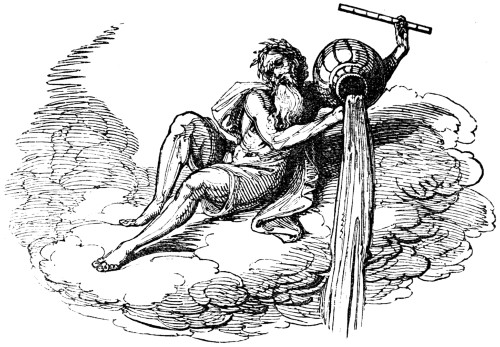
Aquarius, OR, THE WATER BEARER.
The sun enters Aquarius on this day, though he does not enter it in the visible zodiac until the 18th of February.
Ganymede, who succeeded Hebe as cup-bearer to Jove, is fabled to have been changed into Aquarius. Canobus of the Egyptian zodiac, who was the Neptune of the Egyptians, with a water-vase and measure, evidently prefigured this constellation. They worshipped him as the God of many breasts, from whence he replenished the Nile with fertilizing streams. Aquarius contains one hundred and eight stars, the two chief of which are about fifteen degrees in height:
His head, his shoulders, and his lucid breast, Glisten with stars; and when his urn inclines, Rivers of light brighten the watery track.
Eudosia.
January 21.
St. Agnes. St Fructuosus, &c. St. Vimin, or Vivian. St. Publius. St. Epiphanius.
St. Agnes.
“She has always been looked upon,” says Butler, “as a special patroness of purity, with the immaculate mother of God.” According to him, she suffered martyrdom, about 304, and performed wonderful miracles before her death, which was by beheading, when she was thirteen years old; whereupon he enjoins females to a single life, as better than a married one, and says, that her anniversary “was formerly a holiday for the women in England.” Ribadeneira relates, that she was to have been burned, and was put into the fire for that purpose, but the flames, refusing to touch her, divided on each side, burnt some of the bystanders, and then quenched, as if there had been none made: a compassionate quality in fire, of which iron was not sensible, for her head was cut off at a single blow. Her legend further relates, that eight days after her death she came to her parents arrayed in white, attended by virgins with garlands of pearls, and a lamb whiter than snow; she is therefore usually represented by artists with a lamb by her side; though not, as Mr. Brand incautiously says, “in every graphic representation.” It is further related, that a priest who officiated in a church dedicated to St. Agnes, was very desirous of being married. He prayed the pope’s license, who gave it him, together with an emerald ring, and commanded him to pay his addresses to the image of St. Agnes in his own church. Then the priest did so, and the image put forth her finger, and he put the ring thereon; whereupon the image drew her finger again, and kept the ring fast, and the priest was contented to remain a bachelor; “and yet, as it is sayd, the rynge is on the fynger of the ymage.”
In a Romish Missal printed at Paris, in 1520, there is a prayer to St. Agnes, remarkably presumptive of her powers; it is thus englished by Bp. Patrick:
Agnes, who art the Lamb’s chaste spouse, Enlighten thou our minds within; Not only lop the spreading boughs. But root out of us every sin. O, Lady, singularly great, After this state, with grief opprest Translate us to that quiet seat Above, to triumph with the blest.
From Naogeorgus, we gather that in St. Agnes’ church at Rome, it was customary on St. Agnes’ Day to bring two snow-white lambs to the altar, upon which they were laid while the Agnus was singing by way of offering. These consecrated animals were afterwards shorn, and palls made from their fleeces; for each of which, it is said, the pope exacted of the bishops from eight to ten, or thirty thousand crowns, and that the custom originated with Limes, who succeeded the apostle Peter: whereupon Naogeorgus inquires,
But where was Agnes at that time? who offred up, and how, The two white lambes? where then was Masse, as it is used now? Yea, where was then the Popish state, and dreadfull monarchee? Sure in Saint Austen’s time, there were no palles at Rome to see, &c.
In Jephson’s “Manners, &c. of France and Italy,” there is one dated from Rome, February, 14, 1793. That this ceremony was then in use, is evident from the following lines:—
St. Agnes’ Shrine.
Where each pretty Ba-lamb most gaily appears, With ribands stuck round on its tail and its ears; On gold fringed cushions they’re stretch’d out to eat, And piously ba, and to church-musick bleat; Yet to me they seem’d crying, alack, and alas! What’s all this white damask to daisies and grass? Then they’re brought to the Pope, and with transport they’re kiss’d, And receive consecration from Sanctity’s fist.
Blessing of Sheep.
Stopford, in “Pagano-Papismus,” recites this ceremony of the Romish church. The sheep were brought into the church, and the priest, having blessed some salt and water, read in one corner this gospel, “To us a child is born,” &c. with the whole office, a farthing being laid upon the book, and taken up again; in the second corner he read this gospel, “Ye men of Galilee,” &c. with the whole office, a farthing being laid upon the book, and taken up again; in the third corner he read this gospel, “I am the good shepherd,” &c. with the whole office, a farthing being laid upon the book, and taken up again; and in the fourth corner he read this gospel, “In these days,” &c. with the whole office, a farthing being laid upon the book, and taken up again. After that, he sprinkled all the sheep with holy water, saying, “Let the blessing of God, the Father Almighty, descend and remain upon you; in the name of the Father, and of the Son, and of the Holy Ghost. Amen.” Then he signed all the sheep with the sign of the cross, repeated thrice some Latin verses, with the Paternoster and Ave-Marias, sung the mass of the Holy Ghost, and at the conclusion, an offering of fourpence was for himself, and another of threepence was for the poor. This ceremony was adopted by the Romish church from certain customs of the ancient Romans, in their worship of Pales, the goddess of sheepfolds and pastures. They prayed her to bless the sheep, and sprinkled them with water. The chief difference between the forms seems to have consisted in this, that the ancient Romans let the sheep remain in their folds, while the moderns drove them into the church.
FLORAL DIRECTORY.
St. Agnes. Christmas Rose. Helleborus niger flore albo.
THE CROCUS.
Dainty young thing Of life!—Thou vent’rous flower, Who growest through the hard, cold bower Of wintry Spring:— Thou various-hued, Soft, voiceless bell, whose spire Rocks in the grassy leaves like wire In solitude:— Like Patience, thou Art quiet in thy earth. Instructing Hope that Virtue’s birth Is Feeling’s vow. Thy fancied bride! The delicate Snowdrop, keeps Her home with thee; she wakes and sleeps Near thy true side. Will Man but hear! A simple flower can tell What beauties in his mind, should dwell Through Passion’s sphere.
J. R. Prior.
Chronology.
1793. On the 21st of January, Louis XVI. was beheaded at Paris, in the thirty-ninth year of his age, and nineteenth of his reign, under circumstances which are in the recollection of many, and known to most persons. A similar instrument to the guillotine, the machine by which Louis XVI. was put to death, was formerly used in England. It was first introduced into France, during the revolution, by Dr. Guillotine, a physician, and hence its name.
THE HALIFAX GIBBET AND GIBBET-LAW.
The History of Halifax in Yorkshire, 12mo. 1712, sets forth “a true account of their ancient, odd, customary gibbet-law; and their particular form of trying and executing of criminals, the like not us’d in any other place in Great Britain.” The Halifax gibbet was in the form of the guillotine, and its gibbet-law quite as remarkable. The work referred to, which is more curious than rare, painfully endeavours to prove this law wise and salutary. It prevailed only within the forest of Hardwick, which was subject to the lord of the manor of Wakefield, a part of the duchy of Lancaster. If a felon were taken within the liberty of the forest with cloth, or other commodity, of the value of thirteen-pence halfpenny, he was, after three market-days from his apprehension and condemnation, to be carried to the gibbet, and there have his head cut off from his body. When first taken, he was brought to the lord’s bailiff in Halifax, who kept the town, had also the keeping of the axe, and was the executioner at the gibbet. This officer summoned a jury of frith-burghers to try him on the evidence of witnesses not upon oath: if acquitted, he was set at liberty, upon payment of his fees; if convicted, he was set in the stocks on each of the three subsequent market-days in Halifax, with the stolen goods on his back, if they were portable; if not, they were placed before his face. This was for a terror to others, and to engage any who had aught against him, to bring accusations, although after the three market-days he was sure to be executed for the offence already proved upon him. But the convict had the satisfaction of knowing, that after he was put to death, it was the duty of the coroner to summon a jury, “and sometimes the same jury that condemned him,” to inquire into the cause of his death, and that a return thereof would be made into the Crown-office; “which gracious and sage proceedings of the coroner in that matter ought, one would think, to abate, in all considering minds, that edge of acrimony which hath provoked malicious and prejudiced persons to debase this laudable and necessary custom.” So says the book. In April, 1650, Abraham Wilkinson and Anthony Mitchell were found guilty of stealing nine yards of cloth and two colts, and on the 30th of the month received sentence, “to suffer death, by having their heads severed and cut off from their bodies at Halifax gibbet,” and they suffered accordingly. These were the last persons executed under Halifax gibbet-law.
The execution was in this manner:—The prisoner being brought to the scaffold by the bailiff, the axe was drawn up by a pulley, and fastened with a pin to the side of the scaffold. “The bailiff, the jurors, and the minister chosen by the prisoner, being always upon the scaffold with the prisoner, in most solemn manner, after the minister had finished his ministerial office and christian duty, if it was a horse, an ox, or cow, &c. that was taken with the prisoner, it was thither brought along with him to the place of execution, and fastened by a cord to the pin that stay’d the block, so that when the time of the execution came, (which was known by the jurors holding up one of their hands,) the bailiff, or his servant, whipping the beast, the pin was pluck’d out, and execution done; but if there were no beast in the case, then the bailiff, or his servant, cut the rope.”
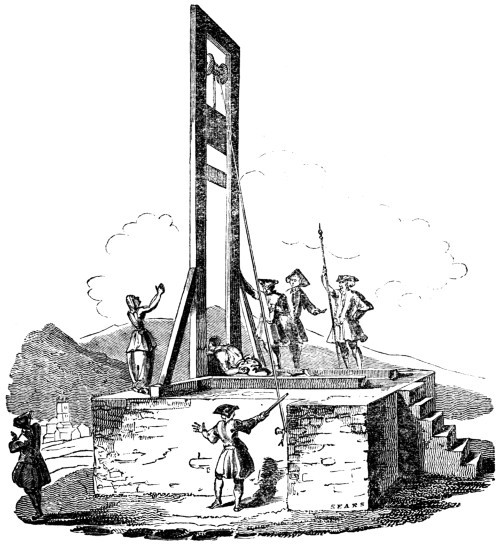
The Halifax Gibbet.
But if the felon, after his apprehension, or in his going to execution, happened to make his escape out of the forest of Hardwick, which liberty, on the east end of the town, doth not extend above the breadth of a small river; on the north about six hundred paces; on the south about a mile; but on the west about ten miles;—if such an escape were made, then the bailiff of Halifax had no power to apprehend him out of his liberty; but if ever the felon came again into the liberty of Hardwick, and were taken, he was certainly executed. One Lacy, who made his escape, and lived seven years out of the liberty, after that time coming boldly within the liberty of Hardwick, was retaken, and executed upon his former verdict of condemnation.
The records of executions by the Halifax gibbet, before the time of Elizabeth, are lost; but during her reign twenty-five persons suffered under it, and from 1623 to 1650 there were twelve executions. The machine is destroyed. The engraving placed above, represents the instrument, from a figure of it in an old map of Yorkshire, which is altogether better than the print of it in the work before cited.
The worthy author of the Halifax gibbet-book seems by his title to be well assured, that the machine was limited to, and to the sole use and behoof of, his district; but in this, as in some other particulars, he is mistaken.
A small print by Aldegraver, one of the little German masters, in 1553, now lying before the writer, represents the execution of Manlius, the Roman, by the same instrument; and he has a similar print by Pens, an early engraver of that school. There are engravings of it in books printed so early as 1510. In Hollinshed’s Chronicle there is a cut of a man who had attempted the life of Henry III. suffering by this instrument. In Fox’s “Acts and Monuments,” there is another execution in the same manner.
The “maiden” by which James, earl of Morton, the regent of Scotland, was put to death for high treason in 1581, was of this form, and is said to have been constructed by his order from a model of one that he had seen in England: he was the first and last person who suffered by it in Scotland; and it still exists in the parliament-house at Edinburgh. In “The Cloud of Witnesses; or the last Speeches of Scottish Martyrs since 1680,” there is a print of an execution in Scotland by a similar instrument. The construction of such a machine was in contemplation for the beheading of lord Lovat in 1747: he approved the notion—“My neck is very short,” he said, “and the executioner will be puzzled to find it out with his axe: if they make the machine, I suppose they will call it lord Lovat’s maiden.”
Randle Holme in his “Armory” describes an heraldic quartering thus:—“He beareth gules, a heading-block fixed between two supporters, with an axe placed therein; on the sinister side a maule, all proper.” This agreeable bearing he figures as the reader sees it.
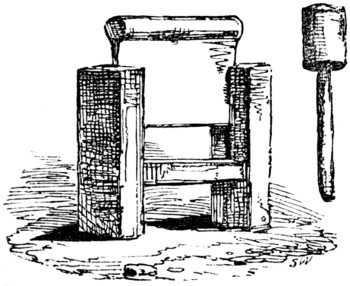
Holme observes, that “this was the Jews’ and Romans’ way of beheading offenders, as some write, though others say they used to cut off the heads of such, with a sharp, two-handed sword: however, this way of decollation was by laying the neck of the malefactor on the block, and then setting the axe upon it, which lay in a rigget in the two side-posts or supporters; the executioner with the violence of a blow on the head of the axe, with his heavy maul, forced it through the man’s neck into the block. I have seen the draught of the like heading-instrument, where the weighty axe (made heavy for that purpose) was raised up and fell down in such a riggetted frame, which being suddenly let to fall, the weight of it was sufficient to cut off a man’s head at one blow.”
THE SEASON.
Remarkable instances of the mildness of January, 1825, are recorded in the provincial and London journals. In the first week a man planting a hedge near Mansfield, in Yorkshire, found a blackbird’s nest with four young ones in it. The Westmoreland Gazette states, that on the 13th a fine ripe strawberry was gathered in the garden of Mr. W. Whitehead, Storth End, near End-Moor, and about the same time a present of the same fruit was made by Thomas Wilson, Esq. Thorns, Underbarrow, to Mr. Alderman Smith Wilson, some of them larger in bulk than the common hazel-nut. Indeed the forwardness of the season in the north appears wonderful. It is stated in the Glasgow Chronicle of the 11th, that on the 7th, bees were flying about in the garden of Rose-mount; on the 9th, the sky was without a cloud; there was scarcely a breath of wind, the blackbirds were singing as if welcoming the spring; pastures wore a fine, fresh, and healthy appearance; the wheat-braird was strong, thick in the ground, and nearly covering the soil; vegetation going on in the gardens; the usual spring flowers making their appearance; the Christmas rose, the snowdrop, the polyanthea, the single or border anemone, the hepatica in its varieties, and the mazerion were in full bloom; the Narcissus making its appearance, and the crocusses showing colour. On the 11th, at six o’clock, the thermometer in Nelson-street, Glasgow, indicated 44 degrees; on the 9th, the barometer gained the extraordinary height of 31·01; on the 11th, it was at 30·8. The Sheffield Mercury represents, that within six or seven weeks preceding the middle of the month, the barometer had been lower and higher than had been remarked by any living individual in that town. On the 23d of November it was so low as 27·5; and on the 9th of January at 11 P. M. it stood at 30·65. In the same place the following meteorological observations were made:
January, 1825.
THERMOMETER.
TEN O’CLOCK A. M. DO. P. M.
11th 42 38
12th 43 37
13th 44 40
14th 44 43
BAROMETER.
TEN O’CLOCK A. M. DO. P. M.
11th 30 ·4 30 ·3
12th 30 ·3 30 ·2
13th 30 ·5 29 ·9
14th 29 ·5 29 ·7
At Paris, in the latter end of 1824, the barometer was exceedingly high, considering the bad weather that had prevailed, and the moisture of the atmosphere. There had been almost constant and incessant rain. The few intervals of fair weather, were when the wind got round a few points to the west, or the northward of west: but invariably, a few hours after, the wind again got to the southwest, and the rain commenced falling. It appeared as if a revolution had taken place in the laws of the barometer. The barometer in London was at 30·48 in May, 1824, and never rose higher during the whole year.
January 22.
St. Vincent. St. Anastasius.
St. Vincent was a Spanish martyr, said to have been tormented by fire, so that he died in 304. His name is in the church of England calendar. Butler affirms that his body was “thrown in a marshy field among rushes, but a crow defended it from wild beasts and birds of prey.” The Golden Legend says that angels had the guardianship of the body, that the crow attended to drive away birds and fowls greater than himself, and that after he had chased a wolf with his bill and beak, he then turned his head towards the body, as if he marvelled at the keeping of it by the angels. His relics necessarily worked miracles wherever they were kept. For their collection, separation, and how they travelled from place to place, see Butler.
Brand, from a MS. note by Mr. Douce, referring to Scot’s “Discoverie of Witchcraft,” cites an old injunction to observe whether the sun shines on St. Vincent’s-day:
“Vincenti festo si Sol radiet memor este.”
It is thus done into English by Abraham Fleming:
Remember on St. Vincent’s day If that the sun his beams display
Dr. Forster, in the “Perennial Calendar,” is at a loss for the origin of the command, but he thinks it may have been derived from a notion that the sun would not shine unominously on the day whereon the saint was burnt.
Chronology.
1800.—On the 22d of January, in this year, died George Steevens, Esq. F. R. S. F. A. S. He was born at Stepney, in 1751 or 1752, and is best known as the editor of Shakspeare, though to the versatility and richness of his talents there are numerous testimonials. He maintained the greatest perseverance in every thing he undertook. He never relaxed, but sometimes broke off favourite habits of long indulgence suddenly. In this way he discontinued his daily visits to two booksellers. This, says his biographer in the Gentleman’s Magazine, he did “after many years’ regular attendance, for no real cause.” It is submitted, however, that the cause, though unknown to others may have been every way sufficing and praiseworthy. He who has commenced a practice that has grown into a destroyer of his time and desires to end it, must snap it in an instant. If he strive to abate it by degrees, he will find himself relaxing by degrees.
“Delusions strong as hell will bind him fast,” unless he achieve, not the determination to destroy, but the act of destruction. The will and the power are two. Steevens knew this, and though he had taken snuff all his life, he never took one pinch after he lost his box in St. Paul’s church-yard. Had he taken one he might have taken one more, and then only another, and afterwards only a little bit in a paper, and then, he would have died as he lived—a snuff-taker. No; Steevens appears to have discovered the grand secret, that a man’s self is the great enemy of himself, and hence his intolerance of self-indulgence even in degree.
His literary collections were remarkably curious, and as regards the days that are gone, of great value.
FLORAL DIRECTORY.
St. Vincent. Early Witlow grass. Draba verna.
January 23.
HILARY TERM begins.
St. Raymund of Pennafort, A. D. 1275. St. John the Almoner, A. D. 619. St. Emerentia, A. D. 304. St. Clement of Ancyra. St. Agathangelus. St. Ildefonsus, A. D. 667. St. Eusebius, Abbot.
This being the first day of term, the judges of the different courts at Westminster, take their seats in Westminster-hall to commence business.
The engraving represents the interior of the hall at the time when the print from whence it is taken was engraved by C. Mosley. The drawing was by Gravelot, who died in 1773.
Westminster Hall, with its Shops.
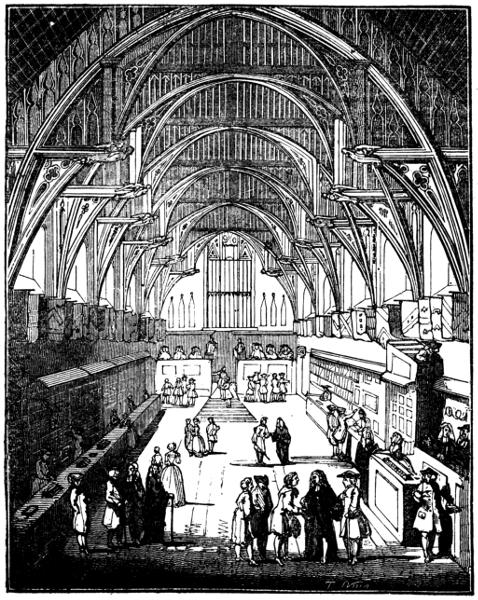
Westminster Hall, with its Shops.
The shops within the hall are remarkably curious from their situation, and indeed the courts themselves are no less worthy of observation. It will be recollected that the court of Chancery and the court of King’s Bench, at the upper end were, until the coronation, enclosed from sight and hearing; in the print they are open. This is the print alluded to in the volume on “Ancient Mysteries,” p. 266, wherein is cited Ned Ward’s remarks respecting the sempstresses, by whom some of these shops were occupied.
It is of ancient custom on the first day of term for the judges to breakfast with the lord chancellor in Lincoln’s-inn-hall, and proceed with him in their respective carriages to Westminster-hall. Being arrived at the hall door in Palace-yard, and having alighted with their officers and train bearers, they formed a procession along the hall until they came opposite to the court of Common Pleas, before which stood the serjeants at law, who had previously arranged themselves in their full dress wigs and gowns, and awaited the coming of the judges, who were also in their full dress. Then the serjeants all bowed, and their obeisance being acknowledged by the judges in like manner, the lord chancellor, being first, approached the first serjeant in the rank, and shook hands with him, saying, “How d’ye do, brother? I wish you a good term;” whereupon the serjeant bowed and thanked his lordship, and the chancellor bowing to him, the serjeant again bowed; and the chancellor saluted and shook hands with the next serjeant in like manner, and so he did with each serjeant present, and then proceeded with his officers to his court. The lord chief justice of England and each of the puisne judges of the court of King’s Bench, saluting and shaking hands with each serjeant in the same manner, followed the chancellor and went into their court. In the same manner also did the chief justice and puisne judges of the court of Common Pleas, and entered their court at the back of the serjeants. Lastly, the lord chief baron and the puisne barons of the Exchequer, having also so saluted the serjeants, returned back and entered the court of Exchequer, which is at the right hand immediately on entering the hall; the entrance to the court of Common Pleas being about midway on the same side of the hall, whither, on the barons having retired, the serjeants withdrew to commence business before the judges. The site of the court of Chancery is on the same side up the steps at the end of the hall, and that of the court of King’s Bench level with it on the left-hand side. It is to be noted, that one judge does not salute the serjeants before the rest of the judges begin to salute them, but each follows the other. Thus whilst the chancellor is saluting the second serjeant the lord chief justice salutes the first, and he salutes the second while the chancellor salutes the third, the next judge of the King’s Bench court saluting the first serjeant; and so the judges proceed successively, and close to each other, till all the serjeants have been saluted. It is further observable, that more extended greetings sometimes pass between the judges and serjeants who are intimate.
In 1825, the 23d of January, whereon Hilary term commences, happening on a Sunday, which is a dies non, or no day in law, the courts were opened on the 24th, when the judges refreshed themselves in Lincoln’s-inn-hall with the lord chancellor, as usual, and departed at half-past twelve o’clock. On retiring, sir Charles Abbot, as lord chief justice, took precedence of lord Gifford, the master of the rolls, though he ranks as a baron of the realm, and is deputy speaker of the house of lords. The court of Chancery in Westminster-hall being under reparation, the chancellor remained in Lincoln’s-inn to keep his term there. For the same reason, the serjeants did not range themselves in the hall at Westminster, but awaited the arrival of the judges of the Common Pleas in their own court; the carriages of the judges of the King’s Bench turned to the right at the top of Parliament-street, and proceeded to the new Sessions’ house, where the judges sit until the new court of King’s Bench in Westminster-hall shall be prepared.
It is further to be remarked, that the Side Bar in Westminster-hall stood, till very lately, within a short space of the wall, and at a few feet on the Palace-yard side of the court of Common Pleas’ steps. Formerly, attorneys stood within this bar every morning during term, and moved the judges for the common rules, called side-bar rules, as they passed to their courts, and by whom they were granted them as of course. These motions have been long discontinued; the rules are applied for and obtained at the rule-office as rules of course; but each rule still expresses that it has been granted upon a “side-bar” motion.
To recur to the engraving, which exhibits Westminster-hall at no distant period, in a state very dissimilar to its more late appearance. The original print by Mosley bears the following versified inscription:
When fools fall out, for ev’ry flaw, They run horn mad to go to law, A hedge awry, a wrong plac’d gate, Will serve to spend a whole estate, Your case the lawyer says is good, And justice cannot be withstood; By tedious process from above From office they to office move; Thro’ pleas, demurrers, the dev’l and all, At length they bring it to the hall; The dreadful hall by Rufus rais’d, For lofty Gothick arches prais’d. The First of Term, the fatal day, Doth various images convey; First from the courts with clam’rous bawl The criers their attorneys call; One of the gown, discreet and wise, By proper means his witness tries; From Wreathock’s gang—not right or laws H’assures his trembling client’s cause; This gnaws his handkerchief, whilst that Gives the kind ogling nymph his hat; Here one in love with choiristers Minds singing more than law affairs. A serjeant limping on behind Shews justice lame, as well as blind. To gain new clients some dispute, Others protract an ancient suit, Jargon and noise alone prevail, While sense and reason’s sure to fail; At Babel thus law terms began, And now at Westm——er go on.
The advocate, whose subornation of perjury is hinted at, is in the foremost group; he is offering money to one of “Wreathock’s gang.” This Wreathock was a villainous attorney, who received sentence of death for his criminal practices, and was ordered to be transported for life in 1736. It is a notorious fact, that many years ago wretches sold themselves to give any evidence, upon oath, that might be required; and some of these openly walked Westminster-hall with a straw in the shoe to signify that they wanted employment as witnesses; such was one of the customs of the “good old times,” which some of us regret we were not born in. The “choirister” in a surplice, bearing a torch, was probably one of the choir belonging to Westminster-abbey. To his right hand is the “limping serjeant” with a stick; his serjeantship being denoted by the coif, or cap, he wears; the coif is now diminished into a small circular piece of black silk at the top of the wig, instead of the cap represented in the engraving. The first shop, on the left, is occupied by a bookseller; the next by a mathematical instrument maker; then there is another bookseller; beyond him a dealer in articles of female consumption; beyond her a bookseller again; and, last on that side, a second female shopkeeper. Opposite to her, on the right of the hall, stands a clock, with the hands signifying it to be about one in the afternoon; the first shop, next from the clock, is a bookseller’s; then comes a female, who is a map and printseller; and, lastly, the girl who receives the barrister’s hat into her care, and whose line appears to sustain the “turnovers” worn by the beaus of those days with “ruffles,” which, according to Ned Ward, the sempstresses of Westminster-hall nicely “pleated,” to the satisfaction of the “young students” learned in the law.
Enough has, probably, been said of the engraving, to obtain regard to it as an object worth notice.
The first day of term is occupied, in the common law courts, by the examination of bail for persons who have been arrested, and whose opponents will not consent to the bail justifying before a judge at his chambers. A versified exemplification of this proceeding in the court of King’s Bench, was written when lord Mansfield was chief, and Mr. Willes a justice of the court; a person named Hewitt was then cryer, Mr. Mingay, a celebrated counsel, still remembered, is represented as opposing the bail proposed by Mr. Baldwin, another counsel:
KING’S-BENCH PRACTICE. CHAP. 10. OF JUSTIFYING BAIL.
Baldwin. Hewitt, call Taylor’s bail,—for I Shall now proceed to justify. Hewitt. Where’s Taylor’s bail? 1st Bail.————————— I can’t get in. Hewitt. Make way. Lord Mansfield.—— For heaven’s sake begin. Hewitt. But where’s the other? 2d Bail.————————— Here I stand. Mingay. I must except to both.—Command Silence,—and if your lordship crave it, Austen shall read our affidavit. Austen. Will. Priddle, late of Fleet-street, gent. Makes oath and saith, that late he went To Duke’s-place, as he was directed By notice, and he there expected To find both bail—but none could tell Where the first bail lived— Mingay.———————Very well. Austen. And this deponent further says, That, asking who the second was, He found he’d bankrupt been, and yet Had ne’er obtained certificate. When to his house deponent went, He full four stories high was sent, And found a lodging almost bare; No furniture, but half a chair, A table, bedstead, broken fiddle And a bureau. (Signed) William Priddle. Sworn at my chambers. Francis Buller. Mingay. No affidavit can be fuller. Well, friend, you’ve heard this affidavit, What do you say? 2d Bail.———Sir, by your leave, it Is all a lie. Mingay. Sir, have a care, What is your trade? 2d Bail.———— A scavenger. Mingay. And, pray, sir, were you never found Bankrupt? 2d Bail. I’m worth a thousand pound. Mingay. A thousand pound, friend, boldly said— In what consisting? 2d Bail.————Stock in trade. Mingay. And, pray, friend, tell me,—do you know What sum you’re bail for? 2d Bail.—————— Truly no. Mingay. My lords, you hear,—no oaths have check’d him: I hope your lordships will— Willes.———————— Reject him. Mingay. Well, friend, now tell me where you dwell. 1st Bail. Sir, I have liv’d in Clerkenwell These ten years. Mingay.—— Half-a-guinea dead. (Aside.) My lords, if you’ve the notice read, It says Duke’s-place. So I desire A little further time t’ inquire. Baldwin. Why, Mr. Mingay, all this vapour? Willes. Take till to morrow. Lord Mansfield.———— Call the paper.
The preceding pleasantry came from the pen of the late John Baynes, Esq. a Yorkshire gentleman, who was born in April, 1758, educated for the law at Trinity college, Cambridge, obtained prizes for proficiency in philosophy and classical attainments, was admitted of Gray’s-inn, practised in his profession, and would probably have risen to its first honours. Mr. Nichols says “his learning was extensive; his abilities great; his application unwearied; his integrity unimpeached. In religious principles he was an Unitarian Christian and Protestant; in political principles the friend of the civil liberties of mankind, and the genuine constitution of his country. He died August 4, 1787, and was buried on the 9th in Bunhill-fields’ burying-ground, near to the grave of Dr. Jebb,” his tutor at college: “the classical hand of Dr. Parr” commemorated him by an epitaph.
One of the best papers in Mr. Knight’s late “Quarterly Magazine,” of good articles, is so suitable to this day, legally considered, that any one sufficiently interested to sympathize with “the cares and the fears” of a young lawyer, or, indeed, any one who dares to admit that a lawyer may have bowels, as well as an appetite, will suffer the Confessions of a Barrister to be recorded here.
MY FIRST BRIEF
“A lawyer,” says an old comedy which I once read at the British Museum, “is an odd sort of fruit—first rotten—then green—and then ripe.” There is too much of truth in the homely figure. The first years of a young barrister are spent, or rather worn out, in anxious leisure. His talents rust, his temper is injured, his little patrimony wastes away, and not an attorney shows a sign of remorse. He endures term after term, and circuit after circuit, that greatest of all evils—a rank above his means of supporting it. He drives round the country in a post-chaise, and marvels what Johnson found so exhilarating in its motion—that is, if he paid for it himself. He eats venison, and drinks claret; but he loses the flavour of both when he reflects that his wife (for the fool is married, and married for love too!) has perhaps just dined for the third time on a cold neck of mutton, and has not tasted wine since their last party—an occurrence beyond even legal memory. He leaves the festive board early, and takes a solitary walk—returns to his lodgings in the twilight, and sees on his table a large white rectangular body, which for a moment he supposes may be a brief—alas! it is only a napkin. He is vexed, and rings to have it removed, when up comes his clerk, who is drunk and insolent: he is about to kick him down stairs, but stays his foot on recollecting the arrears of the fellow’s wages; and contents himself with wondering where the fellow finds the means of such extravagance.—Then in court many are the vexations of the briefless.—The attorney is a cruel person to them—as cruel as a rich coxcomb in a ball-room, who delights in exciting hopes only to disappoint them. Indeed I have often thought the communications between the solicitors and the bar have no slight resemblance to the flirtation between the sexes. Barristers, like ladies, must wait to be chosen. The slightest overture would be equally fatal to one gown as the other. The gentlemen of the bar sit round the table in dignified composure, thinking just as little of briefs as a young lady of marriage. An attorney enters—not an eye moves; but somehow or other, the fact is known to all. Calmly he draws from his pocket a brief: practice enables us to see at a glance that the tormentor has left a blank for the name of his counsel. He looks around the circle as if to choose his man; you cannot doubt but his eye rests on you; he writes a name, but you are too far off to read it, though you know every name on your circuit upside down. Now he counts out the fee, and wraps it up with slow and provoking formality. At length all being prepared, he looks towards you to catch (as you suppose) your eye. You nod, and the brief comes flying; you pick it up, and find on it the name of a man three years your junior, who is sitting next you: you curse the attorney’s impudence, and ask yourself if he meant to insult you.—“Perhaps not,” you say, “for the dog squints.”—I received my maiden brief in London. How well do I recollect the minutest circumstances connected with that case! The rap at the door! I am a connoisseur in raps—there is not a dun in London who could deceive me: I know their tricks but too well; they have no medium between the rap servile, and the rap impudent. This was a cheerful touch; you felt that the operator knew he should meet with a face of welcome. My clerk, who is not much under the influence of sweet sounds, seemed absolutely inspired, and answered the knock with astonishing velocity. I could hear from my inner room the murmur of inquiry and answer; and though I could not distinguish a word,—the tones confirmed my hopes;—I was not long suffered to doubt—my client entered, and the roll of pure white paper tied round with the brilliant red tape, met my eye. He inquired respectfully, and with an appearance of anxiety, which marked him to my mind for a perfect Chesterfield, if I was already retained in —— v. ——? The rogue knew well enough that I had never had a retainer in my life. I took a moment to consider; after making him repeat the name of his case, I gravely assured him I was at perfect liberty to receive his brief. He then laid the papers and my fee upon the table; asked me if the time appointed for a consultation with the two gentlemen who were “with me” would be convenient; and finding that the state of my engagements would allow me to attend, made his bow and departed. That fee was sacred, and I put it to no vulgar use. Many years have now elapsed since that case was disposed of, and yet how fresh does it live in my memory! how perfectly do I recollect every authority to which he referred! how I read and re-read the leading cases that bore upon the question to be argued! One case I so bethumbed that the volume has opened at it ever since, as inevitably as the prayer-book of a lady’s maid proffers the service of matrimony. My brief related to an argument before the judges of the King’s Bench, and the place of consultation was Ayles’s coffee-house, adjoining Westminster-hall. There was I before the clock had finished striking the hour; my brief I knew by heart. I had raised an army of objections to the points for which we were to contend, and had logically slain every one of them. I went prepared to discuss the question thoroughly; and I generously determined to give my leaders the benefit of my cogitations—though not without a slight struggle at the thought of how much reputation I should lose by my magnanimity. I had plenty of time to think of these things, for my leaders were engaged in court, and the attorney and I had the room to ourselves. After we had been waiting about an hour, the door flew open, and in strode one of my leaders, the second in command, less in haste (as it appeared to me) to meet his appointment, than to escape from the atmosphere of clients in which he had been just enveloped, during his passage from the court.—Having shaken off his tormentors, Mr. —— walked up to the fire—said it was cold—nodded kindly to me—and had just asked what had been the last night’s division in the house—when the powdered head of an usher was protruded through the half open door to announce that “Jones and Williams was called on.” Down went the poker, and away flew —— with streaming robes, leaving me to meditate on the loss which the case would sustain for want of his assistance at the expected discussion. Having waited some further space, I heard a rustling of silks, and the great ——, our commander in chief, sailed into the room. As he did not run foul of me, I think it possible I may not have been invisible to him; but he furnished me with no other evidence of the fact. He simply directed the attorney to provide certain additional affidavits, tacked about and sailed away. And thus ended the first consultation. I consoled myself with the thought that I had all my materials for myself, and that from having had so much more time for considering the subject than the others, I must infallibly make the best speech of the three. At length the fatal day came. I never shall forget the thrill with which I heard —— open the case, and felt how soon it would be my turn to speak. O, how I did pray for a long speech! I lost all feeling of rivalry; and would gladly have given him every thing that I intended to use myself, only to defer the dreaded moment for one half-hour. His speech was frightfully short, yet, short as it was, it made sad havoc with my stock of matter. The next speaker’s was even more concise, and yet my little stock suffered again severely. I then found how experience will stand in the place of study. These men could not, from the multiplicity of their engagements, have spent a tithe of the time upon the case which I had done: and yet they had seen much which had escaped my research. At length my turn came. I was sitting among the back rows in the old court of King’s Bench. It was on the first day of Michaelmas term, and late in the evening. A sort of “darkness visible” had been produced by the aid of a few candles dispersed here and there. I arose, but I was not perceived by the judges, who had turned together to consult, supposing the argument finished. B—— was the first to see me, and I received from him a nod of kindness and encouragement which I hope I shall never forget. The court was crowded, for it was a question of some interest; it was a dreadful moment—the ushers stilled the audience into awful silence. I began, and at the sound of an unknown voice, every wig of the white inclined plane, at the upper end of which I was standing, turned round; and in an instant I had the eyes of seventy “learned friends” looking me full in the face! It is hardly to be conceived by those who have not gone through the ordeal, how terrific is this mute attention to the object of it. How grateful should I have been for any thing which would have relieved me from its oppressive weight—a buzz, a scraping of the shoes, or a fit of coughing, would have put me under infinite obligations to the kind disturber. What I said I know not; I knew not then; it is the only part of the transaction of which I am ignorant; it was “a phantasma, or hideous dream.” They told me, however, to my great surprise, that I spoke in a loud voice; used violent gesture, and as I went along seemed to shake off my trepidation. Whether I made a long speech or a short one I cannot tell; for I had no power of measuring time. All I know is, that I should have made a much longer one, had I not felt my ideas, like Bob Acre’s courage, oozing out of my fingers’ ends. The court decided against us, erroneously as I of course thought, for the young advocate is always on the right side. The next morning I got up early to look at the newspapers, which I expected to see full of our case. In an obscure corner, and in a small type, I found a few words given as the speeches of my leaders: and I also read that “Mr. —— followed on the same side.”
LEGAL GLEE.
It is affirmed of sir William Blackstone, that so often as he sat down to the composition of his Commentaries on the Laws of England, he always ordered a bottle of wine wherewith to moisten the dryness of his studies; and in proof that other professional men sometimes solace their cares by otherwise disporting themselves, there is a kind of catch, the words of which, having reference to their art or mystery, do so marvellously inspire them, that they chant it with more glee than gravity, to a right merry tune:—
A woman having settlement, Married a man with none; The question was, he being dead If that she had was gone? Quoth sir John Pratt, her settlement Suspended did remain, Living the husband—but, him dead, It doth revive again. CHORUS OF PUISNE JUDGES. Living the husband—but, him dead, It doth revive again.
FLORAL DIRECTORY.
Peziza. Peziza acetabulum.
January 24.
St. Timothy, disciple of St. Paul. St. Babylas, A. D. 250. St. Suranus, 7th century. St. Macedonius. St. Cadoc, of Wales.
Chronology.
1721. On the 24th of January in this year, the two houses of parliament ordered several of the directors of the South Sea company into the custody of the usher of the black rod and serjeant at arms: this was in consequence of a parliamentary inquiry into the company’s affairs, which had been so managed as to involve persons of all ranks throughout the kingdom in a scene of distress unparalleled by any similar circumstance in English annals.
SOUTH SEA BUBBLE.
In 1711, the ninth year of queen Anne’s reign, a charter of incorporation was granted to a company trading to the South Seas; and the South Sea company’s affairs appeared so prosperous, that, in 1718, king George I. being chosen governor, and a bill enabling him to accept the office having passed both houses, on the 3d of February, his majesty in person attended the house of lords, and gave the royal assent to the act. A brief history of the company’s subsequent progress is interesting at any time, and more especially at a period when excess of speculation may endanger private happiness, and disturb the public welfare.
On the 27th of January, 1719, the South Sea company proposed a scheme to parliament for paying off the national debt, by taking into its funds all the debt which the nation had incurred before the year 1716, whether redeemable or irredeemable, amounting in the whole to the sum of 31,664,551l. 1s. 11⁄4d. For this the company undertook to pay to the use of the public the sum of 4,156,306l.; besides four years and a half’s purchase for all the annuities that should be subscribed into its fund, and which, if all subscribed, would have amounted to the sum of 3,567,503l.; amounting, with the above-mentioned sum, to 7,723,809l.: in case all the annuities were not subscribed, the company agreed to pay one per cent, for such unsubscribed annuities.
To this arrangement parliament acceded, and an act was passed to ratify this contract, and containing full powers to the company accordingly. In March following South Sea stock rose from 130 to 300, gradually advanced to 400, declined to 330, and on the 7th of April was at 340. This so encouraged the directors, that on the 12th they opened books at the South Sea house for taking in a subscription for a portion of their stock to the amount of 2,250,000l. every 100l. of which they offered at 300l.: it was immediately subscribed for at that price, to be paid for by nine instalments within twelve months. On the 21st, a general court of the company resolved, that the Midsummer dividend should be 10 per cent., and that the aforesaid subscription, and all other additions to their capital before that time, should be entitled to the said dividend. This gave so favourable a view to the speculation, that on the 28th the directors opened a second subscription for another million of stock, which was presently taken at 400l. for every 100l., and the subscribers had three years allowed them for payment. On the 20th of May, South Sea stock rose to 550. So amazing a price created a general infatuation. Even the more prudent, who had laughed at the folly and madness of others, were seized with the mania; they borrowed, mortgaged, and sold, to raise all the money they could, in order to hold the favourite stock; while a few quietly sold out and enriched themselves. Prodigious numbers of people resorted daily from all parts of the kingdom to ’Change-alley, where the assembled speculators, by their excessive noise and hurry, seemed like so many madmen just escaped from cells and chains. All thoughts of commerce were laid aside for the buying and selling of estates, and traffic in South Sea stock. Some, who had effected sales at high premiums, were willing to pay out the money on real property, which consequently advanced beyond its actual value: cautious landowners justly concluded that this was the time to get money without risk, and therefore sold their property; shortly afterwards they had an opportunity of purchasing more, at less than half the price they had obtained for their own.
On the 2d of June, South Sea stock rose to 890. On the 15th, many persons who accompanied the king on his foreign journey, sold their stock, which suddenly fell; but the directors promising larger dividends, it got up higher than ever. On the 18th they opened books for a third subscription of four millions more stock, at 1000l. for each 100l., and before the end of the month it had advanced to 1100l., between which and 1000l. it fluctuated throughout the month of July. On the 3d of August they proposed to receive subscriptions for all the unsubscribed annuities, and opened books for the purpose during the ensuing week, upon terms which greatly dissatisfied the annuitants, who, confiding in the honour of the directors, had left their orders at the South Sea House, without any previous contract, not doubting but they should be allowed the same terms with the first subscribers. Finding, to their great surprise and disappointment, that, by the directors’ arrangements, they were only to have about half what they expected, many repaired to the South Sea House to get their orders returned; but these being withheld, their incessant applications and reflections greatly affected the stock, insomuch that, on the 22d of the month, at the opening of the books, it fell to 820. The directors then came to the desperate resolution of ordering the books to be shut; and on the 24th they caused others to be opened for a fourth money subscription for another million of their stock, at 1000l. for each 100l., payable by five instalments within two years: this million was subscribed in less than three hours, and bore a premium the same afternoon of 40 per cent. On the 26th the stock, instead of advancing, fell below 830. The directors then thought fit to lend their proprietors 4,000l. upon every 1000l. stock, for six months, at 4 per cent.; but the annuitants becoming very clamorous and uneasy, the directors resolved that 30 per cent. in money should be the half-year’s dividend due at the next Christmas, and that from thence, for twelve years, not less than 50 per cent. in money should be the yearly dividend on their stock. Though this resolution raised the stock to about 800 for the opening of the books, it soon sunk again.
On the 8th of September, the stock fell to 640, on the 9th to 550, and by the 19th it came to 400. On the 23d the Bank of England agreed with the South Sea company to circulate their bonds, &c. and to take their stock at 400 per cent., in lieu of 3,775,000l., which the company was to pay them. When the books were opened at the Bank for taking in a subscription for supporting the public credit, the concourse was at first so great, that it was judged the whole subscription, which was intended for 3,000,000l., would have been filled that day. But the fall of South Sea stock, and the discredit of the company’s bonds, occasioned a run upon the most eminent goldsmiths and bankers, some of whom, having lent great sums upon the stock and other public securities, were obliged to shut up their shops. The Sword-blade company also, who had been hitherto the chief cash-keepers of the South Sea company, being almost drawn of their ready money, were forced to stop payment. All this occasioned a great run upon the Bank. On the 30th South Sea stock fell to 150, and then to 86.
“It is very surprising,” says Maitland, “that this wicked scheme, of French extraction, should have met with encouragement here, seeing that the Mississippi scheme had just before nearly ruined that nation. It is still more surprising, that the people of divers other countries, notwithstanding the direful effects of this destructive scheme before their eyes, yet, as it were, tainted with our frenzy, began to court their destruction, by setting on foot the like projects: which gives room to suspect,” says Maitland, “that those destructive and fatal transactions were rather the result of an epidemical distemper, than that of choice; seeing that the wisest and best of men were the greatest sufferers; many of the nobility, and persons of the greatest distinction, were undone, and obliged to walk on foot; while others, who the year before could hardly purchase a dinner, were exalted in their coaches and fine equipages, and possessed of enormous estates. Such a scene of misery appeared among traders, that it was almost unfashionable not to be a bankrupt: and the dire catastrophe was attended with such a number of self-murders, as no age can parallel.”
Hooke, the historian of Rome, was a severe sufferer by the South Sea bubble. He thus addresses lord Oxford, in a letter dated the 17th of October 1722: “I cannot be said at present to be in any form of life, but rather to live extempore. The late epidemical (South Sea) distemper seized me: I endeavoured to be rich, imagined for a while that I was, and am in some measure happy to find myself at this instant but just worth nothing. If your lordship, or any of your numerous friends, have need of a servant, with the bare qualifications of being able to read and write, and to be honest, I shall gladly undertake any employments your lordship shall not think me unworthy of.”
In 1720, soon after the bursting of the South Sea bubble, a gentleman called late in the evening at the banking-house of Messrs. Hankey and Co. He was in a coach, but refused to get out, and desired that one of the partners of the house would come to him. Having ascertained that it was really one of the principals, and not a clerk, who appeared, he put into his hands a parcel, very carefully sealed up, and desired that it might be laid on one side till he should call again, which would be in the course of a few days. A few days passed away—a few weeks, a few months, but the stranger never returned. At the end of the second or third year, the partners agreed to open this mysterious parcel, in the presence of each other. They found it to contain 30,000l., with a letter, stating that it was obtained by the South Sea speculation, and directing that it should be vested in the hands of three trustees, whose names were mentioned, and the interest appropriated to the relief of the poor, which was accordingly done.
It has been calculated, that the rise on the original South-sea stock of ten millions, and the subsequent advance of the company’s four subscriptions, inflated their capital to nearly three hundred millions. This unnatural procedure raised bank stock from 100l. to 260l. India, from 100l. to 405l. African, from 100l. to 200l. York-buildings’ shares, from 10l. to 305l. Lustring, from 5l. 2s. 6d. to 105l. English copper, from 5l. to 105l. Welch copper, from 4l. 2s. 6d. to 95l. The Royal Exchange Assurance, from 5l. 5s. to 250l. The London Assurance, from 5l. to 175l., to the great injury of the various purchasers at such prices.
The South Sea scheme terminated in the sudden downfall of the directors, whose estates were confiscated by parliament, and the proceeds applied to the relief of many thousands of families, who had been wholly ruined by the speculation. These dupes of overweening folly and misplaced confidence, were further benefited by a remission in their favour of the national claims on certain of the South Sea company’s real assets. The extent of these donations to the sufferers amounted to 40l. per cent. upon the stock standing in their names.
OTHER BUBBLES.
One consequence of the prosperous appearance that the South Sea scheme bore, till within a short period before its failure, was a variety of equally promising and delusive projects. These were denominated bubbles. Alarmed at the destructive issue of the master-bubble, government issued the following manifesto: “The lords justices in council, taking into consideration the many inconveniences arising to the public, from several projects set on foot for raising of joint-stocks for various purposes; and that a great many of his majesty’s subjects have been drawn in to part with their money, on pretence of assurances that their petitions, for patents and charters to enable them to carry on the same, would be granted: to prevent such impositions, their excellencies ordered the said several petitions, together with such reports from the Board of Trade, and from his majesty’s attorney and solicitor general, as had been obtained thereon, to be laid before them; and, after mature consideration thereof, were pleased, by advice of his majesty’s privy-council, to order that the said petitions be dismissed.” The applications thus rejected prayed patents for various fisheries, for building ships to let or freight, for raising hemp, flax, and madder, for making of sail-cloth, for fire-assurances, for salt-works, for the making of snuff in Virginia, &c.
In defiance of this salutary order, the herd of projectors, with an audacity that passed on the credulous for well-grounded confidence, continued their nefarious traffic. Proclamations from the king, and even acts of parliament, were utterly disregarded; and companies which had been established by charter increased the evil, by imitating the South Sea company’s fatal management, and taking in subscriptions. This occasioned the lords justices to issue another order, wherein they declared that, having been attended by Mr. attorney-general, they gave him express orders to bring writs of scire facias against the charters or patents of the York-building’s company, Lustring company, English copper, Welsh copper, and lead, and also against other charters or patents which had been, or should be made use of, or acted under, contrary to the intent or meaning of an act passed the last session of parliament, &c.
They likewise instructed the attorney-general to prosecute, with the utmost severity, all persons opening books for public subscriptions; or receiving money upon such subscriptions; or making or accepting transfers of, or shares upon, such subscriptions; of which they gave public notice in the Gazette, as “a farther caution to prevent the drawing of unwary persons, for the future, into practices contrary to law.” This effectually frustrated the plans of plunder, exercised or contemplated at that period. How necessary so vigorous a resistance was must be obvious from this fact, that innumerable bubbles perished in embryo; besides an incredible number which could be named that were actually set in motion, and to support which the sums intended to be raised amounted to about 300,000,000l. The lowest advance of the shares in any of these speculations was above cent. per cent., most of them above 400l. per cent.; and some were raised to twenty times the price of the subscription. Taking these circumstances into account, the scandalous projects would have required seven hundred millions sterling, if such a sum could have been realized in the shape of capital. To such a height of madness had the public mind been excited, that even shares were eagerly coveted, and bargained for, in shameless schemes which were not worth the paper whereon their proposals were printed, at treble the price they nominally bore. From a list of only a part of those that the air of ’Change-alley teemed with, the names of a few are here set forth:
Projects
For supplying London with cattle.
For supplying London with hay.
For breeding and feeding cattle.
For making pasteboards.
For improving the paper manufacture.
For dealing in lace, hollands, &c.
For a grand dispensary.
For a royal fishery.
For a fish pool.
For making glass-bottles.
For encouraging the breed of horses.
For discovering gold mines.
For an assurance against thieves.
For trading in hair.
For loan offices.
For dealing in hops.
For making of china ware.
For furnishing funerals.
For a coral fishery.
For a flying machine.
For insuring of horses.
For making of looking-glasses.
For feeding of hogs.
For buying and selling estates.
For purchasing and letting lands.
For supplying London with provisions.
For curing the gout and stone.
For making oil of poppies.
For bleaching coarse sugar.
For making of stockings.
For an air-pump for the brain.
For insurance against divorces.
For making butter from beech-trees.
For paving London streets.
For extracting silver from lead.
For making of radish oil.
For a perpetual motion.
For japanning of shoes.
For making deal boards of sawdust.
For a scheme to teach the casting of nativities.
Joint Stock Companies of 1825.
The large quantity of surplus capital and consequent low rate of interest during the last, and in the present, year, induce its possessors to embark their money in schemes for promoting general utility. One of the advantages resulting from a state of peace is the influx of wealth that pours forth upon the country for its improvement. Yet it behoves the prudent, and those of small means, to be circumspect in their outlays; to see with their own eyes, and not through the medium of others. The premiums that shares in projects may bear in the market, are not even a shadow of criterion whereon to found a judgment for investment. This is well known to every discreet man who has an odd hundred to put out; and he who cannot rely on his own discrimination for a right selection from among the various schemes that are proffered to his choice, will do well to act as if none of them existed, and place his cash where the principal will at least be safe, and the interest, though small, be certain. This month presents schemes for
Twenty Rail Road Companies,
Twenty-two Banking, Loan, Investment, and Assurance Companies,
Eleven Gas Companies,
Eight British and Irish Mine Companies,
Seventeen Foreign Mine Companies,
Nine Shipping and Dock Companies,
and
Twenty-seven Miscellaneous Companies,
Including
A London Brick Company,
A Patent Brick Company,
A London Marine Bath Company,
A Royal National Bath Company,
A Great Westminster Milk Company,
and
A Metropolitan Water Company.
An Alderney Dairy Company,
A Metropolitan Alderney Dairy Company,
A South London Milk Company,
An East London Milk Company,
A Metropolitan Milk Company.
A correspondent in the “London Magazine” declares, that “if we named the several divisions of the year after the French revolutionary fashion, by the phenomena observable in them, we should, from our experience of January, 1825, call it Bubblose—it has been a month of most flagitious and flourishing knavery.” He pleasantly assumes that Mr. Jeremiah Hop-the-twig, attorney at law, benevolently conceives the idea of directing “surplus capital” to the formation of “a joint stock company for the outfit of air-balloons, the purchase of herds of swine, and the other requisites for a flourishing lunar commerce; Capital One Million, divided into 10,000 shares of 100l. each.” The method is then related of opening an account with a respectable banking-house, obtaining respectable directors, appointing his son-in-law the respectable secretary, the son of a respected director the respectable standing counsel, and the self-nomination of the respectable Mr. Jeremiah H. and Co. as the respectable solicitors. Afterwards come the means of raising the bubble, to the admiration of proper persons who pay a deposit of 5l. per share; who, when the shares “look down,” try to sell, but there are “no buyers,” the “quotations are nominal;” a second instalment called for, the holders hesitate; “their shares are forfeited;” the speculation is consequently declared frustrated; and there being only £10,000 in the bankers’ hands to pay “Mr. Hop-the-twig’s bill of 10,073l. 13s. 4d. that respectable solicitor is defrauded of the sum of 73l. 13s. 4d. This is the rise and fall of a respectable bubble.”
Undoubtedly, among these various schemes afloat, some will be productive of great benefit to the country; but it is seriously to be considered whether the estimation of some of them in a money view be not too high, and forced to an undue price by the arts of jobbing:
Haste instantly and buy, cries one Real Del Monte shares, for none Will hold a richer profit; Another cries—No mining plan Like ours—the Anglo-Mexican As for Del Monte, scoff it. This grasps my button, and declares There’s nothing like Columbian shares, The capital a million;— That, cries La Plata’s sure to pay; Or bids me buy without delay Hibernian or Brazilian. ’Scaped from the torments of the mine Rivals in Gas, an endless line, Arrest me as I travel; Each sure my suffrage to receive, If I will only give him leave, His project to unravel. By Fire and Life insurers next I’m intercepted, pester’d, vex’d, Almost beyond endurance; And though the schemes appear unsound, Their advocates are seldom found Deficient in assurance. Last I am worried, shares to buy In the Canadian company, The Milk Association, The Laundry-men who wash by steam, Rail-ways, Pearl-fishing, or the scheme, For Inland Navigation.
New Monthly Mag.
FLORAL DIRECTORY.
Stalkless moss. Phascum muticum.
January 25.
Holiday at the Public Office; except the Excise, Stamps, and Customs.
Conversion of St. Paul. Sts. Juventinus and Maximinus, A. D. 363. St. Projectus, A. D. 674. St. Poppo, A. D. 1048. St. Apollo, A. D. 393. St. Publius, A. D. 369.
The Conversion of St. Paul.
This is a festival in the calendar of the church of England, as well as in that of the Romish church.
St. Paul’s Day.
On this day prognostications of the months were drawn for the whole year. If fair and clear, there was to be plenty; if cloudy or misty, much cattle would die; if rain or snow fell then it presaged a dearth; and if windy, there would be wars:
If Saint Paul’s Day be fair and clear. It does betide a happy year; But if it chance to snow or rain, Then will be dear all kinds of grain; If clouds or mists do dark the skie, Great store of birds and beasts shall die; And if the winds do fly aloft, Then wars shall vex the kingdome oft.
Willsford’s Nature’s Secrets.
These prognostications are Englished from an ancient calendar: they have likewise been translated by Gay, who enjoins,
Let no such vulgar tales debase thy mind, Nor Paul nor Swithin rule the clouds and wind.
The latter lines are allusive to the popular superstitions, regarding these days, which were before remarked by bishop Hall, who observes of a person under such influences, that “St. Paule’s day, and St. Swithine’s, with the twelve, are his oracles, which he dares believe against the almanacke.” It will be recollected that “the twelve” are twelve days of Christmastide, mentioned on a preceding day as believed by the ignorant to denote the weather throughout the year.
Concerning this day, Bourne says. “How it came to have this particular knack of foretelling the good or ill fortune of the following year is no easy matter to find out. The monks, who were undoubtedly the first who made this wonderful observation, have taken care it should be handed down to posterity; but why, or for what reason, they have taken care to conceal. St. Paul did indeed labour more abundantly than all the apostles; but never that I heard in the science of astrology: and why this day should therefore be a standing almanac to the world, rather than the day of any other saint, will be pretty hard to find out.” In an ancient Romish calendar, much used by Brand, the vigil of St. Paul is called “Dies Ægyptiacus;” and he confesses his ignorance of any reason for calling it “an Egyptian-day.” Mr. Fosbroke explains, from a passage in Ducange, that it was so called because there were two unlucky days in every month, and St. Paul’s vigil was one of the two in January.
Dr. Forster notes, that the festival of the conversion of St. Paul has always been reckoned ominous of the future weather of the year, in various countries remote from each other.
According to Schenkius, cited by Brand, it was a custom in many parts of Germany, to drag the images of St. Paul and St. Urban to the river, if there was foul weather on their festival.
Apostle-Spoons.
St. Paul’s day being the first festival of an apostle in the year, it is an opportunity for alluding to the old, ancient, English custom, with sponsors, or visitors at christenings, of presenting spoons, called apostle-spoons, because the figures of the twelve apostles were chased, or carved on the tops of the handles. Brand cites several authors to testify of the practice. Persons who could afford it gave the set of twelve; others a smaller number, and a poor person offered the gift of one, with the figure of the saint after whom the child was named, or to whom the child was dedicated, or who was the patron saint of the good-natured donor.
Ben Jonson, in his Bartholomew Fair, has a character, saying, “And all this for the hope of a couple of apostle-spoons, and a cup to eat caudle in.” In the Chaste Maid of Cheapside, by Middleton, “Gossip” inquires, “What has he given her? What is it, Gossip?” Whereto the answer of another “Gossip” is, “A faire high-standing cup, and two great ’postle-spoons—one of them gilt,” Beaumont and Fletcher, likewise, in the Noble Gentleman, say:
“I’ll be a Gossip. Bewford, I have an odd apostle-spoon.”
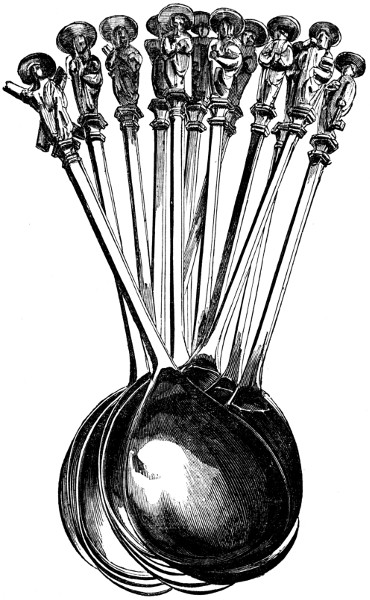
A Set of Apostle-Spoons.
The rarity and antiquity of apostle-spoons render them of considerable value as curiosities. A complete set of twelve is represented in the sketch on the opposite page, from a set of the spoons themselves on the writer’s table. The apostles on this set of spoons are somewhat worn, and the stems and bowls have been altered by the silversmith in conformity with the prevailing fashion of the present day; to the eye of the antiquary, therefore, they are not so interesting as they were before they underwent this partial modernization: yet in this state they are objects of regard. Their size in the print is exactly that of the spoons themselves, except that the stems are necessarily fore-shortened in the engraving to get them within the page. The stem of each spoon measures exactly three inches and a half in length from the foot of the apostle to the commencement of the bowl; the length of each bowl is two inches and nine-sixteenths of an inch; and the height of each apostle is one inch and one-sixteenth: the entire length of each spoon is seven inches and one-eighth of an inch. They are of silver; the lightest, which is St. Peter, weighs 1 oz. 5 dwts. 9 gr.; the heaviest is St. Bartholomew, and weighs 1 oz. 9 dwts. 4 gr.; their collective weight is 16 oz. 14 dwts. 16 gr. The hat, or flat covering, on the head of each figure, is usual to apostles-spoons, and was probably affixed to save the features from effacement. In a really fine state they are very rare.
It seems from “the Gossips,” a poem by Shipman, in 1666, that the usage of giving apostle-spoons at christenings, was at that time on the decline:
“Formerly, when they us’d to troul, Gilt bowls of sack, they gave the bowl; Two spoons at least; an use ill kept; ’Tis well if now our own be left.”
An anecdote is related of Shakspeare and Ben Jonson, which bears upon the usage: Shakspeare was godfather to one of Jonson’s children, and, after the christening, being in deep study, Jonson cheeringly asked him, why he was so melancholy? “Ben,” said he, “I have been considering a great while what should be the fittest gift for me to bestow upon my godchild, and I have resolved it at last.” “I prithee, what?” said Ben, “I’ faith, Ben,” answered Shakspeare, “I’ll give him a dozen good latten spoons, and thou shalt translate them.” The word latten, intended as a play upon latin, is the name for thin iron tinned, of which spoons, and similar small articles of household use, are sometimes made. Without being aware of the origin, it is still a custom with many persons, to present spoons at christenings, or on visiting the “lady in the straw;” though they are not now adorned with imagery.
FLORAL DIRECTORY.
Winter hellebore. Helleborus hyemalis.
January 26.
St. Polycarp. St. Paula. St. Conan.
THE SEASON.
On winter comes—the cruel north Pours his furious whirlwind forth Before him—and we breathe the breath Of famish’d bears, that howl to death: Onward he comes from rocks that blanch O’er solid streams that never flow, His tears all ice, his locks all snow, Just crept from some huge avalanche.
Incog.
BEARS AND BEES.
M. M. M. a traveller in Russia, communicates, through the Gentleman’s Magazine of 1785, a remarkable method of cultivating bees, and preserving them from their housebreakers, the bears. The Russians of Borodskoe, on the banks of the river Ufa, deposit the hives within excavations that they form in the hardest, strongest, and loftiest trees of the forest, at about five-and-twenty or thirty feet high from the ground, and even higher, if the height of the trunk allows it. They hollow out the holes lengthways, with small narrow hatchets, and with chisels and gouges complete their work. The longitudinal aperture of the hive is stopped by a cover of two or more pieces exactly fitted to it, and pierced with small holes, to give ingress and egress to the bees. No means can be devised more ingenious or more convenient for climbing the highest and the smoothest trees than those practised by this people, for the construction and visitation of these hives. For this purpose they use nothing but a very sharp axe, a leathern strap, or a common rope. The man places himself against the trunk of the tree, and passes the cord round his body and round the tree, just leaving it sufficient play for casting it higher and higher, by jerks, towards the elevation he desires to attain, and there to place his body, bent as in a swing, his feet resting against the tree, and preserving the free use of his hands. This done, he takes his axe, and at about the height of his body makes the first notch or step in the tree; then he takes his rope, the two ends whereof he takes care to have tied very fast, and throws it towards the top of the trunk. Placed thus in his rope by the middle of his body, and resting his feet against the tree, he ascends by two steps, and easily enables himself to put one of his feet in the notch. He now makes a new step, and continues to mount in this manner till he has reached the intended height. He performs all this with incredible speed and agility. Being mounted to the place where he is to make the hive, he cuts more convenient steps, and, by the help of the rope, which his body keeps in distension, he performs his necessary work with the above-mentioned tools, which are stuck in his girdle. He also carefully cuts away all boughs and protuberances beneath the hive, to render access as difficult as possible to the bears, which abound in vast numbers throughout the forests, and in spite of all imaginable precautions, do considerable damage to the hives. On this account the natives put in practice every kind of means, not only for defending themselves from these voracious animals, but for their destruction. The method most in use consists in sticking into the trunk of the tree old blades of knives, standing upwards, scythes, and pieces of pointed iron, disposed circularly round it, when the tree is straight, or at the place of bending, when the trunk is crooked. The bear has commonly dexterity enough to avoid these points in climbing up the tree; but when he descends, as he always does, backwards, he gets on these sharp hooks, and receives such deep wounds, that he usually dies. Old bears frequently take the precaution to bend down these blades with their fore-paws as they mount, and thereby render all this offensive armour useless.
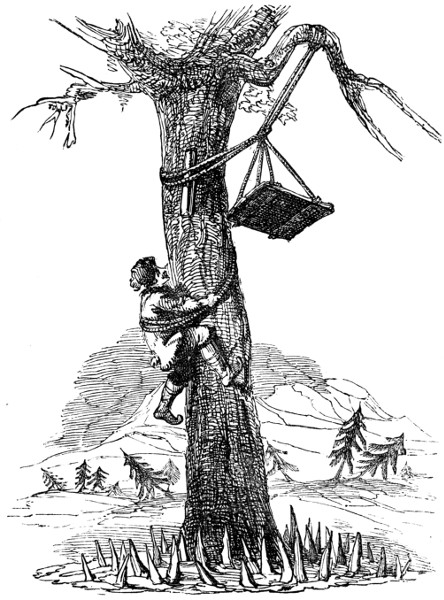
Russian Tree-Climbing and Bear Trap.
Another destructive apparatus has some similitude to the catapulta of the ancients. It is fixed in such a manner that, at the instant the bear prepares to climb the tree, he pulls a string that lets go the machine, whose elasticity strikes a dart into the animal’s breast. A further mode is to suspend a platform by long ropes to the farthest extremity of a branch of the tree. The platform is disposed horizontally before the hive, and there tied fast to the trunk of the tree with a cord made of bark. The bear, who finds the seat very convenient for proceeding to the opening of the hive, begins by tearing the cord of bark which holds the platform to the trunk, and hinders him from executing his purpose. Upon this the platform immediately quits the tree, and swings in the air with the animal seated upon it. If, on the first shock, the bear is not tumbled out, he must either take a very dangerous leap, or remain patiently in his suspended seat. If he take the leap, either involuntarily, or by his own good will, he falls on sharp points, placed all about the bottom of the tree; if he resolve to remain where he is, he is shot by arrows or musket balls.
FLORAL DIRECTORY.
White butterbur. Tressilago alba.
January 27.
St. John Chrysostom. St. Julian of Mans. St. Marius.
THE SEASON
It is observed in Dr. Forster’s “Perennial Calendar,” that “Buds and embryo blossoms in their silky, downy coats, often finely varnished to protect them from the wet and cold, are the principal botanical subjects for observation in January, and their structure is particularly worthy of notice; to the practical gardener an attention to their appearance is indispensable, as by them alone can he prune with safety. Buds are always formed in the spring preceding that in which they open, and are of two kinds, leaf buds and flower buds, distinguished by a difference of shape and figure, easily discernible by the observing eye; the fruit buds being thicker, rounder, and shorter, than the others—hence the gardener can judge of the probable quantity of blossom that will appear:”—
Lines on Buds, by Cowper.
When all this uniform uncoloured scene Shall be dismantled of its fleecy load, And flush into variety again. From dearth to plenty, and from death to life, Is Nature’s progress, when she lectures man In heavenly truth; evincing, as she makes The grand transition, that there lives and works A soul in all things, and that soul is God. He sets the bright procession on its way, And marshals all the order of the year; He marks the bounds which winter may not pass, And blunts his pointed fury; in its case, Russet and rude, folds up the tender germ, Uninjured, with inimitable art; And ere one flowery season fades and dies, Designs the blooming wonders of the next.
“Buds possess a power analogous to that of seeds, and have been called the viviparous offspring of vegetables, inasmuch as they admit of a removal from their original connection, and, its action being suspended for an indefinite time, can be renewed at pleasure.”
On Icicles, by Cowper.
The mill-dam dashes on the restless wheel, And wantons in the pebbly gulf below No frost can bind it there; its utmost force Can but arrest the light and smoky mist, That in its fall the liquid sheet throws wide. And see where it has hung th’ embroidered banks With forms so various, that no powers of art, The pencil, or the pen, may trace the scene! Here glittering turrets rise, upbearing high (Fantastic misarrangement!) on the roof Large growth of what may seem the sparkling trees And shrubs of fairy land. The crystal drops That trickle down the branches, fast congealed, Shoot into pillars of pellucid length, And prop the pile they but adorned before.
FLORAL DIRECTORY.
Earth Moss. Phascum cuspidatum. Dedicated to St. Chrysostom.
January 28.
St. Agnes.—Second Commemoration.
St. Cyril, A. D. 444. Sts. Thyrsus, Leucius, and Callinicus. St. John of Reomay, A. D. 540. Blessed Margaret, Princess of Hungary, A. D. 1271. St. Paulinus, A. D. 804. Blessed Charlemagne, Emperor, A. D. 814. St. Glastian, of Fife, A. D. 830.
St. Thyrsus.
Several churches in Spain are dedicated to him. In 777, the queen of Oviedo and Asturia presented one of them with a silver chalice and paten, a wash-hand basin and a pipe, which, according to Butler, is “a silver pipe, or quill to suck up the blood of Christ at the communion, such as the pope sometimes uses—it sucks up as a nose draws up air.”
Chronology.
John Gottlob Immanuel Breitkopf, a celebrated printer, letter-founder, and bookseller of Leipsic, died on this day, in the year 1794: he was born there November 23, 1719. After the perusal of a work by Albert Durer, in which the shape of the letters is deduced from mathematical principles, he endeavoured to fashion them according to the most beautiful models in matrices cut for the purpose. His printing-office and letter-foundery acquired very high reputation. It contained punches and matrices for 400 alphabets, and he employed the types of Baskerville and Didot. Finding that engraving on wood had given birth to printing, and that the latter had contributed to the improvement of engraving, he transferred some particulars, in the province of the engraver, to that of the printer; and represented, by typography, all the marks and lines which occur in the modern music, with all the accuracy of engraving, and even printed maps and mathematical figures with movable types; though the latter he considered as a matter of mere curiosity: such was also another attempt, that of copying portraits by movable types. He likewise printed, with movable types, the Chinese characters, which are, in general, cut in pieces of wood, so that a whole house is often necessary to contain the blocks employed for a single book. He improved type-metal, by giving it that degree of hardness, which has been a desideratum in founderies of this kind; and discovered a new method of facilitating the process of melting and casting. From his foundery he sent types to Russia, Sweden, Poland, and even America. He also improved the printing-press.
Besides this, his inquiries into the origin and progress of the art of printing, furnished the materials of a history, which he left behind in manuscript. He published in 1784, the first part of “An Attempt to illustrate the origin of playing-cards, the introduction of paper made from linen, and the invention of engraving on wood in Europe;” the latter part was finished, but not published, before his death. His last publication was a small “Treatise on Bibliography,” &c. published in 1793, with his reasons for retaining the present German characters. With the interruption of only five or six hours in the twenty-four, which he allowed for sleep, his whole life was devoted to study and useful employment.
FLORAL DIRECTORY.
Double Daisy. Bellis perennis plenus. Dedicated to St. Margaret of Hungary.
January 29.
St. Francis of Sales, A. D. 1622. St. Sulpicius Severus, A. D. 420. St. Gildas the Abbot, A. D. 570. St. Gildas, the Scot, A. D. 512.
This being the anniversary of the king’s accession to the throne, in 1820, is a Holiday at all the public offices, except the Excise, Stamps, and Customs.
FLORAL DIRECTORY.
Flowering Fern. Osmunda regalis. Dedicated to St. Francis of Sales.
January 30.
KING CHARLES’S MARTYRDOM.
Holiday at the Public Offices; except the Stamps, Customs, and Excise.
St. Bathildes, Queen of Navarre, A. D. 680. St. Martina. St. Aldegondes, A. D. 660. St. Barsimæus, A. D. 114.
St. Martina.
The Jesuit Ribadeneira relates that the emperor Alexander IV., having decreed that all christians should sacrifice to the Roman gods, or die, insinuated to St. Martina, that if she would conform to the edict, he would make her his empress but on her being taken to the temple, “by a sudden earthquake the blockish idol of Apollo was broken in pieces, a fourth part of his temple thrown down, and, with his ruins, were crushed to death; his priests and many others, and the emperor himself, began to fly.” Whereupon St. Martina taunted the emperor; and the devil, in the idol, rolling himself in the dust, made a speech to her, and another to the emperor, and “fled through the air in a dark cloud; but the emperor would not understand it.” Then the emperor commanded her to be tortured. The jesuit’s stories of these operations and her escapes, are wonderfully particular. According to him, hooks and stakes did her no mischief; she had a faculty of shining, which the pouring of hot lard upon her would not quench; when in gaol, men in dazzling white surrounded her; she could not feel a hundred and eighteen wounds; a fierce lion, who had fasted three days, would not eat her, and fire would not burn her; but a sword cut her head off in 228, and at the end of two days two eagles were found watching her body. “That which above all confirmeth the truth of this relation,” says Ribadeneira, “is, that there is nothing herein related but what is in brief in the lessons of the Roman Breviary, commanded by public authority to be read on her feast by the whole church.”
Chronology.
On this day, in the year 1649, king Charles I. was beheaded. In the Common Prayer Book of the Church of England, it is called “The Day of the Martyrdom of the Blessed King Charles I.;” and there is “A Form of Prayer, with Fasting, to be used yearly” upon its recurrence.
The sheet, which received the head of Charles I. after its decapitation, is carefully preserved along with the communion plate in the church of Ashburnham, in this county; the blood, with which it has been almost entirely covered, now appears nearly black. The watch of the unfortunate monarch is also deposited with the linen, the movements of which are still perfect. These relics came into the possession of lord Ashburnham immediately after the death of the king.—Brighton Herald.
Lord Orford says, “one can scarce conceive a greater absurdity than retaining the three holidays dedicated to the house of Stuart. Was the preservation of James I. a greater blessing to England than the destruction of the Spanish armada, for which no festival is established? Are we more or less free for the execution of king Charles? Are we at this day still guilty of his blood? When is the stain to be washed out? What sense is there in thanking heaven for the restoration of a family, which it so soon became necessary to expel again?”
According to the “Life of William Lilly, written by himself,” Charles I. caused the old astrologer to be consulted for his judgment. This is Lilly’s account: “His majesty, Charles I., having intrusted the Scots with his person, was, for money, delivered into the hands of the English parliament, and, by several removals, was had to Hampton-court, about July or August, 1647; for he was there, and at that time when my house was visited with the plague. He was desirous to escape from the soldiery, and to obscure himself for some time near London, the citizens whereof began now to be unruly, and alienated in affection from the parliament, inclining wholly to his majesty, and very averse to the army. His majesty was well informed of all this, and thought to make good use hereof: besides, the army and parliament were at some odds, who should be masters. Upon the king’s intention to escape, and with his consent, madam Whorewood (whom you knew very well, worthy esquire) came to receive my judgment, viz. In what quarter of this nation he might be most safe, and not to be discovered until himself pleased. When she came to my door, I told her I would not let her come into my house, for I buried a maid-servant of the plague very lately: however, up we went. After erection of my figure, I told her about twenty miles (or thereabouts) from London, and in Essex, I was certain he might continue undiscovered. She liked my judgment very well; and, being herself of a sharp judgment, remembered a place in Essex about that distance, where was an excellent house, and all conveniences for his reception. Away she went, early next morning, unto Hampton-court, to acquaint his majesty; but see the misfortune: he, either guided by his own approaching hard fate, or misguided by Ashburnham, went away in the night-time westward, and surrendered himself to Hammond, in the Isle of Wight. Whilst his majesty was at Hampton-court, alderman Adams sent his majesty one thousand pounds in gold, five hundred whereof he gave to madam Whorewood. I believe I had twenty pieces of that very gold for my share.” Lilly proceeds thus: “His majesty being in Carisbrook-castle, in the Isle of Wight, the Kentish men, in great numbers, rose in arms, and joined with the lord Goring; a considerable number of the best ships revolted from the parliament; the citizens of London were forward to rise against the parliament; his majesty laid his design to escape out of prison, by sawing the iron bars of his chamber window; a small ship was provided, and anchored not far from the castle to bring him into Sussex; horses were provided ready to carry him through Sussex into Kent, that so he might be at the head of the army in Kent, and from thence to march immediately to London, where thousands then would have armed for him. The lady Whorewood came to me, acquaints me herewith. I got G. Farmer (who was a most ingenious locksmith, and dwelt in Bow-lane) to make a saw to cut the iron bars in sunder, I mean to saw them, and aqua fortis besides. His majesty in a small time did his work; the bars gave liberty for him to go out; he was out with his body till he came to his breast; but then his heart failing, he proceeded no farther: when this was discovered, as soon after it was, he was narrowly looked after, and no opportunity after that could be devised to enlarge him.”
Lilly goes on to say, “He was beheaded January 30, 1649. After the execution, his body was carried to Windsor, and buried with Henry VIIIth, in the same vault where his body was lodged. Some, who saw him embowelled, affirm, had he not come unto this untimely end, he might have lived, according unto nature, even unto the height of old age. Many have curiously inquired who it was that cut off his head: I have no permission to speak of such things; only thus much I say, he that did it is as valiant and resolute a man as lives, and one of a competent fortune. For my part, I do believe he was not the worst, but the most unfortunate of kings.”
Lilly elsewhere relates, “that the next Sunday but one after Charles I. was beheaded, Robert Spavin, secretary unto lieutenant-general Cromwell at that time, invited himself to dine with me, and brought Anthony Pierson, and several others, along with him to dinner. Their principal discourse all dinner-time was, who it was beheaded the king: one said it was the common hangman; another, Hugh Peters; others also were nominated, but none concluded. Robert Spavin, so soon as dinner was done, took me by the hand, and carried me to the south window; saith he, ‘These are all mistaken, they have not named the man that did the fact; it was lieutenant-colonel Joice: I was in the room when he fitted himself for the work, stood behind him when he did it; when done, went in again with him. There is no man knows this but my master, viz. Cromwell, commissary Ireton, and myself.’—‘Doth not Mr. Rushworth know it?’ said I. ‘No, he doth not know it,’ saith Spavin. The same thing Spavin since hath often related unto me when we were alone.”
MOVEABLE FEASTS.
Shrove Tuesday regulates most of the moveable feasts. Shrove Tuesday itself is the next after the first new moon in the month of February. If such new moon should happen on a Tuesday, the next Tuesday following is Shrove Tuesday. A recently published volume furnishes a list, the introduction of which on the next page puts the reader in possession of serviceable knowledge on this point, and affords an opportunity for affirming, that Mr. Nicolas’s book contains a variety of correct and valuable information not elsewhere in a collected form:—
MOVEABLE FEASTS FROM
“Tables, Calendars, &c. for the use of Historians, Antiquaries, and the Legal Profession, by N. H. Nicolas, Esq.”
Advent Sunday, is the nearest Sunday to the feast of St. Andrew, November 30th, whether before or after.
Ascension Day, or Holy Thursday, is the Thursday in Rogation week, i. e. the week following Rogation Sunday.
Ash Wednesday, or the first day in lent, is the day after Shrove Tuesday.
Carle, or Care Sunday, or the fifth Sunday in lent, is the fifth Sunday after Shrove Tuesday.
Corpus Christi, or Body of Christ, is a festival kept on the Thursday after Trinity Sunday; and was instituted in the year 1264.
Easter Day. The Paschal Sabbath. The Eucharist, or Lord’s Supper, is the seventh Sunday after Shrove Tuesday, and is always the first Sunday after the first full moon, which happens on or next after the 21st of March.