MARCH. (continued 2)
Reading edition
1797. Courtney Melmoth died at Bath, aged 89 years; he translated part of “Cicero’s Works,” and “Pliny’s Epistles,” and wrote “Fitzosborne’s Letters,” and the “Memoirs of a late eminent Advocate;” his father was the author of “The great Importance of a Religious Life.”
1803. Frederick Klopstock, a German writer, author of the “Messiah” and other works, chiefly poetical, died at Hamburgh, aged 80. His funeral was a public one, and conducted with a marked solemnity, denoting affectionate respect for his talents and character.
FLORAL DIRECTORY.
Mountain Soldanel. Soldanella Alpina. Dedicated to St. Maud.
March 15.
St. Abraham, Hermit, and his niece, St. Mary, 4th Cent. St. Zachary, Pope, A. D. 752.
Chronology.
Forty-four years before Christ, Julius Cæsar was assassinated by Brutus and his associates in the senate-house of Rome, in the 56th year of his age. He is said to have conquered three hundred nations, taken eight hundred cities, defeated three hundred millions of men, and slain one hundred millions on the field of battle. He was learned himself, and an encourager of learning and the arts. He wrote the “Commentaries on the wars of Gaul,” a book which bears his name, and which would have been lost in the bay of Alexandria, if he had not swam from his ship with his book in one hand, and his arms in the other. His ruling passion was ambition, yet he was a slave to sensuality; with talents that might have made him the protector of Roman liberty he destroyed it.
1784. Dr. Thomas Franklin, translator of Sophocles, Phalaris, and Lucian, died. He was born about 1720, and wrote two tragedies, the “Earl of Warwick” and “Matilda.”
FLORAL DIRECTORY.
Coltsfoot. Tussilago Farfala. Dedicated to St. Zachery. Lasting Mercury. Mercurialis perennis. Dedicated to St. Abraham.
March 16.
St. Julian, of Cilicia. St. Finian, surnamed Lobhar, or the Leper.
St. Finian.
He was descended from Alild, king of Munster, built the abbey of Innis-Fallen in an island on the lake of Loughlane, county of Kerry; another at Ardfinnan, in Tipperary; and a third at Cluin-more Madoc, in Leinster, where he was buried.[29]
It is related of St. Finian, that he visited St. Ruadanus, who had a miraculous tree in his cell, dropping a liquor so peculiar, into a vessel from nine o’clock to sun-set, that it sufficed to dine him and all his brotherhood every day. St. Finian’s visit was to persuade St. Ruadanus to live like other people; therefore, when St. Finian came to the tree, he signed it with the sign of the cross, by virtue of which the liquor ceased to flow after nine o’clock. This was in the absence of Ruadanus, who being informed on his return, that St. Finian and others had come to see him, he ordered his servant to prepare the miraculous water dinner as usual; the servant surprised to find the vessel empty, told his master, who bade him to fill it with common water from a fountain, which he had no sooner done, than the water was changed into the liquor that flowed from the tree. St. Ruadanus ordered the man to carry it to St. Finian, who making a cross over the liquor, changed it back to water, and said why is this liquor of a false name given to me? St. Finian’s companions urged him to go and cross the fountain as he had crossed the tree; but Finian answered, it would only grieve Ruadanus, who would go to the next bog, and change the water there into the same liquor. In the end, St. Finian and his companions persuaded St. Ruadanus not to work any more miracles, but to live as others did, whereunto he yielded. Thus St. Finian having out-miracled the miracle of St. Ruadanus, and stopped him from working the same miracle again, departed with his companions.[30]
Chronology.
1723. March 16, a royal proclamation was issued for a thanksgiving for our preservation from the plague.
[It has been lately proved that the plague is not contagious. Dr. Maclean is understood to have established the fact to the satisfaction of government, and it is in contemplation to repeal the present laws of quarantine.]
FLORAL DIRECTORY.
Nodding Daffodil. Narcissus nutans. Dedicated to St. Julian.
March 17.
St. Patrick. St. Joseph, of Arimathea. St. Gertrude, Abbess, A. D. 626.
St. Patrick, Apostle of Ireland.
St. Patrick was born towards the end of the fourth century, in Killpatrick, between Dunbriton and Glasgow. At sixteen he was carried off with many of his father’s vassals into slavery, and compelled for six months to keep cattle on the mountains in Ireland, from whence he escaped through the humanity of some sailors. He travelled into Gaul and Italy, and received his apostolical mission to convert the Irish, from pope Celestine, who died in 432. Determined on attempting the conversion of the people, he penetrated to the remotest corners of Ireland, baptized multitudes, ordained clergy to preside over them, instituted monks, gave alms to the poor of the provinces, made presents to the kings, educated children to serve at the altar, held councils, founded monasteries, restored health to the sick, sight to the blind, raised dead persons to life, continued his missions during forty years, and died at Down in Ulster, where he was buried. Such, in brief, is Alban Butler’s account, who assigns the year 464, for a period wherein he lived.
Ribadeneira affirms it, as a most famous miracle, and well known to the whole world, that St. Patrick did so free Ireland of all venomous beasts, that none could ever since breed or live there, and that even the very wood has a virtue against poison, “so that it is reported of king’s college, Cambridge, that being built of Irish wood, no spider doth ever come near it.”
Jocelin, a Cistercian monk of Furnes in the twelfth century, wrote “The Life and Acts of St. Patrick,” wherein he relates many extraordinary particulars, of which the few that follow are specimens: St. Patrick when a child in winter time brought home some pieces of ice, his nurse told him he had better have brought home wood, whereupon he heaped together the ice, and prayed, and the ice immediately became a bonfire. After this his foster-father died, and to relieve his nurse’s distress, St. Patrick prayed, signed him with the sign of the cross, and so restored him to life. Then by the same sign he freed a cow from an evil spirit; recovered five cows she had wounded; and, by the same means, when his nurse was ill and longed for honey, he “immediately changed water into the best honey.” At another time, when she was commanded to clean out some filthy stables, St. Patrick prayed, and they were cleaned without hands. Then St. Patrick himself was carried into slavery, and sold for a kettle; but the kettle being placed on the fire, the hotter the fire burned, the colder became the kettle; whereupon the seller of St. Patrick returned the kettle, took St. Patrick back, and the vessel was restored to its wonted power of boiling. St. Patrick desiring to eat meat, obtained some pork, and having concealed it for a convenient season, presently he saw a man with eyes before and eyes behind, and asked him why he was so formed; the seer answered, “I am the servant of God; with the eyes in my forehead I see things open to view, with my eyes behind I see a monk hiding flesh meat in a vessel to satisfy his appetite privately.” Then the seer vanished. St. Patrick repented, prayed for pardon, besought for a sign that he had it, was told by an angel to put the pork into water, did as the angel bid him, and the pork “immediately became fishes.” Having journeyed into Britain, he saw a leper whom mariners would not carry in their ship, whereon St. Patrick took a stone altar consecrated by the pope, cast it into the sea, caused the leper to sit on it, and the leper immediately set sail on the stone, kept company with the ship all the voyage, and got into port with her at the same time. St. Patrick, returning to Ireland, on approaching the shore, saw a multitude of devils in the form of a globe surrounding the whole island, when he “raised his sacred right hand, made the sign of the cross, and, unhurt and unterrified, passed he over.” Some fishermen in the county of Leinster, drawing their nets from a river loaded with fish, St. Patrick asked them for some; they refused him; he cursed them, and the river; and from that day the river never produced fish. Once when the chief king of Ireland ordered his subjects to prevent St. Patrick from landing, they set a fierce dog at him, whereupon the dog stiffened like a stone; then a gigantic man brandished his sword at the saint, the man stiffened likewise, but repented, and St. Patrick unstiffened him, and baptized him. An old man, would not believe St. Patrick’s preaching. St. Patrick asked him whether he would be persuaded by a miracle; the old man said he would, then St. Patrick prayed, laid his hand on him, “and immediately the old man became beautiful and young, and flourished again, as in his early youth,” and was so made to believe. Having converted Mochna, a virtuous swineherd, while they were conversing together, a staff from heaven fell between them, which St. Patrick gave to Mochna for a pastoral staff, consecrated him bishop of Edrum, “and the staff is in that church still preserved, and called the flying staff.”
St. Patrick’s nephew, St. Lumanus, being desirous of taking a journey by sea when wind and tide were against him, he hoisted the sails, trusted in the merits of St. Patrick, and, “O, miracle till then unheard and unknown! the ship, without any pilot, sailed against wind and stream,” and he made a prosperous voyage. At another time, St. Patrick seeing a hundred men unable to stir a large stone, he, alone, raised it up, and placed it where it was wanted. He was accustomed to stop and erect a cross at the head-stone of every christian who was buried outside of a burial-place; one day, coming to the graves of two men newly buried, and observing that one of the graves only had a cross over it, he stopped his chariot, and speaking to the dead man below, asked him what religion he had been, the dead man answered a pagan, St. Patrick inquired why then a cross was put over him, the dead pagan replied, he who is buried near me was a christian, and one of your faith coming hither placed the cross at my head; the saint stepped out of his chariot, rectified the mistake, and went his way. One Foylge, an idolator, strangled the driver of St. Patrick’s chariot, in his seat, wherefore the saint cast his “holy curse” at Foylge, who pierced thereby, fell dead into hell; but the devil entering the dead body, walked about in it, and seemed as if he were Foylge himself, till one day St. Patrick called at the dead man’s house, and asking the family where Foylge was, they answered he was at home, when the saint told them of Foylge’s death, and that Satan “had entered into his corpse and occupied it as his own proper vessel,” then St. Patrick gave notice to the devil to leave his lodging in Foylge’s body, which he did immediately, and Foylge was buried. Preaching on a journey to 14,000 men, “he first fed them all with spiritual food,” then commanding a cow to be killed, with two stags, and a couple of boars, the people ate abundantly, the remnants were gathered up; and “thus with the flesh of five animals, did St. Patrick plenteously feed 14,000 men.” Once when he was preaching, by way of a strong argument, he raised to life nineteen dead men, one of whom had been buried for ten years. After that, St. Patrick passing over a river one of his teeth dropped into the water, and his disciples could not find it till night, when the tooth in the river shone as a radiant star, and being so discovered was brought to St. Patrick, who on that spot built a church, and deposited his tooth beneath the altar. Desiring to pass an impassable river, and no boat being at hand, St. Patrick prayed, and dividing the river, made himself and followers a free passage, then “he blessed the river, and being so blessed, it abounded in fishes above all others.” St. Mel being denounced unjustly to St. Patrick, and preferring to prove his innocence by a miracle rather than by an oath, he ploughed up the earth on a certain hill, and took by the ploughshare many and large fishes out of the dry land; thereupon St. Patrick absolved him, but lest St. Mel should continue to work miracles presumptuously, “he bade him that he should thenceforth plough on the land, and fish in the water.” St. Patrick had a goat, a thief stole it, and ate it, and when accused, denied it; but the goat bleating in the stomach of the thief, proclaimed the merit of St. Patrick; and, to increase the miracle, by the sentence of the saint, all the posterity of the man were marked with the beard of a goat. St. Patrick having labored to convert a tyrant, who laughed him to scorn, he immediately converted the tyrant, against his will, into a fox; which fox went off with a hard run, and could never be found. Another time being benighted in the open air, violent rain fell around St. Patrick and his companions, but did not wet them a drop. On the same night, the driver of his chariot could not for the darkness find the horses to re-yoke them, on which St. Patrick, drawing his right hand from his sleeve, and lifting up his fingers, they “shone even as sun-beams, and wonderfully illumining the whole country, turned darkness into light, and night into day—then by the aid of the radiant miracle, the chariot-driver found his steed.” After the death of St. Patrick, there was no night for twelve days.
These are some of the miracles attributed to St. Patrick by Jocelin, whose life of him published in “Dublin, Printed for the Hibernia Press Company, By James Blyth,” is sold in London by Messrs. Keating and Brown, Catholic Printers and Publishers, No. 38, Duke-street, Grosvenor-square, in one volume 12mo. containing 264 pages, price 2s. 6d. in boards.
To what extent Catholics believe such miracles, as have been just related is unknown to a Protestant; but the publication of Jocelin’s works by catholic booksellers in a cheap form, seems to signify that it it held in repute by Catholics in a humble rank of life. To what extent the catholic clergy have instructed this class of their flocks, or rather to what extent they design to instruct them, is also unknown to a Protestant; but should the higher classes of catholics enjoy the civil rights, which the most wise and enlightened of their Protestant fellow-subjects deplore they do not possess, and most anxiously desire they should possess, it is not too much to hope that it will become the anxious wish, as it is the positive duty of the catholic clergy to inform the ignorant of their community. An union between the church of England, or any other protestant church, and the church of Rome, never can take place; but protestant churchmen, and Protestants of all denominations, can and will unite with Catholics, if Catholics can and will unite with them, to enlighten the Egyptian darkness, which ensures the mind worse than Egyptian bondage. The education of helpless infancy, and the fixation of just principles in youth, form the best security against criminal manhood. In this, surely, both Protestants and Catholics will concur, and their earnest cooperation to obtain this security will be a firm pledge that each desires the welfare of each. The marked separation of churches and doctrines cannot much longer separate man from man. In the bigotted and selfish interests that dam the social affections, there are incurable and daily widening breaches: the issues alternate and vary, but the first high tide of mutual kindness will burst the restrictions, and sweep them away for ever.
St. Patrick’s Day.
This being the anniversary of the day whereon St. Patrick died, it is commemorated as a high festival in the catholic church; and it is celebrated to his honour in that country, with every demonstration of affection for his memory as the apostle and patron saint of Ireland, that a warm-hearted, enthusiastic, joyous people, can possibly express. An eye-witness represents to the editor of the Every-Day Book that St. Patrick’s day in Dublin is a scene of festivity and mirth unequalled by any thing observable in this country. From the highest to the lowest, all hearts seem inspired by the saint’s beneficence. At day-break flags fly on the steeples, and the bells ring out incessant peals till midnight. The rich bestow their benevolence on the poor, and the poor bestow their blessings on the rich, and on each other, and on the blessed St. Patrick. The “green immortal” shamrock is in every hat. Sports of manly exercise exhibit the capabilities of the celebrated “shillelah,” and before night many a head gives token of the application of its wonderful powers, by a muscular hand. Priestly care soothes querulousness; laughter drowns casualty; innumerable bright-eyed, rosy-cheeked, jaunty lasses dance with their mirth-loving lads; old women run about with children in the hoods of their cloaks, to publicly share care-drowning cups of sweet consolation with each other; and by the voice of wit, humour, and frolic, this miraculous day is prolonged till after the morning dawn.
A popular song on this festal occasion contains these verses:
Saint Patrick’s, the holy and tutelar man; His beard down his bosom like Aaron’s ran: Some from Scotland, from Wales, will declare that he came, But I care not from whence now he’s risen to fame:— The pride of the world and his enemies scorning, I will drink to St. Patrick, to-day, in the morning! He’s a desperate big, little Erin go brah; He will pardon our follies and promise us joy. By the mass, by the Pope, by St. Patrick, so long As I live, I will give him a beautiful song! No saint is so good, Ireland’s country adorning; Then hail to St. Patrick, to-day, in the morning!
In London St. Patrick’s day is observed at court as a high festival, and the nobility crowd to pay their compliments in honour of Ireland’s tutelar saint. For many years it has been selected as an occasion for soliciting and obtaining aid to a great national object—the promotion of education. It is the anniversary of the “Benevolent Society of St. Patrick,” for clothing and educating children of Irish parents who need the assistance, by voluntary contribution. The festival is attended by Irishmen of different political parties and religious persuasions, and many of the highest rank. On this anniversary, in 1825, the marquess of Londonderry was in the chair, with the duke of Leinster on his right, and the marquess of Lansdown at his left hand: several of the king’s ministers and nobility were present. The report stated, that 400 children were educated in the school, the funds admitted of only 240 being clothed, the rest were supplied with shirts, shoes, and stockings; and the committee earnestly invited inspection of the schools from nine till two every day, except on the sabbath and Monday. A donation to the charity, from his majesty of 100 guineas, was followed by others, and by hopes that absent Irishmen and Englishmen who could, would cheerfully contribute towards an institution which on its merits required general support. Speeches from the chairman and noble guests, the chancellor of the exchequer, Mr. O’Connell, Mr. Huskisson, and other distinguished characters, breathed sentiments of universal good will, and must have inspired every individual to kindness, and desire of extending, and cementing, the conciliation so happily commenced between the people of both countries.
It is related that during the dinner, the party at the head table were much amused by a bottle of genuine (illegal) poteen, neat as imported from the emerald isle, being handed to the chancellor of the exchequer, who, forgetting the good of the revenue in the memory of St. Patrick, put a portion of the naughty liqueur in his glass, and drank it with becoming devotion.
In the forenoon of the same day, the festival was celebrated at the Roman catholic chapel in Sutton-street, Soho, with an unusual degree of splendour. The archbishop of Armagh in his mitre and pontifical robes, officiated as high-priest, assisted by the two English catholic bishops, Poynter and Bramston, and one of the Irish bishops, and several of the minor clergy. A selection of music, chiefly from Haydn’s masses, was powerfully performed by a very numerous choir, accompanied by a full band; and after a sermon by Dr. Poynter, a collection was made, to the amount of £65., to assist the chapel and the schools attached to it.
Order of St. Patrick.
In February, 1783, letters patent created a brotherhood denominated “Knights of the illustrious order of St. Patrick,” to consist of the sovereign for the time being, as sovereign of the order; and fifteen knights companions, the “lieutenant-general and general governor of Ireland, or the lord deputy or deputies, or lord’s justices, or other chief governor or governors” for the time being, officiating as deputy grand masters. The statutes of the order of St. Patrick direct the badge to be of gold, surmounted with a wreath of shamrock or trefoil, surrounding a circle of gold, bearing the motto of the order in gold letters, Quis separabit? with the date MDCCLXXXIII, wherein the order was founded, and encircling the cross of St. Patrick gules, surmounted with a trefoil vert, each leaf charged with an imperial crown or, upon a field argent; the badge, encircled with rays in form of a star of silver of eight points, four greater and four lesser, worn on the left side of the outer garment.
The Shamrock.
The shamrock is the trefoil. The Druids used it to cure diseases. The Irish use it as a national cognizance. It is said that when St. Patrick landed near Wicklow to convert the Irish in 433, the pagan inhabitants were ready to stone him; he requested to be heard, and endeavoured to explain God to them as the Trinity in Unity, but they could not understand him, till plucking a trefoil from the ground, he said, “Is it not as possible for the Father, Son, and Holy Ghost, as for these leaves, to grow upon a single stalk,” then the Irish were immediately convinced.[31]
St. Patrick.
The Welch claim St. Patrick. Mr. Owen in his “Cambrian Biography” affirms, he was born at Aberllychwr in Pembrokeshire, South Wales, where there is a church dedicated to him. They call him Padrig, the son of Mawrn or Maenwyn, of the laird of Gwyr. Mr. Owen cites from the genealogy of the British saints, that, “It was the glory of the emperor Theodosius, in conjunction with Cystonnin Llydaw, surnamed the blessed, to have first founded the college of Illtyd, which was regulated by Balerus, a man from Rome; and Padrig, son of Mawrn, was the principal of it, before he was carried away a captive by the Irishman.” In corroboration, Mr. Owen says, it is recorded in the history of Wales, “that the Irish were enabled to settle themselves along nearly the whole extent of its coast, in the beginning of the fifth century, and continued there until nearly the middle of the same era; when they were expelled from the north by the natives, assisted by the sons of Cunedda, and from the south with the aid of Urien.” Thus Wales contends for the honour of the birth-place of Patrick with Scotland, while Ireland has the honour of the saint himself.
A London Bull.
The “Athenæum” affirms the following to be a literal transcript of a letter sent to a gentleman, who had recommended a patient to that excellent institution called the London Electrical Dispensary:—
“To Mr. G——
“No. 5081.
“Sir,
“Having by your recommendation been received a patient at the London Electrical Dispensary, and being discharged this day dead, I beg leave to return my humble and hearty thanks for the same.
“March 7, 1810.”
Except the No., date, and the word dead, which are written, all the rest of the letter is printed.
FLORAL DIRECTORY.
Sweet Violet. Viola odorata. Dedicated to St. Gertrude. Shamrock. Trifolium repens. Dedicated to St. Patrick.
March 18.
St. Alexander, Bp. of Jerusalem, A. D. 251. St. Cyril, Abp. of Jerusalem, A. D. 386. St. Edward, King, A. D. 979. St. Anselm, Bp. of Lucca, A. D. 1086. St. Fridian, Erigdian, or Frigdian, Bp. of Lucca, A. D. 578.
St. Edward.
This is the English king who was stabbed in the back with a dagger, by order of his stepmother, Elfrida, while drinking on horseback at the gate of Corfe castle, in the isle of Purbeck. He spurred his horse, which plunged him into a deep marsh, and there he died of his wounds, in 979. Butler says his body was discovered by a pillar of light, and buried in Wareham church, and worked miracles. His name is in the church of England calendar.
It is an historical fact, that the wretched contriver of king Edward’s murder passed the remainder of her days in dismal horror; and her nights brought no repose from the afflictions of her conscience. She obtained a kind of armour formed of crucifixes, wherein she encased herself, performed penances, built monasteries, and died universally execrated by the indignant people. The treachery of the crime occasioned a general distrust, no one would drink without security from him, who sat beside him, that he was safe while the bowl was at his lips; and hence is said to have originated the customary expression at table of “I pledge you,” when one person invites another to drink first.
Chronology.
1745. Sir Robert Walpole, earl of Orford, died, aged 71.
FLORAL DIRECTORY.
Great Leopard Bane. Doronicum Pardalionetes. Dedicated to St. Cyril.
March 19.
St. Joseph. St. Alemund, 819.
St. Joseph.
The church of Rome has canonized Joseph the spouse of the Virgin Mary, and honours him with offices and worship of various forms.
Chronology.
720, B. C. the first eclipse of the moon on record happened on this day.
1355. Pressing for seamen to man the navy commenced.
1668. Sir John Denham, poet, died in London; he was born in Dublin, 1615.
1719. A surprising meteor was seen about eight o’clock in the evening, from all parts of England, Scotland, and Ireland. To an observer in St. Paul’s churchyard, it appeared a ball of fire as large as the moon, of a pale bluish light, and with little motion, till in a moment it assumed the shape of a common meteor with a stream of light, double the diameter of its first appearance, emitting a splendour by which the smallest print might have been read. Its duration was not above half a minute, and its greatest light about the tenth part of a minute. At Exeter its light exceeded that of the sun at noonday, and there it seemed to break like a skyrocket, into sparks of red fire, which reflected that colour on the houses, and shortly after a report, loud as cannon, shook the windows, succeeded at the interval of a minute by about thirty others; “they sounded just as the tower guns did in Mincing-lane, but shook the houses and windows much more.” Mr. Whiston calculated the greatest height of this extraordinary meteor to have been forty-three or fifty-one statute miles: it gradually descended lower till it came to Devonshire, where it was about thirty-nine miles high, and broke over the sea, near the coast of Brittany; its altitude then being about thirty miles.[32]
FLORAL DIRECTORY.
Yellow Star of Bethlehem. Ormithogalum luteum. Dedicated to St. Joseph.
March 20.
St. Cuthbert, Bp. of Lindisfarne, A. D. 687. St. Wulfran, Abp. of Sens, A. D. 720.
St. Cuthbert.
Of this saint there will be mention hereafter.
Chronology.
1727. Sir Isaac Newton died; he was born December 25th, 1642.
1751. Frederick, prince of Wales, father of king George III. died aged 44.
1793. Died William Murray, earl of Mansfield. He was born on the 2d of March, 1705, and during thirty years, and until his death, presided as lord chief justice of the court of King’s Bench. He was eminent as a lawyer, and dignified as a judge. It is said that he altered the common law of England, by ingrafting upon it the civil law in his decisions. As an elegant scholar, of highly cultivated and vigorous intellect, he shone in the constellation of great men, which arose in the reign of queen Anne. In eloquence and beauty of diction, he outrivalled his predecessors, and has not been excelled by any successor in the high office he filled.
1811. Napoleon, son of the late emperor of France, by the empress Maria Louisa, was born, and received the title of king of Rome.
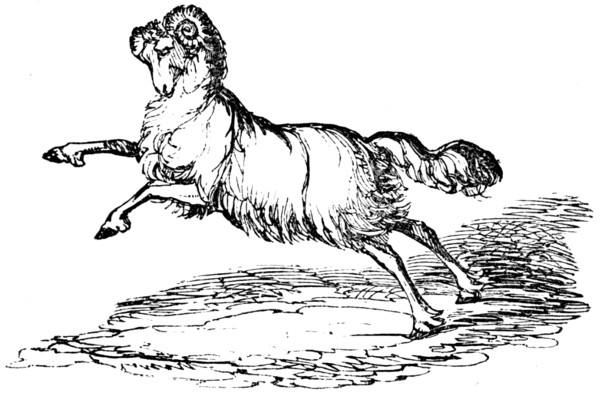
On the 20th of March, the sun enters the constellation ♈ Aries, or the Ram, which is the first zodiacal sign; and this day is the first day of Spring.
By an accident, the remarks relating to Spring were inserted under March 6, instead of this day: and as the error is thus particularly noticed, in order as far as possible to rectify it, the reader will please to consider all that has been said on the sixth of March as applicable to the twentieth alone. The editor, while acknowledging, and craving pardon for a vexatious and unpurposed misrepresentation, will endeavour to set a watch upon himself in future, to guard against a similar accident.
Aries, or the ram, as a zodiacal sign, is said to have been derived by the Greeks from the golden fleece brought from Colchis by Jason, about 1263 years before Christ; but as it is a hieroglyphic on Egyptian monuments, it is of higher antiquity, and symbolizes that season when sheep yean their lambs. The people of Thebes slew a ram in honour of Jupiter Ammon, who personifies the sun in Aries, and is represented by ancient sculpture and coins with the horns of a ram on his head. The Hebrews at this season sacrifice a lamb, to commemorate their deliverance from Egypt. Aries, or the ram, was the ensign of Gad, one of their leaders.
Aries.
VERNAL EQUINOX.
The remarks on the Vernal Equinox, immediately following, are communicated by a respected scientific friend to the editor.
This is a day of great consequence in the year, and one that must excite many associations in the mind of the astronomer, and of every one who entertains a due reverence for our sacred records. The sun on this day passes the imaginary line in the heavens, called the equator, or equinoctial; it being the middle circle equally distant in every part from the north or the south poles. The line is passed to an observer on Greenwich hill, at ten minutes past nine in the morning; and, consequently, when it is on the meridian, or its highest point at noon, it will appear to every observer in the united kingdom at some distance from the equator. It is commonly said, that at this time the day is equal to the night all the world over; but this is a vulgar error. The day is not equal to the night in this country; that is, the sun appears for more than twelve hours above the horizon, and, consequently, a less time than twelve hours elapses before it shines again to us in the morning. Besides, the fallacy of this common saying is perceived at once by any one who considers, that the inhabitant of the north pole, if there is any inhabitant there, has already seen for some days the sun above his horizon, and it will not set to him for above six months. The day then is not equal to the night, either in the united kingdom, or at the north pole. We will leave to the astronomer to determine at what part of the earth this circumstance really takes place; in the investigation of the problem he may encounter some difficulties, of which at present he is probably not aware. The sun crosses the equinoctial line at ten minutes past nine; it was therefore at its rising south of that line, and at its setting it will be north of that line. The line it marks out in the heavens is an arc of a spiral; but had it risen and set in the equinoctial line, the arc would have been circular.
To leave, however, the circumstances peculiarly relative to astronomy, let us consider this day in another point of view. The sun and the moon are the regulators of days, and months, and years, and times, and seasons. Every nation in the world pays some regard to their motions; and in this country they are the subjects of legislative enactments—enactments which have been laughed at by our makers of almanacs; disregarded by the church, though sanctioned in its rubrics; and set at naught by courts of justice, whose openings at certain periods depend on prescribed appearances in the heavens. Of this, hereafter, sufficient proof will be given; and, in thus noticing the errors of past times, there is a chance, that a statute of importance, certainly, as it has been thought worthy of legislation, should not be hereafter violated without the interposition of the legislature.
Our ancestors began their year about this time, and not without reason; for they had for it the sanction of a divine command. To the Israelites it was commanded, that this should be the beginning of their sacred year, on which the great festivals prescribed by their law should depend. Their civil year begins in September, and they continue to observe the command, having an almanac founded on the complicated motions of the sun and moon, whose calculations are of a very subtle nature, and whose accuracy far exceeds that of the polished nations of Europe. That the year should begin either at the vernal or the spring equinox, or at the autumnal equinox, good reasons may be given; but for our taking the first of January for the commencement of the year, nothing more can be said, than the old theme,
Sic volo, sic jubeo, stet pro ratione voluntas.
—Such is my will, the sun and moon may move as they please.
Except for the refraction of the atmosphere, the inhabitants of the equator would have at all times twelve hours’ day and twelve hours’ night; the sun being north or south of this circle not causing any difference, for the equator and ecliptic being both great circles of the sphere, the two points of intersection must be in the same diameter.
By the almanac it will be found, that there are nearly eight days more in the interval between the vernal and the autumnal equinox, than between the latter and the return of the vernal equinox. As, therefore, from the vernal to the autumnal equinox, the sun is on the northern side of the equator, our summer occurring during this period, gives us an advantage of nearly eight days, in this respect, over the southern hemisphere. This difference arises from the oval or elliptical form of the earth’s orbit. The earth, therefore, being at different distances from the sun during the year, it is found to move with different velocities; moving slowest when furthest from the sun, and quickest when nearest to that luminary. It happens to be at its greatest distance just after our Midsummer, and moving consequently slower during our spring and summer months; our summer is about eight days longer than that of the southern hemisphere, our winter eight days shorter than theirs.
The annexed diagram will exhibit the equinoctial condition of the earth; the sun’s rays at their noon falling vertically to the inhabitants of the equator.

Care Sunday.
Care Sunday; care away, Palm Sunday, and Easter day.
Care Sunday is the fifth Sunday from Shrove Tuesday, consequently it is the next Sunday before Palm Sunday, and the second Sunday before Easter. Why it is denominated Care Sunday is very uncertain. It is also called Carle Sunday, and in some parts Carling Sunday. A native of Newcastle-upon-Tyne[33] observes, that in that town, and many other places in the north of England, peas after having been steeped a night in water, are fried with batter, given away, eaten at a kind of entertainment on Carle Sunday, and are called Carlings, “probably as we call the presents at fairs, fairings.” To this he attaches a query, whether Carlen may not be formed from the old plural termination in en, as hosen, &c. The only attempt at a derivation of the word Care, is, that “the Friday on which Christ was crucified, is called in German both Gute Freytag and Carr Freytag;” and that the word karr signified a satisfaction for a fine, or penalty.[34] The inference is corroborated, by the church of Rome anciently using rites on this day peculiar to Good Friday, whence it was also called Passion Sunday. It is noted in an old calendar, that on this day “a dole is made of soft beans,” which was also “a rite in the funeral ceremonies of heathen Rome.” This “dole” of soft beans on Care Sunday, accounts for the present custom of eating fried peas on the same day. No doubt the beans were a very seasonable alms to help out the poor man’s lent stock of provision. “In Northumberland the day is called Carling Sunday. The yeomanry in general steep peas, and afterwards parch them, and eat them on the afternoon of that day, calling them carlings. This is said by an old author, to have taken its rise from the disciples plucking the ears of corn, and rubbing them in their hands.”[35] Hence it is clear, that the custom of eating peas or beans upon this day, is only a continuation of the unrecollected “dole” of the Romish church. It is possible, however, that there may have been no connection between the heathen funeral rite of giving beans, and the church donation, if the latter was given in mere charity; for there was little else to bestow at such a time of the year, when dried pulse, variously cooked, must have been almost the only winter meal with the labourer, and a frequent one with his employer.
The couplet at the head of this article Mr. Nichols says he heard in Nottinghamshire. There is another,
Tid, Mid, Misera, Carling, Palm, Paste Egg day.
The first line is supposed to have been formed from the beginning of Psalms, &c. viz. Te deum—Mi deus—Miserere mei.[36]
But how is it that Care Sunday is also called Carl Sunday and Carling Sunday; and that the peas, or beans, of the day are called carlings? Carle, which now means a churl, or rude boorish fellow, was anciently the term for a working countryman or labourer; and it is only altered in the spelling, without the slightest deviation in sense, from the old Saxon word ceorl, the name for a husbandman. The older denomination of the day, then, may not have been Care but Carl Sunday, from the benefactions to the carles or carlen. These are still the northern names for the day; and the dialect in that part of the kingdom is nearer to Saxon etymology. But whether the day were called Carle or Care Sunday it is now little known, and little more can be said about it, without the reader feeling inclined to say or sing,
“Begone dull Care.”
FLORAL DIRECTORY.
Dog’s Violet. Viola Canina. Dedicated to St. Wulfran.
March 21.
St. Benedict, or Bennet, Abbot, A. D. 543. St. Serapion, called the Sindonite, A. D. 388. St. Serapion, Abbot. St. Serapion, Bishop, 4th Age. St. Enna, or Endeus, Abbot, 6th Cent.
St. Benedict, or Bennet, Founder of the order of St. Benedict.
The accounts of distinguished persons of the Romish church written by its ecclesiastics are exceedingly curious. The rev. Alban Butler states of St. Benedict, that he was born in Umbria about 480, sent to school at Rome, and afterwards being determined to leave the world, “therefore left the city privately, and made the best of his way to the deserts.” Here he remained secreted at a place called Sublacum, till a “certain pious priest,” whilst preparing a dinner on Easter-day, heard a voice say to him, “you are preparing for yourself a banquet whilst my servant Benedict at Sublacum is distressed with hunger.” Then the priest found out Benedict, and invited him to eat, “saying it was Easter-day, on which it was not reasonable to fast.” Bennet answered, he did not know it; and Alban Butler says, “nor is it to be wondered at that he should not understand the Lunar cycle, which at that time was known by very few.” Soon after, some shepherds found him near his cave, and “took him for a wild beast; for he was clad with the skins of beasts, and they imagined no human creature could live among those rocks.” From that time he began to be known and visited, and the devil came to him “in the shape of a little blackbird.” After this, Benedict rolled himself in briars and nettles, till he was covered with blood; and his fame spreading still more abroad, several forsook the world to live with him; and he became an abbot, and built twelve monasteries. In one of these, a monk becoming slothful, St. Benedict said, “I will go and correct him myself;” and Butler, says, “such indeed was the danger and enormity of this fault, as to require the most speedy and effectual remedy;” wherefore St. Benedict coming to the lazy monk “at the end of the divine office, saw a little black boy leading him by the sleeve out of the church,” and applied the “speedy and effectual remedy” to the monk’s shoulders, in the shape of a cudgel; and so “the sinner was freed from the temptation” of the little black boy, who was the devil. Then by Benedict’s prayers a fountain sprung up; and a monk cleaving wood with a hedging bill, and the iron falling into the water, by holding the wooden handle in the water, the iron miraculously swam up to it of its own accord. Such growing fame brought to Benedict “many who came clad in purple with gold and precious stones.” “He seemed,” says Alban Butler, “indued with an extraordinary power, commanding all nature, and foreseeing future events; he baffled the various artifices of the devil, with the sign of the cross; rendered the heaviest stone light; by a short prayer raised to life a novice who had been crushed by the fall of a wall;” and after other wonders died, about the year 543, aged 63.[37]
Pope St. Gregory, of whom some account is given on his festival, (see March 12,) wrote the life and miracles of St. Benedict.[38] This work of many chapters relates how Benedict dispossessed a certain clerk of the devil; how he miraculously discovered the hiding of a flagon of wine; how in a scarcity two hundred bushels of meal were miraculously brought to his monastery; how a boy marvellously cast out of his grave, was miraculously kept in it by St. Benedict putting the host on his body; how a glass bottle cast down on the stones was not broken; how an empty tun was filled with oil by his prayers; how he gave another monk a slap in the face and drove the devil out of him; how he saw the soul of his sister in form of a dove; how he foretold his own death; how he performed miracles too many to be here related; all which, however, may be seen in the said life of St. Benedict, by the said pope St. Gregory, who it will be remembered is called by way of distinction St. Gregory the Great.
St. Benedict founded the order of monks under his name. A reader who desires to be acquainted with its rules may consult Mr. Fosbroke’s “British Monachism,” who remarks, that monkery is an institution founded upon the first principles of religious virtue, wrongly understood and wrongly directed. He then proceeds to remark, that, “If man be endowed with various qualities, in order to be severely punished for using them, God is made the tempter of vice, and his works foolish. If voluntary confinement, vegetable eating, perpetual praying, wearing coarse clothing, and mere automatical action through respiration, be the standard of excellence, then the best man is only a barrel organ set to psalm-tunes.”
Chronology.
1556. Thomas Cranmer, archbishop of Canterbury, was burnt for heresy at Oxford, between Baliol college and St. Mary’s church.
A correspondent, Lector, communicates that there is against the south wall of Camberwell church, an inscription commemorative of “Bartholomew Scott, esq. justice of peace in the county of Surrey,” in which he is said to have married “Margaret, the widow of the right reverend prelate and martyr, Thomas Cranmer, archbishop of Canterburie.” Strype, (Life, p. 418. b. iii. ch. xxviii.) says, that the name of Cranmer’s last wife was Ann; and that she survived him, was living towards the latter end of archbishop Parker’s time, and “for her subsistence enjoyed an abbey in Nottinghamshire.” He does not seem very sanguine on this head, but gives the passage on authority of “a very angry book, writ against the execution of justice in England by cardinall Allen.” Fox, in his “Actes and Monumentes,” says, that Cranmer’s wife was “a Dutchewoman, kynne to the wyfe of Osiander;” and that Cranmer having “sold hys plate, and payed all his debts, so that no man could ask him a grote,” left his wife and children unprovided. The marriage of “Bartholomew Scott, esq.” with Cranmer’s widow, was certainly an act of noble disinterestedness. He is celebrated for his never-dying virtues, and described as a “valiant, wise, and religious gentleman,” of “right worshipful and ancient familie.”
FLORAL DIRECTORY.
Bulbous Fumitory. Fumaria bulbosa. Dedicated to St. Bennet.
March 22.
St. Basil of Ancyra, A. D. 362. St. Paul, Bp. St. Lea, A. D. 384. St. Deogratias, Bp. of Carthage, A. D. 457. St. Catharine of Sweden, Abbess, A. D. 1381.
Chronology.
1687. John Baptist Lulli, the celebrated musician, died, aged 54. He was born at Florence, in 1634, and from being page to madame Montpensier, niece to Louis XIV. became superintendent of music to that monarch.
The Plague in London.
In March, 1665, London abounded in wealth and grandeur, in comparison with its state in former ages. Goldsmiths’ shops shone with plate all along the south-side of the street called Cheapside, then named Goldsmiths’-row. The Strand then united London and Westminster by a range of palaces, inhabited by the nobility, with gardens in the rear reaching to the Thames, from whence through water-gates they descended by stairs to take water. Each of these mansions was named after its owner or occupier; as Essex, Arundel, Norfolk, Salisbury, Worcester, Exeter, Hungerford, Howard, York, and Northumberland. They were built at equal distances from each other, in the grandest style of antique architecture. Such was London in March 1665, when it was visited by the plague, which raged with such unabating fatality, that three, four, and five thousand of the inhabitants died weekly. Deaths increased so fast that the usual mode of interment could no longer be observed; large pits were dug at Hollywell-mount, and in other suburbs of the city, to which the dead were carried in carts, collected by the ring of a bell, and the doleful cry of “Bring out your dead.” The bodies were brought out of the houses, and placed in the carts with no other covering than rugs or sheets tied round them, and were thrown into the pits in promiscuous heaps. Trade was at a stand, the shops were shut up, every day had the appearance of a sabbath; grass grew on the Royal Exchange, and most of the public streets; and Whitechapel might be mistaken for green fields.
THE SEASON.
Dr. Forster observes, in his “Perennial Calendar,” that about this time spiders begin to appear in the gardens, for in winter, they are only seen in houses; and that the species which inhabits our dwellings, is quite distinct from the garden spider. These are a very interesting tribe of insects, in spite of their ugly appearance, and the general dislike which most persons, especially females, attach to them, in common with earwigs and other unsightly insects. Naturalists have found out this curious propensity in spiders, that they seem remarkably fond of music, and have been known to descend from the ceiling during concerts, and to retire when the strain was finished; of which the following old verses, from the “Anthologia Borealis et Australis,” remind us:—
To a Spider which inhabited a Cell.
In this wild, groping, dark, and drearie cove, Of wife, of children, and of health bereft, I hailed thee, friendly spider, who hadst wove Thy mazy net on yonder mouldering raft: Would that the cleanlie housemaid’s foot had left Thee tarrying here, nor took thy life away; For thou, from out this seare old ceiling’s cleft, Came down each morn to hede my plaintive lay; Joying like me to heare sweete musick play, Wherewith I’d fein beguile the dull dark lingering day.
FLORAL DIRECTORY.
Pilewort. Ficaria verna. Dedicated to St. Catharine of Sweden.
March 23.
St. Alphonsus Turibius, Abp. of Lima, A. D. 1606. Sts. Victorian, &c. A. D. 484. St. Edelwald, A. D. 699.
St. Edelwald.
This was an English benedictine monk of Rippon, who became a hermit, and was buried by St. Cuthbert in St. Peter’s church, at Lindisfarne.
Chronology.
1801. Paul, emperor of Russia, was strangled at St. Petersburg.
FLORAL DIRECTORY.
Peerless Daffodil. Narcissus incomparabilis. Dedicated to St. Alphonsus.
March 24.
Cambridge Term ends.
St. Irenæus, Bp. of Sirmium, A. D. 304. St. Simon, an Infant Martyr. St. William of Norwich.
St. Simon, an Infant.
The Jews are said to have murdered this infant in 1472. After having deliberated at their synagogue in the holy week, on the preparations for their passover, they came to the resolution of crucifying a child on Good Friday, and having stolen Simon, they made him the victim, and sung around his body while elevated. Whenever an act of cruelty was to be perpetrated on the Jews, fables like these were forged, and the brutal passions of the mob let loose upon the life and wealth of fugitive Israelites.
St. William of Norwich, A. D. 1137,
Was another of these pretended martyrs to Jewish hatred. Weever states, that “the Jews in the principal cities of the kingdom, did use sometimes to steal away, and crucify some neighbour’s male child,” as if it were a common practice. Since protestantism, no such barbarities have been imputed to the Jews.
Chronology.
1580. The first bombs were thrown upon the town of Wachtendonck in Guelderland. The invention is commonly attributed to Galen, bishop of Munster.
1726. Daniel Whitby, the learned commentator on the New Testament, died. He was born at Rushden, Northamptonshire, in 1638, and was eminent for ability and honesty throughout his life.
FLORAL DIRECTORY.
Golden Saxifrage. Chrysosplenum oppositifolium. Dedicated to St. Irenæus.
March 25.
Lady Day. Holiday at the Public Offices, except the Excise, Stamp, and Custom.
The Annunciation of the Blessed Virgin Mary. St. Cammin, Abbot, A. D. 653.
Lady Day.
The Roman Catholic festival of the Annunciation is commonly called in England LADY DAY, an abridgement of the old term Our Lady’s Day, or the Day of our blessed Lady.
This is a “gaudy day” in the Romish church. Deeming the mother of Christ an intercessor and mediatrix, it offers innumerable honours and devotions to her. Hail Mary! resounds in the masses to her praise; and the worshippers of her shrines and resemblances, are excited to a fervour of devotion which would astonish, if it were not known that sculpture, painting, poetry, vocal and instrumental music, have been added to revive the recollection of monkish fables, and early impressions in her behalf.
In the Golden Legend, a book formerly read instead of the New Testament, but now, in degree, supplanted by Butler’s more voluminous and almost equally miraculous “Lives of the Saints,” there is a story in honour of the virgin, concerning a noble and ignorant knight, who, to amend his life, entered an abbey, but was so incapable of learning, that he could say nothing but Ave Maria, which words he continually repeated wherever he was. When this knight died he was buried in the church-yard of the abbey, and there afterwards grew out of his grave a fair fleur de lis, and in every flower grew, in letters of gold, the words Ave Maria; and at the miracle, the brethren marvelled, and opened the sepulchre, and found the root of the fleur de lis came out of the mouth of the said knight; and then they understood that he was to be honoured for his great devotion to the virgin, by using the words Ave Maria.
There is another story in the “Golden Legend” of “another knyght.” “He had a fayre place bisyde the hye waye where moche people passed, whome he robbed,” and so he did all his life; yet he had “a good custom” of saluting the virgin every day, by saying Ave Maria, and so he went on committing highway robberies, and saluting the virgin day by day, till his people having put “a holy man” in bodily fear and robbed him, the said “holy man” desired to be brought before their master, the knight, and seeing him, required him to summon all his attendants, which the knight did; but the “holy man” objected that one of them was not present. Then the knight perceived that his chamberlain was not there, and called for him; and when the holy man saw the chamberlain, he conjured him to declare who he was, and the chamberlain being so enforced answered, “I am no man, but am a devil in the form of a man;” and he acknowledged that he had abided with the knight fourteen years, and watched him night and day, hoping the knight might leave off saying the salutation Ave Maria, that so he might strangle him, “and brynge him to hell,” because of his evil life; but, because there passed no day without the knight saying Ave Maria, the devil could not have him for all his long waiting. Then the knight fell down at the feet of the holy man, and demanded pardon of his sins, and the “holy man” commanded the devil to depart; wherefore says the “Golden Legend,” “let us pray to the gloryous virgyn Mary, that she kepe us from the devyll.”
The festival of the annunciation is kept at Rome by sumptuous shows. The author of “Rome in the nineteenth Century” relates the pope’s proceedings on the occasion: “We drove through streets lined with expecting crowds, and windows hung with crimson and yellow silk draperies, and occupied by females in their most gorgeous attire, till we made a stop near the church before which the pope’s horse-guards, in their splendid full-dress uniforms, were stationed to keep the ground; all of whom, both officers and men, wore in their caps a sprig of myrtle, as a sign of rejoicing. After waiting a short time, the procession appeared, headed by another detachment of the guards, mounted on prancing black chargers, who rode forward to clear the way, accompanied by such a flourish of trumpets and kettle-drums, that it looked at first like any thing but a peaceable or religious proceeding. This martial array was followed by a bareheaded priest, on a white mule, bearing the host in a gold cup, at the sight of which every body fell upon their knees. The pope used formerly to ride upon the white mule himself, and all the cardinals used to follow him in their magnificent robes of state, mounted either on mules or horses; and as the Eminentissimi are, for the most part, not very eminent horsemen, they were generally fastened on, lest they should tumble off. This cavalcade must have been a very entertaining sight. Pius VI., who was a very handsome man, kept up this custom, but the (then) present pope (Pius VII.) is far too infirm for such an enterprise; so he followed the man on the white mule, in a state coach; at the very sight of which, we seemed to have made a jump back of two hundred years at least. It was a huge machine, composed almost entirely of plate-glass, fixed in a ponderous carved and gilt frame, through which was distinctly visible the person of the venerable old pope, dressed in robes of white and silver, and incessantly giving his benediction to the people, by a twirl of three fingers; which are typical of the Father, the Son, and the Holy Ghost; the last being represented by the little finger. On the gilded back of this vehicle, the only part that was not made of glass, was a picture of the pope in his chair of state, and the virgin Mary at his feet. This extraordinary machine was drawn by six black horses, with superb harness of crimson velvet and gold; the coachmen, or rather postillions, were dressed in coats of silver stuff, with crimson velvet breeches, and full bottomed wigs well powdered, without hats. Three coaches, scarcely less antiquely superb, followed with the assistant cardinals, and the rest of the train. In the inside of the church, the usual tiresome ceremonies went on that take place when the pope is present. He is seated on a throne, or chair of state; the cardinals, in succession, approach and kiss his hand, retire one step, and make three bows or nods, one to him in front, and one on the right hand, and another on the left; which are intended for him (as the personification of the Father,) and for the Son, and for the Holy Ghost, on either side of him; and all the cardinals having gone through these motions, and the inferior priests having kissed his toe—that is, the cross, embroidered on his shoe—high mass begins. The pope kneels during the elevation of the host, prays in silence before the high altar, gets up and sits down, reads something out of a great book which they bring to him, with a lighted taper held beside it; and, having gone through many more such ceremonies, finally ends as he began, with giving his benediction with three fingers, all the way he goes out. During all the time of this high mass, the pope’s military band, stationed on the platform in front of the church, played so many clamorous martial airs, that it effectually put to flight any ideas of religious solemnity.”
In England, Lady Day is only remembered as the first quarter-day in the year, and is therefore only kept by tenants who truly pay rent to their landlords. A few years ago a country gentleman wrote a letter to a lady of rank in town, and sent it through the general post with the following address:
“To “The 25th of March, “Foley-place, London.”
The postman duly delivered the letter at the house of Lady Day for whom it was intended.
Chronology.
1688. Parochial charity schools, for the education of the children of poor persons, were instituted in London and its vicinity.
1748. A fire broke out at one o’clock in the morning in ’Change-alley, Cornhill, London, which raged for ten hours, consuming all the buildings in ’Change-alley and Birchin-lane; and in Cornhill, from ’Change-alley to St. Michael’s-alley, including several celebrated taverns and coffee-houses, and many valuable shops, including five booksellers. There were eighty houses destroyed by this conflagration.
1809. Anna Seward, the friend of Dr. Darwin, and recollected for her life of him, and for her poetry and correspondence, died in the bishop’s palace at Lichfield, aged 66. She was born at Eyan, in Derbyshire. Her poetry is easy, rather than vigorous.
FLORAL DIRECTORY.
Marigold. Calendula Officinalis. Annunciation of V. Mary.
March 26.
Oxford Term ends.
St. Ludger, Bp. of Munster, A. D. 809. St. Braulio, Bp. of Saragossa, A. D. 646.
THE CUCKOO.
Now in many situations may be heard the cuckoo. Its distant note intimating dislike to human approach, comes upon the ear as a soft welcome from a shy stranger:—
Hail, beauteous stranger of the grove, Thou messenger of spring! How heaven repairs thy rural seat, And woods thy welcome sing. What time the daisy decks the green Thy certain voice we hear; Hast thou a star to guide thy path, Or mark the rolling year? Delightful visitant! with thee I hail the time of flowers, And hear the sounds of music sweet From birds among the bowers. The school-boy wandering thro’ the wood To pull the primrose gay, Starts—the new voice of spring to hear And imitates thy lay. Soon as the pea puts on its bloom, Thou fliest thy vocal vale, An annual guest in other lands, Another spring to hail. Sweet bird, thy bower is ever green, Thy sky is ever clear; Thou hast no sorrow in thy song, No winter in thy year! O! could I fly, I’d fly with thee; We’d make with social wing Our annual visit o’er the globe, Companions of the spring.
Logan.
FLORAL DIRECTORY.
Lurid Henbane. Hyoscyamus Scopolia. Dedicated to St. Braulio.
March 27.
St. John of Egypt, Hermit, A. D. 394. St. Rupert, or Robert, Bp. of Saltzbourg.
St. John of Egypt
Was a hermit, inured to obedience by an ancient holy anchoret, “who made him water a dry stick for a whole year, as if it were a live plant.” He walled himself up at the top of a rock, “from the fortieth or forty-second to the ninetieth year of his age,” and “drew the admiration of the whole world on him,” says Butler, by “the lustre of his miracles,” and the “fame of his predictions.”
Chronology.
1801. The peace of Amiens between France and England was signed in France.
Palm Sunday.
Palm Sunday.
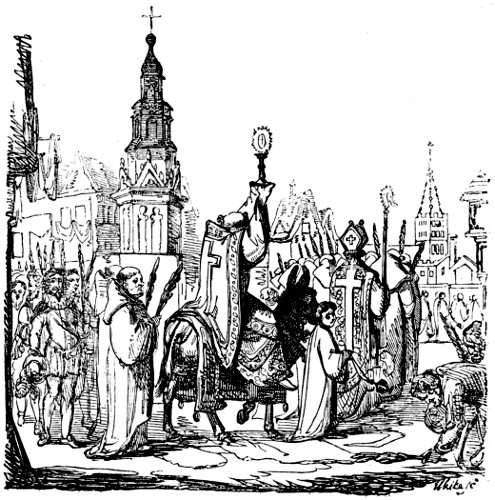
This is the first Sunday before Easter, and is sometimes called Passion Sunday. It is denominated Palm Sunday, because on this day the Roman catholic church ordains boughs or branches of palm trees to be carried in procession, in imitation of those strewed before Christ when he rode into Jerusalem. In this monkish procession the host was carried upon an ass, branches and flowers were strewed on the road, the richest cloths were laid down, and others were hung up. The palms were consecrated by the priest, and after they were used they were preserved to be burned for holy ashes, to lay on the heads of the people on Ash Wednesday in the following year, as before-mentioned (see p. 261,) on that day.
On Palm Sunday, the palm flowers and leaves to be consecrated by the officiating prelate or priest were laid upon the high altar, and those for the poor laity being placed upon the south step of the altar the priest arrayed in a red cope proceeded to consecrate them by a prayer, commencing “I conjure thee, thou creature of flowers and branches, in the name of God the Father,” &c. This was to displace the devil or his influences, if he or they lurked or were hidden in or about the “creature of flowers and branches.” Then followed a prayer wherein he said, with crosses, “We humbly beseech thee that thy truth may + sanctify this creature of flowers and branches, and slips of palms, or boughs of trees, which we offer,” &c. Then the “creature of flowers and branches” was fumed with smoke of frankincense from the censers, and there were other prayers with crossings, and they were sprinkled with holy water with this supplication: “Bless + and sanctify + these branches of palms, and other trees and flowers,” &c. Then the sacrists distributed the palms to the abbots, priors, and nobler persons, and the flowers and leaves to the others. When this was done the procession moved, and afterwards made a stand while two priests brought a Pascal in which the crucifix was laid; afterwards the banner and cross-bearers filed off to the right and to the left, and the boys and monks of the convent arranged themselves, and, after a short service, the priests with the tomb, headed by the banner and cross, passed between the monks, who knelt as they passed. When they came to the city-gates they divided again on two sides, and the shrine being put on a table, was covered with cloth. Above the entrance of the gates, in a place handsomely prepared with hangings, were boys with other singers whom the chanter had appointed, and these sang, “Gloria, Laus,” “Glory, praise,” &c. After having made a procession through the city, they returned to the convent-gate, where the shrine was laid on the table and covered with cloth, and a religious service was performed. The monks then returned to the church, and stood before the crucifix uncovered, while mass was performed; and after they had communicated, the deacon first and the rest afterwards, they offered their palms and flowers, at the altar.[39]
It was also an old Roman catholic custom on Palm Sunday, to draw about the town a wooden ass with a figure on it, representing Christ riding into Jerusalem, and the people strewing palms before it. Googe’s Naogeorgus says:—
A woodden Asse they have, and Image great that on him rides, But underneath the Asse’s feete a table broad there slides, Being borne on wheeles, which ready drest, and al things meete therfore, The Asse is brought abroad and set before the churche’s doore: The people all do come, and bowes of trees and Palmes they bere, Which things against the tempest great the Parson conjures there, And straytwayes downe before the Asse, upon his face he lies, Whome there an other Priest doth strike with rodde of largest sise: He rising up, two lubbours great upon their faces fall, In straunge attire, and lothsomely, with filthie tune, they ball: Who, when againe they risen are, with stretching out their hande, They poynt unto the wooden knight, and, singing as they stande, Declare that that is he that came into the worlde to save, And to redeeme such as in him their hope assured have: And even the same that long agone, while in the streate he roade, The people mette, and Olive-bowes so thicke before him stroade. This being soung, the people cast the braunches as they passe, Some part upon the Image, and some part upon the Asse: Before whose feete a wondrous heape of bowes and braunches ly: This done, into the Church he strayght is drawne full solemly: The shaven Priestes before them marche, the people follow fast, Still striving who shall gather first the bowes that downe are cast: For falsely they beleeve that these have force and vertue great, Against the rage of winter stormes and thunders flashing heate. In some place wealthie citizens, and men of sober chere, For no small summe doe hire this Asse with them about to bere, And manerly they use the same, not suffering any by To touch this Asse, nor to presume unto his presence ny. For they suppose that in this thing, they Christ do lightly serve, And well of him accepted are, and great rewardes deserve.
When the wooden ass had performed in the church procession, the boys hired him:
The Sexten pleasde with price, and looking well no harme be done: They take the Asse, and through the streets and crooked lanes they rone, Whereas they common verses sing, according to the guise, The people giving money, breade, and egges of largest sise. Of this their gaines they are compelde the maister halfe to give, Least he alone without his portion of the Asse should live.
On the Romish processioning on Palm Sunday, it is observed by an old writer that, “Among x thousand, scarce one knew what this meant. They have their laudable dumme ceremonies, with Lentin crosse and Uptide crosse, and these two must justle til lent break his necke. Then cakes must be caste out of the steple, that al the boyes in the parish must lie scambling together by the eares, tyl al the parish falleth a laughyng. But, lorde, what asses-play made they of it in great cathedral churches and abbies. One comes forth in his albe and his long stole (for so they call their girde that they put about theyr neckes,) thys must be leashe wise, as hunters weares their hornes.—This solempne Syre played Christe’s part, a God’s name. Then another companye of singers, chyldren and al, song, in prick-song, the Jewe’s part—and the Deacon read the middel text. The Prest at the Alter al this while, because it was tediouse to be unoccupyed, made Crosses of Palme to set upon your doors, and to beare in your purses, to chace away the Divel.”[40]
Dr. Fulke, opposing the Catholics, observes on their carrying of the host on Palm Sunday,—“It is pretty sport, that you make the priests carry this idol to supply the room of the ass on which Christ did ride. Thus you turn the holy mystery of Christ’s riding to Jerusalem to a May-game and pagent-play.” In the accounts of St. Andrew Hubbard’s parish, there are Palm Sunday charges for the following items: In 1520, eightpence for the hire of an angel. In 1535-7, another eightpence for a priest and a child that played as a messenger: in that year the angel was hired for fourpence. By the churchwardens of St. Mary-at-hill, in 1451, fourpence was paid to one Loreman for playing the prophet on Palm Sunday. Though Roman catholic ceremonies were generally disused under Henry VIII., yet he declared that the bearing of palms on Palm Sunday was to be continued and not cast away; and it appears, that they were borne in England until the second year of Edward VI. In “Stowe’s Chronicle,” by Howes, the practice is said to have been discontinued in 1548.[41]
It was likewise a Roman catholic custom to resort to “our lady of Nantswell,” at Little Conan, in Cornwall, with a cross of palm; and the people, after making the priest a present, were allowed to throw the cross into the well; if it swam, the thrower was to outlive the year; if it sunk, he was not.[42]
Recently, it is related, that on the Saturday before Palm Sunday, the boys of the grammar-school at Lanark, according to ancient usage, parade the streets with a palm, or, its substitute, a large tree of the willow kind, salix cafrea, in blossom, ornamented with daffodils, mezereon, and box-tree. This day there is called Palm Saturday, and the custom is supposed to be “a popish relic of very ancient standing.”[43] Mr. Douce, in a manuscript note, cited by Mr. Ellis, says “I have somewhere met with a proverbial saying, that he that hath not a palm in his hand on Palm Sunday, must have his hand cut off.”
According to Stowe, in the week before Easter, there were great shows in London for going to the woods, and fetching into the king’s house a twisted tree, or withe; and the like into the house of every man of note or consequence.
Palm Sunday remains in the English calendars. It is still customary with men and boys to go a palming in London early on Palm Sunday morning; that is, by gathering branches of the willow or sallow with their grey shining velvet-looking buds, from those trees in the vicinity of the metropolis: they come home with slips in their hats, and sticking in the breast button holes of their coats, and a sprig in the mouth, bearing the “palm” branches in their hands. This usage remains among the ignorant from poor neighbourhoods, but there is still to be found a basket woman or two at Covent-garden, and in the chief markets with this “palm,” as they call it, on the Saturday before Palm Sunday, which they sell to those who are willing to buy; but the demand of late years has been very little, and hence the quantity on sale is very small. Nine out of ten among the purchasers buy it in imitation of others, they care not why; and such purchasers, being Londoners, do not even know the tree which produces it, but imagine it to be a “real” palm tree, and “wonder” they never saw any “palm” trees, and where they grow.
FLORAL DIRECTORY.
Sweet scented Jonquil. Narcissus Odorus. Dedicated to St. John of Egypt.
March 28.
Priscus, Malchus, and Alexander, Martyrs, A. D. 260. St. Sixtus III. Pope, A. D. 440. St. Gontran, King and Confessor, A. D. 593.
Chronology.
On this day in 1380, gunpowder was first used in Europe by the Venetians against the Genoese. Its power is said by the Germans to have been discovered accidentally by Berthold Schwartz; but our Roger Bacon who died in 1278, certainly was acquainted with it. Gunpowder was known in India very early, and from thence the knowledge of it was obtained by the Arabians, who employed it in a battle near Mecca so long ago as the year 690.
1677. Wenceslaus Hollar, the engraver, died at Westminster. His view of London in Howell’s “Londinopolis,” and the numerous plates he executed for Dugdale’s “Monasticon,” “Warwickshire,” “St. Paul’s,” “Origines Juridiciales,” and other works have made him well known to the topographer and portrait collector; but his “muffs” and “insects” are particularly beautiful. His style almost peculiar to himself, is known at a glance by the experienced eye; Gaywood, in portraits, and King, in views, were inferior artists of the same school. Merian, in some insects, rivals him formidably. Hollar’s labour was immense as may be seen from Vertue’s catalogue of his prints; yet he often worked at fourpence an hour, and perished in poverty.
1801. Sir Ralph Abercrombie died in Egypt. He received his death-wound on the 21st., during his memorable victory over the French at Alexandria.
1802. Pallas, a new planet, was discovered by Dr. Olbers, of Bremen in Germany.
FLORAL DIRECTORY.
Lesser Leopardsbane. Doronicum Plantagineum. Dedicated to St. Priscus.
March 29.
Sts. Jonas, Barachisius, &c. A. D. 327. Sts. Armogastes, Archinimus, and Saturus, A. D. 457. St. Eustasius, or Eustachius, Abbot, A. D. 625. St. Gundleus, a Welsh King, 5th Cent. St. Mark, Bishop, 4th Cent.
Chronology.
1315. Raymond Lulle, the most celebrated chemist and alchymist of his time, was stoned to death by the natives of Mauritania, whither he had gone on a religious mission, at the age of eighty. His attention was directed to chemistry by the power of love. A lady, very handsome, with whom he was passionately enamoured, refused to marry him. One day, when he renewed his solicitation, she showed her bosom inflamed by a cancer. Young Lulle instantly took leave, with the resolution to cure, and if possible, conquer the heart of his mistress. He searched with all the ardour, which affection and compassion could inspire, into the secrets of medicine and chemistry, and had the good fortune to cure, and to marry her. After her death he attached himself to the church. The inhabitants of the island of Majorca, where he was born, in 1236, revere him as a martyr.
1461. The battle which decided the claims of the houses of York and Lancaster was fought between Towton and Saxton, two villages near York. It commenced in a snow storm at day break, was contested with fearful obstinacy till three in the afternoon, and terminated in a deluge of blood. Eight and thirty thousand human beings were left dead on the field; of whom the heralds appointed to number the slain, returned that twenty-eight thousand were Lancastrians. Edward, duke of York, who won the day, rode from the scene of carnage to York, where he ordered the death of several prisoners; while Henry VI. of Lancaster, who lost the crown, escaped with great difficulty to the borders.
FLORAL DIRECTORY.
Oxelip. Primula elatior. Dedicated to St. Eustasius. Fumitory. Fumaria officinalis. Dedicated to St. Jonas.
March 30.
St. John Climacus. St. Zozimus, Bishop of Syracuse, A. D. 660. St. Regulus, or Rieul, Bishop of Senlis.
St. John Climacus, A. D. 605,
Was caverned as a hermit in a rock near Mount Sinai, in Syria, and became at seventy-five, abbot and superior-general of all the monks and hermits of the country. He admired one of the principal citizens of Alexandria in Egypt, who, petitioning to become a monk, was ordered to remain without the gate, and manifested his obedience by staying there for seven years, and begging prayers for his leprous soul of every passenger. St. John also admired a monkish cook, because he generally cried while he cooked, and assigned as a reason, that “the fire he always had before his eyes, reminded him of that fire which will burn souls for all eternity.”[44] It is related that a woman who had committed so enormous a sin that she dare not confess it, came to St. John, who bade her write it, and seal it, and give it to him, and he would pray for her; this she did, and shortly after St. John died. The woman sorely afraid that her written secret would be read, wept and prayed at St. John’s tomb, and begged he would appear and tell her what he had done with the paper; on a sudden, St. John came forth habited like a bishop, with a bishop on each side of him, and he said to the woman, “Why troublest thou me so much, and these saints with me? thou sufferest us to have no rest: look here, our clothes are all wet with thy tears.” Then he delivered to her the paper, sealed as she had given it to him, and said, “See here, look at the seal, open the writing, and read it.” So she did; and she found all her sin “defaced clean out;” and instead thereof was written, “All thy sins are forgiven, and put away by the prayer of St. John, my servant.” Then she returned thanks, and St. John and his two bishops returned to their sepulchres.
FLORAL DIRECTORY.
Rough Carameni. Cardemeni hirsuta. Dedicated to St. John of Climacus. Lesser Daffodil. Narcissus minor. Dedicated to St. Zozimus.
March 31.
St. Benjamin, Deacon, Martyr, A. D. 424. St. Acacius, or Achates, Bishop of Antioch, A. D. 250, or 251. St. Guy, A. D. 1046.
Chronology.
1814. On this day the sovereigns who have since formed the holy alliance, entered Paris at the head of the Russian troops. The capitulation of this capital was succeeded by the return of the Bourbons to France.
Maundy Thursday, OR SHERE THURSDAY.
Maundy Thursday is always the Thursday before Easter; its name has occasioned some trouble to antiquaries. One writer conceives maundy to be corrupted from the mandate of Christ to his disciples to break bread in remembrance of him: or from his other mandate, after he had washed their feet, to love one another.[45] With better reason it is conceived to be derived from the Saxon word mand, which afterwards became maund, a name for a basket, and subsequently for any gift or offering contained in the basket. Thus Shakspeare says, “a thousand favours from her maund she drew:” and Hall in his satires, speaks of “a maund charged with household merchandize:” so also Drayton tells of “a little maund being made of osiers small;” and Herrick says,
“Behold, for us, the naked graces stay With maunds of roses, for to strew the way.”
The same poet speaks of maundie at alms:
“All’s gone, and death hath taken Away from us Our maundie, thus The widdowes stand forsaken.”
Thus then, “Maundy Thursday, the day preceding Good Friday, on which the king distributes alms to a certain number of poor persons at Whitehall, is so named from the maunds in which the gifts were contained.”[46]
According to annual custom, on Maundy Thursday, 1814, the royal donations were distributed at the Chapel Royal, Whitehall. In the morning, Dr. Carey, the sub-almoner, and Mr. Hanby, the secretary to the lord high almoner, Mr. Nost, and others belonging to the lord chamberlain’s office, attended by a party of the yeomen of the guard, distributed to seventy-five poor women, and seventy-five poor men, being as many as the king was years old, a quantity of salt fish, consisting of salmon, cod, and herrings, pieces of very fine beef, five loaves of bread, and some ale to drink the king’s health. Mr. Hanby gave notice that in future their cases must be certified by the minister of the parish, by order of the lord almoner. At three o’clock they assembled again, the men on one side the chapel, and the women on the other. A procession entered, of those engaged in the ceremony, consisting of a party of yeoman of the guard, one of them carrying a large gold dish on his head, containing 150 bags, with seventy-five silver pennies in each, for the poor people, which was placed in the royal closet. They were followed by the sub-almoner in his robes, with a sash of fine linen over his shoulder and crossing his waist. He was followed by two boys, two girls, the secretary, and another gentleman, with similar sashes, &c. &c., all carrying large nosegays. The church evening service was then performed, at the conclusion of which the silver pennies were distributed, and woollen cloth, linen, shoes and stockings, to the men and women, and a cup of wine to drink the king’s health.
Anciently, on Maundy Thursday, the kings and queens of England washed and kissed the feet of as many poor men and women as they were years old, besides bestowing their maundy on each. This was in imitation of Christ washing his disciples’ feet. Queen Elizabeth performed this at Greenwich, when she was thirty-nine years old, on which occasion the feet of the same number of poor persons were first washed by the yeomen of the laundry with warm water and sweet herbs, afterwards by the sub-almoner, and lastly, by the queen herself; the person who washed, making each time a cross on the pauper’s foot above the toes, and kissing it. This ceremony was performed by the queen, kneeling, being attended by thirty-nine ladies and gentlewomen. Clothes, victuals, and money were then distributed among the poor.[47] James II. is said to have been the last of our monarchs who performed this ceremony in person. It was afterwards performed by the almoner. On the 5th of April, 1731, it being Maundy Thursday, the king being then in his forty-eighth year, there was distributed at the Banquetting-house, Whitehall, to forty-eight poor men and forty-eight poor women, boiled beef and shoulders of mutton, and small bowls of ale, which is called dinner; after that, large wooden platters of fish and loaves, viz. undressed, one large old ling, and one large dried cod; twelve red herrings, and twelve white herrings, and four half quartern loaves. Each person had one platter of this provision; after which was distributed to them shoes, stockings, linen and woollen cloth, and leathern bags, with one-penny, two-penny, three-penny, and four-penny pieces of silver, and shillings; to each about four pounds in value. His grace, the lord archbishop of York, lord high almoner, performed the annual ceremony of washing the feet of the poor in the Royal Chapel, Whitehall, as was formerly done by the kings themselves.[48]
This day was also called Shere Thursday, and by corruption Chare Thursday. Shere Thursday signified that it was the day whereon the clergy were wont to shere or shear their heads, or get them shorn or shaven, and to clip their beards against Easter-day.[49] In the miraculous legend of St. Brandon it is related that he sailed with his monks to the island of sheep, “and on sherethursdaye, after souper, he wesshe theyr feet and kyssed them lyke as our lorde dyd to his dyscyples.”[50] Maundy Thursday is nowhere observed in London except, as before stated, at the Chapel Royal.
Good Friday.
A Holiday at all the Public Offices.
This and Christmas-day are the only two close holidays now observed throughout London, by the general shutting up of shops, and the opening of all the churches. The dawn is awakened by a cry in the streets of “Hot-cross-buns; one-a-penny buns, two-a-penny buns; one-a-penny, two-a-penny, hot-cross-buns!” This proceeds from some little “peep-o’-day boy,” willing to take the “top of the morning” before the rest of his compeers. He carries his covered buns in a basket hanging on one arm, while his other hand is straightened like an open door, at the side of his mouth, to let forth his childish voice, and he “pipes and trebles out the sound” to the extremity of his lungs. Scarcely has he departed before others come; “another and another still succeeds,” and at last the whole street is in one “common cry of buns.” Old men and young men, young women and old women, big children and little children, are engaged in this occupation, and “some cry now who never cried before.” The bun-venders who eclipse the rest in voice and activity, are young women who drive fruit-barrows—barrows, by the bye, are no more, but of them by and bye. A couple of these ex-barrow-women trip along, carrying a wicker clothes-basket between them, in which the “hot-cross-buns” are covered, first by a clean flannel or green baize, and outwardly by a clean white cloth, which coverings are slowly and partially removed, for fear of letting the buns cool, when a customer stops to buy, or calls them to the door. They continue their lengthened cry, with a volume of concerted sound, unequalled by other rivals in the ephemeral Good Friday trade. These scenes and sounds continue till church-time, and resume in the afternoon. It partially commences on the evening before Good Friday, but with little success.
Some thirty or forty years ago pastrycooks and bakers vied with each other for excellence in making hot-cross-buns; the demand has decreased, and so has the quality of the buns. But the great place of attraction for bun-eaters at that time was Chelsea; for there were the two “royal bun-houses.” Before and along the whole length of the long front of each, stood a flat-roofed, neat, wooden portico or piazza of the width of the foot-path, beneath which shelter “from summer’s heat and winter’s cold,” crowds of persons assembled to scramble for a chance of purchasing “royal hot cross Chelsea buns,” within a reasonable time; and several hundreds of square black tins, with dozens of hot buns on each tin, were disposed of in every hour from a little after six in the morning, till after the same period in the evening of Good Friday. Those who knew what was good, better than new comers, gave the preference to the “old original royal bun-house,” which had been a bun-house “ever since it was a house,” and at which “the king himself once stopped,” and who could say as much for the other? This was the conclusive tale at the door, and from within the doors, of the “old original bun-house.” Alas! and alack! there is that house now; and there is the house that was opened as its rival; but where are ye who contributed to their renown and custom, among the apprentices and journeymen, and the little comfortable tradesmen of the metropolis, and their wives and children—where are ye? With ye hath the fame of “Chelsea buns” departed, and the “royal bun-houses” are little more distinguished than the humble graves wherein ye rest.
Formerly “hot-cross-buns” were commonly eaten in London by families at breakfast, and some families still retain the usage. They are of the usual form of buns; though they are distinguished from them inwardly by a sweeter taste, and the flavour of all-spice, and outwardly by the mark or sign of the cross. The “hot-cross-bun” is the most popular symbol of the Roman catholic religion in England that the reformation has left. Of the use of the cross, as a mark or sign in papal worship and devotion, most readers are aware; for it has been insisted on by Roman catholic writers from the days of Constantine to Alban Butler himself, who giving example of its great virtue on Good Friday, says, “to add one more instance, out of many, St. Teresa assures us, in her own life, that one day the devil, by a phantom, appeared to sit on the letters of her book, to disturb her at her devotions; but she drove him away thrice by the sign of the cross, and at last sprinkled the book with holy water; after which he returned no more.”[51] In the houses of some ignorant people, a Good Friday bun is still kept “for luck,” and sometimes there hangs from the ceiling a hard biscuit-like cake of open cross-work, baked on a Good Friday, to remain there till displaced on the next Good Friday by one of similar make; and of this the editor of the Every-Day Book has heard affirmed, that “it preserves the house from fire;” “no fire ever happened in a house that had one.” This undoubtedly is a relic of the old superstition; as is also a vulgar notion in the west of England, that the straight stripe down the shoulders of the ass, intersected by the long one from the neck to the tail, is a cross of honour conferred upon him by Christ, and that before Christ rode upon the ass, that animal was not so distinguished.
Hot-cross-buns are the ecclesiastical Eulogiæ, or consecrated loaves, bestowed in the church as alms, and to those who from any impediment could not receive the host. They are made from the dough from whence the host itself is taken, and are given by the priest to the people after mass, just before the congregation is dismissed, and are kissed before they are eaten. They are marked with the cross as our Good Friday buns are. Winckelman relates this remarkable fact, that at Herculaneum were found two entire loaves of the same size, a palm and a half, or five inches in diameter. They were marked by a cross, within which were four other lines; and so the bread of the Greeks was marked from the earliest periods. Sometimes it had only four lines, and then it was called quadra. This bread had rarely any other mark than a cross, which was on purpose to divide and break it more easily.[52]
The Tenebræ, a Roman catholic service signifying darkness, is performed on and before Good Friday, to denote the circumstances and darkness at the crucifixion. This is partly symbolized by a triangular candlestick with fourteen yellow wax candles and one white one, seven of these yellow candles being on one side, the seven other yellow ones on the other side, and the white wax candle being at the top. The fourteen yellow candles represent the eleven apostles, the virgin Mary, and the women that were with her at the crucifixion; the white candle at the top is to represent Christ. Fourteen psalms are sung, and at the end of each psalm one of the yellow candles is put out till the whole fourteen are extinguished, and the white candle alone left alight. After this and the extinction of the light on the altar, “the white candle is taken down from the top of the triangular candlestick, and hid under the altar.” The putting out of the fourteen candles is to denote the flight or mourning of the apostles and the women; and the hiding of the white candle denotes that Christ is in the sepulchre; then a noise is made by beating the desks or books, and by beating the floor with the hands and feet, and this noise is to represent the earthquake and the splitting of the rocks at the crucifixion.[53]
In the church of St. Peter’s at Rome on Good Friday, the hundred burning lamps on the tomb of St. Peter are extinguished, and a stupendous illuminated cross depends from the immense dome of the cathedral, as if it hung self-supported. But to relate the papal ceremonies pertaining to the fast of lent, and its ensuing festival, would fill volumes of this size, and we hasten from the devices of men to contemplate works which all his art is incompetent to rival.
Nature! to me, thou art more beautiful In thy most simple forms, than all that man Hath made, with all his genius, and his power Of combination: for he cannot raise One structure, pinnacled, or domed, or gemm’d, By architectural rule, or cunning hand, Like to the smallest plant, or flower, or leaf, Which living hath a tongue, that doth discourse Most eloquent of Him, the great Creator Of all living things. Man’s makings fail To tell of aught but this, that he, the framer Sought also to create, and fail’d, because No life can he impart, or breath infuse, To give inertness being.