JULY. (continued 2)
Reading edition
Cowper, after an eloquent passage upon the blessings of liberty to man, says, “The author hopes that he shall not be censured for unnecessary warmth upon so interesting a subject. He is aware that it is become almost fashionable, to stigmatize such sentiments as no better than empty declamation; but it is an ill symptom, and peculiar to modern times.” He then rolls a flood of indignation against the Bastile. The dreadful fortress was at that time standing. His imagination of human endurance under the horrors of confinement in its cells, beautifully illustrates his compassionate feelings. He says,—
Shame to manhood, and opprobrious more To France than all her losses and defeats, Old or of later date, by sea or land, Her house of bondage, worse than that of old Which God aveng’d on Pharaoh—the Bastile. Ye horrid tow’rs, th’ abode of broken hearts; Ye dungeons and ye cages of despair, That monarchs have supplied from age to age With music, such as suits their sov’reign ears, The sighs and groans of miserable men! There’s not an English heart, that would not leap, To hear that ye were fall’n at last; to know That ev’n our enemies, so oft employ’d In forging chains for us, themselves were free. For he, who values liberty, confines His zeal for her predominance within No narrow bounds; her cause engages him Wherever pleaded. ’Tis the cause of man. There dwell the most forlorn of human kind, Immur’d though unaccus’d, condemn’d untried, Cruelly spar’d, and hopeless of escape. There, like the visionary emblem seen By him of Babylon, life stands a stump, And, filleted about with hoops of brass, Still lives, though all his pleasant boughs are gone. To count the hour-bell, and expect no change; And ever, as the sullen sound is heard, Still to reflect, that, though a joyless note To him, whose moments all have one dull pace, Ten thousand rovers in the world at large Account it music; that it summons some To theatre, or jocund feast, or ball: The wearied hireling finds it a release From labour; and the lover, who has chid Its long delay, feels ev’ry welcome stroke Upon his heart-strings, trembling with delight— To fly for refuge from distracting thought To such amusements, as ingenious woe Contrives, hard-fighting, and without her tools— To read engraven on the mouldy walls, In stagg’ring types, his predecessor’s tale A sad memorial, and subjoin his own— To turn purveyor to an overgorg’d And bloated spider, till the pamper’d pest Is made familiar, watches his approach, Comes at his call, and serves him for a friend— To wear out time in numb’ring to and fro The studs, that thick emboss his iron door; Then downward and then upward, then aslant And then alternate; with a sickly hope By dint of change to give his tasteless task Some relish; till the sum, exactly found In all directions, he begins again— Oh, comfortless existence! hemm’d around With woes, which who that suffers would not kneel And beg for exile, or the pangs of death. That man should thus encroach on fellow man, Abridge him of his just and native rights, Eradicate him, tear him from his hold Upon th’ endearments of domestic life And social, nip his fruitfulness and use, And doom him for perhaps a heedless word To barrenness, and solitude, and tears, Moves indignation, makes the name of king (Of king whom such prerogative can please) As dreadful as the Manichean god, Ador’d through fear, strong only to destroy.
Witchcraft.
In July, 1825, a man was “swam for a wizard,” at Wickham-Skeith, in Suffolk, in the presence of some hundreds of people! In that parish lives Isaac Stebbings, a little spare man about sixty-seven years old, who obtains a livelihood as a huckster; and hard by his cottage lives a thatcher, whose wife is afflicted in mind. In the same parish there happens to be a farmer whose mind is occasionally disturbed. Some one or other put forth the surmise, that these two afflicted persons were bewitched, and Stebbings was spoken of as the “worker of the mischief.” Story grew on story; accumulated hearsays were accepted, as “proof undeniable.” Among other things it was said, that the friends of the afflicted woman had recourse to some means recorded in the annals of witchcraft for detecting the devil’s agent; and that whilst the operation was going on at night, Stebbings came dancing up to the door. In his denial of this circumstance, Stebbings admitted that he did once call at his neighbour’s with mackarel for sale at four o’clock in the morning, before the family were up, and this admission was taken to be as much as he was likely to make. Besides this, the village shoemaker persisted that one morning, as Stebbings passed two or three times before his house, he could not “make” his wax—the ingredients would neither melt nor mix. Dubbed a wizard beyond all doubt, poor Stebbings, ignorant as his neighbours, and teased beyond bearing, proposed at length of himself, the good old-fashioned ordeal of “sink or swim.” The proposal was readily caught at, and on the following Saturday, at two o’clock, in a large pond, called the Grimmer, on Wickham-green, four men walked into the water with him, and the constable of the parish engaged to attend and keep the peace! The sides of the pond were crowded with spectators—men, women, and children. Stebbings had on his breeches and shirt; and when the men had walked with him into the water breast-high, they lifted him up and laid him flat upon his back on the water. Stebbings moved neither hand nor foot, and continued in that position for ten minutes. This was the first trial, and the spectators called out “give him another.” Another trial was accordingly given, for the same length of time, and with the same result. “Try him again, and dip him under the the water,” was then the cry. They did so: one of the four men pressed his chest, and down went his head, whilst up came his heels; in a word, he was like a piece of cork in the water. These trials kept the poor old fellow three-quarters of an hour in the pond, and he came out “more dead than alive.” Still, some were not satisfied. Another man, they said, of his age and size, ought to be swam with him. Stebbings agreed even to this, for he was determined to get rid of the imputation, or die. The following Saturday was appointed for the purpose, and a man called Tom Wilden, of Bacton parish, hard by, was named for his companion. The story now got more wind, and hundreds of people from all the neighbouring parishes attended to witness the second ordeal. But, in the interval, the clergyman of the parish, and the two churchwardens, had interfered, and the swimmers were kept away, to the no small vexation and disappointment of the deluded multitude. It is gravely told, that at the very time Stebbings was swam, the afflicted farmer alluded to above was unusually perturbed; he cried out, “I can see the imps all about me; I must frighten them away with my voice;” and his delusion and his noise, as Stebbings did not sink, are put down to his account. To complete the affair, a respectable farmer in a neighbouring parish went, it is said, to some “cunning man,” and learnt to a certainty that Stebbings was a wizard. The sum of 3l. was paid for this intelligence, and for the assurance that Stebbings should be “killed by inches.”
These particulars in The Times newspaper of July 19, 1825, extracted from the Suffolk Chronicle, prove the deplorable ignorance of certain human beings in England. It is to be hoped, that such persons are not allowed to bring up their offspring in the same darkness. Little can be done towards civilizing adults of this description, but their infants may be reared as intelligent members of society.
Dog Days. “Now Sirius rages.”
To the Editor of the Every-day Book.
Sir,
I am one of those unfortunate creatures, who, at this season of the year, are exposed to the effects of an illiberal prejudice. Warrants are issued out in form, and whole scores of us are taken up and executed annually, under an obsolete statute, on what is called suspicion of lunacy. It is very hard that a sober, sensible dog, cannot go quietly through a village about his business, without having his motions watched, or some impertinent fellow observing that there is an “odd look about his eyes.” My pulse, for instance, at this present writing, is as temperate as yours, Mr. Editor, and my head as little rambling, but I hardly dare to show my face out of doors for fear of these scrutinizers. If I look up in a stranger’s face, he thinks I am going to bite him. If I go with my eyes fixed upon the ground, they say I have got the mopes, which is but a short stage from the disorder. If I wag my tail, I am too lively; if I do not wag it, I am sulky—either of which appearances passes alike for a prognostic. If I pass a dirty puddle without drinking, sentence is infallibly pronounced upon me. I am perfectly swilled with the quantity of ditch-water I am forced to swallow in a day, to clear me from imputations—a worse cruelty than the water ordeal of your old Saxon ancestors. If I snap at a bone, I am furious; if I refuse it, I have got the sullens, and that is a bad symptom. I dare not bark outright, for fear of being adjudged to rave. It was but yesterday, that I indulged in a little innocent yelp only, on occasion of a cart-wheel going over my leg, and the populace was up in arms, as if I had betrayed some marks of flightiness in my conversation.
Really our case is one which calls for the interference of the chancellor. He should see, as in cases of other lunatics, that commissions are only issued out against proper objects; and not a whole race be proscribed, because some dreaming Chaldean, two thousand years ago, fancied a canine resemblance in some star or other, that was supposed to predominate over addle brains, with as little justice as Mercury was held to be influential over rogues and swindlers; no compliment I am sure to either star or planet. Pray attend to my complaint, Mr. Editor, and speak a good word for us this hot weather.
Your faithful, though sad dog, Pompey.
This “sad dog” is a “sensible dog,” and must know, that England is by no means favourable to him or his fellow-creatures. Dogs here are mostly the property of persons who by “training,” and “working,” and “fighting” them, drive many of them mad, and render every dog at this season an object of fear. They have, at present, the right to do wrong to dogs, and the liberty of making them as brutal as themselves. If a few of these dog-masters were tied up, as an example to others, dogs might have rights and liberties. The condition of the lower animals will improve with the subjugation of the passions in the master-animal, man.
ARCHITECTURE OF THE NEW CHURCHES.
For the Every-Day Book.
Taking into consideration the competition excited amongst architects by the public advertizing for designs for the new churches, it might reasonably have been expected that greater specimens of genius would have been elicited, and more variety displayed in the elevations than we at present see. From whatever cause it arises, whether from the interference of individual partiality, or the predominating influence of a bad taste, it is certain that a tameness of design is too generally apparent in these buildings.
Mr. Grey Bennett, speaking of the church in Langham-place, in the house of commons said, “that it was deplorable, a horrible object, and never had he seen so shameful a disgrace to the metropolis. It was like a flat candlestick with an extinguisher on it. He saw a great number of churches building, of all of which it might be said, that one was worse than the other; it seemed as if an adventurous spirit of architecture prevailed, and that its professors had resolved to follow nothing that had ever appeared before, and to invent nothing new that was not purely absurd. No man who knew what architecture was, would have put up the edifices he alluded to, and which disgusted every body, while it made every body wonder who could be the asses that planned, and the fools that built them.”[210] These remarks are upon the whole, perhaps, too severe and sweeping. The greatest fault in the new churches is the want of variety, the eye is tired with the repetition of the same design, and looks with eagerness for something to relieve the general monotony. We have before us so many examples of good church-building, that the spectator is more fastidious in his judgment upon any new specimen, and is led to judge of its merits by comparison with some favourite design, rather than by an examination of its intrinsic beauties or defects: in this view the new churches have not been fairly treated.
Much has been written on the style of architecture most proper for churches. The balance of argument is in favour of the gothic. Architects would decide for the Grecian, but their judgments are so biassed by education, that very few who look at the subject professionally, are likely to form an opinion upon it of any value. If the beauty of a building consists in its appropriateness to the objects for which it is intended, then the gothic style will ever bear away the palm when put into competition with the Greek or Roman architecture for ecclesiastical edifices.
By gothic architecture it should here be understood, that the fashionable mode of building, correctly styled “modern gothic,” is not referred to. So widely different is it from the correct and beautiful architecture which it professes to imitate, that it may with great justness be called a new order. The late Mr. Carter, than whom, no man ever entered into the spirit of gothic architecture with more attention, or ever understood its properties and beauties more soundly, very justly called this splendid invention of modern genius, the “fantastic order;” the correctness of the cognomen is now so far acknowledged, that even architects are giving up this their favourite child, and endeavouring to assume a greater justness of detail, and form a closer imitation of the genuine style. From the reports of the commissioners for building new churches, it appears that the gothic style is adopted in the majority of those churches built in the country; in the environs of the metropolis but in a very few instances. This is to be lamented; it would have been more desirable had the gothic churches been allowed to have borne a proportion to the others, at least of one in three. It has been often urged, that the rejection of this style arises from the expensiveness of its details.—To show at once how little weight there is in this objection, let any one contrast the splendid gothic church lately erected at Chelsea, rich in crockets and mullions, with its stone roof, and pinnacled tower, against the frigid ionic temple built for the parish of St. Pancras. The estimate of the first is, perhaps, little more than a third of the cost of the latter building; the dimensions are at least equal; and which of these buildings displays the most ornament? In the one much money is consumed in delicate mouldings and rich friezes; delicate, minute, and scarcely seen embellishments, which the smoke and damp of a London atmosphere will soon fill with dirt, while it will corrode the composition in which they are worked. In the other, though the gothic detail is marked with a want of coldness, yet what ornament is introduced shows to advantage, and is more calculated to endure than the other. The gothic style in detail is bold and conspicuous, and a little money laid out in embellishment with judgment goes a long way—witness the beautiful chapel at Mile-end, which proves beyond all dispute, that even an ornamented gothic building can be erected at a very limited expense. The architect was the late Mr. Walters, and had he built nothing more than this chapel, he would be entitled to have ranked high in his profession. Another edifice in the gothic style may be worth notice as affording a striking contrast to that last mentioned, this is a church now building in Somers-town. Its only characteristics are meanness and poverty; the style resembles that of a Chinese summer-house, without its lightness; it is clumsy where solidity is required, and possesses not one redeeming quality to atone for the many absurdities it contains.
As to the Grecian architecture of the present day, it is much a matter of question, whether the style of many of the new churches is not as much removed from the original as the gothic I have complained of. It would, however, occupy too much time to inquire into the classical authorities to warrant many of these edifices, and it is very questionable whether many of their architects have done so. It has already been remarked that, a great sameness appears in the new churches. This is in a great measure to be attributed to the designs of the steeples being cramped by the style, which admits of little more than a square tower supporting a circular or polygonal story. It is, however, rather an error of choice than the effect of necessity; the architect does not appear to have been guided by what he can or cannot do; but a want of energy seems the principal cause; he forms a design and fears to deviate from it. This may be exemplified in the three churches erected from Mr. Smirke’s designs, at Wandsworth, Bryanstone-square, and West Hackney. In all, the same design is seen; the same round tower, the same cupola, differing only in height and situation. The bodies of the churches too are so strikingly similar, that the spectator cannot help feeling disappointment from the plainness of the designs and their want of variety; it is not what he has been led to expect from an architect of the eminence to which Mr. Smirke has been raised. The same observations apply even more forcibly to four churches in Surrey: viz. Camberwell, Norwood, Trinity church, Newington, and St. John’s in the Waterloo-road. The steeples of the three latter, as originally designed, would have been exact copies of each other. The first differs but little. The last named church has the good fortune to have had a spire added, as far superior to the others, as it is to the generality of the modern designs. The bodies of all these churches are so closely copied that it would be a difficult matter to point out in what respect they differ. It will be almost needless to add, that the whole four are the work of one architect, Mr. Bedford, of Camberwell. It is not only the sameness of design, but the sameness of style, which I complain of. Though Grecian edifices may be tolerated amidst modern houses, as assimilating with their architecture, they are out of all character in the country. Lambeth parish for instance has built four churches. The Grecian style prevails in the whole, and though the buildings are creditable to their architects, yet, in the case of Brixton, which is certainly a very chaste and pretty doric church, and does honour to the genius of Mr. Porden, and at Norwood, where in every point of view at the least distance, and particularly the latter place, the steeples are seen in connection with trees and country scenery, the pepper-box towers remind the spectator more of pigeon-houses than church steeples; and he, to whom the sight of a village-spire brings almost enthusiastic feelings, and an earnest desire of arriving at it, would scarce bestow any notice on these modern and unappropriate objects. Let the town and the city retain the portico and the dome, the country claims the gothic spire, the mullioned window, and the buttressed wall; but things are now reversed and changed from their natural order. The slender pointed spire is now made to terminate a splendid street of modern houses, where it appears as awkward as the cupola does amidst fields and hedges. Mr. Nash is to build a gothic church at Haggerstone, and let us hope he will atone for his fault at the west, by bestowing a more orthodox steeple upon the eastern erection. Mr. Soane is the architect of Walworth church, which is the first specimen of his ecclesiastical structures; it differs from the generality of new churches, in having a range of arches rising from the parts of the galleries, dividing the structure longitudinally into three aisles, in the style of the older churches. It formed one of the groupes of churches exhibited by this gentleman at Somerset-house in the present year. One recommendation it has, and that by no means a trifling one; the voice of the clergyman may be distinctly heard in every part of the building without the least echo or indistinctness, a fault very common in large buildings.
It would occupy too much space to notice, even briefly, every new church. In regard to steeples, that of the new church building at Hoxton (architect Edwards) is one of the prettiest designs of the modern school of cupolas; and the spire of St. Paul’s, Shadwell, of which Mr. Walters, before spoken of, was the architect, forms a brilliant exception; it is closely formed on the model of Bow steeple, but there are some variations so pleasing, that the design may justly be said to be the architect’s own property—he has followed sir Christopher Wren without copying him. The spire at Poplar is a fine object, but decidedly inferior to the last, inasmuch as it diminishes more abruptly. The steeple attached to St. John’s church, in the Waterloo-road, is a very finely proportioned erection, and shows exceedingly well from the Strand and the Temple-gardens; those who have seen an engraving of this church with the tower originally designed for it, will see what has been gained by the exchange.
There are more new churches still to be built; let us hope then, that the architects who may be selected to erect them, having seen the faults and defects of their predecessors, will produce something better; or, at least, that their designs will differ from the generality of those already built, if only for the sake of variety.
In conclusion, the writer has only to add, that much more might be said both on old and new churches; it is a subject which has more than once employed his pen; he feels, however, that he has already occupied a larger space than he is entitled to do, if he has trespassed on your readers’ patience he has to beg their pardon; his excuse is, that the subject is a favourite one.
E. I. C.
July, 1825.
A HOT LETTER
For Captain Lion, Brighton.
My dear sir,
I anticipated a sojournment in your “neat little country cottage” during your absence, with more pleasure than I expressed, when you made me the offer of it. I imagined how much more comfortable I should be there, than in my own out-of-town single-room. I was mistaken. I have been comfortable nowhere. The malignity of an evil star is against me; I mean the dog-star. You recollect the heat I fell into during our Hornsey walk. I have been hot ever since, “hissing hot,—think of that Master Brook;” I would that thou wert really a brook, I would cleave thy bosom, and, unless thou wert cool to me, I would not acknowledge thee for a true friend.
After returning from the coach wherein you and your lady-cousin departed, I “larded the lean earth” to my own house in town. That evening I got into a hackney coach to enjoy your “cool” residence; but it was hot; and there was no “cool of the evening;” I went to bed hot, and slept hot all night, and got up hot to a hot tea-breakfast, looking all the while on the hot print opposite, Hogarth’s “Evening,” with the fat hot citizen’s wife sweltering between her husband and the New River, the hot little dog looking wistfully into the reachless warm water, her crying hot boy on her husband’s stick, the scolding hot sister, and all the other heats of that ever-to-be-warmly-admired engraving. The coldest picture in the room, to my heated eye, was the fruit-piece worked in worsted—worsted in the dog-days!
How I got through that hot day I cannot remember. At night, when, according to Addison, “evening shades prevail,” the heat prevailed; there were no “cool” shades, and I got no rest; and therefore I got up restless, and walked out and saw the morning star, which I suppose was the dog-star, for I sought coolness and found it not; but the sun arose, and methought there was no atmosphere but burning beams; and the metropolis poured out its heated thousands towards the New River, at Newington; and it was filled with men, and boys, and dogs; and all looked as “comfortable” as live eels in a stew pan.
I am too hot to proceed. What a summer! The very pumps refuse “spring” water; and, I suppose, we shall have no more till next spring.
My heart melts within me, and I am not so inhuman as to request the servant to broil with this letter to the post-office, but I have ordered her to give it to the newsman, and ask him to slip it into the first letter-box he passes, and to tell him, if he forgets, it is of no consequence, and in no hurry; he may take it on to Ludgate-hill, and Mr. Hone, if he please, may print it in his Every-Day Book. I dare say he is too hot to write, and this may help to fill up; so that you’ll get it, at any rate. I don’t care if all the world reads it, for the hot weather is no secret. As Mr. Freeling cannot say that printing a letter is privately conveying it, I shall not get into hot water at the post-office.
I am, my dear sir, Your warmest friend, till winter, Coleman Cottage, Sun Day.
I. Fry.
P. S. I am told the sight of the postmen in their scarlet coats is not bearable in London; they look red-hot.
Weather.
Duncomb, for many years the principal vender of Dunstable larks, resided at the village of Haughton-Regis, near Dunstable. He was an eccentric character, and, according to Dunno’s “Originals,” (himself an “original”) he was “remarkable for his humorous and droll method of rhyming.” The following lines are shrewd and pleasant:—
Duncomb’s Answer in Hay-time relating to the Weather.
Well, Duncomb, how will be the weather? Sir, it looks cloudy altogether. And coming ’cross our Houghton Green, I stopp’d and talk’d with old Frank Beane. While we stood there, sir, old Jan Swain, Went by and said, he know’d ’twood rain. The next that came was Master Hunt, And he declar’d, he knew it wont. And then I met with farmer Blow, He told me plainly he di’nt know. So, sir, when doctors disagree Who’s to decide it, you or me?
Dunstable Larks.
The larks which are caught at Dunstable are unequalled for their size and richness of flavour. Their superiority is said to be owing in a great measure to the chalky soil. On their first arrival they are very lean and weak, but they recover in a short time, and are braced and fattened by picking considerable quantities of the finest particles of chalk with their food. They are usually taken in great quantities, with trammelling nets, on evenings and mornings from Michaelmas to February. When dressed and served up at some of the inns in the town, “in great perfection, by a peculiar and secret method in the process of cooking them,” they are admired as a luxury by travellers during the time they are in season; and by an ingenious contrivance in their package, they are sent ready dressed to all parts of England.
July 15.
St. Henry II., Emperor, A. D. 1024. St. Plechelm, A. D. 714. St. Swithin, Bp. A. D. 862.
Swithin is still retained on this day in our almanacs, and at some public offices is a holiday.
St. Swithin.
He was of noble parentage, and also called Swithun, or in the Saxon language Swithum. He received the tonsure in the church at Winchester, and became a monk in the old monastery there, of which, after being ordained priest, he was made provost or dean. He studied grammar, philosophy, and theology. For his learning and virtue, Egbert, king of England, appointed him his priest, in which character he subscribed a charter to the abbey of Croyland, in 833. Egbert also committed to him the education of his son Ethelwolf, who on succeeding to the throne procured Swithin to be chosen bishop of Winchester in 852.
Tithes were established in England through St. Swithin, who prevailed on Ethelwolf to enact a law, by which he gave the tenth of the land to the church, on condition that the king should have a prayer said for his soul every Wednesday in all the churches for ever. Ethelwolf solemnized the grant by laying the charter on the altar of St. Peter at Rome, in a pilgrimage he made to that city, and by procuring the pope to confirm it.
St. Swithin died on the 2d of July, 862, in the reign of king Ethelbert, and he was buried, according to his own order, in the churchyard. Alban Butler, from whom these particulars are related, affirms the translation of his relics into the church a hundred years afterwards, and refers to the monkish historians for the relation of “such a number of miraculous cures of all kinds wrought by them, as was never known in any other place.” His relics were afterwards removed into the cathedral of Winchester, on its being built under William the Conqueror. It was dedicated to the Holy Trinity, under the patronage of St. Peter, afterwards to St. Swithin, in 980, and was called St. Swithin’s until Henry VIII. ordered it to be called by the name of the Holy Trinity.
Among the notable miracles alleged to have been worked by St. Swithin is this, that after he had built the bridge at Winchester, a woman came over it with her lap full of eggs, which a rude fellow broke, but the woman showed the eggs to the saint, who was passing at the time, and he lifted up his hand and blessed the eggs, “and they were made hole and sounde.” To this may be added another story; that when his body was translated, or removed, two rings of iron, fastened on his grave-stone, came out as soon as they were touched, and left no mark of their place in the stone; but when the stone was taken up, and touched by the rings, they of themselves fastened to it again.[211]
St. Swithin’s Day.
“If it rains on St. Swithin’s day, there will be rain the next forty days afterwards.” The occasion of this old and well-known saying is obscure. In Mr. Douce’s interleaved copy of Brand’s “Popular Antiquities,” there is a printed statement “seemingly cut out of a newspaper” cited, in the last edition of Mr. Brand’s work, thus:—“In the year 865, St. Swithin, bishop of Winchester, to which rank he was raised by king Ethelwolfe, the dane, dying, was canonized by the then pope. He was singular for his desire to be buried in the open church-yard, and not in the chancel of the minster, as was usual with other bishops, which request was complied with; but the monks, on his being canonized, taking it into their heads that it was disgraceful for the saint to lie in the open church-yard, resolved to remove his body into the choir, which was to have been done with solemn procession on the 15th of July. It rained, however, so violently on that day, and for forty days succeeding, as had hardly ever been known, which made them set aside their design as heretical and blasphemous: and, instead, they erected a chapel over his grave, at which many miracles are said to have been wrought.”
Also in “Poor Robin’s Almanac” for 1697, the saying, together with one of the miracles before related, is noticed in these lines:—
“In this month is St. Swithin’s day; On which, if that it rain, they say Full forty days after it will, Or more or less, some rain distill. This Swithin was a saint, I trow, And Winchester’s bishop also. Who in his time did many a feat, As popish legends do repeat: A woman having broke her eggs By stumbling at another’s legs, For which she made a woful cry St. Swithin chanc’d for to come by, Who made them all as sound, or more Than ever that they were before. But whether this were so or no ’Tis more than you or I do know: Better it is to rise betime, And to make hay while sun doth shine, Than to believe in tales and lies Which idle monks and friars devise.”
The satirical Churchill also mentions the superstitious notions concerning rain on this day:—
“July, to whom, the dog-star in her train, St. James gives oisters, and St. Swithin rain.”
The same legend is recorded by Mr. Brand, from a memorandum by Mr. Douce: “I have heard these lines upon St. Swithin’s day:—
“St. Swithin’s day if thou dost rain, For forty days it will remain: St. Swithin’s day if thou be fair For forty days ’t will rain na mair.”
Ben Jonson, in “Every man out of his humour,” has a touch at almanac-wisdom, and on St. Swithin’s power over the weather:—
“Enter Sordido, Macilente, Hine.
“Sord.—(looking at an almanac)—O rare! good, good, good, good, good! I thank my stars, I thank my stars for it.
“Maci.—(aside)—Said I not true, ’tis Sordido, the farmer,
A boar, and brother, to that swine was here.
“Sord. Excellent, excellent, excellent! as I could wish, as I could wish!—Ha, ha, ha! I will not sow my grounds this year. Let me see what harvest shall we have? June, July, August?
“Maci.—(aside)—What is’t, a prognostication raps him so?
“Sord.—(reading)—The xx, xxi, xxii days, Rain and Wind; O good, good! the xxiii and xxiv Rain and some Wind: the xxv, Rain, good still! xxvi, xxvii, xxviii, wind and some rain; would it had been rain and some wind; well, ’tis good (when it can be no better;) xxix inclining to rain: inclining to rain? that’s not so good now: xxx and xxxi wind and no rain: no rain? ’Slid stay; this is worse and worse: what says he of Saint Swithin’s? turn back, look, Saint Swithin’s: no rain?—O, here, Saint Swithin’s, the xv day; variable weather, for the most part rain, good; for the most part rain: why, it should rain forty days after, now, more or less, it was a rule held, afore I was able to hold a plough, and yet here are two days no rain; ha! it makes me muse.”
Gay, whilst he admonishes against falling into the vulgar superstition, reminds his readers of necessary precautions in a wet season, which make us smile, who forbear from hats to loop and unloop, and do not wear wigs:—
Now, if on Swithin’s feast the welkin lours, And every penthouse streams with hasty showers, Twice twenty days shall clouds their fleeces drain And wash the pavements with incessant rain. Let not such vulgar tales debase thy mind; Nor Paul nor Swithin rule the clouds and wind If you the precepts of the Muse despise, And slight the faithful warning of the skies, Others you’ll see, when all the town’s afloat, Wrapt in the embraces of a kersey coat, Or double bottomed frieze; their guarded feet Defy the muddy dangers of the street; While you, with hat unlooped, the fury dread Of spouts high streaming, and with cautious tread Shun every dashing pool, or idly stop, To seek the kind protection of a shop. But business summons; now with hasty scud You jostle for the wall; the spattered mud Hides all thy hose behind; in vain you scour Thy wig, alas! uncurled, admits the shower. So fierce Electo’s snaky tresses fell, When Orpheus charmed the rigorous powers of hell; Or thus hung Glaucus’ beard, with briny dew Clotted and straight, when first his amorous view Surprised the bathing fair; the frighted maid Now stands a rock, transformed by Circe’s aid.
Dr. Forster, in his “Perennial Calendar,” cites from Mr. Howard’s work on the climate of London the following—
“Examination of the popular Adage of ‘Forty Days’ Rain after St. Swithin’ how far it may be founded in fact.”
The opinion of the people on subjects connected with natural history is commonly founded in some degree on fact or experience; though in this case vague and inconsistent conclusions are too frequently drawn from real premises. The notion commonly entertained on this subject, if put strictly to the test of experience at any one station in this part of the island, will be found fallacious. To do justice to popular observation, I may now state, that in a majority of our summers, a showery period, which, with some latitude as to time and local circumstances, may be admitted to constitute daily rain for forty days, does come on about the time indicated by this tradition: not that any long space before is often so dry as to mark distinctly its commencement.
The tradition, it seems, took origin from the following circumstances. Swithin or Swithum, bishop of Winchester, who died in 868, desired that he might be buried in the open churchyard, and not in the chancel of the minster, as was usual with other bishops, and his request was complied with; but the monks, on his being canonized, considering it disgraceful for the saint to lie in a public cemetery, resolved to remove his body into the choir, which was to have been done with solemn procession, on the 15th of July: it rained, however, so violently for forty days together at this season, that the design was abandoned. Now, without entering into the case of the bishop, who was probably a man of sense, and wished to set the example of a more wholesome, as well as a more humble, mode of resigning the perishable clay to the destructive elements, I may observe, that the fact of the hinderance of the ceremony by the cause related is sufficiently authenticated by tradition; and the tradition is so far valuable, as it proves that the summers in this southern part of our island were subject a thousand years ago to occasional heavy rains, in the same way as at present. Let us see how, in point of fact, the matter now stands.
In 1807, it rained with us on the day in question, and a dry time followed. In 1808, it again rained on this day, though but a few drops: there was much lightning in the west at night, yet it was nearly dry to the close of the lunar period, at the new moon, on the 22d of this month, the whole period having yielded only a quarter of an inch of rain; but the next moon was very wet, and there fell 5·10 inches of rain.
In 1818 and 1819, it was dry on the 15th, and a very dry time in each case followed. The remainder of the summers occurring betwixt 1807 and 1819, appear to come under the general proposition already advanced: but it must be observed, that in 1816, the wettest year of the series, the solstitial abundance of rain belongs to the lunar period, ending, with the moon’s approach to the third quarter, on the 16th of the seventh month; in which period there fell 5·13 inches, while the ensuing period, which falls wholly within the forty days, though it had rain on twenty-five out of thirty days, gave only 2·41 inches.
I have paid no regard to the change effected in the relative position of this so much noted day by the reformation of the calendar, because common observation is now directed to the day as we find it in the almanac; nor would this piece of accuracy, without greater certainty as to a definite commencement of this showery period in former times, have helped us to more conclusive reasoning on the subject.
Solstitial and Equinoctial Rains.—Our year, then, in respect of quantities of rain, exhibits a dry and a wet moiety. The latter again divides itself into two periods distinctly marked. The first period is that which connects itself with the popular opinion we have been discussing. It may be said on the whole, to set in with the decline of the diurnal mean temperature, the maximum of which, we may recollect, has been shown to follow the summer solstice at such an interval as to fall between the 12th and 25th of the month called July. Now the 15th of that month, or Swithin’s day in the old style, corresponds to the 26th in the new; so that common observation has long since settled the limits of the effect, without being sensible of its real causes. The operation of this cause being continued usually through great part of the eighth month, the rain of this month exceeds the mean by about as much as that of the ninth falls below it.
As regards St. Swithin and his day, it may be observed, that according to bishop Hall when Swithin died, he directed that “his body should not be laid within the church, but where the drops of rain might wet his grave; thinking that no vault was so good to cover his grave as that of heaven.” This is scarcely an exposition of the old saying, which, like other old sayings, still has its votaries. It is yet common on this day to say, “Ah! this is St. Swithin; I wonder whether it will rain?” An old lady who so far observed this festival, on one occasion when it was fair and sunshiny till the afternoon, predicted fair weather; but tea-time came, and—
“there follow’d some droppings of rain.”
This was quite enough. “Ah!” said she, “now we shall have rain every day for forty days;” nor would she be persuaded of the contrary. Forty days of our humid climate passed, and many, by their having been perfectly dry, falsified her prediction. “Nay, nay,” said she, “but there was wet in the night, depend upon it.” According to such persons St. Swithin cannot err.
It appears from the parish accounts of Kingston upon Thames, in 1508, that “any householder kepying a brode gate” was to pay to the parish priest’s “wages 3d.” with a halfpenny “to the paschall:” this was the great wax taper in the church; the halfpenny was towards its purchase and maintaining its light; also he was to give to St. Swithin a halfpenny. A holder of one tenement paid twopence to the priest’s wages, a halfpenny to the “paschall;” likewise St. Swithin a halfpenny.
Rain on St. Swithin’s day is noticed in some places by this old saying, “St. Swithin is christening the apples.”
FLORAL DIRECTORY.
Small Cape Marigold. Calendula pluvialis. Dedicated to St. Swithin.
July 16.
St. Eustathius, Patriarch of Antioch, A. D. 338. St. Elier or Helier.
French Hoaxing.
July, 1817.—A man of imposing figure, wearing a large sabre and immense mustachios, arrived at one of the principal inns of a provincial city, with a female of agreeable shape and enchanting mien. He alighted at the moment that dinner was serving up at the table d’hote. At his martial appearance all the guests rose with respect; they felt assured that it must be a lieutenant-general, or a major-general at least. A new governor was expected in the province about this time, and every body believed that it was he who had arrived incognito. The officer of gendarmerie gave him the place of honour, the comptroller of the customs and the receiver of taxes sat by the side of Madame, and exerted their wit and gallantry to the utmost. All the tit-bits, all the most exquisite wines, were placed before the fortunate couple. At length the party broke up, and every one ran to report through the city that Monsieur the governor had arrived. But, oh! what was their surprise, when the next day “his excellence,” clad in a scarlet coat, and his august companion dressed out in a gown glittering with tinsel, mounted a small open calash, and preceded by some musicians, went about the squares and public ways, selling Swiss tea and balm of Mecca. Imagine the fury of the guests! They complained to the mayor, and demanded that the audacious quack should be compelled to lay aside the characteristic mark of the brave. The prudent magistrate assembled the common council; and those respectable persons, after a long deliberation, considering that nothing in the charter forbad the citizens to let their beard grow on their upper lip, dismissed the complaint altogether. The same evening the supposed governor gave a serenade to the complainants, and the next day took his leave, and continued his journey amidst the acclamations of the populace; who, in small as well as in great cities, are very apt to become passionately fond of charlatans.[212]
FLORAL DIRECTORY.
Great Garden Convolvulus. Convolvulus purpureus. Dedicated to St. Eustathius.
July 17.
St. Alexius, 5th Cent. St. Speratus and his Companions. St. Marcellina, A. D. 397. St. Ennodius, Bp. A. D. 521. St. Leo IV., Pope, A. D. 855. St. Turninus, 8th Cent.
Mackerel.
The mackerel season is one of great interest on the coast, where these beautiful fish are caught. The going out and coming in of the boats are really “sights.” The prices of mackerel vary according to the different degrees of success. In 1807, the first Brighton boat of mackerel, on the 14th of May, sold at Billingsgate, for forty guineas per hundred, seven shillings each, the highest price ever known at that market. The next boat that came in reduced their value to thirteen guineas per hundred. In 1808, these fish were caught so plentifully at Dover, that they sold sixty for a shilling. At Brighton, in June, the same year, the shoal of mackerel was so great, that one of the boats had the meshes of her nets so completely occupied by them, that it was impossible to drag them in. The fish and nets, therefore, in the end sank together; the fisherman thereby sustaining a loss of nearly sixty pounds, exclusive of what his cargo, could he have got it into the boat, would have produced. The success of the fishery in 1821, was beyond all precedent. The value of the catch of sixteen boats from Lowestoft, on the 30th of June, amounted to 5,252l. 15s. 11⁄4d., being an average of 328l. 5s. 111⁄4d. per each boat; and it is supposed that there was no less a sum than 14,000l. altogether realized by the owners and men concerned in the fishery of the Suffolk coast.[213]
FLORAL DIRECTORY.
Sweet Pea. Lathyrus odoratus. Dedicated to St. Marcellina.
July 18.
Sts. Symphorosa and her seven Sons, Martyrs, A. D. 120. St. Philastrius, Bp. A. D. 384. St. Arnoul, Bp. A. D. 640. St. Arnoul, A. D. 534. St. Frederic, Bp. A. D. 838. St. Odulph. St. Bruno, Bp. of Segni, A. D. 1125.
Summer Morning.
The cocks have now the morn foretold, The sun again begins to peep, The shepherd, whistling to his fold, Unpens and frees the captive sheep. O’er pathless plains at early hours The sleepy rustic sloomy goes; The dews, brushed off from grass and flowers, Bemoistening sop his hardened shoes; While every leaf that forms a shade, And every floweret’s silken top, And every shivering bent and blade, Stoops, bowing with a diamond drop. But soon shall fly those diamond drops, The red round sun advances higher, And, stretching o’er the mountain tops, Is gilding sweet the village-spire. ’Tis sweet to meet the morning breeze, Or list the gurgling of the brook; Or, stretched beneath the shade of trees, Peruse and pause on Nature’s book, When Nature every sweet prepares To entertain our wished delay,— The images which morning wears, The wakening charms of early day! Now let me tread the meadow paths While glittering dew the ground illumes, As, sprinkled o’er the withering swaths, Their moisture shrinks in sweet perfumes; And hear the beetle sound his horn; And hear the skylark whistling nigh, Sprung from his bed of tufted corn, A hailing minstrel in the sky.
Clare.
FLORAL DIRECTORY.
Autumn Marigold. Chrysanthemum coronarium. Dedicated to St. Bruno.
July 19.
St. Vincent, of Paul, A. D. 1660. St. Arsenius, A. D. 449. St. Symmachus, Pope, A. D. 514. St. Macrina V., A. D. 379.
In July, 1797, as Mr. Wright, of Saint Faith’s, in Norwich, was walking in his garden, a flight of bees alighted on his head, and entirely covered his hair, till they made an appearance like a judge’s wig. Mr. W. stood upwards of two hours in this situation, while the customary means were used for hiving them, which was completely done without his receiving any injury. Mr. Wright had expressed a strong wish, for some days before, that a flight of bees might come on his premises.
FLORAL DIRECTORY.
Golden Hawkweed. Hieracium Aurantiacum. Dedicated to St. Vincent of Paul.
July 20.
St. Joseph Barsabas, the Disciple. St. Margaret, of Antioch. Sts. Justa and Rufina, A. D. 304. St. Ceslas, A. D. 1242. St. Aurelius, Abp., A. D. 423. St. Ulmar, or Wulmar, A. D. 710. St. Jerom Æmiliani, A. D. 1537.
Midnight and the Moon.
Now sleep is busy with the world, The moon and midnight come; and curl’d Are the light shadows round the hills; The many-tongued and babbling rills Play on the drowsy ear of night, Gushing at times into the light From out their beds, and hastening all To join the trembling waterfall. Fair planet! when I watch on high, Star-heralded along the sky, That face of light and holiness, I turn, and all my brethren bless: And it must be—(the hour is gone When the fair world thou smilest upon, Lay chained in darkness,) thou wert sent Ministering in the firmament, To be—calm, beautiful, above— The eye of universal love. ’Twere good to die in such an hour, And rest beneath the almighty power, (Beside yon ruin still and rude) Of beauty and of solitude.
Literary Pocket Book.
FLORAL DIRECTORY.
Virginian Dragon’s Head. Dracocephalus Virginianum. Dedicated to St. Margaret.
July 21.
St. Praxedes. St. Zodicus, Bp., A. D. 204. St. Barhadbesciabas, A. D. 354. St. Victor, of Marseilles. St. Arbogastus, Bp. A. D. 678.
Flowers.
A sensitive plant in a garden grew And the young winds fed it with silver dew, And it opened its fanlike leaves to the light, And closed them beneath the kisses of night. And the spring arose on the garden fair, Like the spirit of love felt every where; And each flower and shrub on earth’s dark breast, Rose from the dreams of its wintry rest. But none ever trembled and panted with bliss, In the garden, the field, or the wilderness, Like a doe in the noontide with love’s sweet want, As the companionless sensitive plant. The snowdrop, and then the violet, Arose from the ground with warm rain wet, And their breath was mixed with fresh odour, sent, From the turf, like the voice and the instrument. Then the pied windflowers, and the tulip tall, And narcissi, the fairest among them all, Who gaze on their eyes in the stream’s recess, Till they die of their own dear loveliness. And the naiadlike lily of the vale, Whom youth makes so fair, and passion so pale, That the light of its tremulous bells is seen, Through their pavilions of tender green. And the hyacinth purple, white, and blue, Which flung from its bells a sweet peal anew Of music so delicate, soft, and intense, It was felt like an odour within the sense. And the rose, like a nymph to the bath addrest, Which unveiled the depth of her glowing breast, Till, fold after fold, to the fainting air The soul of her beauty and love lay bare. And the wandlike lily, which lifted up, As a Moenad, its moonlight-coloured cup, Till the fiery star, which is its eye, Gazed through clear dew on the tender sky. And the jessamine faint, and sweet tuberose, The sweetest flower, for scent, that blows; And all rare blossoms from every clime, Grew in that garden in perfect prime.
Shelley.
CAPTAIN STARKEY.
To the Editor of the Every-Day Book.
Dear Sir,
I read your account of this unfortunate Being, and his forlorn piece of self-history, with that smile of half-interest which the Annals of Insignificance excite, till I came to where he says “I was bound apprentice to Mr. William Bird, an eminent writer and Teacher of languages and Mathematics,” &c.—when I started as one does on the recognition of an old acquaintance in a supposed stranger. This then was that Starkey of whom I have heard my Sister relate so many pleasant anecdotes; and whom, never having seen, I yet seem almost to remember. For nearly fifty years she had lost all sight of him—and behold the gentle Usher of her youth, grown into an aged Beggar, dubbed with an opprobrious title, to which he had no pretensions; an object, and a May game! To what base purposes may we not return! What may not have been the meek creature’s sufferings—what his wanderings—before he finally settled down in the comparative comfort of an old Hospitaller of the Almonry of Newcastle? And is poor Starkey dead?—
I was a scholar of that “eminent writer” that he speaks of; but Starkey had quitted the school about a year before I came to it. Still the odour of his merits had left a fragrancy upon the recollection of the elder pupils. The school-room stands where it did, looking into a discoloured dingy garden in the passage leading from Fetter Lane into Bartlett’s Buildings. It is still a School, though the main prop, alas! has fallen so ingloriously; and bears a Latin inscription over the entrance in the Lane, which was unknown in our humbler times. Heaven knows what “languages” were taught in it then; I am sure that neither my Sister nor myself brought any out of it, but a little of our native English. By “mathematics,” reader, must be understood “cyphering.” It was in fact a humble day-school, at which reading and writing were taught to us boys in the morning, and the same slender erudition was communicated to the girls, our sisters, &c. in the evening. Now Starkey presided, under Bird, over both establishments. In my time, Mr. Cook, now or lately a respectable Singer and Performer at Drury-lane Theatre, and Nephew to Mr. Bird, had succeeded to him. I well remember Bird. He was a squat, corpulent, middle-sized man, with something of the gentleman about him, and that peculiar mild tone—especially while he was inflicting punishment—which is so much more terrible to children, than the angriest looks and gestures. Whippings were not frequent; but when they took place, the correction was performed in a private room adjoining, whence we could only hear the plaints, but saw nothing. This heightened the decorum and the solemnity. But the ordinary public chastisement was the bastinado, a stroke or two on the palm with that almost obsolete weapon now—the ferule. A ferule was a sort of flat ruler, widened at the inflicting end into a shape resembling a pear,—but nothing like so sweet—with a delectable hole in the middle, to raise blisters, like a cupping-glass. I have an intense recollection of that disused instrument of torture—and the malignancy, in proportion to the apparent mildness, with which its strokes were applied. The idea of a rod is accompanied with something ludicrous; but by no process can I look back upon this blister-raiser with any thing but unmingled horror.—To make him look more formidable—if a pedagogue had need of these heightenings—Bird wore one of those flowered Indian gowns, formerly in use with schoolmasters; the strange figures upon which we used to interpret into hieroglyphics of pain and suffering. But boyish fears apart—Bird I believe was in the main a humane and judicious master.
O, how I remember our legs wedged in to those uncomfortable sloping desks, where we sat elbowing each other—and the injunctions to attain a free hand, unattainable in that position; the first copy I wrote after, with its moral lesson “Art improves Nature;” the still earlier pot-hooks and the hangers some traces of which I fear may yet be apparent in this manuscript; the truant looks side-long to the garden, which seemed a mockery of our imprisonment; the prize for best spelling, which had almost turned my head, and which to this day I cannot reflect upon without a vanity, which I ought to be ashamed of—our little leaden ink-stands, not separately subsisting, but sunk into the desks; the bright, punctually-washed morning fingers, darkening gradually with another and another ink-spot: what a world of little associated circumstances, pains and pleasures mingling their quotas of pleasure, arise at the reading of those few simple words—“Mr. William Bird, an eminent Writer and Teacher of languages and mathematics in Fetter Lane, Holborn!”
Poor Starkey, when young, had that peculiar stamp of old-fashionedness in his face, which makes it impossible for a beholder to predicate any particular age in the object. You can scarce make a guess between seventeen and seven and thirty. This antique cast always seems to promise ill-luck and penury. Yet it seems, he was not always the abject thing he came to. My Sister, who well remembers him, can hardly forgive Mr. Thomas Ranson for making an etching so unlike her idea of him, when he was a youthful teacher at Mr. Bird’s school. Old age and poverty—a life-long poverty she thinks, could at no time have so effaced the marks of native gentility, which were once so visible in a face, otherwise strikingly ugly, thin, and care-worn. From her recollections of him, she thinks that he would have wanted bread, before he would have begged or borrowed a halfpenny. If any of the girls (she says) who were my school-fellows should be reading, through their aged spectacles, tidings from the dead of their youthful friend Starkey, they will feel a pang, as I do, at ever having teased his gentle spirit. They were big girls, it seems, too old to attend his instructions with the silence necessary; and however old age, and a long state of beggary, seem to have reduced his writing faculties to a state of imbecility, in those days, his language occasionally rose to the bold and figurative, for when he was in despair to stop their chattering, his ordinary phrase was, “Ladies, if you will not hold your peace, not all the powers in heaven can make you.” Once he was missing for a day or two; he had run away. A little old unhappy-looking man brought him back—it was his father—and he did no business in the school that day, but sate moping in a corner, with his hands before his face; and the girls, his tormentors, in pity for his case, for the rest of that day forbore to annoy him. I had been there but a few months (adds she) when Starkey, who was the chief instructor of us girls, communicated to us as a profound secret, that the tragedy of “Cato” was shortly to be acted by the elder boys, and that we were to be invited to the representation. That Starkey lent a helping hand in fashioning the actors, she remembers; and but for his unfortunate person, he might have had some distinguished part in the scene to enact; as it was, he had the arduous task of prompter assigned to him, and his feeble voice was heard clear and distinct, repeating the text during the whole performance. She describes her recollection of the cast of characters even now with a relish. Martia, by the handsome Edgar Hickman, who afterwards went to Africa, and of whom she never afterwards heard tidings,—Lucia, by Master Walker, whose sister was her particular friend; Cato, by John Hunter, a masterly declaimer, but a plain boy, and shorter by the head than his two sons in the scene, &c. In conclusion, Starkey appears to have been one of those mild spirits, which, not originally deficient in understanding, are crushed by penury into dejection and feebleness. He might have proved a useful adjunct, if not an ornament to Society, if Fortune had taken him into a very little fostering, but wanting that, he became a Captain—a by-word—and lived, and died, a broken bulrush.
C. L.
Peerless Pool.
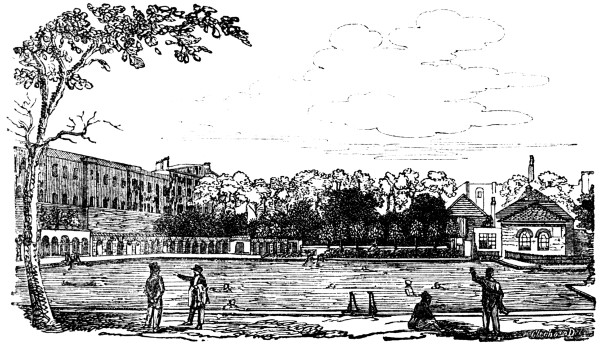
Peerless Pool.
———The sprightly youth Speeds to the well-known Pool. Awhile he stands Gazing th’ inverted landscape, half afraid To meditate the blue profound below; Then plunges headlong down the circling flood. His ebon tresses, and his rosy cheek, Instant emerge; and thro’ th’ obedient wave, At each short breathing by his lip repell’d, With arms and legs according well, he makes, As humour leads, an easy winding path; While, from his polish’d sides, a dewy light Effuses on the pleas’d spectators round.
Thomson.
Coming from the city, on the left-hand side of the City-road, just beyond Old-street, and immediately at the back of St. Luke’s hospital, Peerless Pool
———flows unseen, And wastes its waters in the silver Thames.
It is a pleasure-bath in the open air, a hundred and seventy feet long, and upwards of a hundred feet wide, nearly surrounded by trees, with an arcade divided off into boxes for privately dressing and undressing; and is therefore, both in magnitude and convenience, the greatest bathing-place in the metropolis. Here the lover of cleanliness, or of a “cool dip” in a hot day, may at all times, for a shilling, enjoy the refreshment he desires, without the offensive publicity, and without the risk of life, attendant on river-bathing; while there is “ample room and verge enough” for all the sports and delights which “swimmers only know.” It is no where so deep as five feet, and on one side only three; the experienced and the inexperienced are alike safe. There is likewise a capacious cold-bath in an adjacent building, for the use of those who prefer a temperature below that of the atmosphere.
Peerless Pool is distinguished for having been one of the ancient springs that supplied the metropolis with water, when our ancestors drew that essential element from public conduits; that is to say, before the “old” water-works at London-bridge “commenced to be,” or the “New River” had been brought to London by sir Hugh Myddelton. The streams of this “pool” at that time were conveyed, for the convenience of the inhabitants near Lothbury, through pipes terminating “close to the south-west corner of the church.”[214] Stow speaks of it as a “cleere water, called Perilous Pond, because,” says our chronicler, “divers youths, by swimming therein, have been drowned.”[215] “Upon Saterday the 19 of January, 1633, sixe pretty young lads, going to sport themselves upon the frozen Ducking-pond, neere to Clearkenwell, the ice too weake to support them, fell into the water, concluding their pastime with the lamentable losse of their lives: to the great griefe of many that saw them dying, many more that afterward saw them dead, with the in-expressible griefe of their parents.”[216] In consequence of such accidents, and the worthy inhabitants of Lothbury having obtained their water from other sources, Perilous Pond was entirely filled up, and rendered useless, till Mr. William Kemp, “an eminent jeweller and citizen of London,” “after ten years’ experience of the temperature” of this water, and “the happy success of getting clear of a violent pain of the head by bathing in it, to which he had for many years been subject, was generously led for public benefit” to open the spring in the year 1743, and “to form the completest swimming-bath in the whole world;” and “in reference to the improvements he had made on the ruins of that once Perilous Pond,” and by a very natural transition, he changed that disagreeable appellation of Perilous, “that is,” says Maitland, “dangerous, or hazardous, to the more agreeable name of Peerless Pool, that is, Matchless Bath, a name which carries its own reason with it.”
Maitland says, that Kemp “spared no expense nor contrivance to render it quite private and retired from public inspection, decent in its regulation, and as genteel in its furniture as such a place could be made.” He added a cold-bath, “generally allowed,” says Maitland, “to be the largest in England, being forty feet long, and twenty feet broad; this bath is supplied by a remarkably cold spring, with a convenient room for dressing.” The present cold-bath, faced with marble and paved with stone, was executed by sir William Staines, when he was a journeyman mason. He was afterwards lord mayor of London, and often boasted of this, while he smoked his pipe at the Jacob’s-well in Barbican, as amongst his “best work.”
Kemp’s improvements provided an entrance to it across a bowling-green on the south side, through a neat marble pavilion or saloon, thirty feet long, with a large gilt sconce over a marble table. Contiguous to this saloon were the dressing apartments, some of which were open, others were private with doors. There was also a green bower on each side of the bath, divided into other apartments for dressing. At the upper end was a circus-bench, capable of accommodating forty persons, under the cover of a wall twelve feet high, surmounted on one side by a lofty bank with shrubs, and encircled by a terrace-walk planted with lime-trees at the top. The descent to the bath was by four pair of marble stairs, as it still is, to a fine gravel-bottom, through which the springs gently bubbled and supplied, as they do at this time, the entire basin with the crystal fluid. Hither many a “lover and preserver” of health and long life, and many an admirer of calm retreat, resorted “ever and anon:”—
And in hyghe sommer eueriche daye I wene, Scapyng the hot son’s euer bemyng face, He dyd hym wend unto a pleasaunt place, Where auncient trees shut owht escorchyng shene; And in a solempne lyghte, through braunches grene, In quyet, sytting on a lytel stole, For hys delection he woulde ther’ unlace, Wythin an arbre, where bryddes onlie bene And goe, and bayn hym in the waters cool That alway wellyd there, and made a peerlesse poole.
*
The most remarkable feature of Peerless Pool, to the public eye, was a noble fish-pond, constructed by Kemp, due east and west. It was three hundred and twenty feet long, ninety-three feet broad, and eleven feet deep, stocked with carp, tench, and a great variety of the finny tribe, wherein subscribers and frequenters of either the pleasure or the cold-bath were privileged to angle. On each side was a high slope or bank, with thousands of variegated shrubs, terminated at the top by a gravelled walk between stately lime-trees:—
These beautiful plantations shadow’d all; And flung their beauteous greens so deep and full, Into the surface of the quiet lake, That the cool water seem’d an open mirror Reflecting patterns of all liveries The gentle seasons give the constant earth Wherein to wait on man; or rather seem’d An open portal to the great abyss Inviting entrance.
*
At the head of the fish-pond, westward, stood the house that Kemp built for his own residence, with a garden and orchard of pears and apple-trees, and walled round. It was a handsome old-country-’squire-like building, very similar to the present parsonage-house of St. Luke’s in Helmet-row; the back-front looked upon the water, and had an arch in the embankment on that side, beneath which two boats, kept for the accommodation of gentlemen of the rod and line, were drawn in at night.
Mr. Kemp expired before his lease; but he left property to his family, and his son in possession of the “Pool,” and of his lease. He was not so successful as his father; and after him the premises were held by a person named Taylor, and subsequently by one Crewe. At the expiration of his lease, a new lease upon building terms was obtained of St. Bartholomew’s hospital, at a rental of 600l. per annum, by Mr. Joseph Watts, the present occupier and proprietor of the baths, who, to remunerate himself, set about “improving,” by draining the fish-pond, pulling down Kemp’s house, and felling the trees. He built Baldwyn-street on the site of the fish-pond; Bath-buildings on the ground of Kemp’s orchard; and erected other adjoining streets; preserving the baths as he found them, and in many respects improving them. The pleasure-bath is still a pleasant spot, and both that and the cold-bath retain their ancient capabilities. Indeed, the attractions to the pleasure-bath are undiminished. Its size is the same as in Kemp’s time, and trees enough remain to shade the visitor from the heat of the sun while on the brink, irresolute whether to plunge gloriously in, or ignobly walk down the steps. On a summer evening it is amusing to survey the conduct of the bathers: some boldly dive; others “timorous stand,” and then descend step by step, “unwillingly and slow.” Choice swimmers attract attention by divings and somersets, and the whole sheet of water sometimes rings with merriment. Every fine Thursday and Saturday afternoon in the summer, columns of blue-coat boys, more than three score in each, headed by their respective beadles, arrive, and some half-strip themselves ere they reach their destination; the rapid plunges they make into the pool, and their hilarity in the bath, testify their enjoyment of the tepid fluid.
Mr. John Cleghorn, of Chapman-street, Islington, the architectural draftsman and engraver, was resident near Peerless Pool many years. There being no representation of the fish-pond and house, as they remained within the recollection of himself and the editor of the Every-Day Book, this gentleman, whose taste and knowledge of perspective have by the pencil and the graver exquisitely and accurately illustrated Mr. Rutter’s “Description of Fonthill,” has supplied the drawing from whence the subjoined engraving has been made. Mr. Cleghorn also made the drawing of the pleasure-bath, as it now is, for the engraving at the commencement of this article.
The old Fish-pond at Peerless Pool.
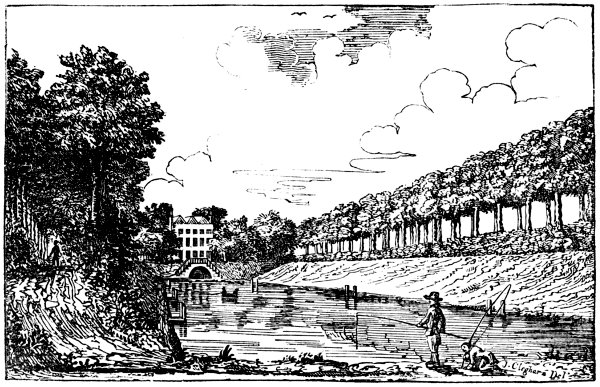
The old Fish-pond at Peerless Pool.
To the Shepherd and Shepherdess then they go To tea with their wives, for a constant rule; And next cross the road to the Fountain also, And there they all sit, so pleasant and cool, And see, in and out, The folks walk about, And gentlemen angling in Peerless Pool.
*
The great earthquake, on the first of November, 1755, which destroyed seventy thousand human beings at Lisbon, and swallowed up the greatest part of the city, affected Peerless Pool. Dr. Birch, then secretary to the Royal Society, authenticated the fact, and records it in the “Philosophical Transactions.” It appears, that on reports that the agitation of the waters observed in many parts of England, Ireland, Scotland, Holland, &c. on that day, had likewise been noticed in Peerless Pool, Dr. Birch, being desirous of as accurate and circumstantial an account as possible of a fact which he had not heard to have been remarked in any other part of London or its suburbs, himself went thither, on Saturday, December the 6th, 1755, and there took down the particulars from the mouth of one of the two waiters, who were eye-witnesses of it. This waiter said, that having been engaged, between ten and eleven in the morning, with his fellow-waiter, near the wall which enclosed the ground of the fish-pond, he accidentally cast his eye on the water, and was surprised to see it greatly moved without the least apparent cause, as the air was quite calm. He called to his companion to take notice of it, who at first neglected, but being urged to attend to so extraordinary an appearance, he was equally struck with the sight of it. Large waves rolled slowly to and from the bank near them for some time, and at last left the bed of the pond dry for several feet, and in their reflux overflowed the bank ten or twelve feet, as they did the opposite one, which was evident from the wetness of the ground about it. This motion having continued for five or six minutes, the two waiters stepped to the cold-bath near the fish-pond, to see what passed there; but no motion was observed in it by them, or by a gentleman who had been in it, and was then dressing himself, and who, on being told of the agitation in the fish-pond, went directly thither with the waiters, and was a third witness of it. On the ceasing of it, they all three went to the pleasure-bath, between which and the fish-pond the cold-bath was situated; they found the pleasure-bath then motionless, but to have been agitated in the same manner with the fish-pond, the water having left plain marks of its having overflown the banks, and risen to the bushes on their sides. The motion in the fish-pond had also been observed by some persons in Mr. Kemp’s house.
FLORAL DIRECTORY.
Philadelphian Lily. Lilium Philadelphicum. Dedicated to St. Praxedes.
July 22.
St. Mary Magdalen. St. Vandrille, or Wandregisilus, A. D. 666. St. Joseph, of Palestine, called Count Joseph, about A. D. 356. St. Meneve, Abbot, A. D. 720. St. Dabius or Davius.
FLORAL DIRECTORY.
African Lily. Agapanthus umbellatus. Dedicated to St. Mary Magdalen.
July 23.
St. Apollinaris, Bp. of Ravenna. St. Liborius, Bp. A. D. 397.
FLORAL DIRECTORY.
Muskflower. Scabiosa atropurpurea. Dedicated to St. Apollinaris.
July 24.
St. Lupus, Bp. A. D. 478. St. Francis Solano, A. D. 1610. Sts. Romanus and David, Patrons of Muscovy. St. Christina. Sts. Wulfhad and Ruffin, A. D. 670. St. Lewine. St. Declan, Bp. St. Kinga, or Cunegundes, A. D. 1292.
FLORAL DIRECTORY.
Tree Lupin. Lupinus arboreus. Dedicated to St. Lupus.
July 25.
St. James the Great, Apostle, A. D. 43. St. Christopher. Sts. Thea, and Valentina, and Paul, A. D. 308. St. Cucufas, A. D. 304. St. Nissen, Abbot.
St. James’s Day.
On this day oysters come in; by act of parliament they are prohibited until its arrival. It is a vulgar superstition, that whoever eats oysters on St. James’s day will never want money. The indifference to industry which such notions engender in many minds, can be testified by some of themselves, who falsify the frivolous legend by their present abodes in workhouses.
Apples were blessed on this day by the priest. There is a special form for blessing them in the manual of the church of Sarum. A greater blessing is conferred at Cliff, in Kent, by the rector there: by an old custom he distributes “at his parsonage-house on St. James’s day, annually, a mutton pye and a loaf to as many as choose to demand it, the expense of which amounts to about 15l. per annum.”[217]
FLORAL DIRECTORY.
Herb Christopher. Actæa Spicata. Dedicated to St. Christopher.
July 26.
St. Anne, Mother of the Virgin. St. Germanus, Bp. A. D. 448.
FLORAL DIRECTORY.
Field Chamomile. Matricaria Chamomilla. Dedicated to St. Anne.
LION FIGHT.
On Tuesday, the 26th of July, 1825 there was a “fight,” if so it might be called, between a lion and dogs, which ls thus reported in the public journals.—
This extremely gratuitous, as well as disgusting, exhibition of brutality, took place, at a late hour on Tuesday evening, at Warwick; and, except that it was even still more offensive and cruel than was anticipated, the result was purely that which had been predicted in The Times newspaper.
The show was got up in an extensive enclosure, called the “Old Factory-yard,” just in the suburbs of Warwick, on the road towards Northampton; and the cage in which the fight took place stood in the centre of a hollow square, formed on two sides by ranges of empty workshops, the windows of which were fitted up with planks on barrels as seats for the spectators; and, in the remaining two, by the whole of Mr. Wombwell’s wild “collection,” as they have been on show for some days past, arranged in their respective dens and travelling carriages.
In the course of the morning, the dogs were shown, for the fee of a shilling, at a public-house in Warwick, called the “Green Dragon.” Eight had been brought over originally; but, by a mistake of locking them up together on the preceding night, they had fallen out among themselves, and one had been killed entirely; a second escaping only with the loss of an ear, and a portion of one cheek. The guardian of the beasts being rebuked for this accident, declared he could not have supposed they would have fought each other—being “all on the same side:” six, however, still remained in condition, as Mrs. Heidelberg expresses it, for the “runcounter.”
The price of admission demanded in the first instance for the fight seemed to have been founded on very gross miscalculation. Three guineas were asked for seats at the windows in the first, second, and third floors of the unoccupied manufactory; two guineas for seats on the fourth floor of this building; one guinea for places at a still more distant point; and half-a-guinea for standing room in the square. The appearance of the cage when erected was rather fragile, considering the furious struggle which was to take place within it. It measured fifteen feet square, and ten feet high, the floor of it standing about six feet from the ground. The top, as well as the sides, was composed merely of iron bars, apparently slight, and placed at such a distance from each other that the dogs might enter or escape between, but too close for the lion to follow. Some doubts were expressed about the sufficiency of this last precaution—merely because a number of “ladies,” it was understood, would be present; but the ladies in general escaped that disgrace, for not a single female came; and, at all events, the attendant bear-wards swore in the most solemn way—that is to say, using a hundred imprecations instead of one—that the security of the whole was past a doubt. Towards afternoon the determination as to “prices” seemed a little to abate; and it was suspected that, in the end, the speculator would take whatever prices he could get. The fact became pretty clear, too, that no real match, nor any thing approaching to one, was pending; because the parties themselves, in their printed notices, did not settle any circumstances satisfactorily, under which the contest could be considered as concluded. Wheeler, Mr. Martin’s agent, who had come down on Monday, applied to the local authorities to stop the exhibition; but the mayor, and afterwards, as we understood, a magistrate of the name of Wade, declined interfering, on the ground that, under Mr. Martin’s present act, no steps could be taken before the act constituting “cruelty” had been committed. A gentleman, a quaker, who resides near Warwick, also went down to the menagerie, in person, to remonstrate with Mr. Wombwell; but, against the hope of letting seats at “three guineas” a-head, of course his mediation could have very little chance of success.
In the mean time, the unfortunate lion lay in a caravan by himself all day, in front of the cage in which he was to be baited, surveying the preparations for his own annoyance with great simplicity and apparent good humour; and not at all discomfited by the notice of the numerous persons who came to look at him. In the course of the day, the dogs who were to fight were brought into the menagerie in slips, it being not the least singular feature of this combat that it was to take place immediately under the eyes of an immense host of wild beasts of all descriptions (not including the human spectators); three other lions; a she wolf, with cubs; a hyæna; a white bear; a lioness; two female leopards, with cubs; two zebras, male and female; a large assortment of monkeys; and two wild asses; with a variety of other interesting foreigners, being arranged within a few yards of the grand stand.
These animals, generally, looked clean and in good condition; and were (as is the custom with such creatures when confined) perpetually in motion; but the dogs disappointed expectation—they were very little excited by the introduction. They were strong, however, and lively; crossed, apparently the majority of them, between the bull and the mastiff breed; one or two showed a touch of the lurcher, a point in the descent of fighting dogs which is held to give an increased capacity of mouth. The average weight of those which fought was from about five and thirty to five and forty pounds each; one had been brought over that weighed more than sixty, but he was on some account or other excluded from the contest.
The cub leopards were “fine darling little creatures,” as an old lady observed in the morning, fully marked and coloured, and about the size of a two months’ old kitten. The young wolves had a haggard, cur-like look; but were so completely like sheep-dog puppies, that a mother of that race might have suckled them for her own. A story was told of the lion “Nero” having already had a trial in the way of “give and take,” with a bull bitch, who had attacked him, but, at the first onset, been bitten through the throat. The bitch was said to have been got off by throwing meat to the lion; and if the account were true, the result was only such as with a single dog, against such odds, might reasonably have been expected. Up to a late hour of the day, the arrival of strangers was far less considerable than had been anticipated; and doubts were entertained, whether, in the end, the owner of the lion would not declare off.
At a quarter past seven, however, in the evening, from about four to five hundred persons of different descriptions being assembled, preparations were made for commencing
The Combat.
The dens which contained the animals on show were covered in with shutters; the lion’s travelling caravan was drawn close to the fighting cage, so that a door could be opened from one into the other; and the keeper, Wombwell, then going into the travelling caravan, in which another man had already been staying with the lion for some time, the animal followed him into the cage as tamely as a Newfoundland dog. The whole demeanour of the beast, indeed, was so quiet and generous, that, at his first appearance, it became very much doubted whether he would attempt to fight at all. While the multitude shouted, and the dogs were yelling in the ground below, he walked up and down his cage, Wombwell still remaining in it, with the most perfect composure, not at all angered, or even excited; but looking with apparently great curiosity at his new dwelling and the objects generally about him; and there can hardly be a question, that, during the whole contest, such as it turned out, any one of the keepers might have remained close to him with entire safety.
Wombwell, however, having quitted the cage, the first relay of dogs was laid on. These were a fallow-coloured dog, a brown with white legs, and a third brown altogether—averaging about forty pounds in weight a-piece, and described in the printed papers which were distributed, by the names of Captain, Tiger, and Turk. As the dogs were held for a minute in slips, upon the inclined plane which ran from the ground to the stage, the lion crouched on his belly to receive them; but with so perfect an absence of any thing like ferocity, that many persons were of opinion he was rather disposed to play: at all events, the next moment showed clearly that the idea of fighting, or doing mischief to any living creature, never had occurred to him.
At the first rush of the dogs—which the lion evidently had not expected, and did not at all know how to meet—they all fixed themselves upon him, but caught only by the dewlap and the mane. With a single effort, he shook them off, without attempting to return the attack. He then flew from side to side of the cage, endeavouring to get away; but in the next moment the assailants were upon him again, and the brown dog, Turk, seized him by the nose, while the two others fastened at the same time on the fleshy part of his lips and under-jaw. The lion then roared dreadfully, but evidently only from the pain he suffered—not at all from anger. As the dogs hung to his throat and head, he pawed them off by sheer strength; and in doing this, and in rolling upon them, did them considerable mischief; but it amounts to a most curious fact, that he never once bit, or attempted to bite, during the whole contest, or seemed to have any desire to retaliate any of the punishment which was inflicted upon him. When he was first “pinned,” for instance, (to use the phraseology of the bear-garden,) the dogs hung to him for more than a minute, and were drawn, holding to his nose and lips, several times round the ring. After a short time, roaring tremendously, he tore them off with his claws, mauling two a good deal in the operation, but still not attempting afterwards to act on the offensive. After about five minutes’ fighting, the fallow-coloured dog was taken away, lame, and apparently much distressed, and the remaining two continued the combat alone, the lion still working only with his paws, as though seeking to rid himself of a torture, the nature of which he did not well understand. In two or three minutes more, the second dog, Tiger, being dreadfully maimed, crawled out of the cage; and the brown dog, Turk, which was the lightest of the three, but of admirable courage, went on fighting by himself. A most extraordinary scene then ensued: the dog, left entirely alone with an animal of twenty times its weight, continued the battle with unabated fury, and, though bleeding all over from the effect of the lion’s claws, seized and pinned him by the nose at least half a dozen times; when at length, releasing himself with a desperate effort, the lion flung his whole weight upon the dog, and held him lying between his fore paws for more than a minute, during which time he could have bitten his head off a hundred times over, but did not make the slightest effort to hurt him. Poor Turk was then taken away by the dog-keepers, grievously mangled but still alive, and seized the lion, for at least the twentieth time, the very same moment that he was released from under him.
It would be tiresome to go at length into the detail of the “second fight,” as it was called, which followed this; the undertaking being to the assembly—for the notion of “match” now began to be too obvious a humbug to be talked about—that there should be two onsets, at twenty minutes’ interval, by three dogs at each time. When the last dog of the first set, Turk, was removed, poor Nero’s temper was just as good as before the affair began. The keeper, Wombwell, went into the cage instantly, and alone, carrying a pan of water, with which he first sluiced the animal, and then offered him some to drink. After a few minutes the lion laid down, rubbing the parts of his head which had been torn (as a cat would do) with his paw; and presently a pan of fresh water being brought, he lapped out of it for some moments, while a second keeper patted and caressed him through the iron grate. The second combat presented only a repetition of the barbarities committed in the first, except that it completely settled the doubt—if any existed—as to a sum of money being depending. In throwing water upon the lion, a good deal had been thrown upon the stage. This made the floor of course extremely slippery; and so far it was a very absurd blunder to commit. But the second set of dogs let in being heavier than the first, and the lion more exhausted, he was unable to keep his footing on the wet boards, and fell in endeavouring to shake them off, bleeding freely from the nose and head, and evidently in a fair way to be seriously injured. The dogs, all three, seized him on going in, and he endeavoured to get rid of them in the same way as before, using his paws, and not thinking of fighting, but not with the same success. He fell now, and showed symptoms of weakness, upon which the dogs were taken away. This termination, however, did not please the crowd, who cried out loudly that the dogs were not beaten. Some confusion then followed; after which the dogs were again put in, and again seized the lion, who by this time, as well as bleeding freely from the head, appeared to have got a hurt in one of his fore feet. At length the danger of mischief becoming pressing, and the two divisions of the second combat having lasted about five minutes, Mr. Wombwell announced that he gave up on the part of the lion; and the exhibition was declared to be at an end.
The first struggle between the lion and his assailants lasted about eleven minutes, and the last something less than five; but the affair altogether wanted even the savage interest which generally belongs to a common bull or bear bait. For, from the beginning of the matter to the end, the lion was merely a sufferer—he never struck a blow. The only picturesque point which could present itself in such a contest would have been, the seeing an animal like the lion in a high state of fury and excitation; but before the battle began, we felt assured that no such event would take place; because the animal in question, had not merely been bred up in such a manner as would go far to extinguish all natural disposition to ferocity, but the greatest pains had been taken to render him tame, and gentle, and submissive. Wombwell, the keeper, walked about in the cage with the lion at least as much at his ease as he could have done with any one of the dogs who were to be matched against him. At the end of the first combat, the very moment the dogs were removed, he goes into the cage and gives him water. At the end of the last battle, while he is wounded and bleeding, he goes to him again without the least hesitation. Wombwell must have known, to certainty, that the animal’s temper was not capable of being roused into ferocity. It might admit, perhaps, of some question, whether the supposed untameable nature of many wild animals is not something overrated: and whether it would not be the irresistible strength of a domestic lion (in case he should become excited,) that could render him a dangerous inmate, rather than any probability that he would easily become furious; but, as regards the particular animal in question, and the battle which he had to fight, he evidently had no understanding of it, no notion that the dog was his enemy. A very large dog, the property of a gentleman in Warwick, was led up to his caravan on the day before the fight; this dog’s appearance did not produce the slightest impression upon him. So, with the other wild beasts of Wombwell’s collection, who were shown to the fighting dogs, as we observed above, on the morning of Tuesday, not one of them appeared to be roused by the meeting in the smallest degree. A common house cat would have been upon the qui vive, and aux mains too probably, in a moment. All the contest that did take place arose out of the fact, that the dogs were of a breed too small and light to destroy an animal of the lion’s weight and strength, even if he did not defend himself. It was quite clear, from the moment when the combat began, that he had no more thought or knowledge of fighting, than a sheep would have had under the same circumstances. His absolute refusal to bite is a curious fact; he had evidently no idea of using his mouth or teeth as a means for his defence. The dogs, most of them, showed considerable game; the brown dog Turk, perhaps as much as ever was exhibited, and none of them seemed to feel any of that instinctive dread or horror which some writers have attributed to dogs in the presence of a lion.
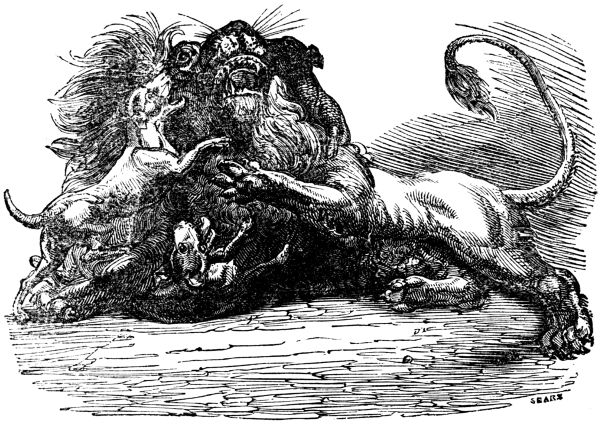
Tame Lion Bait.
“The dogs would not give him a moment’s respite, and all three set on him again, while the poor animal howling with pain, threw his great paws awkwardly upon them as they came.”
Morning Herald.
It would be a joke to say any thing about the feelings of any man, who, for the sake of pecuniary advantage, could make up his mind to expose a noble animal which he had bred, and which had become attached to him, to a horrible and lingering death. About as little reliance we should be disposed to place upon any appeal to the humanity of those persons who make animal suffering—in the shape of dog-fighting, bear-baiting, &c., a sort of daily sport—an indemnification, perhaps, for the not being permitted to torture their fellow-creatures. But as, probably, a number of persons were present at this detestable exhibition, which we have been describing, who were attracted merely by its novelty, and would be as much disgusted as we ourselves were with its details, we recommend their attention to the following letter, which a gentleman, a member of the Society of Friends, who applied personally to Mr. Wombwell to omit the performance, delivered to him as expressive of his own opinions upon the question, and those of his friends. Of course, addressed to such a quarter, it produced no effect; but it does infinite credit both to the head and heart of the writer, and contains almost every thing that, to honourable and feeling men, need be said upon such a subject:—
“Friend,—I have heard with a great degree of horror, of an intended fight between a lion that has long been exhibited by thee, consequently has long been under thy protection, and six bull-dogs. I seem impelled to write to thee on the subject, and to entreat thee, I believe in christian love, that, whatever may be thy hope of gain by this very cruel and very disgraceful exhibition, thou wilt not proceed. Recollect that they are God’s creatures, and we are informed by the holy scriptures, that not even a sparrow falls to the ground without his notice; and as this very shocking scene must be to gratify a spirit of cruelty, as well as a spirit of gambling,—for it is asserted that large sums of money are wagered on the event of the contest,—it must be marked with divine displeasure. Depend upon it that the Almighty will avenge the sufferings of his tormented creatures on their tormentors; for, though he is a God of love, he is also a God of justice; and I believe that no deed of cruelty has ever passed unpunished. Allow me to ask thee how thou wilt endure to see the noble animal thou hast so long protected, and which has been in part the means of supplying thee with the means of life, mangled and bleeding before thee? It is unmanly, it is mean and cowardly, to torment any thing that cannot defend itself,—that cannot speak to tell its pains and sufferings,—that cannot ask for mercy. Oh, spare thy poor lion the pangs of such a death as may perhaps be his,—save him from being torn to pieces—have pity on the dogs that may be torn by him. Spare the horrid spectacle—spare thyself the sufferings that I fear will yet reach thee if thou persist—show a noble example of humanity. Whoever have persuaded thee to expose thy lion to the chance of being torn to pieces, or of tearing other animals, are far beneath the brutes they torment, are unworthy the name of men, or rational creatures. Whatever thou mayest gain by this disgraceful exhibition will, I fear, prove like a canker-worm among the rest of thy substance. The writer of this most earnestly entreats thee to refrain from the intended evil, and to protect the animals in thy possession from all unnecessary suffering. The practice of benevolence will afford thee more true comfort than the possession of thousands. Remember, that He who gave life did not give it to be the sport of cruel man; and that He will assuredly call man to account for his conduct towards his dumb creatures. Remember, also, that cowards are always cruel, but the brave love mercy, and delight to save. With sincere desire for the preservation of thy honour, as a man of humanity, and for thy happiness and welfare, I am, thy friend,