JANUARY. (continued 3)
Reading edition
January 12.
St. Arcadius. St. Benedict Biscop, or Bennet. St. Ælred, Tygrius.
St. Benedict Biscop, or Bennet.
Butler says he was in the service of Oswi, king of the Northumbrians; that at twenty-five years old he made a pilgrimage to Rome, returned and carried Alcfrid, the son of Oswi, back to the shrines of the apostles there, became a monk, received the abbacy of Sts. Peter and Paul, Canterbury, resigned it, pilgrimaged again to Rome, brought home books, relics, and religious pictures, founded the monastery of Weremouth, went to France for masons to build a church to it, obtained glaziers from thence to glaze it, pilgrimaged to Rome for more books, relics, and pictures, built another monastery at Jarrow on the Tine, adorned his churches with pictures, instructed his monks in the Gregorian chant and Roman ceremonies, and died on this day in 690. He appears to have had a love for literature and the arts, and, with a knowledge superior to the general attainment of the religious in that early age, to have rendered his knowledge subservient to the Romish church.
Chronology
1807. The 12th of January in that year is rendered remarkable by a fatal accident at Leyden, in Holland. A vessel loaded with gunpowder entered one of the largest canals in the Rapenburg, a street inhabited chiefly by the most respectable families, and moored to a tree in front of the house of professor Rau, of the university. In Holland, almost every street has a canal in the middle, faced with a brick wall up to the level of the street, and with lime trees planted on both sides, which produce a beautiful effect, and form a delightful shade in hot weather. Vessels of all kinds are frequently moored to these trees, but Leyden being an inland town, the greater part of those which happened to be in the Rapenburg were country vessels. Several yachts, belonging to parties of pleasure from the Hague and other places, were lying close to the newly arrived vessel, and no person was aware of the destructive cargo it contained.
A student of the university, who, at about a quarter past four o’clock in the afternoon, was passing through a street from which there was a view of the Rapenburg, with the canal and vessels, related the following particulars to the editor of the Monthly Magazine:—
“At that moment, when every thing was perfectly tranquil, and most of the respectable families were sitting down to dinner in perfect security, at that instant, I saw the vessel torn from its moorings: a stream of fire burst from it in all directions, a thick, black cloud enveloped all the surrounding parts and darkened the heavens, whilst a burst, louder and more dreadful than the loudest thunder, instantly followed, and vibrated through the air to a great distance, burying houses and churches in one common ruin. For some moments horror and consternation deprived every one of his recollection, but an universal exclamation followed, of “O God, what is it?” Hundreds of people might be seen rushing out of their falling houses, and running along the streets, not knowing what direction to take; many falling down on their knees in the streets, persuaded that the last day was come; others supposed they had been struck by lightning, and but few seemed to conjecture the real cause. In the midst of this awful uncertainty, the cry of “O God, what is it?” again sounded mournfully through the air, but it seemed as if none could answer the dreadful question. One conjecture followed another, but at last, when the black thick cloud which had enveloped the whole city had cleared away a little, the awful truth was revealed, and soon all the inhabitants of the city were seen rushing to the ruins to assist the sufferers. There were five large schools on the Rapenburg, and all at the time full of children. The horror of the parents and relations of these youthful victims is not to be described or even imagined; and though many of them were saved almost miraculously, yet no one dared to hope to see his child drawn alive from under a heap of smoking ruins.
“Flames soon broke out from four different parts of the ruins, and threatened destruction to the remaining part of Leyden. The multitude seemed as it were animated with one common soul in extricating the sufferers, and stopping the progress of the flames. None withdrew from the awful task, and the multitude increased every moment by people coming from the surrounding country, the explosion having been heard at the distance of fifty miles. Night set in, the darkness of which, added to the horrors of falling houses, the smothered smoke, the raging of the flames, and the roaring of the winds on a tempestuous winter night, produced a scene neither to be described nor imagined; while the heart-rending cries of the sufferers, or the lamentations of those whose friends or children were under the ruins, broke upon the ear at intervals. Many were so entirely overcome with fear and astonishment, that they stared about them without taking notice of any thing, while others seemed full of activity, but incapable of directing their efforts to any particular object.”
In the middle of the night, Louis Bonaparte, then king of Holland, arrived from the palace of Loo, having set out as soon as the express reached him with the dreadful tidings. Louis was much beloved by his subjects, and his name is still mentioned by them with great respect. On this occasion his presence was very useful. He encouraged the active and comforted the sufferers, and did not leave the place till he had established good order, and promised every assistance in restoring both public and private losses. He immediately gave a large sum of money to the city, and granted it many valuable privileges, besides exemption from imposts and taxes for a number of years.
Some degree of order having been restored, the inhabitants were divided into classes, not according to their rank, but the way in which they were employed about the ruins. These classes were distinguished by bands of different colours tied round their arms. The widely extended ruins now assumed the appearance of hills and valleys, covered with multitudes of workmen, producing to the eye an ever-varying scene of different occupations. The keel of the vessel in which the catastrophe commenced, was found buried deep in the earth at a considerable distance, together with the remains of a yacht from the Hague with a party of pleasure, which lay close to it. The anchor of the powder vessel was found in a field without the city, and a very heavy piece of lead at the foot of the mast was thrown into a street at a great distance.
One of the most affecting incidents was the fate of the pupils of the different schools on the Rapenburg. At the destructive moment, the wife of the principal of the largest of them was standing at the door with her child in her arms; she was instantly covered with the falling beams and bricks, the child was blown to atoms, and she was thrown under a tree at some distance. Part of the floor of the school-room sunk into the cellar, and twelve children were killed instantly; the rest, miserably wounded, shrieked for help, and one was heard to call, “Help me, help me, I will give my watch to my deliverer.” Fathers and mothers rushed from all parts of the city to seek their children, but after digging five hours they found their labour fruitless; and some were even obliged to leave the spot in dreadful suspense, to attend to other near relations dug out in other quarters. They at last succeeded, by incredible efforts, in bringing up some of the children, but in such a state that many of their parents could not recognise them, and not a few were committed to the grave without its being known who they were. Many of these children, both among the dead and those who recovered, bled profusely, while no wound could be discovered in any part of their bodies. Others were preserved in a wonderful manner, and without the least hurt. Forty children were killed. In some houses large companies were assembled, and in one, a newly married couple, from a distance, had met a numerous party of their friends. One person who was writing in a small room, was driven through a window above the door, into the staircase, and fell to the bottom without receiving much hurt. Many were preserved by the falling of the beams or rafters in a particular direction, which protected them, and they remained for many hours, some for a whole day and night. A remarkable fact of this kind happened, when the city of Delft was destroyed by an explosion of gunpowder in 1654; a child, a year old, was found two days afterwards sucking an apple, and sitting under a beam, with just space left for its body. Two others at a little distance were in their cradles quite safe. At that time almost the whole of Delft was destroyed.
Leyden is as large a city, but not so populous, as Rotterdam, the second city in Holland. Upwards of two hundred houses were overthrown on this occasion, besides churches and public buildings; the Stadt, or town-house, was among the latter.
One hundred and fifty-one dead bodies were taken from the ruins, besides many that died after. Upwards of two thousand were wounded more or less dangerously. It is remarkable that none of the students of the university were either killed or wounded, though they all lodge in different parts of the city, or wherever they please. Contributions were immediately began, and large sums raised. The king of Holland gave 30,000 gilders, and the queen 10,000; a very large sum was collected in London.
Leyden suffered dreadfully by siege in 1573, and by the plague in 1624 and 1635, in which year 15,000 of the inhabitants were carried off within six months. In 1415 a convent was burnt, and most of the nuns perished in the flames. An explosion of gunpowder, in 1481, destroyed the council-chamber when full of people, and killed most of the magistrates.
The misfortunes of this city have become proverbial, and its very name has given rise to a pun. “Leyden” is “Lijden;” Leyden, the name of the city, and Lijden, (to suffer,) have the same pronunciation in the Dutch language.
The chirp of the crickets from the kitchen chimney breaks the silence of still evenings in the winter. They come from the crevices, when the house is quiet, to the warm hearth, and utter their shrill monotonous notes, to the discomfiture of the nervous, and the pleasure of those who have sound minds in sound bodies. This insect and the grasshopper are agreeably coupled in a pleasing sonnet. The “summoning brass” it speaks of, our country readers well know, as an allusion to the sounds usually produced from some kitchen utensil of metal to assist in swarming the bees:—
To the Grasshopper and the Cricket.
Green little vaulter in the sunny grass, Catching your heart up at the feel of June, Sole voice that’s heard amidst the lazy noon, When ev’n the bees lag at the summoning brass; And you, warm little housekeeper, who class With those who think the candles come too soon, Loving the fire, and with your tricksome tune Nick the glad silent moments as they pass; Oh, sweet and tiny cousins, that belong, One to the fields, the other to the hearth, Both have your sunshine; both, though small, are strong At your clear hearts; and both were sent on earth To sing in thoughtful ears this natural song,— In doors and out, summer and winter, Mirth.
L. Hunt.
January 13.
Cambridge Lent Term begins.
St. Veronica of Milan. St. Kentigern.
St. Hilary.
The festival of St. Hilary is not, at this time, observed by the Romish church until to-morrow, but it stands in old calendars, and in Randle Holmes’s Heraldry, on this day, whereon it is also placed in the English calendar. Butler says, he was born at Poictiers, became bishop of that city, was a commentator on Scripture, an orator, a poet, wrote against the Arians, was banished for his orthodoxy, but returned to his see, worked miracles, and died on the 13th of January, 368. Ribadeneira says, that in a certain island, uninhabitable by reason of venemous serpents, they fled from his holiness; that he put up a stake as a boundary, commanding them not to pass it, and they obeyed; that he raised a dead child to life, prayed his daughter to death, and did other astonishing things; especially after his decease, when two merchants, at their own cost and by way of venture, offered an image at his shrine, but as one begrudged the cost of his share, St. Hilary caused the image to divide from top to bottom, while being offered, keeping the one half, and rejecting the niggard’s moiety. The Golden Legend says, that St. Hilary also obtained his wife’s death by his prayers; and that pope Leo, who was an Arian, said to him, “Thou art Hilary the cock, and not the son of a hen;” whereat Hilary said, “I am no cock, but a bishop in France;” then said the pope, “Thou art Hilary Gallus (signifying a cock) and I am Leo, judge of the papal see;” whereupon Hilary replied, “If thou be Leo, thou art not (a lion) of the tribe of Juda.” After this railing the pope died, and Hilary was comforted.
St. Veronica.
She was a nun, with a desire to live always on bread and water, died in 1497, and was canonized, after her claim to sanctity was established to the satisfaction of his holiness pope Leo X.
St. Kentigern.
He was bishop of Glasgow, with jurisdiction in Wales, and, according to Butler, “favoured with a wonderful gift of miracles.” Bishop Patrick, in his “Devotions of the Romish Church,” says, “St. Kentigern had a singular way of kindling fire, which I could never have hit upon.” Being in haste to light candles for vigils, and some, who bore a spite to him, having put out all the fire in the monastery, he snatched the green bough of an hazel, blessed it, blew upon it, the bough produced a great flame, and he lighted his candles: “whence we may conjecture,” says Patrick, “that tinder-boxes are of a later invention than St. Kentigern’s days.”
THE LAW TERMS.
Term is derived from Terminus, the heathen god of boundaries, landmarks, and limits of time. In the early ages of Christianity the whole year was one continued term for hearing and deciding causes; but after the establishment of the Romish church, the daily dispensation of justice was prohibited by canonical authority, that the festivals might be kept holy.
Advent and Christmas occasioned the winter vacation; Lent and Easter the spring; Pentecost the third; and hay-time and harvest, the long vacation between Midsummer and Michaelmas.
Each term is denominated from the festival day immediately preceding its commencement; hence we have the terms of St. Hilary, Easter, the Holy Trinity, and St. Michael.
There are in each term stated days called dies in banco, (days in bank,) that is, days of appearance in the court of common bench. They are usually about a week from each other, and have reference to some Romish festival. All original writs are returnable on these days, and they are therefore called the return days.
The first return in every term is, properly speaking, the first day of the term. For instance, the octave of St. Hilary, or the eighth day, inclusive, after the saint’s feast, falls on the 20th of January, because his feast is on the 13th of January. On the 20th, then, the court sits to take essoigns, or excuses for non-appearance to the writ; “but,” says Blackstone, “as our ancestors held it beneath the condition of a freeman to appear or to do any thing at the precise time appointed,” the person summoned has three days of grace beyond the day named in the writ, and if he appear on the fourth day inclusive it is sufficient. Therefore at the beginning of each term the court does not sit for despatch of business till the fourth, or the appearance day, which is in Hilary term, for instance, on the 23d of January. In Trinity term it does not sit till the fifth day; because the fourth falls on the great Roman catholic festival of Corpus Christi. The first appearance day therefore in each term is called the first day of the term; and the court sits till the quarto die post, or appearance day of the last return, or end of the term.
In each term there is one day whereon the courts do not transact business; namely, on Candlemas day, in Hilary term; on Ascension day, in Easter term; on Midsummer day, in Trinity term; and on All Saints’ day, in Michaelmas term. These are termed Grand days in the inns of court; and Gaudy days at the two universities; they are observed as Collar days at the king’s court of St. James’s, for on these days, knights wear the collars of their respective orders.
An old January journal contains a remarkable anecdote relative to the decease of a M. Foscue, one of the farmers-general of the province of Languedoc. He had amassed considerable wealth by means which rendered him an object of universal detestation. One day he was ordered by the government to raise a considerable sum: as an excuse for not complying with the demand, he pleaded extreme poverty; and resolved on hiding his treasure in such a manner as to escape detection. He dug a kind of a cave in his wine-cellar, which he made so large and deep, that he used to go down to it with a ladder; at the entrance of it was a door with a spring lock on it, which on shutting would fasten of itself. He was suddenly missed, and diligent search made after him; ponds were drawn, and every suggestion adopted that could reasonably lead to his discovery, dead or alive. In a short time after, his house was sold; and the purchaser beginning to make some alterations, the workmen discovered a door in the wine-cellar with a key in the lock. On going down they found Foscue lying dead on the ground, with a candlestick near him, but no candle in it. On searching farther, they found the vast wealth that he had amassed. It is supposed, that, when he had entered his cave, the door had by some accident shut after him; and thus being out of the call of any person, he perished for want of food, in the midst of his treasure.
SIGNS OF FOUL WEATHER.
The hollow winds begin to blow; The clouds look black, the glass is low; The soot falls down, the spaniels sleep; And spiders from their cobwebs peep. Last night the sun went pale to bed; The moon in halos hid her head. The boding shepherd heaves a sigh, For, see, a rainbow spans the sky. The walls are damp, the ditches smell, Clos’d is the pink-ey’d pimpernel. Hark! how the chairs and tables crack, Old Betty’s joints are on the rack: Her corns with shooting pains torment her, And to her bed untimely send her. Loud quack the ducks, the sea fowl cry, The distant hills are looking nigh. How restless are the snorting swine! The busy flies disturb the kine. Low o’er the grass the swallow wings The cricket too, how sharp he sings! Puss on the hearth, with velvet paws, Sits wiping o’er her whisker’d jaws. The smoke from chimneys right ascends Then spreading, back to earth it bends. The wind unsteady veers around, Or settling in the South is found. Through the clear stream the fishes rise, And nimbly catch the incautious flies. The glow-worms num’rous, clear and bright, Illum’d the dewy hill last night. At dusk the squalid toad was seen, Like quadruped, stalk o’er the green. The whirling wind the dust obeys, And in the rapid eddy plays. The frog has chang’d his yellow vest, And in a russet coat is drest. The sky is green, the air is still. The mellow blackbird’s voice is shrill. The dog, so alter’d is his taste, Quits mutton-bones, on grass to feast. Behold the rooks, how odd their flight They imitate the gliding kite, And seem precipitate to fall, As if they felt the piercing ball. The tender colts on back do lie, Nor heed the traveller passing by. In fiery red the sun doth rise, Then wades through clouds to mount the skies. ’Twill surely rain, we see’t with sorrow, No working in the fields to-morrow.
Darwin.
January 14.
Oxford Lent Term begins.
St. Hilary. St. Felix. Sts. Isaias and Sabbas. St. Barbasceminus, &c.
St. Felix of Nola, an exorcist, and afterwards a priest, was, according to Butler and Ribadeneira, a great miraculist. He lived under Decius, in 250; being fettered and dungeoned in a cell, covered with potsherds and broken glass, a resplendent angel, seen by the saint alone, because to him only was he sent, freed him of his chains and guided him to a mountain, where bishop Maximus, aged and frozen, lay for dead, whom Felix recovered by praying; for, straightway, he saw a bramble bear a bunch of grapes, with the juice whereof he recovered the bishop, and taking him on his back carried him home to his diocese. Being pursued by pagans, he fled to some ruins and crept through a hole in the wall, which spiders closed with their webs before the pagans got up to it, and there lay for six months miraculously supported. According to the Legend, his body, for ages after his death, distilled a liquor that cured diseases.
Chronology.
In January, 1784, died suddenly in Macclesfield-street, Soho, aged 79, Sam. Crisp, esq., a relation of the celebrated sir Nicholas Crisp. There was a remarkable singularity in the character of this gentleman. He was a bachelor, had been formerly a broker in ’Change-alley, and many years since had retired from business, with an easy competency. His daily amusement, for fourteen years before, was going from London to Greenwich, and immediately returning from thence, in the stage; for which he paid regularly £27 a year. He was a good-humoured, obliging, and facetious companion, always paying a particular attention, and a profusion of compliments, to the ladies, especially to those who were agreeable. He was perpetually projecting some little schemes for the benefit of the public, or, to use his own favourite maxim, pro bono publico; he was the institutor of the Lactarium in St. George’s Fields, and selected the Latin mottoes for the facetious Mrs. Henniver, who got a little fortune there. He projected the mile and half stones round London; and teased the printers of newspapers into the plan of letter-boxes. He was remarkably humane and benevolent, and, without the least ostentation, performed many generous and charitable actions, which would have dignified a more ample fortune.
THE WINTER ROBIN.
A suppliant to your window comes, Who trusts your faith, and fears no guile: He claims admittance for your crumbs, And reads his passport in your smile. For cold and cheerless is the day, And he has sought the hedges round; No berry hangs upon the spray, Nor worm, nor ant-egg, can be found. Secure his suit will be preferred, No fears his slender feet deter; For sacred is the household bird That wears the scarlet stomacher.
Charlotte Smith.
January 15.
St. Paul, the first Hermit. St. Maurus. St. Main. St. John, Calybite. St. Isidore. St. Bonitus. St. Ita, or Mida. St. Paul, A. D. 342.
The life of St. Paul, the first hermit, is said, by Butler, to have been written by St. Jerome in 365, who received an account of it from St. Anthony and others. According to him, when twenty-two years old, St. Paul fled from the persecution of Decius to a cavern, near which grew a palm-tree, that supplied him with leaves for clothing, and fruit for food, till he was forty-three years of age; after which he was daily fed by a raven till he was ninety, and then died. St. Anthony, in his old age, being tempted by vanity, imagined himself the first hermit, till the contrary was revealed to him in a dream, wherefore, the next morning, he set out in search of St. Paul. “St. Jerome relates from his authors,” says Butler, “that he met a centaur, or creature, not with the nature and properties, but with something of the mixt shape of man and horse; and that this monster, or phantom of the devil, (St. Jerome pretends not to determine which it was,) upon his making the sign of the cross, fled away, after pointing out the way to the saint. Our author (St. Jerome) adds, that St. Anthony soon after met a satyr, who gave him to understand that he was an inhabitant of those deserts, and one of the sort whom the deluded gentiles adored for gods.” Ribadeneira describes this satyr as with writhed nostrils, two little horns on his forehead, and the feet of a goat. After two days’ search, St. Anthony found St. Paul, and a raven brought a loaf, whereupon they took their corporal refection. The next morning, St. Paul told him he was going to die, and bid him fetch a cloak given to St. Anthony by St. Athanasius, and wrap his body in it. St. Anthony then knew, that St. Paul must have been informed of the cloak by revelation, and went forth from the desert to fetch it; but before his return, St. Paul had died, and St. Anthony found two lions digging his grave with their claws, wherein he buried St. Paul, first wrapping him in St. Athanasius’s cloak, and preserving, as a great treasure, St. Paul’s garment, made of palm-tree leaves, stitched together. How St. Jerome, in his conclusion of St. Paul’s life, praises this garment, may be seen in Ribadeneira.
FLOWERS.
A writer, who signs himself “Crito” in the “Truth Teller,” No. 15, introduces us to an honest enthusiast, discoursing to his hearers on the snow-drop of the season, and other offerings from Flora, to the rolling year. “Picture to your imagination, a poor, ‘dirty’ mendicant, of the order of St. Francis, who had long prayed and fasted in his sanctuary, and long laboured in his garden, issuing out on the morning of his first pilgrimage, without money and without provisions, clad in his mantle and hood, ‘like a sad votarist in palmer’s weeds;’ and thus, and in these words, taking leave of the poor flock who lived round his gothic habitation.—‘Fellow-men, I owe you nothing, and I give you all; you neither paid me tithe nor rent, yet I have bestowed on you food and clothing in poverty, medicine in sickness, and spiritual counsel in adversity. That I might do all these things, I have devoted my life in the seclusion of those venerable walls. There I have consulted the sacred books of our church for your spiritual instruction and the good of your souls; to clothe you, I have sold the embroidered garment, and have put on the habit of mendicity. In the intercalary moments of my canonical hours of prayer, I have collected together the treasures of Flora, and gathered from her plants the useful arts of physic, by which you have been benefited. Ever mindful of the useful object of the labour to which I had condemned myself, I have brought together into the garden of this priory, the lily of the valley and the gentian of the mountain, the nymphæa of the lake, and the cliver of the arid bank; in short, I have collected the pilewort, the throatwort, the liverwort, and every other vegetable specific which the kind hand of nature has spread over the globe, and which I have designated by their qualities, and have converted to your use and benefit. Mindful also of the pious festivals which our church prescribes, I have sought to make these charming objects of floral nature, the timepieces of my religious calendar, and the mementos of the hastening period of my mortality. Thus I can light the taper to our Virgin Mother on the blowing of the white snowdrop, which opens its floweret at the time of Candlemas; the lady’s smock and the daffodil remind me of the Annunciation; the blue harebell, of the festival of St. George; the ranunculus, of the Invention of the Cross; the scarlet lychnis, of St. John the Baptist’s day; the white lily, of the Visitation of our Lady; and the virgin’s bower, of her Assumption; and Michaelmas, Martinmas, Holy Rood, and Christmas, have all their appropriate monitors. I learn the time of day from the shutting of the blossoms of the star of Jerusalem and the dandelion, and the hour of the night by the stars.”’
From kind feelings to the benevolence of the Franciscan mendicant’s address, which we may suppose ourselves to have just heard, we illustrate something of his purpose, by annexing the rose, the tulip, and the passion-flower, after an engraving by a catholic artist, who has impressed them with devotional monograms, and symbols of his faith.

RURAL MUSINGS.
Margaret.—What sports do you use in the forest?— Simon.—Not many; some few, as thus:— To see the sun to bed, and to arise, Like some hot amourist with glowing eyes, Bursting the lazy bands of sleep that bound him, With all his fires and travelling glories round him. Sometimes the moon on soft night clouds to rest, Like beauty nestling in a young man’s breast, And all the winking stars, her handmaids, keep Admiring silence, while those lovers sleep, Sometimes outstretcht, in very idleness, Naught doing, saying little, thinking less, To view the leaves thin dancers upon air, Go in eddy ground; and small birds, how they fare, When mother Autumn fills their beaks with corn, Filch’d from the careless Amalthea’s horn; And how the woods berries and worms provide Without their pains, when earth has naught beside To answer their small wants.
C. Lamb.
January 16.
St Marcellus, Pope. St. Macarius the elder, of Egypt. St. Honoratus. St. Fursey. St. Henry, Hermit, &c.
St. Marcellus, Pope.
According to Butler, he was so strict in penance, that the Christians disliked him; he was banished by Maxentius, “for his severity against a certain apostate;” and died pope in 310.
WINTER RAINBOW in Ireland.
In the first of the “Letters from the Irish Islands,” in 1823, the writer addresses to his friend, a description of the rainbow on the hills at this season of the year. He says, “I could wish (provided I could ensure you one fine day in the course of the week) that you were here, to enjoy, in rapid succession, and, with all its wild magnificence, the whirlwind, the tempest, the ocean’s swell, and, as Burns beautifully expresses it,
Some gleams of sunshine, ’mid renewing storms.
To-day there have been fine bright intervals, and, while returning from a hasty ride, I have been greatly delighted with the appearance of a rainbow, gradually advancing before the lowering clouds, sweeping with majestic stride across the troubled ocean, then, as it gained the beach, and seemed almost within my grasp, vanishing amid the storm, of which it had been the lovely, but treacherous, forerunner. It is, I suppose, a consequence of our situation, and the close connection between sea and mountain, that the rainbows here are so frequent, and so peculiarly beautiful. Of an amazing breadth, and with colours vivid beyond description, I know not whether most to admire this aerial phenomenon, when, suspended in the western sky, one end of the bow sinks behind the island of Boffin, while, at the distance of several leagues, the other rests upon the misty hills of Ennis Turc; or when, at a later hour of the day, it has appeared stretched across the ample sides of Mülbrea, penetrating far into the deep blue waters that flow at its base. With feelings of grateful recollection too, we may hail the repeated visits of this heavenly messenger, occasionally, as often as five or six times in the course of the same day, in a country exposed to such astonishing, and, at times, almost incessant floods of rain.”
Behold yon bright, ethereal bow, With evanescent beauties glow; The spacious arch streams through the sky, Deck’d with each tint of nature’s dye, Refracted sunbeams, through the shower, A humid radiance from it pour; Whilst colour into colour fades, With blended lights and softening shades.
Athenæum
“It is a happy effect of extreme mildness and moisture of climate, that most of our hills (in Ireland) are covered with grass to a considerable height, and afford good pasturage both in summer and winter. The grasses most abundant are the dogstail, (cynosurus cristatus,) several species of the meadow grass, (poa,) the fescue, (festuca duriuscula and pratensis,) and particularly the sweet-scented vernal grass, (anthoxanthum odoratum,) which abounds in the dry pastures, and mountain sides; where its withered blossoms, which it is remarkable that the cattle do not eat, give a yellowish brown tint to the whole pasture. Our bog lands are overrun with the couch, or fiorin grass, (agrostis stolonifera,) several other species of the agrostis, and the aira. This is, indeed, the country for a botanist; and one so indefatigable as yourself, would not hesitate to venture with us across the rushy bog, where you would be so well rewarded for the labour of springing from one knot of rushes to another, by meeting with the fringed blossoms of the bog-bean, (menyanthes trifoliata,) the yellow asphodel, (narthecium ossifragum,) the pale bog violet, (viola palustris,) both species of the pinguicula, and of the beautiful drosera, the English fly-trap, spreading its dewy leaves glistening in the sun. I could also point out to you, almost hid in the moist recesses of some dripping rock, the pretty miniature fern, (trichomanes Tunbridgensis,) which you may remember showing me for the first time at Tunbridge Wells: the osmunda lunaria and regalis are also to be found, with other ferns, mosses, and lichens, which it is far beyond my botanical skill to distinguish.—The man of science, to whatever branch of natural history his attention is directed, will indeed find never-failing sources of gratification, in exploring paths, hitherto almost untrodden, in our wild country. Scarcely a county in England is without its peculiar Flora, almost every hill and every valley have been subject to repeated, scientific examination; while the productions of nature, so bountifully accorded to poor Ireland, are either unknown or disregarded.”
A SEASONABLE DIVERSION.
From the many games of forfeits that are played in parlours during in-door weather, one is presented to the perusal of youthful readers from “Winter Evening Pastimes.”
Aunty’s Garden.
“The company being all seated in a circle, the person who is to conduct the game proposes to the party to repeat, in turns, the speech he is about to make; and it is agreed that those who commit any mistake, or substitute one word for another, shall pay a forfeit. The player then commences by saying, distinctly, ‘I am just come from my aunt Deborah’s garden. Bless me! what a fine garden is my aunt’s garden! In my aunt’s garden there are four corners.’ The one seated to the player’s right is to repeat this, word for word: if his memory fails he pays a forfeit, and gives up his turn to his next right-hand neighbour, not being permitted to correct his mistake. When this has gone all round, the conductor repeats the first speech, and adds the following:
‘In the first corner stands a superb alaternus, Whose shade, in the dog-days, won’t let the sun burn us.’
“This couplet having been sent round as before, he then adds the following:
‘In the second corner grows A bush which bears a yellow rose: Would I might my love disclose!’
“This passes round in like manner:
‘In the third corner Jane show’d me much London pride; Let your mouth to your next neighbour’s ear be applied, And quick to his keeping a secret confide.’
“At this period of the game every one must tell his right-hand neighbour some secret.
“In the fourth round, after repeating the whole of the former, he concludes thus:
‘In the fourth corner doth appear Of amaranths a crowd; Each secret whisper’d in the ear Must now be told aloud.’
“Those who are unacquainted with this game occasionally feel not a little embarrassed at this conclusion, as the secrets revealed by their neighbour may be such as they would not like to be published to the whole party. Those who are aware of this finesse take care to make their secrets witty, comic, or complimentary.”
WINTER.
This is the eldest of the seasons: he Moves not like Spring with gradual step, nor grows From bud to beauty, but with all his snows Comes down at once in hoar antiquity. No rains nor loud proclaiming tempests flee Before him, nor unto his time belong The suns of summer, nor the charms of song, That with May’s gentle smiles so well agree. But he, made perfect in his birthday cloud, Starts into sudden life with scarce a sound, And with a tender footstep prints the ground, As tho’ to cheat man’s ear; yet while he stays He seems as ’twere to prompt our merriest lays, And bid the dance and joke be long and loud.
Literary Pocket Book, 1820.
January 17.
St. Anthony, Patriarch of Monks. Sts. Speusippus, Eleusippus, and Meleusippus. Sts. Sulpicius I. and II., Abps. of Bourges. St. Milgithe. St. Nennius, or Nennidhius.
St. Anthony, Patriarch of Monks.
The memoirs of St. Anthony make a distinguished figure in the lives of the saints by Alban Butler, who states the particulars to have been extracted from “The Life of St. Anthony,” compiled by the great St. Athanasius; “a work,” says Butler, “much commended by St. Gregory Nazianzen, St. Jerom, St. Austin,” &c. This statement by Butler, whose biographical labours are estimated by catholics as of the highest order, and the extraordinary temptations which render the life of St. Anthony eminently remarkable, require at least so much notice of him, as may enable the general reader to determine upon the qualities attributed to him, and the reputation his name has attained in consequence.
According to Butler, St. Anthony was born in 251, at Coma near Heraclea in Egypt, and in that neighbourhood commenced the life of a hermit: he was continually assailed by the devil. His only food was bread with a little salt, he drank nothing but water, never ate before sunset, sometimes only once in two or four days, and lay on a rush mat or on the bare floor. For further solitude he left Coma, and hid himself in an old sepulchre, till, in 285, he withdrew into the deserts of the mountains, from whence, in 305, he descended and founded his first monastery. His under garment was sackcloth, with a white sheepskin coat and girdle. Butler says that he “was taught to apply himself to manual labour by an angel, who appeared, platting mats of palm-tree leaves, then rising to pray, and after some time sitting down again to work; and who at length said to him, ‘Do this, and thou shalt be saved.’ The life, attributed by Butler to St. Athanasius, informs us that our saint continued in some degree to pray whilst he was at work; that he detested the Arians; that he would not speak to a heretic unless to exhort him to the true faith; and that he drove all such from his mountain, calling them venomous serpents. He was very anxious that after his decease he should not be embalmed, and being one hundred and five years old, died in 356, having bequeathed one of his sheepskins, with the coat in which he lay, to St. Athanasius.” So far Butler.
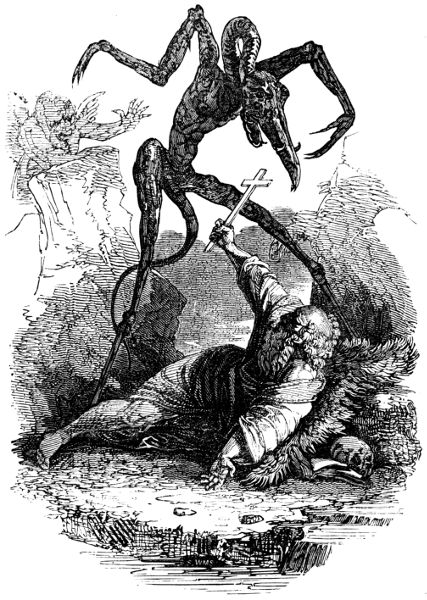
St. Athanasius, or rather the life of St. Anthony before alluded to, which, notwithstanding Butler’s authorities, may be doubted as the product of Athanasius; but, however that may be, that memoir of St. Anthony is very particular in its account of St. Anthony’s warfare with the infernal powers. It says that hostilities commenced when the saint first determined on hermitizing; “in short, the devil raised a great deal of dust in his thoughts, that by bemudding and disordering his intellects he might make St. Anthony let go his design.” In his first conflict with the devil he was victorious, although satan appeared to him in an alluring shape. Next he came in the form of a black boy, and was again defeated. After that Anthony got into a tomb and shut down the top, but the devil found him out, and, with a great company of other devils, so beat and bruised him, that in the morning he was discovered by the person who brought his bread, lying like a dead man on the ground; whereupon he took him up and carried him to the town church, where many of his friends sat by him until midnight. Anthony then coming to himself and seeing all asleep, caused the person who brought him thither to carry him back privately, and again got into the tomb, shutting down the tomb-top as before. Upon this, the devils being very much exasperated, one night, made a noise so dreadful, that the walls shook. “They transformed themselves into the shapes of all sorts of beasts, lions, bears, leopards, bulls, serpents, asps, scorpions and wolves; every one of which moved and acted agreeably to the creatures which they represented; the lion roaring and seeming to make towards him, the bull to butt, the serpent to creep, and the wolf to run at him, and so in short all the rest; so that Anthony was tortured and mangled by them so grievously that his bodily pain was greater than before.” But, as it were laughingly, he taunted them, and the devils gnashed their teeth. This continued till the roof of his cell opened, a beam of light shot down, the devils became speechless, Anthony’s pain ceased, and the roof closed again. At one time the devil laid the semblance of a large piece of plate in his way, but Anthony, perceiving the devil in the dish, chid it, and the plate disappeared. At another time he saw a quantity of real gold on the ground, and to show the devil “that he did not value money, he leaped over it as a man in a fright over a fire.” Having secluded himself in an empty castle, some of his acquaintance came often to see him, but in vain; he would not let them enter, and they remained whole days and nights listening to a tumultuous rout of devils bawling and wailing within. He lived in that state for twenty years, never seeing or being seen by any one, till his friends broke open the door, and “the spectators were in amazement to see his body that had been so belaboured by devils, in the same shape in which it was before his retirement.” By way of a caution to others he related the practices of the devils, and how they appeared. He said that, “to scare us, they will represent themselves so tall as to touch the ceiling, and proportionably broad; they often pretend to sing psalms and cite the scriptures, and sometimes while we are reading they echo what we read; sometimes they stamp, sometimes they laugh, and sometimes they hiss: but when one regards them not, then they weep and lament, as vanquished. Once, when they came threatening and surrounding me like soldiers, accoutred and horsed, and again when they filled the place with wild beasts and creeping things, I sung Psalm xix. 8., and they were presently routed. Another time, when they appeared with a light in the dark, and said, ‘We are come, Anthony, to lend thee our light,’ I prayed, shutting my eyes, because I disdained to behold their light, and presently their light was put out. After this they came and hissed and danced, but as I prayed, and lay along singing, they presently began to wail and weep as though they were spent. Once there came a devil very tall in appearance, that dared to say, ‘What wouldst thou have me bestow upon thee?’ but I spat upon him and endeavoured to beat him, and, great as he was, he disappeared with the rest of the devils. Once one of them knocked at the door of my cell, and when I opened it I saw a tall figure; and when I asked him, ‘Who art thou?’ he answered, ‘I am satan; Why do the monks blame and curse me? I have no longer a place or a city, and now the desert is filled with monks; let them not curse one to no purpose.’ I said to him, ‘Thou art a liar,’ &c. and he disappeared.” A deal more than this he is related to have said by his biographer, who affirms that Anthony, “having been prevailed upon to go into a vessel and pray with the monks, he, and he only, perceived a wretched and terrible stink; the company said there was some salt fish in the vessel, but he perceived another kind of scent, and while he was speaking, a young man that had a devil, and who had entered before them and hid himself, cried out, and the devil was rebuked by St Anthony and came out of him, and then they all knew that it was the devil that stunk.”—“Wonderful as these things are, there are stranger things yet; for once, as he was going to pray, he was in a rapture, and (which is a paradox) as soon as he stood up, he saw himself without himself, as it were in the air, and some bitter and terrible beings standing by him in the air too, but the angels, his guardians, withstood them,”—“He had also another particular favour, for as he was sitting on the mount in a praying posture, and perhaps gravelled with some doubt relating to himself, in the night-time, one called to him, and said, ‘Anthony, arise, go forth and look;’ so he went out and saw a certain terrible, deformed personage standing, and reaching to the clouds, and winged creatures, and him stretching out his hands; and some of them he saw were stopped by him, and others were flying beyond him; whereupon the tall one gnashed his teeth, and Anthony perceived that it was the enemy of souls, who seizes on those who are accountable to him, but cannot reach those who are not persuadable by him.” His biographer declares that the devils fled at his word, as fast as from a whip.
It appears from lady Morgan, that at the confectioners’ in Rome, on twelfth-day, “saints melt in the mouth, and the temptations of St. Anthony are easily digested.”
Alban Butler says that there is an extant sermon of St. Anthony’s wherein he extols the efficacy of the sign of the cross for chasing the devil, and lays down rules for the discernment of spirits. There is reason to believe that he could not read; St. Austin thinks that he did not know the alphabet. He wore his habit to his dying day, neither washing the dirt off his body, nor so much as his feet, unless they were wet by chance when he waded through water on a journey. The jesuit Ribadeneira affirms, that “all the world relented and bemoaned his death for afterwards there fell no rain from heaven for three years.”
The Engraving of St. Anthony conflicting with the Devil, in the present sheet, is after Salvator Rosa.
Saints’ bodies appear, from the Romish writers, to have waited undecomposed in their graves till their odour of sanctity rendered it necessary that their remains should be sought out; and their bodies were sure to be found, after a few centuries of burial, as fresh as if they had been interred a few weeks. Hence it is, that though two centuries elapsed before Anthony’s was looked for, yet his grave was not only discovered, but his body was in the customary preservation. It was brought to Europe through a miracle. One Joceline, who had neglected a pilgrimage to Jerusalem, was, therefore, sorely wounded in battle, and carried for dead into a chapel dedicated to St. Anthony. When he began to revive, a multitude of devils appeared to drag him to hell and one devil cast a halter about his neck to strangle him, wherefore St. Anthony appeared; the devils flew from him of course, and he commanded Joceline to perform his pilgrimage, and to convey his body from the east; whereupon Joceline obeyed, and carried it to France. When Patrick wrote, the saint’s beard was shown at Cologne, with a part of his hand, and another piece of him was shown at Tournay; two of his relics were at Antwerp; a church dedicated to him at Rome was famous for his sackcloth, and part of his palm coat; the other part of it was exhibited at Vienna, and the rest of his body was so multiplied about, that there were limb-bones enough for the remains of half a dozen uncanonized persons. The Romish church has not made saints of late years.
BLESSING OF BEASTS.
On St. Anthony’s day, the beasts at Rome are blessed, and sprinkled with holy water. Dr. Forster, in his “Perennial Calendar,” remarks, that “the early Catholics regarded no beasts, birds, or fish, as hateful.” He says, that “St. Anthony was particularly solicitous about animals, to which a whimsical picture by Salvator Rosa represents him as preaching;” and he suggests, that “from his practices, perhaps, arose the custom of blessings passed on animals still practised at Rome; he regarded all God’s creatures as worthy of protection”—except heretics, the doctor might have added; unless, indeed, which seems to have been the case, Anthony regarded them as “creatures” of the devil, between whom, and this saint, we have seen that the Rev. Alban Butler takes especial care we should not be ignorant of the miraculous conflicts just related.
Lady Morgan says, that the annual benediction of the beasts at Rome, in a church there dedicated to St. Anthony, lasts for some days: “for not only every Roman from the pope to the peasant, who has a horse, a mule, or an ass, sends his cattle to be blessed at St. Anthony’s shrine, but all the English go with their job horses and favourite dogs; and for the small offering of a couple of paoli, get them sprinkled, sanctified, and placed under the protection of this saint. Coach after coach draws up, strings of mules mix with carts and barouches, horses kick, mules are restive, and dogs snarl, while the officiating priest comes forward from his little chapel, dips a brush into a vase of holy water, sprinkles and prays over the beasts, pockets the fee, and retires.”
Dr. Conyers Middleton says, that when he was at Rome, he had his own horses blest for eighteen-pence, as well to satisfy his curiosity, as to humour his coachman, who was persuaded that some mischance would befall them in the year, if they had not the benefit of the benediction.
Lady Morgan describes a picture in the Borghese palace at Rome, representing St. Anthony preaching to the fishes: “The salmon look at the preacher with an edified face, and a cod, with his upturned eyes, seems anxiously seeking for the new light. The saint’s sermon is to be had in many of the shops at Rome. St. Anthony addresses the fish, ‘Dearly beloved fish;’ and the legend adds, that at the conclusion of the discourse, ‘the fish bowed to him with profound humility, and a grave and religious countenance.’ The saint then gave the fish his blessing, who scudded away to make new conversions,—the missionaries of the main.
“The church of St. Anthony at Rome is painted in curious old frescos, with the temptations of the saint. In one picture he is drawn blessing the devil, disguised in a cowl; probably at that time
‘When the devil was sick, and the devil a monk would be;’
“the next picture shows, that
‘When the devil was well, the devil a monk was he;’
“for St. Anthony, having laid down in his coffin to meditate the more securely, a parcel of malicious little imps are peeping, with all sorts of whimsical and terrific faces, over its edges, and parodying Hogarth’s enraged musician. One abominable wretch blows a post-horn close to the saint’s ear, and seems as much delighted with his own music as a boy with a Jew’s-harp, or a solo-player with his first ad libitum.”
St. Anthony’s sermon to the fish is given in some of our angling books. If this saint was not the preacher to the fish, but St. Anthony of Padua, the latter has lost the credit of his miraculous exhortation, from the stupendous reputation of his namesake and predecessor. Not to risk the displeasure of him of Padua, by the possibility of mistake, without an attempt to propitiate him if it be a mistake, let it be recorded here, that St. Anthony of Padua’s protection of a Portuguese regiment, which enlisted him into its ranks seven hundred years after his death, procured him the honour of being promoted to the rank of captain, by the king of Portugal, as will appear by reference to his military certificate set forth at large in “Ancient Mysteries described.”
ST. ANTHONY’S FIRE.
St. Anthony’s fire is an inflammatory disease which, in the eleventh century, raged violently in various parts. According to the legend, the intercession of St. Anthony was prayed for, when it miraculously ceased; and therefore, from that time, the complaint has been called St. Anthony’s fire.
ST. ANTHONY’S PIG.
Bishop Patrick, from the Salisbury missal and other Romish service-books, cites the supplications to St. Anthony for relief from this disease. Catholic writers affirm it to have been cured by the saint’s relics dipped in wine, which proved a present remedy. “Neither,” says Patrick, who quotes the Romish writers, “did this benefit by the intercession of St. Anthony accrue only to men, but to cattle also; and from hence we are told the custom arose of picturing this saint with a hog at his feet, because, the same author (Aymerus) says, on this animal God wrought miracles by his servant.” Patrick goes on to say, that in honour of St. Anthony’s power of curing pigs, “they used in several places to tie a bell about the neck of a pig, and maintain it at the common charge of the parish,” from whence came our English proverb of “Tantony pig,” or t’Antony, an abridgement of the Anthony pig.
“I remember,” says Stow, “that the officers charged with the oversight of the markets in this city did divers times take from the market people, pigs starved, or otherwise unwholesome for man’s sustenance; these they did slit in the ear. One of the proctors for St. Anthony’s (Hospital) tied a bell about the neck, (of one of them,) and let it feed on the dunghills: no man would hurt or take it up; but if any gave to them bread, or other feeding, such they (the pigs) would know, watch for, and daily follow, whining till they had somewhat given them: whereupon was raised a proverb, ‘Such an one will follow such an one, and whine as it were (like) an Anthony pig.’” If such a pig grew to be fat, and came to good liking, (as oftentimes they did,) then the proctor would take him up to the use of the hospital.
St. Anthony’s school in London, now gone to decay, was anciently celebrated for the proficiency of its pupils. Stow relates, that, in his youth, he annually saw, on the eve of St. Bartholomew, the scholars of the different grammar-schools assembled in the churchyard of St. Bartholomew, Smithfield, and then St. Anthony’s scholars commonly were the best, and carried the prizes; and that when the boys of St. Paul’s school met with those of St. Anthony’s, “they would call them St. Anthony’s pigs, and they again would call the others pigeons of Paul’s; because many pigeons were bred in Paul’s church, and St. Anthony was always figured with a pig following him.”
The seal of St. Anthony’s Hospital in London was about the size of a half-crown; it represented the saint preaching to a numerous congregation, with his pig beneath him. The Rev. Mr. Orton, rector of Raseby in Leicestershire, was supposed to have been its possessor by the late Mr. S. Ayscough, who adds (in the Gent. Mag.) that the hospital of St. Anthony had a grant of all the stray pigs which were not owned. He presumes that, from thence, originated the emblem of the saint’s pig. In this he seems to have been mistaken; it clearly did not originate in England. Patrick’s solution of it is more probable, and very likely to be correct.
St. Anthony is always represented by the old painters with a pig by his side. He is so accompanied in the wood-cut to his life in the Golden Legend. There are many prints of him, by early masters, in this way. Rubens painted a fine picture of the Death of St. Anthony, with his pig, or rather a large bacon hog, lying under the saint’s bed: there is a good engraving from this picture by Clouwet.
In the British Museum there is a MS. with a remarkable anecdote that would form an appendix to St. Anthony’s day. The names of the parties are forgotten; but the particulars, recollected from accidental perusal, are these:
A tailor was met out of doors by a person who requested to be measured for a suit of clothes, to be ready on that spot by that day week; and the stranger gave him a piece of cloth to make them with. From certain circumstances, the tailor suspected his new customer to be the devil, and communicated his conjectures to a clergyman, who advised him to execute the order, but carefully to save every piece, even the minutest shred he cut from the cloth, and put the whole into a wrapper with the clothes; he further promised the tailor to go with him on the appointed day to the place where they were delivered. When all was ready and the day arrived, they both went thither, and the person waiting justified the tailor’s suspicions; for he abused the tailor because he brought a divine, and immediately vanished in their presence, leaving the clothes and pieces of cloth in the possession of the tailor, who could not sell the devil’s cloth to pay himself for the making, for fear of the consequences:
And here ends the history Of this wonderful mystery;
from which may be drawn, by way of moral, that a tailor ought not to take an order from a stranger without a reference.
January 18.
St. Peter’s Chair at Rome. St. Paul and Thirty-six Companions in Egypt. St. Prisca. St. Deicolus. St. Ulfrid.
The Feast of St. Peter’s chair is kept by the Romish church on this day. Lady Morgan says that it is one of the very few functions as they are called (funzioni) celebrated in the cathedral of St. Peter, at Rome. She briefly describes this celebration, and says something respecting St. Peter’s chair. “The splendidly dressed troops that line the nave of the cathedral, the variety and richness of vestments which clothe the various church and lay dignitaries, abbots, priests, canons, prelates, cardinals, doctors, dragoons, senators, and grenadiers, which march in procession, complete, as they proceed up the vast space of this wondrous temple, a spectacle nowhere to be equalled within the pale of European civilisation. In the midst of swords and crosiers, of halberds and crucifixes, surrounded by banners, and bending under the glittering tiara of threefold power, appears the aged, feeble, and worn-out pope, borne aloft on men’s shoulders, in a chair of crimson and gold, and environed by slaves, (for such they look,) who waft, from plumes of ostrich feathers mounted on ivory wands, a cooling gale, to refresh his exhausted frame, too frail for the weight of such honours. All fall prostrate, as he passes up the church to a small choir and throne, temporarily erected beneath the chair of St. Peter. A solemn service is then performed, hosannas arise, and royal votarists and diplomatic devotees parade the church, with guards of honour and running footmen, while English gentlemen and ladies mob and scramble, and crowd and bribe, and fight their way to the best place they can obtain.
“At the extremity of the great nave behind the altar, and mounted upon a tribune designed or ornamented by Michael Angelo, stands a sort of throne, composed of precious materials, and supported by four gigantic figures. A glory of seraphim, with groups of angels, sheds a brilliant light upon its splendours. This throne enshrines the real, plain, worm-eaten, wooden chair, on which St. Peter, the prince of the apostles, is said to have pontificated; more precious than all the bronze, gold, and gems, with which it is hidden, not only from impious, but from holy eyes, and which once only, in the flight of ages, was profaned by mortal inspection.
“The sacrilegious curiosity of the French broke through all obstacles to their seeing the chair of St. Peter. They actually removed its superb casket, and discovered the relic. Upon its mouldering and dusty surface were traced carvings, which bore the appearance of letters. The chair was quickly brought into a better light, the dust and cobwebs removed, and the inscription (for an inscription it was) faithfully copied. The writing is in Arabic characters, and is the well-known confession of Mahometan faith,—‘There is but one God, and Mahomet is his prophet!’ It is supposed that this chair had been, among the spoils of the crusaders, offered to the church at a time when a taste for antiquarian lore, and the deciphering of inscriptions, were not yet in fashion. This story has been since hushed up, the chair replaced, and none but the unhallowed remember the fact, and none but the audacious repeat it. Yet such there are, even at Rome!”
St. Prisca.
This saint’s festival stands in the calendar of the church of England this day, as well as in that of the Romish church. Nothing is certainly known of her except that she was a Roman, and martyred about 275.
POWERFUL OPTICAL ILLUSION.
In the London journals of January, 1824, the following anecdote from a Carlow paper bears the above title:—“A young lady, who died in this town, had been some time previous to her death attended by a gentleman of the medical profession. On the evening of her decease, as this gentleman was sitting in company with a friend of his, and in the act of taking a glass of punch, he imagined he saw the lady walking into the room where himself and his friend were sitting, and, having but a few hours before visited her, and found her in a dying state, the shock that his nerves experienced was so great, that the glass which held the punch fell from his hands, and he himself dropped on the floor in a fainting fit. After he had perfectly recovered himself, and made inquiry about the lady, it was ascertained that a few minutes before the time the medical gentleman imagined he had seen her in his friend’s apartment, she had departed this life.” Perhaps this vision may be illustrated by others.
A SPECTRE.
The Editor of the Every-Day Book now relates an appearance to himself.
One winter evening, in 1821, he was writing in a back room on an upper floor of the house No. 45, Ludgate-hill, wherein he now resides. He had been so closely engaged in that way and in reading during several preceding days, that he had taken every meal alone, and in that room, nor did he usually go to bed until two or three o’clock in the morning. In the early part of the particular evening alluded to, his attention had become wearied. After a doze he found himself refreshed, and was writing when the chimes of St. Paul’s clock sounded a quarter to two: long before that dead hour all the family had retired to rest, and the house was silent. A few minutes afterwards he moved round his chair towards the fire-place, and opposite to a large pane of glass which let the light from the room into a closet otherwise dark, the door of which opened upon the landing-place. His eye turning upon the glass pane, he was amazed by the face of a man anxiously watching him from the closet, with knit inquiring brows. The features were prominent and haggard, and, though the look was somewhat ferocious, it indicated intense curiosity towards the motions of the writer, rather than any purpose of immediate mischief to him. The face seemed somewhat to recede with a quick motion when he first saw it, but gazing on it with great earnestness it appeared closer to the glass, looking at him for a moment, and then with more eager anxiety bending its eyes on the writing-table, as though it chiefly desired to be acquainted with the books and papers that lay upon it. The writer shut and rubbed his eyes, and again the eyes of the face were intently upon him; watching it, he grasped the candlestick, strode hastily towards the room door, which is about two feet from the pane, observed the face as hastily draw back, unlatched the closet door on the landing, was in an instant within the closet, and there to his astonishment found nothing. It was impossible that the person could have escaped from the closet before his own foot was at its door, yet he examined nearly every room in the house, until reflecting that it was folly to seek for what, he was convinced, had no bodily existence, he returned up stairs and went to bed, pondering on the recollection of the spectre.
ANOTHER SPECTRE.
To the preceding narrative the Editor adds an account of a subsequent apparition, which he saw, and for greater ease he writes it in the first person, as follows:
In January, 1824, one, whose relationship commanded my affection, was about to leave England with his family for a distant part of the world. The day or two preceding his departure I passed with him and his wife and children. Our separation was especially painful; my mind was distressed, and I got little sleep. He had sailed from Gravesend about three days, and a letter that he had promised to write from the Downs had not arrived. On the evening of the 29th I retired late, and being quite wearied slept till an unusually late hour the next morning, without a consciousness of having dreamed, or being, as I found myself, alone. With my head on the pillow I opened my eyes to an extraordinary appearance. Against the wall on the opposite side of the room, and level with my sight, the person, respecting whom I had been so anxious, lay a corpse, extended at full length, as if resting on a table. A greyish cloth covered the entire body except the face; the eyes were closed, the countenance was cadaverous, the mouth elongated from the falling of the jaws, and the lips were purpled. I shut my eyes, rubbed them and gently raising my head continued to gaze on the body, till from weariness of the attitude and exhausted spirits, I dropped on the pillow, and insensibly sunk to sleep, for perhaps a quarter of an hour. On again awaking, the spectre was not there. I then arose, and having mentioned the circumstance to some of my family, caused a memorandum to be made of what I had seen. In the course of the forenoon a person arrived who had gone round with the vessel to the Downs, from whence he had been put ashore the morning before, and saw the ship in full sail. He was the bearer of the letter I had expected from the individual aboard, whose appearance I had witnessed only a few hours previous to its being put into my hands; it of course relieved no apprehension that might have been excited by the recent spectre.
“That the dead are seen no more,” said Imlac, “I will not undertake to maintain against the concurrent and unvaried testimony of all ages and of all nations. There is no people, rude or learned, among whom apparitions of the dead are not related and believed. This opinion, which, perhaps, prevails as far as human nature is diffused, could become universal only by its truth; those, that never heard of one another, would never have agreed in a tale which nothing but experience can make credible. That it is doubted by single cavillers can very little weaken the general evidence, and some who deny it with their tongues confess it by their fears.”
No man is privileged to impugn the knowledge of existences which others have derived from their experience; but he who sees, without assenting to realities, audaciously rejects positive proof to himself, where presumptive testimony would be satisfactory to most: he daringly falsifies what he knows to be indubitably true, and secret convictions belie the shameless hardihood of pretended incredulity. These, it is presumed, would be the sentiments of the great author of Rasselas, upon the expression of disbelief in him who had witnessed spectral appearances; and yet the writer of these pages, with a personal knowledge upon the subject, declines to admit that knowledge as good evidence. He would say untruly were he to affirm, that when he saw the corpse-like form, and for some time afterwards, he had no misgivings as to the safety of his friend. It was not until a lapse of six months that the vessel was reported to have touched at a certain port in good condition, and this was followed by a letter from the individual himself, wherein he affirmed his good health; he subsequently wrote, that he and his family were at the place of their destination. This spectral appearance therefore at Ludgate-hill, between eight and nine o’clock of the morning on the 30th of January, was no indication of his death, nor would it have been had he died about that time, although the coincidence of the apparition and his decease would have been remarkable. The case at Carlow only differs from the case at Ludgate-hill by the decease of the lady having been coeval with her spectral appearance to the gentleman who was depressed by her illness. The face which the writer saw looking at him from a closet in the dead of night was no likeness of any one he knew, and he saw each spectre when his faculties had been forced beyond their healthful bearing. Under these circumstances, his eyesight was not to be trusted, and he refuses to admit it, although the spectres were so extraordinary, and appeared under such circumstances that probably they will never be forgotten.
Coupled with the incidents just related, the death of the king of Naples in January 1825, which was first announced in the “News” Sunday paper on the 16th of the month, recalls the recollection of a singular circumstance in the bay of Naples. The fact and the facts preceding it are related by Dr. Southey in his “Life of Nelson.” Having spoken of Nelson’s attachment to lady Hamilton, and his weariness of the world, Dr. Southey proceeds thus:—
“Well had it been for Nelson if he had made no other sacrifices to this unhappy attachment than his peace of mind; but it led to the only blot upon his public character. While he sailed from Palermo, with the intention of collecting his whole force, and keeping off Maretimo, either to receive reinforcements there, if the French were bound upwards, or to hasten to Minorca, if that should be their destination, capt. Foote, in the Seahorse, with the Neapolitan frigates and some small vessels under his command, was left to act with a land force consisting of a few regular troops, of four different nations, and with the armed rabble which cardinal Ruffo called the Christian army. His directions were to cooperate to the utmost of his power with royalists, at whose head Ruffo had been placed, and he had no other instructions whatever. Ruffo advancing without any plan, but relying upon the enemy’s want of numbers, which prevented them from attempting to act upon the offensive, and ready to take advantage of any accident which might occur, approached Naples. Fort St. Elmo, which commands the town, was wholly garrisoned by the French troops; the castles of Uovo and Nuovo, which commanded the anchorage, were chiefly defended by Neapolitan revolutionists, the powerful men among them having taken shelter there. If these castles were taken, the reduction of Fort St. Elmo would be greatly expedited. They were strong places, and there was reason to apprehend that the French fleet might arrive to relieve them. Ruffo proposed to the garrison to capitulate, on condition that their persons and property should be guaranteed, and that they should, at their own option, either be sent to Toulon, or remain at Naples, without being molested either in their persons or families. This capitulation was accepted: it was signed by the cardinal, and the Russian and Turkish commanders; and, lastly, by capt. Foote, as commander of the British force. About six and thirty hours afterwards Nelson arrived in the bay, with a force which had joined him during his cruise, consisting of seventeen sail of the line, with 1700 troops on board, and the prince royal of Naples in the admiral’s ship. A flag of truce was flying on the castles, and on board the Seahorse. Nelson made a signal to annul the treaty; declaring that he would grant rebels no other terms than those of unconditional submission. The cardinal objected to this: nor could all the arguments of Nelson, sir W. Hamilton, and lady Hamilton, who took an active part in the conference, convince him that a treaty of such a nature, solemnly concluded, could honourably be set aside. He retired at last, silenced by Nelson’s authority, but not convinced. Capt. Foote was sent out of the bay; and the garrisons taken out of the castles, under pretence of carrying the treaty into effect, were delivered over as rebels to the vengeance of the Sicilian court.—A deplorable transaction! a stain upon the memory of Nelson, and the honour of England! To palliate it would be in vain; to justify it would be wicked: there is no alternative, for one who will not make himself a participator in guilt, but to record the disgraceful story with sorrow and with shame.
“Prince Francesco Caraccioli, a younger branch of one of the noblest Neapolitan families, escaped from one of these castles before it capitulated. He was at the head of the marine, and was nearly seventy years of age, bearing a high character both for professional and personal merit. He had accompanied the court to Sicily; but when the revolutionary government, or Parthenopæan republic, as it was called, issued an edict, ordering all absent Neapolitans to return, on pain of confiscation of their property, he solicited and obtained permission of the king to return, his estates being very great. It is said that the king, when he granted him this permission, warned him not to take any part in politics; expressing, at the same time, his own persuasion that he should recover his kingdom. But neither the king, nor he himself, ought to have imagined that, in such times, a man of such reputation would be permitted to remain inactive; and it soon appeared that Caraccioli was again in command of the navy, and serving under the republic against his late sovereign. The sailors reported that he was forced to act thus: and this was believed, till it was seen that he directed ably the offensive operations of the revolutionists, and did not avail himself of opportunities for escaping when they offered. When the recovery of Naples was evidently near, he applied to cardinal Ruffo, and to the duke of Calvirrano, for protection; expressing his hope, that the few days during which he had been forced to obey the French, would not outweigh forty years of faithful services:—but, perhaps, not receiving such assurances as he wished, and knowing too well the temper of the Sicilian court, he endeavoured to secrete himself, and a price was set upon his head. More unfortunately for others than for himself, he was brought in alive, having been discovered in the disguise of a peasant, and carried one morning on board lord Nelson’s ship, with his hands tied behind him.
“Caraccioli was well known to the British officers, and had been ever highly esteemed by all who knew him. Capt. Hardy ordered him immediately to be unbound, and to be treated with all those attentions which he felt due to a man who, when last on board the Foudroyant, had been received as an admiral and a prince. Sir William and lady Hamilton were in the ship; but Nelson, it is affirmed, saw no one, except his own officers, during the tragedy which ensued. His own determination was made; and he issued an order to the Neapolitan commodore, count Thurn, to assemble a court-martial of Neapolitan officers, on board the British flag-ship, proceed immediately to try the prisoner, and report to him, if the charges were proved, what punishment he ought to suffer. These proceedings were as rapid as possible; Caraccioli was brought on board at nine in the forenoon, and the trial began at ten. It lasted two hours; he averred, in his defence, that he acted under compulsion, having been compelled to serve as a common soldier, till he consented to take command of the fleet. This, the apologists of lord Nelson say, he failed in proving. They forget that the possibility of proving it was not allowed him; for he was brought to trial within an hour after he was legally in arrest; and how, in that time, was he to collect his witnesses? He was found guilty, and sentenced to death; and Nelson gave orders that the sentence should be carried into effect that evening, at five o’clock, on board the Sicilian frigate La Minerva, by hanging him at the fore-yard-arm till sunset; when the body was to be cut down, and thrown into the sea. Caraccioli requested lieutenant Parkinson, under whose custody he was placed, to intercede with lord Nelson for a second trial,—for this, among other reasons, that count Thurn, who presided at the court-martial, was notoriously his personal enemy. Nelson made answer, that the prisoner had been fairly tried by the officers of his own country, and he could not interfere: forgetting that, if he felt himself justified in ordering the trial and the execution, no human being could ever have questioned the propriety of his interfering on the side of mercy. Caraccioli then entreated that he might be shot.—‘I am an old man, sir,’ said he: ‘I leave no family to lament me, and therefore cannot be supposed to be very anxious about prolonging my life; but the disgrace of being hanged is dreadful to me.’ When this was repeated to Nelson, he only told the lieutenant, with much agitation, to go and attend his duty. As a last hope, Caraccioli asked the lieutenant, if he thought, an application to lady Hamilton would be beneficial? Parkinson went to seek her. She was not to be seen on this occasion,—but she was present at the execution. She had the most devoted attachment to the Neapolitan court; and the hatred which she felt against those whom she regarded as its enemies, made her, at this time, forget what was due to the character of her sex, as well as of her country. Here, also, a faithful historian is called upon to pronounce a severe and unqualified condemnation of Nelson’s conduct. Had he the authority of his Sicilian majesty for proceeding as he did? If so, why was not that authority produced? If not, why were the proceedings hurried on without it? Why was the trial precipitated, so that it was impossible for the prisoner, if he had been innocent, to provide the witnesses who might have proved him so? Why was a second trial refused, when the known animosity of the president of the court against the prisoner was considered? Why was the execution hastened, so as to preclude any appeal for mercy, and render the prerogative of mercy useless?—Doubtless, the British admiral seemed to himself to be acting under a rigid sense of justice; but, to all other persons, it was obvious, that he was influenced by an infatuated attachment—a baneful passion, which destroyed his domestic happiness, and now, in a second instance, stained ineffaceably his public character.
“The body was carried out to a considerable distance, and sunk in the bay, with three double-headed shot, weighing 250 pounds, tied to its legs. Between two and three weeks afterward, when the king was on board the Foudroyant, a Neapolitan fisherman came to the ship, and solemnly declared, that Caraccioli had risen from the bottom of the sea, and was coming, as fast as he could, to Naples, swimming half out of the water. Such an account was listened to like a tale of idle credulity. The day being fair, Nelson, to please the king, stood out to sea; but the ship had not proceeded far before a body was distinctly seen, upright in the water, and approaching them. It was soon recognised to be, indeed, the corpse of Caraccioli, which had risen, and floated, while the great weights attached to the legs kept the body in a position like that of a living man. A fact so extraordinary astonished the king, and perhaps excited some feeling of superstitious fear, akin to regret. He gave permission for the body to be taken on shore, and receive christian burial.”
The late Dr. Clarke mentions in his “Travels,” that as he was “one day leaning out of the cabin window, by the side of an officer who was employed in fishing, the corpse of a man, newly sewed in a hammock, started half out of the water, and continued its course, with the current, towards the shore. Nothing could be more horrible: its head and shoulders were visible, turning first to one side, then to the other, with a solemn and awful movement, as if impressed with some dreadful secret of the deep, which, from its watery grave, it came upwards to reveal.” Dr. Ferriar observes, that “in a certain stage of putrefaction, the bodies of persons which have been immersed in water, rise to the surface, and in deep water are supported in an erect posture, to the terror of uninstructed spectators. Menacing looks and gestures, and even words, are supplied by the affrighted imagination, with infinite facility, and referred to the horrible apparition.” This is perfectly natural; and it is easy to imagine the excessive terror of extreme ignorance at such appearances.
January 19.
Sts. Martha, Maris, Audifax, and Abachum. St. Canutus. St. Henry. St. Wulstan. St. Blaithmaie. St. Lomer.
Sts. Martha, Maris, &c.
St. Martha was married to St. Maris, and with their sons, Sts. Audifax and Abachum, were put to death under Aurelian (A. D. 270.) Butler says, that their relics were found at Rome, in 1590, one thousand three hundred and twenty years afterwards.
DEDICATION OF FLOWERS.
The monks, or the observers of monkish rules, have compiled a Catalogue of Flowers for each day in the year, and dedicated each flower to a particular saint, on account of its flowering about the time of the saint’s festival. Such appropriations are a Floral Directory throughout the year, and will be inserted under the succeeding days. Those which belong to this and the eighteen preceding days in January are in the following list:—
JANUARY.
1st. St. Faine. New Year’s Day.
Laurustine. Viburnum Tinus.
2d. St. Macarius.
Groundsel. Senecio vulgaris.
3d. St. Genevieve.
Persian Fleur-de-lis. Iris Persica.
4th. St. Titus.
Hazel. Corylus avellana.
5th. St. Simeon Stylites.
Bearsfoot. Helleborus fœtidus.
6th. St. Nilammon.
Screw Moss. Tortula rigida.
7th. St. Kentigern.
Portugal Laurel. Prunus Lusitanica.
8th. St. Gudula.
Yellow Tremella. Tremella deliquescens.
9th. St. Marciana.
Common Laurel. Prunus Laurocerasus.
10th. St. William.
Gorse. Ulex Europæas.
11th. St. Theodosius.
Early Moss. Bryum horæum.
12th. St. Arcadius.
Hygrometic Moss. Funaria hygrometica.
13th. St. Veronica.
Yew Tree. Taxus baccata.
14th. St. Hilary.
Barren Strawberry. Fragaria sterilis.
15th. St. Paul the Hermit.
Ivy. Hedera helix.
16th. St. Marcellus.
Common Dead Nettle. Larnium purpureum.
17th. St. Anthony.
Garden Anemone. Anemone hortensis.
18th. St. Prisca.
Four-toothed Moss. Bryum pellucidum.
19th. St. Martha.
White Dead Nettle. Larnium album.
THE GARDEN.
In the “Flora Domestica” there is a beautiful quotation from Cowley, in proof that the emperor Dioclesian preferred his garden to a throne:
Methinks I see great Dioclesian walk In the Salonian garden’s noble shade, Which by his own imperial hands was made I see him smile, methinks, as he does talk With the ambassadors, who come in vain T’entice him to a throne again. “If I, my friends,” said he, “should to you show All the delights which in these gardens grow, ’Tis likelier far that you with me should stay, Than ’tis that you should carry me away; And trust me not, my friends, if, every day, I walk not here with more delight, Than ever, after the most happy fight, In triumph to the capitol I rode, To thank the gods, and to be thought myself almost a god.”
To the author of the “Flora Domestica,” and to the reader who may not have seen a volume so acceptable to the cultivator of flowers, it would be injustice to extract from its pages without remarking its usefulness, and elegance of composition. Lamenting that “plants often meet with an untimely death from the ignorance of their nurses,” the amiable author “resolved to obtain and to communicate such information as should be requisite for the rearing and preserving a portable garden in pots;—and henceforward the death of any plant, owing to the carelessness or ignorance of its nurse, shall be brought in at the best as plant-slaughter.”
The cultivation of plants commences with our infancy. If estranged from it by the pursuits of active life, yet, during a few years’ retirement from the “great hum” of a noisy world, we naturally recur to a garden as to an old and cheerful friend whom we had forgotten or neglected, and verify the saying, “once a man, and twice a child.” There is not “one of woman born” without a sense of pleasure when she sees buds bursting into leaf; earth yielding green shoots from germs in its warm bosom; white fruit-blossoms, tinted with rose-blushes, standing out in clumps from slender branches; flowers courting the look by their varied loveliness, and the smell by their delicacy; large juicy apples bowing down the almost tendril-shoots wherefrom they miraculously spring; plants of giant growth with multiform shrubs beyond, and holly-hocks towering like painted pinnacles from hidden shrines:
————— Can imagination boast, ’Mid all its gay creation, charms like these?
Dr. Forster, the scientific author of a treatise on “Atmospheric Phenomena,” and other valuable works, has included numerous useful observations on the weather in his recently published “Perennial Calendar,” a volume replete with instruction and entertainment. He observes, in the latter work, that after certain atmospheric appearances on this day in the year 1809, “a hard and freezing shower of hail and sleet came with considerable violence from the east, and glazed every thing on which it fell with ice; it incrusted the walls, encased the trees and the garments of people, and even the plumage of birds, so that many rooks and other fowls were found lying on the ground, stiff with an encasement of ice. Such weather,” Dr. Forster observes, “has been aptly described by Philips as occurring oftentimes during a northern winter:—
Ere yet the clouds let fall the treasured snow, Or winds begun through hazy skies to blow, At evening a keen eastern breeze arose, And the descending rain unsullied froze. Soon as the silent shades of night withdrew, The ruddy morn disclosed at once to view The face of Nature in a rich disguise, And brightened every object to my eyes; For every shrub, and every blade of grass, And every pointed thorn, seemed wrought in glass, In pearls and rubies rich the hawthorns show, While through the ice the crimson berries glow, The thick-sprung reeds the watery marshes yield Seem polished lances in a hostile field. The stag in limpid currents, with surprise, Sees crystal branches on his forehead rise. The spreading oak, the beech, and tow’ring pine, Glaz’d over, in the freezing ether shine. The frighted birds the rattling branches shun, That wave and glitter in the distant sun. When, if a sudden gust of wind arise, The brittle forest into atoms flies; The cracking wood beneath the tempest bends, And in a spangled shower the prospect ends.
Philips, Lett. from Copenhagen.
“It may be observed, that in both the above descriptions of similar phenomena, the east wind is recorded as bringing up the storm. There is something very remarkably unwholesome in east winds and a change to that quarter often disturbs the nervous system and digestive organs of many persons, causing head-aches, fevers, and other disorders. Moreover, a good astronomical observation cannot be made when the wind is east: the star seems to oscillate or dance about in the field of the telescope.”
In the truth of these observations as regards health, he who writes this is unhappily qualified to concur from experience; and were it in his power, would ever shun the north-east as his most fearful enemy.
Sir, the north-east, more fierce than Russian cold, Pierces the very marrow in the bones, Presses upon the brain an arid weight, And superflows life’s current with a force That checks the heart, and soul, and mind, and strength, In all their purposes.—— Up with the double window-sashes—quick! Close every crevice from the withering blast, And stop the keyhole tight—the wind-fiend comes!
*
January 20.
St. Fabian, Pope. St. Sebastian. St. Enthymius. St. Fechin.
St. Fabian.
This saint is in the church of England calendar; he was bishop of Rome, A. D. 250: the Romish calendar calls him pope.
St. Sebastian’s Day
Is noted in Doblada’s Letters from Spain, as within the period that ushers in the carnival with rompings in the streets, and vulgar mirth.
“The custom alluded to by Horace of sticking a tail, is still practised by the boys in the streets, to the great annoyance of old ladies, who are generally the objects of this sport. One of the ragged striplings that wander in crowds about Seville, having tagged a piece of paper with a hooked pin, and stolen unperceived behind some slow-paced female, as wrapt up in her veil, she tells the beads she carries in her left hand, fastens the paper-tail on the back of the black or walking petticoat called Saya. The whole gang of ragamuffins, who, at a convenient distance, have watched the dexterity of their companion, set up a loud cry of ‘Làrgalo, làrgalo’—‘Drop it, drop it’—this makes every female in the street look to the rear, which, they well know, is the fixed point of attack with the merry light-troops. The alarm continues till some friendly hand relieves the victim of sport, who, spinning and nodding like a spent top, tries in vain to catch a glance at the fast-pinned paper, unmindful of the physical law which forbids her head revolving faster than the great orbit on which the ominous comet flies.”
ST. AGNES’ EVE
Formerly this was a night of great import to maidens who desired to know who they should marry. Of such it was required, that they should not eat on this day, and those who conformed to the rule, called it fasting St. Agnes’ fast.
And on sweet St. Agnes’ night Please you with the promis’d sight, Some of husbands, some of lovers, Which an empty dream discovers.
Ben Jonson.
Old Aubrey has a recipe, whereby a lad or lass was to attain a sight of the fortunate lover. “Upon St. Agnes’ night you take a row of pins, and pull out every one, one after another, saying a Pater Noster, sticking a pin in your sleeve, and you will dream of him or her you shall marry.”
Little is remembered of these homely methods for knowing “all about sweethearts,” and the custom would scarcely have reached the greater number of readers, if one of the sweetest of our modern poets had not preserved its recollection in a delightful poem. Some stanzas are culled from it, with the hope that they may be read by a few to whom the poetry of Keats is unknown, and awaken a desire for further acquaintance with his beauties:—
The Eve of St. Agnes.
St. Agnes’ Eve? Ah, bitter chill it was! The owl, for all his feathers, was a-cold; The hare limp’d trembling through the frozen grass, And silent was the flock in woolly fold. ****** They told her how, upon St. Agnes’ Eve, Young virgins might have visions of delight, And soft adorings from their loves receive Upon the honey’d middle of the night, If ceremonies due they did aright; As, supperless to bed they must retire, And couch supine their beauties, lily white; Nor look behind, nor sideways, but require Of Heaven with upward eyes for all that they desire. ******* Full of this whim was thoughtful Madeline ******* Out went the taper as she hurried in; Its little smoke, in pallid moonshine, died: She clos’d the door, she panted, all akin To spirits of the air, and visions wide No uttered syllable, or, woe betide! But to her heart, her heart was voluble, Paining with eloquence her balmy side; As though a tongueless nightingale should swell Her throat in vain, and die, heart-stifled, in her dell. A casement high and triple arch’d there was, All garlanded with carven imag’ries Of fruits, and flowers, and bunches of knot grass, And diamonded with panes of quaint device Innumerable of stains and splendid dyes, As are the tiger-moth’s deep damask’d wings; And in the midst, ’mong thousand heraldries, And twilight saints, with dim emblazonings, A shielded ’scutcheon blush’d with blood of queens and kings, Full on this casement shone the wintry moon, And threw warm gules on Madeline’s fair breast, As down she knelt for Heaven’s grace and boon; Rose-bloom fell on her hands, together prest, And on her silver cross soft amethyst, And on her hair a glory, like a saint: She seem’d a splendid angel, newly drest, Save wings, for Heaven:— ****** ——————————— Her vespers done Of all its wreathed pearls her hair she frees; Unclasps her warmed jewels one by one; Loosens her fragrant boddice; by degrees Her rich attire creeps rustling to her knees Half-hidden, like a mermaid in sea-weed, Pensive awhile she dreams awake, and sees, In fancy, fair St. Agnes in her bed, But dares not look behind, or all the charm is fled. Soon, trembling in her soft and chilly nest, In sort of wakeful swoon, perplex’d she lay, Until the poppied warmth of sleep oppress’d Her soothed limbs, and soul fatigued away; Flown, like a thought, until the morrow day; Blissfully haven’d both from joy and pain; Clasp’d like a missal where swart Paynims pray; Blinded alike from sunshine and from rain, As though a rose should shut, and be a bud again. Stol’n to this paradise, and so extranced, Porphyro gazed upon her empty dress, And listened to her breathing.———— ———————— Shaded was her dream By the dusk curtains:—’twas a midnight charm Impossible to melt as iced stream:— ******* He took her hollow lute,— Tumultuous,—and, in chords that tenderest be, He play’d an ancient ditty, long since mute, In Provence call’d, “La belle dame sans mercy:” Close to her ear touching the melody;— Wherewith disturb’d, she utter’d a soft moan: He ceas’d—she panted quick—and suddenly Her blue affrayed eyes wide open shone: Upon his knees he sank, pale as smooth-sculptured stone. Her eyes were open, but she still beheld, Now wide awake, the vision of her sleep: There was a painful change, that nigh expell’d The blisses of her dream so pure and deep, At which fair Madeline began to weep, And moan forth witless words with many a sigh, While still her gaze on Porphyro would keep; Who knelt, with joined hands and piteous eye, Fearing to move or speak, she look’d so dreamingly. “Ah, Porphyro!” said she, “but even now “Thy voice was at sweet tremble in mine ear, “Made tuneable with every sweetest vow; “And those sad eyes were spiritual and clear: “How chang’d thou art! how pallid, chill, and drear “Give me that voice again, my Porphyro, “Those looks immortal, those complainings dear? “Oh, leave me not in this eternal woe, “For if thou diest, my love, I know not where to go.” Beyond a mortal man impassion’d far At these voluptuous accents, he arose, Ethereal, flush’d, and like a throbbing star, Seen ’mid the sapphire heaven’s deep repose, Into her dream he melted, as the rose Blendeth its odour with the violet,— Solution sweet: meantime the frost-wind blows Like Love’s alarum pattering the sharp sleet Against the window-panes. ******* “Hark! ’tis an elfin-storm from faery land, “Of haggard seeming, but a boon indeed: “Arise—arise! the morning is at hand;— “Let us away, my love, with happy speed.—” ******* And they are gone: ay, ages long ago These lovers fled away into the storm.