APRIL.
Reading edition
Next came fresh April, full of lustyhed, And wanton as a kid whose horne new buds; Upon a bull he rode, the same which led Europa floting through th’ Argolick fluds: His horns were gilden all with golden studs, And garnished with garlands goodly dight Of all the fairest flowers and freshest buds Which th’ earth brings forth; and wet he seem’d in sight With waves, through which he waded for his love’s delight.
Spenser.
This is the fourth month of the year. Its Latin name is Aprilis, from aperio, to open or set forth. The Saxons called it, Oster or Eastermonath, in which month, the feast of the Saxon goddess, Eastre, Easter, or Eoster is said to have been celebrated.[54] April, with us, is sometimes represented as a girl clothed in green, with a garland of myrtle and hawthorn buds; holding in one hand primroses and violets, and in the other the zodiacal sign, Taurus, or the bull, into which constellation the sun enters during this month. The Romans consecrated the first of April to Venus, the goddess of beauty, the mother of love, the queen of laughter, the mistress of the graces; and the Roman widows and virgins assembled in the temple of Virile Fortune, and disclosing their personal deformities, prayed the goddess to conceal them from their husbands.[55]
In this month the business of creation seems resumed. The vital spark rekindles in dormant existences; and all things “live, and move, and have their being.” The earth puts on her livery to await the call of her lord; the air breathes gently on his cheek, and conducts to his ear the warblings of the birds, and the odours of new-born herbs and flowers; the great eye of the world “sees and shines” with bright and gladdening glances; the waters teem with life, man himself feels the revivifying and all-pervading influence; and his
—— spirit holds communion sweet With the brighter spirits of the sky.
April 1.—All Fools’ Day.
St. Hugh, Bp. A. D. 1132. St. Melito, Bp. A. D. 175. St. Gilbert, Bp. of Cathness, A. D. 1240.
On the first of April, 1712, Lord Bolingbroke stated, that in the wars, called the “glorious wars of queen Anne,” the duke of Marlborough had not lost a single battle—and yet, that the French had carried their point, the succession to the Spanish monarchy, the pretended cause of these wars. Dean Swift called this statement “a due donation for ‘All Fools’ Day!’”
On the first of April, 1810, Napoleon married Maria Louisa, archduchess of Austria, on which occasion some of the waggish Parisians called him “un poisson d’Avril,” a term which answers to our April fool. On the occasion of his nuptials, Napoleon struck a medal, with Love bearing a thunderbolt for its device.
It is customary on this day for boys to practise jocular deceptions. When they succeed, they laugh at the person whom they think they have rendered ridiculous, and exclaim, “Ah! you April fool!”
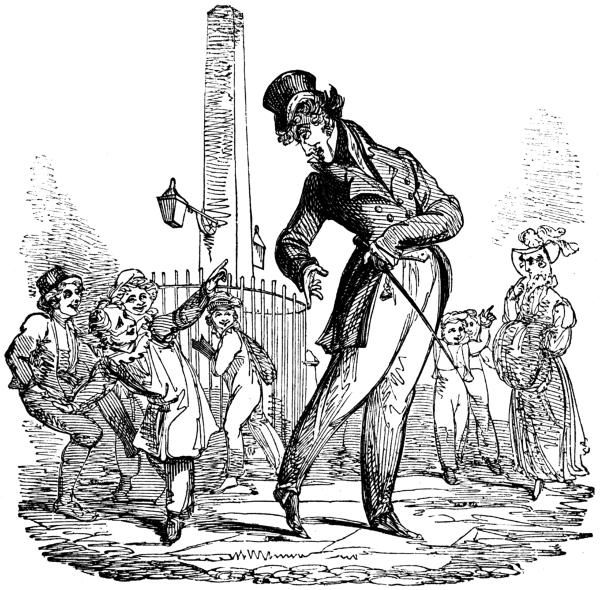
AH! YOU APRIL FOOL!
Thirty years ago, when buckles were worn in shoes, a boy would meet a person in the street with—“Sir, if you please, your shoe’s unbuckled,” and the moment the accosted individual looked towards his feet, the informant would cry—“Ah! you April fool!” Twenty years ago, when buckles were wholly disused, the urchin-cry was—“Sir, your shoe’s untied;” and if the shoe-wearer lowered his eyes, he was hailed, as his buckled predecessor had been, with the said—“Ah! you April fool!” Now, when neither buckles nor strings are worn, because in the year 1825 no decent man “has a shoe to his foot,” the waggery of the day is—“Sir, there’s something out of your pocket.” “Where?” “There!” “What?” “Your hand, sir—Ah! you April fool!” Or else some lady is humbly bowed to, and gravely addressed with “Ma’am, I beg your pardon, but you’ve something on your face!” “Indeed, my man! what is it?” “Your nose, ma’am—Ah! you April fool!”
The tricks that youngsters play off on the first of April are various as their fancies. One, who has yet to know the humours of the day, they send to a cobbler’s for a pennyworth of the best “stirrup oil;” the cobbler receives the money, and the novice receives a hearty cut or two from the cobbler’s strap: if he does not, at the same time, obtain the information that he is “an April fool,” he is sure to be acquainted with it on returning to his companions. The like knowledge is also gained by an errand to some shop for half a pint of “pigeon’s milk,” or an inquiry at a bookseller’s for the “Life and Adventures of Eve’s Mother.”
Then, in-door young ones club their wicked wits, And almost frighten servants into fits— “Oh, John! James! John!—oh, quick! oh! Molly, oh Oh, the trap-door! oh, Molly! down below!” “What, what’s the matter!” scream, with wild surprise John, James, and Molly, while the young ones’ cries Redouble till they come; then all the boys Shout “Ah! you April fools!” with clamorous noise; And little girls enticed down stairs to see, Stand peeping, clap their hands, and cry “te-hee!” Each gibing boy escapes a different way, And meet again some trick, “as good as that,” to play.
*
Much is written concerning the custom of fool-making on the first of April, but with this result only, that it is very ancient and very general.[56] As a better opportunity will occur hereafter, nothing will be said here respecting “fools” by profession.
The practice of making fools on this day in North Britain, is usually exercised by sending a person from place to place by means of a letter, in which is written
“On the first day of April Hunt the gowk another mile.”
This is called “hunting the gowk;” and the bearer of the “fools’ errand” is called an “April gowk.” Brand says, that gowk is properly a cuckoo, and is used here metaphorically for a fool; this appears correct; for from the Saxon “geac, a cuckoo,” is derived geck,[57] which means “one easily imposed on.” Malvolio, who had been “made a fool” by a letter, purporting to have been written by Olivia, inquires of her
“Why have you suffered me to be— —Made the most notorious geck and gull That e’er invention play’d on?”
Olivia affirms, that the letter was not written by her, and exclaims to Malvolio
“Alas, poor fool! how have they baffled thee!”
Geck is likewise derivable “from the Teutonic geck, jocus.”[58]
The “April fool” is among the Swedes. Toreen, one of their travellers, says, “We set sail on the first of April, and the wind made April fools of us, for we were forced to return before Shagen.” On the Sunday and Monday preceding Lent, people are privileged at Lisbon to play the fool: it is thought very jocose to pour water on any person who passes, or throw powder in his face; but to do both is the perfection of wit.[59] The Hindoos also at their Huli festival keep a general holiday on the 31st of March, and one subject of diversion is to send people on errands and expeditions that are to end in disappointment, and raise a laugh at the expense of the persons sent. Colonel Pearce says, that “high and low join in it; and,” he adds, “the late Suraja Doulah, I am told, was very fond of making Huli fools, though he was a mussulman of the highest rank. They carry the joke here (in India) so far, as to send letters making appointments, in the name of persons, who, it is known, must be absent from their house at the time fixed upon; and the laugh is always in proportion to the trouble given.”[60]
The April fool among the French is called “un poisson d’Avril.” Their transformation of the term is not well accounted for, but their customs on the day are similar to ours. In one instance a “joke” was carried too far. At Paris, on the 1st of April, 1817, a young lady pocketed a watch in the house of a friend. She was arrested the same day, and taken before the correctional police, when being charged with the fact, she said it was an April trick (un poisson d’Avril.) She was asked whether the watch was in her custody? She denied it; but a messenger was sent to her apartment, and it was found on the chimney-place. Upon which the young lady said, she had made the messenger un poisson d’Avril, “an April fool.” The pleasantry, however, did not end so happily, for the young lady was jocularly recommended to remain in the house of correction till the 1st of April, 1818, and then to be discharged as un poisson d’Avril.[61]
It must not be forgotten, that the practice of “making April fool” in England, is often indulged by persons of maturer years, and in a more agreeable way. There are some verses that pleasantly exemplify this:[62]
To a Lady, who threatened to make the Author an April Fool.
Why strive, dear girl, to make a fool Of one not wise before, Yet, having ’scaped from folly’s school, Would fain go there no more? Ah! if I must to school again, Wilt thou my teacher be? I’m sure no lesson will be vain Which thou canst give to me. One of thy kind and gentle looks, Thy smiles devoid of art, Avail, beyond all crabbed books, To regulate my heart. Thou need’st not call some fairy elf, On any April-day, To make thy bard forget himself, Or wander from his way. One thing he never can forget, Whatever change may be, The sacred hour when first he met And fondly gazed on thee. A seed then fell into his breast; Thy spirit placed it there: Need I, my Julia, tell the rest? Thou seest the blossoms here.
FLORAL DIRECTORY.
Annual Mercury. Mercurialis annua. Dedicated to St. Hugh.
April 2.
St. Francis of Paula. St. Apian, A. D. 306. St. Theodosia, A. D. 308. St. Nicetius, Abp. of Lyons, A. D. 577. St. Ebba, Abbess, and her companions, A. D. 870, or 874. B. Constantine II. king of Scotland, A. D. 874. St. Bronacha, or Bronanna, Abbess.
St. Francis of Paula
Was a Calabrian, and at fifteen years old shut himself up in a cave, in a rock on the coast. Before twenty he was joined by two others, and the people built them three cells; the number increased, and so arose the order of friar Minims, which means the least of the friars. Constant abstinence from flesh, and all food made of milk or eggs, was one of their rules. In 1479, being invited to Sicily, “he was received there as an angel from heaven, wrought miracles, and built several monasteries.” He prophesied, held burning coals in his hand without being burnt, restored his nephew to life, cured people of the plague, received the host with a cord about his neck on Maundy Thursday, died on the 2d of April, 1508, aged ninety-one, and was buried till 1562 when the hugonots burnt his bones with the wood of a crucifix.[63]
Besides this, it is related, that the elements lost their force against him; that he walked upon fire; entered into a burning oven without harm; and made a sea voyage on his own cloak instead of a ship, and had a companion on board with him.[64]
According to another account he was much worried by the devil. Once while he was at prayers the devil called him three times by his own name. Another time he was so possessed by the fiend, that he had no other way to get rid of him, than by stripping and beating himself with a hard cord, crying while he did it, “thus brother ass thou must be beaten;” after which he ran into the snow and made seven snowballs, intending to swallow them if the devil had not taken his leave. Then a whole parcel of devils came one night, and gave him a grievous beating; this was because he lodged in a cardinal’s palace, and it occasioned him to shift his lodging. Afterwards, when at prayers, he saw upon the roof of the house whole companies of these infernals. He was a bird-fancier. A bird sat singing on a fig-tree by the side of his cell, he called it to him; the bird came upon his hand, and he said to it—“Sing, my sister, and praise the Lord,” and the bird sat singing till he gave it liberty to go away. Going to Venice with his companions, and hearing birds singing in a wood, he proposed to sing the canonical hours, but the monks could not hear themselves for the chanters of the grove, wherefore, he entreated the feathered choir to be silent, and they remained so till he gave them liberty to proceed. At another place when he was preaching, he could not be heard for the swallows, which were making their nests; he said to them—“Sister swallows, it is time for me to speak; as you’ve said enough, be quiet,” and so they were. It was customary with him when one of his friars had committed a fault to take off the friar’s hood, and throw it into the fire, from whence after staying there a proper time, he commanded it to be restored to the friar, and the hood was then taken out of the fire without having sustained injury. More to the like effect, and of equal credibility, is related of this saint in the Golden Legend.
Chronology.
1801. Lord Nelson’s victory at Copenhagen, when eighteen sail of the line were either captured or destroyed.
FLORAL DIRECTORY.
White Violet. Viola alba. Dedicated to St. Francis of Paula.
Moveable feasts.
*** An error under the above title having crept into the Every-Day Book, at p. 190, and also extended to the list of “Moveable feasts,” the reader will please to correct that list, &c. by the following statement.
Shrove Sunday is the Sunday next before Shrove Tuesday. It is also called Quinquagesima Sunday.
Shrove Tuesday is always the seventh Tuesday before Easter-day.
Care, or Carle Sunday is the fifth Sunday in Lent, and the second Sunday before Easter-day.
Maundy Thursday, also called Chare or Shere Thursday, is the day before Good Friday.
Good Friday is the Friday in Passion-week, and consequently the Friday next before Easter-day.
Easter-day is always the first Sunday after the first full moon, which happens on or next after the 21st of March; but if the full moon happens upon a Sunday, Easter-day is the Sunday following.
Octave or Utas of a Feast.
The Octave or Utas of each feast is always the eighth day after it occurs; for example, the feast of St. Hillary is the 13th of January, hence the octave of St. Hillary is the 22d of January.
†⸸† These Corrections would have been made in the sheet itself, but a great number of copies having been printed, before the error was discovered, it became necessary to postpone the rectification. See Note below.[65]
Easter.
Easter-day is distinguished by its peculiar name, through our Saxon ancestors, who at this season of the year held a great festival, in honour of the goddess Eastor, probably the Astarte of the eastern nations. The French call this festival Paques, derived from the Greek pascha, which is also derived from the Hebrew pesech, meaning passover; and whence we have the English word paschal, applied to the lamb, which formed part of the evening meal, the last of which our saviour partook, before his death, with his twelve missionaries. In Cambridgeshire the word pasch is still in use, and applied to a flower which appears at this time on the Gogmagog hills and its environs. The day is of importance in a civil, as well as in a religious, light; for on this day depend the openings of our courts of law, which take place after it, and the festivals of the church are arranged in conformity to it. By the act of parliament on this subject, and the rule given in conformity to it in the “Common Prayer-Book,” which of course every body has an opportunity of seeing, “Easter-day is always the first Sunday after the Full Moon, which happens upon, or next after, the twenty-first day of March; and if the Full Moon happen upon a Sunday, Easter-day is the Sunday after.”
One would think, that when such precise directions had been given, and the state of the moon on any day is so clearly and easily ascertained, that there would be no difficulty in following them; but experience has proved that contrary deviations from the act of parliament have been numerous. These have been pointed out at various times, but without any effect on the public. In the year 1735, Henry Wilson, of Tower-hill, styling himself mathematician, denounced the errors on this subject in a very ingenious work, entitled “The regulation of Easter, or the cause of the errours and differences contracted in the calculation of it, discovered and duly considered, showing—The frequency and consequence of that errour, with the cause from whence it proceeds, and a method proposed for rectifying it, and reconciling the differences about it, and for restoring the time of celebrating that great solemnity in its primitive certainty and exactness, and that without the difficulty and confusion which some have objected would attend such a regulation.” 8vo.
Within these few years an error in the observance of Easter took place, and on all the almanacs fixing an improper day for its observance, a memorial was presented to the lords in council and to the prince regent, humbly soliciting their interference on this subject. It was noticed also by Mr. Frend, in his “Evening Amusements;” and a clergyman of Oxford published a pamphlet on the occasion. There was also, we believe, one clergyman, who, disregarding the almanac, obeyed the rubric, and read the services for Easter-day, and the Sundays depending on it, on very different days from those adopted in other churches. It was remarkable also, that in that very year, judge Garrow arrived at Gloucester a short time after twelve o’clock at night, of the day on which the assizes were to commence, and the high-sheriff very properly representing his scruples, on the legality of then commencing the assizes, they were delayed till the opinion of the judges could be taken, and the consequence was, the issuing of a new writ. Thus the difference of a few minutes was considered fatal to the opening of a country court, though the courts of law at Westminster had been opened a few months before, when a much greater error had taken place with respect to Easter-day, on which, as before observed, the opening of those courts depends.
To understand this subject we must refer back to the origin of this festival, instituted in honour of the resurrection of our saviour, which took place on the third day after his execution as a malefactor. Friday had been fixed upon as the day of commemorating his death, and as that took place on the day of full moon, the first full moon after the twenty-first of March was fixed upon as the regulator of the festival. The great point had in view was to prevent the festival of Easter-day from being observed on the day of a full moon, but as near to it as circumstances would admit, and in consequence there is a great difference in the times of observing this festival; it being specially provided, however, that it should happen after a full moon. The Jews observe their passover by juster rules; the day for the celebration of it taking place on different days of the week: but the Christians having fixed on Friday for the celebration of the fast on the death of our saviour, the Easter-day, on the following Sunday, was accommodated to it, and both were so fixed, that there could not be a full moon on the Easter-day, nor for some weeks after it.
In this year, 1825, the full moon occurs at twenty-three minutes past six in the morning of the third of April; consequently, according to the act of parliament, and the rubric of the church, Easter-day ought to be celebrated on the tenth, and the courts of law ought to open, or Easter term begin, on the twenty-seventh; but our almanac-makers thought good to fix Easter-day on the third, and consequently Easter term is placed by them on the twentieth, on which day it is presumed that judicial proceedings will commence.
Easter-day is observed all over Christendom with peculiar rites. In the catholic church high mass is celebrated, the host is adored with the greatest reverence, and both Catholics and Protestants might be led from it, to a more particular attention to the circumstances attending its form and substance. The host, derived from the Latin word hostia, meaning a victim, is a consecrated wafer, of a circular form, composed of flour and water. Both substance and form are regulated by custom of very ancient date. On the night before his execution, our saviour took bread, and blessing it, divided it among his missionaries; but the bread he took was not ordinary bread, but unleavened bread, such as is used by the Jews during the passover week in the present days. This bread is composed of merely flour and water, no leaven during the festival of their passover being permitted to enter the house of a Jew. It is a kind of biscuit of a circular form, and the host thus, by its form and substance, brings us back to the recollection of the Catholics, and the rite celebrated by our saviour. It is the representation of the Jewish cake, or unleavened bread, which is to this day eaten by that nation during the passover week.
The Protestants have deviated from this custom, and in their churches use leavened bread, without any regard to form, and they cut it with a knife into small pieces, forgetting that our saviour broke the bread; but some use leavened bread, and, as they cannot break it, they attempt to imitate our saviour’s action by tearing it in pieces.
For those who wish to have a more comprehensive view of this subject, the following works are recommended: Cardinal Bona on the mass; Dean Comber on the liturgy; and above all, the Hebrew ritual, which is translated into English, and to which both Catholics and Protestants are indebted for greater part of their services.[66]
April 3.
1825. Easter Sunday. The Resurrection.
Sts. Agape, Chionia, and Irene, Sisters, and their Companions, A. D. 304; St. Richard. St. Ulpian. St. Nicetas, Abbot, A. D. 824.
St. Richard de Wiche
Was born at Wiche, near Worcester; studied at Oxford, Paris, and Bologna; became chancellor to the diocese of Canterbury; and was consecrated bishop of Chichester in 1245, against the desire of Henry III who seized his temporalities. These he regained by replevin, and pleading his cause against the king’s deputies before Innocent IV at Rome, a papal decree confirmed his election. Among his clergy he was a strict disciplinarian, and a friend and comforter to the poor. Preaching a crusade, according to the fashion of those times, against the Saracens, he fell sick, and died in the hospital at Dover, called God’s-house, in 1253, in the fifty-sixth year of his age, and in the ninth of his episcopal functions. This is a brief character of an exemplary prelate, but the credulous Butler chooses to affirm, that three dead persons were restored to life, and other miraculous cures were worked at his tomb. Father Porter gossips a story of a miraculous flow of unction at his consecration; of a dead-born child having been brought to life by his dead merits; and of the touch of his old clothes having cured the diseased, with other performances, “which moved pope Boniface IV. to enrol him into the number of the canonized saincts.” Such wonders have never been performed in our days, and hence late popes have not been able to make saints. If bibles could be suppressed, and the printing-press destroyed, miracles and canonizations would “come in” again.
For particulars respecting Easter-day and Easter Monday, see Easter Tuesday, 5th of April.
FLORAL DIRECTORY.
Evergreen Alkanet. Anchusa sempervirus. Dedicated to St. Agape.
April 4.
St. Isidore, Bishop of Seville, A. D. 636 St. Plato, Abbot, A. D. 813.
Easter Monday
Holiday at the Public Offices; except Excise, Custom, and Stamp.
Chronology.
1774. Oliver Goldsmith died: he was born in Ireland, November 29th, 1728.
1802. Lloyd, lord Kenyon, lord chief-justice of England, died, aged 69.
FLORAL DIRECTORY.
Red Crown Imperial. Fritillaria Imperialis. Dedicated to St Isidore.
April 5.
St. Vincent Ferrer, A. D. 1419. St. Gerald, Abbot, A. D. 1095. St. Tigernach, Bishop in Ireland, A. D. 550. St. Becan, Abbot.
Easter Tuesday.
Holidays at the Public Offices; except Excise, Stamp, and Custom.
Chronology.
1605. John Stow, the antiquary, died, aged 80. He was a tailor.
1800. The rev. William Mason died. He was born at Hull, in Yorkshire, in 1725.
1804. The rev. William Gilpin, author of “Picturesque Tours,” “Remarks on Forest Scenery,” an “Essay on Prints,” &c. died aged 80.
1811. Robert Raikes, of Gloucester, died, aged 76. He was the originator of sunday-schools, and spent his life in acts of kindness and compassion; promoting education as a source of happiness to his fellow beings, and bestowing his exertions and bounty to benefit the helpless.
FLORAL DIRECTORY.
Yellow Crown Imperial. Fritillaria Imperialis Lutea. Dedicated to St. Vincent Ferrer.
Easter Customs.
Dancing of the Sun.
The day before Easter-day is in some parts called “Holy Saturday.” On the evening of this day, in the middle districts of Ireland, great preparations are made for the finishing of Lent. Many a fat hen and dainty piece of bacon is put in the pot by the cotter’s wife about eight or nine o’clock, and woe be to the person who should taste it before the cock crows. At twelve is heard the clapping of hands, and the joyous laugh, mixed with “Shidth or mogh or corries,” i. e. out with the Lent: all is merriment for a few hours, when they retire, and rise about four o’clock to see the sun dance in honour of the resurrection. This ignorant custom is not confined to the humble labourer and his family, but is scrupulously observed by many highly respectable and wealthy families, different members of whom I have heard assert positively that they had seen the sun dance on Easter morning.[67]
It is inquired in Dunton’s “Athenian Oracle,” “Why does the sun at his rising play more on Easter-day than Whit-Sunday?” The question is answered thus:—“The matter of fact is an old, weak, superstitious error, and the sun neither plays nor works on Easter-day more than any other. It is true, it may sometimes happen to shine brighter that morning than any other; but, if it does, it is purely accidental. In some parts of England they call it the lamb-playing, which they look for, as soon as the sun rises, in some clear or spring water, and is nothing but the pretty reflection it makes from the water, which they may find at any time, if the sun rises clear, and they themselves early, and unprejudiced with fancy.” The folly is kept up by the fact, that no one can view the sun steadily at any hour, and those who choose to look at it, or at its reflection in water, see it apparently move, as they would on any other day. Brand points out an allusion to this vulgar notion in an old ballad:—
But, Dick, she dances such away! No sun upon an Easter day Is half so fine a sight.
Again, from the “British Apollo,” a presumed question to the sun himself upon the subject, elicits a suitable answer:
Q. Old wives, Phœbus, say That on Easter-day To the music o’ th’ spheres you do caper; If the fact, sir, be true, Pray let’s the cause know, When you have any room in your paper. A. The old wives get merry With spic’d ale or sherry, On Easter, which makes them romance; And whilst in a rout Their brains whirl about, They fancy we caper and dance.
A bit of smoked glass, such as boys use to view an eclipse with, would put this matter steady to every eye but that of wilful self-deception, which, after all, superstition always chooses to see through.
Lifting.
Mr. Ellis inserts, in his edition of Mr. Brand’s “Popular Antiquities,” a letter from Mr. Thomas Loggan of Basinghall-street, from whence the following extract is made: Mr. Loggan says, “I was sitting alone last Easter Tuesday, at breakfast, at the Talbot in Shrewsbury, when I was surprised by the entrance of all the female servants of the house handing in an arm-chair, lined with white, and decorated with ribbons and favours of different colours. I asked them what they wanted, their answer was, they came to heave me; it was the custom of the place on that morning, and they hoped I would take a seat in their chair. It was impossible not to comply with a request very modestly made, and to a set of nymphs in their best apparel, and several of them under twenty. I wished to see all the ceremony, and seated myself accordingly. The group then lifted me from the ground, turned the chair about, and I had the felicity of a salute from each. I told them, I supposed there was a fee due upon the occasion, and was answered in the affirmative; and, having satisfied the damsels in this respect, they withdrew to heave others. At this time I had never heard of such a custom; but, on inquiry, I found that on Easter Monday, between nine and twelve, the men heave the women in the same manner as on the Tuesday, between the same hours, the women heave the men.”
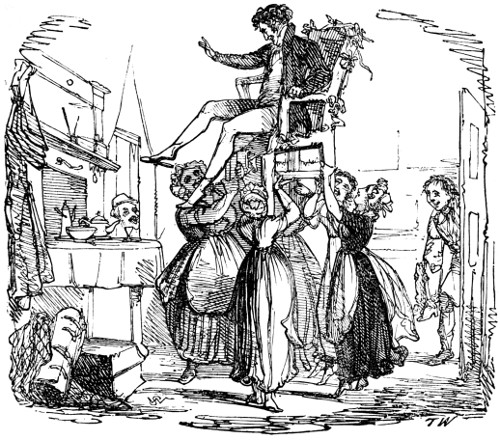
Lifting—an Easter Custom.
In Lancashire, Staffordshire, Warwickshire, and some other parts of England there prevails this custom of heaving or lifting at Easter-tide. This is performed mostly in the open street, though sometimes it is insisted on and submitted to within the house. People form into parties of eight or a dozen or even more for the purpose, and from every one lifted or heaved they extort a contribution. The late Mr. Lysons read to the Society of Antiquaries an extract from a roll in his custody, as keeper of the records in the tower of London, which contains a payment to certain ladies and maids of honour for taking king Edward I. in his bed at Easter; from whence it has been presumed that he was lifted on the authority of that custom, which is said to have prevailed among all ranks throughout the kingdom. The usage is a vulgar commemoration of the resurrection which the festival of Easter celebrates.
Lifting or heaving differs a little in different places. In some parts the person is laid horizontally, in others placed in a sitting position on the bearers’ hands. Usually, when the lifting or heaving is within doors, a chair is produced, but in all cases the ceremony is incomplete without three distinct elevations.
A Warwickshire correspondent, L. S., says, Easter Monday and Easter Tuesday were known by the name of heaving-day, because on the former day it was customary for the men to heave and kiss the women, and on the latter for the women to retaliate upon the men. The women’s heaving-day was the most amusing. Many a time have I passed along the streets inhabited by the lower orders of people, and seen parties of jolly matrons assembled round tables on which stood a foaming tankard of ale. There they sat in all the pride of absolute sovereignty, and woe to the luckless man that dared to invade their prerogatives!—as sure as he was seen he was pursued—as sure as he was pursued he was taken—and as sure as he was taken he was heaved and kissed, and compelled to pay sixpence for “leave and license” to depart.
Conducted as lifting appears to have been by the blooming lasses of Shrewsbury, and acquitted as all who are actors in the usage any where must be, of even the slightest knowledge that this practice is an absurd performance of the resurrection, still it must strike the reflective mind as at least an absurd custom, “more honored i’ the breach than the observance.” It has been handed down to us from the bewildering ceremonies of the Romish church, and may easily be discountenanced into disuse by opportune and mild persuasion. If the children of ignorant persons be properly taught, they will perceive in adult years the gross follies of their parentage, and so instruct their own offspring, that not a hand or voice shall be lifted or heard from the sons of labour, in support of a superstition that darkened and dismayed man, until the printing-press and the reformation ensured his final enlightenment and emancipation.
Easter Eggs.
Another relic of the ancient times, are the eggs which pass about at Easter week under the name of pask, paste, or pace eggs. A communication introduces the subject at once.
To the Editor of the Every-Day Book.
Sir,
19th March, 1825.
A perusal of the Every-Day Book induces me to communicate the particulars of a custom still prevalent in some parts of Cumberland, although not as generally attended to as it was twenty or thirty years ago. I allude to the practice of sending reciprocal presents of eggs, at Easter, to the children of families respectively, betwixt whom any intimacy subsists. For some weeks preceding Good Friday the price of eggs advances considerably, from the great demand occasioned by the custom referred to.
The modes adopted to prepare the eggs for presentation are the following: there may be others which have escaped my recollection.
The eggs being immersed in hot water for a few moments, the end of a common tallow-candle is made use of to inscribe the names of individuals, dates of particular events, &c. The warmth of the egg renders this a very easy process. Thus inscribed, the egg is placed in a pan of hot water, saturated with cochineal, or other dye-woods; the part over which the tallow has been passed is impervious to the operation of the dye; and consequently when the egg is removed from the pan, there appears no discolouration of the egg where the inscription has been traced, but the egg presents a white inscription on a coloured ground. The colour of course depends upon the taste of the person who prepared the egg; but usually much variety of colour is made use of.
Another method of ornamenting “pace eggs” is, however, much neater, although more laborious, than that with the tallow-candle. The egg being dyed, it may be decorated in a very pretty manner, by means of a penknife, with which the dye may be scraped off, leaving the design white, on a coloured ground. An egg is frequently divided into compartments, which are filled up according to the taste and skill of the designer. Generally one compartment contains the name and (being young and unsophisticated) also the age of the party for whom the egg is intended. In another is, perhaps, a landscape; and sometimes a cupid is found lurking in a third: so that these “pace eggs” become very useful auxiliaries to the missives of St. Valentine. Nothing was more common in the childhood of the writer, than to see a number of these eggs preserved very carefully in the corner-cupboard; each egg being the occupant of a deep, long-stemmed ale-glass, through which the inscription could be read without removing it. Probably many of these eggs now remain in Cumberland, which would afford as good evidence of dates in a court of justice, as a tombstone or a family-bible.
It will be readily supposed that the majority of pace eggs are simply dyed; or dotted with tallow to present a piebald or bird’s-eye appearance. These are designed for the junior boys who have not begun to participate in the pleasures of “a bended bow and quiver full of arrows;”—a flaming torch, or a heart and a true-lover’s knot. These plainer specimens are seldom promoted to the dignity of the ale-glass or the corner-cupboard. Instead of being handed down to posterity they are hurled to swift destruction. In the process of dying they are boiled pretty hard—so as to prevent inconvenience if crushed in the hand or the pocket. But the strength of the shell constitutes the chief glory of a pace egg, whose owner aspires only to the conquest of a rival youth. Holding his egg in his hand he challenges a companion to give blow for blow. One of the eggs is sure to be broken, and its shattered remains are the spoil of the conqueror: who is instantly invested with the title of “a cock of one, two, three,” &c. in proportion as it may have fractured his antagonist’s eggs in the conflict. A successful egg, in a contest with one which had previously gained honours, adds to its number the reckoning of its vanquished foe. An egg which is a “cock” of ten or a dozen, is frequently challenged. A modern pugilist would call this a set-to for the championship. Such on the borders of the Solway Frith were the youthful amusements of Easter Monday.
Your very proper precaution, which requires the names of correspondents who transmit notices of local customs, is complied with by the addition of my name and address below. In publication I prefer to appear only as your constant reader.
J. B.
A notice below, the editor hopes will be read and taken by the reader, for whose advantage it is introduced, in good part.[68]
Pasch eggs are to be found at Easter in different parts of the kingdom. A Liverpool gentleman informs the editor, that in that town and neighbourhood they are still common, and called paste eggs. One of his children brought to him a paste egg at Easter, 1824, beautifully mottled with brown. It had been purposely prepared for the child by the servant, by being boiled hard within the coat of an onion, which imparted to the shell the admired colour. Hard boiling is a chief requisite in preparing the pasch egg. In some parts they are variously coloured with the juices of different herbs, and played with by boys, who roll them on the grass, or toss them up for balls. Their more elegant preparation is already described by our obliging correspondent, J. B.
The terms pace, paste, or pasch, are derived from paschal, which is a name given to Easter from its being the paschal season. Four hundred eggs were bought for eighteen-pence in the time of Edward I., as appears by a royal roll in the tower; from whence it also appears they were purchased for the purpose of being boiled and stained, or covered with leaf gold, and afterwards distributed to the royal household at Easter. They were formerly consecrated, and the ritual of pope Paul V. for the use of England, Scotland, and Ireland, contains the form of consecration.[69] On Easter eve and Easter day, the heads of families sent to the church large chargers, filled with the hard boiled eggs, and there the “creature of eggs” became sacred by virtue of holy water, crossing, and so on.
Ball. Bacon. Tansy Puddings.
Eating of tansy pudding is another custom at Easter derived from the Romish church. Tansy symbolized the bitter herbs used by the Jews at their paschal; but that the people might show a proper abhorrence of Jews, they ate from a gammon of bacon at Easter, as many still do in several country places, at this season, without knowing from whence this practice is derived. Then we have Easter ball-play, another ecclesiastical device, the meaning of which cannot be quite so clearly traced; but it is certain that the Romish clergy abroad played at ball in the church, as part of the service; and we find an archbishop joining in the sport. “A ball, not of size to be grasped by one hand only, being given out at Easter, the dean and his representatives began an antiphone, suited to Easter-day; then taking the ball in his left hand, he commenced a dance to the tune of the antiphone, the others dancing round hand in hand. At intervals, the ball was bandied or passed to each of the choristers. The organ played according to the dance and sport. The dancing and antiphone being concluded, the choir went to take refreshment. It was the privilege of the lord, or his locum tenens, to throw the ball; even the archbishop did it.”[70] Whether the dignified clergy had this amusement in the English churches is not authenticated; but it seems that “boys used to claim hard eggs, or small money, at Easter, in exchange for the ball-play before mentioned.”[71] Brand cites the mention of a lay amusement at this season, wherein both tansy and ball-play is referred to.
Stool-ball.
At stool-ball, Lucia, let us play, For sugar, cakes, or wine. Or for a tansy let us pay, The loss be thine or mine. If thou, my dear, a winner be At trundling of the ball, The wager thou shall have, and me And my misfortunes all.
1679.
Also, from “Poor Robin’s Almanack” for 1677, this Easter verse, denoting the sport at that season:
Young men and maids, Now very brisk, At barley-break and Stool-ball frisk.
A ball custom now prevails annually at Bury St. Edmund’s, Suffolk. On Shrove Tuesday, Easter Monday, and the Whitsuntide festivals, twelve old women side off for a game at trap-and-ball, which is kept up with the greatest spirit and vigour until sunset. One old lady, named Gill, upwards of sixty years of age, has been celebrated as the “mistress of the sport” for a number of years past; and it affords much of the good old humour to flow round, whilst the merry combatants dexterously hurl the giddy ball to and fro. Afterwards they retire to their homes, where
“Voice, fiddle, or flute, No longer is mute,”
and close the day with apportioned mirth and merriment.[72]
Corporations formerly went forth to play at ball at Easter. Both then and at Whitsuntide, the mayor, aldermen, and sheriff of Newcastle-upon-Tyne, with a great number of the burgesses, went yearly to the Forth, or little mall of the town, with the mace, sword, and cap of maintenance, carried before them, and patronised the playing at hand-ball, dancing, and other amusements, and sometimes joined in the ball-play, and at others joined hands with the ladies.
There is a Cheshire proverb, “When the daughter is stolen, shut the Pepper-gate.” This is founded on the fact that the mayor of Chester had his daughter stolen as she was playing at ball with other maidens in Pepper-street; the young man who carried her off, came through the Pepper-gate, and the mayor wisely ordered the gate to be shut up:[73] agreeable to the old saying, and present custom agreeable thereto, “When the steed’s stolen, shut the stable-door.” Hereafter it will be seen that persons quite as dignified and magisterial as mayors and aldermen, could compass a holiday’s sport and a merry-go-round, as well as their more humble fellow subjects.
Clipping the Church at Easter.
L. S., a Warwickshire correspondent, communicates this Easter custom to the Every-Day Book:
“When I was a child, as sure as Easter Monday came, I was taken ‘to see the children clip the churches.’ This ceremony was performed, amid crowds of people and shouts of joy, by the children of the different charity-schools, who at a certain hour flocked together for the purpose. The first comers placed themselves hand in hand with their backs against the church, and were joined by their companions, who gradually increased in number, till at last the chain was of sufficient length completely to surround the sacred edifice. As soon as the hand of the last of the train had grasped that of the first, the party broke up, and walked in procession to the other church, (for in those days Birmingham boasted but of two,) where the ceremony was repeated.”
Old Easter Customs in Church.
In the celebration of this festival, the Romish church amused our forefathers by theatrical representations, and extraordinary dramatic worship, with appropriate scenery, machinery, dresses, and decorations. The exhibitions at Durham appear to have been conducted with great effect. In that cathedral, over our lady of Bolton’s altar, there was a marvellous, lively, and beautiful image of the picture of our lady, called the lady of Bolton, which picture was made to open with gimmes, (or linked fastenings,) from the breast downward; and within the said image was wrought and pictured the image of our saviour marvellously finely gilt, holding up his hands, and betwixt his hands was a large fair crucifix of Christ, all of gold; the which crucifix was ordained to be taken forth every Good Friday, and every man did creep unto it that was in the church at that time; and afterwards it was hung up again within the said image. Every principal day the said image of our lady of Bolton, was opened, that every man might see pictured within her, the Father, the Son, and the Holy Ghost, most curiously and finely gilt; and both the sides within her were very finely varnished with green varnish, and flowers of gold, which was a goodly sight for all the beholders thereof. On Good Friday, there was marvellous solemn service, in which service time, after the Passion was sung, two of the ancient monks took a goodly large crucifix, all of gold, of the picture of our saviour Christ nailed upon the cross, laying it upon a velvet cushion, having St. Cuthbert’s arms upon it, all embroidered with gold, bringing it betwixt them upon the cushion to the lowest steps in the choir, and there betwixt them did hold the said picture of our saviour, sitting on either side of it. And then one of the said monks did rise, and went a pretty space from it, and setting himself upon his knees with his shoes put off, very reverently he crept upon his knees unto the said cross, and most reverently did kiss it; and after him the other monk did so likewise; and then they sate down on either side of the said cross, holding it betwixt them. Afterward, the prior came forth of his stall, and did sit him down upon his knees with his shoes off in like sort, and did creep also unto the said cross, and all the monks after him did creep one after another in the same manner and order; in the mean time, the whole choir singing a hymn. The service being ended, the said two monks carried the cross to the sepulchre with great reverence.[74]
The sepulchre was erected in the church near the altar, to represent the tomb wherein the body of Christ was laid for burial. At this tomb there was a grand performance on Easter-day. In some churches it was ordained, that Mary Magdalen, Mary of Bethany, and Mary of Naim, should be represented by three deacons clothed in dalmaticks and amesses, with their heads in the manner of women, and holding a vase in their hands. These performers came through the middle of the choir, and hastening towards the sepulchre, with downcast looks, said together this verse, “Who will remove the stone for us?” Upon this a boy, clothed like an angel, in albs, and holding a wheat ear in his hand, before the sepulchre, said, “Whom do you seek in the sepulchre?” The Maries answered, “Jesus of Nazareth who was crucified.” The boy-angel answered, “He is not here, but is risen;” and pointed to the place with his finger. The boy-angel departed very quickly, and two priests in tunics, sitting without the sepulchre, said, “Woman, whom do ye mourn for? Whom do ye seek?” The middle one of the women said, “Sir, if you have taken him away, say so.” The priest, showing the cross, said, “They have taken away the Lord.” The two sitting priests said, “Whom do ye seek, women?” The Maries, kissing the place, afterwards went from the sepulchre. In the mean time a priest, in the character of Christ, in an alb, with a stole, holding a cross, met them on the left horn of the altar, and said, “Mary!” Upon hearing this, the mock Mary threw herself at his feet, and, with a loud voice, cried Cabboin. The priest representing Christ replied, nodding, “Noli me tangere,” touch me not. This being finished, he again appeared at the right horn of the altar, and said to them as they passed before the altar, “Hail! do not fear.” This being finished, he concealed himself; and the women-priests, as though joyful at hearing this, bowed to the altar, and turning to the choir, sung “Alleluia, the Lord is risen.” This was the signal for the bishop or priest before the altar, with the censer, to begin and sing aloud, Te Deum.[75]
The making of the sepulchre was a practice founded upon ancient tradition, that the second coming of Christ would be on Easter-eve; and sepulchre-making, and watching it, remained in England till the reformation. Its ceremonies varied in different places. In the abbey church of Durham it was part of the service upon Easter-day, betwixt three and four o’clock in the morning, for two of the eldest monks of the quire to come to the sepulchre, set up upon Good Friday after the Passion, which being covered with red velvet, and embroidered with gold, these monks, with a pair of silver censers, censed the sepulchre on their knees. Then both rising, went to the sepulchre, out of which they took a marvellous beautiful image of the resurrection, with a cross in the hand of the image of Christ, in the breast whereof was inclosed, in bright crystal, the host, so as to be conspicuous to the beholders. Then, after the elevation of the said picture, it was carried by the said two monks, upon a velvet embroidered cushion, the monks singing the anthem of Christus resurgens. They then brought it to the high altar, setting it on the midst thereof, and the two monks kneeling before the altar, censed it all the time that the rest of the quire were singing the anthem, which being ended, the two monks took up the cushion and picture from the altar, supporting it betwixt them, and proceeded in procession from the high altar to the south quire door, where there were four ancient gentlemen belonging to the quire, appointed to attend their coming, holding up a rich canopy of purple velvet, tasselled round about with red silk and gold fringe; and then the canopy was borne by these “ancient gentlemen,” over the said images with the host carried by the two monks round about the church, the whole quire following, with torches and great store of other lights; all singing, rejoicing, and praying, till they came to the high altar again; upon which they placed the said image, there to remain till Ascension-day, when another ceremony was used.
In Brand’s “Antiquities,” and other works, there are many items of expenses from the accounts of different church-books for making the sepulchre for this Easter ceremony. The old Register Book of the brethren of the Holy Trinity of St. Botolph without Aldersgate, now in the possession of the editor of the Every-Day Book, contains the following entries concerning the sepulchre in that church:—“Item, to the wexchaundeler, for makyng of the Sepulcre light iii times, and of other dyvers lights that longyn to the trynite, in dyvers places in the chirche, lviis. 10d.” In An. 17 Henry VI. there is another “Item, for xiii tapers unto the lyght about the Sepulcre, agenst the ffeste of Estern, weying lxxviii lb. of the wich was wasted xxii lb.” &c. In Ann. 21 & 22 K. Henry VI. the fraternity paid for wax and for lighting of the sepulchre “both yers, xxs. viiid.” and they gathered in those years for their sepulchre light, xlvs. ixd. This gathering was from the people who were present at the representation; and when the value of money at that time is considered, and also that on the same day every church in London had a sepulchre, each more or less attractive, the sum will not be regarded as despicable.
The only theatres for the people were churches, and the monks were actors; accordingly, at Easter, plays were frequently got up for popular amusement. Brand cites from the churchwardens’ accounts of Reading, set forth in Coate’s history of that town, several items of different sums paid for nails for the sepulchre; “for rosyn to the Resurrection play;” for setting up of poles for the scaffold whereon the plays were performed; for making “a Judas;” for the writing of the plays themselves; and for other expenses attending the “getting up” of the representations. Though the subjects exhibited were connected with the incidents commemorated by the festival, yet the most splendid shows must have been in those churches which performed the resurrection at the sepulchre with a full dramatis personæ of monks, in dresses according to the characters they assumed.
Mr. Fosbroke gives the “properties” of the sepulchre show belonging to St. Mary Redcliff’s church at Bristol, from an original MS. in his possession formerly belonging to Chatterton, viz. “Memorandum:—That master Cannings hath delivered, the 4th day of July, in the year of our Lord 1470, to master Nicholas Pelles, vicar of Redclift, Moses Conterin, Philip Berthelmew, and John Brown, procurators of Redclift beforesaid, a new Sepulchre, well guilt with fine gold, and a civer thereto; an image of God Almighty rising out of the same Sepulchre, with all the ordinance that longeth thereto; that is to say, a lath made of timber and iron work thereto. Item, hereto longeth Heven, made of timber and stained cloths. Item, Hell made of timber and iron work thereto, with Devils the number of thirteen. Item, four knights armed, keeping the Sepulchre, with their weapons in their hands; that is to say, two spears, two axes, with two shields. Item, four pair of Angel’s wings, for four Angels, made of timber, and well-painted. Item, the Fadre, the crown and visage, the ball with a cross upon it, well gilt with fine gold. Item, the Holy Ghost coming out of Heven into the Sepulchre. Item, longeth to the four Angels, four Perukes.” The lights at the sepulchre shows, and at Easter, were of themselves a most attractive part of the Easter spectacle. The paschal or great Easter taper at Westminster Abbey was three hundred pounds’ weight. Sometimes a large wax light called a serpent was used; its name was derived from its spiral form, it being wound round a rod. To light it, fire was struck from a flint consecrated by the abbot. The paschal in Durham cathedral was square wax, and reached to within a man’s length of the roof, from whence this waxen enormity was lighted by “a fine convenience.” From this superior light all others were taken. Every taper in the church was purposely extinguished in order that this might supply a fresh stock of consecrated light, till at the same season in the next year a similar parent torch was prepared.[76]
EASTER IN LONDON.
Easter Monday and Tuesday, and Greenwich fair, are renowned as “holidays” throughout most manufactories and trades conducted in the metropolis. On Monday, Greenwich fair commences. The chief attraction to this spot is the park, wherein stands the Royal Observatory on a hill, adown which it is the delight of boys and girls to pull each other till they are wearied. Frequently of late this place has been a scene of rude disorder. But it is still visited by thousands and tens of thousands from London and the vicinity; the lowest join in the hill sports; others regale in the public-houses; and many are mere spectators, of what may be called the humours of the day.
On Easter Monday, at the very dawn of day, the avenues from all parts towards Greenwich give sign of the first London festival in the year. Working men and their wives; ’prentices and their sweethearts; blackguards and bullies; make their way to this fair. Pickpockets and their female companions go later. The greater part of the sojourners are on foot, but the vehicles for conveyance are innumerable. The regular and irregular stages are, of course, full inside and outside. Hackney-coaches are equally well filled; gigs carry three, not including the driver; and there are countless private chaise-carts, public pony-chaises, and open accommodations. Intermingled with these, town-carts, usually employed in carrying goods, are now fitted up, with boards for seats; hereon are seated men, women, and children, till the complement is complete, which is seldom deemed the case till the horses are overloaded. Now and then passes, like “some huge admiral,” a full-sized coal-waggon, laden with coal-heavers and their wives, and shadowed by spreading boughs from every tree that spreads a bough; these solace themselves with draughts of beer from a barrel aboard, and derive amusement from criticising walkers, and passengers in vehicles passing their own, which is of unsurpassing size. The six-mile journey of one of these machines is sometimes prolonged from “dewy morn” till noon. It stops to let its occupants see all that is to be seen on its passage; such as what are called the “Gooseberry fairs,” by the wayside, whereat heats are run upon half-killed horses, or spare and patient donkeys. Here are the bewitching sounds to many a boy’s ears of “A halfpenny ride O!” “A halfpenny ride O!”; upon that sum “first had and obtained,” the immediately bestrided urchin has full right to “work and labour” the bit of life he bestraddles, for the full space or distance of fifty yards, there and back; the returning fifty being done within half time of the first. Then there is “pricking in the belt,” an old exposed and still practised fraud. Besides this, there are numberless invitations to take “a shy for a halfpenny,” at a “bacca box, full o’ ha’pence,” standing on a stick stuck upright in the earth at a reasonable distance for experienced throwers to hit, and therefore win, but which is a mine of wealth to the costermonger proprietor, from the number of unskilled adventurers.
Greenwich fair, of itself, is nothing; the congregated throngs are every thing, and fill every place. The hill of the Observatory, and two or three other eminences in the park, are the chief resort of the less experienced and the vicious. But these soon tire, and group after group succeeds till evening. Before then the more prudent visitors have retired to some of the numerous houses in the vicinage of the park, whereon is written, “Boiling water here,” or “Tea and Coffee,” and where they take such refreshment as these places and their own bundles afford, preparatory to their toil home after their pleasure.
At nightfall, “Life in London,” as it is called, is found at Greenwich. Every room in every public-house is fully occupied by drinkers, smokers, singers and dancers, and the “balls” are kept up during the greater part of the night. The way to town is now an indescribable scene. The vehicles congregated by the visitors to the fair throughout the day resume their motion, and the living reflux on the road is dense to uneasiness. Of all sights the most miserable is that of the poor broken-down horse, who having been urged three times to and from Greenwich with a load thither of pleasure-seekers at sixpence per head, is now unable to return, for the fourth time, with a full load back, though whipped and lifted, and lifted and whipped, by a reasoning driver, who declares “the hoss did it last fair, and why shouldn’t he do it again.” The open windows of every house for refreshment on the road, and clouds of tobacco-smoke therefrom, declare the full stowage of each apartment, while jinglings of the bells, and calls “louder and louder yet,” speak wants and wishes to waiters, who disobey the instructions of the constituent bodies that sent them to the bar. Now from the wayside booths fly out corks that let forth “pop” and “ginger-beer,” and little party-coloured lamps give something of a joyous air to appearances that fatigue and disgust. Overwearied children cry before they have walked to the halfway house; women with infants in their arms pull along their tipsey well-beloveds, others endeavour to wrangle or drag them out of drinking rooms, and, until long after midnight, the Greenwich road does not cease to disgorge incongruities only to be rivalled by the figures and exhibitions in Dutch and Flemish prints.
While this turmoil, commonly called pleasure-taking, is going on, there is another order of persons to whom Easter affords real recreation. Not less inclined to unbend than the frequenters of Greenwich, they seek and find a mode of spending the holiday-time more rationally, more economically, and more advantageously to themselves and their families. With their partners and offspring they ride to some of the many pleasant villages beyond the suburbs of London, out of the reach of the harm and strife incident to mixing with noisy crowds. Here the contented groups are joined by relations or friends, who have appointed to meet them, in the quiet lanes or sunny fields of these delightful retreats. When requisite, they recruit from well-stored junket baskets, carried in turn; and after calmly passing several hours in walking and sauntering through the open balmy air of a spring-day, they sometimes close it by making a good comfortable tea-party at a respectable house on their way to town. Then a cheerful glass is ordered, each joins in merry conversation, or some one suspected of a singing face justifies the suspicion, and “the jocund song goes round,” till, the fathers being reminded by the mothers, more than once possibly, that “it’s getting late,” they rise refreshed and happy, and go home. Such an assembly is composed of honest and industrious individuals, whose feelings and expressions are somewhat, perhaps, represented below.
INDEPENDENT MEN A HOLIDAY SONG.
We’re independent men, with wives, and sweethearts, by our side, We’ve hearts at rest, with health we’re bless’d, and, being Easter tide, We make our spring-time holiday, and take a bit of pleasure, And gay as May, drive care away, and give to mirth our leisure. It’s for our good, that thus, my boys, we pass the hours that stray, We’ll have our frisk, without the risk of squabble or a fray; Let each enjoy his pastime so, that, without fear or sorrow, When all his fun is cut and run, he may enjoy to-morrow. To-morrow may we happier be for happiness to-day, That child or man, no mortal can, or shall, have it to say, That we have lost both cash and time, and been of sense bereft, For what we’ve spent we don’t relent, we’ve time and money left. And we will husband both, my boys, and husband too our wives; May sweethearts bold, before they’re old, be happy for their lives; For good girls make good wives, my boys, and good wives make men better, When men are just, and scorning trust, each man is no man’s debtor. Then at this welcome season, boys, let’s welcome thus each other, Each kind to each, shake hands with each, each be to each a brother; Next Easter holiday may each again see flowers springing, And hear birds sing, and sing himself, while merry bells are ringing.
*
The clear open weather during the Easter holidays in 1825, drew forth a greater number of London holiday keepers than the same season of many preceding years. They were enabled to indulge by the full employment in most branches of trade and manufacture; and if the period was spent not less merrily, it was enjoyed more rationally and with less excess than before was customary. Greenwich, though crowded, was not so abundant of boisterous rudeness. “It is almost the only one of the popular amusements that remains: Stepney, Hampstead, Westend, and Peckham fairs have been crushed by the police, that ‘stern, rugged nurse’ of national morality; and although Greenwich fair continues, it is any thing but what it used to be. Greenwich, however, will always have a charm: the fine park remains—trees, glades, turf, and the view from the observatory, one of the noblest in the world—before you the towers of these palaces built for a monarch’s residence, now ennobled into a refuge from life’s storms for the gallant defenders of their country, after their long and toilsome pilgrimage—then the noble river; and in the distance, amidst the din and smoke, appears the ‘mighty heart’ of this mighty empire; these are views worth purchasing at the expense of being obliged to visit Greenwich fair in this day of its decline. ‘Punch’ and his ‘better half’ seemed to be the presiding deities in the fair, so little of merriment was there to be found. In the park, however, the scene was different; it was nearly filled with persons of all ages: the young came there for amusement, to see and be seen—the old to pay their customary annual visit. On the hills was the usual array of telescopes; there were also many races, and many sovereigns in the course of the day changed hands on the event of them; but one race in particular deserves remark, not that there was any thing in the character, appearance, or speed of the competitors, to distinguish them from the herd of others; the circumstances in it that afforded amusement was the dishonesty of the stakeholder, who, as the parties had just reached the goal, scampered off with the stakes, amidst the shouts of the by-standers, and the ill-concealed chagrin of the two gentlemen who had foolishly committed their money to the hands of a stranger.”[77]
According to annual custom on Easter Monday, the minor theatres opened on that day for the season, and were thronged, as usual, by spectators of novelties, which the Amphitheatre, the Surrey theatre, Sadler’s-wells, and other places of dramatic entertainment, constantly get up for the holiday-folks. The scene of attraction was much extended, by amusements long before announced at distant suburbs. At half-past five on Monday afternoon, Mr. Green accompanied by one of his brothers, ascended in a balloon from the Eagle Tavern, the site of the still remembered “Shepherd and Shepherdess,” in the City-road. “The atmosphere being extremely calm, and the sun shining brightly, the machine, after it had ascended to a moderate height, seemed to hang over the city for nearly half an hour, presenting a beautiful appearance, as its sides glistened with the beams of that orb, towards which it appeared to be conveying two of the inhabitants of a different planet.” It descended near Ewell in Surrey. At a distance of ten miles from this spot, Mr. Graham, another aërial navigator, let off another balloon from the Star and Garter Tavern, near Kew-bridge. “During the preparations, the gardens began to fill with a motley company of farmers’ families, and tradesmen from the neighbourhood, together with a large portion of city folks, and a small sprinkle of some young people of a better dressed order. The fineness of the day gave a peculiar interest to the scene, which throughout was of a very lively description. Parties of ladies, sweeping the ‘green sward,’ their gay dresses, laughing eyes, and the cloudless sky, made every thing look gay. Outside, it was a multitude, as far as the eye could see on one side. The place had the appearance of a fair, booths and stalls for refreshments being spread out, as upon these recreative occasions. Carts, drays, coaches, and every thing which could enable persons the better to overlook the gardens, were put into eager requisition, and every foot of resting-room upon Kew-bridge had found an anxious and curious occupant. In the mean time, fresh arrivals were taking place from all directions, but the clouds of dust which marked the line of the London-road, in particular, denoted at once the eagerness and numbers of the new comers. A glimpse in that direction showed the pedestrians, half roasted with the sun, and half suffocated with the dust, still keeping on their way towards the favoured spot. About five o’clock, Mr. Graham having seated himself in the car of his vehicle, gave the signal for committing the machine to its fate. She swung in the wind for a moment, but suddenly righting, shot up in a directly perpendicular course, amidst the stunning shout of the assembled multitude, Mr. Graham waving the flags and responding to their cheers. Nothing could be more beautiful than the appearance of the balloon at the distance of about a mile from the earth, for from reflecting back the rays of the sun, it appeared a solid body of gold suspended in the air. It continued in sight nearly an hour and a half; and the crowd, whose curiosity had brought them together, had not entirely dispersed from the gardens before seven o’clock. On the way home they were gratified with the sight of Mr. Green’s balloon, which was seen distinctly for a considerable time along the Hammersmith-road. The shadows of evening were lengthening, and
——— midst falling dew, While glow the Heavens with the last steps of day, Far through their rosy depths it did pursue Its solitary way.”[78]
SPITAL SERMONS.
In London, on Easter Monday and Tuesday, the Spital Sermons are preached. “On Easter Monday, the boys of Christ’s Hospital walk in procession, accompanied by the masters and steward, to the Royal Exchange, from whence they proceed to the Mansion-house, where they are joined by the lord mayor, the lady mayoress, the sheriffs, aldermen, recorder, chamberlain, town clerk, and other city officers, with their ladies. From thence the cavalcade proceeds to Christ church, where the Spital Sermon is preached, always by one of the bishops, and an anthem sung by the children. His lordship afterwards returns to the Mansion-house, where a grand civic entertainment is prepared, which is followed by an elegant ball in the evening.
On Easter Tuesday, the boys again walk in procession to the Mansion-house, but, instead of the masters, they are accompanied by the matron and nurses. On Monday, they walk in the order of the schools, each master being at the head of the school over which he presides; and the boys in the mathematical school carry their various instruments. On Tuesday, they walk in the order of the different wards, the nurses walking at the head of the boys under her immediate care. On their arrival at the Mansion-house, they have the honour of being presented individually to the lord mayor, who gives to each boy a new sixpence, a glass of wine, and two buns. His lordship afterwards accompanies them to Christ church, where the service is the same as on Monday. The sermon is on Tuesday usually preached by his lordship’s chaplain.”[79]
The most celebrated Spital Sermon of our times, was that preached by the late Dr. Samuel Parr, upon Easter Tuesday, 1800, against “the eager desire of paradox; the habit of contemplating a favourite topic in one distinct and vivid point of view, while it is disregarded under all others; a fondness for simplicity on subjects too complicated in their inward structure on their external relations, to be reduced to any single and uniform principle;” and against certain speculations on “the motives by which we are impelled to do good to our fellow creatures, and adjusting the extent to which we are capable of doing it.” This sermon induced great controversy, and much misrepresentation. Few of those who condemned it, read it; and many justified their ignorance of what they detracted, by pretending they could not waste their time upon a volume of theology. This excuse was in reference to its having been printed in quarto, though the sermon itself consists of only about four and twenty pages. The notes are illustrations of a discourse more highly intellectual than most of those who live have heard or read.[80]
The Spital Sermon derives its name from the priory and hospital of “our blessed Lady, St. Mary Spital,” situated on the east side of Bishopsgate-street, with fields in the rear, which now form the suburb, called Spitalfields. This hospital, founded in 1197, had a large churchyard with a pulpit cross, from whence it was an ancient custom on Easter Monday, Tuesday, and Wednesday, for sermons to be preached on the Resurrection before the lord mayor, aldermen, sheriffs, and others who sat in a house of two stories for that purpose; the bishop of London and other prelates being above them. In 1594, the pulpit was taken down and a new one set up, and a large house for the governors and children of Christ’s Hospital to sit in.[81] In April 1559, queen Elizabeth came in great state from St. Mary Spital, attended by a thousand men in harness, with shirts of mail and croslets, and morris pikes, and ten great pieces carried through London unto the court, with drums, flutes, and trumpets sounding, and two morris dancers, and two white bears in a cart.[82] On Easter Monday, 1617, king James I. having gone to Scotland, the archbishop of Canterbury, the lord keeper Bacon, the bishop of London, and certain other lords of the court and privy counsellors attended the Spital Sermon, with sir John Lemman, the lord mayor, and aldermen; and afterwards rode home and dined with the lord mayor at his house near Billingsgate.[83] The hospital itself was dissolved under Henry VIII.; the pulpit was broken down during the troubles of Charles I.; and after the restoration, the sermons denominated Spital Sermons were preached at St. Bride’s church, Fleet-street, on the three usual days. A writer of the last century[84] speaks of “a room being crammed as full of company, as St. Bride’s church upon the singing a Spittle psalm at Easter, or an anthem on Cicelia’s day,” but within the last thirty years the Spital Sermons have been removed to Christ church, Newgate-street, where they are attended by the lord mayor, the aldermen, and the governors of Christ’s, St. Bartholomew’s, St. Thomas’s, Bridewell, and Bethlem Hospitals; after the sermon, it is the usage to read a report of the number of children, and other persons maintained and relieved in these establishments. In 1825, the Spital Sermon on Easter Monday was preached by the bishop of Gloucester, and the psalm sung by the children of Christ’s Hospital was composed by the rev. Arthur William Trollope, D. D., head classical master. It is customary for the prelate on this occasion, to dine with the lord mayor, sheriffs, and aldermen at the Mansion-house. Hereafter there will be mention of similar invitations to the dignified clergy, when they discourse before the civic authorities. In 1766, bishop Warburton having preached before the corporation, dined with the lord mayor, and was somewhat facetious: “Whether,” says Warburton, “I made them wiser than ordinary at Bow (church,) I cannot tell. I certainly made them merrier than ordinary at the Mansion-house; where we were magnificently treated. The lord mayor told me—‘The common council were much obliged to me, for that this was the first time he ever heard them prayed for;’ I said, ‘I considered them as a body who much needed the prayers of the church.’”[85]
An Easter Tale.
Under this title a provincial paper gives the following detail:—In Roman catholic countries it is a very ancient custom for the preacher to divert his congregation in due season with what is termed a Fabula Paschalis, an Easter Tale, which was becomingly received by the auditors with peals of Easter laughter. During Lent the good people had mortified themselves, and prayed so much, that at length they began to be rather discontented and ill-tempered; so that the clergy deemed it necessary to make a little fun from the pulpit for them, and thus give as it were the first impulse towards the revival of mirth and cheerfulness. This practice lasted till the 17th and in many places till the 18th century. Here follows a specimen of one of these tales, extracted from a truly curious volume, the title of which may be thus rendered:—Moral and Religious Journey to Bethlem: consisting of various Sermons for the safe guidance of all strayed, converted, and misled souls, by the Rev. Father Attanasy, of Dilling. “Christ our Lord was journeying with St. Peter, and had passed through many countries. One day he came to a place where there was no inn, and entered the house of a blacksmith. This man had a wife, who paid the utmost respect to strangers, and treated them with the best that her house would afford. When they were about to depart, our Lord and St. Peter wished her all that was good, and heaven into the bargain. Said the woman, ‘Ah! if I do but go to heaven, I care for nothing else.’—‘Doubt not,’ said St. Peter, ‘for it would be contrary to scripture if thou shouldest not go to heaven. Let what will happen, thou must go thither. Open thy mouth. Did I not say so? Why, thou canst not be sent to hell, where there is wailing and gnashing of teeth, for thou hast not a tooth left in thy head. Thou art safe enough; be of good cheer.’ Who was so overjoyed as the good woman? Without doubt, she took another cup on the strength of this assurance. But our Lord was desirous to testify his thanks to the man also, and promised to grant him four wishes. ‘Well,’ said the smith, ‘I am heartily obliged to you, and wish that if any one climbs up the pear-tree behind my house, he may not be able to get down again without my leave.’ This grieved St. Peter not a little, for he thought that the smith ought rather to have wished for the kingdom of heaven; but our Lord, with his wonted kindness, granted his petition. The smith’s next wish was, that if any one sat down upon his anvil, he might not be able to rise without his permission; and the third, that if any one crept into his old flue, he might not have power to get out without his consent. St. Peter said, ‘Friend smith, beware what thou dost. These are all wishes that can bring thee no advantage; be wise, and let the remaining one be for everlasting life with the blessed in heaven.’ The smith was not to be put out of his way, and thus proceeded: ‘My fourth wish is, that my green cap may belong to me for ever and that whenever I sit down upon it, no power or force may be able to drive me away.’ This also received the fiat. Thereupon our Lord went his way with Peter, and the smith lived some years longer with his old woman. At the end of this time grim death appeared, and summoned him to the other world. ‘Stop a moment,’ said the smith; ‘let me just put on a clean shirt, meanwhile you may pick some of the pears on yonder tree.’ Death climbed up the tree; but he could not get down again; he was forced to submit to the smith’s terms and promised him a respite of twenty years before he returned. When the twenty years were expired, he again appeared, and commanded him in the name of the Lord and St. Peter to go along with him. Said the smith, ‘I know Peter too. Sit down a little on my anvil, for thou must be tired; I will just drink a cup to cheer me, and take leave of my old woman, and be with thee presently.’ But death could not rise again from his seat, and was obliged to promise the smith another delay of twenty years. When these had elapsed, the devil came, and would fain have dragged the smith away by force. ‘Holla, fellow!’ said the latter; ‘that won’t do. I have other letters, and whiter than thou, with thy black carta-bianca. But if thou art such a conjuror as to imagine that thou hast any power over me, let us see if thou canst get into this old rusty flue.’ No sooner said than the devil slipped into the flue. The smith and his men put the flue into the fire, then carried it to the anvil, and hammered away at the old-one most unmercifully. He howled, and begged and prayed; and at last promised that he would have nothing to do with the smith to all eternity, if he would but let him go. At length the smith’s guardian-angel made his appearance. The business was now serious. He was obliged to go; the angel conducted him to hell. The devil, whom he had so terribly belaboured, was just then attending the gate; he looked out at the little window, but quickly shut it again, and would have nothing to do with the smith. The angel then conducted him to the gate of heaven. St. Peter refused to admit him. ‘Let me just peep in,’ said the smith, ‘that I may see how it looks within there.’ No sooner was the wicket opened than the smith threw in his cap, and said, ‘Thou knowest it is my property, I must go and fetch it.’ Then slipping past, he clapped himself down upon it, and said, ‘Now I am sitting on my own property; I should like to see who dares drive me away from it.’ So the smith got into heaven at last.”[86]
Silenus.

Silenus.
There is a remarkable notice by Dr. E. D. Clarke, the traveller, respecting a custom in the Greek islands. He says, “A circumstance occurs annually at Rhodes which deserves the attention of the literary traveller: it is the ceremony of carrying Silenus in procession at Easter. A troop of boys, crowned with garlands, draw along, in a car, a fat old man, attended with great pomp. I unfortunately missed bearing testimony to this remarkable example, among many others which I have witnessed, of the existence of pagan rites in popular superstitions. I was informed of the fact by Mr. Spurring, a naval architect, who resided at Rhodes, and Mr. Cope, a commissary belonging to the British army; both of whom had seen the procession. The same ceremony also takes place in the island of Scio.” It is only necessary here to mention the custom, without adverting to its probable origin. According to ancient fable, Silenus was son to Pan, the god of shepherds and huntsmen; other accounts represent him as the son of Mercury, and foster-father of Bacchus. He is usually described as a tipsey old wine-bibber; and one story of him is, that having lost his way in his cups, and being found by some peasants, they brought him to king Midas, who restored him “to the jolly god” Bacchus, and that Bacchus, grateful for the favour, conferred on Midas the power of turning whatever he touched into gold. Others say that Silenus was a grave philosopher, and Bacchus an enterprising young hero, a sort of Telemachus, who took Silenus for his Mentor, and adopted his wise counsels. The engraving is after an etching by Worlidge, from a sardonyx gem in the possession of the duke of Devonshire.
April 6.
OLD LADY-DAY.
St. Sixtus I., Pope, 2d Cent. 120 Persian Martyrs, A. D. 345. St. Celestine, Pope, A. D. 432. St. William, Abbot of Eskille, A. D. 1203. St. Prudentius, Bp. A. D. 861. St. Celsus, in Irish Ceallach Abp. A. D. 1129.
Chronology.
1348. Laura de Noves died. She was born in 1304, and is celebrated for having been beloved by Petrarch, and for having returned his passion by indifference. He fostered his love at Vaucluse, a romantic spot, wherein he had nothing to employ him but recollection of her charms, and imagination of her perfections. These he immortalized in sonnets while she lived; Petrarch survived her six and thirty years.
Francis I., who compared a court without ladies to a spring without flowers, caused Laura’s tomb to be opened, and threw verses upon her remains complimentary to her beauty, and the fame she derived from her lover’s praises.
1803. Colonel Montgomery and captain Macnamara quarrelled and fought a duel at Primrose-hill, because their dogs quarrelled and fought in Hyde-park. Captain Macnamara received colonel Montgomery’s ball in the hip, and colonel Montgomery received captain Macnamara’s ball in the heart. This exchange of shots being according to the laws of duelling and projectiles, Colonel Montgomery died on the spot. Captain Macnamara was tried at the Old Bailey, and, as a man of honour, was acquitted by a jury of men of honour. The laws of England and the laws of Christianity only bind honourable men; men of honour govern each other by the superior power of sword and pistol. The humble suicide is buried with ignominy in a cross road, and a finger-post marks his grave for public scorn; the proud and daring duellist reposes in a christian grave beneath marble, proud and daring as himself.
FLORAL DIRECTORY.
Starch Hyacinth. Hyacinthus racemosus. Dedicated to St. Sixtus I.
April 7.
St. Aphraates, 4th Cent. St. Hegesippus, A. D. 180. St. Aibert, A. D. 1140. B. Herman Joseph, A. D. 1226. St. Finan of Keann-Ethich.
Chronology.
1520. Raphael d’Urbino died on the anniversary of his birth-day which was in 1483.
1807. Lalande, the astronomer, died at Paris, aged 70.
FLORAL DIRECTORY.
Wood Anemony. Anemone Nemorosa. Dedicated to St. Aphraates.
April 8.
St. Dionysius, Bp. of Corinth, 2d Cent. St. Ædesius, A. D. 306. St. Perpetuus, Bp. A. D. 491. St. Walter, Abbot, A. D. 1099. B. Albert, Patriarch of Jerusalem, A. D. 1214.
Chronology.
1341. The expression of Petrarch’s passion for Laura, gained him such celebrity, that he had a crown of laurels placed upon his head, in the metropolis of the papacy, amidst cries from the Roman people, “Long live the poet!”
1364. John, king of France, who had been brought prisoner to England by Edward, the Black Prince, in his captivity, died at the Savoy-palace, in the Strand.
FLORAL DIRECTORY.
Ground Ivy. Glecoma hederacea. Dedicated to St. Dionysius.
April 9.
St. Mary of Egypt, A. D. 421. The Massylitan Martyrs in Africa. St. Eupsychius. The Roman Captives, Martyrs in Persia, year of Christ 362, of Sapor 53. St. Waltrude, or Vautrude, commonly called Vaudru, Widow, A. D. 686. St. Gaucher, or Gautier, Abbot, A. D. 1130. St. Dotto, Abbot.
Chronology.
1483. The great lord Bacon died, aged 66. He fell from distinguished station to low estate, by having cultivated high wisdom at the expense of every day wisdom. “Lord Bacon,” says Rushworth, “was eminent over all the christian world for his many excellent writings. He was no admirer of money, yet he had the unhappiness to be defiled therewith. He treasured up nothing for himself, yet died in debt.” His connivance at the bribery of his servants made them his master and wrought his ruin. The gifts of suitors in the chancery rendered him suspected, but his decrees were so equitable that no one was ever reversed for its injustice.
Let him who lacking wisdom desires to know, and who willing to be taught will patiently learn, make himself master of “Bacon’s Essays.” It is a book more admired than read, and more read than understood, because of higher thought than most readers dare to compass. He who has achieved the “Essays” has a master-key to Bacon’s other works, and consequently every department of English literature.
1747. Lord Lovat was executed on Tower-hill, for high treason, at the age of 90. He was a depraved, bad man; and the coolness with which he wrought his profligate purposes, throughout an abandoned life, he carried to the scaffold.
1807. John Opie, the artist, died. He was born in Cornwall in 1761; self-taught in his youth he attained to high rank as an English historical painter, and at his death was professor of painting at the Royal Academy.
FLORAL DIRECTORY.
Red Polyanthus. Primula polyantha rubra. Dedicated to St. Mary.
April 10.
St. Bademus, Abbot, A. D. 376. B. Mechtildes, Virgin and Abbess, after 1300.
Low Sunday.
The Sunday after Easter-day is called Low Sunday, because it is Easter-day repeated, with the church-service somewhat abridged or lowered in the ceremony from the pomp of the festival the Sunday before.
FLORAL DIRECTORY.
Pale Violet. Viola Tonbrigens. Dedicated to St. Mechtildes.
April 11.
St. Leo the Great, Pope, A. D. 461. St. Antipas. St. Guthlake, A. D. 714. St. Maccai, Abbot. St. Aid of Eacharaidh, Abbot.
Chronology.
1713. The celebrated peace of Utrecht was concluded, and with it concluded the twelve years’ war for the succession to the throne of Spain.
FLORAL DIRECTORY.
Dandelion. Taraxacum Dens Leonis. Dedicated to St. Leo.
April 12.
St. Sabas, A. D. 372. St. Zeno, Bp. A. D. 380. St. Julius, Pope, A. D. 352. St. Victor, of Braga.
Chronology.
65. Seneca, the philosopher, a native of Corduba in Spain, died at Rome, in the fifty-third year of his age. His moral writings have secured lasting celebrity to his name. He was preceptor to Nero, who, in the wantonness of power when emperor, sent an order to Seneca to destroy himself. The philosopher complied by opening his veins and taking poison. During these operations he conversed calmly with his friends, and his blood flowing languidly he caused himself to be placed in a hot bath, till Nero’s soldiers becoming clamorous for quicker extinction of his life, it was necessary to carry him into a stove and suffocated him by steam.[87] A distinguished French writer[88] quotes a passage from Seneca remarkable for its christian spirit; but this passage is cited at greater length by a living English author,[89] in order to show that Seneca was acquainted with christian principles, and in reality a christian.
We may almost be sure that it was impossible for Paul to have preached “in his own hired house,” at Rome, without Seneca having been attracted thither as an auditor, and entered into personal communication with the apostle. There exists a written correspondence said to have passed between Paul and Seneca, which, so far as regards Seneca’s epistles, many learned men have supposed genuine.
Nero.
While Nero followed Seneca’s advice, Rome enjoyed tranquillity. This emperor, who was tyrannical to a proverb, commenced his reign by acts of clemency, his sole object seemed to be the good of his people. When required to sign a list of malefactors, authorizing their execution, he exclaimed, “I wish to heaven I could not write.” He rejected flatterers; and when the senate commended the justice of his government, he desired them to keep their praises till he deserved them. Such conduct and sentiments were worthy the pupil of Seneca, and the Romans imagined their happiness secure. But Nero’s sensual and tyrannical disposition, which had been repressed only for a time, soon broke forth in acts of monstrous cruelty. He caused his mother Agrippa to be assassinated, and divorced his wife Octavia, whom he banished to Campania. The people, enraged at his injustice toward the empress, so openly expressed their indignation that he was compelled to recall her, and she returned to the capital amidst shouts of exultation.
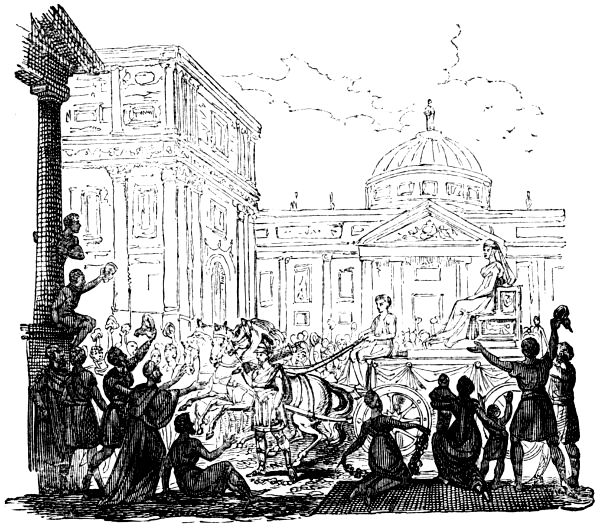
The Empress Octavia’s return from Exile.
The popular triumph was of short duration. Scarcely had Octavia resumed her rank, when Nero, under colour of a false and infamous charge, again banished her. Never exile filled the hearts of the beholders with more affecting compassion. The first day of Octavia’s nuptials was the commencement of her funeral. She was brought under a sad and dismal roof, from whence her father and brother had been carried off by poison. Though a wife, she was treated as a slave, and now she suffered the imputation of a crime more piercing than death itself. Add to this, she was a tender girl in the twentieth year of her age, surrounded by officers and soldiery devoted to her husband’s will, and whom she viewed as sad presages of his ferocious purposes. Almost bereft of life by her fears, and yet unwilling to surrender herself to the rest of the grave, she passed the interval of a few days in unspeakable terror. At length it was announced to her that she must die; but while she implored that at least her life might be spared, and conjured Nero to remember the relationship which before marriage they had borne to each other, by descent from a revered ancestor, she only exemplified the utter inefficacy of crouching to a truculent tyrant. Her appeals were answered by the seizure of her person, and the binding of her limbs; her veins were opened, but her blood, stagnant through fear, issued slowly, and she was stifled in the steam of a boiling bath. “For this execution the senate decreed gifts and oblations to the temples; a circumstance,” says Tacitus, “which I insert with design, that whoever shall, from me or any other writer, learn the events of those calamitous times, he may hold it for granted, that as often as sentences of murder and banishment were pronounced by the prince, so often were thanksgivings by the fathers paid to the deities.” Every decree of the senate was either a new flight of flattery, or the dregs of excessive tameness and servitude.
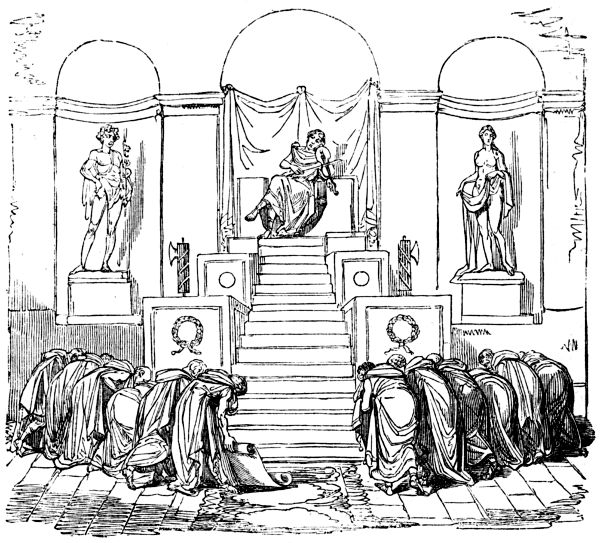
Nero and the Roman Senate.
From this moment Nero butchered without distinction all he pleased, upon any idle pretence, and after an indiscriminate slaughter of men signal in name and quality, he became possessed with a passion to hew down virtue itself. His crimes would be incredible if they were not so enormous that it is scarcely possible imagination could invent atrocities of so foul a nature. He had attained to such indulgence in bloodshed, that the dagger itself was dedicated by him in the capitol, and inscribed to Jupiter Vindex, Jove the Avenger. Yet to this monster one of the consuls elect proposed that a temple should be raised at the charge of the state, and consecrated to the deified Nero as to one who soared above mortality, and was therefore entitled to celestial worship. This, though designed as a compliment to the tyrant, was construed into an omen of his fate, “since to princes,” says Tacitus, “divine honours are never paid till they have finally forsaken all commerce with men,” or, in other words, have ceased to be useful to them. Suetonius relates, that somebody in conversation saying, “When I am dead let fire devour the world”—“Nay,” rejoined Nero, “let it be whilst I am living;” and then he set Rome on fire, in so barefaced a manner, that many of the consular dignitaries detected the incendiaries with torches and tow in their own houses, and dared not touch them because they were officers of Nero’s bedchamber. The fire, during six days and seven nights, consumed a prodigious number of stately buildings, the public temples, and every thing of antiquity that was remarkable and worthy of preservation. The common people were driven by this conflagration to the tombs and monuments for shelter; and Nero himself beheld the flames from a tower on the top of Mæcenas’s house, and sung a ditty on the destruction of Troy, in the dress which he used to perform in on the public stage. This atrocious want of feeling occasioned the saying—“Nero fiddled while Rome was burning.” To divert the hideousness of this crime from himself, he transferred the guilt to the Christians. To their death and torture were added cruel derision and sport; “for,” says Tacitus, “either they were disguised in the skins of savage beasts, and exposed to expire by the teeth of devouring dogs; or they were hoisted up alive and nailed to crosses; or wrapt in combustible vestments, and set up as torches, that when the day set, they might be kindled to illuminate the night.” For this tragical spectacle Nero lent his own gardens, and exhibited at the same time the public diversions of the circus, sometimes driving a chariot in person, and at intervals standing as a spectator amongst the vulgar in the habit of a charioteer; and hence towards the miserable sufferers popular commiseration arose, as for people who were doomed to perish to gratify the bloody spirit of one man. At length, while plotting new and uncommon barbarities, an insurrection broke out amongst the troops, and the senate, who had truckled to his wishes, and made him a tyrant by submitting to be slaves, took heart and issued a decree against him. He committed suicide, under circumstances of such mental imbecility, that his death was as ludicrous as his life was horrible.