MARCH.
Reading edition
—Sturdy March with brows full sternly bent And armed strongly, rode upon a ram, The same which over Hellespontus swam; Yet in his hand a spade he also hent, And in a bag all sorts of weeds ysame, Which on the earth he strewed as he went, And fill’d her womb with fruitfull hope of nourishment.
Spenser.
March is the third month of the year; with the ancients it was the first: according to Mr. Leigh Hunt, from Ovid, the Romans named it from Mars, the god of war, because he was the father of their first prince. “As to the deity’s nature, March has certainly nothing in common with it; for though it affects to be very rough, it is one of the best natured months in the year, drying up the superabundant moisture of winter with its fierce winds, and thus restoring us our paths through the fields, and piping before the flowers like a bacchanal. He sometimes, it must be confessed, as if in a fit of the spleen, hinders the buds which he has dried from blowing; and it is allowable in the less robust part of his friends out of doors, to object to the fancy he has for coming in such a cutting manner from the east. But it may be truly said, that the oftener you meet him firmly, the less he will shake you; and the more smiles you will have from the fair months that follow him.”
Perhaps the ascription of this month to Mars, by the Romans, was a compliment to themselves; they were the sons of War, and might naturally deduce their origin from the belligerent deity. Minerva was also patroness of March.
Verstegan says of our Saxon ancestors, that “the moneth of March they called Lenct-monat, that is, according to our new orthography, Length-moneth, because the dayes did then first begin in length to exceed the nights. And this moneth being by our ancestors so called when they received Christianity, and consequently therewith the ancient christian custome of fasting, they called this chiefe season of fasting the fast of Lenct, because of the Lenct-monat, whereon the most part of the time of this fasting alwayes fell; and hereof it cometh that we now cal it Lent, it being rather the fast of Lent, thogh the former name of Lenct-monat be long since lost, and the name of March borrowed in stead thereof.” Lenct, or Lent, however, means Spring; hence March was the Spring-month. Dr. Sayer says the Saxons likewise called it Rhed-monath, a word derived by some from one of their deities, named Rheda, to whom sacrifices were offered in March; others derive it from ræd, the Saxon word for council, March being the month wherein wars or expeditions were usually undertaken by the Gothic tribes. The Saxons also called it Hlyd-monath, from hlyd, which means stormy, and in this sense March was the Stormy month.
No living writer discourses so agreeably on the “Months” as Mr. Leigh Hunt in his little volume bearing that title. He says of March, that—“The animal creation now exhibit unequivocal signs of activity. The farmer extends the exercise of his plough; and, if fair weather continues, begins sowing barley and oats. Bats and reptiles break up their winter sleep: the little smelts or sparlings run up the softened rivers to spawn: the field-fare and woodcock return to their northern quarters; the rooks are all in motion with building and repairing their nests; hens sit; geese and ducks lay; pheasants crow; the ring-dove coos; young lambs come tottering forth in mild weather; the throstle warbles on the top of some naked tree, as if he triumphed over the last lingering of barrenness; and, lastly, forth issues the bee with his vernal trumpet, to tell us that there is news of sunshine and the flowers.—In addition to the last month’s flowers, we now have the crown-imperial, the dog’s-tooth violet, fritillaries, the hyacinth, narcissus, (bending its face like its namesake,) pilewort, scarlet ranunculus, great snow-drop, tulips, (which turned even the Dutch to enthusiasts,) and violets, proverbial for their odour, which were perhaps the favourite flowers of Shakspeare. The passage at the beginning of ‘Twelfth Night,’ in which he compares their scent with the passing sweetness of music is well-known, and probably suggested the beautiful one in lord ‘Bacon’s Essays,’ about the superiority of flowers in the open air, ‘where the scent comes and goes like the warbling of music.’”
Now, Winter, dispossessed of storms, and weak from boisterous rage,
———— Ling’ring on the verge of Spring, Retires reluctant, and from time to time Looks back, while at his keen and chilling breath Fair Flora sickens.
March 1.
St. David, Archbishop, A. D. 544. St. Swidbert, or Swibert, A. D. 713. St. Albinus, Bishop, A. D. 549. St. Monan, A. D. 874.
ST. DAVID. Patron of Wales.
St. David, or, in Welch, Dewid, was son of Xantus, prince of Cardiganshire, brought up a priest, became an ascetic in the Isle of Wight, afterwards preached to the Britons, founded twelve monasteries, ate only bread and vegetables, and drank milk and water. A synod being called at Brevy, in Cardiganshire, A. D. 519, in order to suppress the heresy of Pelagius, “St. David confuted and silenced the infernal monster by his learning, eloquence, and miracles.” After the synod, St. Dubritius, archbishop of Caerleon, resigned his see to St. David, which see is now called St. David’s. He died in 544. St. Kentigern saw his soul borne by angels to heaven; his body was in the church of St. Andrew. In 962, his relics were translated to Glastonbury.[13]
Butler conceals that St. David’s mother was not married to his father, but Cressy tells the story out, and that his birth was prophecied of thirty years before it happened.
One of the miracles alleged of St. David is, that at the anti-Pelagian synod he restored a child to life, ordered it to spread a napkin under his feet, and made an oration; that a snow white dove descended from heaven and sat on his shoulders; and that the ground whereon he stood rose under him till it became a hill, “on the top of which hill a church was afterwards built, which remains to this day.” He assembled a provincial synod to confirm the decrees of Brevy; and wrote the proceedings of both synods for preservation in his own church, and to be sent to the other churches of the province; but they were lost by age, negligence, and the incursions of pirates, who almost every summer came in long boats from the Orkneys, and wasted the coasts of Cambria. He invited St. Kined to this synod, who answered that he had grown crooked, distorted, and too weak for the journey; whereupon ensued “a double miracle,” for “St. Kined having been restored to health and straightness by the prayers of St. David, by his own prayers he was reduced again to his former infirmity and crookedness.” After this synod he journeyed to the monastery of Glastonbury, which he had built there and consecrated, with intent to repair it, and consecrate it again; whereupon “our Lord appearing to him in his sleep, and forbidding him to profane the sacred ceremony before performed, he, in testimony, with his finger pierced a hole in the bishop’s hand, which remained open to the view of all men till the end of the next day’s mass.” Before his death “the angel of the lord appeared to him, and said to him, Prepare thyself.” Again: “When the hour of his departure was come, our Lord Jesus Christ vouchsafed his presence, to the infinite consolation of our holy father, who at the sight of him exulted.” More to the same purpose is alleged by the catholic writers respecting him. Such as, that at his death “being associated to a troop of angels, he with them mounted up to heaven,” and that the event was known “by an angel divulging it.” This is Cressy’s account.
According to another biographer of St. David, he was uncle to the famous prince Arthur, or, strictly speaking, half uncle, if St. David’s illegitimacy be authentic. The same author relates of him, that on his way from building the church of Glastonbury he went to Bath, cured an infection of the waters, and by his prayers and benediction gave them the perpetual heat they still retain. On the same authority, St. David’s posthumous virtue, in the reign of king Stephen, occasioned the brook above the church-yard of St. David’s church to run wine, by miracle: the well near it, called Pisteldewy or the conduit of David, sent forth milk instead of water. Also a boy, that endeavoured to take pigeons from a nest in St. David’s church at Lhannons, had his fingers miraculously fastened to the stone, till by his friends’ watching, fasting, and praying before the altar three days and nights, the stone fell from his hand. “Manie thousands of other miracles have been wrought by the meritts of this holy man, which for brevities sake we omitt. I only desire all true hearted Welchmen allwaies to honour this their great patrone and protector, and supplicate the divine goodnes to reduce his sometimes beloved countrey out of the blindnes of Protestancie, groveling in which it languisheth. Not only in Wales, but all England over is most famous in memorie of St. David. But in these our unhappie daies the greatest part of his solemnitie consisteth in wearing of a greene leeke, and it is a sufficient theme for a zealous Welchman to ground a quarrell against him, that doeth not honour his capp with the like ornament that day.” So saith Porter.
This legend has been the theme of successive writers, with more or less of variation, and much of addition.
Inscription for a monument in the Vale of Ewias.
Here was it, stranger, that the Patron Saint Of Cambria past his age of penitence, A solitary man; and here he made His hermitage, the roots his food, his drink Of Hodney’s mountain stream. Perchance thy youth Has read, with eager wonder, how the knight Of Wales, in Ormandine’s enchanted bower Slept the long sleep: and if that in thy veins Flow the pure blood of Britain, sure that blood Hath flowed with quicker impulse at the tale Of David’s deeds, when thro’ the press of war His gallant comrades followed his green crest To conquest. Stranger! Hatterill’s mountain heights And this fair vale of Ewias, and the stream Of Hodney, to thine after-thoughts will rise More grateful, thus associate with the name Of David, and the deeds of other days.
Mr. Southey.
St. David’s Day. Wearing the Leek.
Mr. Brady, in the “Clavis Calendaria,” affirms that the custom of wearing the leek on St. David’s day is derived from St. David; who, according to him, caused the Britons under king Cadwallader to distinguish themselves from their enemies during a great battle, wherein they conquered the Saxons by virtue of his prayers and that regulation. Unfortunately he lays no ground for this positive statement, and the same misfortune attends almost every representation in his book, which would really be useful if he had pointed to his sources of information. A work professing to state facts without referring to authorities has no claim to confidence, whoever may be its author.
For any thing in the shape of ancient and authentic statement to the contrary, the institution of wearing the leek on St. David’s day by the saint himself, may rest on a Jeffrey of Monmouth authority, or on legends of no higher estimation with the historian, than “The famous History of the Seven Champions of Christendom,” by Richard Johnson.
Shakspeare, whose genius appropriated every thing that his extraordinary faculty of observation marked for its own, introduces this custom of the Welch wearing leeks upon St. David’s day into his play of King Henry V.
Enter Pistol to King Henry.
Pistol. Qui va là?
K. Henry. A friend.
P. What’s thy name?
K. H. Harry le Roy.
P. Le Roy! a Cornish name: art thou of Cornish crew?
K. H. No, I am a Welchman.
P. Knowest thou Fluellen?
K. H. Yes.
P. Tell him, I’ll knock his leek about his pate Upon St. David’s day.
K. H. Do not you wear your dagger in your cap that day, lest he knock that about yours.
It is again referred to in a dialogue between Henry V. and Fluellen.
Fluellen. Your grandfather of famous memory, an’t please your majesty, and your great-uncle, Edward, the black prince, as I have read in the chronicles, fought a most prave pattle here in France.
K. Henry. They did, Fluellen.
F. Your majesty says very true: if your majesties is remembered of it, the Welchmen did goot service in a garden where leeks did grow, wearing leeks in their Monmouth caps; which, your majesty knows, is an honourable padge of the service: and, I do believe, your majesty takes no scorn to wear the leek upon Saint Tavy’s day.
K. H. I wear it for a memorable honour: for I am a Welch, you know, good countryman.
This allusion by Fluellen to the Welch having worn the leek in a battle under the black prince, is not, perhaps, as some writers suppose, wholly decisive of its having originated in the fields of Cressy or Poictiers; but it shows that when Shakspeare wrote, Welchmen wore leeks. In the same play, the well-remembered Fluellen’s enforcement of Pistol to eat the leek he had ridiculed, further establishes the wearing it as a usage. Fluellen wears his leek in the battle of Agincourt, which it will be recollected takes place in this play, and is there mentioned, as well as in the chronicles, to have been “fought on the day of Crispin Crispianus,” in the month of October. The scene between Fluellen and Pistol takes place the day after this battle.
Enter Fluellen and Gower.
Gower. Why wear you your leek to-day? St. David’s day is past.
Fluellen. There is occasions and causes why and wherefore in all things.—The rascally, scald, peggarly, pragging knave, Pistol, a fellow look you now of no merits, he is come to me with pread and salt yesterday, look you, and pid me eat my leek, it was in a place where I could not preed no contentions with him, but I will be so pold as to wear it in my cap till I see him once again, and then—(Enter Pistol)—Got pless you, ancient Pistol! you scurvy knave, Got pless you!
P. Hence! I am qualmish at the smell of leek.
G. I peseech you heartily scurvy knave, at my desires, and my requests, and my petitions, to eat, look you, this leek.
P. Not for Cadwallader, and all his goats.
F. There is one goat for you. (strikes him.) Will you be so goot, scald knave, as eat it?
P. Base Trojan, thou shalt die.
F. I desire you to live in the mean time, and eat your victuals; come there is sauce for it.—(strikes him.) If you can mock a leek, you can eat a leek.
By beating and taunt, Fluellen forces Pistol to eat the leek, and on its being wholly swallowed, Fluellen exhorts him “when you take occasions to see leeks hereafter, I pray you, mock at them, that is all!” Having thus accomplished his purpose, Fluellen leaves Pistol to digestion, and the consolation of Gower, who calls him “counterfeit cowardly knave: will you mock at an ancient tradition, begun upon an honourable aspect, and worn as a memorable trophy of predeceased valour, and dare not avouch in your deeds any of your words?”
Here we have Gower speaking of the custom of the Welch wearing leeks as “an ancient tradition,” and as “a memorable trophy of predeceased valour.” Thoroughly versed in the history of the few reigns preceding the period wherein he lived, it is not likely that Shakspeare would make a character in the time of Henry V. refer to an occurrence under the black prince, little more than half a century before the battle of Agincourt, as an affair of “ancient tradition.” Its origin may be fairly referred to a very early period.
A contributor to a periodical work[14] rejects the notion, that wearing leeks on St. David’s day originated at the battle between the Welch and the Saxons in the sixth century; and thinks it more probable that leeks were a druidic symbol employed in honour of the British Ceudven or Ceres. In which hypothesis, he thinks, there is nothing strained or far-fetched, presuming that the Druids were a branch of the Phœnician priesthood. Both were addicted to oak worship; and during the funereal rites of Adonis at Byblos, leeks and onions were exhibited in “pots with other vegetables, and called the gardens of that deity.” The leek was worshipped at Ascalon, (whence the modern term of Scallions,) as it was in Egypt. Leeks and onions were also deposited in the sacred chests of the mysteries both of Isis and Ceres, the Ceudven of the Druids; leeks are among the Egyptian hieroglyphics; sometimes a leek is on the head of Osiris; and at other times grasped in an extended hand; and thence, perhaps, the Italian proverb, “Porro che nasce nella mano,” a leek that grows in the hand, for a virtue. Porrus, a leek, is derived by Bryant from the Egyptian god Pi-orus, who is the same as the Beal Peor of the Phœnicians, and the Bel or Bellinis of the Druids. These accordances are worth an ancient Briton’s consideration.
Ridicule of national peculiarities was formerly a pleasantry that the English freely indulged in. They seemed to think that different soil was good ground for a laugh at a person, and that it justified coarse and insolent remarks. In an old satirical tract there is the following sneer at the Welch:
“A WELCHMAN, Is the Oyster that the Pearl is in, for a man may be pickt out of him. He hath the abilities of the mind in potentiâ, and actu nothing but boldnesse. His Clothes are in fashion before his Bodie; and he accounts boldnesse the chiefest vertue. Above all men he loves a Herrald, and speakes pedigrees naturally. He accompts none well descended that call him not Cosen, and prefers Owen Glendower before any of the nine worthies. The first note of his familiaritie is the confession of his valour; and so he prevents quarrels. Hee voucheth Welch a pure, an unconquered language; and courts Ladies with the storie of their Chronicle. To conclude, he is pretious in his own conceit, and upon St. David’s day without comparison.”[15]
Not quite so flouting is a poetical satire called,
The Welchman’s Song in praise of Wales.
I’s come not here to tauke of Prut, From whence the Welse dos take hur root; Nor tell long pedegree of Prince Camber, Whose linage would fill full a chamber; Nor sing the deeds of ould Saint Davie, The Ursip of which would fill a navie, But hark you me now, for a liddell tales Sall make a great deal to the creddit of Wales, For hur will tudge your eares, With the praise of hur thirteen seers; And make you as glad and merry, As fourteen pot of perry.
There are four other stanzas; one of them mentions the leek:
But all this while was never think A word in praise of our Welse drink: Yet for aull that is a cup of bragat Aull England seer may cast his cap at. And what you say to ale of Webley, Toudge him as well, you’ll praise him trebly As well as metheglin, or syder, or meath, Sall sake it your dagger quite out o’ the seath. And oat cake of Guarthenion, With a goodly leek or onion, To give as sweet a rellis As e’er did Harper Ellis.[16]
In “Time’s Telescope,” an annual volume already mentioned for its pleasant varieties and agreeable information, there is a citation of flouting lines from “Poor Robin’s Almanac,” of 1757, under the month of March:
The first of this month some do keep, For honest Taff to wear his leek; Who patron was, they say, of Wales, And since that time, cuts-plutter-a nails, Along the street this day doth strut With hur green leek stuck in hur hat, And if hur meet a shentleman Salutes in Welch; and if hur can Discourse in Welch, then hur shall be Amongst the green-horned Taffy’s free.
The lines that immediately succeed the above, and follow below, are a versified record of public violence to the Welch character, which Englishmen in this day will read with surprise:
But it would make a stranger laugh To see th’ English hang poor Taff; A pair of breeches and a coat, Hat, shoes and stockings, and what not; All stuffed with hay to represent The Cambrian hero thereby meant; With sword sometimes three inches broad, And other armour made of wood, They drag hur to some publick tree, And hang hur up in effigy.
These barbarous practices of more barbarous times have disappeared as knowledge has advanced.
St. David’s day in London is the Anniversary of “the most Honourable and Loyal Society of Ancient Britons,” established in 1714; they celebrate it with festivity in behalf of the Welch charity-school in Grays-inn-road, which was instituted in 1718 for boarding, clothing, and educating 80 boys and 25 girls, born of Welch parents, in or within ten miles of the metropolis, and not having a parochial settlement within those limits. This institution has the king for patron as prince of Wales, and is supported by voluntary contributions. The “Ancient Britons,” according to annual custom, go in procession to the royal residence on St. David’s day, and receive the royal bounty. The society are in carriages, and each wears an artificial representation of the leek in his hat, composed of ribbands and silver foil. They have been sometimes accompanied by horsemen decorated in the same way, and are usually preceded by marshals, also on horseback, wearing leeks of larger dimension in their hats, and ornamented with silk scarfs. In this state they proceed from the school-house to some adjacent church, and hear a discourse delivered on the occasion, by a prelate or other dignified clergyman. The day is concluded by an elegant dinner under the regulation of stewards, when a collection is made for the institution, and a handsome sum is generally contributed.
FLORAL DIRECTORY.
Leek. Allium Porrum. Dedicated to St. David.
March 2.
St. Ceada, or Chad. Martyrs under the Lombards, 6th Cent. St. Simplicius, Pope A. D. 483. St. Marnan, A. D. 620. St. Charles the Good, Earl of Flanders, A. D. 1124. St. Joavan, or Joevin.
St. Chad, A. D. 673.
His name is in the calendar of the church of England. He was founder of the see, and bishop of Lichfield. According to Bede, joyful melody as of persons sweetly singing descended from heaven into his oratory for half an hour, and then mounted again to heaven. This was to presage his death, and accordingly he died, attended by his brother’s soul and musical angels.
St. Chad’s Well
Is near Battle-bridge. The miraculous water is aperient, and was some years ago quaffed by the bilious and other invalids, who flocked thither in crowds, to drink at the cost of sixpence, what people of these latter days by “the ingenious chemists’ art,” can make as effectual as St. Chad’s virtues “at the small price of one halfpenny.”
If any one desire to visit this spot of ancient renown, let him descend from Holborn-bars to the very bottom of Grays-inn-lane. On the left-hand side formerly stood a considerable hill, whereon were wont to climb and browze certain mountain goats of the metropolis, in common language called swine; the hill was the largest heap of cinder-dust in the neighbourhood of London. It was formed by the annual accumulation of some thousands of cart loads, since exported to Russia for making bricks to rebuild Moscow, after the conflagration of that capital on the entrance of Napoleon. Opposite to this unsightly site, and on the right-hand side of the road is an angle-wise faded inscription:
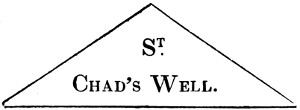
It stands, or rather dejects, over an elderly pair of wooden gates, one whereof opens on a scene which the unaccustomed eye may take for the pleasure-ground of Giant Despair. Trees stand as if made not to vegetate, clipped hedges seem willing to decline, and nameless weeds straggle weakly upon unlimited borders. If you look upwards you perceive painted on an octagon board “Health Restored and Preserved.” Further on towards the left, stands a low, old-fashioned, comfortable-looking, large windowed dwelling; and ten to one, but there also stands, at the open door, an ancient ailing female, in a black bonnet, a clean coloured cotton gown, and a check apron; her silver hair only in part tucked beneath the narrow border of a frilled cap, with a sedate and patient, yet, somewhat inquiring look. This is “the Lady of the Well.” She gratuitously informs you, that “the gardens” of “St. Chad’s well” are “for circulation” by paying for the water, of which you may drink as much, or as little, or nothing, as you please, at one guinea per year, 9s. 6d. quarterly, 4s. 6d. monthly, or 1s. 6d. weekly. You qualify for a single visit by paying sixpence, and a large glass tumbler full of warm water is handed to you. As a stranger, you are told, that “St. Chad’s well was famous at one time.” Should you be inquisitive, the dame will instruct you, with an earnest eye, that “people are not what they were,” “things are not as they used to be,” and she “can’t tell what’ll happen next.” Oracles have not ceased. While drinking St. Chad’s water you observe an immense copper into which it is poured, wherein it is heated to due efficacy, and from whence it is drawn by a cock, into the glasses. You also remark, hanging on the wall, a “tribute of gratitude” versified, and inscribed on vellum, beneath a pane of glass stained by the hand of time and let into a black frame: this is an effusion for value received from St. Chad’s invaluable water. But, above all, there is a full-sized portrait in oil, of a stout, comely personage, with a ruddy countenance, in a coat or cloak, supposed scarlet, a laced cravat falling down the breast, and a small red night cap carelessly placed on the head, conveying the idea that it was painted for the likeness of some opulent butcher who flourished in the reign of queen Anne. Ask the dame about it, and she refers you to “Rhone.” This is a tall old man, who would be taller if he were not bent by years. “I am ninety-four,” he will tell you, “this present year of our Lord, one thousand eight hundred and twenty-five.” All that he has to communicate concerning the portrait is, “I have heard say it is the portrait of St. Chad.” Should you venture to differ, he adds, “this is the opinion of most people who come here.” You may gather that it is his own undoubted belief. On pacing the garden alleys, and peeping at the places of retirement, you imagine the whole may have been improved and beautified for the last time by some countryman of William III., who came over and died in the same year with that king, and whose works here, in wood and box, have been following him piecemeal ever since.
St. Chad’s well is scarcely known in the neighbourhood, save by its sign-board of invitation and forbidding externals. An old American loyalist, who has lived in Pentonville ever since “the rebellion” forced him to the mother country, enters to “totter not unseen” between the stunted hedgerows; it was the first “place of pleasure” he came to after his arrival, and he goes no where besides,—“every thing else is so altered.” For the same reason, a tall, spare, thin-faced man, with dull grey eyes and underhung chin, from the neighbourhood of Bethnal-green, walks hither for his “Sunday morning’s exercise,” to untruss a theological point with a law clerk, who also attends the place because his father, “when he was ’prentice to Mr. —— the great law stationer in Chancery-lane in 1776, and sat writing for sixteen hours a day, received great benefit from the waters, which he came to drink fasting, once a week.” Such persons from local attachment, and a few male and female atrabilarians, who without a powerful motive would never breathe the pure morning air, resort to this spot for their health. St. Chad’s well is haunted, not frequented. A few years and it will be with its water as with the water of St. Pancras’ well, which is enclosed in the garden of a private house, near old St. Pancras’ churchyard.
Holy Wells.
The holy wells of London have all declined in reputation, even to St. Bride’s well, whose fame gave the name of Bridewell to an adjoining hospital and prison, and at last, attached the name to every house of correction throughout the kingdom. The last public use of the water of St. Bride’s well drained it so much, that the inhabitants of St. Bride’s parish could not get their usual supply. This exhaustion was effected by a sudden demand. Several men were engaged in filling thousands of bottles, a day or two before the 19th of July 1821, on which day his majesty, king George IV. was crowned at Westminster; and Mr. Walker of the hotel, No. 10, Bridge-street, Blackfriars, purveyor of water to the coronation, obtained it, by the only means through which the sainted fluid is now attainable, from the cast-iron pump over St. Bride’s well, in Bride-lane.
FLORAL DIRECTORY.
Dwarf Cerastium. Cerastium pumilum. Dedicated to St. Chad.
March 3.
St. Cunegundes, Empress, A. D. 1040. Sts. Marinus and Asterius, or Astyrius. St. Emeterius, or Madir, and St. Chelidonius. St. Winwaloe, Abbot, A. D. 529. St. Lamalisse, 7th Cent.
Sts. Emeterius and Chelidonius.
Two Spanish saints, famous against hailstorms. When hailstorms come on, the clergy proceed thus:
1. They make a procession to the church.
2. They put lighted candles on the altar.
3. They sing a hymn to these saints.
4. They chaunt the antiphona.
5. They sing the praises of these saints.
By the time this chain is linked, the storm finishes.
Chronology.
On the 3d of March, 1792, died Robert Adam, Esq. He was born at Kirkaldy, in Fifeshire, in 1728, educated at the university of Edinburgh, devoted himself to architecture, went to Italy to study its ancient remains, became proficient in his profession, and rose to its highest honours: he was appointed architect to their majesties, and chosen fellow of the Royal and Antiquarian Societies of London and Edinburgh. In conjunction with his brother, Mr. James Adam, who died 20th November 1794, he built some of the finest of our modern mansions. His genius and acquirements adorned London with several structures, eminently superior in beauty to those which arose around him under the direction of other hands; but the work for which the Adams are chiefly celebrated, is the elegant range of buildings called the Adelphi. This Greek word, denoting the relationship of brothers, was conferred in compliment to the brothers, by whose intellect and science, in opposition to long vitiated taste, and difficulties deemed impracticable, these edifices were elevated. It is related that soon after their completion, a classically educated gentleman being present at a public dinner, and intending to toast the Messrs. Adams, who were also present, begged to give “the Adelphi;” and that this occasioned a worthy citizen to exclaim, “Bless me! it’s a very odd toast; what drink the health of a parcel of houses! However, oh, oh! ah, ah! I see! yes, yes! oh, the witty rogue! What, the street’s in a healthy spot? so it is; very healthy! Come I’ll drink its health with all my heart!—Here’s the Adelphi Terrace! I’ll stand up to it, (rising) and I hope it will never go down!”
Garrick resided in one of the houses of the Adelphi until his death, and was a friend of the Adams, who indeed were intimate with most of the eminent men in art and literature. Before the Adelphi was finished, the late Mr. Thomas Becket, the bookseller, desired the corner house of Adam-street, then building as a spacious avenue by the Adams to their terrace and the adjacent thoroughfares. Garrick anxious to secure the commanding corner for his friend Becket, wrote a warm-hearted letter in his behalf to Messrs. Adam. The letter has never been published, and being in the possession of the editor of the Every-Day Book, he inserts a copy of it, with a correct fac-simile of the commencement and conclusion. This hasty unstudied note, warm from the feelings, is testimony of Garrick’s zeal for a friend’s success, and of his qualifications as a solicitor to promote it: there is in it
—— a grace beyond the reach of art.
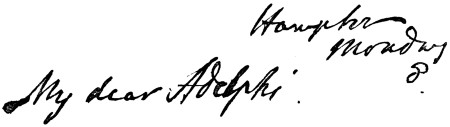
I forgot to speak to you last Saturday about our friend Becket.—We shall all break our hearts if he is not bookseller to ye Adelphi, & has not ye corner house that is to be built.—Pray, my dear & very good friends, think a little of this matter, & if you can make us happy, by suiting all our conveniences—we shall make his shop, as old Jacob Tonson’s was formerly, ye rendevouz for ye first people in England.—I have a little selfishness in this request—I never go to coffee-houses, seldom to taverns, & should constantly (if this scheme takes place) be at Becket’s at one at noon, & 6 at night; as ye monkey us’d to be punctual in Piccadilly.
When you left me on Saturday, whether I had exerted my spirits too much, or gave too great a loose to my love of drinking with those I like, I know not; but I was attack’d terribly with a fit of ye stone, & had it all yesterday morning, till I was relieved from torture, to ye great joy of my wife & family.—I was 4 hours upon ye rack, & now as free from pain as ever I was. I am weak wh my disorder; but I could eat turtle, & laugh with you again to day, as if nothing had ail’d me—’tis a curs’d disorder, & that you may never have that curse make yr peace wth heav’n by an act of righteousness, & bestow that corner blessing (I have mention’d) upon Becket & his family—this is ye pray’r & petition
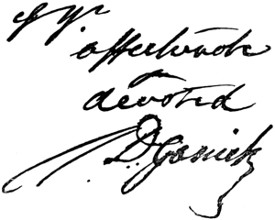
Mr. Becket had the “corner blessing” conferred upon him.—He removed into the house from another part of the Strand, and remained tenant to the “Adelphi,” until he retired into Pall Mall.
FLORAL DIRECTORY.
Golden Fig Marygold. Mesembrianthemum aureum. Dedicated to St. Cunegundes.
March 4.
St. Casimir. St. Lucius, Pope, A. D. 253. St. Adrian, Bishop, A. D. 874.
St. Casimir,
Was born a prince on the 5th of October, 1458, and died 4th March, 1482. He was second son of Casimir III. king of Poland; and, according to Ribadeneira, he wore under his princely attire a prickly hair shirt, fasted rigorously, prayed at night till he fell weary and exhausted on the bare floor; often in the most sharp and bitter weather went barefoot to church at midnight, and lay on his face before the door; studied to advance the catholic religion, and to extinguish or drive heresy out of Poland; persuaded his father to enact a law that no new church should be built for heretics, nor any old ones repaired; in a particular virtue “surpassed the angels;” committed suicide; resigned his soul amidst choirs of priests; had it carried to heaven surrounded with a clear bright light by angels; and thirty-six years after his death he appeared in glittering armour and gallantly mounted; led the Polish army through an impassable river, and conquered the Muscovites; and the next year marched before his beloved Poles in the air against the enemy, and as “he beat them before, so he beat them again.”
Chronology.
On the 4th of March, 1583, died Bernard Gilpin. He was born at Kentmire, in Westmoreland, 1517, sent to Queen’s college, Oxford, in 1553, read the writings of Erasmus, excelled in logic and philosophy, and studied Greek and Hebrew; being a Catholic he held a public disputation against John Hooper, the Protestant, who was martyred at the stake under Henry VIII. Appointed to hold a disputation against Peter Martyr, another eminent reformer, who read the divinity lecture in Oxford, he diligently studied the scriptures and the writings of the early fathers, and “was not sorry to be overcome by the truth.” Cuthbert Tunstall, bishop of Durham, gave him a living, which he shortly afterwards resigned, because he desired to travel, and could not hold it while absent with peace of conscience. “But,” saith the bishop, “thou mayst hold it with a dispensation, and thou shalt be dispensed withal.” To this Gilpin answered, that when he should be called on for an account of his stewardship, he feared it would not serve his turn to answer, that he had been “dispensed withal.” Whereupon the bishop admired, and “Father’s soul!” said he, “Gilpin will die a beggar.” He afterwards went to Lovaine and Paris, from whence he returned to England in the days of queen Mary; and bishop Tunstall gave him the rectory of Essingdon, by which he became archdeacon of Durham, and preached on scriptural authority against the vices in the church. Those who hated his integrity and feared his talents, sought his blood by insnaring controversy. He avoided vain jangling, and beat his adversaries in solid argument. At one of these disputations, carried on in an undertone with bishop Tunstall’s chaplains, and close behind the bishop, who was sitting before the fire, the bishop, leaning his chair somewhat backwards, hearkened to what was said; and when they had done, turning to his chaplains, “Father’s soul!” said the bishop, “let him alone, for he hath more learning than you all.” He was twice accused of heresy to Tunstall, who abhorred to shed blood; but information being given against him to Bonner, bishop of London, an order was issued for his apprehension. Gilpin had intelligence of the danger, yet he only provided against it by ordering William Airy, his house steward, to provide a long garment, that he might go the more comely to the stake. The sudden death of Mary cleared off the impending storm. Not long afterwards, bishop Tunstall presented Gilpin to the rectory of Houghton, a large parish with fourteen villages, which he laboriously served. He built a grammar school, from whence he sent students almost daily to the university, and maintained them there at his own cost. Honoured by the wise, and respected by the noble, the earl of Bedford solicited from queen Elizabeth the vacant bishopric of Carlisle for Gilpin. A congé d’élire was accordingly issued, but Gilpin resisted the dignity against all entreaties. “If I had been chosen to a bishopric elsewhere,” he said, “I would not have refused it; but in Carlisle I have many friends and kindred, at whom I must connive in many things, not without hurt to myself, or else deny them many things, not without hurt to them, which difficulties I have avoided by the refusal of that bishopric.” He was chosen provost of his own (Queen’s) college in Oxford, but this advancement he also declined. Yet he did the office and work of a bishop, by preaching, taking care of the poor, providing for the necessities of other churches, erecting schools, encouraging learned men, and keeping open house to all that needed. Cecil, lord Burleigh, the queen’s secretary, having visited Gilpin at Houghton, on his return towards Durham, when he came to Rainton-hill, reflected his eye upon the open country he had passed, and looking earnestly upon Gilpin’s house, said, “I do not blame this man for refusing a bishopric. What doth he want that a bishopric could more enrich him withal? besides that he is free from the great weight of cares.” Gilpin annually visited the people of Ridsdale and Tindale, and was “little else than adored by that half barbarous and rustic people.” When at Rothbury, in these parts, “there was a pestilent faction among some of them who were wont to resort to the church; the men being bloodily minded, practised a bloody manner of revenge, termed by them a deadly feud:” if one faction came to the church the other kept away, inasmuch as they could not meet without bloodshed. It so happened that when Gilpin was in the pulpit both parties came to the church; one party stood in the chancel, the other in the body of the church. Each body was armed with swords and javelins, and their weapons making a clashing sound, Gilpin, unaccustomed to such a spectacle, was somewhat moved, yet he proceeded with his sermon. A second time the weapons clashed; the one side drew near to the other; and they were about to commence battle in the church. Gilpin descended, stepped to the leaders on each side, appeased the tumult, and laboured to establish peace between them; but he could only obtain from these rude borderers, that they would not break the peace while Mr. Gilpin remained. On this he once more ascended the pulpit, and spent the allotted time in inveighing against this unchristian and savage custom, and exhorting them to forego it for ever. Another incident, further illustrating the manners of the people, will be mentioned below; it may be added here, however, that afterwards, when he revisited these parts, any one who dreaded a deadly foe, found himself safer in Gilpin’s presence than with armed guards. In his younger years, while on a ride to Oxford, Gilpin overtook a youth who was one while walking, and at another time running. He found that the lad came from Wales, knew Latin, had a smattering of Greek, and was bound for Oxford, with intent to be a scholar. “Wilt thou,” said Gilpin, “be contented to go with me? I will provide for thee.” The youth assented, Gilpin took him first to Oxford, afterwards to Houghton, where he improved him exceedingly in Greek and Hebrew, and sent him at last to Oxford. This youth was the learned Hugh Broughton; he is said to have requited this protection and care by something worse than inconstancy. Gilpin’s nature was kind and charitable, he visited sick chambers and prisons, and dispensed large bounties. He was firm in rectitude; and hence, on one occasion, when bishop Tunstall had inclined to his enemies, and insisted on Gilpin’s preaching, sorely against the good man’s petitions to be excused, and repeated refusals, he at length mounted the pulpit, and concluded his discourse by denouncing the enormities in the bishop’s diocese; looking at Tunstall, he said “Lest your lordship should make answer, that you had no notice of these things given you, behold, I bring them to your knowledge. Let not your lordship say these crimes have been committed by the faults of others, without your knowledge; for whatsoever either yourself shall do in person, or suffer through your connivance to be done by others, is wholly your own. Therefore,” thundered forth the faithful preacher, “in presence of God, his angels and man, I pronounce your fatherhood to be the author of all these evils; yea, and, in that strict day of the general account, I shall be a witness to testify against you, that all these things have come to your knowledge by my means: and all these men shall bear witness thereof, who have heard me speaking unto you this day.” Gilpin’s adherents, terrified at this unexpected and bold address, apprehended the worst consequences from the bishop’s power. “You have,” said they, “put a sword into his hand to slay you. If heretofore he hath been offended with you without a cause, what may you now expect from him who, being provoked, shall make use of his own power to injure you by right or wrong.” Gilpin answered, “Be not afraid; the Lord God over-ruleth us all; so that the truth may be propagated, and God glorified, God’s will be done concerning me.” After dinner, Gilpin waited on the bishop to take leave of him, and return home. “It shall not be so,” said the bishop, “for I will bring you to your house.” When they arrived at Mr. Gilpin’s house, and had entered the parlour, the bishop on a sudden caught Mr. Gilpin by the hand, and addressed him in these words:—“Father Gilpin, I acknowledge you are fitter to be bishop of Durham, than myself to be parson of this church of yours; I ask forgiveness for errors past; forgive me, father. I know you have hatched up some chickens that now seek to pick out your eyes; but so long as I shall live bishop of Durham, be secure: no man shall injure you.” Thus the fearless integrity of Gilpin, by which it was conceived he had jeopardized his life, saved him from his enemies and advanced him beyond the reach of their further hate.
After a life excellent for kindness, charity, and faithful dealing towards the people intrusted to his care, he died at the age of sixty-six worn out by labour in well doing.
FLORAL DIRECTORY.
Chickweed. Alsine media. Dedicated to St. Casimir.
March 5.
Sts. Adrian and Eubulus, A. D. 309. St. Kiaran, or Kenerin. St. Roger, A. D. 1236.
St. Piran.
This saint, anciently of good repute in Cornwall, is not mentioned by Butler. According to Porter he was born in Ireland, and became a hermit there. He afterwards came to England, and settling at Cornwall, had a grave made for him, entered into it, and dying on the 6th of March, “in the glorie of a great light and splendour that appeared at the same instant,” was buried at Padstow. “He is reported,” says Porter, “to have wrought manie wonderfull miracles in his lifetime, which bicause they tend rather to breed an incredulous amazement in the readers, then move to anie workes of vertues or pietie, we have willingly omitted.” We have had a specimen of such miracles as father Porter deemed worthy of belief; those of St. Piran which would have caused “incredulous amazement” in Porter’s readers must have been “passing wonderfull.”
St. Piran’s day is said to be a favourite with the tinners; having a tradition that some secrets regarding the manufacture of tin was communicated to their ancestors by that saint, they leave the manufacture to shift for itself for that day and keep it as a holiday.
FLORAL DIRECTORY.
Green Hellebore. Helleborus viridis. Dedicated to St. Adrian.
March 6.
St. Chrodegang, Bishop, A. D. 766. B. Colette. St. Fridolin, A. D. 538. St. Baldrede. Sts. Kyneburge, Kyneswid, and Tibba. St. Cadroe, A. D. 975.
St. Baldrede,
Bishop of Glasgow, died in London A. D. 608, and his relics were famous in many churches in Scotland. Bollandus says, “he was wonderfully buried in three places; seeing that three towns Aldham, Tinningham, and Preston, contended for his body.” In those days when there were no parish registers, these miraculous powers of self-multiplication after death, must have been sadly perplexing to topographers and antiquaries.
Spring.
Spring.
The “New-come” of the year is born to-day, With a strong lusty laugh, and joyous shout, Uprising, with its mother, it, in play, Throws flowers on her; pulls hard buds about, To open them for blossom; and its voice, Peeling o’er dells, plains, uplands, and high groves, Startles all living things, till they rejoice In re-creation of themselves; each loves, And blesses each; and man’s intelligence, In musings grateful, thanks All Wise Beneficence.
Spring commences on the 6th of March, and lasts ninety-three days.
According to Mr. Howard, whose practical information concerning the seasons is highly valuable, the medium temperature during spring is elevated, in round numbers, from 40 to 58 degrees. “The mean of the season is 48.94°—the sun effecting by his approach an advance of 11.18° upon the mean temperature of the winter. This increase is retarded in the forepart of the spring by the winds from north to east, then prevalent; and which form two-thirds of the complement of the season; but proportionately accelerated afterwards by the southerly winds, with which it terminates. A strong evaporation, in the first instance followed by showers, often with thunder and hail in the latter, characterises this period. The temperature commonly rises, not by a steady increase from day to day, but by sudden starts, from the breaking in of sunshine upon previous cold, cloudy weather. At such times, the vapour appears to be now and then thrown up, in too great plenty, into the cold region above; where being suddenly decomposed, the temperature falls back for awhile, amidst wind, showers, and hail, attended, in some instances, with frost at night.”
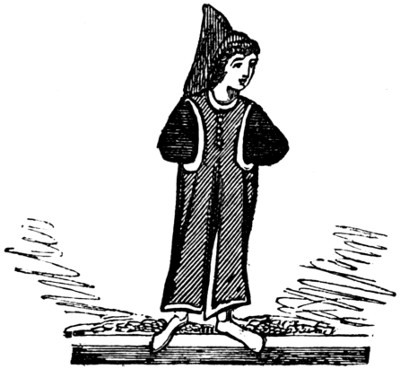
Our ancestors varied their clothing according to the season. Strutt has given the spring dress of a man in the fourteenth century, from an illumination in a manuscript of that age: this is a copy of it.
In “Sylvan Sketches,” a new and charming volume by the lady who wrote the “Flora Domestica,” it is delightfully observed, that, “the young and joyous spirit of spring sheds its sweet influence upon every thing: the streams sparkle and ripple in the noon-day sun, and the birds carol tipseyly their merriest ditties. It is surely the loveliest season of the year.” One of our living minstrels sings of a spring day, that it
Looks beautiful, as when an infant wakes From its soft slumbers;
and the same bard poetically reminds us with more than poetical truth, that at this season, when we
See life and bliss around us flowing, Wherever space or being is, The cup of joy is full and flowing.
Bowring.
Another, whose numbers are choralled by worshipping crowds, observes with equal truth, and under the influence of high feelings, for seasonable abundance, that
To enjoy is to obey.
Watts.
Grateful and salutary spring the plants Which crown our numerous gardens, and Invite to health and temperance, in the simple meal, Unpoisoned with rich sauces, to provoke Th’ unwilling appetite to gluttony. For this, the bulbous esculents their roots With sweetness fill; for this, with cooling juice The green herb spreads its leaves; and opening buds, And flowers and seeds, with various flavours.
Dodsley.
Sweet is thy coming, Spring!—and as I pass Thy hedge-rows, where from the half-naked spray Peeps the sweet bud, and ’midst the dewy grass The tufted primrose opens to the day: My spirits light and pure confess thy pow’r Of balmiest influence: there is not a tree That whispers to the warm noon-breeze; nor flow’r Whose bell the dew-drop holds, but yields to me Predestinings of joy: O, heavenly sweet Illusion!—that the sadly pensive breast Can for a moment from itself retreat To outward pleasantness, and be at rest: While sun, and fields, and air, the sense have wrought Of pleasure and content, in spite of thought!
Athenæum.
In spring the ancient Romans celebrated the Ludi Florales. These were annual games in honour to Flora, accompanied by supplications for beneficent influences on the grass, trees, flowers, and other products of the earth, during the year. The Greeks likewise invoked fertility on the coming of spring with many ceremonies. The remains of the Roman festivals, in countries which the Roman arms subdued, have been frequently noticed already; and it is not purposed to advert to them further, than by observing that there is considerable difficulty in so apportioning every usage in a modern ceremony, as to assign each to its proper origin. Some may have been common to a people before they were conquered; others may have been the growth of later times. Spring, as the commencement of the natural year, must have been hailed by all nations with satisfaction; and was, undoubtedly, commemorated, in most, by public rejoicing and popular sports.
Chronology.
Dr. Samuel Parr died on the 6th of March, 1825.
A SPRING FESTIVAL.
The Germans retain many of the annual customs peculiar to themselves before the Roman conquest. Whether a ceremony described in the “Athenæum,” as having been observed in Germany of late years, is derived from the victors, or from the ancient nations, is not worth discussing.
The approach of spring was there commemorated with an abundance of display, its allegorical character was its most remarkable feature. It was called Der Sommers-gewinn, the acquisition of summer; and about thirty years ago was celebrated at the beginning of spring by the inhabitants of Eisenach, in Saxony, who, for that purpose, divided themselves into two parties. One party carried winter under the shape of a man covered with straw, out of the town, and then, as it were, sent him into public exile; whilst the other party, at a distance from the town, decked spring, or, as it was vulgarly called, summer, in the form of youth, with boughs of cypress and May, and marched in solemn array to meet their comrades, the jocund executioners of winter. In the meanwhile national ballads, celebrating the delights of spring and summer, filled the skies; processions paraded the meadows and fields, loudly imploring the blessings of a prolific summer; and the jovial merry-makers then brought the victor-god home in triumph. In the course of time, however, this ceremonial underwent various alterations. The parts, before personified, were now performed by real dramatis personæ; one arrayed as spring, and another as winter, entertained the spectators with a combat, wherein winter was ultimately vanquished and stripped of his emblematical attire; spring, on the contrary, being hailed as victor, was led in triumph, amidst the loud acclamations of the multitude, into the town. From this festival originated a popular ballad, composed of stanzas each of which conclude thus:
Heigho! heigho! heigho! Summer is at hand! Winter has lost the game, Summer maintain’d its fame; Heigho! heigho! heigho! Summer is at hand!
The day whereon the jubilee takes place is denominated der Todten sonntag, the dead Sunday. The reason may be traced perhaps to the analogy which winter bears to the sleep of death, when the vital powers of nature are suspended. The conjecture is strengthened by this distich in the ballad before quoted:
Now we’ve vanquish’d Death, And Summer’s return ensured: Were Death still unsubdued, How much had we endured!
But of late years the spirit of this festival has disappeared. Lately, winter was uncouthly shaped of wood, and being covered with straw, was nailed against a large wheel, and the straw being set on fire, the apparatus was rolled down a steep hill! Agreeably to the intention of its inventors, the blazing wheel was by degrees knocked to pieces, against the precipices below, and then—winter’s effigy, to the admiration of the multitude, split into a thousand fiery fragments. This custom too, merely from the danger attending it, quickly fell into disuse; but still a shadow of the original festivity, which it was meant to commemorate, is preserved amongst the people of Eisenach. “Although” says the writer of these particulars, “we find winter no longer sent into banishment, as in former times, yet an attempt is made to represent and conciliate spring by offerings of nosegays and sprays of evergreen, adorned with birds or eggs, emblematical of the season.” Probably the latter usages may not have been consequent upon the decline of the former, but were coeval in their origin, and are the only remains of ancient customs peculiar to the season.
FLORAL DIRECTORY.
Lent Lily. Narcissus Pseudonarcissus multiplex. Dedicated to St. Colette.
March 7.
St. Thomas Aquinas, A. D. 1274. Sts. Perpetua and Felicitas, A. D. 203. St. Paul, Anchoret.
St. Perpetua.
This saint is in the church of England calendar. She was martyred under the emperor Severus in 205.
St. Paul the Anchoret.
This saint was “a man of profound ignorance.” Butler says he was named “the simple.” He journeyed eight days into the desert on a visit, and to become a disciple of St. Antony, who told him he was too old, and bade him return home, mind his business, and say his prayers; he shut the door upon him. Paul fasted and prayed before the door till Antony opened it, and out of compassion made a monk of him. One day after he had diligently worked at making mats and hurdles, and prayed without intermission, St. Antony bid him undo his work and do it all over again, which he did, without asking for a morsel of bread though he had been seven days without eating; this was to try Paul’s obedience. Another day when some monks came to Antony for advice, he bid Paul spill a vessel of honey and gather it up without any dust: this was another trial of his obedience. At other times he ordered him to draw water a whole day and pour it out again; to make baskets and pull them to pieces; to sew and unsew garments and the like: these were other trials of his obedience. When Antony had thus exercised him he placed him in a cell three miles from his own, proposed him as a model of obedience to his disciples, sent sick persons to him, and others possessed with the devil, whom he could not cure himself, and “under Paul,” Butler says, “they never failed of a cure.” He died about 330.
FLORAL DIRECTORY.
Early Daffodil. Narcissus Pseudonarcissus simplex. Dedicated to St. Perpetua.
March 8.
St. John of God, A. D. 1550. St. Felix, A. D. 646. Sts. Apollonius, Philemon, &c. A. D. 311. St. Julian, Abp. of Toledo, A. D. 690. St. Duthak, Bp. of Ross, A. D. 1253. St. Rosa, of Viterbo, A. D. 1261. St. Senan, 5th Cent. St. Psalmod, or Saumay, about 589.
Romish saints are like earthquakes, wherein shocks crowd so fast they cannot be noted.
An Earthquake in London.
On the 8th of March, 1750, an earthquake shook all London. The shock was at half past five in the morning. It awoke people from their sleep and frightened them out of their houses. A servant maid in Charterhouse-square, was thrown from her bed, and had her arm broken; bells in several steeples were struck by the chime hammers; great stones were thrown from the new spire of Westminster Abbey; dogs howled in uncommon tones; and fish jumped half a yard above the water.
London had experienced a shock only a month before, namely, on the 8th of February 1750, between 12 and 1 o’clock in the day. At Westminster, the barristers were so alarmed that they imagined the hall was falling.
FLORAL DIRECTORY.
Everblowing Rose. Rosa Semperflorens. Dedicated to St. Rosa of Viterbo. Great Jonquil. Narcissus lætus. Dedicated to St. Felix.
March 9.
St. Frances, Widow, A. D. 1440. St. Gregory, of Nyssa, Bp. 4th Cent. St. Pacian, Bp. A. D. 373. St. Catherine, of Bologna, A. D. 1463.
MISTS AND FALLS.
Scots’ mists, like Scots’ men, are proverbial for their penetration; Plymouth showers for their persevering frequency. The father of Mr. Haydon, the artist, relates that in the latter portion of 1807, and the first three or four months of 1808, there had been more than 160 successive days in which rain, in more or less quantities, had fallen in that neighbourhood. He adds, indeed, by way of consolation, that in winter it only rained there, while it snowed elsewhere. It has been remarked that in this opinion he might be correct; at least if he compared the climate of Plymouth with that of the western highlands. A party of English tourists are said to have stopped for several days at an uncomfortable inn, near Inverary, by the unremitting rains that fall in that country about Lammas, when one of them pettishly asked the waiter, “Does it rain here ALWAYS?” “Na! na!” replied Donald, “it snaws whiles,” i. e. sometimes.
FLORAL DIRECTORY.
Petticoat Daffodil. Narcissus Bulbocodium. Dedicated to St. Catherine.
March 10.
Forty Martyrs of St. Sebasti, A. D. 320. St. Droctovæus, Abbot, A. D. 580. St. Mackessoge.
The 10th of March, 1702, is erroneously said to have been the day whereon died sir Hugh Myddleton; a man renowned in English annals for having abundantly supplied London with water, by conducting the New River from Ware, in Hertfordshire, to the Clerkenwell suburb of the metropolis.
The first View of the New River—from London.
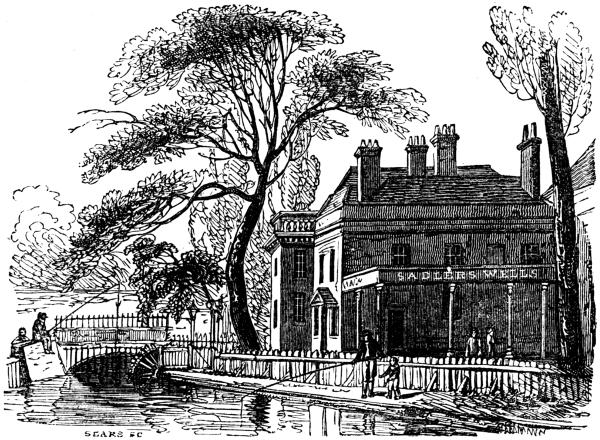
The first View of the New River—from London.
This is seen immediately on coming within view of Sadler’s Wells, a place of dramatic entertainment. After manifold windings and tunnellings from its source, the New River passes beneath the arch in the engraving, and forms a basin within a large walled enclosure, from whence diverging main pipes convey the water to all parts of London. At the back of the boy angling on the wall, is a public-house with tea-gardens and a skittle-ground, “commonly called, or known by the name or sign of, the sir Hugh Myddleton, or of the sir Hugh Myddleton’s head,” a portrait of sir Hugh hangs in front of the house. To this stream, as the water nearest London favourable to sport, anglers of inferior note repair:—
Here “gentle anglers,” and their rods withal, Essaying, do the finny tribe inthrall. Here boys their penny lines and bloodworms throw, And scare, and catch, the “silly fish” below: Backstickles bite, and biting, up they come, And now a minnow, now a miller’s thumb. Here too, experienced youths of better taste And higher aim resort, who bait with paste, Or push beneath a gentle’s shining skin The barbed hook, and bury it within; The more he writhes the better, if he die Not one will touch him of the finny fry; If in strong agony the sufferer live, Then doth the “gentle angler” joy receive, Down bobs the float, the angler wins the prize, And now the gentle, now the gudgeon dies.
Concerning Sir Hugh Myddleton there will be occasion to speak again.
GLOVE OF DEFIANCE In the Church.
In the notice of Bernard Gilpin, March 4, (p. 332,) it is said, “another incident further illustrating the manners of the Northern Borderers will be mentioned below.” The observation refers to a singular challenge, which the arrangements of that day could not include, and is now inserted.
On a certain Sunday Mr. Gilpin going to preach in those parts wherein deadly feuds prevailed, observed a glove hanging up on high in the church. He demanded of the sexton what it meant, and why it hung there. The sexton answered, that it was a glove which one of the parish hung up there as a challenge to his enemy, signifying thereby, that he was ready to enter combat hand to hand, with him or any one else who should dare to take the glove down. Mr. Gilpin requested the sexton to take it down. “Not I, sir,” replied the sexton, “I dare do no such thing.” Then Mr. Gilpin, calling for a long staff, took down the glove himself, and put it in his bosom. By and by, when the people came to church, and Mr. Gilpin in due time went up into the pulpit, he in his sermon reproved the barbarous custom of challenges, and especially the custom which they had, of making challenges by the hanging up of a glove. “I hear,” said he, “that there is one amongst you, who, even in this sacred place, hath hanged up a glove to this purpose, and threateneth to enter into combat with whosoever shall take it down. Behold, I have taken it down myself.” Then plucking out the glove, he showed it openly, and inveighing against such practices in any man that professed himself a Christian, endeavoured to persuade them to the practice of mutual love and charity.
THE SEASON.
The memory of man supplies no recollection of so wet a season as from September 1824 to March 1825; it produced the rot in sheep to an alarming extent. In consequence of the animals being killed in this disease, the mutton is unwholesome for human food, and produces mortality even in dogs. The newspapers relate that such mutton given to a kennel of dogs rendered them fat, till on a sudden their good looks declined, they became lean, and gradually died, without any other cause being assignable for the mortality, than the impure flesh of the sheep. In such a season, therefore, families should shrink from the use of mutton as from a pestilence. There is no security, but in entire abstinence. Almost every hare shot during the same period had a tainted liver. Under such circumstances lamb should be sparingly used, and, if possible, refrained from altogether, in order to secure mutton at a reasonable price hereafter.
Chronology.
1792. John, earl of Bute, died. He was prime minister soon after the accession of George III.; and of all who guided the helm of state, the most unpopular.
On the 10th of March, 1820, died Benjamin West, esq., president of the Royal Academy, in the eighty-second year of his age. It was his delight to gently lead genius in a young artist; and Mr. William Behnes, the sculptor, was honoured by the venerable president with the means of transmitting his parting looks to an admiring world, upon whom he was soon to look no more. Mr. West’s sittings to Mr. Behnes were about two months before his death. Expressing himself to his young friend in terms of high satisfaction at the model, he encouraged him to persevere in that branch of art which Mr. Behnes has since distinguished, by admirable power of design and use of the chisel. To speak of Mr. Behnes’s model as a mere likeness, is meagre praise of an effort which clearly marks observation, and comprehension, of Mr. West’s great mental powers. The bust, as it stands in marble, in sir John Leicester’s gallery, is a perfect resemblance of Mr. West’s features, and an eloquent memorial of his vigorous and unimpaired intellect in the last days of earthly existence. If ever the noblest traits of humanity were depicted by the hand of art, they are on this bust. Superiority of mind is so decidedly marked, and blended, with primitive simplicity, and a beaming look of humanity and benevolence, that it seems the head of an apostle.
Mr. West was an American; he was born at Springfield, in Pennsylvania, on the 10th of October, 1738; his ancestors and parents were “Friends:” the family had emigrated from England with the illustrious founder and legislator of Pennsylvania, William Penn: of whose treaty with the Indians for a tract of their territory, it is observed, that it was the only christian contract unsanctioned by an oath, and the only one never violated.[17] The first of the family who embraced Quaker principles was colonel James West, the friend and companion in arms of the great John Hampden.
Mr. West’s genius developed itself very early. When a child he saw an infant smile in its sleep, and forcibly struck with its beauty, seized pens, ink, and paper, which happened to lie by him, and endeavoured to delineate a portrait; at this period he had never seen an engraving or a picture. He was afterwards sent to school in the neighbourhood, and during hours of leisure was permitted to draw with a pen and ink. It did not occur to any of the family to provide him with better materials, till a party of Indians being amused with little Benjamin’s sketches of birds and flowers, taught him to prepare the red and yellow colours with which they painted their ornaments, and his mother adding blue, by giving him a piece of indigo, he became possessed of the three primary colours. As he could not procure camels’ hair pencils, and did not even know of their existence, he supplied the deficiency by cutting fur from the end of the cat’s tail. From the frequent necessity for repeating this depredation, his father observed the altered appearance of his favourite, and lamented it as the effect of disease; the young artist, with due contrition, informed his father of the true cause, and the old gentleman was highly pleased by his son’s ingenuousness. Mr. Pennington, a merchant of Philadelphia, struck with the genius of the child, sent him a box of paints and pencils, with some canvass, and six engravings by Grevling. Little West rose with the dawn of the next day, carried the box into the garret, prepared a pallet, began to imitate the figures in the engravings, omitted to go to school, and joined the family at dinner, without mentioning how he had been occupied. In the afternoon he again retired to his garret; and for several successive days thus devoted himself to painting. The schoolmaster, however, sent to know the reason of his absence. Mrs. West recollecting that she had seen Benjamin going up stairs every morning, and suspecting that it was the box which occasioned this neglect of the school, affected not to notice the message, but went immediately to the garret, and found him employed on the picture. If she had anger, it was changed to a different feeling by the sight of his performance; she kissed him with transports of affection, and assured him that she would intercede to prevent his being punished. It seemed ever the highest pleasure of Mr. West emphatically to declare, that it was this kiss that made him a painter.
After numerous indications of uncontrollable passion for his favourite and only pursuit, a consultation of “Friends” was held, on the propriety of allowing young West to indulge a taste, which the strict discipline of the society inhibits:—
Genius has such resistless power That e’en the Quaker, stern and plain, Felt for the blooming painter boy.
The destiny he desired was fixed. In 1760 he left Philadelphia for Rome, pursued his studies in the capital of art, visited the galleries and collections of Italy with an ardour that impaired his health, came through France to London, and was about to return to America, when sir Joshua Reynolds, and Wilson, the landscape painter, used their utmost persuasions to detain him in this country. There was only one obstacle; he had formed an attachment on his native soil:
Wheree’er he turn’d, whatever realms to see, His heart, untravell’d, fondly turn’d
to her whom he loved. This difficulty was overcome, for the lady, Miss Shewell, came over; they were married in London, in 1764. Thus “settled,” in the following year Mr. West was chosen a member and one of the directors of the Society of Artists, afterwards incorporated with the Royal Academy, which he assisted in forming, and over which he afterwards presided till his death.
As an artist his works in the various collections and edifices throughout England exhibit his talents, but above all “West’s Gallery,” now open in Newman-street for public inspection, is an assemblage of testimonials to the justice of his fame among his adopted countrymen. His talent germinated on the shores of the Atlantic, but with us it flourished. America at that period was not sufficiently advanced to cultivate his genius: now that she has risen in commerce and the arts, and taken her stand among the nations, she will retain her future Wests to adorn her greatness. May the people of England and America contend with each other no more but in works of peace and good will; and may the interchange of talented individuals from each, contribute to the prosperity and moral grandeur of both countries!
As a man, Mr. West’s characteristics were kindness and warmth of heart. From accordant feelings, he painted with delight and energy some of the most affecting incidents in the New Testament history. His “Christ healing the sick” will be remembered by all who saw it, with reverend solemnity. In his “Christ Rejected,” the various bad passions in the malignant spectators and abettors of the outrage; the patient suffering of the great and all-enduring character; the sympathizing feelings of his adherents; and the general accessories, are great lineaments of the designer’s power. His “Death on the Pale Horse,” and more especially the sketch for that painting, express masterly thought and conception. These are Mr. West’s “large” pictures. Some of his smaller ones and his sketches, the beholder studies and lingers over till his limbs and body tire; and he leaves the large assemblage of paintings in “West’s Gallery” with a conviction, that no artist has yet fully occupied his place. Perhaps there is only one who would have designed the “Death on the Pale Horse” more effectively, and he would have had no compeer—Mr. Fuseli; whose compositions are of a higher order than those of any other in this country, and will be duly estimated when the price set upon his works cannot be useful to their author. No one is valued till he is dead; after the last sigh has sobbed from the body, comes the time for some to suspect that they had inflicted pangs upon its infirmity when living, and a desire to know more of a man, the rufflings of whose dying pillow the breath of their friendship might have smoothed, and whom, to the extent of their comprehension they might have known, if their little feelings, in a state too easy, had not excluded him from their society.
FLORAL DIRECTORY.
Upright Chickweed. Veronica triphyllos. Dedicated to St. Droctavæus.
March 11.
St. Eulogius of Cordova, A. D. 859. St. Sophronius, Patriarch of Jerusalem, A. D. 640. St. Ængus, Bishop, A. D. 824. St. Constantine, 6th Cent.
Chronology.
1752. Papers were affixed in the avenues to both houses of parliament, giving notice that the farmers and their servants intended to destroy the pheasant and partridge eggs, and leverets, if the country gentlemen, who had entered into an association for the preservation of game, did not desist. There were sad hearts at this time between the owners and occupiers of land, from the obnoxiousness of the game laws, and the severity of their execution.
FLORAL DIRECTORY.
Cornish Heath. Erica vaguus. Dedicated to St. Eulogius.
March 12.
St. Gregory the Great. St. Maximilian, A. D. 296. St. Paul, Bishop of Leon, about 573.
St. Gregory the Great.
He was prætor of Rome in 574, under the emperor Justin; next year he became a monk, and by fasting and study so weakened his stomach, that he swooned if he did not frequently eat. “What gave him the greatest affliction,” says Butler, “was, his not being able to fast on an Easter-eve; a day on which, says St. John the deacon, ‘every one, not even excepting little children are used to fast;’ whereupon, by praying that he might be enabled to fast, he not only fasted, but quite forgot his illness.” He determined to come to Britain to propagate the faith; but the whole city rose in an uproar to prevent his departure, and the pope constrained him to remain. Pope Pelagius II. sent him as nuncio to Constantinople, where Eutychius fell into an error, importing that after the resurrection glorified bodies would not be palpable, but of a more subtile texture than air. Whereupon, says Butler, St. Gregory was alarmed, and clearly demonstrated that their bodies would be the same which they had on earth, and Eutychius retracted his error: on his return to Rome he took with him an arm of St. Andrew, and the head of St. Luke. Pelagius made him his secretary, and after his death was elected pope himself. To escape from the danger of this elevation, he got himself carried out of Rome in a wicker basket, and lay concealed in woods and caverns for three days. He was afterwards consecrated with great pomp, and on that occasion sent a synodal epistle to the other patriarchs, wherein he declared that “he received the four councils as the four gospels.” Butler says, he extended his charity to the heretics, and “to the very Jews,” yet he afterwards adds, that in Africa “he extirpated the Donatists.” He subscribed himself in his letters, “Servant of the Servants of God.” He sent to the empress Constantina a veil which had touched the relics of the apostles, and assured her that miracles had been wrought by such relics, and promised her some dust-filings of the chains of St. Paul. He sent St. Austin and other monks to convert the English. (See February 24, St. Ethelbert.) He died on the 25th of January, 604.[18] His devotion to the church was constant; he was learned, enterprising, sincere, and credulous, and, for the times wherein he lived, charitable, and merciful. It should be observed, that he was the author of the church-singing called the Gregorian chaunt.
Many miracles are related of St. Gregory, as that going to bless a church in honour of St. Agnes, which had been used by the Arians, he caused the relics to be placed on the altar, whereon a hog went grunting out of the church with a fearful noise; whence it was averred that the devil, who had been served in it by the heretic Arians, was driven out by the relics. Sometimes the lamps were miraculously lighted. One day a bright cloud descended on the altar, with a heavenly odour, so that from reverence no one dared to enter the church. At another time, when Gregory was transubstantiating the wafers a woman laughed; he asked her why she laughed? to which at length she answered, “because you call the bread which I made with my own hands the body of our Lord;” whereupon he prayed, and the consecrated bread appeared flesh to every one present; and the woman was converted, and the rest were confirmed. At another time, some ambassadors coming to Rome for relics, Gregory took a linen cloth which had been applied to the body of a saint, and enclosing it in a box gave it to them. While on their journey home they were curious to see the contents of the box: and finding nothing within it but the cloth, returned to St. Gregory complaining that he had deceived them. On this he took the cloth, laid it on the altar, prayed, pricked it with a knife, the cloth shed blood, and the astonished ambassadors reverently took back the box. Another time one who had been excommunicated by St. Gregory for having put away his lawful wife, bargained with certain sorcerers and witches for revenge; who, when the holy pope rode through the city, sent the devil into his horse, and made him caper, so that he could not be held; then with the sign of the cross the pope cast out the devil, and the witches by miracle becoming blind were converted, and St. Gregory baptized them; yet he would not restore their sight, lest they should read their magical books again, but maintained them out of the church rents. After his death there was a famine in Rome, and the people being falsely persuaded that St. Gregory had wasted the church property, gathered his writings to burn them; wherefore Peter, the deacon, who had been intimate with Gregory, affirmed, that “he had often seen the Holy Ghost, in form of a dove upon St. Gregory’s head whilst he was writing, and that it would be an insufferable affront to burn those books, which had been written by his inspiration;” and to assure them of this he offered to confirm it by oath, but stipulated that if he died immediately after he had taken the oath, they should believe that he had told them the truth: this being assented to, he took the oath, and thereupon died, and the people believed; and “hence the painters came to represent St. Gregory, with a dove at his ear, to signify that the Holy Ghost inspired and dictated what he writ.”[19]
It is also a legend concerning St. Gregory, that when he fled from Rome to avoid the dignity of popedom and lay hid, a bright pillar of fire descending from heaven, glittered above his head, and angels appeared descending and ascending by the same fiery pillar upon him, wherefore he was “miraculously betrayed.”[20]
After St. Gregory’s death there was a hermit, who had left all his goods, and left the world, and kept nothing but his cat, and this cat he used to play with, and hold in his lap tenderly: one day he prayed that it might be revealed to him, to the joy of what saint he should hereafter come; then St. Gregory was revealed to him, and that he should come to his joy; wherefore the hermit sighed, and disliked his poverty, because St. Gregory had possessed so much earthly riches: and in revelation it was commanded him to be quiet, because he had more pleasure in stroking and playing with his cat, than St. Gregory had in all his riches. Then the hermit prayed that he might have the like merit and reward with St. Gregory; and in this story, lieth great moral.
DOMESTIC MEDICINE.
Although this is not a family receipt-book, yet a prescription is extracted from the “Yea and Nay Almanack for 1678,” because the remedy has been tried and approved.
For the Eyes.
In the morning as soon as you rise, instead of fasting spittle, or a cat’s tail, rub your eyes with a hundred broad pieces of your own gold; and I tell thee friend, it will not only do thy eyes good, but thy purse also.
Chronology.
1689. King James II. landed at Kinsale in Ireland, with an army he brought from France, to assist in the recovery of the throne he had abdicated. He afterwards made a public entry into Dublin, and besieged Londonderry, which vigorously defended itself under the rev. George Walker, and suffered dreadful privations till it was relieved, and the siege abandoned. He then held a parliament in Dublin, coined base money, and committed various outrages, till William III. signally defeated him at the battle of the Boyne, and compelled him to fly to France.
SOCIETY FOR THE ENCOURAGEMENT OF LITERATURE.
Among the proposals in 1825, a year prolific of projects, there is one for a Joint Stock Company or Society for the Encouragement of Literature; the capital to be £100,000. in shares of £25. to be increased, if advisable; shareholders to be allowed to subscribe at par; each shareholder to be entitled to a copy of every work published by the society, at two-thirds of the publication price; interest 5 per cent., to be paid half yearly on the instalments subscribed; a deposit of £1. per share to be paid on subscribing, the remainder by instalments as the extension of the society’s concerns may demand; of the profits one-fourth to form a fund for the benefit of authors, at the discretion of the society; two-fourths to be divided among the proprietors annually; the remaining one-fourth to accumulate into a perpetual triennial fund, to meet unforeseen expenditure, the possibility of loss, &c. &c. &c. There is not one word about the Encouragement of Literature beyond the title. This absence is the most intelligible part of the proposals.
There was a Society for the Encouragement of Learning, established in May, 1736. The duke of Richmond was president, sir Hugh Smithson, (afterwards duke of Northumberland,) and sir Thomas Robinson, bart., were vice-presidents. The trustees were the earl of Hertford, earl of Abercorn, Harley, earl of Oxford, earl Stanhope, lord Percival, Dr. Mead, Dr. Birch, Paul Whitehead, Ward, the professor at Gresham college, Sale, the translator of the Koran, and other really eminent men; Alexander Gordon, the author of “Iter Septentrionale,” a “History of Amphitheatres,” and other learned and antiquarian works, was their secretary. In the December of the same year Gordon wrote a letter to Dr. Richardson, master of Emanuel college Cambridge, soliciting his interference with Dr. Conyers Middleton, to obtain for the society the publication of the life of Cicero. “They have already entirely paved the way for the reception of authors,” says Gordon; “appointed booksellers for their service; settled the regulations concerning printers, and the printing part;” and, “in fine nothing is wanting but to set out with some author of genius and note.” Dr. Middleton chose to publish his life of Cicero with a bookseller, notwithstanding an army of really great names had made all those arrangements, and courted him to their encouragement. In the outset of this society Mr. Clarke in a letter to Mr. Bowyer expressed his conviction, that “it must be at last a downright trading society,” and said “I hope you will take care to be one of their printers, for there will certainly be a society for encouraging printing.” Mr. Bowyer took the hint, and printed for them. The security was good, because each member of such a society is answerable individually for its debts. At the end of three years “Dr. Birch, as treasurer to the society, handed over to Mr. Stephen le Bas, his successor in office, the astonishing balance of 59l. 3s. 91⁄2d. During that period the society had printed only four books; and then, deeming the assistance of booksellers necessary, they entered into a contract for three years with A. Millar, J. Gray, and J. Nourse; afterwards they contracted with six other booksellers, whose profits they retrenched: then they became their own booksellers; then they once more had recourse to three other booksellers; and finally, finding their finances almost exhausted, they laid before the public a memorial of the Present State of Affairs of the Society, April 17, 1748,” whereby it appeared that they had incurred so considerable a debt they could proceed no further.[21]
Less than fifty years ago another society existed, under the very title of the Joint Stock Society proposed in 1825. Mr. Tyson, in a letter of June 21, 1779, to his friend Mr. Gough, the antiquary, mentions that a bequest of £5. was “left at the disposal of the Society for the Encouragement of Literature.”[22] If the literature of the present day owes its existence to that society, its offspring is most ungrateful; the foster-parent is not even remembered, nor is the time of its birth or death recorded in any public register. That it survived the bequest alluded to, only a very short period, appears certain; for in the very next year, 1780, Dr. Lettsom issued “Hints for establishing a Society for promoting useful Literature.” The doctor, a most benevolent man, and a good physician, dispensed much charity in private as well as in public, and patronized almost every humane institution for the relief and cure of human infirmity; and hence his eye was as microscopic in discernment, as his hand was experimental in the healing of griefs. Literature seems to have been to him as a gentle river that he rilled into, and which he thought could be diverted, or regulated by new channels and sluices; he appeared not to know, that it is an ocean of mighty waters, with countless currents and varying tides. He proposed largesses to indigent writers, and their widows and orphans, and “honorary rewards” to successful ones. Robertson, Bryant, Melmoth, Johnson, Gibbon, and many other “useful and accomplished writers,” were to have had the “honorary rewards” of the encouraging society. Such honours, such a society was to have forced on such men! The doctor’s “hints” were not adopted, except that to relieve the casualties of minor literary men, and their dependents, there now exists the Literary Fund.
In the records of former days there is mention of a project for extracting, bottling, and preserving sunbeams from cucumbers, for use at that season when sunbeams are rare, and cucumbers not at all. The projector seems to have inferred, that as cucumbers derived their virtue from sunbeams, it would be virtuous in cucumbers to return the deposit. Whatever virtue cucumbers had, it would not be forced. Experiment, doubtless, disappointed hope; the promising project absorbed the capital advanced, as completely as the cholicky vegetables tenaciously retained the solar rays; and the deposit never found its way to the shareholders.
Any Society for the Encouragement of Literature, save one, is a fallacy—that one is society itself. All interposition in its behalf is feeble and doting interference. A public Joint Stock Company can neither create literary talent, nor by divided efforts obtain so much; nor with capital, however great, reward it so well, as the undivided interest, industry, and unshared purse of the private publisher.
If a Society for the Encouragement of Literature be instituted, when more institution is threatened, and less institution is necessary, than at any former period, such society will be a hot-bed for the cultivation of little more than hopeful weeds. A few literary shoots may be set in warm borders, and drawn up under frames, to look handsome, but they will not bear transplanting to open ground. Their produce will be premature, of inferior quality, and not repay the trouble and expense of rearing. If left unsheltered, the first chill will kill them. Weak suckers, however well favoured, will never come to trees.
The monarch of the forest, in natural solitude, drinking sunshine and dews, uninterrupted and untainted by human encroachments, and striking deep root beneath virgin earth, attains, in fulness of time, to majestic growth. In like manner the silent spirit of man, seeking peace in solitary imaginings, penetrating below the foundations of human knowledge, and generalizing and embodying the objects of sight and feeling, arrives to a grandeur astonishing to men’s eyes, because not the work of men’s hands. This self-created power, is denominated Genius. In an incipient state it evaporates beneath the meddling touch, and at maturity soars above its reach. Talent is ungovernable. It directs itself, appoints its own trustees for uses, and draws drafts upon the public which are honoured at sight. The demand for talent is greater than the supply.
What is to be done?—nothing. What can be done?—nothing. Literature must be let alone. Under bounties and drawbacks, it becomes tortuous and illicit.
FLORAL DIRECTORY.
Channelled Ixia. Ixia Bulbocodium. Dedicated to St. Gregory.
March 13.
St. Nicephorus, Patriarch of Constantinople, A. D. 828. St. Euphrasia, A. D. 410. St. Theophanes, Abbot, A. D. 818. St. Kennocha, A. D. 1007. St. Gerald, Bishop, A. D. 732. St. Mochoemoc, in Latin, Pulcherius, Abbot, A. D. 655.
Mid-Lent Sunday.
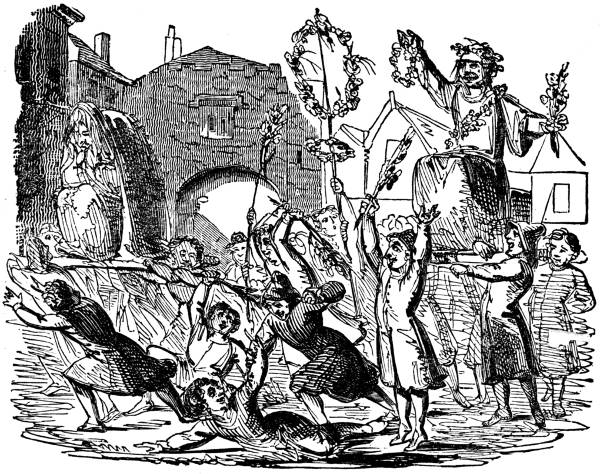
Winter and Spring allegorized—a Sport.
Mothering Sunday.—Refreshment Sunday.—Rose Sunday.
This is the fourth Sunday in Lent, and noted as a holiday in the church of England calendar.
On this day boys went about, in ancient times, into the villages with a figure of death made of straw; from whence they were generally driven by the country people; who disliked it as an ominous appearance, while some gave them money to get the mawkin carried off. Its precise meaning under that form is doubtful, though it seems likely to have purported the death of Winter, and to have been only a part of another ceremony conducted by a larger body of boys, from whom the death-carriers were a detachment, and who consisted of a large assemblage carrying two figures to represent Spring and Winter, whereof one was called “Sommer tout”—
Apparelde all in greene, and drest in youthful fine arraye; The other Winter, cladde in mosse, with heare all hoare and graye.[23]
These two figures they bore about, and fought; in the fight Summer, or Spring, got the victory over Winter, and thus was allegorized the departure or burial of the death of the year, and its commencement or revival as Spring. The custom described on March the 6th, (p. 339,) was only a variation of the present, wherein also the boys carried about cracknels or cakes:—
Thus children also beare, with speares, their cracknelles round about.[24]
It is still a custom on Mid-Lent Sunday in many parts of England, for servants and apprentices to carry cakes or some nice eatables or trinkets, as presents to their parents; and in other parts, to visit their mother for a meal of furmity, or to receive cakes from her with her blessing. This is called going a mothering.[25] Herrick mentions this custom in Gloucestershire:
I’le to thee a simnell bring ’Gainst thou go’st a mothering, So that when she blesseth thee Half that blessing thoul’t give me.
Going a mothering is from the Roman catholic custom of going to the mother-church on Mid-Lent Sunday, to make offerings at the high altar; and that custom of the Romish Church is derived from the Hilaria, a heathen festival celebrated by the ancient Romans, in honour of the Mother of the Gods on the ides of March.[26] The offerings at the altars were in their origin voluntary, and became church property. At length the parish priests compounded with the church at a certain sum, and these voluntary donations of the people have become the dues known by the name of Easter Offerings.
Mid-Lent, or Mothering Sunday is likewise called Refreshment Sunday, “the reason of which,” says Wheatly, (on the Common Prayer) “I suppose is the Gospel for that day, which treats of our Saviour’s miraculously feeding five thousand; or else, perhaps, from the first lesson in the morning, which gives us the story of Joseph entertaining his brethren.” It is also denominated Rose Sunday, from the pope on this day carrying a golden rose in his hand, which he exhibits on his way to and from mass.[27]
On this day at Seville there is an usage evidently the remains of an old custom. Children of all ranks, poor and gentle, appear in the streets fantastically dressed, somewhat like English chimney-sweepers on May-day, with caps of gilt and coloured paper, and coats made of the crusade bulls of the preceding year. During the whole day they make an incessant din with drums and rattles, and cry “Saw down the old woman.” At midnight, parties of the commonalty parade the streets, knock at every door, repeat the same cries, and conclude by sawing in two the figure of an old woman representing Lent. This division is emblematical of Mid-Lent.[28]
FLORAL DIRECTORY.
Heartsease. Viola Tricolor. Dedicated to St. Euphrasia.
March 14.
St. Maud, or Mathildis, Queen, A. D. 968. Sts. Acepsimas, Bishop, Joseph, and Aithilahas, A. D. 380. St. Boniface, Bishop of Ross, about 630.
Chronology.
1733. The Excise scheme was first moved in the House of Commons, by resolutions, which were powerfully resisted, but on the 16th finally carried, and the Excise bill brought in. On the 4th of April the bill was read a first time, and carried by a majority of 36; the majority being 230, the minority 200. There were petitions against it from every trading town of the kingdom, and great tumults in London; the obnoxious members were attacked on their way to parliament. The measure was so unpopular that it was for that time dropped, whereon public feeling was manifested by general illuminations, and other rejoicings.
1757. Admiral John Byng, second son of lord viscount Torrington, was shot at Portsmouth, under the sentence of a court martial, for not having done his duty in an action between the British and French fleets on the 20th of May preceding. After he had made his defence, and conducted himself throughout the trial with coolness and courage, he was so sure of acquittal, that he ordered his coach to be in waiting to convey him to London. He suffered on board the Monarque with undaunted firmness, walking out of the cabin with unchanged countenance to the quarter-deck, where the marines were stationed to execute the sentence. He desired to die with his eyes uncovered; but on its being represented that his intrepid looks might intimidate the soldiers, and frustrate their aim, he tied a handkerchief over his eyes, and then dropping another, five musket balls passed through his body, and he fell dead instantly. An historian of the day says of him, that “Whatever his errors and indiscretions might have been, he seemed to have been rashly condemned, meanly given up, and cruelly sacrificed to vile considerations.” It is believed that popular fury had been excited against him by various arts, and especially by the suppression of important passages in his official despatches. He delivered a paper to the marshal of the admiralty on the morning of his death, wherein he expressed his conviction, that he should hereafter be regarded as a victim to divert the indignation and resentment of an injured and deluded people from the proper objects, and that his very enemies believed him innocent.