JUNE. (continued 2)
Reading edition
The lord mayor having signified his consent to perform the ceremony, Henry Woodthorpe, esq., the town clerk, who has lately obtained the degree of L. L. D., held the copper plate about to be placed beneath the stone with the following inscription upon it, composed by Dr. Coplestone, master of Oriel-college, Oxford:—
Pontis vetvsti qvvm propter crebras nimis interiectas moles impedito cvrsv flvminis navicvlae et rates non levi saepe iactvra et vitae pericvlo per angvstas favces praecipiti aqvarvm impetv ferri solerent Civitas Londinensis his incommodis remidivm adhibere volens et celeberrimi simvl in terris emporii vtilitatibvs consvlens regni insvper senatvs avctoritate ac mvnificentia adivta pontem sitv prorsvs novo amplioribvs spatiis constrvendvm decrev ea scilicet forma ac magnitvdine qvae regiae vrbis maiestati tandem responderet. Neqve alio magis tempore tantum opvs inchoandvm dvxit qvam cvm pacato ferme toto terrarvm orbe Imperivm Britannicvm fama opibus mvltitvdine civivm et concordia pollens principe item gavderet artivm favtore ac patrono cvivs svb avspiciis novva indies aedificiorvm splendor vrbi accederet.
Primum operis lapidem posvit Ioannes Garratt armiger praetor xv. die Ivnii anno regis Georgii Quarti sexto a. s. m.d.ccc.xxv.
Ioanne Rennie F. R. S. architecto.
Translation.
The free course of the river being obstructed by the numerous piers of the ancient bridge, and the passage of boats and vessels through its narrow channels being often attended with danger and loss of life by reason of the force and rapidity of the current, the City of London, desirous of providing a remedy for this evil, and at the same time consulting the convenience of commerce in this vast emporium of all nations, under the sanction and with the liberal aid of parliament, resolved to erect a bridge[787, 788] upon a foundation altogether new, with arches of wider span, and of a character corresponding to the dignity and importance of this royal city: nor does any other time seem to be more suitable for such an undertaking than when in a period of universal peace the British empire, flourishing in glory, wealth, population, and domestic union, is governed by a prince, the patron and encourager of the arts, under whose auspices the metropolis has been daily advancing in elegance and splendour.
The first stone of this work was laid by John Garratt, esquire, lord mayor, on the 15th day of June, in the sixth year of king George the Fourth, and in the year of our Lord m.d.ccc.xxv.
John Rennie, F. R. S. architect.
Dr. Woodthorpe read the Latin inscription aloud, and the lord mayor, turning to the duke of York, addressed his royal highness and the rest of the company.
Lord Mayor’s Speech.
“It is unnecessary for me to say much upon the purpose for which we are assembled this day, for its importance to this great commercial city must be evident; but I cannot refrain from offering a few observations, feeling as I do more than ordinary interest in the accomplishment of the undertaking, of which this day’s ceremony is the primary step. I should not consider the present a favourable moment to enter into the chronology or detailed history of the present venerable structure, which is now, from the increased commerce of the country, and the rapid strides made by the sciences in this kingdom, found inadequate to its purposes, but would rather advert to the great advantages which will necessarily result from the execution of this national work. Whether there be taken into consideration, the rapid and consequently dangerous currents arising from the obstructions occasioned by the defects of this ancient edifice, which have proved destructive to human life and to property, or its difficult and incommodious approaches and acclivity, it must be a matter of sincere congratulation that we are living in times when the resources of this highly favoured country are competent to a work of such great public utility. If ever there was a period more suitable than another for embarking in national improvements, it must be the present, governed as we are by a sovereign, patron of the arts, under whose mild and paternal sway (by the blessing of divine providence) we now enjoy profound peace; living under a government by whose enlightened and liberal policy our trade and manufactures are in a flourishing state; represented by a parliament whose acts of munificence shed a lustre upon their proceedings: thus happily situated, it is impossible not to hail such advantages with other feelings than those of gratitude and delight. I cannot conclude these remarks without acknowledging how highly complimentary I feel it to the honourable office I now fill, to view such an auditory as surrounds me, among whom are his majesty’s ministers, several distinguished nobles of the land, the magistrates and commonalty of this ancient and loyal city, and above all, (that which must ever enlighten and give splendour to any scene,) a brilliant assembly of the other sex, all of whom, I feel assured, will concur with me in expressing an earnest wish that the new London-bridge, when completed, may reflect credit upon the architects, prove an ornament to the metropolis, and redound to the honour of its corporation. I offer up a sincere and fervent prayer, that in executing this great work, there may occur no calamity; that in performing that which is most particularly intended as a prevention of future danger, no mischief may occur with the general admiration of the undertaking.”
The lord mayor’s address was received with cheers. His lordship then spread the mortar, and the stone was gradually lowered by two men at a windlass. When finally adjusted, the lord mayor struck it on the surface several times with a long-handled mallet, and proceeded to ascertain the accuracy of its position, by placing a level on the top of the east end, and then to the north, west, and south; his lordship passing to each side of the stone for that purpose, and in that order. The city sword and mace were then placed on it crossways; the foundation of the new London-bridge was declared to be laid; the music struck up “God save the King;” and three times three excessive cheers, broke forth from the company; the guns of the honourable Artillery Company, on the Old Swan Wharf, fired a salute by signal, and every face wore smiles of gratulation. Three cheers were afterwards given for the duke of York; three for Old England; and three for the architect, Mr. Rennie.
It was observed in the coffer-dam, as a remarkable circumstance, that as the day advanced, a splendid sunbeam, which had penetrated through an accidental space in the awning above, gradually approached towards the stone as the hour for laying it advanced, and during the ceremony, shone upon it with dazzling lustre.
At the conclusion of the proceedings, the lord mayor, with the duke of York, and the other visitors admitted to the floor of the coffer-dam, retired; after which, many of the company in the galleries came down to view the stone, and several of the younger ones were allowed to ascend and walk over it. Some ladies were handed up, and all who were so indulged, departed with the satisfaction of being enabled to relate an achievement honourable to their feelings.
Among the candidates for a place upon the stone, was a gentleman who had witnessed the scene with great interest, and seemed to wait with considerable anxiety for an opportunity of joining in the pleasure of its transient occupants. This gentleman was P. T. W., by which initials he is known to the readers of the Morning Herald, and other journals. The lightness and agility of his person, favoured the enthusiasm of his purpose; he leapt on the stone, and there
———toeing it and heeling it, With ball-room grace, and merry face, Kept livelily quadrilling it,
till three cheers from the spectators announced their participation in his merriment; he then tripped off with a graceful bow, amidst the clapping of hands and other testimonials of satisfaction at a performance wholly singular, because unprecedented, unimitated, and inimitable.
The lord mayor gave a grand dinner in the Egyptian-hall, at the Mansion-house, to 376 guests; the duke of York, being engaged to dine with the king, could not attend. The present lord mayor has won his way to the hearts of good livers, by his entertainments, and the court of common council commenced its proceedings on the following day by honourable mention of him for this entertainment especially, and complacently received a notice to do him further honour for the general festivity of his mayoralty.
His lordship’s name is Garratt; he is a tea-dealer. Stow mentions that one of similar name, and a grocer, was commemorated by an epitaph in our lady’s chapel, in the church of St. Saviour’s, Southwark; which church the first pier of the proposed bridge adjoins. He says,
Upon a faire stone under the Grocers’ arms, is this inscription:—
Garret some cal’d him, but that was too hye, His name is Garrard, who now here doth lye; Weepe not for him since he is gone before To heaven, where Grocers there are many more.[168]
It is supposed that the first bridge of London was built between the years 993 and 1016; it was of wood. There is a vulgar tradition, that the foundation of the old stone bridge was laid upon wool-packs: this report is imagined to have arisen from a tax laid upon wool towards its construction. The first stone-bridge began in 1176, and finished in 1209, was much injured by a fire in the Borough, in 1212, and three thousand people perished. On St. George’s day, 1395, there was a great justing upon it, between David, earl of Crawford, of Scotland, and lord Wells of England. It had a drawbridge for the passage of ships with provisions to Queenhithe, with houses upon it, mostly tenanted by pin and needle-makers: there was a chapel on the bridge, and a tower, whereon the heads of unfortunate partisans were placed: an old map of the city, in 1597, represents a terrible cluster; in 1598, Hentzner the German traveller, counted above thirty poles with heads. Upon this bridge was placed the head of the great chancellor, sir Thomas More, which was blown off the pole into the Thames and found by a waterman, who gave it to his daughter; she kept it during life as a relic, and directed at her death it should be placed in her arms and buried with her.
Howel, the author of “Londinopolis,” in a paraphrase of some lines by Sannazarius, has this—
Encomium on London-bridge.
When Neptune from his billows London spy’d, Brought proudly thither by a high spring-tide, As thro’ a floating wood he steer’d along. And dancing castles cluster’d in a throng; When he beheld a mighty bridge give law Unto his surges, and their fury awe; When such a shelf of cataracts did roar, As if the Thames with Nile had chang’d her shore; When he such massy walls, such towers did eye, Such posts, such irons, upon his back to lye; When such vast arches he observ’d, that might Nineteen Rialtos make for depth and height; When the Cerulean god these things survey’d, He shook his trident, and, astonish’d, said, “Let the whole earth now all the wonders count, This bridge of wonders is the paramount.”
Thus has commenced, under the most favourable auspices, a structure which is calculated to secure from danger the domestic commerce of the port of London. That such a work has not long since been executed, is attributable more to the financial difficulties under which the corporation of London has been labouring for the last quarter of a century, than to any doubts of its being either expedient or necessary. A similar design to that which is now in course of execution, was in contemplation more than thirty years ago; and we believe that many of the first architects of the day sent in plans for the removal of the old bridge, and the construction of a new bridge in its place. A want of funds to complete such an undertaking compelled the projectors of it, to abandon it for a time; but the improved condition of the finances of the corporation, the increasing commerce of the city of London with the internal parts of the country, the growing prosperity of the nation at large, and we may also add, a more general conviction derived from longer experience, that the present bridge was a nuisance which deserved to be abated, induced them to resume it, and to resume it with a zeal proportionate to the magnitude of the object which they had in view. Application was made to parliament for the grant of a sum of money to a purpose which, when considered with regard either to local or to national interests, was of great importance. That application was met with a spirit of liberality which conferred as much honour upon the party who received, as upon the party who gave, the bounty. The first results of it were beheld in the operations of to-day; the further results are in the bosom of time; but from the spirit with which the work has been commenced, we have no doubt but they will tend no less to the benefit, than the glory, of the citizens of London.[169]
There is something peculiarly imposing and impressive in ceremonies of this description, as they are usually conducted, and we certainly do not recollect any previous spectacle of a similar nature, which can be said to have surpassed in general interest, grandeur of purpose, or splendid effect, than that just recorded.
It is at all times agreeable to a philosophical mind, and an understanding which busies itself, not only with the surface and present state of things, but also with their substance and remote tendencies, to contemplate the exercise of human power, and the triumphs of human ingenuity, whether developed in physical or mental efforts, in the pursuit of objects which comprehend a mixture of both. And perhaps, it is in a good degree attributable to this secret impulse of our nature, which operates in some degree upon all, however silent and imperceptible in its operation, that the mass of mankind are accustomed to take such an eager interest in ceremonials like the present. It is true, that show, and preparation, and bustle, and the excitement consequent upon these, are the immediate and apparent motives; but it does not therefore follow that the other reasons are inefficient, or that because they are less prominent and apparent, they are therefore inoperative. The erection of a bridge, without reference to the immediate object or the extent of its design, is per se a triumph of art over nature—a conquering of one of these obstacles, which the latter, even in her most bountiful and propitious designs, delights to present to man, as if for the purpose of calling his powers into exercise, and affording him the quantity of excitement necessary to the happiness of a sentient being. But if we do not entertain these sentiments, and give them utterance in so many words, we nevertheless feel and act upon them. We delight to attend spectacles like the present, where the first germ of a stupendous work is to be prepared. We look round on the complicated apparatus, and the seemingly discordant and unorganized beams and blocks of wood and granite, and then we think of the simple structure, the harmonious and complete whole to which these confused elements will give birth. Such a structure is pregnant with a multitude of almost indefinable thoughts and anticipations. We bethink ourselves of the stream of human life, which, some five years hence, will flow over the new London-bridge as thickly, and almost with as little cessation, as the waters of the Thames below: and then we reflect upon the tide of hopes and fears which that human stream will carry in its bosom! One of our first reflections will necessarily be of its adaptation to trade and commerce, of which it will then constitute a new and immense conduit. Trade, and science, and learning, and war, (Providence long avert it!) will at various periods pass across it. Next we consider what will be the immediate and individual destiny of the structure:—is it to moulder away after the lapse of many ages, under the slow but effectual influence of time, or to suffer dilapidation suddenly from the operation of some natural convulsion? Will it fall before the wrath or wilfulness of man, or is it to be displaced by new improvements and discoveries, in like manner as its old and many-arched neighbour makes way for it—and as that once superseded its narrower and shop-covered predecessor? These are questions which the imaginative man may ask himself; but who is to answer? However, even the man of business may be well excused in indulging some speculations such as these, upon the occasion of the erection of a structure, which is to constitute a new artery to and fro in the mighty heart of London—a fresh vein through which that commerce, which is the life-blood of our national prosperity and greatness will have to flow.[170]
This is one of those public occurrences which may be considered as an event in a man’s life, and an epoch in the city’s history—a sort of station in one’s worldly journey, from which we measure our distances and dates. To witness the manner and the moment, in which is laid the first single resting stone of a grand national structure—the very origin of the existence of a massive and magnificent pile, which will require years to complete, and ages to destroy, has an elevating and sublime effect on the mind.
Great public works are the truest signs of a nation’s prosperity and power; originally its grandest ornaments, and ultimately the strongest proofs of its existence. Its religion, language, arts, sciences, government, and history, may be swept into nothingness; but yet its national buildings will remain entire through the lapse of successive ages—after their very founders are forgotten—after their local history has become a mere matter of conjecture. The columns of Palmyra stand over the ashes of their framers, in a desert as well of history as of sand. The palaces of imperial Rome are still existing, though her religion, her very language, is dead; and the history of the man-wrought miracles of Egypt, had been looked at but as the very dreamings of philosophy long before Napoleon said to his Egyptian army—“From the summits of these pyramids, forty centuries are looking down upon you.”
Of all public edifices, a bridge is the most necessary, the most generally and frequently useful—open at all hours and to all persons. It was probably the very first public building. Some conjecture, that the first hint of it was taken from an uprooted tree lying across a narrow current. What a difference between that first natural bridge, and the perfection of pontifical architecture—the vast, solid, and splendid Waterloo—the monumentum si quæras of John Rennie. We feel pleasure in learning, that the new London-bridge has been designed by the same distinguished architect. It falls to the lot of the son to consummate the plans of the father—we hope with equal success, and with similar benefits, as well to the conductor as to the public.
Old London-bridge, for which the new one is intended as a more commodious substitute, was the first that connected the Surrey and Middlesex banks. It was built originally of wood, about 800 years ago, and rebuilt of stone in the reign of king John, 1209, just two years after the chief civic officer assumed the name of mayor. Until the middle of the last century, it was crowded with houses, which made it very inconvenient to the passengers. The narrowness and inequality of its arches, have caused it to be compared to “a thick wall, pierced with small uneven holes, through which the water, dammed up by this clumsy fabric, rushes, or rather leaps, with a velocity extremely dangerous to boats and barges.” Of its nineteen arches, none except the centre, which was formed by throwing two into one, is more than twenty feet wide. This is but the width of each of the piers of Waterloo-bridge. It is the most crowded thoroughfare in London, and, in this point, exceeds Charing-cross, which, according to Dr. Johnson, was overflowed by the full tide of human existence. It has been calculated, that there daily pass over London-bridge 90,000 foot passengers; 800 waggons; 300 carts and drays; 1,300 coaches; 500 gigs and tax carts; and 800 saddle horses. The importance of this great point of communication, and the necessity of rendering it adequate to the purposes of its construction, are proved, by the numbers to whom it affords a daily passage at present, and, still more, by the probable increase of the numbers hereafter. The present bridge having been for some years considered destitute of the proper facilities of transition for passengers as well as for vessels, an Act of Parliament, passed in 1823, for building a new one, on a scale and plan equal to the other modern improvements of the metropolis. The first pile of the works was driven on the west side of the present bridge, in March, 1824, and the first coffer-dam having been lately finished, the ceremony of laying the first stone of the new bridge, has been happily and auspiciously completed.[171]
Mrs. Barbauld.
The decease of this literary and excellent lady in the spring of 1825, occasioned a friend to the Every-Day Book to transmit the following fugitive poem for insertion. It is not collected in any of the works published by Mrs. Barbauld during her lifetime; this, and the rectitude of spirit in the production itself, may justify its being recorded within these pages.
To her honoured Friends of the families of Martineau and Taylor These lines are inscribed By their affectionate A. L. Barbauld On the Death OF MRS. MARTINEAU.
Ye who around this venerated bier In pious anguish pour the tender tear, Mourn not!—Tis Virtue’s triumph, Nature’s doom, When honoured Age, slow bending to the tomb, Earth’s vain enjoyments past, her transient woes, Tastes the long sabbath of well-earned repose. No blossom here, in vernal beauty shed, No lover lies, warm from the nuptial bed; Here rests the full of days,—each task fulfilled, Each wish accomplished, and each passion stilled. You raised her languid head, caught her last breath, And cheered with looks of love the couch of death. Yet mourn!—for sweet the filial sorrows flow, When fond affection prompts the gush of woe; No bitter drop, ’midst Nature’s kind relief, Sheds gall into the fountain of your grief; No tears you shed for patient love abused, And counsel scorned, and kind restraints refused. Not yours the pang the conscious bosom wrings, When late remorse inflicts her fruitless stings. Living you honoured her, you mourn for, dead; Her God you worship, and her path you tread. Your sighs shall aid reflection’s serious hour, And cherished virtues bless the kindly shower: On the loved theme your lips unblamed shall dwell; Your lives, more eloquent, her worth shall tell. —Long may that worth, fair Virtue’s heritage, From race to race descend, from age to age! Still purer with transmitted lustre shine The treasured birthright of the spreading line! For me, as o’er the frequent grave I bend, And pensive down the vale of years descend; Companions, Parents, Kindred called to mourn, Dropt from my side, or from my bosom torn; A boding voice, methinks, in Fancy’s ear Speaks from the tomb, and cries “Thy friends are here!”
Summer Evening’s Adventure in Wales.
Mr. Proger of Werndee, riding in the evening from Monmouth, with a friend who was on a visit to him, heavy rain came on, and they turned their horses a little out of the road towards Perthyer. “My cousin Powell,” said Mr. Proger, “will, I am sure, be ready to give us a night’s lodging.” At Perthyer all was still; the family were abed. Mr. Proger shouted aloud under his cousin Powell’s chamber-window. Mr. Powell soon heard him; and putting his head out, inquired, “In the name of wonder what means all this noise? Who is there?” “It is only your cousin Proger of Werndee, who is come to your hospitable door for shelter from the inclemency of the weather; and hopes you will be so kind as to give him, and a friend of his, a night’s lodging.” “What is it you, cousin Proger? You, and your friend shall be instantly admitted; but upon one condition, namely, that you will admit now, and never hereafter dispute, that I am the head of your family.” “What was that you said?” replied Mr. Proger. “Why, I say, that if you expect to pass the night in my house, you must admit that I am the head of your family.” “No, sir, I never will admit that—were it to rain swords and daggers, I would ride through them this night to Werndee, sooner than let down the consequence of my family by submitting to such an ignominious condition. Come up, Bald! come up!” “Stop a moment, cousin Proger; have you not often admitted, that the first earl of Pembroke (of the name of Herbert) was a younger son of Perthyer; and will you set yourself up above the earls of Pembroke?” “True it is I must give place to the earl of Pembroke, because he is a peer of the realm; but still, though a peer, he is of the youngest branch of my family, being descended from the fourth son of Werndee, who was your ancestor, and settled at Perthyer, whereas I am descended from the eldest son. Indeed, my cousin Jones of Lanarth is of a branch of the family elder than you are; and yet he never disputes my being the head of the family.” “Well, cousin Proger, I have nothing more to say: good night to you.”—“Stop a moment, Mr. Powell,” cried the stranger, “you see how it pours; do let me in at least; I will not dispute with you about our families.” “Pray, sir, what is your name, and where do you come from?” “My name is so and so; and I come from such a county.” “A Saxon of course; it would indeed be very curious, sir, were I to dispute with a Saxon about family. No, sir, you must suffer for the obstinacy of your friend, so good night to you both.”[172]
June 16.
Sts. Quirius, or Cyr and Julitta, Martyrs, A. D. 304. St. John Francis Regis, A. D. 1640. Sts. Ferreolus, or Fargeau, and Ferrutius, A. D. 211 or 212. St. Aurelian, Abp. A. D. 552.
Chronology.
1722. John Churchill, the great duke of Marlborough, died at Windsor-lodge, in a state of idiocy. He was son of sir Winston Churchill, an English historian, and born at Ashe, in Devonshire, 1650. At twelve years of age he became page to the duke of York, afterwards James II.; at sixteen he entered the guards, and distinguished himself under Turenne. He was called the handsome Englishman, married Miss Jennings, (the celebrated duchess of Marlborough,) obtained distinguished rank and offices, suppressed the duke of Monmouth’s rebellion, and served king James with apparent fidelity in the wane of his fortune, while he faithlessly made court to the prince of Orange. His great military achievements, under king William and queen Anne, were rewarded by munificent public grants, and a public funeral in Westminster-abbey.
FLORAL DIRECTORY.
Moss Privince Rose. Rosa muscosa. Dedicated to St. Julitta.
CRUELTY TO ANIMALS.
To the Editor of the Every-Day Book.
Dear Sir,
A great deal has been lately attempted, by men of feeling minds, to prevent wanton cruelty towards animals; which (unhappily even in this enlightened age,) is but too prevalent.
The lower class of persons, to whom the care of the horse is intrusted, frequently possess less sense than those noble animals, which groan under their tyranny; we constantly find ignorant farriers, who think that a cure can only be effected, by most violent and painful remedies. It is to these brutal men, that the lameness of so many horses may be attributed; for, not understanding the beautiful and singular construction of the interior of a horse’s foot, by cutting away the hoof they contract the foot, and gradually prevent the elasticity so necessary: thus by repeated shoeing, the foot is cramped, as much so, as a man’s who would attempt to walk in a shoe considerably too tight for him. Lameness ensues, and these farriers pronounce the seat of lameness any where but where it actually exists; then comes firing and blistering, and every possible torture, and the poor animal lamed for life, long before his time, is consigned to the lowest drudgery, and subsequently to the dogs.
The inhuman rate at which horses are driven in stage coaches, conduces greatly to mortality; this consumption of animal life is, in some instances, one in three annually.
Soame Jenyns, whose works are well known, and who was himself a man of the finest feelings, in a paper On Cruelty to Animals, adverts to the disciples of Pythagoras, who held that the souls of men, and all other animals, existed in a state of perpetual transmigration, and that when by death they were dislodged from one corporeal habitation, they were immediately reinstated in another, happier or more miserable, according to their behaviour in the former. Soame Jenyns favours this doctrine of transmigration, “first, from its justice; secondly, from its utility; and lastly, from the difficulty we lie under to account for the sufferings of many innocent creatures without it.” He says, “If we look around us, we cannot but observe a great and wretched variety of this kind; numberless animals subjected by their own natures to many miseries, and by our cruelties to many more, incapable of crimes, and consequently incapable of deserving them, called into being, as far as we can discover, only to be miserable for the service or diversion of others less meritorious than themselves, without any possibility of preventing, deserving, or receiving recompense for their unhappy lot, if their whole existence is comprehended in the narrow and wretched circle of their present life.” He then proceeds to observe, that “the theory here inculcated, removes all these difficulties, and reconciles all these seemingly unjust dispensations, with the strictest justice. It informs us, that their sufferings may by no means be understood, but as the just punishments of their former behaviour, in a state, where by means of their vices, they may have escaped them. It teaches us, that the pursued and persecuted fox, was once probably some crafty and rapacious minister, who had purchased by his ill acquired wealth, that safety, which he cannot now procure by his flight; that the bull, baited with all the cruelties that human ingenuity, or human malevolence can invent, was once some relentless tyrant, who had inflicted all the tortures which he endures; that the poor bird, blinded, imprisoned, and at last starved to death in a cage, may have been some unforgiving creditor; and the widowed turtle, pining away life for the loss of her mate, some fashionable wife, rejoicing at the death of her husband, which her own ill-usage had occasioned. Never can the delicious repast of roasted lobsters excite my appetite, whilst the ideas of the tortures in which those innocent creatures have expired present themselves to my imagination. But when I consider that they must have once probably been Spaniards at Mexico, or Dutchmen at Amboyna, I fall to, with a good stomach and a good conscience. Never can I repose myself with satisfaction in a post chaise, whilst I look upon the starved, foundered, accelerated, and excoriated animals which draw it, as mere horses, condemned to such unmerited torments for my convenience, but I reflect, they must have undoubtedly existed in the fathers of the holy inquisition. I very well know that these sentiments will be treated as ludicrous by many of my readers, but they are in themselves just and serious, and carry with them the strongest probability of their truth. So strong is it, that I cannot but hope it will have some good effect on the conduct of those polite people, who are too sagacious, learned, and courageous to be kept in awe by the threats of hell and damnation; and I exhort every fine lady to consider, how wretched will be her condition, if after twenty or thirty years spent at cards, in elegant rooms, kept warm by good fires and soft carpets, she should at last be obliged to change places with one of her coach horses; and every fine gentleman to reflect, how much more wretched would be his, if after wasting his estate, his health, and his life in extravagance, indolence, and luxury, he should again revive in the situation of one of his creditors.”
Besides Jenyns’s suppositions, allow me to notice the crimping of fish, the skinning of eels alive, the whipping of pigs to death, to make them tender, the boiling of live crabs, having first put them in cold water to make them lively; together with the preference given to hunted hares, on account of their delicacy of muscles, softened by worry and exertion. These are but too common instances of a barbarous taste.
At this season of enjoyment and leisure, when we derive pleasure from contemplating the beautiful forms and appearances of nature, and are grateful for annual abundance, let us reflect on the criminal heedlessness wherewith we allow our appetites and pleasures to be indulged, by needless sufferings in the animals we subdue to our wants and whims. While we endeavour to inculcate kindness in our children towards one another, let us teach them kindness to the meanest of created beings. I know that the Every-Day Book widely circulates in families; the humane sentiments that pervade it, must therefore have considerable influence, and for this reason I select it as a channel for conveying a humane suggestion.
I am, dear Sir, Yours sincerely, J. B.
THE SEASON.
To the Editor of the Every-Day Book.
Sir,
The perusal of your remarks on the season and the winds, in the Every-Day Book, page 707, reminded me of some lines I wrote at Ramsgate. If you know Wellington-crescent, where they were composed, you know a very pretty place, for either summer or winter residence.
I am, Sir, &c.
June 6, 1825.
J. S.
THE EAST WIND.
A summer sun in brightness glows, But, ah! the blighting east wind blows, And weighs the spirit down! All smiling is th’ enlivening ray, That tips with silvery tinge the spray, O’er ocean’s bosom thrown! Yet, all inviting though it seems, And tempts one forth to court its beams I tremblingly retire: For I am one who hate and dread That eastern blast, and oft have fled Its pestilences dire! But the young shoots that round me rise And make me old,—(though still unwise) Feel no such fear as I Brimful of joy they venture forth Wind blowing west, south, east, or north, If cloudless be the sky! They tripping lightly o’er the path, To them yet free from grief or scath, Press on—and onward still, With brow unwrinkled yet by care, With spirit buoyant as the air— They breathe at freedom’s will. Where shipwreck’d seamen oft deplore The loss of all their scanty store, They rove at ebb of tide In quest of shells, or various weed, That, from the bed of ocean freed, Their anxious search abide. Proud and elated with their prize, (All eagerness with sparkling eyes,) The treasures home are brought To me, who plunged in gloom the while. At home have watch’d the sea bird’s guile:— Or, in a sea of thought, Have sent my spirit forth to find Fit food for an immortal mind, Else of itself the prey! And in th’ abstraction of that mood. Full oft I’ve realized the good, We boast not every day. Sometimes tho’, with a courage bold, As ever faced the arctic’s cold, I pace the Colonnade;[173] And then am soon compelled to beat, And seek a cowardly retreat, Within the parlour’s shade! Sometimes the place,[174] warm shelter’d close, Where Sharwood’s decorated house, From roof to step all flowers, Shines forth as Flora’s temple, where Dominion falls to sea and air;— Napoleonic powers! There, snugly shelter’d from the blast, My eyes right pensively I cast Where famed sir Williams’s bark Lies moor’d, awaiting the time when That Noah of citizens again Shall venture on such ark! But, ah! still round the corner creeps, That treach’rous wind! and still it sweeps Too clean the path I tread: Arm’d as with numerous needle points, Its painful searchings pierce my joints, And then capsize my head! So home again full trot I speed, As, after wound, the warrior’s steed; And sit me down, and sigh O’er the hard-hearted fate of those Who feel like me these east-wind woes That brain and marrow try! Again upon the sea I look, Of nature that exhaustless book With endless wonder fraught:— How oft upon that sea I’ve gazed, Whose world of waters has amazed Man—social or untaught. And, spite of all that some may say, It is the place from day to day, Whereon the soul can dwell! My soul enkindles at the sight Of such accumulated might; And loves such grandeur well!
J. S.
June 17.
Sts. Nicandeo and Marcian, about A. D. 303. St. Botulph, Abbot, A. D. 655. St. Avitus, or Avy, A. D. 530. St. Molingus, or Dairchilla, Bp. A. D. 697. St. Prior, Hermit, 4th Cent.
St. Alban.
This saint, the proto-martyr of Britain, is in the church of England calendar and almanacs on this day, but he stands in the Romish calendar, on the 22d of the month.
St. Alban was born at Verulam, in Hertfordshire, in the third century, and went to Rome, where he served seven years as a soldier under Dioclesian. He afterwards returned to England, became a Christian, and suffered martyrdom in 303, during the dreadful persecution raised by Dioclesian. Several miracles are said by Bede to have been wrought at his martyrdom.[175]
The fame of Alban, recorded as it was by Bede, made a deep impression on the minds of the superstitious. “The Ecclesiastical History” of that author, was published in 731; and in the year 795, Offa, king of the Mercians, built a monastery to the honour of Alban, on the place where he had suffered, then called by the Anglo-Saxons, Holmhurst, but since, in honour of the martyr, named St. Alban’s. The town built near the abbey still retains the latter appellation; and the abbey-church is even yet in existence, having, at the suppression of the monasteries by Henry the Eighth, been purchased by a rich clothier of the name of Stump, for 400l., and converted by him into a parochial church, for the use of the inhabitants. In the year 1257, some workmen repairing this ancient church, found the remains of some sheets of lead, containing relics, with a thick plate of lead over them, upon which was cut the following inscription:—
“In hoc Mausoleo inventum est Venerabile corpus Sancti Albani, Proto Martyris Anglorum.”[176]
FLORAL DIRECTORY.
Monkey Flower. Mimulus luteus. Dedicated to St. Nicandeo.
June 18.
Sts. Marcus and Marcellianus, A. D. 286. St. Marina, 8th. Cent. St. Elizabeth of Sconage, Abbess, A. D. 1165. St. Amand, Bp. of Bourdeaux.
Chronology.
1815. The battle of Waterloo, which terminated the personal power of Napoleon, was fought on this day.
BATTLE OF WATERLOO
There was a sound of revelry by night, And Belgium’s capital had gathered then Her beauty and her chivalry, and bright The lamps shone o’er fair women and brave men. A thousand hearts beat happily; and when Music arose with its voluptuous swell, Soft eyes looked love to eyes which spake again, And all went merry as a marriage-bell; But hush! hark! a deep sound strikes like a rising knell! Did ye not hear it?—No; ’twas but the wind, Or the car rattling o’er the stony street; On with the dance! let joy be unconfined; No sleep till morn, when youth and pleasure meet To chase the glowing hours with flying fleet— But, hark!—that heavy sound breaks in once more, As if the clouds its echo would repeat; And nearer, nearer, deadlier than before. Arm! arm! it is!—it is—the cannon’s opening roar! Ah! then and there was hurrying to and fro, And gathering tears, and tremblings of distress, And cheeks all pale, which but an hour ago Blushed at the praise of their own loveliness; And there were sudden partings, such as press The life from out young hearts, and choking sighs Which ne’er might be repeated: who could guess If ever more should meet those mutual eyes, Since upon nights so sweet such awful morn could rise? And there was mounting in hot haste: the steed, The mustering squadron, and the clattering car, Went pouring forward with impetuous speed, And swiftly forming in the ranks of war; And the deep thunder peal on peal afar; And near, the beat of the alarming drum Roused by the soldier ere the morning star; While thronged the citizens with terror dumb, Or whispering, with white lips—“The foe! they come! they come!” And wild, and high, the “Cameron’s gathering rose!” The war-note of Lochiel, which Albyn’s hills Have heard, and heard, too, have her Saxon foes: How in the noon of night that pibroch thrills, Savage and shrill! but with the breath which fills Their mountain-pipe, so fill the mountaineers With the fierce native daring which instils The stirring memory of a thousand years, And Evan’s, Donald’s fame rings in each clansman’s ears. And Ardennes waves above them her green leaves, Dewy with Nature’s tear-drops, as they pass, Grieving, if aught inanimate e’er grieves, Over the unreturning brave,—alas! Ere evening to be trodden like the grass Which now beneath them, but above shall grow In its next verdure, when this fiery mass Of living valour, rolling on the foe And burning with high hope, shall moulder cold and low. Last noon beheld them full of lusty life, Last eve in Beauty’s circle proudly gay; The midnight brought the signal sound of strife, The morn the marshalling in arms,—the day Battle’s magnificently-stern array! The thunder-clouds close o’er it, which when rent The earth is covered thick with other clay, Which her own clay shall cover, heaped and pent, Rider and horse,—friend,—foe,—in one red burial blent!
Byron.
On the 18th of June, 1817, the Strand-bridge, a noble structure, erected at the expense of private individuals, was opened for the public accommodation, under the denomination of Waterloo-bridge, with military and other ceremonies.
“Buy a Broom?”
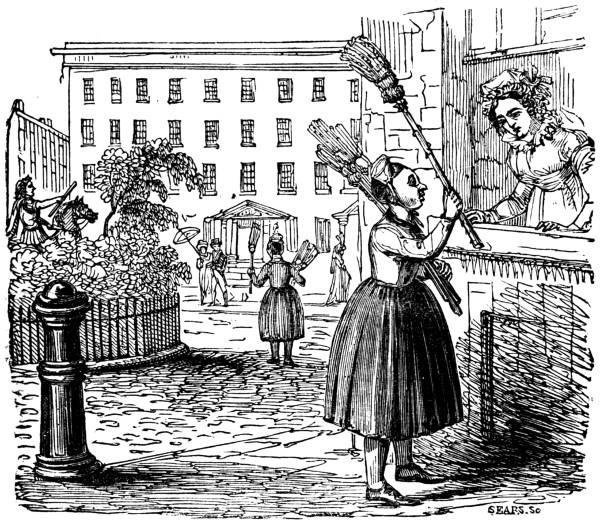
“Buy a Broom?”
These poor “Buy-a-Broom” girls exactly dress now, As Hollar etch’d such girls two cent’ries ago; All formal and stiff, with legs, only, at ease— Yet, pray, judge for yourself; and don’t, if you please, Like Matthews’s “Chyle,” in his Monolo-Play, Cry “The Ev’ry-Day Book is quite right, I dare say;” But ask for the print, at old print shops, (they’ll show it,) And look at it, “with your own eyes,” and you’ll “know it.”
*
These girls are Flemings. They come to England from the Netherlands in the spring, and take their departure with the summer. They have only one low, shrill, twittering note, “Buy a broom?” sometimes varying into the singular plural, “Buy a brooms?” It is a domestic cry; two or three go together, and utter it in company with each other; not in concert, nor to a neighbourhood, and scarcely louder than will attract the notice of an inmate seen at a parlour window, or an open street-door, or a lady or two passing in the street. Their hair is tightened up in front, and at the sides, and behind, and the ends brought together, and so secured, or skewered, at the top of the head, as if it were constricted by a tourniquet: the little close cap, not larger than an infant’s, seems to be put on and tied down by strings fastened beneath the chin, merely as a concealment of the machinery. Without a single inflexion of the body, and for any thing that appears to the contrary, it may be incased in tin. From the waist, the form abruptly and boldly bows out like a large beehive, or an arch of carpentry, built downward from above the hips, for the purpose of opening and distending the enormous petticoat into numerous plaits and folds, and thereby allowing the legs to walk without incumbrance. Their figures are exactly miniatured in an unpainted penny doll of turnery ware, made all round, before and behind, and sold in the toyshops for the amusement of infancy.
These Flemish girls are of low stature, with features as formal and old fashioned as their dress. Their gait and manner answer to both. They carry their brooms, not under the left arm, but upon it, as they would children, upright between the arm and the side, with the heads in front of the shoulder. One, and one only, of the brooms is invariably held in the right hand, and this is elevated with the sharp cry “Buy a broom?” or “Buy a brooms?” to any one likely to become a purchaser, till it is either bought or wholly declined. The sale of their brooms is the sole purpose for which they cross the seas to us; and they suffer nothing to divert them from their avocation. A broom girl’s countenance, so wearisomely indicates unwearied attention to the “main chance,” and is so inflexibly solemn, that you doubt whether she ever did or can smile; yet when she does, you are astonished that she does not always: her face does not relax by degrees, but breaks suddenly into an arch laugh. This appearance may be extorted by a joke, while driving a bargain, but not afterwards: she assumes it, perhaps, as a sort of “turn” to hasten the “business transaction;” for when that is concluded, the intercourse ends immediately. Neither lingering nor loitering, they keep constantly walking on, and looking out for customers. They seldom speak to each other; nor when their brooms are disposed of, do they stop and rejoice upon it as an end to their labours; but go homewards reflectively, with the hand every now and then dipping into the pocket of the huge petticoat, and remaining there for a while, as if counting the receipts of the day while they walk, and reckoning what the before accumulated riches will total to, with the new addition. They seem influenced by this admonition, “get all you can, and keep all you get.”
Rather late in an autumn afternoon, in Battersea-fields, I saw one of these girls by herself; she was seated, with her brooms on her lap, in a bit of scenery, which, from Weirotter’s etchings and other prints, I have always fancied resembled a view in the Low Countries: it is an old windmill, near the “Red-house,” with some low buildings among willows, on the bank of the Thames, thrown up to keep the river from overflowing a marshy flat. To my imagination, she was fixed to that spot in a reverie on her “vader-land.[177]” She gazed on the strait line of stunted trees, as if it were the line of beauty; and from the motion of her lips, and the enthusiasm of her look, I deemed she was reciting a passage from a poet of her native country. Elevation of feeling, in one of these poor girls, was hardly to be looked for; and yet I know not why I should have excluded it, as not appertaining to their character, except from their seeming intentness on thrift alone. They are cleanly, frugal, and no wasters of time; and that they are capable of sentiment, I state on the authority of my imagining concerning this poor girl; whereon, too, I pledge myself not to have been mistaken, for the language of the heart is universal—and hers discoursed to mine; though from the situation wherein I stood, she saw me not. I was not, nor could I be, in love with her—I was in love with human nature.
The “brooms” are one entire piece of wood; the sweeping part being slivered from the handle, and the shavings neatly turned over and bound round into the form of a besom. They are bought to dust curtains and hangings with; but good housewives have another use for them; one of them dipt in fair water, sprinkles the dried clothes in the laundry, for the process of ironing, infinitely better than the hand; it distributes the water more equally and more quickly.
“Buy a Broom?!!”
There is a print with this inscription. It is a caricature representation of Mr. Brougham, with his barrister’s wig, in the dress of a broom girl, and for its likeness of that gentleman, and the play on his name, it is amazingly popular; especially since he contended for a man’s right to his own personal appearance, in the case of Abernethy v. The Lancet, before the chancellor. Mr. Brougham’s good-humoured allusion to his own countenance, was taken by the auditors in court, to relate particularly to his portrait in this print, called “Buy a Broom?” It is certainly as good as “The Great Bell of Lincoln’s-inn,” and two or three other prints of gentlemen eminent at the chancery-bar, sketched and etched, apparently, by the same happy hand at a thorough likeness.
FLORAL DIRECTORY.
Horned Poppy. Chelidonium glaucum. Dedicated to St. Marina.
June 19.
Sts. Gervasius and Protasius. St. Boniface, Abp., Apostle of Russia, A. D. 1009. St. Juliana Falconieri, A. D. 1340. St. Die, or Deodatus, Bp. A. D. 679 or 680.
Chronology.
1215. Magna Charta was signed, on compulsion, by king John, at Runnymead, near Windsor.
1820. Sir Joseph Banks, president of the royal society, died, aged 77.
The Summer Midnight.
The breeze of night has sunk to rest, Upon the river’s tranquil breast, And every bird has sought her nest, Where silent is her minstrelsy; The queen of heaven is sailing high, A pale bark on the azure sky, Where not a breath is heard to sigh— So deep the soft tranquillity. Forgotten now the heat of day That on the burning waters lay, The noon of night her mantle gray, Spreads, from the sun’s high blazonry; But glittering in that gentle night There gleams a line of silvery light, As tremulous on the shores of white It hovers sweet and playfully. At peace the distant shallop rides; Not as when dashing o’er her sides The roaring bay’s unruly tides Were beating round her gloriously; But every sail is furl’d and still, Silent the seaman’s whistle shrill, While dreamy slumbers seem to thrill With parted hours of ecstacy. Stars of the many spangled heaven! Faintly this night your beams are given, Tho’ proudly where your hosts are driven Ye rear your dazzling galaxy; Since far and wide a softer hue Is spread across the plains of blue, Where in bright chorus ever true For ever swells your harmony. O! for some sadly dying note Upon this silent hour to float, Where from the bustling world remote, The lyre might wake its melody; One feeble strain is all can swell From mine almost deserted shell, In mournful accents yet to tell That slumbers not its minstrelsy. There is an hour of deep repose That yet upon my heart shall close, When all that nature dreads and knows Shall burst upon me wond’rously; O may, I then awake for ever My harp to rapture’s high endeavour, And as from earth’s vain scene I sever, Be lost in Immortality!
FLORAL DIRECTORY.
La Julienne de Nuit. Hesperis tristis. Dedicated to St. Juliana.
June 20.
St. Silverius, Pope, A. D. 538. St. Gobian, Priest and Martyr, about 656. St. Idaburga, or Edburge. St. Bain, Bp. of Terouanne (now St. Omer,) and Abbot, about A. D. 711.
Translation of Edward.
This day is so distinguished in the church of England calendar. Edward was the king of the West Saxons, murdered by order of Elfrida. He had not only an anniversary on the 18th of March, in commemoration of his sufferings, or rather of the silly and absurd miracles alleged to have been wrought at his tomb; but he was even honoured by our weak forefathers with another festival on the 20th of June, in each year, in remembrance of the removal, or translation, as it is termed, of his relics at Wareham, where they were inhumed, to the minster at Salisbury, three years after his decease.
It is observed by Mr. Brady, on the translation of St. Edward, as follows:—
“At the period this solemn act of absurd pomp took place, all Europe was plunged in a state of profound ignorance and mental darkness; no marvel, therefore, that great importance should have been attached to such superstitious usage; but for what reason our reformers chose to keep up a recollection of that folly, cannot readily be ascertained.
“Of the origin of translations of this kind, much has been written; and if we are to credit the assertions of those monkish writers, whose works are yet found in catholic countries, though they have themselves long passed to the silent tomb, we must believe not only that they had their source from a principle of devotion, but that peculiar advantages accrued to those who encouraged their increase. In the year 359, the emperor Constantius, out of a presumed and, perhaps, not inconsistent respect, caused the remains of St. Andrew and St. Luke to be removed from their ancient place of interment to the temple of the twelve apostles, at Constantinople; and from that example, the practice of searching for the bodies of saints and martyrs increased so rapidly, that in the year 386, we find almost the whole of the devotees engaged in that pursuit. Relics, of course, speedily became of considerable value; and as they were all alleged to possess peculiar virtues, no expense or labour were spared to provide such treasures for every public religious foundation. Hence translations innumerable took place of the decayed members of persons reputed saints; and where the entire bodies could not be collected, the pious contented themselves with possessing such parts alone as ‘Providence chose to bless them with.’ Without these sacred relics, no establishments could expect to thrive; and so provident had the persons been who laboured in their collection, that not a single religious house but could produce one or more of those invaluable remains; though, unless we are to believe that most relics, like the holy cross itself, possessed the power of self-augmentation, we must either admit, that some of our circumspect forefathers were imposed upon, or that St. John the Baptist had more heads than that of which he was so cruelly deprived, as well as several of their favourite saints having each kindly afforded them two or three skeletons of their precious bodies; circumstances that frequently occurred, ‘because,’ says Father John Ferand, of Anecy, ‘God was pleased so to multiply and re-produce them, for the devotion of the faithful!’
“Of the number of these relics that have been preserved, it is useless to attempt a description, nor, indeed, could they be detailed in many volumes; yet it may gratify curiosity to afford some brief account of such as, in addition to the heads of St. John the Baptist, were held in the greatest repute, were it for no other reason than to show how the ignorance and credulity of the commonalty have, in former ages, been imposed upon, viz.:—
“A finger of St. Andrew;
“A finger of St. John the Baptist;
“The thumb of St. Thomas;
“A tooth of our Lord;
“A rib of our Lord, or, as it is profanely styled, of the Verbum caro factum, the word made flesh;
“The hem of our Lord’s garment, which cured the diseased woman;
“The seamless coat of our Lord;
“A tear which our Lord shed over Lazarus; it was preserved by an angel, who gave it in a phial to Mary Magdalene;
“Two handkerchiefs, on which are impressions of our Saviour’s face; the one sent by our Lord himself as a present to Agbarus, prince of Edessa; the other given at the time of his crucifixion to a holy woman, named Veronica;
“The rod of Moses, with which he performed his miracles;
“A lock of hair of Mary Magdalene’s;
“A hem of Joseph’s garment;
“A feather of the Holy Ghost;
“A finger of the Holy Ghost;
“A feather of the angel Gabriel;
“A finger of a cherubim;
“The water-pots used at the marriage in Galilee;
“The slippers of the antediluvian Enoch;
“The face of a seraphim, with only part of the nose;
“The ‘snout’ of a seraphim, thought to have belonged to the preceding;
“The coal that broiled St. Lawrence;
“The square buckler, lined with ‘red velvet,’ and the short sword of St. Michael;
“A phial of the ‘sweat of St. Michael,’ when he contended with Satan;
“Some of the rays of the star that appeared to the Magi; with innumerable others, not quite consistent with decency to be here described.
“The miracles wrought by these and other such precious remains, have been enlarged upon by writers, whose testimony, aided by the protecting care of the inquisition, no one durst openly dispute who was not of the ‘holy brotherhood;’ although it would appear, by the confessions of some of those respectable persons, that ‘instances have occurred of their failure,’ but that they always ‘recovered their virtue, when,’ as Galbert, a monk of Marchiennes, informs us, ‘they were flogged with rods, &c.!’”[178]
FLORAL DIRECTORY.
Doubtful Poppy. Papaver dubium. Dedicated to St. Silverius.
June 21.
St. Aloysius, or Lewis Gonzaga, A. D. 1591. St. Ralph, Abp. of Bourges, A. D. 866. St. Meen, in Latin, Mevennus, also Melanus, Abbot in Britanny, about A. D. 617. St. Aaron, Abbot in Britanny, 6th Cent. St. Eusebius, Bp. of Samosata, A. D. 379 or 380. St. Leufredus, in French, Leufroi, Abbot, A. D. 738.
Summer Morning and Evening.
The glowing morning, crown’d with youthful roses, Bursts on the world in virgin sweetness smiling, And as she treads, the waking flowers expand, Shaking their dewy tresses. Nature’s choir Of untaught minstrels blend their various powers In one grand anthem, emulous to salute Th’ approaching king of day, and vernal Hope Jocund trips forth to meet the healthful breeze, To mark th’ expanding bud, the kindling sky, And join the general pæan. While, like a matron, who has long since done With the gay scenes of life, whose children all Have sunk before her on the lap of earth— Upon whose mild expressive face the sun Has left a smile that tells of former joys— Grey Eve glides on in pensive silence musing. As the mind triumphs o’er the sinking frame, So as her form decays, her starry beams Shed brightening lustre, till on night’s still bosom Serene she sinks, and breathes her peaceful last, While on the rising breeze sad melodies, Sweet as the notes that soothe the dying pillow, When angel-music calls the saint to heaven, Come gently floating: ’tis the requiem Chaunted by Philomel for day departed.
Ado.
FLORAL DIRECTORY.
Viper’s Buglos. Echium vulgare. Dedicated to St. Aloysius.
Summer.
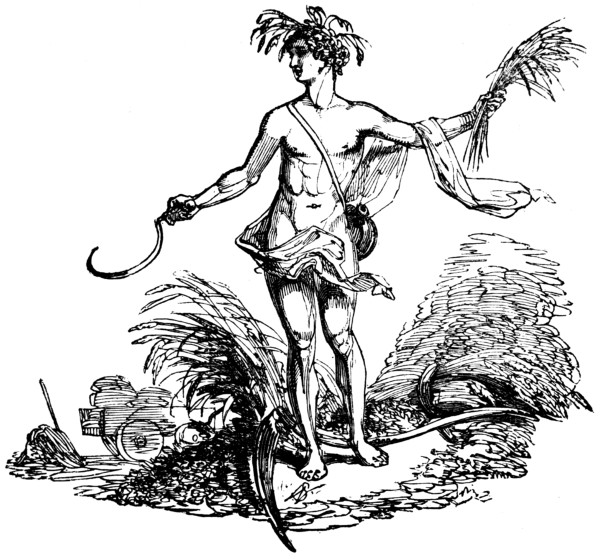
Summer.
Now cometh welcome Summer with great strength, Joyously smiling in high lustihood, Conferring on us days of longest length, For rest or labour, in town, field, or wood; Offering, to our gathering, richest stores Of varied herbage, corn, cool fruits, and flowers, As forth they rise from Nature’s open pores, To fill our homesteads, and to deck our bowers; Inviting us to renovate our health By recreation; or, by ready hand, And calculating thought, t’ improve our wealth: And so, invigorating all the land, And all the tenantry of earth or flood, Cometh the plenteous Summer—full of good.
*
“How beautiful is summer,” says the elegant author of Sylvan Sketches, a volume that may be regarded as a sequel to the Flora Domestica, from the hand of the same lady.—“How beautiful is summer! the trees are heavy with fruit and foliage; the sun is bright and cheering in the morning; the shade of broad and leafy boughs is refreshing at noon; and the calm breezes of the evening whisper gently through the leaves, which reflect the liquid light of the moon when she is seen—
———— “lifting her silver rim Above a cloud, and with a gradual swim Coming into the blue with all her light.”
On page 337 of the present work, there is the spring dress of our ancestors in the fourteenth century, from an illumination in a manuscript copied by Strutt. From the same illumination, their summer dress in that age is here represented.
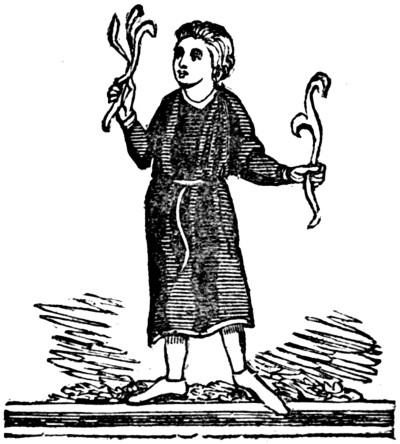
LONGEST DAY.
No day is disadvantageous to an agreeable thought or two upon “Time;” and the present, being the longest day, is selected for submitting to perusal a very pleasant little apologue from a miscellany addressed to the young. The object of the writer was evidently to do good, and it is hoped that its insertion here, in furtherance of the purpose, may not be less pleasing to the editor who first introduced it to the public eye, than it will be found by the readers of the Every-Day Book. This is the tale.
THE DISCONTENTED PENDULUM.
An old clock, that had stood for fifty years in a farmer’s kitchen, without giving its owner any cause of complaint, early one summer’s morning, before the family was stirring, suddenly stopped.
Upon this, the dial-plate (if we may credit the fable,) changed countenance with alarm; the hands made a vain effort to continue their course; the wheels remained motionless with surprise; the weights hung speechless; each member felt disposed to lay the blame on the others. At length the dial instituted a formal inquiry as to the cause of the stagnation, when hands, wheels, weights, with one voice protested their innocence. But now a faint tick was heard below from the pendulum, who thus spoke:—
“I confess myself to be the sole cause of the present stoppage; and I am willing, for the general satisfaction, to assign my reasons. The truth is, that I am tired of ticking.” Upon hearing this, the old clock became so enraged, that it was on the very point of striking.
“Lazy wire!” exclaimed the dial-plate, holding up its hands.—“Very good,” replied the pendulum: “it is vastly easy for you, Mistress Dial, who have always, as every body knows, set yourself up above me,—it is vastly easy for you, I say, to accuse other people of laziness! You, who have had nothing to do all the days of your life but to stare people in the face, and to amuse yourself with watching all that goes on in the kitchen! Think, I beseech you, how you would like to be shut up for life in this dark closet, and to wag backwards and forwards, year after year, and do.”—“As to that,” said the dial, “Is there not a window in your house, on purpose for you to look through?”
“For all that,” resumed the pendulum, “it is very dark here: and, although there is a window, I dare not stop, even for an instant, to look out at it. Besides, I am really tired of my way of life; and, if you wish, I’ll tell you how I took this disgust at my employment. I happened this morning to be calculating how many times I should have to tick in the course only of the next twenty-four hours: perhaps some of you above there can give me the exact sum.”
The minute hand, being quick at figures, presently replied, “Eighty-six thousand four hundred times.”
“Exactly so,” replied the pendulum; “well, I appeal to you all, if the very thought of this was not enough to fatigue one; and when I began to multiply the strokes of one day by those of months and years, really it is no wonder if I felt discouraged at the prospect; so, after a great deal of reasoning and hesitation, thinks I to myself, I’ll stop.”
The dial could scarcely keep its countenance during this harangue; but, resuming its gravity, thus replied:—
“Dear Mr. Pendulum, I am really astonished that such a useful, industrious person as yourself should have been overcome by this sudden notion. It is true you have done a great deal of work in your time; so have we all, and are likely to do; which, although it may fatigue us to think of, the question is, whether it will fatigue us to do. Would you now do me the favour to give about half a dozen strokes, to illustrate my argument?”
The pendulum complied, and ticked six times at its usual pace.—“Now,” resumed the dial, “may I be allowed to inquire, if that exertion was at all fatiguing or disagreeable to you?”
“Not in the least,” replied the pendulum; “it is not of six strokes that I complain, nor of sixty, but of millions.”
“Very good,” replied the dial; “but recollect, that though you may think of a million strokes in an instant, you are required to execute but one; and that, however often you may hereafter have to swing, a moment will always be given you to swing in.”
“That consideration staggers me, I confess,” said the pendulum. “Then I hope,” resumed the dial-plate, “we shall all immediately return to our duty; for the maids will lie in bed till noon, if we stand idling thus.”
Upon this the weights, who had never been accused of light conduct, used all their influence in urging him to proceed; when, as with one consent, the wheels began to turn, the hand began to move, the pendulum began to swing, and, to its credit, ticked as loud as ever; while a red beam of the rising sun, that streamed through a hole in the kitchen shutter, shining full upon the dial-plate, it brightened up as if nothing had been the matter.
When the farmer came down to breakfast that morning, upon looking at the clock, he declared that his watch had gained half-an-hour in the night.
A celebrated modern writer says, “take care of the minutes, and the hours will take care of themselves.” This is an admirable remark, and might be very seasonably recollected when we begin to be “weary in well-doing,” from the thought of having much to do. The present moment is all we have to do with in any sense; the past is irrecoverable; the future is uncertain; nor is it fair to burthen one moment with the weight of the next. Sufficient unto the moment is the trouble thereof. If we had to walk a hundred miles, we should still have to set but one step at a time, and this process continued would infallibly bring us to our journey’s end. Fatigue generally begins, and is always increased, by calculating in a minute the exertion of hours.
Thus, in looking forward to future life, let us recollect that we have not to sustain all its toil, to endure all its sufferings, or encounter all its crosses at once. One moment comes laden with its own little burthens, then flies, and is succeeded by another no heavier than the last; if one could be borne, so can another, and another.
Even in looking forward to a single day, the spirit may sometimes faint from an anticipation of the duties, the labours, the trials to temper and patience that may be expected. Now, this is unjustly laying the burthen of many thousand moments upon one. Let any one resolve always to do right now, leaving then to do as it can; and if he were to live to the age of Methusalem, he would never do wrong. But the common error is to resolve to act right after breakfast, or after dinner, or to-morrow morning, or next time; but now, just now, this once, we must go on the same as ever.
It is easy, for instance, for the most ill-tempered person to resolve, that the next time he is provoked he will not let his temper overcome him; but the victory would be to subdue temper on the present provocation. If, without taking up the burthen of the future, we would always make the single effort at the present moment, while there would, at any time, be very little to do, yet, by this simple process continued, every thing would at last be done.
It seems easier to do right to-morrow than to-day, merely because we forget, that when to-morrow comes, then will be now. Thus life passes with many, in resolutions for the future, which the present never fulfils.
It is not thus with those, who, “by patient continuance in well-doing, seek for glory, honour, and immortality:” day by day, minute by minute, they execute the appointed task to which the requisite measure of time and strength is proportioned: and thus, having worked while it was called day, they at length rest from their labours, and their “works follow them.”
Let us then, “whatever our hands find to do, do it with all our might, recollecting that now is the proper and accepted time.”[179]
June 22.
St. Paulinus, Bp. of Nola, A. D. 431. St. Alban, Proto-Martyr of Britain, A. D. 303.
American Newspapers.
The following singular advertisement, appeared in the “Connecticut Courant,” of June 2, 1784.
Take Notice, Debtors For Newspapers to the Subscriber.
This is the last time of asking in this way; all those who settle their accounts by the 18th of June, instant, will have the thanks of their humble servant; and those that neglect, will find their accounts in the hands of some person, who will collect them in a more fashionable way, but more expensive.
James Johnson.
FLORAL DIRECTORY.
Canterbury Bells. Campanula Medium. Dedicated to St. Paulinus.
June 23.
St. Etheldreda, or Audry, A. D. 679. St. Mary of Oignies, A. D. 1213.
Midsummer—The Bonfire.
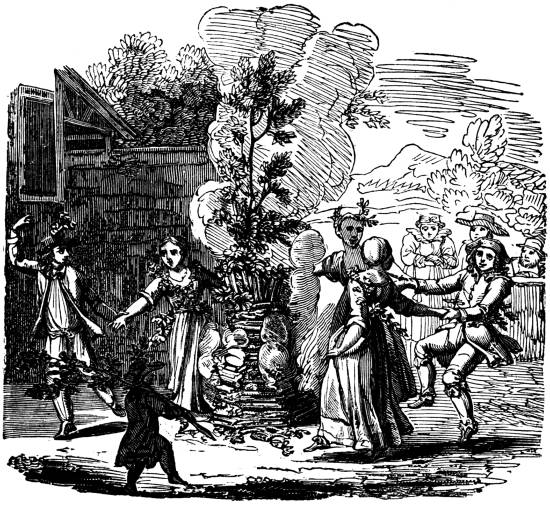
Midsummer—The Bonfire.
This engraving represents a rejoicing formerly common to this season; it is from a French print, inscribed “Le Feu de St. Jean Mariette ex.”
The summer solstice has been celebrated throughout all ages by the lighting up of fires, and hence on “St. John’s eve,” or the vigil of the festival of St. John the Baptist, there have been popular ceremonials of this kind from the earliest times of the Romish church to the present. Before, however, particularizing any of these celebrations, it may be worth while to notice the following practice, which is still maintained.
Midsummer Eve, in Ireland.
At Stoole, near Downpatrick, in the north of Ireland, there is a ceremony commencing at twelve o’clock at night on every Midsummer-eve.—Its sacred mount is consecrated to St. Patrick: the plain contains three wells, to which the most extraordinary virtues are attributed. Here and there are heaps of stones, around some of which appear great numbers of people running with as much speed as possible; around others, crowds of worshippers kneel with bare legs and feet as an indispensable part of the penance. The men, without coats, with handkerchiefs on their heads instead of hats, having gone seven times round each heap, kiss the ground, cross themselves, and proceed to the hill; here they ascend on their bare knees, by a path so steep and rugged that it would be difficult to walk up: many hold their hands clasped at the back of their necks, and several carry large stones on their heads. Having repeated this ceremony seven times, they go to what is called St. Patrick’s chair, which are two great flat stones fixed upright in the hill; here they cross and bless themselves as they step in between these stones, and while repeating prayers, an old man, seated for the purpose, turns them round on their feet three times, for which he is paid; the devotee then goes to conclude his penance at a pile of stones named the altar. While this busy scene of superstition is continued by the multitude, the wells, and streams issuing from them, are thronged by crowds of halt, maimed, and blind, pressing to wash away their infirmities with water consecrated by their patron saint; and so powerful is the impression of its efficacy on their minds, that many of those who go to be healed, and who are not totally blind, or altogether crippled, really believe for a time that they are by means of its miraculous virtues perfectly restored. These effects of a heated imagination are received as unquestionable miracles, and are propagated with abundant exaggeration.[180]
The annual resort of the ignorant portion of our Roman Catholic countrymen, was never so numerously attended as it has been during the late anniversary of this festival, in 1825. The extent of the number of strangers from very remote parts of the country was unprecedented. The usual ablutions, penances, and miraculous results, were performed, and attested by the devotees, who experienced some disappointment in not having the accustomed arch-officiater to consummate the observances by thrice revolving the votary in the chair of St. Patrick. This deprivation, it is said, marks the sense of a dignitary of the church respecting this annual ceremony.[181]
Ancient Custom of SETTING THE WATCH IN LONDON on St. John’s Eve.
The curfew-bell, commanded by William Conquerour to be nightly rung at eight of the clock, as a warning, or command, that all people should then put out their fires and lights, was continued throughout the realm till the time of Henry the First, when Stow says, that it followed, “by reason of warres within the realme, that many men gave themselves to robbery and murders in the night.” Stow then recites from an ancient chronicler, Roger Hoveden, that in the yeare 1175, during the time of a council held at Nottingham, a brother of the earle Ferrers, was “in the night privily slaine at London, and thrown out of his inne into the durty street; when the king understood thereof he sware that he would be revenged on the citizens. It was then a common practice in this city, that a hundred or more in a company, young and old, would make nightly invasions upon houses of the wealthy, to the intent to rob them; and if they found any man stirring in the city within the night, that were not of their crue, they would presently murder him: insomuch, that when night was come, no man durst adventure to walk in the streets. When this had continued long, it fortuned, that a crue of young and wealthy citizens assembling together in the night, assaulted a stone house of a certaine rich man, and breaking through the wall, the good man of that house having prepared himself with other in a corner, when hee perceived one of the theeves, named Andrew Bucquint, to lead the way, with a burning brand in the one hand, and a pot of coles in the other, which hee assaied to kindle with the brand, he flew upon him, and smote off his right hand, and then with a loud voyce cryed ‘theeves.’ At the hearing whereof, the theeves took their flight, all saving he that had lost his hand, whom the good man (in the next morning) delivered to Richard de Lucie, the king’s justice. This theefe, upon warrant of his life, appeached his confederates, of whom many were taken, and many were fled. Among the rest that were apprehended, a certaine citizen of great countenance, credit, and wealth, named John Senex, who for as much he could not acquit himselfe by the water-doome (as that law was then tearmed) hee offered to the king five hundred pounds of silver for his life. But forasmuch as he was condemned by judgement of the water, the king would not take the offer, but commanded him to be hanged on the gallowes, which was done, and then the city became more quiet for a long time after.”
It appears that the city of London was subject to these disorders till 1253, when Henry III. commanded watches to be kept in the cities, and borough towns, for the preservation of the peace; and this king further ordained “that if any man chanced to be robbed, or by any means damnified, by any theefe or robber, he to whom the charge of keeping that county, city, or borough, chiefly appertained, where the robbery was done, should competently restore the losse.”
This origin of the present nightly watch in London was preceded by other popular customs, or they rather, it may be said, assisted in its formation. “In the months of June and July, on the vigils of festivall dayes, and on the same festivall dayes in the evenings, after the sun-setting, there were usually made bone-fires in the streets, every man bestowing wood or labour towards them. The wealthier sort also before their doores, neere to the said bone-fires, would set out tables on the vigils, furnished with sweete bread, and good drinke, and on the festivall dayes with meats and drinkes plentifully, whereunto they would invite their neighbours and passengers also to sit, and be merry with them in great familiarity, praysing God for his benefits bestowed on them. These were called bone-fires, as well of amity amongst neighbours, that being before at controversie, were there by the labour of others reconciled, and made of bitter enemies, loving friends; as also for the vertue that a great fire hath, to purge the infection of the ayre.
“On the vigil of St. John Baptist, and on Sts. Peter and Paul the apostles, every man’s doore being shaddowed with greene birch, long fennel, St. John’s wort, orpin, white lilies, and such like, garnished upon with garlands of beautifull flowers, had also lamps of glasse, with oyle burning in them all the night; some hung out branches of iron curiously wrought, containing hundreds of lamps lighted at once, which made a goodly shew, namely in new Fish-street, Thames-street, &c.
“Then had ye, besides the standing watches, all in bright harnesse, in every ward and street of this city and suburbs, a marching watch, that passed through the principall streets thereof, to wit, from the little conduit by Paul’s gate, through West Cheape, by the Stocks, through Cornehill, by Leadenhall to Aldgate, then backe down Fen-church-street, by Grasse-church, about Grasse-church conduit, and up Grasse-church-street into Cornhill, and through it into West Cheape again, and so broke up.
“The whole way ordered for this marching watch, extended to three thousand two hundred taylors’ yards of assize; for the furniture whereof with lights, there were appointed seven hundred cressets, five hundred of them being found by the companies, the other two hundred by the chamber of London. Besides the which lights, every constable in London, in number more than two hundred and forty, had his cresset: the charge of every cresset was in light two shillings foure pence, and every cresset had two men, one to beare or hold it, another to beare a bag with light, and to serve it: so that the poore men pertaining to the cressets, taking wages, (besides that every one had a strawen hat, with a badge painted, and his breakfast in the morning,) amounted in number to almost two thousand.
“The marching watch contained in number two thousand men, part of them being old souldiers, of skill to bee captaines, lieutenants, serjeants, corporals, &c. wifflers, drummers, and fifes, standard and ensigne-bearers, sword-players, trumpeters on horsebacke, demilaunces on great horses, gunners with hand-guns, or halfe hakes, archers in cotes of white fustian, signed on the breste and backe with the armes of the city, their bowes bent in their hands, with sheafes of arrowes by their sides, pike-men in bright corslets, burganets, &c., holbards, the like billmen in almaine rivets, and aperns of mayle in great number.
“There were also divers pageants, and morris dancers attendant on the setting of this marching watch. The constables, were divided into two parties; one halfe consisting of one hundred and twenty, were appointed on St. John’s eve, the other halfe on St. Peter’s eve.” They were “in bright harnesse, some over-gilt, and every one a jornet of scarlet thereupon and a chaine of gold, his hench-man following him, his minstrels before him, and his cresset light passing by him.” In the procession were “the waytes of the city, the maiors officers, for his guard before him, all in a livery of wosted, or say jackets, party coloured; the maior himselfe well mounted on horseback, the sword-bearer before him in faire armour, well mounted also, the maiors foot-men, and the like torch-bearers about him; hench-men twaine, upon great stirring horses following him. The sheriffes watches came one after the other in like order, but not so large in number as the maiors: for whereas the maior had, besides his giant, three pageants, each of the sheriffes had, besides their giants, but two pageants; each their morris-dance, and one hench-man, their officers in jackets of wosted, or say, party-coloured, differing from the maiors, and each from other, but having harnessed men a great many, &c. This Midsummer watch was thus accustomed yeerely, time out of minde, untill the yeere 1539, the thirty-first of Henry the Eighth, in which yeere, on the eighth of May, a great muster was made by the citizens at the Miles end, all in bright harnesse, with coats of white silke or cloth, and chaines of gold, in three great battels, to the number of fifteen thousand, which passed thorow London to Westminster, and so through the sanctuary, and round about the parke of St. James, and returned home thorow Oldborne.”
In that year, 1539, king Henry VIII. forbid this muster of armed men, and prohibited the marching watch altogether, and it was disused “til the yeere 1548.” When sir John Gresham, then lord mayor, revived the marching watch, both on the eve of St. John the baptist, and of St. Peter the apostle, and set it forth, in order as before had been accustomed; “which watch was also beautified by the number of more than three hundred demilances and light-horsemen, prepared by the citizens to be sent into Scotland, for the rescue of the town of Haddington.” After that time the marching watch again fell into disuse; yet, in the year 1585, “a booke was drawne by a grave citizen, (John Mountgomery,) and by him dedicated to sir Tho. Pullison, then l. maior, and his brethren the aldermen, containing the manner and order of a marching watch in the citie, upon the evens accustomed; in commendation whereof, namely, in times of peace to be used, he hath words to this effect: ‘The artificers of sundry sorts were thereby well set aworke, none but rich men charged, poor men helped, old souldiers, trumpeters, drummers, fifes, and engine-bearers, with such like men meet for the prince’s service, kept in use, wherein the safety and defence of every common-weale consisteth. Armour and weapons being yeerely occupied in this wise, the citizens had of their owne readily prepared for any neede, whereas, by intermission hereof, armorers are out of worke, souldiers out of use, weapons overgrowne with foulnesse, few or none good being provided,’” &c. Notwithstanding these plausible grounds, the practice was discontinued.
There can be little doubt that so great an array of armed citizens, was not only viewed with distrust by the government, but had become of so great charge to the corporation, that it was found mutually convenient to substitute a less expensive and less warlike body to watch and ward the city’s safety. The splendour wherein it was annually set forth was, however, a goodly sight, and attracted the curiosity of royalty itself, for we find that on St. John’s eve, in 1510, king Henry VIII. came to the King’s-head, in Cheap, in the livery of a yeoman of the guard, with a halbert on his shoulder, and there, in that disguise, beheld the watch till it had passed, and was so gratified with the show, that “on St. Peter’s night next following, he and the queen came royally riding to the sayd place, and there, with their nobles, beheld the watch of the city, and returned in the morning.”[182] In 1519, Christern, king of Denmark, and his queen, being then in England, were conducted to the King’s-head, in Cheap, there to see the watch.
On taking leave of the old London watch, on St. John’s eve, a remark or two may be made respecting their lights.
The Cresset.
Concerning the cressets or lights of the watch, this may be observed by way of explanation.
The cresset light was formed of a wreathed rope smeared with pitch, and placed in a cage of iron, like a trivet suspended on pivots, in a kind of fork; or it was a light from combustibles, in a hollow pan. It was rendered portable by being placed on a pole, and so carried from place to place. Mr. Douce, in his “Illustrations of Shakspeare,” gives the following four representations from old prints and drawings of
CRESSETS.
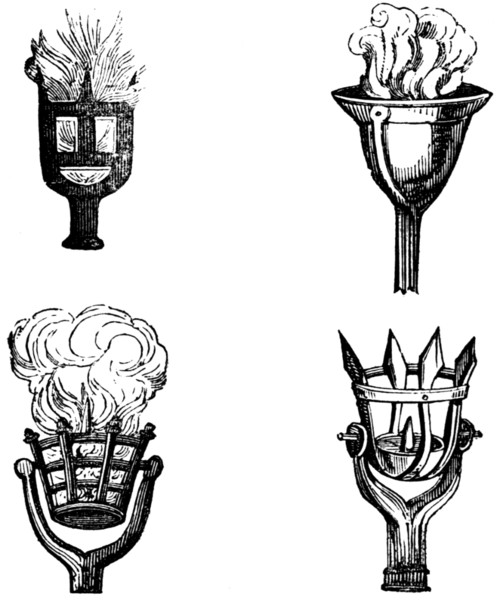
Lamps in the Old Streets, AND ALSO CARRIED BY THE Marching Watch of London.
Mr. Douce imagines the word cresset to have been derived from the French word croiset, a cruet or earthen pot.
When the cresset light was stationary it served as a beacon, or answered the purpose of a fixed lamp, and in this way our ancestors illuminated or lighted up their streets. There is a volume of sermons, by Samuel Ward, printed 1617-24, with a wood-cut frontispiece, representing two of these fixed cressets or street-lamps, with verses between them, in relation to his name and character, as a faithful watchman. In the first lines old Ward is addressed thus:—
“Watch Ward, and keepe thy Garments tight, For I come thiefe-like at Midnight.”
Whereto Ward answers the injunction, to watch, in the lines following:—
“All-seeing, never-slumbering Lord; Be thou my Watch, Ile be thy Ward.”
Ward’s “lamp, or beacon,” is transferred from his frontispiece to the next column, in order to show wherein our ancient standing lamps differed from the present.
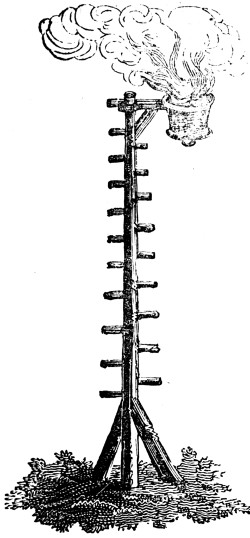
An Old Beacon, OR Standing Lamp.
It will be seen from this engraving that the person, whose business it was to “watch” and trim the lamp, did not ascend for that purpose by a ladder, as the gas-lighters do our gas-lamps, or as the lamp-lighter did the oil-lamps which they superseded, but by climbing the pole, hand and foot, by means of the projections on each side.
St. John’s Eve Watch at Nottingham.
The practice of setting the watch, at Nottingham, on St. John’s eve, was maintained until the reign of Charles I., the manner whereof is thus described:—
“In Nottingham, by an ancient custom, they keep yearly a general watch every Midsummer eve at night, to which every inhabitant of any ability sets forth a man, as well voluntaries as those who are charged with arms, with such munition as they have; some pikes, some muskets, calivers, or other guns, some partisans, holberts, and such as have armour send their servants in their armour. The number of these are yearly almost two hundred, who, at sun-setting, meet on the Row, the most open part of the town, where the mayor’s serjeant at mace gives them an oath, the tenor whereof followeth, in these words: “They shall well and truly keep this town till to-morrow at the sun-rising; you shall come into no house without license, or cause reasonable. Of all manner of casualties, of fire, of crying of children, you shall due warning make to the parties, as the case shall require you. You shall due search make of all manner of affrays, bloud-sheds, outcrys, and of all other things that be suspected,” &c. Which done, they all march in orderly array through the principal parts of the town, and then they are sorted into several companies, and designed to several parts of the town, where they are to keep the watch until the sun dismiss them in the morning. In this business the fashion is for every watchman to wear a garland, made in the fashion of a crown imperial, bedeck’d with flowers of various kinds, some natural, some artificial, bought and kept for that purpose; as also ribbans, jewels, and, for the better garnishing whereof, the townsmen use the day before to ransack the gardens of all the gentlemen within six or seven miles about Nottingham, besides what the town itself affords them, their greatest ambition being to outdo one another in the bravery of their garlands.”[183] So pleasant a sight must have been reluctantly parted with; and accordingly in another place we find that this Midsummer show was held at a much later period than at Nottingham, and with more pageantry in the procession.
St. John’s Eve Watch at Chester.
The annual setting of the watch on St. John’s eve, in the city of Chester, was an affair of great moment. By an ordinance of the mayor, aldermen, and common councilmen of that corporation, dated in the year 1564, and preserved among the Harleian MSS. in the British Museum, a pageant which is expressly said to be “according to ancient custom,” is ordained to consist of four giants, one unicorn, one dromedary, one camel, one luce, one dragon, and six hobby-horses with other figures. By another MS. in the same library it is said, that Henry Hardware, Esq., the mayor, in 1599, caused the giants in the Midsummer show to be broken, “and not to goe the devil in his feathers;” and it appears that he caused a man in complete armour to go in their stead: but in the year 1601, John Ratclyffe, beer-brewer, being mayor, set out the giants and Midsummer show as of old it was wont to be kept. In the time of the commonwealth the show was discontinued, and the giants with the beasts were destroyed.
At the restoration of Charles II., the citizens of Chester replaced their pageant, and caused all things to be made new, because the old models were broken. According to the computation, the four great giants were to cost five pounds a-piece, at the least, and the four men to carry them were to have two shillings and six-pence each; the materials for constructing them were to be hoops of various sizes, deal boards, nails, pasteboard, scaleboard, paper of various sorts, buckram, size-cloth, and old sheets for their body-sleeves and shirts, which were to be coloured; also tinsel, tinfoil, gold and silver leaf, and colours of various kinds, with glue and paste in abundance. The provision of a pair of old sheets to cover the “father and mother giants,” and three yards of buckram for the mother’s and daughter’s hoods, seems to prove that three of these monstrous pasteboard figures represented females. A desire to preserve them may be inferred from an entry in the bill of charges:—“For arsnick to put into the paste, to save the giants from being eaten by the rats, one shilling and four-pence.” There was an item in the estimate—“For the new making the city mount, called the maior’s mount, as auntiently it was, and for hireing of bays for the same, and a man to carry it, three pounds six shillings and eight-pence.” Twenty-pence was paid to a joiner for cutting pasteboard into several images for the “merchant’s mount,” which being made, “as it aunciently was with a ship to turn round,” cost four pounds, including the hiring of the “bays,” and five men to carry it. The charge for the ship, and new dressing it, was five shillings. Strutt, who sets forth these particulars, conjectures, that the ship was probably made with pasteboard, that material seeming, to him, to have been a principle article in the manufacturing of both these movable mountains. The ship was turned, he says, by means of a swivel, attached to an iron handle underneath the frame; the “bays” was to hang round the bottom of the frames to the ground, and so conceal the bearers. Then there was a new “elephant and castell, and a cupid,” with his bows and arrows, “suitable to it;” the castle was covered with tin foil, and the cupid with skins, so as to appear to be naked, and the charge for these, with two men to carry them, was one pound sixteen shillings and eight-pence. The “four beastes called the unicorne, the antelop, the flower-de-luce (?) and the camell,” cost one pound sixteen shillings and four-pence each, and eight men were paid sixteen shillings to carry them. Four boys for carrying the four hobby-horses, had four shillings, and the hobby-horses cost six shillings and eight-pence each. The charge for the new dragon, with six naked boys to beat at it, was one pound sixteen shillings. Six morris-dancers, with a pipe and tabret, had twenty shillings; and “hance-staves, garlands, and balls, for the attendants upon the mayor and sheriffs cost one pound nineteen shillings.”[184]
These preparations it will be remembered were for the setting forth of the Midsummer-watch at Chester, so late as the reign of Charles II. After relating these particulars, Mr. Strutt aptly observes, that exhibitions of this kind for the diversions of the populace, are well described in a few lines from a dramatic piece, entitled “A pleasant and stately Morall of the Three Lordes of London:”—
—— “Let nothing that’s magnifical, Or that may tend to London’s graceful state, Be unperformed, as showes and solemne feastes, Watches in armour, triumphes, cresset lights, Bonefires, belles, and peales of ordinaunce And pleasure. See that plaies be published, Mai-games and maskes, with mirthe and minstrelsie, Pageants and school-feastes, beares and puppet-plaies.”
Somersetshire Custom.
In the parishes of Congresbury and Puxton, are two large pieces of common land, called East and West Dolemoors, (from the Saxon dal, which signifies a share or portion,) which are divided into single acres, each bearing a peculiar and different mark cut in the turf; such as a horn, four oxen and a mare, two oxen and a mare, a pole-axe, cross, dung-fork, oven, duck’s-nest, hand-reel, and hare’s-tail. On the Saturday before Old-Midsummer, several proprietors of estates in the parishes of Congresbury, Puxton, and Week St. Lawrence, or their tenants, assemble on the commons. A number of apples are previously prepared, marked in the same manner with the before-mentioned acres, which are distributed by a young lad to each of the commoners from a bag or hat. At the close of the distribution each person repairs to his allotment, as his apple directs him, and takes possession for the ensuing year. An adjournment then takes place to the house of the overseer of Dolemoors, (an officer annually elected from the tenants,) where four acres, reserved for the purpose of paying expenses, are let by inch of candle, and the remainder of the day is spent in that sociability and hearty mirth so congenial to the soul of a Somersetshire yeoman.[185]
FLORAL DIRECTORY.
Our Lady’s Slipper. Cypripedium Calceolus. Dedicated to St. Etheldreda.
June 24.
Nativity of St. John the Baptist. The Martyrs of Rome under Nero, A. D. 64. St. Bartholomew.
Midsummer-day.
Nativity of St. John the Baptist.
At Oxford on this day there was lately a remarkable custom, mentioned by the Rev. W. Jones of Nayland, in his “Life of Bishop Horne,” affixed to the bishop’s works. He says, “a letter of July the 25th, 1755, informed me that Mr. Horne according to an established custom at Magdalen-college in Oxford, had begun to preach before the university on the day of St. John the baptist. For the preaching of this annual sermon, a permanent pulpit of stone is inserted into a corner of the first quadrangle; and, so long as the stone pulpit was in use, (of which I have been a witness,) the quadrangle was furnished round the sides with a large fence of green boughs, that the preaching might more nearly resemble that of John the baptist in the wilderness; and a pleasant sight it was: but for many years the custom has been discontinued, and the assembly have thought it safer to take shelter under the roof of the chapel.”