FEBRUARY.
Reading edition
——— Then came cold February, sitting In an old waggon, for he could not ride, Drawne of two fishes, for the season fitting, Which through the flood before did softly slyde And swim away; yet had he by his side His plough and harnesse fit to till the ground, And tooles to prune the trees before the pride Of hasting prime did make them burgeon round.
Spenser.
This month has Pisces or the fishes for its zodiacal sign. Numa, who was chosen by the Roman people to succeed Romulus as their king, and became their legislator, placed it the second in the year, as it remains with us, and dedicated it to Neptune, the lord of waters. Its name is from the Februa, or Feralia, sacrifices offered to the manes of the gods at this season. Ovid in his Fasti attests the derivation:
In ancient times, purgations had the name Of Februa, various customs prove the same; The pontiffs from the rex and flamen crave A lock of wool; in former days they gave To wool the name of Februa. A pliant branch cut from a lofty pine, Which round the temples of the priests they twine, Is Februa called; which if the priest demand, A branch of pine is put into his hand; In short, with whatsoe’er our hearts we hold Are purified, was Februa termed of old; Lustrations are from hence, from hence the name Of this our month of February came; In which the priests of Pan processions made; In which the tombs were also purified Of such as had no dirges when they died; For our religious fathers did maintain Purgations expiated every stain Of guilt and sin; from Greece the custom came, But here adopted by another name; The Grecians held that pure lustrations could Efface an impious deed, or guilt of blood Weak men; to think that water can make clean A bloody crime, or any sinful stain.
Massey’s Ovid.
Our Saxon ancestors, according to Verstegan, “called February Sprout-kele, by kele meaning the kele-wurt, which we now call the colewurt, the greatest pot-wurt in time long past that our ancestors used, and the broth made therewith was thereof also called kele; for before we borrowed from the French the name of potage, and the name of herbe, the one in our owne language was called kele, and the other wurt; and as this kele-wurt, or potage-hearbe, was the chiefe winter-wurt for the sustenance of the husbandman, so was it the first hearbe that in this moneth began to yeeld out wholesome yong sprouts, and consequently gave thereunto the name of Sprout-kele.” The “kele” here mentioned, is the well-known kale of the cabbage tribe. But the Saxons likewise called this month “Solmonath,” which Dr. Frank Sayers in his “Disquisitions” says, is explained by Bede “mensis placentarum,” and rendered by Spelman in an unedited manuscript “pan-cake month,” because in the course of it, cakes were offered by the pagan Saxons to the sun; and “Sol,” or “soul,” signified “food,” or “cakes.”
In “The Months,” by Mr. Leigh Hunt, he remarks that “if February were not the precursor of spring, it would be the least pleasant season of the year, November not excepted. The thaws now take place; and a clammy mixture of moisture and cold succeeds, which is the most disagreeable of wintry sensations.” Yet so variable is our climate, that the February of 1825 broke in upon the inhabitants of the metropolis with a day or two of piercing cold, and realized a delightful description of January sparkled from the same pen. “What can be more delicately beautiful than the spectacle which sometimes salutes the eye at the breakfast-room window, occasioned by the hoar-frost dew? If a jeweller had come to dress every plant over night, to surprise an Eastern sultan, he could not produce any thing like the ‘pearly drops,’ or the ‘silvery plumage.’ An ordinary bed of greens, to those who are not at the mercy of their own vulgar associations, will sometimes look crisp and corrugated emerald, powdered with diamonds.”
THE SEASON.
Sunk in the vale, whose concave depth receives The waters draining from these shelvy banks When the shower beats, yon pool with pallid gleam Betrays its icy covering. From the glade Issuing in pensive file, and moving slow, The cattle, all unwitting of the change, To quench their customary thirst advance. With wondering stare and fruitless search they trace The solid margin: now bend low the head In act to drink; now with fastidious nose Snuffing the marble floor, and breathing loud, From the cold touch withdraw. Awhile they stand In disappointment mute; with ponderous feet Then bruise the surface: to each stroke the woods Reply; forth gushes the imprisoned wave.
February 1.
St. Ignatius. St. Pionius, A. D. 250. St. Bridget. St. Kinnia. St. Sigebert II. King.
St. Bridget.
St. Bride, otherwise St. Bridget, confers her name upon the parish of St. Bride’s, for to her its church in Fleet-street is dedicated. Butler says she was born in Ulster, built herself a cell under a large oak, thence called Kill-dara, or cell of the oak, was joined by others of her own sex, formed several nunneries, and became patroness of Ireland. “But,” says Butler, “a full account of her virtues has not been transmitted down to us, together with the veneration of her name;” yet he declares that “her five modern lives mention little else but wonderful miracles.” According to the same author, she flourished in the beginning of the sixth century, her body was found in the twelfth century, and her head “is now kept in the church of the Jesuits at Lisbon.” This writer does not favour us with any of her miracles, but bishop Patrick mentions, that wild ducks swimming in the water, or flying in the air, obeyed her call, came to her hand, let her embrace them, and then she let them fly away again. He also found in the breviary of Sarum, that when she was sent a-milking by her mother to make butter, she gave away all the milk to the poor; that when the rest of the maids brought in their milk she prayed, and the butter multiplied; that the butter she gave away she divided into twelve parts, “as if it were for the twelve apostles; and one part she made bigger than any of the rest, which stood for Christ’s portion; though it is strange,” says Patrick, “that she forget to make another inequality by ordering one portion more of the butter to be made bigger than the remaining ones in honour of St. Peter, the prince of the apostles.”
BURIAL OF ALLELUIA.
In Mr. Fosbroke’s “British Monarchism,” the observation of this catholic ceremony is noticed as being mentioned in “Ernulphus’s Annals of Rochester Cathedral,” and by Selden. From thence it appears to have taken place just before the octaves of Easter. Austin says, “that it used to be sung in all churches from Easter to Pentecost, but Damasus ordered it to be performed at certain times, whence it was chanted on Sundays from the octaves of Epiphany to Septuagesima, and on the Sundays from the octaves of Pentecost and Advent. One mode of burying the Alleluia was this: in the sabbath of the Septuagesima at Nones, the choristers assembled in the great vestiary, and there arranged the ceremony. Having finished the last ‘Benedicamus,’ they advanced with crosses, torches, holy waters, and incense, carrying a turf (Glebam) in the manner of a coffin, passed through the choir and went howling to the cloister, as far as the place of interment; and then having sprinkled the water, and censed the place, returned by the same road. According to a story (whether true or false) in one of the churches of Paris, a choir boy used to whip a top, marked with Alleluia, written in golden letters, from one end of the choir to the other. In other places Alleluia was buried by a serious service on Septuagesima Sunday.”
FLORAL DIRECTORY.
Lesser Water Moss. Fontinalis minor. Dedicated to St. Ignatius. Bay. Laurus nobilis. Dedicated to St. Bridget.
February 2.
Holiday at the Public Offices, except Excise, Stamps, and Customs.
The Purification. St. Laurence, Archbishop of Canterbury, A. D. 619.
CANDLEMAS DAY.
This being the festival which catholics call the Purification of the virgin, they observe it with great pomp. It stands as a holiday in the calendar of the church of England. Naogeorgus thus introduces the day; or rather Barnaby Googe, in his translation of that author’s, “Popish Kingdom:”
“Then comes the Day wherein the Virgin offred Christ unto The Father chiefe, as Moyses law commaunded hir to do. Then numbers great of Tapers large, both men and women beare To Church, being halowed there with pomp, and dreadful words to heare. This done, eche man his Candell lightes where chiefest seemeth hee, Whose Taper greatest may be seene and fortunate to bee; Whose Candell burneth cleare and bright, a wondrous force and might Doth in these Candels lie, which if at any time they light, They sure beleve that neyther storme or tempest dare abide, Nor thunder in the skies be heard, nor any Devil’s spide, Nor fearefull sprites that walke by night, nor hurts of frost or haile.”—
According to “The Posey of Prayers, or the Key of Heaven,” it is called Candlemas, because before mass is said this day, the church blesses her candles for the whole year, and makes a procession with hallowed or blessed candles in the hands of the faithful.
From catholic service-books, quoted in “Pagano Papismus,” some particulars are collected concerning the blessing of the candles. Being at the altar, the priest says over them several prayers; one of which commences thus: “O Lord Jesu Christ, who enlightenest every one that cometh into the world, pour out thy benediction upon these Candles, and sanctifie them with the light of thy grace,” &c. Another begins: “Holy Lord, Father Almighty, Everlasting God, who hast created all things of nothing, and by the labour of bees caused this liquor to come to the perfection of a wax candle; we humbly beseech thee, that by the invocation of thy most holy name, and by the intercession of the blessed virgin, ever a virgin, whose festivals are this day devoutly celebrated, and by the prayers of all thy saints, thou wouldst vouchsafe to bless and sanctifie these candles,” &c. Then the priest sprinkles the candles thrice with holy water, saying “Sprinkle me with,” &c. and perfumes them thrice with incense. One of the consecratory prayers begins: “O Lord Jesu Christ, bless this creature of wax to us thy suppliants; and infuse into it, by the virtue of the holy cross, thy heavenly benediction; that in whatsoever places it shall be lighted, or put, the devil may depart, and tremble, and fly away, with all his ministers, from those habitations, and not presume any more to disturb them,” &c. There is likewise this benediction: “I bless thee, O wax, in the name of the holy trinity, that thou may’st be in every place the ejection of Satan, and subversion of all his companions,” &c. During the saying of these prayers, various bowings and crossings are interjected; and when the ceremonies of consecration are over, the chiefest priest goes to the altar, and he that officiates receives a candle from him; afterwards, that priest, standing before the altar towards the people, distributes the candles, first to the priest from whom he received a candle, then to others in order, all kneeling (except bishops) and kissing the candle, and also kissing the hand of the priest who delivers it. When he begins to distribute the candles, they sing, “A light to lighten the gentiles, and the glory of thy people Israel.” After the candles are distributed, a solemn procession is made; in which one carries a censer, another a crucifix, and the rest burning candles in their hands.
The practice is treated of by Butler in his notice of the festival under this head, “On blessing of Candles and the Procession.” It is to be gathered from him that “St. Bernard says the procession was first made by St. Joseph, Simeon, and Anne, as an example to be followed by all the earth, walking two and two, holding in their hands candles, lighted from fire, first blessed by the priests, and singing.” The candle-bearing has reference to Simeon’s declaration in the temple when he took Jesus in his arms, and affirmed that he was a light to lighten the gentiles, and the glory of Israel. This was deemed sufficient ground by the Romish church, whereon to adopt the torch-bearing of the pagans in honour of their own deities, as a ceremony in honour of the presentation of Jesus in the temple. The pagans used lights in their worship, and Constantine, and other emperors, endowed churches with land and various possessions, for the maintenance of lights in catholic churches, and frequently presented the ecclesiastics with coffers full of candles and tapers. Mr. Fosbroke shows, from catholic authorities, that light-bearing on Candlemas day is an old Pagan ceremony; and from Du Cange, that it was substituted by pope Gelasius for the candles, which in February the Roman people used to carry in the Lupercalia.
Pope Innocent, in a sermon on this festival, quoted in “Pagano Papismus,” inquires, “Why do we (the catholics) in this feast carry candles?” and then he explains the matter by way of answer. “Because,” says he, “the gentiles dedicated the month of February to the infernal gods, and as, at the beginning of it, Pluto stole Proserpine, and her mother, Ceres, sought her in the night with lighted candles, so they, at the beginning of this month, walked about the city with lighted candles; because the holy fathers could not utterly extirpate this custom, they ordained that Christians should carry about candles in honour of the blessed virgin Mary: and thus,” says the pope, “what was done before to the honour of Ceres is now done to the honour of the Virgin.”
Polydore Vergil, observing on the pagan processions and the custom of publicly carrying about images of the gods with relics, says, “Our priests do the same thing. We observe all these ceremonies, but I know not whether the custom is as good as it is showy; I fear, I fear, I say, that in these things, we rather please the gods of the heathen than Jesus Christ, for they were desirous that their worshippers should be magnificent in their processions, as Sallust says; but Christ hates nothing more than this, telling us, When thou prayest, enter into thy closet, and when thou hast shut thy door pray to thy Father. What will then become of us, if we act contrary to his commandment? Surely, whatever may become of us, we do act contrary to it.”
Brand shows, from “Dunstan’s Concord of Monastic Rules,” that the monks went in surplices to the church for candles, which were to be consecrated, sprinkled with holy water, and censed by the abbot. Every monk took a candle from the sacrist, and lighted it. A procession was made, thirds and mass were celebrated, and the candles, after the offering, were offered to the priest. The monks’ candles signified the use of those in the parable of the wise virgins.
In catholic countries the people joined the priests in their public processions to the churches, every individual bearing a burning candle, and the churches themselves blazed with supernumerary illuminations at mid-day.
It is to be noted, that from Candlemas the use of tapers at vespers and litanies, which prevailed throughout the winter, ceased until the ensuing All Hallow Mass; and hence the origin of an old English proverb in Ray’s Collection—
“On Candlemas-day Throw candle and candlestick away.”
Candlemas candle-carrying remained in England till its abolition by an order in council, in the second year of king Edward VI.
The “Golden Legend” relates, that a lady who had given her mantle to a poor man for the love of our lady, would not go to church on Candlemas-day, but went into her own private chapel, and kneeling before the altar, fell asleep, and had a miraculous vision, wherein she saw herself at church. Into this visionary church she imagined that a troop of virgins came, with a noble virgin at their head, “crowned ryght precyously,” and seated themselves in order; then a troop of young men, who seated themselves in like order; then one, with a proper number of candles, gave to each a candle, and to the lady herself he gave a candle of wax; then came St. Laurence as a deacon, and St. Vincent as a sub-deacon, and Jesus Christ as the priest, and two angels bearing candles; then the two angels began the Introit of the mass, and the virgins sung the mass; then the virgins went and each offered the candle to the priest, and the priest waited for the lady to offer her candle; then “the glorious quene of virgyns” sent to her to say that she was not courteous to make the priest tarry so long for her, and the lady answered that the priest might go on with the mass, for she should keep her candle herself, and not offer it; and the virgin sent a second time, and the lady said she would not offer the candle; then “the quene of virgyns” said to the messenger, “Pray her to offer the candle, and if she will not, take it from her by force;” still she would not offer the candle, and therefore the messenger seized it; but the lady held so fast and long, and the messenger drew and pulled so hard, that the candle broke, and the lady kept half. Then the lady awoke, and found the piece of candle in her hand; whereat she marvelled, and returned thanks to the glorious virgin, who had not suffered her to be without a mass on Candlemas-day, and all her life kept the piece of candle for a relic; and all they that were touched therewith were healed of their maladies and sicknesses.
Poetry is the history of ancient times. We know little of the times sung by Homer but from his verses. To Herrick we must confess our obligation for acquaintance with some of the manners pertaining to this “great day in the calendar.” Perhaps, had he not written, we should be ignorant that our forefathers fared more daintily during the Christmas holidays than at other seasons; be unaware of the rule for setting out the due quantum of time, and orderly succession, to Christmas ever-greens; and live, as most of us have lived, but ought not to live longer, without being informed, that the Christmas-log may be burnt until this day, and must be quenched this night till Christmas comes again.
Candlemas Eve.
End now the white-loafe and the pye, And let all sports with Christmas dye. *** Kindle the Christmas Brand, and then Till sunne-set let it burne, Which quencht, then lay it up agen, Till Christmas next returne. Part must be kept wherewith to teend The Christmas Log next yeare, And where ’tis safely kept, the fiend Can do no mischiefe there.
Herrick.
How severely he enjoins the removal of the last greens of the old year, and yet how essential is his reason for their displacement:
Candlemas Eve.
Down with the Rosemary, and so Down with the Baies and Misletoe; Down with the Holly, Ivie, all Wherewith ye drest the Christmas Hall; That so the superstitious find No one least Branch there left behind: For look, how many leaves there be Neglected there, maids, trust to me, So many goblins you shall see.
Herrick.
Hearken to the gay old man again, and participate in his joyous anticipations of pleasure from the natural products of the new year. His next little poem is a collyrium for the mind’s eye:
Ceremonies for Candlemasse Eve.
Down with the Rosemary and Bayes, Down with the Misleto; Instead of Holly, now up-raise The greener Box (for show.) The Holly hitherto did sway; Let Box now domineere, Untill the dancing Easter-day, On Easter’s Eve appeare. Then youthful Box, which now hath grace, Your houses to renew, Grown old, surrender must his place Unto the crisped Yew. When Yew is out, then Birch comes in, And many Flowers beside, Both of a fresh and fragrant kinne, To honour Whitsuntide. Green Bushes then, and sweetest Bents, With cooler Oken boughs, Come in for comely ornaments To re-adorn the house. Thus times do shift; each thing his turne do’s hold; New things succeed, as former things grow old.
Herrick.
Brand cites a curious anecdote concerning John Cosin, bishop of Durham, on this day, from a rare tract, entitled “The Vanitie and Downefall of superstitious Popish Ceremonies, preached in the Cathedral Church of Durham, by one Peter Smart, a prebend there, July 27, 1628,” Edinborough, 4to. 1628. The story is, that “on Candlemass-day last past, Mr. Cozens, in renuing that popish ceremonie of burning Candles to the honour of our lady, busied himself from two of the clocke in the afternoon till foure, in climbing long ladders to stick up wax candles in the said Cathedral Church: the number of all the Candles burnt that evening was two hundred and twenty, besides sixteen torches; sixty of those burning tapers and torches standing upon, and near, the high Altar, (as he calls it,) where no man came nigh.”
A contributor to the Gentleman’s Magazine informs Mr. Urban, in 1790, that having visited Harrowgate for his health a few years before, he resided for some time at that pleasant market-town Rippon, where, on the Sunday before Candlemas-day, he observed that the collegiate church, a fine ancient building, was one continued blaze of light all the afternoon from an immense number of candles.
Brand observes, that in the north of England this day is called the “Wives’ Feast Day;” and he quotes a singular old custom from Martin’s book on the Western Islands, to this effect:—“The mistress and servants of each family dress a sheaf of oats in women’s apparel, put it in a large basket, and lay a wooden club by it, and this they call Brüd’s Bed; and the mistress and servants cry three times, ‘Brüd is come, Brüd is welcome!’ This they do just before going to bed. In the morning they look among the ashes, and if they see the impression of Brüd’s club there, they reckon it a presage of a good crop, and prosperous year; if not, they take it as an ill omen.”
A Dorsetshire gentleman communicates a custom which he witnessed at Lyme Regis in his juvenile days; to what extent it prevailed he is unable to say, his knowledge being limited to the domestic circle wherein he was included. The wood-ashes of the family being sold throughout the year as they were made, the person who purchased them annually sent a present on Candlemas-day of a large candle. When night came, this candle was lighted, and, assisted by its illumination, the inmates regaled themselves with cheering draughts of ale, and sippings of punch, or some other animating beverage, until the candle had burnt out. The coming of the Candlemas candle was looked forward to by the young ones as an event of some consequence; for, of usage, they had a sort of right to sit up that night, and partake of the refreshment, till all retired to rest, the signal for which was the self-extinction of the Candlemas candle.
Bishop Hall, in a Sermon on Candlemas-day, remarks, that “it hath been an old (I say not how true) note, that hath been wont to be set on this day, that if it be clear and sun-shiny, it portends a hard weather to come; if cloudy and louring, a mild and gentle season ensuing.” This agrees with one of Ray’s proverbs:
“The hind had as lief see his wife on the bier, As that Candlemas-day should be pleasant and clear.”
So also Browne, in his “Vulgar Errors,” affirms, that “there is a general tradition in most parts of Europe, that inferreth the coldness of succeeding winter from the shining of the sun on Candlemas-day, according to the proverbial distich:
‘Si Sol splendescat Mariâ purificante, Major erit glacies post festum quam fuit ante.’”
The “Country Almanac” for 1676, in the month of February, versifies to the same effect:
“Foul weather is no news; hail, rain, and snow, Are now expected, and esteem’d no woe; Nay, ’tis an omen bad, The yeomen say, If Phœbus shows his face the second day.”
Country Almanac, (Feb.) 1676.
Other almanacs prophesy to the like purport:
“If Candlemas-day be fair and bright, Winter will have another flight; But if Candlemas-day be clouds and rain, Winter is gone, and will not come again.”
The next old saw is nearer the truth than either of the preceding:
“When Candlemas-day is come and gone, The snow lies on a hot stone.”
FLORAL DIRECTORY.
Snowdrop. Galanthus Nivalis Dedicated to the Purification of the Virgin Mary.
February 3.
Holiday at the Exchequer.
St. Blase. St. Anscharius, A. D. 865. St. Wereburge, Patroness of Chester. St. Margaret, of England.
St. Blase.
This saint has the honour of a place in the church of England calendar, on what account it is difficult to say. All the facts that Butler has collected of him is, that he was bishop of Sebaste in Armenia, receiver of the relics of St. Eustratius, and executor of his last will; that he is venerated for the cure of sore throats; principal patron of Ragusa, titular patron of the wool-combers; and that he was tormented with iron combs, and martyred under Licinius, in 316.
Ribadeneira is more diffuse. He relates, that St. Blase lived in a cave, whither wild beasts came daily to visit him, and be cured by him; “and if it happened that they came while he was at prayer, they did not interrupt him, but waited till he had ended, and never departed without his benediction. He was discovered in his retirement, imprisoned, and cured a youth who had a fish-bone stuck in his throat by praying.” Ribadeneira further says that Ætius, an ancient Greek physician, gave the following
Receipt for a stoppage in the throat:
“Hold the diseased party by the throat, and pronounce these words:—Blase, the martyr and servant of Jesus Christ, commands thee to pass up or down!”
The same Jesuit relates, that St. Blase was scourged, and seven holy women anointed themselves with his blood; whereupon their flesh was combed with iron combs, their wounds ran nothing but milk, their flesh was whiter than snow, angels came visibly and healed their wounds as fast as they were made; and they were put into the fire, which would not consume them; wherefore they were ordered to be beheaded, and beheaded accordingly. Then St. Blase was ordered to be drowned in the lake; but he walked on the water, sat down on it in the middle, and invited the infidels to a sitting; whereupon threescore and eight, who tried the experiment, were drowned, and St. Blase walked back to be beheaded.
The “Golden Legend” says, that a wolf having run away with a woman’s swine, she prayed St. Blase that she might have her swine again, and St. Blase promised her, with a smile, she should, and the wolf brought the swine back; then she slew it, and offered the head and the feet, with some bread and a candle, to St. Blase. “And he thanked God, and ete thereof; and he sayd to her, that every yere she sholde offre in his chirche a candell. And she dyd all her lyf, and she had moche grete prosperyte. And knowe thou that to thee, and to all them that so shal do, shal well happen to them.”
It is observed in a note on Brand, that the candles offered to St. Blase were said to be good for the tooth-ache, and for diseased cattle.
“Then followeth good sir Blase, who doth a waxen Candell give, And holy water to his men, whereby they safely live I divers Barrels oft have seene, drawne out of water cleare, Through one small blessed bone of this same holy Martyr heare: And caryed thence to other townes and cities farre away, Ech superstition doth require such earnest kinde of play.”
The origin of St. Blase’s fame has baffled the inquiry of antiquaries; it seems to have rolled off with the darkness of former ages, never to be known again. To the wool-combers this saint is indebted for the maintenance of his reputation in England, for no other trade or persons have any interest in remembering his existence; and this popularity with a body of so much consequence may possibly have been the reason, and the only reason, for the retention of his name in the church calendar at the Reformation. That it is not in the wane with them, is clear from a report in the Leeds Mercury, of the 5th of February, 1825. The article furnishes the very interesting particulars in the subjoined account:—
Celebration of Bishop Blase’s Festival, AT BRADFORD, 3d FEBRUARY, 1825.
The septennial festival, held in honour of bishop Blase, and of the invention of wool-combing attributed to that personage, was on this day celebrated at Bradford with great gaiety and rejoicing.
There is no place in the kingdom where the bishop is so splendidly commemorated as at Bradford. In 1811, 1818, and at previous septennial periods, the occasion was celebrated with great pomp and festivity, each celebration surpassing the preceding ones in numbers and brilliance. The celebration of 1825 eclipsed all hitherto seen, and it is most gratifying to know, that this is owing to the high prosperity of the worsted and woollen manufactures, which are constantly adding fresh streets and suburban villages to the town.
The different trades began to assemble at eight o’clock in the morning, but it was near ten o’clock before they all were arranged in marching order in Westgate. The arrangements were actively superintended by Matthew Thompson, Esq. The morning was brilliantly beautiful. As early as seven o’clock, strangers poured into Bradford from the surrounding towns and villages, in such numbers as to line the roads in every direction; and almost all the vehicles within twenty miles were in requisition. Bradford was never before known to be so crowded with strangers. Many thousands of individuals must have come to witness the scene. About ten o’clock the procession was drawn up in the following order:—
Herald bearing a flag. Woolstaplers on horseback, each horse caparisoned with a fleece. Worsted Spinners and Manufacturers on horseback, in white stuff waistcoats, with each a sliver over the shoulder, and a white stuff sash; the horses’ necks covered with nets made of thick yarn. Merchants on horseback, with coloured sashes. Three Guards. Masters’ Colours. Three Guards. Apprentices and Masters’ Sons, on horseback, with ornamented caps, scarlet stuff coats, white stuff waistcoats, and blue pantaloons. Bradford and Keighley Bands. Mace-bearer, on foot. Six Guards. King. Queen. Six Guards. Guards. Jason. Princess Medea. Guards. Bishop’s Chaplain. BISHOP BLASE. Shepherd and Shepherdess. Shepherd Swains. Woolsorters, on horseback, with ornamented caps, and various coloured slivers. Comb Makers. Charcoal Burners. Combers’ Colours. Band. Woolcombers, with wool wigs, &c. Band. Dyers, with red cockades, blue aprons, and crossed slivers of red and blue.
The following were the numbers of the different bodies, as nearly as could be estimated:—24 woolstaplers, 38 spinners and manufacturers, 6 merchants, 56 apprentices and masters’ sons, 160 wool-sorters, 30 combmakers, 470 wool-combers, and 40 dyers. The King, on this occasion, was an old man, named Wm. Clough, of Darlington, who had filled the regal station at four previous celebrations. Jason (the celebrated legend of the Golden Fleece of Colchis, is interwoven with the commemoration of the bishop,) was personated by John Smith; and the fair Medea, to whom he was indebted for his spoils, rode by his side.—BISHOP BLASE was a personage of very becoming gravity, also named John Smith; and he had enjoyed his pontificate several previous commemorations; his chaplain was James Beethom. The ornaments of the spinners and manufacturers had a neat and even elegant appearance, from the delicate and glossy whiteness of the finely combed wool which they wore. The apprentices and masters’ sons, however, formed the most showy part of the procession, their caps being richly adorned with ostrich feathers, flowers, and knots of various coloured yarn, and their stuff garments being of the gayest colours; some of these dresses, we understand, were very costly, from the profusion of their decorations. The shepherd, shepherdess, and swains, were attired in light green. The wool-sorters, from their number and the height of their plumes of feathers, which were, for the most part, of different colours, and formed in the shape of fleur-de-lis, had a dashing appearance. The combmakers carried before them the instruments here so much celebrated, raised on standards, together with golden fleeces, rams’ heads with gilded horns, and other emblems. The combers looked both neat and comfortable in their flowing wigs of well-combed wool; and the garb of the dyers was quite professional. Several well-painted flags were displayed, one of which represented on one side the venerable Bishop in full robes, and on the other a shepherd and shepherdess under a tree. Another had a painting of Medea giving up the golden fleece to Jason: a third had a portrait of the King: and a fourth appeared to belong to some association in the trade. The whole procession was from half a mile to a mile in length.
When the procession was ready to move, Richard Fawcett, Esq. who was on horseback at the head of the spinners, pronounced, uncovered, and with great animation, the following lines, which it had long been customary to repeat on these occasions, and which, if they have not much poetical elegance, have the merit of expressing true sentiments in simple language:—
Hail to the day, whose kind auspicious rays Deign’d first to smile on famous bishop Blase! To the great author of our combing trade, This day’s devoted, and due honour’s paid; To him whose fame thro’ Britain’s isle resounds, To him whose goodness to the poor abounds; Long shall his name in British annals shine, And grateful ages offer at his shrine! By this our trade are thousands daily fed, By it supplied with means to earn their bread. In various forms our trade its work imparts, In different methods, and by different arts, Preserves from starving, indigents distress’d As combers, spinners, weavers, and the rest. We boast no gems, or costly garments vain, Borrow’d from India, or the coast of Spain; Our native soil with wool our trade supplies, While foreign countries envy us the prize. No foreign broil our common good annoys, Our country’s product all our art employs; Our fleecy flocks abound in every vale, Our bleating lambs proclaim the joyful tale. So let not Spain with us attempt to vie, Nor India’s wealth pretend to soar so high; Nor Jason pride him in his Colchian spoil, By hardships gain’d, and enterprising toil, Since Britons all with ease attain the prize, And every hill resounds with golden cries. To celebrate our founder’s great renown Our shepherd and our shepherdess we crown; For England’s commerce, and for George’s sway, Each loyal subject give a loud HUZZA. HUZZA!
These lines were afterwards several times repeated, in the principal streets and roads through which the cavalcade passed. About five o’clock they dispersed.
FLORAL DIRECTORY.
Great water moss. Fontinalis Antepyretica. Dedicated to St. Blase.
February 4.
St. Andrew Corsini, A. D. 1373. St. Phileas. St. Gilbert. St. Jane, or Joan, Queen, A. D. 1505. St. Isidore, of Pelusium, A. D. 449. St. Rembert, Archbishop of Bremen, A. D. 888. St. Modan, of Scotland. St. Joseph, of Leonissa, A. D. 1612.
Goe plow in the stubble, for now is the season For sowing of fitches, of beanes, and of peason. Sow runciuals timely, and all that be gray, But sow not the white, till St Gregorie’s day.
Tusser
FLORAL DIRECTORY.
Goldilocks. Polytricum Commune. Dedicated to St. Jane. Indian Bay. Laurus Indica. Dedicated to St. Margaret of England.
February 5.
Holiday at the Exchequer.
St. Agatha. The Martyrs of Japan. The Martyrs of China. St. Avitus, Archbishop, A. D. 525. St. Alice, or Adelaide, A. D. 1015. St. Abraamius, Bishop of Arbela.
St. Agatha.
This saint, who is in the calendar of the church of England, was a Sicilian martyr about the year 251. Butler relates, that before her death she was tortured, and being refused physicians, St. Peter himself came from heaven, healed her wounds, and filled her prison with light. He also as gravely states, that several times when Catana was in danger from the eruptions of mount Ætna, her veil carried in procession averted the volcanic matter from the city.
FLORAL DIRECTORY.
Common Primrose. Primula vulgaris. Dedicated to St. Agatha. Red Primrose. Primula aculis. Dedicated to St. Adelaide.
February 6.
Sexagesima Sunday.
St. Dorothy, A. D. 308. St. Vedast, Bishop, A. D. 539. St. Amandus, A. D. 675. St. Barsanuphius.
FLORAL DIRECTORY.
Blue Jacinth. Hyacinthus Orientalis cœruleus. Dedicated to St. Dorothy.
February 7.
St. Romuald, A. D. 1027. St. Richard, King of the West Saxons, A. D. 722. St. Theodorus of Heraclea, A. D. 319. St. Tresain, 6th Cent. St. Augulus, Bishop.
FLORAL DIRECTORY.
Roundleaved Cyclamen. Cyclamen Coum. Dedicated to St. Romuald.
February 8.
St. John of Matha, A. D. 1213. St. Stephen of Grandmont, A. D. 1124. St. Paul, Bishop of Verdun, A. D. 631. St. Cuthman.
FLORAL DIRECTORY.
Narrow Spring Moss. Mnium Androgynum. Dedicated to St. John of Matha.
February 9.
St. Apollonia, A. D. 249. St. Nicephorus, A. D. 260. St. Theliau, Bishop, A. D. 580. St. Ansbert, Abp. of Rouen, A. D. 695. St. Attracta or Tarahata of Ireland. St. Herard or Eberhard.
FLORAL DIRECTORY.
Roman Narcissus. Narcissus Romanus. Dedicated to St. Apollonia.
February 10.
St. Scholastica, A. D. 543. St. Coteris, 4th Cent. St. William of Maleval, A. D. 1157. St. Erlulph, Scotch Bishop.
FLORAL DIRECTORY.
Mezereon. Daphne Mezereon. Dedicated to St. Scholastica. Silky Fork Moss. Mnium heteomallum. Dedicated to St. Coteris.
February 11.
St. Saturninus Dativus, &c. of Africa, A. D. 304. St. Severinus, A. D. 507, The Empress Theodora, A. D. 867.
FLORAL DIRECTORY.
Red Primrose. Primula Verna rubra. Dedicated to St. Theodora.
February 12.
St. Benedict of Anian, A. D. 821. St. Meletius of Antioch. A. D. 381. St. Eulalia of Barcelona. St. Anthony Cauleas, A. D. 896.
HILARY TERM ends.
FLORAL DIRECTORY.
Noble Liverwort. Anemone hepatica. Dedicated to St. Eulalia.
February 13.
St. Catherine de Ricci. A. D. 1589. St. Licinius, Bishop, A. D. 618. St. Polyeuctus, A. D. 257. St. Gregory II. Pope. St. Martinianus. St. Modomnoc or Dominick of Ossory, 6th Cent. St. Stephen, Abbot, 6th Cent. Roger, Abbot, A. D. 1175.
FLORAL DIRECTORY.
Polyanthus. Primula polyantha. Dedicated to St. Catherine de Ricci.
February 14.
VALENTINE’S DAY.
St. Valentine. St. Maro, A. D. 433. St. Abraames, A. D. 422. St. Augentius, 5th Cent. St. Conran, Bishop of Orkney.
St. Valentine.
Of this saint, so celebrated among young persons, little is known, except that he was a priest of Rome, and martyred there about 270.
It was a custom with the ancient Roman youth to draw the names of girls in honour of their goddess Februata-Juno on the 15th of February, in exchange for which certain Roman catholic pastors substituted the names of saints in billets given the day before, namely, on the 14th of February.
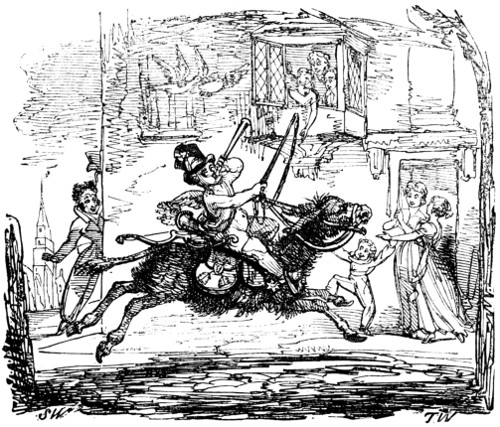
Where can the postman be, I say? He ought to fly—on such a day! Of all days in the year, you know, It’s monstrous rude to be so slow: The fellow’s so exceeding stupid— Hark!—there he is!—oh! the dear Cupid!
Two hundred thousand letters beyond the usual daily average, annually pass through the twopenny post-office in London on St. Valentine’s Day. “Two hundred thousand twopences,” said an old gentleman as he read this in a March newspaper, “are four hundred thousand pence,”—and he was going to cast up the amount—“Why, papa,” said his daughter, “that’s just the number of young folks there must be in love with each other—that’s the way to reckon.” “Ah, my child, that’s not the way to reckon; you have taken something into the account that has no business there: all Valentine-writers are not in love, nor are all lovers Valentine-writers; and remember, my dear girl, that as smiles on the face sometimes conceal cruel dispositions, so there are some who write Valentines, and trifle with hearts for the mere pleasure of inflicting pain.” “I will show you what I mean,” said the old gentleman, and taking a paper from a drawer, he held up this exemplification:

Just then an unmarried gentleman, “of a certain age,” entered the room. On becoming acquainted with the topic, he drew from his pocket a small packet, and said, with a merry smile, “Here was my Valentine.” It contained a rib of some small animal completely enveloped with white satin ribbon, ornamented by a true lover’s knot at each end, and another in the middle. Father and daughter both had a laugh at the “old bachelor,” and he, laughing with them, put into the young lady’s hand the poetical address that accompanied his rib:
Go contemplate this lovely sign! Haste thee away to reason’s shrine, And listen to her voice; No more illusive shades pursue, To happiness this gives the clue, Make but a prudent choice. ’Till Adam had a partner given, Much as fair Eden bloom’d like heaven, His bliss was incomplete; No social friend those joys to share, Gave the gay scene a vacant air! She came—’twas all replete. And could not genuine Paradise, The most extensive wish suffice, Its guiltless lord possest? No—not without a kindred mate; How then in this degen’rate state, Can man, alone be blest? But now the Muse withdraws her aid; Enough, thy folly to upbraid; Enough to make thee wise: No more of pensive hours complain, No more, that all life’s joys are vain, If thou this hint despise.
Feb. 13, 182—.
A Friend.
“Well now, this is capital!” exclaimed the laughing lass. “After such a Valentine, you must take the hint, my dear sir, it’s really a shame that so good-natured a man should remain a bachelor. I recollect, that when I could only just run about, you used to be so kind to me; besides, how you dandled and played with me! and since then, how you have read to me and instructed me till I grew up! Such a man is the very man to be married: you are every way domestic, and it’s settled; you must get married.”—“Well, then, will you have me?” he inquired, with a cheerful laugh. “I have you? No! Why, you are too old; but not too old to find a wife: there are many ladies whom we know, of your age, wholly disengaged; but you don’t pay them any particular attention.” Her father interposed; and the gentleman she addressed playfully said, “It is a little hard, indeed, that I should have these fine compliments and severe reproaches at the same time: however,” taking her by the hand, “you will understand, that it is possible I may have paid particular attention to a lady at an age when the affections are warmer; I did; and I reconciled myself to rejection by courting my books and the pleasures of solitude—
Hast thou been ever waking From slumbers soft and light, And heard sweet music breaking The stillness of the night; When all thy soul was blending With that delightful strain, And night her silence lending To rivet fancy’s chain; Then on a sudden pausing, Those strains have ceas’d to play A painful absence causing Of bliss that died away! So from my soul has vanish’d The dream of youthful days; So Hope and Love are banish’d, And Truth her pow’r displays.”
The origin of so pleasant a day, the first pleasant day in the year, whether its season be regarded, or the mode of its celebration, requires some little investigation; nor must some of its past and present usages be unrecorded here.
St. Valentine’s Morning.
Hark! through the sacred silence of the night Loud chanticleer doth sound his clarion shrill, Hailing with song the first pale gleam of light Which floats the dark brow of yon eastern hill. Bright star of morn, oh! leave not yet the wave To deck the dewy frontlet of the day; Nor thou, Aurora, quit Tithonus’ cave, Nor drive retiring darkness yet away. Ere these my rustic hands a garland twine, Ere yet my tongue endite a single song, For her I mean to hail my Valentine, Sweet maiden, fairest of the virgin throng.
Dodsley’s Miscell.
Attend we upon Elia. Hark, how triumphantly that noble herald of the college of kindness proclaims the day!
“Hail to thy returning festival, old Bishop Valentine! Great is thy name in the rubric, thou venerable arch-flamen of Hymen! Immortal Go-between! who and what manner of person art thou? Art thou but a name, typifying the restless principle which impels poor humans to seek perfection in union? or wert thou indeed a mortal prelate, with thy tippet and thy rochet, thy apron on, and decent lawn sleeves? Mysterious personage! like unto thee, assuredly, there is no other mitred father in the calendar.—Thou comest attended with thousands and ten thousands of little Loves, and the air is
Brush’d with the hiss of rustling wings;
singing Cupids are thy choristers, and thy precentors; and instead of the crosier, the mystical arrow is borne before thee.
“In other words, this is the day on which those charming little missives, ycleped Valentines, cross and intercross each other at every street and turning. The weary and all for-spent twopenny postman sinks beneath a load of delicate embarrassments, not his own. It is scarcely credible to what an extent this ephemeral courtship is carried on in this loving town, to the great enrichment of porters, and detriment of knockers and bell-wires. In these little visual interpretations, no emblem is so common as the heart,—that little three-cornered exponent of all our hopes and fears,—the bestuck and bleeding heart; it is twisted and tortured into more allegories and affectations than an opera-hat. What authority we have in history or mythology for placing the head-quarters and metropolis of god Cupid in this anatomical seat rather than in any other, is not very clear; but we have got it, and it will serve as well as any other thing. Else we might easily imagine, upon some other system which might have prevailed for any thing which our pathology knows to the contrary, a lover addressing his mistress, in perfect simplicity of feeling, ‘Madam, my liver and fortune are entirely at your disposal;’ or putting a delicate question, ‘Amanda, have you a midriff to bestow?’ But custom has settled these things, and awarded the seat of sentiment to the aforesaid triangle, while its less fortunate neighbours wait at animal and anatomical distance.
“Not many sounds in life, and I include all urban and all rural sounds, exceed in interest a knock at the door. It ‘gives a very echo to the throne where Hope is seated.’ But its issues seldom answer to this oracle within. It is so seldom that just the person we want to see comes. But of all the clamorous visitations, the welcomest in expectation is the sound that ushers in, or seems to usher in, a Valentine. As the raven himself was hoarse that announced the fatal entrance of Duncan, so the knock of the postman on this day is light, airy, confident, and befitting one that ‘bringeth good tidings.’ It is less mechanical than on other days; you will say, ‘That is not the post, I am sure.’ Visions of Love, of Cupids, of Hymens, and all those delightful, eternal common-places, which ‘having been, will always be;’ which no schoolboy nor schoolman can write away; having their irreversible throne in the fancy and affections; what are your transports, when the happy maiden, opening with careful finger, careful not to break the emblematic seal, bursts upon the sight of some well-designed allegory, some type, some youthful fancy, not without verses—
Lovers all, A madrigal,
or some such device, not over abundant in sense—young Love disclaims it,—and not quite silly—something between wind and water, a chorus where the sheep might almost join the shepherd, as they did, or as I apprehend they did, in Arcadia.
“All Valentines are not foolish, and I shall not easily forget thine, my kind friend (if I may have leave to call you so) E. B.—E. B. lived opposite a young maiden, whom he had often seen, unseen, from his parlour window in C——e-street. She was all joyousness and innocence, and just of an age to enjoy receiving a Valentine, and just of a temper to bear the disappointment of missing one with good humour. E. B. is an artist of no common powers; in the fancy parts of designing, perhaps inferior to none; his name is known at the bottom of many a well-executed vignette in the way of his profession, but no further; for E. B. is modest, and the world meets nobody half-way. E. B. meditated how he could repay this young maiden for many a favour which she had done him unknown; for, when a kindly face greets us, though but passing by, and never knows us again, nor we it, we should feel it as an obligation; and E. B. did. This good artist set himself at work to please the damsel. It was just before Valentine’s day three years since. He wrought unseen, and unsuspected, a wondrous work. We need not say it was on the finest gilt paper with borders—full, not of common hearts and heartless allegory, but all the prettiest stories of love from Ovid, and older poets than Ovid (for E. B. is a scholar.) There was Pyramus and Thisbe, and be sure Dido was not forgot, nor Hero and Leander, and swans more than sang in Cayster, with mottoes and fanciful devices, such as beseemed,—a work in short of magic. Iris dipt the woof. This on Valentine’s eve he commended to the all-swallowing indiscriminate orifice—(O, ignoble trust!)—of the common post; but the humble medium did its duty, and from his watchful stand, the next morning, he saw the cheerful messenger knock, and by and by the precious charge delivered. He saw, unseen, the happy girl unfold the Valentine, dance about, clap her hands, as one after one the pretty emblems unfolded themselves. She danced about, not with light love, or foolish expectations, for she had no lover; or, if she had, none she knew that could have created those bright images which delighted her. It was more like some fairy present; a God-send, as our familiarly pious ancestors termed a benefit received, where the benefactor was unknown. It would do her no harm. It would do her good for ever after. It is good to love the unknown. I only give this as a specimen of E. B., and his modest way of doing a concealed kindness.
“Good morrow to my Valentine, sings poor Ophelia; and no better wish, but with better auspices, we wish to all faithful lovers, who are not too wise to despise old legends, but are content to rank themselves humble diocesans with old Bishop Valentine, and his true church.”
Mr. Douce, whose attainments include more erudition concerning the origin and progress of English customs than any other antiquarian possesses, must be referred to upon this occasion. He observes, in his “Illustrations of Shakspeare,” concerning St. Valentine’s day, that “it was the practice in ancient Rome, during a great part of the month of February, to celebrate the Lupercalia, which were feasts in honour of Pan and Juno, whence the latter deity was named Februata, Februalis, and Februlla. On this occasion, amidst a variety of ceremonies, the names of young women were put into a box, from which they were drawn by the men as chance directed. The pastors of the early christian church, who by every possible means endeavoured to eradicate the vestiges of pagan superstitions, and chiefly by some commutations of their forms, substituted, in the present instance, the names of particular saints instead of those of the women, and as the festival of the Lupercalia had commenced about the middle of February, they appear to have chosen St. Valentine’s day for celebrating the new feast, because it occurred nearly at the same time. This is, in part, the opinion of a learned and rational compiler of the ‘Lives of the Saints,’ the Rev. Alban Butler. It should seem, however, that it was utterly impossible to extirpate altogether any ceremony to which the common people had been much accustomed: a fact which it were easy to prove in tracing the origin of various other popular superstitions. And accordingly the outline of the ancient ceremonies was preserved, but modified by some adaptation to the christian system. It is reasonable to suppose that the above practice of choosing mates would gradually become reciprocal in the sexes; and that all persons so chosen would be called Valentines, from the day on which the ceremony took place.”
Leaving intermediary facts to the curious inquirer, we come immediately to a few circumstances and sayings from grave authors and gay poets respecting this festival, as it is observed in our own country. It is recorded as a rural tradition, that on St. Valentine’s day each bird of the air chooses its mate; and hence it is presumed, that our homely ancestors, in their lusty youth, adopted a practice which we still find peculiar to a season when nature bursts its imprisonments for the coming pleasures of the cheerful spring. Lydgate, the monk of Bury, who died in 1440, and is described by Warton to have been “not only the poet of his monastery, but of the world in general,” has a poem in praise of queene Catherine, consort to Henry V., wherein he says:
Seynte Valentine. Of custome yeere by yeere Men have an usaunce, in this regioun, To loke and serche Cupides kalendere, And chose theyr choyse, by grete affeccioun; Such as ben move with Cupides mocioun, Takyng theyre choyse as theyr sort doth falle: But I love oon whiche excellith alle.
Chaucer imagines “Nature the vicare of the Almightie Lord,” to address the happiest of living things at this season, the birds, thus:
Foules, take hede of my sentence I pray, And for your own ease in fordring of your need, As fast as I may speak I will me speed: Ye know well, how on St. Valentine’s day By my statute and through my governaunce, Ye doe chese your Makes, and after flie away With hem as I move you with pleasaunce. ***** Saint Valentine, thou art full high on loft, Which drivest away the long nightès black, Thus singen smallè foules for thy sake, Will have they causè for to gladden oft, Since each of them recovered hath his Make: Full blissful may they sing, when they awake.
Our young readers are informed, that the word “make” in Chaucer, now obsolete, signified mate.
Jago, a poet, who, if he has not soared to greatness, has at least attained to the easy versification of agreeable, and sometimes higher feelings, has left us a few stanzas, which harmonize with the suppositions of Chaucer:
St. Valentine’s Day.
The tuneful choir in amorous strains Accost their feathered loves; While each fond mate, with equal pains, The tender suit approves. With cheerful hop from spray to spray They sport along the meads; In social bliss together stray, Where love or fancy leads. Through Spring’s gay scenes each happy pair Their fluttering joys pursue; Its various charms and produce share, For ever kind and true. Their sprightly notes from every shade Their mutual loves proclaim; Till Winter’s chilling blasts invade, And damp th’ enlivening flame. Then all the jocund scene declines, Nor woods nor meads delight; The drooping tribe in secret pines, And mourns th’ unwelcome sight. Go, blissful warblers! timely wise, Th’ instructive moral tell; Nor thou their meaning lays despise, My charming Annabelle!
Old John Dunton’s “British Apollo” sings a question and answer:
Why, Valentine’s a day to choose A mistress, and our freedom lose? May I my reason interpose, The question with an answer close? To imitate we have a mind, And couple like the winged kind.
Further on, in the same miscellany, is another question and answer:
“Question. In chusing valentines (according to custom) is not the party chusing (be it man or woman) to make a present to the party chosen?
“Answer. We think it more proper to say, drawing of valentines, since the most customary way is for each to take his or her lot. And chance cannot be termed choice. According to this method, the obligations are equal, and therefore it was formerly the custom mutually to present, but now it is customary only for the gentlemen.”
This drawing of valentines is remarked in Poor Robin’s Almanac for 1676, under St. Valentine’s day:
“Now Andrew, Antho- ny, and William, For Valentines draw Prue, Kate, Jilian.”
Misson, a learned traveller, who died in England about 1721, describes the amusing practices of his time:—“On the eve of the 14th of February, St. Valentine’s day, the young folks in England and Scotland, by a very ancient custom, celebrate a little festival. An equal number of maids and bachelors get together, each writes their true or some feigned name upon separate billets, which they roll up, and draw by way of lots, the maids taking the men’s billets, and the men the maids’; so that each of the young men lights upon a girl that he calls his valentine, and each of the girls upon a young man which she calls hers. By this means each has two valentines: but the man sticks faster to the valentine that is fallen to him, than to the valentine to whom he is fallen. Fortune having thus divided the company into so many couples, the valentines give balls and treats to their mistresses, wear their billets several days upon their bosoms or sleeves, and this little sport often ends in love. This ceremony is practised differently in different counties, and according to the freedom or severity of madam Valentine. There is another kind of valentine, which is the first young man or woman that chance throws in your way in the street, or elsewhere, on that day.”
In some places, at this time, and more particularly in London, the lad’s valentine is the first lass he sees in the morning, who is not an inmate of the house; the lass’s valentine is the first youth she sees. Gay mentions this usage on St. Valentine’s day: he makes a rustic housewife remind her good man,—
I early rose just at the break of day, Before the sun had chas’d the stars away; A field I went, amid the morning dew To milk my kine, (for so should house-wives do,) Thee first I spied, and the first swain we see In spite of Fortune shall our true-love be.
So also in the “Connoisseur” there is mention of the same usage preceded by certain mysterious ceremonies the night before; one of these being almost certain to ensure an indigestion is therefore likely to occasion a dream favourable to the dreamer’s waking wishes.—“Last Friday was Valentine’s day, and, the night before, I got five bay-leaves, and pinned four of them to the four corners of my pillow, and the fifth to the middle; and then, if I dreamt of my sweetheart, Betty said we should be married before the year was out. But to make it more sure, I boiled an egg hard, and took out the yolk, and filled it with salt; and when I went to bed, ate it, shell and all, without speaking or drinking after it. We also wrote our lovers’ names upon bits of paper, and rolled them up in clay, and put them into water: and the first that rose up was to be our valentine. Would you think it, Mr. Blossom was my man. I lay a-bed and shut my eyes all the morning, till he came to our house; for I would not have seen another man before him for all the world.”
Shakspeare bears witness to the custom of looking for your valentine, or desiring to be one, through poor Ophelia’s singing
Good morrow! ’tis St. Valentine’s day All in the morning betime, And I a maid at your window, To be your valentine!
Sylvanus Urban, in 1779, was informed by Kitty Curious, that on St. Valentine’s day in that year, at a little obscure village in Kent, she found an odd kind of sport. The girls from five or six to eighteen years old were assembled in a crowd, burning an uncouth effigy which they called a “holly boy,” and which they had stolen from the boys; while in another part of the village the boys were burning what they called an “ivy girl,” which they had stolen from the girls. The ceremony of each burning was accompanied by acclamations, huzzas, and other noise. Kitty inquired the meaning of this from the oldest people in the place, but she could learn no more than that it had always been a sport at that season.
A correspondent communicates to the Every-Day Book a singular custom, which prevailed many years since in the west of England. Three single young men went out together before daylight on St. Valentine’s day, with a clapnet to catch an old owl and two sparrows in a neighbouring barn. If they were successful, and could bring the birds to the inn without injury before the females of the house had risen, they were rewarded by the hostess with three pots of purl in honour of St. Valentine, and enjoyed the privilege of demanding at any other house in the neighbourhood a similar boon. This was done, says our correspondent, as an emblem that the owl being the bird of wisdom, could influence the feathered race to enter the net of love as mates on that day, whereon both single lads and maidens should be reminded that happiness could alone be secured by an early union.
On this ancient festival, it was formerly the custom for men to make presents to the women. In Scotland these valentine gifts were reciprocal, as indeed they are still in some parts.
Hurdis calls this
The day Saint Valentine, When maids are brisk, and at the break of day Start up and turn their pillows, curious all To know what happy swain the fates provide A mate for life. Then follows thick discharge Of true-love knots and sonnets nicely penned.
St. Valentine is the lover’s saint. Not that lovers have more superstition than other people, but their imaginings are more. As it is fabled that Orpheus “played so well, he moved old Nick;” so it is true that Love, “cruel tyrant,” moves the veriest brute. Its influence renders the coarsest nature somewhat interesting. A being of this kind, so possessed, is almost as agreeable as a parish cage with an owl inside; you hear its melancholy tee-whit tee-who, and wonder how it got there. Its place of settlement becomes a place of sentiment; nobody can liberate the starveling, and it will stay there. Its mural notes seem so many calls for pity, which are much abated on the recollection, that there are openings enough for its escape. The “tender passion” in the two mile an hour Jehu of an eight-horse waggon, puzzles him mightily. He “sighs and drives, sighs and drives, and drives and sighs again,” till the approach of this festival enables him to buy “a valentine,” with a “halter” and a “couple o’ hearts” transfixed by an arrow in the form of a weathercock, inscribed
“I’ll be yours, if you’ll be mine, I am your pleasing Valentine.”
This he gets his name written under by the shopkeeper, and will be quite sure that it is his name, before he walks after his waggon, which he has left to go on, because neither that nor his passion can brook delay. After he is out of the town, he looks behind him, lest anybody should see, and for a mile or two on the road, ponders on the “two hearts made one,” as a most singular device, and with admired devotion. He then puts it in the trusty pocket under his frock, which holds the waggon bill, and flogs his horses to quicken their pace towards the inn, where “she,” who is “his heart’s delight,” has been lately promoted to the rank of under kitchen-maid, vice her who resigned, on being called “to the happy estate of matrimony” by a neighbouring carter. He gives her the mysterious paper in the yard, she receives it with a “what be this?” and with a smack on the lips, and a smack from the whip on the gown. The gods have made him poetical, and, from his recollection of a play he saw at the statute-fair, he tells her that “love, like a worm in the mud, has played upon his Lammas cheek” ever since last Lammas-tide, and she knows it has, and that she’s his valentine. With such persons and with nature, this is the season of breaking the ice.
St. Valentine, be it repeated, is the saint of all true lovers of every degree, and hence the letters missive to the fair, from wooers on his festival, bear his name. Brand thinks “one of the most elegant jeu-d’esprits on this occasion,” is one wherein an admirer reminds his mistress of the choice attributed by the legend to the choristers of the air on this day, and inquires of her—
Shall only you and I forbear To meet and make a happy pair? Shall we alone delay to live? This day an age of bliss may give. But, ah! when I the proffer make, Still coyly you refuse to take; My heart I dedicate in vain, The too mean present you disdain. Yet since the solemn time allows To choose the object of our vows; Boldly I dare profess my flame, Proud to be yours by any name.
A better might have been selected from the “Magazine of Magazines,” the “Gentleman’s,” wherein Mr. Urban has sometimes introduced the admirers of ladies to the admirers of antiquities—under which class ladies never come. Thence, ever and anon, as from some high barbican or watchtower old, “songs of loves and maids forsaken,” have aroused the contemplation from “facts, fancies, and recollections” regarding other times, to lovers “sighing like furnace” in our own. Through Sylvanus, nearly a century ago, there was poured this
Invocation of St. Valentine.
Haste, friendly Saint! to my relief, My heart is stol’n, help! stop the thief! My rifled breast I search’d with care, And found Eliza lurking there. Away she started from my view, Yet may be caught, if thou pursue; Nor need I to describe her strive— The fairest, dearest maid alive! Seize her—yet treat the nymph divine With gentle usage, Valentine! Then, tell her, she, for what was done, Must bring my heart, and give her own.
So pleasant, so descriptive an illustration of the present custom, requires a companion equally amiable:
MY VALENTINE.
Mark’d you her eye’s resistless glance, That does the enraptur’d soul entrance? Mark’d you that dark blue orb unfold Volumes of bliss as yet untold? And felt you not, as I now feel, Delight no tongue could e’er reveal? Mark’d you her cheek that blooms and glows A living emblem of the rose? Mark’d you her vernal lip that breathes The balmy fragrance of its leaves? And felt you not, as I now feel, Delight no tongue can e’er reveal? Mark’d you her artless smiles that speak The language written on her cheek, Where, bright as morn, and pure as dew, The bosom’s thoughts arise to view? And felt you not, as I now feel, Delight no tongue could e’er reveal? Mark’d you her face, and did not there, Sense, softness, sweetness, all appear? Mark’d you her form, and saw not you A heart and mind as lovely too? And felt you not, as I now feel, Delight no tongue could e’er reveal? Mark’d you all this, and you have known The treasured raptures that I own; Mark’d you all this, and you like me, Have wandered oft her shade to see, For you have felt, as I now feel, Delight no tongue could e’er reveal?
High Wycombe.
Every lady will bear witness that the roll of valentine poesy is interminable; and it being presumed that few would object to a peep in the editor’s budget, he offers a little piece, written, at the desire of a lady, under an engraving, which represented a girl fastening a letter to the neck of a pigeon:—
THE COURIER DOVE.
“Va, porter cet écrit à l’objet de mon cœur!”
Outstrip the winds my courier dove! On pinions fleet and free, And bear this letter to my love Who’s far away from me. It bids him mark thy plume whereon The changing colours range; But warns him that my peace is gone If he should also change. It tells him thou return’st again To her who sets thee free; And O! it asks the truant, when He’ll thus resemble thee!
Lastly, from “Sixty-five Poems and Sonnets,” &c. recently published, he ventures to extract one not less deserving the honour of perusal, than either that he has presented:—
A VALENTINE.
No tales of love to you I send, No hidden flame discover, I glory in the name of friend, Disclaiming that of lover. And now, while each fond sighing youth Repeats his vows of love and truth, Attend to this advice of mine— With caution choose a Valentine. Heed not the fop, who loves himself, Nor let the rake your love obtain; Choose not the miser for his pelf, The drunkard heed with cold disdain; The profligate with caution shun, His race of ruin soon is run: To none of these your heart incline, Nor choose from them a Valentine. But should some generous youth appear, Whose honest mind is void of art, Who shall his Maker’s laws revere, And serve him with a willing heart; Who owns fair Virtue for his guide, Nor from her precepts turns aside; To him at once your heart resign, And bless your faithful Valentine. Though in this wilderness below You still imperfect bliss shall find, Yet such a friend will share each woe, And bid you be to Heaven resign’d: While Faith unfolds the radiant prize, And Hope still points beyond the skies, At life’s dark storms you’ll not repine, But bless the day of Valentine.
Wit at a pinch.
A gentleman who left his snuffbox at a friend’s on St. Valentine’s Eve, 1825, received it soon after his return home in an envelope, sealed, and superscribed—
To J—— E——, Esq.
Dear Sir,
I’ve just found proof enough, You are not worth a pinch of snuff; Receive the proof, seal’d up with care, And extract from it, that you are.
Valentine, 1825
*
Chronology.
Sir William Blackstone died on the 14th of February, 1780. He was born at the house of his father, a silkman, in Cheapside, London, on the 10th of July, 1723; sent to the Charter-house in 1730; entered Pembroke-college, Cambridge, in 1738; of the Middle Temple, 1741; called to the bar in 1746; elected recorder of Wallingford in 1749; made doctor of civil law in 1750; elected Vinerian professor of common law in 1758; returned a representative to Parliament in 1761; married in 1761; became a justice of the court of Common Pleas in 1770. In the course of his life he filled other offices. He was just and benevolent in all his relations, and, on the judicial seat, able and impartial. In English literature and jurisprudence he holds a distinguished rank for his “Commentaries on the Laws of England.” This work originated in the legal lectures he commenced in 1753: the first volume was published in 1759, and the remaining three in the four succeeding years. Through these his name is popular, and so will remain while law exists. The work is not for the lawyer alone, it is for every body. It is not so praiseworthy to be learned, as it is disgraceful to be ignorant of the laws which regulate liberty and property. The absence of all information in some men when serving upon juries and coroners’ inquests, or as constables, and in parochial offices, is scandalous to themselves and injurious to their fellow men. The “Commentaries” of Blackstone require only common capacity to understand. Wynne’s “Eunomus” is an excellent introduction to Blackstone, if any be wanting. With these two works no man can be ignorant of his rights or obligations; and, indeed, the “Commentaries” are so essential, that he who has not read them has no claim to be considered qualified for the exercise of his public duties as an Englishman. He is at liberty, it is true, for the law leaves him at liberty, to assume the character he may be called on to bear in common with his fellow-citizens; but, with this liberty, he is only more or less than a savage, as he is more than a savage by his birth in a civilized country, and less than a savage in the animal instinct, which teaches that self-preservation is the first law of nature; and still further is he less, because, beside the safety of others, it may fall to him, in this state of ignorance, to watch and ward the safety of the commonwealth itself.
Blackstone, on making choice of his profession, wrote an elegant little poem, entitled “The Lawyer’s Farewell to his Nurse.” It is not more to be admired for ease and grace, than for the strong feeling it evinces in relinquishing the pleasures of poesy and art, and parting for ever from scenes wherein he had happily spent his youthful days. Its conclusion describes his anticipations—
Lost to the field and torn from you— Farewell! a long—a last adieu! Me wrangling courts and stubborn law To smoke and crowds, and cities draw; There selfish faction rules the day, And pride and av’rice throng the way; Diseases taint the murky air, And midnight conflagrations glare: Loose revelry and riot bold In frighted streets their orgies hold; Or when in silence all is drowned, Fell murder walks her lonely round No room for peace—no room for you Adieu, celestial nymph, adieu!
A SUIT AT LAW.
Its origin and progress may be traced in the Tree engraved on the opposite page.
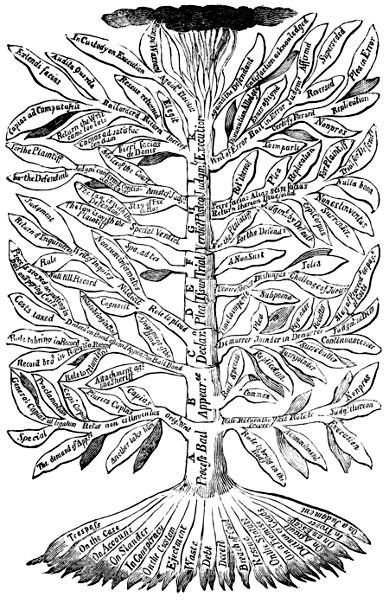
The Tree of Common Law.
Enlarged illustration (290 kB).
1. The root of the engraved Tree exhibits a diversity of suits and actions for the remedy of different wrongs.
2. The trunk shows the growth of a suit, stage by stage, until its conclusion.
3. The branches from each stage show the proceedings of the plaintiff on one side, and the proceedings of the defendant on the other.
4. The leaves of each branch show certain collateral proceedings whereby the suit is either advanced or suspended.
5. Supposing the form of action suitable to the case, and no stay of proceedings, the suit grows, on the “sure and firm set earth” of the law, into a “goodly tree,” and, attaining to execution against either the plaintiff or the defendant, terminates in consuming fire.
A few whimsical miscellanies are subjoined, not derogatory from the importance or necessity of legislation, but amusingly illustrative of legal practice in the sinuosities it has acquired during successive stages of desuetude and change. Those only who know the law are acquainted with the modes by which numerous deformities in its application have originated, or the means by which they may be remedied; while all who experience that application are astonished at its expensiveness, and complain of it with reason.
A legal practitioner is said to have delivered a bill containing several charges of unmerciful appearance, to a client, who was a tailor; and the tailor, who had made a suit of clothes for his professional adviser, is said to have sent him the following bill by way of set-off.
George Grip, Esq.
Dr. to Samuel Smart.
£. s. d.
Attending you, in conference, concerning your proposed Suit, conferring thereon when you could not finally determine 0 6 8
Attending you again thereon, when found you prepared, and taking measures accordingly 0 6 8
Entering 0 3 4
Instructions and warrant to woollen-draper 0 5 0
Copy thereof to keep 0 2 0
Instructions to foreman 0 6 8
Difficulty arising as to proceedings, attending him in consultation 0 6 8
Paid fees to woollen-draper 4 18 6
Attending him thereon 0 6 8
Perusing his receipt 0 3 4
Attending to file same 0 3 4
Filing 0 1 0
Attending button-maker, instructing him 0 6 8
Paid his charges 2 19 0
Having received summons to proceed, perusing and considering same 0 6 8
Drawing consent, and copy to keep 0 4 4
Postage 0 1 6
Copy order thereon and entering 0 3 0
Appointing consultation as to further proceedings, and attending same 0 13 4
Foreman having filed a demurrer, preparing argument against same 0 6 8
Attending long argument on demurrer, when same overruled 0 10 0
Perusing foreman’s plea 0 6 8
Excepting to same 0 6 8
Entering exceptions 0 3 4
Perusing notice of motion to remove suit, and preparing valid objections to lay before you 0 10 0
Same being overruled, consent thereto, on an undertaking 0 6 8
Expenses on removal of suit—paid by you at the time 0 0 0
Writing you my extreme dissatisfaction on finding the suit removed into the King’s Bench, and that I should move the court, when you promised to obtain a Rule as soon as term commenced, and attend me thereon 0 10 0
Conferring with you, in presence of your attendant, at my house, on the first day of term, when you succeeded in satisfying me that you were a Gent. one, &c. and an honourable man, and expressed great dissatisfaction at the proceedings had with the suit while out of my hands; receiving your instructions to demand of your Uncle that same should return to me, on my paying him a lien he claimed thereon, and received from you his debenture for that purpose 0 13 4
Perusing same, and attending him in St. George’s-fields therewith and thereon 0 10 0
Paid him, principal and interest 2 10 4
In consideration of circumstances, no charge for receiving suit back[237, 238] 0 0 0
Perusing letter unexpectedly received from you, dated from your own house, respecting short notice of trial 0 6 8
Attending you thereon 0 6 8
Attending at Westminster several mornings to try the suit, when at last got same on 2 2 0
Paid fees 0 12 0
Fee to porter 0 5 0
It being determined that the suit should be put into a special case, drawing special instructions to Boxmaker for same 0 13 4
Attending him therewith and thereon 0 6 8
Paid him his fee for special case 2 2 0
Paid his clerk’s fee 0 2 6
Considering case, as settled 0 6 8
Attending foreman for his consent to same, when he promised to determine shortly 0 6 8
Attending him again thereon to obviate his objections, and obtained his consent with difficulty 0 6 8
Drawing bill of costs 0 15 0
Fair copy for Mr. —— to peruse and settle 0 7 6
Attending him therewith 0 6 8
Fee to him settling 0 5 0
Attending him for same 0 6 8
Perusing and considering same, as settled 0 6 8
Attending Mr. —— again suggesting amendments 0 6 8
Fee to him on amending 0 5 0
Perusing same as amended 0 6 8
Fair copy, with amendments, to keep 0 7 6
Entering 0 5 0
Fair copy for service 0 7 6
Thirty-eight various attendances to serve same 6 6 8
Service thereof 0 6 8
Drawing memorandum of service 0 5 0
Attending to enter same 0 3 4
Entering same 0 2 6
Attending you concerning same 0 6 8
Accepted service of order to attend at the theatre, and gave consent 0 6 8
Retaining fee at box-office 0 1 0
Service of order on box-keeper 0 6 8
Self and wife, with six children, two of her cousins, her brother, and his son, two of my brothers, my sister-in-law, three nephews, four nieces, each attending for four hours and a half to see the Road to Ruin, and the Beggars’ Opera, eighty-five hours and a half, at 3s. 4d. per hour—very moderate 17 0 10
Coach hire there and back 0 18 0
Attending you to acquaint you with particulars in general, and concerning settlement particularly 0 6 8
Instructions for receipt 0 3 4
Drawing receipt 0 5 0
Vacation fee 1 1 0
Refreshing fee 0 13 4
Perusing receipt, and amending same 0 6 8
Fair copy to keep 0 2 6
Engrossing on stamp 0 2 6
Paid duty and paper 0 3 1
Fee on ending 2 2 0
Letters and messengers 0 10 0
£63 0 9
To numerous, various, and a great variety of divers, and very many letters, messages, and attendances to, from, on, and upon, you and your agents and others, pending a negotiation for settlement, far too numerous to be mentioned; and an infinite deal of trouble, too troublesome to trouble you with, or to be expressed; without more and further trouble, but which you must, or can, or shall, or may know, or be informed of—what you please
£
Item in a Bill of Costs
Attending A in conference concerning the best mode to indemnify B against C’s demand for damages, in consequence of his driving D’s cart against E’s house, and thereby breaking the window of a room occupied by F’s family, and cutting the head of G, one of his children, which H, the surgeon, had pronounced dangerous, and advising on the steps necessary for such indemnity. Attending I accordingly thereon, who said he could do nothing without the concurrence of his brother J, who was on a visit to his friend K, but who afterwards consented thereto, upon having a counter-indemnity from L. Taking instructions for, and writing the letter accordingly, but he refused to accede thereto, in consequence of misconduct in some of the parties towards his distant relation M, because he had arrested N, who being in custody of O, the officer, at P’s house, was unable to prevail upon Q and R to become bail. Attending in consequence upon S, the sheriff, when he said, if he received an undertaking to give a bail-bond at the return of the writ, the defendant should be discharged. Attending T for undertaking accordingly, conferring thereon; but he declined interfering without the concurrence of V, to whom he was largely indebted, in whose hands he had lodged several title-deeds as a collateral security, and who, it appeared, had sent the deeds to his attorney U, for the purpose of preparing a mortgage to W, in trust, for securing his demand, and also of a debt due to X. Attending afterwards on A’s clerk Y, communicating the result of our numerous applications, and conferring with him thereon, when he at length informed me that Z had settled the business.
Legal Recreations.
“To him that goes to law, nine things are requisite: 1. A good deal of money—2. A good deal of patience—3. A good cause—4. A good attorney—5. Good counsel—6. Good evidence—7. A good jury—8. A good judge—and lastly, good luck.”
“Reason is the life of the law, nay, the common law itself is nothing else but reason.”
If a man says of a counsellor of law, Thou art a daffa-down-dilly, an action lies. So adjudged in Scaccario, and agreed per totam curiam.—1 Vin. Abb. 445.
He hath no more law than Mr. C.’s bull. These words being spoken of an attorney, the court inclined that they were actionable, and that the plaintiff should have judgment, though it was objected that the plaintiff had not declared that C. had a bull.—Siderfin, 327, pl. 8. Pasch. 19 Car. II. Baker v. Morfue. The chief justice was of opinion, that if C. had no bull, the scandal was the greater. And it was pronounced per curiam in the same case, that to say of a lawyer, that he has no more law than a goose, has been adjudged actionable.—Sid. 127, pl. 8.—There is quære added as to the saying, He hath no more law than the man in the moon (Ib. 2 Kib. 209); the law, doubtless, contemplating the possibility of there being a man in the moon, and of his being a good lawyer.
My lord chief baron cannot hear of one ear, adjudged actionable, there being a colloquium of his administration of justice. But not so if there had been no discourse of his justice.—1 Vin. Ab. 446.
Adjudged, that the death of a parson is a non-residency, within 13 Eliz. c. 20, so as to avoid his leases. Mott v. Hales, Crok. Eliz. 123
Eden and Whalley’s case:—“One Eden confessed himself guilty of multiplication, and that he had practised the making of quintessence, and the philosopher’s stone, by which all metals might be turned into gold and silver; and also accused Whalley, now a prisoner in the Tower, of urging and procuring him to practise this art; and that Whalley had laid out money in red wine and other things necessary for the said art. And, because this offence is only felony, Eden, the principal, was pardoned by the general pardon; but Whalley, who was but accessary in this case, was excepted as one of those who were in the Tower. The question was moved, whether Whalley should be discharged;—Quære, the statute of 5 Hen. IV. 4, which enacts, ‘that none should use to multiply gold or silver, nor use the craft of multiplication; and if any the same do, that he incur the pain of felony in this case.’—Quære—Whether there can be any accessary in this new felony?—1 Dyer, 87, 6, Easter Term, 7 Ed. VI. This statute was repealed by the stat. of 1 Will. & Mary.”
In the case of monopolized cards, there was cited a commission in the time of Henry V. directed to three friars and two aldermen of London, to inquire whether the philosopher’s stone was feasible, who returned it was, and upon this a patent was made out for them to make it—Moore, 675; Dancey’s case.
According to the Asiatic Researches, a very curious mode of trying the title of land is practised in Hindostan:—Two holes are dug in the disputed spot, in each of which the plaintiff and defendant’s lawyers put one of their legs, and remain there until one of them is tired, or complains of being stung by the insects, in which case his client is defeated. In this country it is the client, and not the lawyer, who puts his foot into it.
Professional practice is frequently the subject of theatrical exhibition. “Giovanni in London” has a scene before going to trial, with the following
Trio.
First Lawyer, Second Lawyer, Giovanni. Air—“Soldier, gave me one Pound.”
First Lawyer. Giovanni, give me one pound. Second Lawyer. Giovanni, give me two. First Lawyer. Trial it comes on to-day; Second Lawyer. And nothing we can do. First Lawyer. You must give a fee, Both to me— Second Lawyer. And me. Both Lawyers. For, oh! the law’s a mill that without grist will never go. Giovanni. Lawyer, there is one pound; (to second Lawyer) Lawyer, there are two; (to first Lawyer) And now I am without a pound, Thanks to the law and you. For, oh! I feel the law Has clapp’d on me its paw; And, oh! the law’s a mill that without grist will never go.
Collop Monday.
The Monday before Shrove Tuesday is so called because it was the last day of flesh-eating before Lent, and our ancestors cut their fresh meat into collops, or steaks, for salting or hanging up till Lent was over; and hence, in many places, it is still a custom to have eggs and collops, or slices of bacon, at dinner on this day. The Rev. Mr. Bowles communicates to his friend Mr. Brand, that the boys in the neighbourhood of Salisbury go about before Shrove-tide singing these lines:
Shrove-tide is nigh at hand, And I am come a shroving; Pray, dame, something, An apple or a dumpling, Or a piece of Truckle cheese Of your own making, Or a piece of pancake.
Polydore Virgil affirms of this season and its delicacies, that it sprung from the feasts of Bacchus, which were celebrated in Rome with rejoicings and festivity at the same period. This, therefore, is another adoption of the Romish church from the heathens; and it is observed by Brand, that on Shrove Monday it was a custom with the boys at Eton to write verses concerning Bacchus, in all kinds of metre, which were affixed to the college doors, and that Bacchus’ verses “are still written and put up on this day.” The Eton practice is doubtless a remnant of the catholic custom.
FLORAL DIRECTORY.
Yellow Crocus. Crocus Mæsiacus. Dedicated to St. Valentine.
February 15.
Sts. Faustinus and Jovita, A. D. 121. St. Sigefride, or Sigfrid, of Sweden, Bp. A. D. 1002.
SHROVE TUESDAY.
It is communicated to the Every-Day Book by a correspondent, Mr. R. N. B——, that at Hoddesdon in Hertfordshire, the old curfew-bell, which was anciently rung in that town for the extinction and relighting of “all fire and candle light” still exists, and has from time immemorial been regularly rang on the morning of Shrove Tuesday at four o’clock, after which hour the inhabitants are at liberty to make and eat pancakes, until the bell rings again at eight o’clock at night. He says, that this custom is observed so closely, that after that hour not a pancake remains in the town.
The Curfew.
I hear the far-off curfew sound, Over some wide-water’d shore, Swinging slow with sullen roar.
Milton.
That the curfew-bell came in with William the Conqueror is a common, but erroneous, supposition. It is true, that by one of his laws he ordered the people to put out their fires and lights, and go to bed, at the eight-o’clock curfew-bell; but Henry says, in his “History of Great Britain,” that there is sufficient evidence of the curfew having prevailed in different parts of Europe at that period, as a precaution against fires, which were frequent and fatal, when so many houses were built of wood. It is related too, in Peshall’s “History of Oxford,” that Alfred the Great ordered the inhabitants of that city to cover their fires on the ringing of the bell at Carfax every night at eight o’clock; “which custom is observed to this day, and the bell as constantly rings at eight as Great Tom tolls at nine.” Wherever the curfew is now rung in England, it is usually at four in the morning, and eight in the evening, as at Hoddesdon on Shrove Tuesday.
Concerning the curfew, or the instrument used to cover the fire, there is a communication from the late Mr. Francis Grose, the well remembered antiquary, in the “Antiquarian Repertory” (vol. i.) published by Mr. Ed. Jeffery. Mr. Grose enclosed a letter from the Rev. F. Gostling, author of the “Walk through Canterbury,” with a drawing of the utensil, from which an engraving is made in that work, and which is given here on account of its singularity. No other representation of the curfew exists.
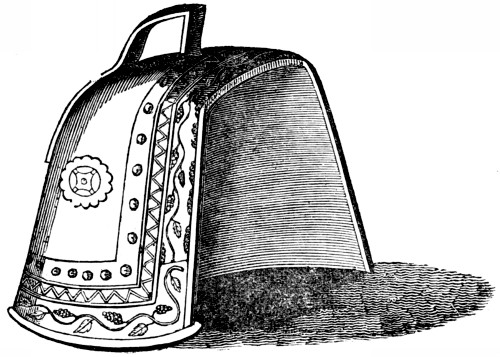
“This utensil,” says the Antiquarian Repertory, “is called a curfew, or couvre-feu, from its use, which is that of suddenly putting out a fire: the method of applying it was thus;—the wood and embers were raked as close as possible to the back of the hearth, and then the curfew was put over them, the open part placed close to the back of the chimney; by this contrivance, the air being almost totally excluded, the fire was of course extinguished. This curfew is of copper, rivetted together, as solder would have been liable to melt with the heat. It is 10 inches high, 16 inches wide, and 9 inches deep. The Rev. Mr. Gostling, to whom it belongs, says it has been in his family for time immemorial, and was always called the curfew. Some others of this kind are still remaining in Kent and Sussex.” It is proper to add to this account, that T. Row, in the “Gentleman’s Magazine,” because no mention is made “of any particular implement for extinguishing the fire in any writer,” is inclined to think “there never was any such.” Mr. Fosbroke in the “Encyclopædia of Antiquities” says, “an instrument of copper presumed to have been made for covering the ashes, but of uncertain use, is engraved.” It is in one of Mr. F.’s plates.
On T. Row’s remark, who is also facetious on the subject, it may be observed, that his inclination to think there never was any such implement, is so far from being warrantable, if the fact be even correct, that it has not been mentioned by any ancient writer, that the fair inference is the converse of T. Row’s inclination. Had he consulted “Johnson’s Dictionary,” he would have found the curfew itself explained as “a cover for a fire; a fire-plate.—Bacon.” So that if Johnson is credible, and his citation of authorities is unquestionable, Bacon, no very modern writer, is authority for the fact that there was such an implement as the curfew.
Football at Kingston.
Mr. P., an obliging contributor, furnishes the Every-Day Book with a letter from a Friend, descriptive of a custom on this day in the vicinity of London.
Respected Friend,
Having some business which called me to Kingston-upon-Thames on the day called Shrove Tuesday, I got upon the Hampton-court coach to go there. We had not gone above four miles, when the coachman exclaimed to one of the passengers, “It’s Foot-ball day;” not understanding the term, I questioned him what he meant by it; his answer was, that I would see what he meant where I was going.—Upon entering Teddington, I was not a little amused to see all the inhabitants securing the glass of all their front windows from the ground to the roof, some by placing hurdles before them, and some by nailing laths across the frames. At Twickenham, Bushy, and Hampton-wick, they were all engaged in the same way: having to stop a few hours at Hampton-wick and Kingston, I had an opportunity of seeing the whole of the custom, which is, to carry a foot-ball from door to door and beg money:—at about 12 o’clock the ball is turned loose, and those who can, kick it. In the town of Kingston, all the shops are purposely kept shut upon that day; there were several balls in the town, and of course several parties. I observed some persons of respectability following the ball: the game lasts about four hours, when the parties retire to the public-houses, and spend the money they before collected in refreshments.