AUGUST.
Reading edition
The eighth was August, being rich array’d In garment all of gold downe to the ground: Yet rode he not, but led a lovely mayd Forth by the lily hand, the which was crown’d With eares of corne, and full her hand was found. That was the righteous Virgin, which of old Liv’d here on earth, and plenty made abound; But after wrong was lov’d, and justice solde, She left th’ unrighteous world, and was to heav’n extoll’d.
August is the eighth month of the year. It was called Sextilis by the Romans, from its being the sixth month in their calendar, until the senate complimented the emperor Augustus by naming it after him, and through them it is by us denominated August.
Our Saxon ancestors called it “Arnmonat, (more rightly barn-moneth,) intending thereby the then filling of their barnes with corne.”[236] Arn is the Saxon word for harvest. According to some they also called it Woedmonath, as they likewise called June.[237]
The sign of the zodiac entered by the sun this month is Virgo, the Virgin. Spenser’s personation of it above is pencilled and engraved by Mr. Samuel Williams.
“Admire the deep beauty of this allegorical picture,” says Mr. Leigh Hunt. “Spenser takes advantage of the sign of the zodiac, the Virgin, to convert her into Astrea, the goddess of justice, who seems to return to earth awhile, when the exuberance of the season presents enough for all.”
Mr. Leigh Hunt notes in his Months, that,—“This is the month of harvest. The crops usually begin with rye and oats, proceed with wheat, and finish with peas and beans. Harvest-home is still the greatest rural holiday in England, because it concludes at once the most laborious and most lucrative of the farmer’s employments, and unites repose and profit. Thank heaven there are, and must be, seasons of some repose in agricultural employments, or the countryman would work with as unceasing a madness, and contrive to be almost as diseased and unhealthy as the citizen. But here again, and for the reasons already mentioned, our holiday-making is not what it was. Our ancestors used to burst into an enthusiasm of joy at the end of harvest, and appear even to have mingled their previous labour with considerable merry-making, in which they imitated the equality of the earlier ages. They crowned the wheat-sheaves with flowers, they sung, they shouted, they danced, they invited each other, or met to feast, as at Christmas, in the halls of rich houses; and what was a very amiable custom, and wise beyond the commoner wisdom that may seem to lie on the top of it, every one that had been concerned, man, woman, and child, received a little present—ribbons, laces, or sweatmeats.
“The number of flowers is now sensibly diminished. Those that flower newly are nigella, zinnias, polyanthuses, love-apples, mignionette, capsicums, Michaelmas daisies, auriculus, asters, or stars, and China-asters. The additional trees and shrubs in flower are the tamarisk, altheas, Venetian sumach, pomegranates, the beautiful passion-flower, the trumpet-flower, and the virgin’s bower, or clematis, which is such a quick and handsome climber. But the quantity of fruit is considerably multiplied, especially that of pears, peaches, apricots, and grapes. And if the little delicate wild flowers have at last withdrawn from the hot sun, the wastes, marshes, and woods are dressed in the luxuriant attire of ferns and heaths, with all their varieties of green, purple, and gold. A piece of waste land, especially where the ground is broken up into little inequalities, as Hampstead-heath, for instance, is now a most bright as well as picturesque object; all the ground, which is in light, giving the sun, as it were, gold for gold. Mignonette, intended to flower in the winter, should now be planted in pots, and have the benefit of a warm situation. Seedlings in pots should have the morning sunshine, and annuals in pots be frequently watered.
“In the middle of this month, the young goldfinch broods appear, lapwings congregate, thistle-down floats, and birds resume their spring songs:—a little afterwards flies abound in windows, linnets congregate, and bulls make their shrill autumnal bellowing; and towards the end the beech tree turns yellow,—the first symptom of approaching autumn.”
The garden blooms with vegetable gold, And all Pomona in the orchard glows, Her racy fruits now glory in the sun, The wall-enamour’d flower in saffron blows, Gay annuals their spicy sweets unfold, To cooling brooks the panting cattle run: Hope, the forerunner of the farmer’s gain, Visits his dreams and multiplies the grain. More hot it grows; ye fervours of the sky Attend the virgin—lo! she comes to hail Your sultry radiance.—Now the god of day Meets her chaste star—be present zephyr’s gale To fan her bosom—let the breezes fly On silver pinions to salute his ray; Bride of his soft desires, with comely grace He clasps the virgin to his warm embrace. The reapers now their shining sickles bear A band illustrious, and the sons of Health! They bend, they toil across the wide champaign, Before them Ceres yields her flowing wealth; The partridge-covey to the copse repair For shelter, sated with the golden grain, Bask on the bank, or thro’ the clover run Yet safe from fetters, and the slaughtering gun.
August 1.
St. Peter ad Vincula, or St. Peter’s chains. The seven Machabees, Brothers, with their Mother. Sts. Faith, Hope, and Charity. St. Etholwold, Bp. A. D. 984. St. Pellegrini, or Peregrinus, A. D. 643.
St. Peter ad Vincula, or the Feast of St. Peter’s chains.
The Romish church pretending to possess one of the chains wherewith Peter was bound, and from which the angel delivered him, indulges its votaries with a festival in its honour on this day. “Pagan Rome,” says Alban Butler, “never derived so much honour from the spoils and trophies of a conquered world, as christian Rome receives from the corporal remains of these two glorious apostles, (Peter and Paul,) before which the greatest emperors lay down their diadems, and prostrate themselves.” Be it observed, that the papacy also pretends to possess the chains of Paul: pope Gregory writing to the empress Constantia tells her he will quickly send her some part of Paul’s chains, if it be possible for him to file any off;—“for,” says Gregory, “since so many frequently come begging a benediction from the chains, that they may receive a little of the filings thereof, therefore a priest is ready with a file; and when some persons petition for it, presently in a moment something is filed off for them from the chains; but when others petition, though the file be drawn a great while through the chains, yet cannot the least jot be got off.” Upon this, bishop Patrick says,—“One may have leave to ask, why should not this miraculous chain of St. Paul have a festival appointed in memory of it, as well as that of St. Peter? you may take Baronius’s answer to it till you can meet with a better.” Baronius, the great Romish luminary and authority in the affairs of papal martyrs, relics, and miracles, says,—“Truly the bonds of St. Peter seem not without reason to be worshipped, though the bonds of the other apostles are not: for it is but fit, that since he has the chief power in the church of binding and loosing other men’s bonds, that his bonds also should be had in honour of all the faithful.” This is a sufficing reason to the believers in the “binding and loosing” according to the gloss put upon that power by Romish writers.
The empress Eudocia is affirmed to have brought the two chains of St. Peter from Jerusalem, in the year 439, one whereof she gave to a church in Constantinople, and sent the other to Rome, where the old lady’s chain has yielded, or not yielded, to the raspings of the file from time immemorial. This chain was pleased to part with some of its particles to the emperor Justinian, who sent ambassadors begging to the pope for a small portion. “The popes,” says Butler, “were accustomed to send the filings as precious relics to devout princes—they were often instruments of miracles—and the pope himself rasped them off for king Childebert, and enclosed them in a golden key to be hung about the neck.” Childebert, no doubt, experienced its aperient qualities. They would be very serviceable to the papal interest at this period.
Gule of August.
The first day of August is so called. According to Gebelin, as the month of August was the first in the Egyptian year, it was called Gule, which being latinized, makes Gula, a word in that language signifying throat. “Our legendaries,” says Brand, “surprised at seeing this word at the head of the month of August, converted it to their own purpose.” They made out of it the feast of the daughter of the tribune Quirinus, who they pretend was cured of a disorder in the throat, (Gula,) by kissing the chain of St. Peter on the day of its festival. Forcing the Gule of the Egyptians into the throat of the tribune’s daughter, they instituted a festival to Gule upon the festival-day of St. Peter ad Vincula.
Lammas-day.
So stands the first of August in our English almanacs, and so it stands in the printed Saxon Chronicle. “Antiquaries,” says Brand, “are divided in their opinions concerning the origin of Lammas-Day; some derive it from Lamb-Mass, because on that day the tenants who held lands under the cathedral church in York, which is dedicated to St. Peter ad Vincula, were bound by their tenure to bring a live lamb into the church at high mass: others derive it from a supposed offering or tything of lambs at this time.” Various other derivations have been imagined. Blount, the glossographer, says, that Lammas is called Hlaf-Mass, that is Loaf-Mass, or Bread-Mass, which signifies a feast of thanksgiving for the first fruits of the corn. It was observed with bread of new wheat, and in some places tenants are bound to bring new wheat to their lord, on, or before, the first of August. New wheat is called Lammas-Wheat. Vallancey affirms that this day was dedicated, in Ireland, to the sacrifice of the fruits of the soil; that La-ith-mas the day of the obligation of grain, is pronounced La-ee-mas, a word readily corrupted to Lammas; that ith, signifies all kinds of grain, particularly wheat, and that mas signifies fruit of all kinds, especially the acorn, whence the word mast.[238] From these explications may easily be derived the reasonable meaning of the word Lammas.
Juliet, Capulet, and Petrarch.
To the Editor of the Every-Day Book.
Sir,
As in your little calendar of worthy observancies you sometimes notice the birthdays of those whom we most desire, and who most deserve to be remembered, and as I am one, who like yourself, am unwilling any thing should be forgotten, or trodden down under the feet of thoughtless and passing generations, that has pleasant speculation in it, pray remember that on the first day of August, Francisco Petrarca was born.—But remember also, that on that same day, in 1578, was born our Juliet Capulet. “On Lammas eve at night shall she be fourteen. That shall she, marry; I remember it well. ’Tis since the earthquake now eleven years, an’ she was weaned.” Shakspeare’s characters, as we all know, be they of what country or of what age they may, speak as an Englishman would have done in his own times, and the earthquake here referred to was felt in 1580. That Juliet, our Juliet, should have been born on the very same day as Petrarch was certainly accidental; yet it is a coincidence worth observing; and if a calendar of birthdays be to recall pleasant recollections, over “our chirping cups,” why may not Juliet be remembered, and her sweetly poetical existence be associated with the reality of Petrarca’s life. And where is the difference? Petrarca is,
———nor hand nor foot Nor arm, nor face, nor any other part Belonging to a man.
And what are all the great men that have ever lived but such mocking names? Montaigne, who translated a theological work by Raimondi di Sibondi, on being told by some learned friend that he suspected it was but an abstract of St. Thomas of Aquin, says “’tis a pity to rob Sibondi of his honours on such slight authority:”—what honours? when are they offered? to whom? it is not known that such a man ever had existence! Not love, nor reverence, nor idolatrous admiration can stay the progress of oblivion: the grave shuts us out for ever from our fellows, and our generation is the limit of our personal and real existence:—mind only is immortal. Francisco Petrarca was dead, and buried, and forgotten, five hundred years ago: he is now no more in reality than Juliet; nay, to myself, not so much so. The witches in Macbeth, though pure creations, have more of flesh and blood reality, are more familiar to the thoughts of all, than the Lancashire witches that lived cotemporary with the poet, and suffered death from the superstition of the age. There have been many Shakspeares, we know but one; that one indeed, from association and recollection, has a real character in our minds, and a real presence in our hearts:—have we neither association nor recollection with the name Juliet Capulet?
D.
FLORAL DIRECTORY.
Stramony. Datura Stramonium. Dedicated to St. Peter ad Vincula.
August 2.
St. Stephen, Pope, A. D. 257. St. Etheldritha, or Alfrida. A. D. 834.
FLORAL DIRECTORY.
Tiger Lily. Lilium tigrinum. Dedicated to St. Alfrida.
August 3.
The Invention of St. Stephen, or the discovery of his relics, A. D. 415. St. Nicodemus. St. Gamaliel, A. D. 415. St. Walthen, or Waltheof, A. D. 1160.
FLORAL DIRECTORY.
Holyhock. Althea rosea. Dedicated to The Invention of St. Stephen’s Relics.
August 4.
St. Dominic, Confessor, founder of the friar preachers, A. D. 1221. St. Luanus, or Lugid, or Molua, of Ireland, A. D. 622.
Chronology.
Holinshed records, that in the year 1577, “on Sundaie the fourth of August, betweene the houres of nine and ten of the clocke in the forenone, whilest the minister was reading of the second lesson in the parish church of Bliborough, a towne in Suffolke, a strange and terrible tempest of lightening and thunder strake thorough the wall of the same church into the ground almost a yard deepe, draue downe all the people on that side aboue twentie persons, then renting the wall up to the veustre, cleft the doore, and returning to the steeple, rent the timber, brake the chimes, and fled towards Bongie, a towne six miles off. The people that were striken downe were found groueling more than halfe an houre after, whereof one man more than fortie yeares, and a boie of fifteene yeares, old were found starke dead: the other were scorched. The same or the like flash of lightening and cracks of thunder rent the parish church of Bongie, nine miles from Norwich, wroong in sunder the wiers and wheels of the clocks, slue two men which sat in the belfreie, when the other were at the procession or suffrages, and scorched an other which hardlie escaped.”
This damage by lightning to the church of Bungay, in Suffolk, is most curiously narrated in an old tract, entitled “A straunge and terrible Wunder wrought very late in the parish Church of Bongay, a Town of no great distance from the citie of Norwich, namely the fourth of this August in ye yeere of our Lord, 1577, in a great tempest of violent raine, lightning, and thunder, the like whereof hath been seldome seene. With the appeerance of an horrible shaped thing, sensibly perceiued of the people then and there assembled. Drawen into a plain method, according to the written copye, by Abraham Fleming.”
Mr. Rodd, bookseller, in Great Newport-street, Leicester-square, well known to collectors by his catalogues and collections of rare and curious works, has reprinted this tract, and says, on the authority of Newcourt’s “Repertorium,” vol i., p. 519, wherein he is corroborated by Antony Wood, in his “Athenæ Oxoniensis;” that of the narrator, Abraham Fleming, nothing more is known than that he was rector of St. Pancras, Soper-lane, from October, 1593, till 1607, in which year he died. “He was probably,” says Mr. Rodd, “a schoolmaster, as his almost literal translation of ‘Virgil’s Pastorals’ into English metre without rhime, and his edition of ‘Withall’s Dictionary,’ were intended for the use of beginners in Latin. From his numerous writings and translations, (a list of which may be seen in Ames, Tanner, &c.,) he appears to have been an industrious author, and most probably subsisted on the labours of his pen.”
In a monitory preface, well befitting the context, Abraham Fleming says, “The order of the thing as I receiued the sāe I have committed to paper, for the present viewe and perusing of those that are disposed. It is grounded uppon trueth, and therefore not only worthie the writing and publishing, but also the hearing and considering.” He then proceeds to “reporte” his “straunge and wonderful spectacle,” in these words:—
“Sunday, being the fourth of this August, in ye yeer of our Lord, 1577, to the amazing and singular astonishment of the present beholders, and absent hearers, at a certein towne called Bongay, not past tenne miles distant from the citie of Norwiche, there fell from heaven an exceeding great and terrible tempest, sodein and violent, between nine of the clock in the morning and tenne of the day aforesaid.
“This tempest took beginning with a rain, which fel with a wonderful force and with no lesse violence then abundance, which made the storme so much the more extream and terrible.
“This tempest was not simply of rain, but also of lightning and thunder, the flashing of the one whereof was so rare and vehement, and the roaring noise of the other so forceable and violent, that it made not only people perplexed in minde and at their wits end, but ministred such straunge and unaccustomed cause of feare to be cōceived, that dumb creatures with ye horrour of that which fortuned, were exceedingly disquieted, and senselesse things void of all life and feeling, shook and trembled.
“There were assembled at the same season, to hear divine service and common prayer, according to order, in the parish church of the said towne of Bongay, the people thereabouts inhabiting, who were witnesses of the straungenes, the rarenesse and sodenesse of the storm, consisting of raine violently falling, fearful flashes of lightning, and terrible cracks of thūder, which came with such unwonted force and power, that to the perceiving of the people, at the time and in the place aboue named, assembled, the church did as it were quake and stagger, which struck into the harts of those that were present, such a sore and sodain feare, that they were in a manner robbed of their right wits.
“Immediately hereupō, there appeared in a most horrible similitude and likenesse to the congregation then and there present, a dog as they might discerne it, of a black colour; at the sight whereof, togither with the fearful flashes of fire which then were seene, moved such admiration in the mindes of the assemblie, that they thought doomes day was already come.
“This black dog, or the divel in such a likenesse (God hee knoweth al who worketh all,) runing all along down the body of the church with great swiftnesse, and incredible haste, among the people, in a visible fourm and shape, passed between two persons, as they were kneeling uppon their knees, and occupied in prayer as it seemed, wrung the necks of them bothe at one instant clene backward, in somuch that even at a momēt where they kneeled, they strāgely dyed.
“This is a wōderful example of God’s wrath, no doubt to terrifie us, that we might feare him for his iustice, or pulling back out footsteps from the pathes of sinne, to love him for his mercy.
“To our matter again. There was at ye same time another wonder wrought: for the same black dog, stil continuing and remaining in one and the self same shape, passing by an other man of the congregation in the church, gave him such a gripe on the back, that therwith all he was presently drawen togither and shrunk up, as it were a peece of lether scorched in a hot fire; or as the mouth of a purse or bag, drawen togither with a string. The man, albeit hee was in so straunge a taking, dyed not, but as it is thought is yet alive: whiche thing is mervelous in the eyes of men, and offereth much matter of amasing the minde.
“Moreouer, and beside this, the clark of the said church beeing occupied in cleansing of the gutter of the church, with a violent clap of thunder was smitten downe, and beside his fall had no further harme: unto whom beeing all amased this straunge shape, whereof we have before spoken, appeared, howbeit he escaped without daunger: which might peradventure seem to sound against trueth, and to be a thing incredible: but, let us leave thus or thus to iudge, and cry out with the prophet, O Domine, &c.—O Lord, how wonderful art thou in thy woorks.
“At the time that these things in this order happened, the rector, or curate of the church, beeing partaker of the people’s perplexitie, seeing what was seen, and done, comforted the people, and exhorted them to prayer, whose counsell, in such extreme distresse they followed, and prayed to God as they were assembled togither.
“Now for the verifying of this report, (which to sōe wil seem absurd, although the sensiblenesse of the thing it self confirmeth it to be a trueth,) as testimonies and witnesses of the force which rested in this straunge shaped thing, there are remaining in the stones of the church, and likewise in the church dore which are mervelously rēten and torne, ye marks as it were of his clawes or talans. Beside, that all the wires, the wheeles, and other things belonging to the clock, were wrung in sunder, and broken in peces.
“And (which I should haue tolde you in the beginning of this report, if I had regarded the observing of order,) at the time that this tempest lasted, and while these stormes endured, ye whole church was so darkened, yea with such a palpable darknesse, that one persone could not perceive another, neither yet might discern any light at all though it were lesser thē the least, but onely when ye great flashing of fire and lightning appeared.
“These things are not lightly with silence to be over passed, but precisely and throughly to be considered.
“On the self same day, in like manner, into the parish church of another towne called Blibery, not above sevē miles distant from Bongay above said, the like thing entred, in the same shape and similitude, where placing himself uppon a maine balke or beam, whereon some ye Rood did stand, sodainly he gave a swinge downe through ye church, and there also, as before, slew two men and a lad, and burned the hand of another person that was there among the rest of the company, of whom divers were blasted.
“This mischief thus wrought, he flew with wonderful force to no little feare of the assembly, out of the church in a hideous and hellish likenes.”
For “a necessary prayer,” and other particulars concerning this “straunge and terrible wunder,” which was “Imprinted at London, by Frauncis Godly, dwelling at the West End of Paules,” the curious reader may consult Mr. Rodd’s verbatim reprint of the tract itself, which is a “rare” distortion of a thunder storm with lightning, well worthy to be possessed by collectors of the marvellous untruths with which Abraham Fleming’s age abounded.
1825. This day at the Northumberland assizes, James Coates, aged twenty-two, and John Blakie, aged sixteen, were found guilty of robbing Thomas Hindmarch of his watch, on Sunday, the 20th of March last. It appeared that Hindmarch, who lived at Howden Panns near Shields, had been at Newcastle on Carling Sunday, a day so called, because it is the custom of the lower orders in the north of England to eat immense quantities of small peas, called carlings, fried in butter, pepper, and salt, on the second Sunday before Easter, and that on his way home about half-past ten at night his watch was snatched from him. The circumstance is noticed as an instance of the practice of keeping Care Sunday at the present time.
FLORAL DIRECTORY.
Blue Bells. Campanula rotundifolia. Dedicated to St. Dominic.
August 5.
The Dedication of St. Mary ad Nives. St. Oswald, King. St. Afra, and Companions, A. D. 304. St. Memmius, or Menge, Bp. A. D. 290.
An Every-Day Complaint.
In the “London Chronicle” of the 5th of August, 1758, there is an advertisement from a sufferer under a disease of such a nature that, though the cure is simple, a description of the various afflictions and modes of relief peculiar to the progress of the disorder would fill many volumes. To guard the young wholly against it is impossible; for like the small pox, every one must expect to have it once, and when it is taken in the natural way, and if the remedy is at hand, and the patient follows good advice, recovery speedily follows. The advertisement alluded to runs thus:—
A young lady who was at Vauxhall on Thursday night last, in company with two gentlemen, could not but observe a young gentleman in blue and a gold-laced hat, who, being near her by the orchestra during the performance, especially the last song, gazed upon her with the utmost attention. He earnestly hopes (if unmarried) she will favour him with a line directed to A. D. at the bar of the Temple Exchange Coffee-house, Temple-bar, to inform him whether fortune, family, and character, may not entitle him upon a further knowledge, to hope an interest in her heart. He begs she will pardon the method he has taken to let her know the situation of his mind, as, being a stranger, he despaired of doing it any other way, or even of seeing her more. As his views are founded upon the most honourable principles, he presumes to hope the occasion will justify it, if she generously breaks through this trifling formality of the sex, rather than, by a cruel silence, render unhappy one, who must ever expect to continue so, if debarred from a nearer acquaintance with her, in whose power alone it is to complete his felicity.
FLORAL DIRECTORY.
Egyptian Water Lily. Nelumbo Nilotica. Dedicated to Our Lady ad Nives.
August 6.
The Transfiguration of our Lord. St. Xystus, or Sixtus II., Pope and Martyr. Sts. Justus and Pastor, A. D. 304.
Transfiguration.
This, which stands in the English almanacs on the present day, is the name of a popish festival, in celebration of the glorified appearance of Christ on mount Tabor.
FLORAL DIRECTORY.
Meadow Saffron. Colchicum autumnale. Dedicated to the Transfiguration.
August 7.
St. Cajetan, A. D. 1547. St. Donatus, Bp. A. D. 361.
Name of Jesus.
There is no satisfactory reason for this nomination of the present day in our almanacs.
The Princess Amelia.
On the 7th of August, 1783, the princess Amelia, daughter to his late majesty, was born; and on the 2d of November, 1810, she died at Windsor. Her constitution was delicate, and subject to frequent and severe indisposition. On her death-bed she anxiously desired to present his majesty with a token of her filial duty and affection; himself was suffering under an infirmity, the most appalling and humiliating in our nature, and in that state he approached her death-bed. She placed on his finger a ring containing a small lock of her hair, set beneath a crystal tablet, enclosed by a few sparks of diamonds, and uttered with her dying breath “Remember me!” The words sunk deep into the paternal heart, and are supposed to have increased a malady in the king, which suspended his exercise of the royal functions, and ended in the extinction of man’s noblest faculty.
The princess Amelia’s character has hitherto lain in the oblivion of silent merit. The editor of these sheets is enabled to disclose sentiments emanating from her, under circumstances peculiarly affecting. Dignity of station and absence of stain upon her reputation, commanded towards her the respect and sympathy which accident of birth, and abstinence from evil, always command in the public mind: but there are higher claims upon it.
Homage, by rule and precedent prescribed, To royal daughters from the courtier-ring Amelia had; and, when she ceased to live, The herald wrote her death beneath her birth; And set out arms for scutcheons on her pall; And saw her buried in official state; And newspapers and magazines doled out The common praise of common courtesy; She was “most” good, “most” virtuous, and—so forth. Thus, ere the Chamberlain’s gazetted order To mourn, so many days, and then half-mourn, Had half expired, Amelia was forgotten! Unknown by one distinguish’d act, her fate, The certain fate of undistinguished rank, Seems only to have been, and died; no more. Yet shall this little book send down her name, By her own hand inscribed, as in an album, With reverence to our posterity. It will revive her in the minds of those Who scarce remember that she was; and will Enkindle kind affection to her memory, For worth we knew not in her when she lived; While some who living, shared her heart, perchance, May read her sentences with wetted eyes, And say, “She, being dead, yet speaketh.”
The princess Amelia relieved the indigent friends of three infant females from care, as to their wants, by fostering them at her own expense. She caused them to be educated, and placed them out to businesses, by learning which they might acquire the means of gaining their subsistence in comfort and respectability. They occasionally visited her, and to one of them she was peculiarly attached; her royal highness placed her with Mrs. Bingley, her dressmaker, in Piccadilly. In this situation
——“long she flourish’d, Grew sweet to sense and lovely to the eye, Until at length the cruel spoiler came, Pluck’d this fair flow’r and rifled all its sweetness, Then flung it like a loathsome weed away.”
The seduction of this young female deeply afflicted the princess’s feelings; and she addressed a letter to her, written throughout by her own hand, which marks her reverence for virtue, and her pity for one who diverged from its prescriptions. It is in the possession of the editor, and because it has never been published, he places it to note the anniversary of her royal highness’s birth in the Every-Day Book. It is a public memorial of her worth; the only record of her high principles and affectionate disposition.
(COPY.)
The accounts I have received of you, My poor Mary from Mrs. Bingley, have given me the greatest concern, and have surprised me as well as hurt me; as I had hoped you were worthy of the kindness you experienced from Mrs. Bingley, and were not undeserving of all that had been done for you.
Much as you have erred, I am willing to hope, My poor Girl, that those religious principles you possessed are still firm, and that they will, with the goodness of God, show you your faults, and make you to repent, and return to what I hoped you were—a good and virtuous Girl. You may depend on my never forsaking you as long as I can be your friend. Nothing but your conduct not being what it ought to be, can make me give you up. Forget you, I never could. Believe me, nothing shall be wanting, on my part, to restore you to what you were; but you must be honest, open, and true. Make Mrs. K——, who is so sincerely your wellwisher, your friend. Conceal nothing from her, and believe me, much as it may cost you, at the moment, to speak out, you will find relief afterwards, and I trust it may enable us to make you end your days happily.
To Mrs. Bingley, and all with her, you never can sufficiently feel grateful. Her conduct has been that of the kindest mother and friend, and, I trust, such friends you will ever try to preserve; for, if with propriety they can continue their kindness to you, it will be an everlasting blessing for you: but, after all that has happened, My dear Mary, I cannot consent to leaving you there. Though I trust, from all I hear, your conduct now is proper, and will continue so, yet, for the sake of the other young people, it must be wrong, and if you possess that feeling, and repent, as I hope you do, you cannot but think I am right. I trust you feel all your errors, and with the assistance of God you will live to make amends; yet your conduct must be made an example of. The misfortune of turning out of the right path, cannot be too strongly impressed on the minds of all young people.—Alas! you now know it from experience. All I say I feel doubly, from wishing you well.
Be open and true, and whatever can be done, to make you happy, will. Truth is one of the most necessary Virtues, and whoever deviates from that, runs from one error into another—not to say Vice. I have heard you accused Mrs. Bingley of harshness; that I conceive to be utterly impossible; but I attribute your saying so to a mind in the greatest affliction, and not knowing what you were about. I pity you from my heart, but you have brought this on yourself, and you must now pray to God, for his assistance, to enable you to return to the right path.
Why should you fear Me? I do not deserve it, and your feeling the force of your own faults can only occasion it; for I feel I am, and wish to be, a friend to three young people I have the charge of, and to make them fit to gain their own bread, and assist their families. For you I have felt particularly, being an orphan, and I had never had cause to regret the charge I had. Your poor parents have been saved a heavy blow. Conceive what their affliction must have been, had they lived to know of your conduct. I trust my poor Mary may yet live to renew all our feelings of regard for her, and that I shall have the comfort to hear many good accounts of your conduct and health. Unless your mind is at ease you cannot enjoy health.
Be assured I shall be happy to find I have reason, always, to subscribe my self,
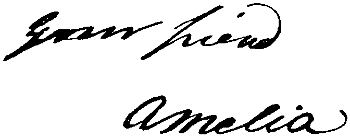
So wrote one of the daughters of England. We hail her a child of the nation by her affiance to virtue, the creator of our moral grandeur, and the preserver of our national dignity. Private virtue is the stability of states.
In the princess Amelia’s letter there is a natural union of powerful sense and exquisite sensibility; it has an easy, common-place air, but a mind that examines the grounds, and searches into the reasons of things, will discover the “root of the matter.” Comment upon it is abstained from, that it may be read and studied.
The crime of seduction is fashionable, because hitherto fashion has been criminal with impunity. The selfish destroyer of female innocence, can prevail on some wives and mothers by varnish of manner, and forcefulness of wealth, to the degradation of sanctioning his entertainments by their presence. Like the fabled upas-tree of Java, he lives a deadly poison to wither and destroy all within his shadow. Uneasiness from a lash of small cords in a feeble hand, he retaliates by a horsewhip: monstrous sensualists must be punished by scourges of flame from vigorous arms, and be hunted by hue and cry, till they find sanctuary in some remote hiding-place for blood-guiltiness.
FLORAL DIRECTORY.
Common Amaranth. Amaranthus hypochondriacus. Dedicated to St. Cajetan.
August 8.
Sts. Cyriacus, Largus, Smaragdus, and their Companions, Martyrs, A. D. 303. St. Hormisdas.
FUNERALS IN CUMBERLAND.
To the Editor of the Every-Day Book.
Sir,
The variety of funeral-rites and ceremonies, prevalent in different ages and countries, has been so great as to forbid any attempt to enumerate them; but it is consistent with the character and design of the Every-Day Book, to record the peculiar customs which have existed in different districts of our native land: for although your motto from old Herrick, does not refer to any thing of a serious kind, yet, in the number of those which you promise the world to “tell of” I perceive that such matters are sometimes related. I proceed, therefore, to detail the circumstances which preceded and attended the interment of the dead in the county of Cumberland, within the last twenty years: they are now discontinued, except, perhaps, in some of the smaller villages, or amongst the humblest class in society. Whether the customs I am about to describe, have been observed in the southern parts of England, I know not; I shall, therefore, confine myself to what has frequently passed under my own observation in my native town.
No sooner had the passing-bell intimated to the inhabitants that an acquaintance or neighbour had departed for that “bourne whence no traveller returns,” than they began to contemplate a call at the “Corse-house,” (for such was the denomination of the house of mourning,) within which preparations were made by the domestics to receive all who might come. To this end all the apartments were prepared for the reception of visitors with the exception of the chamber of death: one for the seclusion of the survivors of the family, and the domestic offices.
The interval between the death and the interment is at present, I believe, extended beyond what was usual at the time I refer to: it was then two days and two nights, varying accordingly as the demise took place in the early or latter part of the day.
The assemblage at the Corse-house, was most numerous during the evening; at which time many persons, who were engaged during the day in their several avocations, found leisure to be present: many of the females made their call, however, during the afternoon. The concourse of visitors rendered the house like a tavern; their noise and tumult being little restrained, and their employment being the drinking of wine or spirits with the smoking of tobacco; and if only some made use of the “stinking herb,” all partook of the juice of the grape. Instances could be adduced in which moderation gave way to excess.
The conversation turned, often upon the character of the deceased, at least when generally respected; “de mortuis nil nisi bonum;” the ordinary topics of the day were discussed: perhaps the Irish people were ridiculed for their barbarism in waking their dead: and each individual as inclination prompted him, retired to make room for another, thus maintaining a pretty rapid succession of arrivals and departures, with the exception of, perhaps, one or two who embraced so favourable an opportunity for economical indulgence. “Where the carcase is there will the eagles be gathered together.”
I must, however, observe in justice to the good taste of my townsmen, that many of them rather assented to the custom than approved it; but an omission to attend a Corse-house, with the occupants of which you were even slightly acquainted, was considered a mark of disrespect to the memory of the dead, and the feelings of the survivors.
It happened, however, that a gentleman (a stranger to this custom,) settled in the town I refer to, and, after a short residence, a death occurred in his family: he at once resolved to deviate from a practice which he did not approve. The first visitors to his house observed that no preparations were made for their reception, and were respectfully told by a servant, that open house would not be kept on the occasion: the news soon spread, and so did the example; a native of the town soon followed it, and a custom fell into desuetude, which the warmest admirers of ancient practices could scarcely desire to perpetuate. Originating probably in the exercise of the social affections, and of that hospitality which was convenient enough in periods when population was thin and widely scattered, they degenerated from their original use, and were “more honoured in the breach than the observance.” Antiquity might, perhaps, plead in their defence. The ancient Jews made great use of music in their funeral rites; before Christ exerted his power in the restoration of the ruler’s daughter, who was supposed to be dead, he caused to be put forth “the minstrels and the people making a noise.” Matt. c. 9, v. 23, et seq.
The ceremonies, which I am now going to describe, are still in existence; and evince no symptoms of decay. On the evening preceding the day appointed for the interment, the parish-clerk perambulates the town, carrying a deep and solemn-toned bell, by means of which he announces his approach to various places at which he is accustomed to stop, and give utterance to his mournful message. Well do I remember the deep interest with which I and my youthful associates listened to the melancholy tones of his sepulchral voice, whilst toys were disregarded, and trifling for a moment suspended! As the sounds of the “Death-bell” died away, it was proclaimed thus: “All friends and neighbours are desired to attend the funeral of —— from ——-street, to Mary’s Chapel: the corpse to be taken up at —— o’clock.” What crowds of little urchins feeling a mixed sensation of fear and curiosity were congregated! What casements were half-opened whilst mute attention lent her willing ear to seize upon the name of the departed, and the hour of burial!
I have known a party at “a round game” hushed into silence: and a whist party thrown into a sort of reverie, and there remain till Mrs. What-d’ye-call-’em asked Mrs. What’s-her-name, if clubs were trumps? or chid her partner for being guilty of a revoke on account of so common a thing as the “Death-bell.”
On the following day the clerk proceeds to the Corse-house, about an hour before the procession is formed. A small table covered with a white napkin, on which are placed wines and spirits, is put at the door of the house within and around which the people assemble: the clerk takes his place by the table, to assist to a glass of liquor, any person who may approach it. The coffin being brought forth, the clerk takes his place in front of the procession, and is usually attended by a number of those who form the choir on Sunday, all being uncovered. A psalm is sung as the cavalcade moves slowly through the streets. The rest of the “friends and neighbours” follow the corpse to the church, where the ordinary services conclude; and thus concludes the “strange eventful history,” related by, sir,
Yours faithfully, J. B——.
FLORAL DIRECTORY.
Love lies bleeding. Amaranthus procumbens. Dedicated to St. Hormisdas.
August 9.
St. Romanus. St. Nathy, or David, A. D. 530. St. Fedlemid, or Felimy, Bp. of Kilmore, 6th Cent.
FLORAL DIRECTORY.
Jacobæan Ragweed. Senecio jacobea. Dedicated to St. Romanus.
The Willow.
According to T. N., a Cambridge correspondent, this tree is, in that county, called the Cambridge oak. Old Fuller calls it “a sad tree, whereof such who have lost their love make their mourning garlands; and we know that exiles hung up their harps upon such doleful supporters. The twigs hereof are physick to drive out the folly of children. This tree delighteth in moist places, and is triumphant in the Isle of Ely, where the roots strengthen their banks, and top affords fuell for their fire. It groweth incredibly fast, it being a by-word in this county, that the profit by willows will buy the owner a horse before that by other trees will pay for his saddle. Let me add, that if green ashe may burne before a queen, withered willows may be allowed to burne before a lady.” The old saying, “She is in her willows” is here illustrated; it implies the mourning of a female for her lost mate.
The Willow (Salix)
In Sylvan Sketches, to an account of the willow, elegant poetical illustrations are attached, from whence are extracted the subjoined agreeable notices.
According to some botanists, there are more than fifty British willows only. The sweet, or bay-leaved willow, salix pentandria, is much used in Yorkshire for making baskets; its leaves afford a yellow dye. Baskets are also made from the osier, which belongs to this genus; but of the willows, the bitter purple willow, salix purpurea, is the best adapted for the finest basket-work. The common, or white willow, salix alba, takes its specific name from the white silken surface of the leaves on the under side. The bark is used to tan leather, and to dye yarn of a cinnamon colour. It is one of the trees to which the necessitous Kamtschatdales are often obliged to recur for their daily bread, which they make of the inner bark, ground into flour. The bark of this willow has in some cases been found a good substitute for the Peruvian bark. The grey willow, or sallow, salix cinerea, grows from six to twelve feet high. In many parts of England, children gather the flowering branches of this tree on Palm Sunday, and call them palms. With the bark, the inhabitants of the Highlands and the Hebrides tan leather. The wood, which is soft, white, and flexible, is made into handles for hatchets, spades, &c. It also furnishes shoemakers with their cutting-boards, and whetting-boards to smooth the edges of their knives upon.
The weeping willow, salix Babylonica, a native of the Levant, was not cultivated in this country till 1730. This tree, with its long, slender, pendulous branches, is one of the most elegant ornaments of English scenery. The situation which it affects, also, on the margins of brooks or rivers, increases its beauty; like Narcissus, it often seems to bend over the water for the purpose of admiring the reflection:—
———“Shadowy trees, that lean So elegantly o’er the water’s brim.”
There is a fine weeping willow in a garden near the Paddington end of the New Road, and a most magnificent one, also, in a garden on the banks of the Thames, just before Richmond-bridge, on the Richmond side of the river. Several of the arms of this tree are so large, that one of them would in itself form a fine tree. They are propped by a number of stout poles; and the tree appears in a flourishing condition. If that tree be, as it is said, no more than ninety-five years old, the quickness of its growth is indeed astonishing.
Martyn relates an interesting anecdote, which he gives on the authority of the St. James’s Chronicle, for August, 1801:
“The famous and admired weeping willow planted by Pope, which has lately been felled to the ground, came from Spain, enclosing a present for lady Suffolk. Mr. Pope was in company when the covering was taken off; he observed that the pieces of stick appeared as if they had some vegetation; and added, ‘Perhaps they may produce something we have not in England.’ Under this idea, he planted it in his garden, and it produced the willow-tree that has given birth to so many others.” It is said, that the destruction of this tree was caused by the eager curiosity of the admirers of the poet, who, by their numbers, so disturbed the quiet and fatigued the patience of the possessor, with applications to be permitted to see this precious relic, that to put an end to the trouble at once and for ever, she gave orders that it should be felled to the ground.
The weeping willow, in addition to the pensive, drooping appearance of its branches, weeps little drops of water, which stand like fallen tears upon the leaves. It will grow in any but a dry soil, but most delights, and best thrives, in the immediate neighbourhood of water. The willow, in poetical language, commonly introduces a stream, or a forsaken lover:—
“We pass a gulph, in which the willows dip Their pendent boughs, stooping as if to drink.”
Cowper.
Chatterton describes
“The willow, shadowing the bubbling brook.”
Churchill mentions, among other trees
“The willow weeping o’er the fatal wave, Where many a lover finds a watery grave; The cypress, sacred held when lovers mourn Their true love snatched away.”
Besides Shakspeare’s beautiful mention of the willow on the death of Ophelia, and notices of it by various other poets, there are several songs in which despairing lovers call upon the willow-tree:—
“Ah, willow! willow The willow shall be A garland for me, Ah, willow! willow!”
Chatterton has one, of which the burthen runs—
“Mie love ys dedde, Gon to hys deathe-bedde, Al under the wyllowe tree.”
In the “Two Noble Kinsmen,” said to have been written by Shakspeare and Fletcher, a young girl, who loses her wit with hopeless love for Palamon—
——“Sung Nothing but ‘Willow! willow! willow!’ and between Ever was ‘Palamon, fair Palamon!’”
Herrick thus addresses the willow-tree:
“Thou art to all lost love the best, The only true plant found; Wherewith young men and maids distrest, And left of love, are crowned. “When once the lover’s rose is dead, Or laid aside forlorn, Then willow garlands ’bout the head, Bedewed with tears, are worn. “When with neglect, the lover’s bane, Poor maids rewarded be For their love lost, their only gain Is but a wreath from thee. “And underneath thy cooling shade, When weary of the light, The love-spent youth and love-sick maid Come to weep out the night.”
This poet has some lines addressed to a willow garland also:—
“A willow garland thou didst send Perfumed, last day, to me; Which did but only this portend, I was forsook by thee. “Since it is so, I’ll tell thee what; To-morrow thou shalt see Me wear the willow, after that To die upon the tree. “As beasts unto the altars go With garlands dressed, so I Will with my willow-wreath also Come forth, and sweetly die.”
The willow seems, from the oldest times, to have been dedicated to grief; under them the children of Israel lamented their captivity:—“By the rivers of Babylon, there we sat down, yea, we wept when we remembered Zion: we hanged our harps upon the willows in the midst thereof.”[239]
The wicker-baskets made by our forefathers are the subject of an epigram by Martial:—
“From Britain’s painted sons I came, And basket is my barbarous name; Yet now I am so modish grown, That Rome would claim me for her own.”
It is worthy to be recollected, that some of the smallest trees known are willows; nay, the smallest tree known, without any exception. The herbaceous willow, salix herbacea, is seldom higher than three inches, sometimes not more than two; and yet it is in every respect a tree, notwithstanding the name herbaceous, which, as it has been observed, is inappropriate. Dr. Clarke says, in his “Travels in Norway,” “We soon recognised some of our old Lapland acquaintances, such as Betula nana, with its minute leaves, like silver pennies; mountain-birch; and the dwarf alpine species of willow: of which half a dozen trees, with all their branches, leaves, flowers, and roots, might be compressed within two of the pages of a lady’s pocket-book, without coming into contact with each other. After our return to England, specimens of the salix herbacea were given to our friends, which, when framed and glazed, had the appearance of miniature drawings. The author, in collecting them for his herbiary, has frequently compressed twenty of these trees between two of the pages of a duodecimo volume.” Yet in the great northern forests, Dr. Clarke found a species of willow “that would make a splendid ornament in our English shrubberies, owing to its quick growth, and beautiful appearance. It had much more the appearance of an orange than of a willow-tree, its large luxuriant leaves being of the most vivid green colour, splendidly shining. We believed it to be a variety of salix amygdalina, but it may be a distinct species: it principally flourishes in Westro Bothnia, and we never saw it elsewhere.”
So much, and more than is here quoted, respecting the willow, has been gathered by the fair authoress of Sylvan Sketches.
In conclusion, be it observed, that the common willow is in common language sometimes called the sallow, and under that name it is mentioned by Chaucer:—
“Whoso buildeth his hous all of salowes, And pricketh his blind hors over the falowes, And suffreth his wife for to seche hallowes, He is worthy to be honged on the gallowes.”
Chaucer.
August 10.
St. Lawrence, A. D. 258. St Deusdedit. St. Blaan, Bp. of Kinngaradha, A. D. 446.
St. Lawrence.
His name stands in the church of England calendar. He suffered martyrdom at Rome, under Valerian. Mr. Audley relates of St. Lawrence, “that being peculiarly obnoxious, the order for his punishment was, ‘Bring out the grate of iron; and when it is red hot, on with him, roast him, broil him, turn him: upon pain of our high displeasure, do every man his office, O ye tormentors.’ These orders were obeyed, and after Lawrence had been pressed down with fire-forks for a long time, he said to the tyrant, ‘This side is now roasted enough; O tyrant, do you think roasted meat or raw the best?’ Soon after he had said this he expired. The church of St. Lawrence Jewry, in London, is dedicated to him, and has a gridiron on the steeple for a vane, that being generally supposed the instrument of his torture. The ingenious Mr. Robinson, in his ‘Ecclesiastical Researches,’ speaking about this saint, says, ‘Philip II. of Spain, having won a battle on the 10th of August, the festival of St. Lawrence, vowed to consecrate a Palace, a Church, and a Monastery to his honour. He did erect the Escurial, which is the largest Palace in Europe. This immense quarry consists of several courts and quadrangles, all disposed in the shape of a GRIDIRON. The bars form several courts; and the Royal Family occupy the HANDLE.’ ‘Gridirons,’ says one, who examined it, ‘are met with in every part of the building. There are sculptured gridirons, iron gridirons, painted gridirons, marble gridirons, &c. &c. There are gridirons over the doors, gridirons in the yards, gridirons in the windows, gridirons in the galleries. Never was an instrument of martyrdom so multiplied, so honoured, so celebrated: and thus much for gridirons.’”[240]
Chronology.
On the 10th of August, 1575, Peter Bales, one of our earliest and most eminent writing-masters, finished a performance which contained the Lord’s prayer, the creed, the decalogue, with two short prayers in Latin, his own name, motto, the day of the month, year of our Lord, and reign of the queen, (Elizabeth,) to whom he afterwards presented it at Hampton-court, all within the circle of a single penny, enchased in a ring with borders of gold, and covered with a crystal, so accurately wrought, as to be plainly legible, to the great admiration of her majesty, her ministers, and several ambassadors at court.
In 1590, Bales kept a school at the upper end of the Old Bailey, and the same year published his “Writing School-Master.” In 1595, he had a trial of skill in writing with a Mr. Daniel (David) Johnson, for a “golden pen” of £20 value, and won it. Upon this victory, his contemporary and rival in penmanship, John Davies, made a satirical, ill-natured epigram, intimating that penury continually compelled Bales to remove himself and his “golden pen,” to elude the pursuit of his creditors. The particulars of the contest for the pen, supposed to be written by Bales himself, are in the British Museum, dated January 1, 1596.
So much concerning Peter Bales is derived from the late Mr. Butler’s “Chronological Exercises,” an excellent arrangement of biographical, historical, and miscellaneous facts for the daily use of young ladies.
Peter Bales according to Mr. D’Israeli, “astonished the eyes of beholders by showing them what they could not see.” He cites a narrative, among the Harleian MSS., of “a rare piece of work brought to pass by Peter Bales, an Englishman, and a clerk of the chancery.” Mr. D’Israeli presumes this to have been the whole Bible, “in an English walnut no bigger than a hen’s egg. The nut holdeth the book: there are as many leaves in his little book as the great Bible, and he hath written as much in one of his little leaves, as a great leaf of the Bible.” This wonderfully unreadable copy of the Bible was “seen by many thousands.”
Peter Huet, the celebrated bishop of Avranches, long doubted the story of an eminent writing-master having comprised “the Iliad in a nut-shell,” but, after trifling half an hour in examining the matter, he thought it possible. One day, in company at the dauphin’s, with a piece of paper and a common pen, he demonstrated, that a piece of vellum, about ten inches in length, and eight in width, pliant and firm, can be folded up and enclosed in the shell of a large walnut; that in breadth it can contain one line of thirty verses, perfectly written with a crow-quill, and in length two hundred and fifty lines; that one side will then contain seven thousand five hundred verses, the other side as much, and that therefore the piece of vellum will hold the whole fifteen thousand verses of the Iliad.
The writing match between Peter Bales and David Johnson, mentioned by Mr. Butler, “was only traditionally known, till, with my own eyes,” says Mr. D’Israeli, “I pondered on this whole trial of skill in the precious manuscript of the champion himself; who, like Cæsar, not only knew how to win victories, but also to record them.” Johnson for a whole year gave a public challenge, “To any one who should take exceptions to this my writing and teaching.” Bales was magnanimously silent, till he discovered that since this challenge was proclaimed, he “was doing much less in writing and teaching.” Bales then sent forth a challenge, “To all Englishmen and strangers,” to write for a gold pen of twenty pounds value, in all kinds of hands, “best, straightest, and fastest,” and most kind of ways; “a full, a mean, a small, with line and without line; in a slow-set hand, a mean facile hand, and a fast running hand;” and further, “to write truest and speediest, most secretary and clerk-like, from a man’s mouth, reading or pronouncing, either English or Latin.” Within an hour, Johnson, though a young friend of Bales, accepted the challenge, and accused the veteran of arrogance. “Such an absolute challenge,” says he, “was never witnessed by man, without exception of any in the world!” Johnson, a few days after, met Bales, and showed him a piece of “secretary’s hand,” which he had written on fine parchment, and said, “Mr. Bales, give me one shilling out of your purse, and, if within six months you better or equal this piece of writing, I will give you forty pounds for it.” Bales accepted the shilling, and the parties were thereby bound over to the trial of skill. The day before it took place, a printed paper posted through the city taunted Bales’s “proud poverty,” and his pecuniary motives as “ungentle, base, and mercenary, not answerable to the dignity of the golden pen!” Johnson declared that he would maintain his challenge for a thousand pounds more, but that Bales was unable to make good a thousand groats. Bales retorted by affirming the paper a sign of his rival’s weakness, “yet who so bold,” says Bales, “as blind Bayard, that hath not a word of Latin to cast at a dog, or say ‘Bo!’ to a goose!” The goose was mentioned perhaps, in allusion to Michaelmas-day 1595, when the trial commenced before five judges; an “ancient gentleman” was intrusted with “the golden pen.” The first trial was for the manner of teaching scholars; this terminated in favour of Bales. The second, for secretary and clerk-like writing, dictated in English and in Latin, was also awarded to Bales; Johnson confessing that he wanted the Latin tongue, and was no clerk. On the third and last trial, for fair writing in sundry kinds of hands, Johnson prevailed in beauty and most “authentic proportion,” and for superior variety of the Roman hand; but in court-hand, and set-text, Bales exceeded, and in bastard secretary was somewhat perfecter than Johnson. For a finishing blow, Bales drew forth his “master-piece,” and, offering to forego his previous advantages if Johnson could better this specimen, his antagonist was struck dumb. In compassion to the youth of Johnson, some of the judges urged the others not to give judgment in public. Bales remonstrated against a private decision in vain, but he obtained the verdict and secured the prize. Johnson, however, reported that he had won the golden pen, and issued an “Appeal to all impartial Penmen,” wherein he affirmed, that the judges, though his own friends, and honest gentlemen, were unskilled in judging of most hands, and again offered forty pounds to be allowed six months to equal Bales’s “master-piece.” Finally, he alleged, that the judges did not deny that Bales possessed himself of the golden pen by a trick: he relates, that Bales having pretended that his wife was in extreme sickness, he desired that she might have a sight of the golden pen, to comfort her, that the “ancient gentleman,” relying upon the kind husband’s word, allowed the golden pen to be carried to her, and that thereupon Bales immediately pawned it, and afterwards, to make sure work, sold it at a great loss, so that the judges, ashamed of their own conduct, were compelled to give such a verdict as suited the occasion. Bales rejoined, by publishing to the universe the day and hour when the judges brought the golden pen to his house, and painted it with a hand over his door for a sign.[241] This is shortly the history of a long contest, which, if it has not been paralleled in our own time, we have been reminded of by the open challenges of living calligraphers.
John Flamsteed.
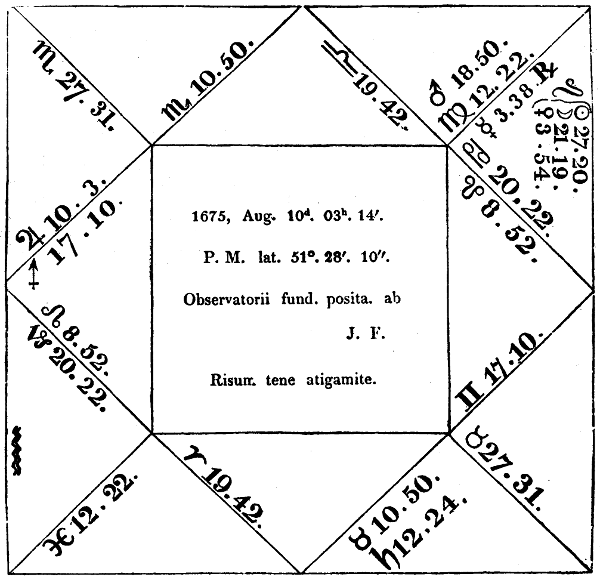
On the 10th of August, 1675, the foundation stone of the Royal Observatory, for watching and noting the motions of the celestial bodies, was laid on the hill where it now stands, in Greenwich Park. The edifice was erected by order of king Charles II., at the instance of sir Jonas Moor, under the direction of sir Christopher Wren; and it is worthy of record here, that the celebrated Flamsteed, constructed a “Scheme of the Heavens,” at the very minute when the foundation stone was laid. It has never appeared in any work, and as the public are wholly unacquainted with its existence, it is subjoined exactly as Flamsteed drew it with his own hand.
1675, Aug. 10d. 03h. 14´.
P. M. lat. 51°. 28´. 10´´.
Observatorii fund. posita. ab
J. F.
Risum tene atigamite.
“Few men rightly temper with the stars.”—Shakspeare.
Flamsteed was the first astronomer-royal, and from him the Observatory at Greenwich derives its popular name, “Flamsteed-house.” His “Scheme of the Heavens,” may be found there in a folio vellum-bound manuscript on the second page. Opposite to it, also drawn by himself, with great exactness, and signed by his own name within it, is a ground plan of the Observatory. On the following, being the fourth page, is a list of “Angles, betwixt eminent places observed with the sextant in the months of February and March, 1679—80.” The remainder of the book consists of about one hundred and seventy pages of “Observations,” also in Flamsteed’s hand-writing. Whatever astrological judgement he may have exercised upon the positions of the stars in his horoscope, he has not left his opinion in writing; but the circumstance of his having been at some pains to ascertain and set them down among his other “Observations,” may be taken as presumptive that this great astronomer practised astrology.
In another folio manuscript in calf binding, containing also one hundred and thirty-two pages of his “Observations,” there is a document of more general importance; namely, a series of notices or memoranda also in his own hand-writing of circumstances in his life which he deemed most worthy of committing to paper. The most curious portion of this labour relates to a difference which is well known to have existed between himself, and sir Isaac Newton. The whole of these memoirs, with the astrological scheme, a scientific gentleman was permitted by Dr. Maskelyne, the late astronomer-royal, to transcribe from the MSS. at the Observatory. Until now, they have been unprinted, and having been obligingly communicated to the Editor of the Every-Day Book, the latter conceives that the public will be gratified by their perusal, and therefore preserves them in the pages of this work without comment. Without any view of detracting sir Isaac Newton, or Mr. Flamsteed, by their publication, he offers the singular statements as Flamsteed wrote them. His birth is stated at their commencement; he died at Greenwich, on the 31st of December 1719.
Memoirs of Mr. John Flamsteed, by himself.
I was borne At Denby, 5 miles from Derby, August 19, 1646—my father having removed his family thither because the Sickness was then in Derby.
Educated in the free school at Derby till 16 years old.
At 14 years of Age 1660, Got a great cold—was followed by 5 years sickness—a Consumption.
Recovered, by God’s blessing, on a journey into Ireland 1665, in the months of August and Sept.
Began to study Mathematics in 1662. The first book I read was Sacrobusco de Sphæra, which I turned into English.
In 1665 Calculated Eclipses and the planets, places from Street’s Caroline tables, and wrote my Treatise of the æquation of Days.
In 1666 observed the Eclipse of ye Sun.
In 1669 observed a Solar Eclipse and some appulses, and presented the prædictions of more for the year 1670 to the R. S.[242] this brought on a Correspondence with Mr. Oldenburg—Collins.
Mr. Oldenburg’s first letter to me is dated Jan. 14. 1669-70.
Mr. Collins 2o Feb. 3. 1669-70.
My Predn. of Appulses 1670, printed in ye Ph. Tr. No. 55 for Jan. 1669-70.
Mr. N’s.[243] The. of light and Colors, 80. Feb. 19. 1671-2.
I was in London after Whitsuntide 1670; came acquainted with Sir. Jo. Moor; bought telescope glasses, and had Mr. Townly’s Micrometer presented to me by Sir Jonas Moor.
Set a Pole up to raise my glasses, March 21, 1671, at Derby.
Began to measure distances in the heavens, Octo. 17, 1672.
Continued them there till Jan. 1673/4.
1672. Sept. Observed ♂—deduced his parellax from the Observations ═ to his diameter.
1674. May the 2d. came to London.
29, went to Cambridge.
June the 5th. My degree.
July 13, returned to London.
Aug. 13, left London.
29, Got to Derby.
1674. First acquaintance with Sir I. N. at Cambridge, occasioned by my fixing there the Microscope, which he could not; the object glass being forgot by him.
1675. feb. 2. Came to London Again.
1675. Mar. 4. Warrant for my Sallary.
Sieur de St. Piex proposes to find the Longitude by Observations of the Ds. * * * Letters hereon.[244]
1675. June 22. Warrant dated for building the Royl. Observatory.
♀ August 10. foundation layd.
1676. July 10. entred into it to inhabit wth T. Smith, and Cutler Denton Servant.
1675. Sept. 19. began to measure distances in the heavens wth the sextant.
76. Sir Jonas Moor gave me the sextant, some books, and glasses, with charge to dispose of them by my Will: all the other instruments and tubes provided at my own charge.
1679. Aug. 17. Sir Jonas Moor died. His Sonn Sir J. M. thrown from his horse, died.
1680. Made the Voluble [?] Quadrant at my own Charge.
1680. Dec. 12. ☉ first saw and observed ye great Comet; observed it till Feb. 5, (80-81.)
1680. Mr. Newton’s first Letter to me about the Comet.
81. Imparted my observations of the Comet with ye may [be] derived from them.
85 or 86. gave him[245] the diameters of the planets in all Positions of the earth, and them in their orbits: got it back with much difficulty after 2 years detention.
He disputed against the comets of Nov. and Dec. being the same, in 2 long letters in Feb. and March 81o; now, in 85, he owned they might be so as I had asserted, and slightly mentioned me as disputing for their being the same as in ye 4th book of his principles; whereas I affirmed it, and himself disputed against it.
1687. his principles published: little notice taken of her Maties. Observatory.
1688 & 9. made the New large Arch and Staff * * * Sharp.
89. Began my observations of the * *s distances from our vertex with it.
Sept. 12. ☿ & 13 ♃s got the Clock removed by Nov. 15 ♀:
89. Dec. 10. first observation of the ☽’s place compared with my lunar Tables in ye 4th book of calculations, pag. 5.
After this I observed the ☾ and planets frequently wth the New Arch; examined the lunar observations, commonly the morning after they were got, and compared them with my Tables, till April, 1692, whereby I saw the faults of the Tables sometimes were near one-third of a degree.
1694. Sept. 1 ♄ Mr. Newton come to visit me; I shewed him these Collations drawn up in 3 large Synopses, and on his request gave him copys of them, he promising me not to impart or communicate them to any body; this promise I required of him because, as I then told him, I made use of some places of the fixed Stars which I had derived from observations made with the Sextant, which were not so exact as those taken with the Murall Arch; that I had now gotten a good stock of observations of the fixed * *s, should make a larger and much exacter Catalogue, that the ☾’s observed places should be derived from the places of the stars in my New Catalogue, and then I would impart them to him, which he approved, and by a Letter of his dated confest.
Nevertheless he imparted what he derived from them both to Dr. Gregory and Mr. H:[246] contra datam fidem.
After he had got the 3 Synopses of ☽’s observations to him he desired more of them, and this caused an Intercourse of letters betwixt us, wherein I imparted to him about 100 more of ye ☽ places, but finding this took up much time, and being now entered in my Rectification of the places of the fixed stars, and very busy in it, I was forced to leave off my correspondence wth him at that time, having found that his corrections of my numbers still gave ye Moon’s places 8 or 9 minutes erroneous, tho’ Dr. G. and Dr. Halley had boasted they would agree wth in 2´ or 3´—I was ill of the stone very oft and had [illegible] ye head ach till Sept. when freed of it by a violent fit of ye stone and my usuall medicine—Deo Laus.
1695 or 1696. Sir I. N.[247] being made an Officer in the Mint came to London. I sometimes visited him there or at his own house in Jermin Street: we continued civil, but he was not so friendly as formerly, because I could
Mr. H. and Dr. G. assertions concerning his corrections of ye Horroccian lunar theorys.
1696. A Correspondence begun wth Mr. Bosseley an Apothecary of Bakewell in Derbyshire and Mr. Luke Leigh a poor Kinsman of Mr. Halleys of the same clan, and myself. Mr. Bosseley wanted observation for correcting the planets places I furnished him, and set him on ♄ and ♃.
Mr. Leigh I hired to calculate the places of the fixed Stars from their Right Ascentions and distances from the Northern Pole determined by myself.
1696. Dec. 11 I received from him the places of the Stars in the Constellations of ♊ ♋ and ♌, which whilst he had been doing the same, were done by my then servant Mr. Hodgson in ye Observatory, so that I easily found the errors of either and corrected them.
♍ ♎ ♏ ♐ I recd Jan. 22. 1696
♑ ♒ ♓ ———— Mar. 27. 1697
♈ & ♉ ———— Jan. 16. 1697
Cetus - Jan. 10 1698-9
Eridanus
Lupus
Canis Maj.
Canis Min.
Navis
Orion - Aug. 19. 1699
Hydra
Cratera
Corvus
Serpens - July 25. 1700
Serpentarius
Aquila cum Antinoo
Sagitta
Delphinos
Equuleus
Pegasus
Triangulum
Andromeda - Jan. 5. ♃ 1701
Perseus
Auriga
Coma Beren.
Bootes
Corona Borea
Hercules
Lyra & Cygnus
Cassiopeia and Cepheus Apr. 26. 1701
The Stars in Hevelius his Sextant and Monsceros. ye Linx, Camelopardalus, Canes, Vanatici, were calculated afterwards in 1705. 6. 7. 8 by my servants, J. Woolferman and J. Crosthwaite, and the Constellations of Hercules and Cassiopeia enlarged with ye addition of many Stars observed in the years 1705. 6. 7. 8. by them and Mr. Ab. Ryley.
In the mean time as often as I met with Sir I. N. he was very inquisitive how the Catalogues went on, I answered as it stood; and when he came here commonly shewed him how it stood in my books, not suspecting any design, but hoping he might serve me as kindly as I had assisted him freely with my pains when he desired me.
1698. At Michælmas was at Derby and Bakewell.
1697-8. Feb. 6, ye CZAR first came to Greenwich.
1704. April 11. ♂ Mr. Newton came to the Observaty dined with me, saw the Volumes of Observations, so much of the Catalogue as was then finished, with the Charts of the Constellations both J. W’s[248] and those copied by Vansomer: desired to have the recommending of them to ye Prince: I knew his temper, that he would be my fr. no further than to serve his own ends, and that he was spitefull and swayed by those that were worse than himself; this made me refuse him: however, when he went away he promised me he would recommend them, tho he never intended me any good by it, but to get me under him, that I might be obliged to boy him up as E H[249] has done hitherto.
1704. Nov. 8. Wrote the Estimate, which was read without my knowledge at the R. S. The Members thought it ought to be recommended to the Prince; the President joynd with them, a Committee was appointed to attend his R. H. even without acquainting me with it, an estimate of the charges drawn up without my knowledge: the Prince allows it—Mr. N. says [illegible.]
He concludes me now in his power, does all he can to hinder the work, or spoyls it by encouraging the printers to commit faults.
We must print the Observations, tho I had shewed in my printed Æstimate, that for very good reasons the Charts of the Constellations ought first to be set upon.
Mr. N. told me he hoped I would give a Note under my hand of security for the Prince’s Money; this I knew was to oblige me to be his slave: I answered that I had, God be thanked, some estate of my own which I hoped to leave for my wife’s support, to her during her life, to my own Relations after; that therefore I would not cumber my own estate with imprests or securitys, but if they would please to take his Rl. Hs. moneys into their hands I would sign the workmen’s bill to them, whereby they would see if they were reasonable at the same time.
I was told I should have all the printed copys save what his R. H. should have to present to the Universitys.
And Mr. N. granted that since I refused to handle any of his R. H. money there was no need of securitys or Articles—Nevertheless——
***
The preceding are all the memoranda by Mr. Flamsteed respecting himself: he breaks off with the word “Nevertheless.”
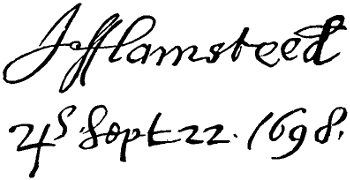
To conclude this article a fac-simile is added of Mr. Flamsteed’s autograph from his copy of “Streete’s Caroline Tables,” mentioned in the preceding memoir, and now in the possession of the Editor of the Every-Day Book. It is to a memorandum made in that book by Mr. Flamsteed, in these words:—
“The greatest declination of ye sun is not more yn 23°. 29′. 00 his horizontall parallax but 10 seconds; the semidiameters of ye Sunn in the Caroline tables less yn they ought to be by 12 seconds.”
FLORAL DIRECTORY.
Common Balsam. Impatiens balsama. Dedicated to St. Lawrence.
August 11.
Sts. Tiburtius and Chromatius, A. D. 286. St. Susanna, 3rd Cent. St. Gery, or Gaugericus, Bp. A. D. 619. St. Equitius, A. D. 540.
The dog-days end on this day. This period in the year 1825, was remarkable for longer absence of rain and greater heat than usual. It was further remarkable for numerous conflagrations, especially in the metropolis and its environs.
THE SEASON.
Dr. Forster in his Perennial Calendar, observes, that the gentle refreshing breezes by day, and the delicious calms by night, at this time of year, draw a vast concourse of persons of leisure to the shores of Great Britain and France in the months of August and September. There is perhaps no period of the year when the seaside is more agreeable. Bathing, sailing, and other marine recreations, are at no time better suited to beguile the hours of the warm summer day than at present; and the peculiar stillness of a seaside evening scene, by moonlight, is now to be enjoyed in perfection, as Cynthia begins to ascend higher in her car after the termination of the nightless summer solstice, and when the unremitted heat of the dog-days at length gives place to the more refreshing dews of a longer period of nocturnal coolness. The peculiar beauties of a sea-scene by night are thus described by a cotemporary poet:—
The sky was clear and the breeze was still, The air was soft and the night was fine, And all was hush save the tinkling rill, While the moonbeams played on the sparkling brine; Scylla had pulled off her glacous vest, No longer responsive to whirlwinds’ roar, But in white flowing silvery mantle drest, With silken shoons danced along the shore.
But the imagery of a calm sea is more poetically described by Milton, perhaps, than by any other author when he tells us:—
That not a blast was from his dungeon strayed, The air was calm, and on the level brine Sleek Panope with all her sisters played.
The swift, hirundo apus, is missed, says Dr. Forster, in its usual haunts about this time. The great body of these birds migrate at once, so that we are struck with their absence about the old steeples of churches and other edifices which they usually inhabit, and from whence they sally forth on rapid wings each morning and evening in search of food, wheeling round and round, and uttering a very loud piercing and peculiar cry, wherefore they are called squeakers. For the last month past, these birds may have been seen flying in lofty gyrations in the air, and seemingly exercising their wings and preparing for their aërial voyage. It is not precisely ascertained to what countries they go when they leave Europe.
Insects, says Dr. Forster, still continue to swarm and to sport in the sun from flower to flower. It is very amusing to observe, in the bright sun of an August morning, the animation and delight of some of the lepidopterous insects. That beautiful little blue butterfly, papilio argus, is then all life and activity, flitting from flower to flower in the grass with remarkable vivacity: there seems to be a constant rivalship and contention between this beauty, and the not less elegant little beau, papilio phlœas. Frequenting the same station, attached to the same head of clover, or of harebell, whenever they approach, mutual animosity seems to possess them; and darting on each other with courageous rapidity, they buffet and contend until one is driven from the field, or to a considerable distance from his station, perhaps many hundred yards, when the victor returns to his post in triumph; and this contention is renewed, as long as the brilliancy of the sun animates their courage. When the beautiful evening of this season arrives, we again see the bat:—
The bat begins with giddy wing His circuit round the shed and tree; And clouds of dancing gnats to sing A summer night’s serenity.
FLORAL DIRECTORY.
China Aster. Aster Chinensis. Dedicated to St. Susanna.
August 12.
St. Clare, Abbess, A. D. 1253. St. Euplius, A. D. 304. St. Muredach, First Bp. of Killala, A. D. 440.
Chronology.
King George IV. was born on the 12th of August, 1762; but the anniversary is kept on St. George’s-day, the 23d of April.
Twelfth of August.
To the Editor of the Every-Day Book.
THE HUMBLE PETITION OF AN UNFORTUNATE DAY.
Sir,
I am a poor wronged Day. I appeal to you as the general patron of the family of the Days. The candour with which you attended to the expostulations of a poor relative of ours—a sort of cousin thrice removed[250]—encourages me to hope that you will listen to the complaint of a Day of rather more consequence. I am the Day, Sir, upon which it pleased the course of nature that your gracious Sovereign should be born. As such, before his Accession, I was always observed and honoured. But since that happy event, in which naturally none had a greater interest than myself, a flaw has been discovered in my title. My lustre has been eclipsed, and—to use the words of one of your own poets,—
“I fade into the light of common day.”
It seems, that about that time, an Impostor crept into Court, who has the effrontery to usurp my honours, and to style herself the King’s-birth-Day, upon some shallow pretence that, being St. George’s-Day, she must needs be King-George’s-Day also. All-Saints-Day we have heard of, and All-Souls-Day we are willing to admit; but does it follow that this foolish Twenty-third of April must be All-George’s-Day, and enjoy a monopoly of the whole name from George of Cappadocia to George of Leyden, and from George-a-Green down to George Dyer?
It looks a little oddly that I was discarded not long after the dismission of a set of men and measures, with whom I have nothing in common. I hope no whisperer has insinuated into the ears of Royalty, as if I were any thing Whiggishly inclined, when, in my heart, I abhor all these kind of Revolutions, by which I am sure to be the greatest sufferer.
I wonder my shameless Rival can have the face to let the Tower and Park Guns proclaim so many big thundering fibs as they do, upon her Anniversary—making your Sovereign too to be older than he is, by an hundred and odd days, which is no great compliment one would think. Consider if this precedent for ante-dating of Births should become general, what confusion it must make in Parish Registers; what crowds of young heirs we should have coming of age before they are one-and-twenty, with numberless similar grievances. If these chops and changes are suffered, we shall have Lord-Mayor’s-Day eating her custard unauthentically in May, and Guy Faux preposterously blazing twice over in the Dog-days.
I humbly submit, that it is not within the prerogatives of Royalty itself, to be born twice over. We have read of the supposititious births of Princes, but where are the evidences of this first Birth? why are not the nurses in attendance, the midwife, &c. produced?—the silly story has not so much as a Warming Pan to support it.
My legal advisers, to comfort me, tell me that I have the right on my side; that I am the true Birth-Day, and the other Day is only kept. But what consolation is this to me, as long as this naughty-kept creature keeps me out of my dues and privileges?
Pray take my unfortunate case into your consideration, and see that I am restored to my lawful Rejoicings, Firings, Bon-Firings, Illuminations, &c.
And your Petitioner shall ever pray,
Twelfth Day of August
The Editor’s Answer.
Madam,
You mistake my situation: I am not the “patron,” but a poor servant of the Days—engaged to attend their goings out and comings in, and to teach people to pay proper respect to them. Mine is no trifling post, Madam; for without disrespect to you, many of your ancient family were spoiled long ago, by silly persons having taken undue notice of them; and in virtue of my office, I am a sort of judge in their court of claims, without authority to enforce obedience to my opinions. However, I shall continue to do my duty to the Days, and to their friends, many of whom are mere hangers-on, and, in spite of their pretended regard, grossly abuse them:—but this only verifies the old saying, “Too much familiarity breeds contempt:” such liberties must not be allowed, nor must the antiquity of the Days be too much insisted on. It is said, “there’s reason in every thing,” but there’s very little in some of the Old Days—excuse me, Madam, you are a young one; and I have something to excuse in you, which I readily do, on account of your inexperience, and of your bringing up.
That you are “the King’s-birth-Day” is undisputed: you are stated so to be in the almanac; as witness this line in August, 1825:—
“12. F. K. Geo. IV. b.”
Can any thing be plainer than the b. or more certain than that it stands for born? So much then for your rank in the Day family, and at Court, where you are acknowledged, and received as the birth-Day once a year, and “kept” as well as His Majesty can keep you. A king represents the majesty of the public welfare, and maintains the dignity of the throne whereon he is placed by promoting the interests of the people. His present Majesty regards your, and their, and his own, interest by remembering you, when you are not entitled to especial recollection with another day in the almanac, and this remembrance stands in April 1825, thus—
23. S. St. Geo. K. b. d. k.
St. George’s-Day does not supersede you; it is not called the King’s-birth-Day; the almanac by K. b. d. k. denotes that you, the King’s-birth-Day, are kept with all the honours due to your August quality on St. George’s-Day. If it had not “pleased the course of nature,” you would only have been distinguished as the first Day after the Day whereon the almanac says “Dog-Days end”—a fine distinction!
“It looks a little oddly” you say that you should have been “discarded not long after the dismission of a set of men and measures with whom you have nothing in common;” and you “hope,” that “no whisperer has insinuated” that you are “whiggishly inclined.” Allow me to tell you, Madam, that if the family of the Days had not been “whiggishly inclined” in the year 1688, you might still have been a “common Day.” I know not how you incline now, and it is of very little consequence; for all “parties” are busy in promoting the happiness of the commonwealth, and I hope, in my lifetime at least, that no Day will be dishonoured by dissensions about trifles at home, or war upon any pretence abroad. And now, Madam, after this indispensable notice of your little flaunt, let me add, that the prorogation of parliament during that season when “in the course of nature” you arrive, and the king’s attention to the manufacturing and trading of the country, are obvious reasons for keeping the King’s-birth-Day, in customary splendour on the 23d Day of April, instead of the 12th Day of August. You are honoured again in your own season at the palace; and your complaint amounts to no more than this, that having received your honours in the presence of a full court circle before you are entitled to them, they are not all repeated to a semicircle:—how childish! Then, you talk about the “ante-dating of births” and “Parish Registers” as if you were the daughter of a parish clerk—remember yourself, Madam.
St. George’s-Day has far more cause for vexation than you. The little respect usually paid to her celebration is eclipsed by the uproar of yours. “The Tower and Park guns proclaim so many big thundering fibs upon her anniversary” for you; and you call her, your elder sister, a “naughty kept creature;” poor thing! How eloquent is her silence compared with your loquacity! how dignified! yet she has antiquity to boast of—the antiquity of many generations, while you at the utmost, are only of sixty-three years standing; indeed, as the King’s-birth-Day, you are not halfway to your teens. A quarrel among the Days would be odious; this would be detestable. Happily the Day-family is saved from this disgrace by the prudence of your more experienced sister, who will no doubt decline provocation even under your spiteful collocation of George of Leyden with George of Cappadocia—she understands the taunt well enough; and can see through the whimsical association of George-a-Green with George Dyer. The dead George-a-Green no one can harm, and the living George Dyer is as harmless. This is pitiful work, and if you were not the King’s-birth-Day you would be made to suffer for it. “However,” as my friend Dyer would say, “let that pass:” he is a good creature, and maintains his innocence spite of his union—with George-a-Green.
On the presentation of your petition I had some doubt whether I ought to entertain such a petition for a moment; but on reconsideration I doubted whether the justice of the case would not be better answered by dealing with it in another way; and I give you the benefit of that doubt: the petition is dismissed.
The Editor.
FLORAL DIRECTORY.
Great Sowthistle. Sonchus palustris. Dedicated to St. Clare.
August 13.
St. Hippolytas, A. D. 252. St. Cassian. St. Rudegundes, queen of France, A. D. 587. St. Wigbert, Abbot, A. D. 747.
Cats.
Once upon a time—on or about the 13th of August, 1819; it might have been a few or many days before or after that day, or a month or so before or after that month—the day or month is of less consequence to the reader, than to the editor, who desires to “bring in” an interesting anecdote or two on the 13th day of August. Once upon a time, a cat—it is a fact—for it is in The Scotsman newspaper of the 23d of October, 1819—once upon a time, a cat, belonging to a shipmaster, was left on shore, by accident, when his vessel sailed from the harbour of Aberdour, Fifeshire, which lies about half a mile from the village. The vessel was absent about a month, and, on her return, to the astonishment of the shipmaster, puss came on board with a fine stout kitten in her mouth, apparently about three weeks old, and went directly down to the cabin. Two others of her young were afterwards caught, quite wild, in a neighbouring wood, where she must have remained with them till the return of the vessel. The shipmaster did not allow her again to go on shore, otherwise it is probable she would have brought the whole litter on board. What is more remarkable, vessels were daily entering and leaving the harbour, none of which she ever thought of visiting till the one she had left returned.[251] This extraordinary instance of feline sagacity, on the day before mentioned or imagined, is paralleled by another:—
A lady lately living at Potsdam, when a child of six years, ran a splinter into her foot, sat down upon the floor, and cried most violently. At first her cries were not regarded, as they were considered to be more the effect of a pettish and obstinate temper, than of any great pain which the accident could have occasioned her. At length the elder sister of the child, who had been lying asleep in bed, was roused by her cries, and as she was just about to get out of bed, in order to quiet her sister, she observed a cat, who was a favourite playmate of the children, and otherwise of a very gentle disposition, leave her seat under the stove, go to the crying girl, and having given her with one of her paws so smart a blow upon the cheek as to draw blood, walk back again with the utmost gravity to her place under the stove. As this cat was by no means of a malicious disposition, for she had grown up together with the younger children of the family, and never designedly scratched any of them, it seems that her intention upon this occasion was to chastise the pettish girl, and put an end to her troublesome cries, in order that she might herself be able to finish her morning nap without further interruption.[252]
In the “Orleans Collection” of pictures there was a fine painting of a “Concert of Cats,” by F. Breughel, from whence there is a print, among the engravings of that gallery, sufficiently meritorious and whimsical to deserve a place here; and therefore it is represented in the sketch on the present page. In justice, to the justice done to it, Mr. Samuel Williams must be mentioned as the artist who both drew and engraved it. The fixed attention of the feline performers is exceedingly amusing, and by no means unnatural; for it appears by the notes that mice is their theme, and they seem engaged in a catch.
Breughel’s Concert of Cats.
Ye rats, in triumph elevate your ears! Exult, ye mice! for fate’s abhorred shears Of Dick’s nine lives have slit the cat-guts nine; Henceforth he mews midst choirs of cats divine!
So sings Mr. Huddesford, in a “Monody on the Death of Dick, an Academical Cat,” with this motto,—
“MI-CAT inter omnes.”
Hor. Carm. Lib. i. Ode 12.
He brings his cat Dick from the Flood, and consequently through Rutterkin, a cat who was “cater-cousin to the great-great-great-great-great-great-great-great-great-grandmother of Grimalkin, and first cat in the caterie of an old woman, who was tried for bewitching a daughter of the countess of Rutland in the beginning of the sixteenth century.” The monodist connects him with cats of great renown in the annals of witchcraft; a science whereto they have been allied as closely as poor old women, one of whom, it appears, on the authority of an old pamphlet entitled “Newes from Scotland,” &c. printed in the year 1591, “confessed that she took a cat and christened it, &c. and that in the night following, the said cat was conveyed into the middest of the sea by all these witches sayling in their Riddles, or Cives, and so left the said cat right before the towne of Leith in Scotland. This done, there did arise such a tempest at sea as a greater hath not been seen, &c. Againe it is confessed, that the said christened cat was the cause of the kinges majestie’s shippe, at his coming forthe of Denmarke, had a contrarie winde to the rest of the shippes then being in his companie, which thing was most straunge and true, as the kinges majestie acknowledgeth, for when the rest of the shippes had a fair and good winde, then was the winde contrarie, and altogether against his majestie,” &c.