September. (continued 3)
Reading edition
Lady Mary was the daughter of noble parents, inhabitants of Florence, who immured her in a nunnery; but she accidentally saw a merry-andrew, with whom she formed a clandestine intercourse; an elopement followed, and finally, he taught her his infamous tricks, which she exhibited for his profit, till vice had made her his own, as Heraclitus proves. The catastrophe of “the lady Mary” was dreadful: her husband, impatient of delays or impediments to profit, either permitted or commanded her to exhibit on the rope, when her situation required compassionate consideration; she fell never to rise again, nor to open her eyes on her untimely infant, which perished in a few minutes after her.
In 1715, Dawks’s “News Letter,” says, “on Wednesday, Bartholomew Fair began, to which we hear, the greatest number of black cattle was brought, that was ever known.—There is one great playhouse erected in the middle of Smithfield for the king’s players.—The booth is the largest that was ever built.” Actors of celebrity performed in the Fair at that time, and in many succeeding years.
A recent writer, evidently well acquainted with the manners of the period, introduces us to a character mentioned in a former sheet. “In the midst of all, the public attention was attracted to a tall, well-made, and handsome-looking man, who was dressed in a very fashionable suit of white, trimmed with gold lace, a laced ruffled shirt, rolled white silk stockings, a white apron, and a large cocked hat, formed of gingerbread, fringed and garnished with Dutch gold. He carried on his arm a basket filled with gingerbread cakes, one of which he held up in the air; while the other hand was stuck with an easy and fashionable manner into his bosom. For this singular vendor of confectionary every one made way, and numbers followed in his train, shouting after him, ‘there goes Tiddy Doll!’ the name by which that remarkable character was known. He himself did not pass silently through the crowd, but as he went along, he poured forth a multiplicity of praises of his ware, occasionally enlivened by that song which first procured him his name.” This was at the Fair of the year 1740 concerning which the same illustrator thus continues: “The multitude behind was impelled violently forwards, a broad blaze of red light, issuing from a score of flambeaux, streamed into the air; several voices were loudly shouting, ‘room there for prince George! make way for the prince!’ and there was that long sweep heard to pass over the ground, which indicates the approach of a grand and ceremonious train. Presently the pressure became much greater, the voices louder, the light stronger, and as the train came onward, it might be seen that it consisted, firstly, of a party of yeomen of the guards clearing the way; then several more of them bearing flambeaux, and flanking the procession; while in the midst of all appeared a tall, fair, and handsome young man, having something of a plump foreign visage, seemingly about four and thirty years of age, dressed in a ruby-coloured frock coat, very richly guarded with gold lace, and having his long flowing hair curiously curled over his forehead and at the sides, and finished with a very large bag and courtly queue behind. The air of dignity with which he walked, the blue ribbon, and star and garter with which he was decorated, the small three-cornered silk court hat which he wore, whilst all around him were uncovered; the numerous suite, as well of gentlemen as of guards, which marshalled him along, the obsequious attention of a short stout person, who by his flourishing manner seemed to be a player,—all these particulars indicated that the amiable Frederick, prince of Wales was visiting Bartholomew Fair by torchlight, and that manager Rich was introducing his royal guest to all the entertainments of the place. However strange this circumstance may appear to the present generation, yet it is nevertheless strictly true; for about 1740, when the drolls in Smithfield were extended to three weeks and a month, it was not considered as derogatory to persons of the first rank and fashion, to partake in the broad humour and theatrical amusements of the place. It should also be remembered, that many an eminent performer of the last century, unfolded his abilities in a booth; and that it was once considered, as an important and excellent preparative to their treading the boards of a theatre-royal.” One of the players is thus represented as informing a spectator concerning the occupation of an itinerant actor:—“I will, as we say, take you behind the scenes. First then, a valuable actor must sleep in the pit, and wake early to sweep the theatre, and throw fresh sawdust into the boxes; he must shake out the dresses, and wind up and dust the motion-jacks; he must teach the dull ones how to act, rout up the idlers from the straw, and redeem those that happen to get into the watch-house. Then, sir, when the Fair begins, he should sometimes walk about the stage grandly, and show his dress: sometimes he should dance with his fellows; sometimes he should sing; sometimes he should blow the trumpet; sometimes he should laugh and joke with the crowd, and give them a kind of a touch-and-go speech, which keep them merry, and makes them come in. Then, sir, he should sometimes cover his state robe with a great coat, and go into the crowd, and shout opposite his own booth, like a stranger who is struck with its magnificence: by the way, sir, that’s a good trick, I never knew it fail to make an audience; and then he has only to steal away, mount his stage, and strut, and dance, and sing, and trumpet, and roar over again.”[290]
An advertisement in the “London Gazette” of April the 13th, 1682, shows under what authority showmen and similar persons “labour in their vocation:”—
“Whereas Mr. John Clarke, of London, bookseller, did rent of Charles Killigrew, Esq. the licensing of all ballad-singers for five years; which time is expired at Lady-day next. These are, therefore, to give notice to all ballad-singers, that they take out licences at the office of the revels, at Whitehall, for singing and selling of ballads, and small books, according to an ancient custom. And all persons concerned are hereby desired to take notice of, and to suppress all mountebanks, rope-dancers, prize-players, ballad-singers, and such as make show of motions and strange sights, that have not a licence in red and black letters, under the hand and seal of the said Charles Killigrew, Esq. master of the revels to his majesty;” and in particular it requires them to suppress two, one of them being “Thomas Teats mountebank,” who have no licence “that they may be proceeded against according to law.”
The late John Charles Crowle, Esq. who bequeathed his illustrated copy of “Pennant’s London” to the British Museum, which he valued at 5000l. was master of the revels. In that quality he claimed a seat in any part of the theatres, and being opposed by the manager of the little theatre in the Haymarket, maintained his right. He was also trumpet-major of England, to whom every one who blows a trumpet publicly (excepting those of the theatres-royal) must pay a certain sum, and therefore the office has jurisdiction of all the merry-andrews and jack-puddings of every Fair throughout England. The office of master of the revels was created under Henry VIII. in 1546. The identical seal of the office used under five sovereigns, was engraved on wood, and is in the possession of Francis Douce, Esq. F.S.A., who permitted impressions of it to be inserted first by Mr. Chalmers in his “Apology for the believers in the Shakspeare MSS.,” and next by Mr. J. T. Smith, of the British Museum, in his “Ancient Topography of London:” the legend on it is “Sigill: Offic: Jocor: Mascar: et Revell: Dnis. Reg.” Mr. Chalmers’s work also contains the “arms of the revels.”[291]
Mr. J. T. Smith was informed by Mr. Thomas Batrich, an ancient barber of Drury-lane, that Mr. Garrick shortly after his marriage conducted Mrs. Garrick to Yates and Shuter’s booth; Garrick being rudely pushed called upon his bill-sticker, old Palmer, who had been engaged to receive the money at the entrance of the booth, for protection. Palmer, though a very strong man, professed himself sorry he could not serve him in Smithfield; alleging that few people there knew Garrick off the stage. One of the merry-andrews who attended on the quack doctors was so much superior to the rest of his profession for wit and gesture, that he was noticed by all ranks of people. Between the seasons he sold gingerbread nuts about Covent-garden, and was the most polite and quiet vendor of the article in London; for to keep up his value at fairs, where he had a guinea a day for his performance besides presents from the multitude, he would never laugh or notice a joke when a dealer in nuts.
Mr. Edward Oram, who died at Hampstead in his seventy-third year, and was buried at Hendon, was intimate with Hogarth in his youth, and introduced him, soon after he left his master, to the proprietors of Drury-lane theatre, where he and Oram painted scenes conjointly, for several years, and were employed by a famous woman, who kept a droll in Bartholomew Fair to paint a splendid set of scenes. The agreement particularly specified that the scenes were to be gilt; but instead of leaf gold being used, they were covered in the usual way with Dutch metal: the mistress of the drolls declared the contract to be broken, and refused to pay for the scenes.[292]
Without going into a history of Bartholomew Fair, it may be remarked that in 1778 it was attended by a foreigner, who exhibited serpents that danced on silk ropes to the sound of music. In 1782, the late Mrs. Baker, proprietor of the Rochester theatre, brought here her company of comedians as “show-folk.” In four successive years, from 1779 to 1780, Mr. Hall of the City-road, eminent for his skill in the preservation of deceased animals, exhibited at the Fair his fine collection of stuffed birds and beasts, which he exhibited for many years before and afterwards at his own house. To obtain notice to it in Smithfield, he engaged sir Jeffery Dunstan to give his imitations in crying “old wigs;” but the mob were no admirers of “still life:” at Hall’s last visit they drew his fine zebra round the Fair; from thenceforth sir Jeffery’s imitations ceased to draw, and Hall came no more.
The exhibitions of living animals at this Fair have been always attractive. Hither came the “illustrious” Pidcock, with his wild beasts, and to him succeeded the “not less illustrious” Polito.
Hither also came the formerly famous, and still well-remembered Astley, with his “equestrian troop,” and his learned horse. These feats were the admiration of never-ceasing audiences, and to him succeeded Saunders with like success.
Puppet Shows.
Flockton was the last eminent “motion-master” at Bartholomew Fair. He was himself a good performer, and about 1790 his wooden puppets were in high vogue. He brought them every year till his death, which happened at Peckham, where he resided in a respectable way, upon a handsome competence realized by their exhibition at this and the principal fairs in the country. Flockton’s “Punch” was a very superior one to the present street show. He had trained a Newfoundland dog to fight his puppet, representing the devil, whom he always conquered in due time, and then ran away with him.
A puppet-show, or play performed by puppets, was anciently called a “motion;” and sometimes, in common talk, a single puppet was called “a motion.” These were very favourite spectacles. In the times of the papacy, the priests at Witney, in Oxfordshire, annually exhibited a show of The Resurrection, &c. by garnishing out certain small puppets representing the persons of Christ, Mary, and others. Amongst them, one in the character of a waking watchman, espying Christ to arise, made a continual noise, like the sound caused by the meeting of two sticks, and was therefore commonly called Jack Snacker of Wytney. Lambarde, when a child, saw a like puppet in St. Paul’s cathedral, London, at the feast of Whitsuntide; where the descent of the Holy Ghost was performed by a white pigeon being let fly out of a hole in the midst of the roof of the great aisle, with a long censer, which descending from the same place almost to the ground, was swung up and down at such a length, that it reached with one sweep almost to the west-gate of the church, and with the other to the choir stairs, breathing out over the whole church and the assembled multitude a most pleasant perfume, from the sweet things that burnt within it. Lambarde says, that they everywhere used the like dumb-shows, to furnish sundry parts of the church service with spectacles of the nativity, passion, and ascension.
There may be added to the particulars of a former exhibition, a puppet-showman’s bill at the British Museum, which announces scriptural subjects in the reign of Anne, as follows: “At Crawley’s booth, over against the Crown Tavern, in Smithfield, during the time of Bartholomew Fair, will be presented a little opera, called the Old Creation of the World, yet newly revived; with the addition of Noah’s Flood; also several fountains playing water during the time of the play. The last scene does present Noah and his family coming out of the ark, with all the beasts two by two, and all the fowls of the air seen in a prospect sitting upon trees; likewise over the ark is seen the sun rising in a glorious manner: moreover a multitude of angels will be seen in a double rank which presents a double prospect, one for the sun, the other for a palace, where will be seen six angels ringing of bells. Likewise machines descend from above, double and treble, with Dives rising out of hell, and Lazarus seen in Abraham’s bosom, besides several figures dancing jigs, sarabands, and country dances, to the admiration of the spectators; with the merry conceits of Squire Punch, and Sir John Spendall.”
These “motions” or puppet-shows were fashionable at this period in other places, and among fashionable people.
In the “Tatler” of May 14, 1709, there is an account of a puppet-show in a letter from Bath, describing the rivalry of Prudentia and Florimel, two ladies at that watering-place. Florimel bespoke the play of “Alexander the Great,” to be acted by the company of strollers on Thursday evening, and the letter-writer accepted the lady’s invitation to be of her party; but he says, “Prudentia had counterplotted us, and had bespoke on the same evening, the puppet-show of the Creation of the World. She had engaged every body to be there; and to turn our leader into ridicule, had secretly let them know that the puppet Eve was made the most like Florimel that ever was seen. On Thursday morning the puppet-drummer, with Adam and Eve, and several others that lived before the flood, passed through the streets on horseback to invite us all to the pastime; and Mr. Mayor was so wise as to prefer these innocent people, the puppets, who he said were to represent christians, before the wicked players who were to show Alexander an heathen philosopher. When we came to Noah’s flood in the show, Punch and his wife were introduced dancing in the ark. Old Mrs. Petulant desired both her daughters to mind the moral; then whispered to Mrs. Mayoress, ’this is very proper for young people to see,’ Punch at the end of the play made Madame Prudentia a bow, and was very civil to the whole company, making bows till his buttons touched the ground.” Sir Richard Steele in the “Spectator” of March 16, 1711, intimates that Powell, the puppet-showman, exhibited religious subjects with his puppets, under the little piazza in Covent-garden; and talks of “his next opera of Susannah, or Innocence Betrayed, which will be exhibited next week with a pair of new elders.”
It is observed in a small pamphlet,[293] that “music forms one of the grand attractions of the Fair, and a number of itinerant musicians meet with constant employment at this time.” A band at the west-end of the town, well known for playing on winter evenings before the Spring-garden coffee-house, and opposite Wigley’s great exhibition-room, consisted of a double drum, a Dutch organ, the tambourine, violin pipes, and the Turkish jingle, used in the army. This band was generally hired at one of the first booths in the Fair; but the universal noise arising from so many other discordant instruments, with the cry of “show them in! just going to begin!” prevented their being attended to.
The pamphlet referred to mentions the performances by a family of tumblers, who went about with a large caravan, and attended all the Fairs near town; and that at the beginning of the last century, Clarke and Higgins made themselves famous for their wonderful exertions in this way. They would extend the body into all deformed shapes, stand upon one leg, and extend the other in a perpendicular line, half a yard above the head. The tumblers of the present day do not attempt such wonderful exploits, but they put their bodies into a variety of singular postures, and leap with remarkable facility.
Lane was a celebrated performer at this Fair, and had several pupils who succeeded him in practising the grand and sublime art of legerdemain, and various tricks with cards and balls. The secrets of fortune were disclosed; unmarried damsels were told when and to whom they were to be married; and the widow when she should strip herself of her weeds, and enter anew into matrimony; knives were run through the hand without producing blood; knives and forks swallowed as of easy digestion; and fire and sparks proceeded out of a man’s mouth as from a blacksmith’s forge.
During Bartholomew Fair there were swings without number, besides round-abouts and up-and-downs. In the latter, the “young gentleman,” with his fair partner, were elated by the undulating motion, or rather vertical rotation of the machine; and while thus in motion, could survey the busy scene around, and hear its roar. The effect cannot be described which a stranger experienced upon entering Smithfield, and beholding the immense number of these vehicles, which appeared as if soaring into the clouds.
Then too, about the year 1815, a well-known eccentric character might be seen with plum-pudding on a board, which he sold in slices. He possessed as much drollery as any mountebank in the Fair, and had as various characteristic traits of oddity. He always walked without his hat, and his hair powdered and tied a la queue, in a neat dress, with a clean apron: his voice, strong and forcible, made many a humorous appeal in behalf of his pudding, large quantities of which he dealt out for “ready money,” and provoked a deal of mirth by his pleasantry.
George Alexander Stevens be-rhymes the Fair in his day thus:—
Here were, first of all, crowds against other crowds driving Like wind and tide meeting, each contrary striving; Shrill fiddling, sharp fighting, and shouting and shrieking, Fifes, trumpets, drums, bagpipes, and barrow girls squeaking— “Come my rare round and sound, here’s choice of fine ware!” Though all was not sound sold at Bartelmew Fair. Here were drolls, hornpipe-dancing, and showing of postures, With frying black puddings, and opening of oysters; With salt-boxes, solos, and galley folks squalling, The tap-house guests roaring, and mouth-pieces bawling. Here’s “Punch’s whole play of the gunpowder plot,” “Wild beasts all alive,” and “peas pudding all hot.” “Fine sausages” fried, and “the Black on the wire,” “The whole court of France,” and “nice pig at the fire.” Here’s the up-and-downs, “who’ll take a seat in the chair?” Tho’ there’s more up-and-downs than at Bartelmew Fair. Here’s “Whittington’s cat,” and “the tall dromedary,” “The chaise without horses,” and “queen of Hungary.” Here’s the merry-go-rounds, “Come who rides, come who rides, sir,” Wine, beer, ale, and cakes, fire eating besides, sir, The fam’d “learned dog,” that can tell all his letters, And some men, as scholars, are not much his betters.
Before the commencement of the last century, Bartholomew Fair had become an intolerable nuisance, and the lord mayor and aldermen, to abate its depravity, issued a prohibition on the 25th of June, 1700, against its lotteries and interludes. Subsequent feints of resistance were made to its shows, music, and other exhibitions, without further advantage than occasional cessation of gross violations against the public peace.
In sir Samuel Fludyer’s mayoralty, interludes were prohibited by a resolution of the court of aldermen. This resolution has been annually put forth, and annually broken by the court itself. When alderman Bull filled the civic chair, he determined to carry the resolution into effect, and so far accomplished his purpose as not to allow any booths to be erected; but want of firmness in his predecessors had inspirited the mob, and they broke the windows of the houses in Smithfield. Alderman Sawbridge in his mayoralty was equally determined against shows, and the mob was equally determined for them; he persisted, and they committed similar excesses. Yet we find that in the year 1743, the resolution had been complied with. The city would not permit booths to be erected, and “the Fair terminated in a more peaceable manner than it had done in the memory of man.”[294] This quiet, however, was only temporary, for on the 23rd of August, 1749, a gallery in Phillips’s booth broke down, and four persons were killed; a silversmith, a plasterer, a woman, and a child, and many others were dangerously bruised; one of the maimed had his leg cut off the next morning.[295] This accident seems to have aroused the citizens: on the 10th of July, 1750, a petition was presented to the lord mayor and court of aldermen, signed by above one hundred graziers, salesmen, and inhabitants in and near Smithfield, against erecting booths for exhibiting shows and entertainments there, during Bartholomew Fair, as not only annoying to them in their callings, but as giving the profligate and abandoned opportunity to debauch the innocent, defraud the unwary, and endanger the public peace.[296]
On the 17th of July, 1798, the court of common council referred it to the committee of city lands, to consider the necessity and expediency of abolishing Bartholomew Fair: in the course of the previous debate it was proposed to shorten the period to one day, but this was objected to on the ground that the immense crowd from all parts of the metropolis would endanger life.[297]
In September, 1825, Mr. Alderman Joshua Jonathan Smith, previous to entering on an examination of forty-five prisoners charged with felonies, misdemeanours, assaults, &c. committed in Smithfield during the Fair of that year, stated, that its ancient limits had been extended into several adjoining streets beyond Smithfield; he said he had particularly noticed this infringement in St. John-street, Clerkenwell on the north side, and nearly half-way down the Old Bailey, on the south; and he was determined, with the aid of his coadjutors, to take such further steps as would in future “lessen the criminal extension which had arisen, if not abolish the degrading scene altogether.”[298]
At other periods besides these, there were loud complaints against Bartholomew Fair; and as in 1825, the corporation of London appears seriously to have been engaged in considering the nuisance, its end may be contemplated as near at hand. It is to the credit of the civic authorities, that though shows and interludes were permitted, the Fair of that year was more orderly than any other within memory. Yet even these regulations are inefficient to the maintenance of the reputation the city ought to hold in the estimation of other corporations. The Fair was instituted for the sale of cloth, cattle, and other necessary commodities: as these have, for many years past, wholly disappeared from it, the use of the Fair has wholly ceased; its abuse alone remains, and that abuse can only be destroyed by the utter extinction of the Fair. To do this is not to “interfere with the amusements of the people,” for the people of the metropolis do not require such amusements; they are beyond the power of deriving recreation from them. The well-being of their apprentices and servants, and the young and the illiterate, require protection from the vicious contamination of an annual scene of debauchery, which contributes nothing to the city funds, and nothing to the city’s character but a shameful stain.
Bartholomew Fair must and will be put down. It is for this reason that so much has been said of its former and present state. No person of respectability now visits it, but as a curious spectator of an annual congregation of ignorance and depravity.
FLORAL DIRECTORY.
Mushroom. Agaricus Campestris. Dedicated to St. Laurence Justinian.
September 6.
St. Pambo of Nitria, A. D. 385. St. Eleutherius, Abbot. St. Bega, or Bees, 7th Cent.
St. Eleutherius.
Alban Butler boldly says, that this saint raised a dead man to life. He died at Rome, in St. Andrew’s monastery, about the year 585.
FLORAL DIRECTORY.
Autumnal Dandelion. Apargia Autumnalis. Dedicated to St. Pambo.
September 7.
Cloud, A. D. 560. St. Regina, or St. Reine, A. D. 251. St. Evurtius, A. D. 340. St. Grimonia, or Germana. St. Madelberte, A. D. 705. Sts. Alchmund and Tilberht, Bps. of Hexham, A. D. 780 and 789. St. Eunan, first Bp. of Raphoe.
St. Enurchus, or Evurtius.
This saint is in the church of England calendar, and therefore in the English almanacs, but on what ground it is difficult to conjecture; for Butler himself merely mentions him as a bishop of Orleans, who lived in the reign of Constantine, and died about 340:—he adds, that “his name is famous, but his history of no authority.”
“Fine Feathers make fine Birds.”
The subjoined letter, dated the 7th of September, 1825, appears in The Times newspaper of the following day:—
To the Editor of the Times.
Sir,—I consider it necessary to inform the public, through your paper, that there is a fellow going about the town, (dressed like a painter,) imposing upon the unwary, by selling them painted birds, for foreign ones. He entered my house on Monday last, and after some simple conversation with the customers in the room, he introduced the topic of his birds, which he had in a paper bag, stating that he had been at work in a gentleman’s family at the west end of the town, and the gentleman being on the point of leaving England for a foreign country, he made him a present of them; “but,” says he, “I’m as bad as himself, for I’m going down to Canterbury to-morrow morning myself, to work, and they being of no use to me, I shall take them down to Whitechapel and sell them for what I can get.” Taking one out of the bag, he described it as a Virginia nightingale, which sung four distinct notes or voices: the colour certainly was most beautiful; its head and neck was a bright vermilion, the back betwixt the wings a blue, the lower part to the tail a bright yellow, the wings red and yellow; the tail itself was a compound mixture of the above colours, the belly a clear green—he said it was well worth a sovereign to any gentleman. However, after a good deal of lying, bidding, and argument, one of the party offered five shillings, which he at last took; and disposing of the others much in the same way, he quickly decamped. In the course of an hour after, a barber, a knowing hand in the bird way, who lives in the neighbourhood, came in, and taking a little water, with his white apron he transferred the variegated colours of the nightingale to the white flag of his profession. The deception was visible—the swindler had fled—and the poor hedge-sparrow had his unfortunate head severed from his body, for being forced to personate a nightingale.
A Licensed Victualler.
Upper Thames-street.
By the preceding letter in The Times, a great number of persons were first acquainted with a fraud frequently practised. As a useful and amusing communication it has a place here. It may, however, be as well to correct an error which the intelligent “Licensed Victualler” falls into by venturing beyond a plain account, to indulge in figurative expression. It is not doubted that his “barber, a knowing hand in the bird way,” wore “a white apron;” but when the “Licensed Victualler” calls the barber’s white apron “the white flag of his profession,” he errs; a white apron may be the “flag” of the “Licensed Victualler’s profession,” but it is not the barber’s “flag.”
The Barber.
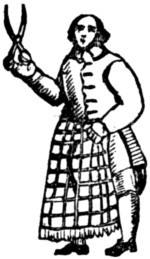
The Barber.
Randle Holme, an indisputable authority, in his great work on “Heraldry,” figures a barber as above. “He beareth argent,” says Holme; “a barber bare-headed with a pair of cisers in his right hand, and a comb in his left, clothed in russet, his apron checque of the first, and azure; a barber is always known by his checque party-coloured apron, therefore it needs not mentioning.” Holme emphatically adds, “neither can he be termed a barber, (or poler, or shaver,) as anciently they were called, till his apron be about him;” that is to say, “his checque party-coloured apron.” This, and this only, is the “flag of his profession.”
Holme derives the denomination barber from barba, a beard, and describes him as a cutter of hair; he was also anciently termed a poller, because in former times to poll was to cut the hair: to trim was to cut the beard, after shaving, into form and order.
The instrument-case of a barber, and the instruments in their several divisions, are particularly described by Holme. It contained his looking-glass, a set of horn combs with teeth on one side and wide, “for the combing and readying of long, thick, and stony heads of hair, and such like perriwigs;” a set of box combs, a set of ivory combs with fine teeth on both sides, an ivory beard-comb, a beard-iron called the forceps, being a curling iron for the beard, a set of razors, tweezers with an earpick, a rasp to file the point of a tooth, a hone for his razors, a bottle of sweet oil for his hone, a powder box with sweet powder, a puff to powder the hair, a four square bottle with a screwed head for sweet water, wash balls and sweet balls, caps for the head to keep the hair up, trimming cloths to put before a man, and napkins to put about his neck, and dry his hands and face with. After he was shaved and barbed, the barber was to hold him the glass, that he might see “his new-made face,” and instruct the barber where it was amiss: the barber was then to “take off the linens, brush his clothes, present him with his hat, and, according to his hire, make a bow, with ‘your humble servant, sir.’”
The same author thus figures
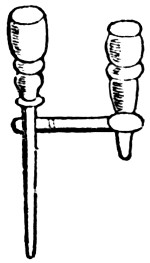
The Barber’s Candlestick.
He describes it to be “a wooden turned stick, having a socket in the streight peece, and another in the cross or overthwart peece; this he sticketh in his apron strings on his left side or breast when he useth to trim by candlelight.”
Without going into every particular concerning the utensils and art of “Barbing and Shaving,” some may be deemed curious, and therefore worthy of notice. It is to be observed, however that they are from Randle Holme, who wrote in 1688, and relate to barbers of former days.
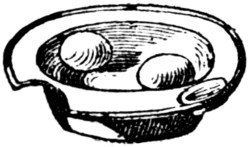
Barber’s Basin.
The barber’s washing or trimming-basin had a circle in the brim to compass a man’s throat, and a place like a little dish to put the ball in after lathering. Holme says, that “such a like bason as this, valiant Don Quixote took from a bloody enchanting barber, which he took to be a golden head-piece.”
The barber’s basin is very ancient; it is mentioned by Ezekiel the prophet. In the middle age it was of bright copper.[299]
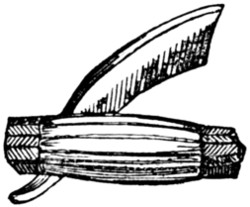
Razor.
This is a figure of the old razor of a superior kind, tipped with silver; “that is,” says Holme, “silver plates engraven are fixed upon each end of the haft, to make the same look more gent and rich.” The old man, being fidgetted by this ornament, declares, “it is very oft done by yong proud artists who adorne their instruments with silver shrines, more then seting themselves forth by the glory that attends their art, or praise obtained by skill.” Before English manufactures excelled in cutlery, razors were imported from Palermo.[300] Razors are mentioned by Homer.
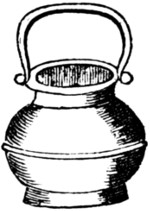
Barber’s Chafer.
“This is a small chafer which they use to carry about with them, when they make any progress to trim or barb gentiles at a distance, to carry their sweet water (or countreyman’s broth) in; the round handle at the mouth of the chafer is to fall down as soon as their hand leaves it;” so says Holme. Mr. J. T. Smith remarks, that “the flying barber is a character now no more to be seen in London, though he still remains in some of our country villages; he was provided with a napkin, soap, and pewter bason, the form of which may be seen in many of the illustrative prints of Don Quixote.” The same writer speaks of the barber’s chafer as being—“A deep leaden vessel, something like a chocolate pot, with a large ring, or handle, at the top; this pot held about a quart of water boiling hot, and thus equipped, he flew about to his customers.” These chafers are no longer made in London; the last mould which produced them was sold in New-street, Shoe-lane, at the sale of Mr. Richard Joseph’s moulds for pewter utensils, in January, 1815: it was of brass and broken up for metal.[301]
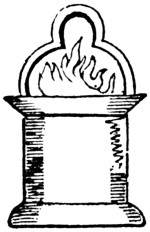
Barber’s Chafing Dish.
This was a metal firepot, with a turning handle, and much used during winter, especially in shops without fire-places. It was carried by the handle from place to place, but generally set under a brass or copper basin with a flat broad bottom, whereon if linen cloths were rubbed or let remain, they in a little time became hot or warm for the barber’s use.
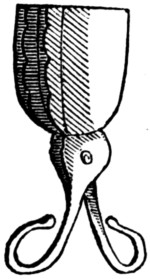
Barber’s Crisping Irons.
This is their ancient shape. “In former times these were much used to curl the side locks of a man’s head, but now (in 1688) wholly cast aside as useless; it openeth and shutteth like the forceps, only the ends are broad and square, being cut within the mouth with teeth curled and crisped, one tooth striking within another.”
Scissors.
Hair-scissors were long and broad in the blades, and rounded towards the points which were sharp.
Beard-scissors had short blades and long handles.
The barber’s scissors differed in these respects from others; for instance, the tailor’s scissors had blunt points, while the seamster’s scissors differed from both by reason of their smallness, some of them having one ring for the thumb only to fit it, while the contrary ring or bow was large enough to admit two or three fingers.
Beards.
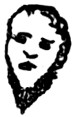
Pick-a-devant Beard.
“A full face with a sharp-pointed beard is termed, in blazon, a man’s face with a pick-a-devant (or sharp pointed,) beard.” Mr. Archdeacon Nares’s “Glossary” contains several passages in corroboration of Holme’s description of this beard.
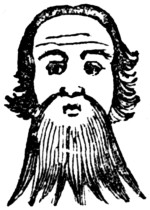
Cathedral Beard.
This Holme calls “the broad or cathedral beard, because bishops and grave men of the church anciently did wear such beards.” Besides this, and the pick-a-devant, he says there are several sorts and fashions of beards, viz. “the British beard hath long mochedoes, (mustachios) on the higher lip, hanging down either side the chin, all the rest of the face being bare:—the forked beard is a broad beard ending in two points:—the mouse-eaten beard, when the beard groweth scatteringly, not together, but here a tuft and there a tuft,” &c.
Guillaume Duprat, bishop of Clermont, who assisted at the council of Trent, and built the college of the Jesuits at Paris, had the finest beard that ever was seen. It was too fine a beard for a bishop, and the canons of his cathedral, in full chapter assembled, came to the barbarous resolution of shaving him. Accordingly, when next he came to the choir, the dean, the prevot, and the chantre approached with scissors and razors, soap, basin and warm water. He took to his heels at the sight, and escaped to his castle of Beauregard, about two leagues from Clermont, where he fell sick for vexation, and died.[302]
Ancient monuments represent the Greek heroes to have worn short curled beards. Among the Romans, after the year 454, B. C., philosophers alone constantly wore a beard; the beard of their military men was short and frizzed. The first emperors with a long and thick beard were Hadrian, who wore it to hide his wounds, and Antoninus Pius, and Marcus Aurelius, who wore it as philosophers: a thick beard was afterwards considered an appendage that obtained for the emperors veneration from the people.[303]
Wigs.
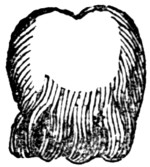
A Peruke.
It is figured as seen above by Holme, who also calls it in his peculiar orthography a “perawicke,” and says it was likewise called “a short bob, a head of hair—a wig that hath short locks and a hairy crown.” He describes it with some feeling. “This is a counterfeit hair which men wear instead of their own; a thing much used in our days by the generality of men; contrary to our forefathers who got estates, loved their wives, and wore their own hair; but,” says he, “in these days (1688) there is no such things!”
He further gives the following as
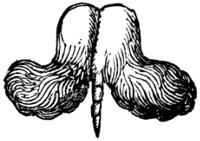
A long Perriwig, with a Pole-lock.
This he puts forth as being “by artists called a long-curled-wig, with a suffloplin, or with a dildo, or pole-lock;” and he affirms, that “this is the sign or cognizance of the perawick-maker.”
That the peruke was anciently a barber’s sign, is verified by a very rare, and perhaps an unique engraving of St. Paul’s cathedral when building, with the scaffolding poles and boards up. This print, in the possession of the editor of the Every-Day Book, represents a barber’s shop on the north-side of St. Paul’s churchyard, with the barber’s pole out at the door, and a swinging sign projecting from each side of the house, a peruke being painted on each.
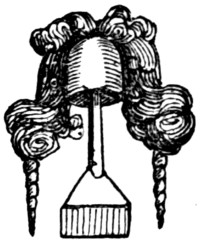
A Travelling Wig.
This peruque, with a “curled foretop and bobs,” was “a kind of travelling wig, having the side or bottom locks turned up into bobs or knots tied up with ribbons.” Holme further calls it “a campaign-wig,” and says, “it hath knots or bobs, or a dildo, on each side, with a curled forehead.”
A Grafted Wig
is described by Holme as “a perawick with a turn on the top of the head, in imitation of a man’s hairy crown.”
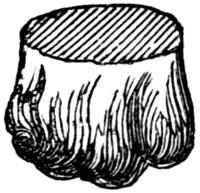
A Border of Hair.
This is so called by Holme; he also calls it “a peruque, with the crown or top cut off; some term it the border of a peruque:” he adds, that “women usually wear such borders, which they call curls or locks when they hang over their ears.” He further says, they were called “taures when set in curls on the forehead,” and “merkins” when the curls were worn lower, or at the sides of the face.
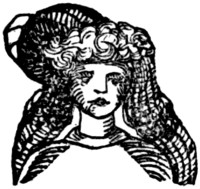
A Bull-head.
“Some,” says Holme, “term this curled forehead a bull-head, from the French word taure, because taure is a bull; it was the fashion of women to wear bull-heads, or bull-like foreheads, anno 1674, and about that time: this is the coat (of arms) of Taurell, a French monsieur, or seigneur.”
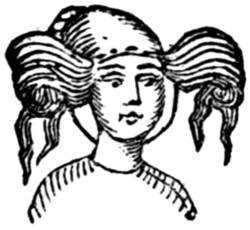
Curls on Wires.
According to our chief authority, Holme, a female thus “quoiffed,” with “a pair of locks and curls,” was in “great fashion, about the year 1670.” He adds, that “they are false locks, set on wyres, to make them stand at a distance from the head; as the fardingales made their clothes stand out (from the hips downwards) in queen Elizabeth’s reign.”
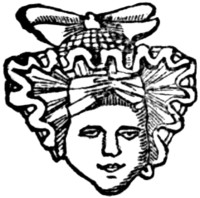
Female Head Dress in 1688.
There is a little difficulty in naming this head dress; for Holme is so diffuse and indignant that he gives it no term though he describes the engraving. The figure is remarkable because it is in many respects similar to the manner wherein the ladies of 1825 adjust the head. It will be remembered that Holme was a herald, and though his descriptions have not hitherto been here related in his armorial language, he always sets them out so, in his “storehouse of armory and blazon.” It may be amusing to conclude these extracts from him with his description of this figure in his own words: thus then the old “deputy for the kings of arms” describes it:—
“He beareth argent a woman’s face; her forehead adorned with a knot of diverse coloured ribbons; the head with a ruffle quoif, set in corners, and the like ribbons behind the head. This,” says Holme, “is a fashion-monger’s head, tricked and trimed up, according to the mode of these times, wherein I am writing of it; and, in my judgment, were a fit coat for such seamsters as are skilled in inventions. But” (he angrily breaks forth,) “what do I talk of arms to such, by reason they will be shortly old, and therefore not to be endured by them, whose brains are always upon new devises and inventions! But all are brought again from the old; for there is no new thing under the sun; for what is now, hath been formerly!”
In the great dining-room at Lambeth-palace, there are portraits of all the archbishops, from Laud to the present time. In these we may observe the gradual change of the clerical dress, in the article of wigs. Archbishop Tillotson was the first prelate who wore a wig, which then was not unlike the natural hair, and worn without powder.[304]
It is related of a barber in Paris, that, to establish the utility of his bag-wigs, he caused the history of Absalom to be painted over his door; and that one of the profession, at a town in Northamptonshire, used this inscription, “Absalom, hadst thou worn a perriwig, thou hadst not been hanged.”[305] It is somewhere told of another that he ingeniously versified his brother peruke-maker’s inscription, under a sign which represented the death of Absalom and David weeping; he wrote up thus:—
“Oh, Absalom! Oh, Absalom! Oh, Absalom! my son, If thou hadst worn a perriwig, Thou hadst not been undone!”
The well-known, light, flaxen wig of Townsend, the well-known police-officer, is celebrated in a song beginning thus:—
Townsend’s Wig. Tune—“Nancy Dawson.”
Of all the wigs in Brighton town, The black, the grey, the red, the brown, So firmly glued upon the crown, There’s none like Johnny Townsend’s: It’s silken hair and flaxen hue, (It is a scratch, and not a quene,) Whene’er it pops upon the view, Is known for Johnny Townsend’s!
Wigs were worn by the Romans when bald; those of the Roman ladies were fastened upon a caul of goat-skin. Perriwigs commenced with their emperors; they were awkwardly made of hair, painted and glued together.
False hair was always in use, though more from defect than fashion; but the year 1529 is deemed the epoch of the introduction of long perriwigs into France; yet it is certain that ladies tetes were in use here a century before. Mr. Fosbroke, from whose “Encyclopædia of Antiquities” these particulars are derived, says, “that strange deformity, the judge’s wig, first appears as a general genteel fashion in the seventeenth century.” Towards the close of that century, men of fashion combed their wigs at public places, as an act of gallantry, with very large ivory or tortoiseshell combs, which they carried in their pockets as constantly as their snuffboxes. At court, in the mall of St. James’s-park, and in the boxes of the theatre, gentlemen conversed and combed their perukes.
Hair.
Horace Walpole relates that when the countess of Suffolk married Mr. Howard, they were both so poor, that they took a resolution of going to Hanover before the death of queen Anne, in order to pay their court to the future royal family. Having some friends to dinner, and being disappointed of a full remittance, she was forced to sell her hair to furnish the entertainment. Long wigs were then in fashion, and the countess’s hair being fine, long, and fair, produced her twenty pounds.
A fashion of wearing the hair gave rise to a college term at Cambridge, which is thus mentioned and explained in a dictionary of common parlance at that university:—
“Apollo. One whose hair is loose and flowing; Unfrizzled, unanointed, and untied; No powder seen.——
“His royal highness prince William of Gloucester was an Apollo during the whole of his residence at the university of Cambridge! The strange fluctuation of fashions has often afforded a theme for amusing disquisition. ‘I can remember,’ says the pious archbishop Tillotson, in one of his sermons, discoursing on this head, viz. of hair! ‘since the wearing the hair below the ears was looked upon as a sin of the first magnitude; and when ministers generally, whatever their text was, did either find, or make occasion to reprove the great sin of long hair; and if they saw any one in the congregation guilty in that kind, they would point him out particularly, and let fly at him with great zeal.’ And we can remember since, the wearing the hair cropt, i. e. above the ears, was looked upon, though not as a ‘sin,’ yet as a very vulgar and raffish sort of a thing; and when the doers of newspapers exhausted all their wit in endeavouring to rally the new-raised corps of crops, regardless of the noble duke who headed them; and, when the rude, rank-scented rabble, if they saw any one in the streets, whether time, or the tonsor, had thinned his flowing hair, would point him out particularly, and ‘let fly at him,’ as the archbishop says, till not a shaft of ridicule remained! The tax upon hair powder has now, however, produced all over the country very plentiful crops. Among the Curiosa Cantabrigiensia, it may be recorded, that our ‘most religious and gracious king,’ as he was called in the liturgy, Charles the Second, who, as his worthy friend, the earl of Rochester, remarked,
‘never said a foolish thing, Nor ever did a wise one,’—
sent a letter to the university of Cambridge, forbidding the members to wear perriwigs, smoke tobacco, and read their sermons! It is needless to remark, that tobacco has not yet made its exit in fumo, and that perriwigs still continue to adorn ‘the heads of houses!’—Till the present all prevailing, all accommodating fashion of crops became general at the university, no young man presumed to dine in hall till he had previously received a handsome trimming from the hair-dresser. An inimitable imitation of ‘The Bard’ of Gray, is ascribed to the pen of the honourable Thomas (the late lord) Erskine, when a student at Cambridge. Mr. E. having been disappointed of the attendance of his college barber, was compelled to forego his commons in hall! An odd thought came into his head. In revenge, he determined to give his hair-dresser a good dressing; so he sat down, and began as follows:—
“‘Ruin seize thee, scoundrel Coe, Confusion on thy frizzing wait; Hadst thou the only comb below, Thou never more shouldst touch my pate. “‘Club, nor queue, nor twisted tail, Nor e’en thy chatt’ring, barber, shall avail To save thy horse-whipped back from daily fears From Cantab’s curse, from Cantab’s tears.’”
The editor of the “Gradus ad Cantabrigiam” regrets that he has not room for the whole of the ode.
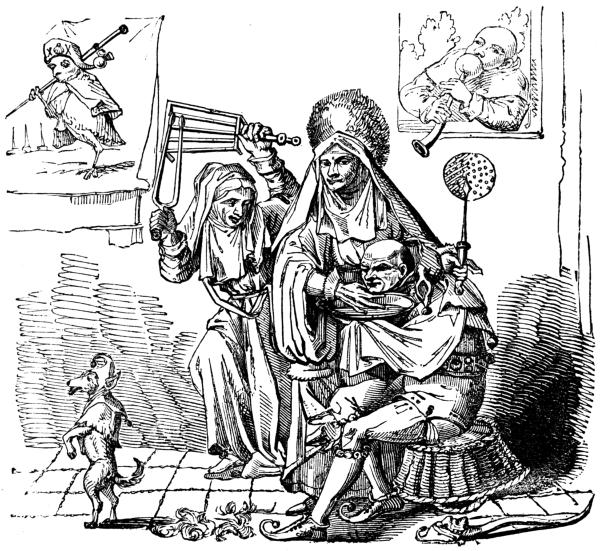
An Ancient Barber.
There is a curious print from Heemskerck, of a barber of old times labouring in his vocation: it shows his room or shop. An old woman is making square pancakes at the fire-place, before which an overfed man sits on a chair sleeping: there is a fat toping friar seated by the chimney corner, with his fingers on the crossed hands of a demure looking nun by his side, and he holds up a liquor-measure to denote its emptiness: a nun-like female behind, blows a pair of bellows over her shoulder, and seems dancing to a tune played on the guitar or cittern, by a humorous looking fellow who is standing up: another nun-like female sounds a gridiron with a pair of tongs, while another friar blows an instrument through a window. These persons are perhaps sojourning there as pilgrims, for there is a print hung against the wall representing an owl in a pilgrim’s habit on his journey. In this room the barber’s bleeding basin is hung up, and his razor is on the mantel ledge: the barber himself is washing the chin of an aged fool, whom, from the hair lying on the ground, it appears he has just polled. A dog on his hind legs is in a fool’s habit, probably to intimate that the fool is under the hands of the barber preparatory to his fraternizing with the friars and their dames. The print is altogether exceedingly humorous, and illustrative of manners: so much of it as immediately concerns the barber is given in the present engraving from it.
Mr. Leigh Hunt, in “The Indicator,” opposes female indifference to the hair. He says, “Ladies, always delightful, and not the least so in their undress, are apt to deprive themselves of some of their best morning beams by appearing with their hair in papers. We give notice, that essayists, and of course all people of taste, prefer a cap, if there must be any thing; but hair, a million times over. To see grapes in paper-bags is bad enough; but the rich locks of a lady in papers, the roots of the hair twisted up like a drummer’s, and the forehead staring bald instead of being gracefully tendrilled and shadowed!—it is a capital offence,—a defiance to the love and admiration of the other sex,—a provocative to a paper war: and we here accordingly declare the said war on paper, not having any ladies at hand to carry it at once into their headquarters. We must allow at the same time, that they are very shy of being seen in this condition, knowing well enough, how much of their strength, like Sampson’s, lies in that gifted ornament. We have known a whole parlour of them fluttered off, like a dove-cote, at the sight of a friend coming up the garden.”
Of the barber’s art, as it was practised formerly, Mr. Archdeacon Nares gives a curious sample from Lyly, an old dramatist, one of whose characters being a barber, says, “thou knowest I have taught thee the knacking of the hands, the tickling on a man’s haires, like the tuning of a citterne. I instructed thee in the phrases of our eloquent occupation, as, how, sir, will you be trimmed? will you have your beard like a spade or a bodkin? a pent-hous on your upper lip, or an ally on your chin? a low curle on your head like a bull, or dangling locke like a spaniel? your mustachoes sharpe at the ends, like shomakers’ aules, or hanging downe to your mouth like goates flakes? your love-lockes wreathed with a silken twist, or shaggie to fall on your shoulders?”
Barbers’ shops were anciently places of great resort, and the practices observed there were consequently very often the subject of allusions. The cittern, or lute, which hung up for the diversion of the customers, is the foundation of a proverb.[306] The cittern resembled the guitar. In Burton’s “Winter Evening Entertainments,” published in 1687, with several wood-cuts, there is a representation of a barber’s shop, where the person waiting his turn is playing on a lute.[307]
The peculiar mode of snapping the fingers, as a high qualification in a barber, is mentioned by Green, another early writer. “Let not the barber be forgotten: and look that he be an excellent fellow, and one that can snap his fingers with dexterity.” Morose, one of Ben Jonson’s characters in his “Silent Woman,” is a detester of noise, and particularly values a barber who was silent, and did not snap his fingers. “The fellow trims him silently, and hath not the knack with his shears or his fingers: and that continency in a barber he thinks so eminent a virtue, as it has made him chief of his counsel.”[308]
This obsolete practice with barbers is noticed in Stubbe’s “Anatomy of Abuses.” “When they come to washing,” says Stubbe, “oh! how gingerly they behave themselves therein. For then shall your mouth be bossed with the lather, or some that rinseth of the balles, (for they have their sweete balles wherewith all they use to washe,) your eyes closed must be anointed therewith also. Then snap go the fingers, ful bravely, Got wot. Thus this tragedy ended, comes me warme clothes to wipe and dry him withall; next, the eares must be picked, and closed together againe artificially, forsooth,” &c. This citation is given by a correspondent to the “Gentleman’s Magazine,” who adds to it his own observations:—“I am old enough,” he says, “to remember when the operation of shaving, in this kingdom, was almost exclusively performed by the barbers: what I speak of is some three-score years ago, at which time gentlemen-shavers were unknown. Expedition was then a prime quality in a barber, who smeared the lather over his customers’ faces with his hand; for the delicate refinement of the brush had not been introduced. The lathering of the beard being finished, the operator threw off the lather adhering to his hand, by a peculiar jerk of the arm, which caused the joints of the fingers to crack, this being a more expeditious mode of clearing the hand than using a towel for that purpose; and the more audible the crack, the higher the shaver stood in his own opinion, and in that of his fraternity. This then, I presume, is the custom alluded to by Stubbe.”
Mr. J. T. Smith says, “The entertaining and venerable Mr. Thomas Batrich, barber, of Drury-lane, informs me, that before the year 1756, it was a general custom to lather with the hand; but that the French barbers, much about that time, brought in the brush.” He also says, that “A good lather is half the shave,” is a very old remark among the trade.
In a newspaper report of some proceedings at a police office, in September, 1825, a person deposing against the prisoner, used the phrase “as common as a barber’s chair;” this is a very old saying. One of Shakspeare’s clowns speaks of “a barber’s chair, that fits all,” by way of metaphor; and Rabelais shows that it might be applied to any thing in very common use.[309]
The Barber’s Pole is still a sign in country towns, and in many of the villages near London. It was stated by lord Thurlow in the house of peers, on the 17th of July, 1797, when he opposed the surgeons’ incorporation bill that, “By a statute still in force, the barbers and surgeons were each to use a pole. The barbers were to have theirs blue and white, striped, with no other appendage; but the surgeons, which was the same in other respects, was likewise to have a gallipot and a red rag, to denote the particular nature of their vocation.”
The origin of the barber’s pole is to be traced to the period when the barbers were also surgeons, and practised phlebotomy. To assist this operation, it being necessary for the patient to grasp a staff, a stick or a pole was always kept by the barber-surgeon, together with the fillet or bandaging he used for tying the patient’s arm. When the pole was not in use the tape was tied to it, that they might be both together when wanted. On a person coming in to be bled the tape was disengaged from the pole, and bound round the arm, and the pole was put into the person’s hand: after it was done with, the tape was again tied on the pole, and in this state, pole and tape were often hung at the door, for a sign or notice to passengers that they might there be bled: doubtless the competition for custom was great, because as our ancestors were great admirers of bleeding, they demanded the operation frequently. At length instead of hanging out the identical pole used in the operation, a pole was painted with stripes round it, in imitation of the real pole and its bandagings, and thus came the sign.
That the use of the pole in bleeding was very ancient, appears from an illumination in a missal of the time of Edward I., wherein the usage is represented. Also in “Comenii Orbis pictus,” there is an engraving of the like practice. “Such a staff,” says Brand, who mentions these graphic illustrations, “is to this very day put into the hand of patients undergoing phlebotomy by every village practitioner.”
The News Sunday-paper of August 4, 1816, says, that a person in Alston, who for some years followed the trade of a barber, recently opened a spirit-shop, when to the no small admiration and amusement of his acquaintance, he hoisted over his door the following lines:—
Rove not from pole to pole, but here turn in, Where naught exceeds the shaving, but the gin.
The south corner shop of Hosier-lane, Smithfield, is noticed by Mr. J. T. Smith as having been “occupied by a barber whose name was Catch-pole; at least so it was written over the door: he was a whimsical fellow; and would, perhaps because he lived in Smithfield, show to his customers a short bladed instrument, as the dagger with which Walworth killed Wat Tyler.” To this may be added, a remark not expressed by Mr. Smith, that Catch-pole had a barber’s pole for many years on the outside of his door.[310]
Catch-pole’s manœuvre to catch customers, and get his shop talked about, was very successful. It is observed in the “Spectator,” that—“The art of managing mankind is only to make them stare a little, to keep up their astonishment, to let nothing be familiar to them, but ever to have something in your sleeve, in which they must think you are deeper than they are.” The writer of the remark exemplifies it by this story:—“There is an ingenious fellow, a barber of my acquaintance, who, besides his broken fiddle and a dryed sea-monster, has a twine-cord, strained with two nails at each end, over his window, and the words, rainy, dry, wet, and so forth, written to denote the weather according to the rising or falling of the cord. We very great scholars are not apt to wonder at this: but I observed a very honest fellow, a chance customer, who sat in the chair before me to be shaved, fix his eye upon this miraculous performance during the operation upon his chin and face. When those, and his head also, were cleared of all incumbrances and excrescences, he looked at the fish, then at the fiddle, still grubbing in his pockets, and casting his eye again at the twine, and the words writ on each side; then altered his mind as to farthings, and gave my friend a silver six-pence. The business, as I said, is to keep up the amazement: and if my friend had had only the skeleton and kitt, he must have been contented with a less payment.”
It was customary with barbers to have their shops lighted by candles in brass chandeliers of three, four, and six branches. Mr. Smith noticing their disuse says, “Mr. Batrich has two suspended from his ceiling; he has also a set of bells fixed against the wall, which he has had for these forty years. These are called by the common people Whittington’s Bells. In his early days, about eighty years back, when the newspapers were only a penny a-piece, they were taken in by the barbers for the customers to read during their waiting time. This custom is handed to us by the late E. Heemskerck, in an etching by Toms, of a barber’s shop, composed of monkies, at the foot of which are the following lines:—
“A barber’s shop adorn’d we see, With monsters, news, and poverty; Whilst some are shaving, others bled, And those that wait the papers read; The master full of wigg, or tory, Combs out your wig, and tells a story.”
Mr. Smith’s inquiries concerning barbers have been extensive and curious. He says, “On one occasion, that I might indulge the humour of being shaved by a woman, I repaired to the Seven Dials, where, in Great St. Andrew’s-street, a slender female performed the operation, whilst her husband, a strapping soldier in the Horse-guards, sat smoking his pipe. There was a famous woman in Swallow-street, who shaved; and I recollect a black woman in Butcher-row, a street formerly standing by the side of St. Clement’s church, near Temple-bar, who is said to have shaved with ease and dexterity.” His friend Mr. Batrich informed him that he had read of “the five barberesses of Drury-lane, who shamefully mal-treated a woman in the reign of Charles II.” Mr. Batrich died while Mr. Smith’s “Ancient Topography of London,” was passing through the press.
The “Glasgow Chronicle,” about the year 1817, notices the sudden death, in Calton, of Mr. John Falconer, hair-dresser, in Kirk-street. While in the act of shaving a man, he staggered, and was falling, when he was placed on a chair, and expired in five minutes. His shop was the arena of all local discussion, and was therefore denominated the Calton coffee-room. His father and he had been in the trade for upwards of half a century. His father was the first who reduced the price of shaving to a halfpenny; and when his brethren in the town wished him again to raise it, he replied, “Charge a penny! Jock and me are just considering about lowering it to a farthing.” He would never take more than a halfpenny though it was offered him; and being very skilful at his business, and of a frank jocular turn, he had a large share of public favour, and was enabled even at this low rate to gather money and build houses. He died about sixteen years before his son, who carried on the business. He often said others wrought for need, but he did it for pleasure or recreation, and never was so happy as when he was improving the countenances of the lieges. He was generally allowed to be at the top of his profession. Some old men whom he and his father had shaved for fifty years, boasted that they were never touched by another: one very old customer regularly came for many a year to his shop every Saturday night from the western extremity of the town. His shop was furnished with two dozen of antique chairs, as many pictures, and a musical clock, and for a long time he had a good library of books, but they at length nearly wholly disappeared, and he took up to his house the few that remained as his own share. At two different times, when trade was dull, he gave his tenants a jubilee on the term day, and presented their discharges without receiving a farthing. He left behind him property worth between 2,000l. and 3000l.
FLORAL DIRECTORY.
Golden Starwort. Aster Solidaginoides. Dedicated to St. Cloud.
September 8.
Nativity of the Blessed Virgin. St. Adrian, A. D. 306. St. Sidronius, A. D. 1067. Sts. Eusebius, Nestablus, Zeno, and Nestor, Martyrs under Julian. St. Corbinian, Bp. A. D. 730. St. Disen, or Disibode, A. D. 700. The Festival of the Holy Name of the Virgin Mary.
Nativity, B. V. M.
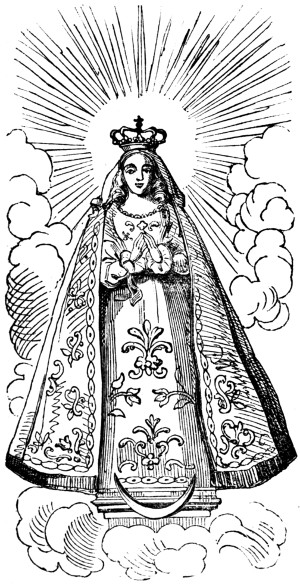
Nativity B. V. M.
This Roman catholic festival is in the church of England calendar and almanacs.
According to Butler and other Romish writers, “the title of the mother of God was confirmed to the virgin Mary” by the traditions of their church; and her nativity has been kept “above a thousand years,” with matins, masses, homilies, collects, processions, and other forms and ceremonies ordained by that hierarchy. Some of its writers “attribute the institution of this feast to certain revelations which a religious contemplative had; who, they say, every year upon the 8th of September, heard most sweet music in heaven, with great rejoicings of the angels; and once asking one of them the cause, he answered him, that upon that day was celebrated in heaven the nativity of the mother of God; and upon the relation of this man, the church began to celebrate it on earth.”[311]
Upon this it is observed and related by the late Mr. Brady thus:—
“A circumstance so important in its nature, and unfolded in so peculiar and miraculous a manner, was of course communicated to the then reigning pope, Servius; who immediately appointed a yearly feast ‘to give an opportunity for the religious on earth to join with the angels in this great solemnity;’ and there have been some contemplations dedicated for this occasion, wherein is unfolded, ‘for the benefit of mankind,’ certain circumstances of her ‘sallies of love and union with God,’ even before her pious mother St. Anne gave her being! It is somewhat extraordinary, that, notwithstanding the day of the nativity of the virgin was so clearly proved, after having been forgotten for many centuries, pope Servius, when he appointed the festival, did not also honour it with an octave or vigil; for it appears that pope Innocent IV. has the credit of the octave which he instituted A. D. 1244, and that pope Gregory XI. appointed the vigil A. D. 1370. At the death indeed of Gregory IX. it was in contemplation to observe an octave upon the following occasion: the cardinals had been long shut up without agreeing upon the appointment of a successor to the deceased pope, when some of these holy men made a vow to the virgin, that if through her merits they could come to a decision they would in future observe her octave; a vow which had an instantaneous effect, and caused Celestine to be elected to St. Peter’s chair; though, as this nominal pope lived only eighteen days from his election, the vow was not fulfilled until Innocent IV. succeeded to that dignity. The long and uncourteous disregard, however, of the early church to the immaculate mother of our Lord, in respect to the day of her nativity, was amply compensated by other attentions, and there still remain many persons in catholic countries, in Spain and Italy in particular, who place a much greater reliance on the efficiency of the mediation of the virgin, than they do on that of our Lord himself: and if we are to credit the numerous authors who have made her divine powers their theme, and celebrated her extraordinary condescensions, our wonder and astonishment must be excited in a most eminent degree. Some of her courtesies are calculated for teaching a lesson of humility, which no doubt was the operating cause of her performing such offices, which in no other view appear of importance. At one time she descends from heaven to mend the gown of Thomas à Becket, which was ripped at the shoulder. Whilst the monks of Clervaux were at work, the virgin relieved their fatigue, by wiping the perspiration from their faces. That the important duties of an abbey should not be neglected, she for some time personally superintended them, whilst the abbess was absent with a monk who had seduced her from the path of virtue. She even descended from heaven to bleed a young man who prayed to her, and whose health required that operation. At the entreaty of a monk, who prayed to her for that purpose, she supplied his place when absent, and sung matins for him. And, we are solemnly assured, that when St. Allan was much indisposed, she rewarded him for his devotional attentions to her, by graciously giving him that nourishment which female parents are accustomed only to afford their offspring! To what depths of impious absurdity will not ignorance and credulity debase mankind!”[312]
Legendary stories in honour of the virgin are numberless. For edifying reading on this particular festival, the “Golden Legend” relates, among others, the following:—
A bishop’s vicar, by name Theophylus, on the death of his diocesan, was willed by the people to succeed him; but Theophylus refused, saying, he had rather be a vicar than a bishop. However, the new bishop displaced him from being vicar, whereupon Theophylus grieved, and falling into despair, consulted a Jew, who being a magician, summoned the devil to the help of Theophylus. The devil being duly acquainted with the state of affairs, wrote a bond with Theophylus’s blood, whereby the said Theophylus was held and firmly bound to renounce the virgin, and the profession of christianity, and the same being by him duly sealed and delivered, as his act and deed, the devil was therewith content, and procured the bishop to re-establish Theophylus in his office. When Theophylus was a vicar again, he began to repent that he had given his bond, and prayed the virgin to relieve him from it. Wherefore she appeared to Theophylus in a vision, “and rebuked him of his felony, and commanded him to forsake the devil,” and to confess himself in heart a christian man. This he accordingly did, and therefore the virgin obtained his pardon, and brought his bond from the devil, and laid it on his breast; and Theophylus became joyful, and related to the bishop and all the people what had befallen him, and they marvelled greatly, and gave praise to the virgin, and “three dayes after he rested in peas,” and died in his vicarage, whereunto the devil had caused him to be presented.
At another time a widow, whose son had been taken prisoner, wept without comfort, and prayed to the virgin for his delivery, but he still remained prisoner; and at last, when she saw that her prayers availed not, she entered into a church where an image of the virgin was carved, and standing before the image, reminded the virgin of her importunities, and that she had not helped her; “and therefore,” said she, “like as my son is taken from me, so shall I take away thy son, and keep him as a hostage for mine.” Then she took away from the image the child that it held, “and shette it in her chest, and locked it fast ryght diligently, and was ryght joyfull that she had so good hostage for her sone.” Wherefore, on the following night, the virgin liberated the widow’s son, and desired him to go and tell his mother that, as he was released, she desired to have her own son back. This he did, and the widow, in great joy, “toke the chylde of the ymage, and came to the chirche, and delyvered it to our lady, sayenge, lady, I thanke you, for ye have delivered to me my son, and here I deliver to you yours.”
One other story is of a thief who was always devout to the virgin. On a time he was taken and judged, and ordered to be hanged; but when he was hanged “the blyssed virgin Mary susteyned, and helde hym up, with her handes, thre dayes, that he dyed not.” When they that caused him to be hanged, “found hym lyvying, and of glad chere,” they supposed that “the corde had not been well strayned,” and would have cut his throat with a sword; but “our blyssed lady” put her hands between his neck and the weapon, so that he could be neither killed nor hurt; and then they took him down “and let him go in the honour of the blyssed virgyn Marye;” and he went and “entred into a monastery, and was in the service of the moder of God as longe as he lyved.”
Perhaps these three stories provided for the festival of the nativity of the blessed virgin Mary in papal times, may be deemed sufficient in our times.
Spain, as a catholic country, is profuse in adoration of the virgin. On her festivals a shrine is erected in the open street, decorated with flowers, and surrounded by a number of wax candles. A flight of stairs leads to an altar, whereon is placed an image of the virgin mother, with an embroidered silk canopy above. On these stairs a priest takes his station, and preaches to the multitude, while other priests go round, at intervals, with a salver, to collect oblations from the devotees. To those who give liberally, the priest presents little engravings of the virgin, which are highly valued. An obliging correspondent, who communicates these particulars, (J. H. D. of Portsmouth,) says, “I have two of them, which I obtained on one of those occasions at Cadiz, in 1811, one of which I herewith send you.” Of this consecrated print, the engraving at the head of the present article is a fac-simile.
FLORAL DIRECTORY.
Amellus. Aster Amellus. Dedicated to St. Adrian.
September 9.
Sts. Gorgonius, Dorotheus, and Companions A. D. 304. St. Omer, A. D. 607. St. Kiaran, Abbot A. D. 549. St. Osmana of Ireland. St. Bettelin.
St. Bettelin, or Beccelin.
The town of Stafford is honoured by this saint being its patron, where “his relics were kept with great veneration.” He is said to have served St. Guthlac, and been of all others most dear to him, and to have led an “anchoretical life in the forest near Stafford.”[313]
Fanny Braddock.
The fate of this unhappy young woman who committed suicide at Bath, on the 9th of September, 1731, is still remembered in that city. She resided with Mr. John Wood, the architect, and on the night of the 8th went well to bed, nowise disordered in behaviour. Her custom was to burn a candle all night, and for her maid to lock the door, and push the key under it, so that she always got up in the morning to let her maid into the room. After she had retired, on the evening mentioned, she got out of bed again, and, it is supposed, employed some time in reading. She put on a white night-gown, and pinned it over her breast; tied a gold and a silver girdle together, and at one end having made three knots about an inch asunder, that if one slipped another might hold, she opened the door, put the knotty end of the girdle over it, and locking the door again, made a noose at the other end, through which she put her neck, by getting on a chair and then dropped from it. She hung with her back against the door, and had hold of the key with one of her hands; she had bit her tongue through, and had a bruise on her forehead; this was occasioned, probably, by the breaking of a red girdle she had tried first, which was found in her pocket with a noose on it; there were two marks on the door. The coroner’s inquest sat on her that day, and brought in their verdict non compos mentis. She was daughter to the late general Braddock, who at his death left her and her sister 6000l. By her sister’s death about four years before, she became mistress of the whole fortune, but being infatuated by the love of gaming, met “an unlucky chance” which deprived her of her fortune. She had been heard to say, that no one should ever be sensible of her necessities, were they at the last extremity. She was generally lamented, and in life had been greatly esteemed for courteous and genteel behaviour, and good sense. She was buried in a decent manner in the abbey church, in the grave of her honest brave old father, a gentleman who had experienced some undeserved hardships in life; but who might be said to have been thus far happy, that he lived not to see or hear of so tragical a catastrophe of his beloved daughter. The following verses were written by her on her window:—
“O, death! thou pleasing end to human woe! Thou cure for life! thou greatest good below! Still may’st thou fly the coward and the slave, And thy soft slumbers only bless the brave.”[314]
Mr. Wood who wrote “an Essay towards a Description of Bath,” speaks of many circumstances which unite to prove that Fanny Braddock had long meditated self-destruction. In a book entitled New Court Tales, she is called “the beautiful and celebrated Sylvia,” which Wood says “she was not very improperly styled, having been a tenant under my roof during the last thirteen months of her life; and at the time of her unhappy death, her debt of two and fifty pounds three shillings and fourpence for rent, &c. entitled me to the sole possession of all her papers and other effects, which I seized on Monday, the 13th of September, 1731.” Though Wood probably knew better how to draw up an inventory, and make an appraisement, than a syllogism, yet at the end of five months the creditors drew “a new inventory” of what was in his possession, and made a new appraisement. “The goods were then sold,” says Wood, “and people striving for something to preserve the memory of the poor deceased lady, the price of every thing was so advanced that the creditors were all paid, and an overplus remained for the nearest relation; though it ought to have come to me, as a consideration towards the damages I sustained on the score of Sylvia’s untimely death”!
Whatever was Wood’s estimation of his unhappy tenant when alive, he could afford to praise her dead. “Nothing can be more deplorable than the fate of this unfortunate young woman; a fate that I have heard hundreds in high life lament their not suspecting, that they might have endeavoured to prevent it, though it should have been at half the expense of their estates; and yet many of those people, when common fame every where sounded Sylvia’s running out of her fortune, would endeavour to draw her into play to win her money, and accept of whatever was offered them from her generous hand!” She was ensnared by a woman named Lindsey, who kept a house for high play. “When I came down to Bath,” says Wood, “in the year 1727, Sylvia was entirely at the dame’s command, whenever a person was wanting to make up a party for play at her house. Dame Lindsey’s wit and humour, with the appearance of sanctity in a sister that lived with her, strongly captivated the youth of both sexes, and engaged them in her interest.” The reputation of this “dame Lindsey” was at a low ebb, but Wood observes, “in the course of three years I could never, by the strictest observations, perceive Sylvia to be tainted with any other vice than that of suffering herself to be decoyed to the gaming-table; and, at her own hazard, playing for the amusement and advantage of others. I was therefore not long in complying with a proposal she made to me in the summer of the year 1738, for renting part of a house I then lived in, in Queen-square; her behaviour was such as manifested nothing but virtue, regularity, and good nature. She was ready to accept of trifling marks of friendship, to give her a pretence of making great returns; and she was no sooner seated in my house than ladies of the highest distinction, and of the most unblemished characters were her constant visiters: her levee looked more like that of a minister of state than of a private young lady. Her endowments seemed to have had a power of attraction among her own sex, even stronger than that of all the riches of a court among the gentlemen that are allured by them.”
The last night of her life she had spent in Mr. Wood’s study, where she took her supper, and dandled two of his children on her knees till the hour of retiring. She then went to the nursery and taking leave of a sleeping infant in its cradle, praised the innocence of its looks. Passing to her own room she undressed and went to bed, and, as her servant left the room, bade her good night; she had never done so before. It is probable that at that moment she thought on her fatal purpose, and some passages in Harrington’s translation of “Orlando Furioso,” are supposed to have strengthened it. It was found that after she had arisen she had been reading in it; the book lay open at pp. 74 and 75, the story of Olympia, who, by the perfidy and ingratitude of her bosom friend, was ruined.
FLORAL DIRECTORY.
Canadian Golden Rod. Solidago Canadensis. Dedicated to St. Omer.
September 10.
St. Nicholas, of Tolentino, A. D. 1306. St. Pulcheria, Empress, A. D. 453. Sts. Nemesianus, Felix, Lucius, another Felix, Litteus, Polianus, Victor, Jader, and Dativus, Bps. with other Priests, Deacons, &c., in Numidia, banished under Valerian. St. Finian, called Winin, by the Welsh, Bp. 6th Cent. St. Salvias, Bp. of Albi, A. D. 580.
Autumn.
[Autumn is by some supposed to commence on the 8th of this month.]
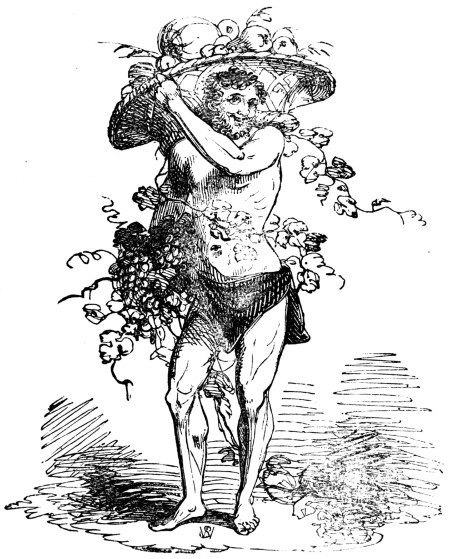
Autumn.
Laden with richest products of the earth; Its choicest fruits, enchanting to the eye, Grateful to taste, and courting appetite.
Dr Forster is of opinion that autumn commences on the 10th of September. “It occupies ninety days. The mean temperature is 49.37°, or 11.29° below the summer: the medium of the day declines in this season from 58° to 40°. The mean height of the barometer is 29.781 inches; being .096 inches below the mean of summer. The range increases rapidly during this season; the mean extent of it is 1.49 inches. The prevailing winds are the class SW., throughout the season. The evaporation is 6.444 inches, or a sixth part less than the proportion indicated by the temperature. The mean of De Luc’s hygrometer is seventy-two degrees. The average rain is 7.441 inches: the proportion of rain increases, from the beginning to near the end of the season: this is the true rainy season with us; and the earth, which had become dry to a considerable depth during the spring and summer, now receives again the moisture required for springs, and for the more deeply rooted vegetables, in the following year.
“The fore part of this season is, nevertheless, if we regard only the sky, the most delightful part of the year, in our climate. When the decomposition of vapour, from the decline of the heat, is as yet but in commencement, or while the electricity remaining in the air continues to give buoyancy to the suspended particles, a delicious calm often prevails for many days in succession, amidst a perfect sunshine, mellowed by the vaporous air, and diffusing a rich golden tint, as the day declines, upon the landscape. At this period, chiefly, the stratus or fallcloud, the lowest and most singular of the modifications, comes forth in the evenings, to occupy the low plains and vallies, and shroud the earth in a veil of mist, until revisited by the sun. So perfectly does this inundation of suspended aqueous particles imitate real water, when viewed in the distance at break of day, that I have known the country people themselves deceived by its unexpected appearance.”
Mr. Howard remarks that—“A phenomenon attends this state of the air, too remarkable to be passed over in silence. An immense swarm of small spiders take advantage of the moisture, to carry on their operations, in which they are so industrious, that the whole country is soon covered with the fruit of their labours, in the form of a fine network, commonly called gossamer. They appear exceedingly active in the pursuit of the small insects, which the cold of the night now brings down; and commence this fishery about the time that the swallows give it up, and quit our shores. Their manner of locomotion is curious: half volant, half aëronaut, the little creature darts from the papillæ on his rump a number of fine threads which float in the air. Mounted thus in the breeze, he glides off with a quick motion of the legs, which seem to serve the purpose of wings, for moving in any particular direction. As these spiders rise to a considerable height, in very fine weather, their tangled webs may be seen descending from the air in quick succession, like small flakes of cotton.”[315]
FLORAL DIRECTORY.
Autumnal Crocus. Crocus autumnalis. Dedicated to St. Pulcheria.
September 11.
Sts. Protus and Hyacinthus, A. D. 257. St. Paphnutius, A. D. 335. St. Patiens, Abp. of Lyons, A. D. 480.
Nicknackitarianism.
On the 11th of September, 1802, the following cause was decided by a jury in the sheriff’s court.
Hurst v. Halford
The plaintiff was a nicknackitarian, that is, a dealer in curiosities, such as Egyptian mummies, Indian implements of war, arrows dipped in the poison of the upas-tree, bows, antique shields, helmets, &c. He was described as possessing the skin of the cameleopard exhibited in the Roman amphitheatre, the head of the spear used by king Arthur, and the breech of the first cannon used at the siege of Constantinople; and, in short, of almost every rarity that the most ardent virtuoso would wish to possess.
The defendant was the executor of a widow lady of the name of Morgan, who, in the enjoyment of a considerable fortune, indulged her fancy, and amused herself in collecting objects of natural and artificial curiosity.
It was stated that this lady had been long in the habit of purchasing a variety of rare articles of the plaintiff: she had bought of him models of the temple of Jerusalem and the Alexandrian library, a specimen of the type invented by Memnon, the Egyptian, and a genuine manuscript of the first play acted by Thespis and his company in a waggon; for all these she had in her lifetime paid most liberally. It appeared also she had erected a mausoleum, in which her deceased husband was laid, and she projected the depositing her own remains, when death should overtake her, by the side of him. The plaintiff was employed in fitting it up, and ornamenting it with a tessellated pavement; this was also paid for, and constituted no part of the present demand. This action was brought against the defendant to recover the sum of 40l. for stuffing and embalming a bird of paradise, a fly-bird, an ourang-outang, an ichneumon, and a cassowary. The defendant did not deny that the plaintiff had a claim on the estate of the deceased, but he had let judgment go by default, and attempted merely to cut down the amount of the demand. The plaintiff’s foreman, or assistant, proved that the work had been done by the direction of Mrs. Morgan, and that the charge was extremely reasonable. On the contrary, the defendant’s solicitor contended that the charge was most extravagant; he stated, that the museum of the deceased virtuoso had been sold by public auction, and including the models of the temple of Jerusalem and the Alexandrian library, the antique type, Thespian manuscript, spearhead, and every thing else she had been all her life collecting, it had not netted more than 110l. As to the stuffed monkies and birds, which constituted the foundation of the plaintiff’s claim, they scarce had defrayed the expense of carrying them away; they were absolute rubbish. The plaintiff’s attorney replied that his client’s labour was not to be appreciated by what the objects of it produced at a common sale, attended, perhaps, by brokers, who were as ignorant as the stuffed animals they were purchasing.
The under-sheriff observed, that in matters of taste the intrinsic value of an article was not the proper medium of ascertaining the compensation due to the labour which produced it; a virtuoso frequently expended a large sum of money for what another man would kick out of his house as lumber. If Mrs. Morgan, who it was proved was a lady of fortune, wished to amuse the gloomy hours of her widowhood by stuffing apes and birds, her executor was at least bound to pay the expense she had incurred, in indulging her whimsical fancy. He saw no reason why a single shilling of the plaintiff’s demand should be subtracted; and the jury viewed the curiosities in the same light, and gave a verdict for the plaintiff, damages 40l.
FLORAL DIRECTORY.
Variegated Meadow Saffron. Colchium variegatum. Dedicated to St. Hyacinthus.
September 12.
St. Eanswide, Abbess, 7th Cent. St. Guy of Anderlecht, 11th Cent. St. Albeus, A. D. 525.
Glass-cutters at Newcastle.
On the 12th of September, 1823, the inhabitants of Newcastle and Gateshead were gratified with a spectacle which in that part was novel and peculiarly interesting, although in London it is common. It was a procession through the principal streets, of the workmen employed in several of the glass-houses, each bearing in his hand a specimen of the art, remarkable either for its curious construction, or its beauty and elegance. The morning was ushered in with the ringing of bells, and notice of the intended procession having been previously circulated, numbers of people crowded the streets. A little after twelve o’clock it moved forward along the Close, amid the cheers of the assembled multitude, the firing of cannon and the ringing of bells, and preceded by the band of the Tyne Hussars. It was composed of the workmen of the Northumberland, the South Shields, the Wear (Sunderland), the Durham and British (Gateshead), the Stourbridge (Gateshead), and the North Shields glass companies, arranged according to the seniority of their respective houses, and each distinguished by appropriate flags. The sky was clear, and the rays of the sun, falling upon the glittering utensils and symbols, imparted richness and grandeur to their appearance. The hat of almost every person in it was decorated with a glass feather, whilst a glass star sparkled on the breast, and a chain or collar of variegated glass hung round the neck; some wore sashes round the waist. Each man carried in his hand a staff, with a cross piece on the top, displaying one or more curious or beautiful specimens of art. These elevations afforded a sight of the different vessels, consisting of a profusion of decanters, glasses, goblets, jugs, bowls, dishes, &c., the staple articles of the trade, in an endless variety of elegant shape, and of exquisite workmanship, with several other representations remarkable either for excellence of manufacture or for curious construction. Amongst these were two elegant bird-cages, containing birds, which sung at periods during the procession. A salute was fired several times from a fort mounted with glass cannon, to the astonishment of the spectators; a glass bugle which sounded the halts, and played several marches, was much admired for its sweetness and correctness of tone. Several elegant specimens of stained glass were exhibited; many of the men wore glass hats and carried glass swords. When the procession arrived at the mansion-house it halted, while a salute was fired from the glass cannon; the procession then moved forward, passing along the bridge, through Gateshead, and then returned and paraded through the principal streets of Newcastle, to dinners provided at different inns.
Mr. John Sykes, in the volume of “Local Records” published by him at Newcastle, from whence this account is taken, says, “that a procession of this kind is highly commendable, not as a mere unmeaning show calculated for caricature, but as exhibiting to public view some of the finest efforts of human industry and genius.”
FLORAL DIRECTORY.
Semilunar Passion Flower. Passiflora peltata. Dedicated to St. Eanswide.
September 13.
St. Eulogius, Patriarch of Alexandria, A. D. 608. St. Amatus, Bp. A. D. 690. Another St. Amatus, or Ame, Abbot, A. D. 627. St. Maurilius, 5th Cent.
“GENTLEMAN SMITH,” THE ORIGINAL CHARLES SURFACE.
To the Editor of the Every-Day Book.
Dear Sir,
Probably a biographical sketch of this eminent professor of the histrionic art, may prove acceptable to your interesting weekly sheet. Of the latter days of Mr. Smith, I write from my own recollection of him. It is a pleasant occupation to record the acts of these worthies of the legitimate drama—to notice the talents and acquirements of an actor so universally respected for the kindness of his disposition—the firmness of a mind gradually developing principles and conduct worthy the sympathy and respect of all—and whose ease and gracefulness of manner obtained for him the honourable distinction of “Gentleman Smith.”
The subject of our memoir was born in London, in 1730. He was designed for the church, and in 1737 his father sent him to Eton, from whence he was removed to St. John’s-college, Cambridge, in 1748. The vivacity and spirit which had distinguished young Smith while at Eton, here led him into some rash and impetuous irregularities. He was young—very young: unknown to the world, and too worldly in his pleasures. The force of evil example, so glaringly displayed within our colleges and grammar-schools, was powerful—and Smith yielded to its power. One hasty act of imprudence and passion, frustrated his father’s hopes, and determined the future pursuits of this tyro. Having one evening drunk too freely with some associates of kindred minds, and being pursued by the proctor, he had the imprudence to snap an unloaded pistol at him. For this offence he was doomed to a punishment to which he would not submit; and in order to avoid expulsion immediately quitted college. He now had the opportunity of gratifying his inclination for the stage, and without any deep reflection upon the step he was about to take, immediately upon his arrival in London, applied to Mr. Rich, then manager of Covent-garden theatre, and succeeded in obtaining an engagement. He made his first appearance in January, 1753, in the character of Theodosius; on which occasion many of his college friends came up for the purpose of giving him their support. His second attempt was Polydore, in the “Orphan;” after which he appeared successively in Southampton, in the “Earl of Essex,” and Dolabella, in “All for Love.” Mr. Smith was obliged for some time to play subordinate parts; but after Mr. Barry quitted the stage, he undertook several of the principal characters in which that great actor had appeared with such distinguished approbation. Mr. Smith’s mode of acting had many peculiarities which were considered as defects, but from his frequent appearance, the audience seemed to forget them, or to regard them as trifles undeserving notice, when viewed in connection with the many excellencies which he always displayed. This favourable disposition towards him was greatly increased by his upright and independent conduct in private life, which gained for him very general esteem. When Churchill published his “Rosciad,” in 1761, the only notice he took of him in his satire, is comprised in the following couplet:—
“Smith the genteel, the airy, and the smart, Smith was just gone to school to say his part.”