NOVEMBER.
Reading edition
Next was November; he full grown and fat As fed with lard, and that right well might seeme; For he had been a fatting hogs of late, That yet his browes with sweat did reek and steam; And yet the season was full sharp and breem; In planting eeke he took no small delight, Whereon he rode, not easie was to deeme For it a dreadful centaure was in sight, The seed of Saturn and fair Nais, Chiron hight.
Spenser.
This is the eleventh month of the year. The anglo-saxons gave names in their own tongue to each month, and “November they termed wint-monat, to wit, wind-moneth, whereby wee may see that our ancestors were in this season of the yeare made acquainted with blustring Boreas; and it was the antient custome for shipmen then to shrowd themselves at home, and to give over sea-faring (notwithstanding the littlenesse of their then used voyages) untill blustring March had bidden them well to fare.”[377] They likewise called it blot-monath. In the saxon, “blot” means blood; and in this month they killed great abundance of cattle for winter-store, or, according to some, for purposes of sacrifice to their deities.[378]
Bishop Warburton commences a letter to his friend Hurd, with an allusion to the evil influence which the gloominess of this month is proverbially supposed to have on the mind. He dates from Bedford-row, October 28th, 1749:—“I am now got hither,” he says, “to spend the month of November: the dreadful month of November! when the little wretches hang and drown themselves, and the great ones sell themselves to the court and the devil.”
“This is the month,” says Mr. Leigh Hunt, “in which we are said by the Frenchman to hang and drown ourselves. We also agree with him to call it ‘the gloomy month of November;’ and, above all, with our in-door, money-getting, and unimaginative habits, all the rest of the year, we contrive to make it so. Not all of us, however: and fewer and fewer, we trust, every day. It is a fact well known to the medical philosopher, that, in proportion as people do not like air and exercise, their blood becomes darker and darker: now what corrupts and thickens the circulation, and keeps the humours within the pores, darkens and clogs the mind; and we are then in a state to receive pleasure but indifferently or confusedly, and pain with tenfold painfulness. If we add to this a quantity of unnecessary cares and sordid mistakes, it is so much the worse. A love of nature is the refuge. He who grapples with March, and has the smiling eyes upon him of June and August, need have no fear of November.—And as the Italian proverb says, every medal has its reverse. November, with its loss of verdure, its frequent rains, the fall of the leaf, and the visible approach of winter, is undoubtedly a gloomy month to the gloomy but to others, it brings but pensiveness, a feeling very far from destitute of pleasure; and if the healthiest and most imaginative of us may feel their spirits pulled down by reflections connected with earth, its mortalities, and its mistakes, we should but strengthen ourselves the more to make strong and sweet music with the changeful but harmonious movements of nature.” This pleasant observer of the months further remarks, that, “There are many pleasures in November if we will lift up our matter-of-fact eyes, and find that there are matters-of-fact we seldom dream of. It is a pleasant thing to meet the gentle fine days, that come to contradict our sayings for us; it is a pleasant thing to see the primrose come back again in woods and meadows; it is a pleasant thing to catch the whistle of the green plover, and to see the greenfinches congregate; it is a pleasant thing to listen to the deep amorous note of the wood-pigeons, who now come back again; and it is a pleasant thing to hear the deeper voice of the stags, making their triumphant love amidst the falling leaves.
“Besides a quantity of fruit, our gardens retain a number of the flowers of last month, with the stripped lily in leaf; and, in addition to several of the flowering trees and shrubs, we have the fertile and glowing china-roses in flower: and in fruit the pyracantha, with its lustrous red-berries, that cluster so beautifully on the walls of cottages. This is the time also for domestic cultivators of flowers to be very busy in preparing for those spring and winter ornaments, which used to be thought the work of magic. They may plant hyacinths, dwarf tulips, polyanthus-narcissus, or any other moderately-growing bulbous roots, either in water-glasses, or in pots of light dry earth, to flower early in their apartments. If in glasses, the bulb should be a little in the water; if in pots, a little in the earth, or but just covered. They should be kept in a warm light room.
“The trees generally lose their leaves in the following succession:—walnut, mulberry, horse-chesnut, sycamore, lime, ash, then, after an interval, elm, then beech and oak, then apple and peach-trees, sometimes not till the end of November; and lastly, pollard oaks and young beeches, which retain their withered leaves till pushed off by their new ones in spring. Oaks that happen to be stripped of their leaves by chaffers, will often surprise the haunter of nature by being clothed again soon after midsummer with a beautiful vivid foliage.
“The farmer endeavours to finish his ploughing this month, and then lays up his instruments for the spring. Cattle are kept in the yard or stable, sheep turned into the turnip-field, or in bad weather fed with hay; bees moved under shelter, and pigeons fed in the dove-house.
“Among our autumnal pleasures, we ought not to have omitted the very falling of the leaves:
To view the leaves, thin dancers upon air, Go eddying round.
C. Lamb.
“Towards the end of the month, under the groves and other shady places, they begin to lie in heaps, and to rustle to the foot of the passenger; and there they will lie till the young leaves are grown overhead, and spring comes to look down upon them with their flowers:—
O Spring! of hope, and love, and youth, and gladness, Wind-winged emblem! brightest, best, and fairest! Whence comest thou, when, with dark winter’s sadness, The tears that fade in sunny smiles thou sharest? Sister of joy, thou art the child who wearest Thy mother’s dying smile, tender and sweet; Thy mother Autumn, for whose grave thou bearest Fresh flowers, and beams like flowers, with gentle feet, Disturbing not the leaves, which are her winding sheet.”
Shelley.
November 1.
All Saints. St. Cæsarius, A. D. 300. St. Mary. M. St. Marcellus, Bp. of Paris, 5th Cent. St. Benignus, Apostle of Burgundy, A. D. 272. St. Austremonius, 3d Cent. St. Harold VI., King of Denmark, A. D. 980.
All Saints.
This festival in the almanacs and the church of England calendar is from the church of Rome, which celebrates it in commemoration of those of its saints, to whom, on account of their number, particular days could not be allotted in their individual honour.
On this day, in many parts of England, apples are bobbed for, and nuts cracked, as upon its vigil, yesterday; and we still retain traces of other customs that we had in common with Scotland, Ireland, and Wales, in days of old.
To the Editor of the Every-Day Book.
Sir,
Should the following excerpt relative to the first of November be of use to you, it is at your service, extracted from a scarce and valuable work by Dr. W. Owen Pughe, entitled “Translations of the Heroic Elegies of Llywarch Hên, London, 1792.”
“The first day of November was considered (among the ancient Welsh) as the conclusion of summer, and was celebrated with bonfires, accompanied with ceremonies suitable to the event, and some parts of Wales still retain these customs. Ireland retains similar ones, and the fire that is made at these seasons, is called Beal teinidh, in the Irish language, and some antiquaries of that country, in establishing the eras of the different colonies planted in the island, have been happy enough to adduce as an argument for their Phœnician origin this term of Beal teinidh.
“The meaning of tàn, (in Welsh), like the Irish teinidh, is fire, and Bal is simply a projecting springing out or expanding, and when applied to vegetation, it means a budding or shooting out of leaves and blossoms, the same as balant, of which it is the root, and it is also the root of bala and of blwydd, blwyddyn and blynedd, a year, or circle of vegetation. So the signification of bâl dân, or tân bâl, would be the rejoicing fire for the vegetation, or for the crop of the year.”
The following seven triplets by Llywarch Hên, who lived to the surprising age of one hundred and forty years, and wrote in the sixth century, also relate to the subject. The translations, which are strictly literal, are also from the pen of Dr. Pughe.
Triplets. Tribanau.
1. 1.
On All Saints day hard is the grain, Calangauaf caled grawn
The leaves are dropping, the puddle is full, Dail ar gychwyn, Uynwyn Uawn:—
At setting off in the morning Y bore cyn noi fyned,
Woe to him that will trust a stranger. Gwae a ymddiried i estrawn.
2. 2.
All Saints day, a time of pleasant gossiping, Calangauaf cain gyfrin,
The gale and the storm keep equal pace, Cyfred awel a drychin:
It is the labour of falsehood to keep a secret. Gwaith celwydd yw celu rhin.
3. 3.
On All Saints day the stags are lean, Calangauaf cul hyddod
Yellow are the tops of birch; deserted is the summer dwelling: Melyn blaen bedw, gweddw hafod:
Woe to him who for a trifle deserves a curse. Gwae a haedd mefyl er bychod.
4. 4.
On All Saints day the tops of the branches are bent; Calangauaf crwm blaen gwrysg:
In the mouth of the mischievous, disturbance is congenial: Gnawd o ben diried derfysg;
Where there is no natural gift there will be no learning. Lle ni bo dawn ni bydd dysg.
5. 5.
On All Saints day blustering is the weather, Calangauaf garw hin,
Very unlike the beginning of the past fair season: Annhebyg i gyntefin:
Besides God there is none who knows the future. Namwyn Duw nid oes dewin.
6. 6.
On All Saints day ’tis hard and dry, Calangauaf caled cras,
Doubly black is the crow, quick is the arrow from the bow, Purddu bran, buan o fras:
For the stumbling of the old, the looks of the young wear a smile. Am gwymp hen chwerddid gwèn gwâs.
7. 7.
On All Saints day bare is the place where the heath is burnt, Calangauaf Uwn goddaith,
The plough is in the furrow, the ox at work: Aradyr yn rhych, ych yn ngwaith:
Amongst a hundred ’tis a chance to find a friend. O’r cant odid cydymmaith.
It will be perceived that each triplet, as was customary with the ancient Britons is accompanied by a moral maxim, without relation to the subject of the song.
Gwilym Sais.
FLORAL DIRECTORY.
Laurastinus. Laurastinus sempervirens. Dedicated to St. Fortunatus.
November 2.
All Souls; or the Commemoration of the Faithful departed. St. Victorinus Bp. A. D. 304. St. Marcian, A. D. 387. St. Vulgan, 8th Cent.
All Souls.
This day, also a festival in the almanacs, and the church of England calendar, is from the Romish church, which celebrates it with masses and ceremonies devised for the occasion. “Odilon, abbot of Cluny, in the 9th century, first enjoined the ceremony of praying for the dead on this day in his own monastery; and the like practice was partially adopted by other religious houses until the year 998, when it was established as a general festival throughout the western churches. To mark the pre-eminent importance of this festival, if it happened on a Sunday it was not postponed to the Monday, as was the case with other such solemnities, but kept on the Saturday, in order that the church might the sooner aid the suffering souls; and, that the dead might have every benefit from the pious exertions of the living, the remembrance of this ordinance was kept up, by persons dressed in black, who went round the different towns, ringing a loud and dismal-toned bell at the corner of each street, every Sunday evening during the month; and calling upon the inhabitants to remember the deceased suffering the expiatory flames of purgatory, and to join in prayer for the repose of their souls.[379]”
Time.
Mr. John M‘Creery, to whose press Mr. Roscoe committed his “History of Leo X.,” and the subsequent productions of his pen, has marked this day by dating a beautiful poem on it, which all who desire to seize the “golden grains” of time, will do well to learn and remember daily.
INSCRIPTION FOR MY DAUGHTERS’ HOUR-GLASS.
Mark the golden grains that pass Brightly thro’ this channell’d glass, Measuring by their ceaseless fall Heaven’s most precious gift to all! Busy, till its sand be done, See the shining current run; But, th’ allotted numbers shed, Another hour of life hath fled! Its task perform’d, its travail past, Like mortal man it rests at last!— Yet let some hand invert its frame And all its powers return the same, Whilst any golden grains remain ’Twill work its little hour again.— But who shall turn the glass for man, When all his golden grains have ran? Who shall collect his scatter’d sand, Dispers’d by time’s unsparing hand?— Never can one grain be found, Howe’er we anxious search around! Then, daughters, since this truth is plain, That Time once gone ne’er comes again. Improv’d bid every moment pass— See how the sand rolls down your glass.
Nov. 2. 1810.
J. M. C.
Mr. M‘Creery first printed this little effusion of his just and vigorous mind on a small slip, one of which he gave at the time to the editor of the Every-Day Book, who if he has not like
——— the little busy bee Improved each shining hour,
is not therefore less able to determine the value of those that are gone for ever; nor therefore less anxious to secure each that may fall to him; nor less qualified to enjoin on his youthful readers the importance of this truth, “that time once gone, ne’er comes again.” He would bid them remember, in the conscience-burning words of one of our poets, that—
“Time is the stuff that life is made of.”
FLORAL DIRECTORY.
Winter Cherry. Physalis. Dedicated to St. Marcian.
November 3.
St. Malachi, Abp. of Armagh, A. D. 1143. St. Hubert, Bp. of Leige, A. D. 727. St. Wenefride, or Winefride. St. Papoul, or Papulus, 3d. Cent. St. Flour, A. D. 389. St. Rumwald.
Without being sad, we may be serious; and continue to-day the theme of yesterday.
Mr. Bowring, from whose former poetical works several citations have already glistened these pages, in a subsequent collection of effusions, has versified to our purpose. He reminds us that—
Man is not left untold, untaught, Untrain’d by heav’n to heavenly things; No! ev’ry fleeting hour has brought Lessons of wisdom on its wings; And ev’ry day bids solemn thought Soar above earth’s imaginings. In life, in death, a voice is heard, Speaking in heaven’s own eloquence, That calls on purposes deferr’d, On wand’ring thought, on wild’ring sense, And bids reflection, long interr’d, Arouse from its indifference.
Another poem is a translation
From the German. Ach wie nichtig, ach wie flüchtig!
O how cheating, O how fleeting Is our earthly being! ’Tis a mist in wintry weather, Gather’d in an hour together, And as soon dispers’d in ether. O how cheating, O how fleeting Are our days departing! Like a deep and headlong river Flowing onward, flowing ever— Tarrying not and stopping never. O how cheating, O how fleeting Are the world’s enjoyments! All the hues of change they borrow, Bright to-day and dark to-morrow— Mingled lot of joy and sorrow! O how cheating, O how fleeting Is all earthly beauty! Like a summer flow’ret flowing, Scattered by the breezes, blowing O’er the bed on which ’twas growing. O how cheating, O how fleeting Is the strength of mortals! On a lion’s power they pride them, With security beside them— Yet what overthrows betide them! O how cheating, O how fleeting Is all earthly pleasure! ’Tis an air-suspended bubble, Blown about in tears and trouble, Broken soon by flying stubble. O how cheating, O how fleeting Is all earthly honour! He who wields a monarch’s thunder, Tearing right and law asunder, Is to-morrow trodden under. O how cheating, O how fleeting Is all mortal wisdom! He who with poetic fiction, Sway’d and silenced contradiction, Soon is still’d by death’s infliction. O how cheating, O how fleeting Is all earthly music! Though he sing as angels sweetly, Play he never so discreetly, Death will overpower him fleetly. O how cheating, O how fleeting Are all mortal treasures! Let him pile and pile untiring, Time, that adds to his desiring, Shall disperse the heap aspiring. O how cheating, O how fleeting Is the world’s ambition! Thou who sit’st upon the steepest Height, and there securely sleepest, Soon wilt sink, alas! the deepest. O how cheating, O how fleeting Is the pomp of mortals! Clad in purple—and elated, O’er their fellows elevated, They shall be by death unseated. O how cheating, O how fleeting All—yes! all that’s earthly! Every thing is fading—flying— Man is mortal—earth is dying— Christian! live on Heav’n relying.
The same writer truly pictures our fearful estate, if we heed not the silent progress of “the enemy,” that by proper attention we may convert into a friend.—
Time.
On! on! our moments hurry by Like shadows of a passing cloud, Till general darkness wraps the sky, And man sleeps senseless in his shroud. He sports, he trifles time away, Till time is his to waste no more. Heedless he hears the surges play; And then is dash’d upon the shore. He has no thought of coming days, Though they alone deserve his thought And so the heedless wanderer strays, And treasures nought and gathers nought. Though wisdom speak—his ear is dull; Though virtue smile—he sees her not; His cup of vanity is full; And all besides forgone—forgot.
These “memorabilia” are from a three-shilling volume, entitled “Hymns, by John Bowring,” intended as a sequel to the “Matins and Vespers.” Mr. Bowring does not claim that his “little book” shall supply the place of similar productions. “If it be allowed,” he says, “to add any thing to the treasures of our devotional poetry; if any of its pages should be hereafter blended with the exercises of domestic and social worship; or if it shall be the companion of meditative solitude, the writer will be more than rewarded.” All this gentleman’s poetical works, diversified as they are, tend “to mend the heart.”
FLORAL DIRECTORY.
Primrose. Primula vulgaris. Dedicated to St. Flour.
November 4.
St. Charles Borromeo, Cardinal, Abp. of Milan, A. D. 1584. Sts. Vitalis and Agricola, A. D. 304. St. Joannicius, Abbot, A. D. 845. St. Clarus, A. D. 894. St. Brinstan, Bp. of Winchester, A. D. 931.
KING WILLIAM LANDED.
So say our almanacs, directly in opposition to the fact, that king William III. did not land until the next day, the 5th: we have only to look into our annals and be assured that the almanacs are in error. Rapin says, “The fourth of November being Sunday, and the prince’s birthday, now (in 1688) thirty-eight years of age, was by him dedicated to devotion; the fleet still continuing their course, in order to land at Dartmouth, or Torbay. But in the night, whether by the violence of the wind, or the negligence of the pilot, the fleet was carried beyond the desired ports without a possibility of putting back, such was the fury of the wind. But soon after, the wind turned to the south, which happily carried the fleet into Torbay, the most convenient place for landing the horse of any in England. The forces were landed with such diligence and tranquillity, that the whole army was on shore before night. It was thus that the prince of Orange landed in England, without any opposition, on the 5th of November, whilst the English were celebrating the memory of their deliverance from the powder-plot about fourscore years before,” &c. Hume also says, “The prince had a prosperous voyage, and landed his army safely in Torbay on the 5th of November, the anniversary of the gunpowder treason.” These historians ground their statements on the authority of bishop Burnet, who was on board the fleet, and from other writers of the period, and their accuracy is provable from the public records of the kingdom, notwithstanding the almanac-makers say to the contrary. It must be admitted, however, that the fourth is kept as the anniversary of the landing of king William, a holiday at different public offices.
FLORAL DIRECTORY.
Strawberry-tree. Arbutus. Dedicated to St. Brinstan.
November 5.
St. Bertille, Abbess of Chelles, A. D. 692.
Powder Plot, 1605.
This is a great day in the calendar of the church of England: it is duly noticed by the almanacs, and kept as a holiday at the public offices. In the “Common Prayer Book,” there is “A Form of Prayer with Thanksgiving, to be used yearly upon the Fifth day of November; for the happy deliverance of King James I., and the three Estates of England, from the most Traiterous and bloody-intended Massacre by Gunpowder: And also for the happy Arrival of His late Majesty (King William III.) on this Day, for the Deliverance of our Church and Nation.”
GUY FAWKES.
There cannot be a better representation of “Guy Fawkes,” as he is borne about the metropolis, “in effigy,” on the fifth of November, every year, than the drawing to this article by Mr. Cruikshank. It is not to be expected that poor boys should be well informed as to Guy’s history, or be particular about his costume. With them “Guy Fawkes-day,” or, as they as often call it, “Pope-day,” is a holiday, and as they reckon their year by their holidays, this, on account of its festivous enjoyment, is the greatest holiday of the season. They prepare long before hand, not “Guy,” but the fuel wherewith he is to be burnt, and the fireworks to fling about at the burning: “the Guy” is the last thing thought of, “the bonfire” the first. About this time ill is sure to betide the owner of an ill-secured fence; stakes are extracted from hedges, and branches torn from trees; crack, crack, goes loose paling; deserted buildings yield up their floorings; unbolted flip-flapping doors are released from their hinges as supernumeraries; and more burnables are deemed lawful prize than the law allows. These are secretly stored in some enclosed place, which other “collectors” cannot find, or dare not venture to invade. Then comes the making of “the Guy,” which is easily done with straw, after the materials of dress are obtained: these are an old coat, waistcoat, breeches, and stockings, which usually as ill accord in their proportions and fitness, as the parts in some of the new churches. His hose and coat are frequently “a world too wide;” in such cases his legs are infinitely too big, and the coat is “hung like a loose sack about him.” A barber’s block for the head is “the very thing itself;” chalk and charcoal make capital eyes and brows, which are the main features, inasmuch as the chin commonly drops upon the breast, and all deficiencies are hid by “buttoning up:” a large wig is a capital achievement. Formerly an old cocked hat was the reigning fashion for a “Guy;” though the more strictly informed “dresser of the character” preferred a mock-mitre; now, however, both hat and mitre have disappeared, and a stiff paper cap painted, and knotted with paper strips, in imitation of ribbon, is its substitute; a frill and ruffles of writing-paper so far completes the figure. Yet this neither was not, nor is, a Guy, without a dark lantern in one hand, and a spread bunch of matches in the other. The figure thus furnished, and fastened in a chair, is carried about the streets in the manner represented in the engraving; the boys shouting forth the words of the motto with loud huzzas, and running up to passengers hat in hand, with “pray remember Guy! please to remember Guy.”
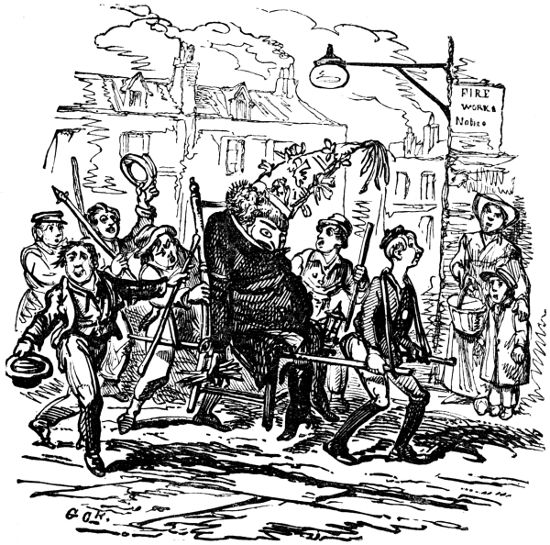
Guy Fawkes.
Please to remember the fifth of November Gunpowder treason and plot; We know no reason, why gunpowder treason Should ever be forgot! Holla boys! holla boys! huzza—a—a! A stick and a stake, for king George’s sake, A stick and a stump, for Guy Fawkes’s rump! Holla boys! holla boys! huzza—a—a
Scuffles seldom happen now, but “in my youthful days,” “when Guy met Guy—then came the tug of war!” The partisans fought, and a decided victory ended in the capture of the “Guy” belonging to the vanquished. Sometimes desperate bands, who omitted, or were destitute of the means to make “Guys,” went forth like Froissart’s knights “upon adventures.” An enterprise of this sort was called “going to smug a Guy,” that is, to steal one by “force of arms,” fists, and sticks, from its rightful owners. These partisans were always successful, for they always attacked the weak.
In such times, the burning of “a good Guy” was a scene of uproar unknown to the present day. The bonfire in Lincoln’s Inn Fields was of this superior order of disorder. It was made at the Great Queen-street corner, immediately opposite Newcastle-house. Fuel came all day long, in carts properly guarded against surprise: old people have remembered when upwards of two hundred cart-loads were brought to make and feed this bonfire, and more than thirty “Guys” were burnt upon gibbets between eight and twelve o’clock at night.
At the same period, the butchers in Clare-market had a bonfire in the open space of the market, next to Bear-yard, and they thrashed each other “round about the wood-fire,” with the strongest sinews of slaughtered bulls. Large parties of butchers from all the markets paraded the streets, ringing peals from marrow-bones-and-cleavers, so loud as to overpower the storms of sound that came from the rocking belfries of the churches. By ten o’clock, London was so lit up by bonfires and fireworks, that from the suburbs it looked in one red heat. Many were the overthrows of horsemen and carriages, from the discharge of hand-rockets, and the pressure of moving mobs inflamed to violence by drink, and fighting their way against each other.
This fiery zeal has gradually decreased. Men no longer take part or interest in such an observance of the day, and boys carry about their “Guy” with no other sentiment or knowledge respecting him, than body-snatchers have of a newly-raised corpse, or the method of dissecting it; their only question is, how much they shall get by the operation to make merry with. They sometimes confound their confused notion of the principle with the mawkin, and for “the Guy,” they say, “the Pope.” Their difference is not by the way of distinction, but ignorance. “No popery,” no longer ferments; the spirit is of the lees.
The day is commonly called Gunpowder treason, and has been kept as an anniversary from 1605, when the plot was discovered, the night before it was to have been put in execution. The design was to blow up the king, James I., the prince of Wales, and the lords and commons assembled in parliament. One of the conspirators, being desirous of saving lord Monteagle, addressed an anonymous letter to him, ten days before the parliament met, in which was this expression, “the danger is past, so soon as you have burnt the letter.” The earl of Salisbury said it was written by some fool or madman; but the king said, “so soon as you have burnt the letter,” was to be interpreted, in as short a space as you shall take to burn the letter. Then, comparing the sentence with one foregoing, “that they should receive a terrible blow, this parliament, and yet should not see who hurt them,” he concluded, that some sudden blow was preparing by means of gunpowder. Accordingly, all the rooms and cellars under the parliament-house were searched; but as nothing was discovered, it was resolved on the fourth of November, at midnight, the day before the parliament met, to search under the wood, in a cellar hired by Mr. Percy, a papist. Accordingly sir Thomas Knevet, going about that time, found at the door a man in a cloak and boots, whom he apprehended. This was Guy Fawkes, who passed for Percy’s servant. On removing the wood, &c. they discovered thirty-six barrels of gunpowder, and on Guy Fawkes being searched, there were found upon him, a dark lantern, a tinder-box, and three matches. Instead of being dismayed, he boldly said, if he had been taken within the cellar, he would have blown up himself and them together. On his examination, he confessed the design was to blow up the king and parliament, and expressed great sorrow that it was not done, saying, it was the devil and not God that was the discoverer. The number of persons discovered to have been in the conspiracy were about thirteen; they were all Roman catholics, and their design was to restore the catholic religion in England. It appears that Guy Fawkes and his associates had assembled, and concerted the plot at the old King’s-head tavern, in Leadenhall-street. Two of the conspirators were killed, in endeavouring to avoid apprehension; eight were executed. Two jesuits, Oldcorn and Garnet, also suffered death; the former for saying “the ill success of the conspiracy did not render it the less just;” the latter for being privy to the conspiracy and not revealing it.
A corporation notice is annually left at the house of every inhabitant in the city of London, previous to lord mayor’s day. The following (delivered in St. Bride’s) is its form:
SIR,
October the 11th, 1825.
BY Virtue of a Precept from my Lord Mayor, in order to prevent any Tumults and Riots that may happen on the Fifth of November and the next ensuing Lord Mayor’s Day, you are required to charge all your Servants and Lodgers, that they neither make, nor cause to be made, any Squibs, Serpents, Fire Balloons, or other Fireworks, nor fire, fling, nor throw them out of your House, Shop, or Warehouse, or in the Streets of this City, on the Penalties contained in an Act of Parliament made in the Tenth year of the late King William.
Note. The Act was made perpetual, and is not expired, as some ignorantly suppose.
C. Puckeridge, Beadle.
Taylor, Printer, Basinghall Street.
On the fifth of November, a year or two ago, an outrageous sparkle of humour broke forth. A poor hard-working man, while at breakfast in his garret, was enticed from it by a message that some one who knew him wished to speak to him at the street door. When he got there he was shaken hands with, and invited to a chair. He had scarcely said “nay” before “the ayes had him,” and clapping him in the vacant seat, tied him there. They then painted his face to their liking, put a wig and paper cap on his head, fastened a dark lantern in one of his hands, and a bundle of matches in the other, and carried him about all day, with shouts of laughter and huzzas, begging for their “Guy.” When he was released at night he went home, and having slept upon his wrongs, he carried them the next morning to a police office, whither his offenders were presently brought by warrant, before the magistrates, who ordered them to find bail or stand committed. It is illegal to smug a man for “a Guy.”
FLORAL DIRECTORY.
Angular Physalis. Physalis Alkakengi. Dedicated to St. Bertille.
November 6.
St. Leonard, 6th Cent. St. Winoc, Abbot, 8th Cent. St. Iltutus, 6th Cent.
Michaelmas Term begins.
Now Monsieur Term will come to town, The lawyer putteth on his gown; Revenge doth run post-swift on legs, And’s sweet as muscadine and eggs; And this makes many go to law For that which is not worth a straw, But only they their mind will have, No reason hear, nor council crave.
Poor Robin’s Almanac, 1757.
To the Editor of the Every-Day Book.
Sir,
October, 1825.
Presuming the object you have in view in your Every-Day Book is to convey useful and pleasing information with the utmost correctness, and, if possible, without contradiction, I beg leave to say, your statement in page 100, “that in each term there is one day whereon the courts do not transact business, namely, on Candlemas-day in Hilary Term, Ascension-day in Easter Term, Midsummer-day in Trinity Term, and All-Saints’-day in Michaelmas Term,” is not quite correct with respect to the two last days; for in last term (Trinity) Midsummer-day was subsequent to the last day, which was on the 22d of June. And if Midsummer-day falls on the morrow of Corpus Christi, as it did in 1614, 1698, 1709, and 1791, Trinity full Term then commences, and the courts sit on that day; otherwise, if it occurs in the term it is a dies non. In 1702, 1713, 1724, 1795, and 1801, when Midsummer-day fell upon what was regularly the last day of term, the courts did not then sit, regarding it as a Sunday, and the term was prolonged to the 25th. (See Blackstone’s Commentaries, vol. iii. page 278.) With respect to All-Saints’-day, (1st of November,) it does not now occur in Michaelmas Term, for by the statute 24th Geo. II. c. 48, (1752,) the Essoin day of that term is on the morrow of All-Souls, 3d of November, consequently Michaelmas Term does not actually commence before the 6th of November.
With respect to the grand days of the inns of court, I find by “The Student’s Guide to Lincoln’s Inn,” the two first days you mention are correct with respect to that society; but in Trinity Term the grand day is uncertain, unless Midsummer-day is in the term, then that is generally the grand day. In Michaelmas Term, grand day is on the second Thursday in the term.
In page 156, you state, “It is of ancient custom on the first day of term for the judges to breakfast with the lord chancellor in Lincoln’s Inn Hall.” Till within these few years, and only on the present lord chancellor removing from Bedford-square, the judges, together with the master of the rolls and his officers, the vice-chancellor, the masters in chancery, the king’s serjeants and counsel, with the different officers of the court of chancery, always assembled at the chancellor’s house to breakfast, and from thence, following the chancellor in his state carriage, to Westminster. But on the removal of lord Eldon to Hamilton-place, his lordship desired to meet the gentlemen of the courts of law and equity in Lincoln’s Inn Hall; and from that time, the judges, &c. have met in Lincoln’s Inn. This place is better adapted to the convenience of the profession than one more distant.
The above observations, if worth notice, may be used on the first day of next term, the 6th of November; but as the 6th is on a Sunday, term will not actually begin until the 7th.
I am, sir, &c.
Lincoln’s Inn, New-square.
S. G.
FLORAL DIRECTORY.
Yew. Taxus baccata. Dedicated to St. Leonard.
November 7.
St. Willibrord, 1st Bp. of Utrecht, A. D. 738. St. Werenfrid. St. Prosdecionus, 1st. Bp. of Padua, A. D. 103.
Chronology.
Hats and Bonnets.
On the 7th of November, 1615, (Michaelmas Term, 13 Jac. I.) when Ann Turner, a physician’s widow, was indicted at the bar of the court of king’s bench, before sir Edward Coke (as an accessary before the fact) for the murder of sir Thomas Overbury, the learned judge observing she had a hat on, told her “to put it off; that a woman might be covered in a church, but not when arraigned in a court of justice.” Whereupon she said, she thought it singular that she might be covered in the house of God, and not in the judicature of man. Sir Edward told her, “that from God no secrets were hid; but that it was not so with man, whose intellects were weak; therefore, in the investigation of truth, and especially when the life of a fellow creature is put in jeopardy, on the charge of having deprived another of life, the court should see all obstacles removed; and, because the countenance is often an index to the mind, all covering should be taken away from the face.” Thereupon the chief justice ordered her hat to be taken off, and she covered her hair with her handkerchief.
On Sunday, the 7th of November, 1824, being the hundredth anniversary of the death of the celebrated John Eyrle, Esq., Pope’s “Man of Ross,” the new society of ringers in that town rung a “muffled peal” on the occasion.—Hereford Paper.[380]
FLORAL DIRECTORY.
Large Furerœa. Furerœa Gigantea. Dedicated to St. Willibrord.
November 8.
The four crowned Brothers, Martyrs, A. D. 304. St. Willehad, Bp. A. D. 787. St. Godfrey, Bp. A. D. 1118.
Now the leaf Incessant rustles from the mournful grove; Oft startling such as studious walk below; And slowly circles through the waving air.
As the maturing and dispersing of seeds was a striking character of the last month, so the fall of the leaf distinguishes the present. From this circumstance, the whole declining season of the year is often in common language denominated the fall. The melancholy sensations which attend this gradual death of vegetable nature, by which the trees are stripped of all their beauty, and left so many monuments of decay and desolation, forcibly suggest to the reflecting mind an apt comparison for the fugitive generations of man.[381]
Like leaves on trees the race of man is found, Now green in youth, now with’ring on the ground. Another race the following spring supplies; They fall successive, and successive rise: So generations in their course decay, So flourish these, when those are pass’d away.
Pope’s Homer.
FLORAL DIRECTORY.
Cape Aletris. Veltheimia glauca. Dedicated to The four Brothers.
November 9.
The Dedication of the Church of St. John Laterans. St. Theodorus, surnamed Tyro, A. D. 306. St. Mathurin, A. D. 388. St. Vanne, or Vitonus, Bp. A. D. 525. St. Benignus, or Binen, Bp. A. D. 468.
Lord Mayor’s Day.
To the Editor of the Every-Day Book.
Sir,
Enclosed are official printed copies of the two precepts issued previous to lord mayor’s day, for the purpose of informing the master and wardens of the respective livery companies, to whom they are directed, (as well as the aldermen of the wards through which the procession passes,) of the preparations necessary to be made on that day. These precepts are first ordered to be printed at a court of aldermen; directions accordingly are afterwards given by the town clerk, and, when printed, they are sent to the four attornies of the lord mayor’s court, by whom they are filled up, afterwards they are left at the mansion-house, and lastly they are intrusted to the marshalmen to be delivered. The larger precept is sent to the aldermen of the wards of Cheap, Cordwainer, Vintry, Farringdon within, Farringdon without, Bread-street, Cripplegate within, and Castle Baynard. The smaller precept is forwarded to the whole of the livery companies.
I am, sir, &c.
S. G. *
November 2, 1825.
Precept to the Aldermen. By the MAYOR. To the Aldermen of the Ward of
Forasmuch as William Venables, Esquire, lately elected Lord Mayor of this City for the Year ensuing, is on Wednesday the Ninth Day of November next to be accompanied by his Brethren the Aldermen, and attended by the Livery of the several Companies of this City, to go from Guildhall, exactly at Eleven o’clock in the Forenoon, to Blackfriars Stairs, and from thence by Water to Westminster there to be sworn, and at his return will land at Blackfriars Stairs, and pass from thence to Fleet Bridge, through Ludgate Street, Saint Paul’s Church Yard, Cheapside, and down King Street to the Guildhall, to Dinner:
Now, for the more decent and orderly Performance of the said Solemnity, and for preventing any Tumults and Disorders which may happen by the great Concourse of People,
These are in his Majesty’s Name to require you to cause the Constables within your Ward to keep a good and sufficient double Watch and Ward of able Men well weaponed on that Day, as well as at the landing Places as in the Streets through which the said Solemnities are to pass; and you are required to charge the said Constables to preserve the said Streets and Passages free and clear from all Stops and Obstructions, and not permit any Coach, Cart, or Dray to stand therein; and if any Coachman, Drayman, or Carman refuse to move out of the said Streets, that they carry such Coachman, Drayman, or Carman to one of the Compters, and such Coach, Dray, or Cart to the Green Yard, and take their Numbers that they may be prosecuted according to Law. And although every Person is bound by the Law to take Notice of all general Acts of Parliament, yet that there may not be the least colour or pretence of Ignorance or Inadvertency, these are also to require you to cause your Beadle to go from House to House, and acquaint the several Inhabitants, that by an Act of Parliament made in the ninth and tenth years of the Reign of King William the Third (which is made perpetual,) It is enacted that no Person of what degree or quality soever shall make, sell, or expose to sale, any Squibs, Serpents, or other Fireworks; or any Cases Moulds, or other Implements whatsoever for making such Fireworks, nor shall permit any Person to cast or throw any Squibs, Serpents, or other Fireworks from out of or in their Houses, Lodgings, or Habitations, nor shall any Person whatsoever cast, throw, or fire any such Squibs, Serpents, or other Fireworks, in, out of, or into any Street, House, or Passage; every such Offence being adjudged by the said Act to be a common Nuisance, and every Offender for every such single Offence being liable to the several Penalties inflicted by the said Act.
And you are to enjoin your Constables and Watchmen carefully to observe and apprehend all such Persons as shall presume to offend against the said Act, or shall commit any Riots, Tumults, or other Disorders whatsoever, and bring them before me or some other of his Majesty’s Justices of the Peace within this City, that they may be punished according to the said Act, and as the Law directs.
And that you cause Notice to be given to the Inhabitants of your Ward to adorn the Fronts and Balconies of their Houses with their best Hangings or other Ornaments, and that they cause the Streets before their respective Houses to be cleanly swept and well paved and amended, whereof the Scavengers are also to take Notice, and to be warned that they see the same duly and effectually performed. And if any Constable, Beadle, or other Officer shall be found remiss and negligent in their Duty, in not apprehending any offending, they shall be prosecuted for such their Neglect, Default, or Remissness, according to the utmost Severity of the Law. Dated this Eleventh Day of
October, 1825.
Woodthorpe.
Printed by Arthur Taylor, Printer to the Honourable City of London, Basinghall Street.
Precept to the Companies. By the MAYOR. To the Master and Wardens of the Company of
Whereas the Right Honourable the Lord Mayor Elect and Court of Aldermen have appointed at their return from Westminster, on Wednesday the 9th day of November next, to land at Blackfriars Stairs, and pass from thence to Fleet Street, through Ludgate Street, to St. Paul’s Church Yard, down Cheapside and King-street, to the Guildhall, to Dinner:
These are therefore to require you to be in your Barge by Eleven o’clock in the Forenoon precisely, his Lordship being resolved to be going by that time; and that as well in your going as return you will cause your Barge to go in order according to your precedency; and that such of your Company as walk in the Streets land at Blackfriars Stairs aforesaid; and that you be early and regular in taking and keeping your Standings. Dated the Eleventh day of October, 1825.
Woodthorpe.
Printed by A. Taylor, 40, Basinghall Street.
Lord Mayor’s Show.
———————— Behold How London did pour out her citizens! The Mayor and all his brethren in best sort!
Shakspeare.
The procession of the corporation of London to Westminster on the occasion of the new lord mayor being sworn into office, is familiar to most residents in the metropolis, and the journals annually record the modern processions and festivals in the Guildhall, sufficiently to acquaint those who have not witnessed them with the nature of the proceedings. It is not purposed then, for the present, to describe what passes in our own times, but to acquaint the citizens and all who feel an interest in ancient customs, with something of the splendour attendant upon the ceremony in old times.
In 1575, “William Smythe, citezen and haberdasher of London,” wrote “A breffe description of the Royall Citie of London, capitall citie of this realme of England.” This manuscript which is in existence sets forth as follows:
“The day of St. Simon and St. Jude, the mayor enters into his state and office. The next day he goes by water to Westminster in most triumphant-like manner, his barge being garnished with the arms of the city; and near it a ship-boat of the queen’s majesty being trimmed up and rigged like a ship of war, with divers pieces of ordnance, standards, pennons, and targets of the proper arms of the said mayor, of his company, and of the merchants’ adventurers, or of the staple, or of the company of the new trades; next before him goeth the barge of the livery of his own company, decked with their own proper arms; then the bachelors’ barge; and so all the companies in London, in order, every one having their own proper barge, with the arms of their company. And so passing along the Thames, he landeth at Westminster, where he taketh his oath in the exchequer before the judge there; which done, he returneth by water as aforesaid, and landeth at Paul’s wharf, where he, and the rest of the aldermen take their horses, and in great pomp pass through Cheapside. And first of all cometh two great standards, one having the arms of the city, and the other the arms of the mayor’s company: next them two drums and a flute, then an ensign of the city, and then about lxx or lxxx poore men marching two and two, in blue gowns, with red sleeves and caps, every one bearing a pike and a target, whereon is painted the arms of all them that have been mayors of the same company that this new mayor is of. Then two banners, one of the king’s arms, the other of the mayor’s own proper arms. Then a set of hautboys playing, and after them certain wyfflers,[382] in velvet coats and chains of gold, with white staves in their hands; then the Pageant of Triumph richly decked, whereupon by certain figures and writings, some matter touching justice and the office of a magistrate is represented. Then sixteen trumpeters, eight and eight, having banners of the mayor’s company. Then certain wyfflers in velvet coats and chains, with white staves as before. Then the bachelors, two and two, in long gowns, with crimson hoods on their shoulders of satin; which bachelors are chosen every year of the same company, that the mayor is of, (but not of the living) and serve as gentlemen on that and other festival days, to wait on the mayor, being in number according to the quantity of the company, sometimes sixty, or one hundred. After them twelve trumpeters more, with banners of the mayor’s company; then the drum and flute of the city, and an ensign of the mayor’s company; and after, the waits of the city in blue gowns, red sleeves and caps, every one having a silver collar about his neck. Then they of the livery in their long gowns, every one having his hood on his left shoulder, half-black and half-red, the number of them according to the greatness of the company whereof they are. After them follow sheriff’s-officers, and then the mayor’s officers, with other officers of the city, as the common serjeant, and the chamberlain; next before the mayor goeth the sword-bearer, having on his head the cap of honour, and the sword of the city in his right hand, in a rich scabbard, set with pearl, and on his left hand goeth the common crier of the city, with his great mace on his shoulder all gilt. The mayor hath on a long gown of scarlet, and on his left shoulder a hood of black velvet, and a rich collar of gold or SS. about his neck, and with him rideth the old mayor also, in his scarlet gown, hood of velvet, and a chain of gold about his neck. Then all the aldermen, two and two, (among whom is the recorder,) all in scarlet gowns; those that have been mayors have chains of gold, the others have black velvet tippets. The two sheriffs come last of all, in their black scarlet gowns and chains of gold. In this order they pass along through the city to the Guildhall, where they dine that day, to the number of one thousand persons, all at the charge of the mayor and the two sheriffs. This feast costeth 400l., whereof the mayor payeth 200l. and each of the sheriffs 100l. Immediately after dinner, they go to St. Paul’s church, every one of the aforesaid poor men bearing staff, torches, and targets, which torches are lighted when it is late, before they come from evening prayer.”[383] In more ancient times, the procession to and from Westminster was by land; until in 1453, sir John Norman built a sumptuous barge at his own expense, for the purpose of going by water, whereupon watermen made a song in his praise, beginning, “Row thy boat, Norman.” The twelve companies emulating their chief have, from that period, graced the Thames on lord mayor’s day.
The first account of this annual exhibition known to have been published, was written by George Peele, for the inauguration of sir Wolstone Dixie, knight, on the 29th of October, 1585. On that occasion, as was customary to the times, there were dramatic representations in the procession—of an allegorical character. Children were dressed to personify the city, magnanimity, loyalty, science, the country, and the river Thames. They also represented a soldier, a sailor, and nymphs, with appropriate speeches. The show opened with a moor on the back of a lynx. On sir Thomas Middleton’s mayoralty, in 1613, the solemnity is described as unparalleled for the cost, art, and magnificence of the shows, pageants, chariots, morning, noon, and night triumphs. In 1655, the city pageants, after a discontinuance of about fourteen years, were revived. Edmund Gayton, the author of the description for that year, says, that “our metropolis for these planetary pageants, was as famous and renowned in foreign nations, as for their faith, wealth, and valour.” In the show of 1659, an European, an Egyptian, and a Persian, were personated. On lord mayor’s day, 1671, the king, queen, and duke of York, and most of the nobility being present, there were “sundry shows, shapes, scenes, speeches and songs, in parts;” and the like, in 1672, and 1673, when the king again “graced the triumphs.” The king, queen, duke and duchess of York, prince Rupert, the duke of Monmouth, foreign ambassadors, the chief nobility, and secretary of state, were at the celebration of lord mayor’s day, in 1674, when there were “emblematical figures, artful pieces of architecture, and rural dancing, with pieces spoken on each pageant.”
The printed description of these processions are usually entitled “Triumphs,” though they are more commonly called “The London Pageants,” all of them are scarce, and some of such extreme rarity, as to bear a price at the rate of two and three guineas a leaf. The description of sir Patience Ward’s show, on the 29th of October, 1680, composed by Thomas Jordan, is an interesting specimen of the setting out and pageantry of this procession. The lord mayor being of the livery of the merchant-tailors’ company, at seven o’clock in the morning, liverymen of the first rank, appointed to conduct the business of the day, assembled at merchant-tailors’ hall, to meet the masters, wardens, and assistants, in their gowns, faced with foyns, (the skin of the martin.) In the second rank, others in gowns faced with budge, (lambs’-skin, with the wool dressed outwards,) and livery-hoods. In the third rank, a number of foyns-bachelors, and forty budge-bachelors, both attired in scarlet hoods and gowns. Sixty gentlemen-ushers, in velvet coats and chains of gold, bearing white staves. Thirty more in plush and buff, bearing colours and banners. Thirty-six of the king’s trumpeters, with silver trumpets, headed by the serjeant-trumpeter, he wearing two scarfs, one the lord mayor’s, and the other the company’s colours. The king’s drum-major, followed by four of the king’s drums and fifes. Seven other drums and two fifes, wearing vests of buff, with black breeches and waste scarfs. Two city marshals on horseback, with attendants. The foot-marshal, with a rich broad shoulder-scarf, to put them in rank and file, attended by six others. The fence-master, with attendants, bearing bright broadswords drawn. Poor pensioners, with gowns and caps, bearing standards and banners. A troop of poor persons, in azure gowns and caps. One hundred more with javelins and targets, bearing the arms of their benefactors. Being all assembled, they are by the foot-marshal’s judgment, arranged into six divisions, ranked out by two and two. The first division contains the ensigns of the company, followed by the poor company of pensioners. Four drums and one fife. Pensioners in coats as before described. Persons of worth, each bearing a standard or banner. Four trumpets. Two merchant-tailors’ ensigns, bearing their supporters and crest. Six gentlemen-ushers. The budge-bachelors, marching in measured order. Second division. Six trumpets. Two gentlemen, bearing the coats of arms of the city, and the merchant-tailors’ company. Eight gentlemen, wearing gold chains. The foyns-bachelors. Third division. Two gentlemen in velvet coats with banners. Ten gentlemen-ushers in coats and chains of gold, as before described. A large body of the livery in their gowns and livery-hoods, followed by “all lord mayors in the potential mood.” In their rear divers of the city trumpets. Two gentlemen bearing the arms of the city and the lord mayor. Gentlemen-ushers. The court of assistants. Four drums. Six trumpets. Three gallants, bearing the banners of the diadem. The king’s, queen’s, and city’s ensigns, attended by six gentlemen as pages. The masters and wardens of the merchant-tailors’ company. Thus formed, they march from merchant-tailors’ hall to the lord mayor’s house, where his lordship and the aldermen take horse, according to their degree, and the whole body proceed in state to Guildhall. Being met at the gate by the old lord mayor, and there attired with the gown, fur hood, and scarf, and guarded by knights, esquires, and gentlemen, they all march through King-street down to Three-Crane-wharf, where the lord mayor and aldermen, discharging some of the attendants, take barge at the west-end of the wharf; the court of assistants’ livery, and the best of the gentlemen-ushers taking barge at the east-end. The rest of the ushers, with the foyns and the budge-bachelors, remain ashore, with others, to await the return of his lordship, who proceeds with several city companies by water, and is rowed all along by the Strand to Westminster, a pleasure boat with great guns aboard saluting him on the way. At New Palace Stairs they disembark, and making a lane to the hall, the lord mayor passes along to take the oath and go through the usual ceremonies. These being completed, he makes a liberal donation to the poor of Westminster, reembarks with all his retinue, and being rowed back to Blackfriars Stairs, he lands there under beat of drum and a salute of three volleys from the artillery company in their martial ornaments, some in buff, with head-pieces, many being of massy silver. From Blackfriars they march before the lord mayor and aldermen through Cheapside to Guildhall. The pensioners and banners who went not to Westminster, being set in order to march, the foot-marshal in the rear of the artillery company, leads the way along by the channel up Ludgate-hill, through Ludgate, into St. Paul’s Churchyard, and so into Cheapside, where his lordship is entertained by the first pageant, consisting of a large stage with the coat armour of the merchant-tailors’ company, eminently erected, consisting of a large tent royal, gules, fringed and richly garnished, or, lined, faced, and doubled, ermine. This stage is winged or flanked by two other stages, bearing two excellent figures of lively carved camels, the supporters to the company’s coat. On the back of one camel, a black native Indian, in a golden robe, a purple mantle fringed with gold, pearl pendants in his ears, coronet of gold with feathers, and golden buskins laced with scarlet ribbon, holds a golden bridle in his left, and a banner of the company, representing Treasure in his right hand. On the other camel, a West Indian, in a robe of silver, scarlet mantle, diamonds pendant from his ears, buskins of silver, laced with purple ribbons, a golden crown feathered, holds a silver bridle in his left, and a banner of the lord mayor, representing Traffic, in his right hand. On one of the camel stages four figures sit on pedestals, one at each corner, representing Diligence, Industry, Ingenuity, and Success; on the other camel-stage, in like manner, Mediocrity, Amity, Verity, Variety, all richly habited in silk or sarcenet, bear splendid emblems and banners. The royal tent, or imperial pavilion, between these two stages, is supported on one side by a minister of state representing Royalty, and on the other side by another representing Loyalty; each in rich robes of honor gules, wearing on their left arms shields azure, with this motto in gold, For the king and kingdom, one bearing a banner of the king’s, and the other one of the city’s banners. On a high and eminent seat of throne-like ascension is seated Sovereignty, in royal posture and alone, with black curled hair, wearing an imperial crown, a robe of purple velvet, lined, faced, and caped with ermine, a collar of SS with a George pendant; bearing in one hand a golden globe, in the other a royal sceptre. On a seat beneath, are Principality, Nobility, and Honour, all richly habited. On the next seat, gradually descending beneath, are, 1. Gentility, shaped like a scholar and soldier, holding in one hand, clad with a golden gauntlet, a silver spear, in the other a book; 2. Integrity, wearing an earl’s coronet for the court, a loose robe of scarlet-coloured silk for the city, underneath a close coat of grass-green plush for the county; 3. Commonalty, as a knight of the shire in parliamentary robes. On the lowest seat, an ancient English Hero, with brown curling hair, in ancient armour, as worn by chief commanders, the coat of mail richly gilt, crimson and velvet scarf fringed with gold, a quiver of arrows in a gold belt on one side, a sword at the other, buskins laced with silver and gold, a silver helmet with red and white plume, in one hand a large long bow, and a spear in the other. This personage, representing sir John Hawkwood, a merchant-tailor of martial renown under Edward III., when he conquered France, as soon as he perceives the lord mayor prepared, with attention riseth up, and with a martial bow exhibiteth a speech in verse of thirty-seven lines, in compliment to the merchant-tailors and the lord mayor. His lordship testifying his approbation, rideth with all his brethren through the throng of spectators, till at Milk-street end, he is intercepted by the second pageant, which is a chariot of ovation, or peaceful triumph, adorned with delightful pieces of curious painting, and drawn by a golden lion and a lamb. On the lion is mounted a young negro prince, richly habited, according to the royal mode in India, holding a golden bridle, and in the other hand St. George’s banner, representing Power. On the lamb is mounted a white beautiful seraphim-like creature, with long bright flaxen curled hair, and on it a golden coronet of cherubims’ heads and wings, a carnation sarcenet robe, with a silver mantle and wings of gold, silver, purple, and scarlet, reining the lamb by a silver bridle in his left hand, and with his right bearing an angelical staff, charged with a red cross, representing Clemency. In the chariot sitteth seven persons, 1. Concordia, 2. Unanimia, 3. Pacifica, 4. Consentania, 5. Melodea, 6. Benevolentia, (whose habits, and those of other characters already and hereafter mentioned, are not described here for want of room) and 7. “Harmonia, a lady of great gravity, with masculine aspect, wearing a lovely dark brown peruke, curiously curled, on which is planted a crown imperial; she wears a robe of French green velvet, pleasantly embroidered with gold, a crimson coloured silk and silver mantle, and sitting majestically alone in front, upon the approach and fixation of my lord mayor, improves the opportunity, riseth up, and delivereth an oration.” This consists of forty-four lines in verse, wherein she acquaints his lordship that the other characters are her attributes, recommends unity, because division is the policy of the pope and the jesuits, expresses her belief that if the lion and the lamb fall out, she should run to ruin, descants upon magistrate-like virtues, and in the end tells his lordship,—
You have done all things fair, no action foul; Your sherevalry gave relish of good rule, Nor need they doubt your mayoralty, therefore, Begging your pardon, I shall say no more.
This speech being concluded, his lordship exhibiting a gracious aspect of favourable acceptation, advanceth further towards Guildhall, but is civilly obstructed by another scene, and in regard, his lordship is a merchant, and his company merchant-tailors, the Third Triumphal Scene, or Pageant, is a ship called the Patience, with masts and sails, fully rigged and manned, the captain whereof addresseth to my lord a speech beginning,—
What cheer, my lord? I am return’d from sea, To amplifie your day of Jubilee, In this tried vessel, &c.
His lordship having surveyed the ship, and the trumpets sounding, he continueth his determined course toward Guildhall, but by the way is once more obstructed by another scene, called the Palace of Pleasure, which is a triumphal ionic arch of excellent structure, where, in distinct and perspicuous situations, sitteth nine beautiful and pleasant ladies, whose names, natures, and ornaments are consentaneous, 1. Jollity, 2. Delight, 3. Fancy, 4. Felicity, 5. Wit, 6. Invention, 7. Tumult, 8. Slaughter, 9. Gladness; all of them properly enrobed and adorned; and to augment their delight, there are several persons properly habited, playing on sundry loud instruments of music, one of which, with a voice as loud and as tunable as a treble hautboy, chanteth out a Ditty in commendation of the Merchant-tailors’ Trade, commencing thus,
Of all the professions that ever were nam’d The Taylers though slighted, is much to be fam’d: For various invention and antiquity, No trade with the Taylers compared may be: For warmth and distinction and fashion he doth Provide for both sexes with silk, stuff, and cloth: Then do not disdain him or slight him, or flout him, Since (if well consider’d) you can’t live without him. But let all due praises (that can be) be made To honour and dignifie the Taylers trade. When Adam and Eve out of Eden were hurl’d, They were at that time king and queen of the world: Yet this royal couple were forced to play The Taylers, and put themselves in green array; For modesty and for necessity’s sake They had figs for the belly, and leaves for the back And afterward clothing of sheep-skins they made Then judge if a Tayler was not the first trade, The oldest profession; and they are but railers, Who scoff and deride men that be Merchant-Taylers.
This song, containing five more verses, being ended, the foot-marshal places the assistants, livery, and the companies on both sides of King’s-street, and the pensioners with their targets hung on the tops of the javelins; in the rear of them the ensign-bearers; drums and fifes in front; he then hastens the foins and budge-bachelors, together with the gentlemen ushers, to Guildhall, where his lordship is again saluted by the artillerymen with three volleys more, which concludes their duty. His land attendants pass through the gallery or lane so made into Guildhall; after which the company repairs to dinner in the hall, and the several silk-works and triumphs are likewise conveyed into Blackwell-hall; and the officers aforesaid, and the children that sit in the pageants, there refresh themselves until his lordship hath dined. At the dinner in Guildhall, his lordship and the guests being all seated, the city music begin to touch their instruments with very artful fingers. Their ears being as well feasted as their palates, and a concert lesson or two succeeding, “a sober person with a good voice, grave humour, and audible utterance, proper to the condition of the times,” sings a song called The Protestants’ Exhortation, the burden whereof is, Love one another, and the subject against the catholics. The song being ended, the musicians play divers new airs, which having done, three or four “habit themselves according to the humour of the song,” and one of them chanteth forth The Plotting Papist’s Litany, in ten stanzas, the first of which ends with
Joyntly then wee ’l agree, To sing a Litany, And let the burden be, Ora pro nobis.
In the year 1688, the second mayoralty of sir Thomas Pilkington, who being of the skinners’ company, a pageant in honour of their occupation, consisted of “a spacious wilderness, haunted and inhabited with all manner of wild beasts and birds of various shapes and colours, even to beasts of prey, as wolves, bears, panthers, leopards, sables, and beavers; likewise dogs, cats, foxes, and rabbits, which tossed up now and then into a balcony fell oft upon the company’s heads, and by them tossed again into the crowd, afforded great diversion; melodious harmony likewise allayed the fury of the wild beasts, who were continually moving, dancing, curvetting, and tumbling to the music.”
On the alteration of the style, the swearing in of the lord mayor and the accompanying show, which had been on the 29th of October, was changed to the 9th of November. The speeches in the pageants were usually composed by the city poet, an officer of the corporation, with an annual salary, who provided a printed description for the members of the corporation before the day. Settle, the last city poet, wrote the last pamphlet intended to describe a lord mayor’s show; it was for sir Charles Duncombe’s, in 1708, but the prince of Denmark’s death the day before, prevented the exhibition. The last lord mayor who rode on horseback at his mayoralty was sir Gilbert Heathcote in the reign of queen Anne.
It will be remarked after this perusal, that the modern exhibitions have no pretension to vie with the grandeur of the old “London triumphs.” In 1760, the court of common council recommended pageants to be exhibited for the entertainment of their majesties on lord mayor’s day. Such revivals are inexpedient, yet probably some means might be devised for improving the appearance of the present procession, without further expenditure from the city funds, or interfering with the public appropriation of the allowance for the support of the civic dignity. All that remains of the lord mayor’s show, to remind the curiously informed of its ancient character, is in the first part of the procession, wherein the poor men of the company to which the lord mayor belongs, or persons hired to represent them, are habited in long gowns and close caps of the company’s colour, and bear painted shields on their arms, but without javelins. So many of these head the show, as there are years in the lord mayor’s age. Their obsolete costume and hobbling walk are sport for the unsedate, who, from imperfect tradition, year after year, are accustomed to call them “old bachelors”—tongues less polite call them “old fogeys.” The numerous band of gentlemen-ushers in velvet coats, wearing chains of gold and bearing white staves, is reduced to half-a-dozen full-dressed footmen, carrying umbrellas in their hands. The antiquarian reminiscences occasioned by the throwing of substances that stone-eaters alone would covet, from the tops of the houses, can arise no more; and even the giants in Guildhall are elevated upon octagon stone columns, to watch and ward the great west window, in no other than a gigantic capacity: their proper situation they were displaced from some few years ago, owing, it is presumed, to lack of information in the civic authorities, that figures of giants anciently belonged to Guildhall, and that their corporate station was at the Guildhall door. In their present station, they are as much out of place as a church weathercock would be if it were removed from the steeple, and put on the sounding board of the pulpit.
Husbands and Wives.
To the Editor of the Every-Day Book.
Sir,
It is not often that men, now-a-days, send copies of verses to their wives, but I think the editor of the Every-Day Book who is fond of the times gone by, is still old fashioned enough not to condemn the practice. The following lines, which have not appeared in print, are much at your service. My best wishes attend the complete success of your useful and instructive undertaking.
I remain, Your constant reader, H.
Norfolk, Oct. 19, 1825.
To Mrs. ———— on my Birth-day.
My Betsy lo! the year’s gone round, We see this day once more, November’s leaves bespread the ground, And I am forty-four. I look me back to boyhood’s days, When I was wont to pore O’er grammar, ’neath a master’s gaze, Nor thought of forty-four. The mathematics I began, Twice two I said was four, What more know I, tho’ time has ran, And made me forty-four. Of French and crabbed Latin too I laid in little store, Yet both are pleasing to my view, Now I am forty-four. Thus time makes pleasant in his round What once to us was sore, This truth full often have I found, Ere I was forty-four. One nymph to crown our nuptial bliss, See dancing on the floor, May all our days be blest as this On which I am forty-four. Tho’ small my girl, our share, our wealth, On wolf, we bar the door; If Providence but sends me health, I’m blest at forty-four. For thee, my love, long life I ask, That blessing sent of yore, When men like boys conn’d o’er a task At ten times forty-four.
The Aerial, or The Great Unknown, AT VAUXHALL.
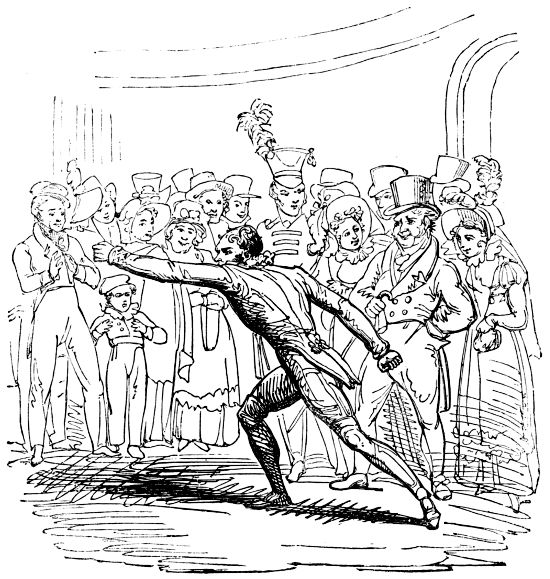
The Aerial, or The Great Unknown, AT VAUXHALL.
“The earth hath bubbles as the water has, And this is of them.”
This personage has obtained himself to be sketched and lithographed. It is a true portraiture of his dress and form, but not of his face. By way of denoting his pretension to “deathless notoriety,” it has these few expressive words beneath it; namely,—“Without equal in nature or art, this or in any other age or globe.” Afterwards follows this intimation, “Published as the act directs, by Mr. Leeming, London, October, 1825.” In vain did he solicit the printsellers to sell the prints for five shillings each. Although he had coupled it with written intimation that he is “the Ærial invaluable,” and that after his decease will be inscribed on his tomb, “If this was not a gentleman, he would not have been buried in christian burial,” yet the publishers were impenetrable to his “assurance,” and therefore before and after, and on Guy Fawkes’ day, a man was employed to walk the streets with a board bearing a couple of the impressions pasted thereon, the said man bearing also unpasted ones, “to all who choose to buy them” at one shilling each.
The first public intimation of this “phenomenon,” is in the Times of Saturday, July 2, 1825:—“An individual in a splendid dress of Spanish costume has excited much attention at Vauxhall gardens. Having walked or rather skipped round the promenade, with a great air of consequence, saluting the company as he passed along, he at length mingled amongst the audience in the front of the orchestra, and distributed a number of cards, on each of which was written, ‘The Ærial challenges the whole world to find a man that can in any way compete with him as such.’ After having served about three or four hundred of these challenges, he darted off like lightning, taking the whole circuit of the gardens in his career, and made his exit through the grand entrance into the road where a carriage was in waiting for him, into which he sprang, and was driven off.”
Postponing a few particulars of this visitation of Vauxhall by “The Ærial” for a minute or two, we proceed to state that he declares himself “an Adonis;” that to glad the eyes of artists with a view of his uncommon person, he condescended to leave the good town of Manchester by the common stage coach, and that assuming the disguise of common dress, like Apollo in “Midas” after expulsion from the celestials, he arrived in London on the day of June. Dull as he found this metropolis to personal merit, yet, to his “Agreeable Surprise,” there were some who said in the language of Lingo:—
“Such beauties in view I Can never praise too high.”
Sculptors and painters of eminence to whom he proffered disclosure of his elegant person were honoured by visits from him. He represents some interviews to this effect. Sir Thomas Lawrence, the president of the royal academy, gazed upon him, and inquired what “he considered the essential principle of man?” the Ærial immediately answered “the thigh.” Sir Thomas insensible to the mundane charms before him, observed that he thought the beauties of the mind should be preferred to those of the body, and therefore suggested the propriety of his cultivating mental beauty. This was an indignity, for it was opposed to the theory maintained by the Ærial, that mental beauty results from personal beauty. Mr. Haydon was not quite so shocking; he admitted to, and to the cost of the Ærial, as will hereafter appear, that he had “a beautiful leg.” His oral developement of his sylph-like perfections to Mr. Chantry, induced that gentleman to decline prolongation of the interview, and to say he should at once call himself Ærial, and from that moment he did. Mr. Behnes told him that he was “no conjuror,” and that every body laughed at him. The Ærial was not to be so subdued, nor by such means humbled. He deemed them to be the sayings of envy. His organ of self-esteem attained a new swell, and in harmonious strength he rose like Antæus from the dust, a giant refreshed.
He conceives that he is the most beautiful person in the world, and hence besides calling himself “the Ærial,” the “New Discovery,” and “the Great Unknown,” he adds “the Paragon of Perfection,” “the Phœnix,” “the God of Beauty,” and “the Grand Arcana of Nature.” Some one intimated that arcanum would be correct; he said, he did not choose to hum, and he was “not to be hummed.” It was hinted that he might assume the name of Apollo; he turned from the speaker with contempt—“Apollo is nothing compared with me; there is no figure to compete with me in any respect, except the Achilles in the park, which may be somewhat like me in the under part of the foot upon the ground, but upon that it is impossible to determine with accuracy, unless the figure flew from the pedestal.”
He relates, that he visited Dr. Thornton, who lectures at the Marlborough rooms, in Great Marlborough-street, on “craniology, botany, chemistry, astronomy, vision, hearing, the circulation of the blood, digestion, and the beneficial effects produced by the different gases in the cure of diseases.” He inquired of this gentleman whether he thought “an exhibition of something never before seen under the sun, and which, when seen, people would fall down and worship, would be likely to take?” The doctor inquired what the “something” was; the Ærial answered by inquiring which of all the exhibitions was likely to be the most successful; the doctor answered, “the panorama of London in the Regent’s-park when it opens.” “But what do you think an infinitely more attractive exhibition will produce.” “It is impossible to say—perhaps 20,000l. a year; but what is yours?”—“You shall see—but not now—to-morrow.” On the morrow the Ærial came with a small bundle; and having obtained permission to retire therewith, alone to a room, promised to return in a few minutes, and cheer the sight of the doctor and his family with a more astonishing production of nature than the doctor or all mankind born before him had seen, or after ages could see. During his absence, the doctor’s household were on tiptoe expectation till the long-looked-at door opened, when the Ærial entered in a close-fitting dress, and walking to the middle of the room, threw out his chest and left arm, and projecting his right arm behind, cried, “Behold!”
Determined on an immediate public exhibition, the Ærial conceived the idea of a new joint stock company, “capital one million;” for which “good and valuable consideration,” he proposed to put himself at the disposition of the company “so soon as the subscription was filled up.” To certain observations of the chancellor against the “new companies,” the Ærial attributed a general indifference to personal overtures that he made to several individuals, with a view to arrangements for bringing him “into the market.” He resolved to speculate on his own account; the first thing to be obtained was a “grand room;” but the proprietor of the “Egyptian-hall” was deaf to the voice of the charmer, and every room in London was denied to him, except on degrading conditions which people “without souls” are accustomed to require on such applications. Could he have obtained one friend to have gone shares with him, the summum bonum might have been obtained. If only one monied man would have advanced with capital, the Ærial would have advanced in person. It was to have been an exhibition by candlelight, for candlelight he said was indispensable to produce “extreme height,” and render him in common eyes “a giant.” This effect of exhibition by candlelight would be, he said, a “new discovery;” and therefore he added to himself the title of the “New Discovery.” He is five feet one inch and a quarter high. Some one unthinkingly conversing in his presence, stated him to be five feet one inch and a half; the Ærial corrected the inaccuracy with severity. “A quarter, sir,” he said; “five feet one and a quarter, sir; mine is the perfect height; a quarter of an inch more would be higher, a quarter of an inch less would be lower than the standard of perfection!”
Acquiring experience from disappointment, and deeming that the wonder of his person might be as insupportable as “excess of light,” the Ærial purposed to let himself in upon the public by degrees. At his chambers in Thavies-inn, he procured the attendance of a person to mould that limb, which Mr. Haydon, from inability to duly appreciate the rest of his body, had denominated “a beautiful leg.” The operation was so tedious, that the mould was not completed till eleven o’clock in the evening. It was then carried away for the purpose of being cast, but the Ærial suspected “all was not right,” and “convinced,” he says, “that the artist was sitting up to surreptitiously take a thousand casts from it, in the course of the night, and sell them all over the country,” he jumped into a hackney, between one and two in the morning, and caused the coachman to drive him “as fast as the horses could go,” to the artist’s house. The coachman, then he, the door-knocker seized, and there both kept “lowd rub a dub tabering, with frapping rip rap.” The drowsy servant roused from slumber, “creeping like snail, unwillingly” opened the street door; the Ærial called out “where’s my leg! I’m come for my leg!” and, seizing “the candle,” rushed to the workroom, which to his astonishment was in darkness till illumined by his presence, and the light he bore in his hand. On seeing the mould of his leg in the basket just as it had been brought, he seized and bore it off to his own home, and after this achievement slept in peace. In the morning he carried it himself to another place, and having had a cast taken from it in his own presence, conveyed both away, and meditated how “all might see, and having seen, admire.” Finally, he deposited the cast with Mr. Cottrell, at his “last and boot-tree manufactory,” No. 125, (near Leather-lane,) Holborn, upon a promise that it should be exhibited in the shop window without note or comment: “it will speak for itself,” he said. He frequently made kind inquiries as to this portional representation of himself, till he was informed, that “two hundred pounds had been bid for it:” this was not enough. On a subsequent interview, he was acquainted that “another person said he was willing to give three hundred for it.” This undervaluation was decisive. “Such people” he said, “shall not have a part of my person: give me my leg; plenty now will desire an entire cast of me: I will submit to it for the sake of the world for a thousand pounds; no less: here is my address, let any one who desires it come to me.” He once more resumed the actual possession of the cast, but no one came, and he pondered in vain to account for the motives of “the world.” At length, by accident, he let the cast fall and broke it; this he entirely destroyed. He next sought how to dispose of the mould without disgrace to it, or to himself. Sudden and quick in purpose, he resolved to bury it in the ocean. The mail carried him to Dover, and from on board a steam-vessel, when midway between England and France, he let it down to the bed of the sea, as to the bed of honour, and “left it alone in its glory.”
After this funeral excursion, which had extended to Calais, he was, on Monday, the 29th of August, at the public office, Marlborough-street. The newspapers state the circumstance to this effect:—“A young man, smart and flippant withal, was introduced to Mr. Conant, the presiding magistrate. Whether the individual thought with Burke, that ‘mystery was an attribute of the sublime,’ we know not—but this we know, he at first attempted to hide his merits under the humble appellative of Joseph Thompson; but subsequently owned a lawful right to the name of Joseph Leeming;—whether to an immoderate love of the grape, or malt, was to be attributed the inclination of Joseph Leeming matters not, a serious charge of drunkenness, and its almost certain offspring, a riotous comportment in his majesty’s highway, was made against him. When it was demanded what part of the metropolis was dignified by the sojourn of Joseph, he replied, No. 20, Newman-street, where he had tarried about a week. Indeed, Joseph, by his own avowal, is of the swallow nature—one of those roving sons of fortune who fillip the world aside, and cock their hat at fate. With this disposition he seldom remains more than a week anywhere,—perhaps he thinks with Virgil, that ‘in no fixed place the happy souls reside,’ and therefore puts his happiness in quick migration. He had come direct from Calais. ‘And pray, sir,’ said the magistrate, ‘what was your business at Calais?’—‘My business?’ retorted Joseph Leeming, ‘business, indeed!’—‘Well, sir,’ replied the magistrate, making due acknowledgment for having imagined that Joseph Leeming could have any business, ‘what was your pleasure?’ but our hero was not to be catechised in this manner, yet feeling that his dependence on his powers were gradually relaxing, he sent for an artist to astonish the world by a publication of that fame which the modesty of Joseph Leeming kept concealed. The messenger said the artist was not at home, but he learned from a man at the house, that Joseph Leeming was, what no one could have discovered, namely, a conjuror; and then came the grand discovery which we have now to relate. England is now the museum of the world; she has balloons, fighting-dogs, fighting-men, giantesses, and griping churchmen. Mr. Leeming, with a laudable spirit to improve the number of these curiosities, and to distend the jaws of public wonderment somewhat wider, had hit upon a plan by which he might fly through the air and wage an equal battle with rooks and magpies. He had purposed, by the aid of a pair of patent wings, (to be had only of the inventor,) to fly from one of the Dover cliffs down into the town of Calais, or, upon extraordinary occasions, to light upon Paris gates, thereby saving a world of trouble resulting from passports and gendarmerie. However, nothing is more uncertain than the resolve of genius, Mr. Leeming had lately examined the cliffs of Dover, and whether, as he surveyed the shores of France from chalky England, he thought a trip to the ‘land of the Gaul’ was too venturous for a goose we know not; but the feat was relinquished, and the good people of Dover and Calais were denied the pleasure of beholding an ærial race between Mr. Leeming and a sea-gull for the point of destination. After this introduction of Mr. Leeming, in his national greatness, to Mr. Conant, his worship recurred to the original subject, and asked Mr. Leeming if he had his ‘wings’ about him. Mr. Leeming said it was a question he should not answer. ‘Because if you have,’ said Mr. Conant, ‘you may fly out of the office as soon as you please, after you have paid five shillings for being drunk.’ Mr. Leeming paid the five shillings; and so much had the adventure awakened curiosity to the suggested voyage, that the spectators could not divest themselves of the hope of seeing Mr. Leeming fly from the step of the office-door to a neighbouring chimney-pot; in this, however, they were deceived, as he preferred walking out.”
Whether Mr. Leeming proposed “to fly” from Dover cliffs or not is of little consequence, but a person at Dover who meditated and perhaps achieved the experiment, deemed it inexpedient to be considered the Ærial of Marlborough-street, and by public announcement, disclaimed the identity. His appearance at that police office was after his return from Calais. He was on his way home to Newman-street, in “tipsy dance,” when in the imperative mood, he inquired his way of a watchman, who, preferring the suaviter in modo, lodged him in the house appointed for the reception of many who indulge too freely in “life in London.” The constable inquired “who are you?” “If you cannot perceive I am a great man with a mere look,” said the Ærial, “I shall not tell you: I will have you all punished.” The result as we have seen, was the proceedings before Mr. Conant.
For the visit to Vauxhall mentioned in The Times, he made due preparation. His dress was a close jacket of blue and silver; theatrical “trunks,” or short breeches, reaching to within two or three inches above the knee; white silk stockings of twenty shillings the pair; blue kid shoes; a double frill or ruff, edged with lace round the neck; and wristbands trimmed with lace. His entrance into the gardens without a hat, surprised and astonished the waiters, who ran across to each other inquiring “who is he?” They imagined him a distinguished foreigner, but as he walked the gardens unrecognised their curiosity ceased. During the performances he was little noticed, for being uncovered, the company presumed he was some performer awaiting his turn to exhibit; but when the amusements had ceased, one or two visiters begged to know whom they had the honour of addressing. He answered, “you’ll find out by and bye.” Inquiries becoming troublesome, and a crowd of gazers pressing on, he suddenly broke through, and sustained the character of Ærial, by a “light fantastic toe” sort of flight, from one part of the ground to another, till having arrived at the saloon and rotunda escape was impossible. From a private pocket he handed the printed card copied in The Times paragraph, with another inscribed, “The New Discovery challenges the whole World, and artists individually, to find a man, or even design, that can in any way, in form or shape, be compared to him.” The distribution of three or four hundred of these challenges were, in general, satisfactory answers; and when he intimated an inclination to walk, a passage was made, through which he passed with the most dignified deportment he could assume, while the company followed huzzaing. A gentleman required a ring for him; it was instantly complied with, and the Ærial put himself into various positions, with the intent of displaying his transcendant form in the attitudes of ancient statues; that which seemed to give the most lively satisfaction to himself and his increasing audience was the gladiator, wherein he is represented by the engraving to this article. He maintained it with painful perseverance and patient endurance, while the perspiration poured down his face, and the spectators shrieked with laughter and amazement. This achievement was the height of his ambition; at its conclusion he withdrew to a couch, whereon he duly reclined in a studied attitude, to the admiration of thousands, who, tempted by the “Wonderful Discovery,” flocked in from the supper rooms to gaze. Loud cries and shouts of “encore,” roused him from temporary repose; but it was not to indulge the anxious desire, for he walked apparently undisturbed by the distinction he had obtained, and entering a box called for “wine, mighty wine.” Draughts of this were succeeded by potations of rack-punch, while loud calls upon him were unanswered; allegations derogatory to his dignity were noticed by looks of indignation and contempt; “he spoke not, he moved not,” till increased throng and uproar raised his indignation, when a person withdrew him from the gardens, put on his cloak, and the Ærial retired delighted with his reception.
Perusing the papers on the morrow, and not finding accounts respecting his Vauxhall adventure, he found an advertisement of a song dedicated to the duke of York, printed in blue and white. “They are my colours,” said the Ærial, “they are the colours of an ærial,—the duke is an ærial.” Elated by this conception, he bought another new pair of silk stockings, and accomplished another visit to Vauxhall the same evening, where being immediately recognised by some who had seen him the evening before, he was soon surrounded. On this occasion he adventured a challenge, with an offer of 500l. to any one who would match himself against him for beauty. Being pushed and pursued he sprung on the supper-table of a company, to the loss or great damage of his second pair of silks, and went home on foot by daylight, amidst the grins of unappreciating people passing to their labour.
On the night of the juvenile fete, as the duke of Cambridge was to be present with his son, the Ærial once more visited Vauxhall. Unhappily, the duke and the young prince were the attracting objects.
Deserted in his utmost need, By those his former fancies fed,
the Ærial retired to a box, and, through the medium of the waiters, consoled himself from their beaufets so effectually, that before supper time he was better qualified to represent an attendant in a bacchanal procession, than the celestial character he assumed. Imagining that certain smiles indicated a deadly jealousy of his superhuman structure, and dreading assassination from the hands of the envious, he manifested his feelings in an undaunted manner, and was overpowered in a scuffle. Being unable to walk from excess of devotion to the rosy deity, he was deposited in one of the cloak rooms, and left to repose: on awaking and sallying forth into the gardens he was astonished to find the place deserted; and, for lamp-light, the glare of the sun. His cloak and purse were not to be found; remonstrance and entreaty were alike vain; he was assured he should have both when they were recoverable, but not then, and he found it convenient to accept the best substitute the place afforded. To be content, where discontent avails not, is a philosophical rudiment, and therefore he philosophically submitted to be assisted by the waiters into a moth-eaten, mouldy, ragged watchman’s scarlet frieze cloak, with “R. G. V. H.,” denoting “Royal Gardens, Vauxhall,” worked in large worsted letters on the back; and in this attire he wandered, “not unseen,” to his dormitory at a few miles distance. The particular compliments he received by the way are not relatable. After a few hours’ rest, he made personal application at Vauxhall for his cloak and purse, and both were returned to him, accompanied by an assurance from them that he must not appear there again. Undaunted by so unexpected a return for the patronage he had vouchsafed towards the gardens, and conceiving that the proprietors ought not to sustain the injury his absence would inflict on them, he laid out another pound in a fourth pair of hose, and again, “in silk attire,” covered by a cloak, presented himself at the door, but he had scarcely advanced from paying his entrance-money when constables hurried him out, and he was not allowed to re-enter. This was the last appearance of the Ærial at Vauxhall.
Conceiving that the managers of the theatres would gladly avail themselves of his attractive powers, he habited himself as before described, and announced himself at their doors as “The Ærial;” but they were “not at home,” nor were they “at home” to his subsequent calls. Such gross inattention to their interests was inconceivable; for it seems he coveted no other remuneration than “to walk across the stage and back again, and receive the plaudits of the audience.” He affirms that he appeared on the boards of the Manchester theatre, and that the people hooted because he would not deign to remain long enough for the gratification of their extreme curiosity. Though convinced that no one ever appeared to such advantage as he does, in the dress wherein he has already appeared in public, yet he walks en deshabille on ordinary occasions, lest he should suffer violence from the fathers, brothers, and lovers of the British ladies, who, according to his own affirmation, are ready to throw themselves at his feet upon the least encouragement. He says he is determined to ally himself to her alone, if she can be found, who knows herself to be a Venus as he knows himself to be an Adonis. He is of opinion that he is “winning each heart and delighting each eye;” and he calls himself “the immortal Mr. L——.” It was suggested to him as possible, that as no income resulted from his outgoings, his property might be expended. His answer was to this effect:—“When I am at the last extremity I can marry any lady I please with thirty thousand pounds.” If he should find himself mistaken in his conceptions before matters have proceeded so far, those to whom his flights have rendered him a public character will soon forget his extraordinary assumptions, and he will find a common station more conducive to his personal quiet. He is unknown to the writer of this article, who, nevertheless, is so well informed respecting him as to be persuaded that when Mr. L.’s feverish excitement is over, his talents merely require diligent cultivation in a different direction to ensure this. A man is in less danger who thinks too meanly, than he who thinks too highly of himself. It is easier to be comfortable in a lower sphere, than to reach an elevated one and live happy in it.