JANUARY.
Reading edition
This is the first and the coldest month of the year. Its zodiacal sign is Aquarius or the Waterbearer. It derives its name from Janus, a deity represented by the Romans with two faces, because he was acquainted with past and future events. Cotton introduces him into a poem on the new year—
Hark, the cock crows, and yon bright star Tells us, the day himself’s not far; And see where, breaking from the night, He gilds the western hills with light. With him old Janus doth appear, Peeping into the future year, With such a look as seems to say, The prospect is not good that way. Thus do we rise ill sights to see, And ’gainst ourselves to prophesy; When the prophetic fear of things A more tormenting mischief brings, More full of soul-tormenting gall Than direst mischiefs can befall. But stay! but stay! Methinks my sight, Better inform’d by clearer light, Discerns sereneness in that brow, That all contracted seem’d but now. His revers’d face may show distaste, And frown upon the ills are past; But that which this way looks is clear, And smiles upon the new-born year.
According to the ancient mythology, Janus was the god of gates and avenues, and in that character held a key in his right hand, and a rod in his left, to symbolize his opening and ruling the year: sometimes he bore the number 300 in one hand, and 65 in the other, the number of its days. At other times he was represented with four heads, and placed in a temple of four equal sides, with a door and three windows in each side, as emblems of the four seasons and the twelve months over which he presided.
According to Verstegan (Restitution of Decayed Intelligence, 4to. 1628, p. 59) the Saxons called this month “Wolf-monat,” or Wolf-month, because the wolves of our ancient forests, impelled by hunger at this season, were wont to prowl and attack man himself; the inferior animals, on whom they usually preyed, having retired or perished from the inclemency of the weather. The Saxons also called this month “Aefter-yula,” or After Christmas. In illuminated calendars prefixed to catholic missals, or service books, January was frequently depicted as a man with fagots or a woodman’s axe, shivering and blowing his fingers. Spenser introduces this month in his Faerie Queene:
Then came old January, wrapped well In many weeds to keep the cold away; Yet did he quake and quiver like to quell; And blow his nayles to warme them if he may; For they were numb’d with holding all the day An hatchet keene, with which he felled wood, And from the trees did lop the needlesse spray.
January 1.
Circumcision. {
A close holiday at all public offices except the Excise, Customs, and Stamps.
This festival stands in the calendar of the church of England, as well as in that of the Roman catholic church. It is said to have been instituted about 487; it first appeared in the reformed English liturgy in 1550.
Without noticing every saint to whom each day is dedicated in the Roman catholic calendars, the names of saints will be given day by day, as they stand under each day in the last edition of their “Lives,” by the Rev. Alban Butler, in 12 vols. 8vo. On the authority of that work the periods will be mentioned when the saints most noted for their miracles flourished, and some of those miracles be stated. Other miracles will be given: First, from “The Golden Legend,” a black letter folio volume, printed by W. de Worde.—Secondly, from “The Church History of Britain,” by the Benedictine father, S. Cressy, dedicated by him to the queen consort of Charles II., a folio, printed in 1668.—Thirdly, from the catholic translation of the “Lives of the Saints,” by the Rev. Father Peter Ribadeneira, priest of the society of Jesus, second edition, London, 1730, 2 vols. folio; and Fourthly, from other sources which will be named. By this means the reader will be acquainted with legends that rendered the saints and the celebration of their festivals popular. For example, the saints in Butler’s Lives on this day occur in the following order:
St. Fulgentius; St. Odilo, or Olou; St. Almachus, or Telemachus; St. Eugendus, or Oyend; St. Fanchea, or Faine; St. Mochua, or Moncain, alias Claunus; St. Mochua, alias Cronan, of Balla.
Sts. Mochua. According to Butler, these were Irish saints. One founded the monastery, now the town of Balla, in Connaught. The other is said to have founded 120 cells, and thirty churches, in one of which he passed thirty years, and died about the sixth century. Bishop Patrick, in his “Reflexions upon the Devotions of the Roman Church,” 1674, 8vo. cites of St. Mochua, that while walking and praying, and seeing a company of lambs running hastily to suck their mothers, he drew a line upon the ground which none of the hungry lambs durst pass. Patrick again cites, that St. Mochua having been visited by St. Kyenanus and fifteen of his clergy, they came to an impetuous and impassable river on their return, and wanted a boat; whereupon St. Mochua spread his mantle on the water, and Kyenanus with his fifteen priests were carried safely over upon the mantle, which floated back again to St. Mochua without wrinkle or wetting.
St. Fanchea, or Faine, is said by Butler to have been an Irish saint of the sixth century. Patrick quotes that St. Endeus desiring to become a monk, his companions approached to dissuade him; but, upon the prayers of St. Faine, and her making the sign of the cross, their feet stuck to the earth like immovable stones, until by repentance they were loosed and went their way.
St. Fulgentius, according to Butler, died on the 1st of January, 533, sometimes went barefoot, never undressed to take rest, nor ate flesh meat, but chiefly lived on pulse and herbs, though when old he admitted the use of a little oil. He preached, explained mysteries, controverted with heretics, and built monasteries. Butler concludes by relating, that after his death, a bishop named Pontian was assured in a vision of Fulgentius’s immortality; that his relics were translated to Bourges, where they are venerated; and that the saint’s head is in the church of the archbishop’s seminary.
NEW YEAR’S DAY.
The King of Light, father of aged Time, Hath brought about that day, which is the prime To the slow gliding months, when every eye Wears symptoms of a sober jollity; And every hand is ready to present Some service in a real compliment. Whilst some in golden letters write their love, Some speak affection by a ring or glove, Or pins and points (for ev’n the peasant may After his ruder fashion, be as gay As the brisk courtly sir,) and thinks that he Cannot, without a gross absurdity, Be this day frugal, and not spare his friend Some gift, to show his love finds not an end With the deceased year.
Pooles’s Eng. Parnassus.
In the volume of “Elia,” an excellent paper begins with “Every man hath two birthdays: two days, at least, in every year, which set him upon revolving the lapse of time, as it affects his mortal duration. The one is that which in an especial manner he termeth his. In the gradual desuetude of old observances, this custom of solemnizing our proper birthday hath nearly passed away, or is left to children, who reflect nothing at all about the matter, nor understand any thing beyond the cake and orange. But the birth of a new year is of an interest too wide to be pretermitted by king or cobbler. No one ever regarded the First of January with indifference. It is that from which all date their time, and count upon what is left. It is the nativity of our common Adam.
“Of all sound of all bells—(bells, the music nighest bordering upon heaven)—most solemn and touching is the peal which rings out the old year. I never hear it without a gathering-up of my mind to a concentration of all the images that have been diffused over the past twelvemonth; all I have done or suffered, performed, or neglected—in that regretted time. I begin to know its worth as when a person dies. It takes a personal colour; nor was it a poetical flight in a contemporary, when he exclaimed,
‘I saw the skirts of the departing year.’
“The elders with whom I was brought up, were of a character not likely to let slip the sacred observance of any old institution; and the ringing out of the old year was kept by them with circumstances of peculiar ceremony. In those days the sound of those midnight chimes, though it seemed to raise hilarity in all around me, never failed to bring a train of pensive imagery into my fancy. Yet I then scarce conceived what it meant, or thought of it as a reckoning that concerned me. Not childhood alone, but the young man till thirty, never feels practically that he is mortal.”
Ringing out the old and ringing in the new year, with “a merry new year! a happy new year to you!” on new year’s day, were greetings that moved sceptred pride, and humble labour, to smiles and kind feelings in former times; and why should they be unfashionable in our own?
Dr. Drake observes, in “Shakspeare and his Times,” that the ushering in of the new year, or new year’s tide, with rejoicings, presents, and good wishes, was a custom observed, during the 16th century, with great regularity and parade, and was as cordially celebrated in the court of the prince as in the cottage of the peasant.
The Rev. T. D. Fosbroke, in his valuable “Encyclopedia of Antiquities,” adduces various authorities to show that congratulations, presents, and visits were made by the Romans on this day. The origin, he says, is ascribed to Romulus and Tatius, and that the usual presents were figs and dates, covered with leaf-gold, and sent by clients to patrons, accompanied with a piece of money, which was expended to purchase the statues of deities. He mentions an amphora (a jar) which still exists, with an inscription denoting that it was a new year’s present from the potters to their patroness. He also instances from Count Caylus a piece of Roman pottery, with an inscription wishing “a happy new year to you;” another, where a person wishes it to himself and his son; and three medallions, with the laurel leaf, fig, and date; one, of Commodus; another, of Victory; and a third, Janus, standing in a temple, with an inscription, wishing a happy new year to the emperor. New year’s gifts were continued under the Roman emperors until they were prohibited by Claudius. Yet in the early ages of the church the Christian emperors received them; nor did they wholly cease, although condemned by ecclesiastical councils on account of the pagan ceremonies at their presentation.
The Druids were accustomed on certain days to cut the sacred misletoe with a golden knife, in a forest dedicated to the gods, and to distribute its branches with much ceremony as new year’s gifts among the people.
The late Rev. John Brand, in his “Popular Antiquities” edited by Mr. Ellis observes from Bishop Stillingfleet, that among the Saxons of the North, the festival of the new year was observed with more than ordinary jollity and feasting, and by sending new year’s gifts to one another. Mr. Fosbroke notices the continuation of the Roman practice during the middle ages; and that our kings, and the nobility especially, interchanged presents. Mr. Ellis quotes Matthew Paris, who appears to show that Henry III extorted new year’s gifts; and he cites from a MS. of the public revenue, anno 5, Edward VI. an entry of “rewards given on new year’s day to the king’s officers and servants in ordinary 155l. 5s., and to their servants that present the king’s majestie with new year’s gifts.” An orange stuck with cloves seems, by reference to Mr. Fosbroke and our early authors, to have been a popular new year’s gift. Mr. Ellis suggests, that the use of this present may be ascertained from a remark by old Lupton, that the flavour of wine is improved, and the wine itself preserved from mouldiness, by an orange or lemon stuck with cloves being hung within the vessel so as not to touch the liquor.
Thomas Naogeorgus, in “The Popish Kingdome,” a Latin poem written in 1553, and Englished by Barnabe Googe, after remarking on days of the old year, urges this recollection:
The next to this is Newe yeares day whereon to every frende, They costly presents in do bring, and Newe yeares giftes do sende, These giftes the husband gives his wife, and father eke the childe, And maister on his men bestowes the like, with favour milde.
Honest old Latimer, instead of presenting Henry VIII. with a purse of gold, as was customary, for a new year’s gift, put into the king’s hand a New Testament, with a leaf conspicuously doubled down at Hebrews xiii. 4, which, on reference, will be found to have been worthy of all acceptation, though not perhaps well accepted. Dr. Drake is of opinion that the wardrobe and jewellery of queen Elizabeth were principally supported by these annual contributions on new year’s day. He cites lists of the new year’s gifts presented to her, from the original rolls published in her Progresses by Mr. Nichols; and from these it appears that the greatest part, if not all the peers and peeresses of the realm, all the bishops, the chief officers of state, and several of the queen’s household servants, even down to her apothecaries, master cook, serjeant of the pastry, &c. gave new year’s gifts to her majesty; consisting, in general, either of a sum of money, or jewels, trinkets, wearing apparel, &c. The largest sum given by any of the temporal lords was 20l.; but the archbishop of Canterbury gave 40l., the archbishop of York 30l., and the other spiritual lords 20l. and 10l.; many of the temporal lords and great officers, and most of the peeresses, gave rich gowns, petticoats, shifts, silk stockings, garters, sweet-bags, doublets, mantles embroidered with precious stones, looking-glasses, fans, bracelets, caskets studded with jewels, and other costly trinkets. Sir Gilbert Dethick, garter king at arms, gave a book of the States in William the Conqueror’s time; Absolon, the master of the Savoy, gave a Bible covered with cloth of gold, garnished with silver gilt, and plates of the royal arms; the queen’s physician presented her with a box of foreign sweetmeats; another physician presented a pot of green ginger, and a pot of orange flowers; her apothecaries gave her a box of lozenges, a box of ginger candy, a box of green ginger, and pots of other conserves. Mrs. Blanch a Parry gave her majesty a little gold comfit-box and spoon; Mrs. Morgan gave a box of cherries, and one of apricots. The queen’s master cook and her serjeant of the pastry, presented her with various confectionary and preserves. Putrino, an Italian, gave her two pictures; Ambrose Lupo gave her a box of lute strings, and a glass of sweet water, each of three other Italians presented her with a pair of sweet gloves; a cutler gave her a meat knife having a fan haft of bone, with a conceit in it; Jeromy Bassano gave two drinking glasses; and Smyth, the dustman, presented her majesty with two bolts of cambrick. Some of these gifts to Elizabeth call to recollection the tempting articles which Autolycus, in the “Winter’s Tale,” invites the country girls to buy: he enters singing,
Lawn, as white as driven snow; Cypress, black as e’er was crow; Gloves, as sweet as damask roses Masks for faces, and for noses; Bugle bracelet, necklace-amber, Perfume for a lady’s chamber; Golden quoifs, and stomachers, For my lads to give their dears; Pins, and poking-sticks of steel, What maids lack from head to heel: Come, buy of me, come: come buy, come buy; Buy, lads, or else your lasses cry, Come, buy, &c.
Dr. Drake says, that though Elizabeth made returns to the new year’s gifts, in plate and other articles, yet she took sufficient care that the balance should be in her own favour.
No. 4982, in the Catalogue for 1824, of Mr. Rodd, of Great Newport-street, is a roll of vellum, ten feet long, containing the new year’s gifts from king James I. to the persons whose names are therein mentioned on the 1st of January 1605, with the new year’s gifts that his majesty received the same day; the roll is signed by James himself and certain officers of his household.
In a “Banquet of Jests, 1634,” 12mo. there is a pleasant story of Archee, the king’s jester, who, having fooled many, was fooled himself. Coming to a nobleman, upon new year’s day, to bid him good-morrow, Archee received twenty pieces of gold; but, covetously desiring more, he shook them in his hand, and said they were too light. The donor answered: “I prithee, Archee, let me see them again, for there is one amongst them I would be loth to part with:” Archee, expecting the sum to be increased, returned the pieces to his lordship; who put them in his pocket with this remark, “I once gave money into a fool’s hand, who had not the wit to keep it.”
Pins were acceptable new year’s gifts to the ladies, instead of the wooden skewers which they used till the end of the fifteenth century. Sometimes they received a composition in money: and hence allowances for their separate use is still denominated “pin-money.”
Gloves were customary new year’s gifts. They were more expensive than in our times, and occasionally a money present was tendered instead: this was called “glove-money.” Sir Thomas More, as lord chancellor, decreed in favour of a Mrs. Croaker against the lord Arundel. On the following new year’s day, in token of her gratitude, she presented sir Thomas with a pair of gloves, containing forty angels. “It would be against good manners,” said the chancellor, “to forsake a gentlewoman’s new year’s gift, and I accept the gloves; their lining you will be pleased otherwise to bestow.”
Mr. Brand relates from a curious MS. in the British Museum, of the date of 1560, that the boys of Eton school used on this day to play for little new year’s gifts before and after supper; and also to make verses, which they presented to the provost and masters, and to each other: new year’s gifts of verses, however, were not peculiar to schoolboys. A poet, the beauties of whose poetry are justly remarked to be “of a kind which time has a tendency rather to hallow than to injure,” Robert Herrick, presents us, in his Hesperides, with “a New Year’s Gift sent to Sir Simon Steward.” He commences it merrily, and goes on to call it
————————————— a jolly Verse, crown’d with ivy and with holly; That tells of winter’s tales and mirth, That milk-maids make about the hearth; Of Christmas’ sports, the wassail bowl, That tost-up after fox-i’ th’ hole; Of blind-man-buff, and of the care That young men have to shoe the mare; Of twelfth-tide cakes, of pease and beans, Wherewith ye make those merry scenes: Of crackling laurel, which fore-sounds A plenteous harvest to your grounds Of those, and such like things, for shift, We send, instead of New Year’s Gift. Read then, and when your faces shine With buxom meat and cap’ring wine Remember us in cups full crown’d And let our city-health go round. Then, as ye sit about your embers, Call not to mind the fled Decembers But think on these, that are t’appear As daughters to the instant year; And to the bagpipes all address Till sleep take place of weariness. And thus throughout, with Christmas plays, Frolick the full twelve holidays.
Mr. Ellis, in a note on Brand, introduces a poetical new year’s gift in Latin, from the stern Buchanan to the unhappy Mary of Scotland.
“New year’s gifts,” says Dr. Drake, “were given and received, with the mutual expression of good wishes, and particularly that of a happy new year. The compliment was sometimes paid at each other’s doors in the form of a song; but more generally, especially in the north of England and in Scotland, the house was entered very early in the morning, by some young men and maidens selected for the purpose, who presented the spiced bowl, and hailed you with the gratulations of the season.” To this may be added, that it was formerly the custom in Scotland to send new year’s gifts on new year’s eve; and on new year’s day to wish each other a happy new year, and ask for a new year’s gift. There is a citation in Brand, from the “Statistical Account of Scotland,” concerning new year’s gifts to servant maids by their masters; and it mentions that “there is a large stone, about nine or ten feet high, and four broad, placed upright in a plain, in the (Orkney) isle of North Ronaldshay; but no tradition is preserved concerning it, whether erected in memory of any signal event, or for the purpose of administering justice, or for religious worship. The writer of this (the parish priest) has seen fifty of the inhabitants assembled there, on the first day of the year, dancing by moonlight, with no other music than their own singing.”
In Mr. Stewart’s “Popular Superstitions of the Highlands,” there is some account of the Candlemas bull, on new year’s eve, as introductory to the new year. The term Candlemas, applied to this season, is supposed to have originated in some old religious ceremonies performed by candlelight. The Bull is a passing cloud, which Highland imagination perverts into the form of that animal; as it rises or falls or takes peculiar directions, of great significancy to the seers, so does it prognosticate good or bad weather. The more northern nations anciently assigned portentous qualities to the winds of new year’s eve. One of their old legends in Brand may be thus versified—the last line eking out the verse:
If New Year’s eve night-wind blow south, It betokeneth warmth and growth; If west, much milk, and fish in the sea; If north, much cold, and storms there will be; If east, the trees will bear much fruit If north-east, flee it man and brute.
Mr. Stewart says, that as soon as night sets in it is the signal with the Strathdown highlander for the suspension of his usual employment, and he directs his attention to more agreeable callings. The men form into bands with tethers and axes, and, shaping their course to the juniper bushes, they return home laden with mighty loads, which are arranged round the fire to-day till morning. A certain discreet person is despatched to the dead and living ford to draw a pitcher of water in profound silence, without the vessel touching the ground, lest its virtue should be destroyed, and on his return all retire to rest. Early on new year’s morning the Usque-Cashrichd, or water from the dead and living ford, is drank, as a potent charm, until next new year’s day, against the spells of witchcraft, the malignity of evil eyes, and the activity of all infernal agency. The qualified highlander then takes a large brush, with which he profusely asperses the occupants of all beds; from whom it is not unusual for him to receive ungrateful remonstrances against ablution. This ended, and the doors and windows being thoroughly closed, and all crevices stopped, he kindles piles of the collected juniper, in the different apartments, till the vapour from the burning branches condenses into opaque clouds, and coughing, sneezing, wheezing, gasping, and other demonstrations of suffocation ensue. The operator, aware that the more intense the “smuchdan,” the more propitious the solemnity, disregards these indications, and continues, with streaming eyes and averted head, to increase the fumigation, until in his own defence he admits the air to recover the exhausted household and himself. He then treats the horses, cattle, and other bestial stock in the town with the same smothering, to keep them from harm throughout the year. When the gude-wife gets up, and having ceased from coughing, has gained sufficient strength to reach the bottle dhu, she administers its comfort to the relief of the sufferers: laughter takes place of complaint, all the family get up, wash their faces, and receive the visits of their neighbours, who arrive full of gratulations peculiar to the day. Mu nase choil orst, “My Candlemas bond upon you” is the customary salutation, and means, in plain words, “You owe me a new year’s gift.” A point of great emulation is, who shall salute the other first; because the one who does so is entitled to a gift from the person saluted. Breakfast, consisting of all procurable luxuries, is then served, the neighbours not engaged are invited to partake, and the day ends in festivity.
Riding stang, a custom that will be observed on hereafter, prevails in some parts of England on new year’s day to the present hour. The “stang” is a cowl-staff; the cowl is a water-vessel, borne by two persons on the cowl-staff, which is a stout pole whereon the vessel hangs. “Where’s the cowl-staff?” cries Ford’s wife, when she purposes to get Falstaff into a large buck-basket, with two handles; the cowl-staff, or “stang,” is produced, and, being passed through the handles, the fat knight is borne off by two of Ford’s men. A writer in the Gentleman’s Magazine, 1791, says, that in Westmoreland and Cumberland, on the 1st of January, multitudes assemble early in the morning with baskets and “stangs,” and whoever does not join them, whether inhabitant or stranger, is immediately mounted across the “stang,” and carried, shoulder height, to the next public-house, where sixpence liberates the prisoner. Women are seized in this way, and carried in baskets—the sex being privileged from riding “stang,” in compliment, perhaps, to the use of side-saddles. In the same part of the country, no one is allowed to work on new year’s day, however industrious. Mr. Ellis shows that it was a new year’s day custom in ancient Rome for tradesmen to work a little only, for luck’s sake, that they might have constant business all the year after.
A communication in an English journal of January 1824 relates, that in Paris on new year’s day, which is called le jour d’étrennes, parents bestow portions on their children, brothers on their sisters, and husbands make presents to their wives. Carriages may be seen rolling through the streets with cargoes of bon-bons, souvenirs, and the variety of et cæteras with which little children and grown-up children are bribed into good humour; and here and there pastrycooks are to be met with, carrying upon boards enormous temples, pagodas, churches, and playhouses, made of fine flour and sugar, and the embellishments which render French pastry so inviting. But there is one street in Paris to which a new year’s day is a whole year’s fortune—this is the Rue des Lombards, where the wholesale confectioners reside; for in Paris every trade and profession has its peculiar quarter. For several days preceding the 1st of January, this street is completely blocked up by carts and waggons laden with cases of sweetmeats for the provinces. These are of every form and description which the most singular fancy could imagine; bunches of carrots, green peas, boots and shoes, lobsters and crabs, hats, books, musical instruments, gridirons, frying-pans, and saucepans; all made of sugar, and coloured to imitate reality, and all made with a hollow within to hold the bon-bons. The most prevailing device is what is called a cornet, that is, a little cone ornamented in different ways with a bag to draw over the large end, and close it up. In these things, the prices of which vary from one franc (tenpence) to fifty, the bon-bons are presented by those who choose to be at the expense of them, and by those who do not, they are only wrapped in a piece of paper; but bon-bons in some way or other must be presented. It would not, perhaps, be an exaggeration to state that the amount expended for presents on new year’s day in Paris, for sweetmeats alone, exceeds 500,000 francs, or 20,000l. sterling. Jewellery is also sold to a very large amount, and the fancy articles exported in the first week in the year to England and other countries, is computed at one-fourth of the sale during the twelve months. In Paris it is by no means uncommon for a man of 8,000 or 10,000 francs a year to make presents on new year’s day which cost him a fifteenth part of his income. No person able to give must on this day pay a visit empty-handed. Every body accepts, and every man gives according to the means which he possesses. Females alone are excepted from the charge of giving. A pretty woman, respectably connected, may reckon her new year’s presents at something considerable. Gowns, jewellery, gloves, stockings, and artificial flowers, fill her drawing-room; for in Paris it is a custom to display all the gifts, in order to excite emulation, and to obtain as much as possible. At the palace the new year’s day is a complete jour de fête. Every branch of the royal family is then expected to make handsome presents to the king. For the six months preceding January 1824, the female branches were busily occupied in preparing presents of their own manufacture, which would fill at least two common-sized waggons. The duchess de Berri painted an entire room of japanned pannels, to be set up in the palace; and the duchess of Orleans prepared an elegant screen. An English gentleman who was admitted suddenly into the presence of the duchess de Berri two months before, found her, and three of her maids of honour, lying on the carpet, painting the legs of a set of chairs, which were intended for the king. The day commences with the Parisians, at an early hour, by the interchange of their visits and bon-bons. The nearest relations are visited first, until the furthest in blood have had their calls; then friends and acquaintances. The conflict to anticipate each other’s calls, occasions the most agreeable and whimsical scenes among these proficients in polite attentions. In these visits, and in gossiping at the confectioners’ shops, which are the great lounge for the occasion, the morning of new year’s day is passed; a dinner is given by some member of the family to all the rest, and the evening concludes, like Christmas day, with cards, dancing, or any other amusement that may be preferred. One of the chief attractions to a foreigner in Paris is the exhibition, which opens there on new year’s day, of the finest specimens of the Sevres china manufactured at the royal establishment in the neighbourhood of Versailles during the preceding year.
Undoubtedly, new year’s gifts originated in heathen observances, and were grossly abused in after ages; yet latterly they became a rational and pleasant mode of conveying our gentle dispositions towards those we esteem. Mr. Audley, in his compendious and useful “Companion to the Almanack,” says, with truth, that they are innocent, if not praiseworthy; and he quotes this amiable sentiment from Bourne: “If I send a new year’s gift to my friend, it shall be a token of my friendship; if to my benefactor, a token of my gratitude; if to the poor, which at this season must never be forgot, it shall be to make their hearts sing for joy, and give praise and adoration to the Giver of all good gifts.” The Jews on the first day of their new year give sumptuous entertainments, and joyfully wish each other “a happy new year.” This salutation is not yet obsolete even with us; but the new year’s gift seldom arrives, except to honest rustics from their equals; it is scarcely remembered with a view to its use but by young persons, who, “unvexed with all the cares of gain,” have read or heard tell of such things, and who, with innocent hearts, feeling the kindness of the sentiment, keep up the good old custom among one another, till mixture with the world, and “long experience, makes them sage,” and sordid.
New year’s day in London is not observed by any public festivity; but little social dining parties are frequently formed amongst friends; and convivial persons may be found at taverns, and in publicans’ parlours, regaling on the occasion. Dr Forster relates, in his “Perennial Calendar,” that many people make a point to wear some new clothes on this day, and esteem the omission as unlucky: the practice, however, from such motives, must obviously be confined to the uninformed. The only open demonstration of joy in the metropolis, is the ringing of merry peals from the belfries of the numerous steeples, late on the eve of the new year, and until after the chimes of the clock have sounded its last hour.
On new year’s day the man of business opens new account-books. “A good beginning makes a good ending.” Let every man open an account to himself; and to begin the new year that he may expect to say at its termination—it has been a good year. In the hilarity of the season let him not forget that to the needy it is a season of discomfort.
There is a satisfaction In doing a good action:
and he who devises liberal things will find his liberality return to him in a full tide of happiness. An economist can afford to be generous. “Give me neither poverty nor riches,” prayed the wise man. To him who is neither encumbered by wealth, nor dispirited by indigence, the stores of enjoyment are unlocked.
He who holds fast the Golden Mean, And lives contentedly between The little and the great, Feels not the wants that pinch the poor, Nor plagues that haunt the rich man’s door, Embitt’ring all his state. The tallest pines feel most the pow’r Of wintry blasts; the loftiest tow’r Comes heaviest to the ground; The bolts that spare the mountain’s side His cloud-capt eminence divide, And spread the ruin round. The well-inform’d philosopher Rejoices with a wholesome fear, And hopes, in spite of pain; If Winter bellow from the North, Soon the sweet Spring comes dancing And Nature laughs again. If hindrances obstruct thy way, Thy magnanimity display, And let thy strength be seen; But oh! if fortune fill thy sail With more than a propitious gale, Take half thy canvass in.
Cowper.
Chronology.
1308. On the 1st of January in this year, William Tell, the Swiss patriot, associated himself on this day with a band of his countrymen, against the tyranny of their oppressors. For upwards of three centuries the opposition was carried on, and terminated by the treaty of Westphalia in 1648, declaring the independence of Switzerland.
1651. On the 1st of January Charles II. was crowned at Scone king of the Scots. Charles, when a child, was weak in the legs, and ordered to wear steel-boots. Their weight so annoyed him that he pined till recreation became labour. An old rocker took off the steel-boots, and concealed them; promising the countess of Dorset, who was Charles’s governess, that she would take any blame for the act on herself. Soon afterwards the king, Charles I., coming into the nursery, and seeing his boy’s legs without the boots, angrily demanded who had done it? “It was I, sir,” said the rocker, “who had the honour, some thirty years since, to attend on your highness, in your infancy, when you had the same infirmity wherewith now the prince, your very own son is troubled; and then the lady Cary, (afterwards countess of Monmouth) commanded your steel-boots to be taken off, who, blessed be God, since have gathered strength, and arrived at a good stature.” Clare, chaplain to Charles II., at the time the affair happened, related this anecdote to old Fuller, who in 1660, contemplating “the restoration,” tells the story, and quaintly exclaims, “the nation is too noble, when his majesty shall return from foreign parts, to impose any other steel-boots upon him, than the observing the laws of the land, which are his own stockings, that so with joy and comfort he may enter on what was his own inheritance.” The nation forgot the “steel-boots,” and Charles forgot the “stockings.”
1801. January 1. The Union of Great Britain with Ireland commenced according to act of parliament, and the event was solemnized by the hoisting of a new royal flag on the Tower of London, accompanied by the firing of guns there and in St. James’s Park. On the 3d the king received the great seal of Great Britain from the lord chancellor, and causing it to be defaced, presented to him a new great seal for the United Kingdom. On the same day, January 1st, 1801, Piazzi, the astronomer at Palermo, discovered a new primary planet, making an eleventh of that order: he called it Ceres, from the goddess of that name, who was highly esteemed by the ancients of Sicily.
Usually at this period the rigour of cold is severely felt. The indisposition of lie-a-beds to face its severity is pleasantly pictured by Mr. Leigh Hunt, in a paper in the Indicator. He imagines one of those persons to express himself in these terms:
“On opening my eyes, the first thing that meets them is my own breath rolling forth, as if in the open air, like smoke out of a cottage-chimney. Think of this symptom. Then I turn my eyes sideways and see the window all frozen over. Think of that. Then the servant comes in. ‘It is very cold this morning, is it not?’—‘Very cold, sir.’—‘Very cold indeed, isn’t it?’—‘Very cold indeed, sir.’—‘More than usually so, isn’t it, even for this weather?’ (Here the servant’s wit and good nature are put to a considerable test, and the inquirer lies on thorns for the answer.) ‘Why, Sir..... I think it is.’ (Good creature! There is not a better, or more truth-telling servant going.) ‘I must rise, however—Get me some warm water.’—Here comes a fine interval between the departure of the servant and the arrival of the hot water; during which, of course, it is of ‘no use’ to get up. The hot water comes. ‘Is it quite hot?’—‘Yes, sir.’—‘Perhaps too hot for shaving: I must wait a little?’—‘No, sir; it will just do,’ (There is an over-nice propriety sometimes, an officious zeal of virtue, a little troublesome.) ‘Oh—the shirt—you must air my clean shirt:—linen gets very damp this weather.’—‘Yes, sir.’ Here another delicious five minutes. A knock at the door. ‘Oh, the shirt—very well. My stockings—I think the stockings had better be aired too.’—‘Very well, sir.’—Here another interval. At length every thing is ready, except myself. I now cannot help thinking a good deal—who can?—upon the unnecessary and villainous custom of shaving; it is a thing so unmanly (here I nestle closer)—so effeminate, (here I recoil from an unlucky step into the colder part of the bed.)—No wonder, that the queen of France took part with the rebels against that degenerate king, her husband, who first affronted her smooth visage with a face like her own. The emperor Julian never showed the luxuriancy of his genius to better advantage than in reviving the flowing beard. Look at cardinal Bembo’s picture—at Michael Angelo’s—at Titian’s—at Shakspeare’s—at Fletcher’s—at Spenser’s—at Chaucer’s—at Alfred’s—at Plato’s. I could name a great man for every tick of my watch. Look at the Turks, a grave and otiose people—Think of Haroun Al Raschid and Bed-ridden Hassan—Think of Wortley Montague, the worthy son of his mother, a man above the prejudice of his time—Look at the Persian gentlemen, whom one is ashamed of meeting about the suburbs, their dress and appearance are so much finer than our own—Lastly, think of the razor itself—how totally opposed to every sensation of bed—how cold, how edgy, how hard! how utterly different from any thing like the warm and circling amplitude, which
Sweetly recommends itself Unto our gentle senses.
Add to this, benumbed fingers, which may help you to cut yourself, a quivering body, a frozen towel, and an ewer full of ice; and he that says there is nothing to oppose in all this, only shows, at any rate that he has no merit in opposing it.”
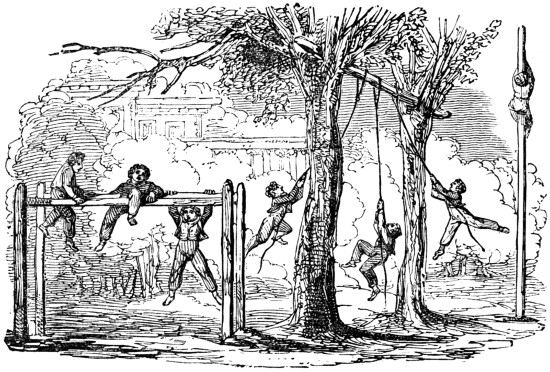
Gymnastics for Youth.
This engraving represents simple methods by which, at this season especially, the health of young persons may be maintained, and the constitution invigorated. Two round parallel bars at two feet distance from each other, on round standards three or four feet high, firmly fixed in the ground, will afford boys the means of actively exerting their limbs and muscles: and if the ends of a pole be let into opposite walls or fastened to trees, the boys may be taught to climb single ropes, and hold on while swinging by them. The engraving is placed before the eyes of parents and teachers with the hope of directing their attention to gymnastic exercises, as diversions for youth, and they are referred to a practical treatise on the subject by Mr. Clias, that may be safely used. His judicious reasoning must convince every reader of their importance to the rising generation, and that it is within the means of all classes of persons to let boys acquire a knowledge of the feats represented in the plates to his work, for teaching which his explanations are numerous and clear.
An unseasonable occurrence in the cellar of the late sir Joseph Banks may be acceptable in the mention, and excite particular sympathy in persons who recreate with the juice of the vine: as a fact, it may tend to elucidate the origin and nature of vegetable fungi, particularly of that species termed mushroom. The worthy baronet had a cask of wine rather too sweet for immediate use; he therefore directed that it should be placed in a cellar, in order that the saccharine matter it contained might be more perfectly decomposed by age. At the end of three years, he directed his butler to ascertain the state of the wine, when, on attempting to open the cellar door, he could not effect it, in consequence of some powerful obstacle. The door was cut down, and the cellar found to be completely filled with a firm fungous vegetable production—so firm that it was necessary to use the axe for its removal. This appeared to have grown from, or have been nourished by, the decomposed particles of the wine: the cask was empty, and carried up to the ceiling, where it was supported by the surface of the fungus.
At the close of this day he who can reflect with satisfaction on the past, may anticipate with calm delight the entrance of the new year, and lift his eyes to the living lustres of the firmament with grateful feelings. They shine out their prismatic colours through the cold thin air, keeping watch while man slumbers, or cheering him, who contemplates their fires, to purposes of virtue. In this season
—————— The night comes calmly forth, Bringing sweet rest upon the wings of even: The golden wain rolls round the silent north, And earth is slumbering ’neath the smiles of heaven.
Bowring.
January 2.
St. Macarius; St. Concordius; St. Adalard or Alard.
St. Macarius. A. D. 394. Alban Butler says he was a confectioner of Alexandria, who, in the flower of his age, spent upwards of sixty years in the deserts in labour, penance, and contemplation. “Our saint,” says Butler, “happened one day inadvertently to kill a gnat, that was biting him in his cell; reflecting that he had lost the opportunity of suffering that mortification, he hastened from his cell for the marshes of Scetè, which abound with great flies, whose stings pierce even wild boars. There he continued six months, exposed to those ravaging insects; and to such a degree was his whole body disfigured by them, with sores and swellings, that when he returned he was only to be known by his voice.” The Golden Legend relates of him, that he took a dead pagan out of his sepulchre, and put him under his head for a pillow; whereupon certain devils came to affright the saint, and called the dead pagan to go with them; but the body under the saint said he could not, because a pilgrim lay upon him, so that he could not move; then Macarius, nothing afraid, beat the body with his fist, and told him to go if he would, which caused the devils to declare that Macarius had vanquished them. Another time the devil came with a great scythe on his shoulder, to smite the saint, but he could not prevail against him, on account of his virtues. Macarius, at another time, being tempted, filled a sack with stones, and bore it many journies through the desert. Seeing a devil before him in the shape of a man, dressed like “a herawde,” with his clothing full of holes, and in every hole a phial, he demanded of this devil whither he went; and why he had so many phials? the devil answered, to give drink to the hermits; and that the phials contained a variety of liquors, that they might have a choice, and so fall into temptation. On the devil’s return, the saint inquired how he had sped; and the devil answered very evil, for they were so holy that only one Theodistus would drink: on this information Macarius found Theodistus under the influences of the phial, and recovered him. Macarius found the head of a pagan, and asked where the soul of its body was: in hell, said the head: he asked the head if hell was deep;—the head said deeper than from heaven to earth: he demanded again, if there were any there lower than his own soul—the head said the Jews were lower than he was: the saint inquired if there were any lower than the Jews—the head answered, the false Christian-men were lower than the Jews, and more tormented: there the dialogue between the saint and the head appears to have ended. Macarius seems, by the Golden Legend, to have been much annoyed by the devil. In a nine days’ journey through a desert, at the end of every mile he set up a reed in the earth, to mark his track against he returned; but the devil pulled them all up, made a bundle of them, and placed them at Macarius’s head, while he lay asleep, so that the saint with great difficulty found his way home again.
St. Adalard, according to Butler, was grandson of Charles Martel, brother to king Pepin, and cousin-german to Charlemagne, who created him a count: he left his court in 773, became a monk at Corbie in Picardy, died in 827, aged seventy-three, and wrought miracles, which procured his body to be enshrined with great pomp in 1010, a history of which solemnity is written by St. Gerard, who composed an office in St. Adalard’s honour, because through his intercession he had been cured of a violent head-ache.—The same St. Gerard relates seven other miracles by St. Adalard of the same nature. Butler says, his relics are still at Corbie, in a rich shrine, and two smaller cases, except a small portion given to the abbey of Chelles.
The first Monday after new year’s day is called Handsel Monday in some parts of Scotland, and is observed by merry-making. In sir J. Sinclair’s “Statistical Account,” it is related of one William Hunter, a collier, that he was cured in the year 1758 of an inveterate rheumatism or gout, by drinking freely of new ale, full of barm or yeast. “The poor man had been confined to his bed for a year and a half, having almost entirely lost the use of his limbs. On the evening of Handsel Monday, as it is called, some of his neighbours came to make merry with him. Though he could not rise, yet he always took his share of the ale, as it passed round the company; and, in the end, became much intoxicated. The consequence was, that he had the use of his limbs the next morning, and was able to walk about. He lived more than twenty years after this, and never had the smallest return of his old complaint.” This is a fact worth remembering, as connected with chronical complaints.
Chronology.
On the 2d of January, A. D. 17, Ovid the celebrated Roman poet died; he was born at Sulmo on the 20th of March, forty-three years before the Christian era. His father designed him for the bar, and he became eminently eloquent, but every thing he wrote was expressed in poetical numbers; and though reminded by his father, that even Homer lived and died in poverty, he preferred the pleasures of imagination to forensic disputation. He gained great admiration from the learned. Virgil, Horace, Tibullus, and Propertius, were his friends, and Augustus became his liberal patron, till he banished him for some unknown cause. In his exile he was cowardly, and prostituted his pen to flatter baseness; and though he desired the death of the emperor, he fawned upon him in his writings to meanness. He died at Tomos on the Euxine sea, the place of his banishment, under the reign of Tiberius, who had succeeded Augustus, and was deaf to the poet’s entreaties for permission to return to Rome. Whatever subject Ovid wrote on, he exhausted; he painted nature with a masterly hand, and his genius imparted elegance to vulgarity; but he defiled the sweetness of his numbers by impurity, and though he ranks among the splendid ornaments of ancient literature, he sullied his fame by the grossest immorality in some of his finest productions.
Livy, the Roman historian, died at Padua on the same day and in the same year with Ovid. His history of the Roman Empire was in one hundred and forty books, of which only thirty-five are extant. Five of these were discovered at Worms in 1431, and some fragments are said to have been lately discovered at Herculanæum. Few particulars of his life are known, but his fame was great even while he lived, and his history has rendered him immortal. He wrote some philosophical treatises and dialogues, with a letter to his son on the merit of authors, which Dr. Lempriere says, ought to be read by young men.
In the Literary Pocket Book there are some seasonable facts which may be transplanted with advantage to the reader, and, it is hoped, without disadvantage to the writer of the articles. He says that a man is infinitely mistaken, who thinks there is nothing worth seeing in winter-time out of doors, because the sun is not warm, and the streets are muddy. “Let him get, by dint of good exercise, out of the streets, and he shall find enough. In the warm neighbourhood of towns he may still watch the field-fares, thrushes, and blackbirds; the titmouse seeking its food through the straw-thatch; the red-wings, field-fares, sky-larks, and tit-larks, upon the same errand, over wet meadows; the sparrows and yellow-hammers, and chaffinches, still beautiful though mute, gleaning from the straw and chaff in farmyards; and the ring-dove, always poetical, coming for her meal to the ivy-berries. About rapid streams he may see the various habits and movements of herons, wood-cocks, wild-ducks, and other water-fowl, who are obliged to quit the frozen marshes to seek their food there. The red-breast comes to the windows, and often into the house itself, to be rewarded for its song, and for its far-famed ‘painful’ obsequies to the Children in the Wood.”
January 3.
St. Genevieve. St. Anterus, Pope. St. Gordius. St. Peter Balsam.
St. Genevieve, Patroness of Paris.
Alban Butler affirms that she was born in 422, at Nanterre, four miles from Paris, near the present Calvary there, and that she died a virgin on this day in 512, and was buried in 545, near the steps of the high altar in a magnificent church, dedicated to St. Peter and St. Paul, began by Clovis, where he also was interred. Her relics were afterwards taken up and put into a costly shrine about 630. Of course they worked miracles. Her shrine of gold and silver, covered with precious stones, the presents of kings and queens, and with a cluster of diamonds on the top, presented by the intriguing Mary de Medicis, is, on calamitous occasions, carried about Paris in procession, accompanied by shrines equally miraculous, and by the canons of St. Genevieve walking bare-foot.
The miracles of St. Genevieve, as related in the Golden Legend, were equally numerous and equally credible. It relates that when she was a child, St. Germaine said to her mother, “Know ye for certain that on the day of Genevieve’s nativity the angels sung with joy and gladness,” and looking on the ground he saw a penny signed with the cross, which came there by the will of God; he took it up, and gave it to Genevieve, requiring her to bear in mind that she was the spouse of Christ. She promised him accordingly, and often went to the minster, that she might be worthy of her espousals. “Then,” says the Legend, “the mother was angry, and smote her on the cheek—God avenged the child, so that the mother became blind,” and so remained for one and twenty months, when Genevieve fetched her some holy water, signed her with the sign of the cross, washed her eyes, and she recovered her sight. It further relates, that by the Holy Ghost she showed many people their secret thoughts, and that from fifteen years to fifty she fasted every day except Sunday and Thursday, when she ate beans, and barley-bread of three weeks old. Desiring to build a church, and dedicate it to St. Denis and other martyrs, she required materials of the priests for that purpose. “Dame,” answered the priests, “we would; but we can get no chalk nor lime.” She desired them to go to the bridge of Paris and bring what they found there. They did so till two swineherds came by, one of whom said to the other, “I went yesterday after one of my sows and found a bed of lime;” the other replied that he had also found one under the root of a tree that the wind had blown down. St. Genevieve’s priests of course inquired where these discoveries were made, and bearing the tidings to Genevieve the church of St. Denis was began. During its progress the workmen wanted drink, whereupon Genevieve called for a vessel, prayed over it, signed it with the cross, and the vessel was immediately filled; “so,” says the Legend, “the workmen drank their belly full,” and the vessel continued to be supplied in the same way with “drink” for the workmen till the church was finished. At another time a woman stole St. Genevieve’s shoes, but as soon as she got home lost her sight for the theft, and remained blind, till, having restored the shoes, St. Genevieve restored the woman’s sight. Desiring the liberation of certain prisoners condemned to death at Paris, she went thither and found the city gates were shut against her, but they opened without any other key than her own presence. She prayed over twelve men in that city possessed with devils, till the men were suspended in the air, and the devils were expelled. A child of four years old fell in a pit and was killed. St. Genevieve only covered her with her mantle and prayed over her, and the child came to life and was baptized at Easter. On a voyage to Spain she arrived at a port “where, as of custom, ships were wont to perish.” Her own vessel was likely to strike on a tree in the water, which seems to have caused the wrecks; she commanded the tree to be cut down, and began to pray; when lo, just as the tree began to fall, “two wild heads, grey and horrible, issued thereout, which stank so sore, that the people that were there were envenomed by the space of two hours, and never after perished ship there; thanks be to God and this holy saint.”
At Meaux, a master not forgiving his servant his faults though St. Genevieve prayed him, she prayed against him. He was immediately seized with a hot ague; “on the morrow he came to the holy virgin, running with open mouth like a German bear, his tongue hanging out like a boar, and requiring pardon.” She then blessed him, the fever left him, and the servant was pardoned. A girl going by with a bottle, St. Genevieve called to her, and asked what she carried, she answered oil, which she had bought; but St. Genevieve seeing the devil sitting on the bottle, blew upon it, and the bottle broke, but the saint blessed the oil, and caused her to bear it home safely notwithstanding. The Golden Legend says, that the people who saw this, marvelled that the saint could see the devil, and were greatly edified.
It was to be expected that a saint of such miraculous powers in her lifetime should possess them after her death, and accordingly the reputation of her relics is very high.
Several stories of St. Genevieve’s miraculous faculties, represent them as very convenient in vexatious cases of ordinary occurrence; one of these will serve as a specimen. On a dark wet night she was going to church with her maidens, with a candle borne before her, which the wind and rain put out; the saint merely called for the candle, and as soon as she took it in her hand it was lighted again, “without any fire of this world.”
Other stories of her lighting candles in this way, call to mind a candle, greatly venerated by E. Worsley in a “Discourse of Miracles wrought in the Roman Catholic Church, or, a full Refutation of Dr. Stillingfleet’s unjust Exceptions against Miracles,” octavo, 1676. At p. 64, he says, “that the miraculous wax candle, yet seen at Arras, the chief city of Artois, may give the reader entertainment, being most certain, and never doubted of by any. In 1105, that is, much above 569 years ago, (of so great antiquity the candle is,) a merciless plague reigned in Arras. The whole city, ever devout to the Mother of God, experienced her, in this their necessity, to be a true mother of mercy: the manner was thus. The Virgin Mary appeared to two men, and enjoined them to tell the bishop of Arras, that on the next Saturday towards morning she would appear in the great church, and put into his hands a wax candle burning; from whence drops of wax should fall into a vessel of water prepared by the bishop. She said, moreover, that all the diseased that drank of this water, should forthwith be cured. This truly promised, truly happened. Our blessed Lady appeared all beautiful, having in her hands a wax candle burning, which diffused light over the whole church; this she presented to the bishop; he, blessing it with the sign of the cross, set it in the urn of water; when drops of wax plentifully fell down into the vessel. The diseased drank of it, all were cured, the contagion ceased, and the candle to this day preserved with great veneration, spends itself, yet loses nothing; and therefore remains still of the same length and greatness it did 500 years ago. A vast quantity of wax, made up of the many drops which fall into the water upon those festival days, when the candle burns, may be justly called a standing, indeficient miracle.”
This candle story, though gravely related by a catholic writer, as “not doubted of by any,” and as therefore not to be doubted, miraculously failed in convincing the protestant Stillingfleet, that “miracles wrought in the Roman catholic church,” ought to be believed.
Chronology.
1639. A manuscript entitled “Commentaries of the Civil Wars, from 1638 to 1648,” written by Sir Henry Slingsby, bart., a royalist, intimates the struggle, then approaching, between Charles I. and the nation. He says, “The 3d of January, 1639, I went to Bramham-house, out of curiosity, to see the training of the light-horse, for which service I had sent two horses, by commandment of the lieutenant and sir Joseph Ashley, who is lately come down, with special commission from the king to train and exercise them. These are strange spectacles to this nation in this age, that has lived thus long peaceably, without noise of drum or of shot, and after we have stood neuter, and in peace, when all the world besides hath been in arms.” The “training” was preparatory to the war with the Scots, the resistance of the commons in parliament, and its levies of troops to oppose the royal will.
“The armourers ———— With busy hammers closing rivets up Gave dreadful note of preparation.”
The conflict ended in the death of Charles on the scaffold, the interregnum, the restoration, and the final expulsion of the Stuart race.
January 4.
St. Titus, disciple of St. Paul. St. Gregory, bishop of Langres. St. Rigobert or Robert. St. Rumon.
St. Rumon.
Alban Butler informs us, from William of Malmsbury, that he was a bishop, though of what nation or see is unknown, and that his name is in the English martyrology. Cressy says, that his body was buried at Tavistock, where, about 960, Ordgar, count of Devonshire, father to Elfrida, the second wife of king Edgar, built a monastery “very agreeable and pleasant, by reason of the great variety of woods, pastures, and rivers abounding with fish.” St. Rumon consecrated the church. About thirty years afterwards, the monastery was destroyed and burnt by the Danes. It is memorable, that Edulf, a son of Ordgar, buried in that monastery, was a man of gigantic stature, and of such wonderful strength, that going to Exeter, and finding the gates shut and barred, he broke the outer iron bars with his hands, burst open the gates with his foot, tore the locks and bolts asunder, and broke down part of the wall.
Chronology.
1568. On the 4th of January Roger Ascham died, and was buried at St. Sepulchre’s church, London. He was born in Yorkshire about 1515, and is celebrated for his learning, for having been tutor and Latin secretary to queen Elizabeth, and for having written “the Scholemaster.” This work originated from mention having been made at dinner that some Eton scholars “had run away from school for fear of beating.” Ascham expressed his opinion that “young children were sooner allured by love, than driven by beating, to attain good learning.” He then retired up stairs “to read with the queen’s majesty: we read then together that noble oration of Demosthenes against Æschines, for his false dealing in his embassy to king Philip of Macedon; sir Richard Sackville came up soon after.” Sackville took Ascham aside, “A fond (silly) schoolmaster,” said sir Richard, “before I was fully fourteen years old, drove me so, with fear of beating, from all love of learning, as now, when I know what difference it is to have learning, and to have little, or none at all, I feel it my greatest grief, and find it my greatest hurt, that ever came to me, that it was so my ill chance, to light upon so lewd (ignorant) a schoolmaster.” The whole conversation was very interesting, and so impressed Ascham with its importance, that he says, he “thought to prepare some little treatise for a new-year’s gift that Christmas,” but it grew beneath his hands and became his “Scholemaster, showing a plain and perfect way of teaching the learned languages.” The best edition of this work, which Ascham did not live to publish, is that edited by the Rev. James Upton, 1743, octavo. The book was first printed by Ascham’s widow, whom with her children he left in distress. It was eminently serviceable to the advancement of teachers and pupils, at a period when it was the fashion to flog. Its most remarkable feature is the frowning down of this brutal practice, which, to the disgrace of our own times, is still heard of in certain seminaries, both public and private. The good old man says, “Beat a child if he dance not well, and cherish him though he learn not well, ye shall have him unwilling to go to dance, and glad to go to his book: knock him always when he draweth his shaft ill, and favour him again though he fault at his book, ye shall have him very loth to be in the field, and very willing to go to school.” He observes, “If ever the nature of man be given at any time, more than another, to receive goodness, it is in innocency of young years before that experience of evil have taken root in him. For the pure, clean wit of a sweet young babe, is like the newest wax, most able to receive the best and fairest printing; and like a new bright silver dish never occupied, to receive and keep clean any good thing that is put into it. Therefore, to love or to hate, to like or contemn, to ply this way or that way, to good or to bad, ye shall have as ye use a child in his youth.” He exemplifies this by a delightful anecdote of the young, beautiful, and accomplished lady Jane Grey, who shortly afterwards perished by the axe of the executioner. Ascham, before he went into Germany, visited Broadgate in Leicestershire, to take leave of her. “Her parents, the duke and duchess, with all the household, gentlemen and gentlewomen, were hunting in the park. I found her,” says Ascham, “in her chamber, reading Phædo Platonis in Greek, and that with as much delight, as some gentlemen would read a merry tale in Boccace. After salutation, and duty done, with some other talk, I asked her, why she would lose such pastime in the park? Smiling, she answered me:
“‘I wist, all their sport in the park is but a shadow to that pleasure that I find in Plato. Alas! good-folk, they never felt what true pleasure meant.’
“‘And how came you, madam,’ quoth I, ‘to this deep knowledge of pleasure? And what did chiefly allure you unto it, seeing not many women, but very few men, have attained thereunto?’
“‘I will tell you,’ quoth she, ‘and tell you a truth, which perchance you will marvel at. One of the greatest benefits that ever God gave me, is, that he sent me so sharp and severe parents, and so gentle a schoolmaster. For when I am in presence either of father or mother, whether I speak, keep silence, sit, stand, or go, eat, drink, be merry, or sad, be sewing, playing, dancing, or doing any thing else, I must do it, as it were, in such weight, measure, and number, even so perfectly, as God made the world; or else I am so sharply taunted, so cruelly threatened, yea presently sometimes with pinches, nips, and bobs, and other ways (which I will not name for the honour I bear them) so without measure misordered, that I think myself in hell, till time come that I must go to Mr. Elmer; who teacheth me so gently, so pleasantly, with such fair allurements to learning, that I think all the time nothing, while I am with him: and when I am called from him, I fall on weeping, because whatsoever I do else, but learning, is full of grief, trouble, fear, and whole misliking unto me: and thus my book hath been so much my pleasure and bringeth daily to me more pleasure and more, that in respect of it, all other pleasures in very deed, be but trifles and troubles unto me.’”
Surely this innocent creature’s confession, that she was won to the love of learning and her teacher by his gentleness, and the disclosure of her affliction under the severe discipline of her parents, are positive testimony to the fact, that our children are to be governed and taught by the law of kindness: nor let it detract from the force of the remark, that in connection with her artless feelings and blameless deportment, if her hard fate call forth a versified effusion.
INSCRIBED BENEATH A PORTRAIT OF LADY JANE GREY. Original.
Young, beautiful, and learned Jane, intent On knowledge, found it peace; her vast acquirement Of goodness was her fall; she was content With dulcet pleasures, such as calm retirement Yields to the wise alone;—her only vice Was virtue: in obedience to her sire And lord she died, with them, a sacrifice To their ambition: her own mild desire Was rather to be happy than be great; For though at their request she claimed the crown, That they, through her, might rise to rule the state, Yet, the bright diadem, and gorgeous throne, She view’d as cares, dimming the dignity Of her unsullied mind, and pure benignity.
*
1815. On the 4th of January, died Alexander Macdonald, Esq., who is no other way remarkable, than for a chivalrous devotion to the family of Stuart. He raised a monument in the vale of Glenfinnyn, at the head of Lochshiel, in the county of Inverness, with a Latin, Gaelic, and English inscription, to commemorate the last open efforts of that family, for the recovery of a crown they had forfeited by innumerable breaches of the laws, and whose aggressions on life and property being suffered, till
“Non-resistance could no further go,”
they were excluded from the throne of the people, by the aristocracy and commonalty of England in parliament assembled. As evidence of the spirit that dictated such a memorial, and of the proper feeling which permits that spirit to be expressed, in spite of its hostility to the principles that deposited and continued the diadem of the commonwealth in the custody of the house of Hanover, the inscription on the monument is placed in the next column. It stands in English in these words:
On the spot where PRINCE CHARLES EDWARD First raised his Standard, On the 19th day of August, MDCCXLV, When he made the daring and romantic attempt To recover a Throne lost by the imprudence of his Ancestors, This Column was erected by ALEXANDER MACDONALD, Esq., of Glenaladale, To commemorate the generous zeal, Undaunted bravery, and the inviolable fidelity, Of his forefathers, and the rest of those Who fought and bled in that Arduous and unfortunate enterprise. This Pillar is now, Alas! Also become the Monument Of its amiable and accomplished Founder, Who, Before it was finished, Died in Edinburgh on the 4th day of January, MDCCCXV.
The “right line” of the Stuart race terminated in the late cardinal York. He was the second son of “the Pretender,” and was born at Rome on the 26th of March 1725; where he was baptized by the name of Henry Benedict Maria Clemens: he died there in 1807, in the 83d year of his age. In 1745 he went to France to head an army of fifteen thousand men, assembled at Dunkirk for the invasion of England. The battle of Culloden settled “the arduous and unfortunate enterprise,” which the “amiable and accomplished founder” of the monument commemorates, and not a single transport left Dunkirk roads. As soon as Henry Benedict heard of the affair at Culloden, he returned to Rome, entered into priest’s orders, and in 1747 was made a cardinal by pope Benedict XIV. It was taunted by a former pope upon James II. that he “lost his kingdom for a mass;” and it is certain that Henry Benedict was better qualified to take a red-hat and pull on and off red stockings, than to attempt the conquest of a free protestant nation.
After the expulsion of pope Pius VI. from “the chair of St. Peter,” by the French, he fled from his splendid residences at Rome and Frascati to Venice, infirm in health, distressed in circumstances, and at the age of seventy-five. He subsisted for awhile on the produce of some silver plate, which he had saved from the ruin of his property. By the friendly interference of sir John Cox Hippisley, the cardinal’s situation was made known to his late majesty, and lord Minto had orders to remit him a present of 2000l., which he received in February 1800, with an intimation that he might draw for the same amount in the July following; and sir J. C. Hippisley communicated to him, that an annuity of 4000l. would be at his service, so long as his circumstances might require it. This liberality was received and acknowledged by the cardinal in terms of gratitude, and made a considerable impression on the reigning pope and his court. These facts are extracted from the Gentleman’s Magazine, (vols. 74 and 77,) which also observes, that “from the time he devoted himself to ecclesiastical functions he seemed to have laid aside all worldly views, till his father’s death in 1788, when he had medals struck, bearing on their face his head, with ‘Henricus nonus Angliæ Rex;’ on the reverse, a city, with ‘Gratia Dei, sed non Voluntate Hominum:’ if we are not misinformed, our sovereign has one of these medals.” From one in the possession of the compiler of this work, he is enabled to present an engraving of it to his readers.
HENRY IX. KING OF ENGLAND.

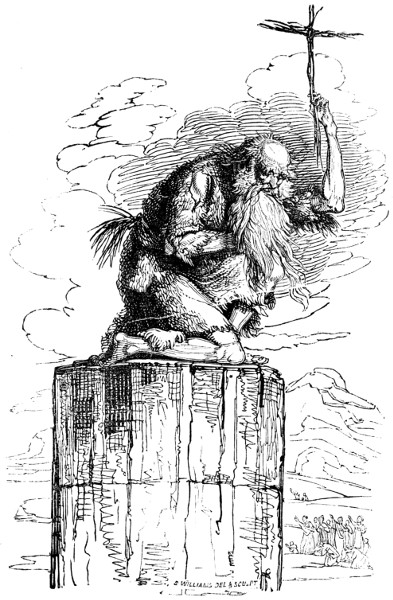
ST. SIMEON STYLITES, HERMIT OF THE PILLAR
January 5.
St. Simeon Stylites. St. Telesphorus. St. Syncletia.
St. Simeon Stylites.
Alban Butler declares, that St. Simeon astonished the whole Roman empire by his mortifications. In the monastery of Heliodorus, a man sixty-five years of age, who had spent sixty-two years so abstracted from the world, that he was ignorant of the most obvious things in it; the monks ate but once a day: Simeon joined the community, and ate but once a week. Heliodorus required Simeon to be more private in his mortifications; “with this view,” says Butler, “judging the rough rope of the well, made of twisted palm-tree leaves, a proper instrument of penance, Simeon tied it close about his naked body, where it remained unknown both to the community and his superior, till such time as it having ate into his flesh, what he had privately done was discovered by the effluvia proceeding from the wound.” Butler says, that it took three days to disengage the saint’s clothes, and that “the incisions of the physician, to cut the cord out of his body, were attended with such anguish and pain, that he lay for some time as dead.” After this he determined to pass the whole forty days of Lent in total abstinence, and retired to a hermitage for that purpose. Bassus, an abbot, left with him ten loaves and water, and coming to visit him at the end of the forty days, found both loaves and water untouched, and the saint stretched on the ground without signs of life. Bassus dipped a sponge in water, moistened his lips, gave him the eucharist, and Simeon by degrees swallowed a few lettuce leaves and other herbs. He passed twenty-six Lents in the same manner. In the first part of a Lent he prayed standing; growing weaker he prayed sitting; and towards the end, being almost exhausted, he prayed lying on the ground. At the end of three years he left his hermitage for the top of a mountain, made an enclosure of loose stones, without a roof, and having resolved to live exposed to the inclemencies of the weather, he fixed his resolution by fastening his right leg to a rock with a great iron chain. Multitudes thronged to the mountain to receive his benediction, and many of the sick recovered their health; but as some were not satisfied unless they touched him in his enclosure, and Simeon desired retirement from the daily concourse, he projected a new and unprecedented manner of life. He erected a pillar six cubits high, (each cubit being eighteen inches,) and dwelt on it four years; on a second of twelve cubits high he lived three years; on a third of twenty-two cubits high ten years; and on a fourth of forty cubits, or sixty feet high, which the people built for him, he spent the last twenty years of his life. This occasioned him to be called stylites, from the Greek word stylos, a pillar. This pillar did not exceed three feet in diameter at the top, so that he could not lie extended on it: he had no seat with him; he only stooped or leaned to take a little rest, and bowed his body in prayer so often, that a certain person who counted these positions, found that he made one thousand two hundred and forty-four reverences in one day, which if he began at four o’clock in the morning and finished at eight o’clock at night, gives a bow to every three-quarters of a minute; besides which he exhorted the people twice a day. His garments were the skins of beasts, he wore an iron collar round his neck, and had a horrible ulcer in his foot. During his forty days’ abstinence throughout Lent, he tied himself to a pole. He treated himself as the outcast of the world and the worst of sinners, worked miracles, delivered prophecies, had the sacrament delivered to him on the pillar, and died bowing upon it, in the sixty-ninth of his age, after having lived upon pillars for six and thirty years. His corpse was carried to Antioch attended by the bishops and the whole country, and worked miracles on its way. So far this account is from Alban Butler.
Without mentioning circumstances and miracles in the Golden Legend, which are too numerous, and some not fit to be related, it may be observed that it is there affirmed of him, that after his residence on the pillars, one of his thighs rotted a whole year, during which time he stood on one leg only. Near Simeon’s pillar was the dwelling of a dragon, so very venomous, that nothing grew near his cave. This dragon met with an accident; he had a stake in his eye, and coming all blind to the saint’s pillar, and placing his eye upon it for three days without doing harm to any one, Simeon ordered earth and water to be placed on the dragon’s eye, which being done, out came the stake, a cubit in length; when the people saw this miracle, they glorified God, and ran away for fear of the dragon, who arose and adored for two hours, and returned to his cave. A woman swallowed a little serpent, which tormented her for many years, till she came to Simeon, who causing earth and water to be laid on her mouth, the little serpent came out four feet and a half long. It is affirmed by the Golden Legend, that when Simeon died, Anthony smelt a precious odour proceeding from his body; that the birds cried so much, that both men and beasts cried; that an angel came down in a cloud that the patriarch of Antioch taking Simeon’s beard to put among his relics, his hand withered, and remained so till multitudes of prayers were said for him, and it was healed: and that more miracles were worked at and after Simeon’s sepulture, than he had wrought all his life.
LONGEVITY.
1724. Jan. 5. An extraordinary instance of longevity is contained in a letter dated the 29th of January, 1724, from M. Hamelbranix, the Dutch envoy at Vienna, to their high mightinesses the states general, and published in a Dutch dictionary, “Het Algemeen historisch, geographisch en genealogisch Woordenboek,” by Luiscius. It relates to an individual who had attained the extraordinary age of one hundred and eighty-five years.
“Czartan Petrarch, by religion a Greek, was born in the year 1539, and died on the 5th of January, 1724, at Kofrosch, a village four miles from Temeswar, on the road leading to Karansebes. He had lived, therefore, a hundred and eighty-five years. At the time when the Turks took Temeswar from the Christians, he was employed in keeping his father’s cattle. A few days before his death he had walked, with the help of a stick, to the post-house at Kofrosch, to ask charity from the travellers. His eyes were much inflamed, but he still enjoyed a little sight. His hair and beard were of a greenish, white colour, like mouldy bread; and he had a few of his teeth remaining. His son, who was ninety-seven years of age, declared his father had once been the head taller; that at a great age he married for the third time; and that he was born in this last marriage. He was accustomed, agreeably to the rules of his religion, to observe fast days with great strictness, and never to use any other food than milk, and certain cakes, called by the Hungarians kollatschen, together with a good glass of brandy, such as is made in the country. He had descendants in the fifth generation, with whom he sometimes sported, carrying them in his arms. His son, though ninety-seven, was still fresh and vigorous. When field marshal count Wallis, the commandant of Temeswar, heard that this old man was taken sick, he caused a portrait of him to be painted, and when it was almost finished he expired.”
1808. Early in January, this year, the shaft of death supplied another case of longevity. At the advanced age of 110 years, died Dennis Hampson, the blind bard of Maggiligan, of whom an interesting account has been given by lady Morgan, in “The Wild Irish Girl.” The “Athenæum,” from whence this notice is extracted, relates, that only a few hours before his decease he tuned his harp, that he might have it in readiness to entertain sir H. Bruce’s family, who were expected to pass that way in a few days, and who were in the habit of stopping to hear his music; suddenly, however, he felt the approach of death, and calling his family around him resigned his breath without a struggle, and in perfect possession of his faculties to the last moment. A kindred spirit produced the following tribute to the memory of this “aged son of song.” He was the oldest of the Irish bards.
The fame of the brave shall no longer be sounded, The last of our bards now sleeps cold in his grave; Maggiligan rocks, where his lays have resounded, Frown dark at the ocean, and spurn at the wave. For, Hampson, no more shall thy soul-touching finger Steal sweet o’er the strings, and wild melody pour; No more near thy hut shall the villagers linger, While strains from thy harp warble soft round the shore. No more thy harp swells with enraptured emotion, Thy wild gleams of fancy for ever are fled, No longer thy minstrelsy charms this rude ocean, That rolls near the green turf that pillows thy head. Yet vigour and youth with bright visions had fired thee, And rose-buds of health have blown deep on thy cheek; The songs of the sweet bards of Erin inspired thee, And urged thee to wander like laurels to seek. Yes, oft hast thou sung of our kings crown’d with glory, Or, sighing, repeated the lover’s fond lay; And oft hast thou sung of the bards famed in story, Whose wild notes of rapture have long past away. Thy grave shall be screen’d from the blast and the billow, Around it a fence shall posterity raise; Erin’s children shall wet with their tears thy cold pillow, Her youths shall lament thee, and carol thy praise.
This is the eve of the Epiphany, or Twelfth-night eve, and is a night of preparation in some parts of England for the merriments which, to the present hour, distinguish Twelfth-day. Dr. Drake mentions that it was a practice formerly for itinerant minstrels to bear a bowl of spiced-wine to the houses of the gentry and others, from whom they expected a hospitable reception, and, calling their bowl a wassail-bowl, to drink wassail to their entertainers. These merry sounds of mirth and music are not extinct. There are still places wherein the wandering blower of a clarionet, and the poor scraper of as poor a fiddle, will this evening strain their instruments, to charm forth the rustic from his dwelling, and drink to him from a jug of warm ale, spiced with a race of ginger, in the hope of a pittance for their melody, and their wish of wassail. Of the wassail-bowl, much will appear before the reader in the after pages of this work.
In certain parts of Devonshire, the farmer, attended by his workmen, with a large pitcher of cider, goes to the orchard this evening; and there, encircling one of the best bearing trees, they drink the following toast three times:
“Here’s to thee, old apple-tree, hence thou mayst bud, and whence thou mayst blow! And whence thou mayst bear apples enow! Hats full! caps full! Bushel—bushel—sacks full, And my pockets full too! Huzza!”
This done, they return to the house, the doors of which they are sure to find bolted by the females, who, be the weather what it may, are inexorable to all entreaties to open them till some one has guessed at what is on the spit, which is generally some nice little thing, difficult to be hit on, and is the reward of him who first names it. The doors are then thrown open, and the lucky clodpole receives the tit-bit as his recompense. Some are so superstitious as to believe, that if they neglect this custom, the trees will bear no apples that year. To the preceding particulars, which are related in the Gentleman’s Magazine for 1791, may be added that Brand, on the authority of a Cornishman, relates it as a custom with the Devonshire people to go after supper into the orchard, with a large milk-pan full of cider, having roasted apples pressed into it. “Out of this each person in company takes, what is called a clayen cup, that is an earthenware cup full of liquor, and standing under each of the more fruitful apple-trees, passing by those that are not good bearers, he addresses it in the following words:
‘Health to thee, good apple-tree, Well to bear, pocket-fulls, hat-fulls, Peck-fulls, bushel-bag-fulls!’
And then drinking up part of the contents, he throws the rest, with the fragments of the roasted apples, at the tree. At each cup the company set up a shout.”
Pennant, in his tour in Scotland, says respecting this custom, that after they have drank a cheerful glass to their master’s health, with success to the future harvests, and expressed their good wishes in the same way, they feast off cakes made of caraways and other seeds soaked in cider, which they claim as a reward for their past labours in sowing the grain. “This,” says Pennant, “seems to resemble a custom of the ancient Danes, who, in their addresses to their rural deities emptied, on every invocation, a cup in honour of them.”
So also Brand tells us that, in Herefordshire, “at the approach of evening on the vigil of the twelfth day, the farmers, with their friends and servants, meet together, and about six o’clock walk out to a field where wheat is growing. In the highest part of the ground, twelve small fires and one large one are lighted up. The attendants, headed by the master of the family, pledge the company in old cider, which circulates freely on these occasions. A circle is formed round the large fire, when a general shout and hallooing takes place, which you hear answered from all the adjacent villages and fields. Sometimes fifty or sixty of these fires may be all seen at once. This being finished, the company return home, where the good housewife and her maids are preparing a good supper. A large cake is always provided, with a hole in the middle. After supper, the company all attend the bailiff (or head of the oxen) to the wain-house, where the following particulars are observed. The master, at the head of his friends, fills the cup, (generally of strong ale,) and stands opposite the first or finest of the oxen. He then pledges him in a curious toast: the company follow his example with all the other oxen, addressing each by his name. This being finished, the large cake is produced, and, with much ceremony, put on the horn of the first ox, through the hole above-mentioned. The ox is then tickled, to make him toss his head: if he throw the cake behind, then it is the mistress’s perquisite; if before, (in what is termed the boosy,) the bailiff himself claims the prize. The company then return to the house, the doors of which they find locked, nor will they be opened till some joyous songs are sung. On their gaining admittance, a scene of mirth and jollity ensues, and which lasts the greatest part of the night.”
Mr. Beckwith relates in the Gentleman’s Magazine, 1784, that “near Leeds, in Yorkshire, when he was a boy, it was customary for many families, on the twelfth eve of Christmas, to invite their relations, friends, and neighbours, to their houses, to play at cards, and to partake of a supper, of which minced pies were an indispensable ingredient; and after supper was brought in, the wassail cup or wassail bowl, of which every one partook, by taking with a spoon, out of the ale, a roasted apple, and eating it, and then drinking the healths of the company out of the bowl, wishing them a merry Christmas and a happy new year. (The festival of Christmas used in this part of the country to hold for twenty days, and some persons extended it to Candlemas.) The ingredients put into the bowl, viz. ale, sugar, nutmeg, and roasted apples, were usually called lambs’-wool, and the night on which it is used to be drunk (generally on the twelfth eve) was commonly called Wassil eve.” The glossary to the Exmore dialect has “Watsail—a drinking song on twelfth-day eve, throwing toast to the apple-trees, in order to have a fruitful year, which seems to be a relic of the heathen sacrifice to Pomona.”
Brand found it observed in the ancient calendar of the Romish church, that on the fifth day of January, the eve or vigil of the Epiphany, there were “kings created or elected by beans;” that the sixth of the month is called “The Festival of Kings;” and “that this ceremony of electing kings was continued with feasting for many days.”
Twelfth-night eve or the vigil of the Epiphany is no way observed in London. There Twelfth-day itself comes with little of the pleasure that it offered to our forefathers. Such observances have rapidly disappeared, and the few that remain are still more rapidly declining. To those who are unacquainted with their origin they afford no associations to connect the present with former ages; and without such feelings, the few occasions which enable us to show a hospitable disposition, or from whence we can obtain unconstrained cheerfulness, will pass away, and be remembered only as having been.
January 6.
Epiphany. {
Close holiday at all Public offices except Stamp, Customs, and Excise.
St. Melanius. St. Peter. St. Nilammon.
St. Peter was a disciple of Gregory the Great, the first abbot of St. Augustine’s monastery at Canterbury, and drowned in 608 while proceeding on a voyage to France. According to Cressy, the inhabitants buried his body without knowing any thing about him, till “a heavenly light appeared every night over his sepulture,” when they held an inquest, and a count Fumert buried him in the church of Boulogne. From a quotation in Patrick, it appears that a weasel who gnawed his robe was found dead upon it for his sauciness.
EPIPHANY.
The Rev Thomas Dudley Fosbroke, M. A. F. A. S., &c. whose “Encyclopædia of Antiquities” has been already cited from, is the author of “British Monachism, or, Manners and Customs of the Monks and Nuns of England,” 4to. 1817; a most erudite work, wherein he gives an account, from Du Cange, of the Feast of the Star, or Office of the Three Kings, a catholic service performed on this day. “Three priests, clothed as kings, with their servants carrying offerings, met from different directions of the church before the altar. The middle one, who came from the east, pointed with his staff to a star: a dialogue then ensued; and after kissing each other, they began to sing, ‘Let us go and inquire;’ after which the precentor began a responsory, ‘Let the Magi come.’ A procession then commenced, and as soon as it began to enter the nave, a crown like a star, hanging before the cross, was lighted up, and pointed out to the Magi, with ‘Behold the star in the east.’ This being concluded, two priests, standing at each side of the altar, answered, meekly, ‘We are those whom you seek,’ and drawing a curtain showed them a child, whom, falling down, they worshipped. Then the servants made the offerings of gold, frankincense, and myrrh, which were divided among the priests. The Magi in the mean while continued praying till they dropped asleep; when a boy clothed in an alb, like an angel, addressed them with, ‘All things which the prophets said are fulfilled.’ The festival concluded with chanting services, &c.”
Mr. Fosbroke adds, that at Soissons a rope was let down from the roof of the church, to which was annexed an iron circle, having seven tapers, intended to represent Lucifer, or the morning star.
The three persons honoured by this service, and called kings, were the three wise men who, in catholic works, are usually denominated the Three Kings of Cologne. Cressy tells us, that the empress Helena, who died about the year 328, brought their bodies from the east to Constantinople; from whence they were transferred to Milan, and afterwards, in 1164, on Milan being taken by the emperor Frederick, presented by him to the archbishop of Cologne, who put them in the principal church of that city, “in which place,” says Cressy, “they are to this day celebrated with great veneration.” Patrick quotes a prayer to them from the Romish service, beginning “O, king Jaspar, king Melchior, king Balthasar;” and he says that the Salisbury Missal states their offerings to have been disposed of in this way:—“Joseph kept of the gold as much as him needed, to pay his tribute to the emperor, and also to keep our lady with while she lay in childbed, and the rest he gave to the poor. The incense he burnt to take off the stench of the stable there as she lay in; and with the myrrh, our lady anointed her child, to keep him from worms and disease.” Patrick makes several observations on the service to these three kings of Cologne, and as to the credibility of their story; and he inquires what good this prayer will do to Jaspar, Melchior, and Balthasar, when another tradition says their names were Apellius, Amerus, and Damascus; a third, that they were Magalath, Galgalath, and Sarasin; and a fourth, Ator, Sator, and Peratoras; which last, Patrick says, he should choose in this uncertainty to call them by, as having the more kingly sound, if it had not been that Casaubon represents these three, “together with Misael, Achael, Cyriacus, and Stephanus, (the names of the four shepherds that came to visit our Lord in Bethlehem,) had been used (and he tells how) for a charm to cure the biting of serpents and other venomous beasts.” Patrick gives other prayers to these three kings, one of them from the “Hours of the Virgin,” and also quotes this miraculous anecdote; that one John Aprilius, when he was hanged, implored the patronage of the three kings of Cologne; the consequence of which seems to have been, that after he had been hung three days and was cut down, he was found alive; whereupon he came to Cologne half naked, with his halter about his neck, and returned thanks to his deliverers.