DECEMBER.
Reading edition
And after him came next the chill December; Yet he, through merry feasting which he made And great bonfires, did not the cold remember; His Saviour’s birth so much his mind did glad. Upon a shaggy bearded goat he rode, The same wherewith Dan Jove in tender years, They say was nourisht by the Idæan mayd; And in his hand a broad deepe bowle he beares, Of which he freely drinks an health to all his peers.
Spenser.
This is the twelfth and last month of the year. By our ancestors “December hath his due appellation given him in the name of winter-monat, to wit, winter-cometh; but after the Saxons received Christianity, they then, of devotion to the birth-time of Christ, termed it by the name of heligh-monat, that is to say, holy-cometh.”[401] They also called it midwinter-monath and guil erra, which means the former or first giul. The feast of Thor, which was celebrated at the winter solstice, was called giul from iol, or ol, which signified ale, and is now corrupted into yule. This festival appears to have been continued through part of January.[402]
Our pleasant guide to “The Months,” Mr. Leigh Hunt, says of December thus:—
It is now complete winter. The vapourish and cloudy atmosphere wraps us about with dimness and chilliness; the reptiles and other creatures that sleep or hide during the cold weather, have all retired to their winter quarters; the farmer does little or nothing out of doors; the fields are too damp and miry to pass, except in sudden frosts, which begin to occur at the end of the month; and the trees look but like skeletons of what they were—
Bare ruined choirs in which the sweet birds sang.
Shakspeare.
The evergreen trees with their beautiful cones, such as firs and pines, are now particularly observed and valued. In the warmer countries, where shade is more desirable, their worth and beauty are more regularly appreciated. Virgil talks of the pine as being handsomest in gardens; and it is a great favourite with Theocritus, especially for the fine sound of the air under its kind of vaulted roof.
But we have flowers as well as leaves in winter-time; besides a few of last month, there are the aconite and hellebore, two names of very different celebrity; and in addition to some of the flourishing shrubs, there is the Glastonbury thorn, which puts forth its beauty at Christmas. It is so called, we believe, because the abbots of the famous monastery at that place first had it in their garden from abroad, and turned its seasonable efflorescence into a miracle.
The evergreens and winter flowers are like real friends, who, whatever be their peculiar disposition, whether serious or gay, will never forsake us. Even roses, with which we are so apt to associate summer weather, flourish from May to December inclusive; and during the winter months will live and prosper in apartments. We need never be without them from the first day of the year to the last; and thus, to the numerous comparisons made between roses and the fair sex, may be added this new one, as complimentary to their friendship as it is true.
We have anticipated our general observations on winter-time in our remarks at the beginning of the year. December is in general too early a month for the fine manly exercise of skating, which indeed can be taken but rarely, on account of our changeful weather and the short continuance of frost. Like swimming, all the difficulty of it is in the commencement, at least for the purposes of enjoyment. The graces of outside strokes, and spread eagles, are the work of time and ambition.
But December has one circumstance in it, which turns it into the merriest month of the year,—Christmas. This is the holiday, which, for obvious reasons, may be said to have survived all the others; but still it is not kept with any thing like the vigour, perseverance, and elegance of our ancestors. They not only ran Christmas-day, new-year’s-day, and twelfth-night, all into one, but kept the wassail-bowl floating the whole time, and earned their right to enjoy it by all sorts of active pastimes. The wassail-bowl, (as some of our readers may know by experience, for it has been a little revived of late,) is a composition of spiced wine or ale, with roasted apples put into it, and sometimes eggs. They also adorned their houses with green boughs, which it appears, from Herrick, was a practice with many throughout the year,—box succeeding at Candlemas to the holly, bay, rosemary, and misletoe of Christmas,—yew at Easter to box,—birch and flowers at Whitsuntide to yew,—and then bents and oaken boughs. The whole nation were in as happy a ferment at Christmas, with the warmth of exercise and their firesides, as they were in May with the new sunshine. The peasants wrestled and sported on the town-green, and told tales of an evening; the gentry feasted then, or had music and other elegant pastimes; the court had the poetical and princely entertainment of masques; and all sung, danced, revelled, and enjoyed themselves, and so welcomed the new year like happy and grateful subjects of nature.
This is the way to turn winter to summer, and make the world what heaven has enabled it to be; but as people in general manage it, they might as well turn summer itself to winter. Hear what a poet says, who carries his own sunshine about with him:—
As for those chilly orbs, on the verge of creation Where sunshine and smiles must be equally rare Did they want a supply of cold hearts for that station, Heaven knows we have plenty on earth we could spare. Oh, think what a world we should have of it here, If the haters of peace, of affection, and glee, Were to fly up to Saturn’s comfortless sphere, And leave earth to such spirits as you, love, and me.
Moore.
Nor is it only on holidays that nature tells us to enjoy ourselves. If we were wise, we should earn a reasonable portion of leisure and enjoyment day by day, instead of resolving to do it some day or other, and seldom doing it at all. Company is not necessary for it, at intervals, except that best and most necessary company of one’s family-partners in life, or some one or two especial friends, truly so called, who are friends for every sort of weather, winter as well as summer. A warm carpet and curtains, a sparkling fire, a book, a little music, a happy sympathy of talk or a kind of discussion, may then call to mind with unenvying placidity the very rarest luxuries of the summer-time; and instead of being eternally and foolishly told, that pleasures produce pains, by those who really make them do so with their profligacy or bigotry, we shall learn the finer and manlier knowledge—how to turn pain to the production of pleasure.
Lawrence, of virtuous father, virtuous son, Now that the fields are dank and ways are mire, Where shall we sometimes meet, and by the fire Help waste a sullen day, what may be won From the hard season gaining? Time will run On smoother, till Favonius re-inspire The frozen earth, and clothe in fresh attire The lily and rose, which neither sowed nor spun. What neat repast shall feast us, light and choice, Of Attick taste, with wine, whence we may rise To hear the lute well touched, or artful voice Warble immortal notes and Tuscan air? He who of these delights can judge, and spare To interpose them oft, is not unwise.
Milton.
December 1.
St. Eligius, or Eloy, Bp. of Noyon. A. D. 659.
The Season.
It is observed by Dr. Forster in the “Perennial Calendar,” that the weather at this time is usually mild, and wet, with fogs; we have an occasional interchange of frosts. On some occasions a kind of weather occurs now which occasionally happens during all the winter months. The air becomes perfectly calm, the sky clouded and dark, without much mist below, the ground gets dry, and not a leaf stirs on the trees, and the sounds of distant bells, and other sounds and noises are heard at a great distance, just as they are on other occasions before rain. The thermometer is often from 45° to 52°. The barometer rises to “set fair” and remains steady, and the current of smoke from the chimnies either goes straight upright into the air in a vertical column, or inclines so little with the breath of air as to indicate sometimes one wind and sometimes another. At this time the crowing of the cocks, the noise of busy rooks and daws, which feed in flocks in the meadows, and fly at morning and eventide in flocks to and from their nests, the music of distant singing, and the strokes of the church clocks and chimes are heard for miles, as if carried along under the apparent sounding board of the clouds above. Even the voices of persons are heard at a vast distance, all being hushed around.
FLORAL DIRECTORY.
Dark Stapelia. Stapelia pulla. Dedicated to St. Eligius.
December 2.
St. Bibiania, A. D. 363.
Chronology.
On the 2d of December, 1823, the London Mechanics’ Institution was formed, and on the anniversary of the day, in 1824, the first stone of its theatre for the delivery of the lectures, in Southampton Buildings, Chancery-lane, was laid by Dr. Birkbeck. In a cavity of the stone was placed a bottle, wherein were sealed up a book of the laws of the institution—the tenth number of the “Mechanics’ Magazine,” which contained an account of the first meeting of the members—a vellum roll, on which was inscribed the names of the officers of the institution,—and a portrait of Dr. Birkbeck, the president. The bottle having been deposited, the president proceeded to lay the stone, which bears the following inscription, with the names of all the officers of the institution:—
This Stone, the first of the Lecture Room, was laid on the 2d of December, 1824, Being the First Anniversary of the Establishment of the LONDON MECHANICS’ INSTITUTION, by GEORGE BIRKBECK, M. D. PRESIDENT, In the presence of the following Officers of the Institution, Vice-Presidents, Trustees, Auditors, John Martineau, Esq., Professor Millington, John Borthwick Gilchrist, LL. D. Robert M‘William, Esq.
After the stone was laid, Dr. Birkbeck addressed the meeting in nearly the following words:—“Now have we founded our edifice for the diffusion and advancement of human knowledge. Now have we begun to erect a temple, wherein man shall extend his acquaintance with the universe of mind, and shall acquire the means of enlarging his dominion over the universe of matter. In this spot, hereafter, the charms of literature shall be displayed, and the powers of science shall be unfolded to the most humble inquirers; for to ‘the feast of reason’ which will be here prepared, the invitation shall be as unbounded as the region of intellect. For an undertaking so vast in its design, and so magnificent in its objects (nothing short, indeed, of the moral and intellectual amelioration and aggrandizement of the human race), the blessing of heaven, I humbly trust, will not be implored in vain. If, in this institution, we seek to obey the mandate which has gone forth, that knowledge shall be increased; if we act in obedience to the injunction, that in all our gettings we should get understanding; if we succeed in proving, that for the existence of the mental wilderness, the continuance of which we all deeply deplore, we ought ‘to blame the culture, not the soil;’ if by rendering man more percipient of the order, harmony, and benevolence, which pervade the universe, we more effectually ‘assert eternal Providence, and justify the ways of God to man;’ and if thus we shall be the happy means of rendering it palpable, that the immortal essence within us, when freed from the deformity of ignorance and vice, has been created in the express image of God—then may we confidently hope that Omniscience will favourably behold our rising structure; and that in its future progress, Omnipotence, without whose assistance all human endeavours are vain, will confer upon us a portion of his powers. Whilst I remind you that the illustrious Bacon, long ago, maintained that ‘knowledge is power,’ I may apprize you that it has, since his time, been established that knowledge is wealth—is comfort—is security—is enjoyment—is happiness. It has been found so completely to mingle with human affairs, that it renders social life more endearing; has given to morality more sprightliness; and, politically, has produced more consistent obedience—it takes from adversity some of its bitterness, and enlarges the sphere, as well as augments the sweetness of every laudable gratification; and lastly, unquestionably one of its brightest influences, it becomes at once an avenue and a guide to that ‘temple which is not made with hands, eternal in the heavens.’”
FLORAL DIRECTORY.
Lemon Geodorum. Geodorum citrinum. Dedicated to St. Bibiania.
December 3.
St. Francis Xavier, A. D. 1552. St. Birinus, first Bp. of Dorchester, A. D. 650. St. Sola, A. D. 790. St. Lucius, King, A. D. 182.
Royal Dance of Torches.
Berlin, December 3, 1821.—Of all the entertainments which took place in this capital, on the occasion of the marriage of the prince royal with the princess of Bavaria, none appeared so extraordinary to foreigners, as the dance of torches, (Fakeltanz.) It was executed after the grand marriage feast, in the following manner:—“The royal family, followed by all the personages who had partook of the feast at separate tables, proceeded to the white saloon. The dance was immediately opened by the privy councillor, marshal of the court, the baron de Maltzahn, bearing his baton of order. After him followed two and two, according to seniority of rank, the privy councillors and the ministers of state, bearing wax torches. The august bride and bridegroom preceded the above dancers, and walked round the saloon. The princess royal stopped before the king, and making him a profound reverence, invited him to dance. After having danced one turn with his majesty, she danced with all the princes. The prince royal, in like manner, danced with all the princesses. After the ball, the royal family passed into the apartment of Frederick I., where the grand mistress, countess of Norde, distributed the garter of the bride.”
FLORAL DIRECTORY.
Indian Tree. Euphorbia Tirucalli. Dedicated to St. Francis Xavier.
December 4.
St. Peter Chrysologus, A. D. 450. St. Barbara, A. D. 306. St. Anno, Abp. of Cologne, A. D. 1075. St. Osmund, Bp. A. D. 1099 St. Maruthas, Bp. 5th Cent. St. Siran, or Sigirannus, A. D. 655. St. Clement, of Alexandria, A. D. 189.
Ancient Divinations in Advent.
From the following lines of Barnaby Googe, it appears that rustic young girls in ancient times, indulged at this season in attempting to divine the name of the man they were to marry, from forcing the growth of onions in the chimney-corner, and that they ascertained the temper of the good man, from the straitness or crookedness of a faggot-stick drawn from a woodstack. Advent seems likewise to have been a time wherein the young ones went about and levied contributions
Three weekes before the day whereon was borne the Lorde of Grace, And on the Thursday boyes and girles do runne in every place, And bounce and beate at every doore, with blowes and lustie snaps, And crie, the advent of the Lord not borne as yet perhaps. And wishing to the neighbours all, that in the houses dwell, A happie yeare, and every thing to spring and prosper well: Here have they peares, and plumbs, and pence, ech man gives willinglee, For these three nightes are always thought unfortunate to bee: Wherein they are afrayde of sprites, and cankred witches spight, And dreadfull devils blacke and grim, that then have chiefest might. In these same dayes yong wanton gyrles that meete for marriage bee, Doe search to know the names of them that shall their husbands bee. Foure onyons, five, or eight, they take and make in every one, Such names as they do fansie most, and best do thinke upon. Thus neere the chimney them they set, and that same onyon than, That first doth sproute, doth surely beare the name of their good man. Their husbandes nature eke they seeke to know, and all his guise, When as the sunne hath hid himselfe, and left the starrie skies, Unto some woodstacke do they go, and while they there do stande Eche one drawes out a faggot sticke, the next that commes to hande, Which if it streight and even be, and have no knots at all, A gentle husband then they thinke shall surely to them fall. But if it fowle and crooked be, and knottie here and theare, A crabbed churlish husband then, they earnestly do feare. These thinges the wicked papistes beare, and suffer willingly, Because they neyther do the ende, nor fruites of faith espie: And rather had the people should obey their foolish lust, Than truely God to know; and in him here alone to trust.
FLORAL DIRECTORY.
Barbados Gooseberry. Cactus Pereskia. Dedicated to St. Peter Chrysologus.
December 5.
St. Sabas, Abbot, A. D. 532. St. Crispina, A. D. 304. St. Nicetius, Bp. of Triers, A. D. 566.
Foot Ball in Scotland.
On Tuesday the 5th of December, 1815, a great foot-ball match took place at Carterhaugh, Ettrick Forest (a spot classical in minstrelsy), betwixt the Ettrick men and the men of Yarrow; the one party backed by the earl of Home, and the other by sir Walter Scott, sheriff of the forest, who wrote two songs for the occasion, one whereof follows:—
Lifting the Banner of the House of Buccleugh, at the great Foot-ball match, on Carterhaugh.
From the brown crest of Newark its summons extending, Our signal is waving in smoke and in flame; And each forester blithe from his mountain descending, Bounds light o’er the heather to join in the game. Chorus. Then up with the banner, let forest winds fan her, She has blazed over Ettrick eight ages and more; In sport we’ll attend her, in battle defend her, With heart and with hand, like our fathers’ before. When the southern invader spread waste and disorder, At the glance of her crescents he paus’d and withdrew For around them were marshal’d the pride of the border, The flowers of the forest, the bands of Buccleuch. Then up with the banner, &c. A stripling’s weak hand to our revel has borne her, No mail glove has grasp’d her, no spearmen around; But ere a bold foeman should scathe or should scorn her, A thousand true hearts would be cold on the ground. Then up with the banner, &c. We forget each contention of civil dissension, And hail, like our brethren, Home, Douglas, and Car; And Elliot and Pringle in pastime shall mingle, As welcome in peace as their fathers in war. Then up with the banner, &c. Then strip lads, and to it, though sharp be the weather, And if, by mischance, you should happen to fall, There are worse things in life than a tumble on heather, And life is itself but a game at foot-ball! Then up with the banner, &c. And when it is over, we’ll drink a blythe measure To each laird and each lady that witness’d our fun, And to every blythe heart that took part in our pleasure, To the lads that have lost and the lads that have won. Then up with the banner, &c. May the forest still flourish, both borough and landward From the hall of the peer to the herd’s ingle nook; And huzza! my brave hearts, for Buccleuch and his standard For the king and the country, the clan and the duke! Then up with the banner, &c. QUOTH THE SHERIFF OF THE FOREST
Abbotsford, Dec. 1, 1815.
Something has been said concerning ball-play, at p. 863, and more remains to be observed, with which foot-ball will be mentioned hereafter. At present the year hastens the volume to a close, and we must put by many things to make ready for the “great festival:”—
Christmas is a coming, We’ll have flowing bowls, Laughing, piping, drumming, We’ll be jovial souls.
FLORAL DIRECTORY.
Longstalked Hibiscus. Hibiscus pedunculatus. Dedicated to St. Crispina.
December 6.
St. Nicholas, Abp. of Myra, A. D. 342. Sts. Dionysia, Dativa, Æmilianus, Boniface, Leontia, Tertius, and Majoricus, Martyrs. St. Peter Paschal, A. D. 1300. St. Theophilus, Bp. of Antioch, A. D. 190.
St. Nicholas.
He is in the almanacs, and church of England calendar. He is patron or titular saint of virgins, boys, sailors, and the worshipful company of parish clerks of the city of London. Mr. Audley briefly observes of him, that he was remarkable in his infancy for piety, and the knowledge of the scriptures; that he was made bishop of Myra, in Lycia, by Constantine the Great, and that “he was present in the council of Nice, where, it is said, he gave Arius a box on the ear.”[403]
According to catholic story, St. Nicholas was a saint of great virtue, and disposed so early in life to conform to ecclesiastical rule, that when an infant at the breast he fasted on Wednesday and Friday, and sucked but once on each of those days, and that towards night.[404] A story is related to his credit which is of considerable curiosity. It is told, that “an Asiatic gentleman” sent his two sons to “Athens” for education, and ordered them to wait on the bishop for his benediction. On arriving at Myra with their baggage they took up their lodging at an inn, purposing, as it was late in the day, to defer their visit till the morrow; but in the mean time the innkeeper, to secure their effects to himself, wickedly killed the young gentlemen, cut them into pieces, salted them, and intended to sell them for pickled pork. Happily St. Nicholas was favoured with a sight of these proceedings in a vision, and in the morning went to the inn, and reproached the cruel landlord with his crime, who immediately confessed it, and entreated the saint to pray to heaven for his pardon. Then the bishop, being moved by his confession and contrition, besought forgiveness for him, and supplicated restoration of life to the children; whereupon the pickled pieces reunited, and the reanimated youths stepping from the brine-tub threw themselves at the feet of St. Nicholas, who raised them up, exhorted them to return thanks to God alone, gave them good advice for the future, bestowed his blessing on them, and sent them to Athens with great joy to prosecute their studies.[405]
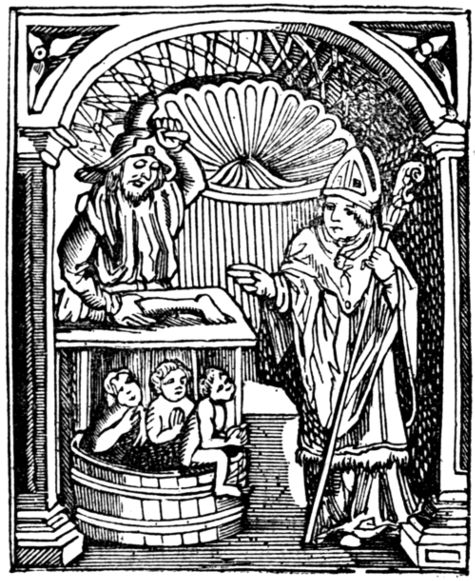
The Salisbury missal of 1534, fol. xxvii. contains a prayer to St. Nicholas, before which is an engraving on wood of the bishop with the children rising from the tub; but better than all, by a licence that artists formerly assumed of representing successive scenes in the same print, the landlord himself is shown in the act of reducing a limb into sizes suitable for his mercenary purpose. There are only two children in the story, and there are three in the tub of the engraving; but it is fairly to be conjectured, that the story was thought so good as to be worth making a little better. It is deemed seemly to introduce this narration by a fac-simile of the missal cut. Ribadeneira says of St. Nicholas, that “being present at the council of Nice, among three hundred and eighteen bishops, who were there assembled together to condemn the heresy of Arius, he shone among them all with so great clarity, and opinion of sanctity, that he appeared like a sun amongst so many stars.” It will be remembered that he is affirmed to have given Arius a clarifying “box on the ear.”
The Boy Bishop.
If there were no other, the miracle of the pickled children would be sufficient to establish Nicholas’s fame as the patron of youth, and we find his festival day was selected by scholars, and the children of the church, for a remarkable exhibition about to be described.
Anciently on the 6th of December, it being St. Nicholas’s day, the choir boys in cathedral churches, chose one of their number to maintain the state and authority of a bishop, for which purpose the boy was habited in rich episcopal robes, wore a mitre on his head, and bore a crosier in his hand; and his fellows, for the time being, assumed the character and dress of priests, yielded him canonical obedience, took possession of the church, and except mass, performed all the ecclesiastical ceremonies and offices. Though the boy bishop’s election was on the 6th of December, yet his office and authority lasted till the 28th, being Innocents’ day.
It appears from a printed church book containing the service of the boy bishop set to music, that at Sarum,[406] on the eve of Innocents’ day, the boy bishop and his youthful clergy, in their copes, and with burning tapers in their hands, went in solemn procession, chanting and singing versicles as they walked into the choir by the west door, in such order that the dean and canons went foremost, the chaplains next, and the boy bishop with his priests in the last and highest place. He then took his seat, and the rest of the children disposed themselves on each side of the choir upon the uppermost ascent, the canons resident bore the incense and the book, and the petit-canons the tapers according to the Romish rubric. Afterwards the boy bishop proceeded to the altar of the Holy Trinity, and All Saints, which he first censed, and next the image of the Holy Trinity, while his priests were singing. Then they all chanted a service with prayers and responses, and the boy bishop taking his seat, repeated salutations, prayers, and versicles, and in conclusion gave his benediction to the people, the chorus answering, Deo gratias. Having received his crosier from the cross-bearer other ceremonies were performed; he chanted the complyn; turning towards the quire delivered an exhortation; and last of all said, “Benedicat Vos omnipotens Deus, Pater, et Filius, et Spiritus Sanctus.”
By the statutes of the church of Sarum, for the regulation of this extraordinary scene, no one was to interrupt or press upon the boy bishop and the other children, during their procession or service in the cathedral, upon pain of anathema. It farther appears that at this cathedral the boy bishop held a kind of visitation, and maintained a corresponding state and prerogative; and he is supposed to have had power to dispose of prebends that fell vacant during his episcopacy. If he died within the month he was buried like other bishops in his episcopal ornaments, his obsequies were solemnized with great pomp, and a monument was erected to his memory, with his episcopal effigy.
About a hundred and fifty years ago a stone monument to one of these boy bishops was discovered in Salisbury cathedral, under the seats near the pulpit, from whence it was removed to the north part of the nave between the pillars, and covered over with a box of wood, to the great admiration of those, who, unacquainted with the anomalous character it designed to commemorate, thought it “almost impossible that a bishop should be so small in person, or a child so great in clothes.”
Mr. Gregorie found the processional of the boy bishop. He notices the same custom at York; and cites Molanus as saying, “that this bishop in some places did reditat census, et capones annuo accipere, receive rents, capons, &c. during his year,” &c. He relates that a boy bishop in the church of Cambray disposed of a prebend, which fell void during his episcopal assumption to his master; and he refers to the denunciation of the boy bishop by the council of Basil which, at the time of the holding of that council, was a well-known custom. Mr. Gregorie, who was a prebendary of Salisbury, describes the finding of the boy bishop’s monument at that place, and inserts a representation of it in his treatise, from which the annexed engraving is taken.
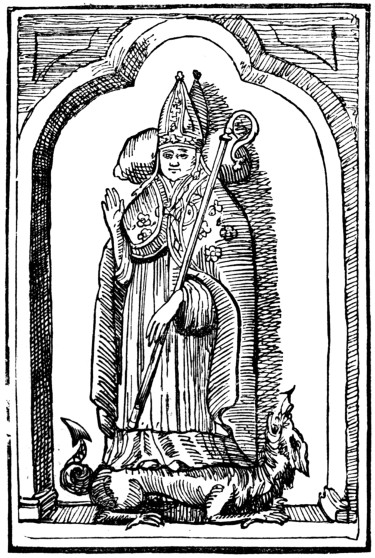
Monument to a Boy Bishop IN SALISBURY CATHEDRAL.
The ceremony of the boy bishop is supposed to have existed not only in collegiate churches, but in almost every parish in England. He and his companions walked the streets in public procession. A statute of the collegiate church of St. Mary Overy, in 1337, restrained one of them to the limits of his own parish. On December 7, 1229, the day after St. Nicholas’s day, a boy bishop in the chapel at Heton, near Newcastle-upon-Tyne, said vespers before Edward I. on his way to Scotland, who made a considerable present to him and the other boys who sang with him. In the reign of king Edward III., a boy bishop received a present of nineteen shillings and sixpence for singing before the king in his private chamber on Innocents’ day. Dean Colet in the statutes of St. Paul’s school which he founded in 1512, expressly ordains that his scholars should every Childermas (Innocents) day, “come to Paulis Churche and hear the Chylde-Bishop’s sermon: and after be at the hygh masse, and each of them offer a penny to the Chylde-Bishop: and with them the maisters and surveyors of the scole.”
By a proclamation of Henry VIII. dated July 22, 1542, the show of the boy bishop was abrogated, but in the reign of Mary it was revived with other Romish ceremonials. A flattering song was sung before that queen by a boy bishop, and printed. It was a panegyric on her devotion, and compared her to Judith, Esther, the queen of Sheba, and the Virgin Mary.
The accounts of St. Mary at Hill, London, in the 10th Henry VI., and for 1549, and 1550, contain charges for the boy bishops of those years. At that period his estimation in the church seems to have been undiminished; for on November 13, 1554, the bishop of London, issued an order to all the clergy of his diocese to have boy bishops and their processions; and in the same year these young sons of the old church paraded St. Andrew’s, Holborn, and St. Nicholas Olaves, in Bread-street, and other parishes. In 1556, Strype says that the boy bishops again went abroad singing in the old fashion, and were received by many ignorant but well-disposed persons into their houses, and had much good cheer.[407]
FLORAL DIRECTORY.
Nestflowered Heath. Erica nidiflora. Dedicated to St. Nicholas.
WINTER.
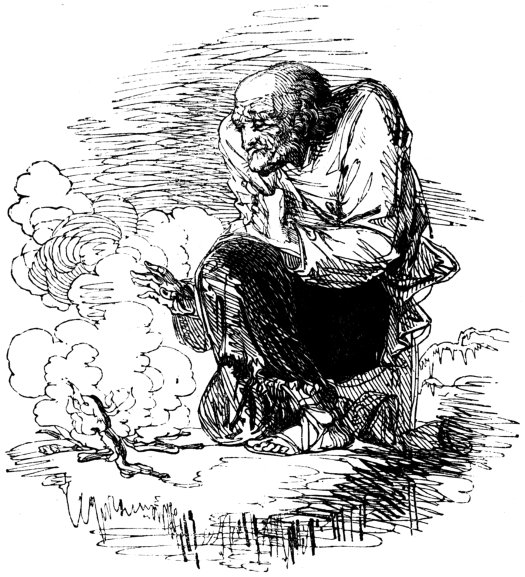
Hoary, and dim, and bare, and shivering, Like a poor almsman comes the aged Year, With kind “God save you all, good gentlefolks!” Heap on fresh fuel, make a blazing fire, Bring out the cup of kindness, spread the board, And gladden Winter with our cheerfulness! Wassail!—To you, and yours, and all!—All health!
*
December 7.
St. Ambrose, A. D. 397. St. Fara, Abbess, A. D. 655.
WINTER.
The natural commencement of the winter season, according to Mr. Howard’s “Tables,” is on the 7th of December. This quarter of the year comprehend eighty-nine days, except in leap-year when it has ninety days. Winter exhibits as large a proportion of the cold, as summer did of the heat. In spring the cold gradually goes off, to be replaced in the middle of the season by warmth; the respective proportions being like those which obtain in autumn, while their positions are reversed.
“The mean temperature of the season in the country is 37.76 degrees. The medium temperature of the twenty-four hours, descends from about 40 to 341⁄2 degrees, and returns again to the former point.
“The mean height of the barometer is 29.802 inches, being .021 inches above that of autumn. The range of the column is greatest in this season; and in the course of twenty winters it visits nearly the two extremities of the scale of three inches. The mean winter range is however 2.25 inches.
“The predominating winds at the beginning of winter are the south-west: in the middle these give place to northerly winds, after which the southerly winds prevail again to the close: they are at this season often boisterous at night.
“The mean evaporation, taken in situations which give more than the natural quantity from the surface of the earth, (being 30.467 inches on the year,) is 3.587 inches. This is a third less than the proportion indicated by the mean temperature; showing the dampness of the air at this season.
“De Luc’s hygrometer averages about 78 degrees.
“The average rain is 5.868 inches. The rain is greatest at the commencement, and it diminishes in rapid proportion to the end. In this there appears a salutary provision of divine intelligence: for had it increased, or even continued as heavy as in the autumnal months, the water instead of answering the purpose of irrigation, for which it is evidently designed, would have descended from the saturated surface of the higher ground in perpetual floods, and wasted for the season the plains and valleys.
“Notwithstanding the sensible indications of moisture, which in the intervals of our short frosts attend this season, the actual quantity of vapour in the atmosphere is now, probably, at its lowest proportion, or rather it is so at the commencement of the season; after which it gradually increases with the temperature and evaporation.”[408]
Winter.
This is the eldest of the seasons: he Moves not like spring with gradual step, nor grows From bud to beauty, but with all his snows Comes down at once in hoar antiquity. No rains nor loud proclaiming tempests flee Before him, nor unto his time belong The suns of summer, nor the charms of song, That with May’s gentle smiles so well agree. But he, made perfect in his birth-day cloud, Starts into sudden life with scarce a sound, And with a tender footstep prints the ground, As tho’ to cheat man’s ear: yet while he stays He seems as ’twere to prompt our merriest days, And bid the dance and joke be long and loud.
Literary P. Book.
FLORAL DIRECTORY.
Hairy Achania. Achania pilosa. Dedicated to St. Ambrose.
December 8.
The Conception of the Blessed Virgin Mary. St. Romaric, Abbot, A. D. 653.
The winter season of the year 1818, was extraordinarily mild. On the 8th of December, the gardens in the neighbourhood of Plymouth showed the following flowers in full bloom, viz.:—Jonquils, narcissus, hyacinths, anemonies, pinks, stocks, African and French marigolds, the passion flowers, and monthly roses, in great perfection, ripe strawberries and raspberries. In the fields and hedges were the sweet-scented violets, heart’s-ease, purple vetch, red robin, wild strawberry blossom, and many others. The oak and the elm retained much of their foliage, and the birds were sometimes heard as in spring.
FLORAL DIRECTORY.
Arbor vitæ. Thuja occidentalis. Dedicated to the Conception of the B. V. Mary.
December 9.
St. Leocadia, A. D. 304. The Seven Martyrs at Samosata, A. D. 297. St. Wulfhilde, A. D. 990.
BURIED ALIVE.
A remarkable instance of premature interment, is related in the case of the rev. Mr. Richards, parson of the Hay, in Herefordshire, who, in December, 1751, was supposed to have died suddenly. His friends seeing his body and limbs did not stiffen, after twenty-four hours, sent for a surgeon, who, upon bleeding him, and not being able to stop the blood, told them that he was not dead, but in a sort of trance, and ordered them not to bury him. They paid no attention to the injunction, but committed the body to the grave the next day. A person walking along the churchyard, hearing a noise in the grave, ran and prevailed with the clerk to have the grave opened, where they found a great bleeding at the nose, and the body in a profuse sweat; whence it was conjectured that he was buried alive. They were now, however, obliged to let him remain, as all appearance of further recovery had been precluded by his interment.[409]
A writer in the “Gentleman’s Magazine” some years before, observes, “I have undoubted authority for saying, a man was lately (and I believe is still) living at Hustley, near Winchester, December, 1747, who, after lying for dead two days and two nights, was committed to the grave, and rescued from it by some boys luckily playing in the churchyard!”
FLORAL DIRECTORY.
Corsican Spruce. Pinus Laricio. Dedicated to St. Leocadia.
December 10.
St. Melchiades, Pope, A. D. 314. St. Eulalia.
BIG MAN.
On the 10th of December, 1741, died Mr. Henry Wanyford, late steward to the earl of Essex. He was of so large a size, that the top of the hearse was obliged to be taken off before the coffin could be admitted, and it was so heavy, that the attendants were forced to move it along the churchyard upon rollers.[410]
FLORAL DIRECTORY.
Portugal Cyprus. Cupressus Lusitanica. Dedicated to St. Eulalia.
December 11.
St. Damasus, Pope, A. D. 384. Sts. Fuscian, Victoricus, and Gentian, A. D. 287. St. Daniel, the Stylite, A. D. 494.
ST. NICHOLAS IN RUSSIA.
A gentleman obligingly contributes the subjoined account of a northern usage on the 5th of December, the vigil of St. Nicholas. He communicates his name to the editor, and vouches for the authenticity of his relation, “having himself been an actor in the scene he describes.”
(For the Every-Day Book.)
In the fine old city of Leewvarden, the capital of West Friezland, there are some curious customs preserved, connected with the celebration of the anniversary of this saint. From time immemorial, in this province, St. Nicholas has been hailed as the tutelary patron of children and confections; no very inappropriate association, perhaps. On the eve, or Avond, as it is there termed, of this festival, the good saint condescends, (as currently asserted, and religiously believed, by the younger fry,) to visit these sublunar spheres, and to irradiate by his majestic presence, the winter fireside of his infant votaries.
During a residence in the above town, some twenty years agone, in the brief days of happy boyhood, (that green spot in our existence,) it was my fortune to be present at one of these annual visitations. Imagine a group of happy youngsters sporting around the domestic hearth, in all the buoyancy of riotous health and spirits, brim-full of joyful expectation, but yet in an occasional pause, casting frequent glances towards the door, with a comical expression of impatience, mixed up with something like dread of the impending event. At last a loud knock is heard, in an instant the games are suspended, and the door slowly unfolding, reveals to sight the venerated saint himself, arrayed in his pontificals, with pastoral staff and jewelled mitre. Methinks I see him now! yet he did “his spiriting gently,” and his tone of reproof, “was more in sorrow than in anger!”
In fine, the family peccadillos being tenderly passed over, and the more favourable reports made the subject of due encomiums, good father Nicholas gave his parting benediction, together with the promise, (never known to fail,) of more substantial benefits, to be realized on the next auspicious morning. So ends the first act of the farce, which it will be readily anticipated is got up with the special connivance of papa and mamma, by the assistance of some family friend, who is quite au fait to the domestic politics of the establishment. The concluding scene, however, is one of unalloyed pleasure to the delighted children, and is thus arranged.
Before retiring to rest, each member of the family deposits a shoe on a table in a particular room, which is carefully locked, and the next morning is opened in the presence of the assembled household; when lo! by the mysterious agency (doubtless) of the munificent saint, the board is found covered with bons bons, toys, and trinkets.
It may not be deemed irrelevant to add, that on the anniversary, the confectioners’ shops display their daintiest inventions, and are gaily lighted up and ornamented for public exhibition, much in the same way as at Paris on the first day of the new year.
These reminiscences may not prove unacceptable to many, who contemplate with satisfaction the relics of ancient observances, belonging to a more primitive state of manners, the memory of which is rapidly passing into oblivion; and who, perhaps, think with the writer, in one sense at least, that modern refinements, if they tend to render us wiser, hardly make us happier!
H. H.
FLORAL DIRECTORY.
Aleppo Pine. Pinus Halipensis. Dedicated to St. Damasus.
December 12.
Sts. Epimachus and Alexander, &c. A. D. 250. St. Finian, or Finan, Bp. in Ireland, A. D. 552. St. Columba, son of Crimthain, A. D. 548. St. Cormac. St. Colman, Abbot, A. D. 659. St. Eadburge, A. D. 751. St. Valery, Abbot, A. D. 622. St. Corentin, 1st. Bp. of Quimper, 5th Cent. Another St. Corentin, or Cury, A. D. 401.
An intoxicated Servant.
In Lloyd’s Evening Post of December 12-14, 1781, there is the following advertisement:—
A YOUNG MAN having yesterday left his master’s service in Smithfield, on a presumption of his pocket being picked of one hundred pounds, his master’s property, when he was in liquor; this is to inform him, that he left it in the shop of his master, who has found it; and if he will return to his master’s service he will be kindly received.
Such was the state of society, in the year 1781, that a drunken servant would be “kindly received” by his employer. We are so far better, in the year 1825, that if such a servant were kindly received, he would not be permitted to enter on his duties till he was admonished not to repeat the vice. Drunkenness is now so properly reprobated, that no one but a thorough reprobate dares to practise it, and the character of sot or drunkard invariably attaches to him.
In the subjoined extract taken from an old author, without recollection of his name, there is something apt to the occasion.
THE TRADE OF BREWING. By a writer, in the year 1621.
Of all the trades in the world, a brewer is the loadstone which draws the customes of all functions unto it. It is the mark or upshot of every man’s ayme, and the bottomlesse whirlepoole that swallowes up the profits of rich and poore. The brewer’s art (like a wilde kestrell or lemand hawke,) flies at all games; or like a butler’s boxe at Christmasse, it is sure to winne, whosoever loses. In a word, it rules and raignes, (in some sort,) as Augustus Cæsar did, for it taxeth the whole earth. Your innes and alehouses are brookes and rivers, and their clients are small rills and springs, who all, (very dutifully) doe pay their tributes to the boundless ocean of the brewhouse. For, all the world knowes, that if men and women did drinke no more than sufficed nature, or if it were but a little extraordinary now and then upon occasion, or by chance as you may terme it; if drinking were used in any reason, or any reason used in drinking, I pray ye what would become of the brewer then? Surely we doe live in an age,[411] wherein the seven deadly sins are every man’s trade and living.
Pride is the maintainer of thousands, which would else perish; as mercers, taylors, embroydrers, silkmen, cutters, drawers, sempsters, laundresses, of which functions there are millions which would starve but for Madam Pride, with her changeable fashions. Letchery, what a continual crop of profits it yeelds, appears by the gallant thriving and gawdy outsides of many he and she, private and publicke sinners, both in citie and suburbs. Covetousnesse is embroydered with extortion, and warmly lined and furred with oppression; and though it be a divell, yet is it most idolatrously adored, honoured, and worshipped by those simple sheep-headed fooles, whom it hath undone and beggared. I could speake of other vices, how profitable they are to a commonwealth; but my invention is thirsty, and must have one carouse more at the brewhouse, who (as I take it) hath a greater share than any, in the gaines which spring from the world’s abuses.
If any man hang, drowne, stabbe, or by any violent meanes make away his life, the goods and lands of any such person are forfeit to the use of the king; and I see no reason but those which kill themselves with drinking, should be in the same estate, and be buried in the highways, with a stake drove thorow them; and if I had but a grant of this suite, I would not doubt but that in seven yeeres (if my charity would but agree with my wealth,) I might erect almes-houses, free-schooles, mend highways, and make bridges; for I dare sweare, that a number (almost numberlesse) have confessed upon their death-beds, that at such and such a time, in such and such a place, they dranke so much, which made them surfeite, of which surfeite they languished and dyed. The maine benefit of these superfluous and manslaughtering expenses, comes to the brewer, so that if a brewer be in any office, I hold him to be a very ingrateful man, if he punish a drunkard; for every stiffe, potvaliant drunkard is a post, beam, or pillar, which holds up the brewhouse; for as the barke is to the tree, so is a good drinker to the brewer.
FLORAL DIRECTORY.
Crowded Heath. Erica conferta. Dedicated to St. Eadburge.
December 13.
St. Lucy, A. D. 304. St. Jodoc, or Josse, A. D. 669. St. Kenelm, King, A. D. 820. St. Aubert, Bp. of Cambray and Arras, A. D. 669. B. John Marinoni, A. D. 1562. St. Othilla, A. D. 772.
St. Lucy.
This saint is in the church of England calendar and the almanacs. She was a young lady of Syracuse, who preferring a religious single life to marriage, gave away all her fortune to the poor. Having been accused to Peschasius, a heathen judge, for professing christianity, she was soon after barbarously murdered by his officers.[412]
TRANSATLANTIC VERSES.
The following effusions are from America. The first, by Mr. R. H. Wilde, a distinguished advocate of Georgia; the second, by a lady of Baltimore, who moots in the court of the muses, with as much ingenuity as the barrister in his own court.
STANZAS.
My life is like the summer rose That opens to the morning sky, But, ere the shades of evening close, Is scattered on the ground to die. Yet on that rose’s humble bed The sweetest dews of night are shed, As if she wept such waste to see; But none shall weep a tear for me. My life is like the autumn leaf That trembles in the moon’s pale ray, Its hold is frail, its date is brief, Restless, and soon to pass away. Yet, ere that leaf shall fall and fade, The parent tree shall mourn its shade, The winds bewail the leafless tree, But none shall breath a sigh for me. My life is like the prints which feet Have left on Tempe’s desert strand, Soon as the rising tide shall beat All trace will vanish from the sand. Yet, as if grieving to efface All vestige of the human race, On that lone shore loud moans the sea; But none, alas! shall mourn for me.
ANSWER.
The dews of night may fall from heaven, Upon the wither’d rose’s bed, And tears of fond regret be given, To mourn the virtues of the dead. Yet morning’s sun the dews will dry, And tears will fade from sorrow’s eye, Affection’s pangs be lull’d to sleep, And even love forget to weep. The tree may mourn its fallen leaf, And autumn winds bewail its bloom, And friends may heave the sigh of grief, O’er those who sleep within the tomb. Yet soon will spring renew the flowers, And time will bring more smiling hours; In friendship’s heart all grief will die. And even love forget to sigh. The sea may on the desert shore, Lament each trace it bears away; The lonely heart its grief may pour O’er cherish’d friendship’s fast decay: Yet when all trace is lost and gone, The waves dance bright and daily on; Thus soon affection’s bonds are torn, And even love forgets to mourn.
FLORAL DIRECTORY.
Cypress arbor vitæ. Thuja cupressioides. Dedicated to St. Lucy.
December 14.
St. Spiridion, Abp. A. D. 348. Sts. Nicasius, 9th Abp. of Rheims, and his Companions, 5th Cent.
Ember Week.
This is an ancient fast, wherein monks were enjoined to great abstinence preparatory to the festival of Christmas.
FLORAL DIRECTORY.
Swamp Pine. Pinus palustris. Dedicated to St. Spiridion.
December 15.
St. Eusebius, Bp. of Vercelli, A. D. 371. St. Florence, or Flann, Abbot.
SEASONABLE.
There is a class of those who are said to “dearly love the lasses, oh?” by whom the verses below may be read without danger of their becoming worse.
A Winter Piece.
It was a winter’s evening, and fast came down the snow, And keenly o’er the wide heath the bitter blast did blow; When a damsel all forlorn, quite bewilder’d in her way, Press’d her baby to her bosom, and sadly thus did say: “Oh! cruel was my father, that shut his door on me, And cruel was my mother, that such a sight could see; And cruel is the wintry wind, that chills my heart with cold; But crueller than all, the lad that left my love for gold! “Hush, hush, my lovely baby, and warm thee in my breast; Ah, little thinks thy father how sadly we’re distrest! For, cruel as he is, did he know but how we fare, He’d shield us in his arms from this bitter piercing air. “Cold, cold, my dearest jewel! thy little life is gone. Oh! let my tears revive thee, so warm that trickle down; My tears that gush so warm, oh! they freeze before they fall: Ah! wretched, wretched mother! thou ’rt now bereft of all.” Then down she sunk despairing upon the drifted snow, And, wrung with killing anguish, lamented loud her woe: She kiss’d her babe’s pale lips, and laid it by her side; Then cast her eyes to heaven, then bow’d her head, and died.
FLORAL DIRECTORY.
Pitch Pine. Pinus resinosa. Dedicated to St. Florence.
December 16.
St. Ado, Abp. of Vienne, A. D. 875. St. Alice, or Adelaide, Empress, A. D. 999. St. Beanus, Bp. in Leinster.
[Cambridge Term ends.]
“O Sapientia.”
This day is so marked in the church of England calendar and the almanacs. Many have been puzzled by this distinction, and some have imagined that “O SAPIENTIA” was a saint and martyr, one of the celebrated eleven thousand virgins of St. Ursula. Mr. Audley, however, has rightly observed that, “This day is so called from the beginning of an anthem in the service of the Latin church, which used to be sung for the honour of Christ’s advent, from this day till Christmas eve.”—The anthem commenced with these words, “O SAPIENTIA quæ ex ore altissimi prodidisti,” &c.
FLORAL DIRECTORY.
Chinese arbor vitæ. Thuja orientalis. Dedicated to St. Alice.
December 17.
St. Olympias, A. D. 410. St. Begga, Abbess, A. D. 698.
[Oxford Term ends.]
The Season.
By this time all good housewives, with an eye to Christmas, have laid in their stores for the coming festivities. Their mincemeat has been made long ago, and they begin to inquire, with some anxiety, concerning the state of the poultry market, and especially the price of prime roasting beef.
“O the roast beef of old England, And O the old English roast beef!”
Manner of Roasting Beef anciently.
A correspondent, who was somewhat ruffled in the dog-days by suggestions for preventing hydrophobia, let his wrath go down before the dog-star; and in calm good nature he communicates a pleasant anecdote or two, which, at this time, may be deemed acceptable.
To the Editor of the Every-Day Book.
Dear Sir,
As an owner of that useful class of animals, dogs, I could not but a little startle at the severity you cast on their owners in your “Sirius,” or dog-star of July 3d. In enumerating their different qualities and prescribing substitutes, you forgot one of the most laborious employments formerly assigned to a species of dogs with long backs and short legs, called “Turnspits.”
The mode of teaching them their business was more summary than humane: the dog was put in a wheel, and a burning coal with him; he could not stop without burning his legs, and so was kept upon the full gallop. These dogs were by no means fond of their profession; it was indeed hard work to run in a wheel for two or three hours, turning a piece of meat which was twice their own weight. As the season for roasting meat is fast approaching, perhaps you can find a corner in your Every-Day Book for the insertion of a most extraordinary circumstance, relative to these curs, which took place many years ago at Bath.
It is recorded, that a party of young wags hired the chairmen on Saturday night to steal all the turnspits in the town, and lock them up till the following evening. Accordingly on Sunday, when every body desires roast meat for dinner, all the cooks were to be seen in the streets,—“Pray have you seen our Chloe?” says one. “Why,” replies the other, “I was coming to ask you if you had seen our Pompey;” up came a third while they were talking, to inquire for her Toby,—and there was no roast meat in Bath that day. It is recorded, also, of these dogs in this city, that one Sunday, when they had as usual followed their mistresses to church, the lesson for the day happened to be that chapter in Ezekiel, wherein the self-moving chariots are described. When first the word “wheel” was pronounced, all the curs pricked up their ears in alarm; at the second wheel they set up a doleful howl; and when the dreaded word was uttered a third time, every one of them scampered out of church, as fast as he could, with his tail between his legs.
Nov. 25, 1825.
John Foster.
A real Every-Day English Dialogue.
(From the Examiner.)
A. (Advancing) “How d’ye do, Brooks?”
B. “Very well, thank’ee; how do you do?”
A. “Very well, thank’ee; is Mrs. Brooks well?”
B. “Very well, I’m much obliged t’ye. Mrs. Adams and the children are well, I hope?”
A. “Quite well, thank’ee.”
(A pause.)
B. “Rather pleasant weather to-day.”
A. “Yes, but it was cold in the morning.”
B. “Yes, but we must expect that at this time o’year.”
(Another pause,—neckcloth twisted and switch twirled.)
A. “Seen Smith lately?”
B. “No,—I can’t say I have—but I have seen Thompson.”
A. “Indeed—how is he?”
B. “Very well, thank’ee.”
A. “I’m glad of it.—Well,—good morning.”
B. “Good morning.”
Here it is always observed that the speakers, having taken leave, walk faster than usual for some hundred yards.
Wild Fowl Shooting in France.
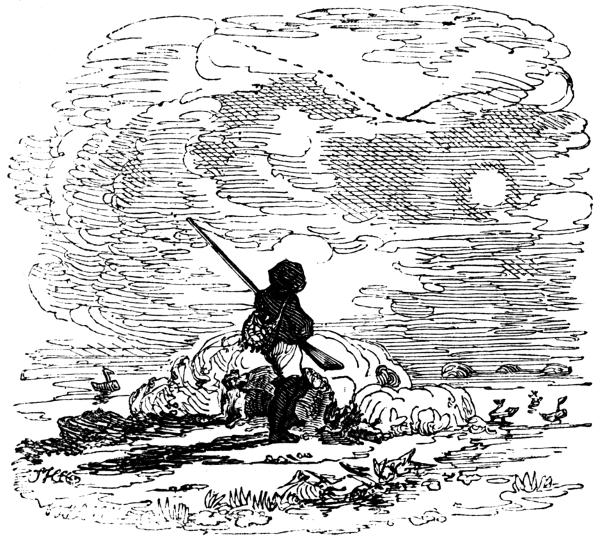
Wild Fowl Shooting in France.
Or where the Northern ocean, in vast whirls Boils round the naked melancholy isles Of farthest Thulé, and th’ Atlantic surge Pours in among the stormy Hebrides; Who can recount what transmigrations there Are annual made? what nations come and go? And how the living clouds on clouds arise? Infinite wings till all the plume-dark air And rude, resounding shore, are one wild cry.
Thomson.
To a sporting friend, the editor is indebted for the seasonable information in the accompanying letter, and the drawings of the present engravings.
Abbeville, Nov. 14, 1825.
Dear Sir,
It is of all things in the world the most unpleasant to write about nothing, when one knows a letter with something is expected. It is true I promised to look out for pious chansons, miraculous stories, and other whims and wonders of the French vulgar; and though I do not send you a budget of these gallimaufry odds and ends, whereon I know you have set your heart, yet I hope you will believe that I thoroughly determined to keep my word. To be frank, I had no sooner landed, than desire came over me to reach my domicile at this place as fast as possible, and get at my old field-sports. I therefore posted hither without delay, and, having my gun once more in my hand, have been up every morning with the lark, lark shooting, and letting fly at all that flies—my conscience flying and flapping in my face at every recollection of my engagement to you. I well remember your telling me I should forget you, and my answering, that it was “impossible!” Birds were never more plentiful, and till a frost sets them off to a milder atmosphere, I cannot be off for England. I am spell-bound to the fields and waters. Do not, however, be disheartened; I hope yet to do something handsome for your “hobby,” but I have one of my own, and I must ride him while I can.
It strikes me, however, that I can communicate something in my way, that will interest some readers of the Every-Day Book, if you think proper to lay it before them.
Every labouring man in France has a right to sport, and keeps a gun. The consequence of this is, that from the middle of October, or the beginning of this month, vast quantities of wild-fowl are annually shot in and about the fens of Picardy, whither they resort principally in the night, to feed along the different ditches and small ponds, many of which are artificially contrived with one, two, and sometimes three little huts, according to the dimensions of the pond. These huts are so ingeniously manufactured, and so well adapted to the purpose that I send you two drawings to convey an idea of their construction.
All wild-fowl are timorous, and easily deceived. The sportsman’s huts, to the number of eight or ten, are placed in such a situation, that not until too late do the birds discover the deception, and the destruction which, under cover, the fowlers deal among them. To allure them from their heights, two or three tame ducks, properly secured to stones near the huts, keep up an incessant quacking during the greater part of the night. The huts are sufficiently large to admit two men and a dog; one man keeps watch while his companion sleeps half the night, when, for the remainder, it becomes his turn to watch and relieve the other. They have blankets, a mattress, and suitable conveniences, for passing night after night obscured in their artificial caverns, and exposed to unwholesome damps and fogs. The huts are formed in the following manner:—A piece of ground is raised sufficiently high to protect the fowler from the wet ground, upon which is placed the frame of the temporary edifice. This is mostly made of ozier, firmly interwoven, as in this sketch.
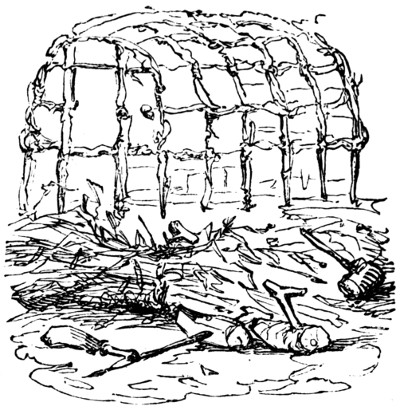
This frame is covered with dry reeds, and well plastered with mud or clay, to the thickness of about four inches, upon which is placed, very neatly, layers of turf, so that the whole, at a little distance, looks like a mound of verdant earth. Three holes, about four inches in diameter, for the men inside to see and fire through, are neatly cut; one is in the front, and one on each side. Very frequently there is a fourth at the top. This is for the purpose of firing from at the wild-fowl as they pass over. The fowlers, lying upon their backs, discharge guess shots at the birds, who are only heard by the noise of their wings in their flight. Fowlers, with quick ears, attain considerable expertness in this guess-firing.
The numbers that are shot in this way are incredible. They are usually therefore sold at a cheap rate. At forty sous a couple, (1s. 8d. English) they are dear, but the price varies according to their condition.
In the larger drawing, I have given the appearance of the country and of the atmosphere at this season, and a duck-shooter with his gun near his hut, on the look out for coming flocks; but I fear wood engraving, excellent as it is for most purposes, will fall very short of the capability of engraving on copper to convey a correct idea of the romantic effect of the commingling cloud, mist, and sunshine, I have endeavoured to represent in this delightful part of France. Such as it is, it is at your service to do with as you please.
For myself, though for the sake of variety, I have now and then crept into a fowler’s hut, and shot in ambuscade, I prefer open warfare, and I assure you I have had capital sport. That you may be acquainted with some of these wild-fowl, I will just mention the birds I have shot here within the last three weeks, beginning with the godwit; their names in French are from my recollection of Buffon.
The Godwit.
Common Godwit, la grand barge.
Red Godwit, la barge rousse.
Cinereous Godwit, (Bewick).
Cambridge Godwit, (Latham).
Green-shanked Godwit, la barge variée.
Red-legged Godwit, le chevalier rouge.
Redshank, le chevalier aux pieds rouges.
Sandpipers.
Ruffs and Reeves, le combattant.
Green Sandpiper, le bécasseau, ou cul-blanc.
Common Sandpiper, la guignette.
Brown Sandpiper, (Bewick.)
Dunlin, la brunette.
Ox-eye, l’alouette de mer.
Little Stint, la petite alouette de mer, (Brisson) &c. &c.
Curlews.
Curlew, la courles.
Whimbiel, le petite courles.
Heron.
Common, le heron hupe.
Bittern, le butor.
Little Bittern, le blongois.
Ducks.
The common Wild Duck, le canard sauvage.
Gadwell, or Gray, le chipeau.
Widgeon, le canard siffleur.
Pochard, penelope, le millovin.
Pintail, le canard à longue queue.
Golden-eye, le garrot.
Morillon, le morillon.
Tufted Duck, le petit morillon. (Brisson.)
Gargany, la sarcelle.
Teal, la petite sarcelle.
If you were here you should have a “gentleman’s recreation,” of the most delightful kind. Your propensity to look for “old masters,” would turn into looking out for prime birds. The spotted red-shanks, or barkers, as they are sometimes called, would be fine fellows for you, who are fond of achieving difficulties. They come in small flocks, skimming about the different ponds into which they run to the height of the body, picking up insects from the bottom, and looking as if they had no legs. They are excessively wary, and above all, the most difficult to get near. Confound all “black letter” say I, if it keeps a man from such delightful scenes as I have enjoyed every hour since I came here; as to picture-loving—come and see these pictures which never tire by looking at. I like a good picture though myself, and shall pick up some prints at Paris to put with my others. You may be certain therefore of my collecting something for you, after the birds have left, especially wood cuts. I shall accomplish what I can in the scrap and story-book way, which is not quite in my line, yet I think I know what you mean. In my next you shall have something about lark-shooting, which, in England, is nothing compared with what the north of France affords.
I am, &c.
J. J. H.
FLORAL DIRECTORY.
White Cedar. Cupressus thyoides. Dedicated to St. Olympias.
December 18.
Sts. Rufus and Zozimus, A. D. 116. St. Gatian, 1st. Bp. of Tours, 3d. Cent. St. Winebald, A. D. 760.
THE ASS AND THE CAMEL.
Fault was found because a newspaper commenced a police-office report of one of the humane endeavours of the warm-hearted member for Galway, in behalf of the proverbially most patient of all quadrupeds, by saying, “Mr. Martin came to this office with another ass.” Ridicule, however, never injures a just man with the just-minded; Mr. Martin has been properly supported in every judicious effort by public opinion.
The notice of the all-enduring ass, in former pages, occasions a letter from a gentleman, (with his name) whose researches have been directed to the geographical and natural history of foreign countries. In this communication he refers to a work of considerable interest relative to Africa, which it may be important for inquirers regarding the interior of that region to be acquainted with.
To the Editor of the Every-Day Book.
Sir,
November 29, 1825.
The facetious Tim Tims, in your Every-Day Book, of the 19th of September, (p. 1309.) cites the amusing and accurate Leo Africanus, as asserting “that asses may be taught to dance to music.” This is an error. Leo, in his description of Africa, (Elzevir edition, 1632. p. 749.) says, “I saw in Cairo a camel dance to the sound of a drum, and as the master told me, this is the mode of teaching: a young camel is selected and placed for half an hour in a place prepared for him of about the size of a stove, the pavement of which is heated by fire. Some one then, outside the door, beats the drum, and the camel, not on account of the music, but of the fire by which his feet are hurt, lifts first one leg then another, after the manner of a dancer, and after having been thus trained for ten or twelve months, he is led into public, when, on hearing the drum, and remembering the burning of his feet, he immediately begins to jump, and thinking himself to be on the same floor, he raises himself on his hind legs, and appears to dance; and so, use becoming second nature, he continues to do.”
The only ass described by Leo, is the ass of the woods, found only in the desert or its borders. It yields to the Barb, or Arabian, (Leo says they are the same,) in swiftness, and is caught with the greatest difficulty. When feeding, or drinking, he is always moving.
A word more about the camel. He is of a most kind and mild nature, and partakes in a manner of the sense of man. If, at any time, between Ethiopia and Barbary (in the great desert) the day’s journey is longer than ordinary, he is not to be driven on by stripes (or beating,) but the driver sings certain short songs, by which the camel being allured, he goes on with such swiftness, that no one is able to keep up with him.
When I open this highly valued book, I never know when to close it; and, indeed, the less at this time, when we are all on tip-toe with respect to Africa.
Now it does appear strange to me, that not one word has been said, either by the travellers, or those who have traced them, about this little work. One reason may be, that it has never been wholly translated into English. It is called by Hartman, (who has been deemed the ablest editor of these oriental authors,) a golden book, which had he wanted, he should as frequently have wanted light. The author, who was a man of a noble family and great acquirements, had been at Tombuto twice at least. Once he accompanied his father on his embassy from the king of Fez to that city, and afterwards as a merchant. This must have been at the very beginning of the sixteenth century, for he finished this work at Rome, the 5th of March, 1526. He describes Tombuto, as well as Bornou, and Cano, and many other of the Negro kingdoms with great minuteness, and with respect to the Niger, (which, like the Nile, rises, falls, and fertilizes the country,) he says, that its course is from the kingdom of Tombuto towards the west as far as Ginea or Jinnea, and even Melli, which joins the ocean at the same place where the Niger empties itself into the sea. He also says, that at Cabra, which is situate on the Niger, about twelve miles from Tombuto, the merchants sailing to Ginea or Melli, go on board their vessels.
Moore, who resided as a writer and factor under the African company, at the mouth of the Gambia, about five years, and in 1738, published his travels, describing the several nations for the space of six hundred miles up that river, concludes that river and the Niger to be the same. In this work will be found an English translation from the Italian, of parts of Leo’s work.
Jackson is a coxcomb, who copies without acknowledgment. He fancies the Niger runs backwards, and joins the Nile, after which they most fraternally run into the Mediterranean.
I am, &c.
T. O.
FLORAL DIRECTORY.
New Holland Cyprus. Cupressus Australis. Dedicated to St. Winebald.
December 19.
St. Nemesion, &c., A. D. 250. St. Samthana, Abbess, A. D. 738.
CELESTIAL SCENERY.
By the contemplation of the “shining heavens” at this season, the mind is induced to the solemn thinking, beautifully imagined by the greatest and most wayward poet of our age.
A Starlight Winter Night.
The stars are forth, the moon above the tops Of the snow-shining mountains.—Beautiful! I linger yet with Nature, for the night Hath been to me a more familiar face Than that of man; and in her starry shade Of dim and solitary loveliness, I learn’d the language of another world. I do remember me, that in my youth, When I was wandering,—upon such a night I stood within the Coloseum’s wall, ’Midst the chief relics of almighty Rome; The trees which grew along the broken arches Waved dark in the blue midnight, and the stars Shone through the rents of ruin: from afar The watchdog bayed beyond the Tiber; and More near from out the Cæsars’ palace came The owl’s long cry, and, interruptedly, Of distant sentinels the fitful song Begun and died upon the gentle wind. Some cypresses beyond the time-worn breach Appeared to skirt the horizon, yet they stood Within a bowshot—where the Cæsars dwelt, And dwell the tuneless birds of night, amidst A grove which springs through levell’d battlements, And twines its roots with the imperial hearths, Ivy usurps the laurel’s place of growth;— But the gladiators’ bloody Circus stands, A noble wreck in ruinous perfection! While Cæsar’s chambers, and the Augustan halls, Grovel on earth in indistinct decay.— And thou didst shine, thou rolling moon, upon All this, and cast a wide and tender light, Which softened down the hoar austerity Of rugged desolation, and fill’d up, As ’twere, anew, the gaps of centuries; Leaving that beautiful which still was so, And making that which was not, till the place Became religion, and the heart ran o’er With silent worship.
Byron.
FLORAL DIRECTORY.
Two-coloured Heath. Erica bicolor. Dedicated to St. Samthana.
December 20.
St. Philogonius, Bp. of Antioch, A. D. 322. St. Paul, of Latrus, or Latra, A. D. 956.
THE BATH SEASON.
Mr. Foster’s letter, inserted on the 17th instant, occasions the seasonable recollection, that this is the time when, in fashionable language, “every body” goes to Bath.
According to fabulous history, the virtues of the hot springs at Bath, were discovered long before the christian era, by Bladud, a British prince, who having been driven from his father’s house because he was leprous, was reduced like the prodigal son to keep swine. His pigs, says the story, had the same disease as himself; in their wanderings they came to this valley, and rolled in the mud where these waters stagnated; and healed them. Whereupon prince Bladud, attaining “to the height of this great argument,” tried the same remedy with the same success, and when he became king, built a city upon the spot—the famous city of Bath.
Nash.
Beau Nash, the founder of the theatre at Bath, made laws to regulate when and where the company should assemble, and when they should separate; arranged the tactics of the dance; enacted the dress in which ladies should appear; and, if they ventured to disobey, whatever was their rank, turned them back. His strong sense and sarcastic humour, being supported by a prevailing sense of propriety, kept offenders of this sort in awe. It has been said that such a man in old times, would have been selected for the king’s fool; he seems to have considered himself in that relation to the Bath visiters, and made use of the privilege the character allowed him. He lived on the follies of mankind, and cultivated them. He gambled, and his profits and his office required and enabled him to live expensively, sport a gay equipage, and keep a large retinue. Yet he became old and helpless, and lived to need that charity which he had never withheld from the needy, but which none extended to him. He died poor, neglected, and miserable; and the inhabitants of Bath rewarded his services and genius, in the usual manner; they erected a statue to the honour of the man whom they had suffered almost to starve.
His loss, to the assemblies was exemplified in a very remarkable manner. Two ladies of quality quarrelled in the ball-room. The company took part, some on one side, some on the other: Nash was gone, and his successor in office did not inherit his authority: the partizans as well as the combatants became outrageous, a real battle-royal took place, and caps, lappets, curls, cushions, diamond pins, and pearls, strewed the floor of those rooms, wherein during Nash’s time order was supreme.
FLORAL DIRECTORY.
Stone Pine. Pinus Pinea. Dedicated to St. Philogonius.
December 21.
St. Thomas, the Apostle. St. Edburge.
St. Thomas.
This apostle is in the church of England calendar and almanacs. He is affirmed to have travelled and promulgated christianity among the Parthians, Medes, Persians, and Carmenians, and to have been the apostle of the Indies; where he effected numerous conversions, and by his preaching raised the indignation of the Bramins, who instigated the people against him till they threw stones and darts at him, and ended his life by running him through the body with a lance.
It is said that the body of the apostle was carried to the city of Edessa. On the discovery of Malabar, by the Portuguese, they found there the Nestorian christians of St. Thomas, whom they treated as heretics, and held a council, which passed decrees for their purgation. Yet many of the Malabarians still maintain the Nestorian doctrines and ceremonies, and refuse to acknowledge the authority of the pope.
Ribadeneira pretends that on the eve of Christmas, in the church of St. Thomas at Malabar, a stone cross commences to shed blood as soon as the Jesuits begin to say mass, “and not before.” He says, “The holy cross also begins, by little and little, to change its natural colour, which is white, turning into yellow, and afterwards into black, and from black into azure colour, until the sacrifice of the mass being ended, it returns to its natural colour: and that which augments both admiration and devotion is, that, as the holy cross changes its colours, it distils certain little drops of blood, and by little and little they grow thicker, until they fall in so great abundance that the clothes with which they wipe it are dyed with the same blood: and if any year this miracle fail, it is held as a certain sign of great calamity that is to come upon them, as experience has shown them.” Perhaps it is further miraculous, that in a country where there is liberty of thought and speech, and a free press, no stone cross will do the like.
ST. THOMAS’S DAY.
Going a gooding on St. Thomas’s day formerly prevailed in England. Women begged money, and in return presented the donors with sprigs of palm and branches of primroses.[413] Mr. Ellis says, “this practice is still kept up in Kent, in the neighbourhood of Maidstone.” Mr. Brand adds, “My servant B. Jelkes, who is from Warwickshire, informs me that there is a custom in that county for the poor on St. Thomas’s day to go with a bag to beg corn of the farmers, which they call going a corning.”
LONDON ELECTIONS.
In London, on St. Thomas’s day, wardmotes are held for the election of the inquest and common councilmen, and other officers, who are annually chosen for the service and representation of the respective wards.
It is a remarkable fact that the majority of the inhabitants, in many wards, are indifferent to these elections, and suffer their ample franchise to run to waste, like housewives who are careless of their serviceable water; hence important offices are frequently filled by persons either ignorant of the duties they should discharge, or indifferent to them, or unqualified to understand them.
The Ward Inquests.
From “An Inquiry into the Nature and Duties of the Office of Inquest Jurymen,” by Mr. Thomas Newell, of Cripplegate Ward, published in 1825, it appears that the ward inquest should be elected on St. Thomas’s day, before the common councilmen are elected, inasmuch as “the alderman is commanded by his precept from the lord mayor, to give all the articles of the precept in charge to the inquest; which they cannot take charge of unless they are elected first.” It is now the common practice of wardmotes, to elect the inquest last. This has arisen, perhaps, from what may be called, in the ordinary sense of the word, the “political” importance usually attached to the election of the common councilmen, and by this means the inquest, though foremost in power, has been degraded in rank, and sunk into comparative insignificance. Withal it is to be observed, that the inquest, with the aldermen, are the returning officers of the election of the common councilmen; so that where the practice prevails of electing the inquest last, such inquests are in fact constituted too late to take cognizance, as an inquest, of the election of the common council, and such inquests are consequently incompetent upon their oaths, as inquest men, to return the common councilmen as having been truly and duly elected.
It appears further, that another extraordinary inroad has been made in London, upon the right of the wardmote inquests to return the jurors to serve in the mayor’s and sheriffs’ courts of the city. By some by-law or order of the court of aldermen, that court claims to exercise this most important and ancient right of the wardmote inquests; and issues a precept to the alderman of each ward, requiring him to acquaint the inquest “that they are not hereafter to intermeddle or concern themselves in the making of the said returns.” This mandate is said to be conformed to at this time by all the inquests; so that the court of aldermen seems to have obtained the inquests to surrender their right to nominate the juries in the city courts, without a struggle. If the proceedings of the court of aldermen were illegal, it is clear that each alderman, in his own ward, illegally dispossessed each inquest of its right, and then, exercised their usurped power when they met together as a court of aldermen.
From the elections in each ward on this day, the citizens are all in a hurry, and there is much discussion at the few remaining clubs and tavern parlours in the different parishes, concerning the qualifications of the respective candidates. All freemen, being householders, are entitled to vote.
FLORAL DIRECTORY.
Sparrowwort. Erica passerina. Dedicated to St. Thomas, Apostle.
December 22.
St. Ischyrion, A. D. 253. Sts. Cyril and Methodius, A. D. 881.
Clark, the Miser of Dundee.
On the 22d of December, 1817, died, at Dundee, aged sixty-six, Thomas Clark, a labouring man, who, by dint of parsimony and saving, had accumulated property to the amount of from 800l. to 1000l. before his death. There are perhaps few authenticated instances of endurance which this person did not voluntarily submit to, in order to gratify his ruling passion. He lived by himself, in a small garret, in a filthy lane, called Tyndal’s Wynd. His diet consisted of a little oatmeal, stirred into hot water, which he begged from some one or other of the neighbours every morning, to save the expense of fuel. For many years he had laboured under a painful disorder, but would not put himself under the care of a surgeon, fearful of the cost. Driven at last to desperation by the intenseness of his sufferings, about twelve months previous to his decease, he sent for Mr. Crichton, who found him lying, in the most inclement season of the year, barely covered by an old tattered blanket. The furniture of the apartment consisted of about a dozen pair of old shoes, some old tattered clothes, a plough-share, a wooden dish, and horn spoon, a pair of scales and weights, a tub for holding meal, and an old crazy chair. Clark’s disorder having been ascertained to be stone in the bladder, he was told that a surgical operation would be necessary for his relief. This he expressed the utmost willingness to undergo; but when informed it would also be necessary to have him removed to a comfortable room, &c. his heart died within him, and he said he must continue as he was, until death relieved him. In vain was he told that every thing needful would be provided. He still persevered in his determination. Leaving a trifle with him to procure necessaries, Mr. Crichton descended from the garret, and made inquiry of the neighbours concerning this miserable object; from whom he received the account narrated. Possessed of this information he returned and rated the wretch for his miserable disposition; but all that could be obtained, was a promise to procure some bed-clothes, and to allow the operation to be performed in a room belonging to one of the neighbours, and immediately to be hoisted back to his own roost. The first morning after the operation he was found quarrelling and abusing the old woman left in charge of him, for her extravagance in making use of soap to wash the cloths that were occasionally taken from under him; and he expressed great exultation when she was given to understand that soap was not absolutely necessary for the purpose. A dose of castor oil that had been prescribed for him, he would not allow to be sent for; but in its place swallowed a piece of soap, which, he said, would equally answer the purpose, and at much less cost. The cure going on well, he was ordered some beef tea. The parting with threepence every morning to purchase half a pound of meat, was perfect torture, and recollecting a piece of old rusty bacon, which he had formerly picked up somewhere in his travels, he tried the expedient of converting part of it into beef tea, and drank it with seeming relish. Next morning, however, the old woman, alarmed for the consequences, insisted peremptorily for money to purchase fresh meat, at the same time acquainting him that a supply of coals was necessary. “The coals consumed already! Impossible! They should have served him for the winter! She must have carried off some of them! Threepence for meat and eighteen-pence for coals! It’s ruination! She must pack off immediately! But before she goes she must account for the two shillings received on the day of the operation!” The poor woman being somewhat confused could not bring to her recollection the disposal of more than 1s. 10d. It was then perfectly plain she was robbing his room, and ruining him by her extravagance, and she must go to prison! The garret was filled with the neighbours, alarmed by his noisy vociferation; and nothing they could say having pacified him, they sent for Mr. Crichton, who thought it might be a wise plan to leave him alone, and let him manage and feed himself in his own way. By the help of a good constitution, he soon recovered his health, but never could forget the expenses he had been put to during his confinement. The failure also of some people holding money of his in their hands, tended much to embitter the remainder of his life: and he was often observed lamenting his misfortunes; frequently saying aloud, “all bankrupts should be hanged!” There would be no end to the detail of this miserable creature’s miserable eccentricities. On a bitter cold day, he went into one of the neighbour’s rooms to warm himself, before ascending to his comfortless loft. The next morning he was found almost stiff with cold, and unable to move—the bed clothes, which he had been made to provide himself with the year before, were lying folded up in a corner; he had not the heart to use them. On Sunday he lost the use of his faculties; and on Monday he breathed his last. His only surviving sister, a poor old woman, living somewhere in Strathmore, inherited his property.
FLORAL DIRECTORY.
Pellucid Heath. Erica pellucida. Dedicated to St. Cyril.
December 23.
St. Servuius, A. D. 590. Ten Martyrs of Crete. St. Victoria, A. D. 250.
A Trifling Mistake.
In December, 1822, the Morning Chronicle states the following whimsical circumstance to have taken place at the Black Swan inn, at York:—
An honest son of Neptune travelling northwards, having put up there for the night, desired the chambermaid to call him early the next morning, as he wished to proceed on his journey by the coach; and added, “as I am a very sound sleeper, you will most likely be obliged to come in and shake me.” Accordingly he left his door unfastened, and soon fell asleep. The next morning when he awoke, he found the sun was high, and the coach must have left him some hours behind. Vexation was his first feeling, the next was that of vengeance against the faithless Molly. Accordingly he proceeded to inform himself of the time of day, that he might tax her accurately with her omission, which was aggravated, in his mind, by every additional hour that he had lost; but after groping for some time under his pillow for his watch, it was not to be found! This effectually roused him, and he launched at once out of bed, but no sooner found himself on his feet, than he discovered that his clothes had likewise vanished. It was now evident to him that he had been robbed; however a little more rubbing of the eyes convinced him that he must have been also stolen himself, as the room, bed, and furniture, were all strange to him! Indeed, he was positive in his own mind, that he had never beheld them before. It was equally clear to him that he had gone to bed sober; so being completely puzzled, Jack sate himself down on the bed to “make a calculation,” as he often had done at sea, in order to discover, if possible, in what precise part of the globe he just then happened to be, and how he came there. He had read of the enchanted carpet, by which persons could be transported to the remotest parts of the world in the twinkling of an eye; but he never had heard that these fairy tricks had been played at or near York, to which place he had now distinctly traced himself by his “log.” His next thought was to “take an observation,” by looking out of the window, but he could observe nothing but tops of houses. This view, however, rejoiced his sight, for, thought he, I am still in a civilized country; this place may be York, where, if my senses do not deceive me, I went to bed last night, at all events I shall have justice done me. But the enigma still remained unexplained, and poor Jack had no clothes to go in quest of a solution. At last he spied a bell-rope, and giving it a hearty tug, leaped into bed again to wait the issue, come who might. It was no enchanter who answered this summons, but only poor Molly. “So you are there, are you? Pray why did you not call me at seven o’clock, as I desired you?” “I did, sir, but you did not answer me.” “Then, why did you not come in and shake me?” “I did come in, sir, but you were gone.” “I tell you I have not been out of bed all night; you must have gone to the wrong room.” “No, sir, I went to No. 22, the room that I put you in last night; besides, there was your watch under the pillow, your impression in the bed, and your clothes placed ready for putting on.” “Then, where the devil am I? and how came I here?” “You are a story higher, sir; just over your own room.” Our hero was now satisfied that he had been rambling over the house in his sleep, and had mistaken a story in returning to his own room. He then recollected that this was a trick to which he had been addicted when a boy, and he devised that the fatigue of a long journey had probably chiefly contributed to revive his old habit. The whole affair was now accounted for, and Molly proceeded to fetch the clothes of the disenchanted knight, resolving within herself never to trust her own door open again, lest it should be entered accidentally by some sleep-walking traveller.
FLORAL DIRECTORY.
Cedar of Lebanon. Pinus cedrus. Dedicated to St. Victoria.
To the Reader.
I am encouraged, by the approbation of my labours, to persevere in the completion of my plan, and to continue this little work next year as usual.
Not a sentence that has appeared in the preceding sheets will be repeated, and the Engravings will be entirely new.
December, 1825.
W. Hone.
December 24.
Sts. Thrasilla and Emiliana. St. Gregory, of Spoleto, A. D. 304.
Christmas Eve.
This is the vigil of that solemn festival which commemorates the day that gave
“To man a saviour—freedom to the slave.”
Calabrian Shepherds playing in Rome at Christmas.
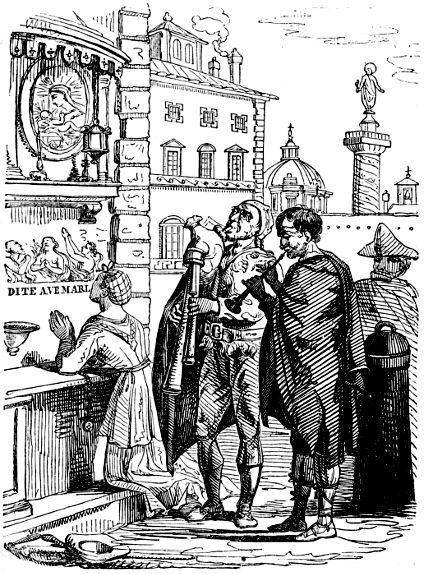
Calabrian Shepherds playing in Rome at Christmas.
In the last days of Advent the Calabrian minstrels enter Rome, and are to be seen in every street saluting the shrines of the virgin mother with their wild music, under the traditional notion of soothing her until the birth-time of her infant at the approaching Christmas. This circumstance is related by lady Morgan, who observed them frequently stopping at the shop of a carpenter. To questions concerning this practice, the workmen, who stood at the door, said it was done out of respect to St. Joseph. The preceding engraving, representing this custom, is from a clever etching by D. Allan, a Scottish artist of great merit. In Mr. Burford’s excellent panorama of the ruins of Pompeii, exhibited in the Strand, groups of these peasantry are celebrating the festival of the patron saint of the master of a vineyard. The printed “Description” of the panorama says, these mountaineers are called Pifferari, and “play a pipe very similar in form and sound to the bagpipes of the Highlanders.” It is added, as lady Morgan before observed, that “just before Christmas they descend from the mountains to Naples and Rome, in order to play before the pictures of the Virgin and Child, which are placed in various parts of every Italian town.” In a picture of the Nativity by Raphael, he has introduced a shepherd at the door playing on the bagpipes.
Christmas Carols.
Carol is said to be derived from cantare, to sing, and rola, an interjection of joy.[414] It is rightly observed by Jeremy Taylor, that “Glory to God in the highest, on earth peace, and good-will towards men,” the song of the angels on the birth of the Saviour, is the first Christmas carol.
Anciently, bishops carolled at Christmas among their clergy; but it would be diverging into a wide field to exemplify ecclesiastical practices on this festival; and to keep close to the domestic usages of the season, church customs of that kind will not now be noticed.
In Mr. Brand’s “Popular Antiquities,” he gives the subjoined Anglo-Norman carol, from a MS. in the British Museum,[415] with the accompanying translation by his “very learned and communicative friend, Mr. Douce; in which it will easily be observed that the translator has necessarily been obliged to amplify, but endeavours every where to preserve the sense of the original.”
Anglo-Norman Carol.
Seignors ore entendez a nus, De loinz sumes venuz a wous, Pur quere Noel; Car lem nus dit que en cest hostel Soleit tenir sa feste anuel Ahi cest iur. Deu doint a tuz icels joie d’amurs Qi a danz Noel ferunt honors. Seignors io vus di por veir Ke danz Noel ne uelt aveir Si joie non; E repleni sa maison, De payn, de char, & de peison, Por faire honor. Deu doint a tuz ces joie damur. Seignors il est crie en lost, Qe cil qui despent bien & tost, E largement; E fet les granz honors sovent Deu li duble quanque il despent Por faire honor. Deu doint a. Seignors escriez les malveis, Car vus nel les troverez jameis De bone part: Botun, batun, ferun groinard, Car tot dis a le quer cuuard Por faire honor. Deu doint. Noel beyt bein li vin Engleis E li Gascoin & li Franceys E l’Angeuin. Noel fait beivre son veisin, Si quil se dort, le chief en clin, Sovent le ior. Deu doint a tuz cels. Seignors io vus di par Noel, E par li sires de cest hostel, Car beuez ben: E io primes beurai le men, E pois apres chescon le soen, Par mon conseil, Si io vus di trestoz Wesseyl Dehaiz eit qui ne dirra Drincheyl.
Translation.
Now, lordings, listen to our ditty, Strangers coming from afar; Let poor minstrels move your pity, Give us welcome, soothe our care In this mansion, as they tell us, Christmas wassell keeps to day; And, as the king of all good fellows, Reigns with uncontrouled sway. Lordings, in these realms of pleasure, Father Christmas yearly dwells; Deals out joy with liberal measure, Gloomy sorrow soon dispels: Numerous guests, and viands dainty, Fill the hall and grace the board; Mirth and beauty, peace and plenty, Solid pleasures here afford. Lordings, ’tis said the liberal mind, That on the needy much bestows, From Heav’n a sure reward shall find; From Heav’n, whence ev’ry blessing flows. Who largely gives with willing hand, Or quickly gives with willing heart, His fame shall spread throughout the land, His memory thence shall ne’er depart. Lordings, grant not your protection To a base, unworthy crew, But cherish, with a kind affection, Men that are loyal, good, and true. Chace from your hospitable dwelling Swinish souls, that ever crave; Virtue they can ne’er excel in, Gluttons never can be brave. Lordings, Christmas loves good drinking, Wines of Gascoigne, France, Anjou,[416] English ale, that drives out thinking, Prince of liquors old or new. Every neighbour shares the bowl, Drinks of the spicy liquor deep, Drinks his fill without controul, Till he drowns his care in sleep. And now—by Christmas, jolly soul! By this mansion’s generous sire! By the wine, and by the bowl, And all the joys they both inspire! Here I’ll drink a health to all. The glorious task shall first be mine: And ever may foul luck befal Him that to pledge me shall decline! THE CHORUS. Hail, father Christmas! hail to thee! Honour’d ever shalt thou be! All the sweets that love bestows, Endless pleasures, wait on those Who, like vassals brave and true, Give to Christmas homage due.
From what has been observed of Christmas carols in another work, by the editor, a few notices will be subjoined with this remark, that the custom of singing carols at Christmas is very ancient; and though most of those that exist at the present day are deficient of interest to a refined ear, yet they are calculated to awaken tender feelings. For instance, one of them represents the virgin contemplating the birth of the infant, and saying,