JULY. (continued 4)
Reading edition
July 27.
St. Pantaleon, A. D. 303. Sts. Maximian, Malchus, Martinian, Dionysius, John, Serapion, and Constantine, the Seven Sleepers, A. D. 250. St. Congail, St. Luica.
THE SEVEN SLEEPERS.
These saints, according to Alban Butler, were Ephesians, who for their faith, under Decius, in 250, were walled up together in a cave, wherein they had hid themselves, till they were found in 479; and hence, he says, “some moderns have imagined that they only lay asleep till they were found.” He designates them in his title, however, as having been “commonly called the seven sleepers;” and we shall see presently who his “moderns” are. He adds, that “the cave wherein their bodies were found, became famous for devout pilgrimages, and is still shown to travellers, as James Spon testifies.”
The miraculous story of the seven sleepers relates, that they remained in the cave till the heresy that “denyed the resurreccyon of deed bodyes” under Theodotian, when a “burges” of Ephesus causing a stable to be made in the mountain, the masons opened the cave, “and then these holy sayntes that were within awoke and were reysed,” and they saluted each other, and they “supposed veryley that they had slepte but one nyght onely,” instead of two hundred and twenty-nine years. Being hungry, Malchus, one of themselves, was deputed to go to Ephesus and buy bread for the rest; “and then Malchus toke V shillynges, and yssued out of the cave.” He marvelled when he saw the mason’s work outside, and when he came to one of the gates of Ephesus he was “all doubtous,” for he saw the sign of the cross on the gate; then he went to another gate, and found another cross; and he found crosses on all the gates; and he supposed himself in a dream; but he comforted himself, and at last he entered the city, and found the city also was “garnysshed” with the cross. Then he went to the “sellers of breed,” and when he showed his money, they were surprised, and said one to another, that “this yonge man” had found some old treasure; and when Malchus saw them talk together, he was afraid lest they should take him before the emperor, and prayed them to let him go, and keep both the money and the bread; but they asked who he was, for they were sure he had found a treasure of the “olde emperours,” and they told him if he would inform them they would divide it, “and kepe it secret.” But Malchus was so terrified he could not speak; then they tied a cord round his neck, and drove him through the middle of the city; and it was told that he had found an ancient treasure, and “all the cite assembled aboute hym;” and he denied the charge, and when he beheld the people he knew no man there; and he supposed they were carrying him before the emperor Decius, but they carried him to the church before St. Martin and Antipater, the consul; and the bishop looked at the money, and marvelled at it, and demanded where he had found the hidden treasure; and he answered, that he had not found it, that it was his own, and that he had it of his kinsmen. Then the judge said his kinsmen must come and answer for him; and he named them, but none knew them; and they deemed that he had told them untruly, and the judge said, how can we believe that thou hadst this money of thy friends, when we read “that it is more than CCC.lxxii. yere syth it was made,” in the time of Decius, the emperor, how can it have come to thee, who art so young, from kinsmen so long ago; thou wouldst deceive the wise men of Ephesus: I demand, therefore, that thou confess whence thou hadst this money. Then Malchus kneeled down, and demanded where was Decius, the emperor; and they told him there was no such emperor then in the world whereat Malchus said he was greatly confused that no man believed he spoke the truth, yet true it was that he and his fellows saw him yesterday in that city of Ephesus. Then the bishop told the judge that this young man was in a heavenly vision, and commanded Malchus to follow him, and to show him his companions. And they went forth, and a great multitude of the city with them towards the cave; and Malchus entered first into the cave, and the bishop next, “and there founde they amonge the stones the lettres sealed with two seales of syluer,” and then the bishop read them before all the people; and they all marvelled, “and they sawe the sayntes syttynge in the caue, and theyr visages lyke unto roses flouryng.” And the bishop sent for the emperor to come and see the marvels. And the emperor came from Constantinople to Ephesus, and ascended the mountain; and as soon as the saints saw the emperor come, “their vysages shone like to the sonne,” and the emperor embraced them. And they demanded of the emperor that he would believe the resurrection of the body, for to that end had they been raised; and then they gave up the ghost, and the emperor arose and fell on them weeping, “and embraced them, and kyssed them debonayrly.” And he commanded precious sepulchres of gold and silver to bury their bodies therein. But the same night they appeared to the emperor, and demanded of him to let their bodies lie on the earth, as they had lain before, till the general resurrection; and the emperor obeyed, and caused the place to be adorned with precious stones. And all the bishops that believed in the resurrection were absolved.[227]
In the breviary of the church of Salisbury, there is a prayer for the 27th of July, beseeching the benefit of the resurrection through the prayers of the seven sleepers, who proclaimed the eternal resurrection. Bishop Patrick,[228] who gives us the prayer, says, “To show the reader in what great care the heads of the Romish church had in those days of men’s souls, how well they instructed them, and by what fine stories their devotions were then conducted, I cannot but translate the history of these seven sleepers, as I find it in the Salisbury breviary; which, if it had been designed to entertain youth as the history of the Seven Champions, might have deserved a less severe censure; but this was read in the church to the people, as chapters are out of the bible, and divided into so many lessons.” He then gives the story of the seven sleepers as it stands in the breviary, and adds, that there was no heresy about the resurrection in the days of Theodotian, and that if any had a mind to see the ground of their prayer in the breviary, and the “stuff” of the legend of the seven sleepers, they might consult “Baronius’s notes upon the Roman Martyrology, July 27.”
It appears then, that the ecclesiastics of the church of Salisbury were among the “moderns” of Alban Butler, “who imagined” of the seven sleepers as related in the legend, and so imagining, taught the “stuff,” as bishop Patrick calls it, to their flocks. Yet Alban Butler weeps over the Reformation, which swept the “imaginations” of his “moderns” away, and he would fain bring us back to the religion of the imaginers.
FLORAL DIRECTORY.
Purple Loosestrife. Lythrum Salicaria. Dedicated to St. Pantaleon.
July 28.
Sts. Nazarius and Celsus, A. D. 68. St. Victor, Pope, A. D. 201. St. Innocent I. Pope, A. D. 417. St. Sampson, A. D. 564.
Musical Prodigies.
There is at present in Berlin, a boy, between four and five years old, who has manifested an extraordinary precocity of musical talent. Carl Anton Florian Eckert, the son of a sergeant in the second regiment of Fencible Guards, was born on the 7th of December, 1820. While in the cradle, the predilection of this remarkable child for music was striking, and passages in a minor key affected him so much as to make tears come in his eyes. When about a year and a quarter old, he listened to his father playing the air “Schone Minka” with one hand, on an old harpsichord: he immediately played it with both hands, employing the knuckles in aid of his short and feeble fingers. He continued afterwards to play every thing by the ear. He retains whatever he hears in the memory, and can tell at once whether an instrument is too high or too low for concert pitch. It was soon observed that his ear was sufficiently delicate to enable him to name any note or chord which might be struck without his seeing it. He also transposes with the greatest facility into any key he pleases, and executes pieces of fancy extempore. A subscription has been opened to buy him a pianoforte, as he has got tired of the old harpsichord, and two able musicians have undertaken to instruct him.[229]
Eckert was pre-rivalled in England by the late Mr. Charles Wesley, the son of the rev. Charles Wesley, and nephew to the late rev. John Wesley, the founder of the religious body denominated methodists. The musical genius of Charles Wesley was observed when he was not quite three years old; he then surprised his father by playing a tune on the harpsichord readily, and in just time. Soon afterwards he played several others. Whatever his mother sang, or whatever he heard in the streets, he could, without difficulty, make out upon this instrument. Almost from his birth his mother used to quiet and amuse him with the harpsichord. On these occasions, he would not suffer her to play only with one hand, but, even before he could speak, would seize hold of the other, and put it upon the keys. When he played by himself, she used to tie him by his back-string to the chair, in order to prevent his falling. Even at this age, he always put a true bass to every tune he played. From the beginning he played without study or hesitation. Whenever, as was frequently the case, he was asked to play before a stranger, he would invariably inquire in a phrase of his own, “Is he a musiker?” and if he was answered in the affirmative, he always did with the greatest readiness. His style on all occasions was con spirito; and there was something in his manner so much beyond what could be expected from a child, that his hearers, learned or unlearned, were invariably astonished and delighted.
When he was four years old, Mr. Wesley took him to London; and Beard, who was the first musical man who heard him there, was so much pleased with his abilities, that he kindly offered his interest with Dr. Boyce to get him admitted among the king’s boys. This, however, his father declined, as he then had no thoughts of bringing him up to the profession of music. He was also introduced among others to Stanley and Worgan. The latter in particular, was extremely kind to him, and would frequently entertain him by playing on the harpsichord. The child was greatly struck by his bold and full manner of playing, and seemed even then to catch a spark of his fire. Mr. Wesley soon afterwards returned with him to Bristol; and when he was about six years old, he was put under the tuition of Rooke, a very good-natured man, but of no great eminence, who allowed him to run on ad libitum, whilst he sat by apparently more to observe than to control him. Rogers, at that time the oldest organist in Bristol, was one of his first friends. He would often sit him on his knee, and make the boy play to him, declaring, that he was more delighted in hearing him then himself. For some years his study and practice were almost entirely confined to the works of Corelli, Scarlatti, and Handel; and so rapid was his progress, that, at the age of twelve or thirteen, it was thought that no person was able to excel him in performing the compositions of these masters. He was instructed on the harpsichord by Kelway, and in the rules of composition by Dr. Boyce. His first work, “A Set of Six Concertos for the Organ or Harpsichord,” published under the immediate inspection of that master, as a first attempt, was a wonderful production; it contained fugues which would have done credit to a professor of the greatest experience and the first eminence. His performance on the organ, and particularly his extempore playing on that sublime instrument, was the admiration and delight of all his auditors.
The present Mr. Samuel Wesley, brother of the preceding, and born in 1766, also gave a very early indication of musical genius. When only three years of age, he could play on the organ; and, when eight years old, attempted to compose an oratorio. Some of the airs which he wrote for the organ were shown to Dr. Boyce, and occasioned the doctor to say, “This boy unites, by nature, as true a bass as I can do by rule and study.” Mr. Wesley’s compositions are in the highest degree masterly and grand; and his extempore performance of fugues on the organ astonishing. He produces from that solemn instrument all the grand and serious graces of which it is capable. His melodies, though struck out on the instant, are sweet and varied, and never common-place; his harmony is appropriate, and follows them with all the exactness and discrimination of the most studious master; his execution, which is very great, is always sacrificed to the superior charms of expression.[230]
To this be it added, that the intellectual endowments of Mr. Samuel Wesley equal his musical talents, and that the amiable and benevolent qualities of his nature add lustre to his acquirements. He is a man of genius without pretension, and a good man without guile.
FLORAL DIRECTORY.
Mountain Groundsel. Senecio montanus. Dedicated to St. Innocent.
July 29.
St. Martha V. Sts. Simplicius and Faustinus, brothers, and Beatrice, their sister, A. D. 303. St. William, Bp. A. D. 1234. St. Olaus, or Olave, king of Norway, A. D. 1030. St. Olaus, king of Sweden.
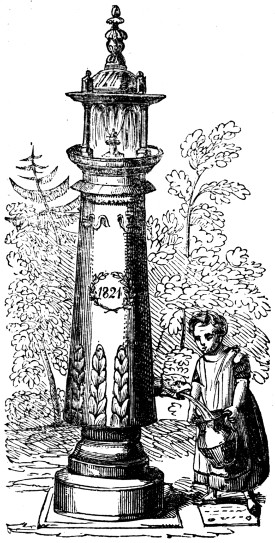
WATER IN WARM WEATHER. Fountains and Pumps.
By the process of boring, springs may be reached more expeditiously and economically than by the old method of well digging. The expense of boring from one to two hundred feet deep is little more than one-fourth of digging, seventy feet is less than a fourth, thirty feet is less than a fifth, and from ten to twenty feet it is not so much as a sixth. In 1821, the water for the fountain at Tottenham High Cross, represented in the engraving, was obtained by boring to a depth of one hundred and five feet, at the expense of the parish, for public accommodation. The water rises six feet above the surface, and flowing over a vase at the top of the column into a basin, as represented in the engraving, it pours from beneath. The boring for this spring and the fountain were suggested by Mr. Mathew, who first obtained water in Tottenham, by that method, and introduced the practice there. The pillar was designed by Messrs. Mathew and Chaplin, and executed by Mr. Turner of Dorset-street, Fleet-street, the well known manufacturer of the cast iron pumps; and not to withhold from him any of “his blushing honours,” be it noted that he was till lately a common-councilman of the ward of Farringdon Without, where he still maintains his reputation as a “cunning workman in iron,” and his good name as a good pump-maker, and as a worthy and respectable man. Public spirit should rise to the height of giving him, and others of the worshipful company of pump-makers, more orders. Many places are sadly deficient of pumps for raising spring-water where it is most wanted. Every body cries out for it in hot weather, but in cool weather they all forget their former want; and hot weather comes again and they call out for it again in vain, and again forget to put up a public pump. At Pentonville, a place abounding in springs, and formerly abounding in conduits, all the conduits are destroyed, and the pumps there, in the midst of that healthy and largely growing suburb, during the hot days of July, 1825, were not equal to supply a tenth of the demand for water; they were mostly dry and chained up during the half of each day without notice, and persons who came perhaps a mile, went back with empty vessels. So it was in other neighbourhoods. Well may we account for ill. Mischievous liquors sold, in large quantities, at some places, for soda water and ginger beer were drank to the great comfort of the unprincipled manufacturers, the great discomfort of the consumers’ bowels, and the great gain of the apothecary.
Were the doings in the New River during summer, or one half of the wholesale nuisances permitted in the Thames described, the inhabitants of London would give up their tea-kettles. Health requires that these practices should be abated, and, above all, a good supply of spring-water. The water from pumps and fountains would not only adorn our public streets and squares, but cool the heated atmosphere, by the surplus water being diverted into the gutters and open channels. Besides, if we are to have dogs, and a beast-market in the heart of the metropolis, the poor overheated animals might by such means slake their thirst from pure and refreshing streams. The condition wherein sheep and cattle are driven for many miles before they reach the metropolis, is a disgrace to the appellation assumed by men who see the cruelty, and have power to remedy it; “a merciful man is merciful to his beast,” and he is not a really merciful man who is not merciful to his neighbours’ beasts.
May these wants be quickly supplied. Give us spring water in summer; and no more let
“Maids with bottles cry aloud for pumps.”
London has but one fountain; it is in the Temple: you pass it on the way from Essex-street, or “the Grecian” to Garden-court. It is in the space at the bottom of the first flight of stone steps, within the railings enclosing a small, and sometimes “smooth shaven green,” the middle whereof it adorns, surrounded, not too thickly, by goodly trees and pleasant shrubs. The jet proceeds from a copper pipe in the middle of a stone-edged basin, and rises to its full height of at least nine feet, if water from the cock by the hall with which it communicates is not drawing; when that process is going on the jet droops, and seems dying away till the drawing ceases, and then the “Temple Fountain” goes up again “famously.”
There was a fountain in the great square of Lincolns Inn, but it had ceased to play “in my time.” I only remember the column itself standing there
“For ornament, not use,”
with its four boys blowing through shells.
In the Kent-road, on the left hand from the Elephant and Castle towards the Bricklayers Arms, there is a fountain in a piece of water opposite a recently built terrace. A kneeling figure, the size of life, blows water through a shell; it is well conceived, and would be a good ornament were it kept clean and relieved by trees.
A “professional” gentleman who to the “delightful task” of improving country residences by laying out grounds in beautiful forms, has added the less “cheerful labour” of embodying others’ theories and practice in an “Encyclopædia of Gardening,” views a fountain as an essential decoration where the “ancient” style of landscape is introduced in any degree of perfection.[231] As the first requisite, he directs attention to the obtaining a sufficiently elevated source or reservoir of supply for the jets, or projected spouts, or threads of water. Some are contrived to throw the water in the form of sheaves, fans, and showers, or to support balls; others to throw it horizontally or in curved lines, but the most usual form is a simple opening to throw the jet or spout upright. Mr. L. judiciously rejects a jet from a naked tube falling from the middle of a basin or canal on a smooth surface as unnatural, without being artificially grand. Grandeur was the aim of the “ancient” gardener, and hence he made a garden “after nature,” look as a garden of nature never did look. Mr. L. suggests that “the grandest jet of any is a perpendicular column, issuing from a rocky base on which the water falling produces a double effect both of sound and visual display.”
In the “Century of Inventions of the Marquis of Worcester,” explained and illustrated by Mr. Partington, there is mention by the marquis of “an artificial fountain, to be turned like an hour glass by a child, in the twinkling of an eye, it yet holding great quantities of water, and of force sufficient to make snow, ice, and thunder, with the chirping and singing of birds, and showing of several shapes and effects usual to fountains of pleasure.” Mr. Partington observes on this, that “how a fountain of water can produce snow, ice, thunder, and the singing of birds, is not easy to comprehend.”
Sir Henry Wotton discoursing on architecture remarks thus:—“Fountains are figured, or only plain watered works; of either of which I will describe a matchless pattern. The first, done by the famous hand of Michael Angelo da Buonaroti, is the figure of a sturdy woman, washing and winding linen clothes; in which act she wrings out the water that made the fountain; which was a graceful and natural conceit in the artificer, implying this rule, that all designs of this kind should be proper.[232] The other doth merit some larger expression: there went a long, straight, mossie walk of competent breadth, green and soft under foot, listed on both sides with an aqueduct of white stone, breast-high, which had a hollow channel on the top, where ran a pretty trickling stream; on the edge whereof were couched very thick, all along, certain small pipes of lead, in little holes; so neatly, that they could not be well perceived, till by the turning of a cock, they did sprout over interchangeably, from side to side, above man’s height, in forms of arches, without any intersection or meeting aloft, because the pipes were not exactly opposite; so as the beholder, besides that which was fluent in the aqueduct on both hands in his view, did walk as it were under a continual bower and hemisphere of water, without any drop falling on him; an invention for refreshment, surely far excelling all the Alexandrian delicacies, and pnuematicks of Hero.”[233] An invention of greater solace could not have been desired in the canicular days, by those who sought shelter from the heat; nor more coveted by any than by him, who is constrained to supply the “every-day” demand of “warm” friends for this little work—no “cool” task!
FLORAL DIRECTORY.
Red Chironia. Chironia Centaureum. Dedicated to St. Martha.
July 30.
Sts. Abden and Sennen, A. D. 250. St. Julitta, A. D. 303.
Witchcraft.
On Tuesday, the 30th of July, 1751, Thomas Colley, William Humbles, and Charles Young, otherwise Lee, otherwise Red Beard, were tried at Hertford for the murder of Ruth Osborne, by drowning her in a pond at Marlston-green, in the parish of Tring. The trial is exceedingly curious. It appeared that William Dell, the town crier of Hamel-Hempstead, on the 18th of April preceding, was desired by one Nichols, who gave him a piece of paper and fourpence, to cry the words at the market-place that were wrote thereon, which he accordingly did. The paper was as follows:—“This is to give notice, that on Monday next, a man and woman are to be publicly ducked at Tring, in this county, for their wicked crimes.”
Matthew Barton, the overseer of Tring, on hearing that this had been cried at Winslow, Leighton-Buzzard, and Hamel-Hempstead, in order to prevent the outrage, and believing them to be very honest people, sent them into the workhouse. On the Monday, a large mob of 5,000 people and more, assembled at Tring; but Jonathan Tomkins, master of the workhouse, in the middle of the night, had removed them into the vestry-room adjoining the church. The mob rushed in and ransacked the workhouse, and all the closets, boxes, and trunks; they pulled down a wall, and also pulled out the windows and window-frames. Some of the mob perceiving straw near at hand said, let us get the straw, and set fire to the house, and burn it down. Some cried out and swore, that they would not only burn the workhouse down, but the whole town of Tring to ashes. Tomkins being apprehensive that they would do so told them where the two unhappy people were, they immediately went to the vestry-room, broke it open, and took the two people away in great triumph.
John Holmes deposed, that the man and woman were separately tied up in a cloth or sheet; that a rope was tied under the arm-pits of the deceased, and two men dragged her into the pond; that the men were one on one side of the pond, and the other on the other; and they dragged her sheer through the pond several times; and that Colley, having a stick in his hand, went into the pond, and turned the deceased up and down several times.
John Humphries deposed, that Colley turned her over and over several times with the stick; that after the mob had ducked her several times, they brought her to the shore, and set her by the pond side, and then dragged the old man in and ducked him; that after they had brought him to shore, and set him by the pond side, they dragged the deceased in a second time; and that Colley went again into the pond, and turned and pushed the deceased about with his stick as before; that then she being brought to shore again, the man was also a second time dragged in, and underwent the same discipline as he had before; and being brought to shore, the deceased was a third time dragged into the pond; that Colley went into the pond again, and took hold of the cloth or sheet in which she was wrapt, and pulled her up and down the pond till the same came from off her, and then she appeared naked; that then Colley pushed her on the breast with his stick, which she endeavoured with her left hand to catch hold of, but he pulled it away, and that was the last time life was in her. He also deposed, that after Colley came out of the pond, he went round among the people who were the spectators of this tragedy, and collected money of them as a reward for the great pains he had taken in showing them sport in ducking the old witch, as he then called the deceased.
The jury found the prisoner Colley—guilty.
The reporter of the trial states, from the mouth of John Osborne, the following particulars not deposed to in court, namely: that as soon as the mob entered the vestry-room, they seized him and his wife, and Red Beard carried her across his shoulders, like a calf, upwards of two miles, to a place called Gubblecut; where not finding a pond they thought convenient, they then carried them to Marlston-green, and put them into separate rooms in a house there; that they there stripped him naked, and crossed his legs and arms, and bent his body so, that his right thumb came down to his right great toe, and his left thumb to his left great toe, and then tied each thumb and great toe together; that after they had so done, they got a cloth, or an old sheet, and wrapped round him, and then carried him to the Mere on the green, where he underwent the discipline as has been related in the course of the trial. What they did with his wife he could not say, but he supposed they had stripped her, and tied her in the same manner as himself, as she appeared naked in the pond when the sheet was drawn from off her, and her thumbs and toes tied as his were. After the mob found the woman was dead, they carried him to a house, and put him into a bed, and laid his dead wife by his side; all which he said he was insensible of, having been so ill-used in the pond, as not to have any sense of the world for some time; but that he was well assured it was so, a number of people since informing him of it who were present. His wife, if she had lived till Michaelmas, would have been seventy years of age; he himself was but fifty-six.
The infatuation of the people in those parts of Hertfordshire was so great, in thinking that these people were a witch and a vizard, that when any cattle died, it was always said that Osborne and his deceased wife had bewitched them. And even after the trial, a great number of people in that part of the country thought the man a vizard, and that he could cast up pins as fast as he pleased. Though a stout able man of his age, and ready and willing to work, yet none of the farmers thereabouts would employ him, ridiculously believing him to be a vizard, so that the parish of Tring were obliged to support him in their workhouse after his wife’s death.
So far is reported by the editor of the trial.
On the 24th of August, 1751, Colley was hung at Gubblecut-cross, and afterwards in chains. Multitudes would not be spectators of his death; yet “many thousands stood at a distance to see him die, muttering that it was a hard case to hang a man for destroying an old wicked woman that had done so much mischief by her withcraft.” Yet Colley himself had signed a public declaration the day before, wherein he affirmed his conviction as a dying man, that there was no such a thing as a witch, and prayed that the “good people” might refrain from thinking that they had any right to persecute a fellow-creature, as he had done, through a vain imagination, and under the influence of liquor: he acknowledged his cruelty, and the justice of his sentence.[234]
The pond wherein this poor creature lost her life was in mud and water together not quite two feet and a half in depth, and yet her not sinking was deemed “confirmation strong as proof of holy writ” that she was a witch. Ignorance is mental blindness.
FLORAL DIRECTORY.
White Mullen. Verbuscum Lychnitis. Dedicated to St. Julitta.
July 31.
St. Ignatius, of Loyola, A. D. 1556. St. John Columbini, A. D. 1367. St. Helen, of Sweden, A. D. 1160.
St. Ignatius Loyola—Founder of the Jesuits.
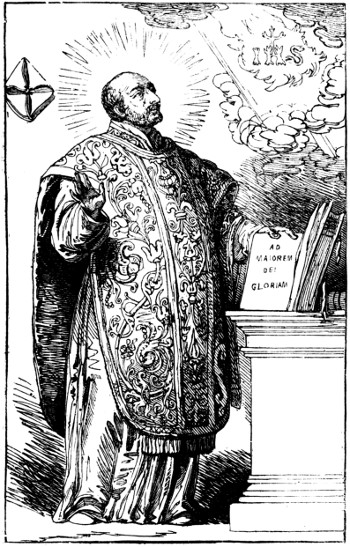
St. Ignatius Loyola—Founder of the Jesuits.
Ignatius was born in 1495, in the castle of Loyola in Guipuscoa, a part of Biscay adjoining the Pyrenees. In his childhood he was pregnant of wit, discreet above his years, affable and obliging, with a choleric disposition, and an ardent passion for glory. Bred in the court of Ferdinand V., under the duke of Najara, his kinsman and patron, as page to the king, he was introduced into the army, wherein he signalized himself by dexterous talent, personal courage, addiction to licentious vices and pleasures, and a taste for poetry; he at that time composed a poem in praise of St. Peter. In 1521, he served in the garrison of Pampeluna, against the French who besieged it: in resisting an attack, he mounted the breach sword-in-hand; a piece of stone struck off by a cannon ball from the ramparts bruised his left leg, while the ball in its rebound broke his right.[235]
Dr. Southey in a note to his recently published “Tale of Paraguay,” cites the Jesuit Ribadeneira’s account of this accident to Ignatius from his life of him in the “Actæ Sanctorum,” where it is somewhat more at length than in the English edition of Ribadeneira’s “Lives of the Saints,” which states that St. Peter appeared to Ignatius on the eve of his feast, with a sweet and gracious aspect, and said that he was come to cure him. “With this visitation of the holy apostle,” says Ribadeneira, “Ignatius grew much better, and not long after recovered his perfect health: but, as he was a spruce young gallant, desirous to appear in the most neat and comely fashion, he caused the end of a bone which stuck out under his knee, and did somewhat disfigure his leg, to be cut off, that so his boot might sit more handsomely, as he himself told me, thinking it to be against his honour that such a deformity should be in his leg: nor would he be bound while the bone was sawed off.” Father Bouhours, also a Jesuit, and another biographer of Ignatius, says, that one of his thighs having shrunk from the wound, lest lameness should appear in his gait, he put himself for many days together upon a kind of rack, and with an engine of iron violently stretched and drew out his leg, yet he could never extend it, and ever after his right leg remained shorter than his left.
————When long care Restored his shattered leg and set him free, He would not brook a slight deformity, As one who being gay and debonair, In courts conspicuous, as in camps must be: So he forsooth a shapely boot must wear; And the vain man, with peril of his life, Laid the recovered limb again beneath the knife. Long time upon the bed of pain he lay Whiling with books the weary hours away. And from that circumstance, and this vain man, A train of long events their course began, Whose term it is not given us yet to see. Who hath not heard Loyola’s sainted name, Before whom kings and nations bow’d the knee?
Tale of Paraguay.
Ribadeneira says, that one night while Ignatius kept his bed and was praying, a great noise shook all the chamber and broke the windows, and the Virgin Mary appeared to him “when he was awake, with her precious Son in her arms;” in consequence of this vision he resolved to embrace a life wherein he might afflict his body. For this purpose, he determined to go a pilgrimage to Jerusalem, and bought a cassock of coarse canvass for a coat, a pair of country buskins, a bottle, and a pilgrim’s staff; he gave his horse to the monastery of our blessed lady at Montserrat; hung up his sword and dagger at our lady’s altar; and having spent the night of Lady-day, 1522, at the said altar, departed to institute the Society of Jesus, in his canvass coat, girded with his cord, walking with his pilgrim’s staff bare-headed: he would have gone bare-footed but he was forced to wear one shoe on the foot of the broken leg. Thus he went,
“One shoe off, And t’other shoe on”
till he came to the hospital of St. Lucy at Manresa, where he lived by begging among the poor, and exhausting his body, not paring his nails, letting the hair of his head and beard both grow, and never using a comb; sleeping on a board or the bare ground; passing the greater part of the night in watching, praying, and weeping; scourging himself three times a day, and spending seven hours upon his knees. Ribadeneira says, “he was so set upon curbing, and taming, and mortifying his flesh, that he allowed it no manner of ease or content, but was continually persecuting it, so that in a very short time from a strong lusty man, he became weak and infirm.” In 1523, he was so feeble and weak that he could hardly set one leg before the other; where the night overtook him, whether in the fields or high-road, there he lay; till at last, as well as he could, often falling and rising again, he made a shift to reach Rome, on Palm Sunday, where he “made the holy stations,” and visited the churches, and after remaining there fifteen days, begged his way from door to door to Venice, afterwards went to Cyprus, and arrived at Jerusalem on the 4th of September. He returned from thence in the depth of winter, through frost and snow, with scarcely clothes to cover him, and arriving at Cyprus, wanted to ship himself on board a Venetian man of war, but the captain disliking his appearance said, if he was a saint, as he said he was, he might securely walk upon the water and not fear to be drowned. Ignatius, however, did not take the hint and set sail upon his coat or a millstone, as other saints are said to have done, but embarked in “a little paltry vessel, quite rotten and worm-eaten,” which carried him to Venice in January, 1524. On his way from thence to Genoa, he was taken by the Spaniards who thought him a spy, and afterwards thought him a fool; when he got to Spain, at thirty-three years of age, he began to learn grammar, fasted as he did before, cut off the soles of his shoes that he might walk barefoot, and cut down a man that had hanged himself, who, through his prayers “returned to life.” At Paris, in 1528, he thought fit to perfect himself in the Latin tongue, and “humanity;” then, also, he studied philosophy and divinity, and made journies into Flanders and England to beg alms of the Spanish merchants, wherewith he got together a fraternity under the name of the Fathers of the Society of Jesus, whom he persuaded John III. of Portugal to send to the East Indies as missionaries. He afterwards increased the number, and retired with two of his order for forty days into a ruined and desolate hermitage without doors or windows, open on all sides to wind and rain, where they slept on the ground on a little straw, and lived by begging hard mouldy crusts, which they were obliged to steep in water before they could eat: they then went to Rome on foot, begging all the way. Before entering that city, Ignatius going into an old church alone, had, according to Ribadeneira’s account, a celestial interview of a nature that cannot be here described without violence to the feelings of the reader. After the removal of certain difficulties, the pope confirmed the order of the Jesuits, and Ignatius was unanimously elected its general. He entered upon his dignity by taking upon himself the office of cook, and doing other menial services about the house, “which he executed,” says Ribadeneira, “with that readiness and desire of contempt, that he seemed a novice employed therein for his profit and mortification: all this I myself can testify, who at that time being a youth, was a scholar and brother in the society, and every day repeated St. Ignatius’s catechism. Our blessed father St. Ignatius was general of the society fifteen years, three months, and nine days, from the 22d of April in the year 1541, until the last of July, 1556, when he departed this world.”
Ribadeneira largely diffuses on the austerities of Ignatius, in going almost naked, suffering hunger and cold, self-inflictions with a whip, hair-cloth, “and all manner of mortifications that he could invent to afflict and subdue his body.” He accounts among his virtues, that Ignatius lived in hospitals like a poor man, amongst the meanest sort of people, being despised and contemned, and desirous to be so: his desire was to be mocked and laughed at by all, and if he would have permitted himself to be carried on by the fervour of his mind, he would have gone up and down the streets almost naked, and like a fool, that the boys of the town might have made sport with him, and thrown dirt upon him. He had a singular gift of tears which he shed most abundantly at his prayers, to the great comfort of his spirit and no less damage to his body, but at length, because the doctors told him so continual an effusion did impair his health, he prayed for command over his tears, and afterwards he could shed or repress his tears as he pleased.
It is especially insisted on by Ribadeneira, that “Ignatius had a strange dominion and command over the devils, who abhorred and persecuted him as their greatest enemy. Whilst he was in his rigorous course of penance at Manresa, Satan often appeared to him in a shining and glistening form, but he discovered the enemy’s fraud and deceit. Several other times, the devil appeared to him in some ugly and foul shape, which he was so little terrified with, that he would contemptibly drive him away with his staff, like a cat, or some troublesome cur. He laboured all he could one day to terrify him, whilst he lived at Alcala, in the hospital, but he lost his labour. At Rome, he would have choked him in his sleep, and he was so hoarse, and his throat so sore, with the violence the devil offered him, that he could hardly speak for a fortnight after. Another time whilst he was in his bed, two devils fell upon him, and whipped him most cruelly, and brother John Paul Castelan, who lay nigh him, and afterwards told it me, heard the blows, and rose up twice that night to help him.” In the year 1545, the college of the society (of Jesuits) which we have at our blessed Lady’s of Loretto, was first begun, and the devils presently began to make war against our fathers in that college, and to molest and disquiet them both by day and by night, making a most terrible clatter and noise, and appearing in sundry shapes and forms, sometimes of a blackamoor, then of a cat and bear, and other beasts, and neither by saying holy mass, praying, sprinkling holy water, using exorcisms, applying relics of saints and the like, could they rid themselves of that molestation, wherefore St. Ignatius, by letters, recommended a firm and strong confidence, and that he on his part would not be wanting to recommend it in his prayers; and from that very hour, (a very remarkable thing,) all those troubles ceased, nor were there seen any more spirits. This happened whilst St. Ignatius was living.” To this, Ribadeneira adds story upon story, of women and maids being tormented by devils, who were discomfited by the mere sight of Ignatius’s picture, “which kept off all the blows and assaults of the ghostly enemy, yet so great was his malice and desire of doing mischief, that he fell furiously upon the chamber walls, and cupboards, chests, coffers, and whatsoever else was in the room, beating upon them with horrible strokes, though he never touched any box wherein was kept a picture of the saint.” He affirms, that the like happened in the year 1599, to a schoolmaster of Ancona:—“These damned spirits,” says Ribadeneira, “opened the doors of his house when they were locked, and shut them when they were left open, swept the chambers, made the beds, lighted the lamps, and then on a sudden put all into disorder and confusion, and removed things from one room into another; but when the good man had hung up a picture of our blessed father in his house, all was quiet within doors, yet a most terrible tumult there was without, for they flung to and fro the doors and windows, and beat as it were, the drum round about his house till he put more pictures of the saint upon the doors, and several parts of the house, when the molestation wholly ceased.” Of the numerous devilries raised and abolished by the saint’s holiness, these specimens may suffice.
To so distinguished and efficient a member of the Romish Church, as Ignatius, the gift of prophecy is, of course, awarded, and the power of working miracles, of necessity, follows; accordingly we find instances of them, “too numerous to mention in this particular.” It is to be expected that his relics were equally miraculous, and hence Ribadeneira’s account is seasoned sufficiently high, for the most discriminating palate of the most miracle-loving epicure. Water wherein a bit of a bone of Ignatius’s body had been dipped, cured the sick at the hospital at Burgos. The letters he wrote were preserved as relics for miraculous purposes; and a later saint carried the autograph of Ignatius about him as a relic. If one of Ignatius’s autographs be coveted in England, it may probably be discovered in the reliquary of Mr. Upcott at the London Institution.
Enough has certainly been said of St Ignatius Loyola; yet less space could hardly have been devoted to the founder of the celebrated order of the Jesuits, a body which perforates and vermiculates through every part of the civilized world wherein the Romish religion predominates, or has ever prevailed. Concerning the present state of an order, composed of men of talent under a vow of poverty; devoted to the papacy, and possessing more wealth than any other catholic fraternity; wearing or not wearing a habit to distinguish them from ordinary citizens in catholic and protestant countries, as may suit their private purposes; prowling unknown, and secretly operating; there can be little gathered, and therefore little to communicate. The coexistence of a free government and a free press is a sure and safe defence from all their machinations.
One circumstance, however, related by all the biographers of Ignatius, must not be forgotten. It stands in Ribadeneira’s life of him thus: “As he was sitting one day upon the steps of St. Dominick’s church, and reading our blessed lady’s office with much devotion, our Lord on a sudden illustrated his understanding, and represented to him a figure of the most blessed trinity, which exteriourly expressed to him what interiourly God gave him to understand. This caused in him so great comfort and spiritual joy, that he could not restrain his sobs and tears, nor speak of any thing but this holy mystery, delivering the high conceit he had of it with so many similitudes and examples, that all who heard him were amazed and astonished, and from that time forward, this ineffable mystery was so imprinted in his soul, that he writ a book of this profound matter which contained fourscore leaves, though at that time he had never studied, and could but only read and write; and he always retained so clear and distinct a knowledge of the trinity of persons, of the divine essence, and of the distinction and propriety of the persons, that he noted in a treatise which was found after his death, written in his own hand, that he could not have learnt so much with many years’ study.” This pretended revelation with figments equally edifying has employed the pencil of the painter. Rubens has left a well-known picture representing Ignatius in his rapture. From a fine print of it, by Bolswert, the engraving at the head of this article has been taken; the picture is in the collection at Warwick Castle.
FLORAL DIRECTORY.
Great Mullen. Verbuscum Virgatum. Dedicated to St. Ignatius.