September. (continued 2)
Reading edition
Little Man.
I took my leave of this show pondering on “the different ends our fates assign,” but the jostling of a crowd in Smithfield, and the clash of instruments, were not favourable to musing, and I walked into the next.
Show XIV.
BROWN’S GRAND TROOP, FROM PARIS.
This was “only a penny” exhibition, notwithstanding that it elevated the king’s arms, and bore a fine-sounding name. The performance began by a clown going round and whipping a ring; that is, making a circular space amongst the spectators with a whip in his hand to force the refractory. This being effected, a conjurer walked up to a table and executed several tricks with cups and balls; giving a boy beer to drink out of a funnel, making him blow through it to show that it was empty, and afterwards applying it to each of the boy’s ears, from whence, through the funnel, the beer appeared to reflow, and poured on the ground. Afterwards girls danced on the single and double slack wire, and a melancholy looking clown, among other things, said they were “as clever as the barber and blacksmith who shaved magpies at twopence a dozen.” The show concluded with a learned horse.
Show XV.
Another, and a very good menagerie—the admission “only a penny!” It was “George Ballard’s Caravan,” with “The Lioness that attacked the Exeter mail.—The great Lion.—Royal Tiger.—Large White Bear.—Tiger Owls,” with monkies, and other animals, the usual accessories to the interior of a menagerie.
The chief attraction was “the Lioness.” Her attack on the Exeter Mail was on a Sunday evening, in the year 1816. The coach had arrived at Winterslow-hut, seven miles on the London side of Salisbury. In a most extraordinary manner, at the moment when the coachman pulled up to deliver his bags, one of the leaders was suddenly seized by some ferocious animal. This produced a great confusion and alarm; two passengers who were inside the mail got out, ran into the house, and locked themselves up in a room above stairs; the horses kicked and plunged violently, and it was with difficulty the coachman could prevent the carriage from being overturned. It was soon perceived by the coachman and guard, by the light of the lamps, that the animal which had seized the horse was a huge lioness. A large mastiff dog came up and attacked her fiercely, on which she quitted the horse and turned upon him. The dog fled, but was pursued and killed by the lioness, within forty yards of the place. It appears that the beast had escaped from its caravan which was standing on the road side with others belonging to the proprietors of the menagerie, on their way to Salisbury Fair. An alarm being given, the keepers pursued and hunted the lioness into a hovel under a granary, which served for keeping agricultural implements. About half-past eight they had secured her so effectually, by barricading the place, as to prevent her escape. The horse, when first attacked, fought with great spirit, and if at liberty, would probably have beaten down his antagonist with his fore feet, but in plunging he embarrassed himself in the harness. The lioness attacked him in the front, and springing at his throat, fastened the talons of her fore feet on each side of his neck, close to the head, while the talons of her hind feet were forced into his chest. In this situation she hung, while the blood was seen flowing as if a vein had been opened by a fleam. He was a capital horse, the off-leader, the best in the set. The expressions of agony in his tears and moans were most pitious and affecting. A fresh horse having been procured, the mail drove on, after having been detained three quarters of an hour. As the mail drew up it stood exactly abreast of the caravan from which the lioness made the assault. The coachman at first proposed to alight and stab the lioness with a knife, but was prevented by the remonstrance of the guard; who observed, that he would expose himself to certain destruction, as the animal if attacked would naturally turn upon him and tear him to pieces. The prudence of the advice was clearly proved by the fate of the dog. It was the engagement between him and the lioness that afforded time for the keepers to rally. After she had disengaged herself from the horse, she did not seem to be in any immediate hurry to move; for, whether she had carried off with her, as prey, the dog she had killed, or from some other cause, she continued growling and howling in so loud a tone, as to be heard for nearly half a mile. All had called out loudly to the guard to despatch her with his blunderbuss, which he appeared disposed to do, but the owner cried out to him, “For God’s sake do not kill her—she cost me 500l., and she will be as quiet as a lamb if not irritated.” This arrested his hand, and he did not fire. She was afterwards easily enticed by the keepers, and placed in her usual confinement.
The collection of animals in Ballard’s menagerie is altogether highly interesting, but it seems impossible that the proprietor could exhibit them for “only a penny” in any other place than “Bartholomew Fair,” where the people assemble in great multitudes, and the shows are thronged the whole day.
Show XVI.
“Exhibition of Real Wonders.”
This announcement, designed to astonish, was inscribed over the show with the usual notice, “Only a Penny!”—the “Wonders of the Deep!” the “Prodigies of the Age!” and “the Learned Pig!” in large letters. The printed bill is a curiosity:—
To be Seen in a Commodious Pavilion in this Place.
REAL WONDERS! SEE AND BELIEVE.
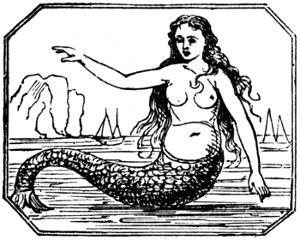
Have you seen THE BEAUTIFUL DOLPHIN, The Performing Pig & the Mermaid?
If not, pray do! as the exhibition contains more variety than any other in England. Those ladies and gentlemen who may be pleased to honour it with a visit will be truly gratified.
TOBY, The Swinish Philosopher, and Ladies’ Fortune Teller.
That beautiful animal appears to be endowed with the natural sense of the human being. He is in colour the most beautiful of his race; in symmetry the most perfect; in temper the most docile; and far exceeds any thing yet seen for his intelligent performances. He is beyond all conception: he has a perfect knowledge of the alphabet, understands arithmetic, and will spell and cast accounts, tell the points of the globe, the dice-box, the hour by any person’s watch, &c.
The Real Head of MAHOWRA, THE CANNIBAL CHIEF.
At the same time, the public will have an opportunity of seeing what was exhibited so long in London, under the title of
THE MERMAID: The wonder of the deep! not a fac-simile or copy, but the same curiosity. Admission Moderate.
⁂ Open from Eleven in the Morning till Nine in the Evening.
The great “prodigies” of this show were the “performing pig,” and the performing show-woman. She drew forth the learning of the “swinish philosopher” admirably. He told his letters, and “got into spelling” with his nose; and could do a sum of two figures “in addition.” Then, at her desire, he routed out those of the company who were in love, or addicted to indulgence; and peremptorily grunted, that a “round, fat, oily”-faced personage at my elbow, “loved good eating, and a pipe, and a jug of good ale, better than the sight of the Living Skeleton!” The beautiful dolphin was a fish-skin stuffed. The mermaid was the last manufactured imposture of that name, exhibited for half-a-crown in Piccadilly, about a year before. The real head of Mahowra, the cannibal chief, was a skull that might have been some English clod-pole’s, with a dried skin over it, and bewigged; but it looked sufficiently terrific, when the lady show-woman put the candle in at the neck, and the flame illuminated the yellow integument over the holes where eyes, nose, and a tongue had been. There was enough for “a penny!”
Show XVII.
Another “Only a penny!” with pictures “large as life” on the show-cloths outside of the “living wonders within,” and the following inscription:—
ALL ALIVE! No False Paintings! THE WILD INDIAN, THE GIANT BOY, And the DWARF FAMILY, Never here before, TO BE SEEN ALIVE!
Mr. Thomas Day was the reputed father of the dwarf family, and exhibited himself as small enough for a great wonder; as he was. He was also proprietor of the show; and said he was thirty-five years of age, and only thirty-five inches high. He fittingly descanted on the living personages in whom he had a vested interest. There was a boy six years old, only twenty-seven inches high. The Wild Indian was a civil-looking man of colour. The Giant Boy, William Wilkinson Whitehead, was fourteen years of age on the 26th of March last, stood five feet two inches high, measured five feet round the body, twenty-seven inches across the shoulders, twenty inches round the arm, twenty-four inches round the calf, thirty-one inches round the thigh, and weighed twenty-two stone. His father and mother were “travelling merchants” of Manchester; he was born at Glasgow during one of their journies, and was as fine a youth as I ever saw, handsomely formed, of fair complexion, an intelligent countenance, active in motion, and of sensible speech. He was lightly dressed in plaid to show his limbs, with a bonnet of the same. The artist with me sketched his appearance exactly as we saw him, and as the present engraving now represents him; it is a good likeness of his features, as well as of his form.
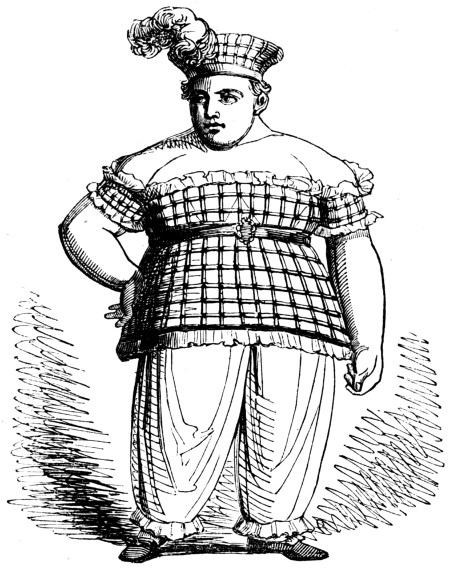
The Giant Boy.
Show XVIII.
“Holden’s Glass Working and Blowing.”
This was the last show on the east-side of Smithfield. It was limited to a single caravan; having seen exhibitions of the same kind, and the evening getting late, I declined entering, though “Only a penny!”
Show XIX.
This was the first show on the south-side of Smithfield. It stood, therefore, with its side towards Cloth-fair, and the back towards the corner of Duke-street. The admission was “Only a penny!” and the paintings flared on the show-cloths with this inscription, “They’re all Alive Inside! Be assured They’re All Alive!—The Yorkshire Giantess.—Waterloo Giant.—Indian Chief.—Only a Penny!”
An overgrown girl was the Yorkshire Giantess. A large man with a tail, and his hair frizzed and powdered, aided by a sort of uniform coat and a plaid rocquelaire, made the Waterloo Giant. The abdication of such an Indian Chief as this, in favour of Bartholomew Fair, was probably forced upon him by his tribe.
Show XX.
The “Greatest of all Wonders!—Giantess and Two Dwarfs.—Only a Penny!” They were painted on the show-cloths quite as little, and quite as large, as life. The dwarfs inside were dwarfish, and the “Somerset girl, taller than any man in England,” (for so said the show-cloth,) arose from a chair, wherein she was seated, to the height of six feet nine inches and three quarters, with, “ladies and gentlemen, your most obedient.” She was good looking and affable, and obliged the “ladies and gentlemen” by taking off her tight fitting slipper and handing it round. It was of such dimension, that the largest man present could have put his booted foot into it. She said that her name was Elizabeth Stock, and that she was only sixteen years old.
Show XXI.
CHAPPELL—PIKE.
This was a very large show, without any show-cloths or other announcement outside to intimate the performances, except a clown and several male and female performers, who strutted the platform in their exhibiting dresses, and in dignified silence; but the clown grimaced, and, assisted by others, bawled “Only a penny,” till the place filled, and then the show commenced. There was slack-rope dancing, tumbling, and other representations as at Ball’s theatre, but better executed.
Show XXII.
WOMBWELL.
The back of this man’s menagerie abutted on the side of the last show, and ran the remaining length of the north-side of Smithfield, with the front looking towards Giltspur-street; at that entrance into the Fair it was the first show. This front was entirely covered by painted show-cloths representing the animals, with the proprietor’s name in immense letters above, and the words “The Conquering Lion” very conspicuous. There were other show-cloths along the whole length of the side, surmounted by this inscription, stretching out in one line of large capital letters, “Nero and Wallace; the same Lions that fought at Warwick.” One of the front show-cloths represented one of the fights; a lion stood up with a dog in his mouth, cranched between his grinders; the blood ran from his jaws; his left leg stood upon another dog squelched by his weight. A third dog was in the act of flying at him ferociously, and one, wounded and bleeding, was fearfully retreating. There were seven other show-cloths on this front, with the words “Nero and Wallace” between them. One of these show-cloths, whereon the monarch of the forest was painted, was inscribed, “Nero, the Great Lion, from Caffraria!”
The printed bill described the whole collection to be in “fine order.” Sixpence was the entrance money demanded, which having paid, I entered the show early in the afternoon, although it is now mentioned last, in conformity to its position in the Fair. I had experienced some inconvenience, and witnessed some irregularities incident to a mixed multitude filling so large a space as Smithfield; yet no disorder without, was equal to the disorder within Wombwell’s. There was no passage at the end, through which persons might make their way out: perhaps this was part of the proprietor’s policy, for he might imagine that the universal disgust that prevailed in London, while he was manifesting his brutal cupidity at Warwick, had not subsided; and that it was necessary his show-place here should appear to fill well on the first day of the Fair, lest a report of general indifference to it, should induce many persons to forego the gratification of their curiosity, in accommodation to the natural and right feeling that induced a determination not to enter the exhibition of a man who had freely submitted his animals to be tortured. Be that as it may, his show, when I saw it, was a shameful scene. There was no person in attendance to exhibit or point out the animals. They were arranged on one side only, and I made my way with difficulty towards the end, where a loutish fellow with a broomstick, stood against one of the dens, from whom I could only obtain this information, that it was not his business to show the beasts, and that the showman would begin at a proper time. I patiently waited, expecting some announcement of this person’s arrival; but no intimation of it was given; at length I discovered over the heads of the unconscious crowd around, that the showman, who was evidently under the influence of drink, had already made his way one third along the show. With great difficulty I forced myself through the sweltering press somewhat nearer to him, and managed to get opposite Nero’s den, which he had by that time reached and clambered into, and into which he invited any of the spectators who chose to pay him sixpence each, as many of them did, for the sake of saying that they had been in the den with the noble animal, that Wombwell, his master, had exposed to be baited by bull-dogs. The man was as greedy of gain as his master, and therefore without the least regard to those who wished for general information concerning the different animals, he maintained his post as long as there was a prospect of getting the sixpences. Pressure and heat were now so excessive, that I was compelled to struggle my way, as many others did, towards the door at the front end, for the sake of getting into the air. Unquestionably I should not have entered Wombwell’s, but for the purpose of describing his exhibition in common with others. As I had failed in obtaining the information I sought, and could not get a printed bill when I entered, I re-ascended to endeavour for one again; here I saw Wombwell, to whom I civilly stated the great inconvenience within, which a little alteration would have obviated; he affected to know nothing about it, refused to be convinced, and exhibited himself, to my judgment of him, with an understanding and feelings perverted by avarice. He is undersized in mind as well as form, “a weazen, sharp-faced man,” with a skin reddened by more than natural spirits, and he speaks in a voice and language that accord with his feelings and propensities. His bill mentions, “A remarkably fine tigress in the same den with a noble British lion!!” I looked for this companionship in his menagerie, without being able to discover it.
Here ends my account of the various shows in the Fair. In passing the stalls, the following bill was slipped into my hand, by a man stationed to give them away.
SERIOUS NOTICE, IN PERFECT CONFIDENCE.
The following extraordinary comic performances at Sadler’s Wells,
Can only be given during the present week; the proprietors, therefore, most respectfully inform that fascinating sex, so properly distinguished by the appropriate appellation of
THE FAIR!
And all those well inclined gentlemen who are happy enough to protect them, that the amusements will consist of a romantic tale, of mysterious horror and broad grin, never acted, called the
ENCHANTED GIRDLES; OR, WINKI THE WITCH, And the Ladies of Samarcand.
A most whimsical burletta, which sends people home perfectly exhausted from uninterrupted risibility, called
THE LAWYER, THE JEW, AND THE YORKSHIREMAN.
With, by request of 75 distinguished families, and a party of 5, that never-to-be-sufficiently-praised pantomime, called
Magic in Two Colours; OR, FAIRY BLUE & FAIRY RED: Or, Harlequin and the Marble Rock.
It would be perfectly superfluous for any man in his senses to attempt any thing more than the mere announcement in recommendation of the above unparalleled representations, so attractive in themselves as to threaten a complete monopoly of the qualities of the magnet; and though the proprietors were to talk nonsense for an hour, they could not assert a more important truth than that they possess
The only Wells from which you may draw WINE, THREE SHILLINGS AND SIXPENCE A full Quart.
Those whose important avocations prevent their coming at the commencement,
will be admitted for HALF-PRICE, AT HALF-PAST EIGHT
Ladies and gentlemen who are not judges of the superior entertainments announced, are respectfully requested to bring as many as possible with them who are.
N.B. A full Moon during the Week.
This bill is here inserted as a curious specimen of the method adopted to draw an audience to the superior entertainments of a pleasant little summer theatre, which, to its credit, discourages the nuisances that annoy every parent who takes his family to the boxes at the other theatres.
Before mentioning other particulars concerning the Fair here described, I present a lively representation of it in former times.
Bartholomew Fair in 1614.
“O, rare Ben Jonson!” To him we are indebted for the only picture of Smithfield at “Barthol’me’-tide” in his time.
In his play of “Bartholomew Fair,” we have John Littlewit, a proctor “o’ the Archdeacon’s-court,” and “one of the pretty wits o’ Paul’s” persuading his wife, Win-the-fight, to go to the Fair. He says “I have an affair i’ the Fair, Win, a puppet-play of mine own making.—I writ for the motion-man.” She tells him that her mother, dame Purecraft, will never consent; whereupon he says, “Tut, we’ll have a device, a dainty one: long to eat of a pig, sweet Win, i’ the Fair; do you see? i’ the heart o’ the Fair; not at Pye-corner. Your mother will do any thing to satisfie your longing.” Upon this hint, Win prevails with her mother, to consult Zeal-of-the-land Busy, a Banbury man “of a most lunatick conscience and spleen;” who is of opinion that pig “is a meat, and a meat that is nourishing, and may be eaten; very exceeding well eaten; but in the Fair, and as a Bartholmew pig, it cannot be eaten; for the very calling it a Bartholmew pig, and to eat it so, is a spice of idolatry.” After much deliberation, however, he allows that so that the offence “be shadowed, as it were, it may be eaten, and in the Fair, I take it—in a booth.” He says “there may be a good use made of it too, now I think on’t, by the public eating of swine’s flesh, to profess our hate and loathing of Judaism;” and therefore he goes with them.
In the Fair a quarrel falls out between Lanthorn Leatherhead, “a hobby-horse seller,” and Joan Trash, “a gingerbread woman.”
“Leatherhead. Do you hear, sister Trash, lady o’ the basket? sit farther with your gingerbread progeny there, and hinder not the prospect of my shop, or I’ll ha’ it proclaimed i’ the Fair, what stuff they are made on.
“Trash. Why, what stuff are they made on, brother Leatherhead? nothing but what’s wholesome, I assure you.
“Leatherhead. Yes; stale bread, rotten eggs, musty ginger, and dead honey, you know.
“Trash. Thou too proud pedlar, do thy worst: I defy thee, I, and thy stable of hobby-horses. I pay for my ground, as well as thou dost, and thou wrongs’t me, for all thou art parcel-poet, and an ingineer. I’ll find a friend shall right me, and make a ballad of thee, and thy cattle all over. Are you puft up with the pride of your wares? your arsedine?
“Leatherhead. Go too, old Joan, I’ll talk with you anon; and take you down too—I’ll ha’ you i’ the Pie-pouldres.”
They drop their abuse and pursue their vocation. Leatherhead calls, “What do you lack? what is’t you buy? what do you lack? rattles, drums, halberts, horses, babies o’ the best? fiddles o’ the finest?” Trash cries, “Buy my gingerbread, gilt gingerbread!” A “costard-monger” bawls out, “Buy any pears, pears! fine, very fine pears!” Nightingale, another character, sings,
“Hey, now the Fair’s a filling O, for a tune to startle The birds o’ the booths, here billing Yearly with old Saint Barthle! The drunkards they are wading, The punks and chapmen trading, Who’ld see the Fair without his lading? Buy my ballads! new ballads!”
Ursula, “a pig-woman,” laments her vocation:—“Who would wear out their youth and prime thus, in roasting of pigs, that had any cooler occupation? I am all fire and fat; I shall e’en melt away—a poor vex’d thing I am; I feel myself dropping already as fast as I can: two stone of sewet a-day is my proportion: I can but hold life and soul together.” Then she soliloquizes concerning Mooncalf, her tapster, and her other vocations: “How can I hope that ever he’ll discharge his place of trust, tapster, a man of reckoning under me, that remembers nothing I say to him? but look to’t, sirrah, you were best; threepence a pipe-full I will ha’ made of all my whole half pound of tobacco, and a quarter of a pound of colts-foot, mixt with it too, to eech it out. Then six-and-twenty shillings a barrel I will advance o’ my beer, and fifty shillings a hundred o’ my bottle ale; I ha’ told you the ways how to raise it. (a knock.) Look who’s there, sirrah! five shillings a pig is my price at least; if it be a sow-pig sixpence more.” Jordan Knockhum, “a horse-courser and a ranger of Turnbull,” calls for “a fresh bottle of ale, and a pipe of tobacco.” Passengers enter, and Leatherhead says, “What do you lack, gentlemen? Maid, see a fine hobby-horse for your young master.” A corn-cutter cries, “Ha’ you any corns i’ your feet and toes?” Then “a tinder-box man” calls, “Buy a mouse-trap, a mouse-trap, or a tormentor for a flea!” Trash cries, “Buy some gingerbread!” Nightingale bawls, “Ballads, ballads, fine new ballads!” Leatherhead repeats, “What do you lack, gentlemen, what is’t you lack? a fine horse? a lion? a bull? a bear? a dog? or a cat? an excellent fine Bartholmew bird? or an instrument? what is’t you lack?” The pig-woman quarrels with her guests and falls foul on her tapster: “In, you rogue, and wipe the pigs, and mend the fire, that they fall not; or I’ll both baste and wast you till your eyes drop out, like ’em.” Knockhum says to the female passengers, “Gentlewomen, the weather’s hot! whither walk you? Have a care o’ your fine velvet caps, the Fair is dusty. Take a sweet delicate booth, with boughs, here, i’ the way, and cool yourselves i’ the shade; you and your friends. The best pig and bottle ale i’ the Fair, sir, old Urs’la is cook; there, you may read; the pig’s head speaks it.” Knockhum adds, that she roasted her pigs “with fire o’ juniper, and rosemary branches.” Littlewit, the proctor, and his wife, Win-the-fight, with her mother, dame Purecroft, and Zeal-of-the-land enter. Busy Knockhum suggests to Ursula that they are customers of the right sort, “In, and set a couple o’ pigs o’ the board, and half a dozen of the bygist bottles afore ’em—two to a pig, away!” In another scene Leatherhead cries, “Fine purses, pouches, pincases, pipes; what is’t you lack? a pair o’ smiths to wake you i’ the morning? or a fine whistling bird?” Bartholomew Cokes, a silly “esquire of Harrow,” stops at Leatherhead’s to purchase: “Those six horses, friend, I’ll have; and the three Jews trumps; and a half a dozen o’ birds; and that drum; and your smiths (I like that device o’ your smiths,)—and four halberts; and, let me see, that fine painted great lady, and her three women for state, I’ll have. A set of those violins I would buy too, for a delicate young noise I have i’ the country, that are every one a size less than another, just like your fiddles.” Trash invites him to buy her gingerbread, and he turns to her basket, whereupon Leatherhead says, “Is this well, Goody Joan, to interrupt my market in the midst, and call away my customers? Can you answer this at the Pie-pouldres?” whereto Trash replies, “Why, if his master-ship have a mind to buy, I hope my ware lies as open as anothers; I may shew my ware as well as you yours.” Nightingale begins to sing,
“My masters and friends, and good people draw near.”
Cokes hears this, and says, “Ballads! hark, hark! pray thee, fellow, stay a little! What ballads hast thou? let me see, let me see myself—How dost thou call it? ‘A Caveat against Cut-purses!’—a good jest, i’ faith; I would fain see that demon, your cut-purse, you talk of.” He then shows his purse boastingly, and inquires, “Ballad-man, do any cut-purses haunt hereabout? pray thee raise me one or two: begin and shew me one.” Nightingale answers, “Sir, this is a spell against ’em, spick and span new: and ’tis made as ’twere in mine own person, and I sing it in mine own defence. But ’twill cost a penny alone if you buy it.” Cokes replies, “No matter for the price; thou dost not know me I see, I am an odd Bartholmew.” The ballad has “pictures,” and Nightingale tells him, “It was intended, sir, as if a purse should chance to be cut in my presence, now; I may be blameless though; as by the sequel will more plainly appear.” He adds, it is “to the tune of ‘Paggington’s Pound,’ sir,” and he finally sings—
A Caveat against Cut-purses.
My masters, and friends, and good people draw near, And look to your purses, for that I do say; And though little money, in them you do bear, It cost more to get, than to lose in a day, You oft’ have been told, Both the young and the old, And bidden beware of the cut-purse so bold. Then if you take heed not, free me from the curse, Who both give you warning, for, and the cut-purse. Youth, youth, thou hadst better been starved by thy nurse, Than live to be hanged for cutting a purse. It hath been upbraided to men of my trade, That oftentimes we are the cause of this crime: Alack, and for pity, why should it be said? As if they regarded or places, or time. Examples have been Of some that were seen In Westminster-hall, yea, the pleaders between; Then why should the judges be free from this curse More than my poor self, for cutting the purse? Youth, youth, thou hadst better been starved by thy nurse, Than live to be hanged for cutting a purse. At Worc’ter ’tis known well, and even i’ the jail, A knight of good worship did there shew his face Against the foul sinners in zeal for to rail, And lost, ipso facto, his purse in the place. Nay, once from the seat Of judgment so great, A judge there did lose a fair pouch of velvet; O, Lord for thy mercy, how wicked, or worse, Are those that so venture their necks for a purse. Youth, youth, thou hadst better been starved by thy nurse, Than live to be hanged for stealing a purse. At plays, and at sermons, and at the sessions, ’Tis daily their practice such booty to make; Yea, under the gallows, at executions, They stick not the stare-abouts’ purses to take. Nay, one without grace, At a better place, At court, and in Christmas, before the king’s face. Alack! then, for pity, must I bear the curse, That only belongs to the cunning cut-purse. Youth, youth, thou hadst better been starved by thy nurse, Than live to be hanged for stealing a purse. But O, you vile nation of cut-purses all, Relent, and repent, and amend, and be sound, And know that you ought not by honest men’s fall, Advance your own fortunes to die above ground. And though you go gay In silks as you may, It is not the highway to heaven (as they say.) Repent then, repent you, for better, for worse; And kiss not the gallows for cutting a purse. Youth, youth, thou hadst better been starved by thy nurse, Than live to be hanged for cutting a purse.
While Nightingale sings this ballad, a fellow tickles Cokes’s ear with a straw, to make him withdraw his hand from his pocket, and privately robs him of his purse, which, at the end of the song, he secretly conveys to the ballad-singer; who, notwithstanding his “Caveat against Cut-purses,” is their principal confederate, and, in that quality, becomes the unsuspected depository of the plunder.
Littlewit tells his wife, Win, of the great hog, and of a bull with five legs, in the Fair. Zeal-of-the-land loudly declaims against the Fair, and against Trash’s commodities:—“Hence with thy basket of popery, thy nest of images, and whole legend of ginger-work.” He rails against “the prophane pipes, the tinkling timbrels;” and Adam Overdoo, a reforming justice of peace, one of “the court of Pie-powders,” who wears a disguise for the better observation of disorder, gets into the stocks himself. Then “a western man, that’s come to wrestle before my lord mayor anon,” gets drunk, and is cried by “the clerk o’ the market all the Fair over here, for my lord’s service.” Zeal-of-the-land Busy, too, is put with others into the stocks, and being asked, “what are you, sir?” he answers, “One that rejoiceth in his affliction, and sitteth here to prophesy the destruction of fairs and may-games, wakes and whitsun-ales, and doth sigh and groan for the reformation of these abuses.” During a scuffle, the keepers of the stocks leave them open, and those who are confined withdraw their legs and walk away.
From a speech by Leatherhead, preparatory to exhibiting his “motion,” or puppet-show, we become acquainted with the subjects, and the manner of the performance. He says, “Out with the sign of our invention, in the name of wit; all the fowl i’ the Fair, I mean all the dirt in Smithfield, will be thrown at our banner to-day, if the matter does not please the people. O! the motions that I, Lanthorn Leatherhead, have given light to, i’ my time, since my master, Pod, died! Jerusalem was a stately thing; and so was Nineveh and The City of Norwich, and Sodom and Gomorrah; with the Rising o’ the Prentices, and pulling down the houses there upon Shrove-Tuesday; but the Gunpowder Plot, there was a get-penny! I have presented that to an eighteen or twenty pence audience nine times in an afternoon. Look to your gathering there, good master Filcher—and when there come any gentlefolks take twopence a-piece.” He has a bill of his motion which reads thus: “The Ancient Modern History of Hero and Leander, otherwise called, the Touchstone of True Love, with as true a Trial of Friendship between Damon and Pythias, two faithful Friends o’ the Bank-side.” This was the motion written by Littlewit. Cokes arrives, and inquires, “What do we pay for coming in, fellow?” Filcher answers, “Twopence, sir.”
“Cokes. What manner of matter is this, Mr. Littlewit? What kind of actors ha’ you? are they good actors?
“Littlewit. Pretty youths, sir, all children both old and young, here’s the master of ’em, Master Lantern, that gives light to the business.
“Cokes. In good time, sir, I would fain see ’em; I would be glad to drink with the young company; which is the tiring-house?
“Leatherhead. Troth, sir, our tiring-house is somewhat little; we are but beginners yet, pray pardon us; you cannot go upright in’t.
“Cokes. No? not now my hat is off? what would you have done with me, if you had had me feather and all, as I was once to-day? Ha’ you none of your pretty impudent boys now, to bring stools, fill tobacco, fetch ale, and beg money, as they have at other houses? let me see some o’ your actors.
“Littlewit. Shew him ’em, shew him ’em. Master Lantern; this is a gentleman that is a favourer of the quality.
[Leatherhead brings the puppets out in a basket.]
“Cokes. What! do they live in baskets?
“Leatherhead. They do lie in a basket, sir: they are o’ the small players.
“Cokes. These be players minor indeed. Do you call these players?
“Leatherhead. They are actors, sir, and as good as any, none dispraised, for dumb shows: Indeed I am the mouth of ’em all.—This is he that acts young Leander, sir; and this is lovely Hero; this, with the beard, Damon; and this, pretty Pythias: this is the ghost of king Dionysius, in the habit of a scrivener: as you shall see anon, at large.
“Cokes. But do you play it according to the printed book? I have read that.
“Leatherhead. By no means, sir.
“Cokes. No? How then?
“Leatherhead. A better way, sir; that is too learned and poetical for our audience: what do they know what Hellespont is? guilty of true love’s blood? or what Abydos is? or the other Sestos height?—No; I have entreated master Littlewit to take a little pains to reduce it to a more familiar strain for our people.
“Littlewit. I have only made it a little easy and modern for the times, sir, that’s all: as for the Hellespont, I imagine our Thames here; and then Leander, I make a dyer’s son about Puddle-wharf; and Hero, a wench o’ the Bank-side, who going over one morning to Old Fish-street, Leander spies her land at Trig’s-stairs, and falls in love with her: now do I introduce Cupid, having metamorphosed himself into a drawer, and he strikes Hero in love with a pint of sherry.”
While “Cokes is handling the puppets” the doorkeepers call out “Twopence a-piece, gentlemen; an excellent motion.” Other visitors enter and take their seats, and Cokes, while waiting with some of his acquaintance, employs the time at the “game of vapours, which is nonsense; every man to oppose the last man that spoke, whether it concerned him or no.” The audience become impatient, and one calls out, “Do you hear puppet-master, these are tedious vapours; when begin you?” Filcher, Leatherhead’s man, with the other doorkeepers, continue to bawl, “Twopence a-piece, sir; the best motion in the Fair.” Meanwhile the company talk, and one relates that he has already seen in the Fair, the eagle; the black wolf; the bull with five legs, which “was a calf at Uxbridge Fair two years agone;” the dogs that dance the morrice; and “the hare o’ the taber.”
Ben Jonson’s mention of the hare that beat the tabor at Bartholomew Fair in his time, is noticed by the indefatigable and accurate Strutt; who gives the following representation of the feat itself, which he affirms, when he copied it from a drawing in the Harleian collection, (6563,) to have been upwards of four hundred years old.
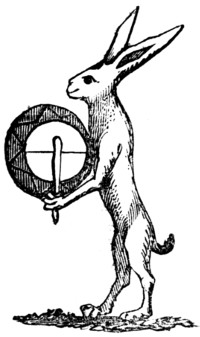
Hare and Tabor.
For an idea of Leatherhead’s motion take as follows: it commences thus:—
Leatherhead. Gentiles, that no longer your expectations may wander, Behold our chief actor, amorous Leander; With a great deal of cloth, lapp’d about him like a scarf, For he yet serves his father, a dyer at Puddle-wharf. Which place we’ll make bold with to call it our Abidus, As the Bank-side is our Sestos; and let it not be denied us Now as he is beating, to make the dye take the fuller, Who chances to come by, but fair Hero in a sculler; And seeing Leander’s naked leg, and goodly calf, Cast at him from the boat a sheep’s eye and an half, Now she is landed, and the sculler come back, By and by you shall see what Leander doth lack. Puppet Leander. Cole, Cole, old Cole. Leatherhead. That is the sculler’s name without controul. Pup. Leander. Cole, Cole, I say, Cole. Leatherhead. We do hear you. Pup. Leander. Old Cole. Leatherhead. Old Cole? is the dyer turn’d collier?— Pup. Leander. Why Cole, I say, Cole. Leatherhead. It’s the sculler you need. Pup. Leander. Aye, and be hang’d. Leatherhead. Be hang’d! look you yonder, Old Cole, you must go hang with master Leander. Puppet Cole. Where is he? Puppet Leander. Here Cole. What fairest of fairs Was that fare that thou landest but now at Trig’s-stairs? Puppet Cole. It is lovely Hero. Puppet Leander. Nero? Puppet Cole. No, Hero. Leatherhead. It is Hero Of the Bank-side, he saith, to tell you truth, without erring, Is come over into Fish-street to eat some fresh herring. Leander says no more but as fast as he can, Gets on all his best clothes, and will after to the swan.
In this way Leatherhead proceeds with his motion; he relates part of the story himself, in a ribald manner, and making the puppets quarrel, “the puppet Cole strikes him over the pate.” He performs Damon and Pythias in the same way, and renders the “gallimaufry” more ridiculous, by a battle between the puppets in Hero and Leander, and those of Damon and Pythias. Zeal-of-the-land Busy interferes with the puppet Dionysius, who had been raised up by Leatherhead—
“Not like a monarch but the master of a school, In a scrivener’s furr’d gown which shows he is no fool; For, therein he hath wit enough to keep himself warm: O Damon! he cries, and Pythias what harm Hath poor Dionysius done you in his grave, That after his death, you should fall out thus and rave,” &c.
Zeal-of-the-land contends that Dionysius hath not a “lawful calling.” That puppet retorts by saying he hath; and inquires—“What say you to the feather makers i’ the Fryers, with their peruques and their puffs, their fans and their huffs? what say you? Is a bugle-maker a lawful calling? or the confect-makers? such as you have there? or your French fashioner? Is a puppet worse than these?”—Whereto Zeal-of-the-land answers—“Yes, and my main argument against you is, that you are an abomination; for the male among you putteth on the apparel of the female, and the female of the male.” The puppet Dionysius triumphantly replies, “You lie, you lie, you lie abominably. It’s your old stale argument against the players; but it will not hold against the puppets: for we have neither male nor female amongst us.” Upon this point, which persons versed in dramatic history are familiar with, Zeal-of-the-land says, “I am confuted, the cause hath failed me—I am changed, and will become a beholder.”
These selections which are here carefully brought together may, so far as they extend, be regarded as a picture of Bartholomew Fair in 1614, when Jonson wrote his comedy for representation before king James I. We learn too from this play that there was a tooth-drawer, and “a jugler with a well educated ape, to come over the chain for the king of England, and back again for the prince, and to sit still on his hind quarters for the pope and the king of Spain;” that there was a whipping-post in the Fair, and that Smithfield was dirty and stinking. Beside particulars, which a mere historiographer of the scene would have recorded, there are some that are essentially illustrative of popular manners, which no other than an imaginative mind would have seized, and only a poet penned.
A little digression may be requisite in explanation of the term arsedine, used by Trash to Leatherhead in Jonson’s play; the denomination costermonger; the tune Paggington’s-pound; and the Pie-pouldres, or Pie Powder Court.
Arsedine.
This is also called arsadine, and sometimes orsden, and is said to be a colour. Mr. Archdeacon Nares says, that according to Mr. Lysons, in his “Environs of London,” and Mr. Gifford in his note on this passage, it means orpiment or yellow arsenic. The archdeacon in giving these two authorities, calls the word a “vulgar corruption” of “arsenic:” but arsenic yields red, as well as yellow orpiment, and both these colours are used in the getting up of shows. Possibly it is an Anglo-Saxon word for certain pigments, obtained from minerals and metals: the ore oꞃe or oꞃa is pure Saxon, and pluralizes ores; to die in the sense of dying, or colouring, is derived from the Saxon ðeaᵹ or ðeah. The conjecture may be worth a thought perhaps, for dramatic exhibitions were in use when the Anglo-Saxon was used.
Costermonger.
This is a corruption of costard-monger; Ben Jonson uses it both ways, and it is noticed of his costermonger by Mr. Archdeacon Nares, that “he cries only pears.” That gentleman rightly defines a costard-monger, or coster-monger, to be “a seller of apples;” he adds, “one generally who kept a stall.” He says of costard, that, “as a species of apple, it is enumerated with others, but it must have been a very common sort, as it gave a name to the dealers in apples.” In this supposition Mr. Nares is correct; for it was not only a very common sort, but perhaps, after the crab, it was our oldest sort: there were three kinds of it, the white, red, and grey costard. That the costard-monger, according to Mr. Nares, “generally kept a stall;” “and that they were general fruit-sellers,” he unluckily has not corroborated by an authority; although from his constant desire to be accurate, and his general accuracy, the assertions are to be regarded with respect. Randle Holme gives this figure of
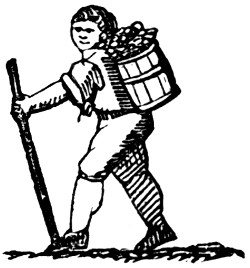
A Huxter.
Holme, in his heraldic language, says of this representation, “He beareth gules a man passant, his shirt or shift turned up to his shoulder, breeches and hose azure, cap and shoes sable, bearing on his back a bread basket full of fruits and herbs, and a staff in his left hand, or. This may be termed either a huxter or a gardiner, having his fruits and herbs on his back from the market. This was a fit crest for the company of Fruiterers or Huxters.” This man is a costard-monger in Mr. Archdeacon Nares’s view of the term; for doubtless the huckster pitched his load in the market and sold it there; yet Holme does not give him that denomination, as he would have done if he had so regarded him; he merely calls him “the hutler or huxter.”
Packington’s Pound.
Concerning the air of this old song, “Hawkins’s History of Music” may be consulted. The tune may also be found in the “Beggar’s Opera,” adapted to the words—“The gamesters united in friendship are found.”[275]
Court of Pie Powder.
This is the lowest, and at the same time the most expeditious, court of justice known to the law of England. It is a court of record incident to every fair and market; its jurisdiction extends to administer justice for all commercial injuries done in that very fair or market, and not in any preceding one; and to every fair and market, the steward of him who owns the toll is the judge. The injury, therefore, must be done, complained of, and redressed, within the compass of one and the same day, unless the fair continues longer. It has cognizance of all matters of contract that can possibly arise within the precinct of that fair or market; and the plaintiff must make oath that the cause of an action arose there. This court seems to have arisen from the necessity of doing justice expeditiously, among persons resorting from distant places to a fair or market, without leaving them to the remedy of an inferior court, which might not be able to serve its process, or execute its judgments on both, or perhaps either of the parties; and therefore without such a court as this, the complaint must necessarily have resorted to, in the first instance, some superior judicature. It is said to be called the court of pie-poudre, curia pedis pulverizati, from the dusty feet of the suitors; or, as sir Edward Coke says, because justice is there done as speedily as dust can fall from the feet: but Blackstone, who says thus much of this court, inclines to the opinion of Daines Barrington, who derives it from pied puldreaux, (a pedlar, in old French,) and says, it signifies, therefore, the court of such petty chapmen as resort to fairs or markets.
Courts similar to pie-powder courts were usual both with Greeks and Romans, who introduced fairs into Germany and the north.[276]
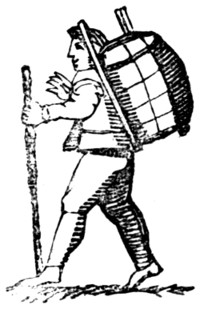
The Pedlar.
This is his figure from Randle Holme, who describes him thus:—“He beareth argent, a crate carrier, with a crate upon his back, or; cloathed in russed, with a staffe in his left hand; hat and shoes sable.” He observes, that “this is also termed a pedlar and his pack,” and he carefully notes that the difference between a porter and a pedlar consists in this, that “the porter’s pack reacheth over his head and so answerable below; but the pedlar’s is a small truss, bundle, or fardel, not exceeding the middle of his head as in this figure.” Every reader of Shakspeare knows the word “fardel:”—
———“Who would fardels bear To groan and sweat under a weary life,” &c.
Fardel means a burden, or bundle, or pack, and so Holme has called the pedlar’s pack. The word is well known in that sense to those acquainted with our earlier language. An Act of common council of the first of August, 1554, against “Abuses offered to Pauls,” recites, that the inhabitants of London, and others, were accustomed to make their common carriage of “fardels of stuffe, and other grosse wares and things thorow the cathedrall church of Saint Pauls,” and prohibits the abuse. There is an old book entitled, “a Fardel of Fancies;” that is, a variety of fancies fardelled or packed together in a bundle or burthen.
“Fancies” was a name for pleasant ballads, or poetical effusions;—and hence, because Orlando “hangs odes upon hawthorns, and elegies on brambles, all, forsooth, deifying the name of Rosalind,” she calls him a “fancy monger.”
The Porter.
It is to be noted too, that a porter is clearly described by Holme. “He beareth vert, a porter carrying of a pack, argent, corked, sable; cloathed in tawney, cap and shoes sable. This is the badge and cognizance of all porters and carriers of burthens;” but that there may be no mistake, he adds, “they have ever a leather girdle about them, with a strong rope of two or three fouldings hanging thereat, which they have in readiness to bind the burdens to their backs whensoever called thereunto.”
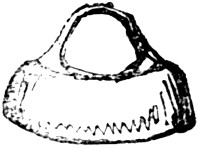
The Porter’s Knot, now used,
did not exist in Randle Holme’s time. This subsequent invention consists of a strong fillet to encircle the head, attached to a curiously stuffed cushion of the width of the shoulders, whereon it rests, and is of height sufficient to bear thereon a box, or heavy load of any kind, which, by means of this knot, is carried on the head and shoulders; the weight thereof being borne equally by the various powers of the body capable of sustaining pressure, no muscles are distressed, but the whole are brought to the porter’s service in his labour of carrying.
“Bartholomew Faire,” a rare quarto tract printed in 1641, under that title states, that “Bartholomew Faire begins on the twenty-fourth day of August, and is then of so vast an extent, that it is contained in no lesse than four several parishes, namely, Christ Church, Great and Little St. Bartholomewes, and St. Sepulchres. Hither resort people of all sorts and conditions. Christ Church cloisters are now hung full of pictures. It is remarkable and worth your observation to beholde and heare the strange sights and confused noise in the Faire. Here, a knave in a foole’s coate, with a trumpet sounding, or on a drumme beating, invites you to see his puppets: there, a rogue like a wild woodman, or in an antick shape like an Incubus, desires your company to view his motion: on the other side, Hocus Pocus, with three yards of tape, or ribbin, in’s hand, shewing his art of legerdemaine, to the admiration and astonishment of a company of cockoloaches. Amongst these, you shall see a gray Goose-cap, (as wise as the rest,) with a what do ye lacke in his mouth, stand in his boothe, shaking a rattle, or scraping on a fiddle, with which children are so taken, that they presentlie cry out for these fopperies: and all these together make such a distracted noise, that you would thinck Babell were not comparable to it. Here there are also your gamesters in action: some turning of a whimsey, others throwing for pewter, who can quickly dissolve a round shilling into a three halfepeny saucer. Long-lane at this time looks very faire, and puts out her best cloaths, with the wrong side outward, so turn’d for their better turning off: and Cloth Faire is now in great request: well fare the ale-houses therein, yet better may a man fare, (but at a dearer rate,) in the pig-market, alias Pasty-Nooke, or Pye-Corner, where pigges are al houres of the day on the stalls piping hot, and would cry, (if they could speak,) ‘come eate me.’”
Pye Corner.
This is the place wherein Ben Jonson’s Littlewit, the proctor, willed that his wife Win-the-fight should not eat Bartholomew pig:—“Long to eat of a pig, sweet Win, i’ the Fair; do you see? i’ the heart o’ the Fair; not at, Pye-corner.”
“Pye-corner was so called” says Dr. (James) Howel, “of such a sign, sometimes a fair Inne, for receipt of travellers, but now devided into tenements.” It was at Pye-corner as observed before, that the Fire of London ended: the houses that escaped were taken down in October, 1809, and upon their site other dwelling-houses have been erected, together with an engine-house, belonging to the Hope Fire Assurance company,[277] where it stands at present (in 1825). It was estimated in the year 1732, that “the number of sucking pigs then annually consumed in this city, (of London) amounted to fifty-two thousand[278].”
Roast Pig.
“A flower—cropped in its prime.”
Elia, author of the incomparable volume of “Essays,” published “under that name,” by Messrs. Taylor and Hessey, indulges in a “Dissertation upon Roast Pig.” He cites a Chinese MS. to establish its origin, when flesh was eaten uncooked, and affirms that “the period is not obscurely hinted at by the great Confucius, in the second chapter of his ‘Mundane Mutations,’ where he designates a kind of golden age by the term Cho-fang, literally the cooks’ holiday.” He premises “broiling to be the elder brother of roasting,” and relates on the authority of the aforesaid MS. that “roast pig” “was accidentally discovered in the manner following”—viz.
“The swine-herd, Ho-ti, having gone out into the woods one morning, as his manner was, to collect mast for his hogs, left his cottage in the care of his eldest son Bo-bo, a great lubberly boy, who, being fond of playing with fire, as younkers of his age commonly are, let some sparks escape into a bundle of straw, which, kindling quickly, spread the conflagration over every part of their poor mansion, till it was reduced to ashes. Together with the cottage (a sorry antediluvian makeshift of a building, you may think it), what was of much more importance, a fine litter of new-farrowed pigs, no less than nine in number, perished. China pigs have been esteemed a luxury all over the east from the remotest periods that we read of. Bo-bo was in the utmost consternation, as you may think, not so much for the sake of the tenement, which his father and he could easily build up again with a few dry branches, and the labour of an hour or two, at any time, as for the loss of the pigs. While he was thinking what he should say to his father, and wringing his hands over the smoking remnants of one of those untimely sufferers, an odour assailed his nostrils, unlike any scent which he had before experienced. What could it proceed from?—not from the burnt cottage—he had smelt that smell before—indeed this was by no means the first accident of the kind which had occurred through the negligence of this unlucky young fire-brand. Much less did it resemble that of any known herb, weed, or flower. A premonitory moistening at the same time overflowed his nether lip. He knew not what to think. He next stooped down to feel the pig, if there were any signs of life in it. He burnt his fingers, and to cool them he applied them in his booby fashion to his mouth. Some of the crums of the scorched skin had come away with his fingers, and for the first time in his life (in the world’s life indeed, for before him no man had known it), he tasted—crackling! Again he felt and fumbled at the pig. It did not burn him so much now, still he licked his fingers from a sort of habit. The truth at length broke into his slow understanding, that it was the pig that smelt so, and the pig that tasted so delicious; and, surrendering himself up to the newborn pleasure, he fell to tearing up whole handfuls of the scorched skin with the flesh next it, and was cramming it down his throat in his beastly fashion, when his sire entered amid the smoking rafters, armed with a retributory cudgel, and finding how affairs stood, began to rain blows upon the young rogue’s shoulders as thick as hailstones, which Bo-bo heeded not any more than if they had been flies. The tickling pleasure, which he experienced in his lower regions, had rendered him quite callous to any inconveniences he might feel in those remote quarters. His father might lay on, but he could not beat him from his pig.”
Bo-bo in the afternoon, regardless of his father’s wrath, and with his “scent wonderfully sharpened since morning, soon raked out another pig, and fairly rending it asunder, thrust the lesser half by main force into the fists of Ho-ti, still shouting out, ‘Eat, eat, eat, the burnt pig, father; only taste—O Lord!’—with such like barbarous ejaculations, cramming all the while as if he would choke.” The narrative relates, that “Ho-ti trembled every joint while he grasped the abominable thing, wavering whether he should not put his son to death for an unnatural young monster, when the crackling scorching his fingers, as it had done his son’s, and applying the same remedy to them, he in his turn tasted some of its flavour, which, make what sour mouths he would for a pretence, proved not altogether displeasing to him. In conclusion, (for the manuscript here is a little tedious,) both father and son fairly set down to the mess, and never left off till they had despatched all that remained of the little.
“Bo-bo was strictly enjoined not to let the secret escape, for the neighbours would certainly have stoned them for a couple of abominable wretches, who could think of improving upon the good meat which God had sent them. Nevertheless, strange stories got about. It was observed that Ho-ti’s cottage was burnt down now more frequently than ever. Nothing but fires from this time forward. Some would break out in broad day, others in the night-time. As often as the sow farrowed, so sure was the house of Ho-ti to be in a blaze; and Ho-ti himself, which was the more remarkable, instead of chastising his son, seemed to grow more indulgent to him than ever. At length they were watched, the terrible mystery discovered, and father and son summoned to take their trial at Pekin, then an inconsiderable assize town. Evidence was given, the obnoxious food itself produced in court, and verdict about to be pronounced, when the foreman of the jury begged that some of the burnt pig, of which the culprits stood accused, might be handed into the box. He handled it, and they all handled it, and burning their fingers, as Bo-bo and his father had done before them, and nature prompting to each of them the same remedy, against the face of all the facts, and the clearest charge which judge had ever given,—to the surprise of the whole court, townsfolk, strangers, reporters, and all present—without leaving the box, or any manner of consultation whatever, they brought in a simultaneous verdict of Not Guilty.
“The judge, who was a shrewd fellow, winked at the manifest iniquity of the decision; and, when the court was dismissed, went privily, and bought up all the pigs that could be had for love or money. In a few days his lordship’s town house was observed to be on fire. The thing took wing, and now there was nothing to be seen but fires in every direction. Fuel and pigs grew enormously dear all over the district. The insurance offices one and all shut up shop. People built slighter and slighter every day, until it was feared that the very science of architecture would in no long time be lost to the world. Thus this custom of firing houses continued, till in process of time, says my manuscript, a sage arose, like our Locke, who made a discovery, that the flesh of swine, or indeed of any other animal, might be cooked (burnt, as they called it,) without the necessity of consuming a whole house to dress it. They first began the rude form of a gridiron. Roasting by the string, or spit, came in a century or two later, I forget in whose dynasty. By such slow degrees, concludes the manuscript, do the most useful, and seemingly the most obvious arts, make their way among mankind.”
Elia maintains, that of all the delicacies in the whole eatable world, “roast pig” is the most delicate.—“I speak,” he says, “not of your grown porkers—things between pig and pork—those hobbydehoys—but a young and tender suckling—under a moon old—guiltless as yet of the sty,” with “his voice as yet not broken, but something between a childish treble and a grumble—the mild forerunner, or præludium, of a grunt.
“He must be roasted. I am not ignorant that our ancestors ate them seethed, or boiled—but what a sacrifice of the exterior tegument!
“There is no flavour comparable, I will contend, to that of the crisp, tawny, well-watched, not over-roasted crackling, as it is well called—the very teeth are invited to their share of the pleasure at this banquet in overcoming the coy, brittle resistance—with the adhesive oleaginous—O call it not fat—but an indefinable sweetness growing up to it—the tender blossoming of fat—fat cropped in the bud—taken in the shoot—in the first innocence—the cream and quintessence of the child-pig’s yet pure food—the lean, no lean, but a kind of animal manna—or, rather fat and lean (if it must be so) so blended and running into each other, that both together make but one ambrosial result, or common substance.
“Behold him while he is doing—it seemeth rather a refreshing warmth, than a scorching heat, that he is so passive to. How equally he twirleth round the string!—Now he is just done. To see the extreme sensibility of that tender age, he hath wept out his pretty eyes—radiant jellies—shooting stars.
“See him in the dish, his second cradle, how meek he lieth!—wouldst thou have had this innocent grow up to the grossness and indocility which too often accompany maturer swinehood? Ten to one he would have proved a glutton, a sloven, an obstinate, disagreeable animal—wallowing in all manner of filthy conversation—from these sins he is happily snatched away—
Ere sin could blight, or sorrow fade, Death came with timely care—
his memory is odoriferous—no clown curseth, while his stomach half rejecteth, the rank bacon—no coalheaver bolteth him in reeking sausages—he hath a fair sepulchre in the grateful stomach of the judicious epicure—and for such a tomb might be content to die.”
Elia further allegeth of “pig,” that “the strong man may batten on him, and the weakling refuseth not his mild juices. He is—good throughout. No part of him is better or worse than another. He helpeth, as far as his little means extend, all around. He is the least envious of banquets. He is all neighbours’ fare.”
“I am one of those,” continueth Elia, “who freely and ungrudgingly impart a share of the good things of this life which fall to their lot (few as mine are in this kind) to a friend. I protest, I take as great an interest in my friend’s pleasures, his relishes, and proper satisfactions, as in mine own. ‘Presents,’ I often say, ‘endear absents.’ Hares, pheasants, partridges, snipes, barn-door chickens (those ‘tame villatic fowl’), capons, plovers, brawn, barrels of oysters, I dispense as freely as I receive them. I love to taste them, as it were, upon the tongue of my friend. But a stop must be put somewhere. One would not, like Lear, ‘give every thing.’ I make my stand upon pig. * * *
“I remember an hypothesis, argued upon by the young students, when I was at St. Omer’s, and maintained with much learning and pleasantry on both sides, ‘Whether, supposing that the flavour of a pig who obtained his death by whipping (per flagellationem extremam) superadded a pleasure upon the palate of a man more intense than any possible suffering we can conceive in the animal, is man justified in using that method of putting the animal to death?’ I forget the decision.
“His sauce should be considered. Decidedly, a few bread crums, done up with his liver and brains, and a dash of mild sage. But banish, dear Mrs. Cook, I beseech you, the whole onion tribe. Barbacue your whole hogs to your palate, steep them in shallots, stuff them out with plantations of the rank and guilty garlic; you cannot poison them, or make them stronger than they are—but consider, he is a weakling—a flower.”
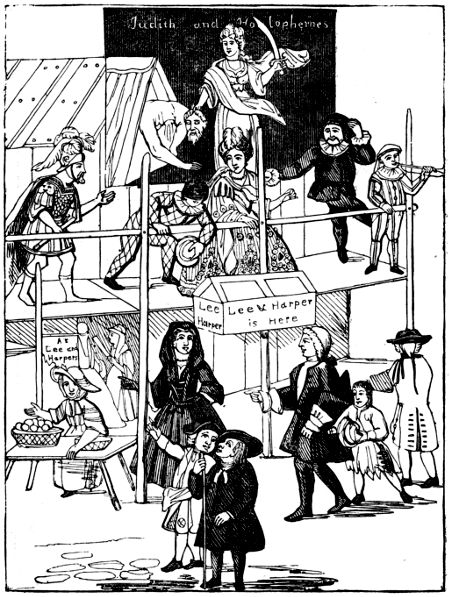
Part of Bartholomew Fair, 1721.
The two engravings whereon the reader now looks, are from a very curious scenic print of this Fair, as represented on an old fan, recently published by Mr. Setchel, of King-street, Covent-garden. The letter-press account subjoined to Mr. Setchel’s print says, that “about the year 1721, when the present interesting view of this popular Fair was taken, the drama was considered of some importance, and a series of minor, although regular, pieces, were acted in its various booths. At Lee and Harper’s, the ‘Siege of Berthulia’ is performing, in which is introduced the tragedy of ‘Holophernes.’”
Mr. Setchel’s account further represents, that “Persons of rank were also its occasional visitors, and the figure on the right (with the star) is also supposed to be that of sir Robert Walpole, then prime minister. Fawkes, the famous conjuror, forms a conspicuous feature, and is the only portrait of him known to exist.”
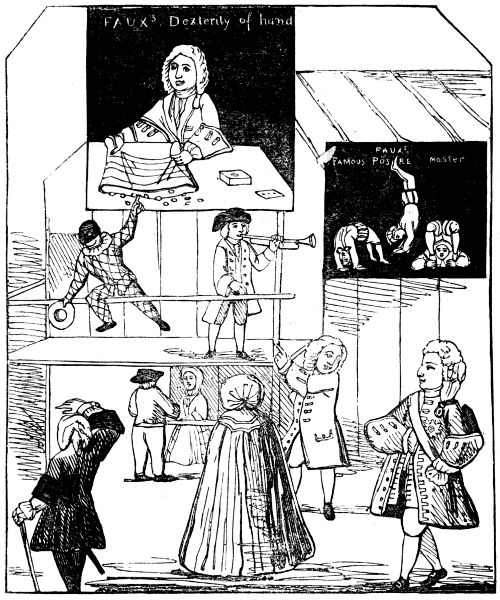
Another Part in the same Fair.
There is however, another portrait of Fawkes, the conjuror: it is a sheet, engraved by Sutton Nichols, representing him in the midst of his performances. Hogarth’s frontispiece to a scarce tract on “Taste,” wherein he bespatters Burlington-gate, further tends to perpetuate Fawkes’s fame, by an inscription announcing his celebrated feats. It is recorded, too, in the first volume of the “Gentleman’s Magazine,” that on the 15th of February, 1731, the Algerine ambassadors went to see Mr. Fawkes, who, at their request, showed them a prospect of Algiers, “and raised up an apple-tree, which bore ripe apples in less than a minute’s time, which several of the company tasted of.” This was one of his last performances, for, in the same volume, his name is in the list of “Deaths,” on the 25th of May, that year, thus: “Mr. Fawkes, noted for his dexterity of hand, said to die worth 10,000l.” The newspapers of the period relate, that “he had honestly acquired” it, by his “dexterity,” and add, that it was “no more than he really deserved for his great ingenuity, by which he had surpassed all that ever pretended to that art. It will be observed from the show-cloth of the tumblers, that Fawkes was also a “famous posture-master:—
The tumbler whirls the flip-flap round, With sommersets he shakes the ground; The cord beneath the dancer springs; Aloft in air the vaulter swings, Distorted now, now prone depends, Now through his twisted arms descends; The crowd in wonder and delight, With clapping hands applaud the sight.
Gay.
On the platform of Lee and Harper’s show, with “Judith and Holophernes,” in Mr. Setchel’s print, which is handsomely coloured in the manner of the fan, the clown, behind the trumpeter, is dressed in black. The lady who represents Judith, as she is painted on the show-cloth, is herself on the platform, with feathers on her head; the middle feather is blue, the others red. She wears a laced stomacher, white hanging sleeves with rosettes, and a crimson petticoat with white rosettes in triangles, and suitably flounced. Holophernes, in a rich robe lined with crimson and edged with gold lace, wears light brown buskins, the colour of untanned leather; Harlequin, instead of the little flat three-corner flexible cap, wherein he appears at our present theatres, has a round beaver of the same light colour. Two females entering at the door below are, apparently, a lady and her maid; the first is in green, and wears a cap with lappets falling behind, and white laced ruffles; the other, with a fan in her hand, is in a tawny gown, striped with red, and cuffs of the same; the lady and gentleman in mourning are evidently about to follow them. From hence we see the costume of the quality, and that at that time Bartholomew Fair was honoured with such visitors.
The boy picking the gentleman’s pocket is removed from another part of Mr. Setchel’s print, which could not be included in the present engraving, to show that the artist had not forgotten to represent that the picking of pockets succeeded to the cutting of purses. The person in black, whose gaze the baker, or man with the apron, is directing with his finger, looks wonderfully like old Tom Hearne. Indeed, this fan-print is exceedingly curious, and indispensable to every “illustrator of Pennant,” and collector of manners. In that print to the right of Lee and Harper’s is another show, with “Rope-dancing is here,” on a show-cloth, representing a female with a pole on the tight-rope; a stout middle-aged man, in a green coat, and leather breeches, walks the platform and blows a trumpet; the door below is kept by a woman, and the figures on the printed posting-bills against the boards exhibit a man on the tight-rope, and two slack-ropes; a figure is seated and swinging on one rope, and on the other a man swings by the hams, with his head downward: the bills state this to be “At the great booth over against the hospital-gate in Smithfield.” Near to where the hospital-gate may be supposed to stand is a cook, or landlord, at the door of a house, with “Right Redstreak Cyder, at per quart,” on the jamb; on the other jamb, a skittle is painted standing on a ball, and an inscription “Sketle ground;” above his head, on a red portcullis-work, is the sign of a punch-bowl and ladle, inscribed “Fine punch;” at the window-way of the house hang two Bartholomew “pigs with curly tails,” and a side of large pork.
There is an “up and down,” or swing, of massive wood-work, with two children in three of the boxes, and one empty box waiting for another pair. Then there is a spacious sausage-stall; a toy-stall, kept by a female, with bows, halberts, rattles, long whistles, dolls, and other knick-knackeries: a little boy in a cocked hat is in possession of a large halbert, and his older sister is looking wistfully at a Chinese doll on the counter; a showman exhibits the “Siege of Gibraltar” to two girls looking through the glasses. These are part of the amusements which are alluded to, in the inscription on the print now describing, as “not unlike those of our day, except in the articles of Hollands and gin, with which the lower orders were then accustomed to indulge, unfettered by licence or excise.” A man with tubs of “Right Hollands Geneva, and Anniseed,” having a cock in each, is serving a bearded beggar with a wooden-leg to a glass, much nearer to the capacity of half a pint, than one of “three outs” of the present day; while a woman, with a pipe in one hand, holds up a full spirit-measure, of at least half a pint, to her own share; there is toping from a barrel of “Geneva” at another stall; and the postures of a couple of oyster-women denote that the uncivil provocative has raised the retort uncourteous. The visit of sir Robert Walpole to this scene might have suggested to him, that his licence and excise scheme, afterwards so unpopular, though ultimately carried, would aid a reformation of manners.
Lady Holland’s Mob.
On the night before the day whereon the lord mayor proclaims the Fair, a riotous assemblage of persons heretofore disturbed Smithfield and its environs, under the denomination of “Lady Holland’s mob.” This multitude, composed of the most degraded characters of the metropolis, was accustomed to knock at the doors and ring the bells, with loud shouting and vociferation; and they often committed gross outrages on persons and property. The year 1822, was the last year wherein they appeared in any alarming force, and then the inmates of the houses they assailed, or before which they paraded, were aroused and kept in terror by their violence. In Skinner-street, especially, they rioted undisturbed until between three and four in the morning: at one period that morning their number was not less than five thousand, but it varied as parties went off, or came in, to and from the assault of other places. Their force was so overwhelming, that the patrol and watchmen feared to interfere, and the riot continued till they had exhausted their fury.
It has been supposed that this mob first arose, and has been continued, in celebration of a verdict obtained by a Mr. Holland, which freed the Fair from toll; but this is erroneous. “Lady Holland’s mob” may be traced so far back as the times of the commonwealth, when the ruling powers made considerable efforts to suppress the Fair altogether; and when, without going into particulars to corroborate the conjecture, it may be presumed that the populace determined to support what they called their “charter,” under the colour of the “Holland” interest, in opposition to the civic authorities. The scene of uproar always commenced in Cloth-fair, and the present existence of an annual custom there, throws some light on the matter. At “the Hand and Shears,” a public-house in that place, it is the usage, at this time, for tailors to assemble the night before the Fair is proclaimed by the lord mayor. They appoint a chairman, and exactly as the clock strikes twelve, he and his companions, each with a pair of shears in his hand, leave the house, and, in the open street of Cloth-fair, the chairman makes a speech and proclaims “Bartholomew Fair.” As soon as he concludes, every tailor holds up and snaps his shears with a shout, and they retire, shears in hand, snapping and shouting, to the “Hand and Shears,” from whence they came forth; but the mob, who await without, to witness the ceremony, immediately upon its being ended, run out into Smithfield, and being joined by others there shout again. This second assemblage and shouting is called “the mob proclaiming the Fair;” and so begins the annual mob, called “Lady Holland’s mob.” Since 1822, the great body have confined their noise to Smithfield itself, and their number and disorder annually decrease.
ORIGIN OF Bartholomew Fair.
About the year 1102, in the reign of Henry I., the priory, hospital, and church of St. Bartholomew, in Smithfield, were founded by one Rahere, a minstrel of the king, and “a pleasant witted gentleman.” It seems that Rahere was determined to this pious work in a fit of sickness, during a pilgrimage he made to Rome agreeably to the fashion of the times, when St. Bartholomew appeared to him, and required him to undertake the work and perform it in Smithfield.[279] Before that time Smithfield, or the greater part of it, was called “the Elms,” because it was covered with elm trees; “since the which time,” saith Stow, “building there hath so increased that now remaineth not one tree growing.” Smithfield derives its name from its being “a plain or smooth field.”[280] Regarding Rahere’s occupation as a minstrel, it may be observed, that minstrels were reciters of poems, story tellers, performers upon musical instruments, and sometimes jugglers and buffoons. Rahere “ofte hawnted the kyng’s palice, and amo’ge the noyse-full presse of that tumultuous courte, enforsed hymselfe with jolite and carnal suavite: ther yn spectaclis, yn metys, yn playes, and other courtely mokkys, and trifyllis intrudyng, he lede forth the besynesse of alle the day.”[281] It is related of a person in this capacity, that he was employed by a king as a story teller, on purpose to lull him to sleep every night; and that the king’s requiring him to tell longer stories, the romancer began one of so great length, that he himself fell asleep in the midst of it.[282] Racine, the French poet, was scarcely higher employed when he was engaged in reading Louis XIV. to sleep with “Plutarch’s Lives:” to such a king the narratives of the philosophical biographer were fables.
Rahere was the first prior of his monastery. There was a remarkable visitation of it by Boniface, archbishop of Canterbury, who being received with a procession in a solemn manner, said he did not require that honour, but came to visit them; whereto the canons answered, that to submit to the visitation of any other than their own prelate, the bishop of London, would be in contempt of his authority; whereupon the archbishop conceiving great offence, struck the sub-prior in the face, and “raging, with oathes not to bee recited, hee rent in peeces the rich cope of the sub-prior, and trode it under his feete, and thrust him against a pillar of the chancell, with such violence that hee had almost killed him.” Then the canons dragged off the archbishop with so great force that they threw him backwards, and thus perceived that he was armed, and prepared to fight; and the archbishop’s followers falling upon the canons, beat and tore them, and trod them under foot; who thereupon ran bleeding with complaints of the violence to the bishop of London, who sent four of them to the king at Westminster, but he would neither hear nor see them. In the mean time, the city was in an uproar, and the people would “have hewed the archbishop into small peeces,” if he had not secretly withdrawn to Lambeth, from whence he went over to the king, “with a great complaint against the canons, whereas himself was guilty.”[283] How the affair ended does not appear.
Stow says, that “to this priory king Henry the second granted the priviledge of a Faire to bee kept yeerly at Bartholomew-tide, for three daies, to wit, the eve, the day, and the next morrow, to the which the clothiers of England, and drapers of London repaired, and had their boothes and standings within the church-yard of this priory, closed in with wals and gates locked every night, and watched for safety of mens goods and wares; a court of piepowders was daily during the Faire holden, for debts and contracts. But,” continues Stow, “notwithstanding all proclamations of the prince, and also the act of parliament, in place of booths within this church-yard (only letten out in the Faire time, and closed up all the yeere after) bee many large houses builded, and the north wall towards Long-lane taken downe, a number of tenements are there erected, for such as will give great rents. The forrainers,” he adds, “were licensed for three days, the freemen so long as they would, which was sixe or seven daies.” This was the origin of Bartholomew Fair, over which the charter of Henry II. gave the mayor and aldermen criminal jurisdiction during its continuance.
Bolton was the last prior of this house, to which he added many buildings, and built “the manor of Canonbury, at Islington, which belonged to the canons.” In 1554, on the dissolution of the religious houses, Henry VIII., in consideration of 1064l. 11s. 3d. granted to Richard Rich, knt. attorney-general, and chancellor of the court of augmentations of the revenues of the crown, the dissolved monastery or priory of St. Bartholomew, and the Close with the messuages and buildings therein appertaining to the monastery. He also granted to the said Richard Rich, knt. and to the inhabitants of the parish of St. Bartholomew, and the church of St. Bartholomew, all the void ground eighty seven feet in length, and sixty in breadth, adjoining the church westward, for a church-yard. In the first year of Edward VI. that king confirmed the grant to sir Richard Rich, who was created lord Rich, and appointed lord chancellor of England; but under Mary the ejected monks were restored to the priory, where they remained till the accession of queen Elizabeth, who renewed the grant to lord Rich and his heirs; and lord Rich took up his residence in Cloth-fair. The lord Rich ultimately became earl of Warwick and Holland, and the property regularly descended to the present lord Kensington, through William Edwards, who was son of the lady Elizabeth Rich, and created, in 1776, baron of Kensington of the kingdom of Ireland.
Henry VIII. having in this way disposed of the priory and church of St. Bartholomew, he gave the hospital, with certain messuages and appurtenances, to the city of London. When connected with the priory, it had been governed by a master, brethren, and eight sisters.
On the 13th of January, 1546, the bishop of Rochester (Holbetch,) preaching at Paul’s-cross, declared the gift of St. Bartholomew’s hospital to the citizens “for relieving of the poore;” and thereupon the inhabitants of the city were called together in their parish churches, where sir Richard Dobbs the lord mayor, the several aldermen, and other principal citizens, showing the great good of taking the poor from their miserable habitations, and providing for them in hospitals abroad, men were moved liberally to contribute what they would towards such hospitals, and so weekly, towards their maintenance for a time, until they were fully endowed; and in July 1552 the reparation of the St. Bartholomew’s hospital commenced, and it was endowed and furnished at the charges of the citizens.[284] The number of the poor and sick to be maintained therein, was limited under the foundation of Henry VIII. to one hundred; but, at this time, several thousands of persons who need surgical aid are annually received and relieved, under the management of the most eminent surgeons of our age.
Smithfield, whereon the Fair was held, was likewise a market-place for cattle, hay, straw, and other necessary provisions; and also, saith Stow, “it hath been a place for honourable justs and triumphs, by reason it was unpaid.” After it had ceased to be a place of recreative exercise with the gentry, loose serving men and quarrelsome persons resorted thither, and made uproars; and thus becoming the rendezvous of bullies and bravoes, it obtained the name of “Ruffians’-hall.” The “sword and buckler” were at that time in use, and a serving-man carried a buckler, or shield, at his back, which hung by the hilt or pommel of his sword hanging before him.[285] Fellows of this sort who hectored and blustered were called “Swash-bucklers,” from the noise they made with the “sword and buckler” to frighten an antagonist: “a bully,” or fellow all noise and no courage, was called a “swasher.”[286]
With the disuse of pageants, the necessity for Smithfield remaining a “soft ground” ceased; and, accordingly, as “it was continually subject to the iniquity of weather, and being a place of such goodly extendure, deserved to be much better respected, it pleased the king’s majesty, (James I.) with the advice of his honourable lords of the counsell, to write graciously to the lord maior and the aldermen his brethren, that Smithfield might be sufficiently paved, which would bee the onely meanes, whereby to have it kept in far cleaner condition: And” says Stow, “as no motion (to any good end and intent) can be made to the city, but they as gladly embrace and willingly pursue it; even so this honourable motion found as acceptable entertainment, and it was very speedily proceeded withall. Some voluntary contribution in the severall parishes (what each man willingly would give) was bestowed on the worke; but, (indeed,) hardly deserving any report. Notwithstanding, on the fourth day of February, in An. 1614, the city began the intended labour, and before Bartholomew-tide then next ensuing, to the credit and honour of the city for ever, it was fully finished, and Bartholomew Faire there kept, without breaking any of the paved ground, but the boothes discreetly ordered, to stand fast upon the pavement. The citizens charge thereof (as I have been credibly told by Master Arthur Strangwaies,) amounting well neere to sixteene hundred pounds.” This improvement, it will be remembered, was effected in the year wherein Ben Jonson’s “Bartholomew Fair” was written.
In “The Order observed by the lord maior, the aldermen, and sheriffes for their meetings, and wearing of their apparell throughout the whole yeere,” it is ordained, That
“On Bartholomew Eve for the Fayre in Smithfield:—
“The aldermen meete the lord maior and the sheriffes at the Guildhall chappel, at two of the clocke after dinner, having on their violet gownes lined, and their horses, but without their cloakes, and there they heare evening prayer. Which being done, they mount on their horses, and riding to Newgate, passe forth of the gate. Then entring into the Cloth-fayre, there they make a proclamation, which proclamation being ended, they ride thorow the Cloth-fayre, and so returne backe againe thorow the church-yard of great Saint Bartholomewes to Aldersgate: and then ride home againe to the lord maior’s house.”
In the same collection of ordinances:—
“On Bartholomew Day for the Wrastling.
“So many aldermen as doe dine with the lord maior, and the sheriffes, are apparelled in their scarlet gownes lined; and after dinner, their horses are brought to them where they dined. And those aldermen which dine with the sheriffes, ride with them to the lord maior’s house for accompanying him to the wrastlings. When as the wrastling is done, they mount their horses, and ride backe againe thorow the Fayre, and so in at Aldersgate, and then home againe to the lord maior’s house.”
“The Shooting Day.
“The next day, (if it be not Sunday,) is appointed for the shooting, and the service performed as upon Bartholomew-day; but if it bee Sunday, the Sabbath-day, it is referred to the Munday then following.”
Ben Jonson’s mention, in his “Bartholomew Fair,” of “the western man who is come to wrestle before the lord mayor anon,” is clearly of one who came up to the annual wrestling on Bartholomew’s-day. Concerning this “annual wrastling,” it is further noticed by Stow in another place, that about the feast of St. Bartholomew, wrestling was exhibited before the lord mayor and aldermen, at Skinnerswell near Clerkenwell, where they had a large tent for their accommodation. He speaks of it as having been a practice “of old time;” and affirms that “divers days were spent in the pastime, and that the officers of the citie, namely the sheriffes, serjeants, and yeomen, the porters of the king’s beame, or weigh-house, (now no such men,” says Stow,) “and other of the citie were challengers of all men in the suburbs, to wrestle for games appointed: and on other days, before the said mayor, aldermen, and sheriffes, in Fensbury-field, to shoot the standard, broad arrow, and flight, for games. But now of late yeeres,” Stow adds, “the wrestling is only practiced on Bartholomew-day in the afternoone, and the shooting some three or foure days after, in one afternoone and no more.” Finally, the old chronicler laments, that “by the means of closing in of common grounds, our archers, for want of roome to shoot abroad creepe into bowling-alleys, and ordinarie dicing houses, neerer home, where they have roome enough to hazzard their money at unlawful games, and there I leave them to take their pleasures.” Another narrator tells of the wrestlers before the lord mayor, aldermen, &c. on Bartholomew’s-day that they wrestled “two at a time;” he says “the conquerors are rewarded by them by money thrown from the tent; after this a parcel of wild rabbits are turned loose in the crowd, and hunted by boys with great noise, at which the mayor and aldermen do much besport themselves.”[287]
It was on St. Bartholomew’s-eve that the London scholars held logical disputations about the principles of grammar. “I myself,” says Stow, “have yeerely seen the scholars of divers grammar-schools, repaire unto the churchyard of St. Bartholomew, the priory in Smithfield, where, upon a banke boorded about under a tree, some one scholler hath stepped up, and there hath opposed and answered, till he were by some better scholler overcome and put downe; and then the overcommer taking the place, did like as the first; and in the end, the best opposers and answerers had rewards.” These disputations ceased at the suppression of the priory, but were revived, though, “only for a yeare or waine,” under Edward VI., where the best scholars received bows, and arrows of silver, for their prizes.
The Bartholomew Fair of 1655, is the subject of
An Ancient Song of Bartholomew Fair.
In fifty-five, may I never thrive, If I tell you any more than is true, To London che came, hearing of the fame Of a Fair they call Bartholomew. In houses of boards, men walk upon cords, As easie as squirrels crack filberds; But the cut-purses they do lite, and rub away, But those we suppose to be ill birds. For a penny you may zee a fine puppet play, And for two-pence a rare piece of art; And a penny a cann, I dare swear a man, May put zix of ’em into a quart. Their zights are so rich, is able to bewitch The heart of a very fine man-a; Here’s patient Grizel here, and Fair Rosamond there, And the history of Susanna. At Pye-corner end, mark well, my good friend, ’Tis a very fine dirty place; Where there’s more arrows and bows, the Lord above knows, Than was handl’d at Chivy Chase. Then at Smithfield Bars, betwixt the ground and the stars, There’s a place they call Shoemaker Row, Where that you may buy shoes every day, Or go barefoot all the year I tro’.[288]
In 1699, Ned Ward relates his visit to the Fair:—
“We ordered the coachman to set us down at the Hospital-gate, near which we went into a convenient house to smoke a pipe, and overlook the follies of the innumerable throng, whose impatient desires of seeing Merry Andrew’s grimaces, had led them ancle deep into filth and nastiness.—The first objects, when we were seated at the window that lay within our observation, were the quality of the Fair, strutting round their balconies in their tinsey robes, and golden leather buckskins, expressing such pride in their buffoonery stateliness, that I could but reasonably believe they were as much elevated with the thought of their fortnight’s pageantry, as ever Alexander was with the thought of a new conquest looking with great contempt from their slit deal thrones, upon the admiring mobility gazing in the dirt at our ostentatious heroes, and their most supercilious doxies, who looked as aukward and ungainly in their gorgeous accoutrements, as an alderman’s lady in her stiffen-bodied gown upon a lord mayor’s festival.”[289]
At the Fair of 1701, there was exhibited a tiger which had been taught to pluck a fowl’s feathers from its body.
In the reign of queen Anne the following curious bill relates part of the entertainment at one of the shows:—
“By her majesty’s permission, at Heatly’s booth, over against the Cross Daggers, next to Mr. Miller’s booth, during the time of Bartholomew Fair, will be presented a little opera, called The Old Creation of the World new Revived, with the addition of the glorious battle obtained over the French and Spaniards by his grace the duke of Marlborough. The contents are these, 1. The creation of Adam and Eve. 2. The intrigues of Lucifer in the garden of Eden. 3. Adam and Eve driven out of Paradise. 4. Cain going to plow; Abel driving sheep. 5. Cain killeth his brother Abel. 6. Abraham offereth up his son Isaac. 7. Three wise men of the east, guided by a star, come and worship Christ. 8. Joseph and Mary flee away by night upon an ass. 9. King Herod’s cruelty; his men’s spears laden with children. 10. Rich Dives invites his friends, and orders his porter to keep the beggars from his gate. 11. Poor Lazarus comes a begging at rich Dives’ gate, the dogs lick his sores. 12. The good angel and Death contend for Lazarus’s life. 13. Rich Dives is taken sick, and dieth; he is buried in great solemnity. 14. Rich Dives in hell, and Lazarus in Abraham’s bosom, seen in a most glorious object, all in machines descending in a throne, guarded with multitudes of angels; with the breaking of the clouds, discovering the palace of the sun, in double and treble prospects, to the admiration of all the spectators. Likewise several rich and large figures, which dance jiggs, sarabands, anticks, and country dances, between every act; compleated with the merry humours of Sir Jno. Spendall and Punchinello, with several other things never exposed. Performed by Matt. Heatly. Vivat Regina.”
A writer in the “Secret Mercury,” of September 9, 1702, says, “Wednesday, September 3, having padlocked my pockets, and trimmed myself with Hudibras from head to foot, I set out about six for Bartholomew Fair; and having thrown away substantial silver for visionary theatrical entertainment, I made myself ready for the farce; but I had scarce composed myself, when bolts me into the pit a bully beau, &c. The curtain drew, and discovered a nation of beauish machines; their motions were so starched, that I began to question whether I had mistaken myself, and Dogget’s booth for a puppet-show. As I was debating the matter, they advanced towards the front of the stage, and making a halt, began a singing so miserably, that I was forced to tune my own whistle in romance ere my brains were set straight again. All the secret I could for my life discover in the whole grotesque, was the consistency of drift of the piece, which I could never demonstrate to this hour. At last, all the childish parade shrunk off the stage by matter and motion, and enter a hobletehoy of a dance, and Dogget, in old woman’s petticoats and red waistcoat, as like Progue Cock as ever man saw; it would have made a stoic split his lungs, if he had seen the temporary harlot sing and weep both at once; a true emblem of a woman’s tears. When these Christmas carols were over, enter a wooden horse; now I concluded we should have the ballad of Troy-town, but I was disappointed in the scene, for a dancing-master comes in, begins complimenting the horse, and fetching me three or four run-bars with his arm, (as if he would have mortified the ox at one blow,) takes a frolic upon the back of it, and translates himself into cavalry at one bound; all I could clap was the patience of the beast. However, having played upon him about half a quarter, the conqueror was pursued with such a clangor from the crusted clutches of the mob in the sixpenny place, that for five minutes together I was tossed on this dilemma, that either a man had not five senses, or I was no man. The stage was now overrun with nothing but merry-andrews and pickle-herrings. This mountebank scene was removed at last, and I was full of expectations that the successor would be pills, pots of balsam, and orvietan; but, alas, they were half empirics, and therefore exeunt omnes.”
We learn something of the excesses at the Fair from “The Observator,” of August 21, 1703:—“Does this market of lewdness tend to any thing else but the ruin of the bodies, souls, and estates of the young men and women of the city of London, who here meet with all the temptations to destruction? The lotteries, to ruin their estates; the drolls, comedies, interludes, and farces, to poison their minds, &c. and in the cloisters what strange medley of lewdness has that place not long since afforded! Lords and ladies, aldermen and their wives, ’squires and fiddlers, citizens and rope-dancers, jack-puddings and lawyers, mistresses and maids, masters and ’prentices! This is not an ark, like Noah’s which received the clean and unclean; only the unclean beasts enter this ark, and such as have the devil’s livery on their backs.”
An advertisement in “The Postman,” of August 19, 1703, by “Barnes and Finley,” invites the reader to “see my lady Mary perform such curious steps on the dancing-rope,” &c. &c. Lady Mary is noticed in “Heraclitus Ridens,” No. 7. “Look upon the old gentleman; his eyes are fixed upon my lady Mary: Cupid has shot him as dead as a robin. Poor Heraclitus! he has cried away all his moisture, and is such a dotard to entertain himself with a prospect of what is meat for his betters; wake him out of his lethargy, and tell him the young noblemen and senators will take it amiss if a man of his years makes pretensions to what is more than a match for their youth. Those roguish eyes have brought her more admirers than ever Jenny Bolton had.”