FEBRUARY. (continued 2)
Reading edition
I understand the corporation of Kingston attempted to put a stop to this practice, but the judges confirmed the right of the game, and it now legally continues, to the no small annoyance of some of the inhabitants, besides the expense and trouble they are put to in securing all their windows.
I was rather surprised that such a custom should have existed so near London, without my ever before knowing of it.
From thy respected Friend,
N—— S——
Third Month, 1815.
J.—— B.——
Pancakes and Confession.
As fit—as a pancake for Shrove Tuesday.
Shakspeare.
Pancake Day is another name for Shrove Tuesday, from the custom of eating pancakes on this day, still generally observed. A writer in the “Gentleman’s Magazine, 1790,” says, that “Shrive is an old Saxon word, of which shrove is a corruption, and signifies confession. Hence Shrove Tuesday means Confession Tuesday, on which day all the people in every parish throughout the kingdom, during the Romish times, were obliged to confess their sins, one by one, to their own parish priests, in their own parish churches; and that this might be done the more regularly, the great bell in every parish was rung at ten o’clock, or perhaps sooner, that it might be heard by all. And as the Romish religion has given way to a much better, I mean the protestant religion, yet the custom of ringing the great bell in our ancient parish churches, at least in some of them, still remains, and obtains in and about London the name of Pancake-bell: the usage of dining on pancakes or fritters, and such like provision, still continues.” In “Pasquil’s Palinodia, 1634,” 4to. it is merrily observed that on this day every stomach
till it can hold no more, Is fritter-filled, as well as heart can wish; And every man and maide doe take their turne, And tosse their pancakes up for feare they burne; And all the kitchen doth with laughter sound, To see the pancakes fall upon the ground.
Threshing the Hen.
This singular custom is almost obsolete, yet it certainly is practised, even now, in at least one obscure part of the kingdom. A reasonable conjecture concerning its origin is, that the fowl was a delicacy to the labourer, and therefore given to him on this festive day, for sport and food.
At Shrovetide to shroving, go thresh the fat hen, If blindfold can kill her, then give it thy men. Maids, fritters and pancakes inough see you make, Let slut have one pancake, for company sake.
So directs Tusser in his “Five Hundred Points of Good Husbandry, 1620,” 4to. On this his annotator, “Tusser Redivivus, 1710,” (8vo. June, p. 15,) annexes an account of the custom. “The hen is hung at a fellow’s back, who has also some horse bells about him, the rest of the fellows are blinded, and have boughs in their hands, with which they chase this fellow and his hen about some large court or small enclosure. The fellow with his hen and bells shifting as well as he can, they follow the sound, and sometimes hit him and his hen, other times, if he can get behind one of them, they thresh one another well favour’dly; but the jest is, the maids are to blind the fellows, which they do with their aprons, and the cunning baggages will endear their sweethearts with a peeping-hole, whilst the others look out as sharp to hinder it. After this the hen is boil’d with bacon, and store of pancakes and fritters are made.”
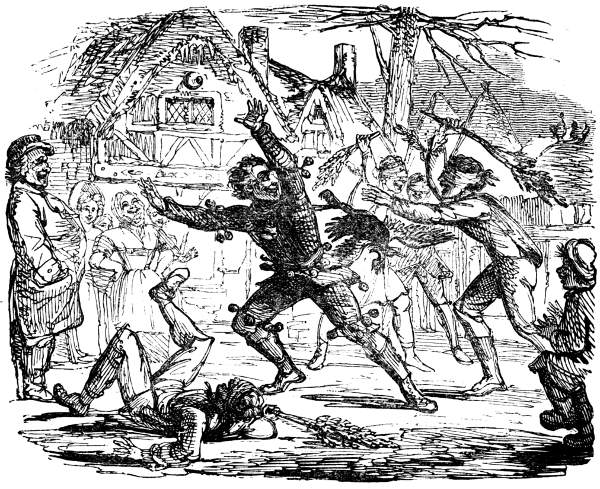
Threshing the Fat Hen at Shrovetide.
Tusser’s annotator, “Redivivus,” adds, after the hen-threshing. “She that is noted for lying a-bed long, or any other miscarriage, hath the first pancake presented to her, which most commonly falls to the dog’s share at last, for no one will own it their due. Thus were youth encourag’d, sham’d, and feasted with very little cost, and always their feasts were accompanied with exercise. The loss of which laudable custom, is one of the benefits we have got by smoking tobacco.” Old Tusser himself, by a reference, denotes that this was a sport in Essex and Suffolk. Mr. Brand was informed by a Mr. Jones that, when he was a boy in Wales, the hen that did not lay eggs before Shrove Tuesday was considered useless, and to be on that day threshed by a man with a flail; if he killed her he got her for his pains.
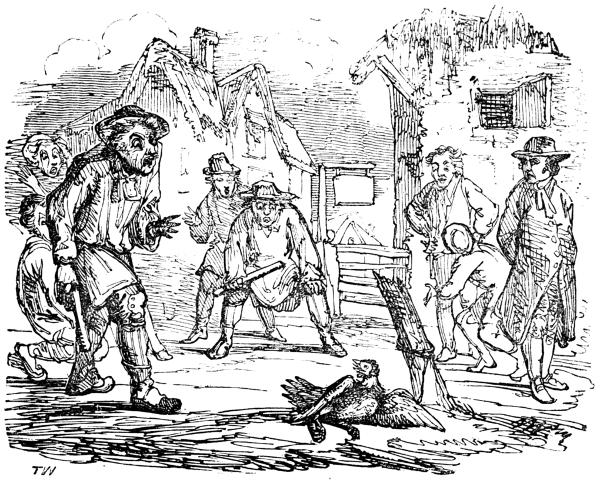
A Hen that spoke on Shrove Tuesday.
On Shrove Tuesday, at a certain ancient borough in Staffordshire, a hen was set up by its owner to be thrown at by himself and his companions, according to the usual custom on that day. This poor hen, after many a severe bang, and many a broken bone, weltering in mire and blood, recovered spirits a little, and to the unspeakable surprise and astonishment of all the company, just as her late master was handling his oaken cudgel to fling at her again, opened her mouth and said—“Hold thy hand a moment, hard-hearted wretch! if it be but out of curiosity, to hear one of my feathered species utter articulate sounds.—What art thou, or any of thy comrades, better than I, though bigger and stronger, and at liberty, while I am tied by the leg? What art thou, I say, that I may not presume to reason with thee, though thou never reasonest with thyself? What have I done to deserve the treatment I have suffered this day, from thee and thy barbarous companions? Whom have I ever injured? Did I ever profane the name of my creator, or give one moment’s disquiet to any creature under heaven? or lie, or deceive, or slander, or rob my fellow-creatures? Did I ever guzzle down what should have been for the support and comfort (in effect the blood) of a wife and innocent children, as thou dost every week of thy life? A little of thy superfluous grain, or the sweeping of thy cupboard, and the parings of thy cheese, moistened with the dew of heaven, was all I had, or desired for my support; while, in return, I furnished thy table with dainties. The tender brood, which I hatched with assiduity, and all the anxiety and solicitude of a humane mother, fell a sacrifice to thy gluttony. My new laid eggs enriched thy pancakes, puddings, and custards; and all thy most delicious fare. And I was ready myself at any time, to lay down my life to support thine, but the third part of a day. Had I been a man, and a hangman, and been commanded by authority to take away thy life for a crime that deserved death, I would have performed my office with reluctance, and with the shortest, and the least pain or insult, to thee possible. How much more if a wise providence had so ordered it, that thou hadst been my proper and delicious food, as I am thine? I speak not this to move thy compassion, who hast none for thy own offspring, or for the wife of thy bosom, nor to prolong my own life, which through thy most brutal usage of me, is past recovery, and a burden to me; nor yet to teach thee humanity for the future. I know thee to have neither a head, a heart, nor a hand to show mercy; neither brains, nor bowels, nor grace, to hearken to reason, or to restrain thee from any folly. I appeal from thy cruel and relentless heart to a future judgment; certainly there will be one sometime, when the meanest creature of God shall have justice done it, even against proud and savage man, its lord; and surely our cause will then be heard, since, at present, we have none to judge betwixt us. O, that some good Christian would cause this my first, and last speech to be printed, and published through the nation. Perhaps the legislature may not think it beneath them to take our sad case into consideration. Who can tell but some faint remains of common sense among the vulgar themselves, may be excited by a suffering dying fellow-creature’s last words, to find out a more good-natured exercise for their youth, than this which hardens their hearts, and taints their morals? But I find myself spent with speaking. And now villain, take good aim, let fly thy truncheon, and despatch at one manly stroke, the remaining life of a miserable mortal, who is utterly unable to resist, or fly from thee.” Alas! he heeded not. She sunk down, and died immediately, without another blow. Reader, farewell! but learn compassion towards an innocent creature, that has, at least, as quick a sense of pain as thyself.
This article is extracted from the “Gentleman’s Magazine,” for the year 1749. It appeals to the feelings and the judgment, and is therefore inserted here, lest one reader should need a dissuasive against the cruelty of torturing a poor animal on Shrove Tuesday.
Hens were formerly thrown at, as cocks are still, in some places.
THROWING AT COCKS.
This brutal practice on Shrove Tuesday is still conspicuous in several parts of the kingdom. Brand affirms that it was retained in many schools in Scotland within the last century, and he conjectures “perhaps it is still in use:” a little inquiry on his part would have discovered it in English schools. He proceeds to observe, that the Scotch schoolmasters “were said to have presided at the battle, and claimed the run-away cocks, called fugees, as their perquisites.” To show the ancient legitimacy of the usage, he instances a petition in 1355, from the scholars of the school of Ramera to their schoolmaster, for a cock he owed them upon Shrove Tuesday, to throw sticks at, according to the usual custom for their sport and entertainment. No decently circumstanced person however rugged his disposition, from neglect in his childhood, will in our times permit one of his sons to take part in the sport. This is a natural consequence of the influence which persons in the higher ranks of life can beneficially exercise. Country gentlemen threw at the poor cock formerly: there is not a country gentleman now who would not discourage the shocking usage.
Strutt says that in some places, it was a common practice to put a cock into an earthen vessel made for the purpose, and to place him in such a position that his head and tail might be exposed to view; the vessel, with the bird in it, was then suspended across the street, about 12 or 14 feet from the ground, to be thrown at by such as chose to make trial of their skill; twopence was paid for four throws, and he who broke the pot, and delivered the cock from his confinement, had him for a reward. At North Walsham, in Norfolk, about 60 years ago, some wags put an owl into one of these vessels; and having procured the head and tail of a dead cock, they placed them in the same position as if they had appertained to a living one; the deception was successful; and at last, a labouring man belonging to the town, after several fruitless attempts, broke the pot, but missed his prize; for the owl being set at liberty, instantly flew away, to his great astonishment, and left him nothing more than the head and tail of the dead bird, with the potsherds, for his money and his trouble; this ridiculous adventure exposed him to the continual laughter of the town’s people, and obliged him to quit the place.
Shying at Leaden Cocks.
A correspondent, S. W., says, “It strikes me that the game of pitching at capons, practised by boys when I was young, took its rise from this sport, (the throwing at cocks,) indulged in by the matured barbarians. The capons were leaden representations of cocks and hens pitched at by leaden dumps.”
Another correspondent, whose MS. collections are opened to the Every-Day Book, has a similar remark in one of his common-place books, on the sports of boys. He says, “Shying at Cocks.—Probably in imitation of the barbarous custom of ‘shying’ or throwing at the living animal. The ‘cock’ was a representation of a bird or a beast, a man, a horse, or some device, with a stand projecting on all sides, but principally behind the figure. These were made of lead cast in moulds. They were shyed at with dumps from a small distance agreed upon by the parties, generally regulated by the size or weight of the dump, and the value of the cock. If the thrower overset or knocked down the cock, he won it; if he failed, he lost his dump.
“Shy for shy.—This was played at by two boys, each having a cock placed at a certain distance, generally about four or five feet asunder, the players standing behind their cocks, and throwing alternately; a bit of stone or wood was generally used to throw with: the cock was won by him who knocked it down. Cocks and dumps were exposed for sale on the butchers’ shambles on a small board, and were the perquisite of the apprentices, who made them; and many a pewter plate, and many an ale-house pot, were melted at this season for shying at cocks, which was as soon as fires were lighted in the autumn. These games, and all others among the boys of London, had their particular times or seasons; and when any game was out, as it was termed, it was lawful to steal the thing played with; this was called smugging and it was expressed by the boys in a doggrel: viz.
“Tops are in. Spin ’em agin. Tops are out. Smuggin about.
or
Tops are in. Spin ’em agin. Dumps are out, &c.
“The fair cock was not allowed to have his stand extended behind, more than his height and half as much more, nor much thicker than himself, and he was not to extend in width more than his height, nor to project over the stand; but fraudulent cocks were made extending laterally over the side, so as to prevent his lying down sideways, and with a long stand behind; the body of the cock was made thinner, and the stand thicker, by which means the cock bent upon being struck, and it was impossible to knock him over.” This information may seem trifling to some, but it will interest many. We all look back with complacency on the amusements of our childhood; and “some future Strutt,” a century or two hence, may find this page, and glean from it the important difference between the sports of boys now, and those of our grandchildren’s great grandchildren.
Cock-fighting.
The cruelty of cock-fighting was a chief ingredient of the pleasure which intoxicated the people on Shrove Tuesday.
Cock-fighting was practised by the Greeks. Themistocles, when leading his troops against the Persians, saw two cocks fighting, and roused the courage of his soldiers by pointing out the obstinacy with which these animals contended, though they neither fought for their country, their families, nor their liberty. The Persians were defeated; and the Athenians, as a memorial of the victory, and of the incident, ordered annual cock-fighting in the presence of the whole people. Beckmann thinks it existed even earlier. Pliny says cock-fighting was an annual exhibition at Pergamus. Plato laments that not only boys, but men, bred fighting birds, and employed their whole time in similar idle amusements. Beckmann mentions an ancient gem in sir William Hamilton’s collection, whereon two cocks are fighting, while a mouse carries away the ear of corn for which they contest: “a happy emblem,” says Beckmann, “of our law-suits, in which the greater part of the property in dispute falls to the lawyers.” The Greeks obtained their fighting cocks from foreign countries; according to Beckmann, the English import the strongest and best of theirs from abroad, especially from Germany.
Cæsar mentions the English cocks in his “Commentaries;” but the earliest notice of cock-fighting in England is by Fitz-Stephens, who died in 1191. He mentions this as one of the amusements of the Londoners, together with the game of foot-ball. The whole passage is worth transcribing. “Yearly at Shrove-tide, the boys of every school bring fighting-cocks to their masters, and all the forenoon is spent at school, to see these cocks fight together. After dinner, all the youth of the city goeth to play at the ball in the fields; the scholars of every study have their balls; the practisers also of all the trades have every one their ball in their hands. The ancienter sort, the fathers, and the wealthy citizens, come on horseback, to see these youngsters contending at their sport, with whom, in a manner, they participate by motion; stirring their own natural heat in the view of the active youth, with whose mirth and liberty they seem to communicate.”
Cock-fighting was prohibited in England under Edward III. and Henry VIII., and even later: yet Henry himself indulged his cruel nature by instituting cock-fights, and even James I. took great delight in them; and within our own time, games have been fought, and attendance solicited by public advertisement, at the Royal Cock-pit, Whitehall, which Henry VIII. built.
Beckmann says, that as the cock roused Peter, so it was held an ecclesiastical duty “to call the people to repentance, or at least to church;” and therefore, “in the ages of ignorance, the clergy frequently called themselves the cocks of the Almighty.”
Old Shrove-tide Revels.
On Shrove Tuesday, according to an old author, “men ate and drank, and abandoned themselves to every kind of sportive foolery, as if resolved to have their fill of pleasure before they were to die.”
The preparing of bacon, meat, and the making of savoury black-puddings, for good cheer after the coming Lent, preceded the day itself, whereon, besides domestic feasting and revelry, with dice and card-playing, there was immensity of mumming. The records of Norwich testify, that in 1440, one John Gladman, who is there called “a man who was ever trewe and feythfull to God and to the kyng” and constantly disportive, made a public disport with his neighbours, crowned as king of christmas, on horseback, having his horse bedizened with tinsel and flauntery, and preceded by the twelve months of the year, each month habited as the season required; after him came Lent, clothed in white and herring-skins, on a horse with trappings of oyster-shells, “in token that sadnesse shulde folowe, and an holy tyme;” and in this sort they rode through the city, accompanied by others in whimsical dresses, “makyng myrth, disportes, and playes.” Among much curious observation on these Shrove-tide mummings, in the “Popish Kingdome” it is affirmed, that of all merry-makers,
The chiefest man is he, and one that most deserveth prayse Among the rest, that can finde out the fondest kinde of playes. On him they look, and gaze upon, and laugh with lustie cheere, Whom boys do follow, crying foole, and such like other geare. He in the mean time thinkes himselfe a wondrous worthie man, &c.
It is further related, that some of the rout carried staves, or fought in armour; others, disguised as devils, chased all the people they came up with, and frightened the boys: men wore women’s clothes, and women, dressed as men, entered their neighbours’ or friends’ houses; some were apparelled as monks, others arrayed themselves as kings, attended by their guards and royal accompaniments; some disguised as old fools, pretended to sit on nests and hatch young fools; others wearing skins and dresses, became counterfeit bears and wolves, roaring lions, and raging bulls, or walked on high stilts, with wings at their backs, as cranes:
Some like filthy forme of apes, and some like fools are drest, Which best beseeme those papistes all, that thus keep Bacchus’ feast.
Others are represented as bearers of an unsavoury morsel—
—————————— that on a cushion soft they lay, And one there is that, with a flap doth keepe the flies away
Some stuffed a doublet and hose with rags or straw—
Whom as a man that lately dyed of honest life and fame, In blanket did they beare about, and streightways with the same They hurl him up into the ayre, not suff’ring him to fall, And this they doe at divers tymes, the citie over all.
The Kentish “holly boy,” and “ivy girl” are erroneously supposed (at p. 226,) to have been carried about on St. Valentine’s day. On turning to Brand, who also cites the circumstance, it appears they were carried the Tuesday before Shrove Tuesday, and most probably were the unrecognised remains of the drest mawkin of the “Popish Kingdome,” carried about with various devices to represent the “death of good living,” and which our catholic neighbours continue. The Morning Chronicle of March the 10th, 1791, represents the peasantry of France carrying it at that time into the villages, collecting money for the “funeral,” and, “after sundry absurd mummeries,” committing the body to the earth.
Naogeorgus records, that if the snow lay on the ground this day, snow-ball combats were exhibited with great vigour, till one party got the victory, and the other ran away: the confusion whereof troubled him sorely, on account of its disturbance to the “matrone olde,” and “sober man,” who desired to pass without a cold salutation from the “wanton fellowes.”
The “rabble-rout,” however, in these processions and mockeries, had the honour of respectable spectators, who seem to have been somewhat affected by the popular epidemic. The same author says that,
——————— the noble men, the rich and men of hie degree, Least they with common people should not seeme so mad to bee,
came abroad in “wagons finely framed before” drawn by “a lustie horse and swift of pace,” having trappings on him from head to foot, about whose neck,
—————— and every place before, A hundred gingling belles do hang, to make his courage more,
and their wives and children being seated in these “wagons,” they
——————behinde themselves do stande Well armde with whips, and holding faste the bridle in their hande.
Thus laden and equipped
With all their force throughout the streetes and market place they ron, As if some whirlwinde mad, or tempest great from skies should come
and thus furiously they drove without stopping for people to get out of their way:
Yea, sometimes legges or arms they breake, and horse and cart and all They overthrow, with such a force, they in their course do fall!
The genteel “wagon”-drivers ceased not with the cessation of the vulgar sports on foot,
But even till midnight holde they on, their pastimes for to make, Whereby they hinder men of sleepe, and cause their heades to ake But all this same they care not for, nor do esteeme a heare, So they may have their pleasure, &c.
APPRENTICES’ HOLIDAY.
Shrove Tuesday was until late years the great holiday of the apprentices; why it should have been so is easy to imagine, on recollecting the sports that boys were allowed on that day at school. The indulgencies of the ancient city ’prentices were great, and their licentious disturbances stand recorded in the annals of many a fray. Mixing in every neighbouring brawl to bring it if possible to open riot, they at length assumed to determine on public affairs, and went in bodies with their petitions and remonstrances to the bar of the house of commons, with as much importance as their masters of the corporation. A satire of 1675 says,
They’r mounted high, contemn the humble play Of trap or foot-ball on a holiday In Finesbury-fieldes. No, ’tis their brave intent, Wisely t’ advise the king and parliament.
But this is not the place to notice their manners further. The successors to their name are of another generation, they have been better educated, live in better times, and having better masters, will make better men. The apprentices whose situation is to be viewed with anxiety, are the out-door apprentices of poor persons, who can scarcely find homes, or who being orphans, leave the factories or work-rooms of their masters, at night, to go where they can, and do what they please, without paternal care, or being the creatures of any one’s solicitude, and are yet expected to be, or become good members of society.
PANCAKES.
A MS. in the British Museum quoted by Brand states, that in 1560, it was a custom at Eton school on Shrove Tuesday for the cook to fasten a pancake to a crow upon the school door; and as crows usually hatch at this season, the cawing of the young ones for their parent, heightened this heartless sport. From a question by Antiquarius, in the “Gentleman’s Magazine,” 1790, it appears that it is a custom on Shrove Tuesday at Westminster school for the under clerk of the college, preceded by the beadle and the other officers, to throw a large pancake over the bar which divides the upper from the lower school. Brand mentions a similar custom at Eton school. Mr. Fosbroke is decisive in the opinion that pancakes on Shrove Tuesday were taken from the heathen Fornacalia, celebrated on the 18th of February, in memory of making bread, before ovens were invented, by the goddess Fornax.
FOOT-BALL.
This was, and remains, a game on Shrove Tuesday, in various parts of England.
Sir Frederick Morton Eden in the “Statistical account of Scotland,” says that at the parish of Scone, county of Perth, every year on Shrove Tuesday the bachelors and married men drew themselves up at the cross of Scone, on opposite sides; a ball was then thrown up, and they played from two o’clock till sun-set. The game was this: he who at any time got the ball into his hands, run with it till overtaken by one of the opposite party; and then, if he could shake himself loose from those on the opposite side who seized him, he run on; if not, he threw the ball from him, unless it was wrested from him by the other party, but no person was allowed to kick it. The object of the married men was to hang it, that is, to put it three times into a small hole in the moor, which was the dool or limit on the one hand: that of the bachelors was to drown it, or dip it three times in a deep place in the river, the limit on the other: the party who could effect either of these objects won the game; if neither won, the ball was cut into equal parts at sun-set. In the course of the play there was usually some violence between the parties; but it is a proverb in this part of the country that “All is fair at the ball of Scone.” Sir Frederick goes on to say, that this custom is supposed to have had its origin in the days of chivalry; when an Italian is reported to have come into this part of the country challenging all the parishes, under a certain penalty in case of declining his challenge. All the parishes declined this challenge except Scone, which beat the foreigner, and in commemoration of this gallant action the game was instituted. Whilst the custom continued, every man in the parish, the gentry not excepted, was obliged to turn out and support the side to which he belonged, and the person who neglected to do his part on that occasion was fined; but the custom being attended with certain inconveniences, was abolished a few years before Sir Frederick wrote. He further mentions that on Shrove Tuesday there is a standing match at foot-ball in the parish of Inverness, county of Mid Lothian, between the married and unmarried women, and he states as a remarkable fact that the married women are always successful.
Crowdie is mentioned by sir F. M. Eden, (“State of the Poor,”) as a never failing dinner on Shrove Tuesday, with all ranks of people in Scotland, as pancakes are in England; and that a ring is put into the basin or porringer of the unmarried folks, to the finder of which, by fair means, it was an omen of marriage before the rest of the eaters. This practice on Fasten’s Eve, is described in Mr. Stewart’s “Popular Superstitions of the Highlands,” with little difference; only that the ring instead of being in “crowdie” is in “brose,” made of the “bree of a good fat jigget of beef or mutton.” This with plenty of other good cheer being despatched, the Bannich Junit, or “sauty bannocks” are brought out. They are made of eggs and meal mixed with salt to make them “sauty,” and being baked or toasted on the gridiron, “are regarded by old and young as a most delicious treat.” They have a “charm” in them which enables the highlander to “spell” out his future wife: this consists of some article being intermixed in the meal-dough, and he to whom falls the “sauty bannock” which contains it, is sure—if not already married—to be married before the next anniversary. Then the Bannich Brauder, or “dreaming bannocks” find a place. They contain “a little of that substance which chimney-sweeps call soot.” In baking them “the baker must be as mute as a stone—one word would destroy the whole concern.” Each person has one, slips off quietly to bed, lays his head on his bannock, and expects to see his sweetheart in his sleep.
Shakspeare in King Henry IV. says,
Be merry, be merry,———— ’Tis merry in hall, when beards wag all And welcome merry Shrovetide. Be merry, be merry, &c.
It is mentioned in the “Shepherd’s Almanack” of 1676, that “some say, thunder on Shrove Tuesday foretelleth wind, store of fruit, and plenty. Others affirm that so much as the sun shineth on that day, the like will shine every day in Lent.”
FLORAL DIRECTORY.
Cloth of Gold. Crocus sulphureus. Dedicated to St. Sigifride.
February 16.
St. Onesimus. Sts. Elias, Jeremy, Isaias, Samuel, and Daniel, A. D. 309. St. Juliana. St. Gregory X. Pope, A. D. 1276. St. Tanco, or Tatta, of Scotland, A. D. 815.
Ash Wednesday.
Holiday at the Public Offices; except the Stamps, Customs, and Excise.
This is the first day of Lent. It is called Ash Wednesday, because in the Roman catholic church the priest blesses ashes on this day, and puts them on the heads of the people. These ashes are made of the branches of brushwood or palms, consecrated the year before. The ashes are cleaned, and dried, and sifted, fit for the purpose. After the priest has given absolution to the people, he prays “Vouchsafe + to bless and sanctify + these ashes—that whosoever shall sprinkle these ashes upon them for the redemption of their sins, they may obtain health of body and protection of soul,” &c. Prayers ended, the priest sprinkles the ashes with holy water, and perfumes them thrice with incense, and the people coming to him and kneeling, he puts ashes on their heads in the form of a cross with other ceremonies.
Platina, a priest, and librarian to the Vatican, who wrote the lives of the popes relates that Prochetus, archbishop of Geneva, being at Rome on Ash Wednesday, he fell at the feet of pope Boniface VIII., who blessed and gave out the ashes on that day, in order to be signed with the blessed ashes as others had been. Thinking him to be his enemy, instead of uttering the usual form, “Remember, O man, because thou art dust, thou shalt return to dust,” &c., the pope parodied the form and said “Remember thou art a Gibelline, and with the Gibellines thou shalt return to ashes,” and then his holiness threw the ashes in the archbishop’s eyes.
It is observed by Mr. Fosbroke that ladies wore friars’ girdles in Lent. This gentleman quotes, from “Camden’s Remains,” that sir Thomas More, finding his lady scolding her servants during Lent, endeavoured to restrain her. “Tush, tush, my lord,” said she, “look, here is one step to heavenward,” showing him a friar’s girdle. “I fear me,” said he, “that one step, will not bring you up one step higher.” There are various instances of belief in the virtues of garments that had been worn by monks and friars; some of them almost surpassing belief.
Ash Wednesday is observed in the church of England by reading publicly the curses denounced against impenitent sinners; to each malediction the people being directed to utter, amen. Many who consider this as cursing their neighbours, keep away from church on the occasion; which absence from these motives Mr. Brand regards as “a folly and superstition worthy of the after-midnight, the spirit-walking time of popery.” On this eloquent remark, and Mr. Brand is seldom warmed to eloquence, it may be observed, that persons far removed from superstition and who have never approached “the valley of the shadow of popery,” deem the commination of the “Common Prayer Book,” a departure from the christian dispensation, and its injunctions of brotherly kindness.
FLORAL DIRECTORY.
Lilac Primrose. Primula acaulis plena. Dedicated to St. Juliana.
February 17.
St. Flavian, Archbishop of Constantinople, A. D. 449. Sts. Theodulus and Julian. St. Silvin of Auchy, A. D. 718. St. Loman, or Luman, Bishop. St. Fintan, Abbot.
FLORAL DIRECTORY.
Scotch Crocus. Crocus Susianus. Dedicated to St. Flavian.
Chronology.
On the 17th of February, 1563, died Michael Angelo Buonarroti, as an artist and a man one of the most eminent ornaments of the times wherein he lived. A bare record of his decease is not sufficient. Thousands of readers have heard his name; some know his works; few know his character.
Michael Angelo was born in Tuscany, on the 6th of March, 1474. Fascinated by art at an early age, he executed a facsimile of a picture in his thirteenth year, which he presented to the owner instead of the original, who did not discover the deception till a confidant of Michael’s began to laugh. He afterwards studied under Ghirlandaïo, and at fifteen drew an outline round a drawing by his master which showed its defects and his own superiority. Studying in a garden supplied by the celebrated Lorenzo de Medici with antique statues and other forms, he saw a student modelling figures in clay, and emulous of excelling in the same branch, begged a piece of marble, and the use of implements, from one of the workmen employed in making ornaments for Lorenzo’s library. With these he imitated an old head, or mask, of a laughing faun, supplying the deficiencies effected by time, by his own invention, and making other additions. Lorenzo saw it, and good humouredly remarked, “You have restored to the old faun all his teeth, but don’t you know that a man of such an age has generally lost some?” As soon as Lorenzo departed, Michael broke a tooth from the upper jaw, and drilled a hole in the gum to denote that it had decayed. Lorenzo at his next visit was delighted by this docility, and to encourage Michael assigned him an apartment in his palace for a workroom, seated him at his table, and introduced him to the men of rank and talent who daily resorted to Lorenzo, as the munificent patron of learning and the arts. He justified this distinction by labouring with intense ardour. At seventeen years of age he sculptured in brass the battle of Hercules with the Centaurs; a work of which he said at seventy, “When I see it now, I repent that I did not entirely devote myself to sculpture.” His reputation increased with his application, for application brought him nearer to excellence. By the merit of a sleeping cupid from his chisel, which was stained and buried by a dealer to be dug up as an antique, and purchased by cardinal Giorgio under the persuasion that it was one, he was invited to Rome.
On the elevation of Julius II. to the pontificate he desired a mausoleum for his remains, and commissioned Michael Angelo to execute it. The design was magnificent and gratified Julius. He inquired the cost of completing it, “A hundred thousand crowns,” answered Michael; the pope replied, “It may be twice that sum,” and gave orders accordingly. The pontiff further determined on rebuilding the cathedral of St. Peter on a plan of corresponding grandeur wherein the mausoleum should be erected. It was for the prosecution of this vast structure for Romish worship, that Leo X. sold the indulgencies against which Luther inveighed, and by establishing the right of private judgment shook the papacy to its foundations. While Michael was engaged on the mausoleum, Julius caused a covered bridge to be erected by which he might pass from the Vatican to Michael’s study unobserved. Envy was excited in the papal dependents by this distinction, and insinuated so much to Michael’s disadvantage that his unrestrained visits to the Vatican were suddenly interrupted. “I have an order not to let you enter,” said the groom of the chamber: a prelate inquired if he knew to whom he spoke; “Well enough,” answered the officer, “and it is my duty to obey my orders.” “Tell the pope,” said Michael indignantly, “if he wants me, he shall have to seek me in another place.” He returned home, ordered his servants to sell his furniture immediately, and follow him to Florence, and the same evening left Rome.
The pope sent couriers to force his return, but before he was overtaken he had reached a territory wherein the papal mandate was without authority. “Immediately return to Rome on pain of our disgrace,” was the pope’s letter. Michael’s answer was, that having been expelled his holiness’s antichamber without having merited disgrace, he had left Rome to preserve his character, and that he would not return; for if he had been deemed worthless one day, he could be little valued the next, unless by a caprice that would neither be creditable to the pope nor to himself. Having despatched the pope’s couriers with this letter, he proceeded to Florence. To the government of this city Julius wrote: “We know the humour of men of his stamp; if he will return, we promise he shall be neither meddled with nor offended, and he shall be reinstated in the apostolic grace.” Michael was unmoved. A second and a third arrived, each more impressive, and Michael remained unchanged; but the Gonfaloniere of Florence, to whom these epistles were addressed, became alarmed and expostulated: “You have done by the pope what the king of France would not have presumed to do; he must be no longer trifled with; we cannot make war against his holiness to risk the safety of the state; and therefore you must obey his will.” Thus remonstrated with, Michael entertained a proposal for entering into the service of the sultan Bajazet II., and building a bridge from Constantinople to Pera. The sultan had even sent him letters of credit on Florence and all the cities on his way; and appointed escorts of Janizaries to await his arrival on the Turkish frontiers, and conduct him, by whatever road he pleased, to the Mahometan capital. To divert Michael Angelo from this course, the Gonfaloniere urged that it was better to die under the pope’s displeasure than to live in the Turkish service; and that if he were apprehensive for his security at Rome, the government of Florence would send him thither as its ambassador, in which character his person would be inviolable. Michael, urged by these and other reasons, relented, and met the pope at Bologna, a city which had been betrayed to the papal arms, and taken possession of by Julius in great pomp just before Michael’s arrival. The cardinal Soderini, brother to the Gonfaloniere, was to have introduced Michael to the pope, but indisposition constrained him to depute that office to a prelate of his household. The pope askanced his eye at Michael with displeasure, and after a short pause saluted him, “Instead of your coming to us, you seem to have expected that we should attend upon you.” Michael answered, that his error proceeded from too hastily feeling a disgrace he was unconscious of having merited, and hoped his holiness would pardon what had passed. The officious prelate who had introduced him, not thinking this apology sufficient, observed to the pope, that great allowance was to to be made for such men, who were ignorant of every thing but their art. “Thou,” answered the pontiff, “hast vilified him; I have not: thou art no man of genius but an ignorant fellow; get out of my sight.” The prelate was pushed from the room. The pope gave Michael his benediction, restored him to full favour, and desired him not to quit Bologna till he had given him a commission for some work. In a few days, Michael received an order from Julius for a colossal statue of himself in bronze. While it was modelling, the pope’s visits to Michael were as frequent as formerly. This statue was grand, austere, and majestic: the pope familiarly asked if the extended arm was bestowing a blessing or a curse upon the people. Michael answered that the action only implied hostility to disobedience, and inquired whether he would not have a book put into the other hand. “No,” said the pope, “a sword would be more adapted to my character, I am no book-man.” Julius quitted Bologna, and left Michael Angelo there to complete the statue; he effected it in sixteen months, and having placed it in the façade of the church of St. Petronio, returned to Rome. This product of Michael’s genius was of short existence. The prosperity of Venice under united councils, and a prudent administration of its affairs, excited the hatred of the European powers. An infamous league was entered into at Cambray for the ruin of the Venetian government, and the partition of its territory; Julius became a party to this alliance, with the hope of adding Romagna to the dominions of the church, and retaining possession of Bologna. Effecting his object, he withdrew from the league; and by a change of policy, and a miscalculation of his strength, quarrelled with Louis XII. who had assisted him in subjecting Bologna. That monarch retook the city, restored the Bentivoglio family, which had been displaced by the papal arms, and the populace throwing down Michael’s statue of the pope, dragged it through the streets, and broke it to pieces. With the mutilated fragments the duke of Ferrara cast a cannon, which he named Julio, but preserved the head entire, as an invaluable specimen of art, although it bore the countenance of his implacable enemy.
Michael Angelo resumed Julius’s mausoleum, but the pontiff had changed his mind, and sorely against Michael’s inclination, engaged him to decorate the ceilings and walls of the Sixtine chapel, with paintings in fresco, to the memory of Sixtus VI., the pope’s uncle. For the purpose of commencing these paintings, ropes were let through the ceiling to suspend the scaffolding. Michael asked Bramante the architect, who had arranged this machinery, how the ceiling was to be completed if the ropes were suffered to remain? The answer did not obviate the objection. Michael represented to the pope that the defect would have been avoided if Bramante had better understood the application of mechanical principles, and obtained the pope’s permission to take down the inefficient contrivance and erect another. This he effected; and his machinery was so ample and complete, that Bramante himself adopted it in the building of St. Peter’s. Michael gave this invention to the poor man who was his carpenter in constructing it, and who realized a fortune from the commissions he received for others on the same plan. To indulge his curiosity, and watch the progress of the work, the pope ascended the ladder to the top of Michael’s platform almost daily. He was of an impetuous temper, and impatient to see the general effect from below before the ceiling was half completed: Michael, yielding to his impatience, struck the scaffold; and so eager were men of taste to obtain a view, that before the dust from displacing the machinery had settled, they rushed into the chapel to gratify their curiosity. Julius was satisfied: but Michael’s rivals, and Bramante among the rest, secretly solicited the pope to intrust the completion of the cartoons to Raphael. Michael had intimation of these wiles, and in the presence of Bramante himself, claimed and obtained of the pope the entire execution of his own designs. He persevered with incessant assiduity. In twenty months from the commencement of “this stupendous monument of human genius” it was completed, and on All Saints’ day, 1512, the pontiff himself opened the chapel in person with a splendid high mass, to crowds of devotees and artists. Whatever Julius conceived he hastened with the ardour of youth; he was old, and knowing that he had no time to spare, he had so harassed the progress of these cartoons by his eagerness, that the scaffolding was struck before they were thoroughly completed; yet, as there was not any thing of importance to be added, Michael determined not to undergo the labour of reerecting the machinery. The pope loved splendour, and wished them ornamented with gold. Michael answered, “In those days gold was not worn, and the characters I have painted were neither rich, nor desirous of riches; they were holy men with whom gold was an object of contempt.”
Julius soon afterwards died; and the execution of his mausoleum was frustrated by Leo X., to whose patronage Michael was little indebted. He finished his celebrated cartoon of the Last Judgment, for the east end of the Sistine chapel, in 1541. On Christmas-day in that year the chapel was opened, and residents in the most distant parts of Italy thronged to see it. In the following year, he painted the Conversion of St. Paul, and the Crucifixion of St. Peter, on the walls of the chapel Paolina. In 1546, when he was 72 years old, the reigning pope nominated him architect of St. Peter’s. Michael would only accept the appointment on the condition that he received no salary; that he should have uncontrolled power over the subordinate officers; and be allowed to alter the original design conformably to his own judgment. It was necessary to adapt and contract that design to the impoverished state of the papal exchequer. Though numerous impediments were purposely opposed to his progress with this splendid edifice, he advanced it rapidly; and before he was 74, he had completed the Farnese palace, built a palace on the hill of the Capitol for the senator of Rome, erected two galleries for sculpture and painting on the same site, and threw up a flight of steps to the church of the convent of Araceli—an edifice remarkable for its occupying the highest part of the hill whereon the temple of Jupiter Capitolinus formerly stood, and, more especially, for Gibbon having mused there, while listening to the vespers of the bare-footed friars, and conceived the first thought of writing his “History of the Decline and Fall of the Roman Empire.”
In 1550, Julius III. succeeded to the pontificate, and Michael to new vexations. His rivals endeavoured to displace him for unfitness in the conduct of St. Peter’s. A committee of architects was appointed to investigate the charge, in the presence of the pope. The committee alleged that the church wanted light; and they furnished the cardinals Salviati and Marcello Cervino with plans, to show that Michael had walled up a recess for three chapels, and made only three insufficient windows. “Over those windows are to be placed three others,” answered Michael. “You never said that before,” answered one of the cardinals. To this Michael indignantly replied, “I am not, neither will I ever be, obliged to tell your eminence, or any one else, what I ought or am disposed to do; it is your office to see that money be provided, to keep off the thieves, and to leave the building of St. Peter’s to me.” The pope decided in Michael’s favour. From that time Julius prosecuted no work in painting or sculpture without Michael’s advice; and his estimation of him was so high, that he told him at a public audience, that if he died before himself, he should be embalmed, and kept in his own palace, that his body might be as permanent as his works. Soon after the death of Julius III. in 1555, Paul IV., the new pontiff, expressed his displeasure of the academical figures in the Last Judgment, and intimated an intention to “reform” the picture. Michael sent this message to him: “What the pope wishes, is very little, and may be easily effected; for if his holiness will only ‘reform’ the opinions of mankind, the picture will be reformed of itself.” This holy father plunged Italy in blood by his vindictive passions; and while war ravaged its plains, Michael, at the age of 82, retreated for a while to a monastery. On coming from his seclusion, he wrote to Vasari, “I have had a great deal of pleasure in visiting the monks in the mountains of Spoleto: indeed, though I am now returned to Rome, I have left the better half of myself with them; for in these troublesome times, to say the truth, there is no happiness but in such retirement.” The death of this pope filled Rome with “tumultuous joy,” and the papal chair was ascended by Pius IV., in whose pontificate, wearied and reduced by the incessant attacks and artifices of his enemies, Michael, at the age of 87, resigned his office of architect to St. Peter’s; but the pope, informed of the frauds which had occasioned it, reinstated him, and to induce him to retain the appointment, ensured strict adherence to his designs until the building should be completed.
At the age of eighty-nine a slow fever indicated Michael Angelo’s approaching decease. His nephew, Leonardo Buonarrotti, was sent for; but not arriving, and the fever increasing, he ordered the persons who were in the house into his chamber, and in the presence of them and his physicians uttered this verbal will:—“My soul I resign to God, my body to the earth, and my worldly possessions to my nearest of kin:” then admonishing his attendants, he said, “In your passage through this life, remember the sufferings of Jesus Christ.”
Thus died one of the greatest artists, and one of the noblest men of modern times. The ceremony of his funeral was conducted at Rome with great pomp, but his remains were removed within a month to Florence, and finally deposited in the church of Santa Croce at Florence. In 1720, the vault was opened; the body retained its original form, habited in the costume of the ancient citizens of Florence, in a gown of green velvet, and slippers of the same.
According to his English biographer, Mr. Duppa, Michael Angelo was of the middle stature, bony in make, rather spare, and broad shouldered; his complexion good, his forehead square and “somewhat” projecting; his eyes hazel and rather small; his brows with little hair; his nose flat from a blow given him in his youth by Torrigiano; his lips thin; his cranium large in proportion to his face. Within these pages a detail of his works will not be sought. The few particulars mentioned are from Mr. Duppa’s quarto life, where many of them are enumerated, and outline sketches of some of them are engraved.
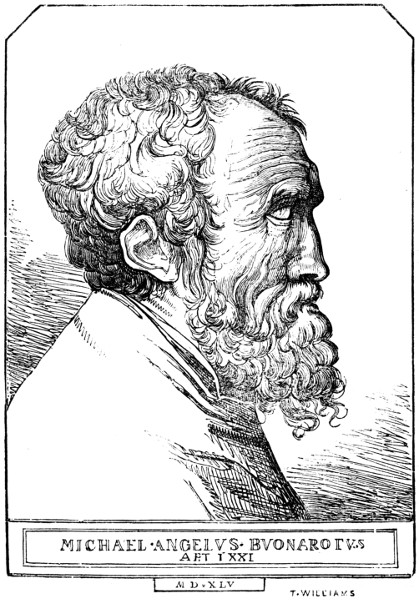
The portrait of Michael Angelo selected by Mr. Duppa, to precede his life, is engraved by Bartolozzi, from a profile in Gori’s edition of “Condivi’s Memoir.” He says its original was a drawing supposed to have been made by Julio Bonasoni, from which Mr. Duppa presumes that artist to have etched a print bearing his name, and dated in the year 1546. There is an engraved portrait dated 1545, without any artist’s name attached. Mr. Duppa says, “of these two prints Bonasoni’s is much the best; and although the second has a prior date, it appears to have been engraved from the same original.” That “original,” whatever it was, is no longer in existence. Certainly Bonasoni’s print is better as a print, for it has the grace of that master’s point, yet as a likeness the print of 1545 seems to the editor of the Every-day Book to have a stronger claim to regard; not because it is of prior date, but because it has more decisive marks of character. He conjectures, that the anonymous print of 1545 may have been executed from a bust or statue of Michael. There is a laboured precision in the contour, and a close mannered marking of the features, that denote the “original” to have been marble. The conjecture is strengthened by the fact, that the eye in the anonymous print is without an iris; a deficiency which exists in no engraved portraits unless they are executed from a marble “original.” While correctness seems to have been the aim of the engraver in this anonymous print, elegance appears to have been the object of the painter Bonasoni in his etching. Bonasoni’s portrait is comparatively common; the anonymous one is rare; a copy of it from the print in the editor’s possession, is executed on wood, by Mr. T. Williams, and placed under the reader’s eye.
Michael Angelo was remarkable for nothing but his genius. He slept little, and was abstemious; he was accustomed to say, “However rich I may have been, I have always lived as a poor man.” He obtained the reputation of being proud and odd; for he found little pleasure in the society of men from whom he could not learn, or whom he could not teach. He was pleased by originality of character in whatever rank he met with it; and cultivated in mature life the society of persons respected for their talents and learning. When young he endeavoured to acquaint himself with every branch of knowledge that could contribute to his improvement. In common with all who have obtained a deserved eminence, he was never satisfied with his performances; if he perceived an imperfection that might have been avoided, he either threw aside the work in disgust, or commenced it anew.
He continued to study to the end of his life. In his old age the cardinal Farnese found him walking in solitude amidst the ruins of the Coliseum and expressed his surprise. Michael answered, “I go yet to school that I may continue to learn.” He lived much alone. His great excess seems to have been indulgence in reflection, and the labours of his profession. The power of generalizing facts, and realizing what he conceived, he drew from this habit: without it some men have become popular for a time, but no man ever became great.
Grandeur was Michael Angelo’s prevailing sentiment. In his architecture of St. Peter’s, he seems to have been limited by the impossibility of arriving to excellence without adopting the ancient styles, and the necessity of attempting something great without them; and to speak with the severity of uncompromising truth he failed. Of what else he did in that science, and he did much, for which he obtained deserved renown, there is neither room nor occasion to speak. In painting and sculpture, if he did not always succeed in embodying his feelings, yet he succeeded more frequently than any other artist since the revival of arts; and, as his power was greater than theirs, so he accomplished greater works. His aim was elevated as that of the giants who warred against the fabled gods; in one respect he was unlike them—he conquered. Majestic and wild as nature in her undescribable sublimity, he achieved with corresponding greatness and beauty. His forms and their intellectual expression are of the highest order. He never did any thing little. All was in harmony with a mind which he created of himself by adding fact to fact, by severe reading, by close observation, by study, by seclusion. He was the quarrier, and architect, and builder-up of his own greatness.
Sir Joshua Reynolds speaks with becoming deference of Michael Angelo’s powers.—“It will not be thought presumptuous in me to appear in the train, I cannot say of his imitators, but of his admirers. I have taken another course, one more suited to my abilities, and to the taste of the times in which I live. Yet however unequal I feel myself to that attempt, were I now to begin the world again, I would tread in the steps of that great master: to kiss the hem of his garment, to catch the slightest of his perfections, would be glory and distinction enough for an ambitious man. He was the bright luminary from whom painting has borrowed a new lustre, under whose hands it assumed a new appearance, and became another and superior art, and from whom all his contemporaries and successors have derived whatever they have possessed of the dignified and majestic.”
There are excellent casts from three of Michael Angelo’s statues exhibited by Mr. West at Mr. Bullock’s museum, in Piccadilly; they are, Christ, from the church of Sta. Maria at Florence, Lorenzo de Medici from his monument, and the celebrated Moses, from the church of St. Pietro, in Vincoli, at Rome. The editor of the Every-day Book has conversed with persons who think themselves pupils and students in sculpture and painting without having seen these!
Michael Angelo had studied anatomy profoundly. Condivi, who was his pupil and one of his biographers, says that his knowledge of human anatomy and of other animals was so correct, that those who had studied it as a profession all their lives, scarcely understood it so well. When he began to dissect he conceived disgust from the offensiveness of the operation and desisted; but reflecting that it was disgraceful to abandon what others could achieve, he resumed and pursued it to the fullest extent. Perceiving the utility of Albert Durer’s “Treatise on the Proportions of the Human Body,” he deemed it capable of improvement. Its rules were in his opinion insufficient and too mechanical, and he contemplated a treatise to exhibit the muscles in their various action. A friend, whom he consulted on the subject, sent him the body of a fine young Moor, which he dissected and made remarks on, but they were never published. The result of his anatomical knowledge may be seen in the powerful muscular developement of his figures: he left no part undefined.
Several remarks occur in the course of Michael Angelo’s letters concerning his art. Speaking of the rivalry between sculpture and painting, he says, “The sculptor arrives at his end by taking away what is superfluous; the painter produces his, by adding the materials which embody the representation to the mind: however, after all, they are both produced by the same intelligence, and the superiority is not worth disputing about, since more time may be lost in the discussion, than would produce the works themselves.” At one time, however, Michael Angelo regarded painting with less favour than he expresses in this letter. It is addressed to Varchi, who wrote a dissertation on the subject, and sent it to him with an inquiry, which had divided the amateurs of Florence, as to whether painting or sculpture required the most talent. Varchi’s treatise has the merit of having convinced Michael Angelo that he was in error, and with the truth and candour inseparable from such a character he confessed his mistake. “Of the relative importance of painting and sculpture,” says Michael Angelo, “I think painting excellent in proportion as it approaches relievo, and relievo bad in proportion as it partakes of the character of a picture, and therefore I was used to be of opinion, that painting might be considered as borrowing light from sculpture, and the difference between them as the sun and moon. Now, however, since I have read your dissertation, which treats the subject philosophically, and shows, that those things which have the same end, are one, and the same, I have changed my opinion, and say, that, if greater judgment, labour, difficulty, and impediment, confer no dignity on the work on which it is bestowed, painting and sculpture may be considered without giving the preeminence to either: and since it has been so considered, no painter ought to undervalue sculpture, and in like manner, no sculptor ought to make light of painting.”
Great as Michael Angelo was in art, his intellectual character was greater. “No one,” says Mr. Duppa, “ever felt the dignity of human nature with its noblest attributes more forcibly than Michael Angelo, and his disgust at any violation of principle was acute in proportion to his sensibility and love of truth.” He despised and shrunk from the shadow of a meanness: hating the heartlessness of unmeaning profession, he regarded the dazzling simulation which constitutes the polish of society as a soul-cloud. With these commanding views of self dignity he poured out his feelings to his friend Luigi del Ricco, in
A MADRIGAL.
Translated by Robert Southey Esq.
(From Mr. Duppa’s Life of Michael Angelo.)
Ill hath he chosen his part who seeks to please The worthless world,—ill hath he chosen his part, For often must he wear the look of ease When grief is at his heart; And often in his hours of happier feeling With sorrow must his countenance be hung, And ever his own better thoughts concealing Must in stupid grandeur’s praise be loud, And to the errors of the ignorant crowd Assent with lying tongue. Thus much would I conceal—that none should know What secret cause I have for silent woe; And taught by many a melancholy proof That those whom fortune favours it pollutes I from the blind and faithless world aloof, Nor fear its envy nor desire its praise, But choose my path through solitary ways.
It was one of Michael Angelo’s high qualities to bear about him an atmosphere which the parasite dared not approach: no heart-eater could live in it.
He justly estimated whatever was influential in society; and hence though he seemed to look down upon rank as an accident of life, he was not regardless of its use. To those whom distinctions had raised, he paid the deference accorded to their dignities. Yet towards him who touched his integrity, he bore a lofty carriage, and when he condescended to resent the attack, hurled an impetuous defiance that kindled as it flew, and consumed the insulting defamer, though he were ensconced behind countless quarterings, or ermined and enthroned. To the constant calumny of jealous rivalry, and the daily lie of envy and enmity, he was utterly indifferent. When asked why he did not resent the aspersions incessantly poured upon him by one of his assailants, he answered—“He who contends with the worthless can gain nothing worth possessing.”
Michael Angelo’s temper was “sudden and quick;” but his nature was kind and benevolent. Inferior artists frequently experienced his friendly disposition. He sometimes made drawings and modelled for them. To Minigella, a very indifferent hand, he gave the model of a crucifix beautifully executed, from which the poor fellow formed a mould and made casts of papier mache to sell to the country people. Friendship and esteem for particular individuals oftener induced him to undertake works than proffers of large sums. Yet he was not indifferent or insensible to a just estimation of his talents when they were undervalued. For Angelo Doni, a Florentine of taste, he painted a holy family, and sent it home with a note requiring seventy ducats for it. Doni told the messenger he thought forty were enough; Michael replied by demanding the picture or a hundred; Doni said he was willing to pay the seventy; Michael demanded a hundred and forty, and Doni paid the sum.
He honoured worthy men in every station. His purse was open to their necessities; he condoled with them in their afflictions, and lightened their oppressions by his sympathies and influence. To artists and men of talent his liberality was munificent. He neither loved money nor accumulated it. His gifts were the free-will offerings of his heart, and hence its dispensations were unaccompanied by a notoriety which sullies the purity of primary obligation, by exposing the nakedness of its object.
Conversing one day with his old and faithful servant, he said, “What will become of you, Urbine, if I should die?” “I must then seek another master” was the reply. “Poor fellow,” said Michael, “thou shalt not need another master,” and he gave him two thousand crowns. This was a large sum in those days: Vasari says such a donation would only have been expected from popes and great emperors. Michael afterwards procured him an appointment in the Vatican to take care of the pictures, with a monthly salary of six ducats; and preserving his regard for the old man, Michael, though at that time eighty-two years of age, sat up with him by night in his last illness. “His death has been a heavy loss to me,” he wrote to Vasari, “and the cause of excessive grief, but it has also been a most impressive lesson of the grace of God: for it has shown me, that he, who in his lifetime comforted me in the enjoyment of life, dying has taught me how to die; not with reluctance, but even with a desire of death. He lived with me twenty-six years, grew rich in my service, and I found him a most rare and faithful servant; and now that I calculated upon his being the staff and repose of my old age he is taken away, and has left me only the hope of seeing him again in paradise.”
Michael Angelo was never married. To one who lamented that he had no children to inherit his property, Michael answered, “My works must supply their place; and if they are good for any thing they will live hereafter. It would have been unfortunate for Lorenzo Ghiberti, had he not left the doors of S. Giovanni, for his sons and his nephews have long since sold and dissipated his accumulated wealth; but his sculpture remains, and will continue to record his name to future ages.” These “doors” were of bronze. When Michael was asked his opinion of them, he said they were fit to be the doors of paradise.
Throughout the poetry of Michael Angelo, of which there is much in existence, love is a pervading sentiment, though, without reference to any particular object. Condivi had often heard him discourse upon it as a passion platonically; and Mr. Duppa gives the following sonnet, translated from the Italian of Michael Angelo by Mr. Wordsworth, as exemplifying Michael’s turn of thought:
SONNET, By Michael Angelo.
Yes! hope may with my strong desire keep pace, And I be undeluded, unbetray’d; For, if of our affections none find grace In sight of Heaven, then wherefore hath God made The world which we inhabit? Better plea Love cannot have, than that in loving thee, Glory to that eternal Peace is paid, Who such divinity to thee imparts As hallows and makes pure all gentle hearts. His hope is treacherous only, whose love dies With beauty, which is varying every hour; But in chaste hearts, uninfluenced by the power Of outward change, there blooms a deathless flower That breathes on earth the air of Paradise.
The personal beauty and intellectual endowments of Vittoria Colonna, marchioness of Pescara, impressed Michael Angelo with sentiments of affectionate esteem. She admired his genius, and frequently left her residence at Viterbo for the sole purpose of enjoying his society at Rome. He addressed three sonnets and a madrigal to her. In her last moments he paid her a visit, and told Condivi he grieved he had not kissed her cheek, as he had her hand, for there was little hope of his ever seeing her again. He penned an epitaph on her decease: the recollection of her death constantly dejected him.
To the purity of his thoughts, there is a high testimony by Condivi. “In a long intimacy, I have never heard from his mouth a single word that was not perfectly decorous, and had not for its object to extinguish in youth every improper and lawless desire: his nature is a stranger to depravity.” He was religious, not by the show, but from feeling and conviction As an instance, a short poetical supplication, translated by Mr. Duppa into prose, is remarkable for its self-knowledge and simplicity; it is here subjoined:—
“To the Supreme Being.
“My prayers will be sweet if thou lendest me virtue to make them worthy to be heard; my unfruitful soil cannot produce virtue of itself. Thou knowest the seed, and how to sow it, that it may spring up in the mind to produce just and pious works: if thou showest not the hallowed path, no one by his own knowledge can follow thee. Pour thou into my mind the thoughts that may conduct me in thy holy steps; and endue me with a fervent tongue, that I may alway praise, exalt, and sing thy glory.”
Finally, it may be added, that in an age of splendid vice, Michael Angelo was an illustrious example of virtue.
To Michael Angelo—Immortal
Michael! to what thou wert, if I could raise An aspiration, or a holy light, Within one reader, I’d essay to praise Thy virtue; and would supplicate the muse For flowers to deck thy greatness: so I might But urge one youthful artist on to choose A life like thine, I would attempt the hill Where well inspiring floods, and thence would drink Till—as the Pythoness of old, the will No longer then controll’d by sense—I’d think Alone of good and thee, and with loud cries, Break the dead slumber of undeeming man, Refresh him with a gush of truth, surprise Him with thy deeds, and show him thine was Wisdom’s plan.
Pisces.
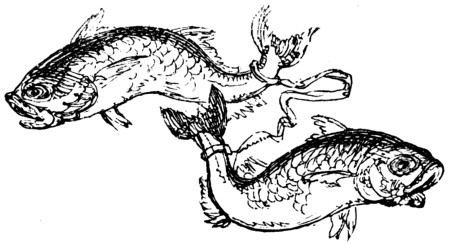
Pisces.
This zodiacal sign is said to symbolize the fishery of the Nile, which usually commenced at this season of the year. According to an ancient fable, it represents Venus and Cupid, who, to avoid Typhon, a dreadful giant with a hundred heads, transformed themselves into fish. This fabulous monster, it seems, threw the whole host of heathen deities into confusion. His story shortly is, that as soon as he was born, he began to avenge the death of his brethren, the giants who had warred against Olympus, by resuming the conflict alone. Flames of fire darted from his eyes and mouths; he uttered horrid yells, and so frightened the pagan celestials, that Jupiter himself became a ram, Juno a cow, Mercury an ibis, Apollo a crow, Bacchus a goat, Diana a cat, Venus a fish, &c. till Jupiter hurled a rock and buried him under Ætna. The idol Dagon, with a human head and arms, and a fish’s tail, is affirmed to be the symbol of the sun in Pisces, and to allegorize that the earth teems with corn and fruits.
The sun generally enters Pisces about the period of February; for instance, in 1824 on the 16th, in 1825 on the 18th of the month. The Romans imagined that the entrance of the sun into Pisces was attended by bad weather, and gales of uncertainty to the mariner.[1] Thomson sings, that in this month—
Muttering, the winds at eve, with blunted point, Blow hollow-blustering from the south. Subdued, The frost resolves into a trickling thaw, Spotted, the mountains shine; loose sleet descends, And floods the country round. The rivers swell, Of bonds impatient. Sudden from the hills, O’er rocks and woods, in broad, brown cataracts, A thousand snow-fed torrents shoot at once; And where they rush, the wide resounding plain Is left one slimy waste.
Thomson.
February 18.
St. Simeon, Bp. of Jerusalem, A. D. 116. Sts. Leo and Paregorius, 3d Cent.
Chronology.
On the 18th of February 1734, the house of commons received a petition from Mr. Samuel Buckley, a learned printer; setting forth that he had, at his sole expense, by several years’ labour, and with the assistance of some learned persons abroad and at home, made collections of original papers and letters relating to “Thuanus’s History,” written in Latin, in order to a new and accurate edition, in 7 vols. folio, which was finished; that the act of the 8th of Q. Anne, for the encouragement of learning, extended only to the authors, purchasers, or proprietors of the copy-right of any book in English, published after the 10th of April, 1710, and allowed the importation or vending of any books in foreign language printed beyond the seas; so that any books, first compiled and printed in this kingdom in any of those languages, might be reprinted abroad and sold in this kingdom, to the great damage of the first printer or proprietor: he therefore prayed, that he might be allowed the same benefit in his copy of the “History of Thuanus,” in Latin, for fourteen years. Leave was given to bring in the bill, and it afterwards passed into an act.
The protection of this excellent work was a justice due to the spirit and liberality of Mr. Buckley. He had been originally a bookseller. John Dunton says of him, “He is an excellent linguist, understands the Latin, French, Dutch, and Italian languages, and is master of a great deal of wit: he prints the ‘Daily Courant,’ and ‘Monthly Register,’ which, I hear, he translates out of the foreign papers himself:”—a great merit, it should seem, in the eyes of old Dunton.
Mr. Buckley was a really learned printer. The collections for his edition of Thuanus were made by Carte, who had fled to France from an accusation of high treason, during the rebellion of 1715 and while in that country possessed himself of so many materials for the purpose, that he consulted Dr. Mead, the celebrated physician, and patron of literary men, concerning the undertaking. By the doctor’s recommendation, it was intrusted to Mr. Buckley, who imported the paper for it, which, with the materials, cost him 2,350l. He edited the work with fidelity, and executed it with elegance.
Mr. Buckley was the publisher of the “Spectator,” which appeared in folio from his shop at the Dolphin in Little Britain, a place then filled with booksellers. At the close of the seventh volume this popular work was suspended, but resumed by Buckley in Amen-corner. He attained to opulence and respectability, was in the commission of the peace for Middlesex, and died, greatly esteemed, on the 8th of September, 1741, in the sixty-eighth year of his age.[2]
It is related of the great lord chancellor Hardwicke, that he so highly regarded “Thuanus’s History,” as to have resigned the seals for the express purpose of being enabled to read it in the original language.[3] It has been computed that a person who gave his attention to this work for four hours every day, would not finish the perusal in twelve months. It comprehends the events of sixty-four years, during the times wherein Thuanus lived and flourished as an eminent French author and statesman. His English biographer quotes, as a character of his writings, that, “in a word, they are calculated to render those who attend to them better and wiser men.”[4]
FLORAL DIRECTORY.
Wall Speedwell. Veronica vivensis. Dedicated to St. Simeon of Jerusalem.
February 19.
St. Barbatus, or Barbas, Bp. A. D. 682.
This saint is patron of Benevento, of which city he was bishop. Butler relates no miracle of him, nor does it appear from him that any other name in the calendar of the Romish church is affixed to this day.
THE SEASON.
A pretty trifle from the Greek is descriptive of appearances about this period:—
To a Lady on her Birthday
See amidst the winter’s cold, Tender infant of the spring; See the rose her bud unfold, Every sweet is on the wing. Hark! the purple flow’ret cries, ’Tis for thee we haste away, ’Tis for thee we brave the skies, Smiling on thy natal day, Soon shalt thou the pleasure prove, Which awaits on virtuous love. Place us ’midst thy flowing hair, Where each lovely grace prevails, Happier we to deck the fair, Than to wait the vernal gales.
FLORAL DIRECTORY.
Field Speedwell. Veronica agrestis. Dedicated to St. Barbatus.
February 20.
St. Tyrannio, Bp. &c. A. D. 310. Sts. Sadoth, Bp. &c. A. D. 342. St. Eleutherius, Bp. A. D. 532. St. Mildred, Abbess. St. Eucherius, Bp. A. D. 743. St. Ulrick.
St. Mildred.
This saint was the first abbess of Minster, in the isle of Thanet, founded by king Egbert about 670, in satisfaction for having murdered his two nephews, Etheldred and Ethelbright; to which satisfaction he was “miraculously terrified, by seeing a ray of bright light dart from the heavens upon their grave.” In 1033, her remains were removed to St. Augustine’s monastery at Canterbury, and venerated above all the relics there, and worked miracles, as all saints’ relics did in those favoured times. The churches of St. Mildred, Bread-street, and St. Mildred in the Poultry, London, are dedicated to her.[5]
In St. Mildred’s church in the Poultry, Thomas Tusser, whose “Five Hundred Points of Good Husbandrie” have been cited in former pages of this work, was buried, and on his tomb this
EPITAPH.
Here Thomas Tusser, clad in earth, doth lie, That sometime made the pointes of Husbandrie: By him then learne thou maist: here learne we must, When all is done, we sleepe, and turne to dust: And yet, through Christ, to Heaven we hope to goe; Who reades his bookes, shall find his faith was so.[6]
St. Ulrick.
Of this saint, who died the 28th of February, 1154, Butler says little.
“The Flowers of the Lives of the most renowned Saincts of the three kingdoms, England, Scotland, and Ireland, written and collected out of the best authours and manuscripts of our nation, and distributed according to their feasts in the calendar, By the R. Father, Hierome Porter, Priest and Monke of the holy order of Sainct Benedict, of the Congregation of England, Printed at Doway with licence, and approbation of the Ordinary, M.dc.xxxii,” relates of this saint, that he was born in a village called Lenton, or Litton, near Bristol, with many marvels concerning him, and among them this:—He became a priest, but kept hawks and dogs for sport, till he met a beggar who asked alms. Ulrick said, he did not know whether he had aught to bestow: “Look in thy purse,” quoth the beggar, “and there thou shalt find twopence halfpenny.” Ulrick finding as he was told, received thanks, and a prophecy that he should become a saint, whereupon he starved and hermitized at Hessleborough, in Dorsetshire, about thirty miles from Exeter. “The skin only sticking to his bones,” his daintiest food was oaten-bread and water-gruel. He passed many nights without sleep, never slept but when he could not keep awake, and never went to bed, “but, leaning his head to a wall, he tooke a short allowance;” and when he awoke, “he would much blame and chastise his body, as yielding vnto ouermuch nicenesse.” His pillow was ropes of hay, his clothing poor, and lined next the skin with a rough shirt of hair-cloth, till his flesh having overcome its uneasiness, he wore next his skin an iron coat of mail. In the sharpest cold of winter, having first put off his iron shirt, he was wont to get into a vessel of cold water and recite psalms. His coat of mail hanging below his knees, he went to the knight who gave it to him, to take counsel therein. His military adviser persuaded him to send it to London to be cut; but he gave the knight “a payre of sheares.” The knight hesitated, the other entreated. “The one falls to his prayers, the other endeavours with iron and steale to cut iron and steale, when both their labours tooke prosperous effect; for the knight, in his cutting worke, seemed rather to divide a piece of cloath than a peece of iron.” Then the saint, “without any sheeres, pulled asunder the little rings of that part of his coate cutt off, and distributed them charitably to all that desired, by virtue whereof manie diseases were cured.” Envying such rare goodness, an infernal spirit, in most horrible shape, dragged him into the church, and ran him round the pavement, till the apparition of a virgin stopped this rude behaviour; however, the infernal took advantage of the saint when he was sick, and with a staff he had in his hand gave him three knocks on the head, and departed. The devil tormented him other ways; he cast him into an intolerable heat, then he gave him an intolerable cold, and then he made him dream a dream, whereby the saint shamed the devil by openly confessing it at church on Easter-day before all the people. At length, after other wonders, “the joints of his iron coate miraculously dissolved, and it fell down to his knees.” Upon this, he foretold his death on the next Saturday, and thereon he died. Such, and much more is put forth concerning St. Ulrick, by the aforesaid “Flowers of the Saincts,” which contains a prayer to be used preparatory to the perusal, with these words, “that this holy reading of their lives may soe inflame our hearts, that we may follow and imitate the traces of their glorious example, that, after this mortall life, we may be made worthie to enjoy their most desired companie.”
FLORAL DIRECTORY.
Navelwort. Cynoglossum omphalodes. Dedicated to St. Mildred.
Chronology.
On the 20th of February 1749, Usher Gahagan, by birth a gentleman, and by education a scholar, perished at Tyburn. His attainments were elegant and superior; he was the editor of Brindley’s beautiful edition of the classics, and translated Pope’s “Essay on Criticism” into Latin verse. Better grounded in learning than in principle, he concentrated liberal talents to the degrading selfishness of robbing the community of its coin by clipping. During his confinement, and hoping for pardon, he translated Pope’s “Temple of Fame,” and his “Messiah,” into the same language, with a dedication to the duke of Newcastle. To the same end, he addressed prince George and the recorder in poetic numbers. These efforts were of no avail. Two of his miserable confederates in crime were his companions in death. He suffered with a deeper guilt, because he had a higher knowledge than ignorant and unthinking criminals, to whom the polity of society, in its grounds and reasons, is unknown.
Accomplishments upon vice are as beautiful colours on a venomous reptile. Learning is a vain show, and knowledge mischievous, without the love of goodness, or the fear of evil. Children have fallen from careless parents into the hands of the executioner, in whom the means of distinguishing between right and wrong might have become a stock for knowledge to ripen on, and learning have preserved the fruits to posterity. Let not him despair who desires to know, or has power to teach—
There is in every human heart, Some not completely barren part, Where seeds of truth and love might grow And flowers of generous virtue blow: To plant, to watch, to water there, This be our duty, be our care.
Bowring.
February 21.
St. Severianus, Bp. A. D. 452. Sts. German, Abbot, and Randaut, or Randoald, A. D. 666. Sts. Daniel and Verda, A. D. 344. B. Pepin, of Landen, A. D. 640.
BREAKFAST IN COLD WEATHER.
“Here it is,” says the “Indicator,” “ready laid. Imprimis, tea and coffee; secondly, dry toast; thirdly, butter; fourthly, eggs; fifthly, ham; sixthly, something potted; seventhly, bread, salt, mustard, knives and forks, &c. One of the first things that belong to a breakfast is a good fire. There is a delightful mixture of the lively and the snug in coming down into one’s breakfast-room of a cold morning, and seeing every thing prepared for us; a blazing grate, a clean table-cloth and tea-things, the newly-washed faces and combed heads of a set of good-humoured urchins, and the sole empty chair at its accustomed corner, ready for occupation. When we lived alone, we could not help reading at meals: and it is certainly a delicious thing to resume an entertaining book at a particularly interesting passage, with a hot cup of tea at one’s elbow, and a piece of buttered toast in one’s hand. The first look at the page, accompanied by a coexistent bite of the toast, comes under the head of intensities.”
THE SEASON.
The weather is now cold and mild alternately. In our variable climate we one day experience the severity of winter, and a genial warmth prevails the next; and, indeed, such changes are not unfrequently felt in the same day. Winter, however, at this time breaks apace, and we have presages of the genial season.
Oxen, o’er the furrow’d soil, Urging firm their annual toil; Trim cottages that here and there, Speckling the social tilth, appear: And spires, that as from groves they rise, Tell where the lurking hamlet lies: Hills white with many a bleating throng, And lakes, whose willowy banks along, Herds or ruminate, or lave, Immersing in the silent wave. The sombre wood—the cheerful plain, Green with the hope of future grain: A tender blade, ere Autumn smile Benignant on the farmer’s toil, Gild the ripe fields with mellowing hand, And scatter plenty through the land.
Baron Smith.
FLORAL DIRECTORY.
White crocus. Crocus versicolor. Dedicated to St. Servianus.
February 22.
The Chair of St. Peter at Antioch. St. Margaret, of Cortona, A. D. 1297. Sts. Thalasius and Limneus. St. Baradat.
St. Margaret.
She was a penitent, asked public pardon for her sins with a rope about her neck, punished her flesh, and worked miracles accordingly.[7]
Sts. Thalasius and Limneus.
St. Thalasius dwelt in a cavern, “and was endowed with extraordinary gifts of the Holy Ghost; but was a treasure unknown to the world.” St. Limneus was his disciple, and “famous for miraculous cures of the sick,” while his master “bore patiently the sharpest cholics, and other distempers, without any human succour.”[8]
St. Baradat.
This saint lived in a trellis-hut, exposed to the severities of the weather, and clothed in the skins of beasts.[9]
FLORAL DIRECTORY.
Herb Margaret. Bellis perennis. Dedicated to St. Margaret, of Cortona.
SPORTING CALENDAR.
A valued correspondent obliges the Every-Day Book with an original sketch, hasty and spirited as its hero, when the sports of the field allured him from the pursuits of literature at college, and the domestic comforts of wife and home.
To the Editor.
To disemburthen oneself of ennui, and to find rational amusement for every season of the year, is a grand desideratum in life. Luckily I have hit on’t, and beg leave, as being the properest place, to give my recipe in the Everlasting Calendar you are compiling. I contrive then to give myself employment for every time of year. Neither lively Spring, glowing Summer, sober Autumn, nor dreary Winter, come amiss to me; for I have contrived to make myself an Universal Sportsman, and am become so devoted a page of Diana, that I am dangling at her heels all the year round without being tired of it. In bleak and frozen January, besides sliding, skating in figures, and making men of snow to frighten children with, by means of a lantern placed in a skull at the top of them, I now and then get a day’s cock shooting when the frost breaks, or kill a few small birds in the snow. In lack of other game, a neighbour’s duck, or goose, or a chicken, shot and pocketed as I sally out to the club dinner, are killed more easily than my dairymaid does it, poor things!
In February, the weather being rainy or mild, renders it worth my while to send my stud into Leicestershire for hunting again; and so my white horse Skyscraper, my old everlasting chestnut Silvertail, the only good black in the hunt Sultan, and the brown mare Rosinante, together with Alfana the king of the Cocktails, a hack or two, and a poney for errands, are “pyked off” pack and baggage for Melton; and then from the first purple dawn of daylight, when I set off to cover, to the termination of the day with cards, I have plenty of rational amusement. Next month, forbearing March hares, I shoot a few snipes before they are all gone, and at night prepare my fishing tackle for April, when the verdant meadows again draw me to the riverside to angle.
My wife has now rational employment for the rest of the Summer in catching and impaling the various flies of the season against my trout mania comes, which is usual early in May, when all her maids assist in this flyfowling sport. I have generally been successful in sport, but I shall never forget my disappointment when on throwing in a flyline which was not baited by myself, I found that Sally, mistaking her new employment, had baited my hook with an earwig. In June I neglected my Grass for the same sport, and often let it stand till the Hay is spoiled by Swithin, who wipes his watery eyes with what ought to be my Winter’s fodder. This gives me rational, though troublesome, employment in buying Hay or passing off the old at market. July, however, affords plenty of bobfishing, as I call it, for roach, dace, perch, and bleak. I also gudgeon some of my neighbours, and cast a line of an evening into their carp and tench ponds. I have not, thank my stars, either stupidity or patience enough for barbel. But in August, that is before the 12th, I get my trolling tackle in order, and am reminded of my old vermin college days, when shutting my room door, as if I was “sported in” and cramming Euclid, I used to creep down to the banks of the Cam, and clapping my hands on my old rod, with his long line to him, exclaimed, in true Horatian measure, the only Latin line I ever cited in my life,
Progenie longa gaudes captare Johannes.
But, oh! the 12th day of August, that mountain holiday, ushered in by the ringing of the sheep bell—’tis then that, jacketed in fustian, with a gun on my shoulder, and a powder horn belted to my side, I ramble the rough highland hills in quest of blackcocks and red game, get now and then a chance shot at a ptarmagan, and once winged a Capercaille on a pine tree at Invercauld. In hurrying home for the First of September, I usually pass through the fens of Lincolnshire, and there generally kill a wild duck or two. You must know I have, besides my pointers, setters, and spaniels, water dogs of every sort. Indeed my dog establishment would astonish Acteon. There are my harriers, Rockwood, Ringwood, Lasher, Jowler, Rallywood, and twenty more; my pointers, Ponto and Carlo; my spaniels, Dash and Old Grizzle; Hedgehog and Pompey, my water dogs. No one, I bet a crown, has better greyhounds than Fly and Dart are, nor a surer lurcher than Groveller. I say nothing of those inferior “Lares,” my terriers—ratcatching Busy, Snap, and Nimbletoes, with whom, in the absense of other game, I go sometimes for a frolic to a farmhouse, disguised as a ratcatcher, and take a shilling for ferret work.
But now I come to thy shrine, O lovely Septembria, thou fairest nymyh in Diana’s train, with rolling blue eyes as sharp and as true as those of a signal lieutenant; I come to court thee again, and may thy path be even paved with the skulls of partridges. Again I come to dine with thee on the leveret’s back or pheasant’s wings. We’ve wildboars’ bladders for wine bottles, ramshorns for corkscrews, bugles for funnels, gunpowder for snuff, smoke for tobacco, woodcock’s bills for toothpicks, and shot for sugar plums! I dare not proceed to tell you now many brace of birds Ponto and I bag the first day of shooting, as the long bow, instead of the fowling piece, might be called my weapon. But enough rodomontading.
I now come to October. Pheasants by all that’s volatile! And then, after them, I go to my tailor and order two suits—scarlet for master Reynard, and a bottlegreen jacket for the harriers, top-boots, white corderoy inexpressibles, and a velvet cap. Then when the covers ring again with the hallowed music of harriers, I begin skylarking the gates and setting into wind to follow the foxhounds in November. When
The dusky night rides down the sky, And ushers in the morn, The Hounds all make a jovial cry, And the Huntsman winds his horn.
With three days in the week chace, and pretty little interludes of hunting with beagles, or of snipe shooting, I manage to get through December to the year’s end. My snug Winter evenings are spent in getting ready my guns, smacking new hunting whips, or trying on new boots, while my old hall furnishes ample store of trophies, stags’ horns hunted by my great grandfather, cross bows, guns, brushes won on rivals of Pegasus, and all sorts of odd oldfashioned whips, horns, and accoutrements, hanging up all round, which remind me of those days of yore when I remember the old squire and his sporting chaplain casting home on spent horses all bespattered from the chase, before I had ridden any thing but my rocking horse. There then have I rational amusement all the year round. And much and sincerely do I praise thee, O Diana! greatest Diana of the Ephesians! at thy feet will I repose my old and weatherbeaten carcass at last and invoke thy tutelary protection for my old age, thou who art Hunting, Shooting, and Fishing personified, the true Diva Triformis of Antiquity.
Imminens Villæ tua Pinus esto, Quam per exactos ego lætus annos, Verris obliquum meditantis ictum, Sanguine donem.
I have the honour to remain, Yours ever, Jack Larking.
AN ADDRESS TO THE MOON, To a “proper new” tune. ORIGINAL.
No!—I have nothing new to say, Why must ye wait to hear my story? Go, get thee on thy trackless way, There’s many a weary mile before ye— Get thee to bed, lest some poor poet, Enraptur’d with thy phiz, should dip A pen in ink to let thee know it, And (mindful not to let thee slip His fingers) bid thy moonship stay And list, what he might have to say. Yet I do love thee!—and if aught The muse can serve thee, will petition Her grace t’ attend thine airy court, And play the part of first musician— But “ode,” and “lines,” “address,” and “sonnet,” “To Luna dedicate,” are now So plentiful, that (fie upon it!) She’ll add no glory to thy brow, But tell thee, in such strains as follow, That thy mild sheen beats Phosphor hollow! That thou art “fairest of the fair,” Tho’ Phœbus more that’s grand possesses, That tree and tower reflect thy glare, And the glad stream thy ray confesses, That, when thy silvery beams illumine The landscape, nature seems bedight With loveliness so rare, that few men Have e’er been blessed with such a sight! And all such moonshine:—but enough Of this tame “milk and water” stuff.
Δ
February 23.
St. Serenus, A. D. 307. St. Milburge. B. Dositheus. St. Peter Damian, Card. Bp. A. D. 1072. St. Boisil, Prior of Melross.