XXIV SUSTO
Reading edition
Era la comida de los niños. Soñaba la lámpara su rosada lumbre tibia[1] sobre el mantel de nieve, y los geranios rojos y las pintadas manzanas coloreaban de una áspera alegría[2] aquel sencillo idilio de caras inocentes. Las niñas comían como mujeres; los niños discutían como algunos hombres. Al fondo, la madre, joven, rubia y bella, los miraba sonriendo. Por la ventana del jardín, la clara noche de estrellas temblaba, dura y fría.
De pronto, Blanca huyó, como un débil rayo, a los brazos de la madre. Hubo un súbito silencio, y luego, en un estrépito de sillas caídas, todos corrieron tras de ella, con un raudo alborotar, mirando, espantados, a la ventana.
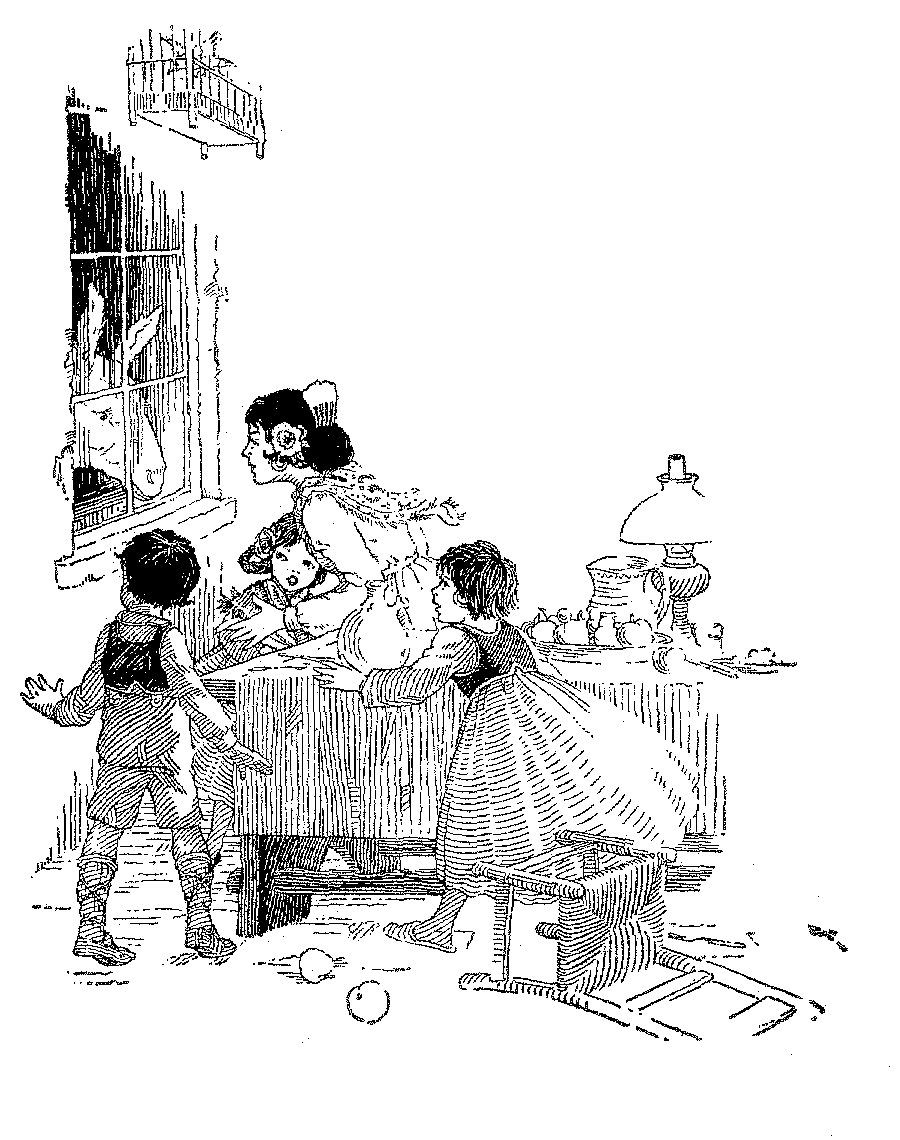
!El tonto de Platero![3] Puesta en el cristal su cabezota blanca, agigantada por la sombra, los cristales y el miedo, contemplaba, quieto y triste, el dulce comedor encendido.
[Footnote 1: Soñaba... tibia (poetic phrasing), cast a rosy, dreamy light.] [Footnote 2: áspera alegría, garish brightness.] [Footnote 3: ¡El tonto de Platero! De is used idiomatically between a noun and a qualifying adjective; cf. English 'the fool of a Platero'. Translate by the foolish Platero.]
I. CUESTIONARIO
¿Cómo era el comedor?
¿Cómo comían las niñas?
¿Cómo discutían los niños?
¿Quién los miraba?
¿Cómo los miraba?
De pronto ¿qué hizo Blanca?
¿Qué hicieron todos?
¿De qué tenían miedo?
¿Quién estaba contemplándolos?
II. REPASO DE GRAMÁTICA
A. Verbos que terminan en -uír.
Usos de haber en varios modismos.
Haber de + infinitivo, to be to, must (no obligation implied).
Haber que + infinitivo, to have to, must (obligation impersonally expressed).
B. 1. Conjúguese en el presente y pretérito de indicativo:
huir de la ventana
atribuír algo a Platero
2. Dése en todos los tiempos de indicativo:
El borrico poner su cabeza en el cristal.
C. Tradúzcanse al español las frases siguientes usando en cada una la forma debida de haber:
There is a lamp in the dining-room.
Suddenly there was a sound of falling chairs.
We are to bury the canary in the garden.
Were there some geraniums on the table? Yes, there were some (los) of various colors.
There must be some one at the window.
It must be Platero.
One must eat in order to live.
Are there any letters for me? Yes, there are some.
III. TRADUCCIÓN
Tradúzcase al español:
One evening the children were all in the dining-room. A rosy light from the lamp lighted up the faces of the children. The mother smiled as she watched them eat and talk.
Suddenly one of the children ran to the mother's arms. As the others ran after her, there was a noise of falling chairs. They were looking toward the window.
There was foolish Platero! He was looking through the window sadly and quietly at the children and their mother.