Volume 2 — Chapter XXXVII.—THE STEAM ENGINE. (continued 2)
Reading edition
It is clear then, that however high the pump may be above the level of the water, the water cannot rise more than 34 feet up the suction pipe, even though all the air be excluded from it and a perfect vacuum formed, because the propelling force, that is, the atmospheric pressure, can only raise a column of water equal in weight to itself, and it is found in practice to be an unusually good pump that will lift water thirty feet.
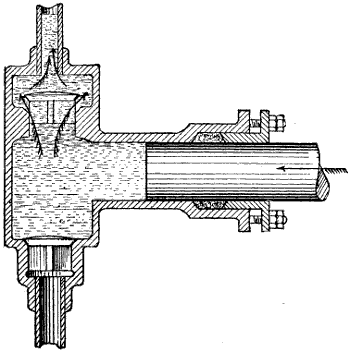
Fig. 3325.
Fig. 3325 shows the plunger making a delivery stroke, the suction valve being closed, and the delivery valve open where it will remain until the plunger stops.
To regulate the quantity of water the pump will deliver in cases where it is necessary to restrict its capacity, as in the case of maintaining a constant boiler feed without pumping too much water in the boiler, the height to which the suction valves can lift must be restricted, so as to limit the amount of water that can enter the pump at each drawing stroke.
The delivery valve should lift no more than necessary to give a free discharge without causing the valve to seat with a blow; but if the pump has a positive motion, the delivery valve must open wide enough to let the water out, or pressure enough may be got up in the pump to break it.
A check valve is merely a second delivery valve placed close to the boiler and serving to enable the pump to be taken apart if occasion should arise, without letting the water out of the boiler.
The lift and fall of both valves act to impair the capacity of the pump. Thus, while the suction valve is falling to its seat, the water already in the pump passes back into the suction pipe, and similarly, while the delivery valve is closing, the delivery water passes back.
A foot valve is virtually a second suction valve placed at the bottom or foot of the suction pipe.
The capacity of a pump is from 70 to 85 per cent. of the displacement of the plunger or piston, and varies with the speed at which the plunger or piston runs.
If a pump runs too fast, the water has not sufficient time to follow the piston or plunger, especially if the suction pipe has bends in it, as these bends increase the friction of the water against the bore of the pipe.
The speed of the piston or plunger should not exceed such as will require the water to pass through the suction pipe at a speed not greater than 500 feet per minute, and better results will be obtained at 350 feet per minute.
An air chamber placed above the suction pipe of any pump causes a better supply of water to the pump by holding a body of water close to it, and by making the supply of water up the suction pipe more uniform and continuous. Air chambers should be made as long in the neck as convenient, so that the water in passing through the pump barrel to the delivery pipe could not be forced up into the chamber, as, if such be the case, the air in the chamber is soon absorbed by the water.
Belt pumps are more economical than independent steam pumps, because the power they utilize is more nearly the equivalent of the power it takes to drive them, whereas in steam pumps there is a certain amount of steam, and therefore of power, expended in tripping the valves and in filling the clearance spaces in the cylinder. Furthermore, the main engine uses the steam expansively, whereas the steam pump does not.