Volume 1 — Chapter XII.—EXAMPLES IN LATHE WORK. (continued 3)
Reading edition
The construction of this device is shown in Fig. 574. In lathes not having a device for this purpose, the workman makes a chalk mark on the tail of the work driver, and another on the top of the lead screw gear, and by always moving the carriage back to the same point on the lathe bed, and engaging the lead screw nut when these two chalk marks are at the top of their paths of revolution, the tool will fall into its correct position and there will be no danger of cutting a double thread.
In cutting V threads of very coarse pitch it will save time, if the thread is a round top and bottom one, to use a single-pointed slide rest tool, and cut up the thread to nearly the finished depth, leaving just sufficient metal for the chaser to finish the thread.
In using the single-pointed tool on the roughing cuts of very coarse pitches, it is an advantage to move the tool laterally a trifle, so that it will cut on one side or edge only. This prevents excessive tool spring, and avoids tool breakage.
This lateral movement should be sufficient to let the follower side or edge of the tool just escape the side of the thread, and all the cut be taken by the leading side or edge of the tool.
This is necessary because the tool will not cut so steadily on the follower as on the leading cutting edge, for the reason that the pressure of the cut assists to keep the feed screw nut against the sides of the feed screw thread, taking up the lost motion between them, whereas the pressure of a cut taken on the follower side of the thread tends to force the thread of the feed nut away from the sides of the feed screw thread and into the space between the nut thread afforded by the lost motion, and as a result the slide rest will move forward when the tool edges meet exceptionally hard places or spots in the metal of the work, while in any event the tool will not operate so steadily and smoothly.
If the screw is a long one, the cutting should be done with a liberal supply of oil or water to keep it cool, otherwise the contraction of the metal in cooling will leave the thread finer than it was when cut. This is of special importance where accuracy of pitch is requisite.
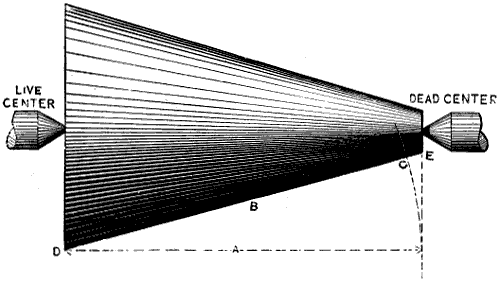
Fig. 1246.
In cutting a taper thread in a lathe, it is preferable that the taper be given by setting over the lathe tailstock, rather than by operating the cross slider from a taper-turning attachment, because the latter causes the thread to be cut of improper pitch. Thus, in Fig. 1246 is a piece of work between the lathe centres, and it will be readily seen that supposing the lathe to be geared to cut, say, 10 threads per inch, and the length a of the work to be 2 inches long, when the tool has traversed the distance a it will have cut 20 threads, and it will have passed along the whole length of the side b of the work and have cut 20 threads upon it, but since the length of line b is greater than that of a, the pitch of the thread cut will be coarser than that due to the change wheels. The amount of the error is shown by the arc c, which is struck from d as a centre; hence from c to e is the total amount of error of thread pitch.
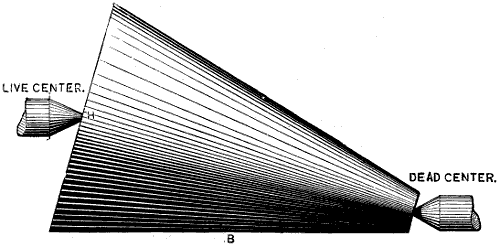
Fig. 1247.
But if the lathe tailstock sets over as in Fig. 1247, then the pitch of the thread will be cut correct, because the length of b will equal the length of tool traverse; hence at each work revolution the tool would advance one-twentieth of the length of the surface on which the thread is cut, which is correct for the conditions.
VOL. I. METHODS OF BALL TURNING. PLATE XIII.
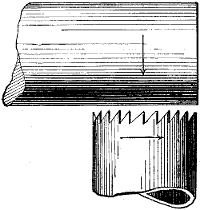
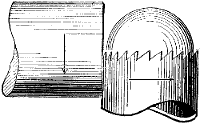
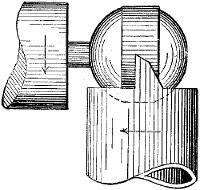
Fig. 1248. Fig. 1249. Fig. 1250.
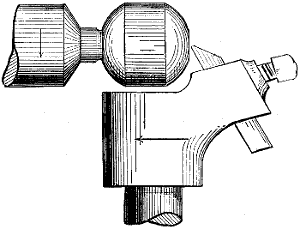
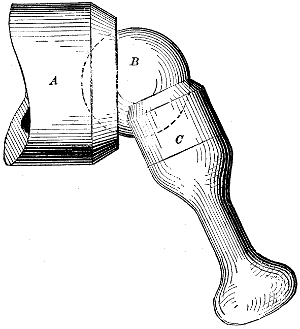
Fig. 1251. Fig. 1252.
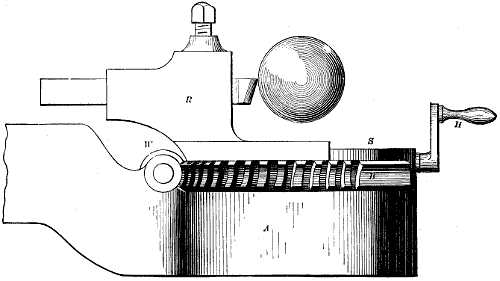
Fig. 1253.
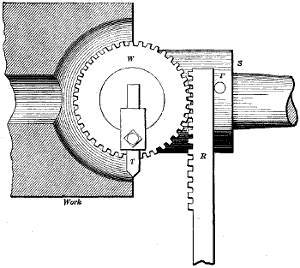
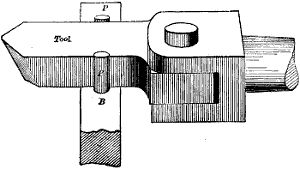
Fig. 1254. Fig. 1255.