Volume 1 — Chapter XIV.—MEASURING MACHINES, TOOLS, AND DEVICES. (continued 3)
Reading edition
“3. That in the case of plates a bulging takes place on the largest surfaces, increasing the thickness towards the centres, although the edges diminish in thickness.
“4. That wrought-iron bars heated to redness, and allowed to cool slowly in air, do not show any change in dimensions (Experiment 3).
“The reduction of specific gravity, and the bulging out of the sides, have been explained as follows by the learned Secretary of the Royal Society, Professor Stokes, who has taken considerable interest in these experiments, and who has kindly allowed the author to publish the explanation:
“‘When the heated iron is plunged into water, the skin tends everywhere to contract. It cannot, however, do so to any significant extent by a contraction which would leave it similar to itself, because that would imply a squeezing in of the interior metal, which is still expanded by heat, and is almost incompressible. The endeavor, then, of the skin to contract is best satisfied, consistently with the retention of volume of the interior, by a contraction of the skin in the two longish lateral directions, combined with a bulging out in the short direction. The still plastic state of the interior permits of this change.
“‘Conceive an india-rubber skin of the form of the plate in its first state, the skin being free from tension, and having its interior filled with water, treacle, or pitch. I make abstraction of gravity. It would retain its shape. But suppose, now, the india-rubber to be endowed with a tension the same everywhere similar to that of india-rubber that has been pulled out, what would take place? Why, the flat faces of considerable area, being comparatively weak to resist the interior pressure, would be bulged out, and the vessel would contract considerably in the long directions, increasing in thickness. This is just what takes place with the iron in the first instance. But when the cooling has made further progress, and the solidified skin has become comparatively thick and strong, the further cooling of the interior tends to make it contract. But this it cannot well do, being encased in a strong hide, and accordingly the interior tends to be left in a porous condition.’
“The reduction by scaling does not require any explanation. The only fact which appears unaccounted for is this persistent contraction of the cooled iron skin, which does not appear to be explicable on any mechanical grounds; and we are, therefore, obliged to look upon it as the result of a change in the distance of the molecules of the iron, caused by the sudden change of temperature in the successive coolings.
“Our next subject is the curious effect of cooling bars or rings by partial immersion in water. Bearing in mind the results at which we have arrived, viz., that wrought iron contracts when immersed in water after heating, and that when allowed to cool in air it remains of the same dimensions, let us ask what would be the behavior of a bar or circular hoop of iron cooled half in water and half in air, the surface of the water being parallel to the fibre and at right angles to the axis of the hoop?
“Arguing from the results of Experiments 1, 2, and 5, it might be expected that the lower portion cooled in water would suffer permanent contraction; and, arguing from Experiment 3, that the upper or air-cooled edge would not alter. This apparently legitimate conclusion is completely disproved by experiments. This will be seen by a reference to Experiments 8, 9, and 10.
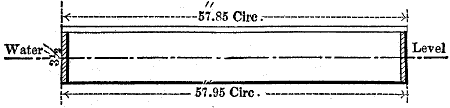
Fig. 1432.—Experiments with a circular hoop of wrought iron. Appearance of the hoop at the beginning.
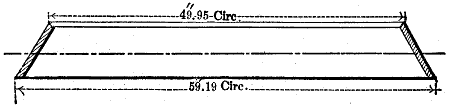
Fig. 1433.—Condition of the hoop after the twentieth cooling.
“In No. 8 a circular hoop of wrought iron was forged out of a 31⁄2-inch by 1⁄2-inch bar, the external diameter being about 18 inches, the breadth, 1⁄2 inch, being parallel to the axis of the hoop. This hoop, Fig. 1432, was heated to redness, then plunged into cold water half its depth, the upper half cooling in air. The changes in the external circumference of the hoop were accurately measured after each of twenty successive coolings, at the end of which the external circumference of the water-cooled edge had increased 1.24 inches, or 2.14 per cent. of its original length, and the air-cooled edge had contracted 7.9 inches, or 13.65 per cent.
“Experiment No. 8.—Wrought-iron hoop, 31⁄2 inches by 1⁄2 inch by about 18 inches in diameter, or exactly 57.85 inches in circumference at top, and 57.95 inches at bottom edge.
Top Edge. Bottom Edge. Remarks.
Contraction. Percentage of original circum- ference. Expansion. Percentage of original circum- ference.
Ins. Ins.
After 1st dip .50 .86 .08 .14
„ 2nd „ .99 1.71 .08 .14
„ 3rd „ 1.47 2.54 .26 .45
„ 4th „ 1.92 3.32 .30 .52
„ 5th „ 2.30 3.97 .34 .59
„ 6th „ 2.60 4.49 .40 .70 Slight crack in expanded edge.
„ 7th „ 2.94 5.25 .44 .76
„ 8th „ 3.40 5.98 .50 .86
„ 9th „ 3.70 6.39 .56 .96
„ 10th „ 4.40 7.60 .62 1.07
„ 11th „ 4.42 7.64 .66 1.14
„ 12th „ 4.85 8.40 .70 1.22
„ 13th „ 5.24 9.02 .78 1.34
„ 14th „ 5.74 9.92 .80 1.39
„ 15th „ 6.00 10.37 .86 1.49
„ 20th „ 7.90 13.65 1.24 2.14 After deducting for a crack .06 inch wide which appeared at sixth dip.
“It will be observed that we have here two remarkable phenomena: 1. The reversal of the expansion and contraction as described. 2. The very large amount of contraction on the upper edge compared with what was exhibited in Experiment 5 of entire submersion.
“The table showing Experiment 5 gives a contraction of 2.25 per cent. after the twentieth cooling, whereas the contraction on the air-cooled edge of Experiment 8 is 13.65 per cent., or six times the contraction of an entirely submerged hoop.
“To ascertain whether these unexpected phenomena had any connection with the circular form of the hoop, Experiment 9 was made with a straight bar of iron 31⁄2 inches deep by 1⁄2 inch thick by 28.4 inches long.
“Experiment No. 9.—Wrought-iron bar, 31⁄2 inches by 1⁄2 inch by 28.4 inches long, heated to a dull red, then quenched half its depth in water.
Bottom Edge. Top Edge.
Expan- sion. Percentage on original length. Contrac- tion. Percentage on original length.
Inches. Inches.
After 1st cooling .05 .18 .26 .91
„ 2nd „ .10 .35 .43 1.51
„ 3rd „ .10 .35 .54 1.90
„ 4th „ .14 .49 .75 2.64
„ 5th „ .20 .70 .92 3.24
„ 6th „ .30 1.05 1.25 4.40
„ 7th „ .34 1.20 1.50 5.28
„ 8th „ .38 1.34 1.56 5.53
„ 9th „ .39 1.37 1.66 5.84
„ 10th „ .40 1.40 1.76 6.19
„ 11th „ .41 1.43 1.84 6.48
„ 12th „ .44 1.55 1.96 6.90
“This was cooled half in air and half in water, and the length of the two edges measured accurately after each of twelve coolings. At the end of this experiment the air-cooled edge had contracted 6.9 per cent., while the water-cooled edge had expanded 1.55 per cent. of the original length. The effect on the bar was to make it gradually curve, the water-cooled or extended edge becoming convex, the air-cooled or contracted edge concave.

Fig. 1434.—Experiments with a wrought-iron bar. Appearance of the piece before heating.
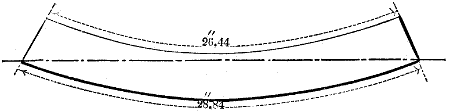
Fig. 1435.—Appearance of the bar after the twelfth cooling.

Fig. 1436.—After the preceding experiment the same bar was reheated and reversed in the water, the eleventh cooling resulting in the above form, the bar bending in the opposite direction from that previously shown.
“Experiment No. 10 was made in order to show the effect of reversing this cooling process. After five coolings, a bar of iron, 28 inches long, 31⁄2 inches deep, and 1⁄2 inch thick, was curved so that the versed sine of its air-cooled edge was 11⁄2 inches. The coolings were then reversed, what was the air-cooled edge being then immersed in water. After five more coolings the bar was restored to within 1⁄8 inch of being straight, and the eleventh cooling threw the concavity on the other side of the bar.
“Experiment No. 10.—Wrought-iron flat bar, 28 inches long by 31⁄2 inches by 1⁄2 inch, heated to dull red, then quenched half its depth in water, up to five heats, then the opposite edge dipped.
Versed sine of concave, i.e. air- cooled edge. Reversed Cooling.
Versed sine of concave, i.e. now water- cooled edge.
Inches. Inches.
1st cooling 5⁄16 6th cooling 1 3⁄16
2nd „ 9⁄16 7th „ 7⁄8
3rd „ 13⁄16 8th „ 3⁄4 scant.
4th „ 1 3⁄8 9th „ 3⁄8 full.
5th „ 1 1⁄2 10th „ 1⁄8
11th „ Brought concavity 1⁄8 in. on other side.
“When the author had proceeded thus far, these curious results were shown to several leading scientific men, who expressed interest in the subject, which encouraged the author to extend his experiments under varied conditions with a view of ascertaining the cause for these anomalous effects. These experiments (Nos. 11 to 17) are fully recorded, and the results shown on the diagrams; the actual rings are also on the table before you.
Large image (49 kB).
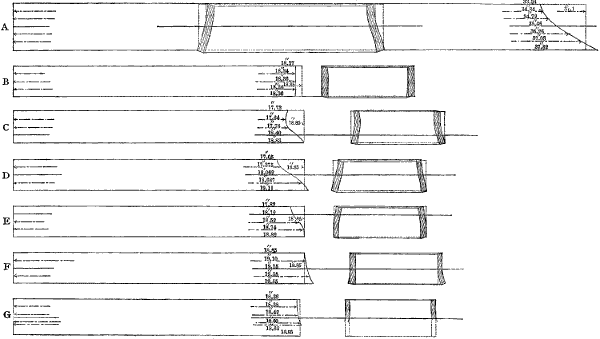
Fig. 1437.
“Experiment No. 11.—Wrought-iron hoop, turned and bored, 37.1 inches, outside circumference, by 2.95 inches deep by .44 inch thick, the grain of the iron running the short way of the bar from which the hoop was made, heated to redness, then cooled half its depth in water (see Fig. 1437 at a for final form of hoop after ten heatings and coolings).
Top Edge. Bottom Edge.
Contrac- tion. Percentage on original length. Expan- sion. Percentage on original length.
Inches. Inches.
After 1st cooling .3 .83 .05 .13
„ 2nd „ .6 4 1.72 .12 .32
„ 3rd „ 1.0 2 2.75 .22 .60
„ 4th „ 1.3 8 3.72 .30 .80
„ 5th „ 1.6 2 4.37 .37 1.00
„ 10th „ 3.1 4 8.46 .76 2.05
“Experiment No. 12.—Wrought-iron hoop, turned and bored, 6 inches diameter (18.85 inches circumference) outside, by 2 inches deep by .375 inch thick, heated to redness, then cooled, with lower edge barely touching the water (see Fig. 1437 at b for final form of hoop after twenty heatings and coolings).
Top Edge. Bottom Edge.
Contrac- tion. Outside circum- ference. Percentage of original circum- ference. Contrac- tion. Outside circum- ference. Percentage of original circum- ference.
Inches. Inches.
After 5th cooling .10 .53 .16 .85
„ 10th „ .22 1.17 .34 1.80
„ 15th „ .32 1.70 .48 2.54
„ 20th „ .48 2.54 .62 3.30
“Experiment No. 13.—Wrought-iron hoop, turned and bored, 6 inches diameter (18.85 inches circumference) outside by 2 inches deep by .375 inch thick, heated to redness, then cooled one-fourth its depth in water (see Fig. 1437 at c for final form of hoop after twenty heatings and coolings).
Top Edge. Bottom Edge.
Contrac- tion. Percentage of original circum- ference. Extension. Percentage of original circum- ference.
Inches. Inches.
After 1st cooling .06 .32 .02 .10
„ 5th „ .28 1.50 { A hair’s breadth contraction.
„ 10th „ .56 3.00 { Returned to original circumference.
„ 15th „ .78 4.14 .02 contraction. .10
„ 20th „ 1.12 6.00 .02 contraction. .10
“Experiment No. 14.—Wrought-iron hoop, turned and bored. 6 inches diameter (18.85 inches circumference) outside by 2 inches deep by .375 inch thick, heated to redness, then cooled one-half its depth in water (see Fig. 1437 at d for final form of hoop after twenty heatings and coolings).
Top Edge. Bottom Edge.
Contrac- tion. Percentage of original circum- ference. Expan- sion. Percentage of original circum- ference.
Inches. Inches.
After 5th cooling .46 2.44 .06 .32
„ 10th „ .96 5.00 .09 .48
„ 15th „ 1.34 7.10 .18 .96
„ 20th „ 1.80 9.10 .26 1.38
“Experiment No. 15.—Wrought-iron hoop turned and bored, 6 inches in diameter (18.85 inches circumference) outside by 2 inches deep by .375 inch thick, heated to redness, then cooled three-fourths its depth in water (see Fig. 1437 at e for final form of hoop after twenty heatings and coolings).
Top Edge. Bottom Edge.
Contrac- tion. Percentage of original circum- ference. Expansion. Percentage of original circum- ference.
Inches. Inches.
After 1st cooling .05 .26 .015 .08
„ 5th „ .30 1.60 .02 .10
„ 10th „ .56 3.00 { A hair’s breadth contraction.
„ 15th „ .74 3.92 { .02 contraction. } .10
„ 20th „ 1.02 5.40 { .03 contraction. } .10
“Experiment No. 16.—Cast-copper ring, turned and bored to same dimensions as Nos. 12, 13, 14, and 15, heated to redness, then cooled half its depth in water (see Fig. 1437 at f for final form of hoop after twenty heatings and coolings).
Top Edge. Bottom Edge.
Contrac- tion. Percentage of original circum- ference. Expan- sion. Percentage of original circum- ference.
Inches. Inches.
After 1st cooling .01 .05 .05 .26
„ 2nd „ .01 .05 .08 .42
„ 3rd „ .02 .10 .14 .75
„ 4th „ .02 .10 .17 .90
„ 5th „ - No change from original size from 5th to 20th cooling. .22 1.17
„ 10th „ .40 2.13
„ 15th „ .56 3.00
„ 20th „ .70 3.70
“It will be unnecessary to occupy much time in analyzing the experiments, as any one who takes a practical interest in the subject will have full information in the diagrams and tables. Professor Stokes drew attention to the fact that, in 1863, similar phenomena had been noticed by Colonel Clark, of the Royal Engineers. His experiments, made at the Royal Arsenal, Woolwich, were published in the ‘Proceedings of the Royal Society,’ and Professor Stokes had himself attached an explanatory note, the outline of which was as follows:—
“Imagine a cylinder divided into two parts by a horizontal plane at the water-line, and in this state immersed after heating. The under part, being in contact with water, would rapidly cool and contract, while the upper part would cool but slowly. Consequently by the time the under part had pretty well cooled, the upper part would be left jutting out; but when both parts had cooled their diameters would again agree. Now in the actual experiments the independent motion of the two parts is impossible on account of the continuity of the metal; the under part tends to pull in the upper, and the upper to pull out the under. In this contest the cooler metal, being the stronger, prevails, and so the upper part gets pulled in a little above the water-line while still hot. But it has still to contract in cooling, and this it will do to the full extent due to its temperature, except in so far as it may be prevented by its connection with the rest. Hence, on the whole, the effect of this cause is to leave a permanent contraction a little above the water-line, and it is easy to see that the contraction must be so much nearer to the water-line as the thickness of the metal is less, the other dimensions of the hollow cylinder and the nature of the metal being given. When the hollow cylinder is very short, so as to be reduced to a mere hoop, the same cause operates, but there is not room for more than a general inclination of the surface, leaving the hoop bevelled.
“The expansion of the bottom edge was not noticed in Colonel Clark’s paper, perhaps owing to the much smaller hoops which he used in experimenting. Accepting Professor Stokes’ explanation of the top contraction, it appears that expansion of the bottom may be accounted for by the reacting strain put on the cooled edge when forcing in the top edge, acting in such a way as to prevent the cooled edge coming quite to its natural contraction, and this, when sufficiently great, expresses itself in the form of a slight expansion.
“Experiment No. 14.—Forged steel hoop, turned and bored, 18.53 inches in circumference outside by 2.375 inches deep by .27 inch thick, heated to redness, then cooled one-half its depth in water (see Fig. 1437 at g for final form of hoop after three heatings and coolings).
Top Edge. Bottom Edge.
Contrac- tion. Percentage of original length. Expan- sion. Percentage of original length.
Inches. Inches.
Afer 1st cooling .06 .32 — — { Cracked at water‑cooled edge one‑third depth of ring.
„ 2nd „ .12 .64 — —
„ 3rd „ .20 1.08 .05 .27 { After allowing for three small cracks in bottom edge.”
The shrinkage of iron and steel by cooling rapidly is sometimes taken advantage of by workmen to refit work, the principles involved in the process being as follows:—
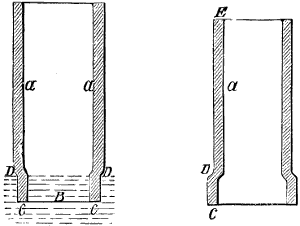
Fig. 1438.
Suppose in Fig. 1438 a a represents a piece of wrought-iron tube that has been heated to a bright red and immersed in cold water c c from the end b to d, until that end is cold. The part submerged and cold will be contracted to its normal diameter and have regained its normal strength, while the part above the water, remaining red-hot, will be expanded and weak. There will be, then, a narrow section of the tube, joining the heated and expanded part to the cooled and contracted part, and its form will be conical, as shown at d d. Now, suppose the tube to be slowly lowered in the water, the cold metal below will compress the heated metal immediately above the water-line, the cone section d being carried up into the metal before it has had time to cool; and the tube removed from the water when cold will be as shown in Fig. 1438, from c to d, representing the part first immersed and cooled. To complete the operation the tube must be heated again from the end c to a short distance past d, and then immersed from e nearly to d, and held still until the submerged part is cold, when the tube must be slowly lowered to compress the end c d, making the tube parallel, but smaller in diameter and in bore, while leaving it of its original length, but thickening its wall.
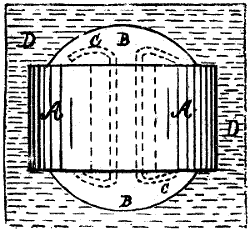
Fig. 1439.
This process may, in many cases, be artificially assisted. Suppose, for example, a washer is too large in its bore; it should have its hole and part of its radial faces filled with fire-clay, as shown in Fig. 1439, in which a is the washer and b b the clay, c c being pieces of wire to hold the fire-clay and prevent its falling off. The washer should be heated to a clear red and plunged in the water d d, which will cool and shrink the exterior and exposed metal in advance of the interior, which will compress to accommodate the contraction of the outer metal, hence the hole will be reduced. This operation may be repeated until the hole be entirely closed.
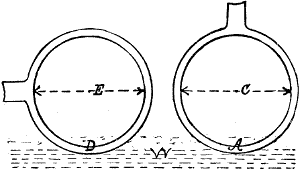
Fig. 1440.
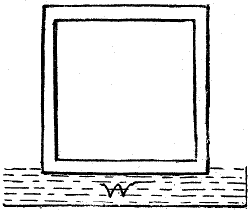
Fig. 1441.
Another method of closing such a piece as an eye of large diameter compared to its section, is shown in Fig. 1440; first dipping the heated eye at a and holding it there till cold and then slowly lowering it into the water, which would close the diameter across c, and, after reheating, dipping at d till cold, and then slowly immersing, which would close the eye across e. To shrink a square ring, the whole ring would require to be heated and a side of the square dipped, as shown in Fig. 1441, until quite cold, and then immersed slowly for about an inch, the operation being performed with a separate heating for each side. Connecting rod straps, wheel-tires, and a large variety of work may be refitted by this process, but in each case the outside diameter will be reduced.