QUERQUEDULA CYANOPTERA.—Vieill. The Red-breasted Teal. PLATE XV.—Male and Female.
Reading edition
This handsomely colored and elegant little Teal, is of frequent occurrence in Western America, though first noticed as a North American species in Louisiana, by E. Pilaté, M. D., a physician and naturalist, residing at Opelousas in that State. In a communication to us accompanying one of the first specimens obtained by him and intended for the collection of the Philadelphia Academy, that gentleman mentions having occasionally seen it in company with other species of ducks, but regards its appearance as unusual in Louisiana. The specimen alluded to, which is that of a male in very fine spring plumage, is now in the collection of the society mentioned. According to Dr. Pilaté, who has paid much attention to Natural History, this bird associates with other small species of water-birds, and appears to possess, in the migrating season, similar habits, and frequents the same places of resort, though rather unusually shy and vigilant.
Our valued friends Capt. Howard Stansbury, of the U. S. Topographical Engineers, in his able Report of a Survey of the valley of the Great Salt Lake of Utah, and Prof. Spencer F. Baird, of the Smithsonian Institution, in a valuable Zoological appendix to that Report, allude to this Duck as commonly met with in Utah, and especially in the vicinity of the Great Salt Lake. It was observed frequenting the rivers and small streams. The collection brought home by Capt. Stansbury containing many objects of the highest interest and scientific value, which are described with his usual great accuracy in Prof. Baird’s Appendix, is now in the National Museum at Washington city. The specimens of the present bird were obtained in the river Jordan, a stream emptying into the Lake, and so named by the settlers in that region, who are principally of the religious denomination of Mormons.
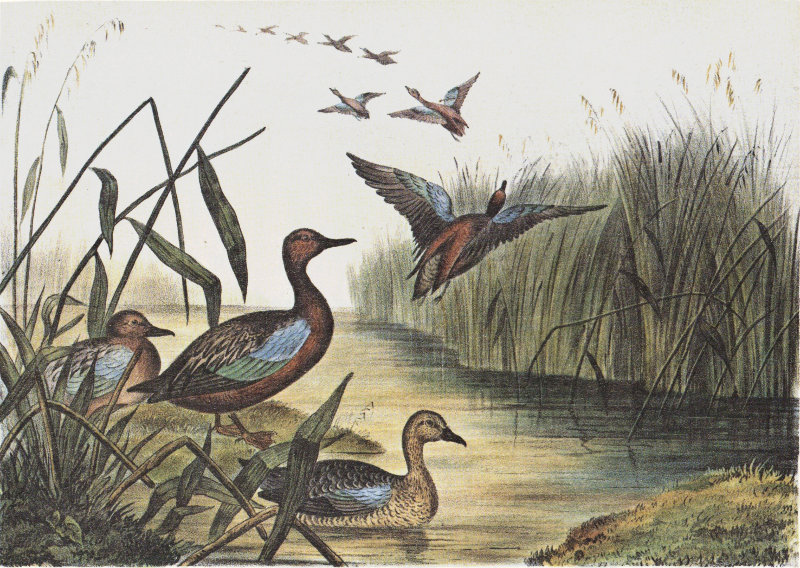
Plate 15 The Red-breasted Teal Querquedula cyanoptera (Vieillo)
83
It visits South America in the course of its winter migration, and is frequently to be met with in the western countries of that portion of this continent. The extensive collection in all departments of Natural History made by the party under the command of Lieut. J. M. Gilliss, of the U. S. Navy, during the performance of several years’ duty in making geographical explorations and astronomical observations in Chili and other countries of South America, by order of government, and which is now a portion of the National Museum, contains numerous specimens of the bird now before us. We have seen it, in fact, in all the various collections from western South America that have recently come under our notice.
Dr. Woodhouse represents this species as very abundant in western Texas and New Mexico. (Sitgreaves’ Report, Zoology, p. 103.)
DESCRIPTION AND TECHNICAL OBSERVATIONS.
Genus Querquedula. Stephens, Continuation of Shaw’s Zoology, XII. p. 142, (1824.)
Size small, bill rather long, straight, of nearly equal width throughout its length, lamellæ well defined, wings moderate, pointed, with the second quill usually longest, tail moderate, pointed, tarsi short, toes fully webbed.
Querquedula cyanoptera. (Vieill.)
Anas cyanoptera. (Vieill.) Nouv. Dict., V. p. 104, (1816.)
Anas Rafflesii. King, Zool. Jour., IV. p. 97, (1828.)
“Pterocyanea cœruleata. (Licht.)” Gray, Gen. of Birds, II. p. 617, (1845.)
Form. Small; wing rather long, with the second quill distinctly longest; tertiaries and scapulars, long; two central tail-feathers pointed; bill, rather long.
Dimensions. Total length (of skin), about 15 inches; wing, 8; tail, 3½ inches.
Colors. Male. Top of the head, chin and under tail-coverts, brownish black; head, neck and entire under parts, deep purplish chestnut; abdomen with a large spot of brownish black; back, scapulars, rump and upper tail-coverts, brownish black, edged with dull chestnut; large space on the shoulder and lesser wing-coverts, light sky-blue, succeeded by a transverse band of white, speculum brilliant grass-green; a portion of the two first scapulars blue, and all with a central stripe of pale reddish chestnut. Bill dark; feet yellow.
84
Female. Shoulders blue as in the male, but no trace of the chestnut color which prevails in the latter, that being replaced by a mottled yellowish and brown, very similar to the females of several other species of ducks. Head above brownish black.
Hab. Utah, California, Louisiana, Chili. Spec. in Mus. Acad. Philada., and Nat. Mus. Washington.
Obs. This very handsome species does not resemble any other species likely to be confounded with it. With other species of Teals, it has been placed in a distinct genus under the name Pterocyanea, Bonaparte, in which, however, we fail to perceive sufficient characters to warrant a separation from Querquedula.
85