BERNICLA LEUCOPAREIA.—(Brandt.) The White-necked Goose. PLATE XLV. Adult Male.
Reading edition
On the western coast of North America, this is one of the most abundant of the species of Geese. In California it appears regularly in the course of its migrations in the spring and autumn, and at both seasons is brought to the market in San Francisco, in large numbers.
This bird is a near relative of Hutchins’ Goose, a well known species, though not of common occurrence on the Atlantic coast. It is more frequently met with in the larger rivers of the interior. From that species our present bird may be easily distinguished by the white ring around the neck, a character not mentioned in the descriptions given by authors, nor represented in the plate in Mr. Audubon’s Birds of America, of Hutchins’ Goose. The plate alluded to is the only one of the species which has come under our notice, and is given with that eminent naturalist’s usual great accuracy, but may not, we suspect, represent a bird in mature plumage. This suspicion we have been induced to entertain from an examination of the specimen figured by Mr. Audubon, for an opportunity to make which we are indebted to the kindness of our friend, Mr. J. P. Giraud, of New York, to whose fine collection it belongs.
We are not, however, sufficiently familiar with Hutchins’ Goose, to feel qualified to decide respecting the identity of the present species.
This bird was first described by Prof. Brandt, a distinguished Russian naturalist, who ascertained it be an inhabitant of the coasts of Russian America. This author, and various others of Russia, have done much towards elucidating the Natural History of Northwestern America, and in some instances names given by them will be found to anticipate those of Americans, especially in ornithology.
As a species occurring on the coast of California, our present bird was first observed by Mr. John G. Bell, of New York, whose collection made in that country contained numerous specimens. Since that period, it has been noticed by nearly all our naturalists, though nothing is recorded of its habits or history. In fact, the water-birds of Western America have by no means received sufficient attention, and contributions to their history would be important additions to American ornithology.
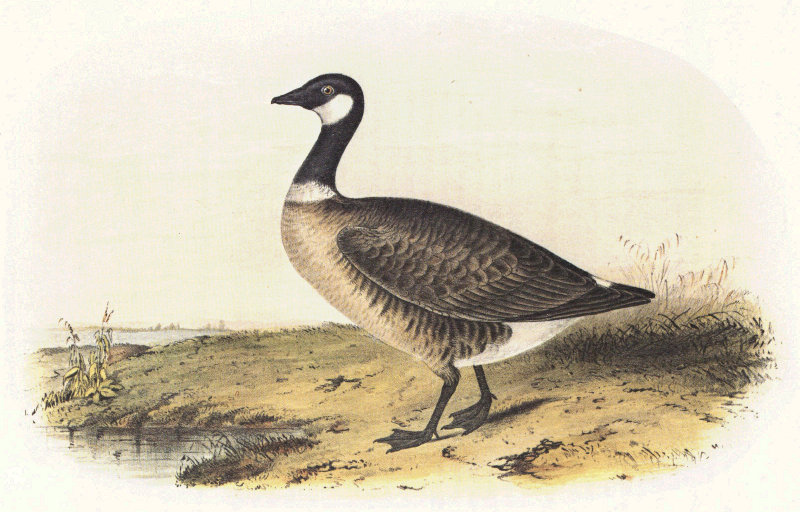
Plate 45 The White-necked Goose Bernicla leucopareius (Brandt)
273
DESCRIPTION AND TECHNICAL OBSERVATIONS.
Genus Bernicla. Stephens, Cont. of Shaw’s Zool. XII. p. 45. (1824).
Bernicla leucopareia. (Brandt.)
Anser leucopareius. Brandt, Bulletin Acad., St. Petersburg, I., p. 37. Desc. et Icones Animalium Rossicorum novorum. Aves, p. 13, pl. 2, (1836.)
Anser Hutchinsii. Richardson, Fauna Boreali Americana, Birds, p. 470? (1831.)
“Anser canadensis. Brisson.” Pallas, Zoographia Rosso-Asiatica, II., p. 230.
Form. Bill small, short, wide vertically at base; wing long, second quill longest; tail short; legs short; toes moderate, fully webbed. A protuberance on the edge of the wing near the shoulder. One of the smallest of the species of this genus.
Dimensions. Total length, male (of skin) about 23 inches, wing 15, tail 5½ inches.
Colors. Head and neck glossy black; a large somewhat reniform patch on each cheek, white, and a ring around the neck of the same (white) at the termination of the black part. Entire upper parts fuscous, lighter on the back, and with the feathers edged with paler and very dark, nearly black on the rump; upper tail coverts white; quills and tail brownish-black; secondaries edged outwardly with pale brown; breast and abdomen glossy yellowish ashy, with transverse stripes of brown on the sides; ventral region and under tail coverts, white; bill and feet dark; under wing coverts and axillaries light ashy brown; the white ring around the neck more or less interrupted behind; the white patches on the cheeks separated by a narrow longitudinal band on the throat.
Hab. California. Russian America. Spec. in Mus. Acad., Philad.
Obs. As stated in the preceding pages, this bird much resembles, if it is not identical with, the species known as Bernicla Hutchinsii, from which the most essential distinctive character is the white ring around the neck. If identical, we have, at any rate, the gratification of being the first to represent that species, in mature plumage. At present we regard it as a distinct, though nearly allied bird.
The date of the publication of Prof. Brandt’s first description we have not succeeded in ascertaining, not having access to the Bulletin of the Academy of St. Petersburg. The reference to the volume and page we copy from his own citation, in his work above quoted, in which, however, the date is not stated.
274