PYROCEPHALUS RUBINEUS.—Boddaert. The Scarlet-crowned Flycatcher. PLATE XVIII.—Adult and Young Males.
Reading edition
This bright-plumaged little bird is a summer visitor to Texas and New Mexico, in which countries it rears its young, and appears to be an inhabitant also not only of Mexico, but of nearly the whole of Central and South America. It has been long known as a bird of the last-named division of this continent, though but recently ascertained to be a resident within the limits of the United States, having been first observed in Texas by Captain J. P. McCown, of the United States Army, in 1850, and announced as an addition to the ornithology of North America, by Mr. Lawrence, in the Annals of the New York Lyceum of Natural History, V. p. 115. In some interesting notes on the birds of Texas, by Capt. McCown, published in the same journal, VI. p. 12, we find the following in reference to the present species:
“This beautiful little Flycatcher is seldom seen. I did not notice over a dozen of them while in Western Texas. I always found them near the ponds along the Rio Grande, and generally on a tree or stake near the water. The only nest I ever found was built upon a retama (a variety of acacia), over the water, and I was not able to procure it. The female is quite a plain bird.”
Our friend, Lieut. D. N. Couch, one of the several officers of the Army who have greatly contributed to the knowledge of the Natural History of little-explored portions of this country, and the results of whose observations have most generously been placed at our disposal, met with this bird in small numbers in Northern Mexico. From many valuable papers, which will add much to the interest of the present work, and for which we are indebted to this gentleman, we make the following extract:
“This bird was first seen at Charco Escondido, in Tamaulipas, on the tenth of March. The male had evidently preceded the female in his arrival, as the latter was not observed until several weeks afterwards. Early in the morning, and again about sunset, he came to the artificial lake that is constructed here for the supplying of water to the inhabitants, and appeared to be of a very quiet and inoffensive disposition, usually sitting on the upper branches of the trees, occasionally uttering a low chirp. Subsequently, it was met with in Nueva Leon, though I had little opportunity of observing its habits. It appeared, however, to be in some respects similar in its manners to the smaller species of the Northern Flycatchers.”
Dr. Henry has also met with the present bird in the vicinity of Fort Webster, New Mexico. He represents it, however, as of exceedingly rare 128 occurrence, so far as he has observed, and fully confirms the statements given above, respecting its partiality for the neighborhood of water. His first specimen, a male in full plumage, was obtained on the Rio Miembres, near Fort Webster, in the month of March, 1853.
DESCRIPTION AND TECHNICAL OBSERVATIONS.
Genus Pyrocephalus. Gould, Zool. Voy. Beagle, Birds, p. 44. (1841.)
General form compact and rather heavy; bill depressed, wide at base, rather long, acute, with an indentation near the tip of the upper mandible, and with several pairs of bristles at its base; wing long, the second and third quills longest, and nearly equal; tail ample, wide; tarsi rather long, slender; toes moderate or short. The species generally have the feathers of the head above lengthened and crest-like, and with other parts of the plumage of a fine scarlet color. An American genus of Flycatchers inhabiting the southern portion of the northern and nearly the whole of the southern division of this continent.
Pyrocephalus rubineus. (Boddaert.)
Muscicapa rubineus. Bodd., Tab. dez Pl. Enl. Buff., p. 42. (1783.)
Muscicapa coronata. Gm., Syst. Nat., II. p. 932. (1788.)
Form. Head above, from the base of the bill to the occiput, with long crest-like feathers. General form rather broad and robust; wings and tail long; legs slender.
Dimensions. Male. Total length (of skin), about 5½ inches; wing, 3¼; tail, 2½ inches.
Colors. Adult Male. Long feathers of the head above, and entire under parts, fine scarlet; brightest on the top of the head, palest on the under tail-coverts. Upper parts of the body, line from behind the eye, wings and tail, sepia brown; bill and feet dark. Under wing-coverts frequently edged and tipped with pale red.
Female. Entire upper parts plain sepia brown; under parts yellowish-white, with a few longitudinal lines of brown.
Young Male. Similar to the female, but with the flanks tinged with pale red.
Hab. Texas and New Mexico. Spec. in Mus. Acad., Philada.
Obs. On comparison of our specimens from Texas with others from various parts of South America, we cannot at present find differences sufficient to induce us to regard them in any other light than as one species. The present is the first bird of its genus which has been observed within the limits of the United States.
The sexes of this species are quite unlike each other, the female having none of the brilliant color of her companion.
The figures in our plate represent the adult and young males about two-thirds of the natural size.
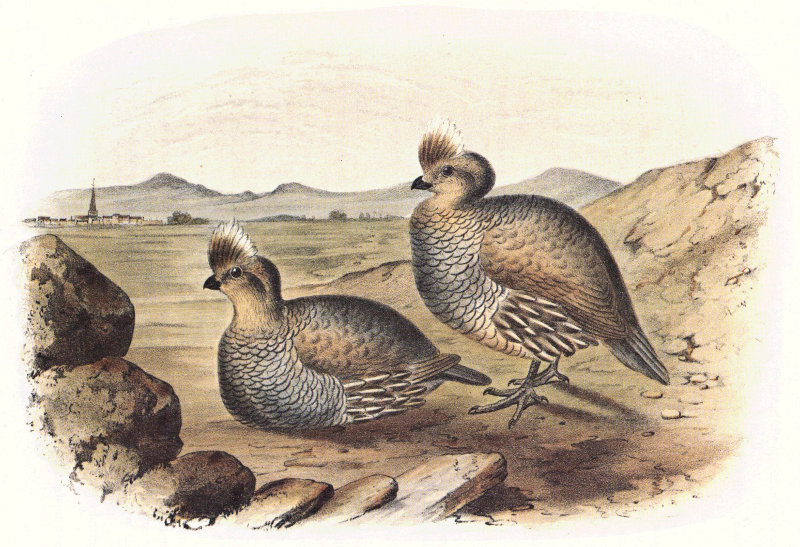
Plate 19 The Blue Partridge Callipepla squamata (Vigors)
129