GYMNOKITTA CYANOCEPHALA.—(De Wied.) The Prince Maximilian’s Jay. PLATE XXVIII.—Adult Male.
Reading edition
We have the pleasure of presenting to the reader, in the plate now before him, one of the most singular of the birds of the family of Crows and Jays yet known to inhabit North America.
This bird was discovered in the Rocky Mountains, by that learned and enthusiastic naturalist, Maximilian, Prince of Wied, who in the course of travels in North America, and especially in the interior, contributed a large amount of valuable information relating to the natural history of the northern portion of our continent, as he had previously to that of South America. Few books, in fact, contain more important observations in the various departments of North American Zoology than the work of that nobleman, “Travels in the Interior of North America,—edition in German, Coblenz, 1839;” but, unfortunately, and certainly without his approbation, nearly everything relating to natural history is omitted in the English edition, London, 1843. In Ornithology, the works of the Prince Maximilian are particularly valuable, and in that relating to North America, there are many notices of little known and interesting species, and the first descriptions of some which have since been regarded as previously unknown by American writers.
The present bird differs in generic as well as specific characters from all other forms of the family to which it belongs. Its short, heavy figure approximates it somewhat to the Nut-crackers of the old world (Nucifraga), and to Clark’s Crow of Western America (Picicorvus columbianus), and its habits, so far as known, are in some respects similar to those of the latter. It does not appear, however, to be in any considerable degree a fruit-eater, but is decidedly carnivorous, and almost rapacious; preying on Reptiles, particularly the various species of Phrynosoma, or Horned Frogs, as they are called with but little propriety, which abound in Western North America. It appears, in fact, to resemble in habits, to some extent, the reptile-eating Kingfishers (Genus Todiramphus) of Asia, the Pacific islands and Australia, and if not absolutely allied, is certainly a strongly analogous representative of those curious birds.
The first specimens of this bird which were brought to the attention of American naturalists, were sent to the Philadelphia Academy, by Mr. Edward 166 M. Kern, who procured them during his connection with Col. Frémont’s Expedition of 1846; and previously no others appear to have reached Europe, than those of its discoverer, the Prince Maximilian.
More recently it has been observed by several of the naturalists who have visited Western America. Our friend, T. Charlton Henry, M. D., of the United States’ Army, has noticed it repeatedly in the vicinity of Fort Webster, in New Mexico. To him we have the pleasure of expressing our obligations for the following interesting notes relating to this bird, as well as for many others:
“This singular and handsome Jay, I first met with near San Miguel, in July, 1852, where I observed a party of some twenty or thirty specimens flitting through the cedars along the roadside. They were mostly young birds, and constantly alighted on the ground, for the purpose, as I ascertained, of capturing lizards, which they killed with great readiness and devoured.
“Since that time, I have frequently observed this bird in the winter only, in the neighborhood of Fort Webster, and always in flocks of about forty or fifty; indeed I am not sure that I have not repeatedly fallen in with the same flock, and it may not therefore be as abundant as I am inclined to suppose. Here they evince an exceeding wariness and are very difficult to approach; I have chased a flock for hours without succeeding in getting within gun-shot.
“Almost invariably a flock alights near the summit of a hill, and passes down its side rapidly, all the birds keeping quite near to each other, and individuals frequently alighting on the ground, when their attention is attracted by their favorite food. They appear to be very social and keep up a continued twittering note. I have occasionally seen them flying in close flocks, high in the air, and apparently passing from one mountain or hill to another.
“This bird, so far as I have seen, is exclusively a mountain species, as I have never observed it in the plains or the bottom lands, which are the usual haunts of its relatives, Steller’s and the California Jay. It differs, however, from them in many respects, and is the only species of these birds that I have never met with singly or in parties of half-a-dozen individuals only. I have always seen it in large flocks. Its food appears to be exclusively reptiles.”
C. B. R. Kennerly, M. D., a young naturalist of great promise, who was attached as Zoologist to Lieut. Whipple’s party, for surveying a route for a railroad to the Pacific Ocean, brought fine specimens of the bird now before us, in the large and highly interesting collection of birds made by him in the countries traversed by the expedition. To Dr. Kennerly we are indebted for the following notice of this species:
“During the march of our party from the Rio Grande to the Sierra Madre, we saw this bird nearly every day. At that season, which was November, large flocks were constantly found in the vicinity of the running streams, which on being frightened from the low bushes, circled around, loudly uttering their peculiar cry, and rising higher and higher, until they reached the summit 167 of some tree on the rocky hills. When settled, they continued their discordant notes, which somewhat resemble some of those of the common Cat-bird (Mimus felivox).”
The Prince Maximilian’s specimens of this bird were obtained on Maria’s river, one of the tributaries of the Upper Missouri, in the northern part of the possessions of the United States in Western America, and much farther north than it has been observed by either of the late naturalists. It probably inhabits a very extensive district, the limits of which cannot at present be conjectured.
The figure in the present plate is that of the adult male, and is about two-thirds of the natural size.
DESCRIPTION AND TECHNICAL OBSERVATIONS.
Genus Gymnokitta. De Wied in Bonap. Consp. Av., p. 382. (1850.)
General form, rather short, robust; bill, straight, wide at base, somewhat rounded and flattened at the point, ridge of the under mandible (or gonys) very distinctly ascending; wings, rather long, first quill very short, fourth, longest, but only slightly longer than the third and fifth; tail, moderate, containing twelve feathers; legs and feet, strong.
Gymnokitta cyanocephala. (De Wied).
Gymnorhinus cyanocephalus. De Wied, Travels in North America (1839, Coblenz).
Cyanocorax Cassinii. McCall, Proc. Acad. Philada., V. p. 216. (1851.)
Form. Bill, straight, wide at base, blunt and rounded, and somewhat flattened towards the point; wings, rather long, secondaries, broad and mostly obtuse at their ends; tail, moderate, tarsi rather long, moderately robust, and with the toes distinctly scaled; claws, curved, rather strong and sharp.
Dimensions. Total length (of skin), about 10 inches; wing, 6; tail, 4½; bill, from gape, 1½ inches.
Colors. Adult.—Throat, white, tinged with bluish running into stripes on the neck before. Entire other plumage, above and below, ashy-blue, much darker and clearer on the head, palest on the abdomen, tibiæ and under wing coverts. Cheeks and frontal feathers, pale ultramarine; bill and claws dark; irides, light-brown—sexes alike.
Hab. New Mexico, Nebraska. Spec. in Mus. Acad., Philada., and Nat. Mus., Washington city.
Obs. This species does not resemble any other in such degree as to readily lead to confusion, and as yet stands alone in its genus.
The bird described by Col. McCall, as above, and to which he did us the honor to apply our name, he has since ascertained to be the present species, 168 of which, at the time of the publication of his description, no specimen was exhibited in the nearly complete collection of Jays in the museum of the Philadelphia Academy, nor had it ever been mentioned by any American ornithologist. He observed it in the vicinity of Santa Fé, in considerable numbers.
Although as we have said above, nearly the whole of the valuable Zoological notes in the German edition of the Prince Maximilian’s Travels, are omitted in the English translation; two notices of the present species may be found in the latter, pp. 287, 297, the last of which is the description, and seems to have accidentally escaped the singular want of judgment which induced the omissions to which we allude.
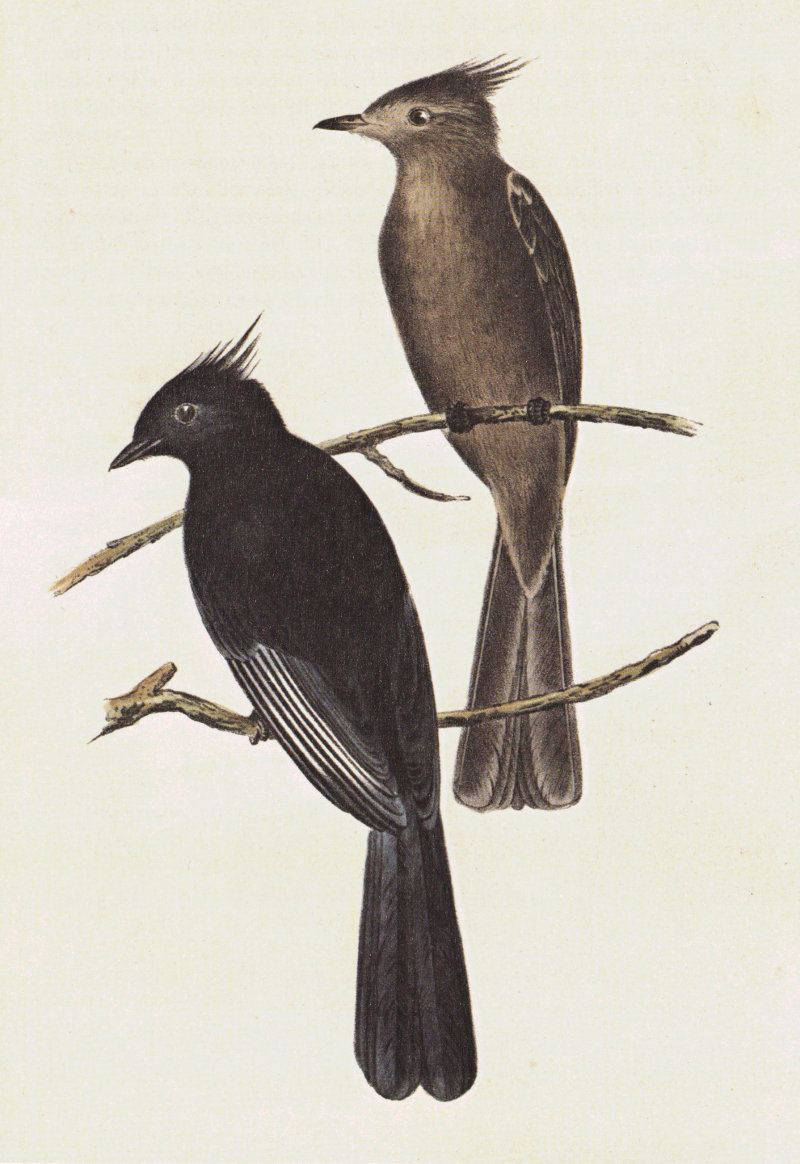
Plate 29 The Black Flycatcher Ptilogonys nitens (Swainson)
169