Part 2 / Book 2 — CHAPTER II.
Henry P. (Henry Pomeroy) Horton translation
ECONOMIC CRIMES.
It is necessary to divide these crimes into separate groups. Notwithstanding their partial similarity they differ too much among themselves to be treated together. I propose to speak of them under the four following heads: A. Vagrancy and mendicity; B. Theft, and analogous crimes; C. Robbery, homicide for economic reasons, etc. (that is to say, economic crimes committed with violence or directed against life); D. Fraudulent bankruptcy, adulteration of food, etc. (that is to say, economic crimes committed almost exclusively by the bourgeoisie, while those of the first three categories are committed almost exclusively by the poor). Some crimes, like that of embezzlement, belong to the second class as well as to the fourth (for example, a workman’s making off with a bicycle loaned to him, and the embezzlement of deposits by a bank director).
each 100 thieves 44.2 vagrants, 35.0 mendicants
each,, 100 swindlers 11.1 vagrants,,, 20.2 mendicants,,
each,, 100 sexual offenders 14.0 vagrants,,, 17.3 mendicants,,
each,, 100 incendiaries 15.1 vagrants,,, 15.5 mendicants,,
each,, 100 perjurers 4.2 vagrants,,, 4.7 mendicants,,
For these reasons, then, it is necessary to treat of vagrancy and mendicity.
A. Vagrancy and Mendicity.
In examining the etiology of these contraventions, we perceive that different causes lead to them. We shall treat them successively and endeavor to find their relation to the economic life.
First. As a first cause of vagrancy and mendicity is the fact that under capitalism there are always workmen who cannot sell their labor. The number of these persons increases greatly at the time of a crisis. When the men out of work have no resource in their family and no longer receive aid from their union, they are obliged to go from place to place looking for employment, and if they do not succeed in finding it must have recourse to begging in order not to die of hunger. Statistics furnish the proof that the army of vagrants and mendicants is in fact made up in part of the unemployed who, though they wish to, cannot find work.
In the first place, vagrancy and mendicity increase in winter (as in general all economic criminality does), when forced unemployment is at its height, and needs are most pressing, while they diminish in summer. The following figures with reference to some of the German states show these facts.
The following figures confirm those that have preceded.
Another proof in support of the assertion that unemployment is a cause of mendicity and vagrancy, is to be found in the fact that the figures for vagrancy and mendicity rise considerably at the time of economic crises. The same phenomenon occurs more or less when the price of grain or bread goes up. Then those whose labor is only poorly paid must find some means of increasing their resources; and further when bread is dear less of other things can be bought, which brings about a decrease in production and consequently an increase in forced idleness.
In the first part of this work I have mentioned authors who have shown for different countries that the curve of vagrancy rises or falls as economic conditions become worse or better. I add here the data that I have been able to find elsewhere.
With some exceptions the curve of vagrancy rises and falls, then, pretty much as the economic situation grows worse or improves.
Bavaria, 1835–1861.
Flanders, 1839–1848.
Ducpetiaux had given proofs of the same correlation. (See pp. 33–37.)
France, 1840–1886.
In this period the economic depression in Germany, dating from about 1890, began to decrease.
Netherlands, 1860–1891.
Since there are no statistical investigations of the course of vagrancy and mendicity I have composed the following chart from the official data.
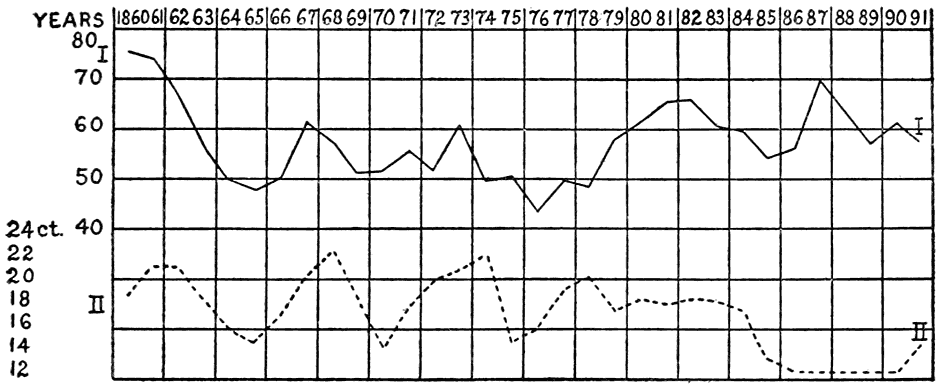
I. Number Convicted of Vagrancy and Mendicity to 100,000 of the Population. II. Price of Bread (in Centimes per Kilogram).
A comparison of the two curves shows that there is a parallelism, tolerably constant up to 1869. After this it ceases with some exceptions. The great fall in the price of bread, beginning with 1878 (as a consequence of the agrarian crisis), even coincides with a considerable increase in vagrancy and mendicity. To explain this we must consult the statistics of failures. These show that the great increase of vagrancy and mendicity coincide with an equally great increase in the number of bankruptcies, beginning in 1875 and lasting to 1882. For the following years there is no relation between the two phenomena apparent.
Prussia, 1854–1870.
I have composed the following table by means of the data given by Starke in his “Verbrechen und Verbrecher in Preussen” (pp. 55 and 115).
Years. Number of New Cases of Vagrancy and Mendicity. Price of 50 Kilograms in Marks.
Wheat. Rye. Potatoes.
1854 14,619 12.90 10.40 3.17
1855 16,665 14.21 11.45 3.37
1856 20,414 13.51 10.64 3.13
1857 15,801 10.18 6.87 2.18
1858 15,318 9.08 6.38 1.91
1859 16,978 8.93 6.79 1.98
1860 16,320 10.48 7.65 2.41
1861 14,239 11.04 7.71 2.79
1862 12,846 10.68 7.97 2.47
1863 11,840 9.18 6.78 2.04
1864 12,026 7.95 5.69 2.10
1865 11,640 8.13 6.24 2.03
1866 13,664 9.80 7.30 2.05
1867 15,339 12.89 9.87 2.95
1868 14,801 12.48 9.84 2.62
1869 15,091 9.70 8.08 2.16
1870 13,320 11.04 7.78 2.58
Although the curves of the price of foodstuffs and of vagrancy do not exactly conform, the influence of the price is none the less evident. The three periods of high prices (1854–56, 1860–62, and 1867–68) coincide with high figures for vagrancy and mendicity. (It is to be noted that the effect of an economic depression does not always make itself felt the following year.)
Kingdom of Saxony, 1889–1892.
It is impossible to fix exactly how far the influence of economic depressions extends; in other words, we cannot determine the number of vagrants and mendicants who become such directly through forced idleness. When it is necessary to record a certain number of convictions for vagrancy and mendicity, although the economic conditions are most favorable, we shall not even then be able to say that this proves that the convictions fell only upon persons who could have found work, but did not wish it.
Before leaving the subject of this cause, we must say something with regard to the objection that the workers who, on account of a long period of unemployment, fall finally into vagrancy, are inferior to the average, generally do not know a trade, and are often addicted to alcohol; and that consequently in this case an individual factor plays a rôle beside the economic factor.
However, supposing that each of these individuals knew a trade, supposing also that they were all robust and healthy and in a condition to work regularly, would there then be fewer persons without work than there are now? The answer to this question must be negative. Even if every workman knew a trade, this fact would not increase the demand for skilled workmen. At any given time the labor market demands only a certain number of skilled workmen, and a certain other number of unskilled laborers; the number of unskilled laborers available has no influence. The same thing is true as to fitness for work; if all the workmen had the same energy, the same zeal, etc., this would not increase the demand for workmen; this demand is regulated by other factors.
In my opinion it cannot be a question of individual causes; individual differences explain partially who remain without work, and so become vagrants; but it is the economic system which causes the existence of persons without work. Vagrancy and mendicity would be no less extensive even if all the workers knew a trade and were equal in zeal and energy.
In the second place the world of vagrants and mendicants is composed of people too old to work, or more or less incapable of working, from physical or psychical causes, so that they are no longer employed. So far as I know the data concerning the age of vagrants and mendicants are not numerous; I can cite those that follow.
Russia, 1897.
As has been said, a certain number of vagrants are weak or sickly, and consequently are nearly or quite unable to work. In “Les habitués des prisons de Paris”, Dr. Laurent gives the following description of some vagrants observed by him, true types of this kind of individual. “I have known at the Santé in recent years an individual who has passed almost the whole of his life in prison, who was born and lived in misery. A natural child, his mother received him as a mistake and a burden and tried to destroy herself and him. Later, convulsions twisted him upon a hospital bed, and he has remained half-paralyzed. So far from knowing how to read or write he can hardly see clearly, for an opaque film covers his left eye. He has undergone more than twenty sentences for mendicity and vagrancy, and he is still only 37 years old. He leaves prison only to enter it again. So he complains bitterly and blames the judicial authorities, who, instead of placing him in an asylum, where he belongs, cast him into prison, because, says he, the food does not cost so much.
“An individual 29 years old, the son of a drunkard and a consumptive, has already been seven times sentenced for mendicity. He has been half-paralyzed since he was 13 months old and can walk only with crutches. Epileptic in addition, he drifts from prison to prison.
The following figures, taken from the work just quoted, inform us as to the number of such individuals.
Breslau.
Physical and Mental Condition. Absolute Numbers. %
Physical condition weak 337 91
Incapable of military service from physical weakness 236 64
Mental anomalies 322 87
Epilepsy 43 11
Imbecility 86 23
Total number examined 369 100
Here it must be noted that in the years 1896–97 there were on the average only 9% of the conscripts of Silesia who were incapable of military service.
It is difficult to tell how many of these children there are. The only figures that I know of are the following.
Among the minors sent to a house of correction for vagrancy there were
Divisions. Absolute Numbers. %
Illegitimate children 91 8.0
Orphans 498 43.8
Children whose parents were in prison 25 2.2
Other children 524 46.0
Total 1,138 100.0
Fourth. Finally, the fourth category of vagrants and mendicants. This consists of those not included in the other three classes of people who are physically in a condition to work and who have opportunity to do so, but are not willing to work. It is hard to determine with certainty how large a part of the army of vagrants and mendicants they make up. But it seems to me certain that the facts given above prove that they are not as numerous as some authors and many other people believe. Besides, how is it that the philanthropic institutions where everyone admitted has to work, are always full, if it is true that most vagrants are persons who are not willing to work?
The vagrants of this class are then lazy persons, unwilling to work, but living at the expense of others, and consequently parasites. It is with reason that many authors have blamed such persons (though, as Dr. Colajanni says, justice would require that we should include all do-nothings, and not the poor only). But this does not advance the cause of sociology; her task is to find the causes of the phenomenon.
In some cases, then, it is more profitable, and in all cases more easy, not to work. In consequence of these facts we read very often that the public ought not to give to these idlers. But the public cannot distinguish this class of mendicants from the others. It is certainly true that professional mendicity would diminish if nothing were given to mendicants; but on the other hand the great misery among the other poor would be aggravated still more. And I venture to doubt whether the advantage thus gained on one side would counterbalance the disadvantage created on the other.
And these laments upon the subject of the stupidity of the public are generally accompanied by anathemas upon those who prefer the life of the parasite to work. No one would naturally be inclined to excuse these individuals. But it is necessary to look at the question from both sides. If these people are blamed, blame must be attached also to a state of society in which honest labor is so poorly paid that begging is often more lucrative. These individuals are cunning egoists and as long as society is organized as it is, they are right from their point of view. To be sure, they have no feeling of honor, they attach no value to the opinion of others, but the feeling of honor is not innate but acquired. As the facts show, vagrants generally come from an environment where there can be no question of a development of moral qualities. Dr. Bonhoeffer shows, for example, that about 45% of the vagrants examined by him had been brought up in bad home surroundings (alcoholism of the parents, etc.). Then, as we have seen above, the social feelings can be developed only where there is reciprocity. I should like to know whether society really concerns itself with the fate of these unfortunates to such an extent that they in their turn care greatly for the opinion of this same society. Certainly not. They are pariahs, and since they are such the contempt of a hostile world is a matter of indifference.
B. Theft and Analogous Crimes.
Before examining the motives inducing the commission of theft (the most important crime of this group, the others being mostly modifications of it) we must first stop a moment to ask the question, “Is honesty an innate characteristic or is it acquired?”
The motives for these crimes with which we are now occupied we shall speak of under three heads. The first group includes the crimes committed from poverty, the second those that result from cupidity, and in the third group we shall treat of the criminals by profession.
a. THEFTS COMMITTED FROM POVERTY.
There are some needs which a man must satisfy, without which his existence is impossible. These are fundamental needs, independent of environment. If a man has not sufficient food, if he has not (at least in non-tropical countries) clothing to protect him against cold, if opportunity for rest is lacking, etc., his life is in danger. In our present society there are always a number of persons who are in want of the strict necessaries of life, and who are therefore obliged to steal if they do not wish to succumb to poverty. It is evident that the word “poverty” is not to be taken in the most limited sense, so that one who can still buy a morsel of bread, and yet steals, may still be considered as a thief from poverty.
We must make here one more observation before we enter upon the proofs of this thesis. We have defined crime as an egoistic act. However, the same act may be at once egoistic and altruistic, and this is the case with some crimes committed from poverty, when an individual steals in order not to have those in his charge die of hunger. What conflicts of duty our present society creates!
The proofs that absolute poverty provokes a number of thefts are of three kinds. The first two are based upon the dynamics of criminality.
First. In winter, when poverty is most pressing, the number of thefts etc. is much greater than in summer. This is a fact so well known that it is unnecessary to give detailed proofs of it, and I think it will be sufficient to give the following statistics dealing with two important countries for a great number of years.
There is, then, a pretty considerable increase as winter approaches, and a decrease with the summer months. I would call the attention of the reader especially to the fact that it is the crimes of simple theft and the receiving of stolen goods which show this change in the most marked way, while aggravated theft, embezzlement and the professional and habitual receiving of stolen goods show it in less degree. It is the two former crimes which have poverty as their cause, while the three latter are more apt to be committed from cupidity and by professional criminals.
The following figures, taken from the criminal calendar composed by Professor Lacassagne, have to do with
Number of Crimes Against Property for Each Month, Reduced to an Equal Duration of 31 Days.
January. 16,350
February. 15,400
March. 14,250
April. 13,450
May. 13,625
June. 13,450
July. 13,225
August. 13,425
September. 13,875
October. 14,400
November. 16,100
December. 16,825
We have here, then, as always, a great increase in fall and winter, and a corresponding decrease in spring and summer.
Second. A second proof of the importance of absolute poverty as a cause of crime etc. is furnished by the fact that there is a considerable increase of the crimes in question in times of economic depression (high price of bread, lack of work, etc.). In Part One I have cited many works in which this phenomenon is proved for a number of countries. I refer the reader, therefore, to the more important of these, and add other data here.
England, 1823–1896.
Dr. Tugan-Baranowsky proved for the periods 1823–1850 and 1871–1896 the correlation between good and bad times and the decrease and increase of criminality.
Grand-Duchy of Baden, 1875–1892.389
J. S(chmidt), the statistician, shows the parallelism of the two curves for the period mentioned (p. 243).
Bavaria, 1835–1861.
Dr. G. Mayr was one of the first statisticians to show the influence of the price of grain upon crimes against property (pp. 39–42).
Belgium, 1839–1890.
France, 1825–1886.
The influence of the price of grain upon crimes against property has been shown for the periods 1845–1864, 1850–1864, and 1855–1864 respectively, by Drs. Weisz (pp. 60–61), Corne (pp. 48–49), and Mayr (pp. 46–47). Lacassagne and Lafargue have shown the correlation between the fluctuations of the economic life and those of economic crime for the years 1825–80 and 1840–86 respectively (pp. 149 and 231 ff.).
Italy, 1873–1890.
For this period Fornasari di Verce has shown the parallelism between the curves of economic occurrences and of economic crime (pp. 138–143).
New South Wales, 1882–1891.
The same author has shown here also the same correlation (p. 144).
Netherlands, 1860–1891.
Since researches for this country upon our subject are lacking, I have composed the following diagram from the official data.
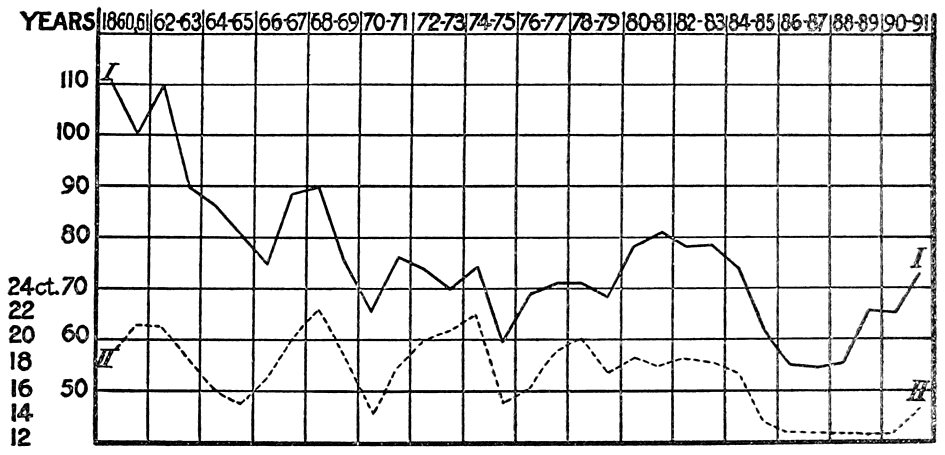
I. Number of those Convicted for Theft to 100,000 of the Population.
II. Price of Bread per Kilogram in Centimes.
Few sociological theses, it seems to me, have been proved as conclusively as the one of which we have just been speaking. The important influence of the trend of economic events upon that of economic criminality has been shown for thirteen different countries for different periods of the nineteenth century. Some authors are of the opinion that poverty cannot be the cause of crimes that are committed when economic conditions are most favorable, and when economic crimes have consequently reached their minimum. This assertion still needs fuller proof, as I have already pointed out, since there are still many persons who are in want of the necessaries of life even in times of prosperity.
We shall not employ any further methods to establish our thesis; since for the reasons already stated they would lead to results of no great significance, and it seems that the accuracy of the thesis has been sufficiently shown by the proofs cited.
We have now come to the end of our consideration of the subject of thefts committed from poverty. There are two ways in which it is the cause of theft. On the one hand it incites directly the appropriation of the property of others, and on the other hand it exercises a demoralizing influence.
b. THEFT COMMITTED FROM CUPIDITY.
The cupidity of those who can satisfy only the desire for the bare necessities is not awakened in the same measure in each of them. As has already been remarked by Guerry and Quetelet (see Part I), economic crimes are most numerous in the countries where manufacturing and commerce are most developed, and where the contrasts of fortune are consequently the greatest. It is for this reason that the cities, where the contrasts between poverty and wealth are greatest, give also very high figures for crimes against property (see pp. 530–531).
After what has been said it is unnecessary to dwell longer upon the different ways in which cupidity is awakened in our present society. However we must note the following. Almost all the thefts of the class of which we are speaking (those committed by so-called occasional criminals) are thefts of articles of very small value (see the figures on p. 201); the exceptions are the thefts of large sums of money. The authors of these last are in general the employes of banks, etc., persons who, from the nature of their work, have the opportunity to appropriate other people’s money. When we investigate the reasons for their committing their misdeeds, we shall see that nine times out of ten (I cannot prove it by figures, but no one will contradict me) the criminal is a speculator who has lost, or perhaps an individual who visits prostitutes, and hence has great need of money.
Cupidity is thus excited by the environment, but not in the same degree in every case, the environment not being the same for all. However, even supposing that the environment were exactly identical for a number of persons, cupidity would not be excited in the same measure in some as in others, since they are not alike, one being born with more intense desires than others (admitting that it is the environment that calls forth the desires). The more intense a man’s desires, the more risk he runs, other things being equal, of falling foul of the law. As I have already remarked above, this is important for the person who is seeking the reason why A and not B has stolen, though both live in the same environment; for sociology this fact is only of secondary importance, for it does not ask “Who becomes criminal?” but rather “How does it happen that there are crimes?”
We have now examined one of the sides of the question; the principal cause of these crimes is the cupidity awakened by the environment. If the environment were different, cupidity would not be aroused and the crimes would not be committed. In my opinion most criminologists do not sufficiently appreciate the importance of this fact. It is very difficult for anyone who lives at ease to form an idea of what is passing in the mind of one who has only the bare necessaries of life and is deprived of every comfort and amusement, while he sees others who have too much, and yet often work less than he does.
Let us now examine the other side of the question. For this purpose let us make use once more of the figure of balances in describing the process that goes on in the brain of the man who hesitates. Upon one of the pans cupidity exercises its force, in different measure according to the person. What are the weights upon the other pan balancing the first? It is the moral forces which must be considered first. I have fully explained above how the economic environment has prevented the social instincts from being developed in man, and how this is especially true for certain classes of persons. It is unnecessary to repeat this here. It will be sufficient to note certain points which have a special importance for the kind of crimes with which we are occupied at the moment.
We might close our observations upon theft from cupidity at this point if there were not fear of an objection drawn from what has just been said, namely the following. If the occasional thief has become such, on the one side because of the cupidity awakened in him, and on the other side in consequence of his lack of a good education, and if he differs, not qualitatively, but only quantitatively from the honest man, possessing less strength of character than the average—if all this is true, then the figures for theft should be higher than the statistics show. All of which would go to prove that it is wrong to deny that criminals constitute a biological anomaly.
Second. Many persons remain honest, not for moral reasons, but because they lack the courage, cleverness, or other qualities necessary for being otherwise, qualities which in themselves have nothing to do with crime.
When we place beside the occasional thieves, those who never steal but commit all sorts of reprehensible (though not illegal) acts, the comparison is not to the advantage of the latter. Their trickery, their pitiless egoism, often make them more dangerous to society than the others; which should be a reason for criminal anthropology not to build a system based solely upon investigations of prisoners.
These two reasons by themselves show that the number of crimes is much greater than the statistics would generally lead one to suppose, even if one takes account of the fact that some of the complaints made to the prosecutors are false.
In the third place, we have been speaking so far of the cases that come to the notice of the officers, while in a great number of cases no complaint is made, especially in the matter of petty theft, either because the person injured wishes to avoid the annoyance of having to appear in the police court as witness, or because he wishes to spare the delinquent.
In the fourth place, a great many small thefts remain unknown even to the person injured, since he does not notice the loss that he has suffered.
To sum up. I believe I have shown that the fundamental causes of theft and similar crimes committed from cupidity are, on the one hand, the cupidity aroused by the environment and, on the other, neglected childhood among the poor. It is especially those weak in character who run the greatest risk of becoming guilty of these crimes.
c. CRIMES COMMITTED BY PROFESSIONAL CRIMINALS.
In considering all the kinds of theft and analogous crimes, we note that the thefts committed by professional criminals represent only a minority. But as soon as we limit our consideration to the more serious forms of theft, such as burglary and similar crimes, we shall discover that they are committed almost exclusively by individuals whose principal or subsidiary occupation is theft, and who, in general, do not consider it shameful, and do not feel the slightest repentance.
The first category is composed of children. Sad as this is it is none the less true. It is plain that not a single child follows the profession of thief from pleasure, for a child prefers not to work at all. These children, then, are taught to steal by their parents. If they are not very numerous, in the great cities there are always some cases of this kind. Dr. Puibaraud, former police official in Paris, describes one of these as follows. “We recall that one day, on visiting the Petite-Roquette, we found in a cell a child scarcely eight years old, with a wide-awake face, a quick eye, but whose physiognomy was already very peculiar. It was a young pickpocket who had been found drunk upon the street, and who, being arrested by an agent and taken to the station, had confessed that the gold he had in his possession was the proceeds of a theft committed by him without the knowledge of his ‘papa.’ This capture ended by the whole family’s being arrested at their lodgings, near the Place Maubert.
As we see this child found theft the most natural thing in the world (and any other child in the same environment would think the same); he “worked” with his father. If exceptionally favorable circumstances do not happen to present themselves to such children they will belong to the army of professional criminals all their lives.
That is easy to say, and certainly justice will not concern itself with him any further until he commits a new offense. But this is not the same as saying that society pardons him and aids him, in order that he may remain in the right path. On the contrary, forgetting that we must forgive those who have trespassed against us, society makes life hard for him. It is almost impossible for him to find work; the fact that he has been in prison is enough to insure his being refused everywhere. Why should anyone hire an old prisoner when there are so many others who have never got into the courts? And then most prisoners have never learned a trade, and this is one reason more why they cannot easily find employment. The liberated convict becomes a nomad, begins by losing all contact with the normal world (supposing he ever had any) and feels himself a social pariah. On the other hand he has relations more and more frequent with the “under world”, with those who recognize no duty toward a society which is not interested in their fate. His moral sense comes to be more and more blunted until he becomes a criminal by profession, having a feeling neither of shame nor of repentance.
The ignorant public, who know nothing about the professional criminal except when he appears before the tribunal, is astonished to find that there are persons so abject. This astonishment is like that of some one who has never seen a house built, and cannot imagine how such a colossus can be put up. But he who has seen how the house has been erected by adding one small brick to another no longer feels any astonishment. It is the same with the professional criminal; he who has followed the story of the criminal’s life recognizes with Dr. Havelock Ellis, that his crime is but the last link of a solidly forged chain.
This is altogether different from what is generally said and written by those who allow themselves to be led away by their imagination. It is plain that the manner in which criminals act toward a society that is hostile to them will not fail to influence the relations they have with their fellows, just as war for those who take part in it cannot leave their moral sense as regards their compatriots unharmed. However, nothing permits us to put the actions of these persons among themselves in the same rank as those towards society. In my opinion this fact has great significance for the moralist and the criminologist; it is one of the forms of the dualism of ethics. It is of very high importance for the criminologist, for its shows that we are upon the wrong track, since it is precisely the more serious forms of crime that the present methods of repression favor.
In imprisoning young people who have committed merely misdemeanors of minor importance, and who have not yet lost all touch with normal society, and putting them in contact with inveterate criminals, or perhaps putting them into a cage like beasts, without striving to enlighten their darkened minds or teach them morality, and without making them capable of sustaining the struggle for existence by teaching them a trade, we are bringing up professional criminals. Punishment, as a means of intimidation, misses its aim in great part, for the professional criminals are recruited among individuals who are not easily intimidated.
We have now come to the question why a certain number only of those whose childhood has been neglected and who have committed a light offense, become professional criminals. In the first place there are those whom chance favors, since they are assisted, it may be by their families, it may be by some philanthropist, and so return to the right path. There are those also who have the advantage of being able to find work, since no one knows that they have been in prison.
Others have less chance; no one aids them, there is no work for them; all, however, do not become professional thieves. Those who become such are the more intelligent, energetic, ambitious, and courageous of these outcasts; the others become vagrants and mendicants. Here is the opinion of Flynt upon the criminal by profession, an opinion which agrees with that of other competent authors. “I must say … that those criminals who are known to me are not, as is also popularly supposed, the scum of their environment. On the contrary, they are above their environment, and are often gifted with talents which would enable them to do well in any class, could they only be brought to realize its responsibilities and to take advantage of its opportunities. The notion that the criminal is the lowest type of his class arises from a false conception of that class and of the people who compose it.…
“In this same class, however, there are some who are born with ambitions, and who have energy enough to try to fulfil them. These break away from class conditions; but unfortunately, the ladder of respectable business has no foothold in their environment.…
There are readers, perhaps, who will find that these qualities of the professional criminal give the lie to the environment hypothesis, since individual factors are recognized in a certain way. For myself I do not find it so. The qualities mentioned have nothing to do with crime as such; they can be utilized to the profit as well as to the detriment of society; it will depend upon the environment in which the individual endowed with them has been raised what direction he will take. It would not be difficult to name a number of historic celebrities (Napoleon, for example) who, if they had been born in the lower stratum of a great city, in place of in a favorable environment, would have had only the sad celebrity of criminals exceptionally endowed.
To have invested funds, to spend plenty of money, not to have to work much, this is their ideal; to share the lot of the working-man, who, notwithstanding his long and hard labor, never succeeds in procuring for himself the pleasures of the rich, makes life insipid in their eyes. M. Gisquet, former prefect of police, gives in his memoirs the following declaration made by Leblanc, the notorious professional criminal. “If I were not a thief by vocation I should become one by calculation; it is the best profession. I have computed the good and bad chances of all the others, and I am convinced by the comparisons that there is none more favorable or more independent than that of thief, nor one that does not offer at least an equal amount of danger.
“What should I have become in the society of honest men? A natural child, with no one to protect me or to recommend me, I could only choose a disagreeable trade, become a delivery-boy in a store, or at most reach the miserable place of shipping clerk in a warehouse; and there, a supernumerary for many years, I should have died of hunger before I reached a salary of six hundred francs. As a workman in any class whatever you exhaust yourself quickly through the fatigues of your labor, to earn a miserable wage, and to live from day to day; then when accident, sickness, or old age come you must go beg or die in the poorhouse.…
So far we have been treating of the etiology of theft and analogous crimes; we shall conclude this section with some observations upon the causes that have led to the designating of these acts as crime.
C. Robbery and Analogous Crimes.
Italy, 1887–1889.
Provinces. Average to 100,000 Inhabitants.
Robbery, etc., with Homicide. Robbery, etc., without Homicide.
Apulia 5.01 0.27
Basilicata 2.42 4.18
Sardinia 2.06 12.11
Sicily 1.22 14.56
Liguria 1.07 8.65
Calabria 0.97 6.36
Latium 0.89 17.15
Campania and Molise 0.71 8.08
Piedmont 0.63 4.67
Romagna 0.63 6.47
Abruzzo 0.58 2.07
Marches and Ombria 0.55 2.46
Venetia 0.33 2.58
Emilia 0.28 5.80
Lombardy 0.21 3.14
Tuscany — 5.68
An investigation into the causes of this change in the form of economic criminality will indicate also the principal causes of the persistent existence of this kind of crime, however it may have decreased in modern times. In my opinion these causes are as follows:
First. The opportunity for committing them presented itself more often formerly, since the means of communication were very primitive, travelers had to traverse uninhabited countries, etc., and in addition the states were not so well organized as at present, and had not the means of suppressing bands of brigands vigorously.
Second. While the opportunity to commit violent economic crimes successfully was diminishing, there was a constantly increasing opportunity to commit other economic crimes, such as theft, embezzlement, and fraud. The accumulation of great wealth in the cities, the development of credit, in short, the enormous extension of capitalism, has multiplied the opportunity for economic crimes without violence.
Third. One of the consequences of the development of society has been the gradual diminution of the importance of the rôle played by violence, and, since criminality presents itself always and everywhere under the same forms as the normal life, violent economic criminality has also commenced to form a smaller and smaller part in the totality of economic crimes. The assertion that violence has lost the importance of its rôle upon the human stage might surprise one, and appear ironical in times like ours when war is the chronic condition, when the military preparations of all the states have reached a degree hitherto unknown. Violence, however, has decreased in so far as it is exercised by the individual as such. The greater becomes the centralization of the state, the more it claims for itself the exclusive right to use violence in the cases where it judges it necessary, and the more it prohibits individual acts of violence.
It is not the development of the state that is alone to be considered in this regard; the economic system enters in also. Under capitalism violence is of no use; he who is master of the means of production attains his end, i.e. makes a profit, without the use of violence. Where it is necessary, however, modern man does not recoil from it, as the wars of expansion prove.
Fourth. Civilization (in the proper sense of the word) has become more general. Formerly the privilege of a few only, it now extends to a greater number. The great mass are still deprived of it, but primary instruction contributes to its development.
When we consider the gradual diminution in the number of economic crimes committed with violence, it clearly appears how false is the notion that anyone committing such a crime is for that reason a biologically abnormal being. Will anyone claim that the number of biologically abnormal persons has constantly diminished? The contrary is much more likely.
We need not concern ourselves with the details of this question, since it has already been thoroughly treated by Professor Manouvrier (see Pt. I of this work, pp. 168–171). He who uses violence to attain an economic end may perhaps, physiologically considered, be a perfectly normal man. How many children are there who do not use force to take a toy from a weaker child? Must we class them as abnormal on that account? And are those who voluntarily take part in a war abnormal? Certainly there is a great difference between those who take part in a war, and those who, for economic reasons, commit a crime, but this difference is of a social nature. Our ideas of war and homicide are not the same, but the act of killing one’s neighbor remains identical. If homicide were the evident proof of biological abnormality the soldier also would be abnormal.
Scientific questions can be solved by reason alone, and not by sentiment. We who experience a profound repulsion at the thought of a murderer, hold him for a being apart, since we feel ourselves so remote from him. Scientific research tells us that this feeling is not innate but acquired, for we detest such acts because the environment in which we live has accustomed us to hate them. If our environment were different, our feelings would likewise be different. Besides, war proves that these feelings are not innate, by hardening the mildest persons in a very brief time.
With time the number of persons who have a horror of violence has increased. Does this prove that men have become better, or simply that they feel a repugnance to the act only and not to its effect? J. J. Rousseau once said: “If, in order to fall heir to the property of a rich mandarin living at the farthest confines of China, whom one had never seen or heard spoken of, it were enough to push a button to make him die, which of us would not push that button?”
It is certain that beside a great number of persons who would not wish to charge their consciences with such a crime, there would also be plenty who would commit it, and their number would be great enough to make the order of mandarins pass into legendary history. There is no reason to suppose that there are fewer persons in our day who would commit such acts, than formerly; if men are no longer as violent as they once were, they do not recoil any more than formerly when it is a question of suppressing, through the agency of a third party, those who oppose them; as witness the wars of expansion.
As the motives of these crimes are the same as those of economic crimes without violence, we shall treat first those that are caused by poverty; secondly, those that are committed from cupidity; and thirdly, those that are the work of professional criminals.
Statistics show that a part of the economic crimes of violence are committed from poverty, for their movement is influenced by the fluctuations of economic conditions. We take from the German criminal statistics the following table of the course of these crimes in the different months of the year.
Number of Crimes a Day in the Different Months, on the Basis of an Average of 100 Crimes a Day throughout the Year.
Number of Crimes a Day in the Different Months, on the Basis of an Average of 100 Crimes a Day throughout the Year.
Crimes. January. February. March. April. May. June. July. August. September. October. November. December.
Robbery, etc. 100 87 78 84 94 98 99 106 84 120 132 116
The highest figures are shown in the winter months when poverty is at its height. (The slight increase from April to August, which appears also in the case of a number of other economic crimes, I am unable to explain.)
As we have seen in the statistics in Part One, the economic situation also exercises its influence upon the movement of these crimes during a period of years. We refer to them here while adding some others.
Although there are exceptions, the influence of the price of grain makes itself felt. It should be remarked that the years 1889–1892 were years of crisis.
France, 1825–1882.
Italy, 1873–1890.
Dr. Fornasari proves that economic events have a great influence upon these crimes (see Part One, p. 143).
Prussia, 1854–1896.
Dr. Starke (see Part One, p. 64) and Dr. Müller (see pp. 76–78) have proved that the changes of economic conditions are here also cause of an increase or diminution of these crimes.
Above I have shown how it happens that only some of those who live in absolute poverty commit crime. We have only, then, to ask ourselves why one commits a crime with violence and the other without violence. The causes are of different kinds. Oftenest it is chance, i.e. opportunity, that is the cause. No one uses violence if it is not necessary, and since the opportunity of committing a successful theft is much greater than that of committing an economic crime with violence, it is the first that is most often practiced. Those who, when driven by abject poverty, commit an economic crime with violence, when the opportunity presents itself, are persons who lack neither the force nor the courage necessary, and in whom the environment in which they live has not inspired a great aversion to violence. Further, absolute poverty is so powerful a factor that it often neutralizes the important influences of education and environment.
From cupidity. The class of criminals who use violence or commit a homicide from cupidity is very small. They furnish only a minor part of violent economic crimes, the total number of which is not itself very great. To show how far the influence of economic environment goes I will cite some striking cases taken at random.
These three cases, types of hundreds of others, have in common the opportunity which had excited, in an unusual degree, the cupidity of the criminals, and the fact that these were very poor. Whatever other causes may have entered in, it is certain that without the great difference of fortune between the authors of the crimes and their victims, the crimes would never have been committed.
Finally, we come to the influence of the environment upon the authors of the crimes. As we have seen, the conditions under which criminals are brought up are in general very unfavorable, and this is especially the case with dangerous criminals. Consider, for example, the second case (we know nothing of the environment of the criminals in the first). What a life this murderer had behind him. The influences which give most men their aversion to violence were entirely lacking. On the contrary his environment had brutalized him. A natural child, he had been brought up in very poor circumstances, and was stupefied by long and toilsome work, with a weekly intoxication as his sole relaxation. No one would assert that this same individual would have become an assassin if he had lived under totally different conditions.
Or look at the third case. One of the guilty parties had been brought up under unfavorable conditions (of the education of the other we know nothing), both were forced, quite young, to earn their living and had been thrown with bad companions, and one of them had already been sentenced to imprisonment.
We have still to fix our attention upon one side of the environment in which the authors of the crimes with which we are concerned at the moment, have lived. They come generally from an environment where,
First, education often consists simply in the administration of a sound beating to the child, a fact which habituates him to the idea that violence is an ordinary act, especially as he sees the members of the family often strike one another;
The authors of violent economic crimes spring nearly always from the lower classes of the population; the exceptions are few in number. We will take up one of these exceptions which has attained considerable notoriety, an evident proof of the rarity of these cases.
The effect of environment is to be discerned, then, as easily in this case as in those that have been referred to before. Limiting ourselves to the principal influence alone, we see that if these individuals had not been in contact with the world of speculation, their cupidity would not have been excited to such a point that they were induced to commit crime. Here the rôle played by chance in such cases clearly appears; if they had been fortunate in their speculations they would never have become criminals.
D. Fraudulent Bankruptcy, Adulteration of Food, and Analogous Crimes.
We reach now the last group of economic crimes, those which are committed wholly, or in great part, by the bourgeoisie. The motives of these crimes are not all the same; here too it is necessary to make distinctions. The categories into which we must distribute the motives leading to these crimes are analogous to those which lead to theft etc., poverty and cupidity. And as in the case of theft it is necessary to add a third category, that of the great criminals, who can be compared with criminals by profession.
We cannot say that it is absolute poverty that drives these persons to commit a crime, for generally they have enough left to keep them from dying of hunger. And if not, they are generally members of families who are in a position to keep them from the worst poverty. Further they can try to provide for their wants by paid labor. Nevertheless these cases are somewhat analogous to those of absolute poverty. Picture to yourself the state of mind of one who has led a more or less comfortable life, who has been independent, and enjoyed the esteem granted to a man who is well-to-do, and who sees that the time is approaching when all this will come to an end, and that there remains nothing for him to do but accept some minor poorly paid employment, and lead henceforth an existence that cannot satisfy him in any way. Imagine also that chance throws in his way an opportunity to commit a crime with good hope of success. It must be granted that we find here very powerful determinants to crime.
This cause of crimes of this class is of an entirely social nature. Under another mode of production, for example, under that of village communities, the idea of committing such crimes could not arise. For this reason we cannot say that social causes have often nothing to do with the matter, but that it is the man’s own fault if his business goes to pieces. This is certainly true at times; but it is the present organization of society which makes it possible for a man to be in charge of an enterprise which he is not fitted to conduct, while another who is fitted for it cannot find employment for his talents. It is only in a society where complete anarchy reigns in the economic life, that it is possible for a man to think he is capable of directing a business merely because he happens to have capital.
Let us now examine the other side of the question. What are the forces capable of preventing these projects from being realized? First let us ask, what is the environment in which many of these individuals who are guilty of such crimes are brought up? Certainly they have learned that one must be honest, that it is wrong to pick pockets, etc., and they will not fail in this regard. But they have learned also that the principal end in life is to grow rich, to succeed. Too often this is contrary to the principle of probity. “Be honest, be honest, if possible, but … make money!” This is the principal rule imprinted upon the minds of the children in certain bourgeois environments. It is an honesty of a special kind that is inculcated, not a moral honesty, but an honesty for the sake of one’s own interests. “Honesty is the best policy” says the quasi-moral precept. Those whose probity has this for a basis have only a weak check to prevent them from becoming criminal, when the thought of the wrong act arises within them. They remain honest so long as it is to their advantage, but woe to society when this is no longer the case.
But further, the environment in which these persons have lived after their youth has not contributed to reinforce the social sentiments, and consequently those that are working in an anti-criminal direction. “Every man for himself” is the principle of success in such an environment. It is evident that the social sentiments must be strongly opposed in their development if the maxim just given is that which dominates. To act morally implies sacrificing one’s own advantage for the sake of the general good. He who is compelled always to have his own interests at heart can give very little thought to the interests of others.
As in the case of all crimes, it is necessary with regard to these also to put the question, are the individuals who are guilty of them, as regards their innate qualities, like those who have lived and still live under the same conditions? And as is the case with all crimes, the answer here must be in the negative. Those who are guilty of these crimes are, in general, those who are below the average in the strength of their moral qualities. They are rather weak than bad; they are conscious of the harm that they do to others and are ashamed of it, but they are too weak to resist the pressure of circumstances. As always it is the environment that is the cause of the crimes’ taking place; it is the individual differences which explain in part who is the one to commit them. Adapting the well-known sentence of Quetelet we may say, “it is society that prepares the crimes, it is the men of inferior moral caliber who execute them.” If the environment were entirely different the men of inferior moral caliber would not be guilty of crime.
It may be observed, perhaps, that if it is true that a special predisposition on the part of the individual is unnecessary for the explanation of these crimes, they ought to be more numerous than they are. This is true enough, but it does not refute the opinion which has been expressed. For, first, as is the case with all the others, these crimes are more numerous than the criminal statistics show; second, there are reasons why some men do not commit crime, although all circumstances lead to it, and their moral condition does not prevent. For example, there are those who, as a consequence of the struggle for existence, have lost all energy and all courage, and give up the fight, even the fight with dishonest weapons; others, prudent by nature, take into consideration the fact that, bad as their situation may be, it would be worse if the crime were discovered, etc.
Statistics prove that it is really the decline of business that is the cause of a great number of bourgeois crimes. In the first part of this work I have given some which show this correlation, namely:
Italy, 1873–1890.
For this country the statistics on this question (see p. 144) have been compiled by Dr. Fornasari di Verce. This author has shown that with the exception of fraudulent bankruptcy (an astonishing and inexplicable fact), commercial crimes are strongly influenced by economic happenings.
Prussia, 1854–1878.
Dr. Starke has proved that the curve of these crimes is parallel with that of economic events (p. 65).
We come now to the second category; bourgeois economic crimes from cupidity (as is always the case, the line of demarcation between this group and the preceding one is not distinctly traced, there being many gradations between the two). They are committed, not, as in the first category, by those whose business is declining, but by those whose affairs are more or less flourishing. The only motive, then, is cupidity; what they get by honest business is not enough for them, they wish to become richer. After what has been already said about cupidity it is unnecessary to go into detail here. It has been shown that it is only under certain special circumstances that this desire for wealth arises, and that it is unknown under others. It will be necessary only to point out the fact that although cupidity is a strong motive with all classes of our present society, it is especially so among the bourgeoisie, as a consequence of their position in the economic life. This, then, is the first and most important cause of these crimes, a cause which is not individual, but entirely of a social nature.
In the second place, the opportunity to commit these offenses undetected is enormous (I refer especially to the adulteration of food). In general the consumer cannot judge whether the merchandise is pure or not, and in most cases there is no inspection by experts, or else it is worthless, since the experts are named by the producers themselves.
In the third place, we have to ask ourselves, in what way does the environment in which these persons live exercise an influence upon their social sentiments? We have already called attention to this point some pages above, and can be brief therefore. This environment tends to weaken the social sentiments which might act as a check upon very egoistic acts.
Considered from the point of view of the consumer the adulteration of food products is a grave crime, for it injures the health and may even endanger the life. But what moral impropriety will be seen in it by a producer who derives great profits from the exploitation of children, or who, by a corner in grain, causes a great increase in the price of bread? Is there, sociologically speaking, a difference between these two groups of acts? Certainly not; the one is as harmful as the other, nay, the last two probably more harmful than the first.
Everyone knows that the adulteration of food is enormous. If anyone has any doubts let him read the reports of the chemists upon a product whose adulteration is easy, milk, for example. His doubts will disappear rapidly; at least half of the milk is adulterated. It is only the adulteration of food products that constitutes a legal offense, but the adulteration of other articles does not differ from this when considered from a sociological point of view, and it is unnecessary to say that there too the adulteration is enormous.
In going from B to C the moral aversion to such acts, observed in individuals, becomes gradually greater, and the danger that they will commit such practices diminishes, and we finally approach those who should be placed between C and D, those who are in no way guilty of such acts.
As is always the case with economic crimes, it is, then, the environment that is the cause of these offenses, while individual differences explain in part who are the authors of them.
We come now to the last category of the criminals of this group, to the great criminals, to those who throw themselves into gigantic enterprises while knowing beforehand that these will certainly or probably fail, or those who make great purchases of stock, and afterward cause a rise in price through the dissemination of false news, etc.
If there is any kind of crime that is the consequence of the economic environment exclusively, this is the one. Such crimes can arise only in a time like ours, with its insatiable thirst for gold, with the unlimited opportunity to deceive the public, greedy for great profits. A superficial knowledge of economic history is enough to make it plain that the bourgeois crimes, and especially those which we are now discussing, can be committed only under an economic system of the kind that ours is.
This should make those anthropologists reflect who wish always to find the causes of crime in the man himself and not in his surroundings. Naturally the originators of such deeds are marked out by characteristic traits. But there is no reason to admit that persons with such dispositions could not have been born also under a different economic system. Yet such crimes do not appear under any other mode of production.
What is the kind of persons who commit these crimes which society has prepared for? We note first that chance must have prepared such individuals in the proper environment, for a crime of this kind. If they were in the class of agriculturists, for example, the idea of committing it would not have occurred to them; it is only in a special environment that such crimes can be committed.
In the third place, this class consists of persons who, as to the intensity of their moral sentiments, take the lowest place. What an ordinary criminal does in a small way, they do on a gigantic scale; while the former injures a single person, or only a few, the latter bring misfortune to great numbers. And they do it with indifference, for the disapprobation of honest men does not touch them.
As I have already shown elsewhere, brought up in no matter what environment, such individuals would not excel in the strength of their social sentiments. But I have added that, nevertheless, the influence of the environment of these persons is very great. We do not know much of the circumstances under which they have passed their youth. At least Laschi makes no mention of them in “Le crime financier”, the principal work upon this class of misdeeds. It is more than probable that their moral education is totally lacking, or has been only very superficial. Theresa Humbert, for example, had already been instructed by her father in the art of swindling on a large scale.
It is not necessary to speak fully of the reasons which cause these acts to be classed as crimes. They are harmful to the regular progress of capitalism and consequently are threatened with penalties. The punishment of the adulteration of food-stuffs, on the contrary, is a consequence of the opposition of the consumers to one of the harmful effects of this system.