Part 2 / Book 2 — CRIMINALITY. (continued 2)
Henry P. (Henry Pomeroy) Horton translation
After the long detour that we have made (in order to comprehend what follows), we come now at last to the subject which especially concerns us in this section, the influence of the economic and social life upon the social sentiments of women.
It results from this examination that, on the one hand, women feel generally less than men the direct harmful influences of the present economic system, and those of alcoholism; that the influence, very significant for criminality, of the environment in which she passes her youth, acts as strongly upon her as upon a man; and that militarism has no influence upon her, nor has prostitution itself upon the majority of the sex.
Then woman has lived for ages in a state of oppression injurious to the development of the social instincts, which forces her to have recourse to lying and hypocrisy, those two defensive weapons of the oppressed. Just so also her retired life has been an obstacle to the development of her feeling of solidarity with reference to persons outside of the family.
e. The family. Here we have to take up the question of how far the family in which the criminal has been raised has contributed to make him such. It will be well to begin with some theoretical observations upon the question, what is the effect of moral education upon a child (in the larger sense of moral surroundings), and how far does this education in the end affect the adult?
It is unnecessary for us to tarry long upon this. The facts which we shall cite below are more convincing than all the theoretical observations, and they show clearly how great this influence is. Nevertheless some brief observations are necessary. It is not far from the truth, it seems to me, to say that the power of moral education upon the character, and that of intellectual education upon the intelligence, are equal. The thesis has been maintained that the intellectual capacities of all men are equal, and that education is the sole cause of the great differences which exist. No reasonable person would maintain this theory; men differ enormously in their innate intellectual capacities; some have great intellectual power, others have very little, while between the two extremes is found the general average. What now is the rôle that education has to play?
Those who have small intellectual capacity naturally never become superior men, even if their education is the best possible; though by virtue of proper education they might become fairly useful. Those who have great intellectual capacity also need education (though less so than the run of mankind), for otherwise their faculties will remain dormant. Darwin would never have made his great discovery if he had been born and reared in the slums of a great city and had learned nothing (even supposing that, with his poor health, he had not succumbed to such an environment). His acquaintances would have doubtless thought him intelligent, but the scientific world would never have heard of him.
It must be much the same with the moral faculty. We are not born with moral precepts in our heads, but only with a greater or less predisposition to become moral. If this predisposition, even though it be very strong, is not cultivated, there is no question of morality.
A great proportion of the whole number of criminals have become such through the evil example of those about them, or have even been deliberately trained to crime. Even those who are endowed with great innate moral capacities cannot withdraw themselves from these influences. One of the men most competent to speak on this subject, M. Raux, director of one of the penitentiary districts in France, and author of one of the best books upon juvenile criminality says, after speaking of the miserable environment in which young criminals are brought up: “Let no one attempt to tell us after these revelations that the child, born in surroundings which asphyxiate him morally, can escape from vice. No nature would resist such demoralizing agencies. In order to convince ourselves of the truth of this it would only be necessary to try an experiment, which, it if were possible, would not fail to be conclusive.
“The method would be to transport some children of the middle or wealthy class, neither of which furnish any inmates to our reformatories, into families considered as types of those from which our young delinquents come, and to substitute for them in their former homes the children of poor families. This double substitution would have immediate effects. Little time would be needed, very little, we are convinced, for the former group of children to lose all trace of their early education and to become thoroughly bad characters. As to the other group, a moral movement in the other direction would be produced in them, but much more slowly. Vices are like diseases, they take hold quickly, and let go with difficulty. There would long remain to the second group a taste for vagabondage and gross pleasures. But when even these habits and impressions of childhood are painfully eradicated, well-being, advice, and care would always keep the child away from the possibility of theft, and after a certain time of probation passed in the bosom of well-to-do and respectable families the public would certainly regard our subjects, grown to be men, as upright and worthy of all confidence. Thus we should have transformed children of good character into malefactors, and of the malefactor we should have made an honest man.
In consequence of what we have just said we may put two questions; first, do all those who are brought up in such an environment inevitably become criminals; second, is there, then, no difference as to morality between two persons of whom one is born with a strong and the other with a weak moral disposition (supposing that both live in the same unfavorable moral environment)?
The answer to the first question must be that there may be sometimes those who succeed notwithstanding the very bad surroundings of their youth. (As we have seen, an expert like Raux denies this possibility.) But such cases are very rare and prove nothing against the theory of environment, for it may readily happen that such persons fall in with a better environment (at school, for example) which puts them on the right track, if they have a strong moral disposition by nature.
To the second question the answer must be made that one endowed with a strong moral disposition, but raised in unfavorable surroundings, will perhaps become criminal, and yet need not be as bad as another with a weak moral disposition, raised in a like environment.
There are criminals and criminals. Anyone who has given himself the trouble of reading the biographies of great criminals knows that all have not been entirely corrupted. It is with morals as with intelligence; in unfavorable circumstances Darwin would not have become a genius, but even in such environment he would nevertheless have been recognized as intelligent; so a child with great moral capacity would not become an honest man when brought up in the company of thieves and assassins, but in his own circle would have been considered as a good boy.
Beside very bad environments there are the great mass of those that are neither the one thing nor the other, in which the children neither have bad examples, nor are, properly speaking, deserted, but in which, nevertheless, they do not receive an education positively good. What is the influence of such environments? They are absolutely insufficient for children with little moral disposition. These have need of a strong and well-taught guide, without which they run much danger of leaving, sooner or later, the straight path. It is evident that an education such as that in question, is insufficient for the great middle class. The future lot of these young people will depend especially upon the circumstances in which chance shall place them. The surroundings spoken of will be enough for those who have great moral capacities, in the sense not that a better environment would not have had a better effect upon them but in the sense that they are more susceptible to the good than to the evil influences and—except in rare circumstances—they will cause less trouble to their fellows.
Finally, how far does the effect of a good education extend? What can a good education do for a person born with weak social instincts? This is the well-known controversy. For no one denies that those who are endowed with strong social instincts, as well as those who have them only in moderation, and who constitute the great majority, do not become bad when they are brought up in a good environment.
We may consider it as certain that children not well endowed will never become very altruistic even if brought up under the best conditions imaginable. But on the other hand no one would doubt that a favorable environment would develop, however little, their weak social instincts (for no one is wholly without such instincts). For the moment we cannot decide how far this influence may extend.
After this introduction we come to the organization of education in present-day society. Before stating the facts we must sum up what has been said above (see Ch. I., Sec. III, B, of this part). The organization of our present social system charges the legitimate parents of the child with his support and education. Most authors who treat of the family wax so enthusiastic that they lose all critical sense. They note that there are parents who love their children, perform all their duties towards them, etc., and they wish to make themselves believe that this is the general rule. But the subject must be considered in cold blood. Certainly it would be ridiculous to deny the social importance of the family; we may even say without hesitation that without the family our present society could not exist. But all this would not be a reason for not seeing its defects.
Are there not many who are bad, even aside from criminals? Is not the majority of mankind made up of those weak in character? Are there not many alcoholics? Are there not persons who do not love their children at all? Are not the persons numerous who have little patience and tact to guide children, or who are lacking in other pedagogic qualities? Is it not true that nearly everyone is ignorant of psychological and pedagogical principles? And have not most men their whole time taken up with the struggle for existence, so that they are not able to concern themselves with the education of their children?
To each 100 children between 8 and 12 years of age:
Good education 5
Education fair 10
Education,, superficial 20
Education,, partially neglected 17
Education,, entirely neglected,, 42
Education,, bad 6
100
One of the characteristics of our present education is that it makes children egoistic. It is to be expected. The organization of society obliges men to be egoistic, and “like father, like son.” An apparent morality is the consequence. Children are taught that they ought to do or leave undone this or that, not because it is needful to help their fellows or not to injure them, but because it will be advantageous to them to act morally, or because otherwise they will be punished. It is unnecessary to say that brought up in such a manner, the individual will not recoil from crime because of any moral restraint, when the opportunity presents itself of making a profit, or when the risk of being punished is not great.
The figures of the following tables show that it is almost exclusively the children of the poor who are guilty of crime.
England and Scotland.
Total. Exempt. Less than 1 Shill. 1 Shill. and More. 2 Shill. and More. 3 Shill. and More. 4 Shill. and More. 5 Shill.
Reformatories
Absolute numbers 6,601 3,858 257 1,818 573 66 15 14
Percentage 100.0 58.5 3.9 27.5 8.7 1.0 0.2 0.2
Industrial Schools
Absolute numbers 17,641 10,406 600 3,904 2,316 301 67 20
Percentage 100.0 59.1 3.4 22.2 13.1 1.7 0.4 0.1
France.207
Children Belonging to Parents 1878. 1879. 1880. 1881. 1882. 1878–1882 Average Percentage.
Boys. Girls. B. G. B. G. B. G. B. G. B. G.
Well-to-do 81 32 75 60 61 3 50 4 43 5 0.9 1.2
Living by their own labor 5,874 1,254 5,799 1,177 5,800 1,224 5,455 1,154 5,300 1,090 79.3 68.7
Mendicants, vagabonds, prostitutes 923 421 956 433 809 429 726 395 697 349 11.5 23.6
Unknown, disappeared, deceased 707 133 684 138 545 102 546 84 486 101 8.3 6.5
Total 7,585 1,840 7,514 1,808 7,215 1,758 6,777 1,637 6,527 1,545 100.0 100.0
After 1882 the penitentiary statistics no longer mention the financial condition of the parents, but their occupation. The results confirm those that we have just cited.
I have been able to procure only a few data from other countries; their results, however, are identical with those for England and France.
Italy.
Prussia.
It is then the poorest classes that furnish the greatest number of juvenile criminals.
In the lower proletariat the situation is naturally worse. Not only is there a total lack of care and surveillance, but children are even brought up to crime.
Up to this point we have supposed the parents to be living. From the present organization of society it follows that the condition of the children of the poor becomes very bad as soon as the parents or even one of them dies. Often private or public charity intervenes, but generally the community does nothing for the orphan.
As a last consequence of the present system it must be noted that children born of illegitimate unions are in a still more precarious situation, since it is only the mother who has to protect them.
The community (in this case the state) concerns itself little with the education of children; it makes education compulsory (at least in some countries) and deprives parents of the charge of their children when they neglect them too much (this again in some countries only).
Now we come to the facts. They prove that the surroundings in which many children live are an important factor in the etiology of crime. The figures at my disposal are not as numerous as I could wish, but official statistics are not yet as full as is desirable for sociological purposes.
Some readers will see in what follows only a tiresome mass of figures—quite wrongly, for those who know how to read the figures find in them a language much more convincing and more shocking than that which can be expressed in words.
The following figures have to do with illegitimacy among the criminals imprisoned in the years 1883 and 1884.
Sex. 1883. 1884.
Total Number of Criminals Imprisoned. Illegitimate. Total Number of Criminals Imprisoned. Illegitimate.
Absolute Number. To 100 Prisoners. Absolute Number. To 100 Prisoners.
Men 4,988 595 11.9 4,512 626 13.8
Women 781 149 19.0 751 156 20.7
Total 5,769 746 12.9 5,263 782 14.8
Recidivists.
Men 2,719 392 14.4 2,353 366 15.5
Women 425 93 21.8 365 97 26.5
Total 3,144 485 15.4 2,718 463 17.0
Sex. 1896. 1897
Total Convicted. Illegitimate. Total Convicted. Illegitimate.
Absolute Number. To 100 Convicted. Absolute Number. To 100 Convicted.
Men 24,833 2,095 8.4 28,984 2,838 9.7
Women 4,065 621 15.2 4,679 642 13.7
Total 28,898 2,716 9.3 33,663 3,480 10.3
In 1887 correctional education (Zwangserziehung) was introduced into the Grand Duchy of Baden. The family conditions of the children received between 1887 and 1891 were as follows:
Years. To Each 100 Children there were:
Illegitimate. Full Orphans. Motherless. Fatherless.
1887 18.5 3.3 21.8 24.3
1888 17.0 4.7 16.2 30.2
1889 15.9 5.0 16.5 30.6
1890 15.0 4.8 16.6 32.8
1891 15.6 4.1 17.7 32.6
England and Scotland, 1887–1899.
The following figures indicate also the relative numbers for the two sexes:
It is interesting to note that with girls the influence of bad family surroundings is worse than it is with boys, more than two thirds living under abnormal circumstances.
Years. To Each 100 Released there were:
Boys. Girls.
Good Conduct. Doubtful Conduct. Recidivists. Conduct Unknown. Good Conduct. Doubtful Conduct. Recidivists. Conduct Unknown.
a. Reformatory Schools.
1882 76 3 14 7 72 7 6 15
1883 76 3 14 7 69 9 8 14
1884 78 2 14 6 70 9 6 15
1885 79 2 14 5 72 9 6 13
1886 77 3 14 6 73 11 5 11
1887 78 2 14 6 75 10 5 10
1888 76 1 17 6 75 9 6 10
1889 74 2 18 6 76 9 6 9
1890 78 2 14 6 73 10 7 10
1891 78 2 14 6 76 8 5 11
b. Industrial Schools.
1882 81 4 5 10 79 7 1 13
1883 80 4 5 11 79 7 2 12
1884 81 4 5 10 80 7 2 11
1885 81 3 5 11 81 7 2 10
1886 82.5 3 4.5 10 83 8 1 8
1887 83.3 3 5 9 84 7 1 8
1888 83 3 5 9 81 8 1 10
1889 83 3 5 9 82 8 1 9
1890 84 2 5 9 83 7 1 8
1891 85.5 2 4.5 8 84 7 1 8
The following important data concern the children in the “établissements d’éducation correctionnelle”:
Condition as to Family. 1890. 1891. 1892. 1893. 1894. 1895. 1890–1895 Average Percentage.
B. G. B. G. B. G. B. G. B. G. B. G. B. G.
Illegitimate 693 236 669 238 654 277 635 295 589 289 535 395 2.1 25.1
Half orphans 1,676 432 1,641 419 1,753 418 1,634 410 1,690 428 1,492 452 1.7 37.1
Full orphans 384 152 310 172 323 203 333 212 324 236 271 225 6.2 17.4
Parents: Convicted one or more times 977 412 875 443 864 570 922 566 853 481 801 488 7.0 43.0
Mendicants, vagabonds, or prostitutes 391 201 434 224 423 287 444 294 403 286 333 300 7.8 43.0
Unknown or disappeared 364 91 342 135 347 136 374 129 325 95 263 106 6.5 10.0
Total of juvenile delinquents 5,151 1,186 5,155 1,135 5,225 1,101 5,235 1,176 5,200 1,131 5,037 1,152
Juvenile Prisoners.
Under normal surveillance 51 51 13%
Under,, weak surveillance,, 90 158 41%

Under,, impotent surveillance,, 44
Under,, brutal surveillance,, 24
Morally abandoned 98 145 38%

Completely abandoned,, 47
Excited to crime by the example of parents 15 31 8%
Having committed crime under the instigation and with the complicity of parents 16
Total 385 385 100%
Only 13% among them enjoyed a normal education (and who could say how far it was really good?), while 87% had an education insufficient or bad. The author arrives at the following conclusion: “… the population of the ‘quartier correctionnel’ of Lyons, more unfortunate than guilty, has been recruited for more than 16 years from families the majority of which bore within themselves, by reason of the vices of their constitution, the principle of disintegration; whose morality was detestable or very doubtful, and whose means of subsistence were insufficient or totally lacking.
There were:
Natural children 11.25%
Half orphans 35.00%
Full orphans 10.00%
Children whose parents had disappeared or been convicted 13.25%
Whose parents had separated or been divorced 16.25%
Coming from a normal family 14.25%
100.00%
These results agree, therefore, with those of the official statistics and of Raux. The normal families were those which did not present any of the external marks of demoralization, and it is more than probable that their “morality”, in many cases was only apparent.
101 discharged prisoners led a good life, i.e. 60%
20 conducted themselves passably, i.e. 12%
24 were put down as bad, i.e. 14%
24 disappeared (died, etc.), i.e. 14%
169 discharged prisoners 100%
Discharged Inmates whose Parents: Reformed. Recidivists.
Had a good reputation 83% 5%
Had,, a,, doubtful reputation,, 52% 16%
Had,, a,, bad reputation,, 37% 16%
Had,, been convicted 50% 29%
Ireland, 1891.
Italy, 1885–1889.
19 ( 3.6%) whose father or mother was a criminal
98 (13.4%) who had a criminal brother or sister
115 (22.6%) whose father was immoral or violent
56 (11.0%) whose,, mother was,, immoral,, or,, violent,,
209 (41.0%) whose,, father was alcoholic
26 ( 5.1%) whose,, mother was,, alcoholic,,
120 (24.1%) had lost their father before the age of 16
90 (18.1%) had,, lost,, their,, mother before,, the,, age,, of,, 16,,
and 36 (7.0%) were orphans before the age of 16.
Netherlands, 1896–1901.
Percentage of Persons of Illegitimate Birth.
Years. Convicts. Recidivists.
Men. Women. Total. Men. Women. Total.
1896 1.5 3.4 1.7 2.2 6.8 2.4
1897 1.3 2.3 1.6 1.9 3.5 2.0
1898 1.3 1.9 1.3 1.6 1.6 1.6
1899 1.5 2.2 1.6 2.0 2.2 2.2
1900 1.8 2.0 2.0 1.9 1.4 1.9
1901 1.3 1.9 1.9 1.5 2.8 1.6
As to juvenile criminals there are the following figures to be gathered from the criminal statistics for the years from 1899 to 1901:
Years. To 100 of Each Category.
Boys. Girls.
Illeg. Orph. Half-Orph. Illeg. Orph. Half-Orph.
1899 0.5 0.8 18.8 4.3 2.2 27.2
1900 3.5 0.1 18.3 3.0 1.5 29.6
1901 2.5 0.8 15.0 1.5 1.5 19.6
New York (State), 1875–1897.
The following very interesting figures are taken from the annual reports of the Elmira Reformatory.
Year. To Each 100 Prisoners.
Parents Alcoholic. Character of Home Environment. Length of Stay at Home.
Plainly. Probably. Positively Bad. Fair. Good. Left Home.
Before 10. Between 10 and 14. Soon after the Age of 14.
1881 33.8 18.0 47.7 44.0 8.3 5.4 7.6 22.5
1882 35.1 16.0 48.1 41.1 10.8 5.0 7.3 22.7
1883 35.6 14.1 49.3 39.1 11.6 5.2 7.0 23.6
1884 35.9 13.3 50.0 39.2 10.8 4.4 6.8 25.0
1885 36.4 12.8 50.6 38.9 10.5 4.9 6.8 25.5
1886 37.5 12.0 52.4 37.4 10.2 4.6 6.4 25.5
1888 38.4 10.9 52.1 38.9 9.0 5.2 6.3 29.5
1889 38.7 11.1 51.8 39.9 8.3 5.2 6.2 30.8
1890 38.4 11.4 52.0 40.4 7.6 4.7 5.8 29.5
1891 38.4 13.0 52.6 39.8 7.6 4.5 5.9 30.7
1892 38.3 13.1 54.1 38.3 7.6 4.1 5.8 32.0
1893 37.8 12.7 50.3 40.0 9.7 3.8 6.1 32.6
1894 37.5 12.1 49.0 40.6 10.4 3.8 6.1 31.8
1896 37.5 11.3 47.0 41.3 11.7 3.6 6.7 33.0
1897 37.6 51.7? 46.7 41.1 12.2 3.7 6.3 34.2
The following figures deal with illegitimacy of birth among the prisoners in Norway.
Years. Persons of Illegitimate Birth to 100 Prisoners of Each Category.
Men. Women. Total.
1897–1898 12.7 14.7 13.0
1898–1899 11.8 17.2 12.6
1899–1900 — — 12.0
Absolute Numbers. %
Of illegitimate birth 2,218 11.2
Had lost father before age of 14 3,230 17.8 35.1
Had,, lost,, mother lost,, age,, of,, 14,, 2,116 11.7
Had,, lost,, both lost,, age,, of,, 14,, 1,027 5.6
Had,, lost,, father after age,, of,, 14,, but before 18 1,183 6.5 12.2
Had,, lost,, mother after the age of 14 but before 18 880 4.8
Had,, both after the age of 14 but before before 18 167 0.9
Had,, committed their first crime before the age of 14 1,150 6.3 33.6
Had,, committed their first crime between the ages of 14 and 18 4,936 27.3
Consequently 47.3% had lost one or both parents before reaching the age of 18; 11.2% were of illegitimate birth—a total, therefore, of 58.5% brought up under abnormal home surroundings. And what was the environment under which the other 41.5% had lived? The table gives no answer to this question, but we may imagine it on the basis of the figures given above.
Switzerland, 1892–1896.
Education. Number of Prisoners.
Men. Women. Illegitimate.
Total. % Total. % %
Good 4,696 57 586 44 37.6
Defective 3,096 37 619 46 47.6
Bad 481 6 141 10 14.8
Total 8,273 100 1,346 100 100.0
These figures show that the education of a very great number of criminals was very insufficient, and especially so in the case of illegitimate children.
Categories of Convicts. To 100 Convicts of Each Category the Education had been:
Good. Defective. Bad. Not known.
Legitimate 33.0 54.0 11.0 2.0
Illegitimate 8.4 63.4 25.3 2.8
Brought up at home 38.0 11.0 49.0 2.0
Brought,, up,, in another family 9.0 17.0 73.0 1.0
Brought,, up,, in,, an institution 16.0 19.0 53.0 13.0
The figures concerning the bad education of illegitimate persons are very striking, as well as those brought up in families other than their own; of the latter only 9% had received a good education even as that term is used in the table.
Wurtemberg, 1877–1888.
The following figures have to do with 3,181 criminals in prison in Wurtemberg during the years mentioned:
Out of 100 in each group there were the following number of illegitimate births:
All prisoners 27.0
Habitual criminals 30.6
Occasional criminals 17.4
Thieves 32.4
Swindlers 23.1
Sexual criminals 21.0
Perjurers 13.0
Incendiaries 12.9
To 100 persons of each category the following were brought up outside of their own family:
Prisoners in general 16.0
Habitual criminals 19.3
Occasional criminals 7.6
Thieves 20.9
Incendiaries 11.0
Swindlers 10.8
Sexual criminals 9.4
Perjurers 6.0
To 100 persons of each category there were the following one or both of whose parents had led an immoral or criminal life:
Prisoners in general 43.7
Sexual criminals 51.7
Thieves 47.3
Swindlers 34.8
Incendiaries 31.0
Perjurers 23.0
Finally it must be mentioned that 16.2% of 1,714 in the detention prison had alcoholic parents.
We are now at the end of our statistical data and also of our observations upon the environment in which criminals are brought up; for it seems to me superfluous to make further comments: the great influence of environment is indubitable.
f. Prostitution. Prostitution has a special importance for the etiology of sexual offenses and of procuration. However, it is not with this that we are concerned at present, but with the correlation between prostitution and criminality in general, in the sense, that is, that prostitution has a demoralizing effect upon the women who practice it and upon the men who have intercourse with them.
Let us begin with the effect upon the prostitutes themselves. And as with all observations upon the relation between certain social phenomena and criminality, these must be preceded by statistical data.
How large a quota do prostitutes contribute to crime? This is a hard question to answer, because, first, most criminal statistics make no mention of the occupation of prostitute; second, when the statistics do mention prostitution they do not give the real truth, since the facts will often be concealed by the woman interested; third, the extent of prostitution is almost unknown, so that it is impossible to make the necessary calculations.
The following figures give us some information on the subject.
Austria, 1896–1898.
England, 1836–1900.
France, 1890–1895.
In citing the figures upon the occupations of the prisoners (1890–1895) we showed (p. 501) that about 5% were prostitutes. Compared with that given in the corresponding statistics for England this percentage is small. It must, however, be taken into consideration that a great number of occasional prostitutes figure in the penitentiary statistics under the head of another occupation.
Germany, 1885.
Italy, 1891–1895.
What data I have been able to secure do not prove—but render exceedingly probable—the assertion that prostitutes show a high degree of criminality. In my opinion this phenomenon is to be explained as follows.
First. From its nature the profession opens a vast field for committing economic offenses.
Second. Prostitution has a very demoralizing effect upon those that practice it. Those who have not sufficiently taken account of the real causes of prostitution consider this a confusing of cause and effect, and believe that it is the demoralization which causes prostitution. In reasoning thus they forget that part of the prostitutes are forced by poverty to take up this profession, and that in such cases there is no need of supposing demoralization. Whatever may be the case with regard to the rest, the profession would increase the demoralization already existing.
To show the influence of chronic alcoholism upon criminality we can use only the direct statistical method; that is to say, we must find the number of chronic alcoholics among criminals, and then place beside this the number among the non-criminal population, in order that we may compare them. If the latter figures are lacking, a comparison is impossible. However, as we shall see, the percentage of chronic alcoholics is so great among the criminals, that we can affirm that among the non-criminals the percentage is very small. Consequently the influence of chronic alcoholism, whether greater or less, is indubitably proved. Here are the statistics which we have at our disposal.
Belgium, 1874–1900.
Denmark, 1871–1897.
England and Wales, 1858–1897.
France.
Crimes and Misdemeanors. Number of Convicts. Number of Drunkards. %
Murder, assault, and other crimes of violence 787 649 82.4
Malicious mischief, etc. 433 344 79.4
Theft and other economic offenses 3,359 2,156 64.2
Arson 42 26 61.9
Rape and other sexual offenses 683 352 51.5
Other offenses 18 9 50.0
Total 5,322 3,536 66.4
Offenses. Entered. Drinkers. %
Insults and violence to public officers 138 91 65.9
Theft 579 357 61.6
Obtaining money under false pretenses 56 34 60.7
Assaults 275 160 58.1
Vagrancy 346 196 56.6
Indecent assault 52 29 55.7
Homicide 33 18 54.5
Expelled offenders 175 95 54.2
Breach of trust 63 33 52.3
Other offenses 133 80 60.1
Total 1,850 1,093 56.3
Germany.
Number of Prisoners. Number of Drinkers.
In General. Occasional. Habitual.
Absolute. % Absolute. % Absolute. %
Men 30,041 13,199 43.9 7,071 23.5 6,128 20.4
Women 2,796 507 18.1 198 7.1 309 11.0
Total 32,837 13,706 41.7 7,269 22.1 6,437 19.6
Crimes and Misdemeanors. Number of Prisoners (Men). Drinkers. Among the Drinkers there were:
Occasional. Habitual.
Absolute Number. % Absolute Number. % Absolute Number. %
A. Houses of Correction.
Assaults 773 575 74.5 418 72.7 157 27.3
Robbery, etc. 898 618 68.8 353 57.1 265 42.9
Homicide 348 220 63.2 129 58.6 91 41.4
Rape, etc. 954 575 60.2 352 61.2 223 38.8
Theft 10,033 5,212 51.9 2,513 48.2 2,699 51.8
Attempted homicide 252 128 50.8 78 60.9 50 39.1
Arson 804 383 47.6 184 48.0 199 52.0
Murder 514 237 46.1 139 58.6 98 41.4
Various crimes 1,689 712 42.2 358 50.2 354 49.8
Perjury 590 157 26.6 82 52.2 75 47.8
B. Houses of Detention.
Offenses against morals 200 154 77.0 113 73.3 41 26.7
Rebellion 652 489 76.5 445 89.0 54 11.0
Assaults 1,130 716 63.4 581 81.1 135 18.9
Robbery 48 28 58.3 16 57.0 12 43.0
Domiciliary trespass 411 223 54.2 210 94.2 13 5.8
Disturbance of public peace 34 18 52.9 12 66.6 6 33.3
Various misdemeanors 826 433 52.4 306 70.7 127 29.3
Arson 23 11 48.0 5 45.4 6 54.6
Theft 3,282 1,048 32.0 666 63.5 382 36.5
Obtaining money under false pretenses, forgery, embez. 786 194 24.7 111 57.2 83 42.8
Italy.
Netherlands, 1900–1901.
It was only in 1900 that the criminal statistics mentioned for the first time the number of habitual drunkards among the convicts. Here are the results:
Crimes and Misdemeanors. Percentage of Habitual Drunkards in Each Category.
Obtaining money under false pretenses 16
Crimes against the public authority 13
Mendicity and vagabondage 10
Crimes of violence 10
Crimes against morals 10
All crimes 8.31
Assault 7
Theft 7
Receiving stolen goods .5
Poaching 3
Among the recidivists the drunkards formed 11.6%.
The data for 1901 are more detailed and also more worthy of confidence.
Crimes and Misdemeanors. Percentage of Habitual Drunkards in Each Category.
Mendicity and vagabondage 26.51
Rebellion 21.16
Embezzlement 19.20
Obtaining money under false pretenses 18.26
Serious assaults 16.94
Malicious mischief 16.59
Insult to public official 16.10
Disturbing the public peace 14.33
Simple theft 11.61
Sexual offenses 10.84
Assaults 10.87
Insults 9.96
Aggravated theft 8.84
Poaching 1.46
All crimes 13.00
New York (State), 1869–1870.
Crimes. Percentage of Habitual Drunkards.
Theft from the person 55.00
Robbery 47.36
Crimes against persons 40.47
Theft 39.28
All crimes 39.05
Crimes against property 38.74
Burglary 33.33
Prussia, 1894–1897.
Sweden, 1887–1897.
Switzerland, 1892–1896.
Wurtemberg, 1887–1888.
Crimes. Percentage of Drunkards in Each Category.
Crimes against morals 36.3
Arson 34.2
Theft 28.0
Obtaining money under false pretenses 25.7
Perjury 24.0
The data given above show sufficiently, it seems to me, what the relation is between chronic alcoholism and criminality. Notwithstanding their divergences the percentages in the different countries are generally very high, and in every case much higher than among the non-criminal population. The danger that these statistics are based upon inaccurate data is not great, since the culprit has every reason to pretend that his act has been committed in a state of intoxication, in order that he may be less severely punished, and not that he is a chronic alcoholic.
h. Militarism. Although the influence of militarism upon criminality may not be an important factor in comparison with some others, it is still necessary to speak of it here briefly, and under two heads: its influence in time of peace, and its influence in time of war.
First, the influence of militarism in time of peace. The army is recruited in great part among those who do not volunteer, in other words among persons who have not the least taste for the military life and only serve for fear of incurring severe penalties. Then a great number of the volunteers have become soldiers only from necessity, because they could not find a place for themselves anywhere else. Finally one class of volunteers have enlisted very young, for a long term of service, perhaps at the instance of their parents, or drawn by the brilliant uniform, or other means of advertising peculiar to the army. It is unnecessary to add that for the last two classes the military service is often a deception, which makes them regret having engaged in it.
The first source of demoralization in an army is to be found in its composition. When you bring together a number of men, uneducated for the most part, with nothing to unite them but constraint, and when there are already certain bad elements among them, the demoralizing influence makes itself felt at once. No moral bond unites these men, but on the contrary a vague irritation begins to spread. And this demoralization is not counteracted by that great moral force, work; a great part of the time among the soldiers is passed in forced idleness, and the rest in learning things in which they have little interest, if indeed they do not feel an aversion to them.
The question may be raised as to whether the disadvantages spoken of above are inseparable from every form of organization of the army. The answer must be that this is the case in part only. The harmful consequences will partially disappear when the army is adapted to the democratic spirit, and the service remains limited to the time strictly necessary to make a good soldier; but the fact that the great mass of which the army is composed has no sympathy with its aim and end but remains in service only by constraint, will continue to exist. This latter circumstance will disappear only in the country where the army is exclusively for the purposes of defense, to repulse an enemy that wishes to destroy democratic institutions.
We come now to the influence of war itself. That which, at ordinary times, is one of the gravest crimes, homicide, is commanded in war; ravages and burnings are the order of the day. It is inevitable that those who are driven to commit such acts, lose little by little their respect for the lives and property of their fellows. War arouses a spirit of violence, not only in those who take part in it, but in the whole population.
Happily wars are neither so numerous nor so long continued as formerly, so that the consequences have no longer so wide a scope.
Statistical research into the influence of war upon criminality is very difficult, for criminality diminishes in time of war in an abnormal fashion, first, because a great part of the male population of the age most disposed to crime is under arms; second, the repression of crime being less vigorous makes the degree of criminality appear smaller than it really is, which explains why the figures for the criminality of women and juveniles are less.
We have examined the tendencies of the present economic system and of its consequences. Before concluding we must treat of the effect of
i. The penalty. The present codes give prominence to three kinds of penalties: fines, different kinds of imprisonment, and capital punishment. We naturally do not have to say anything of the first of these, since there can be no question raised as to its effect upon the person upon whom the fine is laid. All that we can say is that this penalty fails of its object since no account is taken of the financial condition of the person sentenced to it, and it follows that while the punishment involved is only trifling for the rich, it constitutes a heavy burden for the poor. Often a fine for a poor man who cannot pay is simply a sentence to a short imprisonment.
In investigating the influence of punishment upon morality it is imprisonment alone, therefore, which must be taken into consideration, so much the more since even in the case of minor crimes it is almost always inflicted, while capital punishment is either altogether abolished, as in some countries, or else rarely pronounced and still more rarely executed.
The following table shows how many times imprisonment is inflicted in comparison with other forms of punishment.
60% to 70% of the sentences, then, were deprivation of liberty. What is the effect of this? The answer to this question must be found in the statistics of recidivism. Here are the results for certain countries of Europe, which probably are not much different from those of other countries.
Recidivism has regularly increased, then: a little more than 65% in 18 years.
It is present in different crimes in very various degrees. For the following crimes it is very great.
The following figures give a picture of recidivism in
Here also, then, as in Germany there is a great increase in recidivism; 72% in 29 years.
For some offenses recidivism is more common than for others, as the following figures show.
(Assizes and Quarter Sessions.)
Years. Number of Recidivists to 100 Persons Convicted of the Following Crimes.
Crimes against Persons. Crimes against Property with Violence. Crimes against Property without Violence. Malicious Mischief. Forgery and Counterfeiting. Other Crimes.
1894 32.1 67.3 64.1 42.5 41.1 27.9
1895 35.2 67.3 66.1 51.8 38.5 24.4
1896 36.1 67.2 66.3 44.3 37.4 25.0
1897 38.0 68.7 66.4 51.1 40.0 28.1
1898 39.3 68.1 68.3 56.0 43.2 32.4
1899 37.7 69.9 67.4 58.3 40.0 35.2
1900 39.7 71.0 68.9 59.4 40.9 29.8
The following table has to do with
This table has only a little value for the problem of recidivism; it bears only upon those convicted of crime and leaves out of account those convicted of misdemeanors; and in the last two columns are included persons convicted of contraventions, who ought not to figure in statistics of recidivism.
The following figures have much greater value.
Here, then, is a steady increase, checked only in the last 15 years by the law of May 27th, 1885, upon recidivism.
Crimes and Misdemeanors. Percentage of Recidivists among Convicts.
1881–85. 1886–90. 1891–95. 1896–1900.
Drunkenness 81 79 79 86
Vagabondage 73 78 79 82
Mendicity 72 77 75 80
Assaults upon parents, etc. 69 63 55 80
Aggravated theft 73 77 79 79
Counterfeiting 50 54 57 55
Insults and violence to public officials 48 50 51 51
Obtaining money under false pretenses 51 50 51 50
Homicide 42 50 52 50
Murder 46 44 44 48
Arson 53 50 52 46
Theft 47 51 47 46
Serious assaults 40 35 42 46
Domestic theft 47 45 42 44
Forgery 37 43 46 44
Fraudulent bankruptcy 33 26 31 44
Misdemeanor connected with fishing 35 39 39 41
Breach of trust 41 43 41 39
Offenses connected with hunting 26 32 34 38
Minor assaults 32 36 35 35
Offenses against morals 31 30 32 31
Maltreatment of children 32 25 21 25
Infanticide 7 6 8 7
Here are the figures for
In Italy also, then, there is a constant increase of recidivism (except in 1888).
In conclusion, here are the figures for the
The imperfection of the present mode of combating crime is shown even by the evidence of the statistics we have given. It would be hard to imagine a more complete fiasco; in place of a decrease there has been an increase of recidivism; in place of making men better, the prison makes them worse.
Here is in brief the explanation of the fact. As we have already observed above in treating of the definition of crime, one of the important elements in the present system of punishment consists, for many people, in the desire to satisfy their revengeful feelings excited by the crime. Those who realize that the punishment must be especially aimed at the improvement of the criminal form only a small minority. The present forms of punishment and the manner in which they are inflicted are little if at all in accord with this latter point of view. At present the penalty is not much more than an evil inflicted upon the criminal to satisfy the vengeance of a great part of mankind, and at the same time to make it impossible for the criminal to do harm, either for a time or else forever, and finally to terrify him and other men into not committing crimes. So long as punishment has this characteristic, so long as it does not aim at the improvement of the criminal, so long will it fail to effect a decrease in crime, but will rather bring an increase, as the facts prove. No one, not even the most dangerous criminal is morally improved in the slightest degree by vengeance wreaked upon him. Vengeance engenders only vengeance and no other feeling. We can expect to see good results from punishment only if the criminal, from the manner in which he is treated, perceives that those who have him in charge wish him well, are trying to improve him, and that his act was wicked and intolerable.
The disadvantages of this system have led to the cellular plan by which the contagious influences of the prison are gotten rid of. Much was hoped for from the change, but the statistics of recidivism show the hope to have been ill-founded; separate confinement improves the prisoner no more than the older type. This fact is not difficult to explain. Starting from the false theory that man has a free will, the non-determinists have believed, and unhappily still believe, that the criminal left to himself and to his own reflections will repent. As Sacker in “Der Rückfall” judiciously remarks, the criminal must not be left to his thoughts—if he has any—but must be given new ideas. It is unnecessary to remark that it is not life in a cell that will give them to him.
To sum up then, we come to the conclusion that the system of imprisonment is not in a condition to arrest the tide of criminality, but further that it is even one of the causes of the increase of crime, since it makes the prisoners still worse. It may be that in consequence of what I have just said the reader will remark that there is no other expedient possible than imprisonment, whether in common or cellular. Although the question of the treatment of the criminal as it ought to be is not one of those with which we are at present occupied, I shall nevertheless say a few words on the subject.
There is only one objection to this system; that many persons who have not committed crime lead a life which in various ways is worse than that of the criminals so treated. However, this very sound objection does not condemn the system, but rather the present organization of society, which obliges a great number of persons to drag out a miserable existence. The question of crime and the social question are inseparable; he who examines the first without the second will not do much toward solving it.
Character of Associates. Prisoners.
Absolute Number. %
Positively bad 4,511 54.2
Less bad 3,614 43.4
Doubtful 81 1.4
Good 113 1.0
Total 8,319 100.0
England and Wales, 1894–1898.
Districts. Crimes Known to the Police, to the 100,000 of the Population.
All Indictable Offenses. Crimes Against Property. Crimes Against Persons.
Crimes of Violence. Sexual Crimes.
1894. 1898. 1894. 1898. 1894. 1898. 1894. 1898.
London 416.77 391.56 386.24 358.90 11.95 10.63 5.93 5.72
Mining districts 234.33 230.84 214.32 211.07 8.39 7.19 8.11 7.89
Manufacturing cities 351.84 325.93 332.48 306.21 6.66 6.74 4.43 4.00
Sea-ports 643.60 611.10 597.91 575.60 22.54 16.72 8.44 5.95
Watering places, etc. 265.70 302.25 250.37 283.34 4.38 5.93 4.14 6.16
Agricultural districts divided into:
1st. Eastern 128.20 120.23 119.06 107.84 3.76 3.22 3.63 5.45
2nd. South-eastern 182.97 195.86 163.52 176.55 5.29 6.22 8.10 8.70
3rd. Around London 202.13 198.07 185.97 181.41 4.29 4.94 6.53 6.32
England and Wales 296.70 284.20 275.93 262.83 7.28 7.39 6.09 5.94
Bavaria, 1883–1897.
Crimes. Number of Convicts to 10,000 of the Population over 12 Years of Age.
1883–1887. 1888–1892. 1893–1897.
City. Country. City. Country. City. Country.
Assault 19.9 27.7 19.9 31.2 22.4 32.8
Theft 37.4 26.6 39.7 26.1 37.3 25.9
Fraud 10.2 5.0 12.1 6.9 12.5 6.9
Violence and threats against public officials 4.7 2.7 4.5 2.4 4.9 2.6
All crimes 137.1 114.0 133.7 119.6 139.4 123.1
As in England the criminality in the cities is in general greater than in the country.
We find the same picture in the figures for
Crimes. Percentage of Persons Arraigned.
Living in Rural Communes. Living in Urban Communes.
1881. 1900. 1881. 1900.
Murder 64 50 36 50
Homicide 58 54 42 46
Assaults 50 56 50 44
Indecent assaults 55 53 45 47
Forgery 37 37 63 63
Breach of trust 35 14 65 86
Arson 77 74 23 26
Theft 33 21 67 79
In studying the preceding table it must be noted that in the two periods 34% and 39% of the population respectively were urban.
It is unnecessary to treat more fully of the rôle of imitation in the etiology of crime; no one will deny it. As I have already noted, in Part I, in my criticism of the theory of Tarde, imitation is not an independent factor, but dependent upon others. In our present society, with its pronounced egoistic tendencies, imitation strengthens these, as it would strengthen the altruistic tendencies produced by another form of society. Man does not imitate that which is egoistic simply, but also that which is altruistic. It is only as a consequence of the predominance of egoism in our present society that the error is made of supposing the effect of imitation to be necessarily evil.
k. Conclusions. In recapitulating now the egoistic tendencies of the present economic system and of its consequences, we see clearly that they are very strong. Because of these tendencies the social instinct of man is not greatly developed; they have weakened the moral force in man which combats the inclination towards egoistic acts, and hence towards the crimes which are one form of these acts. To mention only the most important things, in a society in which, as in ours, the economic interests of all are in eternal conflict among themselves, compassion for the misfortunes of others inevitably becomes blunted, and a great part of morality consequently disappears. The slight value that is attached to the opinion of others is also a consequence of the strife of economic interests, for we can be responsive to that opinion only when we do not see adversaries in our fellows.
The fluctuations of the mind of the person in whom the criminal idea is born may be compared with the oscillations of a balance; and it is upon sociology that must devolve the task of examining the forces which throw a weight on one side or the other. When the organization of society influences men in an altruistic way there is then a considerable force which can prevent the balance from inclining towards the egoistic side. In our present society, the organization of which does not exert an altruistic influence, this force is very weak, or does not exist at all. Since, however, in every society, man must abstain from a number of egoistic acts, substitutes have been devised to take the place of the weak or wanting social sentiments. The hope of reward (whether terrestrial or celestial) and the fear of being punished (whether by man or God) are charged with the duty of keeping men in order. As believers themselves know very well, most men are not very responsive to divine rewards and punishments—heaven and hell are too far off. Is it not believers who are the strongest partisans of rewards and punishments here below for human acts? However, this expedient is only a very insufficient one. We know too well that the rewards are very often lacking, and the punishments as well. This is why many persons take the risk of committing the crime they have planned.
The present environment exercises an egoistic influence upon all men. We all participate, for example, in exchange, which, as we have seen, is a great egoistic factor; and other similar factors could be named that act upon all. On the other hand there are other egoistic factors which exercise their influence only upon some of us.
Let us compare two totally different environments in which an individual grows up. Let us place him first in the slums of a great city; his father is alcoholic, his mother a prostitute; he has never attended school, passing his time in vagabondage up to the day when, still young, he has been committed to prison, where his education in crime is completed. Now let us suppose this same individual to have grown up in a healthy environment, where neither poverty nor extreme riches exercised their pernicious influence. He has been brought up by rational and loving parents, his mind has been developed, he has found later a good career, in which the greed of gold has not been aroused in him. We shall then have before us two extremes, between which a great many degrees are to be found. The environment is a very important cause of the great diversity among men. However, it is not the only one; we still must give our attention for a moment to:
D. Individual Differences.
Men differ in height, in strength, in weight, in intellectual capacity, in everything, in short. Apparently no regularity is to be seen in their diversity. If, for example, we look at a crowd with reference to the heights of the individuals composing it, there seems to be no regularity about them. However, this is only in appearance. By placing all the persons in a line according to their height, and drawing a line at the top of their heads we shall always get a curve differing little from the one below (the greater the number of persons, the lower the point A, the higher the point D, and the more nearly horizontal the line BC).
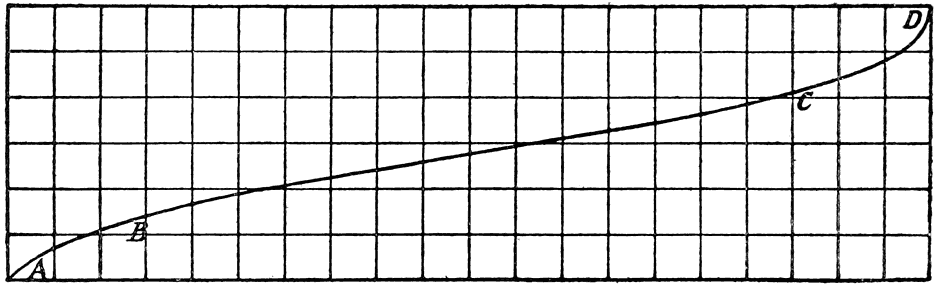
The irregularity is, then, only apparent; there is regularity in this sense, that the persons of average height predominate very greatly in number, and that the very short and very tall persons form minorities. This regularity in the individual differences, discovered by Quetelet, has been recognized as a universal law, applicable to everything living. The scientist named has demonstrated this not only for the height of the human body, but also for its weight, strength, quickness, etc.
What is now the importance of this fact for the etiology of crime? In my opinion, the answer to this question will not be different from those which have been given to analogous questions when we were treating of the etiology of prostitution and alcoholism (pp. 407, 408 and 428), namely, that in every society, everywhere and always, an individual, according as his social sentiments are weaker or stronger than another’s, runs more or less risk than he of becoming a criminal, supposing the environment of the two to be the same in effect. The man who, according to the intensity of his social sentiments, would be placed in the line between A and B, would run more danger of becoming a criminal than the man who belonged between C and D. This point is of great importance for anyone who is investigating why the first falls into crime and not the latter. But it has little weight for criminal sociology, which concerns itself, not with definite persons, but only with general social facts.
The evidence that individuals differ quantitatively always and everywhere does not give the explanation of the problems whose solution sociology seeks, although they must be taken into account. The task that is incumbent upon it is to explain why individuals who, as a consequence of their innate qualities, run more danger than others of becoming criminals, actually become so. He who is born with weak social instincts runs more danger of becoming a criminal. But the certainty that he will become such does not exist—that depends upon the environment.
To sum up; I am of the opinion that individual differences are of great importance for one who is studying an individual by himself, but that they do not belong to the domain of the etiology of criminality.
E. The Classification of Crime.
Before proceeding to the treatment of crimes separately, it is necessary to divide them into some main groups. It is a grave error (committed, however, by many criminologists) not to take account of the very different nature of crimes, if one is concerned with their etiology. It is, to be sure, permissible to treat conjointly moral forces which may prevent the execution of criminal ideas and which apply to all crimes. I have done so in the preceding pages. But we cannot treat the origin of the criminal idea itself in this same way. There are criminals and criminals. There are enormous differences between a professional thief, and a man who has been guilty of assault and battery in a state of intoxication, just as there are between a ravisher and a political criminal. And anyone who does not take account of these differences must necessarily limit himself to certain generalities.
I propose to treat of crimes divided into four categories in accordance with the motives which led their authors to commit them. Three of these categories form quite definite units, while the fourth is more heterogeneous.
The first is composed of crimes that have an economic aim (economic crimes). The greater part of the so-called crimes against property, such as theft, embezzlement, etc., belong to this category, but not all, for malicious mischief, for example, is generally dictated by a desire for vengeance. On the other hand some crimes against the person, like procuration, the object of which is economic and not sexual, belong here. As for crimes against the state, we must add counterfeiting to this category. Then there are other crimes that may be committed either for economic or non-economic reasons; for example, murder (for the purpose of robbery or for revenge), perjury (for the profit of winning a civil suit, or to prevent the conviction of a friend), arson (to get the insurance money, or for revenge), etc.
It may be urged here that, notwithstanding the similarity of their motives the crimes of any class still present many differences. This is true in part, and I have accordingly subdivided them. But on the other hand these differences are not very great from the standpoint of criminal sociology. For the jurist the difference between counterfeiting bank-notes, burning a house to get the insurance, and procuration is very important; but for sociology it is much less so. A man who knows how to make counterfeit bank-notes, will commit this crime, whenever he wishes for any reason to enrich himself in a dishonest fashion, but he will become neither an incendiary nor a procurer. A former prostitute, on the contrary, will not think of making bank-notes, but will become a procuress. The kind of economic crime committed by the person who has a mind to commit such a crime, depends principally upon chance (occupation etc.).
The second category includes sexual crimes, and the fourth political crimes—two categories quite distinct therefore.
Finally, to give a picture of the quantitative proportions of the principal crimes, I add here some figures upon criminality in some of the countries of Europe. These figures may at the same time serve to show to those who are not acquainted with criminal statistics, how regular a course crime has from one year to another.
It is crimes of vengeance, therefore, which form the largest group, then come economic crimes, and then sexual and political crimes, both with low figures. If we do not count the very minor offense of insult in the third group, the first and third groups will be nearly of the same size. There are, then, almost no political crimes in England. As in Germany, sexual crimes are very rare, and it is the economic crimes and those committed out of revenge, etc., that are the most important. The latter preponderate even more in England than in Germany.
England, 1881–1900.
Crimes. Number Arraigned for Each of the Crimes Given:
Annual Averages. 1881–1900 Average.
1881–85. 1886–90. 1891–95. 1896–1900. Absolute Number. %
Theft (of every kind) 57,373 52,573 50,432 45,960 51,584 32.92
Embezzlement 1,475 1,345 1,335 1,387 1,385 0.88
Receiving stolen goods 1,302 1,239 1,348 1,241 1,282 0.82
Burglary 1,464 1,530 1,665 1,630 1,572 1.00
Robbery and extortion 320 322 310 278 307 0.20
Fraud 1,054 965 997 870 971 0.62
Counterfeiting, etc. 534 410 365 309 402 0.26
Perjury 100 85 78 77 85 0.05
Fraudulent bankruptcy 49 41 43 35 42 0.03
Total of economic crimes — — — — — 36.78
Bigamy 116 99 104 103 105 0.07
Indecent assault upon girls under 16 — 305 258 236 249 0.16
Rape, etc. upon adults 647 639 636 595 629 0.40
Total of sexual crimes — — — — — 0.63
Malicious mischief 21,779 19,646 18,484 17,470 19,594 12.51
Arson 155 133 117 104 127 0.08
Assaults 72,707 66,020 63,601 59,611 65,484 41.80
Assaults upon officers 322 285 291 278 294 0.19
Homicide (including attempted homicide) 13,223 11,850 12,626 12,524 12,555 8.01
Total of crimes of vengeance — — — — — 62.59
Political crimes 4 0 0 0 1 0.00
General total — — — — 156,668 100.00
Here, also, the political crimes and the sexual offenses show the smallest figures. The economic crimes exceed considerably those committed out of revenge, etc., a fact to be accounted for in great part by the inclusion of vagrancy and mendicity among the economic crimes. These tables hardly lend themselves to international comparison, since certain acts are regarded as misdemeanors in one country, and as contraventions in another.
The results of the Italian statistics agree in general with those that have gone before.
These figures thus confirm in general the results of the preceding tables. The most frequent crimes are those committed out of revenge etc. and the economic crimes. The sexual crimes only reach low figures, and the political crimes are negligible.
We have placed certain crimes, like homicide and arson, in all the tables, among the crimes of vengeance, etc., although they may also be committed from an economic motive. The French and Italian criminal statistics give information upon the frequency of the motives which lead to these crimes.
About 28% of the crimes, then, had an economic motive, about 12% had a sexual motive, and 40% were committed out of revenge.
Finally, it must not be forgotten that certain crimes of a different kind (leze-majesty and malicious mischief, for example) are sometimes committed simply that the author of them may get himself imprisoned, and hence should be classed as economic crimes.
We have now reached the question: how close a connection have the different crimes with economic conditions? We shall give only a detailed sketch of the subject; to treat it more fully would require extensive monographs. We shall limit ourselves to indicating the general lines.