Part 1 — CHAPTER IV. THE FRENCH SCHOOL (THE SCHOOL OF THE ENVIRONMENT).
Henry P. (Henry Pomeroy) Horton translation
I.
A. Lacassagne.
While the Italian school reigned supreme at the first congress of criminal anthropology at Rome, Professor Lacassagne opposed it with his so-called “hypothesis of the environment” in the following terms: “The important thing is the social environment. Allow me to make a comparison borrowed from a modern theory. The social environment is the bouillon for the culture of criminality; the microbe, that is the criminal, is an element which is only of importance when it has found a medium in which it can grow.
“The criminal with anthropometric and other characteristics seems to us to have only a moderate importance. All these characteristics may be found elsewhere among honest men.
“But you should look at the different social consequences of these two points of view. On the one hand is the fatalism which flows inevitably from the anthropometric theory; and on the other, social initiative. If the social environment is everything, and if it is so defective as to favor the growth of vicious or criminal natures, it is to this environment and its conditions of functioning that our reforms must be directed.
In his “Marche de la criminalité en France, 1825–1880”, the author points out, among other things, the connection between criminality and economic conditions. An examination of the movement of crimes against property shows that the great fluctuations to be observed there are intimately connected with economic conditions. The number of crimes against property corresponds almost exactly with the fluctuation in the price of wheat; and all the economic crises make their influence felt.
During the years 1828, 1835–1837, 1847, 1848–1854, 1865–1868, and 1872–1876, in which the price of wheat was high, there were also a great number of crimes against property. The year 1855 was the sole exception, for then crimes against property did not increase, although the price of grain was very high. This is to be explained by the fact that the government then took measures to lessen the consequences of this calamity. Further, other provisions were then very cheap. From 1860 on the number of crimes against property decreases, which, according to the author, is to be explained by the importation of grain, which increased greatly at this time.
The influence of the production and consumption of alcohol is strongly felt in crimes against persons, especially in assaults.
I would further call attention to the report made by Professor Lacassagne to the Fourth Congress of Criminal Anthropology at Geneva, entitled, “Les vols à l’étalage et dans les grands magasins”, in which he shows how the display of goods on the counters in the great bazaars, which are meant to fascinate visitors, and force them to buy, so to speak, leads to crime in individuals predisposed to kleptomania.
II.
G. Tarde.
This author considers criminality as being preëminently a social phenomenon, which, like all social phenomena, is to be explained by imitation.
Imitation, says the author, is governed by two laws, namely, that men imitate one another more the more closely they come together, and that imitation of the high by the low is what most often takes place (that the customs of the nobility are imitated by the people, etc.). If we test these rules in their application to crime, we shall find that they hold good there also. The author gives the following examples, among others, in support of this:
There was a time, then, when criminality extended itself from the higher classes to the lower; at present new forms of crime take their rise in the great cities and spread out into the country. The increase of crime in the cities is very considerable, and it is very probable that, in accordance with the law cited, criminality will at length increase in the country as greatly. It is especially the crimes of assassination, sexual crimes against minors, abortion, and infanticide, that have increased. So the opinion of several Italian criminologists, “that crimes against persons decrease where crimes against property increase, and vice versa”, is wrong, according to Professor Tarde, since both kinds of crime increase in the great cities.
Nevertheless, civilization improves men, and the growing criminality is in opposition to the greater and greater increase of civilization. This contradiction is explained by the author by means of another law of imitation; the law of insertion, i.e. the alternate passage from fashion to custom.
“All industry is thus fed by a stream of improvements, innovations today, traditions tomorrow; every science, every art, every language, every religion obeys this law of the passage from custom to fashion and of the return from fashion to custom, but to an enlarged custom.
After having mentioned how these different currents of imitation meet, the author applies the idea set forth above to the influence of education upon criminality. He shows that instruction, by itself, is not a remedy for crime, since it may furnish new means for committing crimes, and hence may only change the character of criminality. Finally the author points out the influence of labor upon criminality, combating the theory of Poletti, who says that it is necessary to take into account the economic development (for example, if during the period 1826–78 criminality in France increased in the ratio of 100 to 254, and productive activity was quadrupled, criminality did not increase, but really diminished). The fundamental error in Poletti’s argument, according to Professor Tarde is, that he considers crime as a regular, permanent, and inevitable effect of industrialism.
“Only, there is labor and labor; and if in a more laborious class the work is badly divided, excessive for some, whom it enervates and disorders, insufficient for others, who become dissipated, or if it is badly directed, turned toward deleterious compositions and reading which excite the senses …—in this case it will probably happen that progress in labor is accompanied by a growing lack of discipline and by academic vices of different kinds. An analogous phenomenon takes place in our cities, where the mad chase for luxury outruns the rise of wages, and where sexual crimes are sextupled or septupled while wealth is tripled and quadrupled. The socialists, then, are right in imputing, in part, to unjust distribution and to the objectionable direction of the productive activity, the moral evil that has grown with it, and which, further, does not decrease when productive activity becomes weaker. For since the period when Poletti made his observations upon the prosperity of France, this has ceased to grow, and has even decreased rapidly, as we know only too well, but crime has continued its onward march with a more marked impetus.
In the following section the author treats the influence of wealth and of poverty upon the criminal. He mentions the different opinions of Turati and of Colajanni on the one hand, and of Ferri and Garofalo on the other. The former tried to prove that poverty is often a cause of a poor man’s becoming a criminal. Garofalo tries to disprove it by calling attention, among other things, to the fact that, according to the criminal statistics of Italy for 1880, property owners committed as many crimes in proportion as the proletariat did.
In opposition to this Professor Tarde points out that the French criminal statistics in 1887 show that there were, out of 100,000 of each class of the population, the following number of persons arraigned: 20 out of the class of domestics, one of the poorest classes; 12 from the liberal professions including persons of independent income; 139 from the class of vagrants and persons without occupation (the most necessitous class, therefore); 21 from commerce; 26 from manufacturing (a very high figure considering the profits of that year); and 14 from the farming class (a very low figure considering their relative poverty).
The author explains these contradictions as follows: “Let us not forget that, the desire for wealth being the ordinary motive and more and more the preponderating motive of crime as it is the only motive of industrial labor, the possession of wealth must keep the most dishonest man from crime as it does the most laborious man from industrial labor—for it is impossible to desire what one has—at least if the satisfaction of this desire has not meant the over-exciting of it.… Now in business circles, where on account of men’s throwing one another into a fever, a constant gaining of wealth, rather than wealth itself, is the end pursued, a fortune is like those peppered liqueurs which arouse thirst more than they quench it. Hence it comes, doubtless, as well as from the excitement prevailing in these circles, that criminality there is as great as among domestic servants. In the same way, in the licentious environments, in the great cities, where there are masses of working people, sexual crimes are as much more numerous as the pleasures of the senses are there more easily come by. But we can lay it down as a principle that where wealth is an obstacle to activity it is also an obstacle to crime, very much as political power ceases to be dangerous at the moment when it ceases to be ambitious. This is the situation among the rural proprietors, small and great, among stockholders, and even in the majority of the liberal professions …; content with his relative well-being, man indulges in an intellectual half-labor, artistic rather than mechanical, honorable rather than mercenary, and abstains from flagitious means of obtaining an increase of income which he desires moderately. The French peasant, in general, partakes of this moderation of desires, and, rich from his sobriety, his stoicism, his frugality, his plot of ground at last acquired, he is happier than the feverish millionaire, financier, or politician, driven by his very millions to sow the seed of his rotten speculations, rascalities, and extortions upon a vast scale. Further the well-to-do agriculturists are in general the most honest people. Let us not speak of wealth and poverty, to tell the truth, not even of well-being and the reverse, but rather of happiness and unhappiness, and be careful how we deny this truth, as old as the world, that the wicked man’s excuse is often to be found in his being unhappy. Children of this century … let us confess that under its brilliant exterior our society is not happy, and if we had no other assurances of its great evils than its numerous crimes, without giving a thought to its suicides, and its increasing cases of insanity, without lending an ear to the cries of envy, of suffering, and of hatred … we should not be able to call its woes in question.
Suppose, asks the author, there was no more foreign war, how could we avoid civil war? There have, indeed been historic periods when there existed a common aim uniting individuals, as the faith did in the Middle Ages. In our days this aim can be nothing but “art, philosophy, the higher cultivation of the mind and imagination, the æsthetic life.”
In order to be able to answer the question whether civilization (the collective name for education, religion, science, arts, manufacturing, wealth, public order, etc.) causes a diminution of criminality, it is necessary to discriminate between two stages of civilization. In the first there is an afflux of inventions; this is the stage at which Europe is at the present time. In the second this afflux decreases and it forms itself into a coherent whole. A civilization may be very rich, then, and but little coherent, or very coherent and not very rich, like that of the commune in the Middle Ages.
—This is not the place to criticise the theory of imitation in general, with which Professor Tarde thinks that we can explain every social phenomenon. In my opinion, this theory, in so far as it is new is not correct, and in so far as it is correct is not new. It is true as explaining how a social phenomenon, having taken its rise in a locality, has been rapidly propagated, or why it still persists when the original causes have ceased to operate.
However, it is plain that by means of imitation one can give but a partial explanation of the phenomena mentioned. Other factors must be pointed out to explain, for example, why something spreads everywhere in consequence of imitation, at a certain moment, while before it passed unperceived, etc.
Since the phenomena named remain permanent, there must be other important social factors which have nothing to do with imitation. Thus, for example, faith, whose prevalence is based to a great extent upon tradition, would have disappeared long since, notwithstanding tradition, if there had been no factors in the present society to make it persist.
Admitting what has gone before, there is no reason to see in most of the examples cited by the author in support of his theory, anything else than his great knowledge of historic details of little or no importance for the question of criminality. Where, for example, is the connection between the minstrels of the Middle Ages and the vagrants of our own days? There is certainly none but this, that both went from place to place. But even if there had never been wandering minstrels, the social phenomenon called “vagrancy” would have existed all the same. It has nothing to do with imitation, but on the contrary has everything to do with the existing social organization. It could thus be proved by many examples that Professor Tarde exaggerates the extent of the influence of imitation. We must not lose sight of the fact that imitation teaches us nothing of the essential causes of a social phenomenon. When we seek the causes of a disease that some one has, we frequently see that it is the result of a contagion; we know, then, that the disease is contagious, and this knowledge will point out precautions to be taken to limit or prevent the spread of the disease; but as to the causes of the disease itself we still know nothing.
It is the same way with regard to crime. It is certain that immoral ideas and customs are easily contracted by children. The removal of children from a harmful environment is therefore a preventive of the extension of crime. But we are still ignorant of everything that concerns the rise of these immoral ideas and customs, which is, however, the essential thing.
With regard to the remarks of the author upon the influence of labor, wealth, poverty, and civilization, I simply observe that these very important and very complicated questions occupy but a few pages in his work. It will be, then, quite superfluous to note in detail how the whole has been treated in a very incomplete manner, although very true remarks are found there (for example, those upon the bad distribution of labor, upon the desire for wealth as a cause of crime, etc.).—
Beside an article that appeared in the “Revue Philosophique” (1890), entitled “Misère et criminalité”, Professor Tarde has taken up his subject again in a report: “La criminalité et les phénomènes économiques” (Fifth Congress of Criminal Anthropology at Amsterdam). Of this report we give a synopsis.
According to Professor Tarde, since it has been recognized that the social factors of criminality are the most important, there has been a manifest tendency to exaggerate the importance of economic factors. Their high importance, which is incontestable, does not at all justify our forgetting the stronger and more decisive action of the beliefs and feelings in the aberrations of the will. Which of the two sources of criminality is the more important, the economic or the religious (or intellectual)? That cannot be decided. But it is much more important to know in what phases, from what sides the economic life is criminogenous.
Each economic phase, as, for example, domestic economy or urban economy, has its special form of criminality. But political and religious changes, whether they correspond or not to the transformations in the mode of production, have, perhaps, a much greater part in criminality than have the economic transformations. The domestic economy, for example, gives rise to different crimes in which no economic factor comes into play; as uxoricide, for example.
Neither poverty alone nor wealth alone is an obstacle to honesty. Poor peoples or classes, accustomed to poverty, are often very honest, nor is there any more need that great differences of wealth should lead to crime. But it is the abrupt passing from wealth to poverty and from poverty to wealth that is dangerous to morality.
“In short, criminality and morality are less dependent upon the economic state of a country, than upon its economic transformations. It is not capitalism as such that is demoralizing, it is the moral crisis that accompanies the passage from artisan production to capitalistic production, or from some particular mode of the latter to some other mode.
It is through the second aspect that the economic life can give a direct explanation of crime; that which is given by the other two is only an indirect explanation. That is to say, each invention gives rise to a contest among producers, and the progress of manufacturing creates the possibility of satisfying needs, but at the same time makes those who for want of the means cannot satisfy them, feel their needs all the more strongly.
Hence, then, comes the importance for criminality of social crises, since during these production and consumption are deranged.
According to Professor Tarde, the social contradictions, which are the chronic crises of societies, can be the sole causes of criminality. If a society succeeds in avoiding every internal contradiction there can hardly be any further question of crime.
Social crises are of two kinds: politico-religious, and economic. In opposition to divers statisticians, who are of the opinion that the former class cause a diminution in criminality, the author thinks that this diminution is only apparent, and that in reality the number of crimes increases at these times; which is shown, for example, for France by the addition of cases not prosecuted to those prosecuted.
As to the effect of economic crises, statisticians, Professor Tarde claims, have not yet examined it. It seems to him that there is no parallelism between economic crises and criminality.
The struggle of classes, which springs up and grows during the periods of crisis, is a great danger to public morals, since it gives rise to a class spirit, and consequently increases the contempt for the rights of individuals of another class. However, the class struggle does not increase the number of individual crimes, but only the number of collective crimes.
—Professor Tarde’s report is characterized by many very true observations (as, for example, that every economic phase has its own form of criminality; that sudden transitions from wealth to poverty, and vice versa, are morally more dangerous than slow changes; etc., etc.), but at the same time is still more marked by a certain elasticity and lack of close reasoning. Hence it is almost impossible to frame a criticism of the report that will follow it step by step.
However there are some things to be noted. According to the author there are two sources of criminality, the one economic, the other intellectual. I consider that this distinction is not correct. Every crime has an intellectual source, in this sense, that it is an act conceived by the intellect. It is impossible, therefore, to see beside this source an economic cause. But the intellect considered by itself is empty; it is from the environment that it must draw the material which it will transform into ideas. Consequently the question becomes this: how far is the economic environment the cause of the formation of criminal thoughts. Intellect and economic conditions do not stand side by side but the one follows upon the other. It is only making use of a commonplace to say that crime has an intellectual source; that explains nothing.
In reading the first pages of the report one expects, after the historical exposition which says that every economic phase has its own form of criminality, to find an exposition of the present economic system, and an inquiry into how far the criminality of our own day is bound up with it. This would have been, I think, most important, and would have advanced the subject. The most serious criticism that I have to make is that nothing of the kind is attempted. What follows is only a series of isolated remarks, which are correct only in part, and in which the whole question is reduced to a matter of economic crises, although the title speaks of economic conditions.
It is incorrect to say that the statisticians have not investigated the influence of economic crises, as the second chapter of this work proves. In it I have analyzed the works of the different authors who have especially treated of this subject. Finally, I would call attention to the fact that he furnishes no proof of his assertion that the class struggle takes its rise in times of crisis—and would find it difficult to do so.
What Professor Tarde means in speaking of “the advancement of manufacturing and its reorganization upon a vaster and better conceived plan”, is not clear. But it is certain that the final observation that there must be “an individual organization of wants”, is purely Utopian. For it is one of the characteristic phenomena of our present society that it has strongly excited the cupidity of men, and that this will disappear only when its cause has ceased to exist.
All Professor Tarde’s works upon criminality convince us of the great knowledge of their author. The report of which I have been speaking contains also ideas that are often very original, but this does not prevent the necessity of confessing that it does not contribute much to the solution of the problem that it treats.—
III.
A. Corre.
In the third book of his “Crime et suicide” the author treats of the influence of economic conditions upon criminality, beginning with “labor, wages, and needs.”
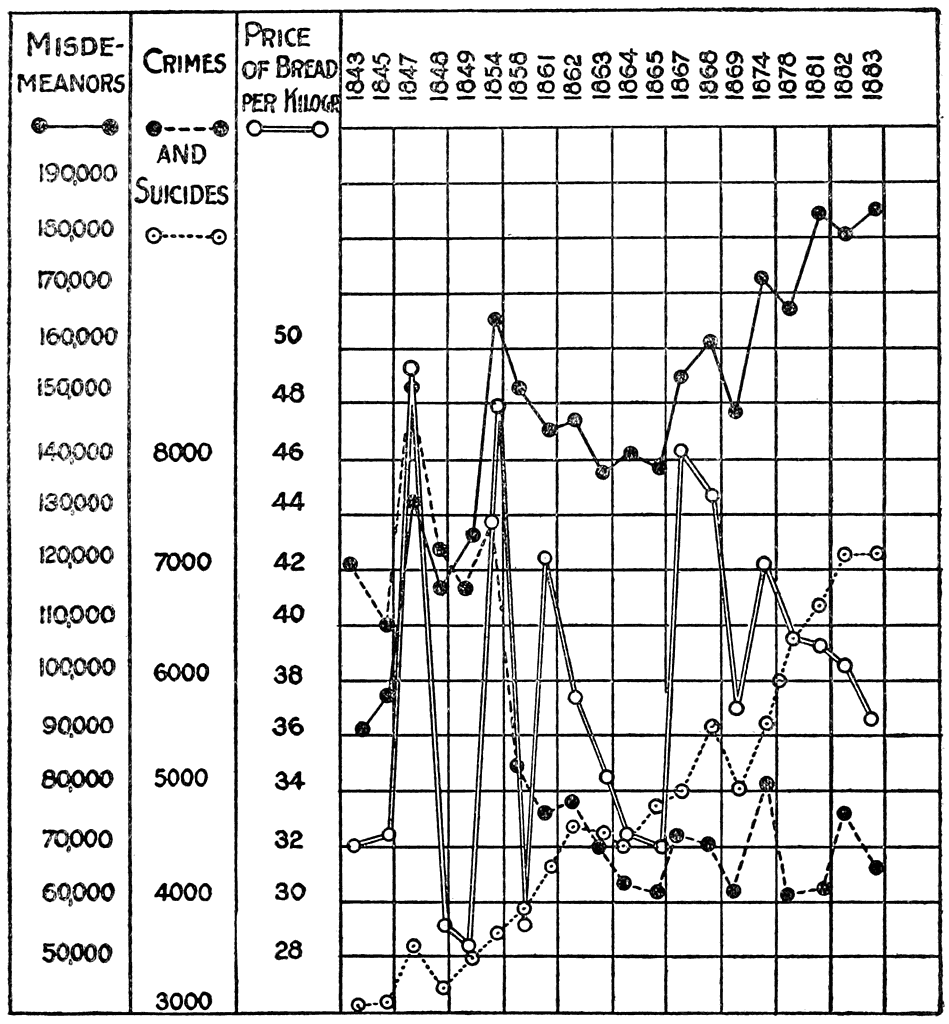
As other authors have already proved, the price of bread also has an influence upon the course of criminality.
However, exaggerated saving is very prejudicial to morality for it degenerates into avarice and thus becomes the cause of crime. We often find the average number of depositors in savings-banks in the departments that gave the lowest figure for crime. The departments with a number of depositors above or below this average are apt to have high figures for crime.
—The second part of this work will show sufficiently why, in my opinion, the treatment of Dr. Corre is confused and incomplete, notwithstanding the truth of some observations made by him with regard to the subject which concerns us. The criticism of the author upon the organization of society at present is that of the petty bourgeoisie; he expects salvation only from the multiplication of small holdings, and hopes that this will make mankind happier. However, the development of large industries makes me believe that this hope will never be realized.—
IV.
L. Manouvrier.
The doctrine of the innate character of crime and the phrenology of Gall and Spurzheim are closely connected. Gall thought that he had discovered in the brain the organs of homicide and theft, without, however, denying the importance of surroundings, so that he explained a case of theft by means of circumstances when the bump of theft was wanting in the thief.
This doctrine has been entirely supplanted by the theories of Lamarck and Darwin. “In the place of attributing to the environment the rôle of a simple player of a hand-organ, Lamarck sees in it a true musician playing upon his instrument any airs suited to its complexity and qualities. Further, the quality and characteristics of the instrument can be modified, transformed under the influence of this marvelous musician and that of the music executed. This was the ruin of craniomancy. The diagnostics of phrenology found themselves limited at once and for always to the faculties, the elementary dispositions that Gall and Spurzheim had tried in vain to discover, and which are consistent with the execution of acts indefinitely variable.
It might be objected here that the horror of blood being natural to most men it would be necessary just the same to have recourse to atavism to explain murder. This horror of blood is assuredly found in most men, but only so far as their interest requires. Not a single surgeon or butcher pursues his bloody trade through atavism, but only because forced to it by his interests. More than one born-bourgeois thinks that he would never eat meat rather than have to kill cattle himself, but this is only pure illusion or an unconscious hypocrisy. For he would do it without any doubt if he could not gain his livelihood in any other way. Do not the bourgeoisie shoot their inoffensive fellow citizens who revolt against a social condition that no one would dare to call ideal? Do they not mow down savages with machine guns in order to divide up their country? Or do they not make war against other states in order to protect their own commercial interests? It will be objected that these things are not crimes; this is a question of definition, but assuredly they are similar to crime.
Having made fuller remarks to the effect that the cruel and repugnant professions referred to above are not practiced because of atavistic tendencies, but solely from necessity, the author ends this part of his article as follows: “There nevertheless remains a tremendous difference between the killing of an animal and the killing of a man, from a moral point of view, of course, but also from the point of view of the motives generally fitted to prevent the killing. But it must be remarked that these motives are connected with environmental influences which are exceedingly variable, and which, for too many persons, are considerably diminished and at the same time replaced by influences of the opposite environment. Most assassins have received a certain culture appropriate to the conception of murder and to its realization, and this is simply facilitated by their conformation, which is in no wise exceptional. If we had only to twirl our thumb to get rid of an enemy we should have to put forth all our efforts to harm no one. Already too many respectable men can order murders that they would not be courageous enough to execute. Let us congratulate ourselves that self-interest more often deters men from murder than drives them to it, for every normal man possesses the cerebral and muscular qualities necessary to conceive, prepare, and execute the crime. It is not necessary to call in the return to animal instincts through atavism. The continuity of man and the animals is much more perfect than the atavistic school pretends. Man is always an animal; the most dangerous of all because he is the most intelligent and because he can utilize his faculties in all sorts of ways, harmful or useful to his fellows according to his own interest. The formula to be applied is to arrange things so that every man will find more advantage in being useful to his fellows than in injuring them. Progress in this regard would be more rapid without this unfortunate predilection for occult causes, which leads so many excellent minds to seek in the clouds for explanations that lie under their noses, but which have to be found just where they are.
Then Professor Manouvrier criticises in a manner as just as it is witty, the hypothesis of the “delinquent man.” He demonstrates that, according to the method of the New School, a work could be written upon the “hunting man” also, full of scientific observations upon his argot, his boasting, etc., etc., upon all sorts of signs, in short, which go to show that a taste for hunting is an atavistic phenomenon. The explanation of crime by atavism is no more true than this other, for both can be explained by the environment.
If we hold absolutely to the expression: “born-criminal”, every man is one, just as every dog is a born-swimmer. Every dog knows how to swim very well, but this does not prevent a number of dogs from never swimming, since ordinarily there are more convenient ways of crossing the water. In the same way every man is a born-criminal, but most men refrain from becoming actual criminals, since that course is more advantageous to them than the other.
“No one is ignorant that the educational influences to which one is subjected during his whole life and especially during infancy, and the solicitations of self-interest, are exceedingly variable under different circumstances and for different individuals; and that the educational influences and the solicitations of self-interest unite very generally to furnish the motive for criminal conduct and for honest conduct as well. And it is this that governs every man’s manner of acting in his relations with others; and it must not be forgotten in treating of anthropology, whether anatomical, physio-psychological, or sociological. It is never forgotten in practical life.
Professor Manouvrier begins the last section of his study by asking what is the significance of the anatomical peculiarities observed in the so-called born-criminals. “The truth probably is that we do find in a number of criminals in prison more of the lower or abnormal characteristics than in a like number of persons chosen at random. But this in no wise proves that those among the criminals who have such characteristics, have been predestined to crime from their physical make-up. Those among them who are not so constituted are nevertheless criminals, and honest men who bear the criminal marks have nevertheless remained honest.
The fact that we generally find more inferior individuals among the criminals imprisoned than among other men must be attributed to the two following circumstances: first, that criminals who have not been arrested, owe their liberty generally to the fact that they are better endowed; and second, that in all social classes a selection goes on by which those best constituted are always in possession of the most desirable and least painful means of existence, while to those less privileged fall the lowest professions, and they “end sooner or later by falling into the ditch where the influences that drive men to crime reach their maximum frequency and power, while the contrary motives are proportionately weak.” Those who have known better days sometimes prefer suicide to crime; but those who are born in the ditch, know no other life, and are consequently led into crime.
What is much more astonishing than crime is the fact that workmen labor courageously and patiently for ten or twelve hours a day, and notwithstanding this lead only a miserable life. The reason is that they have known nothing but labor since infancy and have always had to be content with very simple amusements. It goes without saying that one man is more moved to commit crimes than another, although the conditions under which they are living are the same, just as an athlete will use violence quicker than a weakling. But this is no reason to declare strength a factor of crime, since it serves for useful acts as well. Acts which are contrary to the proper working of society are, therefore, called abnormal and those are called normal that are in harmony with it. But it is not therefore permissible to transfer this distinction to the field of biology, and call the criminal abnormal. “Aptitudes that are very normal physiologically, may be employed for acts that are equally normal physiologically, but which, from a social point of view are classed as abnormal, because contrary to the social prosperity. Yet this is an abuse of the word ‘abnormal’, because society as at present constituted is, in its normal functioning, consistent with innumerable causes of conflict between its own interests and those of individuals. And just as the annoying consequences of our mistakes often make us recognize the truth, so crimes very often serve to indicate to societies the reforms they ought to bring about in order to perfect themselves.
“Every individual has wants to satisfy, wants primordial or secondary, that may become infinitely complicated and clothed in forms as much more various as the environment becomes more complex. Now it happens in every society, and especially in very civilized societies, that the different individuals do not find the same facilities, and further, do not possess the same means of action. There is an evident disproportion between the existing needs and the milder means of satisfying them; whence the struggle for existence and well-being.
“In our estimating the intrinsic worth of criminals, we must not fail to take account of this fact, that most honest men do not deprive themselves of any of the pleasures which are the aim of criminals, and that most criminals, in order to escape crime would have had to have rare virtue. Among the legal means of satisfaction offered by society there are those that are easy and agreeable, among others that of drawing the income from capital amassed by one’s parents. There are also difficult and painful ones, which are the lot of those whom pecuniary heredity has not secured against the so-called criminal heredity. In order to share legally in the pleasures of which they are witnesses, those whom we may call disinherited by fortune, must make efforts of which those born to wealth have no idea. This is why, if the disinherited seek a short-cut, we must ask ourselves, before we consider them as monstrous beings, whether under the same circumstances we should be able to keep to the legal path.
The penal law is one of the means the object of which is combating the illegal satisfaction of wants. Everyone knows, however, that this means does not always attain the end sought. The penal law will, in fact, produce a diminution of criminality only when it shall have brought about profound penal changes,—when punishment shall be no more than the useful and necessary reaction against acts that are harmful to the well-being of the community and to the development of society.
—I shall make only a few observations upon Professor Manouvrier’s study, a work which, in my opinion, is one of the best, not to say the best, upon the origin of crime, and in about fifty pages says more than many a bulky volume.
In the first place Professor Manouvrier shows that in our days wants have increased greatly, and he believes that civilization is the cause of it. I am of the opinion that this last assertion is not correct and that civilization has nothing to do with it. Many writers commit this error of confusing civilization and the present mode of production, and it is just for this reason that it is useful and necessary to correct it. All the evils that have been brought upon the peoples of Africa and of China, war, alcohol, etc., etc., have been called by the collective name of “civilization.” In reality it is those who have brought all these calamities upon these countries, and have tried to destroy a veritable, age-long civilization like that of China, who are the barbarians. It is not a civilizing instinct that has driven European states to a policy of expansion, but rather cupidity, eagerness for gain on the part of the owning class, who are seeking a new outlet for their merchandise; in short, it is the present mode of production, capitalism.
The same is true with regard to the constant increase of wants; it is the present system which creates wants. New methods of procuring profit are invented, and it is only with this in view that many inventions are made, most of them useless, often even harmful. And on the other hand there is a class of persons who grasp at any means, even the most absurd, of passing the time, and have the money to procure these means. And these wants spring up in other persons also, and the impossibility of satisfying them makes men the more eager. Consequently it is not civilization, but capitalism, which must be designated as the cause of this phenomenon.
In the second place, Professor Manouvrier thinks that criminality would diminish enormously, but without disappearing entirely, if the social laws were perfected so that each individual could satisfy his wants according to his capacities, his labor, and his services to the community. This is, in my opinion, entirely correct; but the maxim of Saint-Simon, “to every man according to his capacities, to each capacity according to its works”, which, in Professor Manouvrier’s opinion, is perfect, by many others is not thought to be so, though superior to the present distribution of commodities. We can set over against this the rule, “that each shall work according to his faculties and his strength, and receive according to his needs.” If this were realized, crime would become almost unimaginable. Many persons are of the opinion that such a thing could never be realized. But they forget that it is exclusively from the environment that the enormous differences in wants arise (the wife of the millionaire has perhaps a thousand times as many needs as the wife of the proletarian). If these two persons had been born and brought up in the same environment, the wants of the one would have been to those of the other perhaps as 1 to 3, or even less, but certainly not more. And then those who believe in a future distribution according to needs, are of the opinion (and think they can prove it) that, if in the present organization of society egoism is omnipotent, the feeling of solidarity will be so strengthened in the future social organization, that the man endowed with great abilities and much energy, will not begrudge his fellow less highly endowed, the satisfaction of all his wants.
I would, at the same time, make a remark concerning the environmental school in general, a remark not to be considered as a criticism, for I agree perfectly that it is the environment that makes the criminal. It is this: it is not enough for the treatment of the question of criminality, to furnish proof of the assertion that the cause of crime is not inherent in man; it is also necessary to show in what respects the environment is criminogenous, and in what way it can be improved. Now the French School has given but little attention to this.—