EXPLANATORY LIST OF ILLUSTRATIONS TO VOLUME I.
Henry Yule translation

INSERTED PLATES AND MAPS.
To face page
Title Portrait of Sir Henry Yule. From the Painting by Mr. T. B. Wirgman, in the Royal Engineers’ Mess House at Chatham.
iv. Illuminated Title, with Medallion representing the Polos Arriving at Venice after 26 years’ absence, and being refused admittance to the Family Mansion; as related by Ramusio, p. 4 of Introductory Essay. Drawn by Signor Quinto Cenni, No. 7 Via Solferino, Milan; from a Design by the Editor.
1. Doorway of the House of Marco Polo in the Corte Sabbionera at Venice (see p. 27). Woodcut from a drawing by Signor L. Rosso, Venice.
27. Corte del Milione, Venice.
28. Malibran Theatre, Venice.
31. Entrance to the Corte del Milione, Venice. From photographs taken for the present editor, by Signor Naya.
42. Figures from St. Sabba’s, sent to Venice. From a photograph of Signor Naya.
50. Church of San Matteo, at Genoa.
62. Palazzo di S. Giorgio, at Genoa.
68. Miracle of S. Lorenzo. From the Painting by V. Carpaccio.
70. Facsimile of the Will of Marco Polo, preserved in St. Mark’s Library. Lithographed from a photograph specially taken by Bertani at Venice.
74. Pavement in front of S. Lorenzo.
76. Mosaic Portrait of Marco Polo, at Genoa.
79. The Pseudo Marco Polo at Canton.
81. Porcelain Incense-Burner, from the Louvre.
82. Temple of 500 Genii, at Canton, after a drawing by Félix Régamey.
109. Probable view of Marco Polo’s own Geography: a Map of the World, formed as far as possible from the Traveller’s own data. Drawn by the Editor.
135. Part of the Catalan Map of 1375.
1. Marco Polo’s Itineraries, No. I. Western Asia. This includes also “Sketch showing the chief Monarchies of Asia, in the latter part of the 13th century.”
5. Map illustrating the geographical position of the City of Sarai.
5. Plan of part of the remains of the same city. Reduced from a Russian plan published by M. Grigorieff.
29 & 30. Reduced Facsimile of the Buddhist Inscription of the Mongol Era, on the Archway at Kiu-yong kwan in the Pass of Nan-k’au, north-west of Peking, showing the characters in use under the Mongol Dynasty. Photogravure from the Recueil des documents de l’Époque Mongole, by H.H. Prince Roland Bonaparte. See an Article by Mr. Wylie in the J. R. A. S. for 1870, p. 14.
40. Plan of Ayas, the Laias of Polo. From an Admiralty Chart.
40. Plan of position of Diláwar, the supposed site of the Dilavar of Polo. Ext. from a Survey by Lt.-Col. D. G. Robinson, R.E.
115. Marco Polo’s Itineraries, No. II. Routes between Kerman and Hormuz.
179. Marco Polo’s Itineraries, No. III. Regions on and near the Upper Oxus.
305. Heading, in the old Chinese seal-character, of an Inscription on a Memorial raised by Kúblái Kaan to a Buddhist Ecclesiastic, in the vicinity of his summer-palace at Shangtu in Mongolia. Reduced from a facsimile obtained on the spot by Dr. S. W. Bushell, 1872, and by him lent to the Editor.
319. The Cho-khang. The grand Temple of Buddha at Lhasa, from The Journey to Lhasa, by Sarat Chandra Das, by kind permission of the Royal Geographical Society.
352. “Table d’Or de Commandement;” the Païza of the Mongols, from a specimen found in Siberia. Reduced to one-half the scale of the original, from an engraving in a paper by I. J. Schmidt in the Bulletin de la Classe Historico-Philologique de l’Acad. Imp. des Sciences, St.-Pétersbourg, tom. iv. No. 9.
356. Second Example of a Mongol Païza with superscription in the Uighúr character, found near the Dnieper River, 1845. From Trans. of the Oriental Section, Imp. Soc. of Archæology of St. Petersburg, vol. v. The Inscription on this runs: “By the strength of Eternal Heaven, and thanks to Its Great Power, the Man who obeys not the order of Abdullah shall be guilty, shall die.”
376. Plan of Peking as it is, and as it was about A.D. 1290.
426. Bank-note of the Ming Dynasty, on one-half the scale of the original. Reduced from a genuine note in the possession of the British Museum. Was brought back from Peking after the siege of the Legations in 1900.
448. Mongol “Compendium Instrument.”
448. Mongol Armillary Sphere.
452. Observatory Terrace.
452. Observatory Instruments of the Jesuits. All these from photographs kindly lent to the present Editor by Count de Semallé.
last Marco Polo’s Itineraries. No. IV. Eastern Asia. This includes also Sketch Map of the Ruins of Shangtu, after Dr. Bushell; and Enlarged Sketch of the Passage of the Hwang-ho or Karamoran on the road to Si-ngan fu (see vol. ii. pp. 25–27) from the data of Baron von Richthofen.
WOODCUTS PRINTED WITH THE TEXT.
Introductory Notices.
Page
x. A Mediæval Ship.
xxvi. Coat of Arms of Sir Henry Yule.
8. Arms of the Polo family, according to Priuli.
8. Arms of the Polo family, according to Marco Barbaro. (See p. 7, note.)
13. Autograph of Hethum or Hayton I. King of (Cilician) Armenia; copied from Codice Diplomatico del Sacro Militare Ordine Gerosolemitano, I. 135. The signature is attached to a French document without date, granting the King’s Daughter “Damoiselle Femie” (Euphemia) in marriage to Sire Julian, son of the Lady of Sayete (Sidon). The words run: Thagávor Haiwetz (“Rex Armenorum”), followed by the King’s cypher or monogram; but the initial letter is absent, probably worn off the original document.
18. The Piazzetta at Venice in the 14th century. From a portion of the Frontispiece Miniature of the MS. of Marco Polo in the Bodleian. (Borrowed from the National Miscellany, published by J. H. Parker, Oxford, for 1853–55; and see Street’s Brick and Marble, etc., 1855, pp. 150–151.) [See vol. ii. p. 529.]
29. Three extracts from Maps of Venice, showing the site of the Ca’ Polo at three different periods, (1) From the great woodcut Map or View of Venice, dated 1500, and commonly called Albert Dürer’s. (2) From a Plan by Cav. Ludovico Ughi, 1729. (3) From the Modern Official Plan of the City.
34. Diagram of arrangement of oars in galleys.
35. Extract from a fresco by Spinello Aretini, in the Municipal Palace at Siena, representing a Galley-fight (perhaps imaginary) between the Venetians and the fleet of the Emperor Frederick Barbarossa, and illustrating the arrangements of mediæval galleys. Drawn from a very dim and imperfect photograph, after personal study of the original, by the Editor.
37. Extract from a picture by Domenico Tintoretto in the Ducal Palace at Venice, representing the same Galley-fight. After an engraving in the Theatrum Venetum.
49. Marco Polo’s Galley going into action at Curzola. Drawn by Signor Q. Cenni, from a design by the Editor.
50. Map to illustrate the Sea-fight at Curzola, where Marco Polo was taken prisoner.
57. Seal of the Pisan Prisoners in Genoa, after the battle of Meloria (1284). From Manni, Osservazioni Storiche sopra Sigilli Antichi, tom. xii. Engraved by T. Adeney.
76. The Convent and Church of S. Lorenzo, the burial-place of Marco Polo, as it existed in the 15th century. From the Map of 1500 (see above). Engraved by the same.
78. Arms of the Trevisan family, according to Priuli.
120. Tailed Star near the Antarctic, as Marco Polo drew it for Pietro d’Abano. From the Conciliator of Pietro d’Abano.
Prologue.
Page
3. Remains of the Castle of Soldaia or Sudák. After Dubois de Montpereux, Voyage autour du Caucase, Atlas, 3d s. Pl. 64.
7. Ruins of Bolghar. After Demidoff, Voyage dans la Russie Méridionale, Pl. 75.
15. The Great Kaan delivering a Golden Tablet to the two elder Polos. From a miniature in the Livre des Merveilles du Monde (Fr. 2810) in the Library at Paris, fol. 3 verso.
17. Castle of Ayas. After Langlois, Voyage en Cilicie.
18. Plan of Acre as it was when lost (A.D. 1291). Reduced and translated from the contemporary plan in the Secreta Fidelium Crucis of Marino Sanudo the Elder, engraved in Bongars, Gesta Dei per Francos, vol. ii.
21. Portrait of Pope Gregory X. After J. B. de Cavaleriis Pontificum Romanorum Effigies, etc. Romæ, 1580.
37. Ancient Chinese War Vessel. From the Chinese Encyclopædia called San-Thsai-Thou-Hoei, in the Paris Library.
Book First.
Page
42. Coin of King Hetum I. and Queen Isabel of Cilician Armenia. From an original in the British Museum. Engraved by Adeney.
48. Castle of Baiburt. After Texier, L’Arménie, Pl. 3.
51. Mediæval Georgian Fortress. From a drawing by Padre Cristoforo di Castelli of the Theatine Mission, made in 1634, and now in the Communal Library at Palermo. The name of the place has been eaten away, and I have not yet been able to ascertain it.
55. View of Derbend. After a cut from a drawing by M. Moynet in the Tour du Monde, vol. i.
61. Coin of Badruddín Lolo of Mosul (A.H. 620). After Marsden’s Numismata Orientalia, No. 164. By Adeney.
76. Gházán Khan’s Mosque at Tabriz. Borrowed from Fergusson’s History of Architecture.
95. Kashmir Scarf with animals, etc. After photograph from the scarf in the Indian Museum.
100. Humped Oxen from the Assyrian Sculptures at Kouyunjik. From Rawlinson’s Ancient Monarchies.
102. Portrait of a Hazára. From a Photograph, kindly taken for the purpose, by M.-Gen. C. P. Keyes, C.B., Commanding the Panjáb Frontier Force.
115–118. Illustrations of the use of the double rudder in the Middle Ages. 7 figures, viz., No. 1, The Navicella of Giotto in the Porch of St. Peter’s. From Eastlake’s H. of Painting; Nos. 2 and 3, from Pertz, Scriptores, tom. xviii. after a Genoese Chronicle; No. 4, Sketch from fresco of Spinello Aretini at Siena; No. 5, Seal of Port of Winchelsea, from Sussex Archæological Collections, vol. i. 1848; No. 6, Sculpture on Leaning Tower at Pisa, after Jal, Archéologie Navale; No. 7, from the Monument of Peter Martyr, the persecutor of the Lombard Patarini, in the Church of St. Eustorgius at Milan, after Le Tombe ed i Monumenti Illustri d’Italia, Mil. 1822–23.
134. The Arbre Sec, and Arbres du Soleil et de la Lune. From a miniature in the Prose Romance of Alexander, in the Brit. Museum MS. called the Shrewsbury Book (Reg. xv. e. 6).
138. The Chinár or Oriental Plane, viz., that called the Tree of Godfrey of Boulogne at Buyukdéré, near Constantinople. Borrowed from Le Monde Végétal of Figuier.
147. Portrait of H. H. Agha Khán Meheláti, late representative of the Old Man of the Mountain. From a photograph by Messrs. Shepherd and Bourne.
159. Ancient Silver Patera of debased Greek Art, formerly in the possession of the Princes of Badakhshan, now in the India Museum.
167. Ancient Buddhist Temple at Pandrethan in Káshmir. Borrowed from Fergusson’s History of Architecture.
176. Horns of the Ovis Poli, or Great Sheep of Pamir. Drawn by the Editor from the specimen belonging to the Royal Asiatic Society.
177. Figure of the Ovis Poli or Great Sheep of Pamir. From a drawing by Mr. Severtsof in a Russian publication.
180. Head of a native of Kashgar. After Verchaguine. From the Tour du Monde.
182. View of Kashgar. From Mr. R. Shaw’s Tartary.
184. View of Samarkand. From a Sketch by Mr. D. Ivanoff, engraved in a Russian Illustrated Paper (kindly sent by Mr. I. to the editor).
221. Colossal Figure; Buddha entering Nirvana. Sketched by the Editor at Pagán in Burma.
222. Great Lama Monastery, viz., that at Jehol. After Staunton’s Narrative of Lord Macartney’s Embassy.
224. The Kyang, or Wild Ass of Mongolia. After a plate by Wolf in the Journal of the Royal Zoological Society.
230. The Situation of Karákorum.
230. Entrance to the Erdeni Tso, Great Temple. From Marcel Monnier’s Tour d’Asie, by kind permission of M. Plon.
244. Death of Chinghiz Khan. From a Miniature in the Livre des Merveilles.
253. Dressing up a Tent, from Marcel Monnier’s Tour d’Asie, by kind permission of M. Plon.
255. Mediæval Tartar Huts and Waggons. Drawn by Sig. Quinto Cenni, on a design compiled by the Editor from the descriptions of mediæval and later travellers.
258. Tartar Idols and Kumis Churn. Drawn by the Editor after data in Pallas and Zaleski (Vie des Steppes Kirghiz).
273. The Syrrhaptes Pallasii; Bargherlac of Marco Polo. From a plate by Wolf in the Ibis for April, 1860.
280. Reeves’s Pheasant. After an engraving in Wood’s Illustrated Natural History.
293. The Rampart of Gog and Magog. From a photograph of the Great Wall of China. Borrowed from Dr. Rennie’s Peking and the Pekingese.
308. A Pavilion at Yuen-Ming-Yuen, to illustrate the probable style of Kúblái Kaan’s Summer Palace. Borrowed from Michie’s Siberian Overland Route.
317. Chinese Conjuring Extraordinary. Extracted from an engraving in Edward Melton’s Zeldzaame Reizen, etc. Amsterdam, 1702.
321. A Monastery of Lamas. Borrowed from the Tour du Monde.
326. A Tibetan Bacsi. Sketched from the life by the Editor.
Book Second.—Part First.
Page
340. Nakkaras. From a Chinese original in the Lois des Empereurs Mandchous (Thai-Thsing-Hoei-Tien-Thou), in the Paris Library.
341. Nakkaras. After one of the illustrations in Blochmann’s edition of the Ain-i-Akbari.
352. Seljukian Coin, with the Lion and the Sun (A.H. 640). After Marsden’s Numismata Orientalia, No. 98. Engraved by Adeney.
356. Sculptured Gerfalcon from the Gate of Iconium. Copied from Hammer’s Falknerklee.
358. Portrait of the Great Kaan Kúblái. From a Chinese engraving in the Encyclopædia called San Thsai-Thou-Hoei; in the Paris Library.
367. Ideal Plan of the Ancient Palaces of the Mongol Emperors at Khanbaligh, according to Dr. Bretschneider.
369. Palace at Khan-baligh. From the Livre des Merveilles.
369. The Winter Palace at Peking. Borrowed from Fergusson’s History of Architecture.
371. View of the “Green Mount.” From a photograph kindly lent to the present Editor by Count de Semallé.
373. The Yüan ch’eng. From a photograph kindly lent to the present Editor by Count de Semallé.
376. South Gate of the “Imperial City” at Peking. From an original sketch belonging to the late Dr. W. Lockhart.
399. The Búrgút Eagle. After Atkinson’s Oriental and Western Siberia.
409. The Tents of the Emperor K’ien-lung. From a drawing in the Staunton Collection in the British Museum.
413. Plain of Cambaluc; the City in the distance; from the hills on the north-west. From a photograph. Borrowed from Dr. Rennie’s Peking.
459. The Great Temple of Heaven at Peking. From Michie’s Siberian Overland Route.
463. Marble Archway erected under the Mongol Dynasty at Kiu-Yong Kwan in the Nan-k’au Pass, N.W. of Peking. From a photograph in the possession of the present Editor.
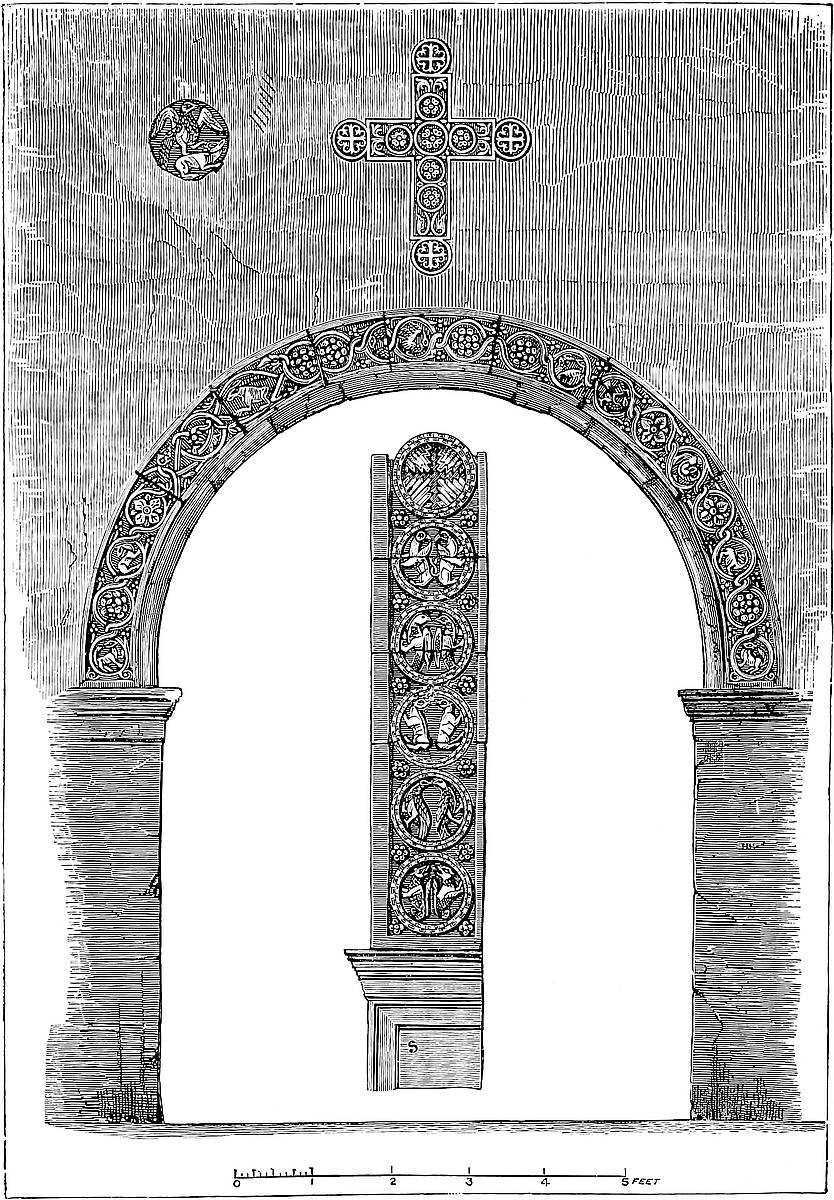
Doorway of the House of Marco Polo in the Corte Sabbionera, at Venice.
MARCO POLO AND HIS BOOK.
INTRODUCTORY NOTICES.
I. Obscurities in the History of his Life and Book. Ramusio’s Statements.
1. With all the intrinsic interest of Marco Polo’s Book it may perhaps be doubted if it would have continued to exercise such Obscurities of Polo’s Book, and personal History.fascination on many minds through successive generations were it not for the difficult questions which it suggests. It is a great book of puzzles, whilst our confidence in the man’s veracity is such that we feel certain every puzzle has a solution.
And such difficulties have not attached merely to the identification of places, the interpretation of outlandish terms, or the illustration of obscure customs; for strange entanglements have perplexed also the chief circumstances of the Traveller’s life and authorship. The time of the dictation of his Book and of the execution of his Last Will have been almost the only undisputed epochs in his biography. The year of his birth has been contested, and the date of his death has not been recorded; the critical occasion of his capture by the Genoese, to which we seem to owe the happy fact that he did not go down mute to the tomb of his fathers, has been made the subject of chronological difficulties; there are in the various texts of his story variations hard to account for; the very tongue in which it was written down has furnished a question, solved only in our own age, and in a most unexpected manner.
2. The first person who attempted to gather and string the Ramusio, his earliest biographer. His account of Polo.facts of Marco Polo’s personal history was his countryman, the celebrated John Baptist Ramusio. His essay abounds in what we now know to be errors of detail, but, prepared as it was when traditions of the Traveller were still rife in Venice, a genuine thread runs through it which could never have been spun in later days, and its presentation seems to me an essential element in any full discourse upon the subject.
Ramusio’s preface to the Book of Marco Polo, which opens the second volume of his famous Collection of Voyages and Travels, and is addressed to his learned friend Jerome Fracastoro, after referring to some of the most noted geographers of antiquity, proceeds:[1]—
“Of all that I have named, Ptolemy, as the latest, possessed the greatest extent of knowledge. Thus, towards the North, his knowledge carries him beyond the Caspian, and he is aware of its being shut in all round like a lake,—a fact which was unknown in the days of Strabo and Pliny, though the Romans were already lords of the world. But though his knowledge extends so far, a tract of 15 degrees beyond that sea he can describe only as Terra Incognita; and towards the South he is fain to apply the same character to all beyond the Equinoxial. In these unknown regions, as regards the South, the first to make discoveries have been the Portuguese captains of our own age; but as regards the North and North-East the discoverer was the Magnifico Messer Marco Polo, an honoured nobleman of Venice, nearly 300 years since, as may be read more fully in his own Book. And in truth it makes one marvel to consider the immense extent of the journeys made, first by the Father and Uncle of the said Messer Marco, when they proceeded continually towards the East-North-East, all the way to the Court of the Great Can and the Emperor of the Tartars; and afterwards again by the three of them when, on their return homeward, they traversed the Eastern and Indian Seas. Nor is that all, for one marvels also how the aforesaid gentleman was able to give such an orderly description of all that he had seen; seeing that such an accomplishment was possessed by very few in his day, and he had had a large part of his nurture among those uncultivated Tartars, without any regular training in the art of composition. His Book indeed, owing to the endless errors and inaccuracies that had crept into it, had come for many years to be regarded as fabulous; and the opinion prevailed that the names of cities and provinces contained therein were all fictitious and imaginary, without any ground in fact, or were (I might rather say) mere dreams.
3. “Howbeit, during the last hundred years, persons acquainted with Persia have begun to recognise the existence of Cathay. Ramusio vindicates Polo’s Geography.The voyages of the Portuguese also towards the North-East, beyond the Golden Chersonese, have brought to knowledge many cities and provinces of India, and many islands likewise, with those very names which our Author applies to them; and again, on reaching the Land of China, they have ascertained from the people of that region (as we are told by Sign. John de Barros, a Portuguese gentleman, in his Geography) that Canton, one of the chief cities of that kingdom, is in 30⅔° of latitude, with the coast running N.E. and S.W.; that after a distance of 275 leagues the said coast turns towards the N.W.; and that there are three provinces along the sea-board, Mangi, Zanton, and Quinzai, the last of which is the principal city and the King’s Residence, standing in 46° of latitude. And proceeding yet further the coast attains to 50°.[2] Seeing then how many particulars are in our day becoming known of that part of the world concerning which Messer Marco has written, I have deemed it reasonable to publish his book, with the aid of several copies written (as I judge) more than 200 years ago, in a perfectly accurate form, and one vastly more faithful than that in which it has been heretofore read. And thus the world shall not lose the fruit that may be gathered from so much diligence and industry expended upon so honourable a branch of knowledge.”
4. Ramusio, then, after a brief apologetic parallel of the marvels related by Polo with those related by the Ancients and by the modern discoverers in the West, such as Columbus and Cortes, proceeds:—
“And often in my own mind, comparing the land explorations of these our Venetian gentlemen with the sea explorations of the aforesaid Signor Don Christopher, I have asked myself which of the two were really the more marvellous. Ramusio compares Polo with Columbus.And if patriotic prejudice delude me not, methinks good reason might be adduced for setting the land journey above the sea voyage. Consider only what a height of courage was needed to undertake and carry through so difficult an enterprise, over a route of such desperate length and hardship, whereon it was sometimes necessary to carry food for the supply of man and beast, not for days only but for months together. Columbus, on the other hand, going by sea, readily carried with him all necessary provision; and after a voyage of some 30 or 40 days was conveyed by the wind whither he desired to go, whilst the Venetians again took a whole year’s time to pass all those great deserts and mighty rivers. Indeed that the difficulty of travelling to Cathay was so much greater than that of reaching the New World, and the route so much longer and more perilous, may be gathered from the fact that, since those gentlemen twice made this journey, no one from Europe has dared to repeat it,[3] whereas in the very year following the discovery of the Western Indies many ships immediately retraced the voyage thither, and up to the present day continue to do so, habitually and in countless numbers. Indeed those regions are now so well known, and so thronged by commerce, that the traffic between Italy, Spain, and England is not greater.”
5. Ramusio goes on to explain the light regarding the first part or prologue of Marco Polo’s book that he had derived Recounts a tradition of the travellers’ return to Venice.from a recent piece of luck which had made him partially acquainted with the geography of Abulfeda, and to make a running commentary on the whole of the preliminary narrative until the final return of the travellers to Venice:—
“And when they got thither the same fate befel them as befel Ulysses, who, when he returned, after his twenty years’ wanderings, to his native Ithaca, was recognized by nobody. Thus also those three gentlemen who had been so many years absent from their native city were recognized by none of their kinsfolk, who were under the firm belief that they had all been dead for many a year past, as indeed had been reported. Through the long duration and the hardships of their journeys, and through the many worries and anxieties that they had undergone, they were quite changed in aspect, and had got a certain indescribable smack of the Tartar both in air and accent, having indeed all but forgotten their Venetian tongue. Their clothes too were coarse and shabby, and of a Tartar cut. They proceeded on their arrival to their house in this city in the confine of St. John Chrysostom, where you may see it to this day. The house, which was in those days a very lofty and handsome palazzo, is now known by the name of the Corte del Millioni for a reason that I will tell you presently. Going thither they found it occupied by some of their relatives, and they had the greatest difficulty in making the latter understand who they should be. For these good people, seeing them to be in countenance so unlike what they used to be, and in dress so shabby, flatly refused to believe that they were those very gentlemen of the Ca’ Polo whom they had been looking upon for ever so many years as among the dead.[4] So these three gentlemen,—this is a story I have often heard when I was a youngster from the illustrious Messer Gasparo Malpiero, a gentleman of very great age, and a Senator of eminent virtue and integrity, whose house was on the Canal of Santa Marina, exactly at the corner over the mouth of the Rio di S. Giovanni Chrisostomo, and just midway among the buildings of the aforesaid Corte del Millioni, and he said he had heard the story from his own father and grandfather, and from other old men among the neighbours,—the three gentlemen, I say, devised a scheme by which they should at once bring about their recognition by their relatives, and secure the honourable notice of the whole city; and this was it:—
“They invited a number of their kindred to an entertainment, which they took care to have prepared with great state and splendour in that house of theirs; and when the hour arrived for sitting down to table they came forth of their chamber all three clothed in crimson satin, fashioned in long robes reaching to the ground such as people in those days wore within doors. And when water for the hands had been served, and the guests were set, they took off those robes and put on others of crimson damask, whilst the first suits were by their orders cut up and divided among the servants. Then after partaking of some of the dishes they went out again and came back in robes of crimson velvet, and when they had again taken their seats, the second suits were divided as before. When dinner was over they did the like with the robes of velvet, after they had put on dresses of the ordinary fashion worn by the rest of the company.[5] These proceedings caused much wonder and amazement among the guests. But when the cloth had been drawn, and all the servants had been ordered to retire from the dining hall, Messer Marco, as the youngest of the three, rose from table, and, going into another chamber, brought forth the three shabby dresses of coarse stuff which they had worn when they first arrived. Straightway they took sharp knives and began to rip up some of the seams and welts, and to take out of them jewels of the greatest value in vast quantities, such as rubies, sapphires, carbuncles, diamonds and emeralds, which had all been stitched up in those dresses in so artful a fashion that nobody could have suspected the fact. For when they took leave of the Great Can they had changed all the wealth that he had bestowed upon them into this mass of rubies, emeralds, and other jewels, being well aware of the impossibility of carrying with them so great an amount in gold over a journey of such extreme length and difficulty. Now this exhibition of such a huge treasure of jewels and precious stones, all tumbled out upon the table, threw the guests into fresh amazement, insomuch that they seemed quite bewildered and dumbfounded. And now they recognized that in spite of all former doubts these were in truth those honoured and worthy gentlemen of the Ca’ Polo that they claimed to be; and so all paid them the greatest honour and reverence. And when the story got wind in Venice, straightway the whole city, gentle and simple, flocked to the house to embrace them, and to make much of them, with every conceivable demonstration of affection and respect. On Messer Maffio, who was the eldest, they conferred the honours of an office that was of great dignity in those days; whilst the young men came daily to visit and converse with the ever polite and gracious Messer Marco, and to ask him questions about Cathay and the Great Can, all which he answered with such kindly courtesy that every man felt himself in a manner his debtor. And as it happened that in the story, which he was constantly called on to repeat, of the magnificence of the Great Can, he would speak of his revenues as amounting to ten or fifteen millions of gold; and in like manner, when recounting other instances of great wealth in those parts, would always make use of the term millions, so they gave him the nickname of Messer Marco Millioni: a thing which I have noted also in the Public Books of this Republic where mention is made of him.[6] The Court of his House, too, at S. Giovanni Chrisostomo, has always from that time been popularly known as the Court of the Millioni.
6. “Not many months after the arrival of the travellers at Venice, news came that Lampa Doria, Captain of the Genoese Fleet, had advanced with 70 galleys to the Island of Curzola, upon which orders were issued by the Prince of the Most Illustrious Signory for the arming of 90 galleys with all the expedition possible, Recounts Marco’s capture by the Genoese. and Messer Marco Polo for his valour was put in charge of one of these. So he with the others, under the command of the Most Illustrious Messer Andrea Dandolo, Procurator of St. Mark’s, as Captain General, a very brave and worthy gentleman, set out in search of the Genoese Fleet. They fought on the September feast of Our Lady, and, as is the common hazard of war, our fleet was beaten, and Polo was made prisoner. For, having pressed on in the vanguard of the attack, and fighting with high and worthy courage in defence of his country and his kindred, he did not receive due support, and being wounded, he was taken, along with Dandolo, and immediately put in irons and sent to Genoa.
“When his rare qualities and marvellous travels became known there, the whole city gathered to see him and to speak with him, and he was no longer entreated as a prisoner but as a dear friend and honoured gentleman. Indeed they showed him such honour and affection that at all hours of the day he was visited by the noblest gentlemen of the city, and was continually receiving presents of every useful kind. Messer Marco finding himself in this position, and witnessing the general eagerness to hear all about Cathay and the Great Can, which indeed compelled him daily to repeat his story till he was weary, was advised to put the matter in writing. So having found means to get a letter written to his father here at Venice, in which he desired the latter to send the notes and memoranda which he had brought home with him, after the receipt of these, and assisted by a Genoese gentleman, who was a great friend of his, and who took great delight in learning about the various regions of the world, and used on that account to spend many hours daily in the prison with him, he wrote this present book (to please him) in the Latin tongue.
“To this day the Genoese for the most part write what they have to write in that language, for there is no possibility of expressing their natural dialect with the pen.[7] Thus then it came to pass that the Book was put forth at first by Messer Marco in Latin; but as many copies were taken, and as it was rendered into our vulgar tongue, all Italy became filled with it, so much was this story desired and run after.
7. “The captivity of Messer Marco greatly disturbed the minds of Messer Maffio and his father Messer Nicolo. They had decided, whilst still on their travels, Ramusio’s account of Marco’s liberation and marriage. that Marco should marry as soon as they should get to Venice; but now they found themselves in this unlucky pass, with so much wealth and nobody to inherit it. Fearing that Marco’s imprisonment might endure for many years, or, worse still, that he might not live to quit it (for many assured them that numbers of Venetian prisoners had been kept in Genoa a score of years before obtaining liberty); seeing too no prospect of being able to ransom him,—a thing which they had attempted often and by various channels,—they took counsel together, and came to the conclusion that Messer Nicolo, who, old as he was, was still hale and vigorous, should take to himself a new wife. This he did; and at the end of four years he found himself the father of three sons, Stefano, Maffio, and Giovanni. Not many years after, Messer Marco aforesaid, through the great favour that he had acquired in the eyes of the first gentlemen of Genoa, and indeed of the whole city, was discharged from prison and set free. Returning home he found that his father had in the meantime had those three other sons. Instead of taking this amiss, wise and discreet man that he was, he agreed also to take a wife of his own. He did so accordingly, but he never had any son, only two girls, one called Moreta and the other Fantina.
“When at a later date his father died, like a good and dutiful son he caused to be erected for him a tomb of very honourable kind for those days, being a great sarcophagus cut from the solid stone, which to this day may be seen under the portico before the Church of S. Lorenzo in this city, on the right hand as you enter, with an inscription denoting it to be the tomb of Messer Nicolo Polo of the contrada of S. Gio. Chrisostomo. The arms of his family consist of a Bend with three birds on it, and the colours, according to certain books of old histories in which you see all the coats of the gentlemen of this city emblazoned, are the field azure, the bend argent, and the three birds sable. These last are birds of that kind vulgarly termed Pole,[8] or, as the Latins call them, Gracculi.
8. “As regards the after duration of this noble and worthy family, I find that Messer Andrea Polo of San Felice had three sons, the first of whom was Messer Marco, the second Maffio, the third Nicolo. Ramusio’s account of the Family Polo and its termination. The two last were those who went to Constantinople first, and afterwards to Cathay, as has been seen. Messer Marco the elder being dead, the wife of Messer Nicolo who had been left at home with child, gave birth to a son, to whom she gave the name of Marco in memory of the deceased, and this is the Author of our Book. Of the brothers who were born from his father’s second marriage, viz. Stephen, John, and Matthew, I do not find that any of them had children, except Matthew. He had five sons and one daughter called Maria; and she, after the death of her brothers without offspring, inherited in 1417 all the property of her father and her brothers. She was honourably married to Messer Azzo Trevisano of the parish of Santo Stazio in this city, and from her sprung the fortunate and honoured stock of the Illustrious Messer Domenico Trevisano, Procurator of St. Mark’s, and valorous Captain General of the Sea Forces of the Republic, whose virtue and singular good qualities are represented with augmentation in the person of the Most Illustrious Prince Ser Marc’Antonio Trevisano, his son.[9]
“Such has been the history of this noble family of the Ca’ Polo, which lasted as we see till the year of our Redemption 1417, in which year died childless Marco Polo, the last of the five sons of Maffeo, and so it came to an end. Such be the chances and changes of human affairs!”
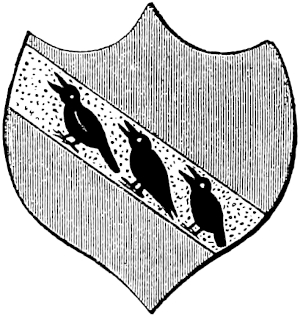
Arms of the Ca’ Polo.
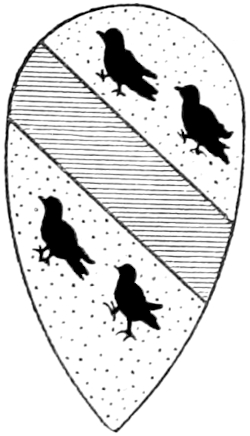
Arms of the Polo[A]
II. Sketch of the State of the East at the time of the Journeys of the Polo Family.
9. The story of the travels of the Polo family opens in 1260.
Christendom had recovered from the alarm into which it had been thrown some 18 years before when the Tartar cataclysm had threatened to engulph it.State of the Levant. The Tartars themselves were already becoming an object of curiosity rather than of fear, and soon became an object of hope, as a possible help against the old Mahomedan foe. The frail Latin throne in Constantinople was still standing, but tottering to its fall. The successors of the Crusaders still held the Coast of Syria from Antioch to Jaffa, though a deadlier brood of enemies than they had yet encountered was now coming to maturity in the Dynasty of the Mamelukes, which had one foot firmly planted in Cairo, the other in Damascus. The jealousies of the commercial republics of Italy were daily waxing greater. The position of Genoese trade on the coasts of the Aegean was greatly depressed, through the predominance which Venice had acquired there by her part in the expulsion of the Greek Emperors, and which won for the Doge the lofty style of Lord of Three-Eighths of the Empire of Romania. But Genoa was biding her time for an early revenge, and year by year her naval strength and skill were increasing. Both these republics held possessions and establishments in the ports of Syria, which were often the scene of sanguinary conflicts between their citizens. Alexandria was still largely frequented in the intervals of war as the great emporium of Indian wares, but the facilities afforded by the Mongol conquerors who now held the whole tract from the Persian Gulf to the shores of the Caspian and of the Black Sea, or nearly so, were beginning to give a great advantage to the caravan routes which debouched at the ports of Cilician Armenia in the Mediterranean and at Trebizond on the Euxine. Tana (or Azov) had not as yet become the outlet of a similar traffic; the Venetians had apparently frequented to some extent the coast of the Crimea for local trade, but their rivals appear to have been in great measure excluded from this commerce, and the Genoese establishments which so long flourished on that coast, are first heard of some years after a Greek dynasty was again in possession of Constantinople.[1]
10. In Asia and Eastern Europe scarcely a dog might bark without Mongol leave, from the borders of Poland and the Gulf of Scanderoon to the Amur and the Yellow Sea. The various Mongol Sovereignties in Asia and Eastern Europe.The vast empire which Chinghiz had conquered still owned a nominally supreme head in the Great Kaan,[2] but practically it was splitting up into several great monarchies under the descendants of the four sons of Chinghiz, Juji, Chaghatai, Okkodai, and Tuli; and wars on a vast scale were already brewing between them. Hulaku, third son of Tuli, and brother of two Great Kaans, Mangku and Kúblái, had become practically independent as ruler of Persia, Babylonia, Mesopotamia, and Armenia, though he and his sons, and his sons’ sons, continued to stamp the name of the Great Kaan upon their coins, and to use the Chinese seals of state which he bestowed upon them. The Seljukian Sultans of Iconium, whose dominion bore the proud title of Rúm (Rome), were now but the struggling bondsmen of the Ilkhans. The Armenian Hayton in his Cilician Kingdom had pledged a more frank allegiance to the Tartar, the enemy of his Moslem enemies.
Barka, son of Juji, the first ruling prince of the House of Chinghiz to turn Mahomedan, reigned on the steppes of the Volga, where a standing camp, which eventually became a great city under the name of Sarai, had been established by his brother and predecessor Batu.
The House of Chaghatai had settled upon the pastures of the Ili and the valley of the Jaxartes, and ruled the wealthy cities of Sogdiana.
Kaidu, the grandson of Okkodai who had been the successor of Chinghiz in the Kaanship, refused to acknowledge the transfer of the supreme authority to the House of Tuli, and was through the long life of Kúblái a thorn in his side, perpetually keeping his north-western frontier in alarm. His immediate authority was exercised over some part of what we should now call Eastern Turkestan and Southern Central Siberia; whilst his hordes of horsemen, force of character, and close neighbourhood brought the Khans of Chaghatai under his influence, and they generally acted in concert with him.
The chief throne of the Mongol Empire had just been ascended by Kúblái, the most able of its occupants after the Founder. Before the death of his brother and predecessor Mangku, who died in 1259 before an obscure fortress of Western China, it had been intended to remove the seat of government from Kara Korum on the northern verge of the Mongolian Desert to the more populous regions that had been conquered in the further East, and this step, which in the end converted the Mongol Kaan into a Chinese Emperor,[3] was carried out by Kúblái.
11. For about three centuries the Northern provinces of China had been detached from native rule, and subject to foreign dynasties; first to the Khitan, China.a people from the basin of the Sungari River, and supposed (but doubtfully) to have been akin to the Tunguses, whose rule subsisted for 200 years, and originated the name of Khitai, Khata, or Cathay, by which for nearly 1000 years China has been known to the nations of Inner Asia, and to those whose acquaintance with it was got by that channel.[4] The Khitan, whose dynasty is known in Chinese history as the Liao or “Iron,” had been displaced in 1123 by the Chúrchés or Niu-chen, another race of Eastern Tartary, of the same blood as the modern Manchus, whose Emperors in their brief period of prosperity were known by the Chinese name of Tai-Kin, by the Mongol name of the Altun Kaans, both signifying “Golden.” Already in the lifetime of Chinghiz himself the northern Provinces of China Proper, including their capital, known as Chung-tu or Yen-King, now Peking, had been wrenched from them, and the conquest of the dynasty was completed by Chinghiz’s successor Okkodai in 1234.
Southern China still remained in the hands of the native dynasty of the Sung, who had their capital at the great city now well known as Hang-chau fu. Their dominion was still substantially untouched, but its subjugation was a task to which Kúblái before many years turned his attention, and which became the most prominent event of his reign.
12. In India the most powerful sovereign was the Sultan of Delhi, Nassir-uddin Mahmud of the Turki House of Iltitmish;[5] but, India, and Indo-China.though both Sind and Bengal acknowledged his supremacy, no part of Peninsular India had yet been invaded, and throughout the long period of our Traveller’s residence in the East the Kings of Delhi had their hands too full, owing to the incessant incursions of the Mongols across the Indus, to venture on extensive campaigning in the south. Hence the Dravidian Kingdoms of Southern India were as yet untouched by foreign conquest, and the accumulated gold of ages lay in their temples and treasuries, an easy prey for the coming invader.
In the Indo-Chinese Peninsula and the Eastern Islands a variety of kingdoms and dynasties were expanding and contracting, of which we have at best but dim and shifting glimpses. That they were advanced in wealth and art, far beyond what the present state of those regions would suggest, is attested by vast and magnificent remains of Architecture, nearly all dating, so far as dates can be ascertained, from the 12th to the 14th centuries (that epoch during which an architectural afflatus seems to have descended on the human race), and which are found at intervals over both the Indo-Chinese continent and the Islands, as at Pagán in Burma, at Ayuthia in Siam, at Angkor in Kamboja, at Borobodor and Brambánan in Java. All these remains are deeply marked by Hindu influence, and, at the same time, by strong peculiarities, both generic and individual.
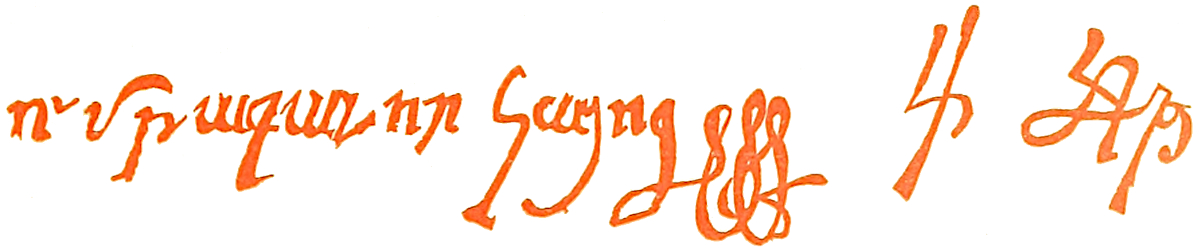
Autograph of Hayton, King of Armenia, circa A.D. 1243.
“... e por so qui cestes lettres soient fermes e establis ci avuns escrit l’escrit de notre main vermoil e sayelé de notre ceau pendant....”
III. The Polo Family. Personal History of the Travellers down to their final Return from the East.
13. In days when History and Genealogy were allowed to draw largely on the imagination for the origines of states and families, Alleged origin of the Polos.it was set down by one Venetian Antiquary that among the companions of King Venetus, or of Prince Antenor of Troy, when they settled on the northern shores of the Adriatic, there was one Lucius Polus, who became the progenitor of our Traveller’s Family;[1] whilst another deduces it from Paolo the first Doge[2] (Paulus Lucas Anafestus of Heraclea, A.D. 696).
More trustworthy traditions, recorded among the Family Histories of Venice, but still no more it is believed than traditions, represent the Family of Polo as having come from Sebenico in Dalmatia, in the 11th century.[3] Before the end of the century they had taken seats in the Great Council of the Republic; for the name of Domenico Polo is said to be subscribed to a grant of 1094, that of Pietro Polo to an act of the time of the Doge Domenico Michiele in 1122, and that of a Domenico Polo to an acquittance granted by the Doge Domenico Morosini and his Council in 1153.[4]
The ascertained genealogy of the Traveller, however, begins only with his grandfather, who lived in the early part of the 13th century.
Two branches of the Polo Family were then recognized, distinguished by the confini or Parishes in which they lived, as Polo of S. Geremia, and Polo of S. Felice. Andrea Polo of S. Felice was the father of three sons, Marco, Nicolo, and Maffeo. And Nicolo was the Father of our Marco.
14. Till quite recently it had never been precisely ascertained whether the immediate family of our Traveller belonged to the Nobles of Venice properly so called, Claims to be styled noble.who had seats in the Great Council and were enrolled in the Libro d’Oro. Ramusio indeed styles our Marco Nobile and Magnifico, and Rusticiano, the actual scribe of the Traveller’s recollections, calls him “sajes et noble citaiens de Venece,” but Ramusio’s accuracy and Rusticiano’s precision were scarcely to be depended on. Very recently, however, since the subject has been discussed with accomplished students of the Venice Archives, proofs have been found establishing Marco’s personal claim to nobility, inasmuch as both in judicial decisions and in official resolutions of the Great Council, he is designated Nobilis Vir, a formula which would never have been used in such documents (I am assured) had he not been technically noble.[5]
15. Of the three sons of Andrea Polo of S. Felice, Marco seems to have been the eldest, and Maffeo the youngest.[6] Marco the Elder.They were all engaged in commerce, and apparently in a partnership, which to some extent held good even when the two younger had been many years absent in the Far East.[7] Marco seems to have been established for a time at Constantinople,[8] and also to have had a house (no doubt of business) at Soldaia, in the Crimea, where his son and daughter, Nicolo and Maroca by name, were living in 1280. This year is the date of the Elder Marco’s Will, executed at Venice, and when he was “weighed down by bodily ailment.” Whether he survived for any length of time we do not know.
16. Nicolo Polo, the second of the Brothers, had two legitimate sons, Marco, the Author of our Book, born in 1254,[9] and Maffeo, Nicolo and Maffeo commence their travels.of whose place in the family we shall have a few words to say presently. The story opens, as we have said, in 1260, when we find the two brothers, Nicolo and Maffeo the Elder, at Constantinople. How long they had been absent from Venice we are not distinctly told. Nicolo had left his wife there behind him; Maffeo apparently was a bachelor. In the year named they started on a trading venture to the Crimea, whence a succession of openings and chances, recounted in the Introductory chapters of Marco’s work, carried them far north along the Volga, and thence first to Bokhara, and then to the Court of the Great Kaan Kúblái in the Far East, on or within the borders of Cathay. That a great and civilized country so called existed in the extremity of Asia had already been reported in Europe by the Friars Plano Carpini (1246) and William Rubruquis (1253), who had not indeed reached its frontiers, but had met with its people at the Court of the Great Kaan in Mongolia; whilst the latter of the two with characteristic acumen had seen that they were identical with the Seres of classic fame.
17. Kúblái had never before fallen in with European gentlemen. He was delighted with these Venetians, Their intercourse with Kúblái Kaan.listened with strong interest to all that they had to tell him of the Latin world, and determined to send them back as his ambassadors to the Pope, accompanied by an officer of his own Court. His letters to the Pope, as the Polos represent them, were mainly to desire the despatch of a large body of educated missionaries to convert his people to Christianity. It is not likely that religious motives influenced Kúblái in this, but he probably desired religious aid in softening and civilizing his rude kinsmen of the Steppes, and judged, from what he saw in the Venetians and heard from them, that Europe could afford such aid of a higher quality than the degenerate Oriental Christians with whom he was familiar, or the Tibetan Lamas on whom his patronage eventually devolved when Rome so deplorably failed to meet his advances.
18. The Brothers arrived at Acre in April,[10] 1269, and found that no Pope existed, for Clement IV. was dead the year before, Their return home, and Marco’s appearance on the scene.and no new election had taken place. So they went home to Venice to see how things stood there after their absence of so many years.
The wife of Nicolo was no longer among the living, but he found his son Marco a fine lad of fifteen.
The best and most authentic MSS. tell us no more than this. But one class of copies, consisting of the Latin version made by our Traveller’s contemporary, Francesco Pipino, and of the numerous editions based indirectly upon it, represents that Nicolo had left Venice when Marco was as yet unborn, and consequently had never seen him till his return from the East in 1269.[11]
We have mentioned that Nicolo Polo had another legitimate son, by name Maffeo, and him we infer to have been younger than Marco, because he is named last (Marcus et Matheus) in the Testament of their uncle Marco the Elder. We do not know if they were by the same mother. They could not have been so if we are right in supposing Maffeo to have been the younger, and if Pipino’s version of the history be genuine. If however we reject the latter, as I incline to do, no ground remains for supposing that Nicolo went to the East much before we find him there viz., in 1260, and Maffeo may have been born of the same mother during the interval between 1254 and 1260. If on the other hand Pipino’s version be held to, we must suppose that Maffeo (who is named by his uncle in 1280, during his father’s second absence in the East) was born of a marriage contracted during Nicolo’s residence at home after his first journey, a residence which lasted from 1269 to 1271.[12]
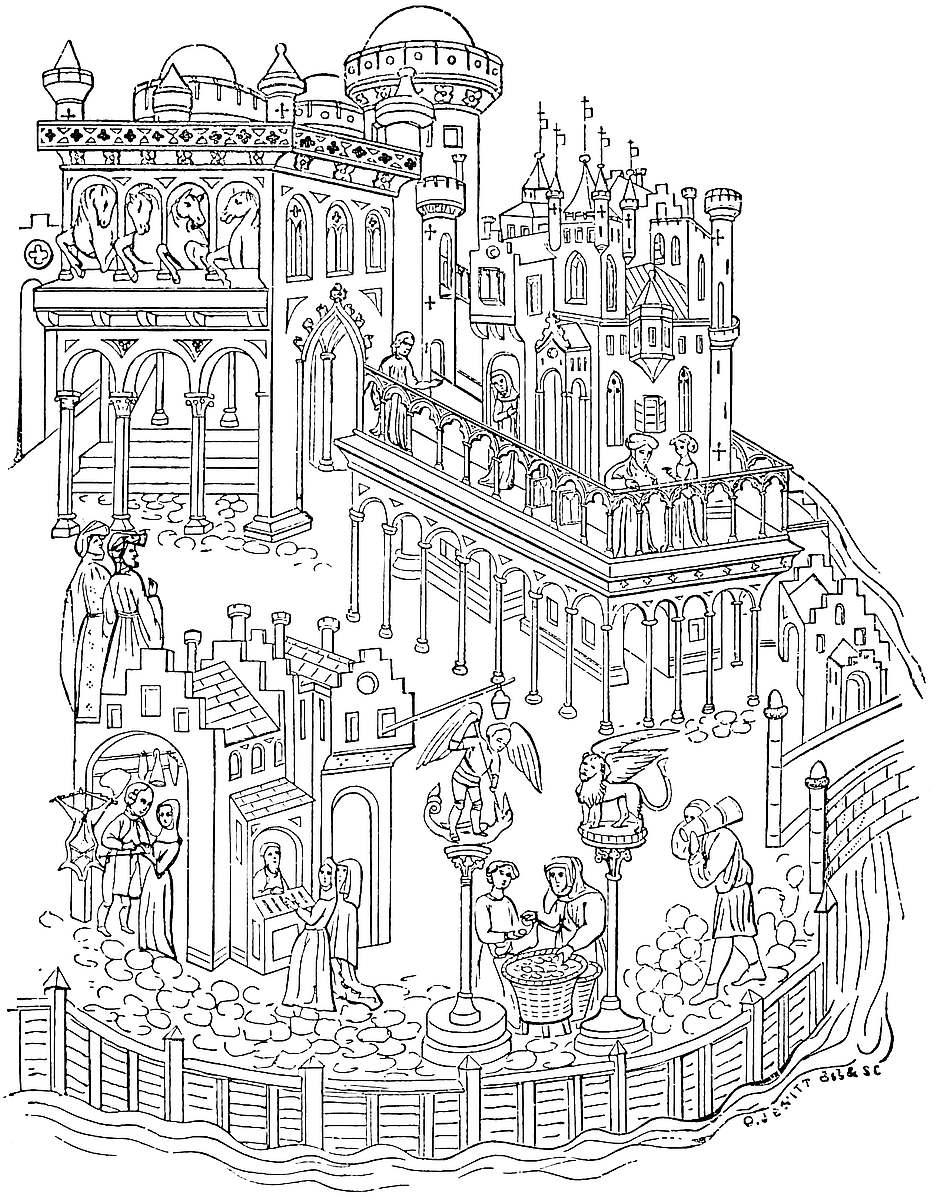
The Piazzetta at Venice. (From the Bodleian MS. of Polo.)
19. The Papal interregnum was the longest known, at least since the dark ages. Those two years passed, and yet the Cardinals at Viterbo had come to no agreement. Second Journey of the Polo Brothers, accompanied by Marco.The brothers were unwilling to let the Great Kaan think them faithless, and perhaps they hankered after the virgin field of speculation that they had discovered; so they started again for the East, taking young Mark with them. At Acre they took counsel with an eminent churchman, Tedaldo (or Tebaldo) Visconti, Archdeacon of Liège, whom the Book represents to have been Legate in Syria, and who in any case was a personage of much gravity and influence. From him they got letters to authenticate the causes of the miscarriage of their mission, and started for the further East. But they were still at the port of Ayas on the Gulf of Scanderoon, which was then becoming one of the chief points of arrival and departure for the inland trade of Asia, when they were overtaken by the news that a Pope was at last elected, and that the choice had fallen upon their friend Archdeacon Tedaldo. They immediately returned to Acre, and at last were able to execute the Kaan’s commission, and to obtain a reply. But instead of the hundred able teachers of science and religion whom Kúblái is said to have asked for, the new Pope, Gregory X., could supply but two Dominicans; and these lost heart and drew back when they had barely taken the first step of the journey.
Judging from certain indications we conceive it probable that the three Venetians, whose second start from Acre took place about November 1271, proceeded by Ayas and Sivas, and then by Mardin, Mosul, and Baghdad, to Hormuz at the mouth of the Persian Gulf, with the view of going on by sea, but that some obstacle arose which compelled them to abandon this project and turn north again from Hormuz.[13] They then traversed successively Kerman and Khorasan, Balkh and Badakhshan, whence they ascended the Panja or upper Oxus to the Plateau of Pamir, a route not known to have been since followed by any European traveller except Benedict Goës, till the spirited expedition of Lieutenant John Wood of the Indian Navy in 1838.[14] Crossing the Pamir highlands the travellers descended upon Kashgar, whence they proceeded by Yarkand and Khotan, and the vicinity of Lake Lob, and eventually across the Great Gobi Desert to Tangut, the name then applied by Mongols and Persians to territory at the extreme North-west of China, both within and without the Wall. Skirting the northern frontier of China they at last reached the presence of the Kaan, who was at his usual summer retreat at Kai-ping fu, near the base of the Khingan Mountains, and nearly 100 miles north of the Great Wall at Kalgan. If there be no mistake in the time (three years and a half) ascribed to this journey in all the existing texts, the travellers did not reach the Court till about May of 1275.[15]
20. Kúblái received the Venetians with great cordiality, and took kindly to young Mark, who must have been by this time one-and-twenty. Marco’s employment by Kúblái Kaan; and his journeys.The Joenne Bacheler, as the story calls him, applied himself to the acquisition of the languages and written characters in chief use among the multifarious nationalities included in the Kaan’s Court and administration; and Kúblái after a time, seeing his discretion and ability, began to employ him in the public service. M. Pauthier has found a record in the Chinese Annals of the Mongol Dynasty, which states that in the year 1277, a certain Polo was nominated a second-class commissioner or agent attached to the Privy Council, a passage which we are happy to believe to refer to our young traveller.[16]
His first mission apparently was that which carried him through the provinces of Shan-si, Shen-si, and Sze-ch’wan, and the wild country on the East of Tibet, to the remote province of Yun-nan, called by the Mongols Karájàng, and which had been partially conquered by an army under Kúblái himself in 1253, before his accession to the throne.[17] Mark, during his stay at court, had observed the Kaan’s delight in hearing of strange countries, their marvels, manners, and oddities, and had heard his Majesty’s frank expressions of disgust at the stupidity of his commissioners when they could speak of nothing but the official business on which they had been sent. Profiting by these observations, he took care to store his memory or his note-books with all curious facts that were likely to interest Kúblái, and related them with vivacity on his return to Court. This first journey, which led him through a region which is still very nearly a terra incognita, and in which there existed and still exists, among the deep valleys of the Great Rivers flowing down from Eastern Tibet, and in the rugged mountain ranges bordering Yun-nan and Kwei-chau, a vast Ethnological Garden, as it were, of tribes of various race and in every stage of uncivilisation, afforded him an acquaintance with many strange products and eccentric traits of manners, wherewith to delight the Emperor.
Mark rose rapidly in favour, and often served Kúblái again on distant missions, as well as in domestic administration, but we gather few details as to his employments. At one time we know that he held for three years the government of the great city of Yang-chau, though we need not try to magnify this office, as some commentators have done, into the viceroyalty of one of the great provinces of the Empire; on another occasion we find him with his uncle Maffeo, passing a year at Kan-chau in Tangut; again, it would appear, visiting Kara Korum, the old capital of the Kaans in Mongolia; on another occasion in Champa or Southern Cochin China; and again, or perhaps as a part of the last expedition, on a mission to the Indian Seas, when he appears to have visited several of the southern states of India. We are not informed whether his father and uncle shared in such employments;[18] and the story of their services rendered to the Kaan in promoting the capture of the city of Siang-yang, by the construction of powerful engines of attack, is too much perplexed by difficulties of chronology to be cited with confidence. Anyhow they were gathering wealth, and after years of exile they began to dread what might follow old Kúblái’s death, and longed to carry their gear and their own grey heads safe home to the Lagoons. The aged Emperor growled refusal to all their hints, and but for a happy chance we should have lost our mediæval Herodotus.
21. Arghún Khan of Persia, Kúblái’s great-nephew, had in 1286 lost his favourite wife the Khatun Bulughán; and, mourning her sorely, Circumstances of the Departure of the Polos from the Kaan’s Court.took steps to fulfil her dying injunction that her place should be filled only by a lady of her own kin, the Mongol Tribe of Bayaut. Ambassadors were despatched to the Court of Kaan-baligh to seek such a bride. The message was courteously received, and the choice fell on the lady Kokáchin, a maiden of 17, “moult bele dame et avenant.” The overland road from Peking to Tabriz was not only of portentous length for such a tender charge, but was imperilled by war, so the envoys desired to return by sea. Tartars in general were strangers to all navigation; and the envoys, much taken with the Venetians, and eager to profit by their experience, especially as Marco had just then returned from his Indian mission, begged the Kaan as a favour to send the three Firinghis in their company. He consented with reluctance, but, having done so, fitted the party out nobly for the voyage, charging the Polos with friendly messages for the potentates of Europe, including the King of England. They appear to have sailed from the port of Zayton (as the Westerns called T’swan-chau or Chin-cheu in Fo-kien) in the beginning of 1292. It was an ill-starred voyage, involving long detentions on the coast of Sumatra, and in the South of India, to which, however, we are indebted for some of the best chapters in the book; and two years or upwards passed before they arrived at their destination in Persia.[19] The three hardy Venetians survived all perils, and so did the lady, who had come to look on them with filial regard; but two of the three envoys, and a vast proportion of the suite, had perished by the way.[20] Arghún Khan too had been dead even before they quitted China;[21] his brother Kaikhátú reigned in his stead; and his son Gházán succeeded to the lady’s hand. We are told by one who knew both the princes well that Arghún was one of the handsomest men of his time, whilst Gházán was, among all his host, one of the most insignificant in appearance. But in other respects the lady’s change was for the better. Gházán had some of the highest qualities of a soldier, a legislator and a king, adorned by many and varied accomplishments; though his reign was too short for the full development of his fame.
22. The princess, whose enjoyment of her royalty was brief, wept as she took leave of the kindly and noble Venetians. They pass by Persia to Venice. Their relations there.They went on to Tabriz, and after a long halt there proceeded homewards, reaching Venice, according to all the texts some time in 1295.[22]
We have related Ramusio’s interesting tradition, like a bit out of the Arabian Nights, of the reception that the Travellers met with from their relations, and of the means that they took to establish their position with those relations, and with Venetian society.[23] Of the relations, Marco the Elder had probably been long dead;[24] Maffeo the brother of our Marco was alive, and we hear also of a cousin (consanguineus) Felice Polo, and his wife Fiordelisa, without being able to fix their precise position in the family. We know also that Nicolo, who died before the end of the century, left behind him two illegitimate sons, Stefano and Zannino. It is not unlikely that these were born from some connection entered into during the long residence of the Polos in Cathay, though naturally their presence in the travelling company is not commemorated in Marco’s Prologue.[25]
IV. Digression concerning the Mansion of the Polo Family at Venice.
23. We have seen that Ramusio places the scene of the story recently alluded to at the mansion in the parish of S. Giovanni Grisostomo, the court of which was known in his time as the Corte del Millioni; and indeed he speaks of Probable period of their establishment at S. Giovanni Grisostomo.the Travellers as at once on their arrival resorting to that mansion as their family residence. Ramusio’s details have so often proved erroneous that I should not be surprised if this also should be a mistake. At least we find (so far as I can learn) no previous intimation that the family were connected with that locality. The grandfather Andrea is styled of San Felice. The will of Maffeo Polo the younger, made in 1300, which we shall give hereafter in abstract, appears to be the first document that connects the family with S. Giovanni Grisostomo. It indeed styles the testator’s father “the late Nicolo Paulo of the confine of St. John Chrysostom,” but that only shows what is not disputed, that the Travellers after their return from the East settled in this locality. And the same will appears to indicate a surviving connexion with S. Felice, for the priests and clerks who drew it up and witness it are all of the church of S. Felice, and it is to the parson of S. Felice and his successor that Maffeo bequeaths an annuity to procure their prayers for the souls of his father, his mother, and himself, though after the successor the annuity is to pass on the same condition to the senior priest of S. Giovanni Grisostomo. Marco Polo the Elder is in his will described as of S. Severo, as is also his sister-in-law Fiordelisa, and the document contains no reference to S. Giovanni. On the whole therefore it seems probable that the Palazzo in the latter parish was purchased by the Travellers after their return from the East.[1]
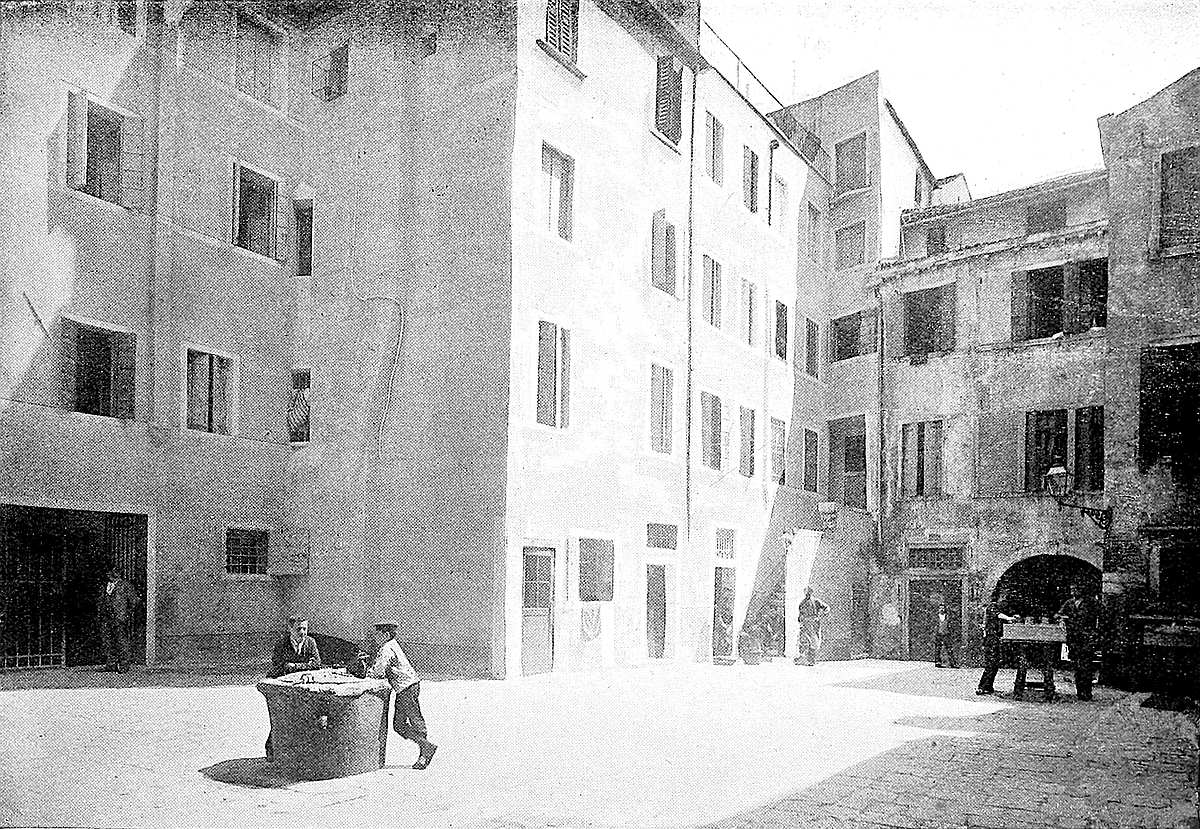
Corte del Milione, Venice.
24. The Court which was known in the 16th century as the Corte del Millioni has been generally understood to be that now known as the Corte Sabbionera,Relic of the Casa Polo in the Corte Sabbionera. and here is still pointed out a relic of Marco Polo’s mansion. [Indeed it is called now (1899) Corte del Milione; see p. 30.—H. C.]
M. Pauthier’s edition is embellished with a good engraving which purports to represent the House of Marco Polo. But he has been misled. His engraving in fact exhibits, at least as the prominent feature, an embellished representation of a small house which exists on the west side of the Sabbionera, and which had at one time perhaps that pointed style of architecture which his engraving shows, though its present decoration is paltry and unreal. But it is on the north side of the Court, and on the foundations now occupied by the Malibran theatre, that Venetian tradition and the investigations of Venetian antiquaries concur in indicating the site of the Casa Polo. At the end of the 16th century a great fire destroyed the Palazzo,[2] and under the description of “an old mansion ruined from the foundation” it passed into the hands of one Stefano Vecchia, who sold it in 1678 to Giovanni Carlo Grimani. He built on the site of the ruins a theatre which was in its day one of the largest in Italy, and was called the Theatre of S. Giovanni Grisostomo; afterwards the Teatro Emeronitio. When modernized in our own day the proprietors gave it the name of Malibran, in honour of that famous singer, and this it still bears.[3]
[In 1881, the year of the Venice International Geographical Congress, a Tablet was put up on the Theatre with the following inscription:—
QVI FURONO LE CASE DI MARCO POLO CHE VIAGGIÒ LE PIÙ LONTANE REGIONI DELL’ASIA E LE DESCRISSE PER DECRETO DEL COMUNE MDCCCLXXXI].
There is still to be seen on the north side of the Court an arched doorway in Italo-Byzantine style, richly sculptured with scrolls, disks, and symbolical animals, and on the wall above the doorway is a cross similarly ornamented.[4] The style and the decorations are those which were usual in Venice in the 13th century. The arch opens into a passage from which a similar doorway at the other end, also retaining some scantier relics of decoration, leads to the entrance of the Malibran Theatre. Over the archway in the Corte Sabbionera the building rises into a kind of tower. This, as well as the sculptured arches and cross, Signor Casoni, who gave a good deal of consideration to the subject, believed to be a relic of the old Polo House. But the tower (which Pauthier’s view does show) is now entirely modernized.[5]
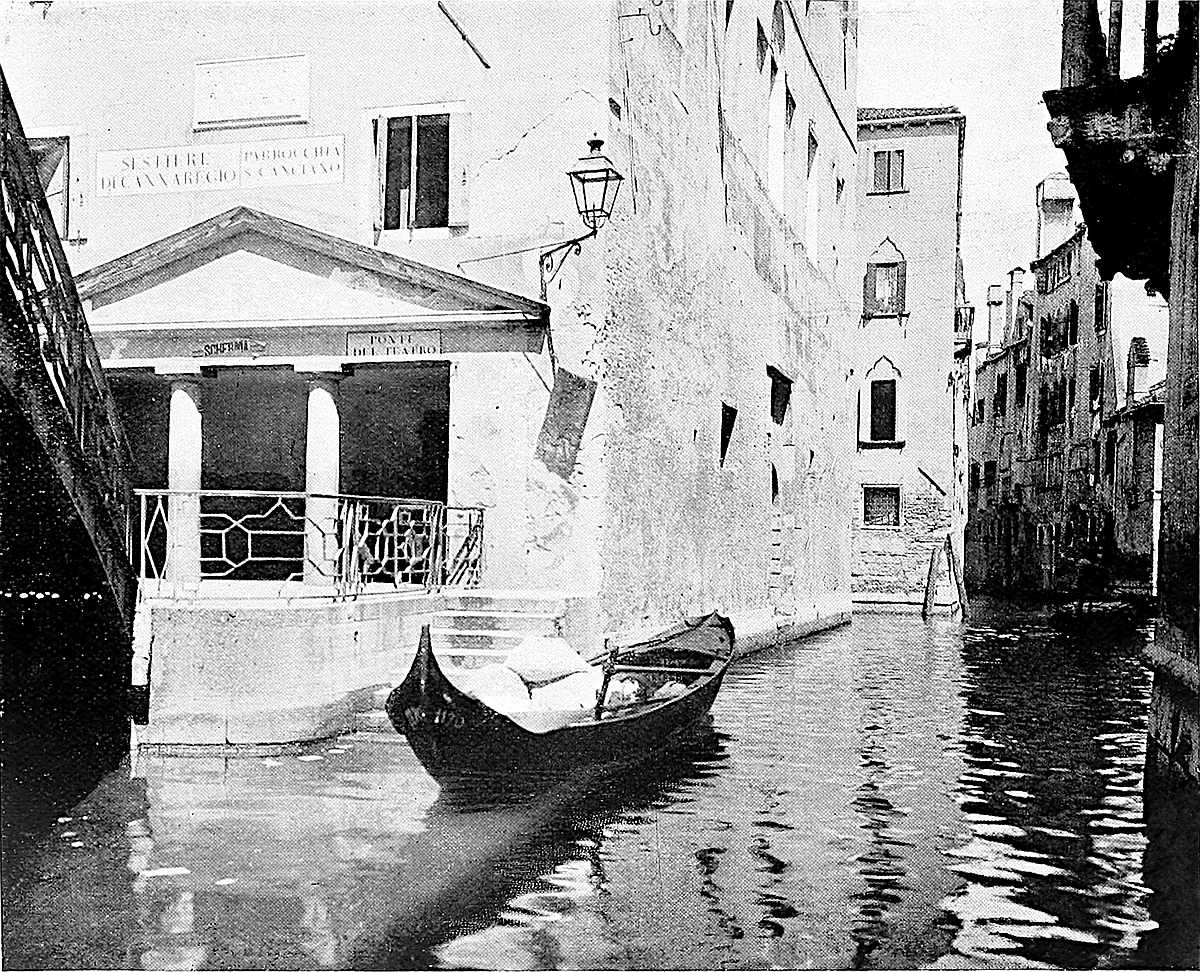
Malibran Theatre, Venice.
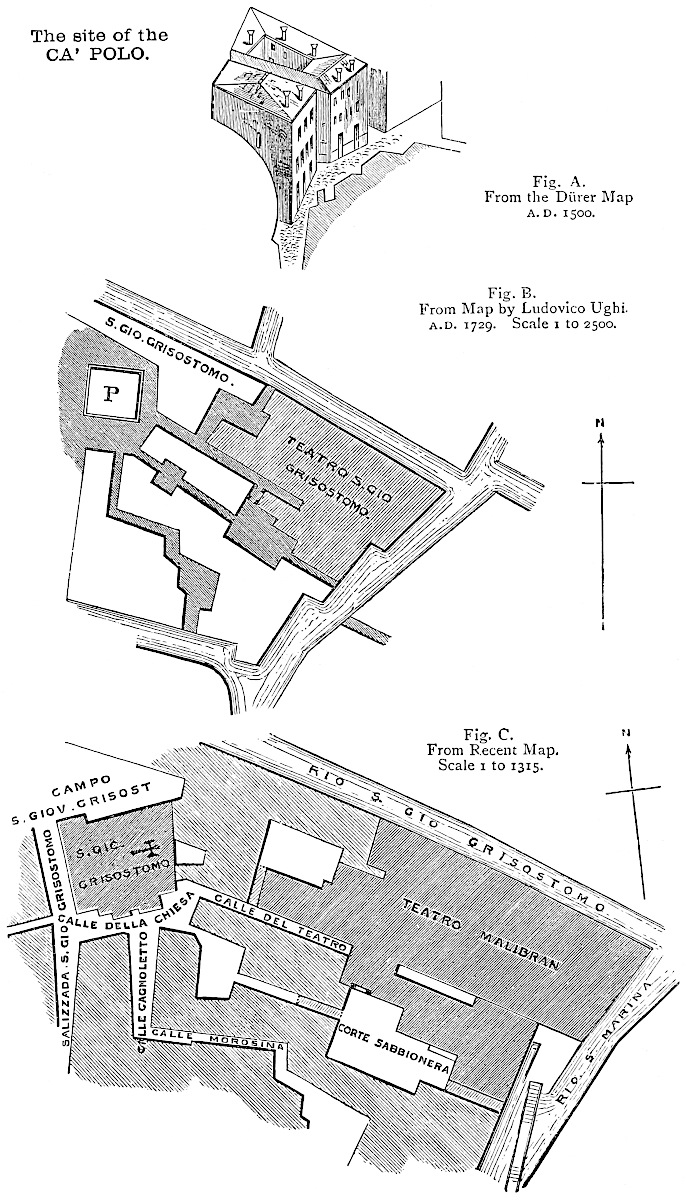
The site of the CA’ POLO. Fig. A. From the Dürer Map. A.D. 1500. Fig. B. From Map by Ludovico Ughi. A.D. 1729 Scale 1 to 2500. Fig. C. From Recent Map. Scale 1 to 1315.
Other remains of Byzantine sculpture, which are probably fragments of the decoration of the same mansion, are found imbedded in the walls of neighbouring houses.[6] It is impossible to determine anything further as to the form or extent of the house of the time of the Polos, but some slight idea of its appearance about the year 1500 may be seen in the extract (fig. a) which we give from the famous pictorial map of Venice attributed erroneously to Albert Dürer. The state of the buildings in the last century is shown in (fig. b) an extract from the fine Map of Ughi; and their present condition in one (fig. c) reduced from the Modern Official Map of the Municipality.
[Coming from the Church of S. G. Grisostomo to enter the calle del Teatro on the left and the passage (Sottoportico) leading to the Corte del Milione, one has in front of him a building with a door of the epoch of the Renaissance; it was the office of the provveditori of silk; on the architrave are engraved the words:
PROVISORES SERICI
and below, above the door, is the Tablet which] in the year 1827 the Abate Zenier caused to be put up with this inscription:—
AEDES PROXIMA THALIAE CVLTVI MODO ADDICTA MARCI POLO P. V. ITINERVM FAMA PRAECLARI JAM HABITATIO FVIT.
24a. I believe that of late years some doubts have been thrown on the tradition of the site indicated as that of the Casa Polo, Recent corroboration as to the traditional site of the Casa Polo.though I am not aware of the grounds of such doubts. But a document recently discovered at Venice by Comm. Barozzi, one of a series relating to the testamentary estate of Marco Polo, goes far to confirm the tradition. This is the copy of a technical definition of two pieces of house property adjoining the property of Marco Polo and his brother Stephen, which were sold to Marco Polo by his wife Donata[7] in June 1321. Though the definition is not decisive, from the rarity of topographical references and absence of points of the compass, the description of Donata’s tenements as standing on the Rio (presumably that of S. Giovanni Grisostomo) on one side, opening by certain porticoes and stairs on the other to the Court and common alley leading to the Church of S. Giovanni Grisostomo, and abutting in two places on the Ca’ Polo, the property of her husband and Stefano, will apply perfectly to a building occupying the western portion of the area on which now stands the Theatre, and perhaps forming the western side of a Court of which Casa Polo formed the other three sides.[8]
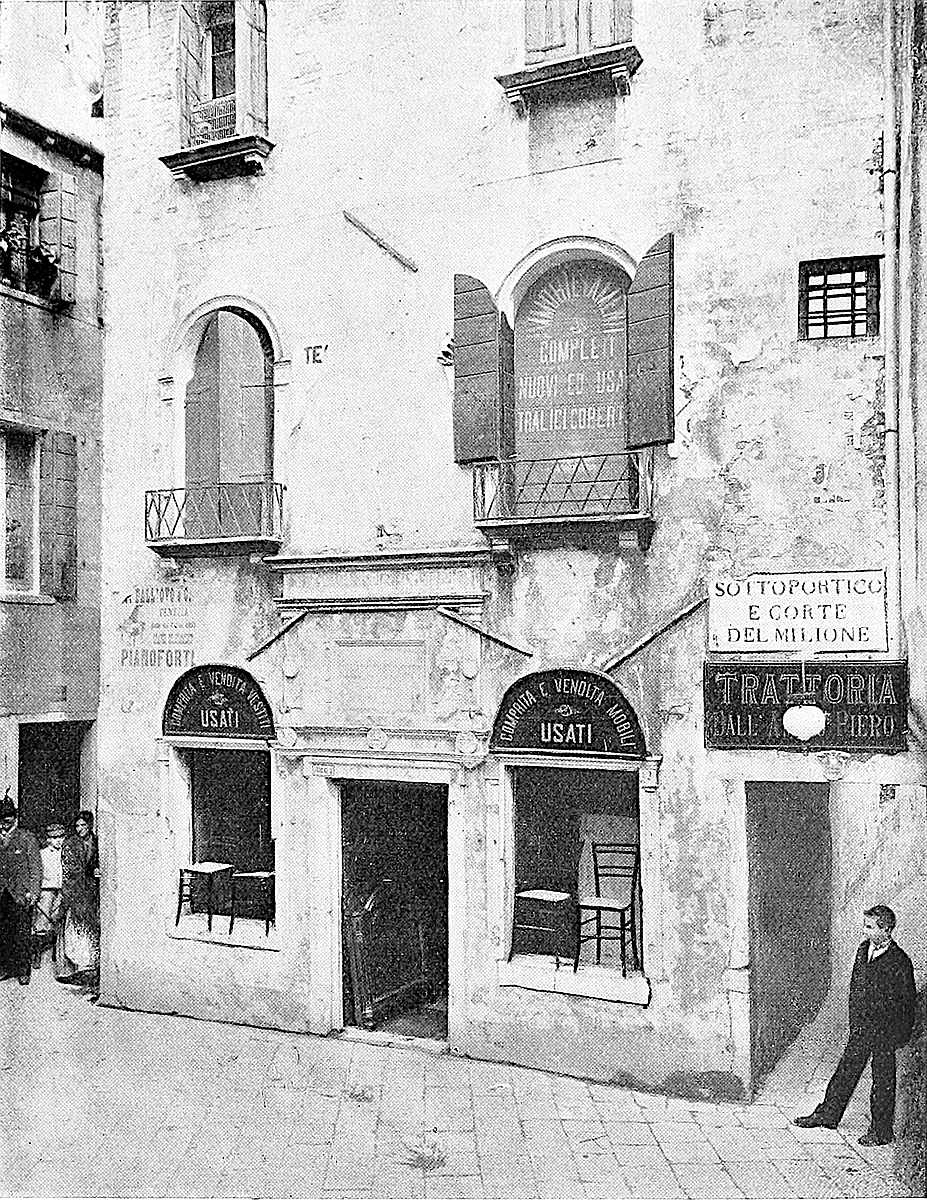
Entrance to the Corte del Milione, Venice.
We know nothing more of Polo till we find him appearing a year or two later in rapid succession as the Captain of a Venetian Galley, as a prisoner of war, and as an author.
V. Digression concerning the War-Galleys of the Mediterranean States in the Middle Ages.
25. And before entering on this new phase of the Traveller’s biography it may not be Arrangement of the Rowers in Mediæval Galleys: a separate oar to every man.without interest that we say something regarding the equipment of those galleys which are so prominent in the mediæval history of the Mediterranean.[1]
Eschewing that “Serbonian Bog, where armies whole have sunk” of Books and Commentators, the theory of the classification of the Biremes and Triremes of the Ancients, we can at least assert on secure grounds that in mediæval armament, up to the middle of the 16th century or thereabouts, the characteristic distinction of galleys of different calibres, so far as such differences existed, was based on the number of rowers that sat on one bench pulling each his separate oar, but through one portella or rowlock-port.[2] And to the classes of galleys so distinguished the Italians, of the later Middle Age at least, did certainly apply, rightly or wrongly, the classical terms of Bireme, Trireme, and Quinquereme, in the sense of galleys having two men and two oars to a bench, three men and three oars to a bench, and five men and five oars to a bench.[3]
That this was the mediæval arrangement is very certain from the details afforded by Marino Sanudo the Elder, confirmed by later writers and by works of art. Previous to 1290, Sanudo tells us, almost all the galleys that went to the Levant had but two oars and men to a bench; but as it had been found that three oars and men to a bench could be employed with great advantage, after that date nearly all galleys adopted this arrangement, which was called ai Terzaruoli.[4]
Moreover experiments made by the Venetians in 1316 had shown that four rowers to a bench could be employed still more advantageously. And where the galleys could be used on inland waters, and could be made more bulky, Sanudo would even recommend five to a bench, or have gangs of rowers on two decks with either three or four men to the bench on each deck.
26. This system of grouping the oars, and putting only one man to an oar, continued down to the 16th century, during the Change of System in the 16th century.first half of which came in the more modern system of using great oars, equally spaced, and requiring from four to seven men each to ply them, in the manner which endured till late in the last century, when galleys became altogether obsolete. Captain Pantero Pantera, the author of a work on Naval Tactics (1616), says he had heard, from veterans who had commanded galleys equipped in the antiquated fashion, that three men to a bench, with separate oars, answered better than three men to one great oar, but four men to one great oar (he says) were certainly more efficient than four men with separate oars. The new-fashioned great oars, he tells us, were styled Remi di Scaloccio, the old grouped oars Remi a Zenzile,—terms the etymology of which I cannot explain.[5]
It may be doubted whether the four-banked and five-banked galleys, of which Marino Sanudo speaks, really then came into practical use. A great five-banked galley on this system, built in 1529 in the Venice Arsenal by Vettor Fausto, was the subject of so much talk and excitement, that it must evidently have been something quite new and unheard of.[6] So late as 1567 indeed the King of Spain built at Barcelona a galley of thirty-six benches to the side, and seven men to the bench, with a separate oar to each in the old fashion. But it proved a failure.[7]
Down to the introduction of the great oars the usual system appears to have been three oars to a bench for the larger galleys, and two oars for lighter ones. The fuste or lighter galleys of the Venetians, even to about the middle of the 16th century, had their oars in pairs from the stern to the mast, and single oars only from the mast forward.[8]
27. Returning then to the three-banked and two-banked galleys of the latter part of the 13th century, the number of benches onSome details of the 13th century Galleys. each side seems to have run from twenty-five to twenty-eight, at least as I interpret Sanudo’s calculations. The 100-oared vessels often mentioned (e.g. by Muntaner, p. 419) were probably two-banked vessels with twenty-five benches to a side.
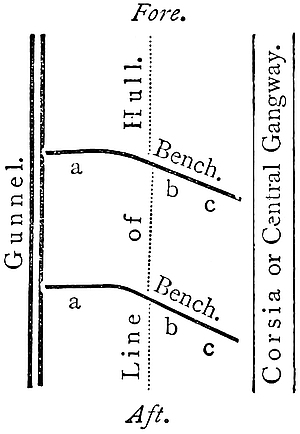
The galleys were very narrow, only 15½ feet in beam.[9] But to give room for the play of the oars and the passage of the fighting-men, &c., this width was largely augmented by an opera-morta, or outrigger deck, projecting much beyond the ship’s sides and supported by timber brackets.[10] I do not find it stated how great this projection was in the mediæval galleys, but in those of the 17th century it was on each side as much as ²⁄₉ths of the true beam. And if it was as great in the 13th-century galleys the total width between the false gunnels would be about 22¼ feet.
In the centre line of the deck ran, the whole length of the vessel, a raised gangway called the corsia, for passage clear of the oars.
The benches were arranged as in this diagram. The part of the bench next the gunnel was at right angles to it, but the other two-thirds of the bench were thrown forward obliquely. a, b, c, indicate the position of the three rowers. The shortest oar a was called Terlicchio, the middle one b Posticcio, the long oar c Piamero.[11]
I do not find any information as to how the oars worked on the gunnels. The Siena fresco (see p. 35) appears to show them attached by loops and pins, which is the usual practice in boats of the Mediterranean now. In the cut from D. Tintoretto (p. 37) the groups of oars protrude through regular ports in the bulwarks, but this probably represents the use of a later day. In any case the oars of each bench must have worked in very close proximity. Sanudo states the length of the galleys of his time (1300–1320) as 117 feet. This was doubtless length of keel, for that is specified (“da ruoda a ruoda”) in other Venetian measurements, but the whole oar space could scarcely have been so much, and with twenty-eight benches to a side there could not have been more than 4 feet gunnel-space to each bench. And as one of the objects of the grouping of the oars was to allow room between the benches for the action of cross-bowmen, &c., it is plain that the rowlock space for the three oars must have been very much compressed.[12]
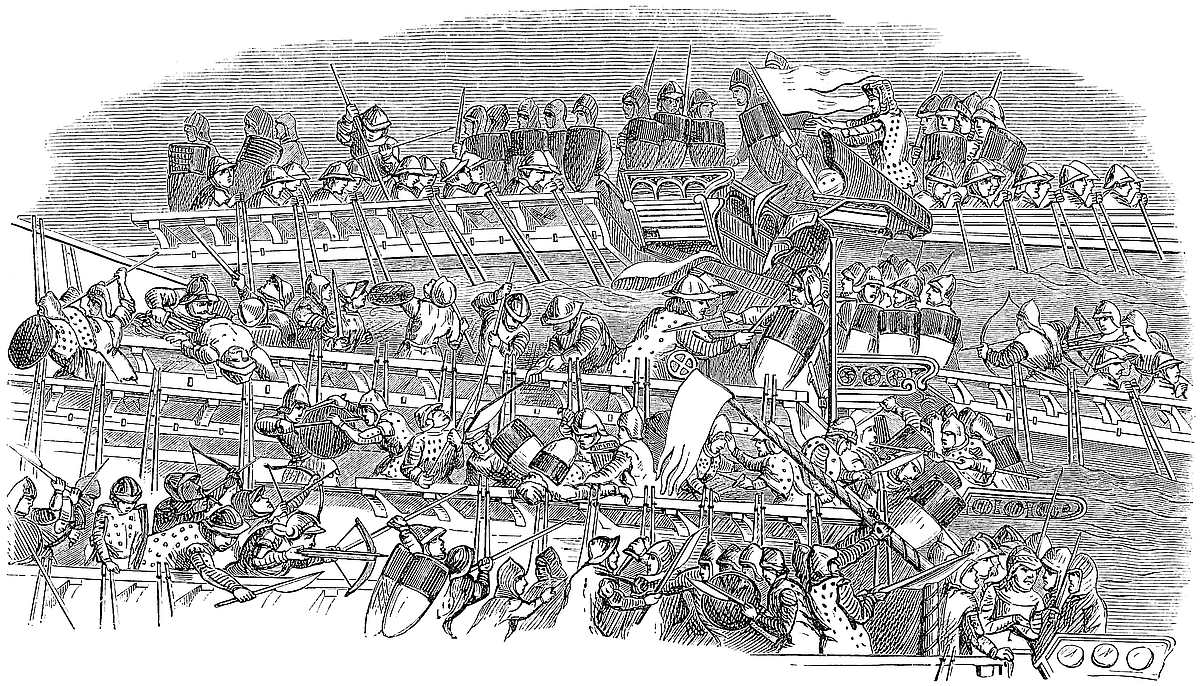
Galley-Fight, from a Mediæval Fresco at Siena. (See p. 36.)
The rowers were divided into three classes, with graduated pay. The highest class, who pulled the poop or stroke oars, were called Portolati; those at the bow, called Prodieri, formed the second class.[13]
Some elucidation of the arrangements that we have tried to describe will be found in our cuts. That at p. 35 is from a drawing, by the aid of a very imperfect photograph, of part of one of the frescoes of Spinello Aretini in the Municipal Palace at Siena, representing a victory of the Venetians over the Emperor Frederick Barbarossa’s fleet, commanded by his son Otho, in 1176; but no doubt the galleys, &c., are of the artist’s own age, the middle of the 14th century.[14] In this we see plainly the projecting opera-morta, and the rowers sitting two to a bench, each with his oar, for these are two-banked. We can also discern the Latin rudder on the quarter. (See this volume, p. 118.) In a picture in the Uffizj, at Florence, of about the same date, by Pietro Laurato (it is in the corridor near the entrance), may be seen a small figure of a galley with the oars also very distinctly coupled.[15] Casoni has engraved, after Cristoforo Canale, a pictorial plan of a Venetian trireme of the 16th century, which shows the arrangement of the oars in triplets very plainly.
The following cut has been sketched from an engraving of a picture by Domenico Tintoretto in the Doge’s palace, representing, I believe, the same action (real or imaginary) as Spinello’s fresco, but with the costume and construction of a later date. It shows, however, very plainly, the projecting opera-morta and the arrangement of the oars in fours, issuing through row-ports in high bulwarks.
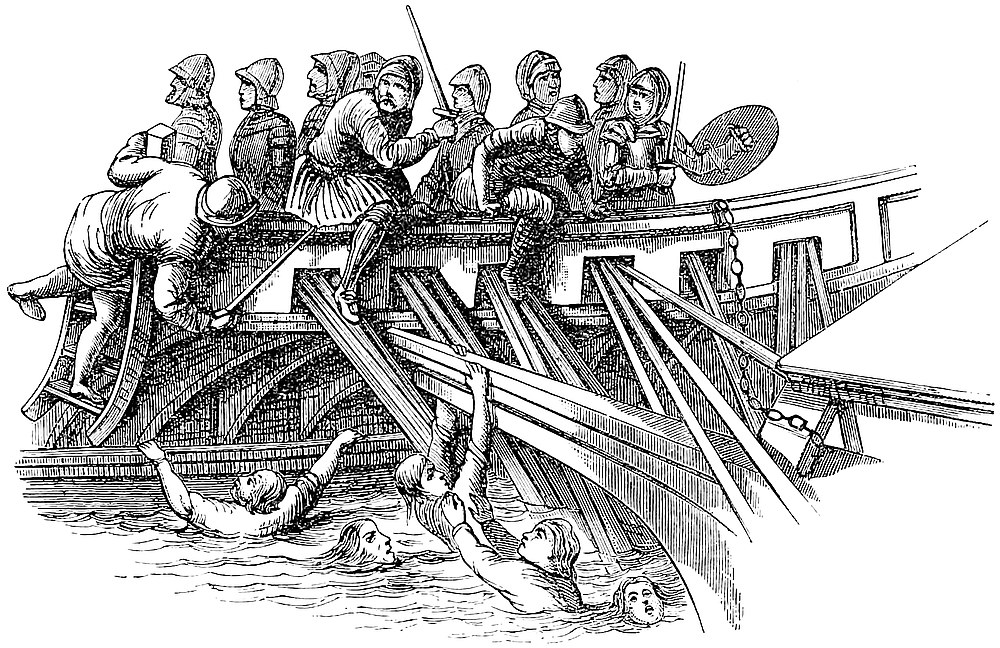
Part of a Sea Fight, after Dom. Tintoretto.
28. Midships in the mediæval galley a castle was erected, of the width of the ship, and some 20 feet in length; Fighting Arrangements.its platform being elevated sufficiently to allow of free passage under it and over the benches. At the bow was the battery, consisting of mangonels (see vol. ii. p. 161 seqq.) and great cross-bows with winding gear,[16] whilst there were shot-ports[17] for smaller cross-bows along the gunnels in the intervals between the benches. Some of the larger galleys had openings to admit horses at the stern, which were closed and caulked for the voyage, being under water when the vessel was at sea.[18]
It seems to have been a very usual piece of tactics, in attacking as well as in awaiting attack, to connect a large number of galleys by hawsers, and sometimes also to link the oars together, so as to render it difficult for the enemy to break the line or run aboard. We find this practised by the Genoese on the defensive at the battle of Ayas (infra, p. 43), and it is constantly resorted to by the Catalans in the battles described by Ramon de Muntaner.[19]
Sanudo says the toil of rowing in the galleys was excessive, almost unendurable. Yet it seems to have been performed by freely-enlisted men, and therefore it was probably less severe than that of the great-oared galleys of more recent times, which it was found impracticable to work by free enlistment, or otherwise than by slaves under the most cruel driving.[20] I am not well enough read to say that war-galleys were never rowed by slaves in the Middle Ages, but the only doubtful allusion to such a class that I have met with is in one passage of Muntaner, where he says, describing the Neapolitan and Catalan fleets drawing together for action, that the gangs of the galleys had to toil like “forçats” (p. 313). Indeed, as regards Venice at least, convict rowers are stated to have been first introduced in 1549, previous to which the gangs were of galeotti assoldati.[21]
29. We have already mentioned that Crew of a Galley and Staff of a Fleet.Sanudo requires for his three-banked galley a ship’s company of 250 men. They are distributed as follows:—
Comito or Master 1
Quartermasters 8
Carpenters 2
Caulkers 2
In charge of stores and arms 4
Orderlies 2
Cook 1
Arblasteers 50
Rowers 180
——
250[22]
This does not include the Sopracomito, or Gentleman-Commander, who was expected to be valens homo et probus, a soldier and a gentleman, fit to be consulted on occasion by the captain-general. In the Venetian fleet he was generally a noble.[23]
The aggregate pay of such a crew, not including the sopracomito, amounted monthly to 60 lire de’ grossi, or 600 florins, equivalent to 280l. at modern gold value; and the cost for a year to nearly 3160l., exclusive of the victualling of the vessel and the pay of the gentleman-commander. The build or purchase of a galley complete is estimated by the same author at 15,000 florins, or 7012l.
We see that war cost a good deal in money even then.
Besides the ship’s own complement Sanudo gives an estimate for the general staff of a fleet of 60 galleys. This consists of a captain-general, two (vice) admirals, and the following:—
6 Probi homines, or gentlemen of character, forming a council to the Captain-General;
4 Commissaries of Stores;
2 Commissaries over the Arms;
3 Physicians;
3 Surgeons;
5 Master Engineers and Carpenters;
15 Master Smiths;
12 Master Fletchers;
5 Cuirass men and Helmet-makers;
15 Oar-makers and Shaft-makers;
10 Stone cutters for stone shot;
10 Master Arblast-makers;
20 Musicians;
20 Orderlies, &c.
30. The musicians formed an important part of the equipment. Sanudo says that in going into action every vessel should make the greatest possible display of colours; Music; and other particulars.gonfalons and broad banners should float from stem to stern, and gay pennons all along the bulwarks; whilst it was impossible to have too much of noisy music, of pipes, trumpets, kettle-drums, and what not, to put heart into the crew and strike fear into the enemy.[24]
So Joinville, in a glorious passage, describes the galley of his kinsman, the Count of Jaffa, at the landing of St. Lewis in Egypt:—
“That galley made the most gallant figure of them all, for it was painted all over, above water and below, with scutcheons of the count’s arms, the field of which was or with a cross patée gules.[25] He had a good 300 rowers in his galley, and every man of them had a target blazoned with his arms in beaten gold. And, as they came on, the galley looked to be some flying creature, with such spirit did the rowers spin it along;—or rather, with the rustle of its flags, and the roar of its nacaires and drums and Saracen horns, you might have taken it for a rushing bolt of heaven.”[26]
The galleys, which were very low in the water,[27] could not keep the sea in rough weather, and in winter they never willingly kept the sea at night, however fair the weather might be. Yet Sanudo mentions that he had been with armed galleys to Sluys in Flanders.
I will mention two more particulars before concluding this digression. When captured galleys were towed into port it was stern foremost, and with their colours dragging on the surface of the sea.[28] And the custom of saluting at sunset (probably by music) was in vogue on board the galleys of the 13th century.[29]
We shall now sketch the circumstances that led to the appearance of our Traveller in the command of a war-galley.
VI. The Jealousies and Naval Wars of Venice and Genoa. Lamba Doria’s Expedition to the Adriatic; Battle of Curzola; and Imprisonment of Marco Polo by the Genoese.
31. Jealousies, too characteristic of the Italian communities, were, in the case of the three great trading republics of Venice, Genoa, and Pisa, Growing jealousies and outbreaks between the Republics. aggravated by commercial rivalries, whilst, between the two first of those states, and also between the two last, the bitterness of such feelings had been augmenting during the whole course of the 13th century.[1]
The brilliant part played by Venice in the conquest of Constantinople (1204), and the preponderance she thus acquired on the Greek shores, stimulated her arrogance and the resentment of her rivals. The three states no longer stood on a level as bidders for the shifting favour of the Emperor of the East. By treaty, not only was Venice established as the most important ally of the empire and as mistress of a large fraction of its territory, but all members of nations at war with her were prohibited from entering its limits. Though the Genoese colonies continued to exist, they stood at a great disadvantage, where their rivals were so predominant and enjoyed exemption from duties, to which the Genoese remained subject. Hence jealousies and resentments reached a climax in the Levantine settlements, and this colonial exacerbation reacted on the mother States.
A dispute which broke out at Acre in 1255 came to a head in a war which lasted for years, and was felt all over Syria. It began in a quarrel about a very old church called St. Sabba’s, which stood on the common boundary of the Venetian and Genoese estates in Acre,[2] and this flame was blown by other unlucky occurrences. Acre suffered grievously.[3] Venice at this time generally kept the upper hand, beating Genoa by land and sea, and driving her from Acre altogether.✛ Four ancient porphyry figures from St. Sabba’s were sent in triumph to Venice, and with their strange devices still stand at the exterior corner of St. Mark’s, towards the Ducal Palace.[4]
But no number of defeats could extinguish the spirit of Genoa, and the tables were turned when in her wrath she allied herself with Michael Palaeologus to upset the feeble and tottering Latin Dynasty, and with it the preponderance of Venice on the Bosphorus. The new emperor handed over to his allies the castle of their foes, which they tore down with jubilations, and now it was their turn to send its stones as trophies to Genoa. Mutual hate waxed fiercer than ever; no merchant fleet of either state could go to sea without convoy, and wherever their ships met they fought.[5] It was something like the state of things between Spain and England in the days of Drake.
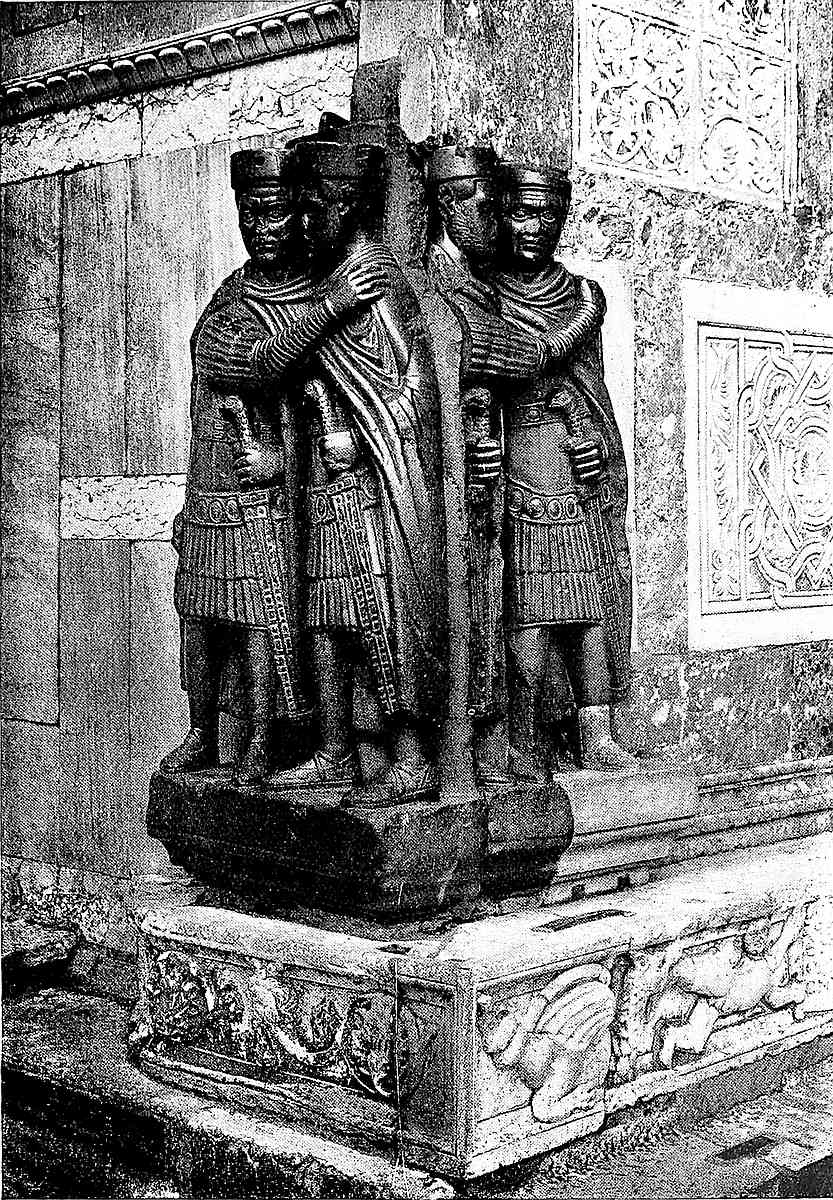
Figures from St. Sabba’s, sent to Venice.
The energy and capacity of the Genoese seemed to rise with their success, and both in seamanship and in splendour they began almost to surpass their old rivals. The fall of Acre (1291), and the total expulsion of the Franks from Syria, in great measure barred the southern routes of Indian trade, whilst the predominance of Genoa in the Euxine more or less obstructed the free access of her rival to the northern routes by Trebizond and Tana.
32. Truces were made and renewed, but the old fire still smouldered. In the spring of 1294 it broke into flame, in consequence of the seizure in the Grecian seas of three Battle in Bay of Ayas in 1294.Genoese vessels by a Venetian fleet. This led to an action with a Genoese convoy which sought redress. The fight took place off Ayas in the Gulf of Scanderoon,[6] and though the Genoese were inferior in strength by one-third they gained a signal victory, capturing all but three of the Venetian galleys, with rich cargoes, including that of Marco Basilio (or Basegio), the commodore.
This victory over their haughty foe was in its completeness evidently a surprise to the Genoese, as well as a source of immense exultation, which is vigorously expressed in a ballad of the day, written in a stirring salt-water rhythm.[7] It represents the Venetians, as they enter the bay, in arrogant mirth reviling the Genoese with very unsavoury epithets as having deserted their ships to skulk on shore. They are described as saying:—
“‘Off they’ve slunk! and left us nothing; We shall get nor prize nor praise; Nothing save those crazy timbers Only fit to make a blaze.’”
So they advance carelessly—
“On they come! But lo their blunder! When our lads start up anon, Breaking out like unchained lions, With a roar, ‘Fall on! Fall on!’”[8]
After relating the battle and the thoroughness of the victory, ending in the conflagration of five-and-twenty captured galleys, the poet concludes by an admonition to the enemy to moderate his pride and curb his arrogant tongue, harping on the obnoxious epithet porci leproxi, which seems to have galled the Genoese.[9] He concludes:—
“Nor can I at all remember Ever to have heard the story Of a fight wherein the Victors Reaped so rich a meed of glory!”[10]
The community of Genoa decreed that the victory should be commemorated by the annual presentation of a golden pall to the monastery of St. German’s, the saint on whose feast (28th May) it had been won.[11]
The startling news was received at Venice with wrath and grief, for the flower of their navy had perished, and all energies were bent at once to raise an overwhelming force.[12] The Pope (Boniface VIII.) interfered as arbiter, calling for plenipotentiaries from both sides. But spirits were too much inflamed, and this mediation came to nought.
Further outrages on both sides occurred in 1296. The Genoese residences at Pera were fired, their great alum works on the coast of Anatolia were devastated, and Caffa was stormed and sacked; whilst on the other hand a number of the Venetians at Constantinople were massacred by the Genoese, and Marco Bembo, their Bailo, was flung from a house-top. Amid such events the fire of enmity between the cities waxed hotter and hotter.
33. In 1298 the Genoese made elaborate preparations for a great blow at the enemy, and fitted out a powerful fleet which they placed Lamba Doria’s Expedition to the Adriatic.under the command of Lamba Doria, a younger brother of Uberto of that illustrious house, under whom he had served fourteen years before in the great rout of the Pisans at Meloria.
The rendezvous of the fleet was in the Gulf of Spezia, as we learn from the same pithy Genoese poet who celebrated Ayas. This time the Genoese were bent on bearding St. Mark’s Lion in his own den; and after touching at Messina they steered straight for the Adriatic:—
“Now, as astern Otranto bears, Pull with a will! and, please the Lord, Let them who bragged, with fire and sword, To waste our homesteads, look to theirs!”[13]
On their entering the gulf a great storm dispersed the fleet. The admiral with twenty of his galleys got into port at Antivari on the Albanian coast, and next day was rejoined by fifty-eight more, with which he scoured the Dalmatian shore, plundering all Venetian property. Some sixteen of his galleys were still missing when he reached the island of Curzola, or Scurzola as the more popular name seems to have been, the Black Corcyra of the Ancients—the chief town of which, a rich and flourishing place, the Genoese took and burned.[14] Thus they were engaged when word came that the Venetian fleet was in sight.
Venice, on first hearing of the Genoese armament, sent Andrea Dandolo with a large force to join and supersede Maffeo Quirini, who was already cruising with a squadron in the Ionian sea; and, on receiving further information of the strength of the hostile expedition, the Signory hastily equipped thirty-two more galleys in Chioggia and the ports of Dalmatia, and despatched them to join Dandolo, making the whole number under his command up to something like ninety-five. Recent drafts had apparently told heavily upon the Venetian sources of enlistment, and it is stated that many of the complements were made up of rustics swept in haste from the Euganean hills. To this the Genoese poet seems to allude, alleging that the Venetians, in spite of their haughty language, had to go begging for men and money up and down Lombardy. “Did we do like that, think you?” he adds:—
“Beat up for aliens? We indeed? When lacked we homeborn Genoese? Search all the seas, no salts like these, For Courage, Seacraft, Wit at need.”[15]
Of one of the Venetian galleys, probably in the fleet which sailed under Dandolo’s immediate command, went Marco Polo as Sopracomito or Gentleman-Commander.[16]
34. It was on the afternoon of Saturday the 6th September that the Genoese The Fleets come in sight of each other at Curzola. saw the Venetian fleet approaching, but, as sunset was not far off, both sides tacitly agreed to defer the engagement.[17]
The Genoese would appear to have occupied a position near the eastern end of the Island of Curzola, with the Peninsula of Sabbioncello behind them, and Meleda on their left, whilst the Venetians advanced along the south side of Curzola. (See map on p. 50).
According to Venetian accounts the Genoese were staggered at the sight of the Venetian armaments, and sent more than once to seek terms, offering finally to surrender galleys and munitions of war, if the crews were allowed to depart. This is an improbable story, and that of the Genoese ballad seems more like truth. Doria, it says, held a council of his captains in the evening at which they all voted for attack, whilst the Venetians, with that overweening sense of superiority which at this time is reflected in their own annals as distinctly as in those of their enemies, kept scout-vessels out to watch that the Genoese fleet, which they looked on as already their own, did not steal away in the darkness. A vain imagination, says the poet:—
“Blind error of vainglorious men To dream that we should seek to flee After those weary leagues of sea Crossed, but to hunt them in their den!”[18]
35. The battle began early on Sunday and lasted till the afternoon. The Venetians had the wind in their favour, but the morning sun in their eyes. The Venetians defeated, and Marco Polo a prisoner. They made the attack, and with great impetuosity, capturing ten Genoese galleys; but they pressed on too wildly, and some of their vessels ran aground. One of their galleys too, being taken, was cleared of her crew and turned against the Venetians. These incidents caused confusion among the assailants; the Genoese, who had begun to give way, took fresh heart, formed a close column, and advanced boldly through the Venetian line, already in disorder. The sun had begun to decline when there appeared on the Venetian flank the fifteen or sixteen missing galleys of Doria’s fleet, and fell upon it with fresh force. This decided the action. The Genoese gained a complete victory, capturing all but a few of the Venetian galleys, and including the flagship with Dandolo. The Genoese themselves lost heavily, especially in the early part of the action, and Lamba Doria’s eldest son Octavian is said to have fallen on board his father’s vessel.[19] The number of prisoners taken was over 7000, and among these was Marco Polo.[20]