Volume 1 — CHAPTER LII.
Henry Yule translation
Concerning the Customs of the Tartars.
Now that we have begun to speak of the Tartars, I have plenty to tell you on that subject. The Tartar custom is to spend the winter in warm plains, where they find good pasture for their cattle, whilst in summer they betake themselves to a cool climate among the mountains and valleys, where water is to be found as well as woods and pastures.
Their houses are circular, and are made of wands covered with felts.{1} These are carried along with them whithersoever they go; for the wands are so strongly bound together, and likewise so well combined, that the frame can be made very light. Whenever they erect these huts the door is always to the south. They also have waggons covered with black felt so efficaciously that no rain can get in. These are drawn by oxen and camels, and the women and children travel in them.{2} The women do the buying and selling, and whatever is necessary to provide for the husband and household; for the men all lead the life of gentlemen, troubling themselves about nothing but hunting and hawking, and looking after their goshawks and falcons, unless it be the practice of warlike exercises.
They live on the milk and meat which their herds supply, and on the produce of the chase; and they eat all kinds of flesh, including that of horses and dogs, and Pharaoh’s rats, of which last there are great numbers in burrows on those plains.{3} Their drink is mare’s milk.
They are very careful not to meddle with each other’s wives, and will not do so on any account, holding that to be an evil and abominable thing. The women too are very good and loyal to their husbands, and notable housewives withal.{4} [Ten or twenty of them will dwell together in charming peace and unity, nor shall you ever hear an ill word among them.]
The marriage customs of Tartars are as follows. Any man may take a hundred wives an he so please, and if he be able to keep them. But the first wife is ever held most in honour, and as the most legitimate [and the same applies to the sons whom she may bear]. The husband gives a marriage payment to his wife’s mother, and the wife brings nothing to her husband. They have more children than other people, because they have so many wives. They may marry their cousins, and if a father dies, his son may take any of the wives, his own mother always excepted; that is to say the eldest son may do this, but no other. A man may also take the wife of his own brother after the latter’s death. Their weddings are celebrated with great ado.{5}
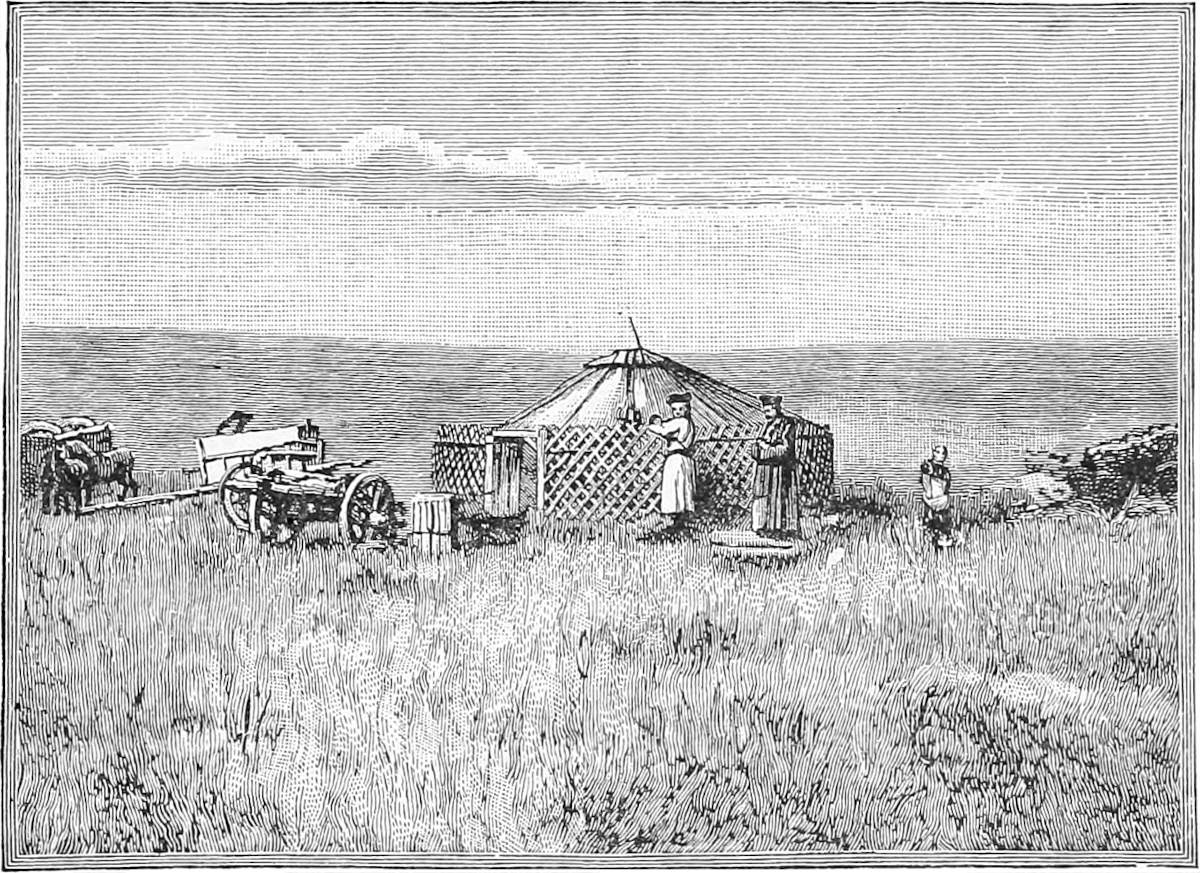
Dressing up a tent.
Rubruquis, Pallas, Timkowski, and others, notice the custom of turning the door to the south; the reason is obvious. (Atkinson, 285; Vámb. 316; Burnes, III. 51; Conolly, I. 96) But throughout the Altai, Mr. Ney Elias informs me, K’alkas, Kirghiz, and Kalmaks all pitch their tents facing east. The prevailing winter wind is there westerly.
[Mr. Rockhill (Rubruck, p. 56, note) says that he has often seen Mongol tents facing east and south-east. He adds: “It is interesting to find it noted in the Chou Shu (Bk. 50, 3) that the Khan of the Turks, who lived always on the Tu-kin mountains, had his tent invariably facing south, so as to show reverence to the sun’s rising place.”—H. C.]
“wandering Scyths who dwell In latticed huts high-poised on easy wheels.” (Prom. Vinct. 709–710.)
And long before him Hesiod says Phineus was carried by the Harpies—
“To the Land of the Milk-fed nations, whose houses are waggons.” (Strabo, vii. 3–9.)
Ibn Batuta describes the Tartar waggon in which he travelled to Sarai as mounted on four great wheels, and drawn by two or more horses:—
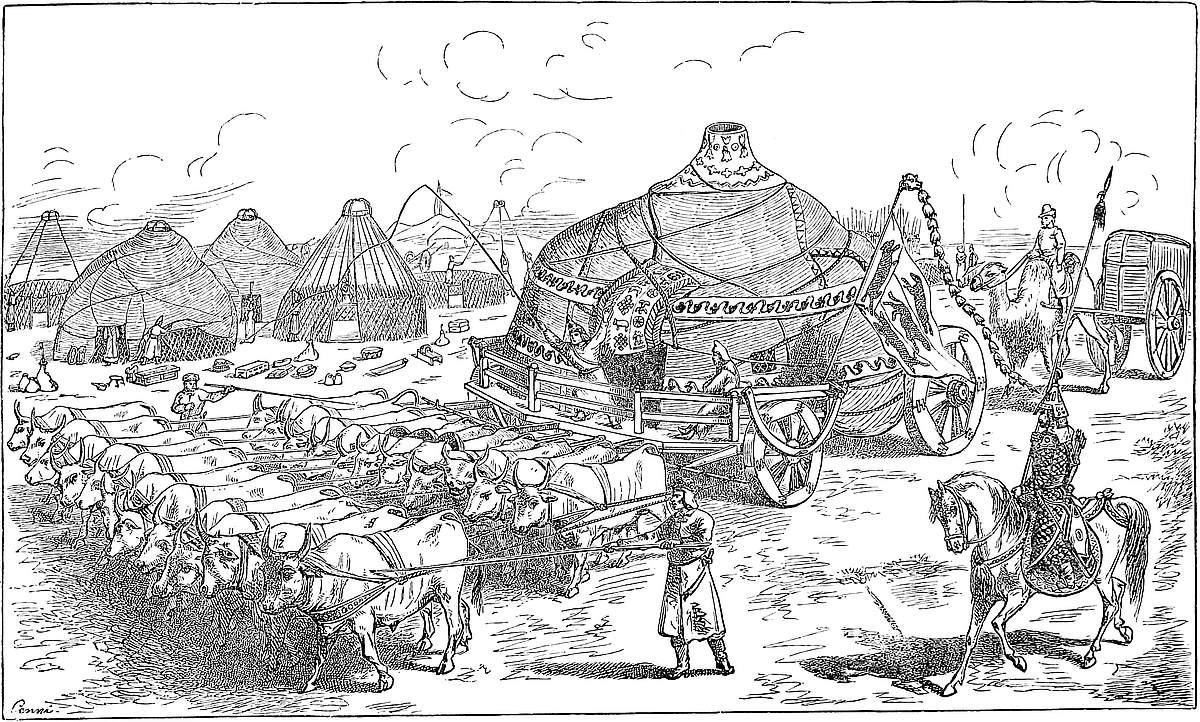
“On the waggon is put a sort of pavilion of wands laced together with narrow thongs. It is very light, and is covered with felt or cloth, and has latticed windows, so that the person inside can look out without being seen. He can change his position at pleasure, sleeping or eating, reading or writing, during the journey.” These waggons were sometimes of enormous size. Rubruquis declares that he measured between the wheel-tracks of one and found the interval to be 20 feet. The axle was like a ship’s mast, and twenty-two oxen were yoked to the waggon, eleven abreast. (See opposite cut.) He describes the huts as not usually taken to pieces, but carried all standing. The waggon just mentioned carried a hut of 30 feet diameter, for it projected beyond the wheels at least 5 feet on either side. In fact, Carpini says explicitly, “Some of the huts are speedily taken to pieces and put up again; such are packed on the beasts. Others cannot be taken to pieces, but are carried bodily on the waggons. To carry the smaller tents on a waggon one ox may serve; for the larger ones three oxen or four, or even more, according to the size.” The carts that were used to transport the Tartar valuables were covered with felt soaked in tallow or ewe’s milk, to make them waterproof. The tilts of these were rectangular, in the form of a large trunk. The carts used in Kashgar, as described by Mr. Shaw, seem to resemble these latter. (I. B. II. 381–382; Rub. 221; Carp. 6, 16.)
The words of Herodotus, speaking generally of the Scyths, apply perfectly to the Mongol hordes under Chinghiz: “Having neither cities nor forts, and carrying their dwellings with them wherever they go; accustomed, moreover, one and all, to shoot from horseback; and living not by husbandry but on their cattle, their waggons the only houses that they possess, how can they fail of being unconquerable?” (Bk. IV. ch. 46, p. 41, Rawlins.) Scythian prisoners in their waggons are represented on the Column of Theodosius at Constantinople; but it is difficult to believe that these waggons, at least as figured in Banduri, have any really Scythian character.
It is a curious fact that the practice of carrying these yurts or felt tents upon waggons appears to be entirely obsolete in Mongolia. Mr. Ney Elias writes: “I frequently showed your picture [that opposite] to Mongols, Chinese, and Russian border-traders, but none had ever seen anything of the kind. The only cart I have ever seen used by Mongols is a little low, light, roughly-made bullock-dray, certainly of Chinese importation.” The old system would, however, appear to have been kept up to our own times by the Nogai Tartars, near the Sea of Azof. (See note from Heber, in Clark’s Travels, 8vo ed. I. 440, and Dr. Clark’s vignette at p. 394 in the same volume.)
J. Cooper Sc
Mediæval Tartar Huts and Waggons.
[“In the Mongol biography of Chinghiz Khan (Mongol text of the Yuan ch’ao pi shi), mention is made of two kinds of animals (mice) used for food; the tarbagat (Aritomys Bobac) and kuchugur.” (Palladius, l.c. p. 14.) Regarding the marmots called Sogur by Rubruquis, Mr. Rockhill writes (p. 69): “Probably the Mus citillus, the Suslik of the Russians.... M. Grenard tells me that Soghur, more usually written sour in Turki, is the ordinary name of the marmot.”—H. C.]
Of the custom that entitled the son on succeeding to take such as he pleased of his deceased father’s wives, we have had some illustration (see Prologue, ch. xvii. note 2), and many instances will be found in Hammer’s or other Mongol Histories. The same custom seems to be ascribed by Herodotus to the Scyths (IV. 78). A number of citations regarding the practice are given by Quatremère. (Q. R. p. 92.) A modern Mongol writer in the Mélanges Asiatiques of the Petersburg Academy, states that the custom of taking a deceased brother’s wives is now obsolete, but that a proverb preserves its memory (II. 656). It is the custom of some Mahomedan nations, notably of the Afghans, and is one of those points that have been cited as a supposed proof of their Hebrew lineage.
“The Kalin is a present which the Bridegroom or his parents make to the parents of the Bride. All the Pagan nations of Siberia have this custom; they differ only in what constitutes the present, whether money or cattle.” (Gmelin, I. 29; see also Erman, II. 348.)