Volume 1 — CHAPTER XXIX.
Henry Yule translation
Of the Province of Badashan.
Badashan is a Province inhabited by people who worship Mahommet, and have a peculiar language. It forms a very great kingdom, and the royalty is hereditary. All those of the royal blood are descended from King Alexander and the daughter of King Darius, who was Lord of the vast Empire of Persia. And all these kings call themselves in the Saracen tongue Zulcarniain, which is as much as to say Alexander; and this out of regard for Alexander the Great.{1}
It is in this province that those fine and valuable gems the Balas Rubies are found. They are got in certain rocks among the mountains, and in the search for them the people dig great caves underground, just as is done by miners for silver. There is but one special mountain that produces them, and it is called Syghinan. The stones are dug on the king’s account, and no one else dares dig in that mountain on pain of forfeiture of life as well as goods; nor may any one carry the stones out of the kingdom. But the king amasses them all, and sends them to other kings when he has tribute to render, or when he desires to offer a friendly present; and such only as he pleases he causes to be sold. Thus he acts in order to keep the Balas at a high value; for if he were to allow everybody to dig, they would extract so many that the world would be glutted with them, and they would cease to bear any value. Hence it is that he allows so few to be taken out, and is so strict in the matter.{2}
There is also in the same country another mountain, in which azure is found; ’tis the finest in the world, and is got in a vein like silver. There are also other mountains which contain a great amount of silver ore, so that the country is a very rich one; but it is also (it must be said) a very cold one.{3} It produces numbers of excellent horses, remarkable for their speed. They are not shod at all, although constantly used in mountainous country, and on very bad roads. [They go at a great pace even down steep descents, where other horses neither would nor could do the like. And Messer Marco was told that not long ago they possessed in that province a breed of horses from the strain of Alexander’s horse Bucephalus, all of which had from their birth a particular mark on the forehead. This breed was entirely in the hands of an uncle of the king’s; and in consequence of his refusing to let the king have any of them, the latter put him to death. The widow then, in despite, destroyed the whole breed, and it is now extinct.{4}]
The mountains of this country also supply Saker falcons of excellent flight, and plenty of Lanners likewise. Beasts and birds for the chase there are in great abundance. Good wheat is grown, and also barley without husk. They have no olive oil, but make oil from sesamé, and also from walnuts.{5}
[In the mountains there are vast numbers of sheep—400, 500, or 600 in a single flock, and all of them wild; and though many of them are taken, they never seem to get aught the scarcer.{6}
Those mountains are so lofty that ’tis a hard day’s work, from morning till evening, to get to the top of them. On getting up, you find an extensive plain, with great abundance of grass and trees, and copious springs of pure water running down through rocks and ravines. In those brooks are found trout and many other fish of dainty kinds; and the air in those regions is so pure, and residence there so healthful, that when the men who dwell below in the towns, and in the valleys and plains, find themselves attacked by any kind of fever or other ailment that may hap, they lose no time in going to the hills; and after abiding there two or three days, they quite recover their health through the excellence of that air. And Messer Marco said he had proved this by experience: for when in those parts he had been ill for about a year, but as soon as he was advised to visit that mountain, he did so and got well at once.{7}]
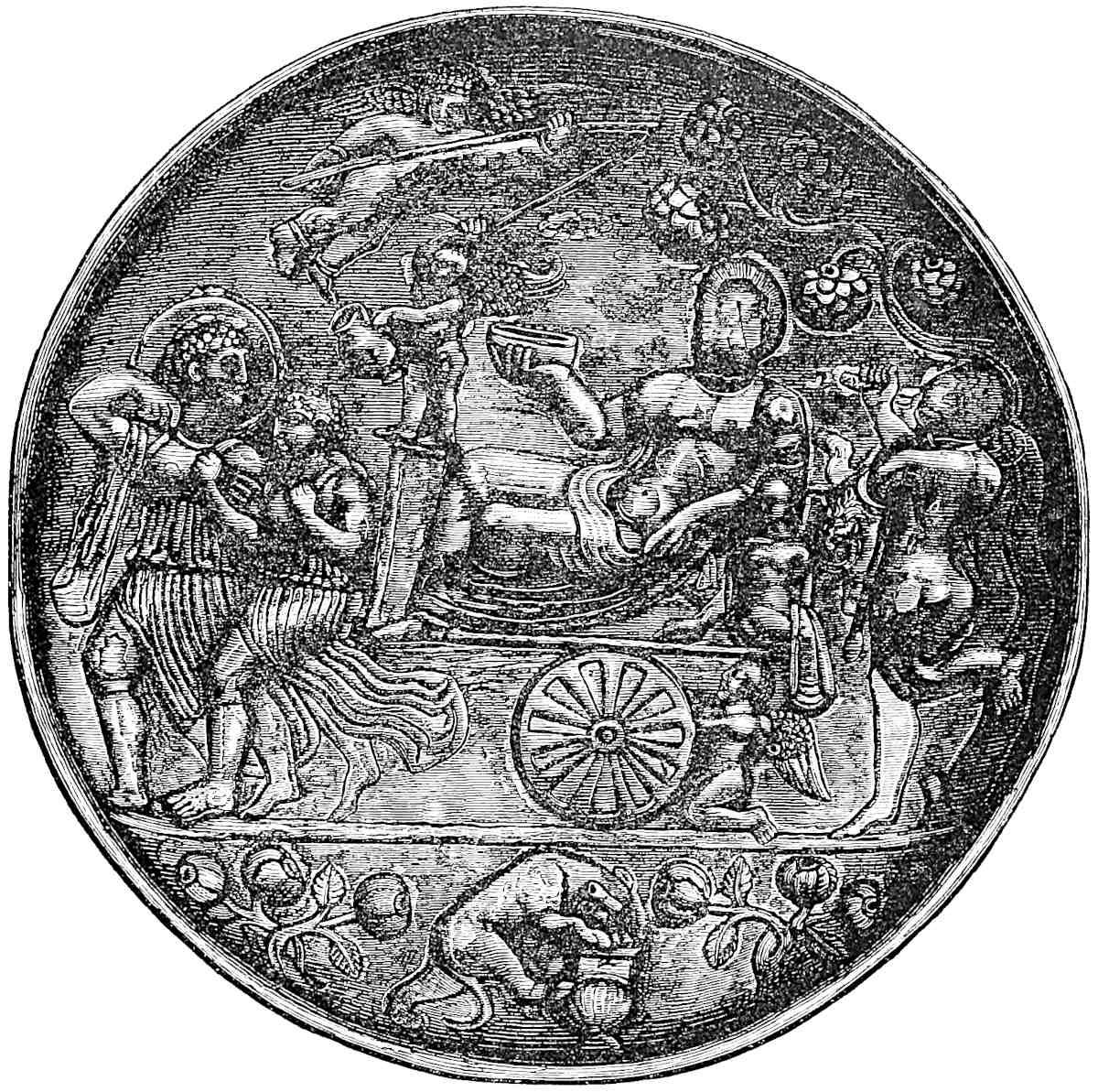
Ancient Silver Patera of debased Greek art, formerly in the possession of the Princes of Badakhshan, now in the India Museum.
In this kingdom there are many strait and perilous passes, so difficult to force that the people have no fear of invasion. Their towns and villages also are on lofty hills, and in very strong positions.{8} They are excellent archers, and much given to the chase; indeed, most of them are dependent for clothing on the skins of beasts, for stuffs are very dear among them. The great ladies, however, are arrayed in stuffs, and I will tell you the style of their dress! They all wear drawers made of cotton cloth, and into the making of these some will put 60, 80, or even 100 ells of stuff. This they do to make themselves look large in the hips, for the men of those parts think that to be a great beauty in a woman.{9}
The Legend of the Alexandrian pedigree of the Kings of Badakhshan is spoken of by Baber, and by earlier Eastern authors. This pedigree is, or was, claimed also by the chiefs of Karátegín, Darwáz, Roshán, Shighnán, Wakhán, Chitrál, Gilgít, Swát, and Khapolor in Bálti. Some samples of those genealogies may be seen in that strange document called “Gardiner’s Travels.”
In Badakhshan Proper the story seems now to have died out. Indeed, though Wood mentions one of the modern family of Mírs as vaunting this descent, these are in fact Sáhibzádahs of Samarkand, who were invited to the country about the middle of the 17th century, and were in no way connected with the old kings.
The traditional claims to Alexandrian descent were probably due to a genuine memory of the Græco-Bactrian kingdom, and might have had an origin analogous to the Sultan’s claim to be “Caesar of Rome”; for the real ancestry of the oldest dynasties on the Oxus was to be sought rather among the Tochari and Ephthalites than among the Greeks whom they superseded.
The cut on p. 159 presents an interesting memorial of the real relation of Bactria to Greece, as well as of the pretence of the Badakhshan princes to Grecian descent. This silver patera was sold by the family of the Mírs, when captives, to the Minister of the Uzbek chief of Kunduz, and by him to Dr. Percival Lord in 1838. It is now in the India Museum. On the bottom is punched a word or two in Pehlvi, and there is also a word incised in Syriac or Uighúr. It is curious that a pair of paterae were acquired by Dr. Lord under the circumstances stated. The other, similar in material and form, but apparently somewhat larger, is distinctly Sassanian, representing a king spearing a lion.
Zu-’lḳarnain, “the Two-Horned,” is an Arabic epithet of Alexander, with which legends have been connected, but which probably arose from the horned portraits on his coins. [Capus, l.c. p. 121, says, “Iskandr Zoulcarneïn or Alexander le Cornu, horns being the emblem of strength.”—H. C.] The term appears in Chaucer (Troil. and Cress. III. 931) in the sense of non plus:—
“I am, till God me better minde send, At dulcarnon, right at my wittes end.”
And it is said to have still colloquial existence in that sense in some corners of England. This use is said to have arisen from the Arabic application of the term (Bicorne) to the 47th Proposition of Euclid. (Baber, 13; N. et E. XIV. 490; N. An. des V. xxvi. 296; Burnes, III. 186 seqq.; Wood, 155, 244; J. A. S. B. XXII. 300; Ayeen Akbery, II. 185; see N. and Q. 1st Series, vol. v.)
“No sapphire in Inde, no Rubie rich of price, There lacked than, nor Emeraud so grene, Balès, Turkès, ne thing to my device.” (Chaucer, ‘Court of Love.’) “L’altra letizia, che m’era già nota, Preclara cosa mi si fece in vista, Qual fin balascio in che lo Sol percuoto.” (Paradiso, ix. 67.)
Some account of the Balakhsh from Oriental sources will be found in J. As. sér V. tom. xi. 109.
(I. B. III. 59, 394; Alb. Mag. de Mineralibus; Pegol. p. 307; N. et E. XIII. i. 246.)
[“The Mohammedan authors of the Mongol period mention Badakhshan several times in connection with the political and military events of that period. Guchluk, the ‘gurkhan of Karakhitai,’ was slain in Badakhshan in 1218 (d’Ohsson, I. 272). In 1221, the Mongols invaded the country (l.c. I. 272). On the same page, d’Ohsson translates a short account of Badakhshan by Yakut (✛1229), stating that this mountainous country is famed for its precious stones, and especially rubies, called Balakhsh.” (Bretschneider, Med. Res. II. p. 66.)—H. C.]
The account of the royal monopoly in working the mines, etc., has continued accurate down to our own day. When Murad Beg of Kunduz conquered Badakhshan some forty years ago, in disgust at the small produce of the mines, he abandoned working them, and sold nearly all the population of the place into slavery! They continue still unworked, unless clandestinely. In 1866 the reigning Mír had one of them opened at the request of Pandit Manphul, but without much result.
The locality of the mines is on the right bank of the Oxus, in the district of Ish Káshm and on the borders of Shignan, the Syghinan of the text. (P. Manph.; Wood, 206; N. Ann. des. V. xxvi. 300.)
[The ruby mines are really in the Gháran country, which extends along both banks of the Oxus. Barshar is one of the deserted villages; the boundary between Gháran and Shignán is the Kuguz Parin (in Shighai dialect means “holes in the rock”); the Persian equivalent is “Rafak-i-Somakh.” (Cf. Captain Trotter, Forsyth’s Mission, p. 277.)—H. C.]
The Yamgán Tract also contains mines of iron, lead, alum, salammoniac, sulphur, ochre, and copper. The last are not worked. But I do not learn of any silver mines nearer than those of Paryán in the Valley of Panjshir, south of the crest of the Hindu-Kúsh, much worked in the early Middle Ages. (See Cathay, p. 595.)
[The Kirghiz between the Yangi Hissar River and Sirikol are the only people using the horse generally in the plough, oxen being employed in the plains, and yaks in Sirikol. (Lieutenant-Colonel Gordon, p. 222, Forsyth’s Mission.)—H. C.]
What Polo heard of the Bucephalid strain was perhaps but another form of a story told by the Chinese, many centuries earlier, when speaking of this same region. A certain cave was frequented by a wonderful stallion of supernatural origin. Hither the people yearly brought their mares, and a famous breed was derived from the foals. (Rém. N. Mél. As. I. 245.)
Sesamé is mentioned by P. Manphul as one of the products of Badakhshan; linseed is another, which is also used for oil. Walnut-trees abound, but neither he nor Wood mention the oil. We know that walnut oil is largely manufactured in Kashmir. (Moorcroft, II. 148.)
[See on Saker and Lanner Falcons (F. Sakar, Briss.; F. lanarius, Schlegel) the valuable paper by Edouard Blanc, Sur l’utilisation des Oiseaux de proie en Asie centrale in Rev. des Sciences natur. appliquées, 20th June, 1895.
“Hawking is the favourite sport of Central Asian Lords,” says G. Capus. (A travers le royaume de Tamerlan, p. 132. See pp. 132–134.)
The Mirza says (l.c. p. 157) that the mountains of Wakhán “are only noted for producing a breed of hawks or falcons which the hardy Wâkhânis manage to catch among the cliffs. These hawks are much esteemed by the chiefs of Badakhshan, Bokhara, etc. They are celebrated for their swiftness, and known by their white colour.”—H. C.]