Volume 1 — CHAPTER XXXI.
Henry Yule translation
Of the Province of Keshimur.
Keshimur also is a Province inhabited by a people who are Idolaters and have a language of their own.{1} They have an astonishing acquaintance with the devilries of enchantment; insomuch that they make their idols to speak. They can also by their sorceries bring on changes of weather and produce darkness, and do a number of things so extraordinary that no one without seeing them would believe them.{2} Indeed, this country is the very original source from which Idolatry has spread abroad.{3}
In this direction you can proceed further till you come to the Sea of India.
The men are brown and lean, but the women, taking them as brunettes, are very beautiful. The food of the people is flesh, and milk, and rice. The clime is finely tempered, being neither very hot nor very cold. There are numbers of towns and villages in the country, but also forests and desert tracts, and strong passes, so that the people have no fear of anybody, and keep their independence, with a king of their own to rule and do justice.{4}
There are in this country Eremites (after the fashion of those parts), who dwell in seclusion and practise great abstinence in eating and drinking. They observe strict chastity, and keep from all sins forbidden in their law, so that they are regarded by their own folk as very holy persons. They live to a very great age.{5}
There are also a number of idolatrous abbeys and monasteries. [The people of the province do not kill animals nor spill blood; so if they want to eat meat they get the Saracens who dwell among them to play the butcher.{6}] The coral which is carried from our parts of the world has a better sale there than in any other country.{7}
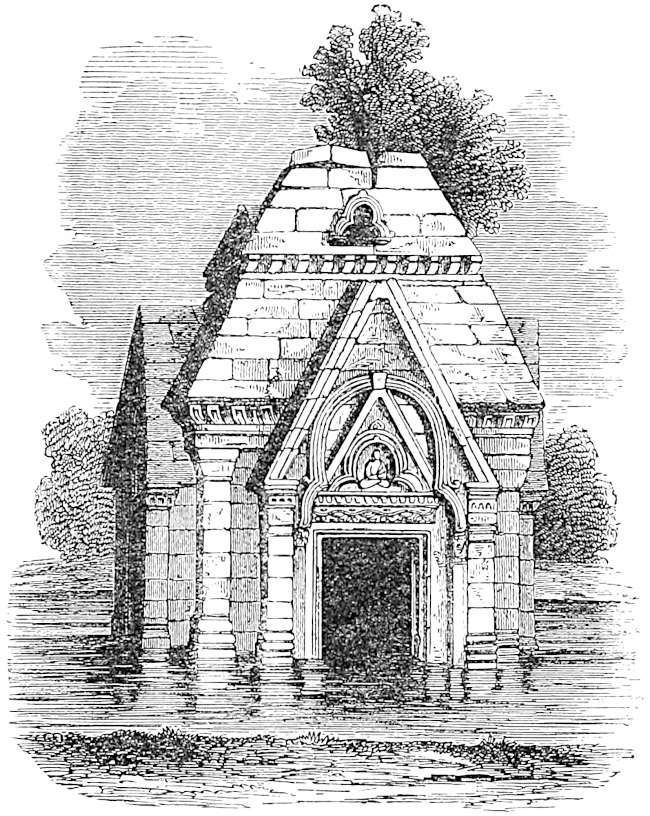
Ancient Buddhist Temple at Pandrethan in Káshmir.
Now we will quit this country, and not go any further in the same direction; for if we did so we should enter India; and that I do not wish to do at present. For, on our return journey, I mean to tell you about India: all in regular order. Let us go back therefore to Badashan, for we cannot otherwise proceed on our journey.
I know not if the spelling Kesciemur represents any peculiar Mongol pronunciation of the name. Plano Carpini, probably the first modern European to mention this celebrated region, calls it Casmir (p. 708).
“The Cashmeerians,” says Abu’l Fazl, “have a language of their own, but their books are written in the Shanskrit tongue, although the character is sometimes Cashmeerian. They write chiefly upon Tooz [birch-bark], which is the bark of a tree; it easily divides into leaves, and remains perfect for many years.” (Ayeen Akbery, II. 147.) A sketch of Kashmiri Grammar by Mr. Edgeworth will be found in vol. x. of the J. A. S. B., and a fuller one by Major Leech in vol. xiii. Other contributions on the language are in vol. xxxv. pt. i. p. 233 (Godwin-Austen); in vol. xxxix. pt. i. p. 95 (Dr. Elmslie); and in Proceedings for 1866, p. 62, seqq. (Sir G. Campbell and Bábú Rájendra Lál Mitra). The language, though in large measure of Sanskrit origin, has words and forms that cannot be traced in any other Indian vernacular. (Campbell, pp. 67, 68). The character is a modification of the Panjáb Nagari.
“The spread of Buddhism to Káshmir is an event of extraordinary importance in the history of that religion. Thenceforward that country became a mistress in the Buddhist Doctrine and the headquarters of a particular school.... The influence of Káshmir was very marked, especially in the spread of Buddhism beyond India. From Káshmir it penetrated to Kandahar and Kabul, ... and thence over Bactria. Tibetan Buddhism also had its essential origin from Káshmir; ... so great is the importance of this region in the History of Buddhism.” (Vassilyev, Der Buddhismus, I. 44.)
In the account which the Mahawanso gives of the consecration of the great Tope at Ruanwelli, by Dutthagamini, King of Ceylon (B.C. 157), 280,000 priests (!) come from Káshmir, a far greater number than is assigned to any other country except one. (J. A. S. B. VII. 165.)
It is thus very intelligible how Marco learned from the Mongols and the Lamas with whom he came in contact to regard Káshmir as “the very original source from which their Religion had spread abroad.” The feeling with which they looked to Káshmir must have been nearly the same as that with which the Buddhists of Burma look to Ceylon. But this feeling towards Káshmir does not now, I am informed, exist in Tibet. The reverence for the holy places has reverted to Bahár and the neighbouring “cradle-lands” of Buddhism.
It is notable that the historian Firishta, in a passage quoted by Tod, uses Marco’s expression in reference to Káshmir, almost precisely, saying that the Hindoos derived their idolatry from Káshmir, “the foundry of magical superstition.” (Rajasthan, I. 219.)
[Bernier says: “The women [of Kachemire] especially are very handsome; and it is from this country that nearly every individual, when first admitted to the court of the Great Mogul, selects wives or concubines, that his children may be whiter than the Indians, and pass for genuine Moguls. Unquestionably, there must be beautiful women among the higher classes, if we may judge by those of the lower orders seen in the streets and in the shops.” (Travels in the Mogul Empire, edited by Archibald Constable, 1891, p. 404.)]
We see from the Dabistan that in the 17th century Káshmir continued to be a great resort of Magian mystics and sages of various sects, professing great abstinence and credited with preternatural powers. And indeed Vámbéry tells us that even in our own day the Kashmiri Dervishes are pre-eminent among their Mahomedan brethren for cunning, secret arts, skill in exorcisms, etc. (Dab. I. 113 seqq. II. 147–148; Vámb. Sk. of Cent. Asia, 9.)
In Tibetan history it is told of the persecutor Langdarma that he compelled members of the highest orders of the clergy to become hunters and butchers. A Chinese collection of epigrams, dating from the 9th century, gives a facetious list of Incongruous Conditions, among which we find a poor Parsi, a sick Physician, a fat Bride, a Teacher who does not know his letters, and a Butcher who reads the Scriptures (of Buddhism)! (Alph. Tib. 445; Koeppen, I. 74; N. and Q., C. and J. III. 33.)