Volume 1 — CHAPTER II.
Henry Yule translation
How the Two Brothers went on beyond Soldaia.
Having stayed a while at Soldaia, they considered the matter, and thought it well to extend their journey further. So they set forth from Soldaia and travelled till they came to the Court of a certain Tartar Prince, Barca Kaan by name, whose residences were at Sara{1} and at Bolgara [and who was esteemed one of the most liberal and courteous Princes that ever was among the Tartars.]{2} This Barca was delighted at the arrival of the Two Brothers, and treated them with great honour; so they presented to him the whole of the jewels that they had brought with them. The Prince was highly pleased with these, and accepted the offering most graciously, causing the Brothers to receive at least twice its value.
After they had spent a twelvemonth at the court of this Prince there broke out a great war between Barca and Aláu, the Lord of the Tartars of the Levant, and great hosts were mustered on either side.{3}
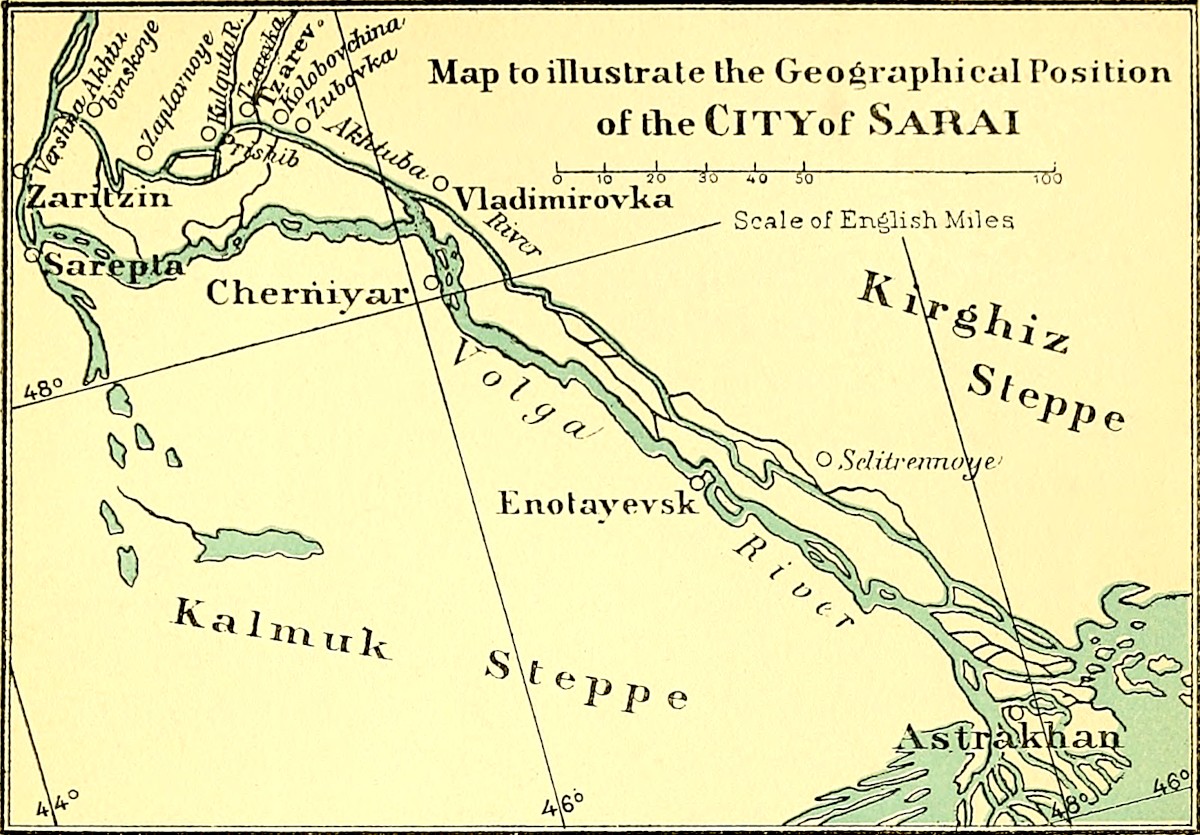
Map to illustrate the Geographical Position of the City of Sarai
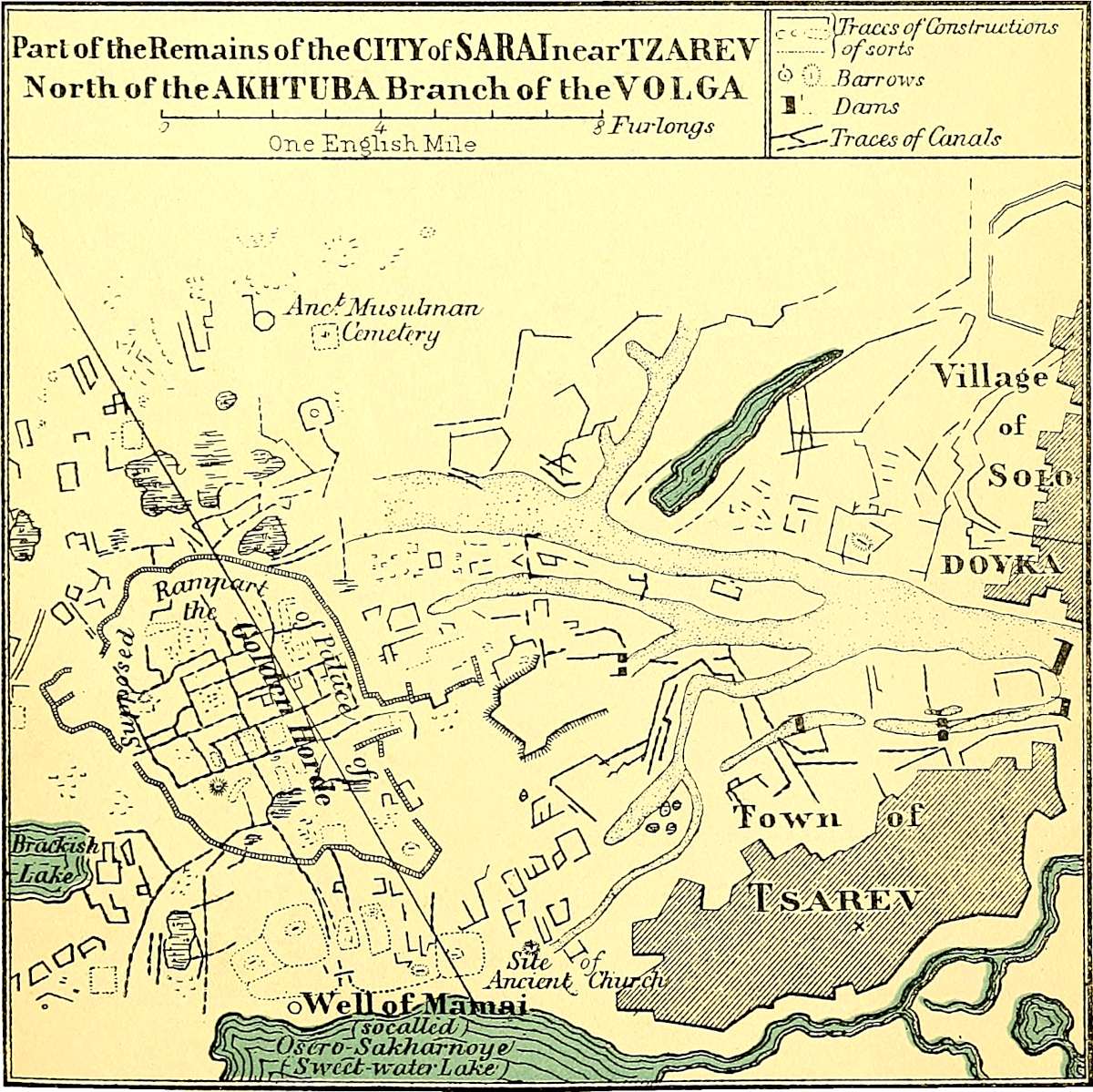
Part of the Remains of the CITY of SARAI near TZAREV North of the AKHTUBA Branch of the VOLGA
Lit. Frauenfelder, Palermo
But in the end Barca, the Lord of the Tartars of the Ponent, was defeated, though on both sides there was great slaughter. And by reason of this war no one could travel without peril of being taken; thus it was at least on the road by which the Brothers had come, though there was no obstacle to their travelling forward. So the Brothers, finding they could not retrace their steps, determined to go forward. Quitting Bolgara, therefore, they proceeded to a city called Ucaca, which was at the extremity of the kingdom of the Lord of the Ponent;{4} and thence departing again, and passing the great River Tigris, they travelled across a Desert which extended for seventeen days’ journey, and wherein they found neither town nor village, falling in only with the tents of Tartars occupied with their cattle at pasture.{5}
Sarai became the seat of both a Latin and a Russian metropolitan, and of more than one Franciscan convent. It was destroyed by Timur on his second invasion of Kipchak (1395–6), and extinguished by the Russians a century later. It is the scene of Chaucer’s half-told tale of Cambuscan:—
“At Sarra, in the Londe of Tartarie, There dwelt a King that werriëd Russie.”
[“Mesalek-al-absar (285, 287), says Sarai, meaning ‘the Palace,’ was founded by Bereké, brother of Batu. It stood in a salty plain, and was without walls, though the palace had walls flanked by towers. The town was large, had markets, madrasas—and baths. It is usually identified with Selitrennoyé Gorodok, about 70 miles above Astrakhan.” (Rockhill, Rubruck, p. 260, note.)—H. C.]
Several sites exhibiting extensive ruins near the banks of the Akhtuba have been identified with Sarai; two in particular. One of these is not far from the great elbow of the Volga at Tzaritzyn: the other much lower down, at Selitrennoyé Gorodok or Saltpetre-Town, not far above Astrakhan.
The upper site exhibits by far the most extensive traces of former population, and is declared unhesitatingly to be the sole site of Sarai by M. Gregorieff, who carried on excavations among the remains for four years, though with what precise results I have not been able to learn. The most dense part of the remains, consisting of mounds and earth-works, traces of walls, buildings, cisterns, dams, and innumerable canals, extends for about 7½ miles in the vicinity of the town of Tzarev, but a tract of 66 miles in length and 300 miles in circuit, commencing from near the head of the Akhtuba, presents remains of like character, though of less density, marking the ground occupied by the villages which encircled the capital. About 2½ miles to the N.W. of Tzarev a vast mass of such remains, surrounded by the traces of a brick rampart, points out the presumable position of the Imperial Palace.
M. Gregorieff appears to admit no alternative. Yet it seems certain that the indications of Abulfeda, Pegolotti, and others, with regard to the position of the capital in the early part of the 14th century, are not consistent with a site so far from the Caspian. Moreover, F. H. Müller states that the site near Tzarev is known to the Tartars as the “Sarai of Janibek Khan” (1341–1357). Now it is worthy of note that in the coinage of Janibek we repeatedly find as the place of mintage, New Sarai. Arabsháh in his History of Timur states that 63 years had elapsed from the foundation to the destruction of Sarai. But it must have been at least 140 years since the foundation of Batu’s city. Is it not possible, therefore, that both the sites which we have mentioned were successively occupied by the Mongol capital; that the original Sarai of Batu was at Selitrennoyé Gorodok, and that the New Sarai of Janibek was established by him, or by his father Uzbeg in his latter days, on the upper Akhtuba? Pegolotti having carried his merchant from Tana (Azov) to Gittarchan (Astrakhan), takes him one day by river to Sara, and from Sara to Saracanco, also by river, eight days more. (Cathay, p. 287.) In the work quoted I have taken Saracanco for Saraichik, on the Yaik. But it was possibly the Upper or New Sarai on the Akhtuba. Ibn Batuta, marching on the frozen river, reached Sarai in three days from Astrakhan. This could not have been at Tzarev, 200 miles off.
In corroboration (quantum valeat) of my suggestion that there must have been two Sarais near the Volga, Professor Bruun of Odessa points to the fact that Fra Mauro’s map presents two cities of Sarai on the Akhtuba; only the Sarai of Janibeg is with him no longer New Sarai, but Great Sarai.
The use of the latter name suggests the possibility that in the Saracanco of Pegolotti the latter half of the name may be the Mongol Kúnḳ “Great.” (See Pavet de Courteille, p. 439.)
Professor Bruun also draws attention to the impossibility of Ibn Batuta’s travelling from Astrakhan to Tzarev in three days, an argument which had already occurred to me and been inserted above.
[The Empire of Kipchak founded after the Mongol Conquest of 1224, included also parts of Siberia and Khwarizm; it survived nominally until 1502.—H. C.]
(Four Years of Archæological Researches among the Ruins of Sarai [in Russian] by M. Gregorieff [who appears to have also published a pamphlet specially on the site, but this has not been available]; Historisch-geographische Darstellung des Stromsystems der Wolga, von Ferd. Heinr. Müller, Berlin, 1839, 568–577; Ibn. Bat. II. 447; Not. et Extraits, XIII. i. 286; Pallas, Voyages; Cathay, 231, etc.; Erdmann, Numi Asiatici, pp. 362 seqq.; Arabs. I. p. 381.)
Russian chroniclers speak of an earlier capital of the Bulgarian kingdom, Brakhimof, near the mouth of the Kama, destroyed by Andrew, Grand Duke of Rostof and Susdal, about 1160; and this may have been the city referred to in the earlier Arabic accounts. The fullest of these is by Ibn Fozlán, who accompanied an embassy from the Court of Baghdad to Bolghar, in A.D. 921. The King and people had about this time been converted to Islam, having previously, as it would seem, professed Christianity. Nevertheless, a Mahomedan writer of the 14th century says the people had then long renounced Islam for the worship of the Cross. (Not. et Extr. XIII. i. 270.)
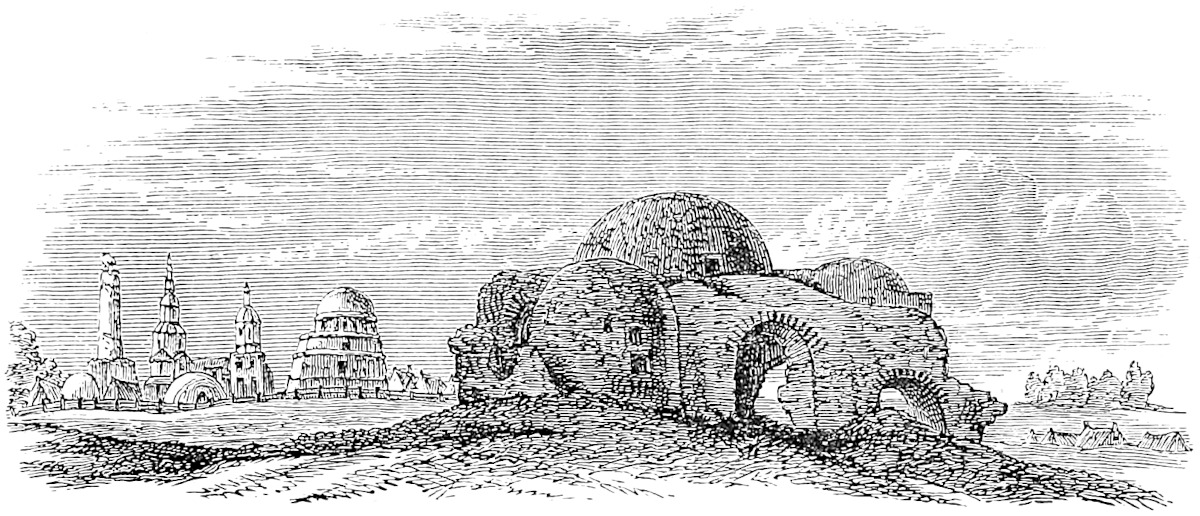
Ruins of Bolghar.
Bolghar was first captured by the Mongols in 1225. It seems to have perished early in the 15th century, after which Kazan practically took its place. Its position is still marked by a village called Bolgari, where ruins of Mahomedan character remain, and where coins and inscriptions have been found. Coins of the Kings of Bolghar, struck in the 10th century, have been described by Fraehn, as well as coins of the Mongol period struck at Bolghar. Its latest known coin is of A.H. 818 (A.D. 1415–16). A history of Bolghar was written in the first half of the 12th century by Yakub Ibn Noman, Kadhi of the city, but this is not known to be extant.
Fraehn shows ground for believing the people to have been a mixture of Fins, Slavs, and Turks. Nicephorus Gregoras supposes that they took their name from the great river on which they dwelt (Βούλγα).
[“The ruins [of Bolghar],” says Bretschneider, in his Mediæval Researches, published in 1888, vol. ii. p. 82, “still exist, and have been the subject of learned investigation by several Russian scholars. These remains are found on the spot where now the village Uspenskoye, called also Bolgarskoye (Bolgari), stands, in the district of Spask, province of Kazan. This village is about 4 English miles distant from the Volga, east of it, and 83 miles from Kazan.” Part of the Bulgars removed to the Balkans; others remained in their native country on the shores of the Azov Sea, and were subjugated by the Khazars. At the beginning of the 9th century, they marched northwards to the Volga and the Kama, and established the kingdom of Great Bulgaria. Their chief city, Bolghar, was on the bank of the Volga, but the river runs now to the west; as the Kama also underwent a change in its course, it is possible that formerly Bolghar was built at the junction of the two rivers. (Cf. Reclus, Europe russe, p. 761.) The Bulgars were converted to Islam in 922. Their country was first invaded by the Mongols under Subutai in 1223; this General conquered it in 1236, the capital was destroyed the following year, and the country annexed to the kingdom of Kipchak. Bolghar was again destroyed in 1391 by Tamerlan. In 1438, Ulugh Mohammed, cousin of Toka Timur, younger son of Juji, transformed this country into the khanate of Kazan, which survived till 1552. It had probably been the capital of the Golden Horde before Sarai.
With reference to the early Christianity of the Bulgarians, to which Yule refers in his note, the Laurentian Chronicle (A.D. 1229), quoted by Shpilevsky, adduces evidence to show that in the Great City, i.e. Bulgar, there were Russian Christians and a Christian cemetery, and the death of a Bulgarian Christian martyr is related in the same chronicle as well as in the Nikon, Tver, and Tatischef annals in which his name is given. (Cf. Shpilevsky, Anc. towns and other Bulgaro-Tartar monuments, Kazan, 1877, p. 158 seq.; Rockhill’s Rubruck, Hakl. Soc. p. 121, note.)—H. C.]
The severe and lasting winter is spoken of by Ibn Fozlán and other old writers in terms that seem to point to a modern mitigation of climate. It is remarkable, too, that Ibn Fozlán speaks of the aurora as of very frequent occurrence, which is not now the case in that latitude. We may suspect this frequency to have been connected with the greater cold indicated, and perhaps with a different position of the magnetic pole. Ibn Fozlán’s account of the aurora is very striking:—“Shortly before sunset the horizon became all very ruddy, and at the same time I heard sounds in the upper air, with a dull rustling. I looked up and beheld sweeping over me a fire-red cloud, from which these sounds issued, and in it movements, as it were, of men and horses; the men grasping bows, lances, and swords. This I saw, or thought I saw. Then there appeared a white cloud of like aspect; in it also I beheld armed horsemen, and these rushed against the former as one squadron of horse charges another. We were so terrified at this that we turned with humble prayer to the Almighty, whereupon the natives about us wondered and broke into loud laughter. We, however, continued to gaze, seeing how one cloud charged the other, remained confused with it a while, and then sundered again. These movements lasted deep into the night, and then all vanished.”
(Fraehn, Ueber die Wolga Bulgaren, Petersb. 1832; Gold. Horde, 8, 9, 423–424; Not. et Extr. II. 541; Ibn Bat. II. 398; Büschings Mag. V. 492; Erdmann, Numi Asiat. I. 315–318, 333–334, 520–535; Niceph. Gregoras, II. 2, 2.)
The war in question is related in Rashíduddín’s history, and by Polo himself towards the end of the work. It began in the summer of 1262, and ended about eight months later. Hence the Polos must have reached Barka’s Court in 1261.
Marco always applies to the Mongol Khans of Persia the title of “Lords of the East” (Levant), and to the Khans of Kipchak that of “Lords of the West” (Ponent). We use the term Levant still with a similar specific application, and in another form Anatolia. I think it best to preserve the terms Levant and Ponent when used in this way.
[Robert Parke in his translation out of Spanish of Mendoza, The Historie of the great and mightie kingdome of China ... London, printed by I. Wolfe for Edward White, 1588, uses the word Ponent: “You shall understande that this mightie kingdome is the Orientalest part of all Asia, and his next neighbour towards the Ponent is the kingdome of Quachinchina ... (p. 2).”—H. C.]
(Fraehn, Ueber die ehemalige Mong. Stadt Ukek, etc., Petersb. 1835; Gold. Horde; Ibn Bat. II. 414; Abulfeda, in Büsching, V. 365; Ann. Minorum, sub anno 1400; Pétis de la Croix, II. 355, 383, 388; Hakluyt, ed. 1809, I. 375 and 472; Lepechin, Tagebuch der Reise, etc., I. 235–237; Rockhill, Rubruck, 120–121, note 2.)
The “17 days” applies to one stretch of desert. The whole journey from Ukek Bokhara would take some 60 days at least. Ibn Batuta is 58 days from Sarai to Bokhara, and of the last section he says, “we entered the desert which extends between Khwarizm and Bokhara, and which has an extent of 18 days’ journey.” (III. 19.)