Volume 1 — CHAPTER L.
Henry Yule translation
The Battle between Chinghis Kaan and Prester John.
And after both sides had rested well those two days, they armed for the fight and engaged in desperate combat; and it was the greatest battle that ever was seen. The numbers that were slain on both sides were very great, but in the end Chinghis Kaan obtained the victory. And in the battle Prester John was slain. And from that time forward, day by day, his kingdom passed into the hands of Chinghis Kaan till the whole was conquered.
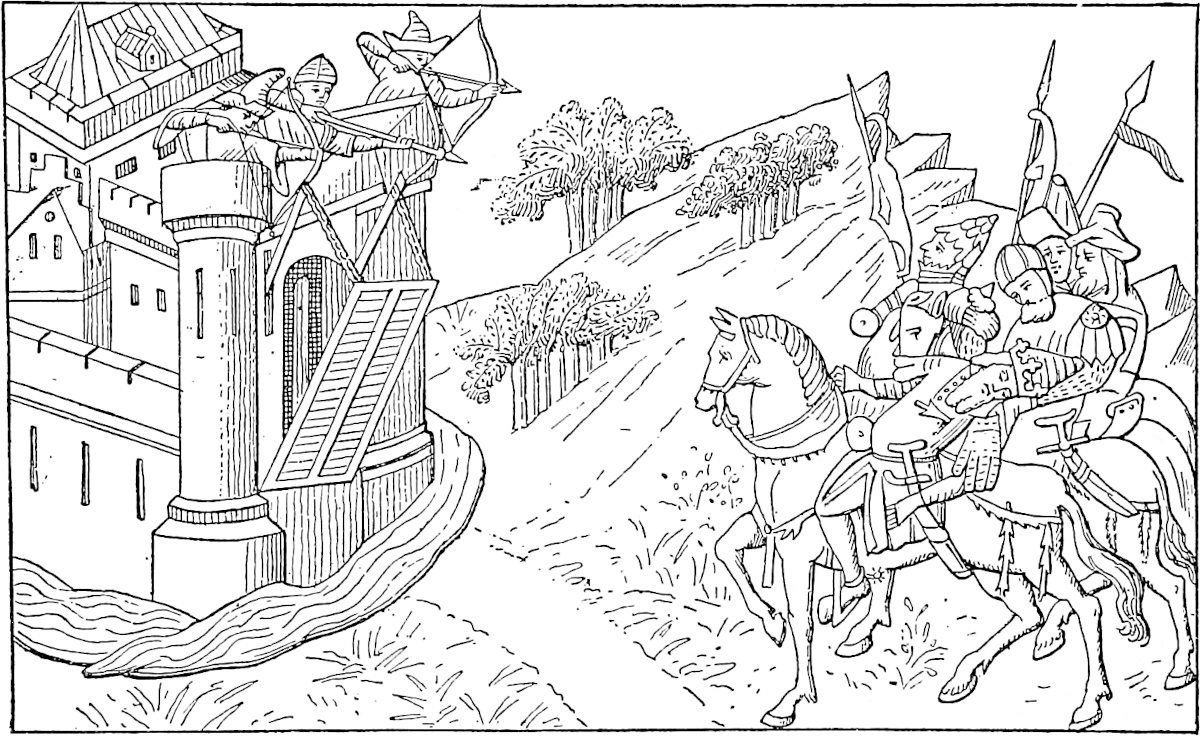
A. Housselin D.
Death of Chinghiz Khan. (From a miniature in the Livre des Merveilles.)
I may tell you that Chinghis Kaan reigned six years after this battle, engaged continually in conquest, and taking many a province and city and stronghold. But at the end of those six years he went against a certain castle that was called Caaju, and there he was shot with an arrow in the knee, so that he died of his wound. A great pity it was, for he was a valiant man and a wise.{1}
I will now tell you who reigned after Chinghis, and then about the manners and customs of the Tartars.
The name of the place before which Polo represents him as mortally wounded is very variously given. According to Gaubil, Chinghiz was in reality dangerously wounded by an arrow-shot at the siege of Taitongfu in 1212. And it is possible, as Oppert suggests, that Polo’s account of his death before Caagiu (as I prefer the reading), arose out of a confusion between this circumstance and those of the death of Mangku Kaan, which is said to have occurred at the assault of Hochau in Sze-ch’uan, a name which Polo would write Caagiu, or nearly so. Abulfaragius specifically says that Mangku Kaan died by an arrow; though it is true that other authors say he died of disease, and Haiton that he was drowned; all which shows how excusable were Polo’s errors as to events occurring 50 to 100 years before his time. (See Oppert’s Presbyter Johannes, p. 76; De Mailla, IX. 275, and note; Gaubil, 18, 50, 52, 121; Erdmann, 443; San. Setzen, 103.)
It is only by referring back to ch. xlvii., where we are told that Chinghiz “began to think of conquering a great part of the world,” that we see Polo to have been really aware of the vast extent and aim of the conquests of Chinghiz; the aim being literally the conquest of the world as he conceived it; the extent of the empire which he initiated actually covering (probably) one half of the whole number of the human race. (See remarks in Koeppen, Die Relig. des Buddha, II. 86.)