Volume 1 — CHAPTER I.
Henry Yule translation
Here the Book begins; and first it speaks of the Lesser Hermenia.
There are two Hermenias, the Greater and the Less. The Lesser Hermenia is governed by a certain King, who maintains a just rule in his dominions, but is himself subject to the Tartar.{1} The country contains numerous towns and villages,{2} and has everything in plenty; moreover, it is a great country for sport in the chase of all manner of beasts and birds. It is, however, by no means a healthy region, but grievously the reverse.{3} In days of old the nobles there were valiant men, and did doughty deeds of arms; but nowadays they are poor creatures, and good at nought, unless it be at boozing; they are great at that. Howbeit, they have a city upon the sea, which is called Layas, at which there is a great trade. For you must know that all the spicery, and the cloths of silk and gold, and the other valuable wares that come from the interior, are brought to that city. And the merchants of Venice and Genoa, and other countries, come thither to sell their goods, and to buy what they lack. And whatsoever persons would travel to the interior (of the East), merchants or others, they take their way by this city of Layas.{4}
Having now told you about the Lesser Hermenia, we shall next tell you about Turcomania.
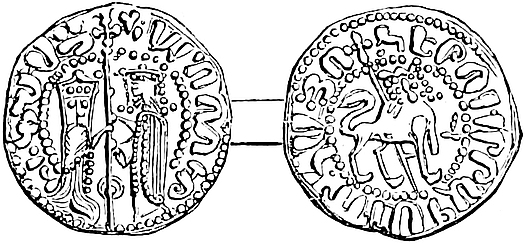
Coin of King Hetum and his Queen Isabel.
But when the old Armenian monarchy was broken up (1079–80), Rupen, a kinsman of the Bagratid Kings, with many of his countrymen, took refuge in the Taurus. His first descendants ruled as barons, a title adopted apparently from the Crusaders, but still preserved in Armenia. Leon, the great-great-grandson of Rupen, was consecrated King under the supremacy of the Pope and the Western Empire in 1198. The kingdom was at its zenith under Hetum or Hayton I., husband of Leon’s daughter Isabel (1224–1269); he was, however, prudent enough to make an early submission to the Mongols, and remained ever staunch to them, which brought his territory constantly under the flail of Egypt. It included at one time all Cilicia, with many cities of Syria and the ancient Armenia Minor, of Isauria and Cappadocia. The male line of Rupen becoming extinct in 1342, the kingdom passed to John de Lusignan, of the royal house of Cyprus, and in 1375 it was put an end to by the Sultan of Egypt. Leon VI., the ex-king, into whose mouth Froissart puts some extraordinary geography, had a pension of 1000l. a year granted him by our Richard II., and died at Paris in 1398.
The chief remaining vestige of this little monarchy is the continued existence of a Catholicos of part of the Armenian Church at Sis, which was the royal residence. Some Armenian communities still remain both in hills and plains; and the former, the more independent and industrious, still speak a corrupt Armenian.
Polo’s contemporary, Marino Sanuto, compares the kingdom of the Pope’s faithful Armenians to one between the teeth of four fierce beasts, the Lion Tartar, the Panther Soldan, the Turkish Wolf, the Corsair Serpent.
(Dulaurier, in J. As. sér. V. tom. xvii.; St. Martin, Arm.; Mar. San. p. 32; Froissart, Bk. II. ch. xxii. seqq.; Langlois, V. en Cilicie, 1861, p. 19.)
With regard to the phrase spicery here and elsewhere, it should be noted that the Italian spezerie included a vast deal more than ginger and other things “hot i’ the mouth.” In one of Pegolotti’s lists of spezerie we find drugs, dye-stuffs, metals, wax, cotton, etc.