Volume 1 — CHAPTER XVIII.
Henry Yule translation
Of the Lions and Leopards and Wolves that the Kaan keeps for the Chase.
The Emperor hath numbers of leopards{1} trained to the chase, and hath also a great many lynxes taught in like manner to catch game, and which afford excellent sport.{2} He hath also several great Lions, bigger than those of Babylonia, beasts whose skins are coloured in the most beautiful way, being striped all along the sides with black, red, and white. These are trained to catch boars and wild cattle, bears, wild asses, stags, and other great or fierce beasts. And ’tis a rare sight, I can tell you, to see those lions giving chase to such beasts as I have mentioned! When they are to be so employed the Lions are taken out in a covered cart, and every Lion has a little doggie with him. [They are obliged to approach the game against the wind, otherwise the animals would scent the approach of the Lion and be off.]{3}
There are also a great number of eagles, all broken to catch wolves, foxes, deer, and wild goats, and they do catch them in great numbers. But those especially that are trained to wolf-catching are very large and powerful birds, and no wolf is able to get away from them.{4}
[The hunting equipment of the Sultan consisted of about thirty falconers on horseback who carried each a bird on his fist. These falconers were in front of seven horsemen, who had behind a kind of tamed tiger at times employed by His Highness for hare-hunting, notwithstanding what may be said to the contrary by those who are inclined not to believe the fact. It is a thing known by everybody here, and cannot be doubted except by those who admit that they believe nothing of foreign customs. These tigers were each covered with a brocade cloth—and their peaceful attitude, added to their ferocious and savage looks, caused at the same time astonishment and fear in the soul of those whom they looked upon. (Journal d’Antoine Galland, trad. par Ch. Schefer, I. p. 135.) The Cheeta (Gueparda jubata) was, according to Sir W. Jones, first employed in hunting antelopes by Hushing, King of Persia, 865 B.C.—H. C.]
“Hyena e Griu num, que nus beste apellum, Ceo est Lucervere, oler fait et mult est fere.”
[The Abbé Armand David writes (Missions Cathol. XXI. 1889, p. 227) that there is in China, from the mountains of Manchuria to the mountains of Tibet, a lynx called by the Chinese T’u-pao (earth-coloured panther); a lynx somewhat similar to the loup-cervier is found on the western border of China, and has been named Lyncus Desgodinsi.—H. C.]
Hunting Lynxes were used at the Court of Akbar. They are also mentioned by A. Hamilton as so used in Sind at the end of the 17th century. This author calls the animal a Shoe-goose! i.e. Siya-gosh (Black-ear), the Persian name of the Lynx. It is still occasionally used in the chase by natives of rank in India. (Brunetto Lat. Tresor, p. 248; Popular Treatises on Science written during Mid. Ages, 94; Ayeen Akbery, u.s.; Hamilt. E. Indies, I. 125; Vigne, I. 42.)
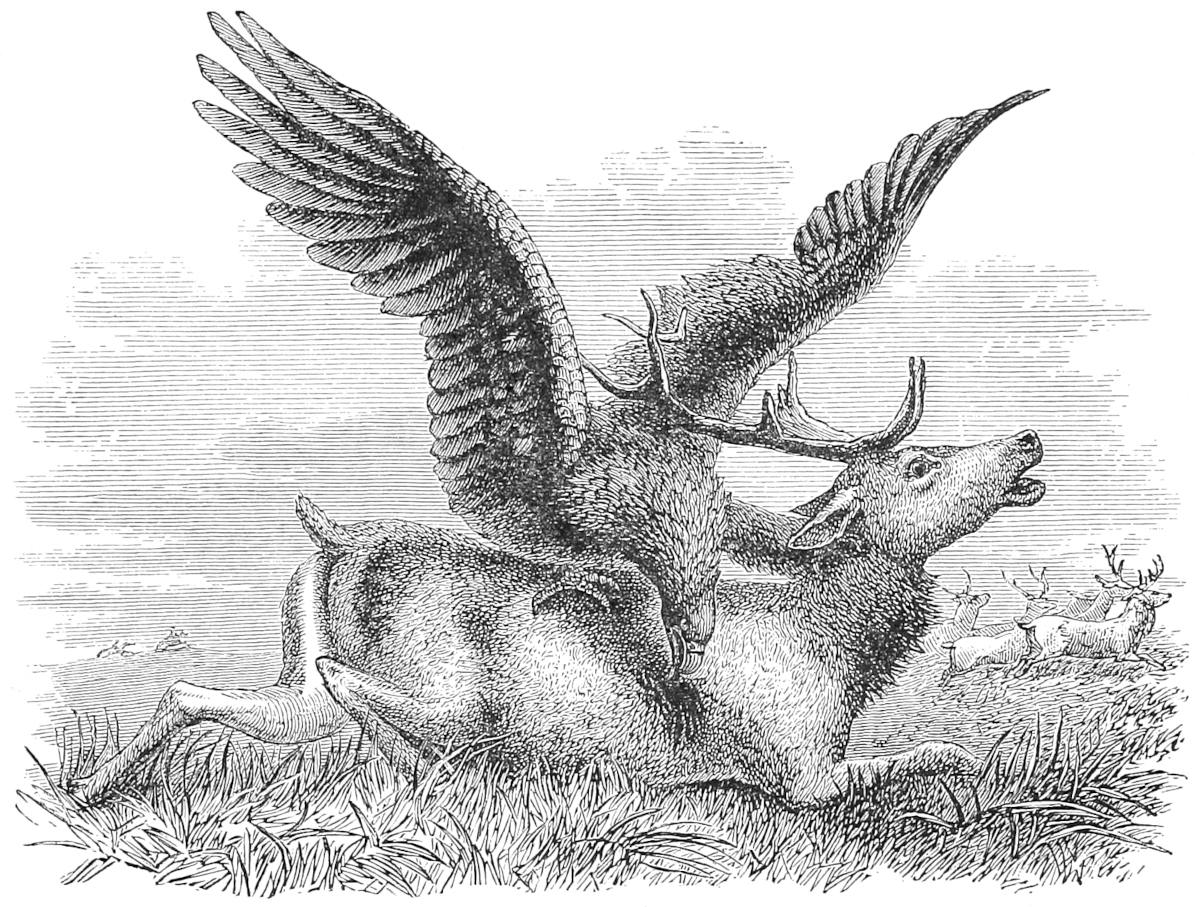
The Búrgút Eagle. (After Atkinson.)
“Il a encore aiglies qe sunt afaités à prendre leus et voupes et dain et chavriou, et en prennent assez.”
The Chinese pilgrim, Sung-Yun (A.D. 518), saw two young lions at the Court of Gandhára. He remarks that the pictures of these animals common in China, were not at all good likenesses. (Beal, p. 200.)
We do not hear in modern times of Tigers trained to the chase, but Chardin says of Persia: “In hunting the larger animals they make use of beasts of prey trained for the purpose, lions, leopards, tigers, panthers, ounces.”
[The Golden Eagle (Aquila chrysaetus) is called at Peking Hoy tiao (black eagle). (David et Oustalet, Oiseaux de la Chine, p. 8.)—H. C.]