EXPLANATORY LIST OF ILLUSTRATIONS TO VOLUME I. (continued 2)
Henry Yule translation
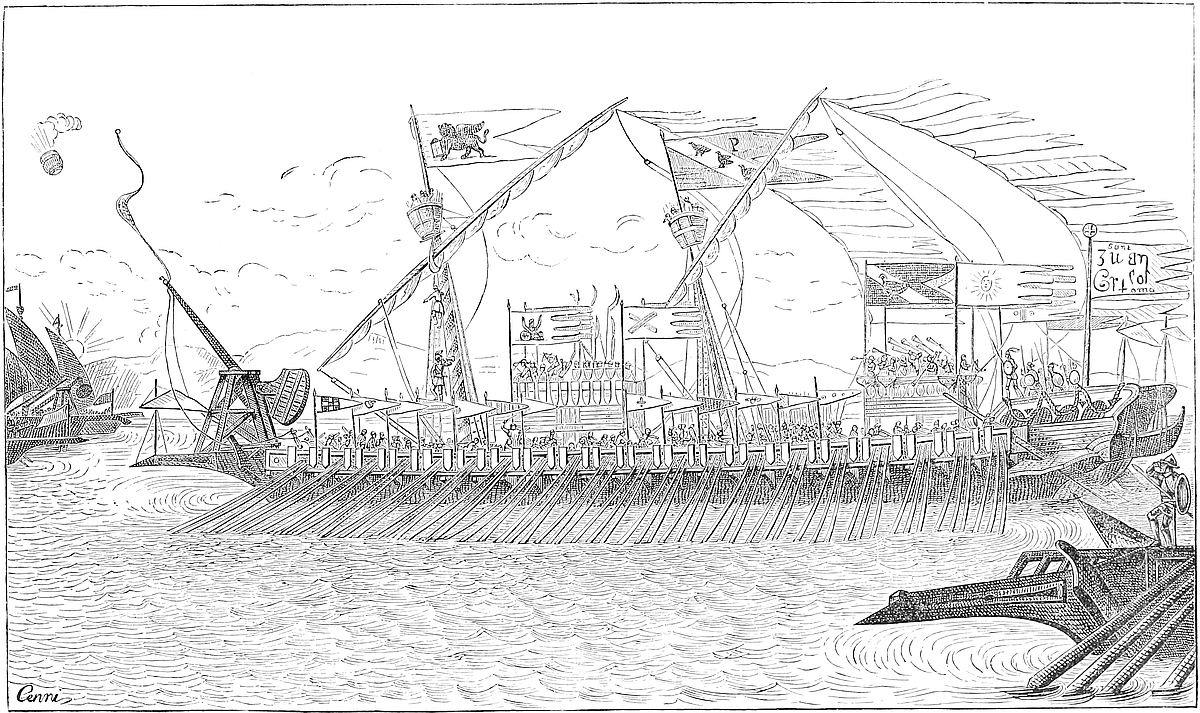
Marco Polo’s Galley going into action at Curzola.
... “il sembloit que la galie volast, par les nageurs qui la contreingnoient aux avirons, et sembloit que foudre cheist des ciex, au bruit que les pennonciaus menoient; et que les nacaires les tabours et les cors sarrazinnois menoient, qui estoient en sa galie.” (Joinville, vide ante, p. 40.)
The prisoners, even of the highest rank, appear to have been chained. Dandolo, in despair at his defeat, and at the prospect of being carried captive into Genoa, refused food, and ended by dashing his head against a bench.[21] A Genoese account asserts that a noble funeral was given him after the arrival of the fleet at Genoa, which took place on the evening of the 16th October.[22] It was received with great rejoicing, and the City voted the annual presentation of a pallium of gold brocade to the altar of the Virgin in the Church of St. Matthew, on every 8th of September, the Madonna’s day, on the eve of which the Battle had been won. To the admiral himself a Palace was decreed. It still stands, opposite the Church of St. Matthew, though it has passed from the possession of the Family. On the striped marble façades, both of the Church and of the Palace, inscriptions of that age, in excellent preservation, still commemorate Lamba’s achievement.[23] Malik al Mansúr, the Mameluke Sultan of Egypt, as an enemy of Venice, sent a complimentary letter to Doria accompanied by costly presents.[24]
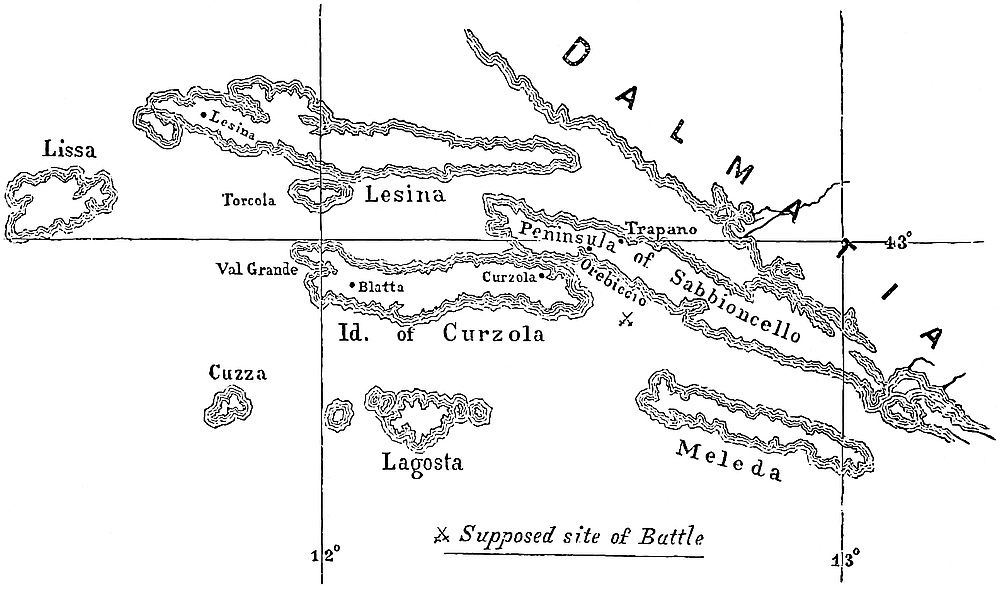
Scene of the Battle of Curzola.
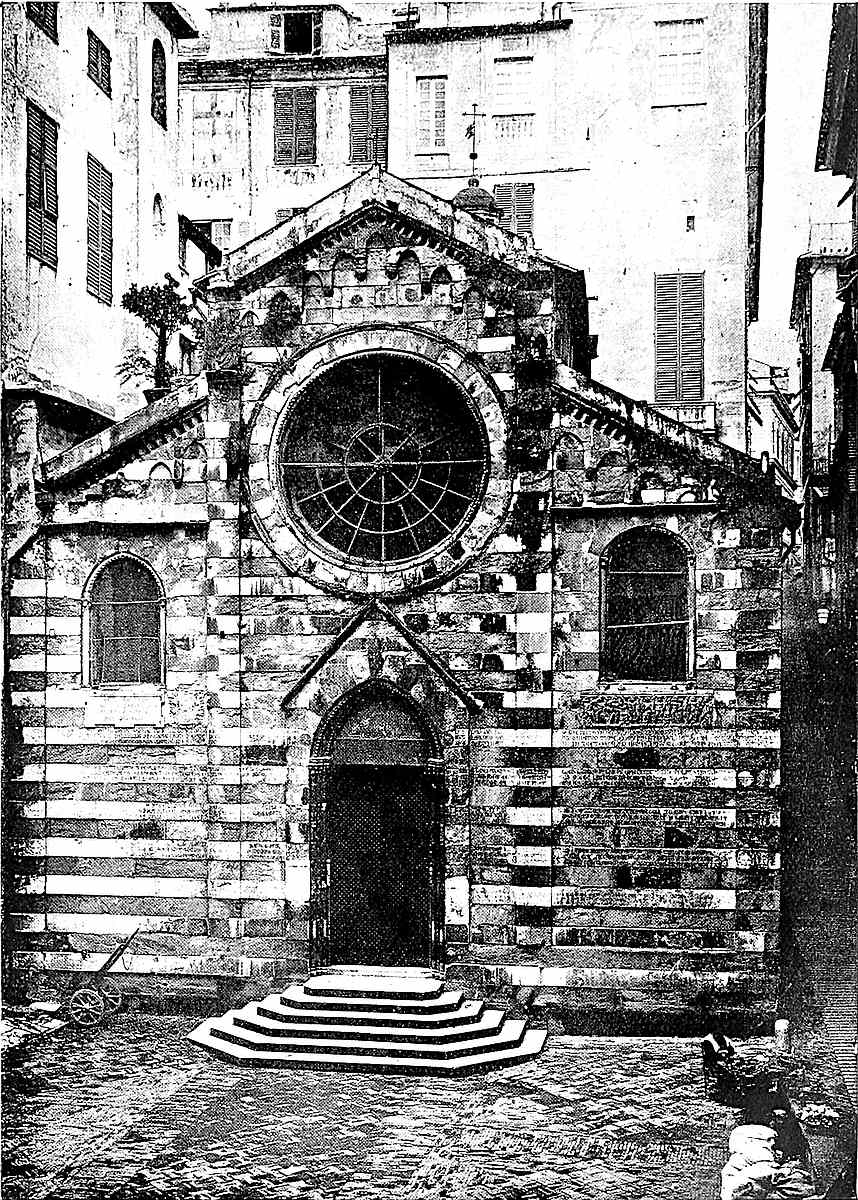
Church of San Matteo, Genoa.
The latter died at Savona 17th October, 1323, a few months before the most illustrious of his prisoners, and his bones were laid in a sarcophagus which may still be seen forming the sill of one of the windows of S. Matteo (on the right as you enter). Over this sarcophagus stood the Bust of Lamba till 1797, when the mob of Genoa, in idiotic imitation of the French proceedings of that age, threw it down. All of Lamba’s six sons had fought with him at Meloria. In 1291 one of them, Tedisio, went forth into the Atlantic in company with Ugolino Vivaldi on a voyage of discovery, and never returned. Through Cæsar, the youngest, this branch of the Family still survives, bearing the distinctive surname of Lamba-Doria.[25]
As to the treatment of the prisoners, accounts differ; a thing usual in such cases. The Genoese Poet asserts that the hearts of his countrymen were touched, and that the captives were treated with compassionate courtesy. Navagiero the Venetian, on the other hand, declares that most of them died of hunger.[26]
36. Howsoever they may have been treated, here was Marco Polo one of those many thousand prisoners in Genoa; Marco Polo in prison dictates his book to Rusticiano of Pisa. Release of Venetian prisoners.and here, before long, he appears to have made acquaintance with a man of literary propensities, whose destiny had brought him into the like plight, by name Rusticiano or Rustichello of Pisa. It was this person perhaps who persuaded the Traveller to defer no longer the reduction to writing of his notable experiences; but in any case it was he who wrote down those experiences at Marco’s dictation; it is he therefore to whom we owe the preservation of this record, and possibly even that of the Traveller’s very memory. This makes the Genoese imprisonment so important an episode in Polo’s biography.
To Rusticiano we shall presently recur. But let us first bring to a conclusion what may be gathered as to the duration of Polo’s imprisonment.
It does not appear whether Pope Boniface made any new effort for accommodation between the Republics; but other Italian princes did interpose, and Matteo Visconti, Captain-General of Milan, styling himself Vicar-General of the Holy Roman Empire in Lombardy, was accepted as Mediator, along with the community of Milan. Ambassadors from both States presented themselves at that city, and on the 25th May, 1299, they signed the terms of a Peace.
These terms were perfectly honourable to Venice, being absolutely equal and reciprocal; from which one is apt to conclude that the damage to the City of the Sea was rather to her pride than to her power; the success of Genoa, in fact, having been followed up by no systematic attack upon Venetian commerce.[27] Among the terms was the mutual release of prisoners on a day to be fixed by Visconti after the completion of all formalities. This day is not recorded, but as the Treaty was ratified by the Doge of Venice on the 1st July, and the latest extant document connected with the formalities appears to be dated 18th July, we may believe that before the end of August Marco Polo was restored to the family mansion in S. Giovanni Grisostomo.
37. Something further requires to be said before quitting this event in our Traveller’s life. For we confess that a critical reader may have some Grounds on which the story of Marco Polo’s capture at Curzola rests. justification in asking what evidence there is that Marco Polo ever fought at Curzola, and ever was carried a prisoner to Genoa from that unfortunate action?
A learned Frenchman, whom we shall have to quote freely in the immediately ensuing pages, does not venture to be more precise in reference to the meeting of Polo and Rusticiano than to say of the latter: “In 1298, being in durance in the Prison of Genoa, he there became acquainted with Marco Polo, whom the Genoese had deprived of his liberty from motives equally unknown.”[28]
To those who have no relish for biographies that round the meagre skeleton of authentic facts with a plump padding of what might have been, this sentence of Paulin Paris is quite refreshing in its stern limitation to positive knowledge. And certainly no contemporary authority has yet been found for the capture of our Traveller at Curzola. Still I think that the fact is beyond reasonable doubt.
Ramusio’s biographical notices certainly contain many errors of detail; and some, such as the many years’ interval which he sets between the Battle of Curzola and Marco’s return, are errors which a very little trouble would have enabled him to eschew. But still it does seem reasonable to believe that the main fact of Marco’s command of a galley at Curzola, and capture there, was derived from a genuine tradition, if not from documents.
Let us then turn to the words which close Rusticiano’s preamble (see post, p. 2):—“Lequel (Messire Marc) puis demorant en le charthre de Jene, fist retraire toutes cestes chouses a Messire Rustacians de Pise que en celle meissme charthre estoit, au tens qu’il avoit 1298 anz que Jezu eut vesqui.” These words are at least thoroughly consistent with Marco’s capture at Curzola, as regards both the position in which they present him, and the year in which he is thus presented.
There is however another piece of evidence, though it is curiously indirect.
The Dominican Friar Jacopo of Acqui was a contemporary of Polo’s, and was the author of a somewhat obscure Chronicle called Imago Mundi.[29] Now this Chronicle does contain mention of Marco’s capture in action by the Genoese, but attributes it to a different action from Curzola, and one fought at a time when Polo could not have been present. The passage runs as follows in a manuscript of the Ambrosian Library, according to an extract given by Baldelli Boni:—
“In the year of Christ MCCLXXXXVI, in the time of Pope Boniface VI., of whom we have spoken above, a battle was fought in Arminia, at the place called Layaz, between xv. galleys of Genoese merchants and xxv. of Venetian merchants; and after a great fight the galleys of the Venetians were beaten, and (the crews) all slain or taken; and among them was taken Messer Marco the Venetian, who was in company with those merchants, and who was called Milono, which is as much as to say ‘a thousand thousand pounds,’ for so goes the phrase in Venice. So this Messer Marco Milono the Venetian, with the other Venetian prisoners, is carried off to the prison of Genoa, and there kept for a long time. This Messer Marco was a long time with his father and uncle in Tartary, and he there saw many things, and made much wealth, and also learned many things, for he was a man of ability. And so, being in prison at Genoa, he made a Book concerning the great wonders of the World, i.e., concerning such of them as he had seen. And what he told in the Book was not as much as he had really seen, because of the tongues of detractors, who, being ready to impose their own lies on others, are over hasty to set down as lies what they in their perversity disbelieve, or do not understand. And because there are many great and strange things in that Book, which are reckoned past all credence, he was asked by his friends on his death-bed to correct the Book by removing everything that went beyond the facts. To which his reply was that he had not told one-half of what he had really seen!”[30]
This statement regarding the capture of Marco at the Battle of Ayas is one which cannot be true, for we know that he did not reach Venice till 1295, travelling from Persia by way of Trebizond and the Bosphorus, whilst the Battle of Ayas of which we have purposely given some detail, was fought in May, 1294. The date MCCLXXXXVI assigned to it in the preceding extract has given rise to some unprofitable discussion. Could that date be accepted, no doubt it would enable us also to accept this, the sole statement from the Traveller’s own age of the circumstances which brought him into a Genoese prison; it would enable us to place that imprisonment within a few months of his return from the East, and to extend its duration to three years, points which would thus accord better with the general tenor of Ramusio’s tradition than the capture of Curzola. But the matter is not open to such a solution. The date of the Battle of Ayas is not more doubtful than that of the Battle of the Nile. It is clearly stated by several independent chroniclers, and is carefully established in the Ballad that we have quoted above.[31] We shall see repeatedly in the course of this Book how uncertain are the transcriptions of dates in Roman numerals, and in the present case the LXXXXVI is as certainly a mistake for LXXXXIV as is Boniface VI. in the same quotation a mistake for Boniface VIII.
But though we cannot accept the statement that Polo was taken prisoner at Ayas, in the spring of 1294, we may accept the passage as evidence from a contemporary source that he was taken prisoner in some sea-fight with the Genoese, and thus admit it in corroboration of the Ramusian Tradition of his capture in a sea-fight at Curzola in 1298, which is perfectly consistent with all other facts in our possession.
VII. Rusticiano or Rustichello of Pisa, Marco Polo’s Fellow-Prisoner at Genoa, the Scribe who wrote down the Travels.
38. We have now to say something of that Rusticiano to whom all who value Polo’s book are so much indebted.
The relations between Genoa and Pisa had long been so hostile that it was only too natural in 1298 to find a Pisan in the gaol of Genoa.Rusticiano, perhaps a prisoner from Meloria. An unhappy multitude of such prisoners had been carried thither fourteen years before, and the survivors still lingered there in vastly dwindled numbers. In the summer of 1284 was fought the battle from which Pisa had to date the commencement of her long decay. In July of that year the Pisans, at a time when the Genoese had no fleet in their own immediate waters, had advanced to the very port of Genoa and shot their defiance into the proud city in the form of silver-headed arrows, and stones belted with scarlet.[1] They had to pay dearly for this insult. The Genoese, recalling their cruisers, speedily mustered a fleet of eighty-eight galleys, which were placed under the command of another of that illustrious House of Doria, the Scipios of Genoa as they have been called, Uberto, the elder brother of Lamba. Lamba himself with his six sons, and another brother, was in the fleet, whilst the whole number of Dorias who fought in the ensuing action amounted to 250, most of them on board one great galley bearing the name of the family patron, St. Matthew.[2]
The Pisans, more than one-fourth inferior in strength, came out boldly, and the battle was fought off the Porto Pisano, in fact close in front of Leghorn, where a lighthouse on a remarkable arched basement still marks the islet of Meloria, whence the battle got its name. The day was the 6th of August, the feast of St. Sixtus, a day memorable in the Pisan Fasti for several great victories. But on this occasion the defeat of Pisa was overwhelming. Forty of their galleys were taken or sunk, and upwards of 9000 prisoners carried to Genoa. In fact so vast a sweep was made of the flower of Pisan manhood that it was a common saying then: “Che vuol veder Pisa, vada a Genova!” Many noble ladies of Pisa went in large companies on foot to Genoa to seek their husbands or kinsmen: “And when they made enquiry of the Keepers of the Prisons, the reply would be, ‘Yesterday there died thirty of them, to-day there have died forty; all of whom we have cast into the sea; and so it is daily.’”[3]
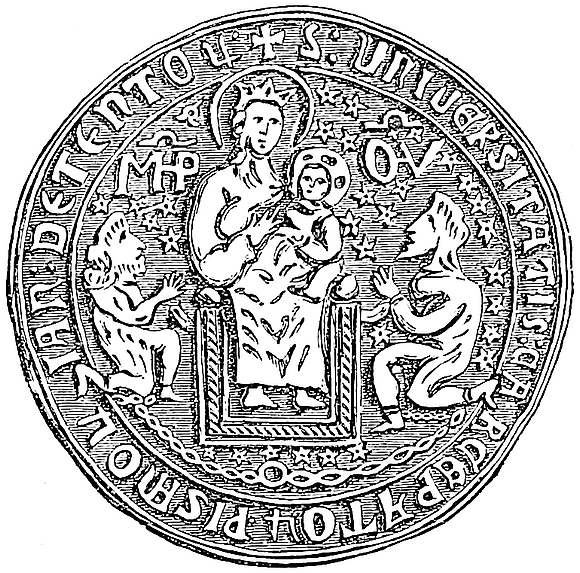
Seal of the Pisan Prisoners.
A body of prisoners so numerous and important naturally exerted themselves in the cause of peace, and through their efforts, after many months of negotiation, a formal peace was signed (15th April, 1288). But through the influence, as was alleged, of Count Ugolino (Dante’s) who was then in power at Pisa, the peace became abortive; war almost immediately recommenced, and the prisoners had no release.[4] And, when the 6000 or 7000 Venetians were thrown into the prisons of Genoa in October 1298, they would find there the scanty surviving remnant of the Pisan Prisoners of Meloria, and would gather from them dismal forebodings of the fate before them.
It is a fair conjecture that to that remnant Rusticiano of Pisa may have belonged.
We have seen Ramusio’s representation of the kindness shown to Marco during his imprisonment by a certain Genoese gentleman who also assisted him to reduce his travels to writing. We may be certain that this Genoese gentleman is only a distorted image of Rusticiano, the Pisan prisoner in the gaol of Genoa, whose name and part in the history of his hero’s book Ramusio so strangely ignores. Yet patriotic Genoese writers in our own times have striven to determine the identity of this their imaginary countryman![5]
39. Who, then, was Rusticiano, or, as the name actually is read in the oldest type of MS., “Messire Rustacians de Pise”?
Rusticiano, a person known from other sources.Our knowledge of him is but scanty. Still something is known of him besides the few words concluding his preamble to our Traveller’s Book, which you may read at pp. 1–2 of the body of this volume.
In Sir Walter Scott’s “Essay on Romance,” when he speaks of the new mould in which the subjects of the old metrical stories were cast by the school of prose romancers which arose in the 13th century, we find the following words:—
“Whatever fragments or shadows of true history may yet remain hidden under the mass of accumulated fable which had been heaped upon them during successive ages, must undoubtedly be sought in the metrical romances.... But those prose authors who wrote under the imaginary names of Rusticien de Pise, Robert de Borron, and the like, usually seized upon the subject of some old minstrel; and recomposing the whole narrative after their own fashion, with additional character and adventure, totally obliterated in that operation any shades which remained of the original and probably authentic tradition,” &c.[6]
Evidently, therefore, Sir Walter regarded Rustician of Pisa as a person belonging to the same ghostly company as his own Cleishbothams and Dryasdusts. But in this we see that he was wrong.
In the great Paris Library and elsewhere there are manuscript volumes containing the stories of the Round Table abridged and somewhat clumsily combined from the various Prose Romances of that cycle, such as Sir Tristan, Lancelot, Palamedes, Giron le Courtois, &c., which had been composed, it would seem, by various Anglo-French gentlemen at the court of Henry III., styled, or styling themselves, Gasses le Blunt, Luces du Gast, Robert de Borron, and Hélis de Borron. And these abridgments or recasts are professedly the work of Le Maistre Rusticien de Pise. Several of them were printed at Paris in the end of the 15th and beginning of the 16th centuries as the works of Rusticien de Pise; and as the preambles and the like, especially in the form presented in those printed editions, appear to be due sometimes to the original composers (as Robert and Hélis de Borron) and sometimes to Rusticien de Pise the recaster, there would seem to have been a good deal of confusion made in regard to their respective personalities.
From a preamble to one of those compilations which undoubtedly belongs to Rustician, and which we shall quote at length by and bye, we learn that Master Rustician “translated” (or perhaps transferred?) his compilation from a book belonging to King Edward of England, at the time when that prince went beyond seas to recover the Holy Sepulchre. Now Prince Edward started for the Holy Land in 1270, spent the winter of that year in Sicily, and arrived in Palestine in May 1271. He quitted it again in August, 1272, and passed again by Sicily, where in January, 1273, he heard of his father’s death and his own consequent accession. Paulin Paris supposes that Rustician was attached to the Sicilian Court of Charles of Anjou, and that Edward “may have deposited with that king the Romances of the Round Table, of which all the world was talking, but the manuscripts of which were still very rare, especially those of the work of Helye de Borron[7] ... whether by order, or only with permission of the King of Sicily, our Rustician made haste to read, abridge, and re-arrange the whole, and when Edward returned to Sicily he recovered possession of the book from which the indefatigable Pisan had extracted the contents.”
But this I believe is, in so far as it passes the facts stated in Rustician’s own preamble, pure hypothesis, for nothing is cited that connects Rustician with the King of Sicily. And if there be not some such confusion of personality as we have alluded to, in another of the preambles, which is quoted by Dunlop as an utterance of Rustician’s, that personage would seem to claim to have been a comrade in arms of the two de Borrons. We might, therefore, conjecture that Rustician himself had accompanied Prince Edward to Syria.[8]
40. Rustician’s literary work appears from the extracts and remarks of Paulin Paris to be that of an industrious simple man,Character of Rustician’s Romance compilations. without method or much judgment. “The haste with which he worked is too perceptible; the adventures are told without connection; you find long stories of Tristan followed by adventures of his father Meliadus.” For the latter derangement of historical sequence we find a quaint and ingenuous apology offered in Rustician’s epilogue to Giron le Courtois:—
“Cy fine le Maistre Rusticien de Pise son conte en louant et regraciant le Père le Filz et le Saint Esperit, et ung mesme Dieu, Filz de la Benoiste Vierge Marie, de ce qu’il m’a doné grace, sens, force, et mémoire, temps et lieu, de me mener à fin de si haulte et si noble matière come ceste-cy dont j’ay traicté les faiz et proesses recitez et recordez à mon livre. Et se aucun me demandoit pour quoy j’ay parlé de Tristan avant que de son père le Roy Meliadus, je respons que ma matière n’estoist pas congneue. Car je ne puis pas scavoir tout, ne mettre toutes mes paroles par ordre. Et ainsi fine mon conte. Amen.”[9]
In a passage of these compilations the Emperor Charlemagne is asked whether in his judgment King Meliadus or his son Tristan were the better man? The Emperor’s answer is: “I should say that the King Meliadus was the better man, and I will tell you why I say so. As far as I can see, everything that Tristan did was done for Love, and his great feats would never have been done but under the constraint of Love, which was his spur and goad. Now that never can be said of King Meliadus! For what deeds he did, he did them not by dint of Love, but by dint of his strong right arm. Purely out of his own goodness he did good, and not by constraint of Love.” “It will be seen,” remarks on this Paulin Paris, “that we are here a long way removed from the ordinary principles of Round Table Romances. And one thing besides will be manifest, viz., that Rusticien de Pise was no Frenchman!”[10]
The same discretion is shown even more prominently in a passage of one of his compilations, which contains the romances of Arthur, Gyron, and Meliadus (No. 6975—see last note but one):—
“No doubt,” Rustician says, “other books tell the story of the Queen Ginevra and Lancelot differently from this; and there were certain passages between them of which the Master, in his concern for the honour of both those personages, will say not a word.” Alas, says the French Bibliographer, that the copy of Lancelot, which fell into the hands of poor Francesca of Rimini, was not one of those expurgated by our worthy friend Rustician![11]
41. A question may still occur to an attentive reader as to the identity of this Romance-compiler Rusticien de Pise with the Messire Rustacians de Pise, Identity of the Romance Compiler with Polo’s fellow-prisoner.of a solitary MS. of Polo’s work (though the oldest and most authentic), a name which appears in other copies as Rusta Pisan, Rasta Pysan, Rustichelus Civis Pisanus, Rustico, Restazio da Pisa, Stazio da Pisa, and who is stated in the preamble to have acted as the Traveller’s scribe at Genoa.
M. Pauthier indeed[12] asserts that the French of the MS. Romances of Rusticien de Pise is of the same barbarous character as that of the early French MS. of Polo’s Book to which we have just alluded, and which we shall show to be the nearest presentation of the work as originally dictated by the Traveller. The language of the latter MS. is so peculiar that this would be almost perfect evidence of the identity of the writers, if it were really the fact. A cursory inspection which I have made of two of those MSS. in Paris, and the extracts which I have given and am about to give, do not, however, by any means support M. Pauthier’s view. Nor would that view be consistent with the judgment of so competent an authority as Paulin Paris, implied in his calling Rustician a nom recommandable in old French literature, and his speaking of him as “versed in the secrets of the French Romance Tongue.”[13] In fact the difference of language in the two cases would really be a difficulty in the way of identification, if there were room for doubt. This, however, Paulin Paris seems to have excluded finally, by calling attention to the peculiar formula of preamble which is common to the Book of Marco Polo and to one of the Romance compilations of Rusticien de Pise.
The former will be found in English at pp. 1, 2, of our Translation; but we give a part of the original below[14] for comparison with the preamble to the Romances of Meliadus, Tristan, and Lancelot, as taken from MS. 6961 (Fr. 340) of the Paris Library:—
“Seigneurs Empereurs et Princes, Ducs et Contes et Barons et Chevaliers et Vavasseurs et Bourgeois, et tous les preudommes de cestui monde qui avez talent de vous deliter en rommans, si prenez cestui (livre) et le faites lire de chief en chief, si orrez toutes les grans aventure qui advindrent entre les Chevaliers errans du temps au Roy Uter Pendragon, jusques à le temps au Roy Artus son fils, et des compaignons de la Table Ronde. Et sachiez tout vraiment que cist livres fust translatez du livre Monseigneur Edouart le Roy d’Engleterre en cellui temps qu’il passa oultre la mer au service nostre Seigneur Damedieu pour conquester le Sant Sepulcre, et Maistre Rusticiens de Pise, lequel est ymaginez yci dessus,[15] compila ce rommant, car il en translata toutes les merveilleuses nouvelles et aventures qu’il trouva en celle livre et traita tout certainement de toutes les aventures du monde, et si sachiez qu’il traitera plus de Monseigneur Lancelot du Lac, et Monsr Tristan le fils au Roy Meliadus de Leonnoie que d’autres, porcequ’ilz furent sans faille les meilleurs chevaliers qui à ce temps furent en terre; et li Maistres en dira de ces deux pluseurs choses et pluseurs nouvelles que l’en treuvera escript en tous les autres livres; et porce que le Maistres les trouva escript au Livre d’Engleterre.”
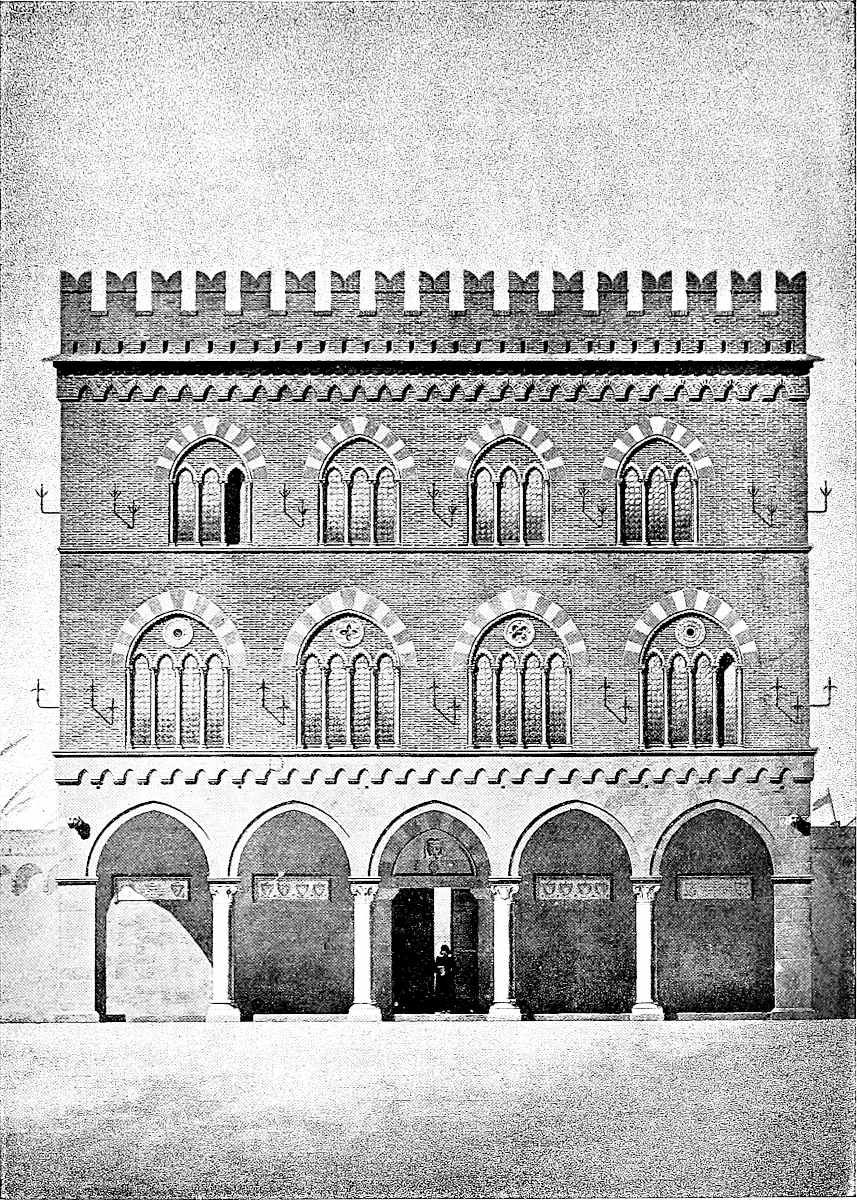
Palazzo di S. Giorgio Genoa.
“Certainly,” Paulin Paris observes, “there is a singular analogy between these two prefaces. And it must be remarked that the formula is not an ordinary one with translators, compilers, or authors of the 13th and 14th centuries. Perhaps you would not find a single other example of it.”[16]
This seems to place beyond question the identity of the Romance-compiler of Prince Edward’s suite in 1270, and the Prisoner of Genoa in 1298.
42. In Dunlop’s History of Fiction a passage is quoted from the preamble of Meliadus, as set forth in the Paris printed edition of 1528, Further particulars concerning Rustician. which gives us to understand that Rusticien de Pise had received as a reward for some of his compositions from King Henry III. the prodigal gift of two chateaux. I gather, however, from passages in the work of Paulin Paris that this must certainly be one of those confusions of persons to which I have referred before, and that the recipient of the chateaux was in reality Helye de Borron, the author of some of the originals which Rustician manipulated.[17] This supposed incident in Rustician’s scanty history must therefore be given up.
We call this worthy Rustician or Rusticiano, as the nearest probable representation in Italian form of the Rusticien of the Round-Table MSS. and the Rustacians of the old text of Polo. But it is highly probable that his real name was Rustichello, as is suggested by the form Rustichelus in the early Latin version published by the Société de Géographie. The change of one liquid for another never goes for much in Italy,[18] and Rustichello might easily Gallicize himself as Rusticien. In a very long list of Pisan officials during the Middle Ages I find several bearing the name of Rustichello or Rustichelli, but no Rusticiano or Rustigiano.[19]
Respecting him we have only to add that the peace between Genoa and Venice was speedily followed by a treaty between Genoa and Pisa. On the 31st July, 1299, a truce for twenty-five years was signed between those two Republics. It was a very different matter from that between Genoa and Venice, and contained much that was humiliating and detrimental to Pisa. But it embraced the release of prisoners; and those of Meloria, reduced it is said to less than one tithe of their original number, had their liberty at last. Among the prisoners then released no doubt Rustician was one. But we hear of him no more.
VIII. Notices of Marco Polo’s History, after the Termination of his Imprisonment at Genoa.
43. A few very disconnected notices are all that can be collected of matter properly biographical in relation to the quarter Death of Marco’s Father before 1300. Will of his brother Maffeo.century during which Marco Polo survived the Genoese captivity.
We have seen that he would probably reach Venice in the course of August, 1299. Whether he found his aged father alive is not known; but we know at least that a year later (31st August, 1300) Messer Nicolo was no longer in life.
This we learn from the Will of the younger Maffeo, Marco’s brother, which bears the date just named, and of which we give an abstract below.[1] It seems to imply strong regard for the testator’s brother Marco, who is made inheritor of the bulk of the property, failing the possible birth of a son. I have already indicated some conjectural deductions from this document. I may add that the terms of the second clause, as quoted in the note, seem to me to throw considerable doubt on the genealogy which bestows a large family of sons upon this brother Maffeo. If he lived to have such a family it seems improbable that the draft which he thus left in the hands of a notary, to be converted into a Will in the event of his death (a curious example of the validity attaching to all acts of notaries in those days), should never have been superseded, but should actually have been so converted after his death, as the existence of the parchment seems to prove. But for this circumstance we might suppose the Marcolino mentioned in the ensuing paragraph to have been a son of the younger Maffeo.
Messer Maffeo, the uncle, was, we see, alive at this time. We do not know the year of his death. But it is alluded to by Friar Pipino in the Preamble to his Translation of the Book, supposed to have been executed about 1315–1320; and we learn from a document in the Venetian archives (see p. 77) that it must have been previous to 1318, and subsequent to February 1309, the date of his last Will. The Will itself is not known to be extant, but from the reference to it in this document we learn that he left 1000 lire of public debt[2] (? imprestitorum) to a certain Marco Polo, called Marcolino. The relationship of this Marco to old Maffeo is not stated, but we may suspect him to have been an illegitimate son. [Marcolino was a son of Nicolo, son of Marco the Elder; see vol. ii., Calendar, No. 6.—H. C.]
44. In 1302 occurs what was at first supposed to be a glimpse of Marco as a citizen, slight and quaint enough; Documentary notices of Polo at this time. The sobriquet of Milione.being a resolution on the Books of the Great Council to exempt the respectable Marco Polo from the penalty incurred by him on account of the omission to have his water-pipe duly inspected. But since our Marco’s claims to the designation of Nobilis Vir have been established, there is a doubt whether the providus vir or prud’-homme here spoken of may not have been rather his namesake Marco Polo of Cannareggio or S. Geremia, of whose existence we learn from another entry of the same year.[3] It is, however, possible that Marco the Traveller was called to the Great Council after the date of the document in question.
We have seen that the Traveller, and after him his House and his Book, acquired from his contemporaries the surname, or nickname rather, of Il Milione. Different writers have given different explanations of the origin of this name; some, beginning with his contemporary Fra Jacopo d’Acqui, (supra, p. 54), ascribing it to the family’s having brought home a fortune of a million of lire, in fact to their being millionaires. This is the explanation followed by Sansovino, Marco Barbaro, Coronelli, and others.[4] More far-fetched is that of Fontanini, who supposes the name to have been given to the Book as containing a great number of stories, like the Cento Novelle or the Thousand and One Nights! But there can be no doubt that Ramusio’s is the true, as it is the natural, explanation; and that the name was bestowed on Marco by the young wits of his native city, because of his frequent use of a word which appears to have been then unusual, in his attempts to convey an idea of the vast wealth and magnificence of the Kaan’s Treasury and Court.[5] Ramusio has told us (supra, p. 6) that he had seen Marco styled by this sobriquet in the Books of the Signory; and it is pleasant to be able to confirm this by the next document which we cite. This is an extract from the Books of the Great Council under 10th April, 1305, condoning the offence of a certain Bonocio of Mestre in smuggling wine, for whose penalty one of the sureties had been the Nobilis Vir Marchus Paulo Milioni.[6]
It is alleged that long after our Traveller’s death there was always, in the Venetian Masques, one individual who assumed the character of Marco Milioni, and told Munchausenlike stories to divert the vulgar. Such, if this be true, was the honour of our prophet among the populace of his own country.[7]
45. A little later we hear of Marco once more, as presenting a copy of his Book to a noble Frenchman in the service of Charles of Valois.
This Prince, brother of Philip the Fair, in 1301 had married Catharine, daughter and heiress of Philip de Courtenay, titular Emperor ofPolo’s relations with Thibault de Cepoy. Constantinople, and on the strength of this marriage had at a later date set up his own claim to the Empire of the East. To this he was prompted by Pope Clement V., who in the beginning of 1306 wrote to Venice, stimulating that Government to take part in the enterprise. In the same year, Charles and his wife sent as their envoys to Venice, in connection with this matter, a noble knight called Thibault de Cepoy, along with an ecclesiastic of Chartres called Pierre le Riche, and these two succeeded in executing a treaty of alliance with Venice, of which the original, dated 14th December, 1306, exists at Paris. Thibault de Cepoy eventually went on to Greece with a squadron of Venetian Galleys, but accomplished nothing of moment, and returned to his master in 1310.[8]
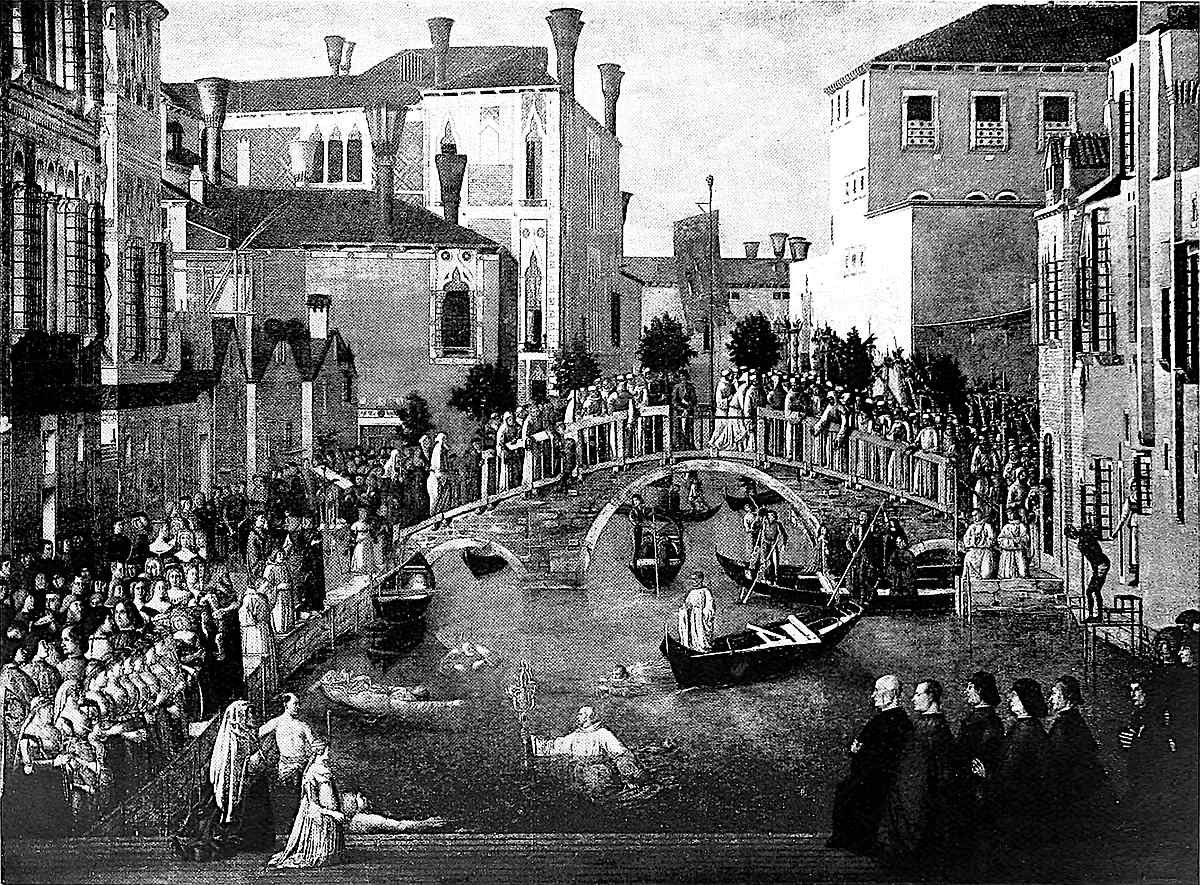
Miracle of S. Lorenzo.
During the stay of Thibault at Venice he seems to have made acquaintance with Marco Polo, and to have received from him a copy of his Book. This is recorded in a curious note which appears on two existing MSS. of Polo’s Book, viz., that of the Paris Library (10,270 or Fr. 5649), and that of Bern, which is substantially identical in its text with the former, and is, as I believe, a copy of it.[9] The note runs as follows:—
“Here you have the Book of which My Lord Thiebault, Knight and Lord of Cepoy, (whom may God assoil!) requested a copy from Sire Marc Pol, Burgess and Resident of the City of Venice. And the said Sire Marc Pol, being a very honourable Person, of high character and respect in many countries, because of his desire that what he had witnessed should be known throughout the World, and also for the honour and reverence he bore to the most excellent and puissant Prince my Lord Charles, Son of the King of France and Count of Valois, gave and presented to the aforesaid Lord of Cepoy the first copy (that was taken) of his said Book after he had made the same. And very pleasing it was to him that his Book should be carried to the noble country of France and there made known by so worthy a gentleman. And from that copy which the said Messire Thibault, Sire de Cepoy above-named, did carry into France, Messire John, who was his eldest son and is the present Sire de Cepoy,[10] after his Father’s decease did have a copy made, and that very first copy that was made of the Book after its being carried into France he did present to his very dear and dread Lord Monseigneur de Valois. Thereafter he gave copies of it to such of his friends as asked for them.
“And the copy above-mentioned was presented by the said Sire Marc Pol to the said Lord de Cepoy when the latter went to Venice, on the part of Monseigneur de Valois and of Madame the Empress his wife, as Vicar General for them both in all the Territories of the Empire of Constantinople. And this happened in the year of the Incarnation of our Lord Jesus Christ one thousand three hundred and seven, and in the month of August.”
Of the bearings of this memorandum on the literary history of Polo’s Book we shall speak in a following section.
46. When Marco married we have not been able to ascertain, but it was no doubt early in the 14th century, for in 1324, we find that he had twoHis marriage and his daughters. Marco as a merchant. married daughters besides one unmarried. His wife’s Christian name was Donata, but of her family we have as yet found no assurance. I suspect, however, that her name may have been Loredano (vide infra, p. 77).
Under 1311 we find a document which is of considerable interest, because it is the only one yet discovered which exhibits Marco under the aspect of a practical trader. It is the judgment of the Court of Requests upon a suit brought by the Noble Marco Polo of the parish of S. Giovanni Grisostomo against one Paulo Girardo of S. Apollinare. It appears that Marco had entrusted to the latter as a commission agent for sale, on an agreement for half profits, a pound and a half of musk, priced at six lire of grossi (about 22l. 10s. in value of silver) the pound. Girardo had sold half-a-pound at that rate, and the remaining pound which he brought back was deficient of a saggio, or, one-sixth of an ounce, but he had accounted for neither the sale nor the deficiency. Hence Marco sues him for three lire of Grossi, the price of the half-pound sold, and for twenty grossi as the value of the saggio. And the Judges cast the defendant in the amount with costs, and the penalty of imprisonment in the common gaol of Venice if the amounts were not paid within a suitable term.[11]
Again in May, 1323, probably within a year of his death, Ser Marco appears (perhaps only by attorney), before the Doge and his judicial examiners, to obtain a decision respecting a question touching the rights to certain stairs and porticoes in contact with his own house property, and that obtained from his wife, in S. Giovanni Grisostomo. To this allusion has been already made (supra, p. 31).
MARCO POLO’S LAST WILL
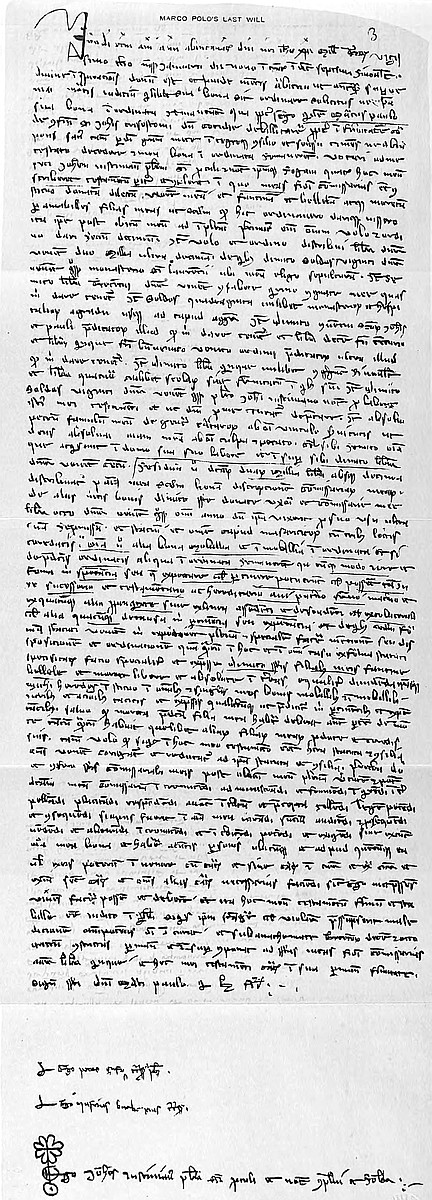
(Dimensions of Original, 26·4 inches by 9·4 inches) FROM A PHOTOGRAPH SPECIALLY TAKEN IN ST. MARK’S LIBRARY BY SIGNOR BERTANI.
47. We catch sight of our Traveller only once more. It is on the 9th ofMarco Polo’s Last Will and Death. January, 1324; he is labouring with disease, under which he is sinking day by day; and he has sent for Giovanni Giustiniani, Priest of S. Proculo and Notary, to make his Last Will and Testament. It runs thus:—
“In the Name of the Eternal God Amen!
“In the year from the Incarnation of our Lord Jesus Christ 1323, on the 9th day of the month of January, in the first half of the 7th Indiction,[12] at Rialto.
“It is the counsel of Divine Inspiration as well as the judgment of a provident mind that every man should take thought to make a disposition of his property before death become imminent, lest in the end it should remain without any disposition:
“Wherefore I Marcus Paulo of the parish of St. John Chrysostom, finding myself to grow daily feebler through bodily ailment, but being by the grace of God of a sound mind, and of senses and judgment unimpaired, have sent for John Giustiniani, Priest of S. Proculo and Notary, and have instructed him to draw out in complete form this my Testament:
“Whereby I constitute as my Trustees Donata my beloved wife, and my dear daughters Fantina, Bellela, and Moreta,[13] in order that after my decease they may execute the dispositions and bequests which I am about to make herein.
“First of all: I will and direct that the proper Tithe be paid.[14] And over and above the said tithe I direct that 2000 lire of Venice denari be distributed as follows:[15]
“Viz., 20 soldi of Venice grossi to the Monastery of St. Lawrence where I desire to be buried.
“Also 300 lire of Venice denari to my sister-in-law Ysabeta Quirino,[16] that she owes me.
“Also 40 soldi to each of the Monasteries and Hospitals all the way from Grado to Capo d’Argine.[17]
“Also I bequeath to the Convent of SS. Giovanni and Paolo, of the Order of Preachers, that which it owes me, and also 10 lire to Friar Renier, and 5 lire to Friar Benvenuto the Venetian, of the Order of Preachers, in addition to the amount of his debt to me.
“I also bequeath 5 lire to every Congregation in Rialto, and 4 lire to every Guild or Fraternity of which I am a member.[18]
“Also I bequeath 20 soldi of Venetian grossi to the Priest Giovanni Giustiniani the Notary, for his trouble about this my Will, and in order that he may pray the Lord in my behalf.
“Also I release Peter the Tartar, my servant, from all bondage, as completely as I pray God to release mine own soul from all sin and guilt. And I also remit him whatever he may have gained by work at his own house; and over and above I bequeath him 100 lire of Venice denari.[19]
“And the residue of the said 2000 lire free of tithe, I direct to be distributed for the good of my soul, according to the discretion of my trustees.
“Out of my remaining property I bequeath to the aforesaid Donata, my Wife and Trustee, 8 lire of Venetian grossi annually during her life, for her own use, over and above her settlement, and the linen and all the household utensils,[20] with 3 beds garnished.
“And all my other property movable and immovable that has not been disposed of [here follow some lines of mere technicality] I specially and expressly bequeath to my aforesaid Daughters Fantina, Bellela, and Moreta, freely and absolutely, to be divided equally among them. And I constitute them my heirs as regards all and sundry my property movable and immovable, and as regards all rights and contingencies tacit and expressed, of whatsoever kind as hereinbefore detailed, that belong to me or may fall to me. Save and except that before division my said daughter Moreta shall receive the same as each of my other daughters hath received for dowry and outfit [here follow many lines of technicalities, ending]
“And if any one shall presume to infringe or violate this Will, may he incur the malediction of God Almighty, and abide bound under the anathema of the 318 Fathers; and farthermore he shall forfeit to my Trustees aforesaid five pounds of gold;[21] and so let this my Testament abide in force. The signature of the above named Messer Marco Paulo who gave instructions for this deed.
“‡ I Peter Grifon, Priest, Witness.
“* I Humfrey Barberi, Witness.
“† I John Giustiniani, Priest of S. Proculo, and Notary, have completed and authenticated (this testament).”[22]
We do not know, as has been said, how long Marco survived the making of this will, but we know, from a scanty series of documents commencing in June of the following year (1325), that he had then been some time dead.[23]
48. He was buried, no doubt, according to his declared wish, in the Church of S. Lorenzo; Place of Sepulture. Professed Portraits of Polo.and indeed Sansovino bears testimony to the fact in a confused notice of our Traveller.[24] But there does not seem to have been any monument to Marco, though the sarcophagus which had been erected to his father Nicolo, by his own filial care, existed till near the end of the 16th century in the porch or corridor leading to the old Church of S. Lorenzo, and bore the inscription: “Sepultura Domini Nicolai Paulo de contrata S. Ioannis Grisostemi.” The church was renewed from its foundations in 1592, and then, probably, the sarcophagus was cast aside and lost, and with it all certainty as to the position of the tomb.[25]
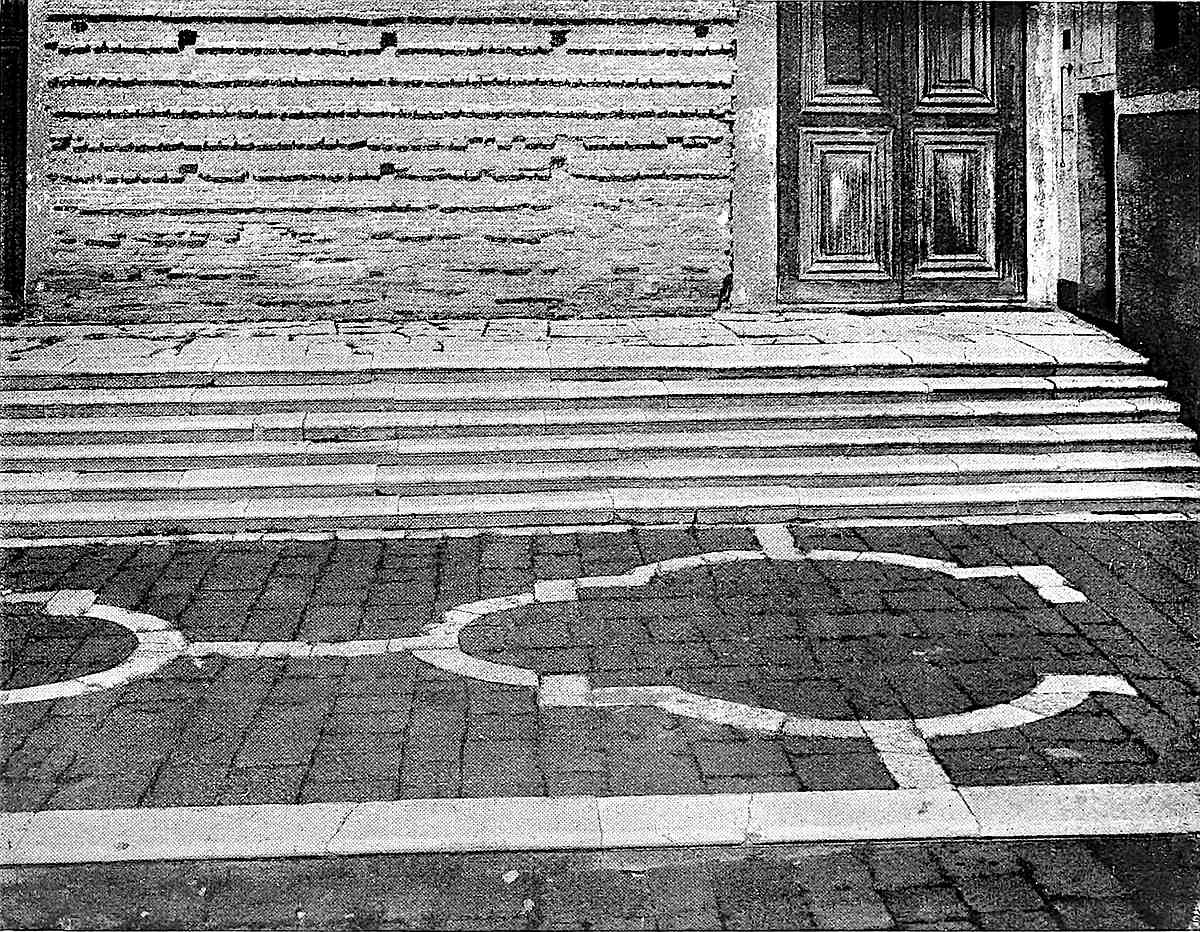
Pavement in front of San Lorenzo, Venice.
There is no portrait of Marco Polo in existence with any claim to authenticity. The quaint figure which we give in the Bibliography, vol. ii. p. 555, extracted from the earliest printed edition of his book, can certainly make no such pretension. The oldest one after this is probably a picture in the collection of Monsignor Badia at Rome, of which I am now able, by the owner’s courtesy, to give a copy. It is set down in the catalogue to Titian, but is probably a work of 1600, or thereabouts, to which the aspect and costume belong. It is inscribed “Marcus Polvs Venetvs Totivs Orbis et Indie Peregrator Primus.” Its history unfortunately cannot be traced, but I believe it came from a collection at Urbino. A marble statue was erected in his honour by a family at Venice in the 17th century, and is still to be seen in the Palazzo Morosini-Gattemburg in the Campo S. Stefano in that city. The medallion portrait on the wall of the Sala dello Scudo in the ducal palace, and which was engraved in Bettom’s “Collection of Portraits of Illustrious Italians,” is a work of imagination painted by Francesco Griselini in 1761.[26] From this, however, was taken the medal by Fabris, which was struck in 1847 in honour of the last meeting of the Italian Congresso Scientifico; and from the medal again is copied, I believe, the elegant woodcut which adorns the introduction to M. Pauthier’s edition, though without any information as to its history. A handsome bust, by Augusto Gamba, has lately been placed among the illustrious Venetians in the inner arcade of the Ducal Palace.[27] There is also a mosaic portrait of Polo, opposite the similar portrait of Columbus in the Municipio at Genoa.
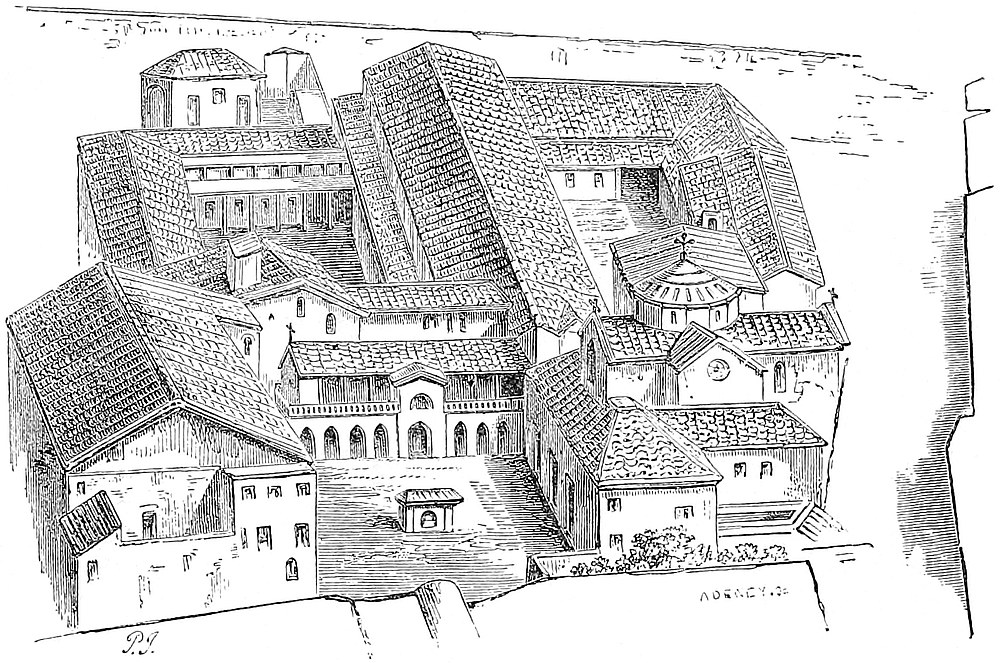
S. Lorenzo as it was in the 15th century.
49. From the short series of documents recently alluded to,[28] we gather all that we know of the remaining history of Marco Polo’s immediate family. Further History of the Polo Family. We have seen in his will an indication that the two elder daughters, Fantina and Bellela, were married before his death. In 1333 we find the youngest, Moreta, also a married woman, and Bellela deceased. In 1336 we find that their mother Donata had died in the interval. We learn, too, that Fantina’s husband was Marco Bragadino, and Moreta’s, Ranuzzo Dolfino.[29] The name of Bellela’s husband does not appear.
Fantina’s husband is probably the Marco Bragadino, son of Pietro, who in 1346 is mentioned to have been sent as Provveditore-Generale to act against the Patriarch of Acquileia.[30] And in 1379 we find Donna Fantina herself, presumably in widowhood, assessed as a resident of S. Giovanni Grisostomo, on the Estimo or forced loan for the Genoese war, at 1300 lire, whilst Pietro Bragadino of the same parish—her son as I imagine—is assessed at 1500 lire.[31] [See vol. ii., Calendar.]
The documents show a few other incidents which may be briefly noted. In 1326 we have the record of a charge against one Zanino Grioni for insulting Donna Moreta in the Campo of San Vitale; a misdemeanour punished by the Council of Forty with two months’ imprisonment.
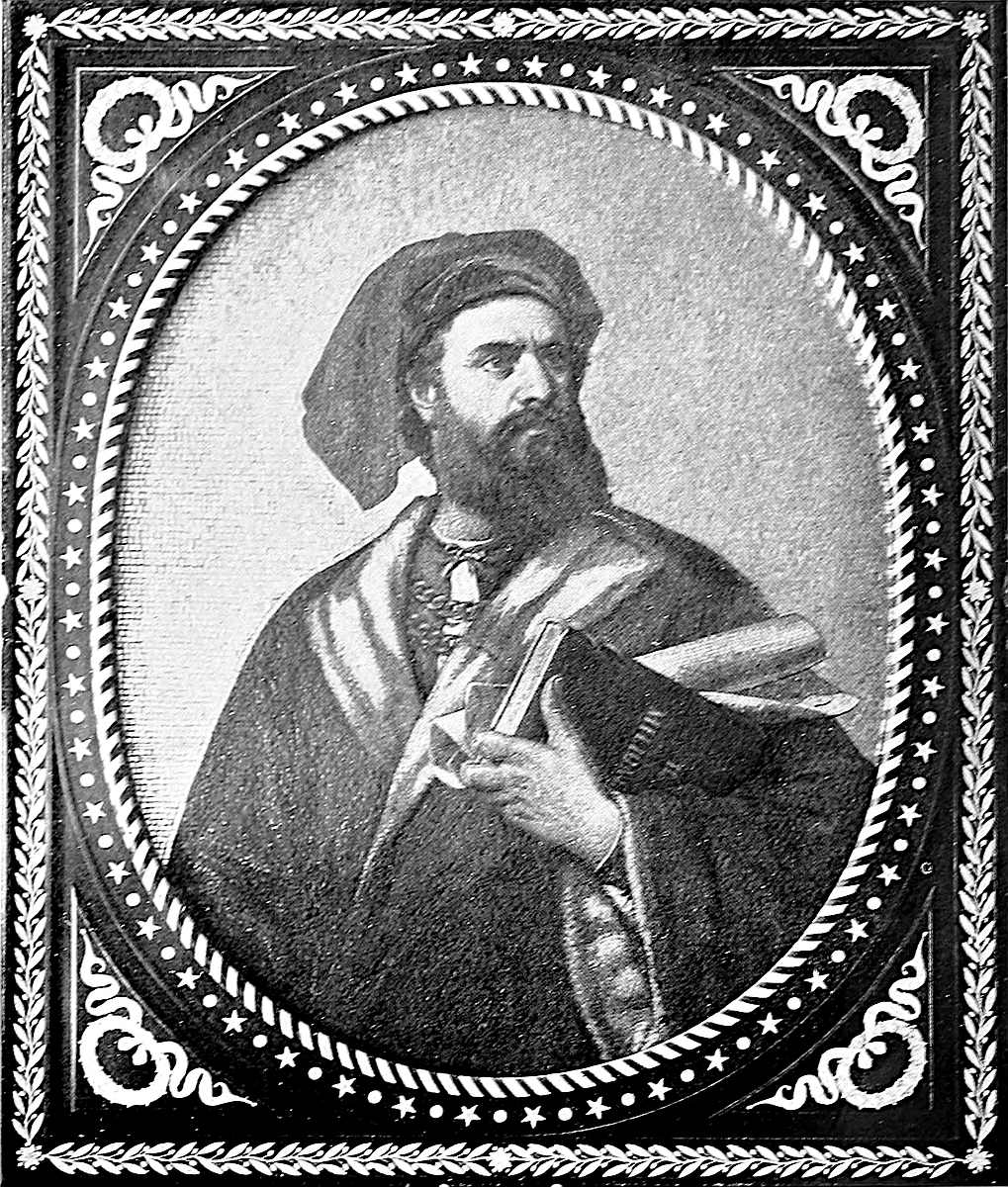
Mosaic Portrait of Marco Polo at Genoa.
In March, 1328, Marco Polo, called Marcolino, of St. John Chrysostom (see p. 66), represents before the Domini Advocatores of the Republic that certain imprestita that had belonged to the late Maffeo Polo the Elder, had been alienated and transferred in May 1318, by the late Marco Polo of St. John Chrysostom and since his death by his heirs, without regard to the rights of the said Marcolino, to whom the said Messer Maffeo had bequeathed 1000 lire by his will executed on 6th February, 1308 (i.e. 1309). The Advocatores find that the transfer was to that extent unjust and improper, and they order that to the same extent it should be revoked and annulled. Two months later the Lady Donata makes rather an unpleasant figure before the Council of Forty. It would seem that on the claim of Messer Bertuccio Quirino a mandate of sequestration had been issued by the Court of Requests affecting certain articles in the Ca’ Polo; including two bags of money which had been tied and sealed, but left in custody of the Lady Donata. The sum so sealed was about 80 lire of grossi (300l. in silver value), but when opened only 45 lire and 22 grossi (about 170l.) were found therein, and the Lady was accused of abstracting the balance non bono modo. Probably she acted, as ladies sometimes do, on a strong sense of her own rights, and a weak sense of the claims of law. But the Council pronounced against her, ordering restitution, and a fine of 200 lire over and above “ut ceteris transeat in exemplum.”[32]
It will have been seen that there is nothing in the amounts mentioned in Marco’s will to bear out the large reports as to his wealth, though at the same time there is no positive ground for a deduction to the contrary.[33]
The mention in two of the documents of Agnes Loredano as the sister of the Lady Donata suggests that the latter may have belonged to the Loredano family, but as it does not appear whether Agnes was maid or wife this remains uncertain.[34]
Respecting the further history of the family there is nothing certain, nor can we give unhesitating faith to Ramusio’s statement that the last male descendant of the Polos of S. Giovanni Grisostomo was Marco, who died Castellano of Verona in 1417 (according to others, 1418, or 1425),[35] and that the family property then passed to Maria (or Anna, as she is styled in a MS. statement furnished to me from Venice), who was married in 1401 to Benedetto Cornaro, and again in 1414 to Azzo Trevisan. Her descendant in the fourth generation by the latter was Marc Antonio Trevisano,[36] who was chosen Doge in 1553.
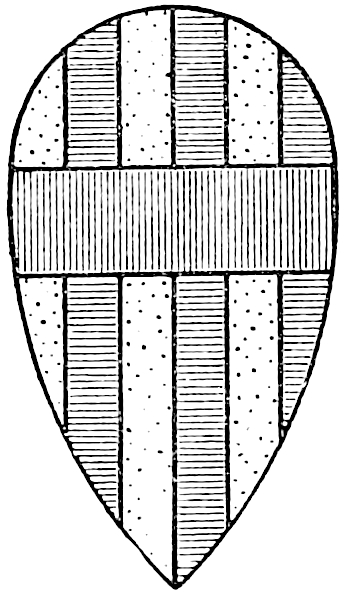
Arms of the Trevisan family.
The genealogy recorded by Marco Barbaro, as drawn up from documents by Ramusio, makes the Castellano of Verona a grandson of our Marco by a son Maffeo, whom we may safely pronounce not to have existed, and makes Maria the daughter of Maffeo, Marco’s brother—that is to say, makes a lady marry in 1414 and have children, whose father was born in 1271 at the very latest! The genealogy is given in several other ways, but as I have satisfied myself that they all (except perhaps this of Barbaro’s, which we see to be otherwise erroneous) confound together the two distinct families of Polo of S. Geremia and Polo of S. Giov. Grisostomo, I reserve my faith, and abstain from presenting them. Assuming that the Marco or Marcolino Polo, spoken of in the preceding page, was a near relation (as is probable, though perhaps an illegitimate one), he is the only male descendant of old Andrea of San Felice whom we can indicate as having survived Marco himself; and from a study of the links in the professed genealogies I think it not unlikely that both Marco the Castellano of Verona and Maria Trevisan belonged to the branch of S. Geremia.[37] [See vol. ii., App. C, p. 510.]
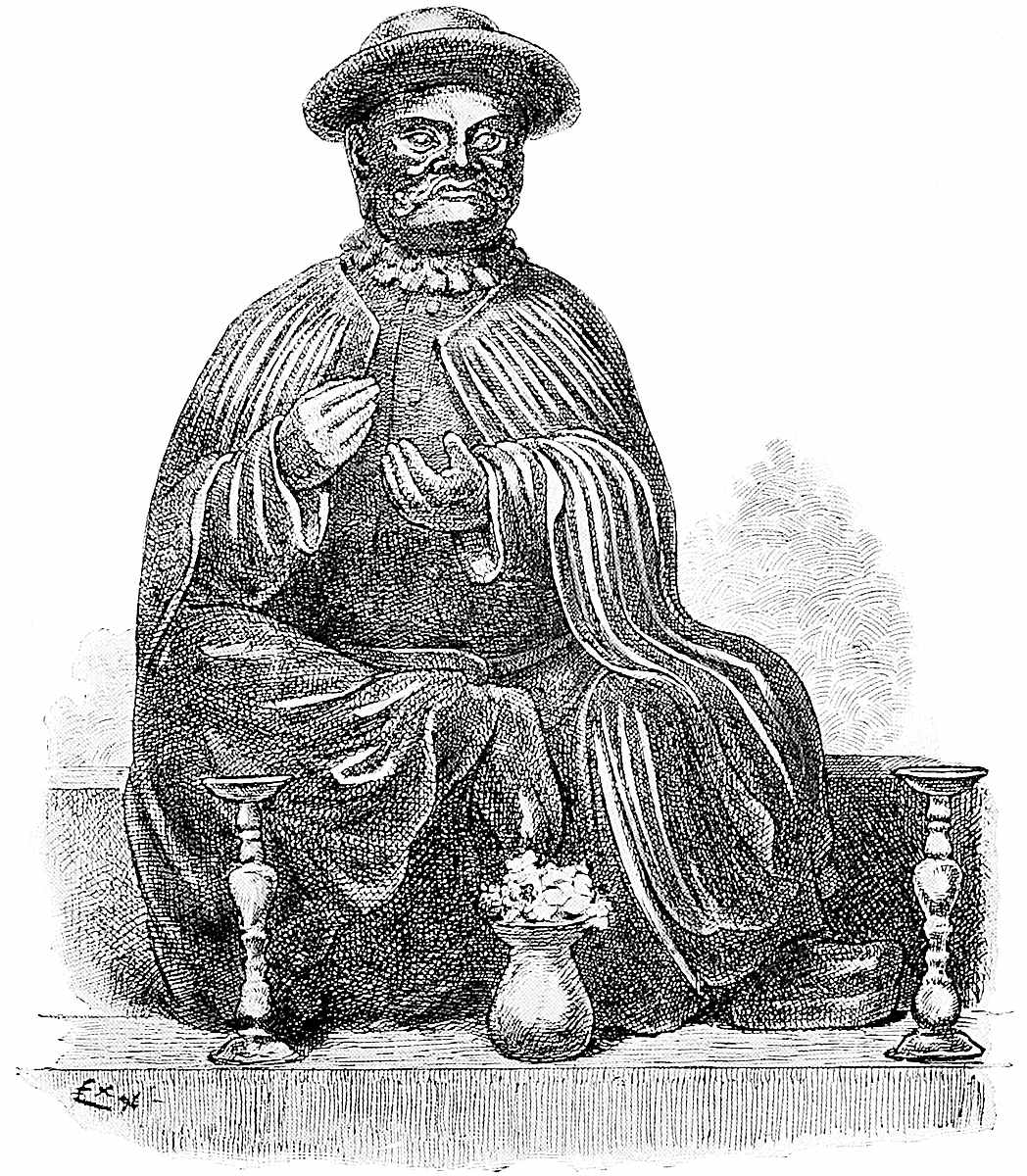
The Pseudo Marco Polo at Canton.
[49. bis.—It is interesting to note some of the reliques left by our traveller.
I. The unfortunate Doge of Venice, Marino Faliero, seems to have possessed many souvenirs of Marco Polo, and among them two manuscripts, one in the handwriting of his celebrated fellow-citizen(?), and one adorned with miniatures. M. Julius von Schlosser has reprinted (Die ältesten Medaillen und die Antike, Bd. XVIII., Jahrb. d. Kunsthist. Samml. d. Allerhöchsten Kaiserhauses, Vienna, 1897, pp. 42–43) from the Bulletino di arti, industrie e curiosità veneziane, III., 1880–81, p. 101,[38] the inventory of the curiosities kept in the “Red Chamber” of Marino Faliero’s palace in the Parish of the SS. Apostles; we give the following abstract of it:—
Anno ab incarnacione domini nostri Jesu Christi 1351° indictione sexta mensis aprilis. Inuentarium rerum qui sunt in camera rubea domi habitationis clarissimi domini Marini Faletro de confinio SS. Apostolorum, scriptum per me Johannem, presbiterum, dicte ecclesie.
•••••
Item alia capsaleta cum ogiis auri et argenti, inter quos unum anulum con inscriptione que dicit: Ciuble Can Marco Polo, et unum torques cum multis animalibus Tartarorum sculptis, que res donum dedit predictus Marcus cuidam Faletrorum.
•••••
Item 2 capsalete de corio albo cum variis rebus auri et argenti, quas habuit praedictus Marcus a Barbarorum rege.
•••••
Item 1 ensem mirabilem, qui habet 3 enses simul, quem habuit in suis itineribus praedictus Marcus.
•••••
Item 1 tenturam de pannis indicis, quam habuit praedictus Marcus.
Item de itineribus Marci praedicti liber in corio albo cum multis figuris.
Item aliud volumen quod vocatur de locis mirabilibus Tartarorum, scriptum manu praedicti Marci.
•••••
II. There is kept at the Louvre, in the very valuable collection of China Ware given by M. Ernest Grandidier, a white porcelain incense-burner said to come from Marco Polo. This incense-burner, which belonged to Baron Davillier, who received it, as a present, from one of the keepers of the Treasury of St. Mark’s at Venice, is an octagonal ting from the Fo-kien province, and of the time of the Sung Dynasty. By the kind permission of M. P. Grandidier, we reproduce it from Pl. II. 6, of the Céramique chinoise, Paris, 1894, published by this learned amateur.—H. C.]
IX. Marco Polo’s Book; and the Language in which it was first written.
50. The Book itself consists essentially of Two Parts. First, of a Prologue, as it is termed, the only part which is actual personal General statement of what the Book contains. narrative, and which relates, in a very interesting but far too brief manner, the circumstances which led the two elder Polos to the Kaan’s Court, and those of their second journey with Mark, and of their return to Persia through the Indian Seas. Secondly, of a long series of chapters of very unequal length, descriptive of notable sights and products, of curious manners and remarkable events, relating to the different nations and states of Asia, but, above all, to the Emperor Kúblái, his court, wars, and administration. A series of chapters near the close treats in a verbose and monotonous manner of sundry wars that took place between the various branches of the House of Chinghiz in the latter half of the 13th century. This last series is either omitted or greatly curtailed in all the copies and versions except one; a circumstance perfectly accounted for by the absence of interest as well as value in the bulk of these chapters. Indeed, desirous though I have been to give the Traveller’s work complete, and sharing the dislike that every man who uses books must bear to abridgments, I have felt that it would be sheer waste and dead-weight to print these chapters in full.
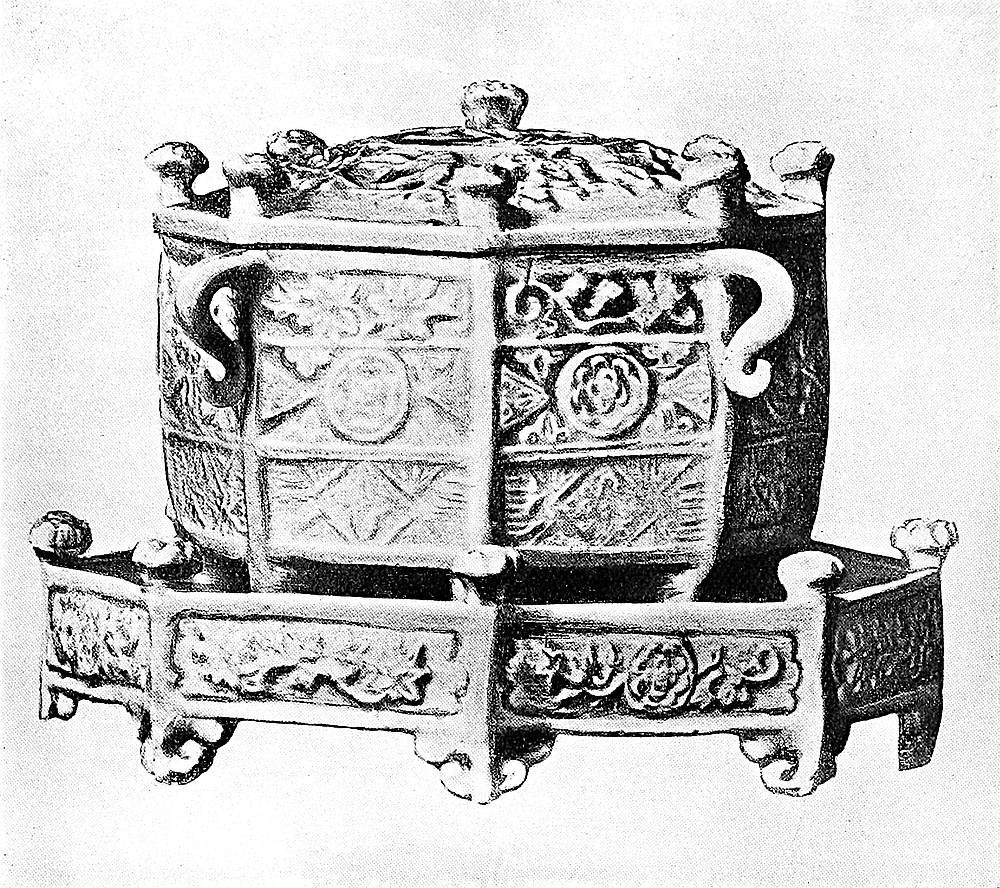
Porcelain Incense-Burner, from the Louvre.
This second and main portion of the Work is in its oldest forms undivided, the chapters running on consecutively to the end.[1] In some very early Italian or Venetian version, which Friar Pipino translated into Latin, it was divided into three Books, and this convenient division has generally been adhered to. We have adopted M. Pauthier’s suggestion in making the final series of chapters, chiefly historical, into a Fourth.
51. As regards the language in which Marco’s Book was first committed to writing, we have seen that Ramusio assumed, somewhat arbitrarily, that it was Latin; Language of the original Work.Marsden supposed it to have been the Venetian dialect; Baldelli Boni first showed, in his elaborate edition (Florence, 1827), by arguments that have been illustrated and corroborated by learned men since, that it was French.
That the work was originally written in some Italian dialect was a natural presumption, and slight contemporary evidence can be alleged in its favour; for Fra Pipino, in the Latin version of the work, executed whilst Marco still lived, describes his task as a translation de vulgari. And in one MS. copy of the same Friar Pipino’s Chronicle, existing in the library at Modena, he refers to the said version as made “ex vulgari idiomate Lombardico.” But though it may seem improbable that at so early a date a Latin version should have been made at second hand, I believe this to have been the case, and that some internal evidence also is traceable that Pipino translated not from the original but from an Italian version of the original.
The oldest MS. (it is supposed) in any Italian dialect is one in the Magliabecchian Library at Florence, which is known in Italy as L’Ottima, on account of the purity of its Tuscan, and as Della Crusca from its being one of the authorities cited by that body in their Vocabulary.[2] It bears on its face the following note in Italian:—
“This Book called the Navigation of Messer Marco Polo, a noble Citizen of Venice, was written in Florence by Michael Ormanni my great grandfather by the Mother’s side, who died in the Year of Grace One Thousand Three Hundred and Nine; and my mother brought it into our Family of Del Riccio, and it belongs to me Pier del Riccio and to my Brother; 1452.”
As far as I can learn, the age which this note implies is considered to be supported by the character of the MS. itself.[3] If it be accepted, the latter is a performance going back to within eleven years at most of the first dictation of the Travels. At first sight, therefore, this would rather argue that the original had been written in pure Tuscan. But when Baldelli came to prepare it for the press he found manifest indications of its being a Translation from the French. Some of these he has noted; others have followed up the same line of comparison. We give some detailed examples in a note.[4]
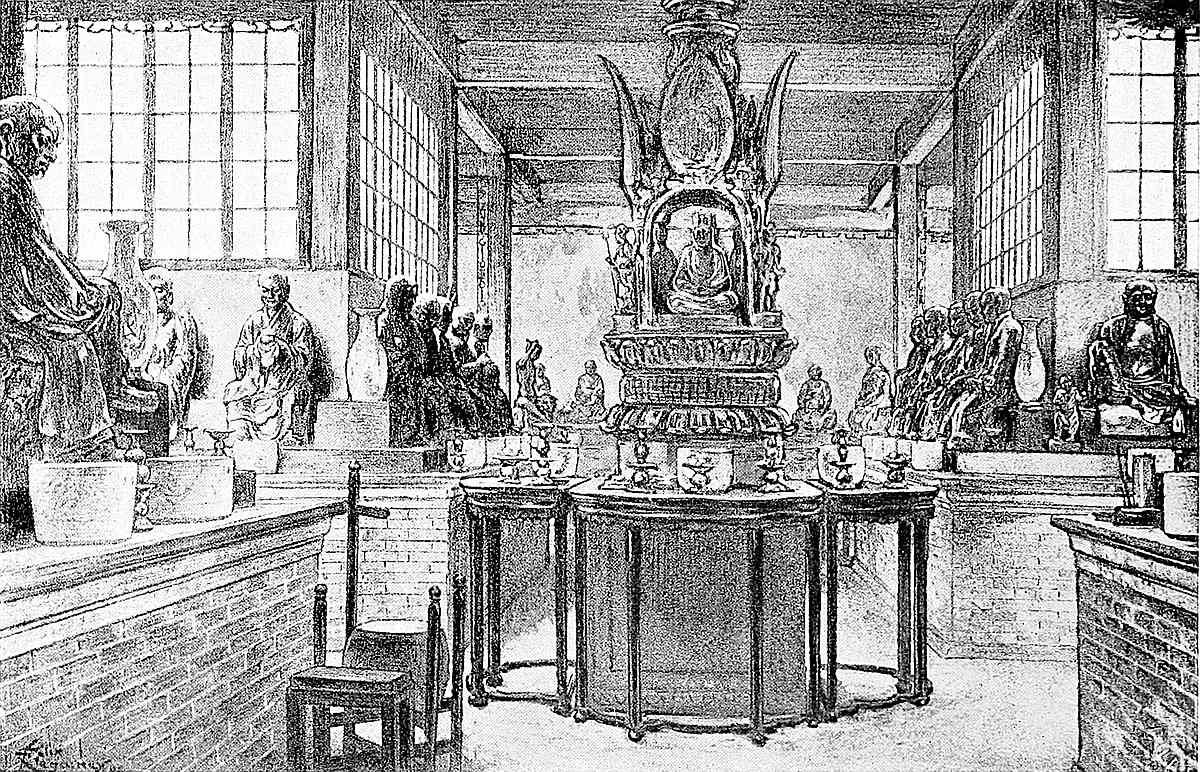
Temple of 500 Genii, at Canton, after a Drawing by Félix Régamey.
52. The French Text that we have been quoting, published by the Geographical Society of Paris in 1824, affords on the other hand the strongest correspondingOld French Text published by the Société de Géographie. proof that it is an original and not a Translation. Rude as is the language of the manuscript (Fr. 1116, formerly No. 7367, of Paris Library), it is, in the correctness of the proper names, and the intelligible exhibition of the itineraries, much superior to any form of the Work previously published.
The language is very peculiar. We are obliged to call it French, but it is not “Frenche of Paris.” “Its style,” says Paulin Paris, “is about as like that of good French authors of the age, as in our day the natural accent of a German, an Englishman, or an Italian, is like that of a citizen of Paris or Blois.” The author is at war with all the practices of French grammar; subject and object, numbers, moods, and tenses, are in consummate confusion. Even readers of his own day must at times have been fain to guess his meaning. Italian words are constantly introduced, either quite in the crude or rudely Gallicized.[5] And words also, we may add, sometimes slip in which appear to be purely Oriental, just as is apt to happen with Anglo-Indians in these days.[6] All this is perfectly consistent with the supposition that we have in this MS. a copy at least of the original words as written down by Rusticiano a Tuscan, from the dictation of Marco an Orientalized Venetian, in French, a language foreign to both.
But the character of the language as French is not its only peculiarity. There is in the style, apart from grammar or vocabulary, a rude angularity, a rough dramatism like that of oral narrative; there is a want of proportion in the style of different parts, now over curt, now diffuse and wordy, with at times even a hammering reiteration; a constant recurrence of pet colloquial phrases (in which, however, other literary works of the age partake); a frequent change in the spelling of the same proper names, even when recurring within a few lines, as if caught by ear only; a literal following to and fro of the hesitations of the narrator; a more general use of the third person in speaking of the Traveller, but an occasional lapse into the first. All these characteristics are strikingly indicative of the unrevised product of dictation, and many of them would necessarily disappear either in translation or in a revised copy.
Of changes in representing the same proper name, take as an example that of the Kaan of Persia whom Polo calls Quiacatu (Kaikhátú), but also Acatu, Catu, and the like.
As an example of the literal following of dictation take the following:—
“Let us leave Rosia, and I will tell you about the Great Sea (the Euxine), and what provinces and nations lie round about it, all in detail; and we will begin with Constantinople—First, however, I should tell you about a province, etc.... There is nothing more worth mentioning, so I will speak of other subjects,—but there is one thing more to tell you about Rosia that I had forgotten.... Now then let us speak of the Great Sea as I was about to do. To be sure many merchants and others have been here, but still there are many again who know nothing about it, so it will be well to include it in our Book. We will do so then, and let us begin first with the Strait of Constantinople.
“At the Straits leading into the Great Sea, on the West Side, there is a hill called the Faro.—But since beginning on this matter I have changed my mind, because so many people know all about it, so we will not put it in our description but go on to something else.” (See vol. ii. p. 487 seqq.)
And so on.
As a specimen of tautology and hammering reiteration the following can scarcely be surpassed. The Traveller is speaking of the Chughi, i.e. the Indian Jogis:—
“And there are among them certain devotees, called Chughi; these are longer-lived than the other people, for they live from 150 to 200 years; and yet they are so hale of body that they can go and come wheresoever they please, and do all the service needed for their monastery or their idols, and do it just as well as if they were younger; and that comes of the great abstinence that they practise, in eating little food and only what is wholesome; for they use to eat rice and milk more than anything else. And again I tell you that these Chughi who live such a long time as I have told you, do also eat what I am going to tell you, and you will think it a great matter. For I tell you that they take quicksilver and sulphur, and mix them together, and make a drink of them, and then they drink this, and they say that it adds to their life; and in fact they do live much longer for it; and I tell you that they do this twice every month. And let me tell you that these people use this drink from their infancy in order to live longer, and without fail those who live so long as I have told you use this drink of sulphur and quicksilver.” (See G. T. p. 213.)
Such talk as this does not survive the solvent of translation; and we may be certain that we have here the nearest approach to the Traveller’s reminiscences as they were taken down from his lips in the prison of Genoa.
Conclusive proof that the Old French Text is the source of all the others.
53. Another circumstance, heretofore I believe unnoticed, is in itself enough to demonstrate the Geographic Text to be the source of all other versions of the Work. It is this.
In reviewing the various classes or types of texts of Polo’s Book, which we shall hereafter attempt to discriminate, there are certain proper names which we find in the different texts to take very different forms, each class adhering in the main to one particular form.
Thus the names of the Mongol ladies introduced at pp. 32 and 36 of this volume, which are in proper Oriental form Bulughán and Kukáchin, appear in the class of MSS. which Pauthier has followed as Bolgara and Cogatra; in the MSS. of Pipino’s version, and those founded on it, including Ramusio, the names appear in the correcter forms Bolgana or Balgana and Cogacin. Now all the forms Bolgana, Balgana, Bolgara, and Cogatra, Cocacin appear in the Geographic Text.
Kaikhátú Kaan appears in the Pauthier MSS. as Chiato, in the Pipinian as Acatu, in the Ramusian as Chiacato. All three forms, Chiato, Achatu, and Quiacatu are found in the Geographic Text.
The city of Koh-banan appears in the Pauthier MSS. as Cabanant, in the Pipinian and Ramusian editions as Cobinam or Cobinan. Both forms are found in the Geographic Text.
The city of the Great Kaan (Khanbalig) is called in the Pauthier MSS. Cambaluc, in the Pipinian and Ramusian less correctly Cambalu. Both forms appear in the Geographic Text.
The aboriginal People on the Burmese Frontier who received from the Western officers of the Mongols the Persian name (translated from that applied by the Chinese) of Zardandán, or Gold-Teeth, appear in the Pauthier MSS. most accurately as Zardandan, but in the Pipinian as Ardandan (still further corrupted in some copies into Arcladam). Now both forms are found in the Geographic Text. Other examples might be given, but these I think may suffice to prove that this Text was the common source of both classes.
In considering the question of the French original too we must remember what has been already said regarding Rusticien de Pise and his other French writings; and we shall find hereafter an express testimony borne in the next generation that Marco’s Book was composed in vulgari Gallico.
54. But, after all, the circumstantial evidence that has been adduced from the texts themselves is the most conclusive. Greatly diffused employment of French in that age.We have then every reason to believe both that the work was written in French, and that an existing French Text is a close representation of it as originally committed to paper. And that being so we may cite some circumstances to show that the use of French or quasi-French for the purpose was not a fact of a very unusual or surprising nature. The French language had at that time almost as wide, perhaps relatively a wider, diffusion than it has now. It was still spoken at the Court of England, and still used by many English writers, of whom the authors or translators of the Round Table Romances at Henry III.’s Court are examples.[7] In 1249 Alexander III. King of Scotland, at his coronation spoke in Latin and French; and in 1291 the English Chancellor addressing the Scotch Parliament did so in French. At certain of the Oxford Colleges as late as 1328 it was an order that the students should converse colloquio latino vel saltem gallico.[8] Late in the same century Gower had not ceased to use French, composing many poems in it, though apologizing for his want of skill therein:—
“Et si jeo nai de François la faconde * * * * Jeo suis Englois; si quier par tiele voie Estre excusé.”[9]
Indeed down to nearly 1385, boys in the English grammar-schools were taught to construe their Latin lessons into French.[10] St. Francis of Assisi is said by some of his biographers to have had his original name changed to Francesco because of his early mastery of that language as a qualification for commerce. French had been the prevalent tongue of the Crusaders, and was that of the numerous Frank Courts which they established in the East, including Jerusalem and the states of the Syrian coast, Cyprus, Constantinople during the reign of the Courtenays, and the principalities of the Morea. The Catalan soldier and chronicler Ramon de Muntaner tells us that it was commonly said of the Morean chivalry that they spoke as good French as at Paris.[11] Quasi-French at least was still spoken half a century later by the numerous Christians settled at Aleppo, as John Marignolli testifies;[12] and if we may trust Sir John Maundevile the Soldan of Egypt himself and four of his chief Lords “spak Frensche righte wel!”[13] Gházán Kaan, the accomplished Mongol Sovereign of Persia, to whom our Traveller conveyed a bride from Cambaluc, is said by the historian Rashiduddin to have known something of the Frank tongue, probably French.[14] Nay, if we may trust the author of the Romance of Richard Cœur-de-Lion, French was in his day the language of still higher spheres![15]
Nor was Polo’s case an exceptional one even among writers on the East who were not Frenchmen. Maundevile himself tells us that he put his book first “out of Latyn into Frensche,” and then out of French into English.[16] The History of the East which the Armenian Prince and Monk Hayton dictated to Nicolas Faulcon at Poictiers in 1307 was taken down in French. There are many other instances of the employment of French by foreign, and especially by Italian authors of that age. The Latin chronicle of the Benedictine Amato of Monte Cassino was translated into French early in the 13th century by another monk of the same abbey, at the particular desire of the Count of Militrée (or Malta), “Pour ce qu’il set lire et entendre fransoize et s’en delitte.”[17] Martino da Canale, a countryman and contemporary of Polo’s, during the absence of the latter in the East wrote a Chronicle of Venice in the same language, as a reason for which he alleges its general popularity.[18] The like does the most notable example of all, Brunetto Latini, Dante’s master, who wrote in French his encyclopædic and once highly popular work Li Tresor.[19] Other examples might be given, but in fact such illustration is superfluous when we consider that Rusticiano himself was a compiler of French Romances.
But why the language of the Book as we see it in the Geographic Text should be so much more rude, inaccurate, and Italianized than that of Rusticiano’s other writings, is a question to which I can suggest no reply quite satisfactory to myself. Is it possible that we have in it a literal representation of Polo’s own language in dictating the story,—a rough draft which it was intended afterwards to reduce to better form, and which was so reduced (after a fashion) in French copies of another type, regarding which we shall have to speak presently?[20] And, if this be the true answer, why should Polo have used a French jargon in which to tell his story? Is it possible that his own mother Venetian, such as he had carried to the East with him and brought back again, was so little intelligible to Rusticiano that French of some kind was the handiest medium of communication between the two? I have known an Englishman and a Hollander driven to converse in Malay; Chinese Christians of different provinces are said sometimes to take to English as the readiest means of intercommunication; and the same is said even of Irish-speaking Irishmen from remote parts of the Island.
It is worthy of remark how many notable narratives of the Middle Ages have been dictated instead of being written by their authors, and that in cases where it is impossible to ascribe this to ignorance of writing. The Armenian Hayton, though evidently a well-read man, possibly could not write in Roman characters. But Joinville is an illustrious example. And the narratives of four of the most famous Mediæval Travellers[21] seem to have been drawn from them by a kind of pressure, and committed to paper by other hands. I have elsewhere remarked this as indicating how little diffused was literary ambition or vanity; but it would perhaps be more correct to ascribe it to that intense dislike which is still seen on the shores of the Mediterranean to the use of pen and ink. On certain of those shores at least there is scarcely any inconvenience that the majority of respectable and good-natured people will not tolerate—inconvenience to their neighbours be it understood—rather than put pen to paper for the purpose of preventing it.
X. Various Types of Text of Marco Polo’s Book.
55. In treating of the various Texts of Polo’s Book we must Four Principal Types of Text. First, that of the Geographic, or oldest French.necessarily go into some irksome detail.
Those Texts that have come down to us may be classified under Four principal Types.
I. The First Type is that of the Geographic Text of which we have already said so much. This is found nowhere complete except in the unique MS. of the Paris Library, to which it is stated to have come from the old Library of the French Kings at Blois. But the Italian Crusca, and the old Latin version (No. 3195 of the Paris Library) published with the Geographic Text, are evidently derived entirely from it, though both are considerably abridged. It is also demonstrable that neither of these copies has been translated from the other, for each has passages which the other omits, but that both have been taken, the one as a copy more or less loose, the other as a translation, from an intermediate Italian copy.[1] A special difference lies in the fact that the Latin version is divided into three Books, whilst the Crusca has no such division. I shall show in a tabular form the filiation of the texts which these facts seem to demonstrate (see Appendix G).
There are other Italian MSS. of this type, some of which show signs of having been derived independently from the French;[2] but I have not been able to examine any of them with the care needful to make specific deductions regarding them.
56. II. The next Type is that of the French MSS. on which M. Pauthier’s Text is based, and for which he claims the highest authority, Second; the remodelled French Text, followed by Pauthier.as having had the mature revision and sanction of the Traveller. There are, as far as I know, five MSS. which may be classed together under this type, three in the Great Paris Library, one at Bern, and one in the Bodleian.
The high claims made by Pauthier on behalf of this class of MSS. (on the first three of which his Text is formed) rest mainly upon the kind of certificate which two of them bear regarding the presentation of a copy by Marco Polo to Thibault de Cepoy, which we have already quoted (supra, p. 69). This certificate is held by Pauthier to imply that the original of the copies which bear it, and of those having a general correspondence with them, had the special seal of Marco’s revision and approval. To some considerable extent their character is corroborative of such a claim, but they are far from having the perfection which Pauthier attributes to them, and which leads him into many paradoxes.
It is not possible to interpret rigidly the bearing of this so-called certificate, as if no copies had previously been taken of any form of the Book; nor can we allow it to impugn the authenticity of the Geographic Text, which demonstratively represents an older original, and has been (as we have seen) the parent of all other versions, including some very old ones, Italian and Latin, which certainly owe nothing to this revision.
The first idea apparently entertained by d’Avezac and Paulin Paris was that the Geographic Text was itself the copy given to the Sieur de Cepoy, and that the differences in the copies of the class which we describe as Type II. merely resulted from the modifications which would naturally arise in the process of transcription into purer French. But closer examination showed the differences to be too great and too marked to admit of this explanation. These differences consist not only in the conversion of the rude, obscure, and half Italian language of the original into good French of the period. There is also very considerable curtailment, generally of tautology, but also extending often to circumstances of substantial interest; whilst we observe the omission of a few notably erroneous statements or expressions; and a few insertions of small importance. None of the MSS. of this class contain more than a few of the historical chapters which we have formed into Book IV.
The only addition of any magnitude is that chapter which in our translation forms chapter xxi. of Book II. It will be seen that it contains no new facts, but is only a tedious recapitulation of circumstances already stated, though scattered over several chapters. There are a few minor additions. I have not thought it worth while to collect them systematically here, but two or three examples are given in a note.[3]
There are also one or two corrections of erroneous statements in the G. T. which seem not to be accidental and to indicate some attempt at revision. Thus a notable error in the account of Aden, which seems to conceive of the Red Sea as a river, disappears in Pauthier’s MSS. A and B.[4] And we find in these MSS. one or two interesting names preserved which are not found in the older Text.[5]
But on the other hand this class of MSS. contains many erroneous readings of names, either adopting the worse of two forms occurring in the G. T. or originating blunders of its own.[6]
M. Pauthier lays great stress on the character of these MSS. as the sole authentic form of the work, from their claim to have been specially revised by Marco Polo. It is evident, however, from what has been said, that this revision can have been only a very careless and superficial one, and must have been done in great measure by deputy, being almost entirely confined to curtailment and to the improvement of the expression, and that it is by no means such as to allow an editor to dispense with a careful study of the Older Text.
57. There is another curious circumstance about the MSS. of this type, viz., that they clearly divide into two distinct recensions, The Bern MS. and two others form a sub-class of this Type.of which both have so many peculiarities and errors in common that they must necessarily have been both derived from one modification of the original text, whilst at the same time there are such differences between the two as cannot be set down to the accidents of transcription. Pauthier’s MSS. A and B (Nos. 16 and 15 of the List in App. F) form one of these subdivisions: his C (No. 17 of List), Bern (No. 56), and Oxford (No. 6), the other. Between A and B the differences are only such as seem constantly to have arisen from the whims of transcribers or their dialectic peculiarities. But between A and B on the one side, and C on the other, the differences are much greater. The readings of proper names in C are often superior, sometimes worse; but in the latter half of the work especially it contains a number of substantial passages[7] which are to be found in the G. T., but are altogether absent from the MSS. A and B; whilst in one case at least (the history of the Siege of Saianfu, vol. ii. p. 159) it diverges considerably from the G. T. as well as from A and B.[8]
I gather from the facts that the MS. C represents an older form of the work than A and B. I should judge that the latter had been derived from that older form, but intentionally modified from it. And as it is the MS. C, with its copy at Bern, that alone presents the certificate of derivation from the Book given to the Sieur de Cepoy, there can be no doubt that it is the true representative of that recension.
58. III. The next Type of Text is that found in Friar Pipino’s Latin version. It is the type of which MSS. are by far the most numerous. Third; Friar Pipino’s Latin.In it condensation and curtailment are carried a good deal further than in Type II. The work is also divided into three Books. But this division does not seem to have originated with Pipino, as we find it in the ruder and perhaps older Latin version of which we have already spoken under Type I. And we have demonstrated that this ruder Latin is a translation from an Italian copy. It is probable therefore that an Italian version similarly divided was the common source of what we call the Geographic Latin and of Pipino’s more condensed version.[9]
Pipino’s version appears to have been executed in the later years of Polo’s life.[10] But I can see no ground for the idea entertained by Baldelli-Boni and Professor Bianconi that it was executed with Polo’s cognizance and retouched by him.
59. The absence of effective publication in the Middle Ages led to a curious complicationThe Latin of Grynæus a translation at fifth hand. of translation and retranslation. Thus the Latin version published by Grynæus in the Novus Orbis (Basle, 1532) is different from Pipino’s, and yet clearly traceable to it as a base. In fact it is a retranslation into Latin from some version (Marsden thinks the printed Portuguese one) of Pipino. It introduces many minor modifications, omitting specific statements of numbers and values, generalizing the names and descriptions of specific animals, exhibiting frequent sciolism and self-sufficiency in modifying statements which the Editor disbelieved.[11] It is therefore utterly worthless as a Text, and it is curious that Andreas Müller, who in the 17th century devoted himself to the careful editing of Polo, should have made so unfortunate a choice as to reproduce this fifth-hand Translation. I may add that the French editions published in the middle of the 16th century are translations from Grynæus. Hence they complete this curious and vicious circle of translation: French—Italian—Pipino’s Latin—Portuguese?—Grynæus’s Latin—French![12]
60. IV. We now come to a Type of Text which deviates largely from any of those hitherto spoken of, and the history Fourth; Ramusio’s Italian.and true character of which are involved in a cloud of difficulty. We mean that Italian version prepared for the press by G. B. Ramusio, with most interesting, though, as we have seen, not always accurate preliminary dissertations, and published at Venice two years after his death, in the second volume of the Navigationi e Viaggi.[13]
The peculiarities of this version are very remarkable. Ramusio seems to imply that he used as one basis at least the Latin of Pipino; and many circumstances, such as the division into Books, the absence of the terminal historical chapters and of those about the Magi, and the form of many proper names, confirm this. But also many additional circumstances and anecdotes are introduced, many of the names assume a new shape, and the whole style is more copious and literary in character than in any other form of the work.
Whilst some of the changes or interpolations seem to carry us further from the truth, others contain facts of Asiatic nature or history, as well as of Polo’s own experiences, which it is extremely difficult to ascribe to any hand but the Traveller’s own. This was the view taken by Baldelli, Klaproth, and Neumann;[14] but Hugh Murray, Lazari, and Bartoli regard the changes as interpolations by another hand; and Lazari is rash enough to ascribe the whole to a rifacimento of Ramusio’s own age, asserting it to contain interpolations not merely from Polo’s own contemporary Hayton, but also from travellers of later centuries, such as Conti, Barbosa, and Pigafetta. The grounds for these last assertions have not been cited, nor can I trace them. But I admit to a certain extent indications of modern tampering with the text, especially in cases where proper names seem to have been identified and more modern forms substituted. In days, however, where an Editor’s duties were ill understood, this was natural.
61. Thus we find substituted for the Bastra (or Bascra) of the older texts the more modern and incorrect Balsora, dear to memories of the Arabian Nights;Injudicious tamperings in Ramusio. among the provinces of Persia we have Spaan (Ispahan) where older texts read Istanit; for Cormos we have Ormus; for Herminia and Laias, Armenia and Giazza; Coulam for the older Coilum; Socotera for Scotra. With these changes may be classed the chapter-headings, which are undisguisedly modern, and probably Ramusio’s own. In some other cases this editorial spirit has been over-meddlesome and has gone astray. Thus Malabar is substituted wrongly for Maabar in one place, and by a grosser error for Dalivar in another. The age of young Marco, at the time of his father’s first return to Venice, has been arbitrarily altered from 15 to 19, in order to correspond with a date which is itself erroneous. Thus also Polo is made to describe Ormus as on an Island, contrary to the old texts and to the fact; for the city of Hormuz was not transferred to the island, afterwards so famous, till some years after Polo’s return from the East. It is probably also the editor who in the notice of the oil-springs of Caucasus (i. p. 46) has substituted camel-loads for ship-loads, in ignorance that the site of those alluded to was probably Baku on the Caspian.
Other erroneous statements, such as the introduction of window-glass as one of the embellishments of the palace at Cambaluc, are probably due only to accidental misunderstanding.
62. Of circumstances certainly genuine, which are peculiar to this edition of Polo’s work, and which it is difficult to assign to any one but himself, Genuine statements peculiar to Ramusio.we may note the specification of the woods east of Yezd as composed of date trees (vol. i pp. 88–89); the unmistakable allusion to the subterranean irrigation channels of Persia (p. 123); the accurate explanation of the term Mulehet applied to the sect of Assassins (pp. 139–142); the mention of the Lake (Sirikul?) on the plateau of Pamer, of the wolves that prey on the wild sheep, and of the piles of wild rams’ horns used as landmarks in the snow (pp. 171–177). To the description of the Tibetan Yak, which is in all the texts, Ramusio’s version alone adds a fact probably not recorded again till the present century, viz., that it is the practice to cross the Yak with the common cow (p. 274). Ramusio alone notices the prevalence of goître at Yarkand, confirmed by recent travellers (i. p. 187); the vermilion seal of the Great Kaan imprinted on the paper-currency, which may be seen in our plate of a Chinese note (p. 426); the variation in Chinese dialects (ii. p. 236); the division of the hulls of junks into water-tight compartments (ii. p. 249); the introduction into China from Egypt of the art of refining sugar (ii. p. 226). Ramusio’s account of the position of the city of Sindafu (Ch’êng-tu fu) encompassed and intersected by many branches of a great river (ii. p. 40), is much more just than that in the old text, which speaks of but one river through the middle of the city. The intelligent notices of the Kaan’s charities as originated by his adoption of “idolatry” or Buddhism; of the astrological superstitions of the Chinese, and of the manners and character of the latter nation, are found in Ramusio alone. To whom but Marco himself, or one of his party, can we refer the brief but vivid picture of the delicious atmosphere and scenery of the Badakhshan plateaux (i. p. 158), and of the benefit that Messer Marco’s health derived from a visit to them? In this version alone again we have an account of the oppressions exercised by Kúblái’s Mahomedan Minister Ahmad, telling how the Cathayans rose against him and murdered him, with the addition that Messer Marco was on the spot when all this happened. Now not only is the whole story in substantial accordance with the Chinese Annals, even to the name of the chief conspirator,[15] but those annals also tell of the courageous frankness of “Polo, assessor of the Privy Council,” in opening the Kaan’s eyes to the truth.
Many more such examples might be adduced, but these will suffice. It is true that many of the passages peculiar to the Ramusian version, and indeed the whole version, show a freer utterance and more of a literary faculty than we should attribute to Polo, judging from the earlier texts. It is possible, however, that this may be almost, if not entirely, due to the fact that the version is the result of a double translation, and probably of an editorial fusion of several documents; processes in which angularities of expression would be dissolved.[16]
63. Though difficulties will certainly remain,[17] the most probable explanation of the origin of this text seems to me to be some suchHypothesis of the sources of the Ramusian Version. hypothesis as the following:—I suppose that Polo in his latter years added with his own hand supplementary notes and reminiscences, marginally or otherwise, to a copy of his book; that these, perhaps in his lifetime, more probably after his death, were digested and translated into Latin;[18] and that Ramusio, or some friend of his, in retranslating and fusing them with Pipino’s version for the Navigationi, made those minor modifications in names and other matters which we have already noticed. The mere facts of digestion from memoranda and double translation would account for a good deal of unintentional corruption.
That more than one version was employed in the composition of Ramusio’s edition we have curious proof in at least one passage of the latter. We have pointed out at p. 410 of this volume a curious example of misunderstanding of the old French Text, a passage in which the term Roi des Pelaines, or “King of Furs,” is applied to the Sable, and which in the Crusca has been converted into an imaginary Tartar phrase Leroide pelame, or as Pipino makes it Rondes (another indication that Pipino’s Version and the Crusca passed through a common medium). But Ramusio exhibits both the true reading and the perversion: “E li Tartari la chiamano Regina delle pelli” (there is the true reading), “E gli animali si chiamano Rondes” (and there the perverted one).
We may further remark that Ramusio’s version betrays indications that one of its bases either was in the Venetian dialect, or had passed through that dialect; for a good many of the names appear in Venetian forms, e.g., substituting the z for the sound of ch, j, or soft g, as in Goza, Zorzania, Zagatay, Gonza (for Giogiu), Quenzanfu, Coiganzu, Tapinzu, Zipangu, Ziamba.
64. To sum up. It is, I think, beyond reasonable dispute that we have, in what we call the Geographic Text, as nearly as may be an exact transcript of theSummary in regard to Text of Polo. Traveller’s words as originally taken down in the prison of Genoa. We have again in the MSS. of the second type an edition pruned and refined, probably under instructions from Marco Polo, but not with any critical exactness. And lastly, I believe, that we have, imbedded in the Ramusian edition, the supplementary recollections of the Traveller, noted down at a later period of his life, but perplexed by repeated translation, compilation, and editorial mishandling.
And the most important remaining problem in regard to the text of Polo’s work is the discovery of the supplemental manuscript from which Ramusio derived those passages which are found only in his edition. It is possible that it may still exist, but no trace of it in anything like completeness has yet been found; though when my task was all but done I discovered a small part of the Ramusian peculiarities in a MS. at Venice.[19]
65. Whilst upon this subject of manuscripts of our Author, I will give some particulars regarding a very curious one, containing a version in the Irish language.
This remarkable document is found in the Book of Lismore, belonging to the Duke of Devonshire. That magnificent book,Notice of a curious Irish Version of Polo. finely written on vellum of the largest size, was discovered in 1814, enclosed in a wooden box, along with a superb crozier, on opening a closed doorway in the castle of Lismore. It contained Lives of the Saints, the (Romance) History of Charlemagne, the History of the Lombards, histories and tales of Irish wars, etc., etc., and among the other matter this version of Marco Polo. A full account of the Book and its mutilations will be found in O’Curry’s Lectures on the MS. Materials of Ancient Irish History, p. 196 seqq., Dublin, 1861. The Book of Lismore was written about 1460 for Finghin MacCarthy and his wife Catharine Fitzgerald, daughter of Gerald, Eighth Earl of Desmond.
The date of the Translation of Polo is not known, but it may be supposed to have been executed about the above date, probably in the Monastery of Lismore (county of Waterford).
From the extracts that have been translated for me, it is obvious that the version was made, with an astounding freedom certainly, from Friar Francesco Pipino’s Latin.
Both beginning and end are missing. But what remains opens thus; compare it with Friar Pipino’s real prologue as we give it in the Appendix![20]

————“Kings and chieftains of that city. There was then in the city a princely Friar in the habit of St. Francis, named Franciscus, who was versed in many languages. He was brought to the place where those nobles were, and they requested of him to translate the book from the Tartar (!) into the Latin language. ‘It is an abomination to me,’ said he, ‘to devote my mind or labour to works of Idolatry and Irreligion.’ They entreated him again. ‘It shall be done,’ said he; ‘for though it be an irreligious narrative that is related therein, yet the things are miracles of the True God; and every one who hears this much against the Holy Faith shall pray fervently for their conversion. And he who will not pray shall waste the vigour of his body to convert them.’ I am not in dread of this Book of Marcus, for there is no lie in it. My eyes beheld him bringing the relics of the holy Church with him, and he left [his testimony], whilst tasting of death, that it was true. And Marcus was a devout man. What is there in it, then, but that Franciscus translated this Book of Marcus from the Tartar into Latin; and the years of the Lord at that time were fifteen years, two score, two hundred, and one thousand” (1255).